By Request, But….
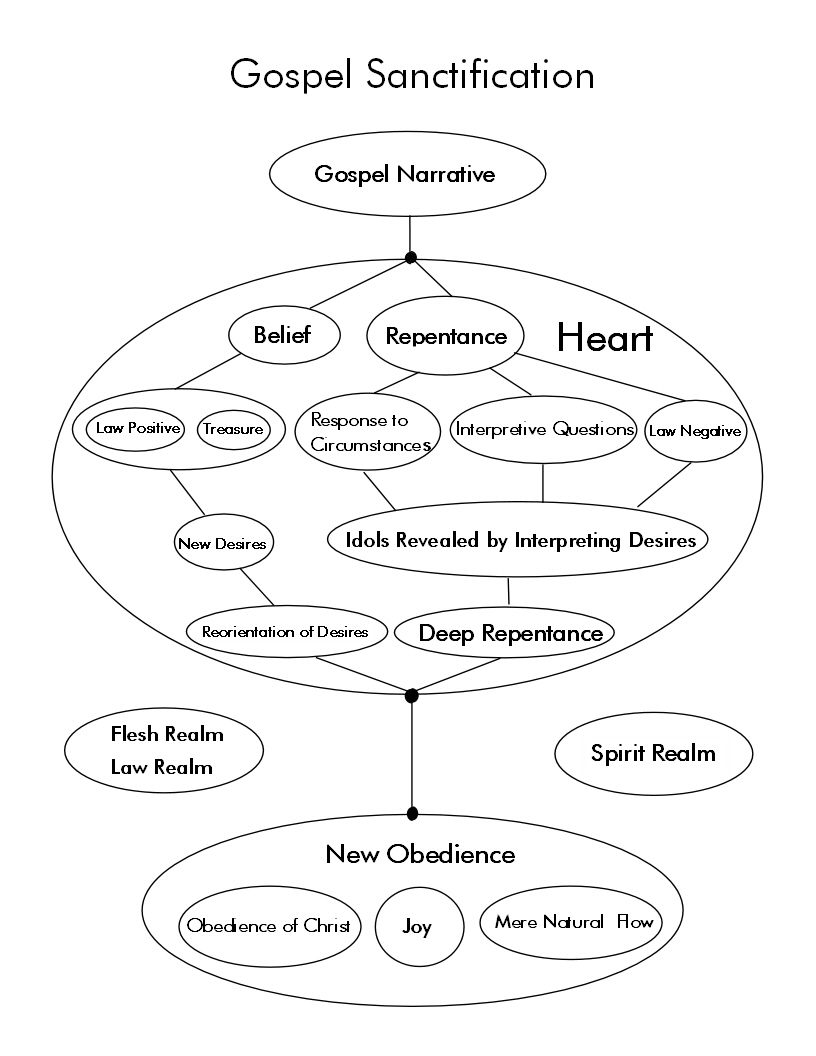
A reader viewed the Old Calvinism / New Calvinism chart ( http://wp.me/pmd7S-Bc ) and the GS / Sonship heart model chart ( http://wp.me/pmd7S-BD ), and found them both “helpful.” She then asked if I had an Old Calvinism / New Calvinism heart model comparison chart. Uh, well, ya, I do, but it was really just something I was playing around with. However, since the individual has impressive theological credentials–maybe the charts aren’t as, well, non-helpful as I thought they were. So, here they are, BUT remember: these are just tools to hang our thoughts on.
But I will say this, I think the charts bring up some interesting points:
1. As I was developing the OC chart, I was struck by how several Scriptures came to mind on each element. To the contrary–that was not the case with the NC chart. HOWEVER, it would be awesome to have a NC proponent tag the different elements of the NC with Scripture. For sure, that would be an interesting challenge.
2. Keep in mind, the charts are in regard to sanctification and the “heart” which is being used to refer to the inner man. With that said–interesting observations can be made; such as, a two-fold limited model verses a many faceted model, and what is inner verses outer.
3. The NC chart needs explanation which follows before the charts.
4. I hope somebody takes this concept and develops something awesome. I really see myself as a get the ball rolling guy.
Gospel Narrative:
It all starts with the Bible being a gospel narrative only. The belief is that the Spirit only sanctifies through the contemplation of the personhood of Christ (whatever that means exactly), or who He is as a person and His works. For instance, to read the Bible with the goal of ascertaining instruction, even by Christ, and applying it to ones life, is an improper use of Scripture (according to GS), and an endeavor that the Spirit will not honor because it focuses on our efforts, and not who Christ is, and what He has done and accomplished for us. To do the prior is to use the Bible as a “instruction book” and not to gain a deeper understanding of the finished works of Christ. Therefore, proponents of GS do not believe that spiritual growth is really taking place in Christian circles where the Scriptures are used for any other purpose than the Chrstocentric approach.
Belief:
Now we come to one of two elements of justification moving forward via the gospel narrative. GS believes that the same gospel leading to justification that saved us, also sanctifies us. Hence, like justification (salvation), their is only two things we can do to grow spiritually, believe and repent. The GS doctrine holds that gazing upon the gospel narrative will lead to more belief, and belief will always produce proper behavior on its own, being earmarked by the right desires. We will follow belief to the bottom of the chart, and then start back at the top with the second, or other half of the sanctification process according to GS, repentance.
Law Positive:
Proper use of the Scripture (according to GS) sees the Law as a description of what Christ has already done for us, fulfilling the law with His life because we are unable to, even as Christians.Therefore, seeing all of the laws Christ has fulfilled for us gives us a deeper appreciation of who He is and what his works accomplished for us.
Treasure:
Seeing who Christ is, and all of His works in Scripture, and all that he has done for us, causes us to treasure Him above all else. Therefore, it becomes our desire to be whatever He is. GS believes that we are primarily driven by desire; and in fact, enslaved by it. Therefore, change the desires, and you change behavior. Assumes our appreciation of Christ’s greatness and mercy is all the motivation we need to change our desires.
Repentance:
This is the second part of our limited role in the sanctification process according to GS. All other activities are a mere natural flow from the Christ in us. It is not we who live, but Christ who lives in us (Galations 2:20). Again, like salvation, the same gospel that saved us, also sanctifies us, and is limited to belief and repentance, with everything else flowing from Christ who lives in us.
Response to Circumstances:
God’s purpose in all circumstances (according to GS) is to reveal idols of the heart so that we can repent of them. How we respond to circumstances reveals what we desire more than Christ. The particular idol that caused us to respond in a Christless manner can be identified by asking ourselves interpretive questions (what did you want? [more than Christ?]). Scripture, which is (according to GS) a grand gospel story (gospel meta narrative), can also reveal to us what the heart idol might be by how other saints responded to the same circumstances in redemptive (gospel) history. So, another limited purpose of Scripture is to help us determine idols of the heart so that we can repent of them.
This is done by showing us what other saints in redemptive history wanted (desired) more than Christ. As you might imagine therefore, how GS effects biblical counseling is profound. The focus will be on identifying heart idols and their attached desires, and changing desires of the heart, rather than behavior through biblical prescriptions born of other approaches to biblical interpretation. Some would argue: objective (behavior) verses subjective (heart issues).
Interpretive Questions:
These are merely “desire” questions that can help us determine what we love more than Christ. The most common one is “What did you want more than Christ?” Or simply, “What did you want?” However, the Christian Counseling and Education Foundation has a list of about one-hundred that they call “X-Ray questions.”
Law Negative:
This is the use of the Law (in Scripture) to drive us to despair by suggesting that we attempt to uphold the Law by application, and thereby driving us back to the cross (being impossible to accomplish). According to GS, the Law is still a schoolmaster that drives us to Christ in sanctification, and in the same way that it does in justification as well; unless, It is seen as being the works of Christ fulfilled for us (Law Positive). Law Negative has a purpose in revealing heart idols to us as well; such as, the desire to be self-dependant (heart idol of pride). Besides, the law has no use to us anyway (Christians) because it has been fulfilled by Christ and replaced by the one Law of love (I will not address this here for lack of room). According to GS advocates, Christians are only obligated to uphold the singular law of love. However, both Law Positive and Law Negative have their respective antithetical purposes for being present in the gospel narrative.
Idols Revealed by Interpreting Desires:
When the methods under “Repentance” are employed to determine idols, we can then repent of them, resulting in “Deep Repentance.”
Deep Repentance:
Also known as “intelligent repentance.” We can eliminate the idol by repenting of the thing we desired more than Christ, and replace it with a truth about Christ that we should desire or treasure more than anything or anyone. This is also known as the “reorientation of desires.” This leads to “New Obedience”
Flesh Realm:
Most GS advocates do not believe that the fight between us and sin takes place on the battle ground of the “flesh.” They believe the battle ground is the “heart.” Though they often speak of the “flesh,” they don’t think it is an inner turf where the real war takes place. This Theory makes our own efforts a point of contention in favor of a more passive viewpoint.Most GS advocates believe it is a realm that puts pressure on us, and at any given time, we either yield to the Spirit or yield to the flesh (a sinful, or worldly realm).
Law Realm:
Since the Law is sometimes said to aggravate sin, some GS proponents also attribute the Law to being part of the Flesh Realm.
Spirit Realm:
The other realm that exerts pressure on us. We simply yield to one or the other.
New Obedience:
New obedience is the natural result of “Belief” and “Deep Repentance.” Since belief is the result of seeing the glory of Christ in the gospel narrative, and causing us to desire and treasure Him more than other things, new obedience will naturally be accompanied by joy and experienced as a “mere natural flow.” Some GS proponents teach that it is actually Christ obeying for us. This is called the “imputed active obedience of Christ.” However, more GS advocates believe this than are willing to admit it.
Addendum: New Desires and Reorientation of Desires:
This is merely what happens automatically when Christ fills the void of eradicated idols through the only two disciplines of sanctification according to GS: belief, and deep repentance.
 If anybody would like these charts in some kind of file: pmd@inbox.com
paul
Should Christian Doctrinal Debate Be Public?

I have taken a lot of heat lately over my public criticism of New Calvinism. Some arguments, for example, go something like this:
“I respect you working hard at something you so fiercely believe in but in the grand scheme of the Great Commission, do these arguments help or hurt the cause of Christ? Sparring between brothers in a good debate is one thing, but making a spectacle of Christianity is not a testament of the grace of God. It is dangerous to publicly call out other brothers.”
Though this comment was made in the same thread as those defending New Calvinist, that wasn’t the intent of this Christian—the intent was to simply pose the question for consideration. However, there was an element of New Calvinism that I wanted to post on that can be based on this question; so, let the New Calvinist themselves answer this question. Also, you can frame this post in regard to comments like the following as well: “Who are you to publicly criticize these great men of God?” Or: “How dare you slam God’s chosen men?” Or: “DA Carson is the greatest theological mind in recent history—who are you?”
Let me set the table. At the 2006 Together for the Gospel conference (T4G), New Calvinist presented an official statement on “the gospel.” T4G is a gargantuan organization (along with The Gospel Coalition) that promotes New Calvinism. The document was divided into three primary categories: “In the essentials unity…in the nonessentials, liberty…and in all things, charity.”
In the essentials unity? Many of the core leaders of T4G are Charismatics. In fact, a huge portion of the New Calvinist movement includes Sovereign Grace Ministries which is an organization founded on—get this: “Reformed Charismatics.” One of the T4G’s “Core four” is CJ Mahaney who is president of SGM. So, obviously, teaching that Christians don’t get all of the Holy Spirit when they are saved is not essential to the gospel. Hmmmm.
In the nonessentials, liberty? That would be anything and everything other than the four core elements of New Calvinism: sanctification by faith alone (sanctification by justification only), the total depravity of the saints, daily salvation, and Scripture as narrative only—not instruction. Please, please, don’t complain that these four tenets are not substantiated in this post; this blog is pregnant with direct quotations from New Calvinist that confirm these tenets. Also, indicative of the movement’s confusion, part of Article XVI states, “We further affirm that the teaching office of the church is assigned only to those men who are called of God in fulfillment of the biblical teachings.” Though I agree, what does that have to do with the essentials of the gospel? That’s more of an essential than Pneumatology? Not only that, Charismatics ordain women all the time! I might also add that Steve Camp had the following complaint in regard to the document: “In these eighteen articles there is no Scripture listed.”
In all things, Charity? Here, I finally get to the point: all things charity unless you’re an orthodox evangelical. Because of the shear mass of this movement and its immense media power; and in a twist of absurd irony, there has never been a time in redemptive history when orthodox Christianity has been more fustigated publicly by professing Christians. The best known proponents of the movement constantly accuse evangelicals at large of promoting a false gospel, and nothing has ever been more public. Furthermore, it boils down to nothing more than a call for mass division in the church. As a matter of fact, I was attending a church in Fort Wayne, Indiana that was loosing members to a New Calvinist church in the area, and the elders couldn’t figure out why. Not only that, the departing members seemed to be offended, and no wonder.
Though, again, several examples can be found on this blog, I will cite some examples:
Tullian Tchividjian: “As I’ve said before, I once assumed (along with the vast majority of professing Christians) that the gospel was simply what non-Christians must believe in order to be saved, while afterward we advance to deeper theological waters…..Fundamentalist smother the gospel in moralism.”
Paul Washer: [I don’t believe that] “even 15% of my Baptist brethren are saved….we find a truth that must be rediscovered by all of us [emphasis mine]. The Gospel is not merely an introductory message to Christianity. It is ‘the’ message of Christianity, and it is not only the means of salvation, but also the means of continued sanctification in the life of the most mature believer.”
Michael Horton: “Where we land on these issues is perhaps the most significant factor in how we approach our own faith and practice and communicate it to the world. If not only the unregenerate but the regenerate are always dependent at every moment on the free grace of God disclosed in the gospel, then nothing can raise those who are spiritually dead or continually give life to Christ’s flock but the Spirit working through the gospel. When this happens (not just once, but every time we encounter the gospel afresh), the Spirit progressively transforms us into Christ’s image. Start with Christ (that is, the gospel) and you get sanctification in the bargain; begin with Christ and move on to something else, and you lose both” [in other words: if you don’t believe in sanctification by faith alone—your lost, and that would definitely be the vast majority of evangelicals].
Chad Bresson: “I believe the greater danger lies with those who would so exalt the Bible [by using it for instruction and wisdom], that the Centrality of Christ in all of life and all of history is eclipsed. And that is the legacy of the conservativism of our own day.”
John Piper: “ You never outgrow the need to preach to yourself the gospel….I know that there are people reading this who are not trusting Jesus Christ, and therefore can only expect condemnation” [if you don’t preach the gospel to yourself everyday].
Comment on an article by Justin Taylor, The Gospel Coalition Blog: “It’s not that complicated: the ground of all Christian obedience is the faithfulness of Jesus Christ. Justification [salvation] occurs EACH [emphasis NOT mine] time a believer confesses and receives forgiveness for his sins [among the many other comments posted on this article including those by Justin Taylor and Chad Bresson—none disputed this comment / statement. In fact, Bresson supported it by indicating that Christ presently obeys for us].
Paul David Tripp: “I am deeply concerned that the gospel has been redefined in the contemporary church in a terribly significant way.”
Concerning the aforementioned question, I will answer it from the standpoint of this blog; when a massive movement calls on evangelicals to acknowledge that they have been sold a bill of goods concerning the gospel for the past several hundred years, and in a very public way, does one have any choice but to counter that publicly? I don’t think so. Can the ignoring of such a movement hinder the gospel? Absolutely.
paul
Discernment Ministry and Philippians 4:13
I am working on a major project right now in regard to GS/Sonship theology. But as I often do, I let myself get distracted, and started doing some reading for a post that is in the batter’s box. Even with being immersed in this foul doctrine, God keeps showing me more, and more. One reality that I have seen of late (discovered in the project I mentioned) is how the movement has systematically redefined almost every tenet of the Christian faith. This tempted me to put some thought into the post that is in the batter’s box. The post will be about how GS has redefined the traditional definition of Antinomianism. Guess what? It’s not what you thought it was—it’s really legalism! Go figure.
I am using (for the post) what I think will be the future, official systematic theology of the GS movement: “The Christian Faith: A Systematic Theology for Pilgrims On the way” by Michael Horton (over 1000 pages). I’m not a prophet, but I would be willing to bet that this book is already the official text for systematic theology in many seminaries. As I was reading the section on Antinomianism and the relationship of law to the Christian life on pages 673-680, something occurred to me, but I will share some other thoughts first.
In that section, Horton employs the usual techniques found in GS teaching: lots of orthodox statements, red herrings, straw men, pink elephants, nuance par excellence, and criticism of movements that believe the same thing GS proponents believe. Then it occurred to me. I’m not smart enough, educated enough, tenacious enough, disciplined enough, organized enough, connected enough, loving of the truth enough, and rich enough to fight this movement. I am up against a doctrine propagated by highly respected men who are paid to do what they do full-time. And…. I guess that’s the beauty of it all.
“ I can do all things through Him who strengthens me.” Yes I can. I can be God’s kind of husband, father, parishioner, worker, etc., etc., and God can also use this hillbilly from Portsmouth, Ohio to bring this vile doctrine to ashes. The bigger the mountain—the more glory for God. Let it be so.
paul
New Calvinist Leaders Now Worshipping Each Other—Dead or Alive
I know I start a lot of articles this way, but I can’t say it enough: foul doctrine yields bad results. Before I get to the information that prompted this post (sent by a reader), what do I mean by “New Calvinism”? NC is a massive movement (supposedly a new reformation) sweeping across the world like a giant tsunami. It encompasses Sonship Theology, Gospel Sanctification, New Covenant Theology, Christian Hedonism, Redemptive Historical Hermeneutics, and Heart Theology. The movement has totally rewritten orthodox Christianity, and soon (if not already the case), considering seminary graduates for ministry in the local church will be a prohibitive risk. Dumbed-down congregants by the masses are ever-waiting with bated breath for the next profound unction to proceed from the mouths of New Calvinist gods. John Piper, who often writes and says outrageously unorthodox things—has over 300,000 followers on Twitter. One wonders if Christianity has ever been inflicted with such a large percentage of koolaholics, as others stand aghast and bewildered regarding the growth of this movement.
The leaders of this movement realize more and more that they can get away with saying and doing anything, and at times seem to be amused themselves at what they get a pass on. Hence, they now worship each other openly—dead or alive. Recently, a group of New Calvinist leaders wrote a book of essays for the purpose of praising John Piper. One of the authors that contributed to the book was none other than John MacArthur Jr. He also wrote a glowing forward in a book written by Piper that was full of outlandish statements. The essay book was presented to Piper at a conference (as a surprise) by his fawning protégé, Justin Taylor. Yes, they wanted to sing his praises—apparently for his great service to Christianity in developing a theology called “Christian Hedonism.” No, it isn’t a dream.
So then, no surprise that Chad Bresson, radio personality and elder at Clearcreek Chapel (a well known and respected church in the NC network), held a tribute to Geerhardus Vos at his grave. Geerhardus Vos is the supposed father of Redemptive-Historical Hermeneutics, a tenet of New Calvinism. But not really, the hermeneutic was developed by a liberal theologian in the eighteenth century—Vos supposedly redeveloped the hermeneutic and took it in a more conservative direction. He developed the hermeneutic into the very orthodox sounding name of “Biblical Theology” which is anything but. “Biblical Theology” was the theme of this year’s Gospel Coalition convention. Per the usual deception of the movement, the term “Redemptive-Historical” was rarely used, if at all because “Biblical Theology” sounds, well, “biblical.”
Bresson brazenly posted photographs of the tribute on his FaceBook page, but why not? After all—who’s going to call him on it? The photograph below shows Bresson reading writings by Vos graveside. One of the comments on his FB page in reference to the pictures said the following: “Standing in the midst of the obvious decay that is the hallmark of the already, speaks of the inbreaking ‘not yet’ through lumped throat and wet eyes.” Creepy, no?

Though I would be amiss not to mention the contrast between this behavior from New Calvinist gods and their supposedly everything Jesus theology, the fact of the matter is, they get a pass on all their hypocrisy, contradictions, and doublespeak as well. As Bresson has written or said on many occasions, he has a major problem with the belief that there is a future for national Israel because that’s eclipsing Christ with a sliver of geography. Apparently, it’s alright to do that if one of the gods of New Calvinism is under the sliver.
paul
Why “Lawless” Equals “Heartless”
Foul doctrine always has consequences. One of the many unfortunate consequences seen in the “Gospel-Driven Life” movement is the merciless, cold-blooded behavior of its leaders and followers. I have counseled spouses who have begged their partners not to divorce them because the marriage “doesn’t look like the gospel.” I have looked into begging eyes pleading for me to explain how “elders” could counsel people to do things that plainly contradict the literal, plain sense of Scripture. Apparently, their broken hearts just didn’t understand that all Scripture must be seen in its “gospel context.”
I have seen the hostile takeover of churches and listened to the many testimonies; for example, Coral Ridge Presbyterian Church where those who took over mercilessly trampled underfoot the memory and work of James D. Kennedy. Whether he was your cup of tea or not is beside the point. I used to attend an early morning Bible study with a group of men in which an “elder” of the Sonship variety attended. He had a reputation for being a very tender, loving, soft-spoken person. On more than one occasion, he shared his exasperation in regard to his terminally ill mother-in-law mourning the fact that she would not be around to see her grandchildren grow up. Stern-faced, he shared his disappointment that she was not rather rejoicing that she would soon be with the Lord. Apparently, she had a Grandchildren Idol.
I can’t help but to wonder if this is the result of GS’s devaluing of God’s law. Why do I say that? Well, observe what Christ said in Matthew, chapter four:
“At that time many will turn away from the faith and will betray and hate each other, and many false prophets will appear and deceive many people. Because of the increase of wickedness, the love of most will grow cold, but he who stands firm to the end will be saved.”
Recently, John MacArthur wrote a book entitled, “Slave” in which he presented the idea that a translation fraud has been perpetrated in the English Bible regarding the word slave. Even though his approach was passive (the book lacked the usual Mac life application), and more or less presented the picture minus detailed life application, he hasn’t been invited to a GS function since the book’s publication. Apparently, even the suggestion that we are in any way, shape, or form, slaves to Christ is more than the GS brain-trust can handle. Well, Mac needs to write another book about the same fraud being perpetrated in regard to the word translated “wickedness” (most translations, “iniquity”) in this passage. He might as well—he’s in the doghouse anyway.
The word is “anomia.” It’s “nomia” (law) with the particle “a” prefixed to it, or “anti-law.” It is were we get the English word, “antinomian.” Some translations have “lawlessness” or better yet, “without the law.” The idea is being a rejecter of God’s law, and has very little to do with governmental laws, if anything. Take note: in the latter days, love will “grow” cold BECAUSE of antinomianism. A cold heart doesn’t cause lawlessness—lawlessness CAUSES the heart to become cold. So much for, “ALL change is from the inside out” (of course, ANY real change is impossible without the indwelling Holy Spirit).
Will my theory hold water? “Because” is a conjunction showing cause—let’s look at a verse with a conjunction that shows contrast: “Their hearts are callous and unfeeling,
but I delight in your law” (Psalms 119:70). Hence, those who delight in God’s law are contrasted with those who don’t; the lawless have callous, unfeeling hearts. Also, the Psalmist didn’t just ask God for compassion, curiously, he asked God’s compassion as found in His law: “Your compassion is great, O LORD; preserve my life according to your laws” (Psalms 119:156).
A movement that devalues God’s law—what’s that look like? It looks like Sonship and Gospel Sanctification: merciless, cold, and uncompassionate.
paul

 Paul's Passing Thoughts
3 comments