2015 TANC Conference Speaker:
 Susan Dohse M.Ed.

Jonathan Edwards: The Man, the Myth, the Message
Session 1: Friday, August 28, 1:00 PM
Session 2: Friday, August 28, 4:45 PM
Session 3: Saturday, August 29, 2:15 PM
TANC 2014 Susan Dohse, Session 2: Three Myths of Puritanism: Freedom, Destiny, and Worldview
Okay, George Santayana is credited with saying “Those who cannot remember the past are condemned to repeat it.” How many of you have heard that? It’s very popular catchy phrase has taken on several variations. Now many moons ago when I taught high school history and social studies, I would sometimes introduce the classes by saying my teacher variation of that quote. First day of U.S. History, “Welcome to U.S. History. It is important for you to do well in this class for remember, those who do not learn history are doomed to repeat it.” One particular year, this one poor guy in the back of the room put his head down on his desk and went, “I’m doomed! I’m doomed!” And his friend is faking compassion patted him on the back, “It’s okay, man. She always gives extra credit.” “But you don’t get it. I hate History and Mrs. [UNINTELLIGIBLE 0:01:12] is the only history teacher in the school. I’m double doomed!” Not only having to repeat history but having to have me for two years, but he did pass the class, and I do believe he still dislikes history.
But that phrase though, “Those who cannot remember the past are condemned to repeat it” is impressive, is common and is difficult to disagree with. If it is true and if history is so ugly and objectionable, then this proverbial quote ought to be a guide to public and private policy. For example, couples who do not learn from their fights, break up. People who don’t learn from their mistakes, they don’t mature. Revolutions that give an individual absolute power inevitably end up as brutal dictatorships. After repeated wars between Germany and France, France made harsh demands on Germany and their terms of surrender after World War I, then the Second World War happened. After Stalin’s brutal regime of secret police and leader worship, Cuban revolutionary has allowed their charismatic revolutionary leader to seize absolute power, and Castro still hold the seat of dictatorial power in Cuba today. History shows that those who do not learn from history are doomed to repeat it.
What about this idea? And what about those who do learn from history? Are they still doomed to repeat it? If the converse is true, then the saying has no power and adds nothing at all to the discussion. What adds power to that quote is the word “learn” because with learning, with knowledge, there’s a hope of change. But will it, can it happen? Will knowledge lead to change? Will learning what history taught us provoke us to make the changes necessary to keep it from being repeated? Can it be that all the good and bad things about people and the way we organize ourselves simply creates patterns as we make history? Could it be that we are given to a certain irrationality which leads us down paths, some disastrous, again and again?
Now consider this different approach. When you look back through history and you see man taking the exact same steps, coming to the exact same conclusions generation after generation, millennia after millennia, what were their root assumptions? “It does not matter how inconsistent the ideas. It doesn’t matter how insane the rationale. They will act until the logic is fulfilled. Therefore, when you see masses of people taking the same destructive actions, find the assumptions and you will find the cause.” That’s the gospel according to John Immel, chapter 3 verses 1 through 3. I did learn something from our first conference.
Knowing the cause should provoke us to take some kind of action, hopefully, preventative action, proactive action, and proactive changes. WXY and Z now I know my ABCs. Tell me what you think of me… Well, I think you know your ABCs. Now tell me what are you going to do with that knowledge? Will you take action and make meaning of the letters, connect them with sounds and letter combinations and create words and words that build sentences and ideas? Will you take your ABCs to that ultimate conclusion and learn to read and write? Will we learn the lessons of the history past and use that knowledge to take action to stay off those irrational and destructive past? Maybe yes maybe no. I do know some children who know their ABCs. Blaine [SOUNDS LIKE 0:06:05] knows his ABCs, but he has not yet learned to read. There are those who know history and are dooming themselves and us by repeating it or causing it to repeat.
So, are we like the Calvinists who believe and hold on so tenaciously to the doctrine that we are predestined to live in this time and space with no choice, no say in the direction we are to take and no say in how we stand, no chance for change. Are we to take up that clarion call, become like the Puritans of old and all things will be set to right? Now why not consider the assumptions and logic and end results of the Puritans? Remember what George said, “Those who do not remember history are doomed to repeat it” because their patterns of irrationality, their faulty root assumptions are leading the institutional church down the same disastrous paths again.
What I’ve been reading from Christian homeschool blogs and from leaders in the homeschool movement, this is what I’ve been reading. Let’s return to the Puritan way and put our children on the road to better education. I’ve read that more than once. A Southern Baptist seminary professor wrote, “We can learn from the old, namely the Puritans, for the doing of theology, for the life and health of the church today,” Stephen J. Wellum, Editorial: “Learning from the Puritans,” Theology Professor at Southern Baptist Seminary, Louisville, Kentucky. And without some understanding of Puritanism, there’s no solid understanding of dominionism, the patriarchy movement and the downward spiral of our Christian institutions. And without understanding Puritanism, you really have a partial knowledge of New Calvinism. And without understanding Puritanism, there is no solid understanding of America either.
Remember what you learned in U.S. history? The New England colonies were started under austere circumstances. Other colonies with more financial support from their mother country, more material resources, suffered collapse. The Puritans faced severe climate, a howling wilderness, yet they made themselves physically secure and began immediately to lay the foundations of government, education, thought and literature that outdid the achievements of all the other colonies. The Puritans made New England the intellectual leader of the nation at that time. Their belief in God’s sovereignty and of divine predestination provided a measure of comfort and stimulus to these early settlers. Did this consciousness that they were not ultimately responsible but that they were being led by God, have anything to do with their success? It is a shining example of human discipline and energy that in the face of circumstances would have discouraged and ruined most other adventurers. Could it be that holding fast to a doctrine that man is not free, he is a not free agent provided, them with a more powerful stimulus to exert extreme effort and a more moral force than any doctrine of human freedom?
Perhaps this is one of the ironies of history. If you compare Americans of the 18th and 19th century to the Puritans, one would have to say that the Puritans were theology-minded. Now I would say they were Calvin-minded. The doctrines of the fall of man, of sin, of salvation, predestination, election, conversion were their meat and drink. But what distinguished them is they were less interested in theology than in the application of Calvin’s theology to everyday life and especially to society. They became consumed with making the society in America embody the truth that they thought they already knew and less concerned with perfecting how they form truth. So Puritan New England was a grand and noble experiment in applied Calvinism.
A sidebar, the Puritans did not learn from history past. John Calvin tried this noble experiment in Geneva, enforced a theocracy, a holy commonwealth. If you read any part of Calvin’s Geneva experience, they did take Calvin’s faulty assumption. They applied a faulty logic and they tried to enforce their theology of theocracy, a holy commonwealth, and the end result was the same.
New England offered a rare opportunity for the Puritans in the New World. The Calvinistic theology was their point of departure when they left England, and they did not waver from it. Life in this New World was life in the wilderness, away from the great university libraries and the higher institutions of learning of their motherland. Daily threatened by hardships and the perils of a savage America, elaborating a theology and disputing its finer points was not practical. It was not the writing of books that was impossible for New England. New England flowed with an abundance of sermons, textual commentaries, collections of providences, statutes and works of history which were of themselves quite remarkable. Cotton Mather wrote 400 books.
With the exception of Roger Williams, who is not in the stream of New England orthodoxy anyway, Massachusetts Bay did not produce, I’m going to repeat, did not produce a major figure in theology until Jonathan Edwards. And when he arrived on the scene, by then the Massachusetts Bay Colony Puritanism was waning. Now during the great days of the New England Puritanism, there was not a single important dispute which was primarily theological. There were arguments over who should rule New England, whether John Winthrop or Thomas Dudley or Harry Vane should be governor, whether the power representation of different classes in the community should be changed, whether the Child Petition Act should be accepted, penalties for crimes by fixed statutes, whether outlying towns should have more representation in the general court. If they were theology-minded, what they argued about was institutions.
Let me do a comparison. At this time in history, the Puritans in England, the mother country, were discussing the fine points of their theory. What was the true nature of liberty? When should a true Puritan resist a corrupt civil government? When should diversity be tolerated? Now the debates of these topics expand the social classes in England for not only the John Miltons but the officers in Cromwell’s Puritan army reveal how different the intellectual atmosphere in England was from that of New England. Soldiers, men of action stopped to debate the theory of revolution and the philosophy of sovereignty. But let’s remember this crucial difference. Puritanism in England was more complex than Puritanism in the Massachusetts Bay Colony. The Puritans in good old England had representatives from a wide range of doctrines–Presbyterians, Independents, Separatists, Levellers, Millenarians. So, naturally, Puritanism in England was a matter of dispute. But consider this. In England, any community they built would have to find some space for the dozens of sects, from Quakers to Papists, because England was their home, too. Now Massachusetts Bay Colony did not possess this vigor. They possessed orthodoxy. It was organized and ran as a community of self-selected conformists.
In 1637, the general court of Massachusetts passed an order forbidding anyone from settling within the colony without first having his orthodoxy approved by the magistrates. These immigrants were required to be free from contamination. John Winthrop was bold and clear in defending this ruling. This community was formed by free consent of its members. Why should they not exclude dangerous men or men with dangerous thoughts? Now take for example Reverend Wheelwright. His brother-in-law’s wife was Anne Hutchinson. We all read about Anne Hutchinson in our history books. He and Anne accused the majority of the colony’s ministers and their magistrates of preaching a covenant of works. So, both he and Anne were banished from the colony. The Governor John Winthrop said, “If we conceive and find by sad experience that Wheelwright’s opinions are such and by his own profession cannot stand with external peace, may we not provide for our peace by keeping of such as would strengthen him and infect others with such dangerous tenets?” This was a peculiar opportunity for the Puritans of New England. Why not see what true orthodoxy could accomplish? In one unspoiled corner of the world, declare a truce on doubts and on theological debate. Here at last, man could devote their full energy to applying Christianity, not to clarifying doctrine, not to build Zion.” Puritan Nathaniel Ward wrote, “I dare take upon me to be the herald of New England so fair as to proclaim to the world in the name of our colony that all Familists, Antinomians, Anabaptists, and other enthusiasts shall have free liberty to keep away from us and such as will come be gone as fast as they can, the sooner the better,” taken from his pamphlet, Simple Cobbler, 1647.
A dissension in England would have created a new sect of Puritanism. In America, dissension simply produced another colony. In England, the Puritans had to find a way to live with dissenters. In New England, the Puritans found ways to live without them. What truly distinguished Massachusetts Bay was its refusal to develop a practice of toleration. Unlike England of the 17th century, the leaders of Massachusetts enjoyed their pure and simple orthodoxy. And that orthodoxy was conformity with established and accepted Calvinistic standards. Now let’s consider another side of the coin. Intolerance was a source of strength for the New England Puritans. This was not a philosophical enterprise they were engaging in. They were community builders. They were building the New Jerusalem. They were building Zion, a city upon a hill. All the energy their counterparts in England were using to debate and war over compulsive and restrictive powers in religion between matters essential and matters indifferent, these are still being debated today by political science students. The American Puritans put all that energy to mark off boundaries of their new towns, enforce criminal laws and to fight the Indian menace. Theology and metaphysics were not going to distract them because they had no doubt and they had no dissent. Had they spent as much energy debating with each other as their English counterparts, would they have still had the single-mindedness to overcome the perils of the wilderness and build a nation? I hold three things that held Massachusetts Bay Colony together initially made them successful–notice I said initially–no toleration, democracy was of the devil, community and unity over individual freedom.
In England the various sects of Puritanism were daring each other to extend and clarify their doctrines, but there was little of this in America. In New England, the critics, the doubters and dissenters were expelled from the community. Roger Williams, I read a wonderful book about Roger Williams. He was expelled for confronting the leaders about separation of Church and State, not doctrinal issues. He agreed in doctrine point by point by point with Calvinistic doctrine. They did not have a problem with his doctrine, but he was relentless in preaching from the pulpit and talking to the magistrates and the civil leaders in public and in private that the Church had no business in civil government, that there had to be a separation. He was expelled for confronting the leaders about this issue. Later, he established the colony of Rhode Island.
Whereas in England, the Puritans had to find ways to live together, which in turn helped to develop a theory of toleration. In New England, they transcended theological preoccupation because what was it? There were no doubts. They allowed no dissent. They just could not be distracted from these practical tasks of theology and metaphysics. In 1637, the General Court passed an order forbidding anyone from settling within the colony, and I’ve said this without having this orthodoxy approved, okay?
Number two, the goal of creating a democracy in Massachusetts had never stirred the leadership except the opposition. The idea that authority and sovereignty came from below, from the government as opposed to from above, from God was completely foreign. Winthrop believed that the magistrates even though being called freemen, we have our authority from God. And by the way, I was kind of misled in my reading when it said the freemen could vote, the freemen elected their magistrates, and then the next paragraph defined what freeman was, a member of the Puritan church. If you were not a member, you were not a freeman. Therefore, you could not vote. So, the freemen were an elite few, who made the decisions for the entire colony. “Freeman, even though being called by you freeman, we have our authority from God; therefore, they must be obeyed,” Governor John Winthrop. “So, shall your liberties be preserved in upholding the honor and power of authority among you.” And he declared, “Democracy amongst civil nations accounted the meanest and worst form of government.” He called it a breach of the Fifth Commandment and noted that history records it has always been of least continuance and fullest of troubles. Now Cotton, John Cotton wrote, “Democracy, I do not conceive that God ever did ordain as a fit government, either for a church or commonwealth. If people be governors, who shall be the governed? As for monarchy and aristocracy, both of them clearly approved and directed by Scripture.”
An example of this lack of tolerance practice is witnessed in the life of Roger Williams. He claimed the people were sovereign. I infer that the sovereign original and foundation of civil power lies in the people. Now these were hardy and rebellious ideas that ended Williams being expelled from the community in the dead of winter during the blizzard, and if it had not been for the Native Americans who rescued him, he would have perished. And he does pay them tribute for aiding him in his time, and he spent the entire winter with them, nursed back to health and taken care of.
Now consider these ideas. The Puritans were concerned with the organization of their New Jerusalem society with making their communities effective. Now three problems which worried them in New England: 1) how to select their leaders and representatives. They had to decide who were the fit rulers and how should they be selected. 2) The proper limit of power: John Cotton said it is therefore more wholesome for magistrates and officers in the church and commonwealth never to afflict more liberty and authority that will do them good and the people good. It is necessary therefore that all power that is on earth be limited. 3) And how power should be distributed between local and central [organs 0:26:21]. Now are not these three problems you hear addressed in the constitution? How to select the leaders and representatives, okay? How much power that they have and how to separate federal and state government?
Though denying democracy is a valid way to address the community’s organizational needs, they unknowingly used democratic ideas to solve these worrisome problems. To the Puritans, the American destiny was inseparable from the mission of community building. It always sounds good to say we need to build a community, you know. What’s her face said a village raises your child, you know. The community is – yeah, it takes a village. It takes a community to raise your child. So to the Puritans, this mission of community building was inseparable from the ongoing relationship among man. Individualism threatened the delicate strings that held the community together. A main component of the emerging American ideology from the Puritan through the Enlightenment was focused on keeping the community united while trying to find some place for individualism.
There was the need for community involvement in the church. They had to show unswerving devotion to the church, perform good works, have unquestioned obedience to the church leaders. Good works and charitable acts would not lead a person to salvation, but was necessary to show their natural grace to prove that they might be considered one of the elect. The concept of unity as a community was communicated, and it was sermonized aboard the Arabella on their way over crossing the Atlantic Ocean. Winthrop: “We must knit together in this work as one man, mourn together, labor, suffer together, always having before our eyes our commission and community in the work, our community as members of the same body.” John Winthrop: “If one part of the community was ill, then the entire community would suffer. Each individual was responsible for their actions because it would affect the entire community. A person could not do simple things without harming the community.” Well, we know we have examples of this from the Bible. Achan, in the camp of Israelites, when he took spoil from Jericho in disobedience, read the results in Joshua. That action had a devastating community result in the Book of Joshua. They lost the next battle, death, judgment from God in a sense, and then of course they had to put the family on trial, and earthquake and execution and all of that. So individuals do affect the community, but it’s not the sole reason for having a community.
Family, community, and nationalism are principles that we can find in God’s word. No person has ever been commanded to isolate themselves. No person in God’s word has been commanded to pursue total individualism, deny and forsake the community. The entire Book of Genesis shows historically how mankind as individuals they formed families, they formed communities, cities, nations. Danger comes to a community when control becomes punitive, leadership turns into tyranny, and unity, unity becomes total conformity. There’s difference in the meaning of those two words. Unity is not total conformity. The Puritans felt that conformity was essential to keeping the community together. The leaders not only felt, it demanded conformity. The leaders not only felt, it demanded conformity and enforced it. Dissention and divisiveness were silenced. The community could not thrive if too many independent thinkers attempted to change the power structure of the community. Individual beliefs and liberties would have to be sacrificed in order to promote a strongly linked community. Individual beliefs and liberties would have to be sacrificed in order to promote a strongly linked community, according to the Puritans.
Eventually out of necessity, the role of the individual evolved and was seen as an asset and not a threat, not until the Enlightenment and revolutionary eras, that’s the 1700s, was individualism recognized. The emphasis focused on individuals using their unique abilities to better the community. One of the Founding Fathers, James Madison, warned of absolute individualism in his federalist paper. In essence, he wrote that there was a delicate balance between expressing individuality and hurting another member of the community. Now during the Puritan era, individualism was suppressed in order to keep that delicate community balance, and individualism was suppressed to assert the power of the church. As the colonies grew and prospered, new ideas began to arise and some individualistic thoughts and ideas were seen as important and necessary for the growth of the community. The puzzle though, the Puritans had to put together, was how to balance individualistic expression and the welfare of the community. Intolerance grew the nation. Distaste of democracy organized their communities and community building necessitated individualism…
The Magnum Opus of the Reformation: Martin Luther’s Heidelberg Disputation, Part 7: Martin Luther’s Unveiling of the Bondage of the Will
Listen to, or download audio file.
Welcome truth lovers to Blog Talk radio.com/False Reformation, this is your host Paul M. Dohse Sr. Tonight, part 7 of “The Magnum Opus of the Reformation: Martin Luther’s Heidelberg Disputation, Martin Luther’s Unveiling of the Bondage of the Will.”
Greetings from the Potters House and TANC ministries where we are always eager to serve all of your heterodox needs. Our teaching catalog can be found at tancpublishing.com.
If you would like to add to our lesson or ask a question, call (347) 855-8317. Remember to turn your PC volume down to prevent feedback. If you choose to use Skype to listen to the show, my advice is to just dial direct from your Skype account without using any of the Blogtalk links. 347-855-8317.
Per the usual, we will check in with Susan towards the end of the show and listen to her perspective.
Remember, you may remain anonymous. When I say, “This is your host; you are on the air, what’s your comment or question”—just start talking.
If you would like to comment on our subject tonight, you can also email me at paul@ttanc.com. That’s Tom, Tony, Alice, Nancy, cat, paul@ttanc.com. I have my email monitor right here and can add your thoughts to the lesson without need for you to call in. You can post a question as well.
Tonight, we continue in our sentence by sentence evaluation of the HD [Heidelberg Disputation] after addressing some asides in parts five and six. We hear a lot about Martin Luther’s bondage of the will. Tonight, we are looking at the very conception of Luther’s beliefs on the human will. What we are going to find is that Luther’s explanation of human will derived from his position of mortal and venial sin.
Simply stated, if one believes that every act they perform is mortal sin, even their good works, their life is forgivable. Man must not believe he can do a good work. Let’s use theses 11 and 12 to segue into thesis 13 which is the first unveiling of Luther’s bondage of the will.
Thesis 11: Arrogance cannot be avoided or true hope be present unless the judgment of condemnation is feared in every work.
This is clear from Thesis 4. For it is impossible to trust in God unless one has despaired in all creatures and knows that nothing can profit one without God. Since there is no person who has this pure hope, as we said above, and since we still place some confidence in the creature, it is clear that we must, because of impurity in all things, fear the judgment of God. Thus arrogance must be avoided, not only in the work, but in the inclination also, that is, it must displease us still to have confidence in the creature.
Here is something that I haven’t talked about enough in this series: the Reformers were masters of doublespeak. So far, it is obvious that Luther disavowed any value in regard to human life. Yet, in some sentences, he sort of makes it sound like that the issue is life without God. This isn’t the case at all; this is a strict dichotomy between 100% evil and 100% good with nothing in-between.
In contrast, God makes new creatures of mortal men. This flies in the face of Reformed ideology and all of the theology that flows from it. Note that, like all good Gnostics, Luther saw impurity in “all things.” And of course, that includes mankind.
Hence, as stated in this thesis by Luther, man must not have any confidence in self. In other words, God’s creation of man has no inherent ability. The natural ability to do anything is the glory story. Anything that brings glory to man diminishes God. Listen, as one example, the Puritans didn’t dress like they did for no good reason. To wear something with a little color or style would have been the glory story. By the way, do you want to help people? Know this: EVERYTHING people do they do for a reason. Logic drives action. If you want to help people, find the logic behind the action.
So, Reformed ideology splits reality into a strict either/or dichotomy; it’s either the glory story or the cross story. The glory story, or the story of man, can only bring about arrogance.
Let’s pause here to look at the foundational ideology of the Reformation which deals primarily with metaphysics. Like I said, everything people believe and do flows from their logic, so what is the logic that all of this stuff flows from? This is a very simplified version, but it really boils down to this: God does everything that He does because of His self-love. And because God loves Himself, He created evil as a contrast to His holiness. In other words, evil helps to define His holiness by contrast.
This leads to the essence of state of being, or metaphysics, or why things are, or their state of being, according to the metaphysical narrative. What’s a metaphysical narrative? Simply stated: state of being is a story written by God. Everything that is happening in the world today, right down to what people decide to wear, is predetermined by God in His historical prewritten narrative.
All of this benefits God’s self-love. Everything is for His glory. And according to this story, man thinking that he has freedom of choice on any level is evil, and what is he doing? Right, he is writing his own story. If you think that it was your decision to wear what you wore today, you are writing your own glory story. Either you are writing your own life story, or God is writing your life story. You are either god writing your own reality, or God is writing your realty.
Of course you don’t have freedom of the will—that would be writing your own reality—that would be making yourself God. We can also stop here and talk about how the Bible fits into this. The Bible becomes a prototype or model for interpreting reality according to God’s story which is primarily about redemption. The Bible is therefore a tool for interpreting reality according to the cross story, or God’s prewritten metaphysical narrative. And folks, this is everywhere. This way of using the Bible saturates the institutional church.
An example, one of myriads, is the Bible Mesh study material. Listen carefully to what these guys are saying in this promo for the study:
Notice the constant theme of Bible as story, and everything in the Bible being about Christ; ie., redemption. Notice that the Bible is also “your story” and this study enables you to put yourself in the story. You have heard me talk often about the redemptive historical method of interpreting the Bible and this is what it is. They make the Bible a tool for interpreting all of reality according to Martin Luther’s cross story metaphysics. And frankly, 90% of the evangelicals occupying the pulpit in the institutional church take this approach to the Bible.
Thesis 12: In the sight of God sins are then truly venial when they are feared by men to be mortal.
This becomes sufficiently clear from what has been said. For as much as we accuse ourselves, so much God pardons us, according to the verse, »Confess your misdeed so that you will be justified« (cf. Isa. 43:26), and according to another (Ps. 141:4), »Incline not my heart to any evil, to busy myself with wicked deeds«.
So, if you look at two slides on the program slide show, you see two contemporary illustrations published by the Reformed camp that explain where we have come to this point. The two man chart explains the metaphysics,


and the cross chart explains the application as stated in this thesis by Luther: “For as much as we accuse ourselves, so much God pardons us…” His use of Isaiah 43:26 pretty much puts it in a nutshell: confession of sin leads to ongoing justification which can only be found in the institutional church. If we believe man has no will to choose good, and that everything we do is sin, we qualify to be forgiven for purposes of ongoing justification. It’s not complicated.
Thesis 13: Free will, after the fall, exists in name only, and as long as it does what it is able to do, it commits a mortal sin.
The first part is clear, for the will is captive and subject to sin. Not that it is nothing, but that it is not free except to do evil. According to John 8:34,36, »Every one who commits sin is a slave to sin.« »So if the Son makes you free, you will be free indeed.« Hence St. Augustine says in his book ›The Spirit and the Letter‹: »Free will without grace has the power to do nothing but sin«; and in the second book of ›Against Julian‹, »You call the will free, but in fact it is an enslaved will,« and in many other places.
The second part is clear from what has been said above and from the verse in Hos. 13:9, »Israel, you are bringing misfortune upon yourself, for your salvation is alone with me,« and from similar passages.
Again, we will take note of something Luther was accustomed to in his doublespeak. Though he quotes Augustine saying that the will can do nothing but sin without grace, we know that Luther also believed that the will can do nothing but sin WITH grace. This is just another example of his doublespeak. This seems to be very indicative of Reformed teachers; they sow seeds of doubt that they are stating outrageous ideas, but after a space of time the outrageous, tempered by a contradictory statement, will be accepted through repetition. The doublespeak is a red herring until you are fully indoctrinated.
Luther is stating here that the will is “not free except to do evil.”
Thesis 14: Free will, after the fall, has power to do good only in a passive capacity, but it can always do evil in an active capacity.
An illustration will make the meaning of this thesis clear. Just as a dead man can do something toward life only in his original capacity (in vitam solum subiective), so can he do something toward death in an active manner while he lives. Free will, however, is dead, as demonstrated by the dead whom the Lord has raised up, as the holy teachers of the church say. St. Augustine, moreover, proves this same thesis in his various writings against the Pelagians.
Here is where we will employ some help from one of the leading Reformed scholars on Luther’s theology of the cross. This is from Gerhard O. Forde’s “On Being a Theologian of the Cross” which is a commentary on the HD.
Theses 14 and 15 are an attempt to define a little more closely what sort of ability may be ascribed to the will. If, as we have seen in thesis 13, the will is not nothing and is not forced or determined, and if, as we might say, we are not puppets, how then may the power of the will be described?
Pause.
Stop right there. This is the Reformed, “But of course we are not puppets, so how do we explain this?” But the only logical conclusion to Reformed ideology is that we are in fact puppets. In classic Reformed teaching protocol, the brainwashing technique is to deny the logical conclusion while hoping that you will function according to the very logical conclusion and goal that they are seeking.
Listen, according to their very own redemptive-historical hermeneutic, we are nothing but characters in a narrative. No, no, no, we are not puppets, rather, we are mere characters in a metaphysical narrative who are penciled in. And we have a choice, and this is a paraphrase, “…join the plot of the divine drama that includes your story, or attempt to be your own god and write your own glory story.” That’s it. That’s it in a nutshell.
I have been learning a lot from Susan about Jonathan Edwards, and she has so much data already accumulated that I don’t know whether she is going to be able to find this or not, but she was sharing with me about Edwards’ view of the will. Basically, he believed that before a person performs an action, God puts the thought, idea, will, and decision to act in one’s mind beforehand. This kind of goes hand and hand with Edwards’ belief that God is recreating reality at every moment. So, in essence, everything you do is a recreation of reality when it gets right down to it.
So this is how this works: the Reformed will continue to deny that we are puppets while teaching all of the elements of puppeteering. If you teach all of the elements constantly while never speaking of the logical conclusions, people will eventually function according to the logical conclusions which is what they are after. Functionality is the goal—not understanding. Reformation ideology is vehemently opposed to reason and understanding.
Here is another example: the official Reformed doctrine of already not yet. So classic. Sure, sure, you are already saved, of course you are! But not yet. So you think: “Well, sure, our salvation will be fully realized when we are resurrected. That makes total sense.” Well guess what? You just bought into progressive justification. See how this works? Salvation doesn’t have a beginning and an end. It’s a conception. Conception is a onetime final event that completes its work in an instant. You didn’t exist, now you do—end of story.
Let’s continue with Forde’s quotation.
If the claim is that we are to “do what is in us,” then the question quite naturally follows: What then is in us? What sort of capacity do we have?
Pause. Stop right there. Let me shortly answer that question according to 1John chapter 3 before we move on: God’s seed. God’s DNA. We are literally born of God and have His seed IN us. We are new creatures born of God.
To get at the question Luther here uses a distinction current in his day between what our translation has called a “passive capacity” and an “active capacity.” What does that mean? In its passive capacity the will can do good when it is acted upon from without but not on its own, not in an active capacity. A commonly used physical analogy is water. Water has a passive capacity to be heated, but it can’t heat itself. It has no active capacity to do that.
The example Luther uses in his proof is even more to the point because it deals with death and life. On the one hand, corpses could be said to have a passive capacity for life because they can be raised from the dead. But not, of course, on their own power, not in an active capacity, not even in the slightest. Not even by doing their best! The capacity they have is strictly passive. They can be raised, but only by divine power. On the other hand, it is of course true that while a people live they have the active capacity to do something about life and death. They can take life, either their own or some other, but they can’t create or give life. Yet, that only demonstrates that, after the fall, will in its active capacity can only do evil. Since will after the fall is dead and bound to do deadly sin, it can be rescued only from without, as indicated by the fact that it could not bring life out of death but could only be commanded from without by our Lord.
Thus, the fact that even after the fall the will is not nothing means that there is something there. What is it? It is a strictly passive capacity, not an active one. That means that it can be changed but it will not change itself. To be changed, it will have to be accessed “from without.” But it will take radical action. It will take death and resurrection. So we are again pointed toward the cross.
Here, we have plunged the depths of Martin Luther’s bondage of the will. Man is dead, and death is defined as the waters of mortal sin. The waters of mortal sin are not only what man dwells in, he is those waters. He is passively dead. The only active works he can do is dead works. The material realm is man’s glory story of death. He ebb and flows between dwelling in death and experiencing resurrection resulting from him being acted upon from the outside. Being acted upon is completely determined by God’s decision and good pleasure. The long and short of being saved is merely giving testimony to this fact and seeing it for what it is. Saving faith is giving testimony to what you see only, and not anything that you do.
To think you are not dead is mortal sin that cannot be qualified for forgiveness. And again, do see what these guys do? No, no, we are not puppets, right? A question: what do we know about puppets? Well, we know that they are dead. We know that they cannot do anything until they are acted upon, right? This Gerald Forde guy is just like all of the Reformed; he will deny that he is saying that we are mere puppets, and then will describe our Christian existence as puppetry.
This is what annoys me so deeply about people who listen to these yahoos because, “they say some good things.” Why would anybody spend any time investing in this intellectual dishonesty?
So, what is the biblical view of the will? Romans chapter 6. Before one is saved, they are enslaved to sinful desires and free to do good works. Slavery indicates the type of wages that the slave gets—only wages for death. Unsaved people are also indifferent to the law that they will be ultimately judged by. They do not love God’s law. But, they definitely have a free will to follow their God-given conscience and receive rewards for doing so. A person who lives a good common sense life will of course suffer fewer calamities than the foolish. But in the end, this only means less condemnation.
The saved person also has a free will. They are enslaved to righteousness, but unfortunately free to commit sin. However, they do not receive wages of death because they are no longer under the condemnation of the law. They can only receive wages for life. They are no longer indifferent to the law, but love God’s law and its truth. The chart below may help:
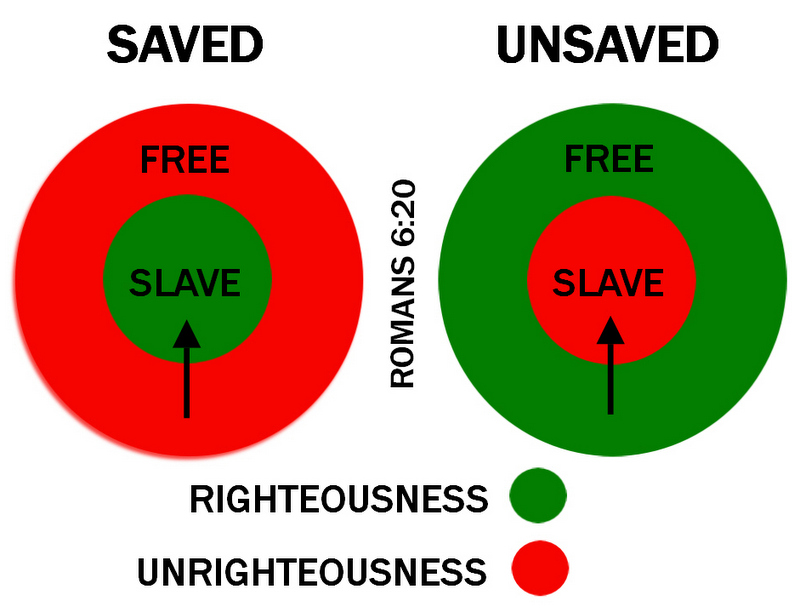
The new birth is a reversal of sin and slavery resulting in a change of direction. No one sins perfectly, and no one loves perfectly. It’s a direction, not perfection. But if you look at the Reformed cross chart again, neither is it a downward direction of sinful perfection resulting in making the cross bigger.
That’s the end of our lesson tonight—let’s go to the phones.
The Protestant Twisting of 1John: A Clarification, Part 2
 Listen to show or download audio here.
Listen or download full show uninterrupted.
Welcome to Blogtalk Radio False Reformation this is your host Paul M. Dohse Sr. Tonight, part 2 of “The Protestant Twisting of 1John: A Clarification.”
How is 1John used to argue for a progressive salvation, and what is John really saying in his epistle? That’s what we are discussing tonight. If you would like to add to our lesson or ask a question, call (347) 855-8317. Per the usual, we will check in with Susan towards the end of the show and listen to her perspective.
If you would like to comment on our subject tonight, you can also email me at paul@ttanc.com. That’s Tom, Tony, Alice, Nancy, cat, paul@ttanc.com. I have my email monitor right here and can add your thoughts to the lesson.
Ok, so this whole idea that is very Protestant that we must keep going back to the same gospel that saved us in order to keep ourselves saved. But, it’s all good because we are going back to the “gospel” and the “gospel” is by faith alone so going back to the gospel is a faith alone work which isn’t really a work. So, it’s ok to do something to keep ourselves saved as long as it’s a faith alone work.
As we discussed last week, here is where the home fellowship movement stands apart from the institutional church: salvation is a finished work; salvation is NOT a progression from point A to point B. The new birth is a onetime instantaneous quickening of the believer. The believer then in fact does move on to something completely different—kingdom living, or discipleship. Central to Protestantism is the idea that moving on from the gospel to doctrinal maturity is an abomination. The who’s who of Protestantism can be cited many times in stating this in no uncertain terms.
The home fellowship movement is not a mere preference over the institutional church—it is an anti-progressive justification movement. It is a return to the true gospel of Christ. All of the institutional church either embraces progressive justification or is willing to fellowship with it and is therefore altogether guilty.
Last week, we also introduced the fact that 1John must be interpreted according to its historical context. The number one nemesis of the 1st century assemblies was Gnosticism and 1John is a treatise against it. We covered John’s introduction which was a direct pushback against the Gnostic idea that the spiritual Christ did not die on the cross. We believe that John was specifically addressing the Gnostic teachings of Cerinthus. He taught that there was more than one Christ; one born naturally of human parents that will be resurrected with all other men in the last days, and the spiritual Christ who dwells in heaven. Elsewhere, John wrote:
1John 4:1 – Beloved, do not believe every spirit, but test the spirits to see whether they are from God, for many false prophets have gone out into the world. 2 By this you know the Spirit of God: every spirit that confesses that Jesus Christ has come in the flesh is from God, 3 and every spirit that does not confess Jesus is not from God. This is the spirit of the antichrist, which you heard was coming and now is in the world already.
The very definition of antichrist teachings is the denial that the true Christ (Messiah) was part of the material world, or actually came in the flesh. Gnostic systems of thought are very complex, but the cardinal principle is that material is evil and the spiritual or invisible is good.
The important distinction is that biblically, the material creation is not inherently evil, but weak. This is an important distinction because Christ coming as man makes it possible for men to be literally recreated and part of God’s literal family. The teaching that “denies Jesus is the Christ” (Messiah: 1Jn 2:22) circumvents the new birth. Throughout this epistle, John refers to the recipients as “little offsprings”(teknion; little children). I want to dig into this a little deeper; the new birth and its relationship to apostolic succession, but first, let me address the crux issue here.
John was also addressing an aspect of Gnosticism that believed the following: sin only resides in the material, and the spiritual part of man is sinless and has never sinned. In essence, it doesn’t matter what we do in the body because the spiritual part of man is sinless and has never sinned, and that is the only part of man that is eternal anyway. Many scholars concur that this was a common form of Gnosticism. Of course, this disavows any need for Christ to die on the cross and makes the knowledge of this supposed lie salvation itself. Salvation by being made into something new is out—coming to grips with the gnosis regarding man’s inner spark of divinity is in. This backdrop now explains exactly what John was getting at in 1John 1:7-10 and 2:1,2.
1John 1:7 – But if we walk in the light, as he is in the light, we have fellowship with one another, and the blood of Jesus his Son cleanses us from all sin. 8 If we say we have no sin, we deceive ourselves, and the truth is not in us. 9 If we confess our sins, he is faithful and just to forgive us our sins and to cleanse us from all unrighteousness. 10 If we say we have not sinned, we make him a liar, and his word is not in us.
1John 2:1 – My little children, I am writing these things to you so that you may not sin. But if anyone does sin, we have an advocate with the Father, Jesus Christ the righteous. 2 He is the propitiation for our sins, and not for ours only but also for the sins of the whole world.
“We” in these verses should be viewed as speaking to mankind in general while including both saved and unsaved individuals. Recognizing that Christ came to deal with man’s sin problem is efficacious to the gospel.
John is NOT stating the Protestant gospel of “deep repentance” which teaches that we keep ourselves saved (or washed) via a “lifestyle of repentance.” That would be a perpetual return to the same gospel that saved us for relief from “present sin.” That flies in the face of biblical justification. This makes “if” in these verses a conditional conjunction. That would mean that our sins continue to be forgiven, or washed, or cleansed “if” we “walk in the light” and continue to repent. That’s clearly works salvation, and clearly a reapplication of Christ’s sacrifice to present sin. As actually taught in Protestant circles, the sacrifice only happened once, but the remembrance of it continues to cleanse present and future sins.
This is the whole deal behind, “We must preach the gospel to ourselves every day” and the vital union doctrine. Living a “lifestyle of repentance” or deep repentance “keeps us in the love of Jesus.” This is salvation by Jesus + deep repentance to keep ourselves saved. The Reformed say, “No, it’s not works because repentance is a faith alone work,” but not even a so-called faith alone work can keep you born again—you can’t unborn yourself by not doing something. Look, here is the money point on all of this: the needed present and future forgiveness can only be found in the Protestant institutional church via baptism/formal membership. And we will be addressing that a little further along.
One of the many problems with this is, in regard to believers, follows: in order for present sin to exist, there has to be a law, and the blood of Christ ended the law—it’s a onetime cleansing. To have some need to reapply the blood of Christ to present sin implies that there is still sin, and there is not because where there is no law—there is no sin, and Christ died on the cross to end the law. This fact is found in Romans 3:19,20, 4:15, 5:13, 7:8, 10:4.
Some insist that John’s context here is fellowship, and since fellowship is the context, John is writing about repentance that is necessary to keep us in proper family relationship with God, and not a repentance that keeps us in the family of God; ie., John is talking about sanctification and not justification. Frankly, that’s the view that I used to hold to as well.
But John is talking about the onetime cleansing that justifies. Note that throughout these verses that it is a forgiveness that cleanses from “all sin” and “all unrighteousness.” That has to be justification. What John is saying is that no matter who you are in humanity, you have need to be forgiven of sin by believing that Jesus is the Christ and died for you. Note the subjects of these verses: “He is the propitiation for our sins, and not for ours only but also for the sins of the whole world.”
However, John is also saying that this fact doesn’t give us a license to sin any more than the Gnostics, “I am writing these things to you so that you may not sin.” But watch this: “But if anyone does sin, we [everyone] have an advocate with the Father.” Ok John, an advocate for what purpose? Answer: “He is the propitiation for our sins, and not for ours only but also for the sins of the whole world.” Who are the subjects? It’s obvious who the subjects are.
If this isn’t speaking to a onetime cleansing of sin, the world doesn’t need the new birth any more than Christians—they only need to ask forgiveness so the blood of Christ will be applied to the particular sin. Not only that, the new birth is also disavowed through the denial of a new creaturehood displayed by people who have passed from death to life. And John is speaking directly towards this issue as well. You see, who the “we” are and what the “if” is—is critical to interpreting these verses properly. The “we” are the “anyone.” The “if” is a cause and effect conjunction and not a conditional conjunction.
And let me tell you something, Protestant theologians rarely have any qualms about saying that God’s promises are conditional. I mean, what’s the paramount example? Replacement theology/supersessionism, right? This whole idea that Israel’s election was conditional on them holding up their end of the covenant. I just don’t know what can be more obvious, and this is their exact take on justification as well.
This is the crux. John is saying that if we walk in the light, it’s because we have been born again, not that we keep ourselves born again if we do our part by walking in the light. Walking in the light is not our part of the so-called vital union, we walk in the light because that’s what new creatures do; cows like hay and ducks like water—it’s a cause and effect conjunction not a conditional conjunction.
Now, here is where we really struggle with these verses: in verse 7, the English word in the plural strongly suggests a present continuous action. Verse 9 really isn’t that much of a problem as it’s merely saying that anyone that confesses their sin is cleansed of all unrighteousness. Note the following verse 10 that can be rendered this way: “If we say we have not [never] sinned.” The English “ed’ on the end of sin indicates past tense like, “I sinned.” That’s past tense. If John is speaking to the present continuance, why would he have not written, “if we say that we do not sin.” Right? Verse 9 simply fits into the Gnostic motif that John was arguing against.
Neither is 1John 2:1, 2 a problem. John is simply stating that anyone who recognizes their sin and wants to do something about it has an advocate in Christ who cleanses all sin. And by the way, the rest of John’s letter backs up my Pauline argument to the hilt. Just, all over the place in the rest of the letter, for example,
1John 3:3 – And everyone who thus hopes in him purifies himself as he is pure. 4 Everyone who makes a practice of sinning also practices lawlessness; sin is lawlessness. 5 You know that he appeared in order to take away sins, and in him there is no sin.
He came to “take away sin,” not to cover it with His own righteousness and to continue to forgive it. Christ came to end sin altogether. Are we “in Christ”? Well, in Him there is NO sin. So if we are in Him, why would we need forgiveness for present or future sin in regard to justification? In 1John 2:12-14, forgiveness of sin and overcoming the evil one is spoken of in the past tense.
The only matter at hand is the word “cleanses” in verse 7. Let me point something out to you. Most of the English translations that we have come out of the Protestant Reformation. Therefore, and there are myriads of examples of this, the translations are tainted with progressive justification presuppositions. And unfortunately, this includes the Greek word-study helps. Here is something I read in one:
Every encounter with a command to obey, is our opportunity to jettison self-reliance and to yield to the enabling power of the Holy Spirit. Supernatural commands from the supernatural God can only be carried out with reliance on His supernatural power! The Spirit is called the Helper, but don’t let His Name mislead you. To say that we need His help is to imply we have some ability of our own to obey and are in need of a little “push” so to speak.
See the problem? You can know the Greek backwards and forwards, but what good does it do if “help” doesn’t mean “help”? Look, what good have all of the Protestant Greek scholars done for us? I came to realize the problem of progressive justification by my own independent study in Romans. The basic concept easily understood regardless of the language, “where there is no law there is no sin.” That statement astounded me, but was the key to unraveling the whole mystery. Once you understand that fundamental, the rest of the Bible, when taken in context, fits together perfectly in every way. How much did any knowledge of Greek aid me in this understanding? Nada. Goose egg. Zilch. Loco zippo.
Greek can be confirming, and helpful, but the Bible is written in definitive structures that mean the same thing in all languages and that is no accident. You can translate the fact that Christ died on the cross to end the law, and where there is no law there is no sin, any way you want to—it’s going to mean the same thing in any language. Then you start seeing where the concept fits together with everything else in the Bible which enables you to nail down what the anomalies are. And a lot of the anomalies are bias towards a certain worldview.
Notice in the example I gave there is no room given for an authentic colaboring between us and the Holy Spirit. It is either all us or all of the Holy Spirit. My friends, that is the Protestant redemptive-historical worldview to a T and it is fundamentally Gnostic in its premise. Hence, when you use Greek word-study helps, you are often dealing with the same bias. This is why I eventually threw away my Kenneth Wuest expanded New Testament translation. I started seeing clear bias in how he processed the Greek verbs and I was totally done with him at that point.
I spent the better part of yesterday researching 1John 1:7 and the word “cleanses” therein. We know from biblical context that this verse cannot be saying that the one sacrifice of Christ continues to rewash us IF we continue to walk in the light; ie., Protestantism. And let me give you the thumbnail: if you remain faithful to the institutional church and its sacraments/ordinances, that keeps you saved. Even if the Greek usage indicates a present continual action there is no way to distinguish that from the simple reality of being washed once and remaining clean thereafter. In other words, there is no way to definitively distinguish between two intents: a required reapplication to reinstate a status or an unchanged status that continues in the same state without any further action.
Though “cleanses” appears to be some kind of continuing action in the ESV version of 1John 1:7 as well as many other versions, we know that this same cleansing of regeneration is clearly stated as a onetime final act in many, many other Bible passages. For example,
1Corinthians 6:11- And that is what some of you were. But you were washed, you were sanctified, you were justified in the name of the Lord Jesus Christ and by the Spirit of our God.
Ok, you have “were” in there four times with sinful lifestyles being in the past tense, and sanctified, justified, and “washed” being in the present tense. It is one event that happens one time and transforms us into an immutable state. Period. This is irrefutable. And by the way, if you do a New Testament word search on the exact form of the Greek word “cleanses” (other translations “cleanseth”) in 1John 1:7, it is almost always used as a onetime ceremonial cleansing.
Matthew 8:2 – And behold, a leper came to him and knelt before him, saying, ” Lord, if you will, you can make me clean.” 3 And Jesus stretched out his hand and touched him, saying, “I will; be clean.” And immediately his leprosy was cleansed. [Here in Mathew 8:2, the same exact form of the Greek word is used for past, present, and future tense. “Ed” is added to the English word “cleansed” to indicate past tense].
Note how Young’s Literal Translation has 1John 1:7.
and if in the light we may walk, as He is in the light — we have fellowship one with another, and the blood of Jesus Christ His Son doth cleanse us from every sin;
Now, not only does this simply state the fact that the blood of Christ cleanses us from every sin with a much less conditional translation, it’s interesting that the YLT picks up on something that Andy related to me yesterday in regard to the word “may”:
What is interesting is that all of the examples that John uses where he says “if” are all 3rd class conditions. All the key verbs are in the subjunctive mood.
Here is an excerpt regarding 3rd class conditions…
“The third class condition often presents the condition as uncertain of fulfillment, but still likely. There are, however, many exceptions to this…The third class condition encompasses a broad range of potentialities in Koine Greek. It depicts what is likely to occur in the future, what could possibly occur, or even what is only hypothetical and will not occur” (Wallace, p. 696).
So John is really posing a series of future hypothetical situations. Any place where it says “if” you should read it as “if ever in the future…” or “if at any time in the future…”
It would appear that this seems to be an exercise in reason using hypothetical examples to refute the gnostics that were among them in those assemblies. Notice that the present tense verbs are present tense because they are in the conclusion (apodosis) to the proposed hypothetical conditional premise (protasis). But the verbs in the premise (protasis) are in the subjunctive mood.
Also, you cannot read verse 7 without verse 6. Verse 7 is an antithetical conclusion of verse 6. In other words, you can’t properly interpret vs 7 without vs 6. In fact, notice how 7 contrasts 6, AND vs 9 contrasts vs 8 also! They are parallel arguments, and then vs 10 kind of sums it up.
This bolsters my contention that John is addressing people in general regarding the ramifications of their beliefs about sin in contrast to Gnosticism. That’s the crux here: the backdrop is the Gnosticism John is addressing. If you say that you have no sin, for whatever reason, you are making God out to be a liar. But if you confess your sin, God will cleanse you from all unrightousness. And, that will have an effect on your life because you have been cleansed. John does not hone-in on the new birth right here, but does so in chapter 3 bigtime. Really, chapter 3 clarifies exactly what is being stated in the first two chapters.
In addition, John is saying that even though those who confess their sin are cleansed of all sin, that is not a different kind of license to sin without ramifications. Hence, “…I am writing these things to you so that you may not sin.” But if you do recognize that you have sin, we have an advocate with the Father that is a propitiation for all sin, those who confess that they have sin, and those who may in the future confess that they have sin—this is what is going on in this passage. And by the way, this is another refutation of limited atonement as well.
Let me give another example that might help clarify all of this. One Reformed fellow (a disciple of Paul David Tripp) arguing against me in regard to all of this stated the following:
In John 4, we are to drink once, but that one drink becomes a reserve that refreshes continually. The substance that refreshes is the same (Christ’s salvation, in an ongoing manner)…For Calvin, the cleaning is ongoing, because there WILL be new sins, and 1 John tells us there are new sins. WERE IT NOT FOR the ongoing cleaning and forgiveness, we would exit the family of God, but the faithful know of a certainty that this cleansing is ongoing and present.
See the problem with not interpreting this passage in its historical context? John isn’t talking about “new sins,” he is talking about SIN period. Where is there anything stated in this passage in regard to “new sins”? What relevance does “new sins” have with the unsaved world that is one of the subjects of this passage? The unsaved have “new sins”?
Also, Christians do not have “new sins” because Christ ended the law and where there is no law there is no sin. This is exactly why the Protestant gospel keeps people under law—the whole concept of “new sin.”
In addition, notice what he states about John 4 that is a common Reformed position:
In John 4, we are to drink once, but that one drink becomes a reserve that refreshes continually.
This statement is a common smoking gun that damns Protestantism. In that passage, Jesus said that those who drink of the water will never… (what?) again? Right, they will NEVER “thirst” again. Christians may need refreshment against the weakness of the flesh, but we never need our justification to be refreshed—that’s just a blatant false gospel.
Moreover, note, “WERE IT NOT FOR the ongoing cleaning and forgiveness, we would exit the family of God, but the faithful know of a certainty that this cleansing is ongoing and present.” This is where the “if(s)” of 1John totally shoot Protestantism in its gospel foot. If you take this approach, the if(s) of 1John 1:7-2:2 are conditional upon confessing “new sins.” This clearly makes the cleansing of sin that makes us part of God’s family conditional. It makes the new birth conditional. “If” we don’t confess, we can be unborn.
Doesn’t it make much more sense if John is saying that we (people in general) have to recognize that men have sin in order to receive a cleansing from it? Sure it does. John is pushing back against a philosophy that taught the following: man is spirit and therefore without sin; only the material world has sin. Therefore, it doesn’t matter what people do in the body, it’s all just part of the material world that is passing away. This also rejects the new birth and its righteous lifestyle that walks in the light as Christ is in the light and there is no darkness in Him. Those who walk in the light are born of the light and they are of the light because they recognized the need to confess their sin in order to be cleansed. Hence…
John 3:2 – Beloved, we are God’s children now, and what we will be has not yet appeared; but we know that when he appears we shall be like him, because we shall see him as he is. 3 And everyone who thus hopes in him purifies himself as he is pure.
Next week, we are going to look at how the rest of the book of 1John fits into this Pauline soteriological schema perfectly. Why does John follow our passage at hand with a discussion of love and then the new birth? How do we get from the gospel anomaly of “new sins” to “love,” and what does that have to do with the new birth? How does all of this make walking in the light synonymous with the new birth?
See you next, and now let’s go to the phones.
How Christians Change: Biblical Dynamics of Change in Sanctification; Part 3, Doing the Christian Walk
Good evening, everyone. Welcome to Blog Talk Radio False Reformation. This is your host, Paul Dohse. If you would like to call in and add to the lesson tonight, the number is 347-855-8317. You will hear me say, “You are on the air. This is your host, Paul. What is your question or comment?” and just start talking. Identifying yourself is optional.
Per the usual, we’ll be checking in towards the end of the conclusion of our presentation and try to get a conversation going with Susan about the topic at hand to kind of round everything out.
This is our third part in the series, “How Christians Change: Biblical Dynamics of Change in Sanctification.” In the first part we defined the enemy; in the second part we defined the Christian, and now we are getting into the actual nuts and bolts of Christian living. How, yes, how do we walk in the Spirit or according to the will and desires of the Spirit? These are also our desires because we are born of God.
Again, this series is designed to address the core basics of sanctification and we trust that folks will add to their understanding through independent Bible study. We must remember, for more than 500 years, Protestantism has focused on justification while making sanctification a subjective outflow of salvation. Christian living is therefore a vast untapped knowledge.
Taking the first two parts together, we understand that the Christian is not only declared righteous by God, we are in fact new creatures who are holy. Perfect sinlessness is not the issue, change of direction is the issue. We have examined why sin in the Christian life does not exempt the Christian from being truly righteous and why that is not “legal fiction.”
This is important: the only soteriological imputation spoken of in the Bible is our sins to Jesus. Righteousness is not imputed to the Christian nor does the Bible state that anywhere. Christians are MADE righteous by the new birth. There is no so-called “double imputation.”
Romans 6:4 – We were buried therefore with him by baptism into death, in order that, just as Christ was raised from the dead by the glory of the Father, we too might walk in newness of life. 5 For if we have been united with him in a death like his, we shall certainly be united with him in a resurrection like his. 6 We know that our old self was crucified with him in order that the body of sin might be brought to nothing, so that we would no longer be enslaved to sin. 7 For one who has died has been set free from sin.
The righteousness of God is not merely imputed to us, the new birth has made us the righteousness of God because we are His literal offspring. This is important to know if we are to live a sanctified life as kingdom citizens.
In order to adequately tap into the vast riches of sanctification via the Scriptures, it is essential that justification and sanctification not be confused. Regardless of what English translations seem to say, “gift” and “reward” cannot be confused. Salvation is a gift, sanctification, or the Christian walk involves rewards. Anything spoken of in the Bible as a reward CANNOT refer to salvation.
This part is going to be a summary on some of the methods of change for Chrsitians. Let’s start with the basic ones and move on from there. First of all, we are disciples, or learners. Gaining wisdom in sanctification is critical.
It is also critical that Scripture is your authority. Therefore, for all practical purposes, that means independent study and not a total dependence on teachers who are a help, NOT an authority. The only authority is Scripture (Acts 17:11).
Also, the method of interpretation should be grammatical historical as illustrated by the Sermon on the Mount. Jesus prescribed a learning and applying in order to have a life built upon on a rock. The audience was the uneducated peasantry of that day. The Bible is to be interpreted according to its plain sense of the words and how they are arranged in sentences. Historical context and rules of grammar should be observed as well.
Never forget this: all rules for interpreting the Bible are found within the Bible itself. Also, always remember to interpret a passage in context of justification or sanctification.
Do you know who you are as a Christian other than a holy one? You are a disciple, or learner. One of your primary objectives is to continually gain wisdom for Christian living. That’s sanctification.
1Thessalonians 4:1 – Finally, then, brothers, we ask and urge you in the Lord Jesus, that as you received from us how you ought to walk and to please God, just as you are doing, that you do so more and more. 2 For you know what instructions we gave you through the Lord Jesus. 3 For this is the will of God, your sanctification: that you abstain from sexual immorality; 4 that each one of you know how to control his own body in holiness and honor, 5 not in the passion of lust like the Gentiles who do not know God;
In the first two studies, we looked at how sin uses desire to make its appeal. Sin’s goal is to sell you on obeying its desires. Unbelievers, as we just read, are marked by obeying their desires.
Romans 6:12 – Let not sin therefore reign in your mortal body, to make you obey its passions. 13 Do not present your members to sin as instruments for unrighteousness, but present yourselves to God as those who have been brought from death to life, and your members to God as instruments for righteousness. 14 For sin will have no dominion over you, since you are not under law but under grace.
As born again believers, we are going to have desires like those of the Holy Spirit who indwells us.
Galatians 5:16 – But I say, walk by the Spirit, and you will not gratify the desires of the flesh. 17 For the desires of the flesh are against the Spirit, and the desires of the Spirit are against the flesh, for these are opposed to each other, to keep you from doing the things you want to do. 18 But if you are led by the Spirit, you are not under the law. 19 Now the works of the flesh are evident: sexual immorality, impurity, sensuality, 20 idolatry, sorcery, enmity, strife, jealousy, fits of anger, rivalries, dissensions, divisions, 21 envy, drunkenness, orgies, and things like these. I warn you, as I warned you before, that those who do such things will not inherit the kingdom of God. 22 But the fruit of the Spirit is love, joy, peace, patience, kindness, goodness, faithfulness, 23 gentleness, self-control; against such things there is no law. 24 And those who belong to Christ Jesus have crucified the flesh with its passions and desires.
25 If we live by the Spirit, let us also keep in step with the Spirit. 26 Let us not become conceited, provoking one another, envying one another.
Again, our members, or mortality is not inherently evil. When Paul wrote “the desires of the flesh” that refers to when the flesh is being used in service to sinful desires. We have firmly established that our members can also be used for holy purposes. We also looked at the fact that our bodies are the Holy of Holies where the Holy Spirit resides. When we were “under law” we were enslaved to sinful desires and free to do good, but as ones “under grace” we are enslaved to righteousness and unfortunately free to sin.
It’s a reversal of overall direction predicated mostly by a love for God’s truth versus indifference to God’s law. That’s the glaring difference between a lost person and a saved person; though the unregenerate might be moral and practically wise in many areas of life, there will be a marked indifference to God’s opinion about things. People under grace love the truth:
2Thessolonians 2:9 – The coming of the lawless one is by the activity of Satan with all power and false signs and wonders, 10 and with all wicked deception for those who are perishing, because they refused to love the truth and so be saved. 11 Therefore God sends them a strong delusion, so that they may believe what is false, 12 in order that all may be condemned who did not believe the truth but had pleasure in unrighteousness.
Wisdom teaches that Christians must discern between the desires of the Spirit and the desires of sin. I assume sinful desires will usually have pleasure as their goal, while godly desires will often look beyond pleasure to some higher goal. This can get pretty complex and would be a vast field of study in and of itself. Greed, taking shortcuts in dealing with life, and many other considerations would come into play.
At any rate, we learn of an extremely important principle in Romans 6. We become slaves to whatever desires we obey.
Romans 6:15 – What then? Are we to sin because we are not under law but under grace? By no means! 16 Do you not know that if you present yourselves to anyone as obedient slaves, you are slaves of the one whom you obey, either of sin, which leads to death, or of obedience, which leads to righteousness? 17 But thanks be to God, that you who were once slaves of sin have become obedient from the heart to the standard of teaching to which you were committed, 18 and, having been set free from sin, have become slaves of righteousness. 19 I am speaking in human terms, because of your natural limitations. For just as you once presented your members as slaves to impurity and to lawlessness leading to more lawlessness, so now present your members as slaves to righteousness leading to sanctification.
20 For when you were slaves of sin, you were free in regard to righteousness. 21 But what fruit were you getting at that time from the things of which you are now ashamed? For the end of those things is death. 22 But now that you have been set free from sin and have become slaves of God, the fruit you get leads to sanctification and its end, eternal life. 23 For the wages of sin is death, but the free gift of God is eternal life in Christ Jesus our Lord.
When someone comes to you with an addiction, they have become addicted because they have become enslaved to that desire by obeying it over and over again. Whether believer or unbeliever, we become enslaved to what we obey. When we don’t feel like doing something that perhaps is an obligation like going to work, and we obey that feeling, the feeling becomes stronger and stronger to the point where it dominates us.
People who are lazy are enslaved to a certain feeling. And feelings talk, right? In this case, the feeling is saying, “I don’t want to go to work.” A lazy person must stop obeying that feeling.
Then you have stuff like pornography. People can be what we call “attractive.” So, whether men or women, we want to avoid soft porn. If you begin by obeying a desire to view soft porn, it’s just going to escalate from there. This is why I stay away from the magazine racks at grocery stores. It’s saying no to soft porn. If you say no to soft porn and set boundaries, it will always be easy to say no—the desire is weak. Saying yes makes you a slave to whatever you need to be saying no to.
And porn is dangerous because it can intermingle with the reality of an innocent recognition that there is attractiveness among people. Some people are easy on the eyes, other people not so much. This is reality. But wisdom comes into play here as well. There is an inner beauty and outer beauty which is a subject worthy of a whole book in and of itself.
Another thing we learn from Scripture is the principle of life and death. This is an active principle in both the believer and unbeliever. People either choose life or death. What we obey in life either brings about death or life. When we obey a sinful desire, it brings about some sort of death which in many cases is an extremely subtle form of death. In the life of an unbeliever, the overall direction in various degrees is death leading to ultimate death. That’s why there are degrees of eternal punishment. The end of a believer’s life is going to be eternal life, but that can look pretty sad in many cases.
More on this later, but it is clear in Scripture that a believer wallowing in anemic sanctification can sin unto death. I don’t think Ananias and Sapphire were struck dead because of their onetime act of hypocrisy, I think it was the final straw in a long succession of choices leading to death.
This is where we might plug in another sanctification dynamic. In regard to justification, we should have no fear. There is no condemnation for those who believe in Christ. But, we are commanded to have fear in sanctification throughout the New Testament. Why? This life and death dynamic in regard to what we obey. This is heavily emphasized throughout the New Testament.
1Peter 4:17 – For it is time for judgment to begin at the household of God; and if it begins with us, what will be the outcome for those who do not obey the gospel of God? 18 And “If the righteous is scarcely saved, what will become of the ungodly and the sinner?”
Before we build on this life and death construct, let’s look more at desires. It is important for Christians to know that they can put sinful desires to death in their lives. And sinful desires can take on all sorts of forms. Among unbelievers who are under law, you name it: a desire to murder. What happens when someone obeys that desire? They become a what? Right, serial killer. What about a desire to have sex with animals? What about thrill-seeking which can take on all kinds of manifestations? See, believers don’t understand these dynamics. Sin manifests itself differently in different people through different desires. Unbelievers can only be freed from these desires by dying:
Romans 6:6 – We know that our old self was crucified with him in order that the body of sin might be brought to nothing, so that we would no longer be enslaved to sin. 7 For one who has died has been set free from sin.
Oh my, what a wonderful evangelism tool! Offering the good news to people that they can die with Christ and be resurrected with Him in Spirit baptism which will free them from sinful desires. Homosexuals do not have to be hounded by that desire the rest of their lives. They may also learn they are called to singleness. Because of lack of wisdom, I think some unbelievers reason that if they don’t desire the opposite sex, they must be homosexual. Also, be sure of this: not saying no to sexual desire might lead anywhere. Most homosexuality begins with unfettered sexual desires with the same sex as well as sexual fantasies of all sorts. In a passage we read, it speaks of drunken orgies that would have involved group sex fueled by alcohol, and undoubtedly, anything goes in those settings. Point being: obeying sexual desires of all sorts can lead to anything and the slavery thereof.
Those desires can be put to death.
Colossians 3:5 Put to death therefore what is earthly in you: sexual immorality, impurity, passion, evil desire, and covetousness, which is idolatry. 6 On account of these the wrath of God is coming. 7 In these you too once walked, when you were living in them. 8 But now you must put them all away: anger, wrath, malice, slander, and obscene talk from your mouth. 9 Do not lie to one another, seeing that you have put off the old self[d] with its practices 10 and have put on the new self, which is being renewed in knowledge after the image of its creator.
Sinful desires can be put to death. How? By disobeying the desire, and robbing the desire of provisions:
Romans 13:14 – But put on the Lord Jesus Christ, and make no provision for the flesh, to gratify its desires.
The word for “provision” is pronoia; it means to give forethought in caring for something. We are to cut off anything that gives a thought to the desire. No, if you are a former homosexual, you don’t associate with homosexuals. No, if you are a former alcoholic, you don’t associate with people who drink. And no, you don’t keep alcohol in the house for any reason.
If you have repented of gluttony, you don’t keep excess amounts of food in the house, and if you are on a diet, you keep certain foods out of the house. Many more examples could be used—you get the picture. You don’t feed the desire because desire is what sin uses to make its appeal, and strong appeals make it harder to say no.
As we look at this further, INCENTIVE is so huge in all of this. Note 2Timothy 2:15.
Do your best to present yourself to God as one approved, a worker who has no need to be ashamed, rightly handling the word of truth.
Note the use of the word “worker.” The same Greek word is mostly translated “laborer” elsewhere. This couldn’t be talking about salvation. Paul isn’t telling Timothy to earn his salvation. This not only means that a Christian can be ashamed, but that their entry into heaven can be a foggy and fearful affair:
2Peter 1:5 – For this very reason, make every effort to supplement your faith with virtue, and virtue with knowledge, 6 and knowledge with self-control, and self-control with steadfastness, and steadfastness with godliness, 7 and godliness with brotherly affection, and brotherly affection with love. 8 For if these qualities are yours and are increasing, they keep you from being ineffective or unfruitful in the knowledge of our Lord Jesus Christ. 9 For whoever lacks these qualities is so nearsighted that he is blind, having forgotten that he was cleansed from his former sins. 10 Therefore, brothers, be all the more diligent to confirm your calling and election, for if you practice these qualities you will never fall. 11 For in this way there will be richly provided for you an entrance into the eternal kingdom of our Lord and Savior Jesus Christ.
If adding these things listed to our lives can result in a rich entry into heaven, I have to believe that a not-so-rich entry is also possible. Every indication here is that one can go to heaven shrouded in doubt. Peter could not be telling Christians to make every effort to finish their salvation—that’s not what is in view here. Paul described his own rich entry:
2Timothy 4:5 – As for you, always be sober-minded, endure suffering, do the work of an evangelist,. 6 For I am already being poured out as a drink offering, and the time of my departure has come. 7 I have fought the good fight, I have finished the race, I have kept the faith. 8 Henceforth there is laid up for me the crown of righteousness, which the Lord, the righteous judge, will award to me on that Day, and not only to me but also to all who have loved his appearing.
Key to the rich entry is “fulfill your ministry.” As we read in one of the many passages cited here tonight, EVERY Christian has been granted gifts for the purpose of the ministry they are called to. Fulfill that ministry. At least for Paul, the ability to stare death in the face without even flinching is tied to the fact that he fulfilled his ministry, and I strongly suspect it is no different for us. And let’s face it, we know how much emphasis there is on individual gifts in the institutional church.
Not only that, the only ministry that is taken seriously is performed by those who purchased a degree from a seminary. In a home fellowship, the gifts of the individuals in that small group are right in front of you every week. Individual service is the focus—not all of the distractions of an institution bewitched by authority. Leaders of a home fellowship are focused on individual gifts—not all of the drama that goes along with an institution.
Wise sanctification is rewarded richly in this life and the life to come. You can have eternal life, and be miserable in this life. Jesus came that we may have life and have it more abundantly. Hey, you’re here, while you are it you might as well love life.
1Peter 3:10 – For “Whoever desires to love life and see good days, let him keep his tongue from evil and his lips from speaking deceit; 11 let him turn away from evil and do good; let him seek peace and pursue it. 12 For the eyes of the Lord are on the righteous, and his ears are open to their prayer. But the face of the Lord is against those who do evil.” (Psalms 34:12).
Is it fair to say that depressed people don’t love life? Is it fair to say that depression is a form of death? Remember when I told you that choosing death or making death choices can be very subtle? Well, many times a series of subtle death choices can culminate into depression and often people will have no idea where the depression came from. This is where we get into people thinking depression is a chemical imbalance etc. Now look, depression can be medical, so definitely go to the doctor, but also be sure to take a hard look at your life—do both.
Susan and I are involved with a young person right now that can’t tell the truth about anything. I don’t know a whole lot, but I know this: if that person doesn’t repent they aren’t going to love life and see good days. If for no other reason, please start a home fellowship for the sake of our young people. Why? Because the institutional church is not going to teach this stuff to our children. No, no, that would be making them Pharisees. So, what do we see coming out of the institutional church in regard to our youth? Death, and death more abundantly unto death. Weak sanctification delegates God’s people to death, period.
Ephesians 6:1 – Children, obey your parents in the Lord, for this is right. 2 “Honor your father and mother” (this is the first commandment with a promise), 3 “that it may go well with you and that you may live long in the land.” 4 Fathers, do not provoke your children to anger, but bring them up in the discipline and instruction of the Lord.
Mark 10: 28 – Peter began to say to him, “See, we have left everything and followed you.” 29 Jesus said, “Truly, I say to you, there is no one who has left house or brothers or sisters or mother or father or children or lands, for my sake and for the gospel, 30 who will not receive a hundredfold now in this time, houses and brothers and sisters and mothers and children and lands, with persecutions, and in the age to come eternal life. 31 But many who are first will be last, and the last first.”
Luke 14:12 – He said also to the man who had invited him, “When you give a dinner or a banquet, do not invite your friends or your brothers or your relatives or rich neighbors, lest they also invite you in return and you be repaid. 13 But when you give a feast, invite the poor, the crippled, the lame, the blind, 14 and you will be blessed, because they cannot repay you. For you will be repaid at the resurrection of the just.”
What is missing in Christianity is a whole new way of life defined in kingdom living. We are merely ambassadors here, and are to live as sojourners and aliens (1Peter 2:11). Neglected is a body of knowledge that encompasses kingdom living from how we think to citizenship.
Missing is this whole concept of incentive for kingdom living. Obviously, when salvation is emphasized, and sanctification is looked at as an endeavor to keep our salvation, life more abundant in the here and now is not going to be emphasized. Our individual calling is not emphasized, keeping our salvation is emphasized.
This is the great calling of the home fellowship movement: an emphasis on sanctification and kingdom living. I was going to have several other parts to this series until I started researching; then I realized that I would be doing nothing but this till the second coming and none of our other projects would ever get done. So this is it. Next week we move on to something else. But I do believe that the Scriptures hold the answers for life’s most difficult problems, and it is up to us to find those answers in the Scriptures.
However, I am doing another series that is a critical supplement to this study; the whole issue of the “race of faith.” Part one, What is the Race of Faith? Justification or Sanctification? Or Both? A Biblical Evaluation, Part 1: First Letter of John 1:7-10 is complete and posted on PPT. Yes, this whole idea of perseverance that fuses justification and sanctification together. Is salvation in part a reward? Is salvation the reward for persevering, or is salvation strictly a gift?
Protestantism clearly states that salvation is a gift, but also a reward for persevering. This fits perfectly with their progressive justification construct. We contend that even though the English translations seem to indicate salvation as reward, that in the overall consensus of Scripture, mixing gift and reward is absolutely impossible—the two MUST be kept separate. I believe that a Christian can throw in the towel, but that doesn’t mean he loses his salvation—it means he loses reward in this life and the life to come. The idea of losing eternal reward is difficult for me to grasp, but losing rewards presently—not so much. It’s hard to love life when you have no hope. An example of eternal reward follows:
Daniel 12:3 – And those who are wise shall shine like the brightness of the sky above; and those who turn many to righteousness, like the stars forever and ever.
That sounds pretty cool, but then there is this:
1 Corinthians 3:10 – According to the grace of God given to me, like a skilled master builder I laid a foundation, and someone else is building upon it. Let each one take care how he builds upon it. 11 For no one can lay a foundation other than that which is laid, which is Jesus Christ. 12 Now if anyone builds on the foundation with gold, silver, precious stones, wood, hay, straw— 13 each one’s work will become manifest, for the Day will disclose it, because it will be revealed by fire, and the fire will test what sort of work each one has done. 14 If the work that anyone has built on the foundation survives, he will receive a reward. 15 If anyone’s work is burned up, he will suffer loss, though he himself will be saved, but only as through fire.
This is pretty clear, no? Saved people will suffer loss of reward. The “through fire” part is a little unsettling, and it should be, but nevertheless, gift and reward cannot be confused. ANY passage that speaks of gift apart from spiritual gifts for service MUST refer to justification/salvation. ANY passage that speaks of reward MUST be speaking to Christian living. And when you start reading your Bible that way, it makes sense. For instance, James 1:12.
Blessed is the man who remains steadfast under trial, for when he has stood the test he will receive the crown of life, which God has promised to those who love him.
So, if life is about Life and death choices, wouldn’t it make sense that one of the eternal rewards is for someone who persevered well in the Christian life? Specifically, a crown of life? Note what else James writes in the very next verse and following:
13 Let no one say when he is tempted, “I am being tempted by God,” for God cannot be tempted with evil, and he himself tempts no one. 14 But each person is tempted when he is lured and enticed by his own desire. 15 Then desire when it has conceived gives birth to sin, and sin when it is fully grown brings forth death.
Look, we all make choices in life that brings forth some sort of death, but that doesn’t mean we lose our salvation. Yes, yes, I know how the Reformed get around the accusation of Christ plus perseverance; already not yet which means that perseverance is merely a manifestation of who God has already elected. Well lovely—that just overfloweth with hope.
So, your assurance is only as good as your response to the next trial. And by the way, I heard John MacArthur Jr. say that. In fact, it was said to me by a Reformed counselor during a hard time that I was going through; I had to persevere through the trial in order to show myself approved.
Ok, so that’s it, part three of our series and next week we move on to something else.
Addendum: (more…)

 Paul's Passing Thoughts
leave a comment