The Good News About God
 God is good news. This is perhaps the simplest distinction between Biblicism and Protestantism; Biblicists believe that the gospel, or the good news about God is good news to everyone. It believes that the offer of salvation is a valid offer. It believes that the gift is offered to everyone. This speaks to the pejorative claim that Biblicists are unreasonable wooden literalists; indeed, we believe that words mean things. We believe that “news” informs someone of something that they didn’t know previously, and that God is a good reporter tending towards full disclosure; it isn’t good news to some and bad news to others. How is predetermined eternal suffering for the glory of God good news? How can a promise be a promise to you if you have no way of knowing if the promise is actually for you or not? Biblicists assume different word choices from a God that is not a God of confusion. Biblicists believe words mean things; Protestants don’t, and even say so in no uncertain terms! (Note Rick Holland’s heading on page 39 of Uneclipsing The Son: “When Bad Grammar Makes Good Theology”).
In these sessions, the term “Protestant” refers to the authentic doctrine of the Protestant Reformation. The fact that many have strayed from the original article is noted, but what Protestant gives a waiver to a Buddhist that doesn’t believe everything Buddha believed? It’s still Buddhism.
Consider an apple tree. Apple trees do not produce peaches. However, nor are the branches or the fruit exactly the same. The branches differ, and the apples vary in size and color, but it is still an apple tree. Biblicism is an altogether different tree.
Before we examine the Biblicist gospel, let me take you to the book of Genesis to illustrate the aforementioned elements of Biblicism.
Genesis 1:1 – In the beginning, God created the heavens and the earth. 2 The earth was without form and void, and darkness was over the face of the deep. And the Spirit of God was hovering over the face of the waters.
3 And God said, “Let there be light,” and there was light. 4 And God saw that the light was good. And God separated the light from the darkness. 5 God called the light Day, and the darkness he called Night. And there was evening and there was morning, the first day.
All kinds of hay is made with these opening statements from God’s word; if this creation account is really about the gospel, or symbolic of it, then outrageous presuppositions can be assimilated into the thinking of people without plainly stating the thesis. If you believe that the creation account is about the gospel, you also concede that God preordained the fall of man, created evil (darkness), and goodness, (light). And in fact, as I think will be ascertained from Susan’s sessions, this very belief, that God created evil and preordained the fall of man for his own glory, is very much a part of Protestant tradition.
There is no doubt that many of the biblical authors used the creation account for metaphors, but that does not speak to the primary purpose or point of the passage. The idea that this creation account is about the gospel is an assumption, and Biblicism chooses conclusions that are plainly stated over assumption in all cases. This is an account of the “first day” of creation and how God brought that about. The rightness of this epistemology can also be seen in the same passage:
God called the light Day, and the darkness he called Night.
Hence, from the very beginning, we see that reality is defined by what it is called through using words. If the meaning and science of words are not concrete, reality cannot be known. If this is a metaphysical statement concerning the gospel and good and evil, why wouldn’t God simply state that accordingly?
As far as words interpreting reality, God involved Adam in the process:
Genesis 2:19 – Now out of the ground the Lord God had formed every beast of the field and every bird of the heavens and brought them to the man to see what he would call them. And whatever the man called every living creature, that was its name.
Don’t misunderstand, things don’t cease to exist because they are not named, but there is no way to define existence without words, at least not in our reality, and therefore, the unnamed thing has no meaning. Remember also that people can be manipulated into doing absolutely anything if they are convinced by others that certain words mean certain things.
The definitions of words define reality in the minds of people. Those who control the definitions control what and how people think, and thus control their actions as well. Some call this “propaganda.”
Symbolism is the most often-used communication technique to convince people that certain words mean things they don’t mean. This is very subtle and effective; if creation represents the gospel, then obviously God anticipated the fall of man because it was part of His intended will for mankind.
But mankind did fall, and the recorded account in Genesis gives us insight into the nature of God, the nature of man, the nature of Sin, the gospel, evangelism, and the Caste religion.
This shouldn’t surprise us, but the serpent approached Eve with a religion. Well, really, THE religion. If this approach worked, and it did, why would there be a deviation from the original article? Sure, applications will differ, but the basic principles remain the same; it’s a tree of kind. What is it?
Genesis 3:1 – Now the serpent was more crafty than any other beast of the field that the Lord God had made.
He said to the woman, “Did God actually say, ‘You shall not eat of any tree in the garden’?” 2 And the woman said to the serpent, “We may eat of the fruit of the trees in the garden, 3 but God said, ‘You shall not eat of the fruit of the tree that is in the midst of the garden, neither shall you touch it, lest you die.’” 4 But the serpent said to the woman, “You will not surely die. 5 For God knows that when you eat of it your eyes will be opened, and you will be like God, knowing good and evil.” 6 So when the woman saw that the tree was good for food, and that it was a delight to the eyes, and that the tree was to be desired to make one wise, she took of its fruit and ate, and she also gave some to her husband who was with her, and he ate. 7 Then the eyes of both were opened, and they knew that they were naked. And they sewed fig leaves together and made themselves loincloths.
Let’s focus on the obvious here. The Religion has four basic principles, and the second point is less obvious, but valid: for the most part, ALL religious and political ideologies flow from this religion. Mankind was absolutely hell-bent on functioning by this premise until the Enlightenment Era. Here are the four basic principles of the Caste religion:
1. There is spiritual knowledge that is separate from material knowledge; the knowledge of good and evil.
2. Mankind is unable to comprehend the spiritual; he is enslaved to the material world.
3. Mediators are needed between God and man to understand the spiritual knowledge and apply it to the material realm for the overall well-being of mankind.
4. These mediators are divinely gifted by God and preordained.
The first three points can clearly be seen in Genesis 3:1ff. “Hey Eve, there is a whole body of wisdom that God is keeping from you, and you need me to mediate that wisdom between you and God because I am superior to you and therefore qualified to do so.”
Notice the communication techniques used by the serpent to deceive Eve: he changed the definition of words; “No, no, Eve, you misunderstand what God said, he didn’t mean that you will literally die.” And she ate, and guess what? She didn’t drop dead. The serpent changed the definition of the word, “death” as God meant it in that context, and nothing has ever changed accordingly. When we allow mediators between ourselves and God, we are trusting them to define words for us because we supposedly can’t understand God. Take note: when men speak of “subordinate truth,” this is set against the superior truth that only they and God understand, and we call that “orthodoxy.” When Biblicists are criticized for thinking we do not need creeds and confessions, that ought to make cold chills run up our spine. Creeds, confessions, and counsels are nothing more than mediators penning bedtime stories for the great unwashed who are childlike in their ability to understand realty. Consider this illustration once again:

What is this? Right, the knowledge of good and evil. Right? Let me show you something else:
Our wisdom, insofar as it ought to be deemed true and solid wisdom, consists almost entirely of two parts: the knowledge of God and ourselves.
That’s the very first sentence of the Calvin Institutes. If only God is good, and mankind is totally depraved, how is this not the knowledge of good and evil as the premiere epistemology of all metaphysics? It’s the knowledge of good and evil mediated by those preordained by God for the well-being of society at large. This religion brought death in the garden, and created elitist caste systems that dictate life from the family unit to offices of governors and kings.
We saw it in high school, and we even see it in the Republican primary. The elitist party hacks are beside themselves that the great unwashed are being duped by Donald Trump, but instead of asking “why?” and looking in the mirror, it is chalked up to the total depravity of the masses. Therefore, the party elitists must neutralize Trump in order to save the great unwashed masses from themselves. Though Trump continues to lead the pack in the polls by double digits, he is summarily dismissed by political pundits. One cannot by any means separate this from an elitist mentality that dismisses the discernment of the voters.
SIN: THE BIBLICAL DEFINITION
Something else can be learned here about the nature of sin. What is the biblical definition of sin? It is defined as a master, or slave master. Sin is defined as a separate entity that seeks to enslave.
Genesis 4:5 – So Cain was very angry, and his face fell. 6 The Lord said to Cain, “Why are you angry, and why has your face fallen? 7 If you do well, will you not be accepted? And if you do not do well, sin is crouching at the door. Its desire is for you, but you must rule over it.”
In what can be considered the first detailed account of a gospel presentation and that by God Himself, sin is identified as something that has desire, and that desire is to rule over others. God tells Cain that he must instead rule over sin. We also find that sin makes its appeal through desire:
Genesis 3:6 – So when the woman saw that the tree was good for food, and that it was a delight to the eyes, and that the tree was to be desired to make one wise, she took of its fruit and ate, and she also gave some to her husband who was with her, and he ate.
James 1:13 – Let no one say when he is tempted, “I am being tempted by God,” for God cannot be tempted with evil, and he himself tempts no one. 14 But each person is tempted when he is lured and enticed by his own desire. 15 Then desire when it has conceived gives birth to sin, and sin when it is fully grown brings forth death.
This is a fundamental definition of sin that is an important building block for additional understanding: it is a slave master that desires to rule over others and makes its appeal through desires, or “sinful desires.” The results of sin are types of death experienced throughout life leading to ultimate death. Sin is also empowered by its ability to condemn:
1Corinthians 15:56 – The sting of death is sin, and the power of sin is the law. 57 But thanks be to God, who gives us the victory through our Lord Jesus Christ.
When we get into the subject of law/gospel in part 3 of this session, the correlation between law and condemnation will be explained, but for now, the main point is that sin is empowered by its ability to condemn. It’s a master who desires to rule over people and bring many faceted deaths into their lives, and makes its appeal through the desires of others. It is empowered by the condemnation that results. In one way, sin rules over people by paralyzing them with guilt and fear.
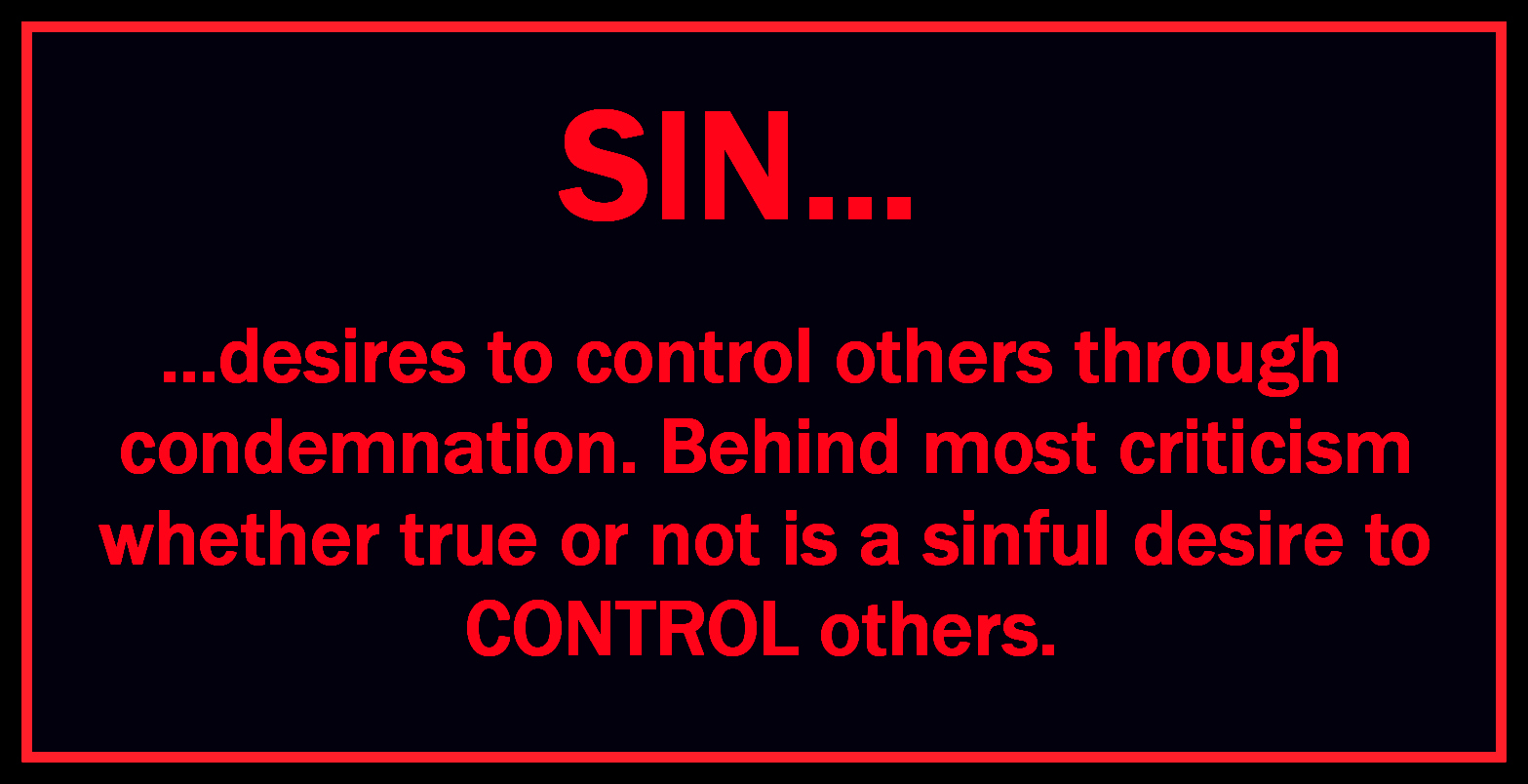
We see this in the garden. After Adam and Eve sin, they hide from God because they are afraid of God’s condemnation.
Genesis 3:9 – But the Lord God called to the man and said to him, “Where are you?” 10 And he said, “I heard the sound of you in the garden, and I was afraid, because I was naked, and I hid myself.” 11 He said, “Who told you that you were naked? Have you eaten of the tree of which I commanded you not to eat?”
Sin and fear of condemnation go together. This also speaks to evangelism and free will. Protestants love to make much of “No man seeks after God” (Rom 3:11). But this is not because man is totally depraved and has no inkling towards God whatever. Man does not seek God because he fears condemnation. Obviously, when Adam and Eve sinned, they did not immediately seek out God for a solution. Instead, they hid from God because they were afraid of His condemnation. This is why man does not seek God, he is afraid—not because he is totally depraved.
In addition, we see the essence of evangelism from the very beginning: God seeks out man with the remedy for sin. Just because God is the one who is proactive does not mean man has no ability to make a choice when confronted by God. Adam and Eve had no ability to come up with a plan that would fix the fall. Obviously, God is the only one who could remedy the problem. Man’s inability is in regard to proposing a plan of reconciliation with God, not an inability to accept the gift of salvation through a plan devised by God when offered.
Blog TalkRadio Podcast, Session 2: Challenging Doctrinal Presuppositions of Orthodoxy
The Protestant Twisting of 1John: A Clarification, Part 3
 Originally published April 5, 2015
Listen to full show audio here in separate window.
Welcome to Blogtalk Radio False Reformation. This is your host Paul M. Dohse Sr. Tonight, part 3 of “The Protestant Twisting of 1John: A Clarification.” If you would like to add to our lesson or ask a question, call (347) 855-8317. Remember to turn your PC volume down to prevent feedback. Per the usual, we will check in with Susan towards the end of the show and listen to her perspective.
If you would like to comment on our subject tonight, you can also email me at paul@ttanc.com. That’s Tom, Tony, Alice, Nancy, cat, paul@ttanc.com. I have my email monitor right here and can add your thoughts to the lesson without need for you to call in.
We are going to back up a little bit to start tonight’s lesson in order to observe some very important addendums to our series. I am just going to simply state the first one that is something to keep in mind while you read the book of 1John. John states two primary purposes for writing the letter. First…
1John 1:4 – And we are writing these things so that our joy may be complete.
Tradition holds that the apostle John wrote this book, and obviously on behalf of the apostles. Note how the ESV translates “our joy.” Taking other translations into consideration, the “our” probably includes all those who have fellowship with the Father. Also…
1John 5:13 – I write these things to you who believe in the name of the Son of God that you may know that you have eternal life.
The achievable goal for every Christian is joy and assurance of salvation. Obviously, falling into the false teachings that John was contending against was going to steal that from them. More importantly, we must keep in mind that this letter claims to have the knowledge that leads to joy and full assurance of salvation.
But in addition, there is something else I want to take note of. It’s a third primary reason that John writes this epistle:
1John 1:3 – that which we have seen and heard we proclaim also to you, so that you too may have fellowship with us; and indeed our fellowship is with the Father and with his Son Jesus Christ.
You might miss it because instead of referring to the writing of it, John wrote that “we proclaim also to you,” and the stated reason is mutual fellowship with the Father and the Son. These aren’t the only stated reasons for writing this epistle, but they are primary and let’s review them: joy, assurance, and fellowship.
Note that the apostles didn’t write this letter demanding that their authority be followed. The letter is written for the benefit of the readers and fellowship. Again, notice the fellowship is mutual fellowship with the Father and His Son. The goal is a mutual goal of fellowship, joy, and assurance. We find this elsewhere in Scripture.
2Corinthians 1:21 – And it is God who establishes us with you in Christ, and has anointed us, 22 and who has also put his seal on us and given us his Spirit in our hearts as a guarantee.
23 But I call God to witness against me—it was to spare you that I refrained from coming again to Corinth. 24 Not that we lord it over your faith, but we work with you for your joy, for you stand firm in your faith.
That’s it. Teachers don’t lord it over people’s faith, they co-labor for their joy. This pattern of co-laboring versus authority saturates the New Testament while elder authority is conspicuously missing. Do you know why proponents of elder authority always go to Hebrews 13:17? Because that’s the only verse they have, so let’s address it. This series is about why Protestants twist 1John and we have looked at a lot of things in the first two parts, but a distorted view of what Christian assembly really is also comes into focus in this discussion.
Are we merely part of a club that gets us into heaven in the end, or is salvation a settled issue leading to the gathering together for service and good works? Obviously, as with the Protestant case, if you need a continued forgiveness of “present sin,” and that forgiveness can only be found in allegiance to the institutional church, your whole interpretation of Scripture is going to be overshadowed by that.
The introduction to 1John emphasizes what gathering together as Christians is all about: fellowship, not authority. Home fellowships are an organized body of gifts under one head for the purpose of faith working through love. The church is a mediator of progressive salvation through authority structure and co-mediation with Christ. The goal of the institutional church is getting people from salvation point A to salvation point B and collecting a temple tax for that purpose. The goal of home fellowships is the full exploitation of the gifts granted to every believer. Leaders equip for that purpose and lead by example while the only authority is Christ. Throughout the New Testament assemblies are called on to strive for unity in the one mind of Christ.
That’s what we are going to focus on tonight. We are going to debunk the whole notion that there is horizontal authority in the body of Christ. All authority is vertical because Christ said ALL authority has been given to Him, and ALL means “all.” Let’s think about this: a horizontal authority also assumes the dictation of truth by those who have an elevated ability to understand truth. Folks, you cannot separate authority from a claim on truth. We hear this all of the time in the church, this idea that the elders need to be obeyed because they are preordained to understand things you cannot understand. We hear this all of the time. And does this impact the book of 1 John? Sure it does.
1John 2:19 – They went out from us, but they were not of us; for if they had been of us, they would have continued with us. But they went out, that it might become plain that they all are not of us. 20 But you have been anointed by the Holy One, and you all have knowledge. 21 I write to you, not because you do not know the truth, but because you know it, and because no lie is of the truth. 22 Who is the liar but he who denies that Jesus is the Christ? This is the antichrist, he who denies the Father and the Son. 23 No one who denies the Son has the Father. Whoever confesses the Son has the Father also. 24 Let what you heard from the beginning abide in you. If what you heard from the beginning abides in you, then you too will abide in the Son and in the Father. 25 And this is the promise that he made to us—eternal life.
26 I write these things to you about those who are trying to deceive you. 27 But the anointing that you received from him abides in you, and you have no need that anyone should teach you. But as his anointing teaches you about everything, and is true, and is no lie—just as it has taught you, abide in him.
Why do you think John wrote that? Those who were trying to deceive them were claiming a higher knowledge that the common believers were supposedly not privy to. And by the way, this is a hallmark of Gnosticism which was cut from the same block as Plato’s epistemological caste system. Anyway, let’s debunk this whole idea of horizontal authority among God’s people.
Before I do, I would like to add yet another thought. I have spent eight years researching the Protestant false gospel of progressive justification and refuting it, but I am beginning to think of it as just another mere symptom of the bigger problem: “the church,” the marriage of authority and Christianity.
The Bible states that there is one mediator between God and man, the Lord Jesus Christ (1Timothy 2:5). I now realize the real significance of that after eight years of research. I see “one” really means “one.” Something has happened this week that this ministry is taking note of: HBO’s documentary “Going Clear” on Scientology premiered 3/29/2015. Megan Kelly of Fox News interviewed one of the key figures featured in the documentary who shared an astonishing bit of information: members who offend leadership are locked up in a literal prison until they repent of whatever the offense is; release is contingent on signing a written confession. Kelly was incredulous that any adult would agree to such a thing and asked the guest if he could explain it. I was surprised when the guest said he could not explain it.
Maybe the explanation is too simple, but here it is: every false gospel opposed to the gospel of Jesus Christ is predicated on the idea of an additional mediator between God and man other than Christ. Even if one man or women is representative of the false doctrine, it will always be expressed in the form of an institution and its authority. Rather than all authority and mediation being in Christ, a subset of Christ’s mediation and authority is claimed; a claim that has no biblical merit whatsoever. These religious institutions always claim authority to grant salvation on behalf of God as co-mediators, but will also use the authority of government whenever they can get away with it.
So why do the institutional members of “the church” agree to every insane notion proffered by these institutions? It’s not complicated in the least: their salvation depends on it. The temptation is great; people relate truth with authority and want to be told how to get to heaven. Some sort of lofty authority gives the seekers confidence that God will accept their salvific pedigree. And Scientology has all of the elements common with these institutions, especially a strong emphasis on glorious infrastructure.
This documentary is important because Scientology is indicative of institutional religion in general. It claims authority and mediation it doesn’t have, quibbles over words, and entangles itself in the frivolous affairs of the world. And another important element–a major one should be noted as well: cults are spawned by authority. Hence, religious institutions often get a pass on being cultic because people don’t understand the catalyst of cultism: authority.
The alternative is a functioning body under one head. Gifts replace rank, and fellowship replaces authority. The goal is agreement on truth as defined by Christ and agreement according to conscience determines who fellowships together. Christ said, “All authority has been given to me.” ALL means “all.” If people get together for the purpose of following an authority anyway, why not Christ as opposed to some man or institution? If the divide in regard to what Christ is saying is too wide, go start your own group–Christ is the final judge anyway. A final point: institutions focus on getting people to heaven; fellowships focus on the unfinished work of service to God and others.
The following are relevant audio clips that make the point. First two are from Pastor John MacArthur Jr., and the third is from Pastor James MacDonald.
These clips are just too rich and could be the whole show. I mean surely, someone has some thoughts on theses clips. Where to start? When MacArthur talks about putting ourselves under the authority of godly men, what are the parameters of such authority? Historically in regard to the institutional church, this authority knows no bounds. And did you notice who decides what your gifts are? That’s right, not you, the leadership. Oh my, let’s just throw out one little example of this going completely wrong. If a guy gets saved but his wife doesn’t, she just may divorce him eventually. The Bible is very clear on this; the believing spouse is no longer obligated to that marriage. But if that young man comes to believe that he is called to be an elder—you can forget it. So, he will not fulfill his gift because of the traditions of men, and that’s a pity.
Many more examples could be given, but let’s get into our argument against authority among God’s people, or what I will call horizontal authority. The argument is that God’s people are a body of gifts cooperating together with one head. Horizontal co-laboring with vertical authority. I am going to be arguing this from a message I taught on Romans 14:2-12 titled, “Authority’s Assault on Unity.” So here we go, let’s see if we can learn anything.
The week before this lesson we talked about the mystery of the gospel. The mystery is God’s intention to bring Jew and Gentile into one body by the Spirit. Undoubtedly, this posed significant unity challenges because of the diverse cultures. When the Romans inquired of Paul as to whether or not they should bother associating with Jews due to these cultural differences, it sent Paul scrambling for his writing utensil because that issue is one of the core values of the gospel itself.
The bone of contention was dietary laws and the observance of days which would have been deeply entrenched traditions for the Jews. In addition, there were a plethora of issues among the Jews concerning the decadent culture of the Gentiles. Some of these issues included the eating of meat and its preparation according to Old Testament law. For sure, pork was out, but there were other issues, apparently, with meat sacrificed to idols and then sold on the open market at a reduced price. Hence, because what had been done with meat would have been ambiguous in many cases as far as its source and preparation, it’s possible that many Jews decided to play it safe and become vegetarians.
As far as convictions concerning the observance of days in this transition from the old covenant to the new, there would have been many days sacred to the Jews that would have had little significance among the Gentiles. So, what is Paul’s solution to these differences for purposes of fulfilling the mystery of the gospel?
In verse 2, Paul identifies the two parties: Gentiles who believe they can eat anything, and the weak Jew who understandably was not yet up to speed on the mystery of the gospel in regard to the law. Also consider, much like today, the Jews had been dumbed down in regard to Scriptural knowledge. The leadership of that day replaced Scriptural truth with the traditions of men. Specifically, like today, the integration of Gnosticism with Scripture saturated Jewish thought and religion.
In verse 3, Paul defines the attitudes that fueled the division between Jew and Gentile: the ones who eat should not “despise” the ones who don’t eat; i.e., the Jews, and the Jews should not “judge” the ones who eat according to what? Right, the law. And why? Because God had come to receive who? Right, the Gentile. Paul shifts his focus to the Jewish responsibility of accepting the ones God received into the one body regardless of the fact that they did not keep or regard much of the Old Testament law. This would have been a really challenging transition of thought for the Jew. But the main point here is that the Jew had a tendency to “judge” because they had the what? Right, the law.
The way Paul addresses this (v. 4) towards the Jew is very interesting. In that culture or the Jewish culture as well, it would have been very uncouth to tell another person’s slave what to do. It would have been absurd. In ancient times there were many types of slaves in regard to social strata, but let me use the types of slaves that were more like today’s employee as an example. It would be like a manager from Wendy’s walking into a Kentucky Fried Chicken and telling those employees what to do. Or, closer to the point Paul is making, openly criticizing them in some way. The absurdity demonstrated in this illustration falls a little short because the servants Paul is talking about only served their own masters whereas in my illustration you could argue that the Wendy’s manager was a customer at KFC and had a right to complain about something. But slaves of Paul’s day only served one master. Christ used the same kind of illustration Paul is using here when he said you cannot serve two masters.
So, what Paul is saying is that ALL Christians, Jew and Gentile, only have one master, Jesus Christ.
4 Who are you to pass judgment on the servant of another? It is before his own master that he stands or falls. And he will be upheld, for the Lord is able to make him stand.
“It is before his own master that he stands or falls” is a reflection of the slave culture. Typically, slaves only answered to one master. This is interesting to think about in our day. First, like most of the New Testament writings, and for that matter the Old Testament writings as well, the letter is addressed to the whole group. It also regards the problem with arguing over what Paul called, “opinions.” In all of this, where is elder involvement discussed? Thirdly, Paul is about to teach us that no one has a right to judge you or others in the Christian realm because everyone answers to one master and one master only—Jesus Christ.
The more one studies the Scriptures independently, the more one notices that elders (or pastors) are conspicuously missing. The context of Romans 14 makes the absence of elders odd in our minds because of what we have been taught about “elder authority.” We see this elsewhere concerning conflict among God’s people. In Matthew 18:15-20, again, elders are conspicuously missing. Often we hear the call to be willing to “place ourselves under the authority of godly men.” What I understand here is that we only have one master. Salvation is not in view here, the authority to pass judgment on another is what is in view. What is in view is a judge who is able to make the Christian “stand or fall.”
What becomes more and more clear is the fact that “pastor” or “elder” is just another gift and has NO element of authority. It has even been suggested that elders are optional for home fellowships where Christians gather together for edification and fellowship. The suggestion is that 1Timothy 3:1 could refer to a fellowship’s desire to have an elder and not necessarily an individual’s desire to be an elder. Practically, this makes sense because wherever God’s people meet there may not be any elders. What I am saying follows: in geographies where there is no sound gathering of professing Christians, saints are not forced to fellowship there because eldership validates an assembly. Clearly, it can be surmised that some 1st century Christian fellowships had elders and others didn’t.
But at any rate, elders are not lords (1Pet 5:3), they are leaders. Even the apostle Paul stated that he was to be followed only as long as he followed Christ (1Cor 11:1).
Putting all of these ideas together, I like the rendering of 1Timothy 3;1 by the Complete Jewish Bible (CJB):
Here is a statement you can trust: anyone aspiring to be a congregation leader is seeking worthwhile work.
Elders lead by example. I believe their oversight is primarily a proper interpretation of the Bible. They are ministers of the word (Acts 6:4). We only have one Lord—Jesus Christ. The apostle Paul continually pointed to the authority of God’s truth as the only authority:
Galatians 1:8 – But even if we or an angel from heaven should preach to you a gospel contrary to the one we preached to you, let him be accursed.
1Corinthians 3:21 – So let no one boast in men. For all things are yours, 22 whether Paul or Apollos or Cephas or the world or life or death or the present or the future—all are yours, 23 and you are Christ’s, and Christ is God’s.
Paul sets forth another rule in verse 5: Each believer should be persuaded (KJV) in their OWN mind. There needs to be space given for everyone to grow in wisdom. See here that we don’t believe certain things just because certain people believe it. We are to be persuaded in our OWN minds through the continued study of God’s word. PERSUASION is a major theme in the New Testament. The idea of persuasion is often translated “obey” in English translations for some incredibly strange reason. Listen, “obedience” is not the heavy emphasis among believers, persuasion is the key. Here is the word for persuaded in verse 5:
g4135. πληροφορέω plērophoreō; from 4134 and 5409; to carry out fully (in evidence), i. e. completely assure (or convince), entirely accomplish:— most surely believe, fully know (persuade), make full proof of. AV (5)- be fully persuaded.
Listen, before I develop this important aspect of persuasion, I am going to jump ahead to Paul’s next principle of motive in verse 6:
The one who observes the day, observes it in honor of the Lord. The one who eats, eats in honor of the Lord, since he gives thanks to God, while the one who abstains, abstains in honor of the Lord and gives thanks to God.
Giving room for motive is huge in our day because we are all so dumbed down theologically. Admittedly, these are difficult waters, but if the home fellowship movement is going to work, we need to chill out on the dogma thing and emphasize the fact that we all need room to grow in God’s word. What we are looking for is honest seekers of truth—people who are persuaded by truth and the one mind of Christ that brings unity. Basically, a genuine love for the truth. That’s THE truth not A truth.
Meanwhile, Paul is saying that the spiritually weak have the right motives and are thankful to God. Other than a love for the truth, even the spiritually weak will have a spirit of thankfulness.
Probably, the beginnings of fellowship should begin with a fundamental agreement on the gospel of first importance and the sufficiency of God’s word. From there, you study the Scriptures together and let all be fully persuaded in their own minds. It boils down to this…
Does the person love THE truth? (2Thess 2:10).
Now, back to developing verse 5. I am going to develop this point by looking at Hebrews 13:17:
Obey your leaders and submit to them, for they are keeping watch over your souls, as those who will have to give an account. Let them do this with joy and not with groaning, for that would be of no advantage to you.
As we can ascertain so far, no one among God’s people can demand that you believe anything—only Christ has the authority to demand that you believe something. Otherwise, it would have been like passing judgment on someone else’s slave which was an absurd notion in that culture. In contrast, what is in vogue in our day is this whole idea of “putting yourself under the authority of godly men” lest you be a spiritual sluggard. A verse often used is Hebrews 13:17.
The word for “obey” is the following word:
g3982. πείθω peithō; a primary verb; to convince (by argument, true or false); by analogy, to pacify or conciliate (by other fair means); reflexively or passively, to assent (to evidence or authority), to rely (by inward certainty):— agree, assure, believe, have confidence, be (wax) content, make friend, obey, persuade, trust, yield.
The idea is to be persuaded, or following as a result of being persuaded or convinced. The same word is used about 50 times this way in the New Testament. Here is just one example:
Matthew 27:20 – Now the chief priests and the elders persuaded (peithō) the crowd to ask for Barabbas and destroy Jesus.
There is a Greek word for outright obedience, it is…
g5219. ὑπακούω hypakouō; from 5259 and 191; to hear under (as a subordinate), i. e. to listen attentively; by implication, to heed or conform to a command or authority:— hearken, be obedient to, obey.
Here is one example of about 20 in regard to how the word is used in the New Testament:
Matthew 8:27 – And the men marveled, saying, “What sort of man is this, that even winds and sea obey (hypakouō) him?”
Again, among fellow Christians, we don’t demand obedience, we persuade. Elders lead, but they do not have Christ’s authority. You obey Christ no matter what. Such is not the case with elders or pastors. Notice in all of chapter 14, the key to unity is not the authority of leaders.
Continuing on…
7 For none of us lives to himself, and none of us dies to himself. 8 For if we live, we live to the Lord, and if we die, we die to the Lord. So then, whether we live or whether we die, we are the Lord’s. 9 For to this end Christ died and lived again, that he might be Lord both of the dead and of the living.
Honestly, I am not entirely sure of the point Paul is making in verses 7-9. There is even the transition “For” that links this idea to the previous thought in verse 6, but it’s like Paul just parachutes this idea in here out of nowhere. Each sentence in verses 7-9 link together with verse 6 by a conjunction, “For,” “So then.” Somehow, Christ being the Lord of those who have passed on figures into the equation, but I simply don’t know how.
At any rate, Paul is back to the main point with verses 10-12:
10 Why do you pass judgment on your brother? Or you, why do you despise your brother? For we will all stand before the judgment seat of God; 11 for it is written, “As I live, says the Lord, every knee shall bow to me, and every tongue shall confess to God.” 12 So then each of us will give an account of himself to God.
This is clear, we will all give an account for ourselves regarding what we have done as Christians in the body (1Cor 3:10-15, 2Cor 5:10). Therefore, do not judge a fellow believer who is doing his/her best to honor God with what knowledge they presently have.
Second, let them be convinced in their OWN minds.
Third, stay focused on glorifying God in regard to the purposes of the mystery of the gospel.
At this time, let’s go ahead and take calls.
TANC 2015: Paul Dohse Session 1 – Introduction to Biblicism
Session 1: Introduction to Biblicism
Who do we think we are? Why would Western culture be immune from populous deception? In fact, history, even recent history reveals the dangers of collective logic whether by tradition or some sort of neo-movement. Moreover, examples of bad fruit coming from collective logic can be taken from the best of what Western culture has to offer.
There is one constant that shapes culture; change occurs as a result of bad fruit. The collective pain threshold begins to surpass the threshold of life value. Society then becomes split into two types of people: those with new ideas and those willing to listen.
Tyranny has always been a foolish endeavor by virtue of God’s design of things. The reason is simple: the people always outnumber the rulers, and the rulers need people to have a government, and you can only kill so many people. This is why controlling the way people think is so important; this taps into the human resource without killing the donor.
From the cradle of society, caste was the norm. Unfortunately, the consensus had always been that bad fruit had nothing to do with the system, but only those running it. The American experiment was the first successful challenge to collectivism. The definition of the words and the understanding of them are a matter of life and death on a massive scale. For example, “individualism” does not exclude cooperation and organization for the common good, but rather, asks who will determine what the common good is and how one reaches that conclusion. The assumption that individualism leads to societal chaos has in fact produced chaos in incomprehensible proportions.
Once again, history is repeating itself in many ways, but the particular aspect that TANC focuses on is Protestantism. Once again, fruit demands reevaluation because of the threshold of pain. But this time of historical reevaluation is utterly unique because it is post American Revolution. For the first time in over 500 years, Protestantism faces a reevaluation without the force of state at its disposal.
Nevertheless, Protestantism has done its job well. It yet has no fear of replacement because those who have given up on it believe there is no alternative. Hence, its utter failure has produced no competitors. The Nones and the Dones are just that, none and done. Yet, lest Protestantism would break from protocol and show mercy to its detractors, the Nones and the Dones are declared damned to hell on their way out to the wilderness of hopelessness because being a member in good standing in the institutional church is synonymous with loving Christ and being a legitimate part of His body.
We at TANC reject such an arrogant notion with extreme prejudice, and believe we understand a legitimate alternative—a return to the assembly of Christ and its priesthood of believers. A return to individual gifts, not spiritual collectivism; fellowship, not membership; leadership, not dictatorship; organization, not institutionalization; not many masters, but only one; a body, not a corporation, and finally, freedom of conscience. Individual saints with one word, one Lord, and one body. It’s a body, not a spiritual caste system, and we have but one mediator—the Lord Jesus Christ.
Biblicism
The alternative to Protestant orthodoxy is Biblicism. What is it? Let’s begin with a definition from Wikipedia. This is by far the best definition of Biblicism that I have ever found, and unfortunately listed under an alternative name for Biblicism, “Biblical Literalism.” And, as rightfully noted by Wikipedia, often used as a pejorative. Don’t you know, any Biblicist that has read Matthew 5:30 has cut off his right hand or feels guilty that he hasn’t. Let’s examine the definition:
Alternatively, the term can refer to the historical-grammatical method, a hermeneutic technique that strives to uncover the meaning of the text by taking into account not just the grammatical words, but also the syntactical aspects, the cultural and historical background, and the literary genre. It emphasizes the referential aspect of the words in the text without denying the relevance of literary aspects, genre, or figures of speech within the text (e.g., parable, allegory, simile, or metaphor).
Let me add that Biblicism starts with literalism and the plain sense of the text first, and then utilizes the elements of the historical-grammatical methods as needed to make the rendering consistent with the rest of Scripture. As one person has said, “When the plain sense of Scripture makes common sense, seek no other sense.” Let me also add that Biblicists would normally be impressed with a method of interpretation known as Occam’s razor. Again, we are indebted to Wiki for a definition:
…a problem-solving principle devised by William of Ockham (c. 1287–1347). It states that among competing hypotheses, the one with the fewest assumptions should be selected. Other, more complicated solutions may ultimately prove correct, but—in the absence of certainty—the fewer assumptions that are made, the better.
In context of the lay person, learning is a jigsaw puzzle. I want to use this example of a jigsaw puzzle that is a map of Xenia, Ohio. Let’s say the map, to the degree that it is fitted together, represents knowledge of Xenia. Until the puzzle is completely fitted together with all of the pieces, what do we do with the pieces that we can’t get to fit into the map presently? Answer: we lay those pieces aside for the time being. Dear layman, you don’t need the scholars. In fact, please remember that we live in the Information Age. Study to show yourself approved as a “workman.”
As a parenthesis regarding interpretation, let me offer all the proof you need to know that every verse of Scripture must be interpreted in context of justification or sanctification; Christians, throughout the New Testament, are referred to as “workman.” If justification is not a finished work, the fact that we are participants in it is unavoidable, either by direct participation or intentional non-participation. Intentional non-participation is doing something. If justification is not a finished work, invariably, religious formulas for work works and faith alone works emerge. The problem here is evident: if you can lose your salvation, what do you have to do, or not do, in order to keep it?
The Dirty Little Secret
What we are talking about here is deductive/inductive study of the Bible that begins with the presupposition that man is able to reason. Here is where we must stop and state a huge historical fact in this matter that is irrefutable. Historically, there have only been two schools of thought on Bible interpretation: the historical-grammatical method, and the historical-redemptive method.
But please, if you don’t take anything else away from this first session, please know the dirty little secret in all of this: these are ALSO two different ways of interpreting reality itself. Listen: the Protestant Reformers started first with their interpretation of reality, and then extrapolated that method onto the Bible as well.
If you have been following our TANC series on the first and foundational doctrinal statement of the Reformation, the Heidelberg Disputation, you know that Martin Luther laid the foundations in that document for the historical-redemptive method of interpreting reality and consequently the Bible as well. Luther believed that all of reality is a redemptive metaphysical narrative written by God. Look out the window right now. See that car driving down the street? The only reason that just happened is because God wrote it into the script of the metaphysical narrative, what many of the Reformed call the “divine drama.” Reality is nothing but a story written by God.
Hence, salvation is only an ability to perceive or “see” the story. The unregenerate are defined by those who think they have ANY measure of freewill. To have freewill is the ability to write your own reality. Luther’s assessment of freewill is therefore called “the glory story of man.” Either one confesses that God wrote the story of history and reality, or man is foolishly trying to write his own reality.
Luther received this idea primarily from Saint Augustine and Saint Gregory, established the Protestant Reformation with its premise, and John Calvin later articulated its supposed life application in the Calvin Institutes of the Christian Religion. It called for a repeat of our spiritual baptism throughout the Christian life by progressively seeing/perceiving two things: the depravity of man and the holiness of God. Plunging the depths of our sinfulness supposedly brings about humbleness and self-death resulting in a resurrection of joy regarding our original salvation. Therefore, the joy of our salvation is progressively increased throughout our Christian lives regardless of circumstance. In fact, tragedy only facilitates our ability to see our depravity and the judgement that we deserve. Tragedy is merely a part of God’s prewritten gospel narrative.
Consequently, Spirit baptism is not a onetime event, but is repeated throughout our Christian life. The Bible has one purpose and one purpose only: to aid the “believer” in continually revisiting salvation and the perpetual revisiting of Spirit baptism. This is an official Protestant doctrine called mortification and vivification. Several Protestant organizations use the chart below to illustrate this doctrine and the historical-redemptive use of the Bible:
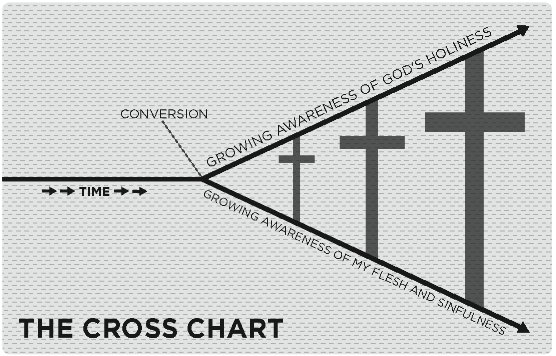
Therefore, God uses circumstances and the Bible to help us in the downward trajectory illustrated by this chart. A contrary perspective on reality is illustrated by another chart widely published by Protestant organizations:
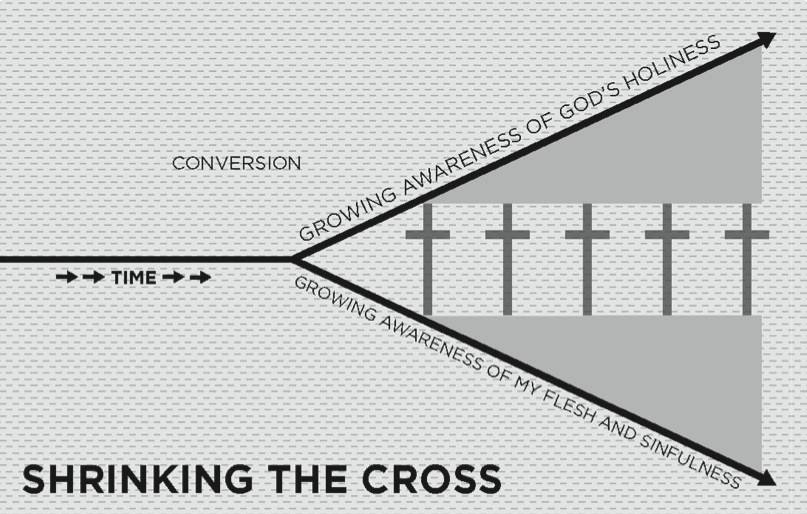
What is behind the popularity of this worldview? Simply, an ability to live a carefree life without fear of unknown circumstances (with the only exception being your eternal destiny). We all know that investing in life can set us up for enhanced disappointments and suffering. This is a worldview that completely separates us from the responsibilities of life and its suffering. Don’t worry, be happy, it’s a just a divine video tape anyway, and what will be, will be. If one of your loved ones dies tragically, don’t sweat it, it’s just part of God’s divine drama prewritten before the foundation of the earth. Besides, God is using this to make the gospel bigger and you smaller. Listen, even Protestants who don’t get this function according to the same worldview: “It’s God’s will.” “I didn’t do it! God did it!” “We are all just sinners saved by grace.” All of these Protestant truisms fit the downward trajectory of the above cross chart.
As far as Biblicism, there is a huge pushback against it. A focal point of the pushback is a book written by Protestant turned Catholic Prof. Christian Smith titled, The Bible Made Impossible: Why Biblicism is Not a Truly Evangelical Reading of Scripture. I must credit the Christian Research Institute with the following review of the book which is endorsed by many evangelical heavyweights such as Rachel Held Evans, and will help us further define Biblicism:
Smith asserts that biblicism is the constellation of ten different assumptions or beliefs: (1) The words of the Bible are identical with God’s words written inerrantly in human language. (2) The Bible represents the totality of God’s will for humanity. (3) The divine will for all issues relevant to Christian life is contained in the Bible. (4) Any reasonable person can correctly understand the plain meaning of the text. (5) The way to understand the Bible is to look at the obvious, literal sense. (6) The Bible can be understood without reliance on creeds, confessions, or historic church traditions. (7) The Bible possesses internal harmony and consistency. (8) The Bible is universally applicable for all Christians. (9) All matters of Christian belief and practice can be learned through inductive Bible study. (10) The Bible is a kind of handbook or textbook for Christian faith and practice.
While some evangelicals may downplay or deny some of these points, Smith suggests as long as you hold to some of these points, you are still a biblicist (pp. 4–5).
Before we address these points for a clearer understanding of what Biblicism is, it shouldn’t surprise us that the only alternative in the book is the Christocentric hermeneutic which is the same thing as the historical-redemptive hermeneutic. It sees the gospel or Jesus in every verse of the Bible as a result of interpreting reality itself through the suffering of the cross. It should be noted that this hermeneutic is crossing over into Catholicism as well.
(1) The words of the Bible are identical with God’s words written inerrantly in human language.
A Biblicist believes no such thing. God used fallible humans to write the Bible over 1600 years in many different languages. Because Christ warned that there would be serious consequences for tampering with God’s word, we can assume many have in fact tampered with it.
The key follows: the Bible is God’s statement on being including metaphysics, epistemology, ethics, and politics. The Bible is not without error in the transmission of these truths, but none of the truths are lost due to God’s oversight and assistance. Included is the way that the Bible was written, or its overall structure of checks and balances. As the “workman” studies to show himself approved, God’s principles become more and more apparent.
(2) The Bible represents the totality of God’s will for humanity.
This point is vague, but one assumes it speaks to the accusation that Biblicists believe the Bible speaks to every detail of life like how to fix our cars etc. While the notion is absurd, the Bible does tell us what kind of car-fixer we should be—not the details of a how-to-manual. The Bible is a manual for how we should love God and others, so while it does not give specific instructions on how to fix our wife’s Toyota, it does convey a principle of love that would prevent us from taking shortcuts on safety issues in order to save money. If it’s our wife’s car, we don’t repair the brake lines with duct tape, etc.
(3) The divine will for all issues relevant to Christian life is contained in the Bible.
This is true, and the reason for the contention is evident: the sole purpose of the Bible should be to show us how wicked we are, not instruction on loving God and others.
(4) Any reasonable person can correctly understand the plain meaning of the text.
True, with the exclusion of the straw man argument that the meaning in every text is always “plain.” The Bible states that individual study is required, and acknowledges that obtaining understanding can be difficult work.
(5) The way to understand the Bible is to look at the obvious, literal sense.
This is true as the primary organizing principle, but gain, the straw man is the assertion that Biblicists believe this is true of every verse.
(6) The Bible can be understood without reliance on creeds, confessions, or historic church traditions.
This is absolutely true because Biblicism rejects spiritual caste systems of all kinds. Teachers are a help, they are a gift to the church for purposes of equipping, NOT an office. But when it gets right down to it, in context of the apostle John addressing the Gnosticism that was wreaking havoc on the 1st century church, he stated, “You have no need for anyone to teach you.” Biblicism is predicated on collective individualism, not group-think overseen by an elite class of those who supposedly possess the “gnosis.”
(7) The Bible possesses internal harmony and consistency.
Absolutely. Again, the complexities of the Bible are used to argue against human reason as a valid epistemology for reasons of selling a redemptive interpretation of all reality.
(8) The Bible is universally applicable for all Christians.
Sure it is. Loving God and others pertains to principles that are universal.
(9) All matters of Christian belief and practice can be learned through inductive Bible study.
In regard to loving God and others, absolutely.
Note the continual distinction being made between love and law. There is a specific reason for that which we will see more of later.
(10) The Bible is a kind of handbook or textbook for Christian faith and practice.
The word “practice” factors in huge here. As previously noted, Protestantism defines salvation as an ability to see/perceive/experience APART from practice. Therefore, the Christocentric approach to interpretation of reality, and consequently the Bible as well, will reject any practice by man to be of any value to God. Therefore, the sole purpose of the Bible is to aid mankind is seeing that all righteousness is an alien righteousness completely outside of man.
So, this is an introduction to Biblicism. In the next session, we will look at the Biblicist gospel, its evaluation of law/gospel, the nature of God, the nature of man, evangelism, and the nature of sin. In the fourth session, we will examine Protestantism and the extreme contrast that it presents. I will conclude this first session with a few more principles of interpretation:
Deuteronomy 29:29 – The secret things belong to the Lord our God, but the things that are revealed belong to us and to our children forever, that we may do all the words of this law.
Deuteronomy 30:11 – For this commandment that I command you today is not too hard for you, neither is it far off. 12 It is not in heaven, that you should say, ‘Who will ascend to heaven for us and bring it to us, that we may hear it and do it?’ 13 Neither is it beyond the sea, that you should say, ‘Who will go over the sea for us and bring it to us, that we may hear it and do it?’ 14 But the word is very near you. It is in your mouth and in your heart, so that you can do it.
Two basic interpretative principles can be drawn from these verses. First, some things we cannot know, but what we can know we are responsible for. Second, we have no need for interpretive mediators between us and God. There is only ONE mediator between God and man—Christ.

The Life of the Believer is Logical, Reasonable, Practical, and Objective
 More than anything, Christ reasoned with people. More than anything, Christ challenged people to think and ponder. One of His favorite introductions to challenging people to think was, “What do you think?” followed by a parable or an example from everyday life.
When Christ began to preach the good news of the kingdom, the Jewish culture was mired in spiritual caste and mysticism. The straightforward commonsense practicality of The Sermon on the Mount, a transcript of Christ’s “good news of the kingdom of God” was utter culture shock. Christ spoke directly to their responsibility in understanding kingdom living and cited NO earthly authority whatsoever. It also demonstrates the kingdom’s mode of operation in regard to present ambassadorship: one head instructing common folks for a common goal.
Christ completely bypassed the spiritual hierarchy of that day as he would in our day if He walked among us as He once did. He wouldn’t contact the Pope, he wouldn’t contact Al Mohler, He wouldn’t contact John Piper; He would take His mandate directly to the common people who are organized and energized by individual gifts—NOT authority.
The institutional church in our day is a mirror image of that day’s spiritual caste; whether the Pope or the Neo-Calvinists, they are no less the contemporary Pharisees and Sadducees of our day. Be sure of this: spiritual authority is ALWAYS accompanied by the idea that God has mediated knowledge through preordained human agencies in addition to Christ. And also be sure of this: spiritual authority will ALWAYS result in illiterate kingdom knowledge and living at best, and cultic tyranny at worst. The supposedly meek pastor is no less a tyrant for disarming you with ignorance that doesn’t even have an ability to ask the right questions.
The apostle Paul could not have been clearer on this as he used the human body to illustrate the function of Christ’s assembly; body parts don’t have authority, they have function. The right hand can tell the bladder to behave itself till the cows come home, but if the bladder is not doing its job, the right hand is wasting its breath (1Corinthians 12). The assembly of believers operate as a body, not an institution. Proper function leads to organized productivity, wellbeing, the advancement of the gospel, and the glory of God.
Christ offered His body once so that we may follow Him in the death and resurrection of the new birth. Once we are born again, our “reasonable (logikos: logical) service” is to offer our bodies as a living sacrifice for the kingdom. Paul’s use of words in Romans 12:1 is stunningly practical. In contrast, cultures have traditionally seized on hokey gimmicks of every sort offered by cultic mediators to bring spiritual manifestations down to earth for our experiential enjoyment or escape from the responsibility of real life. In the first century, as today, the misrepresentation of speaking in tongues is certainly no exception.
1 Corinthians 14:1 – Pursue love, and earnestly desire the spiritual gifts, especially that you may prophesy. 2 For one who speaks in a tongue speaks not to men but to God; for no one understands him, but he utters mysteries in the Spirit. 3 On the other hand, the one who prophesies speaks to people for their upbuilding and encouragement and consolation. 4 The one who speaks in a tongue builds up himself, but the one who prophesies builds up the church. 5 Now I want you all to speak in tongues, but even more to prophesy. The one who prophesies is greater than the one who speaks in tongues, unless someone interprets, so that the church may be built up.
6 Now, brothers, if I come to you speaking in tongues, how will I benefit you unless I bring you some revelation or knowledge or prophecy or teaching? 7 If even lifeless instruments, such as the flute or the harp, do not give distinct notes, how will anyone know what is played? 8 And if the bugle gives an indistinct sound, who will get ready for battle? 9 So with yourselves, if with your tongue you utter speech that is not intelligible, how will anyone know what is said? For you will be speaking into the air. 10 There are doubtless many different languages in the world, and none is without meaning, 11 but if I do not know the meaning of the language, I will be a foreigner to the speaker and the speaker a foreigner to me. 12 So with yourselves, since you are eager for manifestations of the Spirit, strive to excel in building up the church.
13 Therefore, one who speaks in a tongue should pray that he may interpret. 14 For if I pray in a tongue, my spirit prays but my mind is unfruitful. 15 What am I to do? I will pray with my spirit, but I will pray with my mind also; I will sing praise with my spirit, but I will sing with my mind also. 16 Otherwise, if you give thanks with your spirit, how can anyone in the position of an outsider say “Amen” to your thanksgiving when he does not know what you are saying? 17 For you may be giving thanks well enough, but the other person is not being built up. 18 I thank God that I speak in tongues more than all of you. 19 Nevertheless, in church I would rather speak five words with my mind in order to instruct others, than ten thousand words in a tongue.
20 Brothers, do not be children in your thinking. Be infants in evil, but in your thinking be mature. 21 In the Law it is written, “By people of strange tongues and by the lips of foreigners will I speak to this people, and even then they will not listen to me, says the Lord.” 22 Thus tongues are a sign not for believers but for unbelievers, while prophecy is a sign not for unbelievers but for believers. 23 If, therefore, the whole church comes together and all speak in tongues, and outsiders or unbelievers enter, will they not say that you are out of your minds? 24 But if all prophesy, and an unbeliever or outsider enters, he is convicted by all, he is called to account by all, 25 the secrets of his heart are disclosed, and so, falling on his face, he will worship God and declare that God is really among you.
The key to spiritual growth and true manifestations (our walking in truth) of the Spirit is MATURE THINKING and edification by which God’s people mature. Experiential endeavors that are not objective do NOT edify. Period.
Susan and I have a wonderful marriage, but we are not exactly on the same page regarding perceived value in listening to Christian radio. She thinks it has some limited value while I think it is utterly devoid of any edification whatsoever. While riding in the car with her yesterday, we listened to a young girl giving her personal testimony on a “Christian” radio station. Susan often beckons me to “give Christian radio another chance.” The girl spoke of her “personal relationship” with Christ as opposed to merely knowing Him. Trust me, few of these people, if any, can define what it is to have a “personal relationship” with Christ. It’s the mindless spewing of a spiritual bumper sticker that posits subjective piety which supposedly knows beyond knowing. Yes, it’s not about what Jesus says in His word, it’s about the “intimate” relationship with Him. After all, “He’s a person, not a precept.” And so goes the incessant gagathon.
The girl concluded her Gnostic diatribe by sharing how she led her sister to the Lord. Apparently. Yes, she is really happy that her sharing of the gospel lacked substance and knowledge because she had been praying for her sister’s salvation. Hence, she can be confident that it was all of God and not her proficiency in sharing according to knowledge. Susan then asked, “Would you like me to turn the radio off?” I would. This is just another example of why the institutional church is a wasteland of destruction and death. Like gangrene, feeble thinking leads to the silent eating away of flesh and a crippled body with an ongoing need for amputation.
Spiritual growth goes hand in glove with the individual believer being responsible for personal understanding, and by the way, for unity sake must be “convinced in his own mind” (Romans 14). Critical and central to the relevance of home fellowships is EDIFICATION. Teaching and learning must be a primary focus. Home fellowships must be rooted and grounded in objective truth.
paul

 Paul's Passing Thoughts
leave a comment