What is the Reformed/Calvinist “Noble Lie”?
 This post wasn’t on my schedule this morning, but I am nevertheless compelled to start my day by commenting on a link that “Carmen” has sent me. Carmen comments on PPT publically, and I continually get emails along the line of, “Hey, did you see Carmen’s comment? She really gets it.” Not only that, Carmen sends me research that flavors what is written here, and frankly, I fear that a lot of it will be lost in PPT’s 1 TB plus archives.
Therefore, starting with this post, and because she comments publically as “Carmen,” we are going to attach her relevant input on the bottom of posts where applicable to the subject. This will prevent her efforts from being lost in PPT electronic files and my 58 year old mind. This might include one of her comments that often contain research, or research that she sends us.
Furthermore, the research she sends influences the writings here to the point where it is becoming a borderline plagiarism issue. We know that she probably isn’t concerned about this, but we are. Therefore, whenever Pearl or the other contributors want to pad a post with her research, it will be archived along with the post at the bottom starting with this post where you can refer to the link that she sent me.
Let’s now address the link sent: a post on the TGC blog by Colin Smith concerning “change.” Let’s also be clear: Reformed thought disavows the idea that people change. When they write books like “How People Change” by the habitual liar Paul David Tripp, they don’t really intend to teach that people change. This should be obvious, no? How many of these guys have publicly proclaimed on the one hand that, “I am done trying to fix people” while on the other hand speaking of “change.” So, what’s going on?
 “Cognitive dissonance!” That was easy. We have to go further than that; we have to discuss the most important element of CD, which is a mental form of ED. CD is functioning by two contradictory ideas or a series of contradictions, and in the case of CD, there is what psychologists call the “consonant” or “buffer.” It is the ideas that attempt to reconcile the contradictions and relieve the anxiety that causes it.
In the case of Reformed thought, the consonant is orthodoxy. What is orthodoxy? It is a dignified form of mythology which shouldn’t need dignifying. Mythology is not a collection of ancient superstitions as many people suppose. Mythology is the teaching construct of spiritual caste. This is the most common philosophy of world history. It presupposes an epistemological pecking order between deity, or a natural force, and humanity. The deity, or force, preselects those who can comprehend reality to lead those who cannot comprehend reality. Sometimes, those who cannot comprehend reality don’t know they can’t comprehend reality and hinder the preordained from bringing order and wellbeing to humanity; we call that “war.”
So, mythology is simply parables written by the preordained to help those who cannot understand reality to understand why they should follow the preordained. Predeterminism is central to this common philosophy and dominates mythology in general. Plato articulated this construct in The Republic this way: philosopher kings, warriors, producers. The producers do not necessarily take mythology literally, though some do (now you can invoke “superstition”); they understand that it is a narrative tool to help the producers understand why they should function a certain way in society. It is no different than the concept of children’s story books, except mythology is for adults. We try to instill principles in children based on what we know they can’t completely understand through stories and narratives—it’s the same construct. Of course there isn’t really a “Little Blue Engine That Can.” The personification of a train is not to be taken literally.
Orthodoxy is the same thing. It is the traditional teachings of preordained “Divines” who write creeds, confessions, and catechisms for the great unwashed masses. In mythology, orthodoxy’s kissing cousin, we have what’s called the “noble lie.” It is the misrepresentation of something cognitive that the producers understand in an elementary way. People don’t really change, but most producers are unable to grasp that, so the goal is to teach “change” in a way that produces the functionality desired by the philosopher kings.
Hence, the meaning of words in the minds of philosopher kings rarely mean the same thing to the producers. Philosopher kings allow the producers to assume they mean the same thing, but they don’t. And it’s not a lie because words that producers understand, and the way they understand them must be used in orthodoxy in order to lead the ignorant to green pastures of wellbeing; it is the noble lie.
And, the break point: the consonant is “paradox,” viz, contradictions only seem to be contradictions because the producers cannot comprehend what the philosopher kings can comprehend. And, this construct is appealing to the producer class for a number of reasons. If you want to see this construct in historical living color, study Nazi orthodoxy during the WWII era. The Bible makes it clear that there are some things God knows that we cannot understand, however, the bible also makes it clear that we are responsible for what we can know, and what we need to do in order to know it. In this construct, people are not responsible for knowing anything and many people like that idea for many misguided reasons not excluding good old fashioned laziness.
So, now we know the definitions of mythology, orthodoxy, superstition, and paradoxy in their true historical context.
The Colin Smith post is just another example of all of this. If you examine his sentence structure carefully, you begin to suspect that he really isn’t saying what he seems to be saying, and that’s the whole idea; he really isn’t saying what he seems to be saying. It’s a philosopher king thing, you wouldn’t understand. Notice that he subtly defines “birth” as an idea that can’t be dichotomized from the growth process. To think of a man as different from a baby is to deny babies because the growth that made the man is dichotomized from the separate concept of “baby.” Reformed elders constantly practice this cultish form of metaphysical two- stepping communication. It’s subtle, and very evil. It is often done by eliminating conjunctions/transitions and thereby making two different things the same. Their deceptive communication techniques are an identifiable system and complex.
Look, I am not going to dissect all of his nuance in the post; there is no need as others in his camp make it clear that people don’t change. Obviously, he is not saying what he seems to be saying, and you are supposed to accept it based on the Reformed CD consonant.
Don’t but it. It’s nothing more or less than Nazi Light.
paul

Victims and Discernment Bloggers: Let’s Ask the Right Questions
“So, they would say to the young ladies and boys who have been molested in the church, ‘So what?’ The same sin that indwells the pedophile is in the victim as well. Can we not survey the past and present abuse and see this worldview plainly?”
Even though we hate to think commonsense is important in understanding spiritual issues, the fact remains that such is the case. We struggle with this because of our notion that material is evil and spiritual is good. This notion is deep-seated in the Western psyche. Consequently, we are often willing to throw math out the window for something spiritual. Also, the spiritual get out of commonsense free card comes in handy when we have invested too much of our own self-esteem in a bad idea. If we humble ourselves and admit we were wrong, our intellect labeled as “humbleness” (lest it have no credibility) seems to lose its credibility.
Frankly, I find admission of wrong freeing. Yes, it may make you feel stupid for a while, but the problem with being wrong is that you can’t get anything done with bad information, and not getting anything done leads to hopelessness. Ultimately, even if you are stupid, people will judge you by what you get done, and even if they don’t, God will. Christ is documented throughout the New Testament as being annoyed by verbal assent to righteousness rather than actual doing, and bad information does not lead to right doing. This would seem evident.
But what if you can’t really know anything? And what if you can’t really do anything good? What would the results of that be? Well, look at the blogosphere spiritual discernment and victim “healing” ministries. In full force since 2009, matters continue to get worse, not better, and to date, justice for the victims is found nowhere. Why? Why doesn’t discernment ministry work? In the analysis of Herman Cain’s acronym, W-A-R, discernment bloggers are not working on the right problem, asking the right questions, nor removing the necessary obstacles.
What is the right question? It follows: “Why doesn’t discernment ministry accomplish anything?” Need proof? Anybody remember the outrageous ABWE scandal? Thought so. A secular media producer just cancelled “Here Comes Honey Boo Boo” because of the mere potential of a smidgen element of the ABWE scandal, yet, ABWE continues to thrive unabated. How can this be? is another right question.
No, that is THE right question. And what is the obvious answer? It follows: people keep supporting ABWE financially. In case it escapes anyone, ABWE cannot continue unless it receives money. That raises another question: “Why do people keep sending such an organization money despite their deplorable behavior?”
Um, I can only tell you why the people who keep sending ABWE money say they keep sending ABWE money. Would that suffice? The reasons follow:
- Because ABWE, and institutions like it are God’s anointed, preordained vessels to take the gospel to a dying world, they are the only ones qualified to do so. If ABWE fails, thousands and thousands of souls will go to hell for eternity. ABWE must survive.
- ABWE must operate with people, and where there are people, there is sin, this is unavoidable.
- ABWE should be forgiven as Christ forgave us.
These are the reasons that no justice can be found in the institutional church. These are the reasons that religious institutions continue to spiritually abuse unabated. That’s the problem that must be worked on. Those answers assume the following: spiritual hierarchy, moral equivalency, and individual value defined by contribution to the group; i.e., no justice for the individual is what’s best for the many.
Note: the institution in and of itself is not the problem, people in and of themselves within the institution are not the problem, and money in and of itself is not the problem: the logic is the problem. The threefold logic clearly gives license to the behavior. The threefold logic insists that nothing can be done, or that nothing should be done. In fact, the threefold logic insists that there really isn’t a problem to be worked on in the first place—this is clearly ascertained by the normative results of all of these scandals.
So, how do discernment blogs work on the problem? By exposing the problem, “properly” identifying the problem, and assuming that the institutions will respond and seek justice for the victims. How’s that working for us so far?
So let’s ask another right question: “Why isn’t that approach working?” One reason is the identification of a particular problem that discernment bloggers like to call “cognitive dissonance.” This is the study of how people believe contradictory propositions and their attempts to reconcile the contradictions. But this is where discernment bloggers totally miss it: spiritual hierarchy is more times than not predicated on the idea that the masses cannot properly interpret reality itself. How many times have we heard the following?
No matter what it looks like, you need to trust the leaders who have been working close to the situation and know all of the details.
Though we would not agree with a naked verbalization of the idea that only spiritual leaders can properly interpret reality, we by all means function that way. However, more and more in Reformed circles, this concept is being openly stated in the following way:
All of reality, or what is truly reality, is interpreted through redemption, and only the gifted are able to do so. Meanwhile, it is acceptable to obtain worldly knowledge, and some of it is good, but a good thing is not always the best thing.
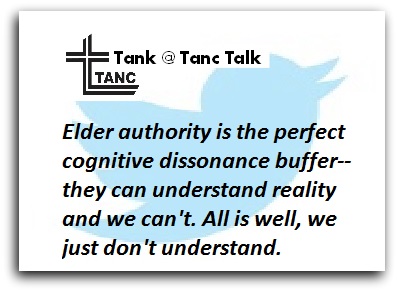 Therefore, when it comes to spiritual matters, trust God’s anointed regardless of the obvious. In cognitive dissonance, the thing used in an attempt to reconcile two contradictions as much as possible is called the “buffer.” In this case, the buffer is the belief that spiritual leaders must be obeyed because they are the ones who can see reality and we can’t. Sure, we can understand worldly things that have no eternal value, but when it comes to eternal matters the leaders must be trusted at all cost. The right problem to address is the buffer, not the symptom of being comfortable with contradictions. Discernment bloggers wrongly identify the real problem and work on the wrong one. They fail completely on Cain’s “W.”
And by the way, if you want to read a sermon by a conservative evangelical that exemplifies this dualist approach to reality, you can read it here, and listen to it here.
In addition, this author can give firsthand evidence of this mentality via correspondence from someone upset by what this ministry publishes.
Deep down you know that it is true. Turning logic on its head, twisting words, pseudo-scholarship, and outright attacking people for things that both you and I know they do not believe does no one any good.
Another misunderstanding is that I somehow knew and stood behind any improper things you may have experienced at Clear Creek.
These statements were made in light of the fact that citations/quotations make-up approximately 30% of what our ministry writes, and improper things “you may have” experienced is set against a website that thoroughly documents what exactly happened. The individual wrote these statements in the face of undeniable documentation. How can he do that? Because only those with authority can properly interpret reality despite the evidence presented to the contrary. That’s why. The individual also accused our ministry of “pseudo-scholarship.” Why is it such according to him? Because it doesn’t have the authority of Reformed institutional scholarship—they are the ones who really know the truth. Discernment bloggers seem to miss the point that institutional tyrants do not interpret reality in the normative sense.
Another point missed by discernment bloggers is: tyrants who interpret reality differently will not always act out in the same way. However, if the same ideology does not produce shameful behavior, it will at least produce tolerance for it. And the right question here is, “why is this so?” Answer: moral equivalence. If everyone is Adolf Hitler at heart, who is anyone to judge anybody for anything? We are ALL just sinners saved by grace after all. “Justice,” you say? What justice? We ALL deserve hell! Again, this is also seen in the aforementioned correspondence:
I truly grieve for the things that you have shared have happened with your family, but all either of us can do from here is look to faithful God and away from the sin that is in our heart and other men who will always ultimately disappoint because none of us are sinless.
Notice that he grieves for the things “that you have shared happened with your family,” i.e., how I interpret their actions, not what they actually did. And notice that the sin these men may have committed against me is also in my heart as well. So, they would say to the young ladies and boys who have been molested in the church, “So what?” The same sin that indwells the pedophile is in the victim as well. Can we not survey the past and present abuse and see this worldview plainly?
So, if there is no moral unequivalence necessitating a need for justice, all that is left is unity and peace for the sake of unity and peace which can only be obtained by blindly following those preordained to lead the great unwashed masses. We must also understand that this logic gave rise to institutions in general and the institutional church in particular.
Let’s work on the right problem: the worldview of the institutional church. Let’s ask the right question: “What should we do about it?” And finally, let’s remove obstacles to what works.
The obstacle that needs to be removed is fellowship with the institutional church. Again, the institution in and of itself is not the problem, but its caste worldview is the problem. Christians en masse must stop giving their money to the institutional church and must warn all people that they involve themselves with the institutional church at their own risk. It looks something like this:
Mark, likewise, I don’t care to debate with you because we see reality differently. I interpret reality grammatically, and you interpret reality redemptively like the Neo-Platonist “Christians” that you follow. Even John Street has bought into this latter-day antinomian nonsense. All I want to hear is that you stay clear of my family, and let’s be clear, it is not a wish—it is a demand, and I will protect my family at all cost—be sure of it.
Keep your family away from the institutional church. What else needs to happen in order to demonstrate that its fundamental worldview is horribly distorted? Husbands need to step up and take over their responsibility before Christ to lead their own families spiritually. You need to join a fellowship and be encouraged by men of God who can think for themselves and fear the Holy Spirit more than puffed-up control freaks. If you cannot find such a fellowship, do so in your own home.
paul
Related articles:
The Greatest Threat to Civilization in the 21st Century: Protestantism’s Doctrine of Death
 In researching the Reformation, one finds the “terror” of ISIS (Islamic State of Iraq and Syria) wanting in regard to its overall threat to civilization. Islam has always been inept in the politics of logic that despises life. Even many who agree with them will not buy into their means or politics. Per the usual since the 6th century, the likes of them only succeed in stirring up what little wrath there may be in the most passive among us.
A far greater threat, if not the threat, is Protestantism. While it is thought of by and large as a force for good in the world, if not the force for good in the world, its core logic is no whit different from Islam. Both are rooted in zero sum life value (not to be confused with life as zero sum game). The fallen creation is not merely weak by God’s metaphysical standards, it is utterly evil. If you can see it, feel it, smell it, taste it, or hear it—it is evil. The definition of faith is to believe that and nothing else, and a man’s highest calling is to set the masses free from placing value in this life. Protestant leaders are selfless souls in their own estimation, enduring the horrors of life for the sake of those who are in bondage to finding happiness here.
What people think they believe and how they function are two different things. This is where the intelligence of Martin Luther and John Calvin were far superior to their Islamic kinsmen. The latter think it important for people to know why they function the way they do; that wasn’t important to Luther or Calvin at all. In fact, they didn’t think the average person has the ability to know that anyway. Islam is considered fringe because they openly proclaim zero sum life. In contrast, Protestants claim to uphold the “sanctity of life,” but the core value is Luther’s doctrine of death. Islam is always too hasty—Protestantism is patient in its endeavor to plunge the whole world into its identity of darkness and death.
This fact is undeniable: while Protestants proclaim life, their father was a purveyor of zero sum life. Protestants have an appearance of loving life, and many actually think they do, but the core value of their hero and founder is death—this is an unavoidable metaphysical fact. We will first examine what Luther believed about life and reality, how that functions in life, and finally, why it is the greatest threat to the wellbeing of civilization in the 21st century.
The doctrine of zero sum life ALWAYS has three primary elements: material is evil and invisible is good; preordained mediators between the material world and the invisible world, and the goal of utopia. Though the varied assessments in each category are vast, the three fundamentals remain fixed with the SAME results: death and darkness. The only difference is the quality and experience in getting to the predictable end. These are ancient principles found in the cradle of civilization that play themselves out in myriad cyclic progressions of history. The Protestant Reformation was nothing new; it was a biblical version of the same worn-out caste system that has wreaked havoc on the earth since the Garden of Eden, and continues to do so in various and sundry expressions.
Obviously, the Protestant Reformation was not founded on Luther’s 95 Theses. That was a “Remember the Alamo” sort of thing. The doctrinal foundation of the Reformation came about six months later in Luther’s Heidelberg Disputation of 1518 to the Augustinian Order. In it, we find the three basic elements of ancient spiritual caste defined by zero sum life. Luther equated ALL human works with the natural and material:
Much less can human works, which are done over and over again with the aid of natural precepts, so to speak, lead to that end (Theses 2).
The manifest and visible things of God are placed in opposition to the invisible, namely, his human nature, weakness, foolishness (Theses 20).
That wisdom which sees the invisible things of God in works as perceived by man is completely puffed up, blinded, and hardened (Theses 22).
In other words, nothing that man does in this life can be based on wisdom from the invisible because he can’t comprehend it. He is enslaved to “natural precepts.” ALL visible things are defined by “human nature, weakness, foolishness.”
Because the material is supposedly evil, Luther believed that the deprecation of everything human and natural was the only way to experience wellbeing. Man cannot do anything good, but can experience wellbeing that comes from the invisible realm through suffering. Luther believed that Christ came to suffer in order to establish suffering and the annihilation of the natural as an epistemological gateway to the wellbeing of the invisible realm:
The manifest and visible things of God are placed in opposition to the invisible, namely, his human nature, weakness, foolishness. The Apostle in 1 Cor. 1:25 calls them the weakness and folly of God. Because men misused the knowledge of God through works, God wished again to be recognized in suffering, and to condemn »wisdom concerning invisible things« by means of »wisdom concerning visible things«, so that those who did not honor God as manifested in his works should honor him as he is hidden in his suffering (absconditum in passionibus). (Theses 20).
Viz, ALL knowledge of God is hidden in suffering. This is suffering as a plenary epistemology. Stated simply, spiritual wisdom cannot be known, but only experienced through suffering. The material cannot produce anything good which of course includes mankind. By the grace of God, mankind can experience the glory of heaven, but he cannot perform any work that has merit in the material realm.
This brings us to Luther’s preordained mediators for the great unwashed masses between the visible and invisible. He called them, Theologians of the Cross, or in other words, theologians of suffering:
That person does not deserve to be called a theologian who looks upon the »invisible« things of God as though they were clearly »perceptible in those things which have actually happened« (Rom. 1:20; cf. 1 Cor 1:21-25).
This is apparent in the example of those who were »theologians« and still were called »fools« by the Apostle in Rom. 1:22. Furthermore, the invisible things of God are virtue, godliness, wisdom, justice, goodness, and so forth. The recognition of all these things does not make one worthy or wise (Theses 19).
He deserves to be called a theologian, however, who comprehends the visible and manifest things of God seen through suffering and the cross (Theses 20).
These are men specially gifted, if that’s your perspective, in interpreting ALL reality, or at least reality that means anything significant, through redemption or the suffering of the cross. This was Luther’s version of Plato’s philosopher kings. While Plato’s epistemology was based on immutable elements in the shadow world such as geometry and math, for Luther it was the cross of suffering. The gateway to freedom from the bondage of “natural precepts” is the study and meditation of suffering, and better yet, the experience of it.
This is where Luther prescribed law and Scripture as a tool to pursue suffering as an epistemology and way of life. The Bible’s purpose, according to Luther, is to show us the depths of our depravity and worthlessness:
The law wills that man despair of his own ability, for it »leads him into hell« and »makes him a poor man« and shows him that he is a sinner in all his works, as the Apostle does in Rom. 2 and 3:9, where he says, »I have already charged that all men are under the power of sin.« However, he who acts simply in accordance with his ability and believes that he is thereby doing something good does not seem worthless to himself, nor does he despair of his own strength (Theses 18).
Luther’s focus was on the wellbeing of the individual and not necessarily that of society, but obviously, individual wellbeing defines the collective wellbeing of community. The use of the law for self-depravation and the embrace of suffering are key to experiencing wellbeing. Humble, broken individuals lead to a humble society.
The payoff for this way of life is a well-known Reformed doctrine till this very day: Vivification. Luther saw the Christian life as a perpetual cycle of death and rebirth. As man strives to see his depravity in the Scriptures and is driven to despair, the result is a recurring and deepening experience of future glory. This is the formal Reformed doctrine of Mortification and Vivification supposedly pictured in baptism. Hence, baptism doesn’t picture a onetime transformational event—the old self dying with Christ and then resurrected to new life, it is supposedly a picture of Christian life defined by perpetual death and rebirth:
He, however, who has emptied himself (cf. Phil. 2:7) through suffering no longer does works but knows that God works and does all things in him. For this reason, whether God does works or not, it is all the same to him. He neither boasts if he does good works, nor is he disturbed if God does not do good works through him. He knows that it is sufficient if he suffers and is brought low by the cross in order to be annihilated all the more. It is this that Christ says in John 3:7, »You must be born anew.« To be born anew, one must consequently first die and then be raised up with the Son of Man. To die, I say, means to feel death at hand (Theses 24).
Protestants of our day are in no wise confused about the doctrine Mortification and Vivification:
Progressive sanctification has two parts: mortification and vivification, ‘both of which happen to us by participation in Christ,’ as Calvin notes….Subjectively experiencing this definitive reality signified and sealed to us in our baptism requires a daily dying and rising. That is what the Reformers meant by sanctification as a living out of our baptism….and this conversion yields lifelong mortification and vivification ‘again and again.’ Yet it is critical to remind ourselves that in this daily human act of turning, we are always turning not only from sin but toward Christ rather than toward our own experience or piety” (Michael Horton: The Christian Faith; mortification and vivification, pp. 661-663 [Calvin Inst. 3.3.2-9]).
At conversion, a person begins to see God and himself as never before. This greater revelation of God’s holiness and righteousness leads to a greater revelation of self, which, in return, results in a repentance or brokenness over sin. Nevertheless, the believer is not left in despair, for he is also afforded a greater revelation of the grace of God in the face of Christ, which leads to joy unspeakable. This cycle simply repeats itself throughout the Christian life. As the years pass, the Christian sees more of God and more of self, resulting in a greater and deeper brokenness. Yet, all the while, the Christian’s joy grows in equal measure because he is privy to greater and greater revelations of the love, grace, and mercy of God in the person and work of Christ. Not only this, but a greater interchange occurs in that the Christian learns to rest less and less in his own performance and more and more in the perfect work of Christ. Thus, his joy is not only increased, but it also becomes more consistent and stable. He has left off putting confidence in the flesh, which is idolatry, and is resting in the virtue and merits of Christ, which is true Christian piety” (Paul Washer: The Gospel Call and True Conversion; Part 1, Chapter 1, heading – The Essential Characteristics Of Genuine Repentance, subheading – Continuing and Deepening Work of Repentance).
This is Luther’s utopian ideal: perpetual death and rebirth towards ultimate freedom from the natural.
What is the appeal of such a belief? It is the same as it has always been: this life that we are in bondage to does not have to be taken seriously; don’t worry, be happy. Life is worthless, and we are therefore not obligated to invest in it. This life is not what really matters, so don’t sweat it. Sure, if you want to excel in the shadow world, that’s fine, but it’s not really relevant. You can experience life in a completely relaxed mode because it is all just an illusion anyway. As with all trifold spiritual caste systems, EVERYTHING is predetermined, therefore, you are really not responsible for anything that happens. Neither is this point missed among Protestants as well:
What is the appeal of such a doctrine? I think it was stated best by the popular Reformed Mockingbird blog. They wrote an article entitled, The Subjective Power of an Objective Gospel. The following is an excerpt:
What, then, is the subjective power of this message? Firstly, we find that there is real, objective freedom, the kind that, yes, can be experienced subjectively. We are freed from having to worry about the legitimacy of experiences; our claims of self-improvement are no longer seen as a basis of our witness or faith. In other words, we are freed from ourselves, from the tumultuous ebb and flow of our inner lives and the outward circumstances; anyone in Christ will be saved despite those things. We can observe our own turmoil without identifying with it. We might even find that we have compassion for others who function similarly. These fluctuations, violent as they might be, do not ultimately define us. If anything, they tell us about our need for a savior (David Zahl and Jacob Smith: Mockingbird blog). (Paul M. Dohse Sr.: Pictures of Calvinism; TANC Publishing 2013, p. 34).
When it gets right down to the crux of it, this is the appeal in a nutshell. And what are the consequences for our 21st century culture? Dire. A return to the original articles of the Reformation and a proper understanding of it has been growing since 1970. In our day, “New Calvinism” which is a return to Reformation fundamentals has all but completely taken over the evangelical churches worldwide. The political consequences, especially in the United States, could be catastrophic.
 Why? For the first time in world history, the American idea adopted a government for the people and by the people. It was the first government in history to reject the ancient threefold caste system of man’s inability, oligarchy, and utopia. The common three-fold caste system has never produced anything other than suffering and tyranny. Protestantism is merely one of many different versions of three-fold spiritual caste. American Protestants of the past have been a strength for freedom because of their integration with capitalism, but with Protestantism returning to its original European roots, that has already changed dramatically. New Calvinists are markedly anti-American, and this should not surprise us in the least.
Compounding the problem is the aforementioned issue of beliefs versus function. American Protestants profess to believe in individual responsibly and capability, but they function as those totally dependent on experts to understand reality. While they would verbally reject the three-fold caste system based on beliefs, they clearly function by all three elements.
This is confirmed by what evangelicals profess as set against blatant contradictions. The most glaring contradiction is the idea that America is a “Christian nation.” Worse yet, we must be a Christian nation because if we weren’t, that only leaves “secular,” and secular equals evil because, well, it’s not Christian. This is a mentality spawned from element one of spiritual caste: material is evil—invisible is good, and Christianity represents the invisible. My wife Susan, after being a Christian for more than 50 years, is beginning to recognize this. Though she would have always rejected the idea of spiritual caste as a lifelong professional educator, there was a time when she thought the only good teacher was a Christian teacher. In her mind, only Christian teachers had a proper grasp of reality. Where did she get such ideas?
In regard to groups that threaten American liberty, patriots would do well to add Protestants to the list. And unwitting Protestants who think they are patriots should wise up and do their own research. To the New Calvinists, anybody being in control is better than “We the people.” American exceptionalism is based on individual ability, not total depravity. For the most part, New Calvinists do not vote, and if they do, they vote socialist. Why? Because there is only one thing worse than communist rule in their minds: the collective will of totally depraved individuals. This ministry researches in the realm of New Calvinism, and anti-American rhetoric is a constant theme among them.
First, New Calvinism is a huge movement, and growing; second, if America goes south, so goes the world. Right now, America has, at the very least, a 45% leaning towards socialism, and the ever-growing New Calvinist movement will continue to chip away at the remaining 55%. What needs to be done?
Those who get it must stop arguing with New Calvinists on their own terms. They must be confronted in regard to their interpretation of reality and what their mentors really believed. In light of their massive and blatant contradictions to the plain sense of Scripture, why does this movement continue to grow by leaps and bounds? Answer: most Christians would say that we must interpret Scripture for ourselves, but we don’t function that way. If a leader states something that seems like a blatant contradiction to us, we chalk it up to our own inability and assume them to be the experts.
We must come to grips with the fact that these “experts” are no different from the chanting Buddhist monks sitting on the ground dressed in orange bath towels and shaved heads. Such do not benefit American freedom—you have never seen any of them in line at a voting location. New Calvinist numbers are growing at an alarming rate among what is left of evangelicalism, and that could very well tip the balance of influence and America’s future political landscape, and where America goes, so goes the world.
That’s why Protestantism is now the greatest threat to civilization in the 21st century.
paul
Election

This will be our ninth and final lesson on election. We will now continue on in our verse by verse study of Romans. We will resume in Romans 14:1. Just three chapters left in our study of Romans. We are not quite ready to relent from our focus on justification in this gospel-illiterate age, so our next verse by verse focus will be Paul’s letter to the Galatians.
I wanted to divert into a temporary journey of discovery regarding election because it is an important part of Paul’s letter to the Romans. As I have stated before, I was comfortable skimming over the subject because of the overall ignorance in regard to justification. I somewhat rethought that position and decided to look at election closer. The first eight parts of our interlude have set forth a mostly logical argument against the idea of salvific preselection of individuals, but I believe our study here nails down a definitive doctrinal argument based on grammatical interpretation.
I have come to believe that individuals are not preselected, but it is the plan of salvation that is elected, and the end of it predetermined. Hence, the certain outcome of God’s plan for the ages is what is predetermined, and that is part of the good news: a hopeful outcome is predetermined, not specific people. Certainly, God knows who is going to be saved, but He does not preselect individuals for eternal life and eternal damnation. I have seen this vaguely in Scripture from time to time, but the first three chapters of Ephesians have convinced me of it.
This is why we are going to move on in the book of Romans; we could spend a lifetime learning about election, but I think basic understanding is enough for now as we will see more of the pieces come together in future readings.
Whenever election appears in the text of Scripture, the subject is almost always Jew and Gentile, and that is what we see in the first three chapters of Ephesians. Election is not about individuals, it is about God’s purpose for groups in His overall plan of salvation. Individuals are not excluded from the plan of salvation. The plan is offered as a gift to man, and there is no other way to be saved. That’s the theme of election—it is the offering of a gift; viz, God’s plan of salvation for all men.
Ephesians 1:3 – Blessed be the God and Father of our Lord Jesus Christ, who has blessed us in Christ with every spiritual blessing in the heavenly places, 4 even as he chose us in him before the foundation of the world, that we should be holy and blameless before him. In love 5 he predestined us for adoption as sons through Jesus Christ, according to the purpose of his will, 6 to the praise of his glorious grace, with which he has blessed us in the Beloved.
“Us” refers to both Jew and Gentile. Jew and Gentile were chosen before the foundation of the earth, not individuals. Paul will also cite the specific purposes of God’s plan accordingly. Two groups of people are in view here, not individuals. As we move along, this becomes clearer and clearer. These groups were chosen “in Christ.” His death made the inclusion possible. These groups will also be adopted sons, or part of God’s literal family.
Ephesians 1:7 – In him we have redemption through his blood, the forgiveness of our trespasses, according to the riches of his grace, 8 which he lavished upon us, in all wisdom and insight 9 making known to us the mystery of his will, according to his purpose, which he set forth in Christ 10 as a plan for the fullness of time, to unite all things in him, things in heaven and things on earth.
What is elected is Christ and God’s plan for the ages. The “mystery” of His will is according to His purposes set forth in Christ. The purposes are, “to unite all things in him,” which includes heaven and earth, and to make it all “known to us,” that is, Jew and Gentile.
Ephesians 1:11 – In him we have obtained an inheritance, having been predestined according to the purpose of him who works all things according to the counsel of his will, 12 so that we who were the first to hope in Christ might be to the praise of his glory. 13 In him you also, when you heard the word of truth, the gospel of your salvation, and believed in him, were sealed with the promised Holy Spirit, 14 who is the guarantee of our inheritance until we acquire possession of it, to the praise of his glory.
“We” is Jew and Gentile. But, “we” in verse 12 are the Jews only who were first to hope in Christ. God’s will is that they be the “praise of his glory.” Note “In him you also” (verse 13) is obviously talking about Gentiles. Individuals are not the subject here. What is in view is God’s plan, purposes, and the groups that He has chosen to bring about those purposes according to the counsel of His will.
Individuals enter into the privileges and purposes of God’s plan when they hear the word of truth and believe. It is when we hear the gospel and believe that we are “sealed.” Hence, it is God’s plan for people groups that is predetermined, individuals are saved in time when they hear the gospel and believe. It is “when” we heard and believed that we were “sealed,” we were not sealed before the foundation of the earth; we were sealed in time when we believed. There is a clear distinction in the text between these two ideas. We enter into God’s family and His plan for the ages “through” faith.
Ephesians 2:1 – And you were dead in the trespasses and sins 2 in which you once walked, following the course of this world, following the prince of the power of the air, the spirit that is now at work in the sons of disobedience— 3 among whom we all once lived in the passions of our flesh, carrying out the desires of the body and the mind, and were by nature children of wrath, like the rest of mankind. 4 But God, being rich in mercy, because of the great love with which he loved us, 5 even when we were dead in our trespasses, made us alive together with Christ—by grace you have been saved— 6 and raised us up with him and seated us with him in the heavenly places in Christ Jesus, 7 so that in the coming ages he might show the immeasurable riches of his grace in kindness toward us in Christ Jesus. 8 For by grace you have been saved through faith. And this is not your own doing; it is the gift of God, 9 not a result of works, so that no one may boast. 10 For we are his workmanship, created in Christ Jesus for good works, which God prepared beforehand, that we should walk in them.
“Made ‘us’ alive together with Christ” continues to show the dominant theme of Jew and Gentile and God’s purposes in making both groups joint heirs of God’s salvation and entry into His family. Now, many take note of “For by grace you have been saved through faith. And this is not your own doing; it is the gift of God”…
See! See! Your very faith is a gift. Not only is the plan predestined, your faith is predestined.
So, the question becomes, is it God’s grace (salvation) that is the gift, or faith? Let’s answer the question with Scripture:
Romans 3:22…For there is no distinction: 23 for all have sinned and fall short of the glory of God, 24 and are justified by his grace as a gift, through the redemption that is in Christ Jesus, 25 whom God put forward as a propitiation by his blood, to be received by faith. This was to show God’s righteousness, because in his divine forbearance he had passed over former sins. 26 It was to show his righteousness at the present time, so that he might be just and the justifier of the one who has faith in Jesus. 27 Then what becomes of our boasting? It is excluded.
Clearly, it is grace that is the gift, made possible by Christ’s death, and “received” by faith. In both texts, the fact that grace is the gift excludes boasting, not the idea that our faith is predetermined. Also, “Of this gospel I was made a minister according to the gift of God’s grace, which was given me by the working of his power” (Eph 3:7). Grace is the gift, not faith. Faith comes by hearing the word and being persuaded that it is the way of salvation.
Ephesians 3:11 – Therefore remember that at one time you Gentiles in the flesh, called “the uncircumcision” by what is called the circumcision, which is made in the flesh by hands— 12 remember that you were at that time separated from Christ, alienated from the commonwealth of Israel and strangers to the covenants of promise, having no hope and without God in the world. 13 But now in Christ Jesus you who once were far off have been brought near by the blood of Christ. 14 For he himself is our peace, who has made us both one and has broken down in his flesh the dividing wall of hostility 15 by abolishing the law of commandments expressed in ordinances, that he might create in himself one new man in place of the two, so making peace, 16 and might reconcile us both to God in one body through the cross, thereby killing the hostility. 17 And he came and preached peace to you who were far off and peace to those who were near. 18 For through him we both have access in one Spirit to the Father. 19 So then you are no longer strangers and aliens, but you are fellow citizens with the saints and members of the household of God, 20 built on the foundation of the apostles and prophets, Christ Jesus himself being the cornerstone, 21 in whom the whole structure, being joined together, grows into a holy temple in the Lord. 22 In him you also are being built together into a dwelling place for God by the Spirit.
This is the “mystery” that is now revealed:
Ephesians 3:1 – For this reason I, Paul, a prisoner for Christ Jesus on behalf of you Gentiles— 2 assuming that you have heard of the stewardship of God’s grace that was given to me for you, 3 how the mystery was made known to me by revelation, as I have written briefly. 4 When you read this, you can perceive my insight into the mystery of Christ, 5 which was not made known to the sons of men in other generations as it has now been revealed to his holy apostles and prophets by the Spirit. 6 This mystery is that the Gentiles are fellow heirs, members of the same body, and partakers of the promise in Christ Jesus through the gospel.
And another purpose is stated:
Ephesians 3:8 – To me, though I am the very least of all the saints, this grace was given, to preach to the Gentiles the unsearchable riches of Christ, 9 and to bring to light for everyone what is the plan of the mystery hidden for ages in God who created all things, 10 so that through the church the manifold wisdom of God might now be made known to the rulers and authorities in the heavenly places.
The revealing of the mystery and its purposes in Christ is what is elected, not individuals. This is the very theme that is initially stated:
Ephesians 1:3 – Blessed be the God and Father of our Lord Jesus Christ, who has blessed us in Christ with every spiritual blessing in the heavenly places, 4 even as he chose us in him before the foundation of the world, that we should be holy and blameless before him. In love 5 he predestined us for adoption as sons through Jesus Christ, according to the purpose of his will, 6 to the praise of his glorious grace, with which he has blessed us in the Beloved.
Again, “us” is both Jew and Gentile—that the two would be one is what is predetermined—not individuals. It is an “eternal” purpose (Eph 3:11). We gain “access” to this purpose and become part of its covenants and promises “through our faith in him” (Eph 3:11). Faith is distinct from the eternal purpose which is elected. God elected the means which are accessed through faith. If faith is the mark of those who have been preselected as opposed to those who haven’t been preselected, why wouldn’t the Bible state that fact in plain terms? This is why some peradventure to make faith a gift in the same wise as grace using Eph 2:8. Romans 3:22ff and many other texts refute that idea—grace is the gift. In one sense, faith is an indirect gift because without grace there is nothing to believe in, but in the biggest sense salvation is a legitimate offer and mankind’s choice to either accept the gift or reject it.
In this discussion, let’s consider Matthew 22:
And again Jesus spoke to them in parables, saying, 2 “The kingdom of heaven may be compared to a king who gave a wedding feast for his son, 3 and sent his servants to call those who were invited to the wedding feast, but they would not come. 4 Again he sent other servants, saying, ‘Tell those who are invited, “See, I have prepared my dinner, my oxen and my fat calves have been slaughtered, and everything is ready. Come to the wedding feast.”’ 5 But they paid no attention and went off, one to his farm, another to his business, 6 while the rest seized his servants, treated them shamefully, and killed them. 7 The king was angry, and he sent his troops and destroyed those murderers and burned their city. 8 Then he said to his servants, ‘The wedding feast is ready, but those invited were not worthy. 9 Go therefore to the main roads and invite to the wedding feast as many as you find.’ 10 And those servants went out into the roads and gathered all whom they found, both bad and good. So the wedding hall was filled with guests.
11 “But when the king came in to look at the guests, he saw there a man who had no wedding garment. 12 And he said to him, ‘Friend, how did you get in here without a wedding garment?’ And he was speechless. 13 Then the king said to the attendants, ‘Bind him hand and foot and cast him into the outer darkness. In that place there will be weeping and gnashing of teeth.’ 14 For many are called, but few are chosen.”
Again, the context of election is two groups: Jew and Gentile. Jesus directs this parable towards the Jewish leaders who were rejecting Him and leading the Jewish people to do the same. The original invitation to the wedding feast was to the Jews. When they, for the most part rejected the invitation, and even murdered those who invited them, the King orders His servants to call anyone they can find to the feast (the Gentiles). The one found at the feast without the traditional wedding coat represents a Jew who comes to the feast on his own terms.
What I would like to address is verse 14, “For many are called, but few are chosen.” Just about everywhere else in Scripture, the same word translated “chosen” here, is eklektos which appears 21 times in the New Testament and translated “elect.” So, a better translation here would be, “many are called, but few are elect.” Jesus was addressing the mindset of the Jewish leaders that they would be a part of the great feast because they were God’s chosen people. In reality, they were being called to God’s elect purposes which included Christ, the elect angels, and the election of Jews and Gentiles both. Their rejection of this elect purpose would condemn them to eternal punishment. The point saturates the context surrounding this passage.
This brings us to the infamous Acts 13:48:
And when the Gentiles heard this, they began rejoicing and glorifying the word of the Lord, and as many as were appointed to eternal life believed (ESV).
Regardless of the controversy surrounding the various translations of this verse, the context is God’s predetermination that the Gentiles would become heirs of the promises made to Israel. There would not be two classes of people in the kingdom—Jew and Gentile would become one body in the commonwealth of Israel. That is the mystery of the gospel revealed in this age. Acts is the historical account of this plan being unfolded. The point in Acts 13:48 is the inclusion of a group, not the preselection of individuals. I do believe that many translations slant this verse towards that conclusion (individual selection), but clearly, it doesn’t fit the context and is off-topic.
It is amazing how we have been conditioned by Protestantism to interpret everything through the prism of individual selection. Every instance of intervention on God’s part is used to assume plenary predeterminism and thereby plunging the Scriptures into total confusion. God “opened” Lydia’s heart, so that means nobody understands anything unless God shows it to them. Hence, all ignorance is predetermined by God. “Study to show thyself approved,” but you aren’t going to understand anything unless God “opens” your eyes like He did to the disciples on the road to Emmaus.
This extreme view of Scripture starts with plenary monergism, and can only lead to one place: a caste system that inserts philosopher kings as mediators between mankind and God. This is also why Reformed theology posits Christ as the primary member of the Trinity with God the Father and the Holy Spirit playing secondary roles: Christ is promoted to the role of Father so that men can assume His role as mediator between God and mankind. This is where a Platonist worldview is essential to the mediation of elitist philosophers construct. God predetermines certain men to rule over the great unwashed masses. This, in turn, leads to absolution and salvation being found in an institution run by elitists.
Yet another consideration:
Romans 9:6 – But it is not as though the word of God has failed. For not all who are descended from Israel belong to Israel, 7 and not all are children of Abraham because they are his offspring, but “Through Isaac shall your offspring be named.” 8 This means that it is not the children of the flesh who are the children of God, but the children of the promise are counted as offspring. 9 For this is what the promise said: “About this time next year I will return, and Sarah shall have a son.” 10 And not only so, but also when Rebekah had conceived children by one man, our forefather Isaac, 11 though they were not yet born and had done nothing either good or bad—in order that God’s purpose of election might continue, not because of works but because of him who calls— 12 she was told, “The older will serve the younger.” 13 As it is written, “Jacob I loved, but Esau I hated.”
14 What shall we say then? Is there injustice on God’s part? By no means! 15 For he says to Moses, “I will have mercy on whom I have mercy, and I will have compassion on whom I have compassion.” 16 So then it depends not on human will or exertion, but on God, who has mercy. 17 For the Scripture says to Pharaoh, “For this very purpose I have raised you up, that I might show my power in you, and that my name might be proclaimed in all the earth.” 18 So then he has mercy on whomever he wills, and he hardens whomever he wills.
19 You will say to me then, “Why does he still find fault? For who can resist his will?” 20 But who are you, O man, to answer back to God? Will what is molded say to its molder, “Why have you made me like this?” 21 Has the potter no right over the clay, to make out of the same lump one vessel for honorable use and another for dishonorable use? 22 What if God, desiring to show his wrath and to make known his power, has endured with much patience vessels of wrath prepared for destruction, 23 in order to make known the riches of his glory for vessels of mercy, which he has prepared beforehand for glory— 24 even us whom he has called, not from the Jews only but also from the Gentiles?
Once again, what is the context? In fact, what is the context of what follows in Romans chapters 10 and 11? Answer, the whole Jew/Gentile issue… “even us whom he has called, not from the Jews only but also from the Gentiles?” Because of God’s elected purpose, neither Jew nor Gentile has reason to boast. And again, it is grace that is elected, not individual choice. Does the Bible ever say directly that individual choice is predetermined? I don’t think so. Rather, freedom to choose seems to be assumed. For certain, what man can choose is predetermined, but the choice itself is not predetermined. Many things such as God’s intervention and helping us in our weakness is interpreted as plenary monergism—I think this is wrong—weakness does NOT equal total inability.
Furthermore, indeed, God hated Esau and loved Jacob before they were even born…or did he? Read the text carefully. Before they were born, he predetermined that the older would serve the younger based on what God knew about these two men and their lives beforehand. Esau would not be selected to further the linage of the coming Messiah because of what God knew about his character beforehand. If you read the Old Testament text that Paul uses to make his point (Malachi 1:2,3), you will find that God hated Esau because of his betrayal of Israel in time, not because God predetermined his behavior.
God elected the plan of salvation and His purposes for the ages. All men are “invited” (klētos: Rom 8:28; Matt 22:14) to be a part of this plan THROUGH faith. Many are invited, but only those who love God are part of His elect group called out for His specific purposes. The plan, and the way he works all things together for the elect is His “workmanship,” not individuals per se. In other words, God doesn’t predetermine our choices as God’s elect. He may intervene at certain points to bring about our good, but we are responsible for our own choices. Unsaved people are free to accept the invitation or reject it.
This is why many of the Reformed make it a point to call the gospel an “announcement,” “herald,” or “proclamation.” The idea that the gospel is an “invitation” creates huge problems for them.
The so-called “church,” ekklēsia, is the “out-called,” ek (out) – klesia (called). It is not an institution; it is a calling to Gods purposes for the ages and an invitation to be a part of it. You are being called away from all other plans to God’s plans that have a certain end—you can also call that “repentance.” You are “persuaded” by the invitation and believe it.
You are then part of God’s elect.
We are ALL Calvinists. Yes, You Too
 Why has the Neo-Calvinist movement all but completely taken over the church? Because we are all Calvinists to begin with.
“What! I don’t believe in election! I’m not even a one-point Calvinist!”
See what I mean? Christians believe Calvinism is defined by the sovereign grace issue. No, Calvinism is defined by the plenary inability of man issue. Calvinism completely owns the prism in which Western Christianity interprets reality and the Bible. This was their goal from the very beginning, and I must give them credit for the excellent job they have done.
I catch on slow, but apparently, I eventually catch on. For years I have been sending emails to the who’s who of the Not Reformed among us stating the following:
“Uh, guys, Calvinism holds to a blatantly false justification, and this is simple theological math. If people of your stature start talking about this—they are done.”
Not one reply ever, except from a well-known evangelical that told me what I should have already known:
“We all believe the same gospel.”
Yep. What has become obvious to me is that the academics on both sides feed all of the drama to keep the dumb sheep distracted from the real issue: Protestantism is a false gospel. Arminians and Calvinists have the same gospel at stake and all of the money that goes with it. Catholicism and Protestantism both are institutions that collect a tax, and foundational to any religious institution is the idea of human mediators. In other words, religious institutions must have a spiritual caste system.
This confuses body life with authority, and the purpose of the body of Christ. The body of Christ and institutions are mutually exclusive. This is what all of the academia on both sides of the Calvinism/Arminian debate don’t want the herd to figure out. The called out assembly of Christ was based on the fellowship of likeminded believers in one mind, or one truth. It’s based on conscience and not authority. Get into the New Testament and find an institution construct that resembles what we have today in any regard—good luck. That’s not to say there isn’t organization; there most certainly is, but that’s not the same as institutional caste.
A religious institution must have one particular gospel in order to survive: a linear one; specifically, the “golden chain of salvation” (eerily similar to the “golden chain of philosophers” or the “golden chain of Platonic succession”). It isn’t complicated; justification/salvation isn’t finished and you need the religious scholars to help you make sure you finish it correctly. Come now, look around. We don’t find our own understanding in the Bible with the help of the Holy Spirit, we listen to men. Christian academia is a multi-billion dollar a year business. While we say, “The Holy Spirit is my counselor and He uses the Scriptures which I am called on to study,” that’s not how we function at all. The idea that salvation is not finished dominates the American institutional church.
“But I believe that my salvation is finished!”
No you don’t. You believe that YOUR part of it is finished while Jesus is finishing your salvation for you, lest it be by works. This is why Calvinists and Arminians only stop arguing about election long enough to say in unison, “But for the grace of God there go I.” And, “We are all just sinners saved by grace.” Calvinists and Arminians teach the exact same inability in sanctification gospel. Why? Since salvation is an ongoing process in their minds, any ability on our part in sanctification suggests a colaboring in our justification. Martin Luther taught the following: if any good work done by a Christian was “attended to with fear,” God would not consider it a mortal sin. The contemporary version of this is the often heard, “I didn’t do it, the Holy Spirit did it.” Indeed, Christians caught doing a good work even in our day must plead their case.
If salvation is truly finished, and we have ability to pursue our gifts because the only possible motive is love, that obviously decentralizes the need for authority. In contrast, the steroidal introspection continually called for in the institutional church Sunday after Sunday, after Sunday is clearly on display.
The institutional church is that research foundation looking for the latest and best way to work by faith alone so that Jesus will not be angry. You need them, and they need your money to research the best way to let Jesus finish your salvation for you, lest your part is a work that is really a work and you find yourself in hell. People will pay big money for that information, and obviously do. We have a name for all of the theories that come out of this research: Denominations. This is nothing more or less than different theories on how to live our Christian life by faith alone.
The placard below is what inspired this post; it is indicative of the Protestant gospel that encompasses all of the various denominational labels, but what they all have in common is faith alone in sanctification because justification isn’t finished. Note that each statement is a blatant contradiction to many different Bible verses. Rather than the Bible being a tool for aggressive obedience in sanctification, it is a tool for reminding us how weak we are, even in the new birth, and reminding us of how much we still need the same gospel that saved us lest we try to help Jesus finish our salvation.
paul


 Paul's Passing Thoughts
1 comment