The Biblical Emphasis on Pastors and Their Authority: Where is It? Romans 15:14
 Listen to the show audio or download the video file here.
Welcome to Blogtalk Radio False Reformation this is your host Paul M. Dohse Sr. Tonight, “The Biblical Emphasis on Pastors and Their Authority: Where is It?” If you would like to add to our lesson or ask a question, call (347) 855-8317. Remember to turn your PC volume down to prevent feedback. Per the usual, we will check in with Susan towards the end of the show and listen to her perspective.
If you would like to comment on our subject tonight, you can also email me at paul@ttanc.com. That’s Tom, Tony, Alice, Nancy, cat, paul@ttanc.com. I have my email monitor right here and can add your thoughts to the lesson without need for you to call in.
We are going to begin tonight by surveying the present landscape. The church invests billions in the education and accreditation of pastors. Of course, this is all made possible by the working class laity. Pastorate authority is expressed in church polity, and they are seen as the gatekeepers of orthodoxy. Never before in history have so many willingly paid so much for the privilege of being subservient.
Let me just pull the rabbit out of the hat right now. Let me go ahead and reveal where I am going with all of this tonight, and then I will make my case. We know that America was the first idea in human history that rejected the marriage of faith and force, and the results speak for themselves. We also know why some people deny what America has done for the world because of their ancient presuppositions concerning mankind; i.e., if mankind is allowed to self-govern, chaos will ensue.
There is that crowd, then there is the crowd that thinks mankind is just outright evil, and the American idea emphasizes life and liberty, so America is the antitheses of this whole idea that mankind is evil. And remember, this is not just a religious idea. No, no, no. This is also very prevalent among secular ideas. Some environmentalists would be included among them.
In the minds of the framers of the American Constitution, the marriage of faith and force always leads to tyranny, and history would agree. It all starts with those who are specially gifted to know truth that the masses are not able to understand, and for their own good, the masses that is, or the “great unwashed” if you will, the great seers call on the state to enforce their wisdom for the good of mankind and its overall survival. It is a striving for social justice leading to utopia.
We know that this basic presupposition about man’s ability to self-govern always leads to tyranny, and it now begs the question: culturally, in the church, if truth is married with pastoral authority, is the same tyranny inevitable? We think the answer is “yes.” The marriage of faith and authority in the church will yield the same results as the marriage of faith and force among governments. The problem is the injunction of truth on the majority by the few.
Without getting into another body of study altogether, let me answer some anticipated objections. A couple of weeks ago while Charlie Rose was interviewing the president of Syria, here is a paraphrase of what he said: “Society in general doesn’t accept the use of chemical weapons.” Interesting. What was he in essence saying albeit probably unwittingly? Answer: Romans chapters one and two. The law of God is written on the hearts of every man and his God-given conscience passes judgement on his actions. Why do we need government? For people who are deficient in regard to their faculties of conscience—that’s why.
Let’s note something important moving forward. The behavior evidenced in the church in our present day is consistent across all religions and denominations. Why? Because they all have one thing in common: they marry faith and authority. This is just another institutional church elephant in the room; the question of pastoral authority. And how churches get around this is soooo smooth:
“As pastors, our only authority is in the word of God.”
Well, that’s just wonderful because the Bible covers every nuance of life. While that answer usually assumes the Bible is boss and pastors only point people to its authority, what is really being said is the Bible determines the parameters of their authority which is without bounds if determined by the Bible.
What does this across-the-board authority look like regardless of the particular breed of church? What does it mean when we say that pastors “have authority”? It all starts with a same presupposition concerning mankind. Basically, mankind in general is not able to properly understand reality in a way that brings about social justice resulting in utopia. Man needs to be ruled over for his own good, and those who believe man can self-govern must be neutralized for the good of the many.
This is why the line between churches and liberal leftwing politics is often blurred. Why did some church, I think in New York, recently sue Walmart to ban their gun sales? Because in their mind, you just can’t have people in general running around with guns. In their minds, that’s a disaster waiting to happen.
So, it starts with that philosophy. Now, how does it seek to implement this philosophy? What system dictates the application for the greater good? Again, in ALL religions and denominations it’s the same: mediation, authority, orthodoxy, progressive justification, polity, political collectivism, resulting in the EXACT same results and behavior. This is the technical definition of “the church.” Take note of how often you hear “the church” in the everyday white noise of churchianity.
Mediation. The Bible makes it clear that there is one mediator between God and man: Christ, period. All institutional churches have a concept of what Protestants call the “power of the keys.” This is the idea that the institution represents the body of Christ on earth. Hence, institutional membership is synonymous with salvation. The institution represents Christ’s mediation on earth by proxy. Whatever the church binds on earth will be bound in heaven, and whatever the church looses on earth will be loosed in heaven.
Authority. Vested in the elders/pastors of the church regardless of the fact that Christ clearly stated that ALL authority in heaven and earth has been given to Him. Pastors are men who have been preordained and specially gifted to know things that the common Christian does not know. Therefore, God has supposedly given them authority on earth for the collective good of mankind. Every institutional church has its own breed of popery.
“But Paul, I am a Southern Baptist and our churches are” …and this is so adorable… “independently autonomous.”
OK, now try to be a pastor of a Southern Baptist church without a degree from a Southern Baptist seminary. Good luck with that. If you are not credentialed, if you do not speak according to authority given you by the church, if your words do not carry authority by the aping of those credentialed, you are nothing but a little yapping mutt that will be ignored. If you tithe enough, people will put up with you and that’s about it.
For the time being, file this away: this is the exact same system Christ was up against when he came. How did He deal with it? Confirming miracles. Remember the paraplegic He healed so that people would know that the Son of Man has authority to forgive sins on earth?
Orthodoxy. This is the extra-biblical authoritative body of teaching that is developed by those in authority. Since the great unwashed cannot understand truth, orthodoxy takes the higher knowledge of truth and puts it in story form for the spiritually adolescent masses. It’s exactly like story books written for children that explain reality via narratives that they can understand. In church culture, orthodoxy is synonymous with truth itself. This is why in seminary you are told straight up that the knowledge you are learning there is not anything you will be teaching at local churches—they can’t understand it. However, you will learn a lot about being a good spiritual cowboy who keeps the herd from being spooked resulting in a stampede. You will also be taught how to deal with those who think they can know truth, also known as Mad Cow disease.
Progressive justification. All religions and denominations have some form of progressive justification. This soteriology is the necessary gospel that must go hand in hand with mediation, authority, and orthodoxy. It is the teaching that salvation progresses from point A to point B, and the institutional church is the overseer of that progression. This is a hard-fast rule. The church cannot function or survive by propagating the true gospel—it’s impossible and we will look at why this is the case tonight. Why are there so many different religions and denominations? It’s all disagreement on how you get from point A to point B.
Polity. Or “church polity.” This is a soft term for “church government.” All churches have church government. It’s different levels of authority and an epistemological pecking order. In contrast, biblical contra church assemblies are based on fellowship with the Father and His Son—not authority. Historically, churches enforce polity by getting into bed with the government, but post America, the emphasis is control over your salvation.
In pre-American history, if you didn’t believe the church had the authority to take away your salvation, they would simply hang you, drown you, cut you in half, or burn you, not necessarily in that order. So, in our day, the heavy emphasis is authority and control over your eternal destiny. Why do people obey the outrageous notions that flow from the traditions of men? Because their eternal salvation depends on it, and “faith believes all things,” right? One of the favorite truisms vomited out by the clergy is this whole Lutheresque idea that “knowledge puffeth up” and makes people proud.
The real problem is that informed people are very difficult to control. Let me pull another rabbit out of the hat right now. I will make the case tonight that cultism goes hand in hand with elder authority. It is absolutely impossible to separate horizontal authority among God’s people and cultism. Religion plus horizontal authority ALWAYS equals cult. This is an unavoidable and hard-fast rule.
Political collectivism. Here is the dirty little secret: ultimate control is really in the hands of the populous. Why? It’s simple; they outnumber government. In China, if the people decide to rise up, the Chinese government is totally screwed. There are particular things common to people that the framers of the American constitution recognized such as those things that are “self-evident.” All in all, the church has merely stuck its nose in the debate over who owns truth: mankind in general or the state?
This necessarily demands a conversation about the church’s dominion theology. Is God’s kingdom presently on earth, or is it presently in heaven? If it is presently down here, then obviously the church has a dog in the fight. Therefore, since populous rule is the real power in the world, power is determined by how many people you have effectively brainwashed. The church cannot avoid being a political animal seeking to gain control by numbers and infrastructure because it believes it is a nation builder on earth.
This includes all of the trappings of doing good works to endear numbers, and formal education for the purposes of indoctrinating people. Most church hierarchies openly admit that their agenda is to take over every aspect of culture; i.e., education, the arts, etc, etc. The specific quotations abound and are not the least bit ambiguous.
Also, watch out for the “Oh my, missionaries are being persecuted for the gospel in this country, that country, or the other country.” No, many countries are more privy to the dominion aspirations of the church than their own missionaries. In many cases, it is feared that missionaries will incite an insurrection. A cursory observation of history confirms this as a valid concern. Traditionally, church missionaries not only want to get people saved, they want to quote, “transform the culture.” They say it all the time!
Let me stick this idea in here. Do you know how home fellowships could do world evangelism? We could find people gifted to be elders in other countries and bring them stateside to live for a while in the home fellowship network. They would live with a sponsoring family and learn/experience the New Testament model. As they learn and experience, they could be feeding the information back to their country of origin. This would be dirt cheap and very effective.
Do you know how expensive and ineffective world missions are in the institutional church? It’s horrific, and mostly predicated on Western arrogance. I have heard missionaries say it: “Without our academic wherewithal, effective ministry is impossible.” Behold the arrogance: after hundreds of years of trial and error and oceans of ink used in the pontification of orthodoxy, 1600 people a day leave the church and become Nones or Dones. 1500 pastors per month leave the ministry for good. But yet, the church continues to export this failed model overseas on the financial backs of the laity. It’s beyond insane.
Behavior. The results are all the same. Spiritual abuse in the church is just a symptom of the specific problem, church. Stuff happening in the church is not the problem—church is the problem. Thanks to the internet, we now know that the church produces the exact same behavior over and over and over again. We now know that the institutional church is nothing more or less than a super-cult.
Let’s begin to look at the evidence.
Yes, once again, Calvary Temple of Sterling, Va. is back in the news. Let’s listen to the recent news report by MRC TV titled “Sexual Abuse, Broken Families, and Race Cars: The Story Of An Alleged D.C.-Area Cult” dated 4/2/2015/. As you listen to this clip, make a list of the elements such as “authority,” “broken family relationships,” “control,” “divorce,” etc.
Listen, whether the HBO documentary I mentioned last week on Scientology, or my wife’s testimony in regard to her experience in the Baptist church, or what my son shared with me the other night about a Jehovah Witness that he works with and what that guy is going through with his church, or my own testimony, or myriads of testimonies that you can read via the internet discernment blogs, it is all the same basic elements in regard to behavioral outcomes.
Sure, John MacArthur Jr. isn’t going to marry a twenty-year-old and buy a dragster and a race car, he just oversees an in-house police station at Grace Community Church that will escort you out to your car if you ask too many questions in Sunday school. I know from firsthand testimony that MacArthur rules that church with an iron fist. I rubbed shoulders with some of his elders for years. In addition, accusations from relatively sound people that Grace Community Church is a cult abound. One such site is The Watchman Wakes .com / John MacArthur’s cult. Google that and the exact link should come up. Look, all one needs to know for purposes of confirming these allegations is MacArthur’s own words from last week’s sound bites; the inevitable result of the belief that elders have authority on earth is cultism.
Let’s also look at the obvious manifestation of well-behaved tyranny. Even though some church pastors would not engage in some of the more outrageous behavior, by and large, the well-behaved tyrants of the church turn a blind eye to the behavior and even cover for it. MacArthur is absolutely notorious for turning a blind eye to the atrocities committed by the institutional church. Why? The obvious answer is the church’s authority to forgive sins on earth. Without the institutional church, there is no means of salvation for anyone so the church must be saved at all cost. I am not sure what is more obvious.
Look, for example, Jack Hyles could have been shut down years ago. All it would have taken is twenty-five IFB pastors walking down the isle of First Baptist Church of Hammond, Ind. and rebuking the guy publically on a Sunday morning. Game over. Why doesn’t that ever happen even though it is the exact biblical prescription? Because the institution has to be preserved as God’s authority on earth by proxy—that’s why.
I am not going to rehearse the outrageous details of the ABWE scandal, but in reaction to ABWE refusing to deal with the situation, not one GARB church withdrew from the association in protest, and as far as I know, not one church withdrew support from ABWE. One GARB pastor that I know who was mortified by the scandal nevertheless allowed Michael Loftis, at that time the president of ABWE to speak at their church.
Why?!!!! because there is only one name under heaven by which man is saved—the institutional church and its authority on earth by proxy. This isn’t complicated. Support the church if you will, but also know that you are supporting the divine right of kings to rape, pillage and steel at will.
“But my pastor isn’t like that!” Yes he is—he turns a blind eye to it!
It’s all the same, and they all operate by the same principles; for example, let’s just take one, orthodoxy. For Baptists, what is it? The First and Second London Baptist Confessions. For Presbyterians, what is it? The Westminster Confession. For Jehovah Witnesses, what is it? The Watchtower. For Mormons, what is it? The Book of Mormon. For Islam, what is it? The Quran. It’s all the same stuff resulting in the same behavior. Read history for yourself—none of these religions acted any differently until America came along.
At any rate, the church invests billions in the education and accreditation of pastors. Their authority is expressed in church polity, and they are seen as the gatekeepers of orthodoxy. When one surveys the emphasis on pastors in the church, certainly we should expect to easily find abundant information about them in the Scriptures. A cursory observation of Scripture should reveal their purpose, scope of authority, and a description of their duties.
But in reality, the lack of biblical emphasis on pastors and elders is stunning when compared to the emphasis experienced in the institutional church. If a pastor has authority, where does that authority begin and end? While the idea of elder authority is common, any discussion of the parameters is extremely uncommon and such ambiguity can lead anywhere, and it does. Furthermore, their assumed authority is nowhere to be found in holy writ.
In regard to their importance in general, the specific gift of elder/pastor is mentioned a meager four times in Scripture.
In the most vital portions of Scripture where elders would be prevalent according to their assumed authority, they are not mentioned. In the corrective letters to Corinth where Christianity was completely off the reservation, elders are not mentioned once. In the book of Romans, the magnum opus of soteriology, again, elders are not written about.
In Paul and Peter’s mini-treatises regarding submission starting in the home, to the workplace, and society in general, again, no mention of elders (Eph 5:22-33, 1Pet 2:13-3:7).
In the protocol for solving conflict among believers in Matthew 18, the same. If a person finally refuses to repent of what he has done to a fellow brother, the passage doesn’t say to go tell the elders, it says to go tell the assembly. The process in Matthew 18 is commonly thought to be a process under the control and auspices of the elders, but if that’s the case, where are they?
Sure, when the Greek widows were treated unfairly as documented in Acts 6:1ff, the people appealed to the apostles, but who was given the responsibility to choose what I think were the first Deacons? Right, the saints in general. Not only that, notice that the solution offered by the apostles met the approval of the people. They did not go to the apostles for an edict—they sought their counsel and leadership in the situation, but it obviously needed the approval of the people.
In Philippians 4:2,3, Paul entreats the whole congregation to reconcile the two women who were in some kind of rift, and this is the same pattern found in Matthew 18 as well. Listen, we could go on and on and on and add Acts 17:11 as well, but is this sinking in? Where are the big bad elders? Where are they and their supposed authority? I do believe the apostles had authority, but clearly what they emphasized is the model that would follow after their departure; appeal to the one mind of Christ and not the dictation of authority.
Moreover, not only are elders conspicuously missing, the saints in general are told throughout the New Testament that they are qualified to do ministry that is normally attributed to elders exclusively. A good example is Romans 15:14.
I myself am satisfied about you, my brothers, that you yourselves are full of goodness, filled with all knowledge and able to instruct one another.
Another one is 1John 2:27.
But the anointing that you received from him abides in you, and you have no need that anyone should teach you. But as his anointing teaches you about everything, and is true, and is no lie—just as it has taught you, abide in him.
Clearly, when it gets right down to it, God’s people can do without elders. Eldership is a gift that is no more or less important to the body of Christ than any other gift. Yes, if God’s people are serious about furthering the testimony and deepening fellowship, they should seek out good elders. But eldership is not a horizontal authority granted by God. Eldership does not represent God’s authority on earth.
Indeed, the apostles did have some of God’s authority, and that’s why they will sit on twelve thrones judging Israel in the final days, but that authority was NOT passed on to the elders. This is why the apostles predominately appealed to the one mind of Christ and not authority.
So, what is in fact the biblical model? Let’s compare the biblical model point by point with the institutional model. Here we go.
Presuppositions concerning mankind. Simple, Romans chapters one and two. Man can know reality and is personally and individually accountable to God. Throughout history for the most part, society in general determines law and what is acceptable. But please do not underestimate the real debate underlying the more visible debates manifested in this question: does man understand the reality that he lives in. He most certainly does. Mankind does not need seers to rule over them who have special insight into a reality that the masses do not understand.
History is a vicious cycle of the masses buying into that philosophy resulting in revolts when the tyranny of it becomes more than they can bear. Life gets to the point where it is not worth living and there is an uprising. The framers of the American Constitution observed this vicious historical cycle of serfism, tyranny, war, freedom, serfism, tyranny, war, freedom, serfism, tyranny, war, freedom, and the lightbulb turned on. America is the greatest country ever because it is the first ever government by the people and for the people.
The Bible is clear, people stand before God at the judgement individually. Be sure of this: the church’s emphasis on pastors comes from the world’s debate on man’s ability to self-govern. According to the Bible, and more specifically 1John, God’s people are able to self-govern because all of them have the same anointing of the Holy Spirit. When it gets right down to it, we have no need for anyone to teach us.
Mediation. There is only one mediator between God and man—Christ. Clearly, the church posits elders as sub mediators. This does not pass biblical muster.
Orthodoxy. There isn’t any. God’s people do not need a dumbed down version of truth written by sub-mediators creating…watch it… here it is, “subordinate truth.” Really? This is absolutely nothing new and the very reason that the Bible is constantly drilling down on oneness: one truth, one mind, one mediator, one Spirit, one baptism, one anointing, one Lord, etc., etc., ect. There isn’t two minds, there is only one and one truth accordingly. And really? There is such a thing as a lesser truth? No, it is either true or it isn’t true.
Progressive justification. No institution or religious hierarchy is needed to get us from salvation point A to salvation point B. This is why we constantly hear, “We don’t believe the gospel and then move on to something else, we never leave the gospel.” “The gospel isn’t the ABCs of salvation, it’s the A-Z,” etc., etc., etc. If your salvation is finished, and you do move on to something else, guess who you no longer need?
The elements of the institutional church follow a logical progression: presuppositions concerning mankind; sub-mediation; orthodoxy or sub-truth; the gospel of progressive justification; church government (polity) because authority trumps fellowship; political activism because God’s kingdom is supposedly on earth (if it wasn’t authority would be absent), and the subsequent bad behavior ordinarily exhibited by the divine right of kings, mind control cults, and institutional ownership of truth.
Church polity (government). Christ’s assembly does not have a government structure. There is no church polity. There is a body made up of gifts that seeks to mature by “mutual edification” through fellowship under one head. There is no government, but rather organization. Here is the organization: gifted elders equip the saints for ministry, and deacons/deaconesses oversee need. There aren’t any bosses; it’s a cooperative striving for a common goal. It’s an organized body where every part is equally valued. It’s just this simple, and this is the exact same analogy seen throughout the New Testament: to the degree that your body is sound, you can accomplish work. Ephesians 4:1-16 spells it out point by point, and so does 1Corinthians chapter 12. That’s not a government—it’s an organized body.
Political collectivism. It is not the concern of Christ’s assembly to take over every aspect of culture. Our concern is to build up the body in love and let the world watch. And watch they will. Our kingdom is NOT on earth—it’s still up in heaven. That’s why we are called “ambassadors” in the Bible. What’s an “ambassador”? An ambassador doesn’t live in a country to…here it is, we hear this constantly…”take over the culture for Christ.” No, we are here to represent another kingdom that is not presently here.
Behavior. The goal is to think like our big brother Jesus Christ and do what He would do. And trust me, the world will take note.
Here are some references that you should read on your own: Matt 23:8, Psalm 133:1, Acts 4:32, Rom 12:16, Rom 14:19… Rom 15:5, 1Cor 1:10, 2Cor 13:11, Eph 4:3, Phil 1:27, Phil 2:2, Phil 3:16, 1Peter 3:8.
Elder authority, where is it? Where is the emphasis on body striving for unity in one mind? EVERYWHERE! Let’s now go to the phones.
Why Home Fellowships Can Help Abused Women and the Institutional Church Cannot

In our vision for a return to the way Judeo-Christian assemblies were done for about the first 300 years, let’s look at why home fellowships can help abused women and the institutional church cannot.
I would like to use this article as a catalyst for argumentation. The article was posted (author is not clearly stated) by Anna Wood who co-authored a book with Jeff Crippen, a Reformed pastor. The book can be found here.
The post is titled, What domestic abuse victims need from the church. My contention is that abused women cannot get what they need from “the church” as demonstrated over and over and over again. In fact, clearly, as also demonstrated over and over and over again as well, the institutional church adds to the abuse and becomes a co-abuser.
Why is this? The article offers a perspective from which to answer. This issue also speaks to the differences between home fellowships and the institutional church, hereafter “the church.” In an institution, it is easy to sign on the dotted line, give at the office, and pretend. Pastors can bark from Calvin’s Geneva pulpit all they want to; all folks have to say is, “Hey, I am a member in good standing, and as often heard, humble and incompetent—it’s not my gift and I am not qualified.” Likewise, in said article, the author’s call to “get involved” is going nowhere in the church in case anyone hasn’t noticed.
To the contrary, home fellowships are comprised of people who are sick of playing church, are weary of being mere spectators, and are not looking to walk into an arena with hungry lions, but know it could lead to that. They are also confident in the Spirit-filled laity and recognize where 500 years of academic popeism has brought us. In addition, they have a literal view of reality versus the functional dualism that drives orthodoxy. What am I saying? I am saying that home fellowships have a radically different worldview than orthodoxy and this will lead to aggressive participation in all kinds of needs.
Let me further this point by using the article at hand:
Statistics say that one out of four women in the United States experience domestic abuse of some form in their lifetime. Men can also be victims of domestic abuse. When those who have suffered are members of the Lord’s church, the faithful among them have an obligation to help them. And, if we know of someone in the community who is being abused, I also believe we have an obligation to help if we can. When, for whatever reason, we shy away from this obligation, either through ignorance or willful refusal to get involved, we lay waste to the Gospel we claim to believe. Christians are called to defend the oppressed yet when it comes to domestic violence, so few do.
What abuse victims need from their fellow Christians is pretty simple and straightforward. We need you to be Jesus to us. Do what He would do, say what He would say, were He the One ministering to us. Isn’t that what we all need from each other, anyway? Christians are called to stand in the place of Christ here on the earth and be His representative and do the works He would do. To fail in this is to fail in serving Christ.
Whoa, what a minute here! This is entirely unrealistic because of the message constantly drilled into the heads of Protestants. We are “all just sinners saved by grace.” We are, according to one prominent evangelical, “enemies of God.” According to yet another, “we hate God.” On the one hand, it is constantly drilled into the heads of those in the church that “when you are dead, you can do nothing,” but on the other hand we really think that parishioners shouldn’t think twice about getting involved in a domestic abuse situation?
First of all, getting involved in domestic violence is not “pretty simple.” Actually, it can get you killed by someone who doesn’t much appreciate your intervention. Moreover, getting the facts and evaluating the situation biblically is far from simple. Now couple that with the constant total depravity of the saints mantra heard in the church and it is little wonder that few will get involved in domestic abuse needs. The completely upside down worldview of the church makes laity involvement in domestic abuse nothing more than a pipe dream.
And, “Christians are called to defend the oppressed yet when it comes to domestic violence, so few do.” This complaint is not only a mere symptom, but is not even a symptom of the real problem. Congregants not only fail to defend the oppressed, they either turn a blind eye or defend the defender of the abusers—the church. Ever heard of SGM? Ever heard of ABWE? Ever heard of the SBC? In case you haven’t noticed, they are not only still in business, but business is booming! Why? Because regardless of what happens in the church, it is the only ticket to heaven. “What? so billions of people should go to hell because some bad things happen in the church that is made up of sinners? Well, get a grip—where there are people, there is sin!” That is in quotations because this is exactly what we hear in response to a “cry for justice.”
So far, if you are keeping notes, we have two reasons the church cannot help abused women: 1. The total depravity of the saints resulting in a few “experts” attempting to minister to a massive throng 2. Salvation is found in the institution, and therefore the institution will be defended at all cost. Better that a few suffer by themselves rather than all of humanity being sent to hell.
Before we move on to the next points, a little more clarification: why does the church defend abusers? It starts with its worldview. Without going into a lot of detail, we must first recognize that Calvin and Luther are the church’s heroes, and then recognize what their “theology of the cross” was all about. This is a philosophy that interprets all reality via the suffering of the cross. As Luther stated, “all wisdom is hidden in suffering.” Luther, as well as Calvin, split reality into two epistemologies: the cross story and the glory story. Only preordained leaders can lead the great unwashed masses in the cross story—only the preordained can save humanity from the story of man, or the glory story. As Al Mohler once said, “pastors are preordained to save God’s people from ignorance.”
 However, theologians of the cross and the spiritual peasantry have something in common: we are all just sinners saved by grace. So, everything going on in the material realm is fairly insignificant—it’s just the same old sin and dance anyway. But by the same token, theologians of the cross are preordained of God and invaluable. And besides, many are icons of the institution that keep the money rolling in. Sure, you can reject this theory and opt for another one, but in the process you will drive yourself nuts trying to figure out why ABWE defended and protected Donn Ketcham until the bitter end.
Need another example among myriads? What about Jack Hyles? The guy was a mafia don dressed in Bible verses and is still a spiritual hero among many Baptists. David Hyles, Jack’s son, was also a well-respected pastor in the church who had affairs with at least 19 women and is a suspect in an unsolved murder. Yet, to the best of my knowledge to date, David Hyles is still invited to speak at Baptist conferences/churches and receives robust ovations. Jack Hyles remained in the pulpit until his death in 2001 and was succeeded by his son in law Jack Schaap who is presently in prison for statutory rape. Jack Hyles is notorious for his quip, “If you didn’t see it, it didn’t happen” and is still revered among many Baptists as the best preacher since the apostle Paul.
The article continues with its list of things abuse victims need from “the church.” But the thesis of this article is that the church is not only unable to supply these things, but becomes a co-abuser. In contrast, the original Christian model for fellowship is well able to help and more likely to do just that.
First on the list is “The Pure Gospel.”
The church long ago got away from the pure gospel. We water it down, mix it up and serve it with a side of fun. No wonder it doesn’t save. It can’t save. It’s poison. We need preachers dedicated to the truth of God’s Word who are willing to stand up and preach that truth without changing it one iota. We need Christians who long after righteousness. When we have that–the pure Gospel preached and lived–we’ll see more Christians helping abuse victims and we’ll see less abusers masquerading as Christians.
Uh, ok, not sure how to add to this. It’s a stunning admission while calling on the same church to do something about the problem it has created. We don’t need “preachers” to do anything. Preachers have been preaching long and hard for thousands of years and the results are evident. We need God’s people to stand up and get back to the first works of home fellowship. The laity waiting on the experts is long traveled and worthless. More of what is beginning to happen needs to happen more and more. Ordinary Spirit-filled Christians are meeting together around the word and fellowship, and seeking God’s face in this whole matter about how church is traditionally practiced. And the fact that the church is grounded in a false gospel is something I addressed in another article posted today and Friday.
Without addressing every single point in the article other than those mentioned already, let me move on to this one:
Someone to care for their needs
Do you know what keeps a lot of abused women and children with their abusers? The lack of money to leave. If a woman is trying to get herself and her children to safety, don’t spend time telling her why she’s wrong, what you think about her decision or trying to talk her out of it. She knows what it’s like to live in abuse and you don’t. Even if she stays, chances are great that she and her children need something or maybe a lot of things. Financial abuse often accompanies other types of abuse. Instead of lecturing, get busy serving and help them.
According to the first-century model, a home fellowship network would be several small groups meeting in several homes in the same geographical area. And because of freedom from massive infrastructure cost and “tithing” versus New Testament giving based on NEED only funds and resources to help the abused would be ample. In fact, I could share an example from our very own home fellowship. We have a young lady living with us, and other people connected to our fellowship contribute financially to her needs. She is fully supported independently from anybody who might be a problem in her life. And when people live with you, trust me, you know the facts and you do a lot of listening. She will be completely self-reliant this month after living with us for about two years.
In regard to a different kind of abuse, a home fellowship network that I know of in Africa operates in the following way: the network assimilates street orphans from Nairobi into their fellowships. There is a leader from the network, equipped with the latest information about funds and availability that goes into Nairobi searching for orphans, and upon finding some, brings them back to the fellowship network where they will have a home, food, protection, and education. Let’s say that our home fellowships are connected with theirs; many of these children could be brought stateside and assimilated into fellowship here as well.
In addition to being freed from the bondage of infrastructure expense, the authority of the church’s clergy is suffocating. Clergy, more times than not, are control freaks obsessed with keeping the herd calm. They are spiritual cowboys constantly concerned with the herd being spooked. This speaks to the rest of the concerns in the post being considered here. More times than not, the laity are kept in the dark concerning the needs of those abused. There is a wall of confidentiality between the church’s “trained” counselors and the parishioners who fund the whole mess. When red flags are raised in regard to how certain situations are handled, we are told that “we should trust the elders who are closest to the situation and know all of the details.” This continually proves to be a recipe for disaster, and elders are granted NO such authority via the Scriptures.
Small groups in private homes offer intimate support and confidentiality from the other home fellowships. It is a perfect balance of intimate care and financial support if needed. All of the different gifts and experiences of Christ’s body are brought to bear on the situation.
Also, we must remember that the home fellowship movement is comprised of people from all walks of life: policemen, mental health professionals, etc., etc. These people or their areas of expertise are not separated from any situation by the professional clergy for inappropriate reasons.
paul


Like John Street, Like Stuart Scott: A Celebration of Mystic Despotism
Will Speak at Clearcreek Chapel’s 2015 “Family Enrichment” weekend.
 “Hence, and don’t miss this, justice is not the point. The concept of justice and fairness digresses from Reformed Calvinistic dualism.”
“….six months after Luther’s 95 Theses launched the Reformation, the true magnum opus of the Reformation was written, his Heidelberg Disputation to the Augustinian Order. The document reflects Luther’s utter Platonist disdain for humanity.”
“Now, let’s take this information and evaluate why Scott et al are completely indifferent to suffering and injustice.”
Once again, Stuart Scott will break bread with the elders at Clearcreek Chapel (Springboro, Ohio) as he is the featured speaker at this year’s “Family Enrichment” Conference. Clearcreek Chapel having a family enrichment conference is like the Nazis sponsoring an endowment for Judaism. It’s a mockery; the Chapel has ravaged innumerable families and Christian lives since its orchestrated takeover by Russ Kennedy and aided by former Clearcreek elder Greg Cook. Cook brought in a group from another Baptist church which included present Clearcreek elders Chad Bresson and Dr. Dale Evans.
Their attempted takeover of the church they left failed, but their endeavor at the Chapel succeeded—the spiritual carnage notwithstanding. Cook, as director of Clearcreek’s counseling program, was giving wives the green light to divorce husbands who had “ruined the family finances” while he himself was just under $200,000.00 in due and owing debt. It is unclear as to whether this revelation led to his stepping down as an elder, or not. Probably not since hypocrisy is a requirement for eldership in our day.
Other present Clearcreek elders have been forced to step down in the past, but have been reinstated; specifically, Mark Schindler who was re-baptized after his prior eldership. Apparently, not being sanctified by justification was the prior cause of his disgrace. Whatever it was specifically, his wife gave testimony that she never considered divorce and was determined to make the marriage work. It’s a pity that such wifely resolve that saved Schindler’s marriage is not encouraged among wives in the counseling rooms of the Chapel in this day. But one must remember that such resolve is only honorable in regard to saving the marriages of New Calvinist philosopher kings.
It all seems insane until you realize that people act from their logic. Why would Scott give credence to such a camp? Why would he ignore the pleadings of the oppressed? Why is he, like all New Calvinists, utterly indifferent to justice? We get a clue from his book The Exemplary Husband on page 72. He states the following:
God uses everything in our lives for His perfecting (growing) purposes (Romans 8:28-29; James 1:2-4). As we learned earlier, our growth as Christians toward Christ-likeness is a life-long process, often referred to as sanctification. Because God is so intent on sanctifying us, we know that He will certainly use our most important human relationships to do this.
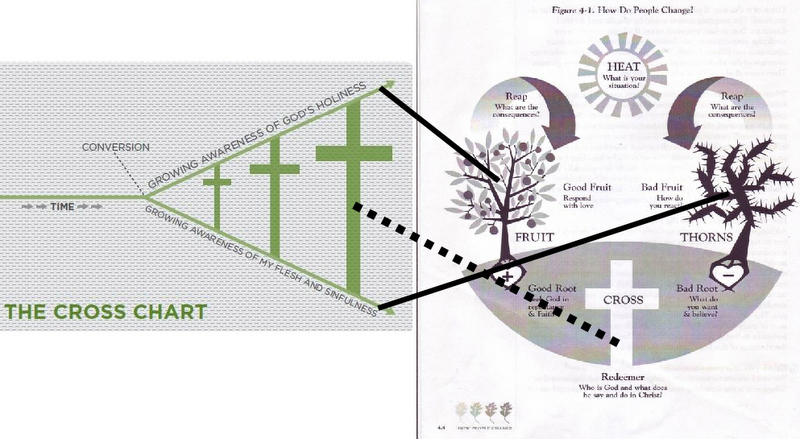
Right. As I have worn out multiple keyboards emphasizing here on PPT, New Calvinism is a dualist philosophy. Let’s go over this again. Below is THEIR illustration, NOT mine:

Note first that regardless of their verbiage, they don’t believe we really grow, it’s the cross (what it represents) that grows. That’s obviously job one. The endeavor thereof requires a primary focus on two goals and two goals only: a deeper and deeper UNDERSTANDING of our sinfulness, and absolutely nothing else, as set against God’s holiness. Part and parcel with this is also the idea of worthlessness on our part.
The cross represents bigger and bigger salvation which must be manifested more and more until the day when our “final justification” is “revealed.” This occurs as we are sanctified the same way we are saved, by partaking in the realizing of our sinful worthlessness before God and His holiness. The more we understand the difference between the two, the more our salvation is manifested. We don’t change, only the greatness of our salvation changes in order to glorify God. Of course, this obviously redefines the new birth and denies it.
As propagated in the satanic treatise “How People Change” by Paul David Tripp, ALL tragic and sinful events in life serve the bottom of the cross chart, and ALL good that occurs in our lives serves the top of the chart. As we contemplate the gospel narrative, the goodness of God is manifested which contributes to more understanding at the top of the chart. Goodness is not our fruit, its God’s fruit only for the purpose of aiding us in understanding His goodness—not ours. Hence, and don’t miss this, justice is not the point. The concept of justice and fairness digresses from Reformed Calvinistic dualism.
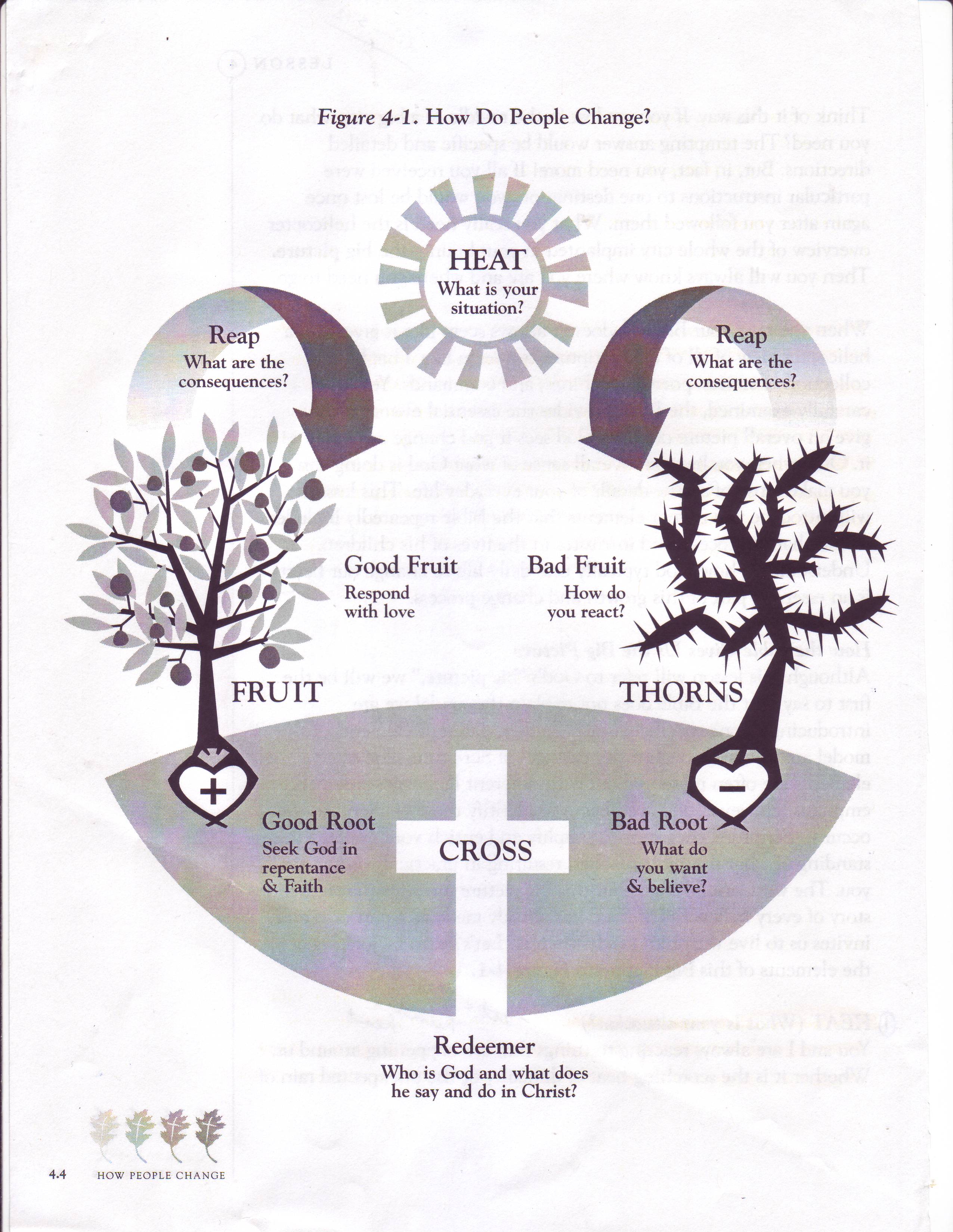
The next point is that in the neo-Calvinist gospel schema, the Scriptures serve as a Cross narrative to help us see this dualism in a clearer way. In the mind of the neo-Calvinist, the Scriptures do not define what is right and fair; the Scriptures define Luther’s “cross story.” Here is what the vast majority of Christians do not understand: six months after Luther’s 95 Theses launched the Reformation, the true magnum opus of the Reformation was written, his Heidelberg Disputation to the Augustinian Order. The document reflects Luther’s utter Platonist disdain for humanity.
In Luther’s Disputation, all reality must be seen through the cross story; i.e., the cross illustration at hand here, and ALL else is the “glory story” or anything at all to do with us—our glory, not the cross story that makes God bigger and mankind smaller. To any degree that we are in the equation, the cross story is diminished.
Now, let’s take this information and evaluate why Scott et al are completely indifferent to suffering and injustice. What did the Clearcreek elders do that is wrong? Nothing because the purpose of the Bible is not to judge the authority of Reformed elders, it is to show forth the cross story, not our story, and injustice is an Us Story kind of thing. Have former parishioners at Clearcreek suffered unjustly at the hands of the elders? Well, that’s a good thing! That suffering shows us the bottom of the chart. And besides, “justice”? If we got what we all deserved, there wouldn’t be any grace! Is this like Paul’s protest in Romans against propagating more evil that grace may abound? Yes, I think so. To the contrary in the minds of neo-Calvinists, we should bow down and thank God for bringing such abuse into our lives.
This is the gospel construct that rules the majority of biblical counseling in our day and is taking over the church in this country. It is a Platonist world view that set Europe on fire for hundreds of years with unspeakable horrors. And it is a story that is playing at a local church near you.
And this weekend, Stuart Scott brings his version of the show to Springboro, Ohio. A celebration of suffering in the name of Christ. But I have news for Scott: the sins of the Clearcreek elders does not cause grace to abound. And his appearance there has nothing to do with grace or love.
If there are any parishioners at Clearcreek (who may be reading this) who are presently there against their will for fear of public humiliation or things revealed in counseling —in your desperation, don’t slip Scott a note—he’s one of them.
paul

 Paul's Passing Thoughts
1 comment