The Hostile Takeover of the SBC by “Aggressive Calvinism” Began in 1982
Addendum to Second Edition: The Truth About New Calvinism
Very well, if folks want to refer to the New Calvinists taking over the SBC as “aggressive Calvinism,” that will work; New Calvinists are very aggressive. The events going on in the SBC right now are a mirror image of Coral Ridge, Clearcreek Chapel, NANC, and many, many other examples. Some months prior, a Presbyterian pastor/acquaintance of mine warned a church that called him for references regarding a new pastor for their church; in essence, he told them, “there is a dangerous movement afoot and the proponents are very stealth in regard to what they really believe—be careful.” They didn’t listen. The tragic results are all too common. The present debate over the SBC name change is part of it, and Southern Baptists better win that symbolic battle in order to hold ground. There is hope; the Daviess-McLean Baptist Association recently took a stand against “aggressive Calvinism.” If the SBC survives, it will only be because others follow their example.
More hope: there are lots of folks in the SBC who do not like hyper-Calvinists who also concern real Calvinists. New Calvinism is hyper-Calvinism in both justification (salvation) and sanctification (plenary hyper-Calvinism). So if many Southern Baptists do not like hyper-Calvinism, they should dislike the double hyper-Calvinists even more who are in the process of taking over the convention, and seeking to wipe out the memory of the SBC they secretly despise. Yes, there is hope, but SBC protestants need to better identify the enemy. We need to get rid of the “aggressive [New] Calvinists” first, and then have discussion about the hypers and the standards later. Aggressive Calvinists threaten the very existence of the SBC. We have our problems, and we may even be on life support, but Dr. Kevorkian presiding over our condition is not the answer—neither do I think he should be able to plunder SBC resources before he pulls the plug.
The Difference Between the Old and the New
This is not difficult. One only needs to examine their mantras to know the difference between Old and New Calvinism. “The same gospel that saved you also sanctifies you.” “We must preach the gospel to ourselves every day.” “The gospel isn’t the entry point of Christianity, it is the A-Z of Christianity” [even though Christ referred to the gospel as an entry point to the kingdom, and the apostle Paul referred to the gospel as a “foundation”: 1Corinthians 3:10-15, Romans 15:20]. If we are sanctified by salvation, what does that say about what Aggressive [New] Calvinists believe about sanctification? All Christians, whether Calvinistic or otherwise, believe that salvation is by faith alone and not works. Theologians call this “monergistic.” However, we also believe that sanctification is “synergistic,” meaning that the new birth enables us to co-labor with God in the sanctification process as friends devoted to Him in the truest sense. In other words, our marvelous God has made a way to be reconciled to Him while also enabling us to participate in His work in a truly legitimate way despite our weakness. The Bible specifically refers to us as God’s co-laborers in 1Corinthians 3:9, 1Thessalonians 3:2, and 2 Corinthians 6:1.
But obviously, if we are sanctified by monergism, sanctification must also be monergistic (a work by God alone). And as indicated elsewhere in this book, this is critical because the law (Scripture) is a primary conduit used to participate in God’s work. If we cannot participate in sanctification, neither can we uphold God’s law in sanctification any more than we could in justification. This is the crux of the matter. The real issue is the church’s primary nemesis used by the kingdom of darkness throughout the ages: against every word that proceeds from the mouth of God. This is what theologians call “antinomianism,” and as discussed in chapter one, the Bible predicts that it will be the spirit of the last days. Christ and the apostles framed the last days in context of “anomia” (primarily, 2Thessalonians, chapter 2; Matthew 7:23, 13:41, 24:11,12; 2Corinthians 6:14; Titus 2:14). It’s the same type word, used in all of these cited verses regarding the spirit, fellowship, love, antichrist, and redemption of the last days, as our English word “atypical,” or “against/anti what is normal.” Old Calvinists do not believe in monergistic sanctification which necessarily makes us antinomians. And orthodox evangelicalism has never believed in sanctification by faith alone. The modern-day epitome of Old Calvinism, Dr. Peter Masters, stated the following:
The new Calvinism is not a resurgence but an entirely novel formula which strips the doctrine of its historic practice, and unites it with the world (The Merger of Calvinism with Worldliness from Sword & Trowel 2009, No. 1 by Dr Peter Masters).
And this by Calvinistic Baptist Donn Arms, M.Div.:
Justification is monergistic, sanctification is synergistic. Walking is what I do, not something Christ does for me (Institute for Nouthetic Studies blog: Archives; Gospel Sanctification, May 13, 2011 Gospel Sanctification comments section).
Despite their adamant denials concerning the above, the simplicity of the Aggressive Calvinist mantras will always betray them in regard to their lies. And as discussed elsewhere in this book, all of their massive doctrinal pontification is discussion on how to make an overly passive sanctification work with the blessed truth of our Lord and Savior. Our brother Jude called Him our “absolute ruler” (despotace) and “supreme commander” (kooreeos).
Thirdly, Old Calvinists, unlike the Aggressive Calvinists, do not believe in the fusion of justification and sanctification. Listen to what Old Calvinist Jay Adams (no pun intended) said about “Gospel Sanctification” (the name given to New Calvinism [Aggressive Calvinism] before it was realized they are the same thing):
The crux of the issue has to do with the unbiblical fusion of sanctification with justification. The latter is set forth not as “keeping” God’s commandments, but as bringing about change by concentrating on the cross. As one immerses himself in the cross of Christ, sanctifying growth occurs. The biblical truth is that we are to pursue fruit, which becomes a reality and the Spirit helps us grow in grace (Institute for Nouthetic Studies blog: Archives; Gospel Sanctification, May 9, 2011 by Jay Adams).
The fact that Aggressive Calvinism fuses justification and sanctification together can be seen clearly in their mantra-like anthems such as, “The same gospel that saves you also sanctifies you.” This completely distorts the orthodox view of justification which is a onetime declaration by God that His righteousness has been credited to our account in full. According to their own pithy truisms, justification continues and completes itself. That’s a huge problem. If justification is progressive (what they deceptively call “progressive sanctification”), we cannot be involved, except in whatever our involvement was concerning justification. Hence, “….because the believer’s role is reduced to a point that is not according to Scripture, he/she is deprived of the abundant life in a way God wants us to experience it for His glory and the arousing of curiosity from those who don’t have the hope of the gospel.” And, “….while reductionist theologies seek to reduce the believer’s role to the least common denominator, supposedly to make much of God and little of man, the elements that attempt to make it seem plausible are often complex and mutating. Therefore, instead of majoring on the application of what is learned from Scripture, believers are constantly clamoring about for some new angle that will give them a ‘deeper understanding’ of the gospel that saved them.”(p. 77, The Truth About New Calvinism).
Unless this doctrine is exposed and halted, it will leave the SBC in ruins.
New Covenant Theology Cannot be Separated from New Calvinism
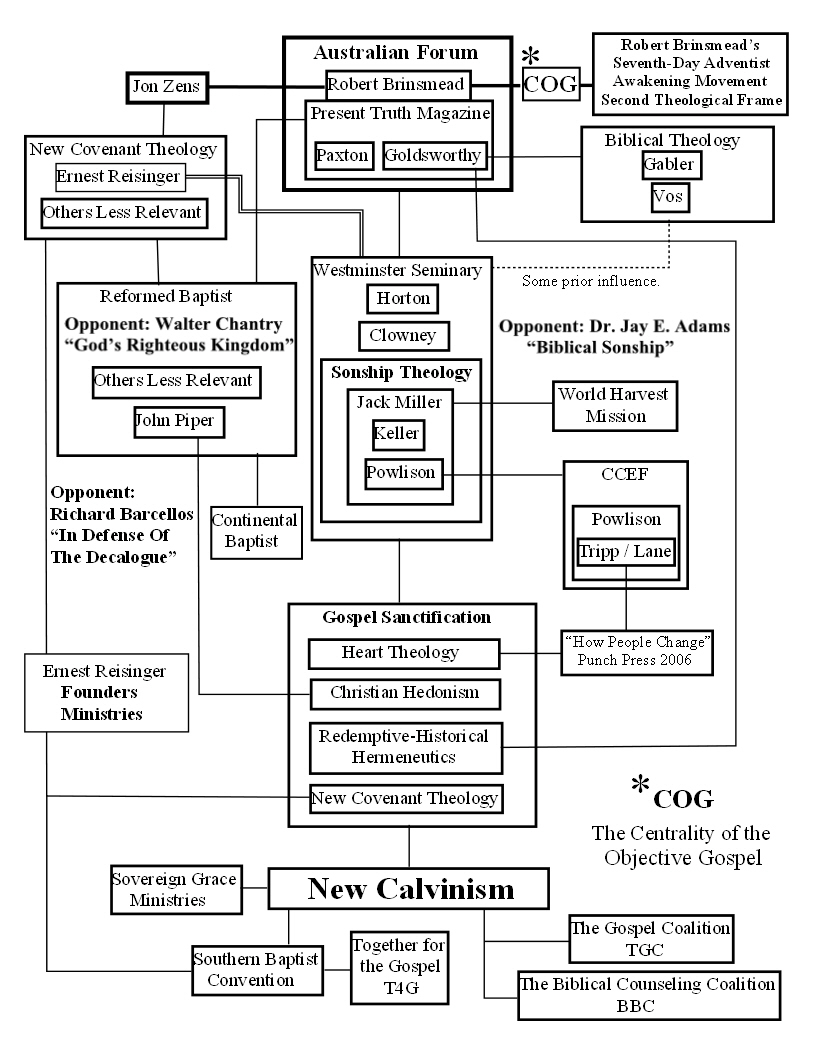
It is important to note that New Calvinism entered into the SBC through Reformed Baptist circles. New Calvinism was conceived by the Australian Forum’s Centrality of the Objective Gospel (COG). The detailed history can be observed in the “History” section of The Truth About New Calvinism. Jon Zens, the father of New Covenant Theology (NCT), worked with the Forum to develop a systematic theology that would make COG plausible. Present Truth magazine was the Forum’s theological journal. Citing from volume 16, article 13, it is obvious that the Forum’s doctrine is exactly the same as present-day New Calvinism:
Unless sanctification is rooted in justification and constantly returns to justification, it cannot escape the poisonous miasma of subjectivism, moralism or Pharisaism…. Since the life of holiness is fueled and fired by justification by faith, sanctification must constantly return to justification. Otherwise, the Christian cannot possibly escape arriving at a new self-righteousness. We cannot reach a point in sanctification where our fellowship with God does not rest completely on forgiveness of sins…. Christian existence is gospel existence. Sanctification is justification in action (emphasis mine).
As noted in The Truth About New Calvinism, Robert Brinsmead, the principle figure of the Forum, was intimately involved with Zens and the development of New Covenant Theology before Zens coined the phrase in 1981 (chapter 5). Zens himself said that Robert Brinsmead wrote articles in the Baptist Reformed Review (BRR) that accomplished the following: “The dynamic N.T. approach to law and gospel was stated forcefully by RDB [Robert D. Brinsmead]….” (Id. pages 56,57). The BRR was the primary lightening rod in the law/gospel debate raging in Reformed Baptist circles at that time, and Robert Brinsmead was a contributing author at the behest of Jon Zens. Zens took the doctrine into Reformed Baptist circles, while the Forum was primarily responsible for spreading the doctrine in Presbyterian territory, especially Westminster Seminary. Also, according to Zens, Present Truth magazine was “….the largest English-speaking theological journal in the world at that time” (Id. p. 53).
Though COG/NCT took on different nuances, COG and NCT share the same basic tenets that make the primary doctrine unique. They share the same unique hermeneutic, the same emphasis on progressive justification, the centrality of the gospel, a historic Christocentricity to the understanding and meaning of all reality, the personification of the law, the indicative/imperative prism, so-called “experiential Calvinism,” a majority view of Supersessionism, and especially unorthodox dichotomies of law and gospel (to name a few). The differences come in regard to how law and gospel relate to each other in order to make the doctrine fit together with “truth” in the best possible way. But they all believe that the same gospel that saves us also sanctifies us. Both infuse justification and sanctification.
The recognition that NCT is integral to New Calvinism is grudging and aloof among proponents. For example, DA Carson vigorously supports NCT by his actions, but when cornered verbally, espouses things that sound like, “I was for it before I was against it.” And, “It depends on what the meaning of the word ‘is’ is.” A good example of this is an article by Jim Gunn entitled, A Critique of New Covenant Theology (online source: http://goo.gl/Pm9E9). The article is an apt specimen of how Carson and Tom Nettles vigorously support NCT, but refuse to acknowledge its validity in plain language. Other New Calvinist leaders openly acknowledge that the two are inseparable. One example is the elders of Clearcreek Chapel in Springboro, OH. They are a highly respected New Calvinist church regularly hosting notable teachers such as Paul David Tripp, Stuart Scott, Dr. Robert D. Jones, and Dr. Lou Priolo. While embracing gospel centrality, they consider it all to be under the auspices of NCT. This can be seen best in a series preached there by Dr. Dale Evans entitled, A Gospel-Centered Hermeneutic: Foundations for a New Covenant Theology. In his introduction, Evans stated:
Over the last several weeks, the pulpit ministry at Clearcreek Chapel has focused on presenting texts and issues related to the concept know[n] as New Covenant Theology. This morning we will look at a text and suggest that this idea under this label is exactly how the apostle Paul read and interpreted Scripture.
As a ministry that vigorously supports all the major tenets of New Calvinism such as Heart Theology, Redemptive Historical Hermeneutics, and Christian Hedonism, one of their pastors on staff, former radio personality Chad Bresson, is sometimes referred to as “the golden boy of central Ohio NCT.” He is also a member of the Earth Stove Society formed to promote NCT. On the other hand, he has a blog dedicated to the “Biblical Theology” of Geerhardus Vos, the father of Chrsitocentric Hermeneutics. He often posts articles by two former key figures of the Australian Forum on that same blog: Robert Brinsmead and Graeme Goldsworthy.
The Plot to Take over the SBC With COG
The plot to take over the SBC with the Forum doctrine was hatched in a hotel room in Euless, Texas on November 13, 1982:
Then, on November 13, 1982, [Ernest] Reisinger, Nettles and Malone met at a Holiday Inn in Euless, Texas, for prayer to seek God’s direction with respect to a Southern Baptist conference ministry. Nettles brought to the meeting several young men who had embraced the doctrines of grace. Among them were Bill and Tom Ascol, Ben Mitchell and evangelist R.F. Gates. Reisinger later called this one of the most meaningful prayer meetings in which he had ever participated. The attendees spent the first half of the day in prayer, reading Psalms and hymns. During the second half of the day, they discussed ideas. They finally settled on the idea of a conference with the doctrines of grace as its foundation. Thus began the Southern Baptist Founders Conference (Founders Ministries blog: The Beginnings of Reformation in The Southern Baptist Convention: The Rise of the Founders Movement).
Reisinger was a former Presbyterian turned Reformed Baptist, then Southern Baptist. He also knew Cornelius Van Til personally. Van Til, a Reformed Presbyterian with an inclination towards mysticism like his close friend Geerhardus Vos, attended Reisinger’s ordination in 1971. As far as the movement begun by Reisinger and others to restore the “doctrines of grace” to the SBC, another Presbyterian by the name of John H. Armstrong was apparently present at its conception and describes the movement as the beginnings of the “neo-Calvinism” movement in a review of Time magazine’s 2009 assessment of the New Calvinism movement:
I have watched this movement for neo-Calvinism from its infancy. I personally attended the first meeting (and several more the years following) of the group that started this effort back in the 1980s. I personally knew the founder who dreamed up the idea of recovering Calvinism in the SBC [Ernie Reisinger] and then spread the “doctrines of grace” very widely. He is now with the Lord [ie., five years prior in 2004]….I was also involved in the various “gospel” recovery groups which were begun, now creating large gatherings of folk who believe they are the people who are preaching and recovering the “biblical gospel” (John H. Armstrong blog: The New Calvinism, Archives; March 31, 2009).
The early eighties is when the combination of the Forum, their theological journal, and the push among Reformed Baptist by Jon Zens (with the help of Robert Brinsmead) began to rapidly expand. And the torch carried forth was the idea that the Forum had recovered the lost doctrines of grace. Armstrong makes that clear:
The sixteenth-century rediscovery of Paul’s objective message of justification by faith [and sanctification also because justification is supposedly progressive] came upon the religious scene of that time with a force and passion that totally altered the course of human history. It ignited the greatest reformation and revival known since Pentecost.
Now, if the Fathers of the early church, so nearly removed in time from Paul, lost touch with the Pauline message, how much more is this true in succeeding generations? The powerful truth of righteousness by faith needs to be restated plainly, and understood clearly, by every new generation.
In our time we are awash in a “Sea of Subjectivism,” as one magazine put it over twenty years ago. Let me explain. In 1972 a publication known as Present Truth published the results of a survey with a five-point questionnaire which dealt with the most basic issues between the medieval church and the Reformation. Polling showed 95 per cent of the “Jesus People” were decidedly medieval and anti-Reformation in their doctrinal thinking about the gospel. Among church-going Protestants they found ratings nearly as high.
Reading Scott Hahn’s testimony in his book, Rome Sweet Home (Ignatius Press, 1993), I discovered the same misunderstanding. Here can be found a complete and total failure to perceive the truths of grace, faith and the righteousness of God. No wonder Hahn left his Presbyterian Church of America ordination behind to become a Roman Catholic. He did not understand the gospel in the first place, as his own words demonstrate.
I do not believe that the importance of the doctrine of justification by faith can be overstated. We are once again in desperate need of recovery. Darkness has descended upon the evangelical world in North America and beyond, much as it had upon the established sixteenth-century church (The Highway blog: Article of the Month, Sola Fide: Does It Really Matter?; Dr. John H. Armstrong).
According to Armstrong: “We are once again in desperate need of recovery. Darkness has descended upon the evangelical world in North America and beyond, much as it had upon the established sixteenth-century church.” Apparently, light came “twenty years” prior to his writing of that post via the Forum’s Present Truth magazine. That was the mindset of the “Reformation” movement in the early eighties that is now New Calvinism. The details of this are expanded in chapter four of The Truth About New Calvinism.
A Proven Method
Reisinger was no stranger to how the formation of conferences could affect the taking over of Christian groups. He witnessed firsthand how this was done by Jon Zens in 1979:
At the fall Banner of Truth Conference in 1979, Ron McKinney spoke with lain Murray, Ernie Reisinger and others about the possibility of having a conference where some aspects of Reformed theology could be discussed and evaluated by men of differing viewpoints (Jon Zens: Law And Ministry In The Church: An Informal Essay On Some Historical Developments (1972-1984).
That conference ended up being the first “1980 Council on Baptist Theology” held in Plano, TX. It was the coming out party for New Covenant Theology, and eventually resulted in the formation of a denomination that split a large group of Reformed Baptists. Two years later, Reisinger would be leading the way for the same kind of “revival.” From the beginning, NCT/COG came forth from the womb with visions of grandeur, splitting churches, deceiving, and wreaking havoc on God’s people. It will continue to do so until it is stopped.
But wasn’t Ernest Reisinger an opponent of NCT and a good friend of Walter Chantry who also opposed NCT? Apparently, Chantry was opposed to certain aspects of Zens’ teachings before it was NCT, especially the antinomian parts. As far as the who’s who of the evangelical world mugging together while differing on theology—what’s new? NCT theology cannot be separated from New Calvinism over one of many disagreements among them concerning how law and gospel relate to each other. Still, they all believe in the fusion of justification and sanctification. Ernest Reisinger stated the following in “Lordship and Regeneration”:
The Lordship teaching puts the order of salvation as follows: 1) Regeneration, 2) Faith (which includes repentance), 3) Justification, 4) Sanctification (distinct from but always joined to justification), and 5) Glorification.
The “always joined” justification and sanctification is the fusion thereof, and the “distinct[ion]” he is talking about is the supposed idea that sanctification is the progressive form of justification. Orthodox evangelicals believe no such thing. Also, his view of the distinctions between law and gospel are endorsed by proponents of Sonship Theology, which will certainly save one research on that wise concerning Reisinger (Gospel Discipling—The Crying Need of the Hour: Stephen E. Smallman; Executive Director, World Harvest Mission, November 1997).
Does Chantry believe in the synthesis of justification and sanctification? It’s not relevant—the primary point concerning Chantry is that he recognized antinomian elements of NCT early in the movement, and also, his role refutes the story among New Calvinists that this doctrine has always been widely accepted among other Reformed leaders. It might be noted that he didn’t launch an attempted takeover of the SBC which makes him less relevant than Reisinger, who also promoted the Founders movement among Southern Baptists by claiming that James Boyce believed in their form of “Calvinism.” Did James Boice believe in the fusion of justification and sanctification? That’s doubtful.
Did the COG Come After the Reisinger, or Before the Ascol?
One of the participants in the “prayer meeting”/takeover plot at the Holiday Inn at Euless was Tom Ascol, heir apparent to Reisinger’s pastorate and Founders Ministries. Ascol is a consummate New Calvinist. On Grace Baptist Church’s website, under “core distinctives,” the following statement appears:
The gospel is not an add-on to our services or merely an entry point to Christianity. The gospel is the message we preach and the means by which we persevere in the faith. We focus on applying the gospel to every area of living, including marriage, family, work, personal sanctification, evangelism, and Christian community.
In 2010, Ascol authored a resolution to the SBC’s annual convention entitled, “SBC Resolution on the Centrality of the Gospel.” In part, it reads:
….and be it further
RESOLVED, That we encourage churches in preaching, teaching, and discipleship to proclaim the gospel to unbelievers, showing them how to find peace with God, and to proclaim the gospel to believers, that through the renewing of our minds we might continually be transformed by the gospel.
Did Ascol embrace New Calvinism after the passing of an orthodox Ernest Reisinger? That’s very doubtful. Ascol said the following on Reisinger’s homepage:
Ernie Reisinger has been a mentor, friend and great encourager to me in the ministry. I thank the Lord for his influence in my life. Tom Ascol Pastor of Grace Baptist Church, Cape Coral, Florida, Executive Director of Founders’ Ministries and Editor of Founders Journal. (The Reformed Reader blog homepage).
Ascol represents what Reisinger believed from the beginning. Ascol learned it from Reisinger. Armstrong places Reisinger at the beginning of the movement, and as an eyewitness, describes it to a “T.” And like all New Calvinists, Reisinger possessed an arrogance that crowned him the supposed savior of the SBC.
The SBC’s Dark Future
Unless the hostile takeover of the SBC is halted, Southern Baptists will be removed from history, its service assets compiled by sacred labor plundered, assemblies divided, and replaced with cult-like congregations. The very essence of this movement and its tenets breed cultish assemblies. The following can be read on page 134 of The Truth About New Calvinism:
All this leads to many New Calvinist churches taking on cult-like tendencies. Exclusiveness (new Reformation), an attitude that some higher knowledge is a part of the movement that many are not “ready” for (the scandalous gospel), and a subjective view of Scripture (a gospel narrative, not instruction) is a mixture that will have bad results, and is the perfect formula for a cult-like church.
The footnote accompanying this quote also reads as follows:
Many New Calvinist churches fit all eight descriptive points published by cultwatch.com: 1. Deception 2. Exclusiveness 3. Intimidation 4. Love Bombing 5. Relationship Control 6. Information Control 7. Reporting Structure 8. Time Control.
One example of this is New Calvinism’s dirty little secret about what they really believe concerning church discipline. They don’t believe in a Matthew 18 process to correct a particular situation—they believe in “redemptive church discipline.” What’s that? It holds to the view that all sin is a result of one’s view of justification. Therefore, what they did is not the issue, their view of justification is the issue. So the discipline is “redemptive.” In other words, it is designed to bring the individual into New Calvinism and out of “evangelicalism” which New Calvinists continually liken to the Roman Catholicism that the “first reformers” contended against. This attitude can be seen in the prior citation by Armstrong. Is this creepy and cultish? Absolutely. Hints of this can be seen in a 2008 resolution to the SBC that (according to my understanding) Ascol contributed to:
RESOLVED, That we urge the churches of the Southern Baptist Convention to repent of the failure among us to live up to our professed commitment to regenerate church membership and any failure to obey Jesus Christ in the practice of lovingly correcting wayward church members (Matthew 18:15-18).
Notice the implication that church discipline regenerates.
Much could be discussed here just on the “deception” point alone, but I will close with one example that exemplifies the character of this movement. In heated back and forth correspondence with New Calvinists regarding the proposed connection between Founders and NCT, one of the contenders emailed Tom Ascol and asked him to verify that both Founders and Reisinger are/were anti-NCT. Ascol replied in the affirmative for them, and I was copied on the email. As evidence, Ascol claimed that Founders Press published the book, “In Defense Of The Decalogue” by Richard Barcellos (which is a devastating treatise against NCT). I found this very perplexing, and checked my copy. Sure enough, it was published by Barcellos himself through Winepress Publishing. Both the contenders and I have emailed Founders for an explanation, and are still waiting.
paul
With Permission: Peter Lumpkins Comment on New Calvinist Interpretation
To begin with, the phrase “preach the gospel to ourselves” is prima facie nonsensical. It apparently is a clever phrase which means something other than what it literally communicates. What is that “something other than”?
More importantly, what I see happening with the parable is laying a needless filter upon it which effectively, at least in some important ways, hides the real meaning of the text. That is, a rhythmic literary pattern is employed to glean the proper interpretation. In your case, it’s “gospel>>>righteous living.” For others in this “preach the gospel to myself everyday” community, it’s “indicative>>>imperative.”
Yet, from my perspective, this is nothing less than a direct assault on what some call the “perspicuity” of Scripture or what Wayne Grudem calls the “clarity” of Scripture. Who would have imagined the Holy Spirit wanted to communicate, from the passage you cited–or any passage for that matter–the “imperative” is “preceded by” or “grounded in” the “indicative” or some other interpretative pattern, a pattern which is not derived from standard canons of literary interpretation, but rather from theological presuppositions imposed upon the text?
My fear is, we’re substituting theology for basic Bible study. And by basic I mean neither shoddy nor surface. Rather, I mean raw, fundamental textual interpretation based upon sound exegesis.
Contrarily, to lay a “preach the gospel to myself” (i.e. indicative precedes imperative) filter upon the page of Scripture seems to me predetermines the text’s meaning before one even reads the text, before one exegetes the text.
If I am anywhere near correct, the common man or woman just got left out of actually understanding the Word of God. Why? Well, they don’t have the secret interpretative principle to guide them–the indicative precedes the imperative. And, without that filter, they’re doomed to gospel ignorance.
Yet, no where in all God’s Word do we get the impression that the Bible in general needs special filters to discern its meaning, especially filters designed by Christians hundreds and even thousands of years after the Bible was written and after so many other believers–stalwart believers, learned believers, brilliant believers–read the Bible with understanding but without the contemporary filters about which some now so desperately insist.
Indeed the Reformation began when filters were discarded not when new filters were employed. The Baptist movement was built upon a simple reading of the New Testament, not upon innovative nonsense like indicative precedes imperative created by incipient immersionists. They took the plain meaning of Scripture rather than an alleged literary pattern they discovered to read the Scripture aright.
Why, to believe some today, the whole of Christianity crumbles if we don’t perpetuate the indicative precedes the imperative gospel principle. Millions of evangelicals are lost because they don’t understand that the indicative precedes the imperative.
Where this ultimately leads only our Sovereign Lord knows for sure. I do know one thing: I want no part or parcel in this hermeneutical madness.
Maranatha. Come Lord.
With that, I am…
Peter
“Lifeway” Publishers Now Serving Antinomian Koolaid to Our Youth: Part 1
 Just yesterday, a youth leader from the Southern Baptist church Susan and I attend brought me a copy of a recent edition of “EC,” a magazine published for teens by Lifeway Publishers. By way of description, their website says the following:
“LifeWay Christian Resources was originally created as the Sunday School Board of the Southern Baptist Convention in 1891. As a denominational publisher, LifeWay provides resources for use in Southern Baptist churches and for the general public. LifeWay publications include curriculum study materials, ministry periodicals, personal growth materials, leisure-reading periodicals, multimedia and Internet resources, and books.”
The leader also brought me a copy of “Life Focus,” the student learning guide for teens. He also suggested that while both were saturated with contemplative spirituality, the student guide was much more nuanced than the magazine because the student guide would involve participation by adult leaders. It wouldn’t surprise me. For purposes of introducing this problem to our church, I will be writing a series on the one edition presented to me which has almost all the tenets of New Calvinism, Gospel Sanctification, New Covenant Theology, Sonship Theology, etc.
I will get the ball rolling in this first part by addressing a concept from page 49 of the July 2011 edition of EC. Don’t get discouraged if this first part is hard to understand—I will have more time to better articulate in the following parts. It states the following to our youth:
“You know you love Christ, and you know how He is calling you to live—and you obey from the heart. That means that the reason you’re obedient to God isn’t because you think you have to, that being “good” will earn you His favor, or that the way to live the Christian life is to follow a bunch of rules. It means that you obey Christ’s commands out of love, recognizing who He is and what He has done for you. When you understand the cost Christ paid to set you free from sin and the depth of His love for you, you simply can’t pursue a life characterized by sin.”
Where to even start? This statement, though nuanced, and as the youth leader also suggested; speaks of the sanctification process in a justifying way, is fraught with error and a twisting of phraseology. Notice that the sanctification concept of “making it our goal to please Him” (2Cor. 5:9) is twisted into the concept of earning God’s favor for salvation by trying to be “good” (the implication is perfection, which we know will not happen until glorification). Of course, the error plays on the fact that most Christians, especially youth, do not know the difference between justification, sanctification, and glorification. Hence, trying to please God in sanctification is synonymous with trying to earn His favor for justification.
Then the most disturbing statement: “….or [notice “or”:other than; what?] that the way to live the Christian life is to follow a bunch of rules.” Notice how Christ’s mandate to put all that He has said into “practice” (Matt.7:26,27) is reworded as “a bunch of rules.” Clearly, the statement doesn’t qualify what “rules” are being talked about (the Psalms calls God’s word “rules” in many places), and the qualification thereof in the following sentences insinuates that obedience “from the heart” comes from one thing and one thing only: a deeper and deeper appreciation of what Christ did for us on the cross.
And that is what I am going to focus on here in the first part. This is the same contemplative spiritually presently overrunning the American church like a giant Tsunami. It holds that obedience flows naturally from a gushy, romantic like love that is produced from our gratitude for what Christ did for us on the cross, and is propagated by highly acclaimed teachers such as Francis Chan, John Piper, and Michael Horton. Supposedly, disobedience is always the result of lack in a “deeper and deeper” understanding of the gospel, who Christ is as a “real person” (whatever that means), and the depth of His love for us, as seen in the EC quotation:
“It means that you obey Christ’s commands out of love, (= the following) recognizing who He is and what He has done for you. When you understand the cost Christ paid to set you free from sin and the depth of His love for you, you simply can’t pursue a life characterized by sin.”
Of course, this assumes that Christ wanted Peter, who witnessed what Christ did firsthand, to qualify his love for Him this way: Do you love me? Then always contemplate what I did this week. Do you love me? Then study my personhood. Do you love me? Then figure out how much I love you. And by the way, teach my sheep to do the same thing.
Francis Chan, in his highly acclaimed book “Crazy Love,” compares this love to what it feels like when we fall in love with a girlfriend: “Because when you’re wildly in love with someone, it changes everything” (back cover forward: “Crazy Love”). Throughout the book, like his good friend John Piper, the legitimacy of love toward God is determined by feelings only. Francis Chan writes in the same aforementioned book on page 110: “When we work for Christ out of obligation, it feels like work. But when we truly love Christ, our work is a manifestation of that love, and it feels like love” So much for the Evangelical battle cry of past years: “Love is a verb.” Completely absent in Chan’s book is the concept of love that beseeches God Almighty for a passing of the cup of suffering if it be His will while sweating great drops of blood. On page 100, he says Christ was his grandmother’s “lover.” On page 101, Chan eludes to the New Covenant Theology concept of God’s law being replaced with a single law of love that is always accompanied by giddy, romantic feelings: “When we love, we’re free! We don’t have to worry about a burdensome load of commands, because when we are loving, we can’t sin. Do you feel free in your Christian life?” Notice: Chan’s standard for loving obedience in the Christian life is clearly; “Do you feel free in your Christian life?”
Michael Horton puts this in systematic theological terms with the following formula: Gratitude > Doxology > Obedience. I will now conclude this first post of the series with an excerpt from another article written to answer a reader’s question concerning this theological formula:
So, help me understand. I pulled the following quote from an article published in Modern Reformation, posted here, http://www.ouruf.org/d/cvt_sanctification.pdf. Why are you so against this way of thinking about the Christian life. If I am not motivated to obey the commands of scripture by the fact that I am already justified, then what would you suggest should be my motivation?
“I began to see that we stand before God today as righteous as we ever will be, even in heaven, because he has clothed us with the righteousness of his Son. Therefore, I don’t have to perform to be accepted by God. Now I am free to obey him and serve him because I am already accepted in Christ (see Rom. 8:1). My driving motivation now is not guilt but gratitude.”
And my answer:
Great question. One: Modern Reformation (MR) presents “gratitude” as the primary motivation for obedience to the exclusion of almost everything else. Second point under One: supposedly, our gratitude is increased by pondering / contemplating / meditating on the “gospel” or works of Christ which results in obedience that is qualified as acceptable before God because it is accompanied by joy, and a willing spirit. This is exactly what John Piper believes also; the moral character of obedience is ALWAYS determined by joy. Both of these points are indicative of Quietist, contemplative spirituality that Matt mentioned in the comment section of the other post.
Two: “I began to see that we stand before God today as righteous as we ever will be, even in heaven, because he has clothed us with the righteousness of his Son.” This is true, but MR believes that any attempt on our part to apply that righteousness horizontally is to take away from Christ’ righteousness that has been granted to us. This error is very subtle and is clothed in truth. We are not only righteous positionally, but we are also enabled to be righteous practically. It is up to us to “put on” the righteousness we have been given and to “put off” the remnant of sin left in our mortal bodies (Eph 4:20-24). This process will be EXPERIENCED IN A MYRIAD OF WAYS and will use a wide range of spiritual weapons granted to us, NOT JUST an endeavoring to be thankful for what Christ has done for us. In fact, making use of our complete arsenal is what will lead to deeper gratitude, not the limitation thereof. Paul said to put on the “full armor of God.”
But now let me hasten to reference what I said above (“MR believes that any attempt on our part to apply that righteousness horizontally is to take away from Christ’ righteousness that has been granted to us.”): On page 62 of “Christless Christianity” M. Horton says that spiritual growth only takes place when we, like unbelievers as well, “encounter the gospel afresh.” In other words, contemplation on the gospel is the only thing that produces spiritual growth. Furthermore, this eliminates the purpose of instruction from use of the Scriptures because the Spirit only works “through the gospel.” This is known as the “Christocentric” or Gospel-centric hermeneutic. Also, on pages 189-191 of the same book, Horton propagates the idea that corporate worship is strictly a contemplative affair and that we are a valley of dead bones coming to receive life through the corporate presentation of the gospel and sacraments. Of course, this is a blatant contradiction of Hebrews 10:23-25. In addition, on pages 117-119, Horton says that any attempt on our part to be a testimony with our good works (as Christians) is an attempt to “be the gospel” rather than presenting the gospel. In other words, our own efforts in evangelism is an attempt t to replace the works of Christ with our works. Of course, this is a blatant contradiction to Matthew 5:16 and 1Peter 3:1,2.
Three: “Therefore, I don’t have to perform to be accepted by God.” No, not for justification, but we need to dependently perform in sanctification in order to “PLEASE God” (2Cor 5:9). Note 2Cor 5:9 carefully–for crying out loud, it will even be our goal in heaven to please Him–except we will be unhindered by the flesh, but it will be no less us obeying Him than now, just more, and too perfection. Christ will not be obeying for us in heaven while we please Him there because we will be “like Him.” Neither does He obey for us now, though no doubt, we need to depend on His strength and knowledge to do so, but we are definitely WORKING with God (1Cor 3:9 1Thess 3:2). But Horton believes that justification and sanctification are the same thing. Therefore, any effort to be “accepted”(a salvation concept) by Him in sanctification (a misnomer) equals an effort to be justified by Him as well. This is very subtle and deceptive. However, he states plainly on page 62 in “Christless Christianity” that any effort to grow spiritually apart from contemplation on the gospel will result “in the LOSS of BOTH.” Both what? Answer: both justification and sanctification; ie, your lost!
Four: The Bible designates several other motivations for obedience other than gratitude. Let’s start with MR’s use of guilt because they / Horton know that our society has been conditioned to view guilt as an ill motivation or bad thing. “My driving motivation now is not guilt but gratitude.” This statement insinuates that the sum of sanctification is either / or. Not so. The apostle Paul instructed Timothy to “Keep a clear conscience before God” (1Tim 1:5, 1:19, 3:9, 4:2, 2Tim 1:3). Clearly, one of the goals in sanctification is the consideration and motivation to KEEP a clear conscience. Secondly, under Four, fear of discipline is used to motivate (Acts 5:10-16 1Thess 4:6 1Tim 5:20). Thirdly, the awesome motivation to discipline self to prevent the Lord’s discipline. What a wonderful motivation / promise from our Lord! (1Cor 11:27-32). Fourthly, we are motivated by being promised blessings IN (a preposition) the DOING, (James 1:25) not IN CONTEMPLATION.
Fifthly, God motivates us to good works via REWARDS. Really, hundreds of verses could be cited to make this point, but I will mention Matthew 6:6. Also note that contemplation is not the cure for hypocritical prayer in the context of Jesus’ counsel here, but the practice of private prayer. I will stop here as the biblical points that could be cited on this are endless, but let me say that I am very concerned with contemplation replacing biblical instruction in regard to helping Christians with serious life problems, and being complete before the Lord, lacking nothing (2Timothy 3:16).
Five: MR fails to recognize the all important biblical concept of self-sacrifice. Often, our faith will drag ourselves kicking and screaming into obedience in order to please God; and the belief that blessings will be our reward, though delayed for the time-being. Joy does not always walk with obedience at every moment. In fact, faith often does not care about self at all, but rather takes pleasure in the fact that God is pleased regardless of how we feel at the time. Here, beating our bodies into subjection and self-death is the motivation / goal. Do we always seek to please God because we are mindful of his sacrifice? Or is it our love for Him that is many faceted with gratitude included?
Six: Gratitude alone does not bring us near to God; “adding” to our faith does (2Peter 1:5-11).
Bottom line: The MR quote above is fraught with deception. Contemplative spirituality is a roadway to destruction.
paul

 Paul's Passing Thoughts
1 comment