The True Gospel Verses Calvinism: Part 1
 “The difference between Calvinism and the true gospel is a fine line of distinction with eternal consequences.”
“Justification is a finished work that guarantees glorification apart from anything that happens in progressive sanctification….Justification is a finished work that guarantees glorification completely apart from progressive sanctification.”
“All bible verses must be interpreted by, verse….for justification, or verse….for sanctification.”
This post is actually in reply to the following question posted in the comment section of this blog:
Paul, please explain in layman’s terms how Calvinism views justification and sanctification. I am trying to understand this. Does this have anything to do with the saint’s persevering?
My initial response was several hundred words which were deleted somehow when I was near completion; I must have hit a wrong key or something, but this time I will be smart and type it on Microsoft Word first.
Let me begin by addressing this part of the reader’s question first: “Does this have anything to do with the saints persevering?” No. Please, let’s just focus on the foundation—you can address all of the many other issues later, but you will be unable to address them definitively until you have an understanding in regard to the first part of your question: “….how Calvinism views justification and sanctification.”
Short answer: It views them as being the same thing, and that’s a false gospel, and I will explain why (the forthcoming long answer). But first, know this: election does not necessarily mean that God predetermined before creation who was/is going to be saved and not saved. How God weaves His sovereignty together with our choices is a mystery. For example, “The heart of man plans his way, but the Lord establishes his steps (Proverbs 16:9).” Does this mean that we shouldn’t bother planning because the Lord has already determined our steps? Hardly. Proverbs 16:9 is speaking of the mystery/paradox of God’s weaving together of what we do and His sovereign will. Does prayer change things? Certainly it does. When we present the gospel to someone, do we say, “I am just here to find out whether you are one of God’s chosen or not. So, I am going to present the gospel to you, and if you believe and repent, you are one of the chosen, if you don’t, you are toast for eternity.” No, we persuade with all diligence and knowledge (like the apostle Paul did) as if it depends on us, because to some degree, it does. Bottom line:
How then will they call on him in whom they have not believed? And how are they to believe in him of whom they have never heard? And how are they to hear without someone preaching? (Romans 10:14).
God’s offer of salvation is a legitimate offer.
Justification 101 (For now, forget about sanctification, this concerns justification only!)
Nevertheless, when they/we believe, we know it’s because of Romans 8:30, which will be the focus of my explanation/long answer. Let’s now observe Romans 8:30:
And those whom he predestined he also called, and those whom he called he also justified, and those whom he justified he also glorified.
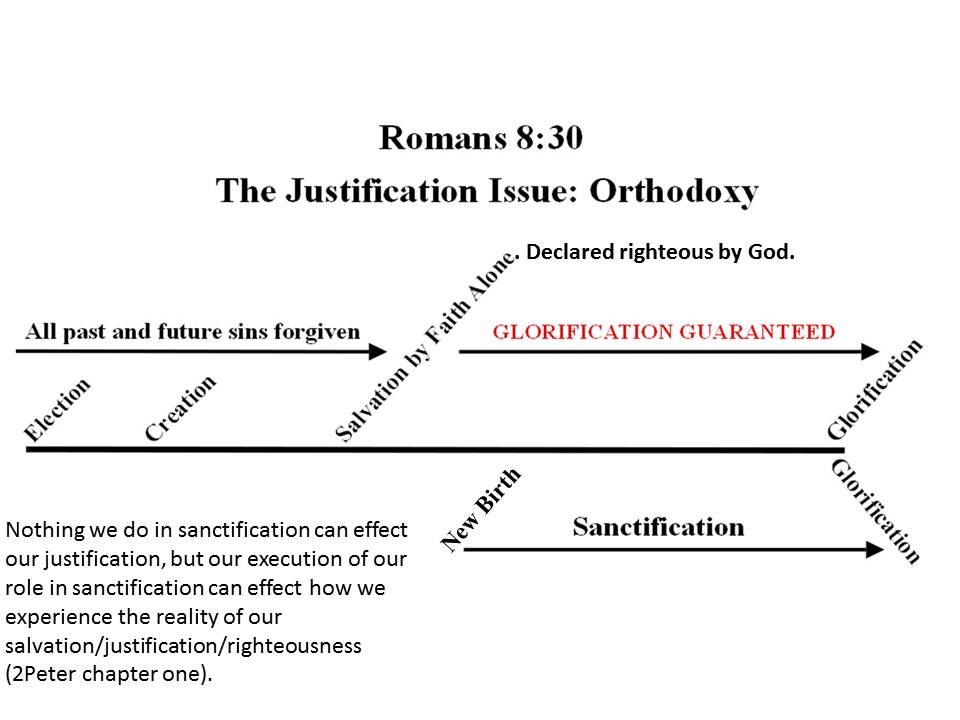
Done deal. Finished before the creation of the world. He predestined us, then called us, then justified us, and finally, glorified us. The word “justified” is dikaioo. It is a legal declaration of innocence that sets one free. Christians are declared righteous before creation, and glorification (when we will be instantly transformed completely at the resurrection) is guaranteed. We cannot mess that up. It’s a finished work by God before we were born. How can we possibly mess that up? We can’t.
Law/Justification [Gospel]
Also, the law can’t touch us. Why? We are already declared righteous, that’s why. Stop everything you are thinking about and take note of this: the law is no longer the standard for maintaining our salvation/justification. Do not turn your mind off here because of familiarity—this is not what you think it is. Pay attention! The difference between Calvinism and the true gospel is a fine line of distinction with eternal consequences. Caution: this is a concept that it so simple that it escapes us. We are no longer ….key word alert,….UNDER the law. In the book of Romans, Chapter 7, Paul compares our relationship to the law as a marriage covenant that is no longer valid because one of the spouses died:
Do you not know, brothers —for I am speaking to men who know the law—that the law has authority over a man only as long as he lives? 2 For example, by law a married woman is bound to her husband as long as he is alive, but if her husband dies, she is released from the law of marriage. 3 So then, if she marries another man while her husband is still alive, she is called an adulteress. But if her husband dies, she is released from that law and is not an adulteress, even though she marries another man.4 So, my brothers, you also died to the law through the body of Christ, that you might belong to another, to him who was raised from the dead, in order that we might bear fruit to God.
Now, I will slightly digress and bring danger of confusion, but will then quickly return to the subject of justification. Paul is talking about justification in this passage, and then finishes the thought with a mention of justification’s purpose; sanctification: “….in order that we might bear fruit to God.” BUT, as we shall see, other than the fact that justification makes sanctification (our kingdom living) possible, the two are totally separate, and the separation of the two is the key to understanding the issue at hand, and the true gospel in general.
….for justification.
We, as Christians, are dead to the law. It can’t touch us. We are no longer UNDER it:
Romans 2:12
All who sin apart from the law will also perish apart from the law, and all who sin under the law will be judged by the law.
But not us. The law can’t judge us, we are no longer under it:
Romans 3:19
Now we know that whatever the law says, it says to those who are under the law, so that every mouth may be silenced and the whole world held accountable to God.
Note that the world is under the law, but we are not. We have no regard for the law whatsoever, ….for justification.
Slavery/Justification
Paul also described our relationship to the law in regard to not being enslaved by it. To be evaluated by the law is to be in bondage to it:
Romans 6:14
For sin shall no longer be your master, because you are not under the law, but under grace.
Galatians 4
21 Tell me, you who want to be under the law, are you not aware of what the law says? 22 For it is written that Abraham had two sons, one by the slave woman and the other by the free woman. 23 His son by the slave woman was born according to the flesh, but his son by the free woman was born as the result of a divine promise.
In fact, Paul said for us Christians, ALL things are lawful!
1 Corinthians 6:12
All things are lawful for me, but not all things are profitable. All things are lawful for me, but I will not be mastered by anything.
All things are lawful, but not all things are profitable. All things are lawful, but not all things edify.
But not expedient, or profitable….
….for sanctification. Sanctification 101
There are two kinds of sanctification, but only one kind of justification, and the two sanctification are totally separate from justification. If not, we are eternally doomed. Justification must be a finished work that we have no part in except for showing others how they can be justified like we are; saved, if you will. Note: Romans 8:30, the epic verse of justification, does not include the subject of sanctification because the two must be separate. One is a finished work (justification), the other, sanctification (or, kingdom living) is progressive. In fact, Dr. Jay E. Adams states well that sanctification (our Christian life) does not in any way draw it’s life or power from justification because justification is a legal declaration that determines our POSITION:
The problem with Sonship™ [same thing as New Calvinism prior to 2008] is that it misidentifies the source of sanctification (or the fruitful life of the children of God) as justification. Justification, though a wonderful fact, a ground of assurance, and something never to forget, cannot produce a holy life through strong motive for it. As a declaration of forgiveness, pardon, and adoption into the family of God, it is (remember) a legal act. It changes the standing, but not the condition, of the person who is justified.
That’s because justification is a finished work, and discipleship (sanctification) is not; it’s progressive. But, there is also a positional sanctification that is also a finished work that even preceded justification. But like justification, it is a finished work and cannot produce progressive life, because for crying out loud, a finished work doesn’t continue to produce a progression. This would seem evident. Remember this: sanctification is a word that merely means, “to set apart.” So, sanctification is a progressive separating from the world. As we progress in our sanctification, we look more like Christ, and less like the world. But there is also a positional separation from the world that is also a finished work that includes predestination, election, calling, justification, and a setting apart:
Such were some of you; but you were washed, but you were sanctified, but you were justified in the name of the Lord Jesus Christ and in the Spirit of our God (1Corinthians 6:11).
Notice the past tense of the verse. Our position is a finished work. We were washed, set apart, and justified. Peter asked Jesus to wash him. But Christ told him that there was no need for him to be washed because it had already been done, he only needed a daily washing of his feet:
The evening meal was being served, and the devil had already prompted Judas Iscariot, son of Simon, to betray Jesus. Jesus knew that the Father had put all things under his power, and that he had come from God and was returning to God; so he got up from the meal, took off his outer clothing, and wrapped a towel around his waist. After that, he poured water into a basin and began to wash his disciples’ feet, drying them with the towel that was wrapped around him. He came to Simon Peter, who said to him, “Lord, are you going to wash my feet?” Jesus replied, “You do not realize now what I am doing, but later you will understand.” “No,” said Peter, “you shall never wash my feet.” Jesus answered, “Unless I wash you, you have no part with me.” “Then, Lord,” Simon Peter replied, “not just my feet but my hands and my head as well!” Jesus answered, “A person who has had a bath needs only to wash his feet; his whole body is clean. And you are clean, though not every one of you.” For he knew who was going to betray him, and that was why he said not everyone was clean (John 13:2-11).
Justification and the New Birth
Though justification is a finished work, it passes the torch to something that is a mark of true salvation. This is where sanctification draws its power. This element of sanctification is a Proof of Purchase Seal that you and I have been purchased by God with the price of His Son. It is the new birth. We are born of the Holy Spirit into new creatures. Our spiritual growth is now a colaboring with the Holy Spirit who indwells us. He also colabored with saints of old, but His permanent indwelling of New Testament believers is probably related to the engrafting of the Gentiles. But whatever the reasons, remember that the saints of old were also justified by faith alone, and like us, they were not UNDER the law….for justification.
Paul makes this point in Galatians 3:13-18:
Christ redeemed us from the curse of the law by becoming a curse for us, for it is written: “Cursed is everyone who is hung on a tree.” He redeemed us in order that the blessing given to Abraham might come to the Gentiles through Christ Jesus, so that by faith we might receive the promise of the Spirit.
Brothers, let me take an example from everyday life. Just as no one can set aside or add to a human covenant that has been duly established, so it is in this case. The promises were spoken to Abraham and to his seed. The Scripture does not say “and to seeds,” meaning many people, but “and to your seed,” meaning one person, who is Christ. What I mean is this: The law, introduced 430 years later, does not set aside the covenant previously established by God and thus do away with the promise. For if the inheritance depends on the law, then it no longer depends on a promise; but God in his grace gave it to Abraham through a promise.
Hence, the law CANNOT be our standard…. for justification. Paul makes that clear by pointing out that the law didn’t come for 430 years after Abraham was justified according to the covenant of promise. Nevertheless, we must be born again (new birth). Again, the new birth is proof of Justification, but is not powered by it. The new birth is the indwelling Holy Spirit colaboring with His new creatures. Theologians call this, regeneration. We, like the saints of old, MUST BE BORN AGAIN. Before the cross, and before Pentecost, Christ made this clear to Nicodemus in the present tense, and expressed surprise that he was ignorant of the new birth (John, chapter 3).
And this is very, very important: regeneration does not work towards/for glorification. Sanctification (the progressive type) is NOT a link to glorification. Remember, glorification is a finished work. Romans 8:30 speaks of it in the past tense. It is the guarantee of our justification. Both happened before the creation of the world. Some theologians call glorification, “final sanctification.” Perish the thought! Glorification is the manifestation of positional sanctification (both are final, finished works), NOT the completion of progressive sanctification. Though the completion of progressive sanctification happens at the same time as glorification—glorification is a finished work, and therefore is not the culmination of progressive sanctification’s progressive work; it is rather, redemption. Redemption is the manifestation of glorification when God cashes in on his purchase:
There will be signs in the sun, moon and stars. On the earth, nations will be in anguish and perplexity at the roaring and tossing of the sea. People will faint from terror, apprehensive of what is coming on the world, for the heavenly bodies will be shaken. At that time they will see the Son of Man coming in a cloud with power and great glory. When these things begin to take place, stand up and lift up your heads, because your redemption is drawing near (Luke 21: 25-28).
Though the Bible speaks of glorification as a future event, Romans 8:30 refers to it in the past tense. This is because it does not need progressive sanctification to complete it (again, progressive sanctification is not included in the list of Rom. 8:30), and the past tense usage points to the guarantee that accompanies justification.
Justification and progressive sanctification are totally separate. Progressive sanctification DOES NOT link justification to glorification. Justification is a finished work that guarantees glorification apart from anything that happens in progressive sanctification. This is why progressive sanctification is excluded from this paramount justification verse….for justification, and speaks of justification and glorification in the past tense. Justification is a finished work that guarantees glorification completely apart from progressive sanctification.
One Law; Three Relationships/Standards
Hence, the law, which includes all of Scripture (see Matthew 4:4, 2Timothy 3:16) must always be read in this context: ….for justification, or….for sanctification. The standard/relationship…. for [our] justification is ZERO LAW. The standard/relationship….for [our] sanctification is….100% law! Why not? It’s not related to our justification anyway! Therefore:
Do not think that I have come to abolish the Law or the Prophets; I have not come to abolish them but to fulfill them. For truly I tell you, until heaven and earth disappear, not the smallest letter, not the least stroke of a pen, will by any means disappear from the Law until everything is accomplished. Therefore anyone who sets aside one of the least of these commands and teaches others accordingly will be called least in the kingdom of heaven, but whoever practices and teaches these commands will be called great in the kingdom of heaven. For I tell you that unless your righteousness surpasses that of the Pharisees and the teachers of the law, you will certainly not enter the kingdom of heaven (Matthew 5:17-20).
The word for “set aside” is lou. It means to “relax” or loosen. That is, in regard to the “least of these commandments.” So, do we interpret this way: “Whoever practices and teaches these commands”….for justification; or, ….for sanctification ? The framing of a house and the rightness of its foundation will determine its quality. Are the frame and the foundation going to be perfect? No. But is that the standard? One would hope so. We should strive for perfection in sanctification for many reasons, but most of all, because it has no bearing on our justification which is a settled issue. However, Christ links a poor attitude towards the law in sanctification to an absence of the new birth/ new creaturehood:
For I tell you that unless your righteousness surpasses that of the Pharisees and the teachers of the law, you will certainly not enter the kingdom of heaven.
Unfortunately, the relationship/standard in regard to the unregenerate is perfection ….for justification because they are UNDER the law and in bondage to it. Christians are free from the law for justification and “uphold” (Romans 3:31) it…. for sanctification. That is why James refers to it as the “perfect law of liberty” in James 1:25. All Bible verses must be interpreted by, verse….for justification, or verse….for sanctification.
Eschatology and Justification
This is why in the study of biblical last things (eschatology), we find two resurrections and two judgments. One resurrection and judgment for the saved, and a separate resurrection and judgment for the unsaved. Unfortunately, the standard for the second set will be perfection, and nobody will measure up (Revelation 20:4-6; 11,12). We will be a part of the “resurrection of the just” (Luke 14:14) and will not stand in such a judgment because we have already been declared just. Our judgment will be for rewards:
For we must all appear before the judgment seat of Christ, so that each of us may receive what is due us for the things done while in the body, whether good or bad (2 Corinthians 5:10).
Obviously, we can’t do this: 2Cor 5:10…. for justification. That would be a huge problem.
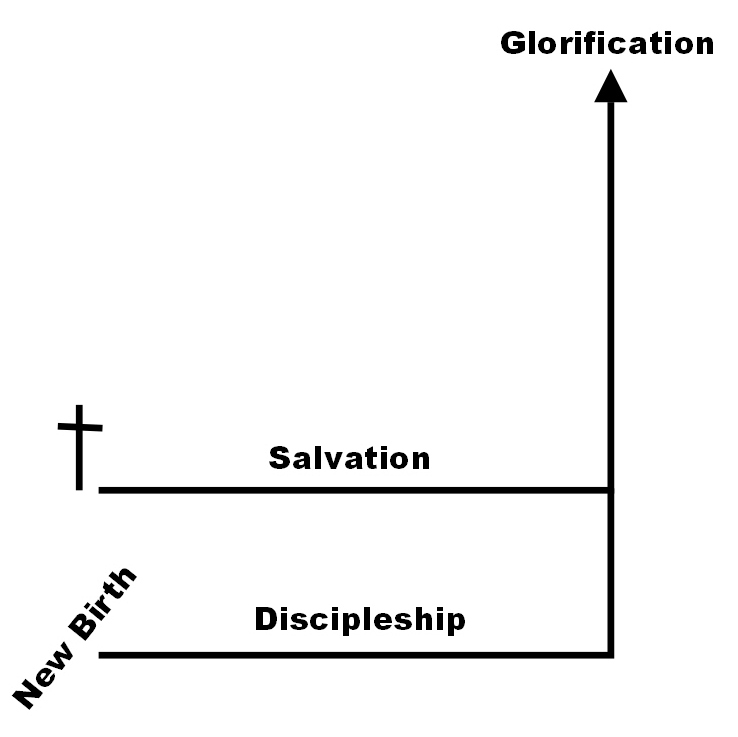
I will conclude with a visual chart to help clarify the above. In the second part, we will examine the difference between this and Calvinism.
New Calvinist Calvin Wannabes and How Their Polity Is Modeled After Geneva: Part 2
 My association with John Immel has been a real eye opener. For someone who has been of the Reformed mindset for more than twenty years and served as a Reformed pastor, discussions about who owns man, the very discussion in the arena of ideas itself, feels like being at a strip club. For the Reformed mind, this is an outrageous concept, the idea that man is a free agent, or in other words, owns himself.
Immel, for the most part, has pointed me in the right direction, and what I have discovered by my own study has brought about a significant transformation of thinking. New Calvinism is old Calvinism to a “T.” Hear me and hear me well: New Calvinists will do what the old Calvinists did; i.e., study the history of Calvin’s Geneva theocracy.
What we are seeing today in the churches, this spiritual abuse tsunami, is a direct result from the resurgence of authentic Calvinism in our day. The present abuses are all about the control Reformed elders think they should have via the Reformed tradition. The present control abuses are merely cheap substitutes for the implementation of government to enforce church doctrine enjoyed by the Reformers in medieval times. How does that play out today? What has taken the place of the burning stake, the dungeon, the guillotine, and the gallows?
1. Brain washing. Communication techniques employed by New Calvinist elders are vast, and most certainly, a book could be written on that topic alone. Some blogs like Under Much Grace explore some of these techniques in significant details.
2. Accountability structures. This has become very easy to detect in New Calvinist churches if you are looking for it. When you visit initially, you will be befriended by a member and probably taken out to lunch and immediately invited to several functions. The purpose is to ascertain your ability to think for yourself and ability to discern doctrine. Such are a threat to the control structure. If you are foolish enough to join after attending a “church membership class” and signing a covenant which you probably didn’t read, you will be assigned an elder which also oversees the small group that you are ASSIGNED to. As in Calvin’s Geneva, periodic home visits/inspections by elders to determine the “spiritual wellbeing” of the family are becoming more prevalent in New Calvinist churches.
3. Per New Calvinists protocol, there will be a refusal to discuss/debate doctrine in the arena of truth/ideas. New Calvinist elders see their authority as absolute and a binding on earth as it is in heaven.
4. New Calvinist elders teach that God will in fact condemn a person to eternal separation based on their declaration. In other words, they hold your very eternal security in their hands.
5. Where church discipline fits into all of this is rather self-explanatory. Reformed elders believe that they have the authority to bring any individual under church discipline for any reason, and at any time.
6. Read the fine print on membership covenants: you can be brought up on church discipline for leaving a church for “unbiblical reasons.” One of these unbiblical reasons is departure for doctrinal disagreements. Just ask the former co-founder of SGM. My wife Susan was also told by a pastor that she couldn’t leave the church where she was a member.
7. Church discipline doesn’t end with “if he SAYS ‘I repent,’” but rather a decision by fruit inspecting elders.
8. Fact: this ministry counsels people from time to time on how to leave New Calvinist churches without stress/conflict/tension. In extreme cases, people are counseled to temporarily take a job well beyond a feasible driving distance from said church. Moving to accept employment elsewhere is hard to argue with. At least two families that I know of have done so and not left forwarding addresses, emails, or phone numbers. You smile, hug, kiss, wave, enjoy the cake at your farewell party put on by the elders for appearance sake, and then disappear. Keep in mind that New Calvinist elders believe they can condemn you to hell via church discipline even if you are no longer a member; ie, if you contact present members after you leave.
I was asked for advice by one couple who were leaving a New Calvinist church for two reasons: mission work for an upstart church, and doctrine. I pleaded with them to only mention the former, and they heeded my advice. When they only stated the one reason to the elders, one elder remarked, “We would never prevent you from leaving for that reason.” Even with that, the elders told the congregation that the couple was leaving to start a new ministry that was an extension of their church. They also had the audacity to do this before the couple even left. In fact, their farewell party was a supposed celebration regarding the new upstart ministry supposedly started by them. I counseled them to just keep their mouth shut and play along. This is the extremes that people have to go through in order to leave these churches in peace.
paul
Cluelessness Saves Southern Baptist Pastors From New Calvinist Heretic David Platt
New Calvinism is a resurgence of authentic Calvinism. Since its conception during the so called “Reformation,” authentic Calvinism dies a social death from time to time because of the spiritual tyranny that its basic philosophy produces. Most of the rediscovery/resurgence movements of the past since authentic Calvinism died out after the Reformation have made little impact on Christianity. However, Calvinism Light (sanctified Calvinism) is left behind to live on after these movements die. When resurgence happens, the sanctified Calvinists actually take offence, not realizing that they are not really authentic Calvinists. Authentic Reformation theology in the vein of Augustine, Luther, and Calvin, is gross heresy. It is a works salvation with Gnosticism as its practical application. This also contributes to its eventual demise, but this takes a while because Augustine, Luther, and Calvin were masters of nuance and using familiar terms to articulate their doctrine.
The rediscovery movement that has become New Calvinism is different. Robert Brinsmead, the father of contemporary New Calvinism, argued that the recovery movements of the past failed due to a lack of systemization. Three other Reformed theologians agreed, and they started a theological think tank (the Australian Forum and its theological journal, Present Truth Magazine) to prepare the doctrine for a proper launching. That was in 1970, when the doctrine was originally known as the centrality of the objective gospel completely outside of us and New Covenant Theology. NCT took a brutal beating in Reformed Baptist circles and caused a split in at least one convention. Eventually, the doctrine was only represented by about twenty churches in those circles. However, the doctrine found new life in Presbyterian circles as Sonship Theology. Nevertheless, Sonship experienced a severe pushback by sanctified Calvinists in Presbyterian circles and was forced underground in circa 2000. It was renamed, “Gospel Transformation” and experienced massive growth between 2000 and 2004.
In 2004, the fallout from its tyranny became more evident, but no one could identify the doctrine. It was coined “Gospel Sanctification” by a small group of protestants including Dr. Jay E. Adams. But its influence and controversy continued to expand and the whole world started taking note when it was dubbed “New Calvinism” in 2008. Like the prior rediscovery movements, it has spawned a massive wave of spiritual abuse in the church under the auspices of several different sub movements such as Patriarchy and the Shepherding Movement. New Calvinists have also reached back into history and revived movements that were based on authentic Calvinism and brought them back into the fold. The whole thing is a perfect storm of mystical despotism dressed in orthodoxy. Robert Brinsmead was right; the movement needed the systematic touch.
In 1981, a Presbyterian started an organization for the sole purpose of taking over the Southern Baptist Convention with this doctrine, and today that organization is known as Founders Ministries. Until last week’s controversy concerning one of the speakers at the annual SBC Pastors Conference, authentic Calvinist heretic David Platt, I was convinced that the SBC was doomed to be taken over by this doctrine. But the response by 80% of the pastors who attended has given me great comfort. Per the normal, my beloved Southern Baptist brethren are too theologically illiterate to be led astray by a false doctrine. Their utter incompetence is demonstrated by the fact that heretics such as Platt could even be invited to speak at such a conference, and the additional fact that the flagship seminary of the SBC is run by New Calvinist “Big Al” Mohler.
Platt dissed the Sinner’s Prayer in his message, calling it “superstitious and unbiblical.” His particular beef with the prayer is the concept of “accepting Jesus into our hearts.” Platt’s message was full of nuanced and peculiar use of the English language, including the misidentification of subjects and objects, and turning verbs into adjectives, which should have begged the question: “What is this guy’s particular beef with the Sinner’s Prayer?” But my beloved Southern Baptists didn’t even blink, and did what I can always count on them doing lest they think below the surface of anything leading to possible deception; they focused on the ridicule of one of their sacred traditions. Thank goodness for that ole time religion. My dumbed down faithful brethren moved quickly to submit a resolution to the convention to confirm the validity of the Sinner’s Prayer. The resolution passed by more than 80%. Whew, that was a close one! Platt, apparently amazed at his inability to deceive them, responded to the clamor by saying that he wished he would have presented it differently. In other words, I think he meant that he wished he would have simplified it more. Platt need not worry; it wouldn’t have made any difference. I am now totally assured that my brothers are safe.
Actually, Platt’s problem with “asking/accepting Jesus in our hearts” is directly related to authentic Calvinism’s rejection of the new birth. Classic: one of the rising stars in the SBC, like Big Al, rejects the new birth, but how dare them diss the Sinner’s Prayer! You see, authentic Calvinism borrows the Platonist concept of emphasis. Though shadows are true, they are only a result of the sun’s true reality. Therefore, to emphasize shadows is to reject the only thing that can truly give life—the sun. Shadows can’t give life, only the sun’s light can. Since authentic Calvinism believes that life only comes from meditating on the works of Christ outside of us, an emphasis on the new birth, which is inside us, is to emphasize the result of Christ’s works and not Christ himself. So, to the degree that we focus on regeneration, we take away from the only thing that gives life: the personhood of Christ and His works. That is exactly what Platt’s beef is in regard to “accepting Jesus in our hearts.”
The crux of what Platt is really after was articulated by the Australian Forum. They dedicated a whole issue of their theological journal to The False Gospel of the New Birth. One article was titled as such. I will quote two members of the Australian Forum on this wise and throw in other quotes by contemporary New Calvinists as well:
“The false gospel of the new birth” imagines that the new birth refers primarily to what happens in the believer and that this is the greatest news in the world. This is classical Roman Catholicism. It teaches that a good thing is the best thing, that the work of the Spirit is greater than that of the Son. It takes the fruit of the gospel and elevates it over the root, which is the gospel. It confuses the effect of the gospel with the gospel itself.
~Geoffrey Paxton: Present Truth; The false Gospel of the New Birth Volume Thirty-Seven — Article 4
How can my life, my doing, be fruit and not root? The fruit of the tree of justification and not the root of justification? The fruit of God being on my side rather than the root of making God be on my side? How can it be the fruit of the Holy Spirit so that I’m acting in the power of another and not in my own power?
~John Piper: http://marshill.com/media/guests/be-killing-sin-or-sin-will-be-killing-you
Bultmann’s existential gospel led him inevitably to a negative view of the Old Testament. And the new-birth oriented “Jesus-in-my-heart” gospel of evangelicals has destroyed the Old Testament just as effectively as has nineteenth-century liberalism.1 [Goldsworthy’s footnote #1] (1 See Geoffrey J. Paxton, “The False Gospel of the New Birth,” Present Truth Magazine 7, no.3 (June 1978): 17-22).
~Graeme Goldsworth: Present Truth; Obituary for the Old Testament Volume Forty-One — Article 2
It robs Christ of His glory by putting the Spirit’s work in the believer above and therefore against what Christ has done for the believer in His doing and dying.
~ Geoffrey Paxton (Australian Forum)
But to whom are we introducing people to, Christ or to ourselves? Is the “Good News” no longer Christ’s doing and dying, but our own “Spirit-filled” life?
~ Michael Horton
As my lovely wife said in her first session at last week’s conference on spiritual tyranny:
By glazing over the finer details of Christianity and focusing on more moderate doctrines he [Billy Graham] made evangelism enticing, non-threatening, and easy to swallow, and in a lot of ways gave definition to easy believeism.
His mission to present the “gospel” and get people saved and on their way to heaven permeated the focus of many fundamental churches thereafter, particularly the Southern Baptist denomination with which Billy Graham was associated.
As a result of the success of Billy Graham, many other evangelists and pastors adopted and adapted his mode of operation in order to” bring in the sheaves.” This is often referred to as the first gospel wave that swept over America in the 50’s and continued on into the early 70’s.
Please do not misunderstand my opening remarks. The biographical remarks were taken from an article written of Billy Graham. We all believe that people were genuinely saved as a result of the ministry of Billy Graham; but I want to also say that many thought they were saved as a result of his ministry as well. Here’s the dilemma his type of evangelism created: a) genuine salvation experiences occurred and b) professions of salvation made but no outward change in living or life-style and c) lack of assurance of salvation as a result of poor follow-up and discipleship.
In my neck of the woods the “At least he is saved mentality” which the Billy Graham Association innocently created, helped people rationalize sinful lifestyles, make valid emotional experiences and equate them with regeneration, and issued “fire insurance” policy mentality amongst church going people. Just say the sinner’s prayer and you are guaranteed a home in heaven.
So, at least some people get saved, and they’re too doctrinally illiterate to be taken over by a movement that is completely of the devil.
Maybe it’s not all bad!
paul
If New Calvinists….
 If New Calvinists ever succeed in marrying the government, church discipline will be traded in for the guillotine. The headless don’t talk.

 Paul's Passing Thoughts
176 comments