What Happens When Salvation is Enough: An Ode to Wayne St. Denis
 I have always wanted to write a poem or the kissing cousin to a poem—the ode. This essay in ode form will have to suffice for the rough draft; perhaps I will find time later to put it in poem or lyric form, or someone else will be inspired by the essay and save me from the effort. For the sake of a life that speaks from the grave, it would indeed be a worthy effort.
The Strophe
Really, I was just minding my own business when I married this man’s wife who survived him, a man struck down by the world’s devices—Wayne St. Denis. He had a large library of theological books which I inherited. In many of the books he wrote his thoughts where printed words did not occupy, and I have read them. Not all of them mind you, but enough to see the sentiment of the heart.
What I knew of Wayne’s life from others and the heart I saw in his books has laid siege to my thoughts for several months now. An eerie contradiction not in the forefront, but yet following my heart like a stray dog that refuses to go away until it is fed.
In all, mutual ground between me and one in the grave; we both hate hopelessness. Wayne lost his battle with the beast, but his life story only adds to my resolve to fight this monster. The monster’s intimidation and strong message only feeds my resolve and hatred of it. Because of God, where there is life—there is hope—I stake my life on this belief.
The Antistrophe
There is no need to go into all of the gory details of Wayne’s behavior, but yet, this is the testimony that has followed him to the grave; it is his legacy. A like story was sent to me by a reader this week that was written by an agnostic. The author wrote of another professing Christian’s life and asked the following question which is now a companion to the first dog: “Why is God so bad at making people good?”
From 1950 to 1970, the first gospel wave would answer that question as follows: “God doesn’t make us good until we go home to be with him. Until then, we are ‘sinners’ saved by grace.” From 1970 to present (the second gospel wave), the mantras are, “It’s not about our doing, it’s about HIS doing and dying.” “It’s not about us, it’s about making us small and the cross big.” “It’s about making much of Jesus.” “If we get better, that eclipses the Son.”
Does that answer the agnostic’s question? “God is not trying to make us good. If He wanted us to be good, He could make us good.” And perhaps Michael Horton would answer the question this way: “We preach the gospel; we don’t try to be the gospel.”
I have read Wayne’s notes. He would have strongly objected to such a notion. So what’s with the life? The first gospel wave would say, “Well, at least he was saved.” The second gospel wave would say: “His problem was that he tried. He made an effort to keep the law. Therefore, he was ‘making his sanctification the ground of his justification.’ He was a legalist which is why his life was powerless. That’s why he never experienced, ‘real and lasting change.’ He would try, and fail—try, and fail—try, and fail over and over again. He partook in ‘Christless activism’ which is why his life didn’t show forth the fruits of Christ’s active obedience. He wasn’t saved, he was a Pharisee. He lived a hopeless life, and died without hope.”
The first and second gospel wave would debate Wayne’s probable eternal state, the latter accusing the former of easy believeism, and the former accusing the latter of legalism (not realizing that they believe Jesus obeys for us). In both cases however, Salvation is enough. The gospel is the final word.
Wayne would have never bought that, he was searching in a world that (to a large degree) didn’t believe what he believed—that God had the answers and solutions for life’s deepest problems—here and now. He was a man who sought to give answers to others in various ways, but he was seemingly searching by himself, perhaps passing others who were searching like two ships in the night.
The Epode
Funny, not many give hope that Wayne was saved though his life looked a lot like another man who lost hope when he couldn’t seem to find the answers: King Solomon. And like the description of the man written of by the agnostic, Wayne had a storied gospel life of being miraculously transformed from a life of decadence, and henceforth paraded around before others as a celebration of the gospel that is enough. And when they fell, as usual, the propagators of everything gospel didn’t have the answers…. because the gospel is enough.
Yes, Wayne should of learned to live by the gospel that saved him. Who knew? Supposedly, Wayne should have lived by the gospel honeymoon that apparently requires no investment in relationship following. That would eclipse our Spouse.
I contend that Wayne tried to do the right thing the wrong way. And as he failed, he lost hope, and perhaps the demons kicked out of the house during the honeymoon were tamer than the ones who returned. Nevertheless, those who mocked his efforts by predicting his short-term repentance were of no more help than the demons. At any rate, King David is testimony to how we can go from men after God’s own heart to falling into unspeakable sin. Though the enslaving power of sin is broken in the believer, it is still present and powerful. That powerful? Yes, I think so.
The gospel is a settled issue for the dead, but the lives of the dead still speak from the grave on other issues with the help of God’s counsel contained in the Bible. In Wayne’s efforts to find life more abundant after gospel life, he colored his life with more than his legacy. That is sanctification truth that Philippians 4:8 points us to. That verse isn’t about the gospel, it is about truthful, sanctified thinking about others. Wayne’s legacy isn’t the truth, what his life really was as whole is the truth. Armed with the truthful remembrance of Wayne’s entire life, and biblical wisdom concerning how men who love God can fall deep and hard, forgiveness is found for Wayne by some that he harmed long after his departure.
That is the power of sanctification wisdom beyond the gospel. There is no healing apart from truth. That is the power of the word that equips us for every good work. That is the power of the word that we live by. I am therefore inspired to dedicate my life to the idea that salvation is not enough, we need resurrection also, and in showing forth the power that resurrected Christ from the grave, men want what we have. We have been given that power as a gift, but with any gift, ownership, learning, and responsibility is implicit. Wayne failed in his search to best appropriate God’s wisdom for his life, but that doesn’t mean we should fail also. His life is a testimony to why we shouldn’t. His life still speaks from the grave….
The gospel is not enough.
paul
Is All Truth God’s Truth? And How Does the Question Relate to Spiritual Abuse?
There is a thinking crisis in our culture that is greatly compounded in the church because faith is often a license for subjectivity; an inability to think coupled with an attitude that pragmatism is the antithesis of spirituality. Especially in Reformed circles, knowing things and being solution oriented =’s “arrogance.”
Propositions are judged by how good they sound, or how logical they sound, or if the hearing thereof incites a stimulating chemical reaction in the brain that we seem to like.
All truth is God’s truth; is that true? No. However, the following is true: that truism has led many to destruction. Why? Because it assumes truth is the same as facts, and it doesn’t understand that all teaching is a process of propositions that lead to a conclusion. And, logic always yields the same results.
“Dr. John Doe has said many valid things here; I would only disagree with this point or that point.”
Facts and truth are two different things. Facts are usually passive and an elementary part of a larger schema. 2+2=4 is a fact, and a tree is a fact, but unlike truth, they are morally neutral and can rarely take you anyplace by themselves. Truth has a moral aspect, and usually has a purpose in mind. Jesus Christ is not merely a fact, though His existence is certainly factual—He is “The Truth.” He is the epitome of all that is good and gives life.
When the serpent deceived Eve in the garden, he used facts to take her to a rejection of the truth. The fact that Eve was not going to die on the spot after eating the apple was a fact. Satan presented many facts to Jesus when he tempted Him in the wilderness, but the goal wasn’t truth. Does that make the facts God’s truth? Hardly.
True facts that lead to untruth are not God’s truth, because God’s truth always equals life and has that end in mind. Sub truth, or facts, are only as true as what they yield whether life or death. When ill motives are attached to a fact, it is still fact, but it isn’t truth because the fact was used for ill intent. Truth has a moral qualification.
It is not a good idea to sit under the tutelage of Satan because he espouses facts that are undeniable—his facts never lead to truth, he is “the father of lies.”
“Satan has said many valid things here. I agree that Psalms 9:11,12 states that the angels will bear Jesus up. However, I disagree with his suggestion that Jesus should have jumped off the temple pinnacle.”
Really? That’s nice.
Secondly, each proposition that builds up to the conclusion needs to be evaluated. Sub points need to be true and they need to fit together logically to affirm the conclusion. When we have some disagreement on a point in a message or teaching, the possible application of it for another conclusion should be irrelevant. It needs to be judged according to its proposition and contribution to the conclusion at hand. Not all incorrect propositions on the way to a conclusion do irreparable damage to the conclusion, but it’s rare.
Thirdly, Philosophy forms logic which always leads to the same results. All “truth” teachers have a philosophy. All teaching seeks to lead you to a conclusion. Conclusions form logic and lead to action. Hence, “….the student will be like his teacher.”
Philosophy is metaphysics (what we believe about reality and being), epistemology (the theory of how we come to know what we know, or how we obtain knowledge), ethics (the moral application of what we know), and politics (how we use what we know to relate to others, or how we communicate it). The first two elements of philosophy always determine ethics and politics. Often, behavior reveals the philosophy: “….by their fruits you will know them.”
This is exactly why we categorize teachers and reject all that they say out of hand because once their philosophy is revealed, we know where the logic will always take us. Even if some of what they say is factual, the conclusions they want to take you to are based on the philosophy. Therefore, their factual stepping stones are only relevant to the truth or error that is the goal, and for all practical purposes, the same value is placed on the propositions leading to the conclusion. Hence, the biblical prescription for those who have errant philosophy: “AVOID THEM,” and, “Do not allow them into your home or bid them God’s speed.”
Therefore, facts that are part of a conclusion that is a lie have no moral value and are not truth, but part of a deception.
This is the folly of sitting under the teachings of people with errant philosophy, or even greeting them: even the facts that they present are intended to lead to untruthful conclusions. So no, all truth is not God’s truth. God’s truth always has a good ending. Scripture states plainly to completely avoid anyone with errant philosophy.
How you would then glean what is “good” from their teachings while “leaving what’s bad on the shelf,” or “eat the chicken and throw away the bones” is a mystery to me. God forbids that the chicken is even in our house and disallows the use of our shelves.
What does this all have to do with the war against spiritual abuse in the blogosphere? Well, there is a reason it is beginning to look like the Jerry Springer show more and more every day. Even though the Christian culture of our day is primarily framed with two gospels that are radically different, nobody is required to state their philosophy. Spiritual abuse blogs are fraught with Christian mystics, Gnostics, and proponents of progressive justification.
As I have confronted some of these bloggers in regard to their abhorrent psychobabble solutions for spiritual abuse, at least one informed me that the Bible (what the Apostle Paul called “the mind of Christ”) is “not enough” to fully address the problem. And let there be no doubt: what you read out there is a gargantuan volley of propositions from a myriad of philosophical camps followed by massive chatter that evaluates the propositions.
If the Apostle John said that greeting a person with errant philosophy was to also partake in their sin—then it is no less for propositions—factual or otherwise.
Do I think there is an endgame to all of this “all truth is God’s truth” business? Yes. I think it is a ploy to keep us at the feet of those with errant philosophy because there are some “facts” in their teachings that can be added to the “wider field of knowledge.” But those facts can’t help us who strive for truth because the usage of those facts are in a context leading to bad conclusions.
And I think that’s the crux. It creates conduits between ill philosophies and good philosophies. There isn’t the wide separation God calls for.
Whatever is used to endorse error is not God’s truth, even if it is factual. The moral goal is not the same. It may be a fact, but it’s not God’s truth.
Propositions are only as good as the conclusions and results that they always produce. And that qualifies the propositions as either endorsing truth or not endorsing truth. And only TRUTH sets us free from spiritual abuse.
paul
To David Powlison et al: Stop Lying About Jay Adams; God Doesn’t Like Lying
“No Steve. Let me repeat that. ‘No Steve’: the issue isn’t the ‘simplistic’ versus the wider field of knowledge, the issue is which gospel are we going to use to minister to other Christians; progressive justification or progressive sanctification? And who is competent to counsel? Please do not be a part of the big lie in our present day.”
Steve,
Thanks for the response because I am a busy person and our conversation provides an easy framework to post something that needs to be said. My response is primarily provoked by your comment following and will be the subject of a post on my own blog:
Jay Adams and nouthetic counseling are familiar to me. Jay has contributed much to biblical counseling, but his perspective is only one in a field containing hother highly-reputable Christians such as Larry Crabb and Dan Allender. I have found Jay’s approach simplistic and—when used by someone without proper training or grace—combative and even abusive.
“Nouthetic” means “admonishing,” which, though a biblical term, can often devolve into simply berating someone with a Bible verse and telling them to deal with their sin. While scripture is always the grid to evaluate truth claims in this world, not all truth is found in the Bible. Rather, God has given some truth to the realms of science, engineering, medicine, psychology, and others, for the benefit of all people everywhere. Christians must think critically about any truth claim, compare it with scriptural principles, and then proceed accordingly. I prefer an integrated approach to Christian counseling.
First of all, Jay Adams doesn’t need me to defend him, but your portrayal of contemporary history concerning the biblical counseling movement is very much in vogue and happens to be a lie first propagated by David Powlison, and furthered by the insufferably arrogant likes of Heath Lambert.
People like Lambert who is a prototype of many in our day accept any proposition espoused by the men they mindlessly follow as truth. And the truth is my concern here, not necessarily a defense of Jay Adams. However, though I enjoy defending Jay, he would probably prefer that many of his “friends” in Christian academia would defend him, but unfortunately, most of them are cowards and only pretend to love the truth for monetary gain and notoriety. I despise both, and have way too many Facebook friends (62). Therefore, the following is the true historical/biblical facts of the matter:
In circa 1970, American Christianity was feeling the pain of a skewed attitude and understanding of sanctification. The previous twenty years had been an easy believeism/hyper-grace approach. The focus was getting people saved, and not “making disciples.” There were several reasons for this, but suffice to say that “the gospel” was grossly overemphasized. As I type that, I can now hear the shrill cat-cries: “IT’S IMPOSSIBLE TO OVEREMPHASIZE THE GOSPEL!” Right.
However, in order to fill the void, a variety of biblical generalities were thrown around (along with let go and let God theologies) as damage control, plus pastors farmed sanctification out to psychologists. Deeper problems of life were labeled “sickness,” and the idea of pastors sending their parishioners to mind/spiritual doctors was sanctified with “Christian Psychology.” Your everyday pastor was who you went to if you got bubble gum in your hair, but the really deep problems of life needed a “Christian Psychologist.”
Adams was the first in our day to say “NO” to this assertion. The theme of his sanctification reformation was “Competent to Counsel,” and was based on Romans 15:14. Moreover, this one verse powerfully destroys much of the errant philosophy of our day.
But something else was happening at the same time. Another reformation. This other reformation that was emerging at the same time that Adams began to challenge the church is the dirty little secret that is the foundation of your whole proposition that Adams is a mere contributor to a wider field of counseling wisdom. In fact, in a rare episode of truth-telling by David Powlison while lecturing at John Piper’s “church,” he specifically stated the difference between Adams’ biblical construct and the present-day “wider field of knowledge.” Two gospels. That’s right. A wider field of knowledge is not the issue, which gospel that you are going to use to minister to the saints is the issue—so stated the most prominent one in the “wider field.” Powlison dropped his usual nuanced verbiage as it is no longer necessary among the vast majority of Christians who are utterly unable to think for themselves. He stated the following:
This might be quite a controversy, but I think it’s worth putting in. Adams had a tendency to make the cross be for conversion. And the Holy Spirit was for sanctification. And actually even came out and attacked my mentor, Jack Miller, my pastor that I’ve been speaking of through the day, for saying that Christians should preach the gospel to themselves.
I cover this in more detail in chapter 9 of “The Truth About New Calvinism,” but this statement by Powlison while lecturing at Piper’s church is the crux. Even in that rare episode of truth-telling by Powlison, he left out the following detail concerning Adams’ “attack” against his “mentor” for telling people to preach the gospel to themselves every day: the “attack” was in the form of a book and devastating treatise against Sonship Theology. Adams’ thesis was that the power for sanctification comes from regeneration and not justification.
No Steve. Let me repeat that. “No Steve”: the issue isn’t the “simplistic” versus the wider field of knowledge, the issue is which gospel are we going to use to minister to other Christians; progressive justification or progressive sanctification? And, who is competent to counsel? All who are “full of goodness,” or just the Christian experts? Again, I hear the alley cats screaming in the night’s full moon: “Progressive justification? Nonsense! Miller didn’t teach that!” Oh really? Have we become so postmodern that “preaching the gospel to ourselves” as a way to be empowered in sanctification is not progressive sanctification? Have Christians really become that mindless?
What is the source of our power for change, and who can counsel? The answer to those questions is the difference between light and darkness. Here is the reality and the line in the sand: choose which gospel you will follow according to truth or according to what man butters your bread.
The key to discussing what significant movement emerged at the same time as Adams’ biblical construct is Powlison’s mention of Dr. John “Jack” Miller. Miller was a professor at Westminster approximate to the time that the theological journal Present Truth was all the rage. The journal, in magazine form was published by the Australian Forum theological think tank headed by SDA theologian Robert Brinsmead. Much to Adams’ consternation, Brinsmead and company were invited to Westminster to chat with the theological big boys. Brinsmead had rediscovered the authentic Reformation gospel that launched the SDA Awakening movement and led to a concerted effort to get Progressive Adventism recognized as a valid denomination.
The Australian Forum argued that the true Reformation gospel was monergistic substitutionary sanctification, or in essence, progressive justification. From that, Miller contrived his Sonship Theology scheme. Tim Keller and David Powlison were rabid followers of Miller, and Powlison used Miller’s Sonship Theology to develop his Dynamics of Biblical Change counseling program that is the foundation of CCEF’s counseling model. Like the father that gave birth to Sonship Theology and CCEF ( the Australian Forum), Miller, Powlison, and Keller felt called to save America from this present Dark Age that supposedly resulted from the lost Reformation gospel. Powlison was then compelled to take over NANC with said doctrine, which he has effectively done.
Hence, Adams was obviously a threat and had to be neutralized. The failings of the movement that Adams came to fix were pinned on Adams; ie, all of the things that filled the void: living by biblical generalizations; legalism; and, “Take a Bible verse and call me in the morning”; etc. Meanwhile, the new gospel of progressive justification was guilty of the same thing that the previous hyper-grace movement was guilty of: devaluing aggressive sanctification and the new birth. The so called second generation “biblical” counseling construct made sanctification the same thing as justification rather than merely devaluing it.
But again, this necessitated a replacement for the real article, and I think the replacement is well articulated by the Powlison understudy Paul David Tripp in How People Change which is really not about biblical change at all. Progressive justification advocates the manifestation of realms, not real change within the individual Christian. Tripp makes this absolutely clear on pages 64 and 65 of HPC by describing Christians as still being enslaved to sin and enemies of God.
Therefore, Powlison is guilty of thwarting the real model for real change in our day. He has marketed the contra product well, so many follow and trade the truth that sanctifies for a bowl of soup; ie, invitations to conferences, recognition, book promotions, friends, etc.
While thinking of themselves as on the cutting edge of change, which doesn’t include changing people, but rather making the cross bigger, they do not even realize that God doesn’t approve of lying.
So Steve, I would recommend that you not promote the fictitious storyline concerning first generation biblical counseling. It’s a lie, and God doesn’t approve, even if it somehow supposedly makes the cross bigger—which trust me—it doesn’t.
paul
Addendum: The Gospel According to John MacArthur’s Reformation Myth
But perhaps the whole issue should be narrowed down to the most glaring contradiction in all of this. While MacArthur states that justification and sanctification cannot be separated, but are distinct, like all neo-Calvinists, he then complains that Rome “blends” the two. According to the standard New Calvinist MO, the cardinal sin in regard to this blending is “progressive justification.” Note once again the following excerpt in this post by JM:
If sanctification is included in justification, then justification is a process, not an event. That makes justification progressive, not complete.
But MacArthur is a Calvinist, and progressive justification is exactly what John Calvin propagated. Again, they accuse Rome of exactly what they are guilty of themselves. Calvin entitled chapter 14 of the third book of the Calvin Institutes, “The Beginning of Justification. In What Sense Progressive.” Calvin then makes the same case throughout the rest of the chapter that all New Calvinists constantly make–that a believer must continually return to justification for their sanctification. Seeing these kinds of blatant neo-Reformed contradictions in MacArthur’s teaching is truly sad to watch when one considers what he once was.
paul
The Gospel According to John MacArthur’s Reformation Myth
“’Subjective’ verses ‘objective’ is key to understanding the Reformed denial of the new birth that predicates its false gospel.”
Note: Click on illustrations to make bigger.
Let me state something right out of the gate: the church has never been in a Dark Age. Christ said, “And I tell you that you are Peter, and on this rock I will build my church, and the gates of Hades will not overcome it” (Matthew 16:18). Imagine that. Peter wasn’t anybody—he was an everyday Joe—a blue-collar guy in that culture. Then one day God shows up personally and informs everybody that He would oikodomhsw “be building His church,” or some translators, “I shall be home building”….mou (of me)….the ekklhsian (out-called, not “church” which is not a biblical word) on Peter. You can trust me on this one: Jesus has been home building His out-called, and the construction project has never slowed down or stopped. The building project has always been on schedule and within budget—funded by the Blood. And Christ didn’t choose a John MacArthur Jr. of that day—He chose an ordinary Joe.
Right here, two pillars of the Reformation myth are found wanting. There has never been an out-called Dark Age, and Christ doesn’t primarily use renowned scholars like Martin Luther to get things done. Today’s “Reformed” “church” is built on the foundation of lofty creeds and confessions written by men of fleshly renown. The very name, “Reformed” is fundamentally false—our Lord’s building project has never needed a “reformation”—especially at the hands of murdering mystic despots.
But two days ago, Susan and I had the rare privilege of sitting down with four men who exemplify what Christ is using to build His out-called. We held siege at the restaurant for three hours. These men so encouraged me that it is a wonder that the local police were not called accompanied by men in white attire. They bore four marks of God’s true out-called:
1. Ordinary men.
2. Thinkers who constantly wrestle with understanding.
3. Wholly devoted to truth.
4. Sold-out to the sufficiency of the Scriptures as their only authority.
Somewhere in the world since the day Christ showed up and walked into the everyday lives of twelve men, He has been slowly building His out-called. He has been building with those who possess the same spirit of Noah and is in-fact a fifth mark: they will stand alone if they have to. In the present day neo-Reformed blitzkrieg, it is, and will be two or three families who come out from among them, weeping with sorry, often leaving the only church they have ever known while the door is held open for them by the young, petulant Reformers of our day that despise the sweat and blood that built the work that they have covertly sieged. As our brother Jude said of these brute beasts, they slip in “unawares” (v.4).
Basically, the problem is the same as when Christ showed up to found His out-called. The religion of the day was founded on the authority and institutions of self-important men. People where amazed that Christ didn’t check in with the academics before He launched His ministry, nor quoted the spiritual brainiacs of that day. Likewise, if Christ came today, John MacArthur, Al Mohler, and the insufferable likes of obnoxious men like Steve Lawson and Paul Washer would watch with incredulities as Christ would ignore them and make a b-line for the ghettos—choosing His workers and confidants from among them.
So how should I view an article sent to me by a reader that was written by John MacArthur regarding the Reformation motif of “Justification by faith.” First, as I am presently teaching my family, ALL ideas presented by men, and I believe that MacArthur fits into that category, will entail a litany of propositions that lead to a conclusion. Therefore, let us examine and wrestle with the propositions presented by MacArthur in this article (Justification by Faith: online source: http://goo.gl/xJyFO).
Proposition 1: “The Reformation doctrine of justification by faith is, and has always been, the number one target of the enemy’s attack.”
The “Reformation doctrine”? Excuse me Mr. MacArthur (hereafter, JM), but we get our doctrine from the Bible, not the Reformers, who, as I have noted, are an oxymoron to begin with. In the first sentence of this article, JM sets up an authority between the out-called priests (that’s us) and the word of God. Therefore, his article is predicated on a proposition by men who are not original authors chosen by God— buyers beware. Hence, if we are discerning, JM has raised the propositional ante to a considerable level. By citing the preapproved authors of the Bible, additional consideration could have been avoided.
JM goes on to state that this doctrine, “….provides the foundation of the bridge that reconciles God and man — without that key doctrine, Christianity falls.” This should now incite interpretive questions for the proposition:
1. Could the Reformers have been wrong?
2. Even if they were right, is there a danger in making Reformed epistemology a standard of truth?
3. Is the claim that the church stands or falls on this doctrine establishing Reformation doctrine as a significant authority? And if so, is this wise?
Proposition 2: “Social and political concerns have brought evangelicals and Catholics together in recent years to unite against the forces of secularism. Under the influence of ecumenism, it’s difficult for either group to remember what it was that divided them in the first place.
The pragmatists and ecumenicists are aided in their forgetfulness by new theological movements that redefine justification in more Catholic terms. Under the influence of liberalism and postmodernism, proponents of the New Perspective on Paul, the Emergent Church, and others have so confused and redefined the doctrine of justification that it has become shrouded in darkness once again
The Christian church today is in danger of returning to the Dark Ages. The seeker movement has Christianity turning in its Bibles; the ecumenical movement urges Christians to use worldly means to accomplish temporal ends; and current theological movements look through the lens of philosophy — Enlightenment rationalism and postmodern subjectivism — rather than Scripture. The departure from sola scriptura has led to the departure from sola fide — justification by faith alone.”
JM asserts that the Reformation was a marked contrast between Catholicism and the Reformers. Catholic influence is dragging the “church” back into a “Dark Age.” Regardless of the nomenclature of which he frames this proposition, he begins to articulate the Reformation motif in a way that is traditional, and packaged for fairly easy digestion—if you understand the premise of the motif, and we soon will.
The key here is this part of JM’s proposition: “….and current theological movements look through the lens of philosophy — Enlightenment rationalism and postmodern subjectivism — rather than Scripture.” First, throughout his post, JM uses the term “Reformation doctrine” and “Scripture” interchangeably. Hence, he is proposing that the two are synonymous—he is asking that you accept this proposition as fact. But what we want to focus on here as a gateway of understanding is the word “subjectivism” in his proposition. This is key to understanding my counter proposition:
1. There was no difference in Reformation doctrine and Catholic doctrine.
2. Subjective verses objective is key to understanding the Reformed denial of the new birth that predicates its false gospel.
MacArthur begins to propagate the traditional Reformed dogma of subjective verses objective; that is, as I have previously stated, the crux of their doctrine.
And is that biblical? Is Reformed doctrine biblical doctrine? Is the Reformed gospel the biblical gospel?
The History of the Reformation Motif / Myth
We will take an interlude on the way to our understanding to examine the very significant contemporary contribution to understanding Reformation doctrine by its own proponents and advocates. It is true that Reformation doctrine has experienced times of low recognition followed by “rediscovery,” “resurgence,” and “revival” since the Sixteenth century. The last resurgence began in 1970. It was a rediscovery of authentic Reformed theology that launched the SDA Awakening Movement. Until then, the doctrine had never been framed in a subjective verses objective model of understanding. “Subjectivism” was fingered as the root of all evil verses the, and here it is: objective gospel outside of us. More specifically, “The Centrality of the Objective Gospel Outside of Us.” Hereafter, COGOUS.
This apt method of framing Reformation doctrine was the brainchild of SDA theologian Robert Brinsmead, who was joined by Anglican theologians Geoffrey Paxton and Graeme Goldsworthy, and later by Reformed Baptist Jon Zens. They attributed all contra Reformation beliefs and movements such as the Enlightenment era to “subjectivism.” JM shows his kinship to this contemporary understanding of Reformation theology via his propositions in said article, of which the sender asked, “Does this muddy the waters?” Answer: no, in-fact, it clarifies MacArthur’s participation in the endeavor to save the church from a supposed “Evangelical Dark Age.”
The theological think tank formed by this “core four” was known as the Australian Forum and their theological journal was Present Truth Magazine which was the most publicized theological journal in English speaking countries during the Seventies. They compiled a vast amount of documentation that clearly shows that the Reformation gospel of Luther and Calvin was the Centrality of the Objective Gospel Outside of Us. It contends that if the power of God is infused into the believer, it will enable him/her to, as the truism states, “know enough to be dangerous.”
Because the Reformers saw justification and sanctification as the same thing, they argued that any enablement infused into the believer would automatically contribute to the justification process which they saw as progressive. Please note: this is exactly what JM et al accuse the Catholics of, but as we shall see, they are both guilty of this same thing: the fusion of justification and sanctification together.
Hence, in contemporary lingo, the outcry of the Reformers against Rome was the “infusion of grace into the believer—making sanctification the ground of his/her justification.” In other words, all enablement and spiritual life must remain outside of the believer. All of the power of grace must remain ‘objective” by staying outside of the believer. This Reformed paradigm was brilliantly illustrated by the Australian Four, hereafter A4, by the following pictorial illustration:

Also let me demonstrate by another A4 pictorial that they believed justification was progressive:
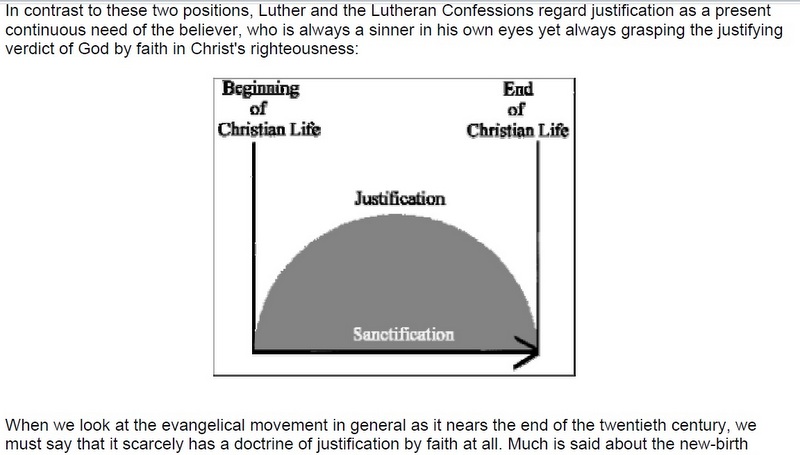
I will later explain the application of the two-man chart in this post. I can most certainly read your mind as you look at it: “How in the world does that work in real life?”
We will now further my contra proposition by substantiating some of my sub-propositions. Let’s first establish that one of the elder statesmen of the neo-Reformed movement, John Piper, and a close confidant of JM, agree with the AF’s contemporarily framed assessment of authentic Reformed doctrine, hereafter, ARD. Graeme Goldsworthy, one of the original A4, recently lectured at Southern Seminary on the Reformation. John Piper wrote an article on Goldsworthy’s lecture (Goldsworthy on Why the Reformation Was Necessary: Desiring God blog, June 25, 2009). Piper’s assessment of Goldsworthy’s lecture is a major smoking gun in regard to agreement on ARD:
In it [Goldsworthy’s lecture at Southern] it gave one of the clearest statements of why the Reformation was needed and what the problem was in the way the Roman Catholic church had conceived of the gospel….I would add that this ‘upside down’ gospel has not gone away—neither from Catholicism nor from Protestants….
This meant the reversal of the relationship of sanctification to justification. Infused grace, beginning with baptismal regeneration, internalized the Gospel and made sanctification the basis of justification. This is an upside down Gospel….
When the ground of justification moves from Christ outside of us to the work of Christ inside of us, the gospel (and the human soul) is imperiled. It is an upside down gospel [emphasis Piper’s—not this author].
Note, if you think about it, it is impossible to “reverse” justification and sanctification unless they are on the same plane. Nor can you turn a two-part object upside down unless both parts are attached—making either one the “ground” or otherwise. Hence, a careful observation of Piper’s use of words betrays his subtleness in regard to believing in the fusion of justification and sanctification together. Furthermore, Piper’s beef with Catholicism is not the fusion of justification and sanctification together per se, but rather the infusion of grace into the believer. The AF two-man illustration depicts Piper’s contention to a “T.” Note the exact same issue: Christ within, or Christ without. Just grasp that for now, and put the absurdity of it on the back burner—it will come together for you later.
Basically, if God’s grace/goodness is placed within the believer, he/she becomes enabled enough to become dangerous leading to all of the terrible things inside of the guy looking down. Everything must remain outside of the believer, leading to all of the good things listed on the right side of the chart which are listed outside of him. Don’t miss that. Today’s church owes Robert Brinsmead a tremendous debt of gratitude for publishing this chart.
A Major Key to Understanding: John H. Armstrong and SUBJECTIVISM
Now, let’s take yet another sub interlude to further my contra proposition. The following illustration shows how the AF made the objective/subjective / Christ within / Christ without the major crux of ARD:

A theologian named John H. Armstrong eludes to this exact survey in Present Truth to make a point in an article that he wrote (The Highway blog: Article of the Month; Sola Fide: Does It really Matter?). Armstrong was the general editor of a combined work called The Coming Evangelical Crisis (1996 by Moody Bible Institute) that included the who’s who of the neo-Reformed movement: R. Kent Houghs; John MacArthur; RC Sproul; and heretics Michael S. Horton and Albert Mohler Jr. Armstrong stated the following in the aforementioned article:
The sixteenth-century rediscovery of Paul’s objective message of justification by faith [and sanctification also because justification is supposedly progressive] came upon the religious scene of that time with a force and passion that totally altered the course of human history. It ignited the greatest reformation and revival known since Pentecost.
Now, if the Fathers of the early church, so nearly removed in time from Paul, lost touch with the Pauline message, how much more is this true in succeeding generations? The powerful truth of righteousness by faith needs to be restated plainly, and understood clearly, by every new generation.
In our time we are awash in a “Sea of Subjectivism,” as one magazine put it over twenty years ago. Let me explain. In 1972 a publication known as Present Truth published the results of a survey with a five-point questionnaire which dealt with the most basic issues between the medieval church and the Reformation. Polling showed 95 per cent of the “Jesus People” were decidedly medieval and anti-Reformation in their doctrinal thinking about the gospel. Among church-going Protestants they found ratings nearly as high….
I do not believe that the importance of the doctrine of justification by faith can be overstated. We are once again in desperate need of recovery. Darkness has descended upon the evangelical world in North America and beyond, much as it had upon the established sixteenth-century church.
As JM said in our observation of the article at hand:
….the doctrine of justification….has become shrouded in darkness once again. The Christian church today is in danger of returning to the Dark Ages.
And,
Enlightenment rationalism and postmodern subjectivism — rather than Scripture. The departure from sola scriptura has led to the departure from sola fide — justification by faith alone.
JM, John Piper, Armstrong, Graeme Goldsworthy, and what they call the “Justification by faith” doctrine—all the same camp, and the same belief: The Centrality of the Objective Gospel Outside of Us.
How in the World Does COGOUS Work in Real Life?
As far as how this doctrine functions, there are two camps. But in both camps, the believer remains unchanged and totally depraved. The crux of COGOUS is that sanctification is a total work of God because it finishes justification. The doctrine then frames man’s role in regard to Gnostic ideas. In fact, the very first sentence of the Calvin Institutes is a Gnostic idea. Calvin claims therein that all knowledge is contained in the knowledge of ourselves and knowledge of God. Since we already know that Calvin believed in the total depravity of man, this is the knowledge of good and evil.
Calvin, right out of the gate, states that this is the core of all true wisdom. So, what you begin to see when reading the works of various Reformers of old and new, is the idea that change begins with wisdom, and as we see our own depravity in deeper and deeper ways, and the holiness of God in deeper and deeper ways (which the former facilitates as well), a transformation takes place. Not in us, of course, we are totally depraved—we therefore cannot change—we rather manifest a realm. As it was explained to me by a fairly well known Calvinist, there is a Spirit realm, and a flesh realm (not an old nature within us), and both put pressure on us if we are saved, and we either “yield” to one or the other realms at any given time. But again, we don’t change, we merely manifest a realm. Out of this comes terms like, “Pastor of Spiritual Formation,” and “heart formation,” or “spiritual transformation.” Notice that the “spiritual” is being transformed, not us. I am presently doing research to get a more refined understanding in regard to “what this looks like.” Apparently, an exercise of our own will to obey is creating our own reality instead of “His preordained story.”
A rough sketch follows: all reality points to Christ’s glory, and all reality is wrapped up in the gospel and interpreted by it (the first tenet of New Covenant Theology). All history is “redemptive.” Therefore, all historical events, and events period, are preordained by God to show us wisdom; ie, the knowledge of the good (Christ), and the knowledge of the evil (our own depravity), and both point to God’s glory and “show forth the gospel.” So, all events in life are preordained by God to show us our own depravity, and His holiness. That’s the first way we gain wisdom of ourselves and God, and when we see it, our manifestation results in part of the grand gospel narrative preordained by God.
The second way that we manifest the gospel is through seeing historic events in the Bible that represent the same kind of events that happen in redemptive history. The Bible, in the same way that redemptive history does, gives us wisdom in regard to our own evil and God’s holiness, again resulting in redemptive historical manifestations. If we respond improperly to the redemptive historical event (whether good or bad), we reap “bad fruit” (ie., a bad manifestation) which lends further opportunity for deeper understanding of our own depravity and more glory for God. If we participate properly in the gospel story, we are assured peace and joy regardless of our circumstances (because we are in essence detached from reality in my view). Many Reformed thinkers such as David Powlison and Paul David Tripp call this,
The big picture model is the story of every believer. God invites us to enter into the plot! (Paul D. Tripp: How People Change, p.94).
As I said before, there are two camps: one rejects any kind of work at all by Christ in us, but Tripp is of the other camp that teaches that we remain totally depraved, but Christ does do a work in us, albeit His work in totality. Tripp states that as we gain deeper understanding of our own evil (deep repentance), our hearts are emptied of idols which then results in a filling of Christ resulting in spiritual formations or manifestations (Ibid, p. 28). Others believe that whatever we see in the Bible ( like a circumstance of Christ’s love) is imputed to us as we see it and understand it. Many of Reformed thought call this “such and such ( love or whatever) by proxy.” It is also known as the “active obedience of Christ” or progressive imputation. Following is an illustration of some of these ideas presented here (Ibid, p.100):
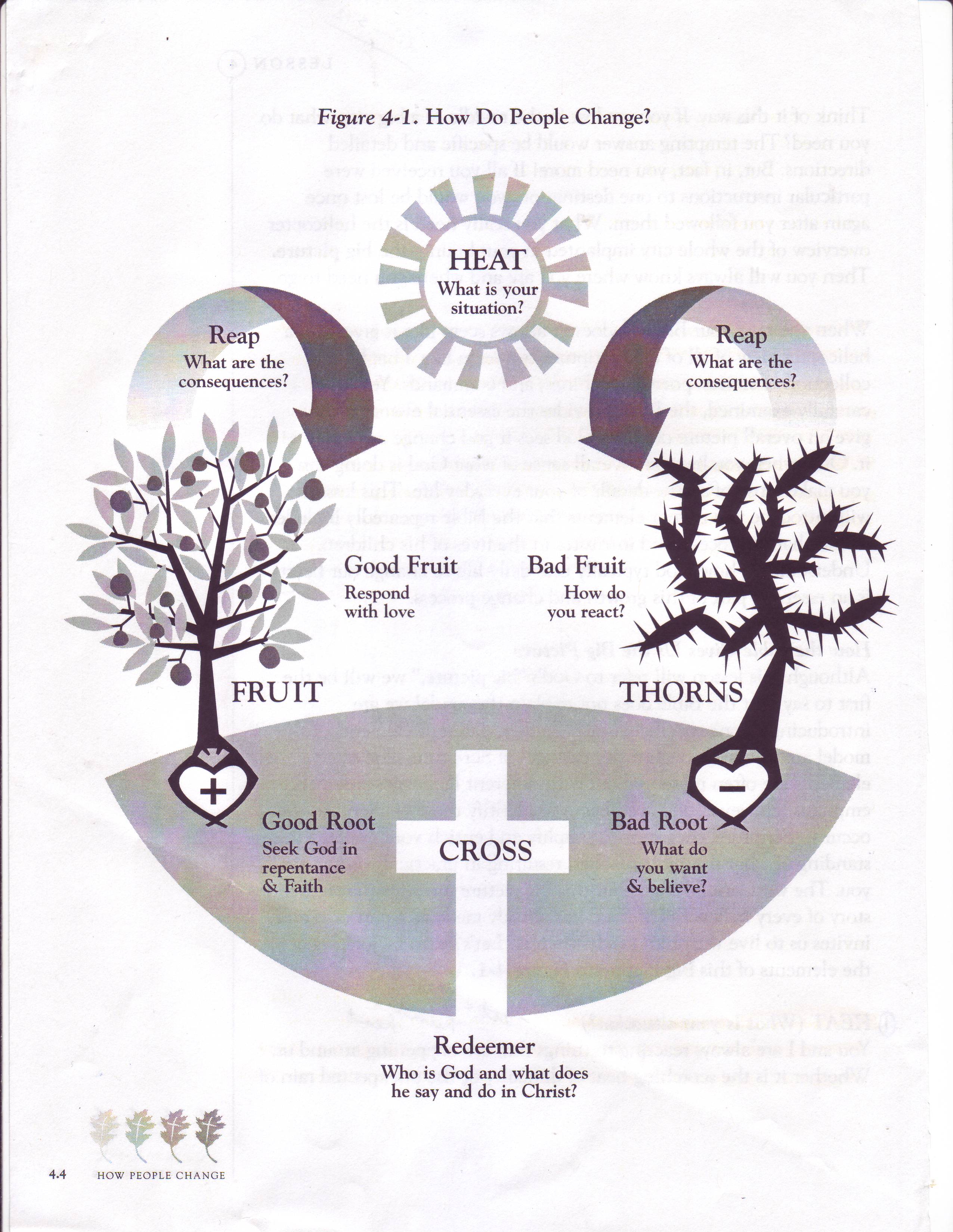
But you can also see some of these concepts if you refer back to the two-man chart. The gospel man meditates on “Grace, Justification, Perfection, Security, immortality, Law,” but these things remain outside of him as manifestations of the objective gospel. But the Christ within man has these things inside of him because that is where his focus is (subjective). Following is another Reformed illustration of what we are talking about. Notice that the cross gets bigger—not us. We don’t grow—the cross does. The cross represents grace outside of us; so, the cross is seen as bigger (ie, God is glorified) while we don’t change. These manifestations make God look bigger while not being connected to anything recognized as us being new and improved. Michael Horton refers to this as “preaching the gospel instead of being the gospel.”
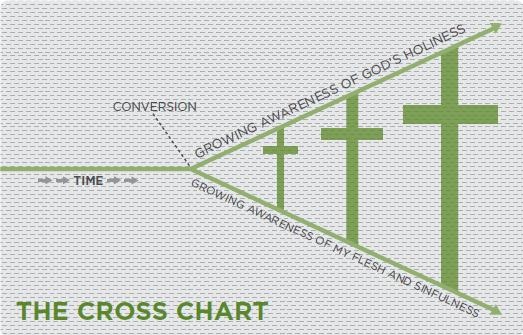
MacArthur often conveys ideas that do nothing in regard to separating himself from this absurd mysticism. In writing the Forward to the Gnostic masterpiece, Uneclipsing the Son by former associate Rick Holland, JM states the following:
As believers gaze at the glory of their Lord—looking clearly, enduringly, and deeply into the majesty of His person and work—true sanctification takes place as the Holy Spirit takes that believer whose heart is fixed on Christ and elevates him from one level of glory to the next. This is the ever-increasing reality of progressive sanctification; it happens not because believers wish it or want it or work for it in their own energy, but because the glory of Christ captures their hearts and minds. We are transformed by that glory and we begin to reflect it more and more brightly the more clearly we see it. That’s why the true heart and soul of every pastor’s duty is pointing the flock to Christ, the Great Shepherd.
Let’s now return to the article at hand and address the more relevant parts. In the section entitled, “Back to the Beginning,” JM sates the following:
In the 1500s a fastidious monk, who by his own testimony “hated God,” was studying Paul’s epistle to the Romans. He couldn’t get past the first half of Romans 1:17: “[In the gospel] is the righteousness of God revealed from faith to faith” (KJV).
One simple, biblical truth changed that monk’s life — and ignited the Protestant Reformation. It was the realization that God’s righteousness could become the sinner’s righteousness — and that could happen through the means of faith alone. Martin Luther found the truth in the same verse he had stumbled over, Romans 1:17: “Therein is the righteousness of God revealed from faith to faith: as it is written, the just shall live by faith” (KJV, emphasis added).
JM then fails to mention that Luther believed that this justification passage also applies to sanctification. Then JM sates the following under the next heading, Declared Righteous: What Actually Changes?:
In its theological sense, justification is a forensic, or purely legal, term. It describes what God declares about the believer, not what He does to change the believer. In fact, justification effects no actual change whatsoever in the sinner’s nature or character. Justification is a divine judicial edict. It changes our status only, but it carries ramifications that guarantee other changes will follow. Forensic decrees like this are fairly common in everyday life….
Similarly, when a jury foreman reads the verdict, the defendant is no longer “the accused.” Legally and officially he instantly becomes either guilty or innocent — depending on the verdict. Nothing in his actual nature changes, but if he is found not guilty he will walk out of court a free person in the eyes of the law, fully justified.
In biblical terms, justification is a divine verdict of “not guilty — fully righteous.” It is the reversal of God’s attitude toward the sinner. Whereas He formerly condemned, He now vindicates. Although the sinner once lived under God’s wrath, as a believer he or she is now under God’s blessing.
This all looks to be very solid theologically, but I want you to notice that JM fails to mention that Justification is a finished work. That’s key. And it’s key because of what he states next:
Justification is more than simple pardon; pardon alone would still leave the sinner without merit before God. So when God justifies He imputes divine righteousness to the sinner (Romans 4:22-25). Christ’s own infinite merit thus becomes the ground on which the believer stands before God (Romans 5:19; 1 Corinthians 1:30; Philippians 3:9). So justification elevates the believer to a realm of full acceptance and divine privilege in Jesus Christ.
The problem here is the implication that a pardon is not enough, and that our “standing” must be maintained lest we find ourselves “without merit”…. “before God.” This is problematic because any kind of standard that would maintain merit before God for justification is voided (Romans 7;1-4). There is simply no merit or standard left for a Christian to be judged by in regard to justification.
But the smoking gun that convicts MacArthur in fusing justification and sanctification together in this same article follows under “How Justification and Sanctification Differ.” JM starts out well with this statement:
Justification is distinct from sanctification because in justification God does not make the sinner righteous; He declares that person righteous (Romans 3:28; Galatians 2:16). Notice how justification and sanctification are distinct from one another:
After stating this, JM, evokes the classic neo-Reformed double-speak sleight of hand for fusing justification and sanctification together without appearing to do so:
Those two must be distinguished but can never be separated. God does not justify whom He does not sanctify, and He does not sanctify whom He does not justify. Both are essential elements of salvation.
JM also clearly states that progressive sanctification is part of the same “salvation” process that justification is also a part of ; hence, they supposedly can’t be separated. But the Bible authors only speak of sanctification as salvation in a manner of speaking because there are three sanctifications: positional (1Cor. 6:11), progressive/practical (2 Cor. 7:11, 2 Peter ch. 1), and complete (1 Cor. 6:11[those who are sanctified positionally are glorified as well]), but only one justification that is a onetime legal declaration (Romans 8:30).
Furthermore, JM’s use of the distinct but never separate sleight of hand is the exact same mantra constantly used by many in the neo-Reformed crowd:
Though justification and sanctification cannot be separated they must be distinguished.
~ Ernest Reisinger
It would also stand to reason therefore that MacArthur, like all of the neo-Reformed, would not see any role for the believer in sanctification other than gospel contemplationism. This can be confirmed by reviewing the previous excerpt from Holland’s book.
Classic Reformed Kettles Calling the Pot Black
We now observe a trait by JM that was never true about him before he went over to the dark side—blatant contradictions that assume the utter stupidity of his followers. He follows the neo-Reformed protocol for drawing the line of distinction between the Reformers and Rome in this way:
Roman Catholicism blends its doctrines of sanctification and justification.
So, the two cannot be “separate,” but they can be blended? But what JM states next brings us full circle to what we observed in John Piper’s article on the Goldsworthy lecture at Southern:
Catholic theology views justification as an infusion of grace that makes the sinner righteous. In Catholic theology, then, the ground of justification is something made good within the sinner — not the imputed righteousness of Christ.
Please note JM’s either/or interpretive prism, (a neo-Reformed distinctive) that eliminates the possibility that the believer is empowered by the Spirit internally for something that is separate from justification; namely, kingdom living. Notice that the issue is specifically “something good” inside the believer verses the “imputed righteousness of Christ.” Obviously, JM rejects the idea that it can be both, and whatever it is, it must point back to justification if it is something “good” inside of the believer.
Rome’s motive for fusing the two together is beside the point, both the Reformers and Rome believe the two cannot be separated. Hence, for Rome it was easy: Christ forgives all of your past sins, but now you must do certain things to complete your justification because salvation is linear with both justification and sanctification on the same plane. Likewise, the Reformers believe in the same linear gospel, but pardon it by making everything that needs to be done to complete justification—totally of Christ alone. This requires us to remain totally depraved in the process and utilizes Gnosticism for whatever application can be surmised. Frankly, this is the first time that I have seen writings from JM that totally remove all doubt that he has bought into this doctrine , hook, line, and sinker.
JM continues:
If sanctification is included in justification, the justification is a process, not an event. That makes justification progressive, not complete. Our standing before God is then based on subjective experience, not secured by an objective declaration. Justification can therefore be experienced and then lost. Assurance of salvation in this life becomes practically impossible because security can’t be guaranteed. The ground of justification ultimately is the sinner’s own continuing present virtue, not Christ’s perfect righteousness and His atoning work.
The contradictions here are mindboggling. Again, “If sanctification is included in justification….” Is somehow different from, “… . but can never be separated.” Like all in this camp, JM complains about those who combine the two, while at the same time stating that they cannot be separated.
But perhaps the whole issue should be narrowed down to the most glaring contradiction in all of this. While MacArthur states that justification and sanctification cannot be separated, but are distinct, like all neo-Calvinists, he then complains that Rome “blends” the two. According to the standard New Calvinist MO, the cardinal sin in regard to this blending is “progressive justification.” Note once again the following excerpt in this post by JM:
If sanctification is included in justification, then justification is a process, not an event. That makes justification progressive, not complete.
But MacArthur is a Calvinist, and progressive justification is exactly what John Calvin propagated. Again, they accuse Rome of exactly what they are guilty of themselves. In fact, Calvin entitled chapter 14 of the the third book of the Calvin Institutes, “The Beginning of Justification. In What Sense Progressive.” Calvin then makes the same case throughout the rest of the chapter that all New Calvinists constantly make–that a believer must continually return to justification for their sanctification. Seeing these kinds of blatant neo-Reformed contradictions in his teaching is truly sad to watch.
What is it going to take to overcome this kind of error in the church? Christians who think, and love truth enough to wrestle with it long and hard. That’s going to be a small percentage of Christians as thinking is also not in vogue.
Nevertheless, they are out there—Christ said they would be in increasing numbers as He continues to build His out-called ones.
paul

 Paul's Passing Thoughts
4 comments