To the Whiny Crybaby Calvinist Heretics: This is For You
 I have been barraged lately with emails and comments by Calvinists whining and moaning that I have not quoted one respectable Calvinist to prove that Calvinism is the false gospel of progressive justification. What is progressive justification? Well, it is what Calvinists call, “progressive sanctification.” They believe justification has a beginning, and then progresses to “final justification.” Basically, by faith alone in our Christian life, the perfect obedience of Christ who came to fulfill the law is imputed to our Christian life, and this progresses justification (or maintains it) till the end. This is what Calvinists deceptively refer to as “progressive sanctification.” Christ’s obedience to the cross effected the beginning of justification (“passive obedience”), but Christ’s perfect obedience to the law or “active obedience” is an efficacious part of the atonement if anyone is to be saved, and of course, the belief in it as well.
Greshem Machen, the founder of Westminster Seminary, obviously a Calvinist heavyweight, was a big advocate of the “active obedience” of Christ:
J. Gresham Machen, the courageous Presbyterian churchman who sought to preserve the Gospel message in the warring Presbyterian Church (USA), who went on to found Westminster Theological Seminary and the Orthodox Presbyterian Church (OPC), wrote the previous quote in a telegram on Jan. 1, 1937 to Prof. John Murray, a friend and colleague. This is the last thing Dr. Machen ever penned, and he went to be with the Lord a few hours later. Not only does this quote summarize the life and faith of a man who followed the Lord faithfully until the end, but it also presents a clear look at the absolute centrality of Christ’s obedience during His life for those of us who call upon His name in faith–”No hope without it” (David Bibee: CHRIST-CENTERED, NOT (MERELY) CROSS-CENTERED: PART 2 Online source: http://thebereanway.wordpress.com/2011/09/27/christ-centered-cross-centered-pt-2/#).
Machen, a Calvinist, thoroughly understood that this was Calvin’s position.
Now someone asks, How has Christ abolished sin, banished the separation between us and God, and acquired righteousness to render God favorable and kindly toward us? To this we can in general reply that he has achieved this for us by the whole course of his obedience. This is proved by Paul’s testimony: “As by one man’s disobedience many were made sinners, so by one man’s obedience we are made righteous” [Romans 5:19]. In another passage, to be sure, Paul extends the basis of the pardon that frees us from the curse of the law to the whole life of Christ: “But when the fullness of time came, God sent forth his Son, born of woman, subject to the law, to redeem those who were under the law” [Galatians 4:4-5]. Thus in his very baptism, also, he asserted that he fulfilled a part of righteousness in obediently carrying out his Father’s commandment [Matthew 3:15]. In short, from the time when he took on the form of a servant, he began to pay the price of liberation in order to redeem us.
Yet to define the way of salvation more exactly, Scripture ascribes this as peculiar and proper to Christ’s death. He declares that “he gave his life to redeem many” [Matthew 20:28]. Paul teaches that “Christ died for our sins” [Romans 4:25]. John the Baptist proclaimed that he came “to take away the sins of the world,” for he was “the Lamb of God” [John 1:29]. In another passage Paul teaches that “we are freely justified through the redemption which is in Christ, because he was put forward as a reconciler in his blood” [Romans 3:24-25]. Likewise: “We are …justified by his blood …and reconciled …through his death.” [Romans 5:9-10.] Again: “For our sake he who knew no sin was made sin, so that in him we might become the righteousness of God.” [2 Corinthians 5:21] I shall not pursue all the testimonies, for the list would be endless, and many of them will be referred to in their order. For this reason the so-called “Apostles’ Creed” passes at once in the best order from the birth of Christ to his death and resurrection, wherein the whole of perfect salvation consists. Yet the remainder of the obedience that he manifested in his life is not excluded. Paul embraces it all from beginning to end: “He emptied himself, taking the form of a servant …and was obedient to the Father unto death, even death on a cross – Calvin’s Institutes 2.16.5
Calvin, knowing that references to Christ’s obedience to the Father always refer to the one act of submitting to the cross, makes the specific references to His death justifying us a thumbnail that supposedly encompasses his life and death. Let’s say that this only refers to positional justification; that’s still a problem because the Bible states that we were justified apart from the law. If Christ obeyed the law perfectly for our justification, that’s not a manifestation of righteousness apart from the law (ROM 3:21). Moreover, if Christ’s life fulfilled the law, why does the Bible say we were justified by His death? Why is the clear emphasis on the one act rather than His whole life?
But the primary concern here is that sanctification completes justification (denying that it is a finished work), and Christ’s perfect active obedience is imputed to our sanctification by FAITH ALONE as part of the salvation process. That’s progressive justification. It’s also faith alone in sanctification in order to keep ourselves saved because “the same gospel that saves us also sanctifies us.” And: “We must preach the gospel to ourselves every day.” Calvinist heavyweights in our day see it that way. But is that what Calvin believed? You be the judge:
Why, then, are we justified by faith? Because by faith we apprehend the righteousness of Christ, which alone reconciles us to God. This faith, however, you cannot apprehend without at the same time apprehending sanctification; for Christ “is made unto us wisdom, and righteousness, and sanctification, and redemption,” (1 Cor. 1:30). Christ, therefore, justifies no man without also sanctifying him. These blessings are conjoined by a perpetual and inseparable tie. Those whom he enlightens by his wisdom he redeems; whom he redeems he justifies; whom he justifies he sanctifies. But as the question relates only to justification and sanctification, to them let us confine ourselves. Though we distinguish between them, they are both inseparably comprehended in Christ. Would ye then obtain justification in Christ? You must previously possess Christ. But you cannot possess him without being made a partaker of his sanctification: for Christ cannot be divided. Since the Lord, therefore, does not grant us the enjoyment of these blessings without bestowing himself, he bestows both at once but never the one without the other. Thus it appears how true it is that we are justified not without, and yet not by works, since in the participation of Christ, by which we are justified, is contained not less sanctification than justification (CI 3.16.1).
The above reference is referred to as “duplex gratia” or Calvin’s view that grace was extended equally to justification and sanctification. Few Christians would quarrel with the idea that sanctification comes with justification, but the contention arises against the idea that sanctification is powered by perpetual justification: “These blessings are conjoined by a perpetual and inseparable tie.” This states the fusion of justification and sanctification together, and makes them both continuous or “perpetual.” Elsewhere, Calvin stated,
Our justification is his work; from him is power, sanctification, truth, grace, and every good thought, since it is from the Spirit alone that all good gifts proceed (CI 1.13.14) [sanctification is powered by justification].
So, if we are sanctified by justification progressively, sanctification is also monergistic—hence:
If our sanctification consists in the mortification of our own will, the analogy between the external sign and the thing signified is most appropriate. We must rest entirely, in order that God may work in us; we must resign our own will, yield up our heart, and abandon all the lusts of the flesh. In short, we must desist from all the acts of our own mind, that God working in us, we may rest in him, as the Apostle also teaches (Heb. 3:13; 4:3, 9) – CI 2.8.29
And this is how the Calvinist heavyweights of our day interpret all of this. For example, Michael Horton:
Where we land on these issues is perhaps the most significant factor in how we approach our own faith and practice and communicate it to the world. If not only the unregenerate but the regenerate are always dependent at every moment on the free grace of God disclosed in the gospel, then nothing can raise those who are spiritually dead or continually give life to Christ’s flock but the Spirit working through the gospel. When this happens (not just once, but every time we encounter the gospel afresh), the Spirit progressively transforms us into Christ’s image. Start with Christ (that is, the gospel) and you get sanctification in the bargain; begin with Christ and move on to something else, and you lose both (Christless Christianity: p. 62).
Graeme Goldsworthy and co. articulated it this way:
The Present, Continuous Nature of Justification. For all its strength, Reformed theology tends to relegate justification by faith to an initiatory action in the soteriological process. This is because it contends that the subjective (personal) justification of the believing sinner is a once-and-for-all, nonrepeatable act. Hence the relationship between justification and sanctification is seen as justification succeeded by sanctification (Present Truth Magazine: vol. 16; art.13).
And like this:
The Holy Spirit gives the sinner faith to accept the righteousness of Jesus. Standing now before the law which says, “I demand a life of perfect conformity to the commandments,” the believing sinner cries in triumph, “Mine are Christ’s living, doing, and speaking, His suffering and dying; mine as much as if I had lived, done, spoken, and suffered, and died as He did . . . ” (Luther). The law is well pleased with Jesus’ doing and dying, which the sinner brings in the hand of faith. Justice is fully satisfied, and God can truly say: “This man has fulfilled the law. He is justified”…. We say again, Only those are justified who bring to God a life of perfect obedience to the law of God. This is what faith does—it brings to God the obedience of Jesus Christ. By faith the law is fulfilled and the sinner is justified. (Present Truth Magazine: law and Gospel vol. 7 art. 2 pt. 2).
And then for good measure:
Moreover, the message of free reconciliation with God is not promulgated for one or two days, but is declared to be perpetual in the Church (2 Cor. 5:18, 19). Hence believers have not even to the end of life any other righteousness than that which is there described. Christ ever remains a Mediator to reconcile the Father to us, and there is a perpetual efficacy in his death—viz. ablution, satisfaction, expiation; in short, perfect obedience (CI 3.14.11).
So there you go crybabies.
paul
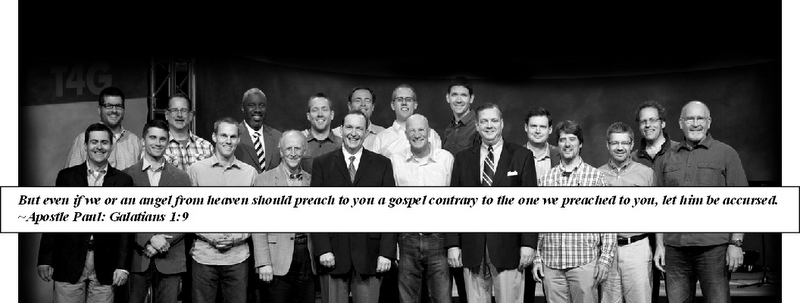
Mohler, DeYoung, Carson, Dever Defend CJ Mahaney’s Known Criminal Behavior in Recent Statement
 “Mahaney has never repented of this documented criminal act. But while Mark Dever excommunicated 256 people for non-attendance, which isn’t a biblical reason to bring anyone up on church discipline to begin with, he is giving Mahaney a pass on blackmail and coercion.”
When are Christians at large going to stop letting New Calvinists frame the discussions to their desirable outcomes? DA Carson et al have issued statements explaining their silence about the SGM pedophile class action lawsuit. See here: SGM Civil Case pdf And no, I don’t have a “trigger alert” for its reading, suck it up and face the facts; it’s the American church in living color. The “unadjusted gospel,” the “scandalous gospel” [true that], the “shocking gospel,” the “underestimated” gospel has inundated the American church for 43 years now—WHERE’S THE BEEF?
Instead of revival and “real lasting change” we have two Reformed organizations needed to keep Calvinists out of court, innumerable broken families and friendships, innumerable church splits, an unprecedented doctrinally dumbed down congregant, a massive exodus of people from the organized church known as “The Nones,” a Neo-Calvinist resurgence exclusive to upper income churches, and innumerable spiritual abuse blogs spawned by the New Calvinist movement which again has had 43 years to make its mark. When are Christians going to start asking the hard questions?
The statements clearly reveal the true character of these evil, wicked men. They falsely accused one blogger of issuing unsubstantiated information about the suit. How can you call the posting of the actual lawsuit unsubstantiated? The statements are blotted with hypocrisy and indications of how stupid they think people are. And frankly, I don’t have time to unravel it all, so let me cut to the quick. But first, let me mention that Mark Dever, who excommunicated 256 parishioners for non-attendance and was applauded for it, along with the others, vindicated Mahaney based on a ruling by a civil judge. In the statement, they also declare Mahaney innocent and fit for ministry based on what they know of him while rejecting the massive outcry against him. Who made them judge?
But let’s just zero in on one fact that they ignore and that Mahaney has never repented of. Oddly, this incident is widely reported as an attempt by Mahaney to force the cofounder of SGM out of the ministry—the opposite is true; Mahaney tried to blackmail the cofounder in order to force him into remaining a member of SGM. In most states, this is clearly a criminal act:
Transcript of Phone Conversation between C.J., Doris and Larry Tomczak on October 3, 1997 pp. 10-11:
C.J.: Doctrine is an unacceptable reason for leaving P.D.I.
Larry: C.J., I’m not in sync with any of the T.U.L.I.P., so whether you agree or not, doctrine is one of the major reasons I believe it is God’s will to leave P.D.I. and it does need to be included in any statement put forth.
C.J.: If you do that, then it will be necessary for us to give a more detailed explanation of your sins [ie, beyond the sin of leaving for doctrinal reasons].
Larry: Justin’s name has been floated out there when there’s statements like revealing more details about my sin. What are you getting at?
C.J.: Justin’s name isn’t just floated out there – I’m stating it!
Larry: C.J. how can you do that after you encouraged
Justin to confess everything; get it all out. Then when he did, you reassured him “You have my word, it will never leave this room. Even our wives won’t be told.”
I repeatedly reassured him, “C.J. is a man of his word. You needn’t worry.” Now you’re talking of publically sharing the sins of his youth?!
C.J.: My statement was made in the context of that evening. If I knew then what you were going to do, I would have re-evaluated what I communicated.
Doris: C.J., are you aware that you are blackmailing Larry? You’ll make no mention of Justin’s sins, which he confessed and was forgiven of months ago, if Larry agrees with your statement, but you feel you have to warn the folks and go national with Justin’s sins if Larry pushes the doctrinal button? C.J., you are blackmailing Larry to say what you want!―Shame on you, C.J.! As a man of God and a father, shame on you!
This will send shock waves throughout the teens in P.D.I. and make many pastors’ teens vow, “I‘ll never confess my secret sins to C.J. or any of the team, seeing that they‘ll go public with my sins if my dad doesn‘t toe the line.”―C.J., you will reap whatever judgment you make on Justin. You have a young son coming up. Another reason for my personally wanting to leave P.D.I. and never come back is this ungodly tactic of resorting to blackmail and intimidation of people!
C.J.: I can‘t speak for the team, but I want them to witness this. We’ll arrange a conference call next week with the team.
Doris: I want Justin to be part of that call. It’s his life that’s at stake.
C.J.: Fine.
(SGM Wikileaks, part 3, p.139. Online source: http://www.scribd.com/sgmwikileaks)
Ohio: 2905.12 Coercion.
(A) No person, with purpose to coerce another into taking or refraining from action concerning which the other person has a legal freedom of choice, shall do any of the following:
(1) Threaten to commit any offense;
(2) Utter or threaten any calumny against any person;
(3) Expose or threaten to expose any matter tending to subject any person to hatred, contempt, or ridicule, to damage any person’s personal or business repute, or to impair any person’s credit;
Mahaney has never repented of this documented criminal act. But while Mark Dever excommunicated 256 people for non-attendance, which isn’t a biblical reason to bring anyone up on church discipline to begin with, he is giving Mahaney a pass on blackmail and coercion.
paul
SGM’s House of Horrors and the New Calvinist Theocratic Subculture
 The class action law suit brought against SGM has been revised. And with new allegations added, the narrative can now describe SGM as a house of horrors. I will leave the gory details to the Calvinism would be a good thing if not for the Neo-Calvinists crowd and their Reformed versions of the National Enquirer.
In a recent interview, John Piper discussed a few [!] faults that Calvin had; namely, his idea of integrating church and state. Piper then proceeded to propagate the outrageous idea that Reformed Baptists were responsible for reversing that concept. Funny, no matter how many times you read James Madison’s Memorial Remonstrance Against Ecclesiastical Establishments the Reformed Baptists don’t seem to be mentioned. Last year, Piper announced his post-retirement plans to spread “the light” of Calvinism—on location in Geneva as a way of presenting Calvin’s Geneva as a model for the renovation of humanity. If you believe Piper thinks the marriage of Church and state is a bad idea, I have an oceanfront property in Dayton, Ohio I would like to sell you.
CJ Mahaney and company may not think too much of what their pedophile friends have done, but to them, a bigger issue is at hand here: the preservation of their theocratic subculture. Mahaney et al don’t think that they should be subject to civil law. The way they state it: “The church should be free to shepherd their people as they see fit.” And the way they prefer to handle these situations should be evident by now and is directly linked to their Reformed ideology.
I have written on that extensively, and frankly, I am too lazy this morning to rehearse it all. It’s just exhausting: this behavior, though shocking, should not be surprising when their gospel is understood. Calvin and Luther considered the whole concept of Justice to be a joke and part of the “glory story” and not the “cross story.” These are people who function from a total different reality than normative metaphysics. If you believe that you are capable of interpreting your own reality you are living the glory story; if you trust them to interpret your reality for you according to the cross story, you are living in the gospel meta-narrative.
But back to my original point. New Calvinists have simply improvised and built a theocratic subculture. Again, I have written extensively on this and am weary of it. New Calvinist churches are ruled by elder law and have various ways of enforcing that law apart from the state. They would prefer the state, but the likes of James Madison, whom they despise, messed that plan up big-time on this corner of the globe.
Yawn, ugh, let me repeat a few improvisions: in-house security forces; control structure; covenants; church discipline; brainwashing; networking with likeminded government officials willing to operate off the record; etc.
Hence, the New Calvinists see this as an opportunity. If they win this case based on separation of church and state, the implications are staggering. Don’t miss this: that is why the rest of the New Calvinist community is watching this in silent, anxious anticipation. If you think they see this as a bad thing, if you think this puts New Calvinism on the ropes—you are dead wrong—they see this as a grand opportunity to set precedent and further strengthen their theocratic subculture.
paul

 Paul's Passing Thoughts
2 comments