“The ‘Gospel’ Coalition” Series, Part 14: GS / Sonship’s Double Imputation as the Only True Gospel
 There seems to be discussion in the GS camp concerning the importance of “double imputation” verses “passive imputation” and its relevance to the gospel. The debate is articulated well by Steve Lehrer and Geoff Volker here: http://goo.gl/UxyaX .
I decided to post on this because I think it is an important element of their doctrine to be understood, and you will see why further along, but let’s lay some groundwork first. Here is Lehrer’s definitions of the terms that the debate is comprised of:
Active (or Preceptive) Obedience: The perfect obedience of Jesus Christ to the Mosaic Law.
Passive (or Penal) obedience: Christ’s sacrificial death by which He paid the penalty for the sins of the elect.
Imputation: Getting something that you did not earn. Imputation, rather abstractly, describes how all that Jesus accomplished for us gets to us. So, one might say that imputation communicates that all that Jesus did on the cross is placed or wired into your “spiritual bank account” when you believe.
Righteousness: Acceptance with God. Righteousness, in the context of salvation, is whatever it is that God requires in order to be accepted by Him.
Lehrer then explains the crux of the argument:
“Before we can begin to discuss the imputation of the active obedience of Christ, we must consider Christ’s passive obedience. The great reformed theologian Louis Berkhof believes that the passive obedience of Jesus Christ imputed to the believer has limitations as to what it does for the believer:
‘…if He (Christ) had merely paid the penalty (for the believer), without meeting the original demands of the law (for the believer), He would have left man in the position of Adam before the fall, still confronted with the task of obtaining eternal life in the way of obedience. By His active obedience, however, He carried His people beyond that point and gave them a claim to everlasting life.’
If only the passive obedience of Christ is imputed to the believer, according to Berkhof, this would not give him eternal life. He would have to obey God perfectly and earn eternal life on His own. The man who only has the passive obedience of Christ imputed to him would be in a spiritual Switzerland— stuck in neutral. Is the distinguished Louis Berkhof right? We don’t think so.”
And I’m not taking sides because I have a lot more to learn about Covenant Theology, which Lehrer thinks is ground zero for this debate. Neither I’m I prepared to accept his explanation of Covenant Theology as stated in this article. As Lehrer says, he believes the so-called passive obedience of Christ imputed to the believer is all that is necessary. However, I do think “passive” is a strange term indeed for Christ’s obedience to the cross because it was far from being a passive affair. Nevertheless, the crux of the matter seems to be whether or not Christ had to fulfill the original covenant broken by Adam (the Covenant of Works in Covenant Theology) via living a perfect life while here in the flesh, and in addition to paying the penalty for sin as well. Hence, double imputation. Lehrer says no, and you can read his lengthy argument via the link cited.
Apparently, the GS / Sonship movement is split concerning this issue, and he mentions Wayne Grudem as one who seems to hold to the double imputation view. But something is conspicuously missing here for I would imagine neither side is saying that one must believe in double imputation in order to profess a true gospel. Or are they? What’s conspicuously missing in Lehrer’s discussion is the practical implication for sanctification. If Christ died to pay the penalty of sin (the imputation of His so-called passive obedience), and lived to fulfill the covenant (the imputation of His active obedience) that God made with Adam, does that mean fulfilled works / obedience are also imputed to us, and thereby relinquishing our need / responsibility to perform?
Furthermore, if we believe we must work / obey in sanctification, could that be seen as an attempt to replace the works of Christ already imputed to us? Yes. In fact, when many proponents of GS refer to “the imputed active obedience of Christ,” this is exactly what they are talking about. Supposedly, righteousness, the fulfillment of the Works Covenant (if they are GS Covenant Theology types), and not only a substitution for the penalty of sin, but Christ’s substitution for our works as well would be imputed to us—eliminating any responsibility on our part to perform works. Before I became privy to this argument, I couldn’t see how Covenant Theology could be consistent with GS/ Sonship, but now I see the possibility and stand corrected accordingly.
But, in fact, does Lehrer avoid any discussion of how this debate effects our role in sanctification because the synthesis of justification and sanctification is assumed in these circles? I Don’t know, but the belief that double imputation fleshes itself out in sanctification, and is efficacious for the presentation of a true gospel is defiantly a reality in the movement. It is sometimes referred to as monergistic substitutionary sanctification, ie., Christ’s death (passive obedience) was not only a substitution for the penalty of sin, but his life fulfilled the Works Covenant and is also a substitution for any works that would be required by us in sanctification / regeneration, even for different purposes than earning salvation (which should be assumed since justification is a onetime act / declaration by God). There are probably some in the movement that think synergism in sanctification is unfortunate error, but most of the more prominent leaders in the movement such as Michael Horton believe it is a false gospel that results in the loss of justification (Christless Christianity p. 62).
paul
“The ‘Gospel’ Coalition” Series, Part 12: The Creepiness Continues to Get Creepier
Not only is the GS / Sonship doctrine completely off the tracks theologically, it is inevitable that such doctrine will lead to many other things that followers “are not yet ready for.” However, as this hideous doctrine grows, for the most part, unchecked—proponents are now presenting teachings that would have been rejected out of hand a couple of years ago. In other words, probably surprised themselves by the lack of contention against their ridiculous doctrine—they are becoming more bold. For example, more and more, the GS concept of learning how to listen to a sermon is becoming more prevalent. Yesterday, a reader sent me two links.
First of all, the thesis itself is just plain creepy and should raise red flags all over the place. I became aware of it three years ago when I obtained a manuscript from a parishioner at Clearcreek Chapel in Springboro, Ohio, a bastion of GS / Sonship teachings and a NANC training center. As I carried the manuscript from place to place while I was slowly absorbing it, whether in the waiting room of my auto mechanic, or waiting for food at the local diner—the title caught the attention of many, and the following was usually the result: “Huh?” “That’s just really strange,” etc. In fact, one proponent wrote in one of the links sent to me, “I was first alerted to this issue by Christopher Ash’s leaflet entitled ‘Listen Up’. In it he claims that there’s been nothing written on the issue in the last 200 years.” Yep, I’m not really surprised by that. Nor was any reference given as to who supposedly wrote about it even then—go figure.
So what’s behind this creepy concept? I will use the manuscript from Clearcreek Chapel (hereafter: CCC) because it was one of the first independent sovereign grace churches in this country to adopt the Sonship doctrine. Not only that, CCC is a well respected and noted church in the movement. Paul David Tripp (speaks there often), David Powlison, and John Piper have close association with CCC, and the Pastor prides himself as a follower of John Piper—dressing like him and speaking like him as well. As far back as 1994 or 96, when the movement was barley fifteen years old, one or two respected Sonshippers (of course, nobody at CCC was aware of the doctrine) in the CCC congregation were instrumental in having the likes of Jerry Brides and DA Carson invited to speak there. I sat in the congregation myself and heard Jerry Bridges say: “We must preach the gospel to ourselves everyday.” The comment gave me pause, but I brushed it aside and continued to struggle to stay awake as I thought the guy would die standing there behind the pulpit at any moment. When the founding pastor moved to California, Russ Kennedy became pastor under false pretence—knowing grade-A-well that the vast majority of CCC parishioners would reject such a doctrine. In fact, Kennedy allowed me to be instrumental in his appointment while knowing that such a doctrine would cause me to jump in the river.
I will be writing a post in this series about CCC because it is a projected model of what churches will look like in the future who implement this doctrine. And it is also why I am using their model for this whole learning how to listen to a sermon concept which is eerily similar to Jack Hyle’s famous quote: “Now I want you to close your Bibles and listen to me.” Most of what I have written on this blog concerns the doctrine itself, but the subtle creepiness / cult-like elements of this movement is another story altogether. But without further ado, let us examine the GS / Sonship take on how to listen to a sermon. Actually, I have written on the crux of this concept before. What really drives this issue? Answer: elder authority. GS / Sonship has a very overemphasized view of elder authority and that is really at the heart of this concept. Devon Berry, the “elder” at CCC who delivered this message, is also one of the primary instructors for the NANC training center at CCC. The following is my critique of his message. I apologize for how difficult it is to unravel this clever twisting of God’s word. However, if you try to follow my argument thoughtfully, I think by the end it will come together for you. The title of his message was, How to Listen to a Sermon:
In the sermon, the elder strays away from the main point to strongly emphasis the idea that spiritual growth comes primarily from preaching and teaching, and is an absolute, paramount necessity accordingly:
“You think, perhaps, that [you] can fill up the other half of the plate with personal study, devotions, or quiet times, or a radio program. Beloved, you cannot. Scripture is relatively quiet on such practices. But on preaching, the case is clear and strong. Neglect preaching and neglect your soul. I know that some are kept from services for legitimate reasons which are out of their control, but I doubt that is the case for most. I beseech you, change your ways for the good of this people and for the good of your own selves. Give the Word its rightful place. As I have often said, there is no better place you could be than here, under the preaching of the Word.”
Actually, I believe “devotions,” “quiet times,” and “radio programs” are added in to mask the disturbing part of this statement: “personal study.” Nowhere , but nowhere, does the Scriptures ever say that personal study is expendable when compared to preaching or teaching. In fact, IF I wanted to make the case that preaching and teaching could be done without, I would cite the following:
1 John 2:27
”As for you, the anointing you received from him remains in you, and you do not need anyone to teach you. But as his anointing teaches you about all things and as that anointing is real, not counterfeit—just as it has taught you, remain in him.”
This verse clearly teaches that when it gets right down to it, the indwelling Holy Spirit is our teacher, and that human teachers are not an absolute necessity as this elder is clearly saying. At the very least, he is in grave error concerning the level of importance between the two.
But even more disturbing is the logical conclusion that must be drawn from this assertion. If personal study is expendable (please note; in his list of examples, he names devotions, quiet times, and radio programs in the same list. One can only assume that if they are in the same list to make his point, they share the same level of importance. Surely then, no one would deny that Christians could do without radio programs or devotionals), then how could it (personal study) be sufficiently empowered to discern the truthfulness of the sermon? The conclusion must necessarily be that personal interpretation is always at the mercy of preaching. Do you think my statement is a subjective conclusion in regard to what he is saying? Think again. He actually uses Acts 17:10,11 (a text that clearly states the importance of personal study to confirm truthfulness) to imply that preaching is a critical link in the learning process, with personal study being secondary:
“In addition to coming with anticipation, we must come to a sermon prepared. Coming to the hearing of the Word prepared is both a matter of our hearts and our behaviors. I think the example of the Bereans in Acts 17 is helpful. Verse 11 says, ‘Now these Jews were more noble than those in Thessalonica; they received the word with all eagerness, examining the Scriptures daily to see if these things were so.’ We can note from earlier in the chapter what exactly it was the Bereans were responding to – verses 2-3 tell us that Paul’s pattern was to reason with his hearers from the Scriptures, explaining and proving that Jesus was the Christ. What made the Jews in Berea more noble than the Jews in Thessalonica? Well for one, they did not run Paul out of town, and secondly, they took Paul’s preaching seriously enough to go to the Word to test it [he is not talking about a test in regard to the truth, but rather, a nebulous concept of testing the Christocentric interpretation in everyday life. He covers this idea in another part of the same sermon. Note that “it” in his statement refers to God’s word, not Paul’s preaching]. The text here implies that there was an interactive nature between three entities: The preacher, the hearers, and the Word. Note this cycle: Paul, from the Word, delivers words. The Bereans, from Paul’s words, go to the Word. The Word cycles from God, through the preacher, to the people, back to the Word, and this, verse 12 tells us, produced belief in the God of the Word. An important thing to note is that this happened daily – suggesting a regular interaction between preaching, personal study, and the Word. The Bereans eagerly prepared by paralleling their own Bible reading and study with Paul’s preaching. So a good preparation for the public preaching of the Word is the private consumption of the Word. It will be the seasoning that brings out the flavor – salt on your French fries, if you will.”
Where to begin in the unraveling of this hideous twisting of God’s word! First of all, I had to actually draw a diagram to unravel what he is saying in regard to this part of the quote:
“Note this cycle: Paul, from the Word, delivers words. The Bereans, from Paul’s words, go to the Word. The Word cycles from God, through the preacher, to the people, back to the Word, and this, verse 12 tells us, produced belief in the God of the Word.”
Read the quote carefully. Think about it. God’s word goes through the “preacher” first, before getting to the “people,” making the preacher’s words synonymous with God’s words. Also note that he cites 17:1,2:
“We can note from earlier in the chapter what exactly it was the Bereans were responding to – verses 2-3 tell us that Paul’s pattern was to reason with his hearers from the Scriptures, explaining and proving that Jesus was the Christ.”
Let me cut to the chase here: what he is saying is that all Christocentric and gospel-centered preaching is infallible. Hence, any preacher teaching from a Christocentric perspective is also infallible. He also emphasizes this in his conclusion (emphasis mine):
“On to our last point, then. It is simple. The lens set forth by Christ himself on the road to Emmaus, in Luke 24, is the lens through which we should hear every sermon. Here it is from the text: …everything written about me in the Law of Moses and the Prophets and the Psalms must be fulfilled… You should always listen to a sermon looking for Christ and the redemptive plan that God has set out in history to accomplish through his Son. We must be Christ-centered listeners.”
In other words, when the Scriptures are being taught from the Christ / gospel perspective, error is impossible, and likewise, neither can the preacher teaching from that perspective be in error as well. If the mere intention is to present Christ from the text, the Holy Spirit then becomes involved, making error impossible. Another elder at the same church (Chad Bresson) projected this same idea in an article entitled “The Word of God is a Person.” He quotes Robert Brinsmead to make his point:
“That which makes the Bible the Bible is the gospel. That which makes the Bible the Word of God is its witness to Christ. When the Spirit bears witness to our hearts of the truth of the Bible, this is an internal witness concerning the truth of the gospel. We need to be apprehended by the Spirit, who lives in the gospel, and then judge all things by that Spirit even the letter of Scripture.”
Said another way, the Holy Spirit “lives in the gospel,” so when your doin’ gospel, your doin’ truth, end of discussion.
Going back now to the elder’s use of Acts 17 and the original sermon of interests here, he completely ignores any sort of basic grammatical rules at all to draw his conclusions. He gives the following reasons for the nobility of the Bereans:
“What made the Jews in Berea more noble than the Jews in Thessalonica? Well for one, they did not run Paul out of town, and secondly, they took Paul’s preaching seriously enough to go to the Word to test it.”
But the excerpt he speaks of is a compound sentence:
“Now these Jews were more noble than those in Thessalonica; they received the word with all eagerness, examining the Scriptures daily to see if these things were so.”
In a compound sentence the ideas must be related, this is a hard-fast rule. Therefore, the specific reason for their nobility is obviously in the second independent clause, which does not include anything mentioned by the elder. Furthermore, in the second clause, the proving of what Paul taught is obviously the (purpose) object of both verb phrases, both directly and indirectly. Clearly, the reason for their nobility was the fact that they proved what Paul was teaching to be true through personal study. Not only that, the elder also said the following:
“An important thing to note is that this happened daily – suggesting a regular interaction between preaching, personal study, and the Word.”
But this is clearly an improper correlation. “Daily” in this sentence refers to “examining the Scriptures” and not Paul’s preaching (which is not even in the compound sentence which begins with “now“—introducing a separate idea). The elder is suggesting an inseparable correlation (“cycle”) between preaching and personal study that cannot be separated from the word for proper understanding. Instead of personal study proving the truthfulness of preaching or teaching, he is making preaching an absolute necessity to understanding truth, with personal study supplying a mere “seasoning” to the preaching, instead of testing its truthfulness. Besides this, he also assumes that the Bereans knew what Paul was going to teach before he came:
“The Bereans eagerly prepared by paralleling their own Bible reading and study with Paul’s preaching.”
Not only is this an assumption, given the technology of the time, it is also highly unlikely. What tense in the text even remotely suggests that the Bereans “examined” the Scriptures before Paul preached? Clearly, the intent of this elder is to discourage a proving of truthfulness in regard to Chrisocentric preaching after the fact, but rather a prior, personal study that merely “flavors” the preaching instead of proving its truthfulness. At any rate, it is a complete bastardization of the biblical text.
I might also mention that another elder in this same church, and previously mentioned, preached a sermon entitled “Adam’s Insurrection, Man Jettisons God from the Educational Process,” in which he argues that the essence of Adam’s fall was a rejection of Christocentric teaching that was outside of himself (Adam). The theme of that sermon seems to be similar to the sermon that is the subject of this post; namely, and at the very least, it strongly discouraged a mentality that elevates personal discernment to the same level of teaching outside of ourselves.
So, it now begs the question that is the subject of this post; in regard to elders teaching from the Christocentric perspective, does Christocentric theology teach that they are infallible? I suspect that this belief is more than likely to be prominent among churches that hold to Sonship / GS theology.
paul
“The ‘Gospel’ Coalition” Series, Part 11: DA Carson Exposed in the Desert
I get my share of grief for identifying DA Carson as a primary proponent of the GS / Sonship doctrine. One reader recently challenged me by sending a Carson quote that was, of course, seemingly orthodox. So, I decided to do a GS / Sonship acid test, which seeks to determine if someone holds to the GS / Sonship view of Galatians 2 and 3. To test, you merely do a google search like this one: “DA Carson Galatians.” What came up was an annual convention sponsored by The Gospel Coalition at Desert Springs Church in Albuquerque, New Mexico. The name of the event is “Clarus [year].” The annual event usually features two prominent teachers from the Sonship tribe. This particular seminar was “Clarus 2008,” and featured Carson teaming up with none other than Michael Horton.
The duo’s theme at this seminar was “Galatians and the Problem of Self Justification.” I listened to Carson’s message on Galatians 2:11-21 entitled “An Apostolic Disputation—and Justification.” Throughout all the tape that I listened to, the fawning enamoration from the members at Desert Springs, an obvious bastion of Sonship / GS doctrine, was obnoxiously evident as the listeners chuckled, laughed, and sighed at every clever phrase and profound utterance that came from Carson’s mouth. If your listening to that tape (mp3), you have to know these people are going to believe everything coming out of Carson’s mouth which is indicative of the Gospel Coalition’s cult of personality.
Aside from that, the message was a pure, unadulterated Sonship take on Galatians. Throughout the message, Carson speaks as if the daily details of Christian living have nothing to do with something called sanctification, but often used the word justification in that context, as the text does, but speaking with a flavor of ideas that we would normally associate with sanctification. Carson, and other Sonship proponents get away with this because most Christians don’t know the theological difference between justification and sanctification, which are in-fact biblical words / terms. Carson, in the same message, belittled the biblical idea of striving to please God as “having a good day,” and gives examples of how Christians supposedly pray about that, and thereby exposing their motives in trying to please God in their own efforts (not his words, but the same idea), which he likens to “spitting on the cross.” A usual mode of operation for GS teachers is to illustrate misguided attempts by Christians to please God (trying to do the right thing the wrong way) as proof that any striving on our part circumvents grace. It’s rarely about wrong application verses right application, but always a works / grace issue. This message was certainly no exception.
However, I have been a Christian for twenty-eight years and have never witnessed any of their extreme examples. Truly, GS propagators are the sultans of red herrings and straw men. But all in all, it can’t be denied that Carson’s message was primarily focused on Christian living in relationship to the law, and that using what text? Galatians 2:11-21. But, primarily, this text is about the law’s relationship to salvation, NOT Christian living. A much better text would have been Ephesians 4:17-32. If you examine all their (the GS brain trust) teachings carefully, the idea of Christian living and salvation (declared / imputed righteousness as a onetime act of God) are almost always synthesized. It is very subtle, but for instance, in Paul Tripp’s chapel message at Southeastern Baptist Seminary entitled “Playing With the Box” (Spring 2007), his introduction clearly concerns the gospel, but the body of the message clearly concerns sanctification in context of the gospel theme. Therefore, again, if one pays attention, their teachings on Christian living are almost always set in a gospel context that distorts the law’s role in sanctification / regeneration. It cannot be denied that they make no distinction between salvation and life application of God’s word.
Carson also taught in the same message that whenever Paul said “law” in Galatians, that Paul was referring to the “law covenant.” Um, this is a smoking gun. Most GS advocates are New Covenant theologians. NCT holds to the idea that the New Covenant abrogated the Old Covenant, which was the law covenant. Traditionally, orthodox evangelicals believe that even though the New Covenant is “better,” elements of the old are still intact, especially the law. In other words, the covenants build on each other. In Ephesians 2:12, the apostle Paul makes being alienated from Christ synonymous with being “strangers to the covenants.” Notice “covenants” is in the plural, not singular, then Paul later makes an Old Covenant application to life in Ephesians 6:1-3. Please note the following reference concerning proponents of NCT and the familiar suspects of GS:
“The last twenty-five years have seen a great resurgence of Reformed theology in Baptist circles. As a result, many within this camp have sought to develop a more clarified system of the covenants that relate back to older thought. Leaders of this movement include such theologians as John Reisinger, Jon Zens, Peter Ditzel, Fred Zaspel, Tom Wells, Gary Long, Geoff Volker and Steve Lehrer. The writings of Douglas Moo, Tom Schreiner, and D.A. Carson on the relation of the Christian to the law reveal their sympathies with NCT. However they have not wanted themselves to be so labeled. John Piper also has many points of contact with this movement, but an article at Desiring God carefully distinguishes his position from the Covenant, New Covenant and Dispensational theological systems” (Theopedia,com).
That’s another GS mode of operation, avoiding labels to prevent detection, but these men are clearly in the NCT camp which is a tenet of GS doctrine. This is why I seriously doubt Michael Horton is a Covenant theologian regardless of what he or anyone else claims. His joined at the hip verbiage with Carson at the Q and A sessions of Clarus 08 also makes that difficult to believe as well. Furthermore, in the same message, Carson insinuated that Christians are not obligated to the law (a proper view of that text in Galatians should add “not for justification” after each consideration), but should obey the law as a way of being a Gentile for the sake of the Gentiles in the same way that Paul “became a Jew for the sake of the Jews.” But moreover, he added the warning that we should not do it in a way that gives people the idea that we can actually keep the law as Christians because, as he said earlier in the message: “….we just aren’t [we (Christians) aren’t (present tense)] good enough….consistent enough….whole enough.” Of course, the apostle Paul saw a difference between Christian liberty and upholding the law; Carson makes no such distinction in the same message.
In the Q and A sessions, Horton and Carson agree on the GS dichotomy of law and gospel, without including any clarification in regard to how that would relate to sanctification verses justification. This kind of ambiguity saturated the Q an A’s and the aforementioned message I listened to. Horton and Carson also paid homage to Tim Keller and Edmund Clowney—further demonstrating their kinship with Sonship / GS doctrine.
The classic GS / Sonship take on Galatians 1-5 as being about sanctification is also noted by Eastwood Presbyterian Church in their formal contention ( http://goo.gl/rODyO ) against Sonship theology: “Further, we think Sonship makes a serious exegetical error in its dealings with the book of Galatians: Sonship wrongly identifies the Galatian problem as one dealing with sanctification instead of justification.” In his message, Carson relates Galatians to how we live as Christians, but cleverly calls it justification (to match Paul’s terminology) as if works can only be classified in the justification category. However, his subject matter is clearly that of which would be placed in the regeneration / sanctification category.
Carson’s close association with Horton should be noted as well because Horton is more forthright in how he propagates their Quietist doctrine: http://goo.gl/y03xn
Paul
“The ‘Gospel’ Coalition” Series, Part 10: How Can Something Be “New” if it’s Not Different?
Advocates of GS/Sonship that protest my writings must ask themselves the following: what is it, exactly, that the propagators of GS/Sonship say is so different? On the one hand, people write me and deny my representations. On the other hand, what then are the differences that the proponents themselves describe as “A radical departure” (Russ Kennedy, director of a NANC training center in Dayton OH), a “Modern ‘Reformation’” (the name of Horton’s magazine publication), different from the “vast majority” of “professing” Christians (Tullian T.), different from “hordes” of other Christians (Paul David Tripp), a “New” Calvinism? What’s “new” about it? If my proposed differences are incorrect–then what are they exactly? The former director of the aforementioned NANC counseling center in Dayton OH said that the GS (of course, he didn’t use that label) hermeneutic was “a whole new way of reading the Bible.”
Let me ask: how can someone choose a church to attend when they don’t even know how the pastor of that church “reads his Bible”? Sure, who is going to object to constantly hearing about who Christ is and what he did throughout the Old and New Testaments? Nobody, unless they stop and think about it. Christ was constantly annoyed by people who wanted to focus on other things besides his commands and instruction (Luke 11:27,28). There are two distinct ways of interpreting our Bibles in this day that will yield different results—the GS proponents themselves say they have a different way of interpreting the Bible. Is this not a major issue? How many Christians know the difference between the Redemptive-Historical hermeneutic and the Grammatical-Historical hermeneutic?—No Christian that I have ever asked; and moreover, how many attending this year’s TGC conference even know? However, have no fear; apparently, both sides are going to be presented. Ya, right.
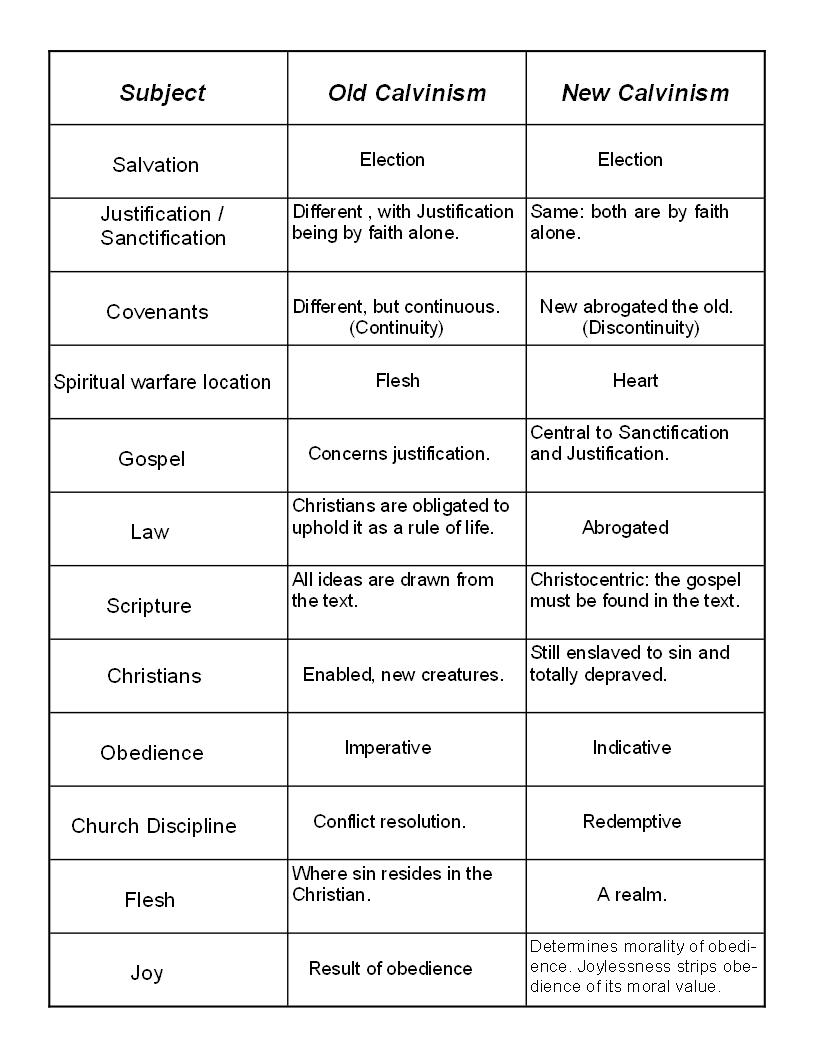
I have a better idea. One of the seventy teachers that are going to be there should make a chart with old Calvinism on the left, and New Calvinism on the right to help explain why it is “new.” List theological elements on the far left and the differences between the two can be noted in the short descriptions under each new/old heading. My proposed chart follows. Please feel free to print it and take it to the conference with you. It is not meant to be comprehensive or indicative of what ALL GS proponents believe, but merely an instrument to provoke discussion. However, the chart does indicate my conviction that the two are only similar on the election issue.
paul
“The ‘Gospel’ Coalition” Series, Part 9: The Five Points of New Calvinist Contradictions
Point One: The totally depraved preaching the gospel to themselves everyday. We gotta believe that they aren’t very good sermons (Jess—thanks for this one).
Point Two: Do what you know God wants you to do even if joy is not present, but it is sin. So, there are some situations where God would prefer that we sin (ebook: “Delight as Duty is Controversial,” John Piper, Desiring God website).
Point Three: New Calvinism encourages us to contemplate Christ in the Scriptures to make Him bigger and us smaller. The bigger the Jesus, the more humbled we are, and the more we realize how worthless and totally depraved we are as well. Yet, no Christian movement in all of redemptive history has invested more in IMAGE than the TGC and T4G. No “Christian” movement in redemptive history has been more image conscience than the leaders of TGC and T4G, sporting their super-yuppie sports wear and Sarah Palin like eyewear. No group of leaders has ever sought to draw attention to themselves via niche identity / personality / credentials like this group.
Point Four: Two different interpretive hermeneutics. When a text seems to confirm their doctrine literally (especially Gal 2:20), they want you to interpret it literally. But when not, they want you to view the text “in its gospel context,” ie., Christocentric hermeneutics.
Point Five: In my opinion, more deliberate deception than contradiction, is the TGC and T4G’s contentions against postmodernism and the Keswick movement, when they share many of the same elements. Note what Terry Johnson writes concerning Sonship theology (pdf available in right column):
“Many of us will have to be forgiven if we hear the quacks of the “higher life” movements from which we ostensibly escaped by coming to the PCA. We fled Keswick, the “Victorious Life,” the “Abundant Life,” and other perfectionists aberrations into the safe and sane arms of Westminster/ Puritan spirituality. Forgive us if we are nervous about losing the realism and balance of Reformed piety, where grace and law, love and duty, affection and fear, God’s power and our responsibility all stand in beautiful, biblically proportioned relation to one another. We liked the products of that spirituality: the Huguenot, the Puritan, the Covenanter; the modern missionary movement, the Protestant work ethic, precise morals, zeal for holiness, faithfulness amidst suffering, and what Packer calls “an ardor for order,” that orderliness that facilitates the fulfillment of all one’s duties. We will not quickly abandon this heritage for a reformulation that quacks suspiciously like the failed stepchildren of Wesleyanism.”
paul

 Paul's Passing Thoughts
7 comments