Are Calvinists Saved?
 The begging of the question has a sound Scriptural argument.
This ministry has made much of the critical importance of separating justification (salvation) and sanctification (growth in holiness, or kingdom living). The Reformed (Calvin/Luther Reformation doctrine/gospel) “never separate, but distinct” doublespeak doesn’t cut it in the arena of truth, and we will see why. “Never separate” =’s false gospel. If you get a little lost in the first part of my argument which gives the lay of the land, don’t worry, when I get into the specific Scriptural argument, it will clear things up and make it all come together for you.
It must delight the ghosts of the Reformation that the argument has always been in the arena of freewill verses predestination. It’s the primary thrust of this ministry to change that argument. This isn’t a quibbling about semantics in the mainstream—this is about the truth of the gospel. As New Calvinist Russ Kennedy once thundered from the pulpit in his mousy voice: “Any separation of justification and sanctification is an abomination!”
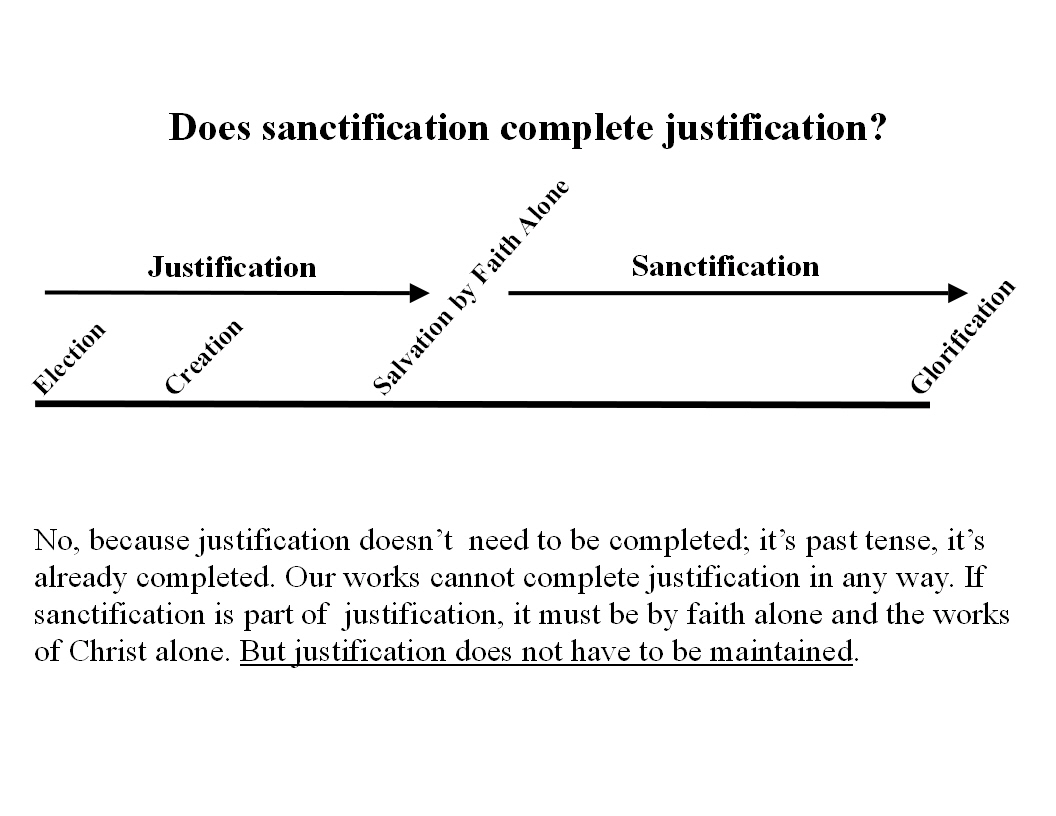
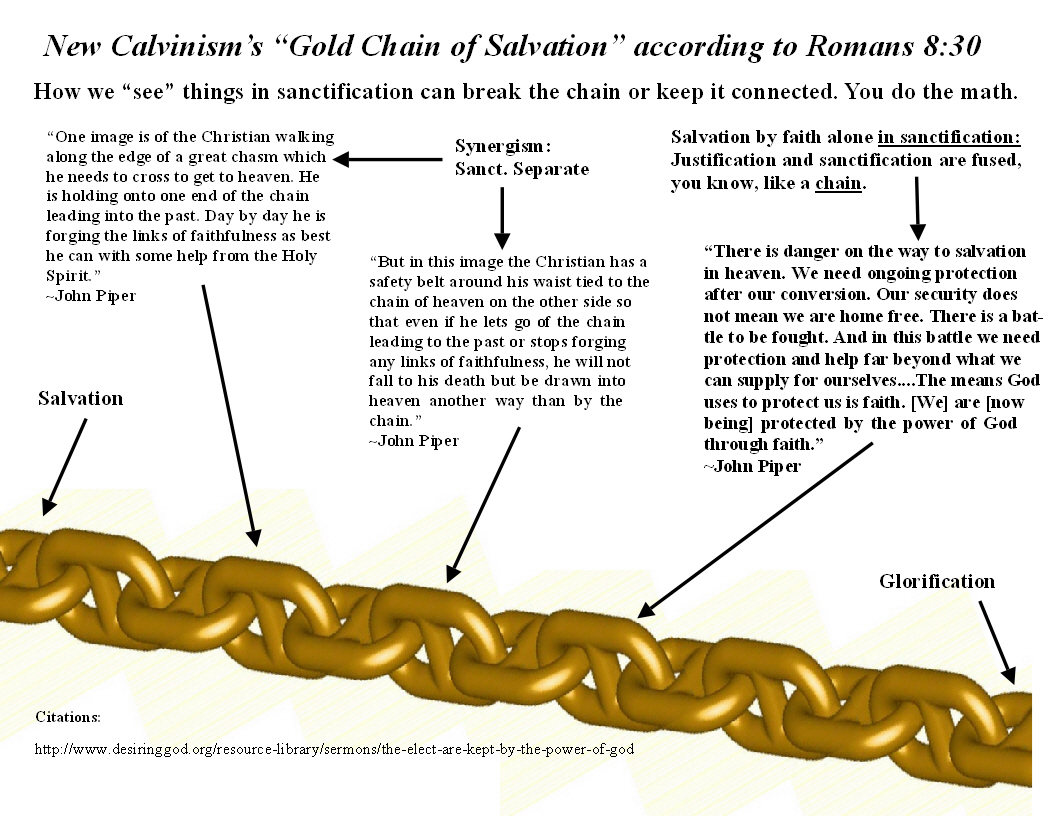
I have often argued from the standpoint of this issue. If sanctification is the middle of the Reformed “golden chain of salvation” then sanctification is part of finishing justification. This means that what happens in sanctification determines whether or not justification is properly finished. What’s a chain? John Piper even preached a message about the eternal importance of our contribution to the “links” in just the right way. In essence, sanctification becomes a spiritual minefield.
This is exactly the same thing that the Reformed crowd has always accused Rome of: the fusing together of justification and sanctification. However, as we shall see, they are both guilty of the exact same heresy/false gospel. As we shall see, both teach that sanctification finishes justification.
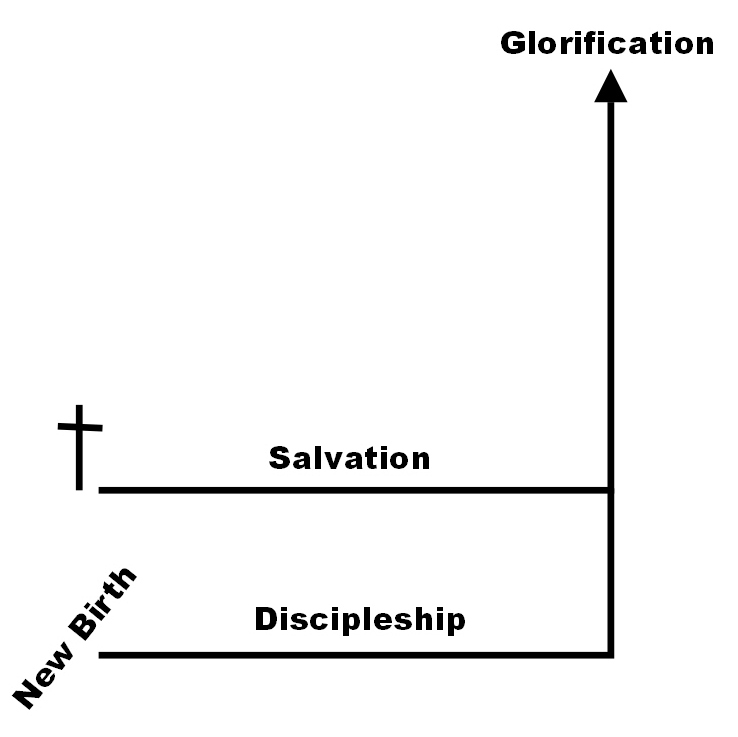
This is a linear gospel (one unified chain from salvation to resurrection (glorification) versus a parallel gospel with salvation on one plane as a finished work before the foundation of the world, and kingdom living that runs parallel with the finished work and reflects the reality of our salvation until glorification. Typical in the linear gospel is the idea that Christ died for all of our past sins, but we must now finish the work (with the Holy Spirit’s help [sanctified works salvation]) until glorification when we are completely transformed into complete holiness. This is the often-heard bemoaning of “Christ PLUS something.”
An excellent example is some strains of Freewill Baptists who teach that Christ died for all of our past sins, but with the help of the Holy Spirit, we must confess and repent of every sin we commit until the resurrection; e.g., Christ plus salvation by repentant prayer for sins committed after we are “saved.” My grandparents were saved out of this tradition. When my grandfather asked my grandmother if she thought that God could ever forgive him of all the sins he committed, she answered: “Yes, but you are going to have to pray awful hard!” Praise God that through the ministry of several individuals my grandparents eventually abandoned that gospel for the true one of salvation by faith alone as a finished work.
Likewise, Rome teaches that you must let the Catholic Church finish your justification through ritual; e.g., Christ plus Catholic ritual. The Reformation gospel is also Christ plus something else, but the something else is ever-so-subtle. In both cases, sin must be dealt with in sanctification in order for the saint to remain justified until the final judgment. In other words, the righteous standard of justification must be maintained on our behalf. Like all other proponents of a linear gospel, the Reformed crowd contends that anything less than the perfection demanded of the law (“all sin is transgression of the law”) is “legal fiction.” So both Rome and the Reformers agree: justification must be maintained by sanctification, and in the case of the Reformers specifically, they believe that the perfect standard of the law must be maintained until glorification; otherwise, our justification is “legal fiction.”
Here is where Reformed subtlety is uncanny: Christ keeps the law for us in sanctification. He maintains the perfect standard. All the fruit of sanctification (obedience/good works) flows from the life He lived on Earth and His death on the cross. Christ plus the works of Christ to finish salvation. “But Paul, what in the world is wrong with that!” Here is what is wrong with it: works are still required to maintain justification. That is a huge problem, even if it is Christ doing the work. What did the Hebrew writer say about Christ’s work for justification not being complete?
And even more subtle is the following Reformed idea: believing that the law is no longer a standard for maintaining justification is antinomianism. Antinomianism =’s legal fiction. Their definition of antinomianism is the removal of the law from justification as the standard for maintaining it. Traditionally, among Biblicist, antinomianism is the removal of the law from sanctification, and herein lays even further steroidal subtlety: the Reformed theologians would refute a removal of the law from sanctification as well, not only because they think justification and sanctification are the same thing, but because its perfect keeping is required to maintain a true declaration of the just that is not “legal fiction.”

However, the Biblicist believes that the law is a standard for kingdom living and is no longer a standard for justification. Therefore, if we attempt to obey it with the Holy Spirit’s help, and to please/serve the Lord, it can have no bearing on our just state. While the Biblicists think they are therefore joint contenders with the Reformers against antinomianism, such is far from the truth. The Reformed mind believes the Biblicist is either a legalist or an antinomian, or both. The Biblicist is supposedly an antinomian because he/she has removed the law from justification as a just standard, or is a legalist because they think they should strive to keep the law in sanctification. Since sanctification finishes justification’s perfect standard of law keeping, our “own” attempts to keep the law in sanctification is an attempt to finish justification. Hence, what the Biblicist fails to understand is the Reformers belief that Christ must maintain the law for us in sanctification because justification and sanctification are not separate. Anything more or less is supposedly works salvation.
On the other hand, because it is vital that Christ obeys the law for us in sanctification, the likes of John Piper and Tullian Tchividjian contend that those who are really preaching the Reformed gospel will indeed be accused of antinomianism. All in all, their position is easy to see if you pay attention. John Piper and many other Calvinists often state that, “Good works are the fruit of justification.” And, “Justification is the root, and sanctification is the fruit.”
Well, the average Biblicist then thinks, “Yes, but of course, our salvation makes good works in sanctification possible.” But that’s not what they are saying. If you pay closer attention, they are saying that justification is a tree that produces its own fruit. Justification is the root, and whatever happens in true sanctification is the fruit of the root of the justification tree. Problem is, justification doesn’t grow. Justification is a finished work. What Calvinists refer to as “progressive sanctification” is really the fruit of the root: progressive justification. Another name for this that they throw around is “definitive sanctification.” The word “definitive” refers back to the definite completion of justification.

Revision: this ministry now rejects the idea that orthodoxy is truth; orthodoxy is the traditions of men. Never in Scripture do we find premise for a body of teaching that explains the teaching. The above illustration is valuable for demonstrating that the fruit of justification is glorification, NOT sanctification.
This brings us to the Scriptural argument which begins with a question I asked myself just this morning: “Paul, you are always harping about the crucial importance of the separation of justification and sanctification—a parallel gospel versus a linear one. But where does the Bible say specifically that this is critical?”
First, the very definition of a lost person in the Bible is one who is “under the law”:
Romans 3:19
Now we know that whatever the law says it speaks to those who are under the law, so that every mouth may be stopped, and the whole world may be held accountable to God.
Romans 6:14
For sin will have no dominion over you, since you are not under law but under grace.
Romans 6:15
What then? Are we to sin because we are not under law but under grace? By no means!
1 Corinthians 9:20
To the Jews I became as a Jew, in order to win Jews. To those under the law I became as one under the law (though not being myself under the law) that I might win those under the law.
Romans 7:1
Or do you not know, brothers —for I am speaking to those who know the law—that the law is binding on a person only as long as he lives?
Romans 7:2
For a married woman is bound by law to her husband while he lives, but if her husband dies she is released from the law of marriage.
Romans 7:3
Accordingly, she will be called an adulteress if she lives with another man while her husband is alive. But if her husband dies, she is free from that law, and if she marries another man she is not an adulteress.
The unsaved are “under the law” and will be judged by it in the end. This is the very definition of the unsaved. Calvinists define Christians the same way—we are supposedly still under the law and will be judged by it in the end. That’s why Christ must keep the law for us—because we are still under it.
If not this position, why do many in the Reformed tradition hold to the idea that Christ’s perfect obedience is imputed to our sanctification? His death justifies us, and His perfect life sanctifies us. Hence, His death pays the penalty for past sins, and then His perfect life imputed to our sanctification keeps us justified. Why would an imputation to our sanctification be necessary if we are no longer under the law? This is known as the Reformed view of “double imputation” and has been called out as heresy by many respected theologians for this very reason: it implies that Christians are still under the law.
In regard to sustaining the law in our stead, why? It has been totally abolished in regard to our just standing:
Romans 3:20
For by works of the law no human being will be justified in his sight, since through the law comes knowledge of sin.
Romans 3:21
But now the righteousness of God has been manifested apart from the law, although the Law and the Prophets bear witness to it—
Romans 4:15
For the law brings wrath, but where there is no law there is no transgression.
The keeping of the law by anybody DOES NOT do anything to justify mankind:
Romans 3:28
For we hold that one is justified by faith apart from works of the law.
Here is where the separation of justification and sanctification is vital on this first point: we ARE NOT under the law for justification, but rather UPHOLD THE LAW in sanctification. The two must be separate because of the differing relationships to the law:
Romans 3:31
Do we then overthrow the law by this faith? By no means! On the contrary, we uphold the law.
Romans 6:15
What then? Are we to sin because we are not under law but under grace? By no means!
Furthermore, if we are still under the law (whether or not Christ obeys it for us to keep us in a just standing), this means we are still under the power of sin. Being under the law and also under its spell to provoke sin in the unregenerate is spoken of as being synonymous in the Bible. Those who are “under the law” are also under the power of sin and enslaved to it:
Romans 7:4
Likewise, my brothers, you also have died to the law through the body of Christ, so that you may belong to another, to him who has been raised from the dead, in order that we may bear fruit for God.
Romans 7:5
For while we were living in the flesh, our sinful passions, aroused by the law, were at work in our members to bear fruit for death.
Romans 7:6
But now we are released from the law, having died to that which held us captive, so that we serve in the new way of the Spirit and not in the old way of the written code.
Romans 7:8
But sin, seizing an opportunity through the commandment, produced in me all kinds of covetousness. For apart from the law, sin lies dead.
If we are still under the law, and will be judged by it, whether or not Christ stands in the judgment for us with His own works, we are still enslaved to sin by virtue of being under the law…. for justification. And Calvinists know this to be true, that’s why they say we are still…. what? Right, even as Christians, “totally depraved.” And, “enemies of God.” Of course, throughout the Bible, Christians are spoken of as being friends of God and no longer His enemies. Our status as enemies of God is stated in the past tense. But the Reformed crew continually state that Christians are vile enemies of God and are enslaved to sin. They realize that this goes hand in hand with being under the law.
To the contrary, dying to the law in the death of Christ….for justification—sets us free to be enslaved to the righteousness that is defined by the law. We are dead to the law for justification and alive to obey truth….for sanctification:
Romans 8:2
For the law of the Spirit of life has set you free in Christ Jesus from the law of sin and death.
Romans 8:3,4 [emphasis by author]
For God has done what the law, weakened by the flesh, could not do. By sending his own Son in the likeness of sinful flesh and for sin, he condemned sin in the flesh,….in order that the righteous requirement of the law might be fulfilled in us, who walk not according to the flesh but according to the Spirit.
Romans 8:7
For the mind that is set on the flesh is hostile to God, for it does not submit to God’s law; indeed, it cannot.
Romans 9:31
but that Israel who pursued a law that would lead to righteousness did not succeed in reaching that law.
John 17:17
Sanctify them in the truth; your word is truth.
James 1:25
But the one who looks into the perfect law, the law of liberty, and perseveres, being no hearer who forgets but a doer who acts, he will be blessed in his doing.
So, that is the separation that must be for the true Christian: Justification has no law for which we are judged, and we live by the law of blessings in sanctification.
This brings us to another important separation in the two: the judgments. Those under the law and sin will stand in a final judgment which will be according to the law. Again, because Calvinists believe that we are still under the law, albeit that Christ obeyed/obeys it for us, Christians will supposedly stand in the same judgment as the damned who are under the law and enslaved to it. At that time, the children of God, according to Calvinists, will be “made manifest.”
But because Christians are not under the law and cannot be judged by it, they will stand in a judgment for rewards and not a judgment that determines a perfect keeping of the law by Christ in our stead. Hence, there will be two different resurrections: one for those under the law and another for those under grace, and two different judgments for the same two groups. One for rewards, and one to determine if those under the law kept it perfectly. That judgment doesn’t go well for any standing in it.
Luke 14:12-14
He said also to the man who had invited him, “When you give a dinner or a banquet, do not invite your friends or your brothers or your relatives or rich neighbors, lest they also invite you in return and you be repaid. 13 But when you give a feast, invite the poor, the crippled, the lame, the blind, 14 and you will be blessed, because they cannot repay you. For you will be repaid at the resurrection of the just.” [Notice that this is a resurrection for the “just.” They are already determined to be just before they are resurrected].
2Corinthians 5:9,10
So whether we are at home or away, we make it our aim to please him. 10 For we must all appear before the judgment seat of Christ, so that each one may receive what is due for what he has done in the body, whether good or evil.
1Corintians 3:11-15
For no one can lay a foundation other than that which is laid, which is Jesus Christ. 12 Now if anyone builds on the foundation with gold, silver, precious stones, wood, hay, straw— 13 each one’s work will become manifest, for the Day will disclose it, because it will be revealed by fire, and the fire will test what sort of work each one has done. 14 If the work that anyone has built on the foundation survives, he will receive a reward. 15 If anyone’s work is burned up, he will suffer loss, though he himself will be saved, but only as through fire.
Hebrews 6:10
For God is not unjust so as to overlook your work and the love that you have shown for his name in serving the saints, as you still do.
Revelation 20:6
Blessed and holy is the one who shares in the first resurrection! Over such the second death has no power, but they will be priests of God and of Christ, and they will reign with him for a thousand years.
Revelation 20:11-15
Then I saw a great white throne and him who was seated on it. From his presence earth and sky fled away, and no place was found for them. 12 And I saw the dead, great and small, standing before the throne, and books were opened. Then another book was opened, which is the book of life. And the dead were judged by what was written in the books, according to what they had done. 13 And the sea gave up the dead who were in it, Death and Hades gave up the dead who were in them, and they were judged, each one of them, according to what they had done. 14 Then Death and Hades were thrown into the lake of fire. This is the second death, the lake of fire. 15 And if anyone’s name was not found written in the book of life, he was thrown into the lake of fire.
Don’t let anyone tell you that eschatology is a “secondary” or “nonessential” consideration. Your eschatology is your gospel. It will state your position regarding whether or not you fuse justification and sanctification together; ie, likening Christians to those under the law.
Yet another vital difference in sanctification and justification is repentance. Repentance for salvation (when you are justified) is different from our repentance in sanctification. Among many in the Reformed tradition where the “same gospel that saved you also sanctifies you,” the repentance is the same. Repentance unto salvation is not a onetime “washing,” but rather a means to continue “in the gospel” through what they call, “deep repentance.” Biblicism holds to repentance in sanctification that restores his/her fellowship and communion with God as His children. They would see repentance unto salvation as differing, and only necessary for salvation—a onetime decision to take one’s life in a new direction by following Christ, and believing in his death, burial, and resurrection.
Reformed repentance, according to the likes of Paul David Tripp and others is a “daily rescue.” Our original repentance was for rescue, and we need rescue today as much as we needed rescue when we were saved. Again, this indicates their belief that we are still under the curse of the law and need to be continually rescued from it while remaining under the bondage of sin.
However, Christ made it clear to Peter (John 13:6-11) that those who have been washed (1Corinthians 6:11, Romans 8:30) do not need another washing. Those who drink of the living water do not thirst again (John 4:13,14).
Lastly, though many other separations could be discussed, why saints can be considered just while they still sin at times is of paramount importance. There is no sin in our justification because there is no law, and where there is no law, there is no sin. Though unfortunate, there can be sin in our sanctification because it is totally separate from justification and can’t affect our just standing with God.
Basically, all of the aforementioned makes it of necessity to deny the new birth. If we have God’s seed in us, and we do (1John 3:9), that dispels total depravity, and without total depravity, justification and sanctification cannot be fused together. The new birth is a huge problem for Reformed theology. If the old man that was under the law is dead (Romans 7:1ff), and the seed of God is in the saved person, and the sin due our weakness in the flesh cannot be laid to our account for justification, then our justification is not “legal fiction” because we do not exhibit perfect obedience to the law. This is another grave consideration because Christ said, “You must be born again.” Obviously, despite their denials that they deny the new birth—you can’t be both totally depraved and born again.
Reformation doctrine is clearly a false gospel. Its version of justification does not void the law, and denies the new birth while distorting everything in-between. Freewill verses predestination is hardly the issue, the very gospel itself is the issue.
paul
The True Gospel Verses Calvinism: Part 1
 “The difference between Calvinism and the true gospel is a fine line of distinction with eternal consequences.”
“Justification is a finished work that guarantees glorification apart from anything that happens in progressive sanctification….Justification is a finished work that guarantees glorification completely apart from progressive sanctification.”
“All bible verses must be interpreted by, verse….for justification, or verse….for sanctification.”
This post is actually in reply to the following question posted in the comment section of this blog:
Paul, please explain in layman’s terms how Calvinism views justification and sanctification. I am trying to understand this. Does this have anything to do with the saint’s persevering?
My initial response was several hundred words which were deleted somehow when I was near completion; I must have hit a wrong key or something, but this time I will be smart and type it on Microsoft Word first.
Let me begin by addressing this part of the reader’s question first: “Does this have anything to do with the saints persevering?” No. Please, let’s just focus on the foundation—you can address all of the many other issues later, but you will be unable to address them definitively until you have an understanding in regard to the first part of your question: “….how Calvinism views justification and sanctification.”
Short answer: It views them as being the same thing, and that’s a false gospel, and I will explain why (the forthcoming long answer). But first, know this: election does not necessarily mean that God predetermined before creation who was/is going to be saved and not saved. How God weaves His sovereignty together with our choices is a mystery. For example, “The heart of man plans his way, but the Lord establishes his steps (Proverbs 16:9).” Does this mean that we shouldn’t bother planning because the Lord has already determined our steps? Hardly. Proverbs 16:9 is speaking of the mystery/paradox of God’s weaving together of what we do and His sovereign will. Does prayer change things? Certainly it does. When we present the gospel to someone, do we say, “I am just here to find out whether you are one of God’s chosen or not. So, I am going to present the gospel to you, and if you believe and repent, you are one of the chosen, if you don’t, you are toast for eternity.” No, we persuade with all diligence and knowledge (like the apostle Paul did) as if it depends on us, because to some degree, it does. Bottom line:
How then will they call on him in whom they have not believed? And how are they to believe in him of whom they have never heard? And how are they to hear without someone preaching? (Romans 10:14).
God’s offer of salvation is a legitimate offer.
Justification 101 (For now, forget about sanctification, this concerns justification only!)
Nevertheless, when they/we believe, we know it’s because of Romans 8:30, which will be the focus of my explanation/long answer. Let’s now observe Romans 8:30:
And those whom he predestined he also called, and those whom he called he also justified, and those whom he justified he also glorified.
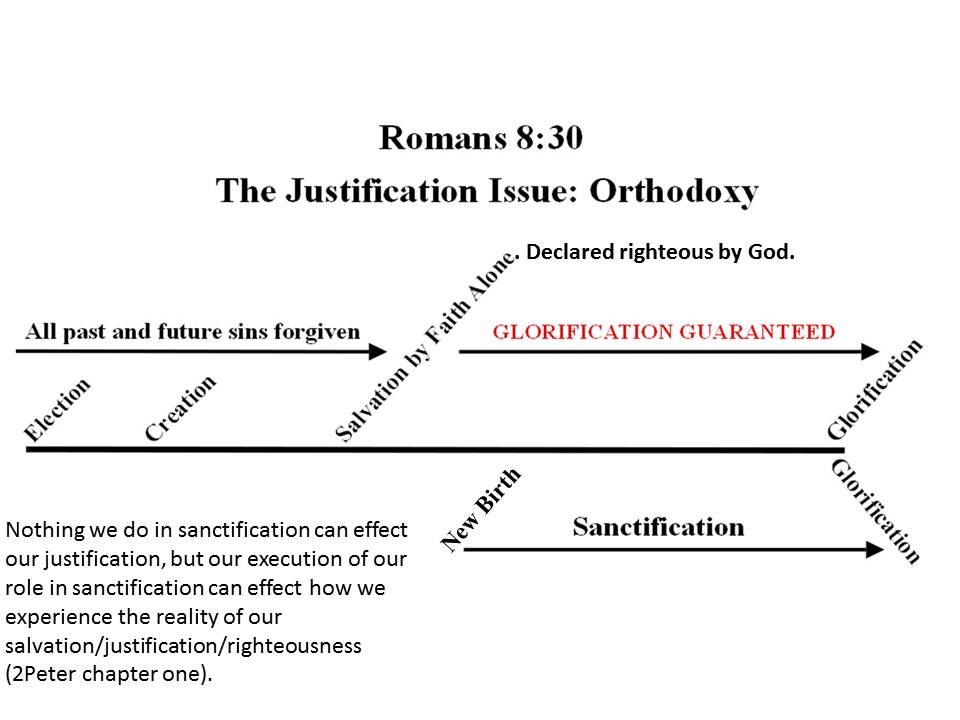
Done deal. Finished before the creation of the world. He predestined us, then called us, then justified us, and finally, glorified us. The word “justified” is dikaioo. It is a legal declaration of innocence that sets one free. Christians are declared righteous before creation, and glorification (when we will be instantly transformed completely at the resurrection) is guaranteed. We cannot mess that up. It’s a finished work by God before we were born. How can we possibly mess that up? We can’t.
Law/Justification [Gospel]
Also, the law can’t touch us. Why? We are already declared righteous, that’s why. Stop everything you are thinking about and take note of this: the law is no longer the standard for maintaining our salvation/justification. Do not turn your mind off here because of familiarity—this is not what you think it is. Pay attention! The difference between Calvinism and the true gospel is a fine line of distinction with eternal consequences. Caution: this is a concept that it so simple that it escapes us. We are no longer ….key word alert,….UNDER the law. In the book of Romans, Chapter 7, Paul compares our relationship to the law as a marriage covenant that is no longer valid because one of the spouses died:
Do you not know, brothers —for I am speaking to men who know the law—that the law has authority over a man only as long as he lives? 2 For example, by law a married woman is bound to her husband as long as he is alive, but if her husband dies, she is released from the law of marriage. 3 So then, if she marries another man while her husband is still alive, she is called an adulteress. But if her husband dies, she is released from that law and is not an adulteress, even though she marries another man.4 So, my brothers, you also died to the law through the body of Christ, that you might belong to another, to him who was raised from the dead, in order that we might bear fruit to God.
Now, I will slightly digress and bring danger of confusion, but will then quickly return to the subject of justification. Paul is talking about justification in this passage, and then finishes the thought with a mention of justification’s purpose; sanctification: “….in order that we might bear fruit to God.” BUT, as we shall see, other than the fact that justification makes sanctification (our kingdom living) possible, the two are totally separate, and the separation of the two is the key to understanding the issue at hand, and the true gospel in general.
….for justification.
We, as Christians, are dead to the law. It can’t touch us. We are no longer UNDER it:
Romans 2:12
All who sin apart from the law will also perish apart from the law, and all who sin under the law will be judged by the law.
But not us. The law can’t judge us, we are no longer under it:
Romans 3:19
Now we know that whatever the law says, it says to those who are under the law, so that every mouth may be silenced and the whole world held accountable to God.
Note that the world is under the law, but we are not. We have no regard for the law whatsoever, ….for justification.
Slavery/Justification
Paul also described our relationship to the law in regard to not being enslaved by it. To be evaluated by the law is to be in bondage to it:
Romans 6:14
For sin shall no longer be your master, because you are not under the law, but under grace.
Galatians 4
21 Tell me, you who want to be under the law, are you not aware of what the law says? 22 For it is written that Abraham had two sons, one by the slave woman and the other by the free woman. 23 His son by the slave woman was born according to the flesh, but his son by the free woman was born as the result of a divine promise.
In fact, Paul said for us Christians, ALL things are lawful!
1 Corinthians 6:12
All things are lawful for me, but not all things are profitable. All things are lawful for me, but I will not be mastered by anything.
All things are lawful, but not all things are profitable. All things are lawful, but not all things edify.
But not expedient, or profitable….
….for sanctification. Sanctification 101
There are two kinds of sanctification, but only one kind of justification, and the two sanctification are totally separate from justification. If not, we are eternally doomed. Justification must be a finished work that we have no part in except for showing others how they can be justified like we are; saved, if you will. Note: Romans 8:30, the epic verse of justification, does not include the subject of sanctification because the two must be separate. One is a finished work (justification), the other, sanctification (or, kingdom living) is progressive. In fact, Dr. Jay E. Adams states well that sanctification (our Christian life) does not in any way draw it’s life or power from justification because justification is a legal declaration that determines our POSITION:
The problem with Sonship™ [same thing as New Calvinism prior to 2008] is that it misidentifies the source of sanctification (or the fruitful life of the children of God) as justification. Justification, though a wonderful fact, a ground of assurance, and something never to forget, cannot produce a holy life through strong motive for it. As a declaration of forgiveness, pardon, and adoption into the family of God, it is (remember) a legal act. It changes the standing, but not the condition, of the person who is justified.
That’s because justification is a finished work, and discipleship (sanctification) is not; it’s progressive. But, there is also a positional sanctification that is also a finished work that even preceded justification. But like justification, it is a finished work and cannot produce progressive life, because for crying out loud, a finished work doesn’t continue to produce a progression. This would seem evident. Remember this: sanctification is a word that merely means, “to set apart.” So, sanctification is a progressive separating from the world. As we progress in our sanctification, we look more like Christ, and less like the world. But there is also a positional separation from the world that is also a finished work that includes predestination, election, calling, justification, and a setting apart:
Such were some of you; but you were washed, but you were sanctified, but you were justified in the name of the Lord Jesus Christ and in the Spirit of our God (1Corinthians 6:11).
Notice the past tense of the verse. Our position is a finished work. We were washed, set apart, and justified. Peter asked Jesus to wash him. But Christ told him that there was no need for him to be washed because it had already been done, he only needed a daily washing of his feet:
The evening meal was being served, and the devil had already prompted Judas Iscariot, son of Simon, to betray Jesus. Jesus knew that the Father had put all things under his power, and that he had come from God and was returning to God; so he got up from the meal, took off his outer clothing, and wrapped a towel around his waist. After that, he poured water into a basin and began to wash his disciples’ feet, drying them with the towel that was wrapped around him. He came to Simon Peter, who said to him, “Lord, are you going to wash my feet?” Jesus replied, “You do not realize now what I am doing, but later you will understand.” “No,” said Peter, “you shall never wash my feet.” Jesus answered, “Unless I wash you, you have no part with me.” “Then, Lord,” Simon Peter replied, “not just my feet but my hands and my head as well!” Jesus answered, “A person who has had a bath needs only to wash his feet; his whole body is clean. And you are clean, though not every one of you.” For he knew who was going to betray him, and that was why he said not everyone was clean (John 13:2-11).
Justification and the New Birth
Though justification is a finished work, it passes the torch to something that is a mark of true salvation. This is where sanctification draws its power. This element of sanctification is a Proof of Purchase Seal that you and I have been purchased by God with the price of His Son. It is the new birth. We are born of the Holy Spirit into new creatures. Our spiritual growth is now a colaboring with the Holy Spirit who indwells us. He also colabored with saints of old, but His permanent indwelling of New Testament believers is probably related to the engrafting of the Gentiles. But whatever the reasons, remember that the saints of old were also justified by faith alone, and like us, they were not UNDER the law….for justification.
Paul makes this point in Galatians 3:13-18:
Christ redeemed us from the curse of the law by becoming a curse for us, for it is written: “Cursed is everyone who is hung on a tree.” He redeemed us in order that the blessing given to Abraham might come to the Gentiles through Christ Jesus, so that by faith we might receive the promise of the Spirit.
Brothers, let me take an example from everyday life. Just as no one can set aside or add to a human covenant that has been duly established, so it is in this case. The promises were spoken to Abraham and to his seed. The Scripture does not say “and to seeds,” meaning many people, but “and to your seed,” meaning one person, who is Christ. What I mean is this: The law, introduced 430 years later, does not set aside the covenant previously established by God and thus do away with the promise. For if the inheritance depends on the law, then it no longer depends on a promise; but God in his grace gave it to Abraham through a promise.
Hence, the law CANNOT be our standard…. for justification. Paul makes that clear by pointing out that the law didn’t come for 430 years after Abraham was justified according to the covenant of promise. Nevertheless, we must be born again (new birth). Again, the new birth is proof of Justification, but is not powered by it. The new birth is the indwelling Holy Spirit colaboring with His new creatures. Theologians call this, regeneration. We, like the saints of old, MUST BE BORN AGAIN. Before the cross, and before Pentecost, Christ made this clear to Nicodemus in the present tense, and expressed surprise that he was ignorant of the new birth (John, chapter 3).
And this is very, very important: regeneration does not work towards/for glorification. Sanctification (the progressive type) is NOT a link to glorification. Remember, glorification is a finished work. Romans 8:30 speaks of it in the past tense. It is the guarantee of our justification. Both happened before the creation of the world. Some theologians call glorification, “final sanctification.” Perish the thought! Glorification is the manifestation of positional sanctification (both are final, finished works), NOT the completion of progressive sanctification. Though the completion of progressive sanctification happens at the same time as glorification—glorification is a finished work, and therefore is not the culmination of progressive sanctification’s progressive work; it is rather, redemption. Redemption is the manifestation of glorification when God cashes in on his purchase:
There will be signs in the sun, moon and stars. On the earth, nations will be in anguish and perplexity at the roaring and tossing of the sea. People will faint from terror, apprehensive of what is coming on the world, for the heavenly bodies will be shaken. At that time they will see the Son of Man coming in a cloud with power and great glory. When these things begin to take place, stand up and lift up your heads, because your redemption is drawing near (Luke 21: 25-28).
Though the Bible speaks of glorification as a future event, Romans 8:30 refers to it in the past tense. This is because it does not need progressive sanctification to complete it (again, progressive sanctification is not included in the list of Rom. 8:30), and the past tense usage points to the guarantee that accompanies justification.
Justification and progressive sanctification are totally separate. Progressive sanctification DOES NOT link justification to glorification. Justification is a finished work that guarantees glorification apart from anything that happens in progressive sanctification. This is why progressive sanctification is excluded from this paramount justification verse….for justification, and speaks of justification and glorification in the past tense. Justification is a finished work that guarantees glorification completely apart from progressive sanctification.
One Law; Three Relationships/Standards
Hence, the law, which includes all of Scripture (see Matthew 4:4, 2Timothy 3:16) must always be read in this context: ….for justification, or….for sanctification. The standard/relationship…. for [our] justification is ZERO LAW. The standard/relationship….for [our] sanctification is….100% law! Why not? It’s not related to our justification anyway! Therefore:
Do not think that I have come to abolish the Law or the Prophets; I have not come to abolish them but to fulfill them. For truly I tell you, until heaven and earth disappear, not the smallest letter, not the least stroke of a pen, will by any means disappear from the Law until everything is accomplished. Therefore anyone who sets aside one of the least of these commands and teaches others accordingly will be called least in the kingdom of heaven, but whoever practices and teaches these commands will be called great in the kingdom of heaven. For I tell you that unless your righteousness surpasses that of the Pharisees and the teachers of the law, you will certainly not enter the kingdom of heaven (Matthew 5:17-20).
The word for “set aside” is lou. It means to “relax” or loosen. That is, in regard to the “least of these commandments.” So, do we interpret this way: “Whoever practices and teaches these commands”….for justification; or, ….for sanctification ? The framing of a house and the rightness of its foundation will determine its quality. Are the frame and the foundation going to be perfect? No. But is that the standard? One would hope so. We should strive for perfection in sanctification for many reasons, but most of all, because it has no bearing on our justification which is a settled issue. However, Christ links a poor attitude towards the law in sanctification to an absence of the new birth/ new creaturehood:
For I tell you that unless your righteousness surpasses that of the Pharisees and the teachers of the law, you will certainly not enter the kingdom of heaven.
Unfortunately, the relationship/standard in regard to the unregenerate is perfection ….for justification because they are UNDER the law and in bondage to it. Christians are free from the law for justification and “uphold” (Romans 3:31) it…. for sanctification. That is why James refers to it as the “perfect law of liberty” in James 1:25. All Bible verses must be interpreted by, verse….for justification, or verse….for sanctification.
Eschatology and Justification
This is why in the study of biblical last things (eschatology), we find two resurrections and two judgments. One resurrection and judgment for the saved, and a separate resurrection and judgment for the unsaved. Unfortunately, the standard for the second set will be perfection, and nobody will measure up (Revelation 20:4-6; 11,12). We will be a part of the “resurrection of the just” (Luke 14:14) and will not stand in such a judgment because we have already been declared just. Our judgment will be for rewards:
For we must all appear before the judgment seat of Christ, so that each of us may receive what is due us for the things done while in the body, whether good or bad (2 Corinthians 5:10).
Obviously, we can’t do this: 2Cor 5:10…. for justification. That would be a huge problem.
I will conclude with a visual chart to help clarify the above. In the second part, we will examine the difference between this and Calvinism.
Guest Blogger Woody Crosthwaite: Praise Doesn’t Cover for Sin in the Camp
 This is a message that should be heard more often, especially in our day when the New Calvinist tsunami makes praise and contemplation the summation of all Christian duty, with whatever the Lord decides to do following. Doing anything more than observing what “Jesus has done, not anything we would do,” is supposedly “making a list of do’s and don’ts the ground of our justification.” Sin is really no big deal, Jesus is going to do what He is going to do anyways—our job is to “lift up his name” and experience any obedience He throws our way as a “mere natural flow.” These kinds of passive doctrines are wreaking havoc on the church.
Churches suppose God will use them despite sin in the secret chambers. Hardly, and most leaders are experts at praise, and flunkies in regard to showing the saints how to control their bodies/passions and put on Christ with the word of God. Music about sanctification is hardly anywhere to be found while 7/11 music flourishes. That is, gospel music that is seven verses about Jesus repeated eleven times. Without further ado, Woody’s thoughts:
Sex in the church; and what happens when we harbor ‘secret sin!’ (Ezek. 8)
Let me just jump into this topic with a broad, very broad statement. There are a few, perhaps even many (?) men in YOUR church who view internet pornography somewhat regularly and end their session with self-gratification. Does that shock you? It should. This ‘secret sin’ affects men of all ages and from every walk of life. AND, your pastor, or someone on your pastoral staff may even be involved. Certainly, statistics show that leaders, Sunday school teachers, “worship” leaders, choir members, and especially young men are all involved in and many trapped in and by pornography and all that follows a session of viewing overt sexual material.
Few, very few churches are talking about this plague that is rampant in the church, and even fewer who are actually doing something about it. I want to share some other things with you, but before I do, let me lay the foundation of what I want to say.
In 1 Corinthians 12, Paul is talking about the parts of the body and what our attitude should be when we take our turn at being an arm or leg. But right in the middle of the discourse he makes a curious statement – he says that “…when one member suffers, all the members suffer with it…” (NKJV). He says right before that, that there should be no division in the body. I have always thought that he is referring to that part of the body that is persecuted; the persecuted church. (The church in Saudi Arabia, China, etc.,). I believe however, after careful consideration that anything that causes division, anything that breaks the family apart causes the WHOLE body to suffer. When the body suffers, true LOVE which is the “better way” Paul speaks of as he moves into chapter 13 is either inhibited or PROHIBITED in the church. If love, the love of Christ that John says is PERFECTED IN US (1 John 2:5) is in anyway sacrificed, then we CEASE being salt and light. Should this cause GREAT concern? Should we be SO concerned and care enough to fast, pray and cry out to God for the body to be cleansed of secret sin and be united in faith and love???? The body IS suffering, but few seem to notice or care. If the secret sin wasn’t bad enough, the lack of concern IN the Body, FOR the Body is EXTREMELY frightening.
I believe that the lust that tears at the heart and soul of men IN THE CHURCH is at such a level that we should stop, fast and pray for God’s deliverance for the men and boys whom satan has trapped and is destroying. We should take immediate, and drastic action because the “good things” that we think are happening on Sunday morning, (you know, the “vibrant, excited, and seemingly passionate worship”) is really nothing more than a facade. If a significant number of men are involved in sexual sin, and thoughts are clouded by sexual temptation then what goes on – on any given Sunday is nothing more than a continuation of a feeding of the flesh. Let me tell you why I believe this:
Read slowly and carefully, Ezekiel, chapter 8. In this vision, God takes Ezekiel in a vision to the temple. As God moves Ezekiel in closer and closer Ezekiel discovers a secret room INSIDE the sanctuary where the elders of Israel are worshipping idols. Does this story speak volumes, and LOUDLY to the integrity of the heart??? I believe it does. Men who think that they can live for the moment; live for the flesh and it’s lusts; and then just waltz in to church on Sunday morning and move to the beat of the music; clap, maybe even dance and “feel” so good…are delusional. The scene that Ezekiel saw in a vision is why God LEFT the temple. God will not share His throne with anyone or anything. Now, that speaks to personal integrity but it’s not just US that we should be concerned with! IF we suffer because God has left the throne room of our hearts, which should cause us to be VERY concerned with “secret sin,” and if that suffering spreads to the whole Body and causes the church to suffer…why are we not calling those in attendance to repentance so that the Body can be pure, whole and God honoring? Because of this “secret sin” that is without question harbored in the hearts of A LOT of men of every age, what we THINK is “worship” on Sunday morning is absolutely the product of self – centeredness and prideful, arrogant misunderstanding.
Most churches just jump right in on Sunday morning with a rousing round of peppy, even rocked out music that does little more than cover up the sexual impurity raging in the hearts and minds of more than a few men in the “service.” If we have NOT learned to take every thought into captivity, (2 Cor. 10:3-5) then the sexual appetite that has been fed all week will NOT, I repeat, WILL NOT be turned off by a few minutes of contemporary music. Guys…are you listening? You will glance at the women around you and your thoughts will be impure because you have fed your lusts all week! How then, will God be honored just because you sang a few songs??? You have been deceived, your “praise” is a stench to God and the Spirit is grieved. Again, if when one member of the body suffers we ALL suffer – what does that say about the real health of the body? I think we’re living in some sort of euphemistic world far from reality…
A NOTE TO THE WOMEN AND GIRLS OF OUR CHURCHES!
Women, you may fail to understand how a man’s mind works. Is holiness in dress just an old fashioned idea that pinned the church to some archaic and legalistic list of do’s and don’ts? Am I suggesting that you come to church looking like an 18th century puritan? No, but I am suggesting that men who struggle with impure, lustful thoughts will look at you, dressed in something short and tight and revealing and will NOT be able to worship God as God intends, because they can’t get images out of their heads. Do you WANT to be ‘sexy’ in your dress?? Then why would you NOT dress modestly, so that men could come closer to filling their minds with all that is good, rather than risk evil? There’s something really wrong with a picture that suggests that women dress for church as though they were headed for a style show as a model…I suggest you read Steven Arterburn’s book, “Every Man’s Battle.” If women don’t do their part in helping guys avoid (at ALL costs) lustful thoughts which prohibits praise, grieves the Spirit, and hinders the work of the church, then women should be as ashamed in promoting sex as men should be ashamed in exploiting sex. Girls who get up on “church day” and try to be “sexy” are disgusting to the heart of God. Girls, women; if that’s your desire – to look ‘sexy’ for your man, YOUR “praise” is also a stench in the nostrils of God).
This is serious…something must be done if we want God’s glory and His blessing to return to the church. He is NOT blessing His people in MANY places because we are not just ignoring and/or excusing sin, we are feeding and enabling it. I conclude this because too often there is fear of being too bold in the public forum and sin, therefore is not confronted. The whole counsel of God is not proclaimed. The other issue is, more importantly, one of true faith in God’s Word. We “say” we believe, but what we say, doesn’t seem to be mean anything. I have already asked you to consider the “suffering body” that suffers due to sin. But what of a more clear and non-negotiable image of what sin in the body will do? What of the story of Aiken? Will God, can God bless the church when there is “sin in the camp?”
We have settled for assimilation into a church program rather than following the Scriptural mandate to be born again as the ONLY way into the kingdom. People are coming to church and engaging in all kinds church ‘stuff’ but there is NO true life in the church because we are not sharing truth. One can ONLY be part of the church when a new life experience is gained in, by and through Jesus Christ and Him alone. There are few if any baptisms. There is no effort to help “believers” understand the imperative of seeking the Holy Spirit’s help to reveal a Christ like LIFE in, through and by His Spirit. The church discourages talk of integrity, openness, and honesty. We live individual lives, with no regard for community. Our propensity to lust after the flesh and do what seems right to us is a poison that has left the church impotent and ineffective. We are most deceived if we think that the church is having REAL and lasting change in our culture. We are impotent and it’s because we have created something we think is right, but in reality, our plans and programs are devices of our own idolatrous desire to please ourselves instead of God.
Because men hide the secret sin of sexual thought and action, our young men are even more so riddled and shredded by the same. Youth “pastors” are afraid to speak boldly and plainly about the lusts of the flesh, eyes, and pride of life for fear of alienating the students in their group. If the problem of dress is an issue between adult men and women; and women inadvertently choose attire that causes men to lust; the issue is compounded exponentially in adolescents and teens. Youth programs are often gutless as they feed the lusts of their young men by allowing the young women of the group to appear in ways that absolutely keep young men from actually worshipping God. The problem and issue of lust is as much a young women’s “problem” as a young man’s Why wouldn’t we want to share the truth about how young men think so that young women could dress more appropriately? Is it old fashioned? Then why are our young men agonizing over the trap satan has set. What’s wrong with young women who want to look like a cover girl when they know that they are driving the guys crazy?? (Sorry girls! I’m not angry or judgmental, but the cancer has to be healed!!!) We serve them up a diet of contemporary to rock to metal music and deceive them into thinking that because they spent a few minutes “rocking out,” that they have somehow closed the door on the secret sins of lust. More than likely, a short time before coming to “worship” and certainly within a short time afterwards they will have succumbed to temptation by viewing pornography on the internet and more than likely, in agony ended their session of lust with self gratification as their adult counterparts do. It is also likely that some youth ministers suffer themselves so are ill equipped to provide STRONG counsel and assistance to help youth resist temptation and live holy lives. Oh, we can’t talk to kids about holiness of mind, spirit and life however; we may cause them too much discomfort and alienate them from being part of our mind – numbing, dumb – downing multi-media extravaganzas that leave their temples as unholy as was the temple Ezekiel saw.
That’s why we have precious few youth in love with Jesus, His Word; His church and able to rightly divide Scripture, anoint the sick, preach sermons, write and teach Bible studies; bleed for the lost and grieve with the persecuted church. They are yet in kindergarten and need weekly supplies of crayons, play-doh, and construction paper to even sit for a few minutes in a gathering that is nothing more than mindless rhetoric. Time is short. God is about to do something so radical that “adults” will be in shock, much less our youth.
Shame on youth leaders, ministers and pastors that want to merely entertain rather than grow a church ready to fulfill Matthew 16. We had better get ready! We had better prepare our people for the days ahead instead of figuring out every way we can to feed our flesh. God help us!!!
Two Roads to Hell Named “Gospel”
 It happened again on Facebook. A twenty- something professing Christian posting casual information about cohabitation with a boyfriend/girlfriend. What struck me about it was the following: as in other cases that I have seen and heard about, the shameless normality in which the information is shared.
Why is this the norm of our day? Answer: the gospel. The gospel means “good news,” and since the Fifties there has been two primary gospels preached in America and both are great news to most people. The first gospel (from the 50’s to the 90’s) emphasized the importance of believing that Christ died for our sins, and if you believed that, you were going to heaven. Obeying the ten commandments was a nice thing to do for Jesus, but optional. Even if you later denied Christ and the gospel, you were still saved, and keeping the law was optional. After all, we aren’t saved by the law, so how important could it be? Just in case you think that’s a generalization, consider these quotes from the book, “Eternal Security” written by evangelical superstar Charles Stanley:
PAGE 6 “As long as I have an ongoing role in the salvation process, my natural tendency will be to focus on my behavior rather than on Christ.”
PAGE 7 “People who are constantly examining their spiritual condition tend to fall into the trap of legalism.”
PAGE 200 “But isn’t it true that people who believe they must maintain some kind of good works in order to stay saved are trusting in themselves for their eternal security?”
PAGE 195 “Placing the responsibility for maintaining salvation on the believer is adding works to grace. Salvation would no longer be a gift. It would be a trade – our faithfulness for His faithfulness.”
PAGE 7 “Show me a believer who is caught up in trying to maintain God’s acceptance through good works, and I will show you a fragile saint. My experience has been that these are the people who on the surface appear to be completely sold out to personal holiness and purity but who suddenly disappear. It is not unusual for these well-meaning types to end up in a lifestyle completely opposite of what they once stood for.”
PAGE 93 “Even if a believer for all practical purposes becomes an unbeliever, his salvation is not in jeopardy.”
PAGE 72 “The Bible clearly teaches that God’s love for His people is of such magnitude that even those who walk away from the faith have not the slightest chance of slipping from His hand.”
PAGE 93 “Christ will not deny an unbelieving Christian his or her salvation because to do so would be to deny Himself. Why? Faithful or not, every person who has at any time had saving faith is a permanent part of the body of Christ.”
PAGE 104 “In Christ, the requirements of God’s holiness have been completely fulfilled!”
PAGE 63 “According to Jesus, what must a person do to keep from being judged for sin? Must he stop doing something? Must he promise to stop doing something? Must he have never done something? The answer is so simple that many stumble all over it without ever seeing it. All Jesus requires is that the individual “believe in” Him.”
Then more good news came in the latter Nineties. The first gospel didn’t emphasize the law enough, but the second gospel places very strong emphasis on the law. But the news is still good; Jesus obeys the law for us! In fact, it was part of the atonement; His perfect obedience was imputed to our sanctification! Moreover, even the relaxed approach to the law in the first gospel was legalism! So relax, be happy, live in peace with thy girlfriend. As one of the propagators of this second gospel has said,
The irony, of course, is that it’s only when we stop obsessing over our own need to be holy and focus instead on the beauty of Christ’s holiness that we actually become more holy! Not to mention, we start to become a lot easier to live with! Will someone please keep reminding me of this? (Tullian Tchividjian, Accountability Groups: The Tyranny of Do More, Try Harder).
And trust me, everyone is getting the message.
Besides, why bother with keeping the law? After all, as second gospel guru Paul David Tripp has stated in regard to Christians, “When you are dead you can’t do anything” (p. 64, How People Change 2006). Likewise, CJ Mahaney: “We [who is “we”?] are [present tense] enemies of God. We are God ignoring. We are God defying. We hate God” (2009 Resolved Conference).
Hence, compare the following quotes from these second gospel gurus to those of Stanley:
Francis Chan: “To change our hearts, what we value, what we risk, how we act, we don’t need more guilt or more rules, we just need to be in love with God. Because when you’re wildly in love with someone, it changes everything.”
DA Carson: “In this broken world, it is not easy to promote holiness without succumbing to mere moralism; it is not easy to fight worldliness without giving in to a life that is constrained by mere rules.”
John Piper: “So the key to living the Christian life – the key to bearing fruit for God – the key to a Christ-exalting life of love and sacrifice – is to die to the law and be joined not to a list of rules, but to a Person, to the risen Christ. The pathway to love is the path of a personal, Spirit-dependent, all-satisfying relationship with the risen Christ, not the resolve to keep the commandments.”
Tullian Tchividjian: “A taste of wild grace is the best catalyst for real work in our lives: not guilt, not fear, not another list of rules.”
These two gospels are two roads to hell. Why? Because both gospels restrict saving faith / belief to limited knowledge of the true gospel. Both limit saving faith to what Jesus did to make our entry into the kingdom possible, and not its purpose. “Jesus died for our sins, just believe that.” No, there is more. Jesus died for the purpose of setting us apart. The biblical word is “sanctification”:
Or do you not know that wrongdoers will not inherit the kingdom of God? Do not be deceived: Neither the sexually immoral nor idolaters nor adulterers nor men who have sex with men 10 nor thieves nor the greedy nor drunkards nor slanderers nor swindlers will inherit the kingdom of God. 11 And that is what some of you were. But you were washed, you were sanctified, you were justified in the name of the Lord Jesus Christ and by the Spirit of our God (1Corinthians 6:9-11).
But we ought always to thank God for you, brothers and sisters loved by the Lord, because God chose you as firstfruits to be saved through the sanctifying work of the Spirit and through belief in the truth (2Thess. 2:13).
In other words, the Spirit’s purpose is to set us apart, and Christ died for our sins to make that possible, resulting in us being declared righteous by the Father. Any gospel that excludes that purpose thereof is a half gospel:
It is God’s will that you should be sanctified: that you should avoid sexual immorality (1Thess.4:3).
The one who does what is sinful is of the devil, because the devil has been sinning from the beginning. The reason the Son of God appeared was to destroy the devil’s work (1John 3:8).
Therefore, the “new convert” supposes that Jesus only died to save us, and “enters the kingdom” indifferent to one of the primary reasons Christ died for us—to set us apart from the rest of the world unto the Father as a peculiar people. Hence, Facebook. Yea, flaunt thy supposed “festival of freedom.” After all, he only died to save us. Supposedly. For the true Christian beholding the heart of Christ and his purpose of setting us apart unto the Father, and His willingness to leave Heaven and obey the cruel cross—I beg you to tell me—how can being like the world be like business as usual? Furthermore, how can any man claiming to be a bishop of God tell us not to “obsess” over our holiness? It is the very essence of being a saint. It is what we signed up for. According to Mark G. Cambron, D.D. in Bible Doctrines:
Again we emphasis that the words “holiness,” “sanctification,” and “saint” all come from the same word meaning “set apart,” “separation.” The word “sanctify” in Exodus 13:2, and the word ‘holiness” in Psalm 29:2, and the word “saints” of Psalm 34:9 are the same word. The word “sanctify” of John 17:17, and the word “saint” of Philippians 1:1, and the word ‘holiness” of Hebrews 12:10 are all from the same word.
The call of the true gospel is a call to believe in the works of Christ and a commitment to be set apart according to His will. It is a call to embrace Him as Savior and Lord. It is most certainly an obsession with truth and holiness. It recognizes that being born again is to be set apart by the Spirit. Christ went to the cross to see this happen in His children, resulting in the destruction of the devil’s work. How it must grieve the Holy Spirit and Christ when we not only do the world’s bidding, but report it to others in casual fashion.
And because of this, should not the wording of the gospel be of major concern when we present it? How is it that the gurus of the second gospel proudly herald a five word gospel: “Christ died for our sins”? And then even go as far as to say that we live by that as well! How is it that John Piper presents the gospel in “one sentence,” excludes sanctification, and then says, “that’s the gospel”?
It is not the gospel. It is a half gospel. Both of these gospels breed an indifference for one of the primary reasons Christ went to the cross—sanctification. And by the way, the word of God is the standard for what that separation is and the knowledge to obtain it. It is not just law, it is every word that comes from the mouth of God that we live by (Matthew 4:4).
paul
How Most Pastors Today Use The Bible
“….if the higher law of love abrogates the law of Scripture, it sure as hell abrogated your by-laws. I find the incredulous demeanor of people who come to me with these reports both adorable and naive. It’s time for Christians to wake up and start drinking more coffee.”
I’m wondering; can we begin calling our present day, “The Age of the Australian Forum”? If you really want to understand what’s going on in the church theologically, read the Forum’s journal: Present Truth Magazine. It can be obtained online for free through a Progressive Adventist church that archived most of the issues.
The Forum’s hermeneutic was based on their thesis, the centrality of the objective gospel completely outside of us (COGOUS) which is supposedly the lost doctrine of the Reformation. It’s monergism on steroids. We are so wicked and totally depraved, that objective truth can only be outside of us. When truth starts being processed inside of us, the only result can be subjectivism.
What to do then? Answer: focus on central truth that is the “power of the gospel.” Basically, gospel, gospel, and more gospel transforms us into Christ likeness. We need to saturate ourselves with information about the works of Christ, not anything we would do. Hence, pithy truisms like, “Not, ‘What would Jesus do?’ But, ‘What has Jesus done.’”
Supposedly, saturating ourselves with what Jesus has done, not anything that we would do fills our hearts with gratitude and makes us willing and joyful participants in obedience. However, the key is to focus on gospel and then allow works to flow from that. Obedience when we don’t feel like it, or out of duty, is not “done in love” And, the point isn’t how well we do that—because we are not “under law, but under grace.” The point is not to “obey in our own efforts.” Results are not the goal, we can’t affect any results anyway; the goal is to avoid “making our sanctification the basis of our justification.” In other words, all works must flow from justification truth and the “power of the gospel.” Just focus on gospel, and let the “active obedience of Christ” take care of the rest.
This is because Christ was not only obedient to the cross (known as His “passive” obedience), but also lived a perfect life so that His obedience for sanctification could be imputed to us as well (Christ’s “active” obedience). Hence, and don’t miss this, if we try to obey in sanctification, we are trying to accomplish works that have already been finished by Christ as part of the atonement, and thus making our sanctification the grounds of our justification because the two are fused together and part of the atonement with Christ living a perfect life here on Earth for one, and dying for the other. Got that? This makes sanctification very tricky business. At any time, we could be unwittingly “making our sanctification the grounds of our justification.”
Come now, admit it, we hear this lingo all the time reverberating throughout churchianity.
Where does the use of the Bible fit into all of this? Answer: it is a tool for the gospel contemplationism needed to transform us into the likeness of Christ. All of the commands in the Bible are to remind us of the fact that Christ obeyed all of them for us (this is the basis of the New Calvinist motto, “Christ for us”). Biblical imperatives are supposed to remind us of the futility of trying to keep them ourselves while invoking thankfulness for what Jesus has done “for us,” not anything we do. However, polity framework is considered to be a separate issue. They concede that the Bible contains guidelines for structuring the church, but that is for practical function and is separate from “spiritual formation.” Moreover, this view contends that the Holy Spirit only illumines when the Bible is used to see the gospel in a deeper and deeper way. And also, aside from practical use for structuring, seeing the Bible through the prism of gospel (ie., Christ the person and His works) interprets the Bible itself for all uses in “spiritual formation.”
Now, since Christ already fulfilled the law and imputed it to us, our goal isn’t to follow specific imperatives in the Bible, but rather to fulfill the “higher law of love” that Christ has instituted to replace the “fulfilled” law which is now abrogated by the “higher law of Christ.” What does that look like?! Answer: it looks like whatever the gospel produces! Because, when it’s the result of the gospel, it can’t be wrong! If the elders of your church are “saturated with the gospel”—they can’t be wrong, and it may, or may not look like “the dead letter of the law,” ie., biblical imperatives not seen in their “gospel context.” As Francis Chan states it: “When you are loving, you can’t sin.”
Look folks, this ministry sees this approach to the Bible fleshing itself out in real-life church situations daily: “But, but, how can they do this?! It is clearly against Scripture!” No, in their minds, it is against a law that has been abrogated by the higher law of Christ. “But, but, what’s that?” Answer: whatever results in the elders being saturated with the gospel, that’s what. And then there is the whole issue of New Calvinist elders poo—pooing church constitutions and by-laws. Trust me, if the higher law of love abrogates the law of Scripture, it sure as hell abrogated your by-laws. I find the incredulous demeanor of people who come to me with these reports both adorable and naive. It’s time for Christians to wake up and start drinking more coffee.
Let me tell you what the perfect cover is and why so many pastors get away with using the Bible this way. In fact, I will begin to explain with a question: how many great sermons can be preached about the awesomeness of Christ and all that He has done for us? Answer: how many books has John Piper written? And people rave about all of them! But what is missing? Answer: aside from a truckload, Matthew 7:24-27. One of the best friendships I have was brought about when she objected to an article I wrote along these lines, and mentioned a book by John Piper that was supposedly “full of biblical instruction.” I then responded and encouraged her to reread the book and list every biblical life application she could find. She did just that and contacted me by email: “Your right. This is a real eye opener.”
What prompted this post? I read this article here: article link. Read it for yourself and let me know if it rings any bells.
paul

 Paul's Passing Thoughts
10 comments