Romans 13:11 | What’s in the Word, “Saved” Part 1: A Salvation Paradigm
 “You were purchased and the sale if final. Christ did not purchase you on a Reformed installment plan. We wait for redemption when Christ comes to claim what He purchased.”
“Moreover, if justification and sanctification are not separate, and are the same thing the Bible must be interpreted through the prism of justification only and in fact that is the very interpretive craze of our day; i.e., every verse in the Bible is about Jesus. Unfortunately, this would not explain the interpretive dichotomies of the Bible and would instead make them contradictions. There are many, many examples of this throughout the Bible, but the primary one is works. On the one hand, the Bible continually calls for faith alone without works, but on the other hand, it also calls for vigorous labor and obedience to the law. How can these be reconciled? Answer: some verses are talking about justification while others are talking about sanctification. If justification and sanctification are not separate, the Bible is nothing more than a book of confusion.”
Click to enlarge illustrations if needed.
I am very happy that we have arrived at Romans 13:11 because what Paul states here is the source of much misunderstanding in our day. As a pastor, I have said it: “We were saved, are being saved, and will be completely saved.” What was I thinking when I used to say things like that? I really don’t know. But isn’t that what Paul is saying here in Romans 13:11?
Besides this you know the time, that the hour has come for you to wake from sleep. For salvation is nearer to us now than when we first believed.
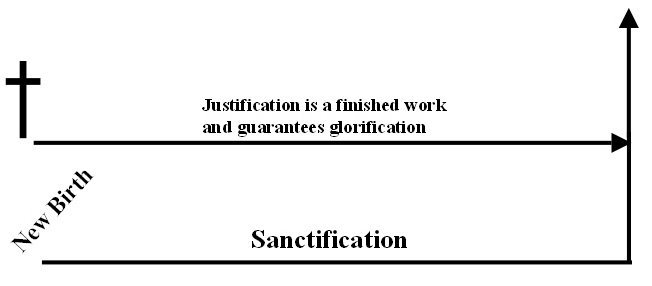
Paul seems to be saying what I used to say: our original salvation culminates into a final salvation. At TANC LLC, our research institute, we call that the “linear gospel.” In Reformed circles it is called the “golden chain of salvation.” Now listen, this is a really big deal. One must choose between the linear gospel and the parallel gospel. Let’s look at the illustrations below:
Illustration A

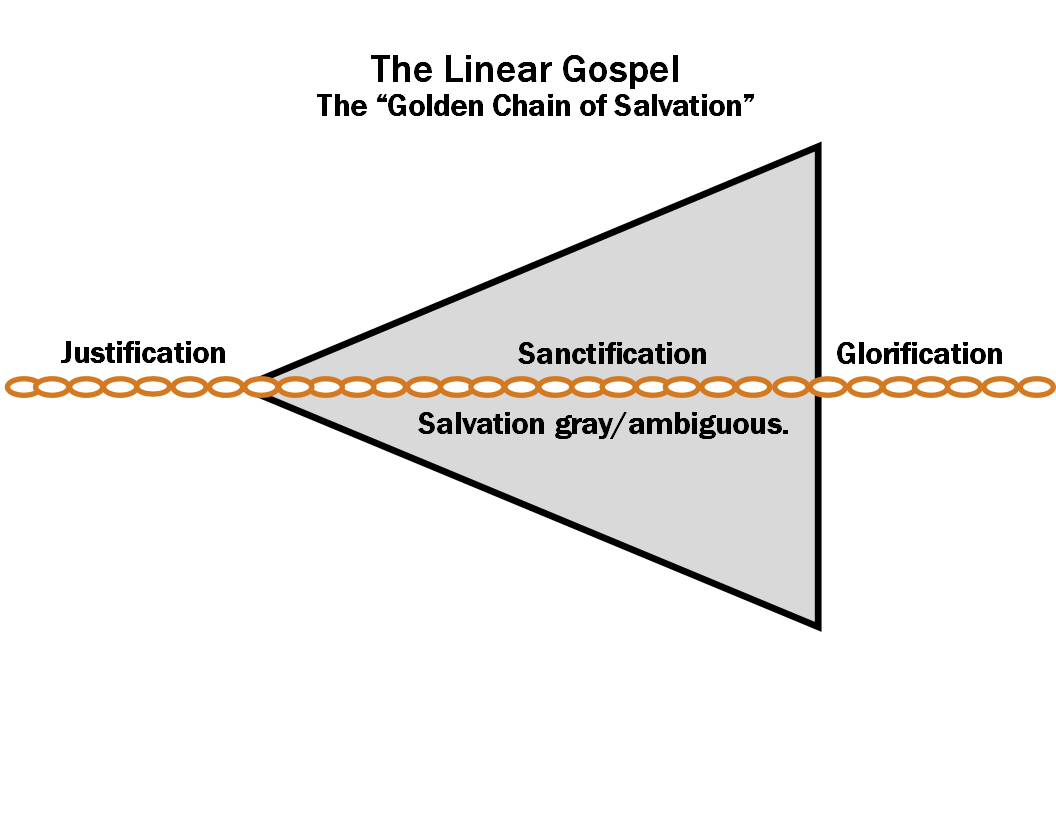
Illustration B
I have been making these illustrations for some time, and was surprised to find the following like-illustrations in the archives of the Australian Forum, the reformed think tank that spawned the present-day neo Calvinist movement:
Illustration C
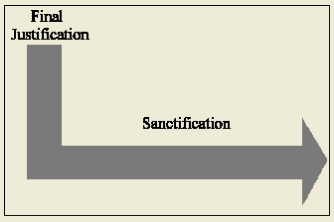
Illustration D

Illustration E
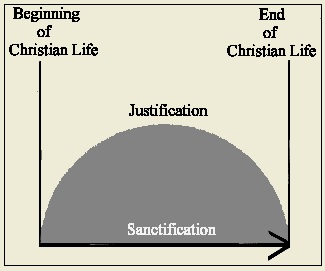
The Australian forum used these illustrations to convince the church that the true gospel of the Reformation had been lost. These illustrations were key in clarifying what the Reformers really believed. And, though the recent Neo-Calvinist movement parrots much of the Forum’s dialect and other illustrations to teach authentic Reformed doctrine, they avoid these illustrations like a plague. Why? Because these concepts are the most clarifying, and what was used to clarify can also be used to refute the same doctrine.
I agree with the Forum, my illustration B and their Illustration C was the model that the church, for the most part, was teaching when the Australian Forum showed up in 1970 (Hereafter: AF). Don’t get me wrong, I don’t think the church was applying the model, but it is what they held to. They were actually functioning like model A and E.
Model A combines salvation with the Christian life. That may sound like a statement in regard to the obvious, but it really isn’t. When someone asks us if we are saved, we say yes, but the answer is in regard to models B and C. We were saved, so we are now saved. It was a onetime permanent act. Valerie, the family dog was born in the past, but her dogness is permanent. Valerie is not in the process of becoming a complete dog, she is a dog, she is perfect dogness. The AF would agree with my assessment here. Note in model C that justification is “finished.” When Valerie was born, her doghood was finished. Valerie will now start acting like a dog because that is her nature.

Not so with the Reformed models A and E. If someone asks a Reformed person if they are saved, they most say, “already—not yet” which is the nomenclature of an official Reformed doctrine. It means that one is in the process of BEING saved—their complete salvation is future. Again, the AF would have agreed with this assessment. Note the following illustration published by them:
Illustration F
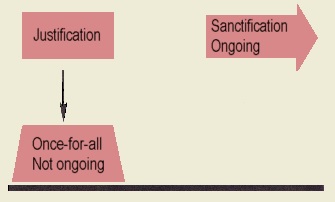
I would also like to use their illustration to make a point. They, in representing the Reformed view take issue with justification being finished. They believe it is ongoing, but look what they call it: “sanctification.” Why wouldn’t they call it “ongoing justification”? Normally, the term for the Christian life is progressive sanctification, but Reformed theologians stay well clear of the term progressive justification. The only exception is in the Calvin Institutes (3.14.title). At issue is what they illustrate with model E—justification and sanctification are combined. Salvation is a progression and worse yet, we are in the midst of the progression. That means we can mess up the progression, this is an unavoidable inference, and is indeed an element of Reformed thinking.
This is where I want to make a point about illustration D. The AF, like all of the Reformed, refutes this model as Christ plus something. Salvation only covers past sins, but we have to do something in our sanctification to maintain our righteous standing. In both models justification (salvation) is not finished, but the Reformers say that is ok for their model because justification is finished by justification.
But yet, this is the problem with all linear gospels like model A: we are in the middle of the process, so the question must be answered; “what is our role?” And that very question is a huge problem because mankind has NO role in being justified. No man other than Christ could pay the penalty for our sins. However, the Reformed answer is, “The Vital Union.” Basically, it is ok for us to be in the midst of the unfinished justification process because we participate in the same way that we were saved; viz, by faith alone. So models A, D, and E are the same thing, but the Reformed say that is ok for their model because it is Christ plus faith alone in Christ. In order to keep justification moving along properly, we must live our lives by faith alone.
Personally, I contend that if we have ANY role in our salvation other than the decision that brought the death of the old us and the birth of a new us, that’s works salvation by doing nothing with intentionality. In fact, it’s called abstaining and that’s a verb. Salvation by Christ plus doing nothing is still model D. Calvinist Tullian Tchividjian wrote a book titled Jesus plus nothing equals everything, but in a linear gospel where justification and sanctification are fused together, IT’S IMPOSSIBLE TO DO NOTHING because doing nothing is something. The only way that we can do nothing is if …
1. The work itself is finished. You can’t do anything to finish a finished work.
2. You are not present to do anything. The work is not located in your realm of operation.
This requires a discussion regarding the separation of justification and sanctification which is anathema to the Reformed thinker. They say, “Justification and sanctification are never separate, but distinct.” However, because of the terms used by Scripture, the Reformers are forced to do something with sanctification, especially in light of 1Thess 4:3,4, so the progression of justification falls under the auspices of progressive sanctification. This brings us back to illustration F. If Valerie, a dog, specifically a beagle, is justification, why would we call her something different because she gets up and starts walking? Is that cause to call her a duck? Indeed, a Valerie sitting is “distinct” from Valerie walking, but does that make her something other than a dog? If Calvin himself spoke of justification as being progressive in the title of chapter 14 | book 3, and that in fact is what you deem it to be, why not call it progressive justification and be done with it?
We hold that justification is a finished work and completely separate from the Christian life. Model B is the ONLY “plus nothing” model because you cannot add to a finished work nor can you work on something that is otherworldly. Christ came to finish a work that we cannot touch. Justification declares that the law that would judge us has no jurisdiction over us. Our sanctification comes from the regeneration of the new birth, not the finished work of justification. This was the rhetorical question that Paul asked of the Galatians:
3:2 – this only do I wish to learn from you—by works of law the Spirit did ye receive, or by the hearing of faith?
3 so thoughtless are ye! having begun in the Spirit, now in the flesh do ye end?
(YLT).
In other words, after receiving the Spirit, do you finish a finished work by circumcision? Note the previous verse:
3:1 – O thoughtless Galatians, who did bewitch you, not to obey the truth—before whose eyes Jesus Christ was described before among you crucified? (YLT).
Christ’s death on the cross finished the work of justification.
But doesn’t Paul say that our salvation is future? The question is salvation from what? We know it is not salvation from sin that would condemn us for sin is not counted where there is no law (Rom 4:15, 5:13) and Christ put an end to the law (Rom 10:4). However, it is clear that the world will be judged by the law (Rom 3:19, 20). It is not salvation from sin that would condemn us.
While the believer is born again and truly righteous, we must carry around the old us that was crucified with Christ. The things Christ died for are still with us (2Cor 4:7-18). As Christians, we await a deliverance from this body of death. (Rom 7:25). Clearly, salvation from condemnation is finished (Rom 8:34), salvation from the sin that condemns is past and complete, but there is left a salvation from sin that harasses us daily. If the gospel is linear, and justification is not finished, Paul is speaking of a future salvation from condemnation—we reject that idea with prejudice, Paul is talking about the other salvation from the sin of our mortality.
The Bible also refers to that as redemption. Remember last week and our discussion of the exchange of slavery? We were purchased from the other slave owner by the blood of Christ (1Cor 6:19,20, 7:22,23), and Christ will one day return to redeem His purchase (Gal 3:13, Luke 21:28). In the linear model, there can be no exchange of slavery because we are not finally free till the end. Neither is there an exchange of law because faith only is required to maintain the “vital union” that keeps our original justification moving forward.
Moreover, if justification and sanctification are not separate, and are the same thing the Bible must be interpreted through the prism of justification only and in fact that is the very interpretive craze of our day; i.e., every verse in the Bible is about Jesus. Unfortunately, this would not explain the interpretive dichotomies of the Bible and would instead make them contradictions. There are many, many examples of this throughout the Bible, but the primary one is works. On the one hand, the Bible continually calls for faith alone without works, but on the other hand, it also calls for vigorous labor and obedience to the law. How can these be reconciled? Answer: some verses are talking about justification while others are talking about sanctification. If justification and sanctification are not separate, the Bible is nothing more than a book of confusion.
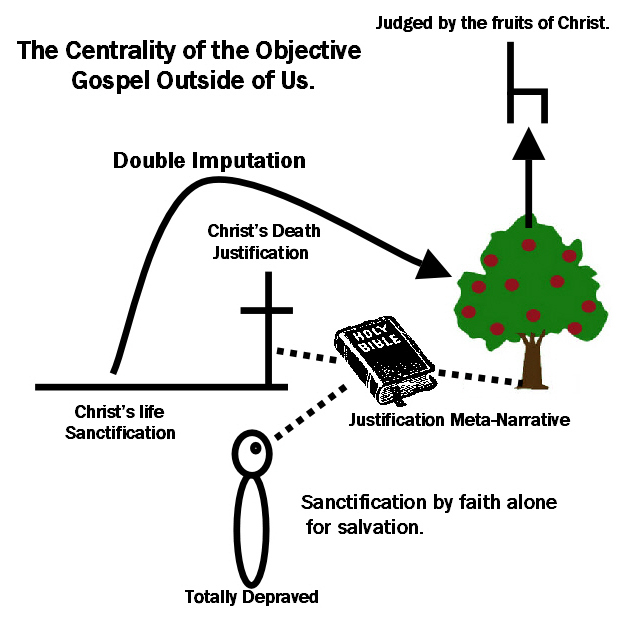
The linear gospel also leads to all sorts of confusing doctrines that make doing nothing in our Christian life feasible. One is double imputation. This is the belief that Christ died for our justification and lived a perfect life of obedience for our sanctification. That way, Christ’s perfect obedience to the law is imputed to our Christian life as we live by faith alone.
Illustration G
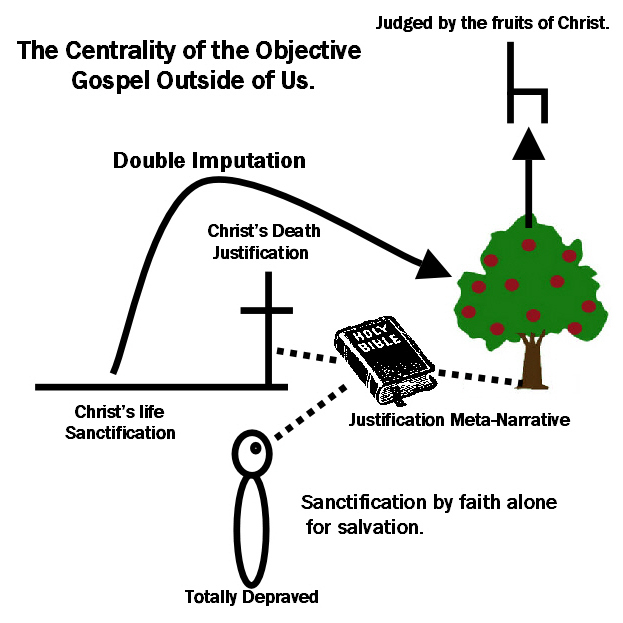
This Reformed doctrine also makes law the standard for justification in regard to Christians. Since perfect adherence to law remains the standard, but Christ fulfilled and keeps it for us, neither is an exchange of law needed in salvation as we discussed last week—the relationship to the law doesn’t change.
This results in an attempt to reduce sanctification to a mere “awareness” or “experience” with all kinds of mystic doctrines following of which there is no shortage in Reformed circles. An excellent example is the following excerpt from a sermon I heard recently:
Years ago, there was a pastor named Ichabod Spencer, and he was talking to a young student who was convicted of a sin and wasn’t a believer but wanted to come to Christ. And he wrote of the conversation, and it’s in a book called Pastoral Sketches, and Ichabod Spencer’s section in there has this conversation. And it’s fascinating because it’s called “I Can’t Feel.” Listen to this interchange. Ichabod Spencer said,
“I don’t know, my dear sir, what more can be said to you. I’ve told you all that I know. Your state as a sinner, lost, exposed to the righteous penalty of God’s law and having a heart alienated from God and the free offer of redemption by Christ, I’ve told you those things, and your instant duty to repent of sin and give up the world and give God your heart and the source of your help through the power of the Holy Spirit assured to you if you will receive Christ.” In other words, self-empty, and believe it, all these things have become as familiar to you as household words. What more can I say? I know not more what there is to be said.” He said, “I cannot read your heart. God can. And you can by his aid. Some things you’ve said almost made me think you a Christian, and other things again have destroyed that hope. I now put it to your own heart. If you’re not a Christian, what hinders you?”
And he thought for a moment, and he said, “I can’t feel.” “Well, why didn’t you tell me this before?” He said, “I never thought of it before, sir.” “Well, how do you know this hinders you?” “I can’t think of nothing else. I’m sure I shall never be converted to God if I have no more feeling than I have now. That is my own fault. I know you can’t help me.” And he said, “No, sir, I cannot, nor can you help yourself. Your heart will not feel at your bidding.” “What then can I do?” said he with much anxiety. “Come to Christ now. Trust him. Give up your darling world. Repent so inequity shall not be your ruin.” Well, he seemed perplexed, annoyed, vexed. And with an accent of impatience such as I had never witnessed in him before, he replied, “That is impossible. I want the feeling to bring me to that, and I can’t feel.”
And Spencer said, “Hear me, sir, and heed well what I say. I have several points. Number one, the Bible never tells you you must feel, but you must repent and believe. Number two, your complaint that you cannot feel,” listen to this, “is just an excuse by which your wicked heart will justify you for not coming to Christ now.”
First of all, this idea that we cannot command our feelings is something that I hear often and is not biblical. The apostle Paul instructed us to keep a clear conscience before God. Elsewhere, we find that our consciences either accuse us or excuse us. We all know how bad we feel when our consciences accuse us; therefore, we may assume that the opposite is true when we do right. We are also instructed by Paul as well to make it our goal to please God; certainly, a feeling of accomplishment can be expected here as well.
Clearly, we can command our feelings by doing what is right. In contrast, the above dialogue is the result of the linear gospel where an act of grace must precede all feelings. Again, if we are in the middle of a process that saves us, and we are good Reformed thinkers with faith alone always in the forefront, we must only believe and merely be a witness to “grace.” Can you see this in the above dialogue? Only believe is the exhortation of the pastor, and we cannot command our feelings anyway.
In contrast, this young man isn’t going feel any different UNTIL he makes a decision to follow Christ. Why? Because he is under judgment! When you are under law, all that awaits you is a fearful judgment under the law. Why would he feel any different until he is no longer under threat of judgment? This would have been my counsel to this young man. At the very least, the vacancy of fear and the knowledge that you are going to spend eternity in heaven will produce good feelings on some level.
Yes, this leads into all kinds of Reformed wackiness that I believe shuts up the door of heaven to many. I myself know of a young man that wouldn’t make a commitment to Christ because he was yet to see Christ as a “treasure chest of joy.” This all speaks to the Reformed concern that man is able to make an intellectual decision that is part of the salvation process. Yea, we must have some kind of sign that we were enlightened first before we make the decision. But why would it be delight? What of a fear of judgment that we know we deserve?
The fact that the aforementioned young man was vexed and in turmoil is a sure sign from heaven that he understand that he is under the law. Good grief! Lord come quickly and deliver us from this ignorance dressed in academic garb! Remember what we have learned previously in this Romans study? Our service to God is a what? Right, “reasonable service.” Remember what that word means? It means “rational.” My father was an intellectual who always had an interest in God throughout his whole life, but in the end, he assured me that he had made a personal commitment to Christ. But be sure of this, my dad would not have made a commitment to mystic nonsense coming from the Reformed crowd. The decision to be saved is a rational decision, and our service to Christ is rational.
“Just believe” is no answer, we must tell people WHY they mustn’t wait on a feeling. It is because feelings follow thinking and doing. For the most part, feelings are a choice. What do you do if you feel unsafe? You make a decision to change your circumstance to something safer, and then you feel safer. My friends, this is hardly rocket science.
But this can now bring us to another consideration of linear versus parallel—that of end times. The linear gospel can only speak of one final judgment where the children of God are “manifested.” If you look at the parallel gospel, it supplies the possibility of two judgments. Note the illustration below:
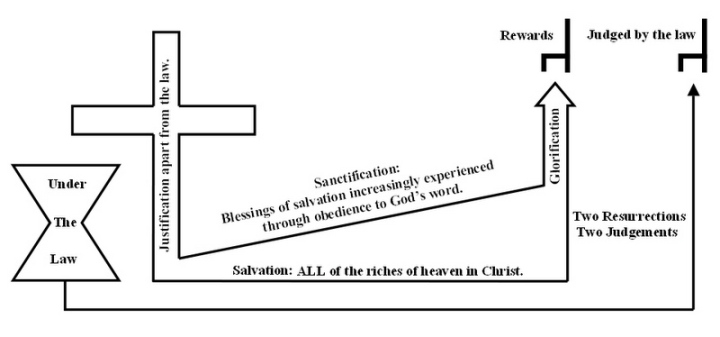
What comfort is there in thinking that our “final justification” will be confirmed at some plenary judgment at the end of the age? We should take comfort in the fact that we will not stand in that judgment at all! And again, this points to the need for interpretation according to the following interpretive question: Is it a justification verse, or a sanctification verse? In the linear construct, it must always be a justification verse; either a sitting still dog or a walking dog that is apparently a duck because he is now walking. But in the parallel construct, I can point to numerous biblical dichotomies that are defined by parallelism. Let’s look at a couple.
In 1John, John tells us there is no fear in love and fear has to do with “judgment.” But then Paul tells us to work out our own salvation with trembling and fear. This is not the same salvation being spoken of. John is writing of the difference between the law of sin and death that will judge us, and the law of love which is the difference between being under law and under grace. Paul is writing of having a sober stance towards our sanctification. The Christian life isn’t a birthday party; it’s a many-faceted intellectual warfare. “Salvation” in the Bible doesn’t always speak of salvation from eternal judgment, there is yet a salvation for God’s people—the salvation from carrying about in our bodies all of the things that Christ died for. Let’s close by looking at an example of how the linear perspective gets us into difficulty. In the Reformed scholarly work “The Race Set Before Us,” the authors cite Matthew 24:13 as proof that salvation is future and that Christians must persevere till the end of their life:
But the one who endures to the end will be saved.
Again, the assumption is that “saved” always means eternal salvation. But let’s qualify that with Matthew 10:
21 Brother will deliver brother over to death, and the father his child, and children will rise against parents and have them put to death, 22 and you will be hated by all for my name’s sake. But the one who endures to the end will be saved. 23 When they persecute you in one town, flee to the next, for truly, I say to you, you will not have gone through all the towns of Israel before the Son of Man comes.
What is Christ saying? He is saying that when you see certain things happen during the tribulation period, you will be able to save yourself from physical death by fleeing from town to town because the Lord’s return is near. He is talking about saving yourself from physical death, not eternal salvation.
“Saved” has more than one meaning. In verse 11, Paul is talking about salvation from this present warfare against evil within and evil without. In the same way Christ stated that those who see certain things in the tribulation period draw near to their “redemption.” That word refers to a ransom that has already been paid on the cross.
You were purchased and the sale if final. Christ did not purchase you on a Reformed installment plan. We wait for redemption when Christ comes to claim what He purchased.

Romans 13:8-10; The Law in Sanctification and Justification

This series began on September 29th 2012, and we are on lesson # 50. The series has been heavily predicated on interpreting the Bible with the Bible, drawing conclusions from the literal grammatical sense, and prayer. This approach has paid off abundantly. More than anything, I hope it inspires Christians to know that they can study and understand the Scriptures for themselves. In fact, that is their calling.
Romans 13:8 should get waaaaay more press than it does. It should truly be one of the John 3:16s of the Bible. This is the love side of the law. Justification takes care of the judgment side of the law, sanctification takes care of the love side of the law. Woe unto us because many Christians in our day do not understand the difference between justification and sanctification. Those are supposedly words that are “50-cent theology terms.” God help us. Not only are those specific Bible words, but the two together define LOVE! Oh my! Where are we as Christians if we don’t understand love? But yet, it is impossible to understand love if you don’t understand the difference between justification and sanctification. Does there seem to be a problem with the church today? By the grace of God it is not much worse!
Let’s begin by reading verses 8:
Owe no one anything, except to love each other, for the one who loves another has fulfilled the law.
In this life, there is one debt that will never be paid between believers: love. The ability to love each other was not free, God sacrificed His only Son to make love between us possible. Also note: Christ died in this realm, and it was no less grievous to the Father accordingly. Christ was not sacrificed in heaven, He was sacrificed on earth. Hence, this realm has spiritual value. Hence, this realm matters. God will dwell with us on earth. This life has value. It will be redeemed by God. Watch out for any man who deems this life as worthless—mark him and be wary of him.
Pivotal to understanding verse 8 is the antonymic James 2:10. Let’s read it now:
For whoever keeps the whole law but fails in one point has become accountable for all of it.
Stop right there. This is where we plunge the depths of salvation. It encompasses a full understanding of law; i.e., accountability, justification, and sanctification. First, what is “law”? Certainly it includes the Ten Commandments, but when we speak of the law, we are really using a term that describes the full counsel of God encompassed in the Scriptures. We do not live by bread alone, but by EVERY word that comes from the mouth of God (Matthew 4:4). That is not only the Ten Commandments or the law of Moses, that is the whole Bible. Another point here is Matthew 5:17,18;
17 Do not think that I have come to abolish the Law or the Prophets; I have not come to abolish them but to fulfill them. 18 For truly, I say to you, until heaven and earth pass away, not an iota, not a dot, will pass from the Law until all is accomplished.
Here Christ unites the prophets and the law under “law.” In Luke 24:27, He unites the writings of Moses and the prophets with “all the Scriptures.” Also note that Christ didn’t come to fulfill the law during His earthly ministry as some teach, for nothing of the law will be lost “until all is accomplished.” Obviously, there is prophecy yet to be fulfilled and heaven and earth hasn’t passed away yet. We will yet discuss what Christ meant by “fulfilling” the law.
Back to James 2:10. If one breaks one element of the law of God, he is guilty of breaking all of it, and he is “accountable” to the whole law. In other words, he is under it. He is convicted as a “transgressor,” or a “lawbreaker.” James’ primary point is those who take a lax view of the law show themselves as still under the law. Christ agreed:
Matthew 5:19 – Therefore whoever relaxes one of the least of these commandments and teaches others to do the same will be called least in the kingdom of heaven, but whoever does them and teaches them will be called great in the kingdom of heaven. 20 For I tell you, unless your righteousness exceeds that of the scribes and Pharisees, you will never enter the kingdom of heaven.
Christ came to die on the cross to release us from “accountability” to the law. But, He also came to die on the cross to fulfill the law through us. His death declared us righteous apart from the law and released us from the accountability to it in order to be justified. That’s justification. Believing in Christ’s death on the cross justifies us apart from the law. Christ is the end of the law for justification…
Roman 10:4 – For Christ is the end of the law for righteousness to everyone who believes.
This verse could be well worded in this way: “For Christ is the end of the law for justification to everyone who believes. Be sure of this: interpreting all of Scripture in regard to …for justification and …for sanctification is a key method for understanding the Bible. Be also sure of this: many Christians in our day do not understand their Bibles because they don’t understand the difference between justification and sanctification. The institutional church has deliberately excluded this teaching so that congregants have to depend on men to understand their Bibles. You can quote me on that—it is a deliberate control ploy. Please quote me accordingly. I stand by the statement 200%.
This is justification. It was accomplished by the imputation of all of our law-breaking to Christ. He who knew no sin became sin for us, and bore the penalty for us on the cross so that we would become the righteousness of God (2Corithians 5:21). And by the way, when we believe in Christ, it’s the righteousness of God the Father that is imputed to us, not Christ’s righteousness. Of course, Christ is no less righteous, but to say that it is the righteousness of Christ that was imputed to us, something the Bible NEVER states, is to confound Trinitarian salvation—it is Christ’s death and the imputation of our sins to Him, and the Imputation of the Father’s righteousness to us—this is an important distinction because that is technically how the Bible states it.
This is justification, the epic act of love towards us by God. It is a debt of sin that has been paid in full by Christ. There is no way we can repay it. We come and drink of these living waters for free. It is free to us, but it required the sacrifice of God’s Son. Christ paid the debt of sin for us. We are no longer accountable to the law. The law has been ended by Christ…FOR JUSTIFCATION. Justification is apart from the law.
But the story now continues in regard to sanctification. Something else besides our sin died with Christ when our sins were imputed to Him: us. When we believe in Christ the old us and our accountability to the law dies. But something was also resurrected with Christ when He arose from the dead on the third day: us. The new us finds life and love in the law. Accountability to the law before salvation could only bring death, but now the law is our standard for love. We love God through obedience to the law as an outflow of our new nature, and we are indebted to each other in love. In the same way that breaking the law at one point violated all of the law, one act of love fulfills the whole law. That’s verse 8. I don’t understand it, but it is no less true: every time you love someone—you fulfil the whole law. By DISOBEYING the law at one point before salvation, you were guilty of breaking all of it. Justification saved us from that. By one act of obedience to the law in sanctification, you fulfill the whole law.
Fulfilling the law by loving God and others, that’s sanctification. Our attitude towards Scripture indicates whether we are under law or under grace. We are learners in regard to discovering new ways in the Bible to love God and others—that’s discipleship. Obedience to the law reflected on justification will hinder love—it is not the perfect law of liberty that James wrote of. The law is different in sanctification. We love the law because it teaches us to love God and others. It puts deeds of darkness to death and fulfills the law through us, hence:
Romans 8:1 – There is therefore now no condemnation for those who are in Christ Jesus. 2 For the law of the Spirit of life has set you free in Christ Jesus from the law of sin and death. 3 For God has done what the law, weakened by the flesh, could not do. By sending his own Son in the likeness of sinful flesh and for sin, he condemned sin in the flesh, 4 in order that the righteous requirement of the law might be fulfilled in us, who walk not according to the flesh but according to the Spirit. 5 For those who live according to the flesh set their minds on the things of the flesh, but those who live according to the Spirit set their minds on the things of the Spirit. 6 For to set the mind on the flesh is death, but to set the mind on the Spirit is life and peace. 7 For the mind that is set on the flesh is hostile to God, for it does not submit to God’s law; indeed, it cannot. 8 Those who are in the flesh cannot please God.
Before salvation, the law is the “law of sin and death” that condemns. After salvation, it is the “law of the Spirit of life” and the “perfect law of liberty.” It is a law that gives life—it is the Spirit’s law. It is a law that informs our love and can no longer condemn us. It is a law that judges our love in sanctification, but not for justification.
It reverses our life direction because it reverses our slavery. Before salvation, we were enslaved to sin while able to do good or enslaved to sin and free in regard to righteousness (Rom 6:20). With those under law, perfect righteousness is a demand; with those under grace, perfect righteousness is the goal because love is the goal. No person sins perfectly before salvation, and no person loves perfectly after salvation; change of overall direction and attitudes towards the law is the issue. A lax attitude towards the law is not indicative of the new birth. We now love the law that we are no longer accountable to for justification.
So, in justification: we are no longer accountable to the law; we have the righteousness of God imputed to us; our sins are imputed to Christ, and He paid the penalty for them, and we died with Him; we are quickened—made alive by the Holy Spirit, and regenerated with the same power that raised Christ from the dead (Eph 1:19, 20, Jn 3: 4-8). We are declared righteous by the Father, our sins are imputed to Christ, and we are born again by the Spirit. This is not only a positional righteousness, we are in fact righteous. Being yet in a mortal body harassed by sinful desires does not negate the fact that we are born of God:
1John 3:7 – Little children, let no one deceive you. Whoever practices righteousness is righteous, as he is righteous. 8 Whoever makes a practice of sinning is of the devil, for the devil has been sinning from the beginning. The reason the Son of God appeared was to destroy the works of the devil. 9 No one born of God makes a practice of sinning, for God’s seed abides in him, and he cannot keep on sinning because he has been born of God. 10 By this it is evident who are the children of God, and who are the children of the devil: whoever does not practice righteousness is not of God, nor is the one who does not love his brother.
“Seed” in verse 9 is the following word:
g4690. σπέρμα sperma; from 4687; something sown, i. e. seed (including the male “sperm”); by implication, offspring; specially, a remnant (figuratively, as if kept over for planting):— issue, seed.
We are God’s offspring in the truest sense though in mortal bodies. This life in us cannot help but to bring about the different direction. The “flesh” no longer enslaves us because the former self died with Christ. In regard to justification, we no longer live, and therefore are not under the law:
Romans 7:1 – Or do you not know, brothers—for I am speaking to those who know the law—that the law is binding on a person only as long as he lives? 2 For a married woman is bound by law to her husband while he lives, but if her husband dies she is released from the law of marriage. 3 Accordingly, she will be called an adulteress if she lives with another man while her husband is alive. But if her husband dies, she is free from that law, and if she marries another man she is not an adulteress.
4 Likewise, my brothers, you also have died to the law through the body of Christ, so that you may belong to another, to him who has been raised from the dead, in order that we may bear fruit for God. 5 For while we were living in the flesh, our sinful passions, aroused by the law, were at work in our members to bear fruit for death. 6 But now we are released from the law, having died to that which held us captive, so that we serve in the new way of the Spirit and not in the old way of the written code.
As we learned earlier in the book of Romans, being under the law provokes us to sin against the law. The flesh, which was alive, provoked us to sin against the law leading up to the day when we would be judged by the law. This is what Paul is talking about in one of the most abused portions of Scripture in our day:
Galatians 2:20 – I have been crucified with Christ. It is no longer I who live, but Christ who lives in me. And the life I now live in the flesh I live by faith in the Son of God, who loved me and gave himself for me.
“See, see, we live by faith alone in the Christian life. We are still spiritually dead in our Christian life, and it is only Christ who lives in us.” That notion needs to be answered with Romans 7:1-6. Dying with Christ made us dead to the law, but alive to the law of the Spirit which is the same law that formally brought forth fruits of death. Let’s look at Galatians 2:20 in the larger context:
15 We ourselves are Jews by birth and not Gentile sinners; 16 yet we know that a person is not justified by works of the law but through faith in Jesus Christ, so we also have believed in Christ Jesus, in order to be justified by faith in Christ and not by works of the law, because by works of the law no one will be justified.
17 But if, in our endeavor to be justified in Christ, we too were found to be sinners, is Christ then a servant of sin? Certainly not! 18 For if I rebuild what I tore down, I prove myself to be a transgressor. 19 For through the law I died to the law, so that I might live to God. 20 I have been crucified with Christ. It is no longer I who live, but Christ who lives in me. And the life I now live in the flesh I live by faith in the Son of God, who loved me and gave himself for me. 21 I do not nullify the grace of God, for if righteousness [earlier ESV “justification”] were through the law, then Christ died for no purpose.
What do you notice in context regarding the underlined words? The context is clearly justification. Galatians 2:20 is just another way of stating Romans 7:1-6. Paul is saying that it is impossible to be justified by the law because when we died with Christ, we died to the law which made us alive to God and the law of the Spirit. The law was letters of death while we were under it. Hence, Paul concludes his thought in Gal 2:21 by saying that if we are still under the law, Christ died for nothing. We were made dead to the law and alive to God by faith alone in Christ. That’s what that verse is stating. Again, it’s another way of stating Romans 7:1-6.
In regard to justification, it is not us who live, but Christ. That doesn’t mean we are also dead to the law in sanctification.
When someone using Gal 2:20 to teach a sanctification by faith alone, you need to correct them with Rom 7:1-6. You should also inform them that they do not know the difference between justification and sanctification. We are justified by faith alone, but sanctification (discipleship) is not by faith alone. James wrote to the 12 tribes of Israel to refute that very idea.
Now, in sanctification, we love God by obeying the law, and the Holy Spirit is our Helper in doing so. This is sanctification, not justification:
John 14:12 – “Truly, truly, I say to you, whoever believes in me will also do the works that I do; and greater works than these will he do, because I am going to the Father. 13 Whatever you ask in my name, this I will do, that the Father may be glorified in the Son. 14 If you ask me anything in my name, I will do it. 15 “If you love me, you will keep my commandments. 16 And I will ask the Father, and he will give you another Helper, to be with you forever, 17 even the Spirit of truth, whom the world cannot receive, because it neither sees him nor knows him. You know him, for he dwells with you and will be in you.
Notice that Christ did not come to fulfill the law on His own. Notice that the exact works of Christ are not imputed to us for justification; in fact, He states that we will do greater works than He did! And know what the Spirit of truth uses to sanctify us:
John 17:16 – They are not of the world, just as I am not of the world. 17 Sanctify them in the truth; your word is truth. 18 As you sent me into the world, so I have sent them into the world. 19 And for their sake I consecrate myself, that they also may be sanctified in truth.
Learning and obeying truth is the only way to love God and His people. What we have today is a lot of discussion about loving each other without the knowledge to do so. Love among the doctrinally illiterate is an oxymoron. Replacing the hard work of discipleship in the church with love bombing is an epidemic. Undoubtedly, the main point of this message focuses on the paramount importance of the law in sanctification for effectively loving each other. Devaluing the law in sanctification is the very essence of antinomianism, and Christ said that the hearts of many will wax cold in the last days “because of anomia.” And we are in those days.

For the Sake of the True Gospel STOP Saying that Christ’s Righteousness is Imputed to Us
 Please stop picking up on every little jingle that sounds good and mindlessly repeating it. In Christian circles, every hour on the hour, whether on TV, radio, or a blog, we see or hear, “the imputed righteousness of Christ,” or “we have the righteousness of Christ” etc. Is this technically true? And why does it matter? The fact is, the Bible never states that the righteousness of Christ has been imputed to us, but rather states in many, many, many places that the righteousness of God the Father has been imputed to us. Is that distinction, or if you will, technicality, relevant? Yes it is; very much so.
Why the constant emphasis on the righteousness of Christ being imputed to us when the Bible emphasizes the righteousness of the Father instead? Well, this is a tradition originally promoted during the Reformation out of necessity. It is the righteousness of Christ that must be imputed to us because the Reformers taught that Christ had to keep the law perfectly during His life in order to secure our justification. Hence, righteousness had to be secured by someone fulfilling the law. So, since the righteousness had to be earned or established by Christ, it can only come from Him. If this approach creeps you out—it should.
Reformed types call this the active obedience of Christ. His death on the cross is the passive obedience of Christ. This makes Christ the primary procurer of our salvation and devalues the role of God and the Holy Spirit. God calls and declares us righteous (imputation), Christ died for our sins (the imputation of our sins to Christ), and the Holy Spirit regenerates (the new birth). Salvation is Trinitarian. If God doesn’t call and impute righteousness, no salvation. If Christ doesn’t die for our sins, no salvation. If the Holy Spirit doesn’t regenerate, no salvation.
A Trinitarian view of salvation keeps law in its proper place, a Christocentric view of salvation causes all sorts of problems with the law. It posits the idea that the law had to be fulfilled as a standard for justification—that’s a huuuuge problem.
We are justified APART from the law. This makes it possible for us to aggressively obey the law in sanctification without it affecting our justification.
Adding to the creepiness is the idea that since the law is a standard for our justification, and we can’t keep it perfectly, the perfect obedience of Christ is continually applied if we live by the same gospel that saved us. This also necessitates the death of Christ being perpetually applied to our lives as well (the Calvin Institutes 3.14.11).
When Christians speak of the imputed righteousness of Christ, they are unwittingly partaking in a distortion of the Trinity. Because the Reformers were Platonists, they believed that Christ was the true, good, and beautiful, and everything else, and everyone else, are shadows. And I do mean everyone else, including the Father and the Holy Spirit. Consider these quotes by Reformed teachers:
Christ alone means literally Christ alone, and not the believer. And for that matter, it does not even mean any other member of the Trinity!
~ Geoffrey Paxton
The pastor who makes anything or anyone other than Christ the focus of his message is actually hindering the sanctification of the flock…We don’t ‘see’ Christ literally and physically, of course (I Peter 1:8). But His glory is on full display in the Word of God, and it is every minister’s duty to make that glory known above all other subjects.
~John MacArthur Jr.
And in regard to the Holy Spirit:
But to whom are we introducing people to, Christ or to ourselves? Is the “Good News” no longer Christ’s doing and dying, but our own “Spirit-filled” life?
~Michael Horton

 Paul's Passing Thoughts
1 comment