Clearcreek’s Russ Kennedy and Southwood’s Jean Larroux III: The Divine Right of Philosopher Kings
 Though in the title, Jean Larroux, pastor of the gutted Southwood Presbyterian Church (the subject of several articles here at PPT), has little to do with the crux of the issue to be discussed here. This post is in response to some requests by Southwood members to divulge information I have concerning alleged indiscretions unbecoming of a pastor. I obtained the information through an email by a person who identified _____-self. The information has been vetted and is credible for several reasons. I have not re-contacted the sender of the email, but could probably obtain even more confirmation points if deemed necessary. Where I am going with this will require the laying of some groundwork. Clearcreek Chapel in Springboro, Ohio will supply some additional and helpful examples.
“Cult” is a word that is thrown around quite a bit in Christian circles, but in reality, for good reason. The essence of a cult is CONTROL. Cultwatch.com posits this definition of a cult:
The modern definition of a mind control cult is any group which employs mind control and deceptive recruiting techniques. In other words cults trick people into joining and coerce them into staying.
Cultism dates back to the cradle of civilization and is part and parcel with a basic concept that forms the philosophical infrastructure of all false religious groups. It begins with the presupposition that the masses are spiritually incompetent, and that preordained individuals are selected by God, the universe, or some other higher power to rule the masses on the behalf of that entity. Determinism is almost always a mainstay in said presupposition.
In the Platonist construct (which replaced mythology in these systems with a more scientific approach), the philosopher kings rule, the soldiers enforce the will of the kings (father [entity] knows best), and the masses are the producers who’s sum and substance of life is for the predetermined good of society as a whole. And the philosopher kings know best how to bring that about. And therefore, they should RULE the masses.
If at all possible, philosopher kings will use the sword and fear to keep the process running smoothly, but mind control, brainwashing, and indoctrination will always be present as the staple modus operandi. Such reduces the need for the sword, but the sword has the final say if necessary. The authority of the philosopher kings to send you to hell for eternity is also a strong incentive to live for the group or the whole, which is the “vision of the good.” So, job one is CONTROL.
This is the staple doctrine of EVERY religion that operates apart from truth, capital T. So, wherever truth is not practiced in religion, there is going to be a strong cultish feel in the mix. From a pure biblical perspective, the word is SECT, or SECTARIAN. These are groups who divide with UNTRUTH. So, a strong, very strong element of the cultish motif is lots of division. While cults maintain an operative core, it is at the expense of relationships and other human infrastructures. AND, the primary focus of the philosopher kings—where most of their energies will always be expended, is in maintaining CONTROL—leading to the cultish aura. Hence, “Hey Paul, we are going to this you fill in the blankchurch and I know this sounds crazy, but I think it’s a cult.” I don’t doubt it a bit. ANY system based on the spiritually enlightened ruling over the incompetent masses WILL have the cultish aura.
With all of that said, what about the moral fitness of the philosopher kings? Well, that depends on the particular gargantuan-faceted variances of this ancient principle, but for the most part, the moral fitness of the philosopher king is irrelevant. And throughout history, those who think otherwise and are vocal about it have become a rare breed. Ever heard of a guy named John the Baptist? Especially in Reformed circles where we are all totally depraved “sinners saved by grace,” and all being captive passengers on the Love Slime Boat, integrity doesn’t have relevance in regard to the spiritual caste system needed to lead the totally depraved safely to heaven. Those who don’t get it are mercilessly slaughtered for the sake of the group and the wellbeing of the whole. In America where John the Baptist types can’t be burned at the stake, hanged, or beheaded; slander, bogus church discipline, character assignation, and false criminal charges attempt to fill the gap in silencing detractors. Furthermore, antinomianism may be the very doctrine of the philosopher king to begin with. This reality is known as the divine right of kings:
The divine right of kings, or divine-right theory of kingship, is a political and religious doctrine of royal and political legitimacy. It asserts that a monarch is subject to no earthly authority, deriving the right to rule directly from the will of God. The king is thus not subject to the will of his people, the aristocracy, or any other estate of the realm, including (in the view of some, especially in Protestant countries) the Church. According to this doctrine, only God can judge an unjust king. The doctrine implies that any attempt to depose the king or to restrict his powers runs contrary to the will of God and may constitute a sacrilegious act (http://en.wikipedia.org/wiki/Divine_right_of_kings).
Therefore, the formula: higher power >+ enlightened proxy rulers >+ totally depraved = spiritual caste system = control = cultism = sectarianism = tyranny.
Let’s talk about the operative core that philosopher kings/pastors/elders are able to keep intact. Many people are inclined towards cult atmospheres. Some people are just there for the social community of it all. They like the people, the parties, the events etc. Many people there may be of the same cultural mindset as well. TRUTH is low priority—they hold to the doctrine of the leaders for the sake of community. A second group to consider are those who are simply adverse to change. Normality and business as usual is very important to them. Things would have to get pretty crazy before change would be considered. There is also a group that will follow whatever is placed in front of them. They simply have no discernment. Some know things aren’t right, but have been brainwashed into thinking that there isn’t anything better out there. Besides, to leave would also be admitting to complicity in unjust things that took place; things that are spawned by sectarianism. Finally, there are those who have totally bought into the doctrine. Dissenters who care enough about the truth to raise concerns are disposed with in one of several aforementioned methods.
But the bottom line is the following: churches that function by a caste system are in continual damage control mode. Everything else is window dressing. Real ministry is not taking place. The elders spend all of their time indoctrinating. Again, CONTROL is job one. Sermons are not focused on Scriptural life-wisdom—the focus is indoctrination for control purposes. There is going to be a constant tension, and one reason for this follows:
The written word of God poses a huge problem for the religious caste systems that have plagued the world from the beginning of time—the spiritual elite ruling the masses on God’s behalf via supposed direct revelation and authority. As church historian John Immel notes: The problem is that God is not standing there beside them and confirming His agreement. Or is He? The superintended life manual of God, and its availability to the masses poses a huge problem for those who wish to rule over men: God is telling us what He is telling them, and the tendency is to think God knows more than they do.
And it is clear that God’s word speaks to the individual. The books of the Old Testament and the letters of the New address the whole congregation of the saints. Yes, there are leaders among God’s people, but they are obviously very accountable. There are no closed board meetings between God and church leaders. Luke wrote two letters, really a book in two parts, for the benefit of one person. Why? “….that you may have certainty concerning the things you have been taught” (Paul Dohse: False Reformation; p. 97, TANC Publishers 2012).
This is where Clearcreek Chapel, the church that incited my journey into these matters, supplies a helpful example. The leadership of that church is in constant damage control mode. Their sermon and teaching modules are continually focused on indoctrination and authority. Even when I was last there (circa 2006), there was a climate of fear. Often, their choice of sermon topics are driven by the latest challenges to their doctrine. Apparently, the last episode was in September of this year, prompting a sermon series entitled, “Biblical Authority at The Chapel”:
And, I want to dispel one false, wicked slander about us and churches like us. We do not believe or teach or require absolute, unquestioning submission to the leadership of this church. Whatever you have been told; whatever bad experience you have had elsewhere, I plead with you to listen this morning to God’s word. So in what I am going to say this morning, I am trying to hover close to the Bible and build a Biblical understanding of authority in God’s Kingdom. Tonight, Pastor Dale will help us think about how we take these precepts, principles and patterns and institute Biblical governance and guidance in the church. [and at the pm service: “A recent criticism has been leveled that we at Clearcreek Chapel engage in some sort of Christian mysticism.”].
No? They insist on “absolute, unquestioning submission” to “biblical authority.” BUT, they are the only ones that can properly interpret it! What’s the difference? As noted in the new publication of False Reformation (pp.110,111), another elder at Clearcreek plainly stated that personal study was only a supplement to efficacious elder preaching, and that the word came from God to the elders, then to the parishioner—back to the word, and then back to God with faith being the result. Clearly, the elders and the word are between the believers and God:
You think, perhaps, that [you] can fill up the other half of the plate with personal study, devotions, or quiet times, or a radio program. Beloved, you cannot. Scripture is relatively quiet on such practices. But on preaching, the case is clear and strong. Neglect preaching and neglect your soul. I know that some are kept from services for legitimate reasons which are out of their control, but I doubt that is the case for most. I beseech you, change your ways for the good of this people and for the good of your own selves. Give the Word its rightful place. As I have often said, there is no better place you could be than here, under the preaching of the Word.
The text here implies that there was an interactive nature between three entities: The preacher, the hearers, and the Word. Note this cycle: Paul, from the Word, delivers words. The Bereans, from Paul’s words, go to the Word. The Word cycles from God, through the preacher, to the people, back to the Word, and this, verse 12 tells us, produced belief in the God of the Word. An important thing to note is that this happened daily – suggesting a regular interaction between preaching, personal study, and the Word.
The Bereans eagerly prepared by paralleling their own Bible reading and study with Paul’s preaching. So a good preparation for the public preaching of the Word is the private consumption of the Word. It will be the seasoning that brings out the flavor – salt on your French fries, if you will.
In the first part of the series, Kennedy makes it clear where the authority to interpret resides:
The New Testament often uses the word translated overseer or bishop. This word was primarily was used in the culture to refer to a governor who was sent by a conquering king to govern a city/state on behalf of the king. The overseer, the governor was to exercise oversight under the law the king had given. He was serving, not on his own behalf, but in the place of and for the good of the king. This is the term used for Elders. We are to govern the church on behalf of our King Jesus using the Scriptures as that which expresses His will and frames His wisdom. We are to govern and guide according to the Word of God.
But by the same token, these elders, and many others like them believe that all Scripture must interpreted in a way to yield a Christocentric (grace) meaning. Again, as noted in False Reformation (p. 100):
At this time, resist the temptation to utilize subsequent passages to validate the meaning or to move out from the immediate context. Remembering that all exegesis must finally be a Christocentric exegesis.
Look for Christ even if He isn’t there directly. It is better to see Christ in a text even if He isn’t, than to miss Him where He is.
Kennedy illustrates this in the same message via the following illustration.

Taken together, it is clearly a mystical approach that sees every verse in the Bible as redemptive, and a task that elders are only qualified to execute. This is spiritual cast that dates back to the beginning of time and always leads to tyranny. The point here is to clarify the divine rights of philosopher kings.
Now let’s address the ill behavior of Jean Larroux, and why it’s not relevant. First, the behavior. Jean Larroux’s outrageous behavior in the name of Christ is well documented. Larroux is the subject of chapter 8 in Cathleen Falsani’s “Sin Boldly.” Right, that’s the title of the book. It’s a treatise on, let’s sin more so grace may abound. According to Falsani, Larroux told her (in a conversation endowed with cursing and cigarette smoking) that the depths of grace can only be understood via the depths of our sinfulness. This is no less than the doctrine of the knowledge of good and evil that adorns the vast majority of tyrannical spiritual caste systems—especially Calvinism. This is the same Christocentric interpretation that the Clearcreek elders constantly refer to. All Scripture must be interpreted via God’s holiness as set against our wickedness. Obviously, if wisdom is the goal, and obedience puts us in a good light as opposed to endeavoring to understand our evil more and more; well, you do the math.
But there is something interesting about the writings of those, like Larroux, that think it better yet to actually practice evil as well to better understand grace; the disturbance of the conscience is clearly seen. However, it is usually seen as a vice to be overcome and related to an inept understanding of grace. On a blog belonging to a pastorate that preceded Southwood, Larroux writes the following:
I am becoming keenly aware of how little I actually believe the Gospel that I have been called to preach. I find it ‘easy’ to preach the truth, yet believing it is harder and harder.
Nevertheless, Larroux is a member of a prestigious club of Presbyterian philosopher kings—he is untouchable, and his sin is irrelevant to the Presbytery, and frankly, to most of the Presbyterian producers. I seriously doubt that many are unaware of the things revealed in the email I received, though heinous.
I receive many emails from hurting people who see this in the church and don’t know what to make of it. When you love the truth, it’s hard to get your mind around it. The email revelation will only build hope that someone will care with the enviable disappointment to follow, and deeper wounding.
Come out from among them. Where will you go? Go anywhere but back there. But wherever you end-up, Christ our brother will be with you, and our Helper will counsel you with powerful words from the Scriptures as you go.
All you lovers of the truth—Christ loves you, and for what it’s worth, I love you.
Forever His, and forever a yokefellow to the lovers of truth.
paul
Are Calvinists Saved?
 The begging of the question has a sound Scriptural argument.
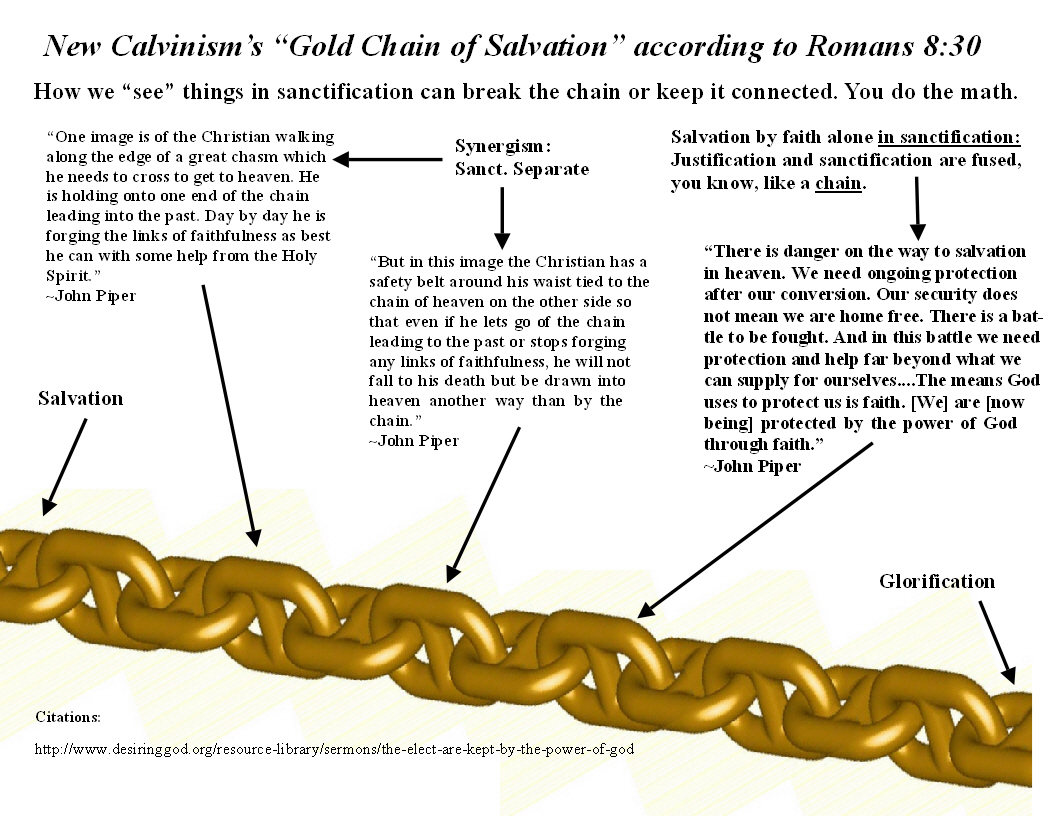
This ministry has made much of the critical importance of separating justification (salvation) and sanctification (growth in holiness, or kingdom living). The Reformed (Calvin/Luther Reformation doctrine/gospel) “never separate, but distinct” doublespeak doesn’t cut it in the arena of truth, and we will see why. “Never separate” =’s false gospel. If you get a little lost in the first part of my argument which gives the lay of the land, don’t worry, when I get into the specific Scriptural argument, it will clear things up and make it all come together for you.
It must delight the ghosts of the Reformation that the argument has always been in the arena of freewill verses predestination. It’s the primary thrust of this ministry to change that argument. This isn’t a quibbling about semantics in the mainstream—this is about the truth of the gospel. As New Calvinist Russ Kennedy once thundered from the pulpit in his mousy voice: “Any separation of justification and sanctification is an abomination!”
I have often argued from the standpoint of this issue. If sanctification is the middle of the Reformed “golden chain of salvation” then sanctification is part of finishing justification. This means that what happens in sanctification determines whether or not justification is properly finished. What’s a chain? John Piper even preached a message about the eternal importance of our contribution to the “links” in just the right way. In essence, sanctification becomes a spiritual minefield.
This is exactly the same thing that the Reformed crowd has always accused Rome of: the fusing together of justification and sanctification. However, as we shall see, they are both guilty of the exact same heresy/false gospel. As we shall see, both teach that sanctification finishes justification.
This is a linear gospel (one unified chain from salvation to resurrection (glorification) versus a parallel gospel with salvation on one plane as a finished work before the foundation of the world, and kingdom living that runs parallel with the finished work and reflects the reality of our salvation until glorification. Typical in the linear gospel is the idea that Christ died for all of our past sins, but we must now finish the work (with the Holy Spirit’s help [sanctified works salvation]) until glorification when we are completely transformed into complete holiness. This is the often-heard bemoaning of “Christ PLUS something.”
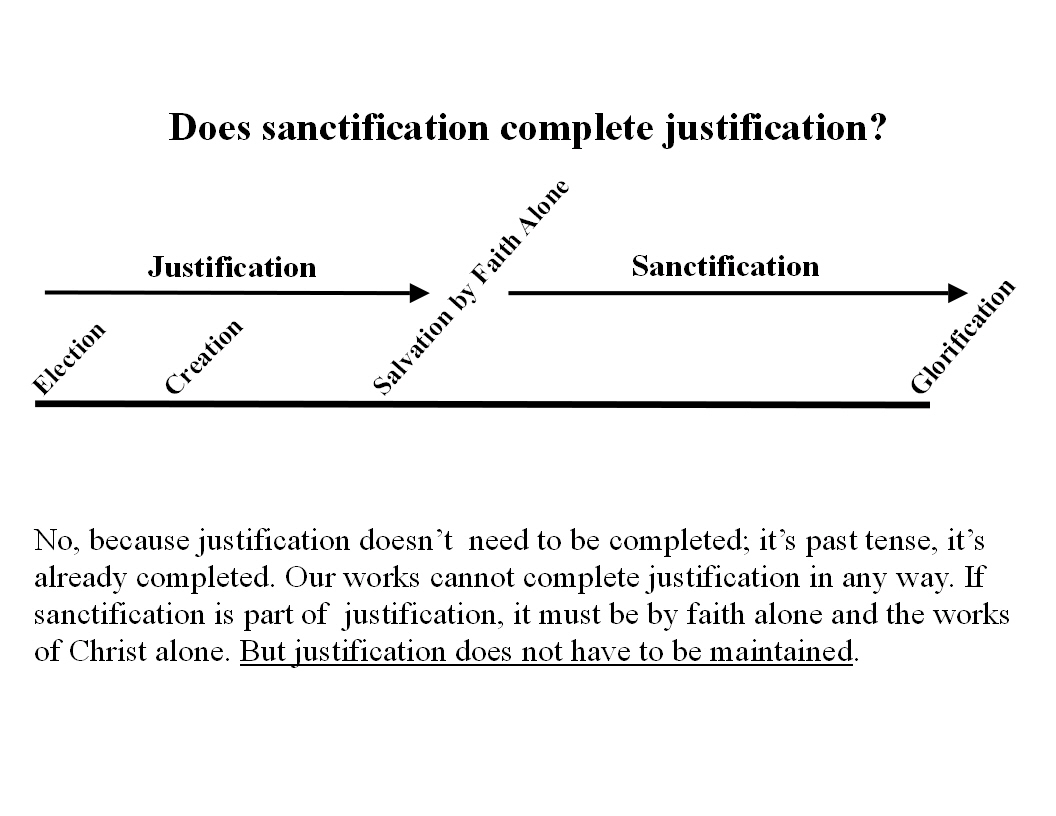
An excellent example is some strains of Freewill Baptists who teach that Christ died for all of our past sins, but with the help of the Holy Spirit, we must confess and repent of every sin we commit until the resurrection; e.g., Christ plus salvation by repentant prayer for sins committed after we are “saved.” My grandparents were saved out of this tradition. When my grandfather asked my grandmother if she thought that God could ever forgive him of all the sins he committed, she answered: “Yes, but you are going to have to pray awful hard!” Praise God that through the ministry of several individuals my grandparents eventually abandoned that gospel for the true one of salvation by faith alone as a finished work.
Likewise, Rome teaches that you must let the Catholic Church finish your justification through ritual; e.g., Christ plus Catholic ritual. The Reformation gospel is also Christ plus something else, but the something else is ever-so-subtle. In both cases, sin must be dealt with in sanctification in order for the saint to remain justified until the final judgment. In other words, the righteous standard of justification must be maintained on our behalf. Like all other proponents of a linear gospel, the Reformed crowd contends that anything less than the perfection demanded of the law (“all sin is transgression of the law”) is “legal fiction.” So both Rome and the Reformers agree: justification must be maintained by sanctification, and in the case of the Reformers specifically, they believe that the perfect standard of the law must be maintained until glorification; otherwise, our justification is “legal fiction.”
Here is where Reformed subtlety is uncanny: Christ keeps the law for us in sanctification. He maintains the perfect standard. All the fruit of sanctification (obedience/good works) flows from the life He lived on Earth and His death on the cross. Christ plus the works of Christ to finish salvation. “But Paul, what in the world is wrong with that!” Here is what is wrong with it: works are still required to maintain justification. That is a huge problem, even if it is Christ doing the work. What did the Hebrew writer say about Christ’s work for justification not being complete?
And even more subtle is the following Reformed idea: believing that the law is no longer a standard for maintaining justification is antinomianism. Antinomianism =’s legal fiction. Their definition of antinomianism is the removal of the law from justification as the standard for maintaining it. Traditionally, among Biblicist, antinomianism is the removal of the law from sanctification, and herein lays even further steroidal subtlety: the Reformed theologians would refute a removal of the law from sanctification as well, not only because they think justification and sanctification are the same thing, but because its perfect keeping is required to maintain a true declaration of the just that is not “legal fiction.”

However, the Biblicist believes that the law is a standard for kingdom living and is no longer a standard for justification. Therefore, if we attempt to obey it with the Holy Spirit’s help, and to please/serve the Lord, it can have no bearing on our just state. While the Biblicists think they are therefore joint contenders with the Reformers against antinomianism, such is far from the truth. The Reformed mind believes the Biblicist is either a legalist or an antinomian, or both. The Biblicist is supposedly an antinomian because he/she has removed the law from justification as a just standard, or is a legalist because they think they should strive to keep the law in sanctification. Since sanctification finishes justification’s perfect standard of law keeping, our “own” attempts to keep the law in sanctification is an attempt to finish justification. Hence, what the Biblicist fails to understand is the Reformers belief that Christ must maintain the law for us in sanctification because justification and sanctification are not separate. Anything more or less is supposedly works salvation.
On the other hand, because it is vital that Christ obeys the law for us in sanctification, the likes of John Piper and Tullian Tchividjian contend that those who are really preaching the Reformed gospel will indeed be accused of antinomianism. All in all, their position is easy to see if you pay attention. John Piper and many other Calvinists often state that, “Good works are the fruit of justification.” And, “Justification is the root, and sanctification is the fruit.”
Well, the average Biblicist then thinks, “Yes, but of course, our salvation makes good works in sanctification possible.” But that’s not what they are saying. If you pay closer attention, they are saying that justification is a tree that produces its own fruit. Justification is the root, and whatever happens in true sanctification is the fruit of the root of the justification tree. Problem is, justification doesn’t grow. Justification is a finished work. What Calvinists refer to as “progressive sanctification” is really the fruit of the root: progressive justification. Another name for this that they throw around is “definitive sanctification.” The word “definitive” refers back to the definite completion of justification.

Revision: this ministry now rejects the idea that orthodoxy is truth; orthodoxy is the traditions of men. Never in Scripture do we find premise for a body of teaching that explains the teaching. The above illustration is valuable for demonstrating that the fruit of justification is glorification, NOT sanctification.
This brings us to the Scriptural argument which begins with a question I asked myself just this morning: “Paul, you are always harping about the crucial importance of the separation of justification and sanctification—a parallel gospel versus a linear one. But where does the Bible say specifically that this is critical?”
First, the very definition of a lost person in the Bible is one who is “under the law”:
Romans 3:19
Now we know that whatever the law says it speaks to those who are under the law, so that every mouth may be stopped, and the whole world may be held accountable to God.
Romans 6:14
For sin will have no dominion over you, since you are not under law but under grace.
Romans 6:15
What then? Are we to sin because we are not under law but under grace? By no means!
1 Corinthians 9:20
To the Jews I became as a Jew, in order to win Jews. To those under the law I became as one under the law (though not being myself under the law) that I might win those under the law.
Romans 7:1
Or do you not know, brothers —for I am speaking to those who know the law—that the law is binding on a person only as long as he lives?
Romans 7:2
For a married woman is bound by law to her husband while he lives, but if her husband dies she is released from the law of marriage.
Romans 7:3
Accordingly, she will be called an adulteress if she lives with another man while her husband is alive. But if her husband dies, she is free from that law, and if she marries another man she is not an adulteress.
The unsaved are “under the law” and will be judged by it in the end. This is the very definition of the unsaved. Calvinists define Christians the same way—we are supposedly still under the law and will be judged by it in the end. That’s why Christ must keep the law for us—because we are still under it.
If not this position, why do many in the Reformed tradition hold to the idea that Christ’s perfect obedience is imputed to our sanctification? His death justifies us, and His perfect life sanctifies us. Hence, His death pays the penalty for past sins, and then His perfect life imputed to our sanctification keeps us justified. Why would an imputation to our sanctification be necessary if we are no longer under the law? This is known as the Reformed view of “double imputation” and has been called out as heresy by many respected theologians for this very reason: it implies that Christians are still under the law.
In regard to sustaining the law in our stead, why? It has been totally abolished in regard to our just standing:
Romans 3:20
For by works of the law no human being will be justified in his sight, since through the law comes knowledge of sin.
Romans 3:21
But now the righteousness of God has been manifested apart from the law, although the Law and the Prophets bear witness to it—
Romans 4:15
For the law brings wrath, but where there is no law there is no transgression.
The keeping of the law by anybody DOES NOT do anything to justify mankind:
Romans 3:28
For we hold that one is justified by faith apart from works of the law.
Here is where the separation of justification and sanctification is vital on this first point: we ARE NOT under the law for justification, but rather UPHOLD THE LAW in sanctification. The two must be separate because of the differing relationships to the law:
Romans 3:31
Do we then overthrow the law by this faith? By no means! On the contrary, we uphold the law.
Romans 6:15
What then? Are we to sin because we are not under law but under grace? By no means!
Furthermore, if we are still under the law (whether or not Christ obeys it for us to keep us in a just standing), this means we are still under the power of sin. Being under the law and also under its spell to provoke sin in the unregenerate is spoken of as being synonymous in the Bible. Those who are “under the law” are also under the power of sin and enslaved to it:
Romans 7:4
Likewise, my brothers, you also have died to the law through the body of Christ, so that you may belong to another, to him who has been raised from the dead, in order that we may bear fruit for God.
Romans 7:5
For while we were living in the flesh, our sinful passions, aroused by the law, were at work in our members to bear fruit for death.
Romans 7:6
But now we are released from the law, having died to that which held us captive, so that we serve in the new way of the Spirit and not in the old way of the written code.
Romans 7:8
But sin, seizing an opportunity through the commandment, produced in me all kinds of covetousness. For apart from the law, sin lies dead.
If we are still under the law, and will be judged by it, whether or not Christ stands in the judgment for us with His own works, we are still enslaved to sin by virtue of being under the law…. for justification. And Calvinists know this to be true, that’s why they say we are still…. what? Right, even as Christians, “totally depraved.” And, “enemies of God.” Of course, throughout the Bible, Christians are spoken of as being friends of God and no longer His enemies. Our status as enemies of God is stated in the past tense. But the Reformed crew continually state that Christians are vile enemies of God and are enslaved to sin. They realize that this goes hand in hand with being under the law.
To the contrary, dying to the law in the death of Christ….for justification—sets us free to be enslaved to the righteousness that is defined by the law. We are dead to the law for justification and alive to obey truth….for sanctification:
Romans 8:2
For the law of the Spirit of life has set you free in Christ Jesus from the law of sin and death.
Romans 8:3,4 [emphasis by author]
For God has done what the law, weakened by the flesh, could not do. By sending his own Son in the likeness of sinful flesh and for sin, he condemned sin in the flesh,….in order that the righteous requirement of the law might be fulfilled in us, who walk not according to the flesh but according to the Spirit.
Romans 8:7
For the mind that is set on the flesh is hostile to God, for it does not submit to God’s law; indeed, it cannot.
Romans 9:31
but that Israel who pursued a law that would lead to righteousness did not succeed in reaching that law.
John 17:17
Sanctify them in the truth; your word is truth.
James 1:25
But the one who looks into the perfect law, the law of liberty, and perseveres, being no hearer who forgets but a doer who acts, he will be blessed in his doing.
So, that is the separation that must be for the true Christian: Justification has no law for which we are judged, and we live by the law of blessings in sanctification.
This brings us to another important separation in the two: the judgments. Those under the law and sin will stand in a final judgment which will be according to the law. Again, because Calvinists believe that we are still under the law, albeit that Christ obeyed/obeys it for us, Christians will supposedly stand in the same judgment as the damned who are under the law and enslaved to it. At that time, the children of God, according to Calvinists, will be “made manifest.”
But because Christians are not under the law and cannot be judged by it, they will stand in a judgment for rewards and not a judgment that determines a perfect keeping of the law by Christ in our stead. Hence, there will be two different resurrections: one for those under the law and another for those under grace, and two different judgments for the same two groups. One for rewards, and one to determine if those under the law kept it perfectly. That judgment doesn’t go well for any standing in it.
Luke 14:12-14
He said also to the man who had invited him, “When you give a dinner or a banquet, do not invite your friends or your brothers or your relatives or rich neighbors, lest they also invite you in return and you be repaid. 13 But when you give a feast, invite the poor, the crippled, the lame, the blind, 14 and you will be blessed, because they cannot repay you. For you will be repaid at the resurrection of the just.” [Notice that this is a resurrection for the “just.” They are already determined to be just before they are resurrected].
2Corinthians 5:9,10
So whether we are at home or away, we make it our aim to please him. 10 For we must all appear before the judgment seat of Christ, so that each one may receive what is due for what he has done in the body, whether good or evil.
1Corintians 3:11-15
For no one can lay a foundation other than that which is laid, which is Jesus Christ. 12 Now if anyone builds on the foundation with gold, silver, precious stones, wood, hay, straw— 13 each one’s work will become manifest, for the Day will disclose it, because it will be revealed by fire, and the fire will test what sort of work each one has done. 14 If the work that anyone has built on the foundation survives, he will receive a reward. 15 If anyone’s work is burned up, he will suffer loss, though he himself will be saved, but only as through fire.
Hebrews 6:10
For God is not unjust so as to overlook your work and the love that you have shown for his name in serving the saints, as you still do.
Revelation 20:6
Blessed and holy is the one who shares in the first resurrection! Over such the second death has no power, but they will be priests of God and of Christ, and they will reign with him for a thousand years.
Revelation 20:11-15
Then I saw a great white throne and him who was seated on it. From his presence earth and sky fled away, and no place was found for them. 12 And I saw the dead, great and small, standing before the throne, and books were opened. Then another book was opened, which is the book of life. And the dead were judged by what was written in the books, according to what they had done. 13 And the sea gave up the dead who were in it, Death and Hades gave up the dead who were in them, and they were judged, each one of them, according to what they had done. 14 Then Death and Hades were thrown into the lake of fire. This is the second death, the lake of fire. 15 And if anyone’s name was not found written in the book of life, he was thrown into the lake of fire.
Don’t let anyone tell you that eschatology is a “secondary” or “nonessential” consideration. Your eschatology is your gospel. It will state your position regarding whether or not you fuse justification and sanctification together; ie, likening Christians to those under the law.
Yet another vital difference in sanctification and justification is repentance. Repentance for salvation (when you are justified) is different from our repentance in sanctification. Among many in the Reformed tradition where the “same gospel that saved you also sanctifies you,” the repentance is the same. Repentance unto salvation is not a onetime “washing,” but rather a means to continue “in the gospel” through what they call, “deep repentance.” Biblicism holds to repentance in sanctification that restores his/her fellowship and communion with God as His children. They would see repentance unto salvation as differing, and only necessary for salvation—a onetime decision to take one’s life in a new direction by following Christ, and believing in his death, burial, and resurrection.
Reformed repentance, according to the likes of Paul David Tripp and others is a “daily rescue.” Our original repentance was for rescue, and we need rescue today as much as we needed rescue when we were saved. Again, this indicates their belief that we are still under the curse of the law and need to be continually rescued from it while remaining under the bondage of sin.
However, Christ made it clear to Peter (John 13:6-11) that those who have been washed (1Corinthians 6:11, Romans 8:30) do not need another washing. Those who drink of the living water do not thirst again (John 4:13,14).
Lastly, though many other separations could be discussed, why saints can be considered just while they still sin at times is of paramount importance. There is no sin in our justification because there is no law, and where there is no law, there is no sin. Though unfortunate, there can be sin in our sanctification because it is totally separate from justification and can’t affect our just standing with God.
Basically, all of the aforementioned makes it of necessity to deny the new birth. If we have God’s seed in us, and we do (1John 3:9), that dispels total depravity, and without total depravity, justification and sanctification cannot be fused together. The new birth is a huge problem for Reformed theology. If the old man that was under the law is dead (Romans 7:1ff), and the seed of God is in the saved person, and the sin due our weakness in the flesh cannot be laid to our account for justification, then our justification is not “legal fiction” because we do not exhibit perfect obedience to the law. This is another grave consideration because Christ said, “You must be born again.” Obviously, despite their denials that they deny the new birth—you can’t be both totally depraved and born again.
Reformation doctrine is clearly a false gospel. Its version of justification does not void the law, and denies the new birth while distorting everything in-between. Freewill verses predestination is hardly the issue, the very gospel itself is the issue.
paul
Martha Peace’s Favorite Dish: Mutton
 By their fruits we will know them. Christ did not say we would know them by their excellent teachings or their education; He said we would know them by what they do. Many of the highly touted leaders of our day are showing their true hearts, and it isn’t a heart for the sheep, it’s for their share of the mutton.
When it comes down to associations on the speaking/book/counseling/conference circuit, what pads one’s career and wallet/purse is the bottom line, not the welfare of the sheep. The idea that nationally visible teachers are in it for the welfare of the sheep is naïve, if not outright laughable.
Whether John MacArthur, Stuart Scott, Martha peace, Lou Priolo or anyone else you would like to name, they gleefully and eagerly network with serial sheep abusers and spiritual despots. Why? Because it’s not about the sheep, it’s about the mutton.
Lending credibility to spiritual tyrants and fellowshipping with them has become socially acceptable in the church. Somehow, these leaders are seen as several cuts above those who actually repented of their sins, like Jimmy Swaggart and Jim Baker. Sexual perversion is not yet completely acceptable for the spiritually enlightened (not yet), unless it’s an under the table perk as in the ABWE situation. But using church discipline as a weapon, holding people hostage at churches, and blatant character assassination is.
Martha Peace continues to network with Clearcreek Chapel in Springboro, Ohio. The leadership of that church is unreconciled with a slew of God’s people, and at least in my case, their outrageous abuse of my family is well documented. And the abuse continues behind the scenes as Martha Peace is completely indifferent to the suffering inflicted on people by this leadership. Not only that, she endorses it with her participation in their “counseling” program. Sure, she has probably bought into the whole gospel contemplation thing as a way to supposedly help people—that’s bad enough, but aiding and abetting abuse of the ones she is supposedly ministering to?
What’s that all about? It’s about the real Martha Peace. Vying for her share of the mutton, her favorite dish.
paul
Open Letter from “Friend” Challenges PPT’s Tone
I love working from other people’s framework of thought to write articles because the outline is usually the most difficult to develop. The following comment (for all practical purposes an open letter) offers an opportunity for this sanctified laziness, and some long overdue clarification. First, the comment:
Paul,
I understand your frustration with New Calvinist theology, which you believe to be fundamentally erroneous. I can also make sense of your indignation with regard to your excommunication from Clearcreek Chapel, which you believe to be unjust. These are sensitive and provocative issues that naturally lend themselves to strong emotions. What I do not understand is the vindictive nature of your blog. Keeping in mind that there is always going to be a wide range of disagreement, even among genuine believers, about matters of doctrine and practice, can you honestly say that you doubt the very salvation (that is, the basic belief in the atonement of Christ) of this particular church’s members and elders?
If not–if you cannot deny that at the very least, the membership and leadership of Clearcreek Chapel PROCLAIM to believe in the gospel of Christ–then I must urge you to be mindful of the manner in which you discuss the men and women who so profess. Even if the leadership at that church has wronged you in the way they administered discipline, it is not your place to seek vengeance through the use of this blog. I anticipate that you will cite a desire to protect fellow believers from doctrinal error as a primary reason for your writing, and it may be so. Only God knows the heart. But whether that is your intention or not, I would strongly encourage you to transform the purpose of your blog from one of accusation and refutation to one of Spirit-enabled, Christ-centered, God-glorifying, constructive writing that seeks to edify others in all that it proclaims. Such an endeavor would leave little room for the derision that seems to characterize many of your posts.
As I said, perhaps you are entirely correct in your assessment of your dealings with the elders of Clearcreek Chapel. Let us assume that you are. Even still, because it is a church of professing believers, I urge you to remember that, as I’m sure you know, Ephesians calls us to practice “humility and gentleness, with patience, bearing with one another in love, eager to maintain the unity of the Spirit in the bond of peace.” (Eph. 4)
Even among our enemies, this exhortation applies. I pray that the Spirit may persuade you to set aside grievances and instead to “bless those who persecute you; bless and do not curse them”, “live in harmony with one another”, “never avenge yourself, but leave it to the wrath of God”, and, “if it is possible, so far as it depends on you, live peaceably with all.” (Rom. 12)
Please consider my encouragement.
Peace of God be with you.
A Friend
Let me take these well-organized/stated thoughts and reply to them:
I understand your frustration with New Calvinist theology, which you believe to be fundamentally erroneous.
Actually, New Calvinism is more than “fundamentally erroneous.” It is a false gospel that fuses justification and sanctification together making sanctification a virtual minefield for Christians to walk through on the way to a supposed judgment to determine a righteous standing. In sermons on “the golden chain of salvation,” John Piper speaks of participating in the “links” in just the right way. If we don’t, we are “making sanctification the ground of our justification.” Um, this is clearly works salvation by what New Calvinists would call “justification by faith alone.” But keep in mind, it is really sanctification by faith alone. And in essence, works salvation by faith alone because the two are fused. Their formula makes faith alone a WORK that maintains our justification—this is what makes it so deceptive, but deadly in every way.
The pastor of Clearcreek Chapel has said: “A separation of Justification and sanctification is an abomination.” What is an “abomination” is the New Calvinist formula that identifies certain things as works and non-works for use in sanctification, as if faith/belief is not human activity. When justification and sanctification are fused together, everything we do in sanctification relates back to our justification, making it works. In essence, we are maintaining our just standing by NOT making this, that, or the other a “ground for our justification.” This is a very clever false gospel. In fact, so clever, I must surmise that it was hatched from the pit of hell itself.
What I do not understand is the vindictive nature of your blog. Keeping in mind that there is always going to be a wide range of disagreement, even among genuine believers, about matters of doctrine and practice, can you honestly say that you doubt the very salvation (that is, the basic belief in the atonement of Christ) of this particular church’s members and elders?
No, and I say again, “no,” we should not “keep in mind that there is always going to be a wide range of disagreement, even among genuine believers, about matters of doctrine and practice…” What we need to keep in mind is the fact that such “wide range of disagreement” is COMPLETELY UNACCEPTABLE. This plays into the New Calvinist Emphasis hermeneutic. Many things are true, but the only thing that brings about meaningful results is what you “emphasize,” ie., the gospel. This is Platonist to the core. All other realities are shadows of the truth and inferior to the gospel, which as Clearcreek elder Chad Bresson has said: “is the measure of all reality.” Let me repeat that; the gospel is the “measure of ALL REALITY.” Add to that the following: Paul Washer has said that the gospel is a deeper knowledge that cannot be fully known, and never will be. New Calvinists have made themselves the gatekeepers of the higher knowledge—the only “objective truth completely outside of us.” This is Gnosticism on steroids.
Unity, I repeat, unity, ONLY comes from having the “one mind,” and that being the one mind of Christ, our Savior and Lord. A “wide range” of disagreement is to be avoided like the Bubonic Plague. Christ said to make disciples by observing “all that I have commanded.” If making disciples is only through the gospel, I am sure our Lord could have made that point. In fact, observe in the Gospels how often Christ talks about His own walk to the cross as compared to other subjects. The New Calvinists know this, which is why John Piper states that the only theme of a narrative is determined by its ending. Oh really? What a lame assertion in an attempt to make every verse in the Gospels about justification!
In regard to your next point, I strongly suspect that New Calvinist leaders are unregenerate false teachers. I believe John Piper is the premier false teacher of this day, with many following. And I have no reason to believe that the Clearcreek elders are regenerate, but have much reason to believe otherwise. I believe that Clearcreek parishioners who follow them (while not making any definitive judgment) should be treated “like” unbelievers. The whole Clearcreek assembly was confronted according to Matthew 18, but they continue to refuse to seek my forgiveness for a litany of gross sin against my family. Not owning sin is the mark of an unbeliever. For instance, they stand behind the Clearcreek elders in their written statement that is full of outrageous/untrue statements about me. This document was used to counsel my wife to divorce me. But yet, a copy of the document obtained by me includes my former wife’s copious notes which at various places clearly contradicts the accusations made by the elders.
Note in the below jpeg of the document that her copious notes contradict the most serious accusation: that I was not supplying for the basic needs of my family for a three-year period. She corrects that accusation by saying that we were not increasing our savings, or reducing debt (company debt that had nothing to do with personal debt), and that she had to help at times (from part-time cleaning jobs as she did an excellent job running our household full-time for 20 years). Furthermore, for any Clearcreek parishioner who has the guts to look at the evidence, I can supply financial records pertaining to the same three-year period that clearly shows the following: $700.00 dollars a week was direct deposited into Shirley’s personal checking account weekly by my company. This also included 100% medical coverage, and the company supplying all of my automobile and living expenses while I was traveling on company business (which was pretty much most of the time). In fact, as court documents show, Clearcreek’s attorney tried to contend against a motion made by my attorney to cancel alimony payments by claiming that I made $100,000.00 dollars in 2005.
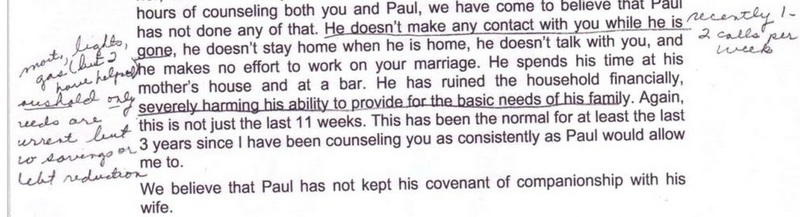
I am not arguing that I was sinless, or that my family never struggled financially; I am arguing that a formal document giving my wife the green light to divorce me should be the epitome of truth in every word, and if it isn’t, they should be as big as the gospel they confess and make that right. They should at least confess indisputable sloppiness in this grave matter, not withstanding the casual mention of “misreading records” in the matter of my excommunication. A “misreading” attended by two elders who were supposedly counseling me!
Furthermore, the elders propagated the false accusation that I abandoned my family and moved to Fort Wayne Indiana while continually refusing to put the accusation in writing. This outrageous accusation was then furthered by many Clearcreek Parishioners such as Veronica Gelvin. Moreover, none of their accusations were repeated by my wife in her testimony before the guardian ad litem ordered by my attorney. Massive documentation that has been complied and archived reveals their accusations to be patently false. The refusal to repent of these outrageous sins committed against my family clearly reveals the utterly black heart of the Clearcreek assembly.
The Clearcreek elders and their following assembly pose a grave threat to God’s people. I have a duty to warn others with all zeal. In the future when it fits into my list of priories (and Lord willing), each and every Clearcreek parishioner will be entered into the Matthew 18 process, and if they do not repent, I will tell it to the church, and I will name names Publication1. I do not believe that Clearcreek parishioners bear the right to hide behind their vile leaders (each will be presented with this document).
Clearcreek is indicative of a huge problem that is growing in today’s church: the return back to Calvin’s Authority = Truth paradigm, and his heavy handed Geneva style leadership. Folks better wise up; the election/free will debate is not the major issue: spiritual tyranny and the philosophy/doctrine that drives it is the major issue. Whether the Southwood story, ABWE story, or my story, cries for justice fall on deaf ears Grace Partners 2. But yet our God is a God of justice. He warns us to take up the cause of those who are trodden down by oppressors. Until Clearcreek offers the slightest whimper of regret for the deep pain they have unrightfully inflicted on many people—here I stand, and I will not relent as long as the lover of our souls gives me breath. To Him be all glory, and I confess that I love Him with all of my heart. And thank you my dear friend for your concern, I pray that God will abundantly bless you.
And to you who stand silent and fellowship with Clearcreek as though they are innocent: shame on you. Shame.
paul

 Paul's Passing Thoughts
1 comment