Freewriting Notes for “Against Church”: The Problem with Church; Salvation Does NOT Sanctify
 What’s wrong with church? Every honest longtime confessing evangelical will testify to the same experience; we have all been longing and searching for that elusive “revival.” Where is the power of Christ’s resurrection that the apostle Paul wrote of? Evangelicals spend their whole lives looking for the newest program that will usher in revival after the last one failed. Some programs offer a hope of revival, but soon burn out like a comet.
“Revivals” come and go. Church history is full of them. Christian scholars study them in order to “rediscover” the secret to escaping this mundane repetition we call church. We show up at a certain time, we are told when to stand, when to sing, when to sit down, when to raise our hand, what to think, when to put our money in the plate, when to leave, and when to come back. Our children cynically refer to the mandatory routine as “doing church.” Every now and then we recognize that we bring our Bibles with us to church, but really don’t need them, and wonder why; an unasked question that our children stopped asking themselves long ago. In most cases, Bibles are unopened during the week and church lost and found boxes are full of unclaimed Bibles. Precious few are excited about witnessing, and the vast majority of evangelicals have never led another person to the Lord.
Let’s be honest: church is boring except when it is controversial. We are so desperate for some spiritual excitement that we have our own Christian versions of Entertainment Tonight and The National Enquirer, and frankly, the church excels at supplying fodder for such. Sadly, the unchurched that have not yet been duped by the pitch, “We are different at Community Different Church, come visit and see for yourself” are now few and far between. The so-called New Calvinist revival of our day is really just a redistribution of sheep from smaller institutions to bigger institutions that offer more bells and whistles.
In all of this, no one asks if church might be the problem with church. While confessing, “The church is not a building; it’s the people,” emphasis on the institutional aspects of church dwarf any consideration of individuals. Committees abound for the sake of the institution while individuals are “left in the hands of God and His unfailing mercies.” If the church needs a coat of paint, you can bet a work day will be scheduled to get it done. But when a life needs renovation, Christians are utterly powerless to do anything about it. Pastors routinely farm-out serious life problems to the “experts.” The Bible is adequate for run of the mill problems, but the experts are needed for the “deeper” problems of life; besides, “at least they are saved.” Because He lives, you can face tomorrow because you are going to heaven anyway. Little of Christianity is about offering present hope and is mere fire insurance. When our children see this, they assume at least two things: God doesn’t have answers, and if He really created us, why not?
Could it be that the whole problem is profoundly simple? Could it be that the church is trying to live out the power of Christ’s resurrection through His death? And if so, why is that the problem?
It is the problem because Christ’s death is a onetime past event that is finished while the power of His resurrection is present continuance by virtue of the fact that it is power. Christ never needed a death or resurrection; He did that for us because we needed it, and many still do. Christ’s death and resurrection is a gift to us—the “good news.” One is a finished work, but the other is alive, and where there is life, growth is assumed. Life is not powered from death, life is powered from life.
The purpose of Christ’s death was to get rid of the old us, and for the new us to experience the power of His resurrection. Do we accomplish that through His death, or His resurrection? Did the old us really die, and is the new us really a completely new person endowed with the life and power of Christ’s resurrection? If that’s the case, why is the experience of Christ’s resurrection so elusive?
The problem follows: a literal resurrection of the individual empowers the individual and not the institution. The American church is comprised of splendid buildings full of broken people. In fact, at a conference in Columbus, Ohio Calvinist DA Carson stated that Christians are “broken people.” Well, look around, the mega-church buildings are not broken—far from it as they invoke awe in those who look upon them. More and more evangelical pastors are proudly coming out of the ecclesiastical closet and “resigning from the job of trying to fix people” because they can’t be fixed. Recently, Calvinist James MacDonald triumphantly proclaimed such while overseeing a multimillion dollar institutional church campus network. However, far be it from the church to resign from fixing the church building or in any way hinder the operation of the institution.
There is only one reason why the visible facilities of the church deserve so much honor, and by no means excluding things like four million dollar aquariums in the foyers: salvation by institution. However, the biblical emphasis is on the individual as a vital part of the body of Christ, and the temples being the very bodies of the believers:
1 Corinthians 3:6 – I planted, Apollos watered, but God gave the growth. 7 So neither he who plants nor he who waters is anything, but only God who gives the growth. 8 He who plants and he who waters are one, and each will receive his wages according to his labor. 9 For we are God’s fellow workers. You are God’s field, God’s building.
10 According to the grace of God given to me, like a skilled master builder I laid a foundation, and someone else is building upon it. Let each one take care how he builds upon it. 11 For no one can lay a foundation other than that which is laid, which is Jesus Christ. 12 Now if anyone builds on the foundation with gold, silver, precious stones, wood, hay, straw— 13 each one’s work will become manifest, for the Day will disclose it, because it will be revealed by fire, and the fire will test what sort of work each one has done. 14 If the work that anyone has built on the foundation survives, he will receive a reward. 15 If anyone’s work is burned up, he will suffer loss, though he himself will be saved, but only as through fire.
16 Do you not know that you are God’s temple and that God’s Spirit dwells in you? 17 If anyone destroys God’s temple, God will destroy him. For God’s temple is holy, and you are that temple.
1Corinthians 12:12 – For just as the body is one and has many members, and all the members of the body, though many, are one body, so it is with Christ. 13 For in one Spirit we were all baptized into one body—Jews or Greeks, slaves or free—and all were made to drink of one Spirit.
14 For the body does not consist of one member but of many. 15 If the foot should say, “Because I am not a hand, I do not belong to the body,” that would not make it any less a part of the body. 16 And if the ear should say, “Because I am not an eye, I do not belong to the body,” that would not make it any less a part of the body. 17 If the whole body were an eye, where would be the sense of hearing? If the whole body were an ear, where would be the sense of smell? 18 But as it is, God arranged the members in the body, each one of them, as he chose. 19 If all were a single member, where would the body be? 20 As it is, there are many parts, yet one body.
21 The eye cannot say to the hand, “I have no need of you,” nor again the head to the feet, “I have no need of you.” 22 On the contrary, the parts of the body that seem to be weaker are indispensable, 23 and on those parts of the body that we think less honorable we bestow the greater honor, and our unpresentable parts are treated with greater modesty, 24 which our more presentable parts do not require. But God has so composed the body, giving greater honor to the part that lacked it, 25 that there may be no division in the body, but that the members may have the same care for one another. 26 If one member suffers, all suffer together; if one member is honored, all rejoice together.
This is why it is critical that God’s people disciple each other in private homes and not institutions; invariably the focus becomes the institution and not the individual member. The institution becomes the temple to the exclusion of the temples. Not only is it not God’s intention that His people meet corporately in a large central location, but it never was the model until it was introduced in the 4th century. Synagogues operated in private homes and were separate from temple worship and priests. Synagogues, which later became the home fellowships of the 1st century Christian assemblies, were operated by the laity. Though priests were treated with honor when they visited, they had no authority in the local synagogues. The only exception was Philo’s Hellenistic influence on Jewish culture which led to institutionalized synagogues. Even the priesthood of the temple was redefined as a holy nation of royal priests, originally in reference to individual believers (1Peter 2:9).
Adding to the misplaced emphasis on church as institution is the idea that God’s kingdom is presently on earth. The good news of the kingdom means that God’s kingdom is presently on earth and seeking to eventually take dominion over all things. Of course, this fuels the concept of institution dramatically. In contrast, believers are “aliens,” “sojourners,” and “ambassadors” here on earth.
1Peter 2:11 – Beloved, I urge you as sojourners and exiles to abstain from the passions of the flesh, which wage war against your soul. 12 Keep your conduct among the Gentiles honorable, so that when they speak against you as evildoers, they may see your good deeds and glorify God on the day of visitation.
2Corinthians 5:20 – Therefore, we are ambassadors for Christ, God making his appeal through us. We implore you on behalf of Christ, be reconciled to God. 21 For our sake he made him to be sin who knew no sin, so that in him we might become the righteousness of God.
Symptoms of salvation by institution can be seen everywhere in contemporary evangelicalism. A minority of truth-loving Christians are often dumbfounded by the mysterious behavior of Christianity at large in the institutional church. Nevertheless, most of this behavior can be explained via salvation by institution. If God appointed a glorious institution to usher people into heaven, we can expect the buildings to reflect God’s glory while the inner rooms are full of wickedness, and if not wickedness, compromise.
How this concept crept into the church historically encompasses the subject of ancient philosophy that will be addressed later; this chapter focuses on the necessary gospel that flowed from the philosophical concept of salvation by institution. Salvation by institution is church, and church therefore needed its own gospel that functions in an institutional construct. This is a gospel that necessarily focuses on the wellbeing of the institution and not the individual. If individuals have all they need to be a temple in and of themselves—they don’t need an institution. That’s a problem for institutions. Therefore, the individual must be stripped of all ability, and must be completely dependent on the institution for…spiritual growth? Hardly. Those stakes are not high enough to sufficiently support the institution; the individual must trust the institution for their very salvation.
Therefore, salvation cannot be a finished work. Salvation must be progressive. If the individual is saved and secure, they have need of little including some sort of institution. If NOTHING can separate us from the love of God (Romans 8:31-39), what do we need an institution for?
Consequently, the institution must be the temple and not the believers, and when believers assemble together, it is in a temple and not the gathering together of a body. The biblical distinctions between body and temple are very deliberate. Christians are to view saved individuals as functioning body parts. The apostle Paul stated clearly that there is no spiritual caste system in a body. Body parts are categorized as visible/nonvisible, but obviously, the nonvisible parts are just as important as the visible parts. In a home fellowship construct, the focus is body parts, in the institutional church the focus is the temple. The New Testament invests in this distinction considerably. Christ doesn’t want centralized worship—He wants a fluid mass of body parts worshiping in spirit and truth. Christianity doesn’t need temples; the individual Christians are temples that are home to the Holy Spirit, and the focus is that the Holy Spirit is at peace in His dwelling.
Why then do many pastors farm-out Christians who have no peace in their temples to “experts”? Because they are seen as a drag on the institutional machine. They are not seen as part of the body, they are seen as a mere recipient of institutional salvation. Likewise, sin is swept under the rug to preserve the institution because it is a conduit from beginning salvation to final salvation, and the gospel of church will serve that purpose and that purpose alone. Threats of any sort to the institution must be neutralized.
The institutional gospel must endorse the institutional church as a conduit to heaven. That necessarily requires that salvation is not finished. If salvation is finished, the institutional church is not needed; therefore, the church must have its own gospel. The institutional church cannot be supported by the low stakes of quality Christian living—the stakes must be higher to support what some call a “vast evangelical industrial complex.” That would be salvation itself—the consequences must be eternal.
The simplest way to differentiate the home fellowship gospel from the church gospel is “law.” In the Bible, “law” is a word that refers to the full counsel of God. It is also referred to as “Scripture,” “holy writ,” “the law and the prophets,” “the gospel,” “the word,” “the law of liberty,” or simply, “the law.” The Bible explains how people are saved, and guides believers according to the issues of life and life more abundantly. Unbelievers will be judged by the Bible if they refuse to be reconciled to God; in that sense the Bible condemns. But believers learn and apply the wisdom of the Bible to their lives leading to a life “built on a rock.”
Matthew 7:24 – “Everyone then who hears these words of mine and does them will be like a wise man who built his house on the rock. 25 And the rain fell, and the floods came, and the winds blew and beat on that house, but it did not fall, because it had been founded on the rock. 26 And everyone who hears these words of mine and does not do them will be like a foolish man who built his house on the sand. 27 And the rain fell, and the floods came, and the winds blew and beat against that house, and it fell, and great was the fall of it.”
Wise obedience to God’s law also leads to a blessed life:
James 1:25 – But the one who looks into the perfect law, the law of liberty, and perseveres, being no hearer who forgets but a doer who acts, he will be blessed in his doing.
Likewise, doing the word leads to peace:
Philippians 4: 8 – Finally, brothers, whatever is true, whatever is honorable, whatever is just, whatever is pure, whatever is lovely, whatever is commendable, if there is any excellence, if there is anything worthy of praise, think about these things. 9 What you have learned and received and heard and seen in me—practice these things, and the God of peace will be with you.
To the unbeliever, the law is death, but to the believer the law is life. This has never changed from the time Moses exhorted the Israelites to choose between life and death until now. In regard to salvation, the unbeliever must have the law’s ability to condemn cancelled which leads to a new life in the Spirit guided by God’s law. When someone is saved, they pass from death to life; that is, from the law’s condemnation to life in the law. The law’s ability to condemn is cancelled. Now, the same law gives life—it’s the full counsel of God for life and godliness (2Peter 1:3).
This takes place when a candidate for salvation realizes that salvation is not a mere mental ascent to the facts of the gospel, it is a decision to follow Christ in death and resurrection. The person desires to die with Christ for the purpose of eradicating the old self that was under the condemnation of the law, and wishes to be resurrected with Christ as a new creature who loves His law. The new creature should not see obedience as a requirement for anything, but rather a privilege to love God and others. He/she has chosen life over death. Obedience is not a requirement of any sort, it is the way of wisdom and life.
If the Christian is permanently sealed by the Holy Spirit until the day of redemption, is able to understand the full counsel of God independently (and that counsel is the final word on truth), cannot be condemned by the law, and cannot be separated from the love of God by anyone or anything, then the institutional church is not efficacious for eternal life. Nothing is needed to finalize salvation; and in regard to living a life that glorifies God, an organization is not needed, only the body of Christ is needed. The key is mutual edification—not institutional authority.
As God’s supposed overseer of salvation, the church proffers a gospel that restricts the law to a single dimension of condemnation. In other words, the law can only condemn, and cannot liberate, bless, or sanctify. “Sanctification” is the setting apart of one’s life for holy purposes. “Justification” is the impartation of God’s righteousness to the believer through the quickening of the Holy Spirit. This is the new birth in which a person is born anew by the seed of God (1John 3:8-10). The new birth makes the believer righteous. This is because they are born of God, and their desires are turned towards fulfilling the law which once condemned them. Prior to salvation there is no love for God’s law, but now…
Psalm 119:97 – Oh how I love your law! It is my meditation all the day. 98 Your commandment makes me wiser than my enemies, for it is ever with me. 99 I have more understanding than all my teachers, for your testimonies are my meditation. 100 I understand more than the aged, for I keep your precepts. 101 I hold back my feet from every evil way, in order to keep your word. 102 I do not turn aside from your rules, for you have taught me. 103 How sweet are your words to my taste, sweeter than honey to my mouth! 104 Through your precepts I get understanding; therefore I hate every false way. Nun 105 Your word is a lamp to my feet and a light to my path. 106 I have sworn an oath and confirmed it, to keep your righteous rules.
Also prior to salvation, all the law could do was condemn—this is the apostle Paul’s “under law” versus “under grace” distinction between the saved and the unsaved.
In regard to the institutional church in our Western culture, this book primarily addresses the Reformation which was founded as an institutional model from its conception, and needed a gospel suited for such.
The Reformation gospel makes no distinction between the law’s role for the unsaved and saved; in both cases, the law can only condemn. The most basic problem arising out of this is the law becomes the standard for justification when in fact God makes believers righteous “apart from the law” (Romans 3:21). There is NO law in justification. Christ went to the cross to end the law for justification (Romans 10:4). Those under grace nevertheless now love God’s law. What the Reformers did in essence said…
“You love the law, fine and dandy, but a perfect keeping of the law must be maintained in order for you to be justified and remain justified, so any attempt to keep the law as a Christian is the same as trying to keep the law in order to justify yourself.”
This premise of the Reformation gospel, the crux of it, is well articulated by the late Reformed think tank, the Australian Forum:
After a man hears the conditions of acceptance with God and eternal life, and is made sensible of his inability to meet those conditions, the Word of God comes to him in the gospel. He hears that Christ stood in his place and kept the law of God for him. By dying on the cross, Christ satisfied all the law’s demands. The Holy Spirit gives the sinner faith to accept the righteousness of Jesus. Standing now before the law which says, “I demand a life of perfect conformity to the commandments,” the believing sinner cries in triumph, “Mine are Christ’s living, doing, and speaking, His suffering and dying; mine as much as if I had lived, done, spoken, and suffered, and died as He did . . . ” (Luther). The law is well pleased with Jesus’ doing and dying, which the sinner brings in the hand of faith. Justice is fully satisfied, and God can truly say: “This man has fulfilled the law. He is justified.”
We say again, only those are justified who bring to God a life of perfect obedience to the law of God. This is what faith does—it brings to God the obedience of Jesus Christ. By faith the law is fulfilled and the sinner is justified.
On the other hand, the law is dishonored by the man who presumes to bring to it his own life of obedience. The fact that he thinks the law will be satisfied with his “rotten stubble and straw” (Luther) shows what a low estimate he has of the holiness of God and what a high estimate he has of his own righteousness. Only in Jesus Christ is there an obedience with which the law is well pleased. Because faith brings only what Jesus has done, it is the highest honor that can be paid to the law (Rom. 3:31). [The Forum’s theological journal, Present Truth: “Law and Gospel,” Volume 7, Article 2, Part 2; also see the Calvin Institutes 3.14.9-11].
This is what makes the Reformation gospel patently false. The law is not Justification’s standard. If there is any standard at all, it is a love for the law, not a perfect keeping of it. Christ ended the law for justification, and the law is now the standard of love for sanctification. The Christian’s motives for obedience are pure because he/she knows the law has NO bearing on their justified state. The only motive for obedience is love, but the law is now the standard for what love is in sanctification.
The crux for the Reformed gospel now becomes how one obtains a perfect keeping of the law apart from any obedience of the “believer.” This is a system where perfect obedience must be continually imputed to the believer in order to satisfy the law. It boils down to a system where perfect obedience satisfies the law through faith alone in whatever that system is. In the Reformed construct, that necessarily requires that Jesus not only died for our sins, but also lived a life of perfect obedience to the law while He was ministering on earth. This is called “double imputation.” Our sins were imputed to Christ, and then He died to pay the penalty thereof, and His perfect obedience to the law is also imputed to us so that the law, being the standard of justification, is satisfied.
This is not a new approach; this whole idea of justification’s standard being a perfect keeping of the law. The apostle Paul argued against this universal anti-gospel in his letter to the Galatians in the following way:
Galatians 3:15 To give a human example, brothers: even with a man-made covenant, no one annuls it or adds to it once it has been ratified. 16 Now the promises were made to Abraham and to his offspring. It does not say, “And to offsprings,” referring to many, but referring to one, “And to your offspring,” who is Christ. 17 This is what I mean: the law, which came 430 years afterward, does not annul a covenant previously ratified by God, so as to make the promise void. 18 For if the inheritance comes by the law, it no longer comes by promise; but God gave it to Abraham by a promise.
19 Why then the law? It was added because of transgressions, until the offspring should come to whom the promise had been made, and it was put in place through angels by an intermediary. 20 Now an intermediary implies more than one, but God is one.
21 Is the law then contrary to the promises of God? Certainly not! For if a law had been given that could give life, then righteousness would indeed be by the law. 22 But the Scripture imprisoned everything under sin, so that the promise by faith in Jesus Christ might be given to those who believe.
23 Now before faith came, we were held captive under the law, imprisoned until the coming faith would be revealed. 24 So then, the law was our guardian until Christ came, in order that we might be justified by faith. 25 But now that faith has come, we are no longer under a guardian, 26 for in Christ Jesus you are all sons of God, through faith. 27 For as many of you as were baptized into Christ have put on Christ. 28 There is neither Jew nor Greek, there is neither slave nor free, there is no male and female, for you are all one in Christ Jesus. 29 And if you are Christ’s, then you are Abraham’s offspring, heirs according to promise.
What is Paul saying? He is speaking from the perspective of offspring and the offspring that gives eternal life according to “the promise.” Salvation is based on the covenant God made with Abraham based on promise alone. The promise involved ONE offspring, NOT more than one. If law is a standard for justification, it is in fact an additional offspring—that’s Paul’s point exactly.
This is where the concept of covenant comes in. To say that all sin was imputed to Christ is not exactly right. Actually, all sin is imputed to the Old Covenant law, and then Christ came to end the law and all of the sin imputed to it. Sin is defined by breaking the law (1John 3:4). All sin is imputed to the Old Covenant law until faith comes. That’s why Christ came to end the law for righteousness. In regard to justification, the law and all of our sins imputed to it are cast away as far as the east is from the west. That’s the function of the New Covenant in this age: it ends sin while the Old Covenant only covered sin. That’s why the New Covenant is a “better” covenant; it doesn’t just cover sin, it ends sin. The coming of the Old Covenant did not replace the Abrahamic covenant because it was ratified according to the promise of the one seed 430 years prior. The Old Covenant was a “guardian” or protector until Christ came to end the law.
Hence, to say that the law is the standard for righteousness is to also say that it was part of the promise and is an additional seed that can give life—no, only Christ can give life. Who keeps the law is irrelevant, it cannot give life in regard to justification—there is only ONE SEED. Christ didn’t come to keep the Old Testament law for us—He came to end the law for us. The New Covenant is not a covering of sin—it is an ending of sin.
On this wise, the Old Covenant still has a function presently; unbelievers are still under it. Every sin they commit is against that law and imputed to it. When they believe on Christ, that law, the “law of sin and death” is ended along with all sins they ever committed. One reason for this ending is because they die with Christ, and are no longer under that covenant:
Romans 7:1 – Or do you not know, brothers—for I am speaking to those who know the law—that the law is binding on a person only as long as he lives? 2 For a married woman is bound by law to her husband while he lives, but if her husband dies she is released from the law of marriage. 3 Accordingly, she will be called an adulteress if she lives with another man while her husband is alive. But if her husband dies, she is free from that law, and if she marries another man she is not an adulteress.
4 Likewise, my brothers, you also have died to the law through the body of Christ, so that you may belong to another, to him who has been raised from the dead, in order that we may bear fruit for God. 5 For while we were living in the flesh, our sinful passions, aroused by the law, were at work in our members to bear fruit for death. 6 But now we are released from the law, having died to that which held us captive, so that we serve in the new way of the Spirit and not in the old way of the written code.
Indeed, the Old Covenant law was “served,” but now the law that kept our sins “captive” is ended by Christ, and we “serve” in the new way of the Spirit, BUT that does not mean that there is not a written law that we “UPHOLD” (Romans 3:31). This same law which includes both covenants is now the sword of the Spirit and our guide for loving God and others. We not only died with Christ to end our sins, but we were resurrected with Him in order to uphold the law for the sake of love. Our NEW desire is to love God and others through obedience to the law. It was the same, as we have seen in Psalms 119 for those under the Old covenant, but at that time their sins were only covered by the law and not ended. This makes the New covenant “better.”
We are saved (justified) by faith alone, but in sanctification, our faith WORKS through love:
Galatians 5:2 – Look: I, Paul, say to you that if you accept circumcision, Christ will be of no advantage to you. 3 I testify again to every man who accepts circumcision that he is obligated to keep the whole law. 4 You are severed from Christ, you who would be justified by the law; you have fallen away from grace. 5 For through the Spirit, by faith, we ourselves eagerly wait for the hope of righteousness. 6 For in Christ Jesus neither circumcision nor uncircumcision counts for anything, but only faith working through love [“If you love me, keep my commandments”].
And what about future sin after salvation?
Romans 4:15 – For the law brings wrath, but where there is no law there is no transgression.
Romans 7:8…Apart from the law, sin lies dead.
However, the universal anti-gospel of the ages retains the law as a covering and the very standard of justification. It makes the law a co-heir with Christ. This necessary separation of law from the believer because he/she cannot keep it perfectly circumvents any ability to love God and others (“If you love me, keep my commandments”), separates law from sanctification, and is the very definition of antinomianism. In the Bible, antinomianism is stated as the antithesis of love (Psalm 119:70, Matthew 24:11, John 14:15).
Consequently, the vast majority of denominations that came out of the Protestant Reformation came up with their own systems that impute a satisfaction of the law to the “believer” who must appropriate this satisfaction by faith alone in whatever that system may be. However, most systems followed the basic principles of the most notable Reformers, Martin Luther and John Calvin. Also, it stands to reason that these systems are encompassed within the authority of an institution because of the complexity of such systems, but also the simplicity as well. Because a perfect keeping of the law must be satisfied in order to justify, and no one can keep the law perfectly, there must be a way for the “believer” to have a perfect keeping of the law credited to their account. When figuring that out from Scripture, it seems complex, but institutions endowed with God’s authority are supposedly vested with the responsibility to make the application simple for the great unwashed masses via orthodoxy. Said another way; ritual, or the “traditions of men.” Note once again Galatians 5:2ff., the Judaizes proffered the ritual of circumcision as a fulfillment of the law for justification. Paul said no; ritual cannot replace a fulfillment of the law for justification unless you keep the whole law perfectly. The law must be ended.
In the final analysis, most religions and denominations that comprise them, bridge a particular standard of righteousness with a ritual system based on a mediation authority between the common people and God. This is always a temple focused institution. God’s system has no standard for righteousness, but only a standard that defines love. When it gets right down to it, what standard could ever adequately define God’s righteousness? The apostle John stated that the world was not big enough to hold a book that would record the good works Christ did while He ministered on earth; so, we are to believe that Christ fulfilled all righteousness in our stead by obeying the Old Testament perfectly? In addition to this problematic question, the New Testament had not yet been written, and many prophecies in both the Old and New testaments are not yet fulfilled.
These substitute systems that errantly seek to satisfy a law by proxy offer the masses a simplistic ritual or tradition that shows their faith in whatever system that credits perfection to their account. This is always done via an institution. The institution is supposedly the God-ordained authority to usher the masses into an eternal utopia of some sort. People then pick the institution of their choice generally assuming that their good intentions and willingness to humbly submit to an authority will get them into heaven.
In the Protestant construct, that is defined as present and future sins removing us from grace which requires perpetual atonement. This is achieved by continually returning to the same gospel that saved us. “We must preach the gospel to ourselves every day” is even a well-traveled mantra among the Neo-Calvinists of our day. This perpetual return to the same gospel that saved us is only sanctioned in the institutional church overseen by Reformed elders:
Moreover, the message of free reconciliation with God is not promulgated for one or two days, but is declared to be perpetual in the Church (2 Cor. 5:18, 19). Hence believers have not even to the end of life any other righteousness than that which is there described. Christ ever remains a Mediator to reconcile the Father to us, and there is a perpetual efficacy in his death—viz. ablution, satisfaction, expiation; in short, perfect obedience, by which all our iniquities are covered (The Calvin Institutes: 3.14.11).
Nor by remission of sins does the Lord only once for all elect and admit us into the Church, but by the same means he preserves and defends us in it. For what would it avail us to receive a pardon of which we were afterwards to have no use? That the mercy of the Lord would be vain and delusive if only granted once, all the godly can bear witness; for there is none who is not conscious, during his whole life, of many infirmities which stand in need of divine mercy. And truly it is not without cause that the Lord promises this gift specially to his own household, nor in vain that he orders the same message of reconciliation to be daily delivered to them (The Calvin Institutes: 4.1.21).
To impart this blessing to us, the keys have been given to the Church (Mt. 16:19; 18:18). For when Christ gave the command to the apostles, and conferred the power of forgiving sins, he not merely intended that they should loose the sins of those who should be converted from impiety to the faith of Christ; but, moreover, that they should perpetually perform this office among believers (The Calvin Institutes: 4.1.22).
Secondly, This benefit is so peculiar to the Church, that we cannot enjoy it unless we continue in the communion of the Church. Thirdly, It is dispensed to us by the ministers and pastors of the Church, either in the preaching of the Gospel or the administration of the Sacraments, and herein is especially manifested the power of the keys, which the Lord has bestowed on the company of the faithful. Accordingly, let each of us consider it to be his duty to seek forgiveness of sins only where the Lord has placed it. Of the public reconciliation which relates to discipline, we shall speak at the proper place (Ibid).
…by new sins we continually separate ourselves, as far as we can, from the grace of God… Thus it is, that all the saints have need of the daily forgiveness of sins; for this alone keeps us in the family of God” (John Calvin: Commentaries on the Catholic Epistles; The Calvin Translation Society 1855. Editor: John Owen, p. 165 ¶4).
This is why Christ primarily limited His apologetic concerns to the traditions of men and antinomianism. Almost without exception, the traditions of men, bolstered by intimidating authoritative institutions, make the lives of “Christians” a segue from beginning salvation to final salvation. The institution is trusted to manage the Christian’s life in a way that they will be able to “stand in the final judgment.” Invariably, almost all religious institutions focus on preparing people for some kind of final judgment.
But Christ came to set people free from judgment, and into freedom to love. The Bible was written to individuals. The Bible always addresses particular individuals or an assembly/group. The Bible never addresses an hierarchy; NEVER. The Bible is written to Spirit-filled individuals called to fulfill their individual and unique callings. The emphasis is not making sure you get to heaven via a preordained institution. That concept circumvents love because the focus is making sure you can “stand in judgment” according to what the institution says will accomplish that.
Salvation doesn’t grow. Sanctification is not the “growing part” of salvation. Salvation is a conception of life that is a onetime event that creates a new creature. The creature grows, but not the conception. The conception is completed. The baby has been born. A baby cannot bring themselves into the world, but in due time they can take the gift of life and participate in it. Their birth is a finished work that makes growing in life possible, but in no way perpetually contributes to it. Likewise, salvation does not sanctify.
Keeping people under the law keeps them saved by keeping them from any attempt to love because that would be works salvation. Christians need to grow in an environment where the individual calling to love and good works is the emphasis, not salvation by faith in an institution. Even in cases where the latter is professed, the fruit of tradition that came from the roots of the Protestant tree is the actual function. Therefore, function mimics slavery to the law while proclaiming freedom. No, true freedom from the law is the only salvation that will yield abundant love in sanctification.
Salvation Does NOT Sanctify.
paul
Romans 13:14B; Part 2, “Overcoming Sin and Living Righteously, a Righteous Life of Real and Lasting Change”

In part one we looked at condemnation and how it empowers sin. Christ went to the cross and ended the law’s condemnation. Fear of death is primarily driven by condemnation and the fear of judgment. One of the most important parts of a Christian’s identity is to know that we are no longer under condemnation.
However, in our day there is a return to authentic Reformed soteriology that actually posits fear of condemnation as the primary motivator in sanctification. In Reformed soteriology, sanctification is seen as a conduit to final justification. In order to remain in the conduit that gives us our best chance to “stand in the judgment,” we must relive our original salvation by faith alone in sanctification. How is that accomplished? By reliving the same gospel that saved us over and over again. This is done through what the Reformers called mortification and vivification. Mortification is something we can do, vivification is only a future glory experience. When you see a Charismatic-like Reformed worship service, what John Piper calls exultation worship, they believe they are experiencing the joy of “future glory.” Really, this is probably the New Calvinist claim to fame: they put feet on the vivification part of mortification and vivification through a more contemporary form of worship. Hence, the “Reformed Charismatic” movement shouldn’t surprise us.
The “mortification of the flesh” part of this doctrine is a return to the fear of judgment, the same fear of judgment that originally saved us. Said John Calvin:
By mortification they mean, grief of soul and terror, produced by a conviction of sin and a sense of the divine judgment [sec.3]… it seems to me, that repentance may be not inappropriately defined thus: A real conversion of our life unto God, proceeding from sincere and serious fear of God; and consisting in the mortification of our flesh and the old man, and the quickening of the Spirit. In this sense are to be understood all those addresses in which the prophets first, and the apostles afterwards, exhorted the people of their time to repentance. The great object for which they labored was, to fill them with confusion for their sins and dread of the divine judgment, that they might fall down and humble themselves before him whom they had offended, and, with true repentance, retake themselves to the right path [sec.5]… The second part of our definition is, that repentance proceeds from a sincere fear of God. Before the mind of the sinner can be inclined to repentance, he must be aroused by the thought of divine judgment; but when once the thought that God will one day ascend his tribunal to take an account of all words and actions has taken possession of his mind, it will not allow him to rest, or have one moment’s peace, but will perpetually urge him to adopt a different plan of life, that he may be able to stand securely at that judgment-seat. Hence the Scripture, when exhorting to repentance, often introduces the subject of judgment, as in Jeremiah, “Lest my fury come forth like fire, and burn that none can quench it, because of the evil of your doings,” (Jer. 4:4)… The stern threatening which God employs are extorted from him by our depraved dispositions [sec.7] [from the CI 3.3.3-7].
Susan and I sat in a Pentecostal service and listened to the pastor say in no uncertain terms that one is not really saved till they experience the “second blessing” usually manifested by speaking in tongues. Services from the Charismatic camps are predicated by these second blessing experiences such as speaking in tongues, Holy Spirit laughter, and “dancing in the Lord.” Though Charismatics emphasize mortification far less than the Reformed, it’s the same basic idea. The vast majority of all denominations in our day flowed out of the Reformation and are predicated by progressive justification; viz, keeping ourselves saved by the same gospel that originally saved us.
The result is a proper biblical definition of antinomianism: some sort of doctrine that separates the law from sanctification. The “Christian” remains under condemnation, and must prepare to “stand in the judgment” by other means apart from loving God and others through obedience to the law. But there is no future judgment for Christians to stand in that has to do with justification. Antinomianism, when it boils right down to it, is the fusion of justification and sanctification together. In any doctrinal construct where sanctification is the progression of justification—that’s antinomianism because the law must be separated from sanctification lest it be justification by works. This is probably the key to ecumenicalism because the primary religion of the last days, according to the Bible, will be antinomianism.
To the contrary, why is it critical that Christians know they are no longer under the condemnation of the law?
1John 4:18 – There is no fear in love, but perfect love casts out fear. For fear has to do with punishment, and whoever fears has not been perfected in love.
The word translated “perfect” in the English is τέλειος (teleios), and is translated “mature” in many other passages of the New Testament. The word means “maturity,” or possessing everything one needs to be mature. Mature love is the idea here, not a “perfect” love.
So, what do we need to understand if we are to be mature in love, overcoming sin, and living righteously? We need to understand that there is no condemnation for us and no need to fear judgment, and we need to understand how sin works against us.
We need to understand that sin is a stand-alone element. It was sin that was found in Satan at some point in time (Ezekiel 28:15). Sin, whatever it is exactly, wages war against righteousness. The location of sin is in the body, and it uses desire to tempt individuals against righteousness. So, the four elements to understand are sin, righteousness, body, and desire. Sin is the problem; its enemy is righteousness; its location is the body, and it uses desire to tempt people to wage war against righteousness.
Let’s begin by looking at how these four elements operate in an unbeliever. Every person born into the world has the works of God’s law written on their hearts. Also within every person born into the world is a conscience that uses this law to either accuse or excuse behavior. So, every person born into the world has an intuitive law and judge within as part of their being. In the final judgment of condemnation at the end of the ages, those who have never been exposed to God’s written law will be judged and condemned because they violated their consciences on many occasions. As a cosmic principle, where there is no law there is no sin, so all babies go to heaven because they do not have a developed conscience. This would also apply to mental disabilities where a conscience is not present.
The Bible also states that repeated rebellion against one’s conscience can sear it like a hot iron. A refusal to obey conscience can reduce a person’s ability to feel guilt.
1Timothy 4:1 – Now the Spirit expressly says that in later times some will depart from the faith by devoting themselves to deceitful spirits and teachings of demons, 2 through the insincerity of liars whose consciences are seared, 3 who forbid marriage and require abstinence from foods that God created to be received with thanksgiving by those who believe and know the truth. 4 For everything created by God is good, and nothing is to be rejected if it is received with thanksgiving, 5 for it is made holy by the word of God and prayer.
Sear: g2743. from a derivative of 2545; to brand (“cauterize”), i. e. (by implication) to render unsensitive (figuratively):— sear with a hot iron.
Those who lack a conscience or moral compass are referred to as sociopaths in our culture. Sin uses desire to tempt, so a person with a seared conscience will most likely follow every desire that sin uses to wage war against righteousness. Police are sometimes stunned that murderers confess to their crime and state the following motive: “I wanted to know what it felt like to kill someone.” So, the murder was committed to satisfy the murderer’s curiosity.
Civil and criminal law restrains evil when fear of punishment outweighs the desire to commit a certain act. If a person thinks they can outwit law enforcement they will be inclined to obey the desire that sin is tempting them with. They don’t see the desire as evil; they have a stronger desire to avoid punishment. Nevertheless, the desire can be strong enough that any kind of logic or self-preservation is abandoned.
Sinful desires can take on all sorts of forms. The question is whether or not we will obey the desire just because it is a desire. Sin is opposed to any kind of law and is empowered by condemnation. Sin is an entity that seeks to bring death through the condemnation of conscience and bad desires. It is a complex death system. Those who are under law are constantly bearing fruits for death although they are able to do good works. In fact, their consciences will reward them with good feelings when they do good, but they are still under condemnation and sin’s constant harassment.
In regard to the believer, sin still resides in the body, but it has been stripped of its power due to Christ dying on the cross for our sins. Sin is empowered by its ability to condemn. I can’t say that I completely understand this, but nevertheless, it is what the Bible states:
1Corinthians 15:56 – The sting of death is sin, and the power of sin is the law. 57 But thanks be to God, who gives us the victory through our Lord Jesus Christ.
Sin brings about some sort of temporary death, physical death, and ultimately eternal death. Sin is in the sowing and reaping business, and the sowing of sin is often interpreted as “getting away with it” because there has not yet been a reaping. But the point here is that sin is empowered by the condemnation of law. When Christ died on the cross to end the law, it stripped sin of its power. Hence, when a Christian is confronted with a sinful desire, they are not only able to say no to that desire, but do so for the proper motives; i.e., love for God and others.
James 1:13 – Let no one say when he is tempted, “I am being tempted by God,” for God cannot be tempted with evil, and he himself tempts no one. 14 But each person is tempted when he is lured and enticed by his own desire. 15 Then desire when it has conceived gives birth to sin, and sin when it is fully grown brings forth death.
Romans 6:1 – What shall we say then? Are we to continue in sin that grace may abound? 2 By no means! How can we who died to sin still live in it? 3 Do you not know that all of us who have been baptized into Christ Jesus were baptized into his death? 4 We were buried therefore with him by baptism into death, in order that, just as Christ was raised from the dead by the glory of the Father, we too might walk in newness of life.
5 For if we have been united with him in a death like his, we shall certainly be united with him in a resurrection like his. 6 We know that our old self was crucified with him in order that the body of sin might be brought to nothing, so that we would no longer be enslaved to sin. 7 For one who has died has been set free from sin. 8 Now if we have died with Christ, we believe that we will also live with him. 9 We know that Christ, being raised from the dead, will never die again; death no longer has dominion over him. 10 For the death he died he died to sin, once for all, but the life he lives he lives to God. 11 So you also must consider yourselves dead to sin and alive to God in Christ Jesus.
12 Let not sin therefore reign in your mortal body, to make you obey its passions. 13 Do not present your members to sin as instruments for unrighteousness, but present yourselves to God as those who have been brought from death to life, and your members to God as instruments for righteousness. 14 For sin will have no dominion over you, since you are not under law but under grace.
15 What then? Are we to sin because we are not under law but under grace? By no means! 16 Do you not know that if you present yourselves to anyone as obedient slaves, you are slaves of the one whom you obey, either of sin, which leads to death, or of obedience, which leads to righteousness? 17 But thanks be to God, that you who were once slaves of sin have become obedient from the heart to the standard of teaching to which you were committed, 18 and, having been set free from sin, have become slaves of righteousness. 19 I am speaking in human terms, because of your natural limitations. For just as you once presented your members as slaves to impurity and to lawlessness leading to more lawlessness, so now present your members as slaves to righteousness leading to sanctification.
20 For when you were slaves of sin, you were free in regard to righteousness. 21 But what fruit were you getting at that time from the things of which you are now ashamed? For the end of those things is death. 22 But now that you have been set free from sin and have become slaves of God, the fruit you get leads to sanctification and its end, eternal life. 23 For the wages of sin is death, but the free gift of God is eternal life in Christ Jesus our Lord.
Sin resides in the body, but even though the body is weak, it is neutral. When the Bible authors speak of the “body of sin,” “desires of the flesh,” etc., they are speaking of when the body is being used by the individual to do the bidding of sin. In the case of an unbeliever, they are under law and sin can provoke them to yield their members up for unrighteousness to the point of slavery while the power of sin has been broken within the believer and they have a choice:
Romans 12:1 – I appeal to you therefore, brothers, by the mercies of God, to present your bodies as a living sacrifice, holy and acceptable to God, which is your spiritual worship. 2 Do not be conformed to this world, but be transformed by the renewal of your mind, that by testing you may discern what is the will of God, what is good and acceptable and perfect.
Therefore, let me comment on this passage:
Galatians 5:16 – But I say, walk by the Spirit, and you will not gratify the desires of the flesh. 17 For the desires of the flesh are against the Spirit, and the desires of the Spirit are against the flesh, for these are opposed to each other, to keep you from doing the things you want to do. 18 But if you are led by the Spirit, you are not under the law. 19 Now the works of the flesh are evident: sexual immorality, impurity, sensuality, 20 idolatry, sorcery, enmity, strife, jealousy, fits of anger, rivalries, dissensions, divisions, 21 envy, drunkenness, orgies, and things like these. I warn you, as I warned you before, that those who do such things will not inherit the kingdom of God. 22 But the fruit of the Spirit is love, joy, peace, patience, kindness, goodness, faithfulness, 23 gentleness, self-control; against such things there is no law. 24 And those who belong to Christ Jesus have crucified the flesh with its passions and desires.
25 If we live by the Spirit, let us also keep in step with the Spirit. 26 Let us not become conceited, provoking one another, envying one another.
The “desires of the flesh” are really sinful desires spoken of in context of yielding up our members in service to sinful desires. At least for the believer, our bodies are the temple of the Holy Spirit:
1Corinthians 3:16 – Do you not know that you are God’s temple and that God’s Spirit dwells in you? 17 If anyone destroys God’s temple, God will destroy him. For God’s temple is holy, and you are that temple.
So, even among Christians, if they “Let…sin…reign in [their] mortal bod[ies], it can lead to fruits unto death, or destruction. Not eternally, but present miseries of all sort.
Through learning God’s full counsel and applying it to one’s life, Christians can learn to say no to sinful desires and live according to the desires of the Spirit. The unregenerate do not possess the desires of the Spirit because they are not born of God. There is not a war between sin and the desires of the Spirit raging within the unbeliever, only a battle between the conscience and sin, and the motives for saying yes to the conscience involve motives other than those of a kingdom citizen. The battle is a single dimension. However, here is where the importance of evangelism comes in: the Holy Spirit convicts the world of unrighteousness, and the word of God is the sword of the Spirit. Evangelism adds another dimension in regard to showing people their need for a savior.
For the Christian, they have the testimony of conscience and the Holy Spirit. The New Testament has much to say about utilizing conscience in our fight against sin. The apostle Paul instructed us to keep a clear conscience before God. This also has much to do with assurance of salvation. Even though we know intellectually that the law has been ended by Christ and we are never condemned, sin nevertheless invokes feelings of condemnation and shakes our confidence.
In the final analysis, sanctification is the growing art of knowing how to control our bodies:
1Thessalonians 4:3 – For this is the will of God, your sanctification: that you abstain from sexual immorality; 4 that each one of you know how to control his own body in holiness and honor, 5 not in the passion of lust like the Gentiles who do not know God; 6 that no one transgress and wrong his brother in this matter, because the Lord is an avenger in all these things, as we told you beforehand and solemnly warned you. 7 For God has not called us for impurity, but in holiness. 8 Therefore whoever disregards this, disregards not man but God, who gives his Holy Spirit to you.

Victims and Discernment Bloggers: Let’s Ask the Right Questions
 “So, they would say to the young ladies and boys who have been molested in the church, ‘So what?’ The same sin that indwells the pedophile is in the victim as well. Can we not survey the past and present abuse and see this worldview plainly?”
Even though we hate to think commonsense is important in understanding spiritual issues, the fact remains that such is the case. We struggle with this because of our notion that material is evil and spiritual is good. This notion is deep-seated in the Western psyche. Consequently, we are often willing to throw math out the window for something spiritual. Also, the spiritual get out of commonsense free card comes in handy when we have invested too much of our own self-esteem in a bad idea. If we humble ourselves and admit we were wrong, our intellect labeled as “humbleness” (lest it have no credibility) seems to lose its credibility.
Frankly, I find admission of wrong freeing. Yes, it may make you feel stupid for a while, but the problem with being wrong is that you can’t get anything done with bad information, and not getting anything done leads to hopelessness. Ultimately, even if you are stupid, people will judge you by what you get done, and even if they don’t, God will. Christ is documented throughout the New Testament as being annoyed by verbal assent to righteousness rather than actual doing, and bad information does not lead to right doing. This would seem evident.
But what if you can’t really know anything? And what if you can’t really do anything good? What would the results of that be? Well, look at the blogosphere spiritual discernment and victim “healing” ministries. In full force since 2009, matters continue to get worse, not better, and to date, justice for the victims is found nowhere. Why? Why doesn’t discernment ministry work? In the analysis of Herman Cain’s acronym, W-A-R, discernment bloggers are not working on the right problem, asking the right questions, nor removing the necessary obstacles.
What is the right question? It follows: “Why doesn’t discernment ministry accomplish anything?” Need proof? Anybody remember the outrageous ABWE scandal? Thought so. A secular media producer just cancelled “Here Comes Honey Boo Boo” because of the mere potential of a smidgen element of the ABWE scandal, yet, ABWE continues to thrive unabated. How can this be? is another right question.
No, that is THE right question. And what is the obvious answer? It follows: people keep supporting ABWE financially. In case it escapes anyone, ABWE cannot continue unless it receives money. That raises another question: “Why do people keep sending such an organization money despite their deplorable behavior?”
Um, I can only tell you why the people who keep sending ABWE money say they keep sending ABWE money. Would that suffice? The reasons follow:
- Because ABWE, and institutions like it are God’s anointed, preordained vessels to take the gospel to a dying world, they are the only ones qualified to do so. If ABWE fails, thousands and thousands of souls will go to hell for eternity. ABWE must survive.
- ABWE must operate with people, and where there are people, there is sin, this is unavoidable.
- ABWE should be forgiven as Christ forgave us.
These are the reasons that no justice can be found in the institutional church. These are the reasons that religious institutions continue to spiritually abuse unabated. That’s the problem that must be worked on. Those answers assume the following: spiritual hierarchy, moral equivalency, and individual value defined by contribution to the group; i.e., no justice for the individual is what’s best for the many.
Note: the institution in and of itself is not the problem, people in and of themselves within the institution are not the problem, and money in and of itself is not the problem: the logic is the problem. The threefold logic clearly gives license to the behavior. The threefold logic insists that nothing can be done, or that nothing should be done. In fact, the threefold logic insists that there really isn’t a problem to be worked on in the first place—this is clearly ascertained by the normative results of all of these scandals.
So, how do discernment blogs work on the problem? By exposing the problem, “properly” identifying the problem, and assuming that the institutions will respond and seek justice for the victims. How’s that working for us so far?
So let’s ask another right question: “Why isn’t that approach working?” One reason is the identification of a particular problem that discernment bloggers like to call “cognitive dissonance.” This is the study of how people believe contradictory propositions and their attempts to reconcile the contradictions. But this is where discernment bloggers totally miss it: spiritual hierarchy is more times than not predicated on the idea that the masses cannot properly interpret reality itself. How many times have we heard the following?
No matter what it looks like, you need to trust the leaders who have been working close to the situation and know all of the details.
Though we would not agree with a naked verbalization of the idea that only spiritual leaders can properly interpret reality, we by all means function that way. However, more and more in Reformed circles, this concept is being openly stated in the following way:
All of reality, or what is truly reality, is interpreted through redemption, and only the gifted are able to do so. Meanwhile, it is acceptable to obtain worldly knowledge, and some of it is good, but a good thing is not always the best thing.
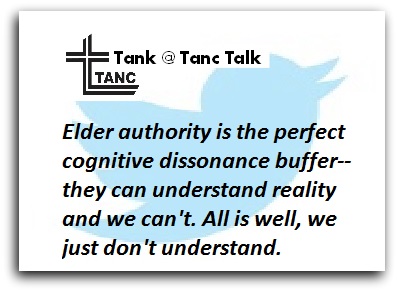 Therefore, when it comes to spiritual matters, trust God’s anointed regardless of the obvious. In cognitive dissonance, the thing used in an attempt to reconcile two contradictions as much as possible is called the “buffer.” In this case, the buffer is the belief that spiritual leaders must be obeyed because they are the ones who can see reality and we can’t. Sure, we can understand worldly things that have no eternal value, but when it comes to eternal matters the leaders must be trusted at all cost. The right problem to address is the buffer, not the symptom of being comfortable with contradictions. Discernment bloggers wrongly identify the real problem and work on the wrong one. They fail completely on Cain’s “W.”
And by the way, if you want to read a sermon by a conservative evangelical that exemplifies this dualist approach to reality, you can read it here, and listen to it here.
In addition, this author can give firsthand evidence of this mentality via correspondence from someone upset by what this ministry publishes.
Deep down you know that it is true. Turning logic on its head, twisting words, pseudo-scholarship, and outright attacking people for things that both you and I know they do not believe does no one any good.
Another misunderstanding is that I somehow knew and stood behind any improper things you may have experienced at Clear Creek.
These statements were made in light of the fact that citations/quotations make-up approximately 30% of what our ministry writes, and improper things “you may have” experienced is set against a website that thoroughly documents what exactly happened. The individual wrote these statements in the face of undeniable documentation. How can he do that? Because only those with authority can properly interpret reality despite the evidence presented to the contrary. That’s why. The individual also accused our ministry of “pseudo-scholarship.” Why is it such according to him? Because it doesn’t have the authority of Reformed institutional scholarship—they are the ones who really know the truth. Discernment bloggers seem to miss the point that institutional tyrants do not interpret reality in the normative sense.
Another point missed by discernment bloggers is: tyrants who interpret reality differently will not always act out in the same way. However, if the same ideology does not produce shameful behavior, it will at least produce tolerance for it. And the right question here is, “why is this so?” Answer: moral equivalence. If everyone is Adolf Hitler at heart, who is anyone to judge anybody for anything? We are ALL just sinners saved by grace after all. “Justice,” you say? What justice? We ALL deserve hell! Again, this is also seen in the aforementioned correspondence:
I truly grieve for the things that you have shared have happened with your family, but all either of us can do from here is look to faithful God and away from the sin that is in our heart and other men who will always ultimately disappoint because none of us are sinless.
Notice that he grieves for the things “that you have shared happened with your family,” i.e., how I interpret their actions, not what they actually did. And notice that the sin these men may have committed against me is also in my heart as well. So, they would say to the young ladies and boys who have been molested in the church, “So what?” The same sin that indwells the pedophile is in the victim as well. Can we not survey the past and present abuse and see this worldview plainly?
So, if there is no moral unequivalence necessitating a need for justice, all that is left is unity and peace for the sake of unity and peace which can only be obtained by blindly following those preordained to lead the great unwashed masses. We must also understand that this logic gave rise to institutions in general and the institutional church in particular.
Let’s work on the right problem: the worldview of the institutional church. Let’s ask the right question: “What should we do about it?” And finally, let’s remove obstacles to what works.
The obstacle that needs to be removed is fellowship with the institutional church. Again, the institution in and of itself is not the problem, but its caste worldview is the problem. Christians en masse must stop giving their money to the institutional church and must warn all people that they involve themselves with the institutional church at their own risk. It looks something like this:
Mark, likewise, I don’t care to debate with you because we see reality differently. I interpret reality grammatically, and you interpret reality redemptively like the Neo-Platonist “Christians” that you follow. Even John Street has bought into this latter-day antinomian nonsense. All I want to hear is that you stay clear of my family, and let’s be clear, it is not a wish—it is a demand, and I will protect my family at all cost—be sure of it.
Keep your family away from the institutional church. What else needs to happen in order to demonstrate that its fundamental worldview is horribly distorted? Husbands need to step up and take over their responsibility before Christ to lead their own families spiritually. You need to join a fellowship and be encouraged by men of God who can think for themselves and fear the Holy Spirit more than puffed-up control freaks. If you cannot find such a fellowship, do so in your own home.
paul
Related articles:
The Non-Doing Doesn’t Damn Protestants; It’s What They Believe About the New Birth

“Protestantism speaks of being saved from the condemnation of the law to a rest from obedience to the law of the Spirit of life. This is a rejection of the new birth and leaves the Christian enslaved to sin. This denies the good news of the incorruptible seed that Christians are born of. Protestantism makes the case that “the law” cannot produce righteousness, but this totally neglects the true biblical relationship between the believer and the law of the Spirit. A one-dimensional law necessarily rejects the new birth and circumvents the Christians ability to love God and others.”
In the parable of the talents, the slothful servant wasn’t sent to hell because he was lazy, what sent him to hell is the logic that caused the laziness. In other words, his laziness was a symptomatic cause of what he believed about God.
All liars will be thrown in the lake of fire, but it’s not the lying that paves the way—what they believe paves the way. How they act is merely a natural result of what they believe. Likewise, how Abraham lived is not what made him righteous, what he believed made him righteous—his life as set against the weakness of his mortality was the result.
BUT we cannot stop there because what we believe is not the direct thrust of what we do. Yes, it’s a symptom, but not the main thrust. What we believe leads to God recreating us or not recreating us through the new birth. The argument is better defined by behavior flowing from a particular type of human creature: born again of the Spirit or not born again of the Spirit. We must be careful to not say it’s belief alone while excluding the regeneration of the new birth.
It is also very important to know that regeneration is a colaboring with the Spirit that puts us in the love-loop. If we are not truly recreated into new creatures born of God who actually participate in righteous doing, we are not really participating in loving acts. Simple belief only watches the love being performed or manifested by the Spirit with no involvement by us. When Jesus says, “well done faithful servant,” he supposedly isn’t really talking about anything we did other than simply believing, which also ironically includes, “as much as you did it to one of these, you did it to me as well.”
Now let’s use this paragraph to dismiss some stupidity. The title of this post does not include people who consider themselves Protestants, but really have no idea what the Protestant gospel states. But would you go to a Kingdom Hall church because you have points of agreement with them? No, and why is that? Because you know the fundamentals of their gospel are false. So, if the official stated gospel of Protestantism is false, you need to get out of there. And that is the case. Secondly, Protestants like to interpret reality via either/or. This is because it is a Gnostic religion founded on all reality being interpreted by two categories only: material evil or invisible good. What you are discussing, whatever that may be, is one or the other. In contrast, OUR doing is not either evil or good, it can be one or the other, or both. In Protestantism, man’s doing must be totally good, or totally evil according to its Platonist/Gnostic foundations, and it is therefore the latter because man is part of the material world. The Reformers then went to the Bible and stuffed the Bible into that prism come hell or high water.
Protestantism is a false gospel because it redefines the new birth and denies the biblical definition of it. How is this done? We will use Romans 8:2 to explain.
For the law of the Spirit of life has set you free in Christ Jesus from the law of sin and death.
This is not complicated. Protestantism denies the new birth by making the law one-dimensional. The law can only do one thing: condemn. Therefore, you are not set free to “serve,” you are only set free from the condemnation of the law. YOU do not pass from death to life functionally, only positionally. By faith alone in Christ’s death and resurrection, the Spirit performs all of the acts of love described in the Bible in our stead. That becomes the Protestant definition of being free in Christ: Jesus performs all obedience in your stead through the Spirit. The Christian life of faith is a “rest.” As Joseph Prince has stated,
When we work, God rests, when we rest, God works.
And that my friends is good old fashioned authentic Protestant soteriology. That is almost word for word from John Calvin himself.
When the law can only condemn, we must stay clear of it because it demands perfection as a standard for righteousness. Its righteous demands must be fulfilled by the law-giver Himself. And again, there is no dynamic from which any person can please God because they are of the material realm in which only evil can come. Therefore, the new birth must be redefined as a position rather than something that results in a function performed by humanity. A command to love is really a command to see what you are unable to do while watching its manifestation by the Spirit…
When we work, God rests, when we rest, God works.
Rather than the new birth being defined as an actual new creature able to please God through loving obedience to the law, it is defined as a rest that merely perceives the works of the Spirit apart from us. We do not love functionally because belief does not bring about an actual new creature—only an ability to perceive works done by proxy. Christ said, “You MUST be born again”; therefore, a true gospel must properly define the new birth. Is it being set free to rest, or is it being set free to serve as literal new creatures reborn of God?
In the former, note that the law of the Spirit of life is something that the Spirit does and not us according to Protestantism. The law of the Spirit of life is a realm in which the Spirit performs obedient acts of love in our stead. This frees us from the condemnation of the law of sin and death and its demands for perfect obedience. Any attempt to obey the law directly is not of faith—the law must be obeyed for us as a result of complete rest “in Christ.” The law can only condemn.
In Protestantism, some teach that the law of the Spirit of life is a realm, and the law of sin and death is an actual written law while others teach that both are a realm; viz, Spirit realm versus sin realm, or material versus invisible. But either way, the Christian life is a rest.
In addition, according to them, remember that the Christian life must continue by faith alone, the same way we were saved. This necessarily connects the Christian life to our original salvation; in other words, salvation must be maintained the same way it began: by faith alone. If works must be eradicated in the Christian life save the work of faith only, it must be concluded that salvation is an ongoing work. If it wasn’t, we could safely leave the gospel that saved us and move on to something else. The who’s who of Protestantism warn continually that this would be a false gospel.
Start with Christ (that is, the gospel) and you get sanctification in the bargain; begin with Christ and move on to something else, and you lose both (Christless Christianity: published by Dr. Michael Horton in 2008, p.62).
It’s remaining in a rest to keep yourself saved by faith alone, the same way you were saved. Working in the Christian life is made synonymous with works salvation and law-keeping for the same.
Now, let’s look at this from the biblical point of view. In Romans 8:2, in both cases concerning the law of the Spirit and the law of sin, the word is “nomos.”
g3551. νόμος nomos; from a primary νέμω nemō (to parcel out, especially food or grazing to animals); law (through the idea of prescriptive usage), genitive case (regulation), specially, (of Moses (including the volume); also of the Gospel), or figuratively (a principle):— law.
The strict grammar calls for the meaning to be a prescriptive application of principles or regulations. There is a law of the Spirit, and a law of sin and death, and both refer to a prescriptive standard. It is such with a different dimension for the saved and another dimension for the unsaved—one law with two different perspectives and result. To the unbeliever, the law is the law of sin and death because sin within provokes the unbeliever to sin against the law. Therefore, it can only condemn the unbeliever; the power of sin is the law’s condemnation. Sin can provoke the unbeliever to compounded wages of judgment and wrath.
More than likely, “sin” is the seed of the serpent, and those born again of the Spirit have the seed of God within them.
Genesis 3:15 – I will put enmity between you and the woman, and between your offspring [seed] and her offspring [seed]; he shall bruise your head, and you shall bruise his heel.
1John 3:9 – No one born of God makes a practice of sinning, for God’s[b] seed abides in him, and he cannot keep on sinning because he has been born of God. 10 By this it is evident who are the children of God, and who are the children of the devil: whoever does not practice righteousness is not of God, nor is the one who does not love his brother.
1Peter 1:22 – Having purified your souls by your obedience to the truth for a sincere brotherly love, love one another earnestly from a pure heart, 23 since you have been born again, not of perishable seed but of imperishable, through the living and abiding word of God; 24 for
“All flesh is like grass and all its glory like the flower of grass. The grass withers, and the flower falls, 25 but the word of the Lord remains forever.” And this word is the good news that was preached to you.
… 1Peter 2:1 – So put away all malice and all deceit and hypocrisy and envy and all slander. 2 Like newborn infants, long for the pure spiritual milk, that by it you may grow up into salvation— 3 if indeed you have tasted that the Lord is good.
This exchange of seeds is vital. Notice that being born anew with an imperishable seed is actually “the good news preached to you.” Notice also that this gospel preached to us is PAST TENSE. And by the way, the “grow[ing] up unto salvation” is NOT salvation in the justification sense, but salvation in the redemption sense. Justification is a onetime finished act by God, the redemption of the body (glorification) is future. What is telling is that Peter doesn’t say that the gospel IS being preached to you (present continuance). Moreover, Peter states in his second epistle that we are to add several different actions to our faith, not continue in the same faith.
Let me also add this: it is an “imperishable seed.” Once you are born of it, it is irrevocable. The seed doesn’t qualify you to help God finish your justification (Catholicism), it is an eternal seed within you whether you are silly enough to attempt to finish a work that is already finished or not. Granted, if you believe justification has to be finished, you are probably not born of the seed. In addition, to say the seed of God is not in us (Protestantism) is equally egregious.
When the ground of justification moves from Christ outside of us to the work of Christ inside of us, the gospel (and the human soul) is imperiled. It is an upside down gospel.
~John Piper
The new birth and the seed of God within us makes it possible for us to obey God according to the law of His Spirit, which is the Bible—a written standard. Christ said we must love Him by keeping His commandments, and immediately after stating that, He added a very significant caveat: He would send a “helper/counselor” to aid us in doing so. The indwelling Holy Spirit HELPS us, he doesn’t love Himself in our stead. Neither does He grieve Himself by not obeying for us all of the time—that’s our job. To deny that is to deny the new birth and the gospel of the kingdom.
When we died with Christ, the old us that was born with a perishable seed also died. We were then born anew with the same Spirit that raised Christ from the grave. This set us free to SERVE…not rest.
Romans 7:1 – Or do you not know, brothers—for I am speaking to those who know the law—that the law is binding on a person only as long as he lives? 2 For a married woman is bound by law to her husband while he lives, but if her husband dies she is released from the law of marriage. 3 Accordingly, she will be called an adulteress if she lives with another man while her husband is alive. But if her husband dies, she is free from that law, and if she marries another man she is not an adulteress.
4 Likewise, my brothers, you also have died to the law through the body of Christ, so that you may belong to another, to him who has been raised from the dead, in order that we may bear fruit for God. 5 For while we were living in the flesh, our sinful passions, aroused by the law, were at work in our members to bear fruit for death. 6 But now we are released from the law, having died to that which held us captive, so that we serve in the new way of the Spirit and not in the old way of the written code.
Now, please note: “the old way of the written code.” What is that? That was servitude to the Old Covenant which was a will with the inheritance being eternal life. All sins committed against the law were imputed to that covenant.
Galatians 3:21 – Is the law then contrary to the promises of God? Certainly not! For if a law had been given that could give life, then righteousness would indeed be by the law. 22 But the Scripture imprisoned everything under sin, so that the promise by faith in Jesus Christ might be given to those who believe.
23 Now before faith came, we were held captive under the law, imprisoned until the coming faith would be revealed. 24 So then, the law was our guardian until Christ came, in order that we might be justified by faith. 25 But now that faith has come, we are no longer under a guardian, 26 for in Christ Jesus you are all sons of God, through faith. 27 For as many of you as were baptized into Christ have put on Christ. 28 There is neither Jew nor Greek, there is neither slave nor free, there is no male and female, for you are all one in Christ Jesus. 29 And if you are Christ’s, then you are Abraham’s offspring, heirs according to promise.
Hebrews 9:15 – Therefore he is the mediator of a new covenant, so that those who are called may receive the promised eternal inheritance, since a death has occurred that redeems them from the transgressions committed under the first covenant. 16 For where a will is involved, the death of the one who made it must be established. 17 For a will takes effect only at death, since it is not in force as long as the one who made it is alive. 18 Therefore not even the first covenant was inaugurated without blood. 19 For when every commandment of the law had been declared by Moses to all the people, he took the blood of calves and goats, with water and scarlet wool and hyssop, and sprinkled both the book itself and all the people, 20 saying, “This is the blood of the covenant that God commanded for you.” 21 And in the same way he sprinkled with the blood both the tent and all the vessels used in worship. 22 Indeed, under the law almost everything is purified with blood, and without the shedding of blood there is no forgiveness of sins.
The Old Covenant still has a function today. All those who do not know Christ are still provoked to sin against it, enslaved to its condemnation, and all of their sins are imprisoned in it. When they believe in Christ, that law, signified by the marriage covenant of the dead spouse in Romans 7, is ended along with all sins imputed to it and its condemnation. There is then no law to judge us, and where there is no law there is no sin. The Bible never says that the Old Covenant is presently ended for all purposes (Hebrews 8:13).
But now, the newly born spouse is free to “serve” Christ. The Spirit uses His law (word) to counsel us, encourage us, and instruct us in regard to life and godliness. To “serve” (in the new way of the Spirit) is the following word:
g1398. δουλεύω douleuō; from 1401; to be a slave to (literal or figurative, involuntary or voluntary):— be in bondage, (do) serve (- ice). AV (25)- serve 18, be in bondage 4, do service 3; to be a slave, serve, do service of a nation in subjection to other nations metaph. to obey, submit to in a good sense, to yield obedience in a bad sense, of those who become slaves to some base power, to yield to, give one’s self up to.
It is an exchange of seeds from death to life, and an exchange of slavery from sin to righteousness:
Romans 6:5 – For if we have been united with him in a death like his, we shall certainly be united with him in a resurrection like his. 6 We know that our old self[a] was crucified with him in order that the body of sin might be brought to nothing, so that we would no longer be enslaved to sin. 7 For one who has died has been set free[b] from sin. 8 Now if we have died with Christ, we believe that we will also live with him. 9 We know that Christ, being raised from the dead, will never die again; death no longer has dominion over him. 10 For the death he died he died to sin, once for all, but the life he lives he lives to God. 11 So you also must consider yourselves dead to sin and alive to God in Christ Jesus.
12 Let not sin therefore reign in your mortal body, to make you obey its passions. 13 Do not present your members to sin as instruments for unrighteousness, but present yourselves to God as those who have been brought from death to life, and your members to God as instruments for righteousness. 14 For sin will have no dominion over you, since you are not under law but under grace.
15 What then? Are we to sin because we are not under law but under grace? By no means! 16 Do you not know that if you present yourselves to anyone as obedient slaves,[c] you are slaves of the one whom you obey, either of sin, which leads to death, or of obedience, which leads to righteousness? 17 But thanks be to God, that you who were once slaves of sin have become obedient from the heart to the standard of teaching to which you were committed, 18 and, having been set free from sin, have become slaves of righteousness.
This brings us full circle back to Romans 8:2. We are set free from the law of sin and death “in Christ,” that is, His death on the cross to obey “the standard of teaching to which you were committed.” That would be the law of the Spirit.
To deny that the Christian is able to please God through their own obedience aided by the Holy Spirit is to deny the new birth. Christ said we must be born again. Protestantism speaks of being saved from the condemnation of the law to a rest from obedience to the law of the Spirit of life. This is a rejection of the new birth and leaves the Christian enslaved to sin. This denies the good news of the incorruptible seed that Christians are born of. Protestantism makes the case that “the law” cannot produce righteousness, but this totally neglects the true biblical relationship between the believer and the law of the Spirit. A one-dimensional law necessarily rejects the new birth and circumvents the Christians ability to love God and others.
Romans 8:3 – For God has done what the law, weakened by the flesh, could not do. By sending his own Son in the likeness of sinful flesh and for sin,[c] he condemned sin in the flesh, 4 in order that the righteous requirement of the law might be fulfilled in us, who walk not according to the flesh but according to the Spirit. 5 For those who live according to the flesh set their minds on the things of the flesh, but those who live according to the Spirit set their minds on the things of the Spirit. 6 For to set the mind on the flesh is death, but to set the mind on the Spirit is life and peace. 7 For the mind that is set on the flesh is hostile to God, for it does not submit to God’s law; indeed, it cannot. 8 Those who are in the flesh cannot please God.
Calvinism’s Parasitic Deception: How the Puritans Hijacked the Great Awakening
 Originally published October 30, 2013
The writing of The Truth About New Calvinism—Volume 2 is in full throttle. From time to time, I would like to share some things that I am stumbling upon as I define my research of the past three years.
Many thanks to those who have helped me define the direction of volumes two and three. Volume 2 is guaranteed to be understandable. This is the unveiling of Calvinism’s fundamental detriment to Christianity and humanity in general. It doesn’t matter whether you understand the doctrine or not; volume 2 will trace and define the logic that formed the doctrine. From there, the assumption that the ideology is dressed up in Bible verses to look, sound, and feel biblical is a correct one. Volume 2 is for the layman, volume 3 will be an in-depth theological evaluation for those who want it. Once the ideology that formed the doctrine is understood in volume 2, volume 3 may be easier to understand.
If it can be confirmed that the Reformers used the Bible to sell an ideology, and it can, and they did, what they came up with is fairly irrelevant. Not only that, volume 2 will examine the fruits of the doctrine which is also telling. In order to sell the ideology, the Reformers proffered a theological treatise from the Bible. Volume 3 will demonstrate why that doesn’t even hold water.
One character trait of New Calvinism is to exploit the overall lack of education concerning its history, ideology, doctrine, and character. New Calvinism, the authentic Reformed article, is looking for a result based on covert assimilation. The result that is sought is CONTROL. This control is sought through justification by faith alone which is a doctrine that is literally justification alone because it eliminates sanctification. Stated in layman’s terms: it emphasizes the work of God while deemphasizing anything the Christian does in salvation or post-salvation. This is done by out of sight, out of mind. If you only teach justification (salvation) to the exclusion of sanctification (the Christian life), the masses will eventually live according to the Reformed version of justification alone. The Reformers were masters at redefining the terms and teaching sanctification in a justification way.
This leads to the Reformed practice of infiltrating religious movements throughout history as a stowaway and then taking over the movement. The prime example is the Great Awakening (1730s – 1790s). The Great Awakening was a pushback against Reformed ideology, not the result of it. The Pilgrims created the need for the Great Awakening. The Pilgrims, a soft idiom for “Calvinistic Puritan political refugees,” brought European tyrannical polity with them. The motif that the Pilgrims came to America for religious freedom is patently false—they came to establish their own vision of a church state. To this point:
Throughout the colonial period, and even in the early years of the independent United States, most colonies or states had established churches—churches legally recognized as the official state church. Different colonies privileged different Christian sects, for example, Congregationalism (the descendent of Puritanism) was the official state church for Massachusetts, Connecticut, and New Hampshire; and Anglicanism was the established faith in most colonies, including Virginia, South Carolina, and Georgia. Along with official recognition came special privileges, like financial support from public taxation. Before the Great Awakening, colonial Americans harbored no expectation that there should be any separation between church and state.[1]
In reality, there are NO religious movements that could be considered legitimate revivals post apostolic church until the Great Awakening which was ignited by the Age of Enlightenment. The Enlightenment was predicated on the ideas of all men being created equal by God, and mankind’s ability to solve problems through reason. This resonated with colonials and slaves alike that were under European tyranny:
Joseph Tracy, the minister, historian, and preacher who gave this religious phenomenon its name in his influential 1842 book The Great Awakening, saw the First Great Awakening as a precursor to the American Revolution. The evangelical movement of the 1740s played a key role in the development of democratic thought, as well as the belief of the free press and the belief that information should be shared and completely unbiased and uncontrolled. [2]
Enlightenment ideas were completely contrary to Reformed thought as exemplified by the Westminster Confession.[3] Most of the Westminster Divines were Puritans. Colonial Puritans believed in slavery according to their extreme European caste mentality, and executed doctrinal detractors. Contra Enlightenment ideas that ignited the Great Awakening can be seen in the present-day New Calvinist movement; for instance, an article written by New Calvinist James MacDonald bearing the title, “Congregational Government is From Satan.”
Nevertheless, Reformed hacks like Jonathan Edwards infiltrated the Great Awakening, and to a large extent hijacked it. The Great Awakening was a revolt against the organized institutional church state, and was a gargantuan human mass of people searching out new ideas. Hence, the thousands who showed up to hear Reformed teachers during that time were not necessarily enthralled by the supposed gatekeepers of the Awakening, but were flocking to hear anyone who had an idea. Edwards et al proceeded to connect the movement to the Reformers of old who were the ones directly responsible for the tyranny that the colonials were experiencing in the first place.
Moreover, the colonial Puritans wasted no time in trying to infiltrate the American Revolution, its founding declarations, and constitution. James Madison fought the infiltration tooth and nail with his Memorial and Remonstrance Against Religious Assessments.
Unfortunately, the colonial Puritans did succeed in identifying Reformation thought with the Great Awakening. The many denominations and groups that were created by the Awakening usually, and unwittingly, identified themselves as Protestants. As a result, the primary Reformed institutions of learning[4] were built with money from the children of the Great Awakening who were really the product of Benjamin Franklin’s contra ideology. Incredibly, and undoubtedly the zenith of historical misrepresentation, those of Reformed thought who hijacked the Great Awakening have been credited with the Abolitionist movement. The Abolitionist movement was nothing more or less than an Enlightenment idea, while the Puritans were the first to bring slaves to the shores of America (ironically, slaves brought many cultic beliefs with them that in part incited the Salem witch trials).[5] The Enlightenment era was directly responsible for the massive conversion of slaves to Christianity shortly after the signing of the Declaration of Independence. The ideas of freedom and reason ignited colonial revivalism, not the contra idealism of the Reformation. Franklin was an abolitionist while he was governor of Pennsylvania, and the epicenter of revivalism among the slave population was Philadelphia.
This form of parasitic deception and covert assimilation is a Reformed hallmark. Those of Reformed idealism, historically, do not build anything. The Pilgrims were utterly inept in fending for themselves in the new world. They latch on to what is alive and feed off of it. Their very institution is a historical Ponzi scheme. A contemporary example is the home church movement in America. Because of the fundamentals that came out of the Great Awakening, the American church remained fundamentally Reformed in its overemphasis on justification because sanctification infers human ability. Therefore, per the usual outcome, a mass exodus from the institutional church began in circa 2000. This resulted in the home church movement. According to the Reformed mode of operation, New Calvinism hijacked that movement as well, primarily for self-preservation. This is the motivation for flock groups and “churches” like Apex. However, they are not purely home churches, and are connected to a central institution in order to maintain control.
A proper understanding of church history is the key. Until then, Reformation thought will continue to suck the life blood out of anything that lives in Western church culture.
Endnotes
1. Shmoop Editorial Team. “Religion in The American Revolution” Shmoop.com. Shmoop University, Inc., 11 Nov. 2008. Web. 30 Oct. 2013.
2. Wikipedia.org: Great Awakening.
3. Paul Dohse: Inseparable: The Reformation’s Principles of Persecution and its Gospel; Paul’s Passing Thoughts .com, August 31, 2013.
4. Columbia University (King’s College, 1754, Anglican), Brown University (Rhode Island College, 1764, Baptist), Rutgers (Queens College, 1766, Dutch Reformed), and Dartmouth College (1769, Congregationalist).
5. 1619: Slavery begins in the colonies, as twenty Africans are brought by a Dutch ship to Jamestown for sale as indentured servants. 1664: Maryland makes lifelong servitude for black slaves legally mandatory. Similar laws are later passed in New York, New Jersey, the Carolinas and Virginia. 1667: The Virginia House of Burgesses passes a law that binds blacks to servitude, even if they convert to Christianity.

 Paul's Passing Thoughts
2 comments