Politics: One More Reason to Hate Calvinism
 Calvinists are sooooo much more spiritual than we are that we can’t even talk about real life without being corrected. So, let me instruct you on how to discuss last night’s election without being chastised by a Calvinist:
‘Like, praise Jesus. But like, I was watching the election last night, not caring about who won because Jesus should be the king anyway. I just wanted to see how like, you know, the gospel narrative was going to unfold. It was just so awesome to see what Jesus already planned to do. Praise Jesus. I am still contemplating what the election results mean in their gospel context. Like, it’s really, really deep. In my own part of the gospel narrative, I read from the Scriptures about Jesus (of course) for several hours and then went to the polls to see what gave me joy. When I voted, it was like, a mere natural flow dude.”
Seriously, you can’t say anything. I tweeted something about political conservatism, and the next thing I know, I’m getting blasted for “hoping in conservatism instead of Jesus.” I saw where other tweets that referred to needed political change in this country were met with,” Only Jesus can bring about change.” Right. How dare we be so unspiritual! Folks, these people are making me gag. And I think the primary source of my gagetry is the hypocrisy on steroids. In regard to politics, Calvinists in this country posit a mindset of being above the fray, or endeared to loftier concerns unlike the everyday spiritual peasants among us.
The truth of the matter is that Calvin and his followers throughout the centuries have been rabid, political animals. The Puritans were up to their ears in political intrigue, and the executions of many Reformers/Puritans were for political reasons and not martyrdom for the faith (though factiously represented as such). In fact, the Puritans who came to America were political refugees and little more than that.
While pretending to be above the concerns of mere worldly governments, American Calvinists walk about quoting the Westminster Confession constantly. Do you know what that is? It was a document prepared by Reformed “Divines” at the behest of the English Parliament! It was a religious rule of law for the church and state. The European marriage of church and state resulted in the innumerable slaughter of thousands in Christ’s name.
But American Calvinists are above getting involved in the political system that put an end to all of that. It’s like, so unJesus.
I mean really, how petty can a system be when it lacks so much blood and torture?
paul
A Dead Dog in Dallas, Ghost Sex, Saving Baby Lions, and the Truth War
The Bible teaches us how to be reconciled to God. It also teaches us how to show others the same salvation we received, but in doing so, it also teaches us how to interpret our entire world. This message is the crux of this ministry—what I believe God has called many to proclaim. The prism that dominates my mind concerning all questions regarding one; life, and two; godliness, is the apostle Paul’s rhetorical question, “What saith the Scriptures?”
It seems strange indeed: God wants to involve us in the knowledge process. We must, “study to show thyself approved.” We are to seek God’s wisdom for maneuvering through life which puts His wisdom on display and exposes the foolishness of men. This is set against the wide easy road of our day: the “gospel” is a narrative about Christ’s story. It is a metaphysical story, or a metanarrative that is a predetermined redemptive history by God that encompasses everything from what tie we decide to wear today to great historical events that affect the whole world.
Metaphysics is the interpretation of reality, and all reality therefore according to the “gospel” of our day must be interpreted through the redemptive metanarrative. The sole purpose of the Bible is to help us place ourselves in the narrative that is predestined rather than to use the Bible to determine propositional truth. Seeking truth in order to determine our way in life according to divine guardrails and guidelines arrogantly assumes that Christ’s redemptive story is not already predetermine in every detail.
All is predetermined to “show forth Christ and His gospel” in the historic metanarrative. Tragedies such as 911 and giant tsunamis that show forth Christ’s wrath towards sinful man are birth pangs that point towards the final birth of all wrath at the end of the ages. All good things that happen are for the sole purpose of showing forth the good (or glory of God), and all sins show forth the depravity of man as set against God’s holiness. Therefore, we should run to repentance because it is the other half of the epistemology that shows forth the all-encompassing gospel reality.
The gospel is a Genesis seed that grows organically into the full grown Revelation tree and encompasses every event in human history. Therefore, ALL wisdom (or epistemology: how we know what we know) is divided into two primary parts: the glory of God and the depravity of man. These two things enable us to see reality: the gospel metanarrative. All events therefore are predetermined to show forth gospel reality. If we do not “inter into the rest” by observing what God has predetermined and showing it forth, we are attempting to create our own reality. We are attempting to create our own gospel story where we please God with “our own efforts.” We are attempting to “be the gospel rather than showing forth the gospel” (Michael Horton).
This allows us to separate ourselves from true reality—a freedom from a material world that we often can’t control. Is there tragedy in your life? Don’t take it too hard, it’s merely part of the gospel narrative; ie, “God’s will,” and “for His glory.” Hence, coldblooded indifference is often interpreted as spiritual maturity that at times seems to even celebrate tragedy. Hence, the snooty indifference to politics because those on this spiritual plane flavored by Gnosticism are above the fray of such trivial worldliness. Hence, the indifference to injustice and spiritual abuse as well.
Much of the preaching in today’s church is driven by this philosophy. We do not often realize what is really behind seemingly harmless truisms like, “History is His story.” We assume things like the aforementioned mini-treatise are not behind those bumper stickers. Therefore, these ideas are slowly assimilated into our minds, and we begin to function according to philosophies that we are totally unaware of. This is why there are no answers for life’s difficult questions in the church. Answers are not the issue. Your pain isn’t the issue. A right way verses a wrong way isn’t the issue (men can’t do anything right anyway). The only issue is “how we respond to God’s gospel narrative.” I contest that the Bible refutes this epistemology, and it is a “wisdom” that will hinder the true gospel, and in fact has.
In our (The Potter’s House) study on the book of Romans, we see that book as equipping Christians to interpret reality from God’s viewpoint. The book is about how to be reconciled to God, and interpreting reality according to God’s worldview. It is how to do things God’s way. It is about changing our outlook to God’s outlook. And it involves us, and holds us personally responsible before God for doing so. It holds us responsible to learn our part, and to do our part, and to teach others to do the same.
We have finally come to a very exciting part of the book: God’s anthropological, psychological view of man. What makes mankind tick from the one who created man Himself. It will have much to say about something that I am going to touch on in this post: a life happening, and the question of how we should interpret it. Paul’s “what saith the Scriptures?”
It involves a dead dog in Dallas, ghost sex, and saving baby lions. Every day in this world our children get hit in the face with all kinds of information. And that information always has an agenda. Somebody wants to sell us something, either for money or a victory in the truth war that is constantly raging about us. We must always remember that the world is also trying to sell our children the same thing 24-7. TV shows are not mere entertainment—somebody’s trying to sell something. Interpretations and conclusions are the loss or winning of a battle that in part determines the winning of the war; specifically, the truth war. It is a war between the kingdom of God and the kingdom of Darkness. And even though the outcome is determined, those who win or lose eternally will be manifest according to the truth they buy or reject.
“It’s just entertainment.” That’s easy. “Truth isn’t absolute.” That’s easy. “It’s just a song.” That’s easy. “That’s what it means to me.” That’s easy. “It’s just part of the gospel narrative—praise God anyway!” That’s easy. “What saith the Scriptures?” That’s hard. And easy is the road, and wide is the gate that leads to destruction. Eternal destruction.
So let’s just pick something at random that hits our children in the face daily in this culture. The successful pop star Kesha, who stylizes her stage name by replacing the “S” with a dollar sign (Ke$ha), claims to have had sex with a ghost. This has been widely reported, and her attractive blonde persona does nothing to prevent further stimulation of young imaginations. The episode was reported as follows by the Huffington Post:
Ke$ha says she has had sex with a ghost. Yes, you read that right — sex with a ghost.
And what do you do when you have sex with a ghost? You write a song about the experience, of course.
At least that’s what the 25-year-old singer told Ryan Seacrest on his KIIS FM radio show, of her new song “Supernatural.”
“It’s about experiences with the supernatural… but in a sexy way,” she told Seacrest. “I had a couple of experiences with the supernatural. I don’t know his name! He was a ghost! I’m very open to it.”
The singer added that her new album “Warrior” is based around the theme of the spiritual quest she embarked on to improve her music.
“The theme of this record is magic. I went on a spirit journey by myself. No security guard. No managers. I just went around the world and lived on a boat,” she explained. “I was in Africa rehabilitating baby lions. I went diving with great white sharks, and just went on this crazy spirit quest. I got hypnotized, and I just really wanted this record to be really positive, really raw, really vulnerable and about the magic of life.”
If one googles this eventful claim by Kesha, opinions abound. And if our teenagers ask what we think of such a claim, will we push the easy button, or does the word of God speak to her report? Well, her reported experience is no new thing under the sun. Based on what the Bible describes, I assure you it didn’t happen. Not because the claim is sensational—truth can certainly be sensational, but because of objective information that can be found in God’s word. I would like to focus on a more difficult question that can arise from her statement: can lost people, even lost people who obviously have issues, do good works? And are the works, in and of themselves, good? I am speaking of her work in rehabilitating baby lions (apparently injured or otherwise). Kesha is an animal rights activist which is honorable. Does this earn her any merit at all with God? What about the whole issue of good works and lost people? Moreover, unbelievers have been known to execute extraordinary feats of good works. Does the Bible equip us to lead an Oscar Schindler to the Lord? Would we approach him with the gospel in the exact same way as we would others? Why do wicked people do good works?
I will never forget an experience I had as an unbeliever while living in Dallas, Texas. I was traveling down a street and saw the car in front of me hit a dog. They kept going and did not stop. I stopped and looked for the dog which was able to run some distance, though fatally injured. I found the dog at the same time the owner did who was a widow. The dog was her long time, and only companion in the world. It was truly a very sad affair to witness. The widow and I decided we would bury the dog and I would help her. It was winter; thus, not only cold, but the ground was hard and difficult to dig. Not only that, when I had a fairly deep whole dug, she remembered how much her dog enjoyed romping around a nearby pond and wondered if I would mind changing locations. I agreed. On the way home, I pointed out to God (assuming that He was listening) what a righteous deed it was that I had accomplished and suggested that He would have to agree that I was a pretty nice person.
I know now that unsaved people do righteous deeds because God has written the works of the law on their heart, and they also have a conscience that argues for the law and accuses them when they don’t obey it. We will observe this truth as we progress in the book of Romans. I believe that this greatly restrains evil in the world and is the only reason that the world is a fit place to live in at all. Nevertheless, sin still wreaks havoc, and all of creation groans under its curse and tragedy. Man would rather endure the awful weight of sin in order to avoid change. He is willing to pay a heavy price in order to remain the king of his own throne. God doesn’t want our good works, he wants our whole life. He wants more than common decency, He wants kingdom citizens. Men are willing to continue the bet that they will cheat death in order to proclaim their own glory.
People display common decency, but the whole world lays in the lap of the wicked one. They assume that the spring of true life puts forth both pure and bitter water. That’s Kesha’s “magic life.”
She’s right, if that were true, it would be magic. But life isn’t magic—it’s a gift from God, and all will give an account in regard to the offer of eternal life. Kesha, like many other prophets in both the religious and secular realm are selling something. It is competition for the persuasion of minds in the truth war. In such a war, slothful thinking and lack of discernment will certainly lead to death. Our major weapon is our epistemology, or how we interpret what truth is.
What is the proper use of the Bible? This is a life and death question. Eternally.
Paul
Mutable Justification: Not Shocking—Just Reformed
Denver Sound Church is a church of the “Reformed tradition.” I have posted some of their material regarding a rejection of double imputation taught by “some in the Reformed tradition.” They reject the uniquely Reformed idea that Christ lived in perfect obedience to the law as part of the atonement, so that His perfect obedience could be imputed to our sanctification. They rightfully and forcefully make the case that such teachings are “heresy.”
Therefore, you would think that an article published by them propagating a mutable justification would be shocking to me, but not really. The idea that justification has to be maintained by us in sanctification is a Reformed family tradition. Even those who propagate the aforementioned Reformed view of double imputation believe that our justification has to be maintained by faith alone. I know that sounds no-brainer, but there is a big difference between being justified by faith alone and maintaining justification by faith alone. The latter requires faith alone in sanctification, or sanctification by faith alone in order to maintain our justification. The former is free to work in sanctification because justification is finished and immutable. But if justification is mutable as a result of our missteps, we must maintain it the same way we got it—by faith alone. So, we must maintain our justification by faith alone in sanctification. That’s where Reformed double imputation comes into play; we offer the perfect obedience of Christ to the Father in sanctification to maintain our justification.
Denver Sound Church calls that heresy, but agrees that we must maintain justification (obtained by faith alone) via obedience. Here is how they begin the post:
Despite being well-supported in Scripture, the doctrine of the loss of justification is not widely held in the contemporary Evangelical-Reformed community. Instead, most believe and teach that justification is a one-time, legal declaration by God. Contemporary theologians explain that once the decree of “justified” has been declared it cannot be revoked regardless of a person’s future actions.
The idea that justification can be lost is a minority view among Reformed Evangelicals, but that does not necessarily make it wrong. All theologians understand that the majority of Christendom is not always right. In fact, it might be more accurate to say that when it comes to theology, the majority is more often in the wrong. Examples of this from history abound: only eight people made it onto Noah’s ark, the majority of the Old Testament Jews were apostate, Roman Catholics certainly outnumbered Protestants at the beginning of the Reformation, etc.
The point is that every doctrine, even if widely accepted and even doctrines which are at the core of the Reformed faith must be put to biblical test. Our goal throughout this series is to demonstrate that Scripture does not teach justification as a one-time, merely forensic declaration, but that it is a righteous and forgiven state before God which can be lost due to unrepentant sin. Justification is gained by grace through faith alone, but must be maintained through faithfulness. This doctrine is solidly supported through biblical theology and its support from systematic theology is just as sound.
Recently, we published an article highlighting twenty three Scripture passages which teach, imply or warn that a person can lose his justification. That article was followed up with a post about why it is consistent with both Scripture and Calvinistic soteriology to say that one can lose his justification, but that salvation cannot be lost. The doctrine of the loss of justification provides a framework that adds great depth and consistency to the theological unity of Scripture. On the other hand, the more commonly held position that justification is an immutable (unable to be changed) result of a one-time expression of faith causes theological problems throughout the Bible, in fact, the belief in an immutable state of justification undermines many orthodox doctrines. Here are a few:
And the key to the problem here is the words, “orthodox doctrines.” We owe a great debt of gratitude to church historian John Immel for pointing out that “orthodoxy” is a body of interpretation by Reformed “divines” and “doctors” of the Church. We need to be reminded that we have the same illuminating Holy Spirit that they had; or, those “divines” who actually had Him. The Sound Church guys then go on to make their case in the post with nine arguments, some of which are of the Reformed tradition to begin with.
We will address each, but first let me put the argument to bed. I would also like to preface my rebuttal with the following: I believe a careful study of the apostle Paul’s writings indicate that the offer of salvation to all men is a legitimate offer, and Paul believed that his efforts of persuasion made a difference. How do I reconcile that with God’s knowledge of the future and how He makes that a part of His preordained plan? The best I can do is to state that God wants to involve us in the process while preserving all glory unto Himself. How He weaves His sovereignty together with our will is a mystery, and a debate that I do not enter into.
With that said, I believe justification is immutable because of Romans 8:30:
And those whom he predestined he also called, and those whom he called he also justified, and those whom he justified he also glorified.
And when did that happen?
Ephesians 1:4 – even as he chose us in him before the foundation of the world, that we should be holy and blameless before him. In love 5 he predestined us for adoption as sons through Jesus Christ, according to the purpose of his will, 6 to the praise of his glorious grace, with which he has blessed us in the Beloved. 7 In him we have redemption through his blood, the forgiveness of our trespasses, according to the riches of his grace, 8 which he lavished upon us, in all wisdom and insight 9 making known to us the mystery of his will, according to his purpose, which he set forth in Christ 10 as a plan for the fullness of time, to unite all things in him, things in heaven and things on earth.
Are we already glorified? No, but I believe Romans 8:30 states our glorification in the past tense in regard to its certainty which is connected to our justification. Glorification comes part and parcel with our justification.
Christ furthers this point:
John 10: 27 – My sheep hear my voice, and I know them, and they follow me. 28 I give them eternal life, and they will never perish, and no one will snatch them out of my hand. 29 My Father, who has given them to me, is greater than all, and no one is able to snatch them out of the Father’s hand. 30 I and the Father are one.
How peculiar that Calvinism is associated with predestination, yet many of the Reformed tradition believe that we can lose our salvation. Note what Michael Horton writes on page 62 of Christless Christianity:
Where we land on these issues is perhaps the most significant factor in how we approach our own faith and practice and communicate it to the world. If not only the unregenerate but the regenerate are always dependent at every moment on the free grace of God disclosed in the gospel, then nothing can raise those who are spiritually dead or continually give life to Christ’s flock but the Spirit working through the gospel. When this happens (not just once, but every time we encounter the gospel afresh), the Spirit progressively transforms us into Christ’s image. Start with Christ (that is, the gospel) and you get sanctification in the bargain; begin with Christ and move on to something else, and you lose both.
Both what? Answer: justification and sanctification. How peculiar that a doctrine associated with predestination also teaches that we can lose our justification. But they offer assurance that this won’t happen in something that might surprise you, and is offered as one of the nine arguments in said post. Yes, you are predestined for justification, but you can lose it, and the status thereof can change (mutable) under certain conditions. We will get to that, but let me state beforehand that assurance of salvation comes through obedience in sanctification (2Peter 1:5-11 is one of many examples). Our justification cannot change, but assurance of our standing can. Lack of assurance is a time for reevaluation and examination in our Christian lives. And hopefully, we will be associated with those who can help us with the word of God as well.
This brings us to the first argument given:
1. If justification is immutable, then the doctrine of sola fide is destroyed.
So what? Sola fide is one of the five solas of Reformed orthodoxy. It’s NOT Scripture—it’s orthodoxy. And not only that, to many in the Reformed tradition, it isn’t faith alone for justification, but faith alone for sanctification as well. In sanctification, we are called on to mix our faith with works/obedience for the purpose of showing forth our faith—leading to “blessings.” This is what the whole book of James is about. Though Denver Sound Church is not in this camp (sola fide in sanctification), using Reformed orthodoxy as an argument is dead on arrival. And though they offer twenty-three Scriptural arguments in another post, it is obvious from John 10:27, Romans 8:30, and Ephesians 1:4 that those citations cannot be used to make a case for mutable justification. Furthermore, I have reviewed those arguments and do not find them compelling, but you can read them for yourself here; http://www.soundchurch.org/23-bible-passages-which-teach-the-loss-of-something/ . And by the way, let me further my point on Reformed orthodoxy, and the five solas in particular by saying that Solus Christus is blatantly unbiblical. Salvation is not by Christ alone. The Father elected, the Spirit set us apart, and Christ died for our sins. Salvation is Trinitarian; it is not through Christ alone.
2. If justification is immutable, then church discipline is an empty threat with no realistic consequences.
This is the money argument that takes the place of true biblical assurance, and according to church historian John Immel, is the real crux of Reformed orthodoxy. Justification is maintained and assured by submitting to the authority of the Church and being a member in good standing. This is tied to elder rule which supposedly has the authority to declare people unjustified:
An immutable justification means that the removal from the covenant community (the final step of the process of church discipline) has no teeth. In fact, if one who has been excommunicated retains his justification, church discipline might actually seem like a better situation for the person who has been removed from the church. If justification remains intact, life without membership in the covenant community might actually be attractive to some folks. To eventually go to heaven without enjoying potlucks in the basement or having to deal with the interpersonal relationship stresses that come with church participation seems like a pretty good deal!
However, despite what some may say, Scripture makes it clear that there is no justification available to a person who is outside of the local biblical church. Thus, the only conclusion that we can make is that one who is removed from the covenant community has lost his justification. The belief in an immutable justification is logically inconsistent because it creates a class of believers who are on the “outs” with God’s people, but yet somehow still “in” with God. This is biblically impossible. All believers will be in a biblical, visible, local church – the Body of Christ (Acts 2:38-41; 1 Corinthians 10:16-17; Ephesians 1:23). The person who is not in the visible, local church cannot be a believer and is therefore, not reconciled to God – i.e. not justified.
By a local “biblical” church, they mean Reformed. So, regardless of the fact that Reformed orthodoxy is fraught with biblical error (like the Synod of Dort total depravity that is also the total depravity of the saints), and we are only truly sanctified by truth (John 17:17), we hold up our part of the marriage covenant (justification) by submitting to a local church whether they are bearing the truth or not. This in and of itself is another element of a long list of error. Justification is a covenant that God upholds Himself; it is a covenant that God in no wise trusts us to uphold in any way, shape, or form. We have a picture of this in Genesis chapter 15. God put Abraham in a deep sleep and consummated the covenant Himself. When God makes any covenant with mankind, he is the one that guarantees it, and we have no part of that guarantee. We cannot participate in the maintaining of any covenant with God any more than Noah participated in making rainbows.
3. If justification is immutable, then obedience becomes optional.
Obedience is optional, but with consequences following: lack of assurance, discipline, loss of rewards, sin unto death, etc., etc., etc. You can read this post for yourself here: http://www.soundchurch.org/if-justification-is-immutable/ ,but I am not going to address #3 at length.
4. If justification is immutable, then apostasy is a myth.
I believe I stared apostasy in the face shortly before I gave my life over to Christ. God had reach out to me through other people for almost two years. It came to a point where I knew that if I didn’t respond to what God had used other people to do in my life to that point—I never would. What else was God going to do to convince me? I had a very strong sense that it was then, or never. I believe Scripture validates that experience. Again, I have supplied the link to their argument which you can read for yourselves.
5. If justification is immutable, then there is no reason for the Church to exist.
This relates to #2. Basically the same argument.
6. If justification is immutable, then a large number of the parables of Jesus are pointless.
Again, you can read this argument for yourself—I do not find it compelling in light of reconciling Romans 8:30 and the other cited passages.
7. If justification is immutable, then pastors and churches are liars.
See #2.
8. If justification is immutable, then the marriage covenant is irrelevant to salvation.
See #2.
9. If justification is immutable, then the final judgment according to deeds is a kangaroo court.
Again, this argument depends heavily, heavily on Reformed orthodoxy which holds to one resurrection and one judgment. A biblical argument for two resurrections and 2-3 judgments is very strong if the Scriptures are taken literally.
What was the “Reformation”? What did it reform? It Reformed the Catholic Church. But Scripture doesn’t say to reform heresy; it commands us to “come out from among them.” Yet, the father of the Reformation, Saint Augustine, never repented of being a Catholic nor disavowed the Catholic Church. And the Reformed community is looking more like the Catholic Church everyday despite claims to the contrary. We see the same basic philosophy concerning church authority that seeks to control people and tell them how to think. It is the same philosophy that has always led to the same tyranny whether in Rome or Geneva.
And neither have ever repented of it.
paul
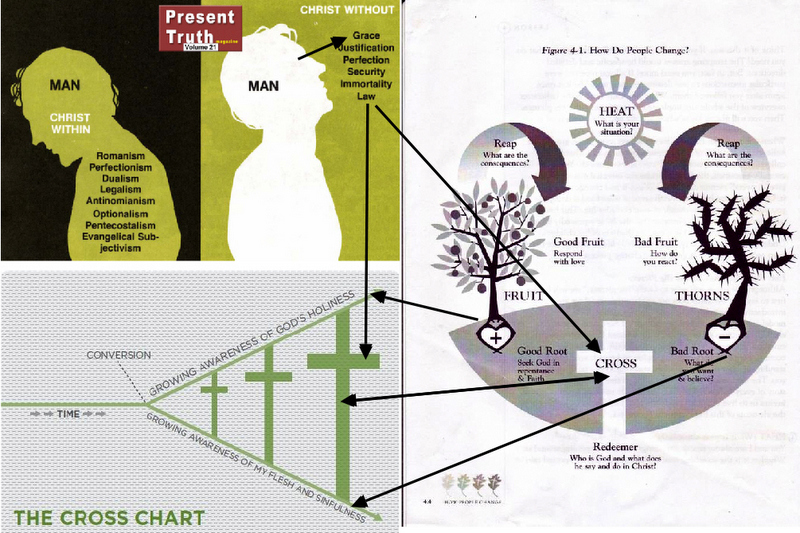
Moving Bus Running Over Discernment During Meditation
 I have been sent another article written by the poetic Scott Bennett who authors Moving Bus Meditations blog. This is the second, very annoying post of his that has been sent to me that I am compelled to respond to. The other one propagated progressive imputation. What’s that? I will explain because it’s a prerequisite to understanding my annoyance with his most recent post:
In salvation; the once saved always saved variety, the righteousness of God the Father is imputed to us when we believe that His Son paid the penalty for our sins. So, justification is not progressive. Our salvation does not grow. It’s a finished work. We grow as new creatures in Christ, but we are no more saved or less saved than when God declared us righteous. Our sanctification is not powered by justification—it’s powered by regeneration; ie, the new birth and the indwelling of the Holy Spirit who is our counselor and helper.
Bennett is hardcore Reformed, or an authentic Calvinist. They believe that our justification was also dependent on Christ’s perfect life when He came the first time. He died for our sins on the cross, what they call His “passive obedience,” and He also lived a perfect life as a substitute for our obedience in sanctification, what they call His “active obedience.” They believe this is necessary because John Calvin did not believe justification is a finished work. He believed that the perfect standard of the law must be maintained during our life in order for God’s declaration concerning us to be true. If the law is not obeyed for us perfectly while we are alive, His declaration would be “legal fiction.” So, because Calvin believed that sanctification is the progressive part of our salvation until glorification, and the standard is perfect obedience to the law, Jesus had to therefore live a perfect life for our life as part of the atonement. Unfortunately, and also indicative of our day, I have lost most Christians by now, so let me simplify it for you: Jesus obeys for us. In fact, if you make any effort to obey, you are trying to help Jesus finish your salvation; therefore, you are no different than a Roman Catholic.
“But, but, Jesus obeys for us? How in the world does that happen?!” I’m glad you asked. This was the subject of Bennett’s post. Hardcore authentic followers of the murdering mystic despot John Calvin believe the Bible is a “gospel narrative,” or “story.” As we meditate on the narrative, and see how Jesus obeyed the commands that we are unable to obey to maintain the true legal story that is not fiction, what we “see” is imputed to us. Hence, we experience the obedience and love of Jesus, but it’s not really us doing it. Obeying biblical commands “in our own efforts” is paramount to works salvation. Reformed leaders call this: “the imperative command is grounded in the indicative event.”
“But, but, how do we know when we are obeying “in our own efforts” instead of Jesus obeying for us?” Again, I’m glad you asked. Any obedience done out of duty, or without joy, or with effort as opposed to a “mere natural flow” is obedience done in “our own effort.” It’s not learn and practice—it’s meditate and experience. Experience is not always part and parcel with who we are. We can experience something that doesn’t define our being; eg, Hitler experienced good things, but that doesn’t mean he was a good person. Our experience is a manifestation in the realm in which we exist, but it is not really us who is responsible for the manifestation.
This is the Segway to his latest post (A Political Post: Are We Following the Wrong Story?). A few more basics to understanding how this supposedly “works”: the “gospel” (or the works of Christ) is the summation of all reality. True reality is only realized by meditating on the gospel narrative. Simply meditating on the gospel story via the Bible shows us a deeper and deeper vision of Christ’s holiness as “set against a deeper and deeper knowledge of our own total depravity.” This results in a “revisiting of the gospel afresh” which results in a “manifestation of love.” Or, now speaking directly to Bennett’s post, the following occurs as a “mere natural flow”:
…. a family spends a Saturday serving warm soup to the homeless.
…. a boy pours out his piggy bank to count the coins he’s collected for his favorite charity.
…. a sweet 77-year-old sings hymns to her dying husband in the night.
….a pastor stands up on a Wednesday night—telling five faithful families one more time about a carpenter who came to earth as Prophet, Priest and King.
Because this doctrine is supposedly lived out through the heavenly realm on earth, it sees worldly affairs as petty. Therefore, Bennett sets the above examples against supposed worldly concerns:
While the nation holds its breath for the outcome of November 6….
While the nation is frozen, paralyzed in its preoccupation over who will occupy the White House….
While America spars dividedly over which party’s brand of change is better….
While bitter political arguments pervade the social networks….
While political prophecies of hope or despair dominate the headlines….
You know, the kind of stuff Abraham Lincoln got tangled up in when he was president. A pity he didn’t spend more time in gospel contemplationism. And I am sure Bennett would think it unspiritual for the Negro population of that time to be concerned for those things regardless of the fact that their relatives were being lynched at will. But oh well—God’s will—right?
Aside from the naive arrogance of it all, Bennett’s doctrine doesn’t manifest his musings. He is a rabid follower of leaders who have a litany of unresolved conflict with many Christians, and are guilty of criminal acts against others, both in the present, and those who hatched this mystic doctrine 500 years ago. While Bennett’s motif is popular among the neo-Calvinists of our day, their more visible leaders work behind the scenes through several organizations to once again get in bed with the government. They lust for a return to Calvin’s Geneva that was a totalitarian state bar none. Missing from Bennett’s fluffy motif are the screams of those burning at the stake and the heads of disobedient children falling into a basket.
He is a hypocrite extraordinaire.
paul

 Paul's Passing Thoughts
35 comments