Redemption: Another Choice between Calvinism and Biblicism; One? Or more Than One?
The choice between John Calvin’s gospel and the gospel described by a grammatical interpretation of the Bible is made up of multiple distinctives.
1. The standard for justification.
2. Infused grace.
3. Righteousness.
4. The role of law.
5. The number of judgments and resurrections.
6. The dichotomy of justification and sanctification.
7. Interpretation.
8. Total Depravity
9. Faith Alone
10. The law’s use.
11. New Birth
12. National Israel
13. Redemption
Number 13 is the subject of this post.
A review of 1-12 follows:
| Reformed | Bible | |
| Justification Standard | Perfect law-keeping. | No law. |
| Infused Grace | All righteousness remains outside of the believer. | Righteousness within. |
| Righteousness | Positionally only. | Practically |
| The Role of the Law | Doesn’t change for saved. | Changes for saved. |
| Judgments / Resurrections | One only. | Multiple |
| Dichotomy | Justification progresses by sanctification. | Justification is finished; only sanctification progresses. |
| Interpretation | Luther’s Theology of the Cross. | Grammatical |
| Total Depravity | Saved and Unsaved | Neither |
| Faith Alone | Both for justification and sanctification. | Only justification. |
| Law’s Use | To show evil and holiness only. | Practical instruction for the Christian life. |
| New Birth | Realm manifestation. | New creaturehood. |
| National Israel | No future. | Future |
The subject of redemption is another element of contradiction between what the Bible states grammatically and the Reformed method of interpretation. The word means, “The act of buying back.” It has also in it the thought of taking possession of that which has been bought. Since man’s condition never changes, and there is a vast metaphysical gulf between mankind and God according to Reformed thought, redemption is seen as taking place in the one great judgment where everyone’s just standing is determined (Calvin Institutes 3.25.9). Those who lived their Christian life by faith alone (the Reformed, “Christ 100% for us”) will be revealed as redeemed at that one last judgment which reveals those who are justified (the Reformed, “Already, not yet”). According to Reformed thought, if you persevere against the essence of all sin, which is, “trying to please God in your own efforts,” you will be granted eternal life and thereby revealed as one who has been purchased or “redeemed.”
However, since the Bible teaches that justification is a finished work, and righteousness is infused within the born-again Christian, the Bible teaches a separate redemption for the soul of the believer and the redemption of the mortal body. The soul is redeemed at salvation; the body is redeemed at resurrection.
Furthermore, there is redemption of national Israel, and a future redemption of creation. This is just another example of how all Reformed doctrine is crushed and found wanting by a single biblical elemental truth. Different redemptions take place at different times in history, and are not encompassed in one final event as proposed by Reformed thought (with the one exception of “already, not yet”).
The following treatise written by John Ritchie is helpful:
Redemption is the “act of buying back.” It has also in it the thought of taking possession of that which has been thus bought. There is a redemption by purchase, and also a redemption by power, spoken of in the Scriptures. There is a redemption which the believer has now, and there is a redemption that he hopes for, by-and-bye. It is needful to distinguish between these.
Man’s Need of Redemption.
Man is the slave of sin and Satan. In his fail, he surrendered himself into Satan’s hand. His inheritance, was lost with him. The world is claimed by Satan, and he rules it. He is the “prince of this world” (John 12:31). Man is a subject of his power (Acts 26:18) and must remain so until delivered by the power of God. He cannot redeem or deliver himself, nor can his fellow. “None of them can by any means redeem his brother, nor give to God a ransom for him” (Psa. 49:7). If deliverance comes, it must be from above. This is what the Gospel reveals. “Deliver him from going down to the pit: I have found a ransom” (Job 33:24) is the Word of the God of redemption. “He sent redemption unto His people” (Psa. 111:9). This redemption comes through Christ, as we read– “Christ Jesus, who of God is made unto us wisdom, and righteousness, and sanctification, and redemption” (I Cor. 1:30). He obtained “eternal redemption” (Heb. 9:12) for His people.
Redemption by Blood, and by Power.
The language of the Word concerning the believer is, “In whom we have redemption through His blood, the forgiveness of sins, according to the riches of His grace” (Eph. 1:7). Then, looking onward to the day of coming glory, when redemptive power shall be extended to his mortal body, and to creation, the word is— “In whom also after that ye believed, ye were sealed with that holy Spirit of promise, which is the earnest of our inheritance, until the redemption of the purchased possession” (Eph. 1:13-14). Then again, “Grieve not the holy Spirit of God, whereby ye are sealed unto the day of redemption” (Eph. 4:30).
Redemption by blood was effected at the Cross. There the Lord Jesus “purchased with His own blood” (Acts 20:28) His people. Yea, more; He bought the field — the world, in which the treasure lay (see Matt. 13:44), and will yet take possession of it, set it in order, and rule it for God. But the time for this display of His redemptive power in the world has not yet come. He is now engaged in gathering His purchased treasure out of it. This He is doing by the Gospel. When a sinner believes the Gospel, his sins are forgiven, he is sealed by the Holy Spirit, and he waits for the day of full and final redemption.
Like a farmer who goes to the market to buy a flock of sheep, He purchases them, pays for them, and sets His mark upon them as His property. By-and-bye He returns, and takes the sheep that bear His mark out from the rest, and appropriates them to Himself.
These two aspects of redemption by blood and by power had their foreshadowing in the redemption of Israel. First, they were redeemed by the blood of the lamb from judgment, next by the arm of the Lord from Pharaoh. He “redeemed them from the hand of the enemy” (Psa. 106:10) to be unto Himself a peculiar treasure above all people: a people among whom He might dwell, and rule by His Word.
Kinsman, Redeemer, Avenger.
Under the law, a kinsman had a right to redeem (Lev. 25:25; Ruth 4:6-7). He might also avenge his brother’s blood (Joshua 20:5). The Hebrew word for Redeemer is also translated— “Kinsman” and “Avenger”; it has in it the threefold significance of Kinsman, Redeemer, Avenger. We have in the Lord Jesus all these three characters sustained. He is at once our Kinsman, Redeemer, and Avenger. He became our Kinsman by His incarnation. So we read, “Forasmuch then as the children are partakers of flesh and blood, he also himself likewise took part of the same” (Heb. 2:14). Being “made in the likeness of men” (Phil. 2:7), His humanity was sinless, He had no share in man’s fallen nature, He was not at a distance from God as others were by nature. We must jealously guard against the thought that such things were associated with His manhood. But in all respects — sin excepted — He was a man. Thus He became our kinsman. But this of itself did not deliver. It is a fundamental error to say — as some have said — that in becoming man Christ linked Himself with our race, and thus elevated and dignified man as such. The Scriptures teach the reverse. Man’s nature has not been elevated since the day of his fall, nor will it ever be. He murdered Christ. He can only enter God’s Kingdom by being born again. The Lord became Kinsman in order that He might become Redeemer. He took flesh and blood in order that He might enter into man’s responsibilities, and discharge them by death. By death redemption was secured. The redemption of His people and the redemption of His inheritance were both secured by the Cross. By death He also became the Avenger. He destroyed the power of Satan, He bruised the serpent’s head, and, in virtue of His triumph over the enemy there, His people shall yet, in a day to come, see Satan bruised beneath their feet also (Rom. 16:20).
These three aspects of the work of Christ are all given in Heb. 2:14-15. Redemption by blood is past at the Cross: it never will be repeated; but redemption by power will go on until all that Christ has purchased shall be possessed and restored to God.
Redemption from the Curse.
“Christ hath redeemed us from the curse of the law, being made a curse for us” (Gal.3:13). The curse is the penalty of sin: it must have come upon us; but One was found who willingly died in our stead. Now all who believe are free. As we sing—
“Believing, we rejoice
To see the curse removed;
We bless the Lamb with cheerful voice,
And sing redeeming love.”
Redeemed From All Iniquity.
“Who gave Himself for us, that He might redeem us from all iniquity, and purify unto Himself a peculiar people, zealous of good works” (Titus 2:14). This is redemption from sin’s power. The people of the Lord are a purchased and a purified people. They are redeemed from lawlessness and set apart to God, to be of service to Him and for Him among men.
Not long ago, a Christian farmer was showing me over his fields waving with yellow grain. Not many years before, that same ground was over-run with whin, and yielded nothing. It passed into other hands, and the new owner began at once to reclaim his possession. Skill and labour were brought to bear, on the wild, uncared-for soil; it was first “purified,” then sown, and now it yields a good return to its owner. The redeemed on earth “are God’s husbandry” (I Cor. 3:9).
On them He is bestowing His grace, His discipline, and His care, with the object of having them a people zealous of good works, such as He has ordained for them to walk in (Eph. 2:10).
Redemption of the Body.
There is a redemption yet to come. “Waiting for the adoption, to wit, the redemption of our body” (Rom. 8:23). The body has not yet been delivered from that condition into which the fall has brought it. It has changed owners (see 1 Cor. 6:20), its members are no longer the weapons of sin, but now instruments of righteousness unto God (Rom. 6:13). It is still “our vile body” (Phil. 3:21), and must either be “dissolved” — as it is in those who have fallen asleep — or “changed” — as it will be in those who are “alive and remain” unto the coming of the Lord. In both, the body shall be fashioned anew, “like unto His glorious body” (Phil. 3:21), in that day when redemptive power shall be put forth on the bodies of the saints. For this we wait.
Creation Redeemed.
There is also the “redemption of the purchased possession” (Eph. 1:14). Creation has long been subject to the bondage of corruption. The ground has been under the curse for man’s sake. It has long groaned and travailed in pain under its burden, but a day will come when it too shall be delivered and become a sharer of “glorious liberty of the children of God” (Rom. 8:21). Then a new Heaven and a new earth, wherein righteousness dwells, shall shine forth, and all trace of sin and its fruit shall be done away. Everything in that new creation shall stand in the power of redemption, and not like the first creation, in the goodness of the creature. Thus God shall receive back unto Himself, through Christ and His redemption, the glory lost by sin, and fill His Heaven with a ransomed throng, who, looking on the Redeeming Lamb “in the midst of the throne,” shall ascribe to Him the honour and the praise. “Thou art worthy … for Thou wast slain, and hast redeemed us to God by Thy blood” (Rev. 5:9).
(Copied by Stephen Ross for WholesomeWords.org from Foundation Truths of the Gospel by John Ritchie. 2nd ed. Kilmarnock: Office of “The Believer’s Magazine,” [1904]).
The following chart below illustrates these points further:

Note: I am not going to interject the development of another point in my schedule right now, but be advised that Calvin made a really, really big deal of whether or not our redeemed bodies will be new ones or renovated ones (CI 3.25.7). He called the notion that our bodies will be new rather than renovated, “monstrous.” This always puzzled me, but I now suspect it was a big deal to Calvin because of the subject’s ramifications in regard to the different redemptions at different times.
paul
Does the Law Really Lead People to Christ by Revealing Sin Only?
 The insanely celebrated return to our Reformed roots teaches the following about the law:
We are unable to keep the law perfectly. And since a perfect keeping of the law is the standard for righteousness required to live with God forever, our inability to keep the law perfectly leads us to Christ who must keep/fulfill it for us. As Christians, we continue to use the law in this way to “preach the gospel to ourselves.” The more we use the law to show our innate sinfulness, the more we experience “vivification” (a joyful, perpetual rebirth).
The bogus idea that perfect law-keeping is justification’s standard aside, the most popular text that supposedly supports this idea is Galatians 3:24 –
So then, the law was our guardian until Christ came, in order that we might be justified by faith.
To make that verse work, “guardian” (paidagōgos) is often translated as “tutor.” That’s a stretch. The word is better translated “protector”:
Among the Greeks and the Romans the name was applied to trustworthy slaves who were charged with the duty of supervising the life and morals of boys belonging to the better class. The boys were not allowed so much as to step out of the house without them before arriving at the age of manhood (Strong’s Dictionary).
Furthermore, the Reformed gospel teaches that the law is used by the Christian for this same purpose in our Christian walk—to continually lead us closer and closer to Christ by showing forth sin. This blatantly contradicts the context of the passage:
Galatians 3:25 – But now that faith has come, we are no longer [added] under a guardian,
Reformed doctrine clearly teaches that Christians are still under the law’s purpose to show us a deeper and deeper need for Christ and His grace as we see our own sinfulness in a deeper and deeper way. In other words, for Christians, God’s word still has a redemptive purpose. This is the basis for Historic Redemptive hermeneutics. However, even in regard to the lost, the showing forth of sin is only one purpose for the law, but far from being the only one.
Primarily, the law shows forth life. This is by far the primary theme of law throughout the Scriptures. The law shows forth the wisdom of God, and the wellbeing (blessings) of those who follow it. The law is also framed in the context of promise much more than it is judgment.
This gets into the major crux of the Reformed false gospel; the fusion of justification and sanctification concepts. The blessings of law-keeping can be experienced by unbelievers and believers alike, but such cannot obtain eternal life. The point is that the law shows forth life as much as it does death. It shows both. Again, this is a constant theme throughout the Scriptures. Who will deny that unbelievers will have a higher quality of life to the degree that they follow God’s law? No, it can’t gain salvation for them, but the law brings horizontal blessings by virtue of its wisdom.
Point in case:
1Peter 3:1 – Likewise, wives, be subject to your own husbands, so that even if some do not obey the word, they may be won without a word by the conduct of their wives, 2 when they see your respectful and pure conduct.
In this passage, the husband is not won over by the wife demonstrating how sinful we are and our subsequent need for Christ; she is showing forth the blessings of being a believer. These are blessings that he is also experiencing because the home is sanctified by her presence:
1Corinthians 7:14 – For the unbelieving husband is made holy because of his wife, and the unbelieving wife is made holy because of her husband. Otherwise your children would be unclean, but as it is, they are holy. 15 But if the unbelieving partner separates, let it be so. In such cases the brother or sister is not enslaved. God has called you to peace. 16 For how do you know, wife, whether you will save your husband? Or how do you know, husband, whether you will save your wife?
So, there is a sense in which the unbelieving spouse is blessed by the believing one. The law not only shows forth sin, but also shows forth life. The latter is the way the law leads people to Christ just as much as the former.
paul
Romans 12:2 B; Perfection

Tonight and next week we will be looking at Romans 12:2 as we continue in our verse by verse study of Romans. For those interested in catching up to where we are at, all of the messages are available online, and in the first volume of “The Gospel: Clarification in Confusing Times.” Let’s begin by reading Romans 12:2;
Do not be conformed to this world, but be transformed by the renewal of your mind, that by testing you may discern what is the will of God, what is good and acceptable and perfect.
Next week, we will focus the “Do not be conformed to this world, but be transformed by the renewal of your mind, that by testing you may discern what is the will of God.” Tonight, we will focus on the last part of this verse, “what is good and acceptable and perfect.”
As we reveal God’s will to ourselves and the world, it is the “good and acceptable and perfect.” I want to focus on the word, “perfect.” Following is the definition and a comprehensive list of references regarding the word’s use in the New Testament. I list the references for your own person study as we will only be borrowing from a few of them tonight.
g5046. τέλειος teleios; from 5056; complete (in various applications of labor, growth, mental and moral character, etc.); neuter ( as noun, with 3588) completeness: — of full age, man, perfect. AV (19)- perfect 17, man 1, of full age 1; brought to its end, finished wanting nothing necessary to completeness.
MATT 5:48 -You therefore must be perfect, as your heavenly Father is perfect.
MATT 19:21 – Jesus said to him, ” If you would be perfect, go, sell what you possess and give to the poor, and you will have treasure in heaven; and come, follow me.” 22 When the young man heard this he went away sorrowful, for he had great possessions.
ROM 12:2 – Do not be conformed to this world, but be transformed by the renewal of your mind, that by testing you may discern what is the will of God, what is good and acceptable and perfect.
1 COR 2:6 – Yet among the mature we do impart wisdom, although it is not a wisdom of this age or of the rulers of this age, who are doomed to pass away.
1COR 13:9 – For we know in part and we prophesy in part, 10 but when the perfect comes, the partial will pass away.
1 COR 14:20 – Brothers, do not be children in your thinking. Be infants in evil, but in your thinking be mature.
EPH 4:13- until we all attain to the unity of the faith and of the knowledge of the Son of God, to mature manhood, to the measure of the stature of the fullness of Christ, 14 so that we may no longer be children, tossed to and fro by the waves and carried about by every wind of doctrine, by human cunning, by craftiness in deceitful schemes. 15 Rather, speaking the truth in love, we are to grow up in every way into him who is the head, into Christ,
PHI 3:12 – Not that I have already obtained this or am already perfect, but I press on to make it my own, because Christ Jesus has made me his own.
PHIL 3:15 – Let those of us who are mature think this way, and if in anything you think otherwise, God will reveal that also to you. 16 Only let us hold true to what we have attained. 17 Brothers, join in imitating me, and keep your eyes on those who walk according to the example you have in us. 18 For many, of whom I have often told you and now tell you even with tears, walk as enemies of the cross of Christ. 19 Their end is destruction, their god is their belly, and they glory in their shame, with minds set on earthly things. 20 But our citizenship is in heaven, and from it we await a Savior, the Lord Jesus Christ, 21 who will transform our lowly body to be like his glorious body, by the power that enables him even to subject all things to himself.
COL 1:28 – Him we proclaim, warning everyone and teaching everyone with all wisdom, that we may present everyone mature in Christ. 29 For this I toil, struggling with all his energy that he powerfully works within me.
COL 4:12 – Epaphras, who is one of you, a servant of Christ Jesus, greets you, always struggling on your behalf in his prayers, that you may stand mature and fully assured in all the will of God.
HEB 5:12- For though by this time you ought to be teachers, you need someone to teach you again the basic principles of the oracles of God. You need milk, not solid food, 13 for everyone who lives on milk is unskilled in the word of righteousness, since he is a child. 14 But solid food is for the mature, for those who have their powers of discernment trained by constant practice to distinguish good from evil.
HEB 9:11 – But when Christ appeared as a high priest of the good things that have come, then through the greater and more perfect tent (not made with hands, that is, not of this creation) 12 he entered once for all into the holy places, not by means of the blood of goats and calves but by means of his own blood, thus securing an eternal redemption.
JS 1:4 – And let steadfastness have its full effect, that you may be perfect and complete, lacking in nothing.
JS 1:17 – Every good gift and every perfect gift is from above, coming down from the Father of lights with whom there is no variation or shadow due to change. 18 Of his own will he brought us forth by the word of truth, that we should be a kind of firstfruits of his creatures.
JS 1:25 – But the one who looks into the perfect law, the law of liberty, and perseveres, being no hearer who forgets but a doer who acts, he will be blessed in his doing.
JS 3:2 – For we all stumble in many ways. And if anyone does not stumble in what he says, he is a perfect man, able also to bridle his whole body.
1JN 4:18 -There is no fear in love, but perfect love casts out fear. For fear has to do with punishment, and whoever fears has not been perfected in love. 19 We love because he first loved us.
I want to focus on Matthew 5:48, for many times in the Bible we are commanded to be holy as God is holy, and perfect as God is perfect. What’s up with that? And of course, the teaching that is in vogue today is the idea that Christ deliberately commands things that we are not able to do in order to humble us and continually drive us back to the cross for resalvation. Supposedly, as we revisit the gospel “afresh,” we experience the original joy of our salvation and keep ourselves saved by faith alone.
The word for “perfect” in the New Testament and its use is a very difficult study, but let me suggest a few observations. By “perfect,” Christ probably didn’t mean perfect in the same way as we think of it. This can be seen in the definition itself and the references above. James, in one of the above references, using the same word, called the Bible the “perfect law of liberty.” The Bible isn’t perfect. There are several different versions, right? Yet, no truth is lost in these translations, and truth is always perfect and sanctifying (JN 17:17), but the versions themselves are not perfect in the way that we think of perfect. Perfection is found in the Scriptures, but not always exhibited in translation by men.
What I want to do in borrowing from one of the references above is look at the way our Lord uses the word “perfection” in context of Matthew 5:48:
Matthew 5:17 – “Do not think that I have come to abolish the Law or the Prophets; I have not come to abolish them but to fulfill them. 18 For truly, I say to you, until heaven and earth pass away, not an iota, not a dot, will pass from the Law until all is accomplished. 19 Therefore whoever relaxes one of the least of these commandments and teaches others to do the same will be called least in the kingdom of heaven, but whoever does them and teaches them will be called great in the kingdom of heaven. 20 For I tell you, unless your righteousness exceeds that of the scribes and Pharisees, you will never enter the kingdom of heaven.
Many coincide Christ’s commentary on the Pharisees with the idea of him demanding that we be perfect in the normal sense that we would think of it:
See, see, he is saying that our righteousness must exceed that of the Pharisees and the Pharisees were really, really good at keeping the law.
Not so, the Pharisees were horrible at keeping the law. They were the ones who relaxed the law and taught others to do the same. I devote a whole chapter in one of my books to explain how Christ indicted the Pharisees for being lawless on the inside and outside both. Their thinking was lawless, and their behavior was lawless. Christ then gives examples of how the Pharisees replaced the law of God with their traditions in Matthew 5:21-47.
Ok, so evidently, Christ commanding us to do things we can’t do to make a point isn’t the point. So what is? At least in regard to the point I want to make which by the way only scratches the surface of this topic, the key is Matthew 5:17,
Do not think that I have come to abolish the Law or the Prophets; I have not come to abolish them but to fulfill them.
Here we go again; this verse is also used to tout the aforementioned idea as well:
See, see, Christ came to fulfill the law because we can’t keep it. He fulfilled it in the life He lived on earth perfectly, and that is imputed to us in our Christian life as part of the atonement—if we live by faith alone.
Not so. Christ came to fulfill the law IN US, that’s what He is talking about. But in what way do we fulfill the law perfectly? Is that possible? Well, yes and no. Let’s begin by looking at the following text in your notes:
Romans 8:1-There is therefore now no condemnation for those who are in Christ Jesus. 2 For the law of the Spirit of life has set you free in Christ Jesus from the law of sin and death. 3 For God has done what the law, weakened by the flesh, could not do. By sending his own Son in the likeness of sinful flesh and for sin, he condemned sin in the flesh, 4 in order that the righteous requirement of the law might be fulfilled in us, who walk not according to the flesh but according to the Spirit.
That’s how Christ intends to fulfill the law, through us. But, the law takes on two different forms for two different people groups. We have learned in the book of Romans how the unregenerate are “under law” and the saved are “under grace.” The law has a different relationship to each group. In the text we just looked at, it is the “law of the Spirit of life” for those under grace and “the law of sin and death” for those who are under law.
Remember the two relationships? Those under law are enslaved to sin, free to do good, provoked to sin by the law, and will be judged by the law. Those under grace are enslaved to righteousness, free to sin, provoked to righteousness by the law, and will not be judged by the law.
The apostle Paul also taught us in the book of Romans that there is no law in justification, that we are justified apart from the law, but the law (the Bible) informs our sanctification (the Christian life).
Remember, this is only a basic principle that scratches the surface of much deeper issues, but we must now make another distinction between the relationship of the law to those under grace and those who are under law:
James 2:8 – If you really fulfill the royal law according to the Scripture, “You shall love your neighbor as yourself,” you are doing well. 9 But if you show partiality, you are committing sin and are convicted by the law as transgressors. 10 For whoever keeps the whole law but fails in one point has become accountable for all of it. 11 For he who said, “Do not commit adultery,” also said, “Do not murder.” If you do not commit adultery but do murder, you have become a transgressor of the law. 12 So speak and so act as those who are to be judged under the law of liberty. 13 For judgment is without mercy to one who has shown no mercy. Mercy triumphs over judgment.
James 2:10 is often used by teachers to once again posit the idea that Christians cannot keep the law to any benefit or merit before God. If you break the law at one point, you are guilty of breaking all of it. This is John Calvin’s very theses in JCICR 3.14.9-11. Only problem is, there are two relationships to the law here; those who are under the law and are guilty of breaking all of it, and will be judged by it, and those who are under grace, and will be judged by the “law of liberty.” Remember that one? James uses that term first in 1:25. And here is the way these two relationships are different:
In the same way that the whole law is violated by one infraction by those who are under it, the whole law is fulfilled by those who exhibit one act of love towards their neighbor on God’s behalf:
Galatians 5:14 – For the whole law is fulfilled in one word: “You shall love your neighbor as yourself.” 15 But if you bite and devour one another, watch out that you are not consumed by one another.
Matthew 22:34 – But when the Pharisees heard that he had silenced the Sadducees, they gathered together. 35 And one of them, a lawyer, asked him a question to test him. 36 “Teacher, which is the great commandment in the Law?” 37 And he said to him, “You shall love the Lord your God with all your heart and with all your soul and with all your mind. 38 This is the great and first commandment. 39 And a second is like it: You shall love your neighbor as yourself. 40 On these two commandments depend all the Law and the Prophets.”
Matthew 7:12 – “So whatever you wish that others would do to you, do also to them, for this is the Law and the Prophets.
Christians are under grace and judged by the law of love, the royal law of liberty, and also known as the “law of Christ.” The apostle Paul further elaborates on this law in Romans 13:8-10:
8 Owe no one anything, except to love each other, for the one who loves another has fulfilled the law. 9 For the commandments, “You shall not commit adultery, You shall not murder, You shall not steal, You shall not covet,” and any other commandment, are summed up in this word: “You shall love your neighbor as yourself.” 10 Love does no wrong to a neighbor; therefore love is the fulfilling of the law.
This is also known as the “law of Christ”:
Galatians 6:1 – Brothers, if anyone is caught in any transgression, you who are spiritual should restore him in a spirit of gentleness. Keep watch on yourself, lest you too be tempted. 2 Bear one another’s burdens, and so fulfill the law of Christ.
Paul also distinguishes between these laws in 1Corithians 9:19-23,
19 For though I am free from all, I have made myself a servant to all, that I might win more of them. 20 To the Jews I became as a Jew, in order to win Jews. To those under the law I became as one under the law (though not being myself under the law) that I might win those under the law. 21 To those outside the law I became as one outside the law (not being outside the law of God but under the law of Christ) that I might win those outside the law. 22 To the weak I became weak, that I might win the weak. I have become all things to all people, that by all means I might save some. 23 I do it all for the sake of the gospel, that I may share with them in its blessings.
If you have been with us throughout Romans, you know what Paul is talking about here. He makes it a point that he is NOT under the law for obvious reasons. He is speaking of those under the law (the Jews) and those outside of the law, but under the law of their consciences. Those who have never been under Bible teaching will be judged according to every time they violated their consciences. Those who sit in church and do not confess Christ will be judged by both. Paul makes it a point to say that he is NOT under either law, but under the law of Christ. One who endeavors to love God and others as prescribed by the perfect law of liberty is perfect because they fulfill the whole law in doing so. And even though they don’t exhibit the full love of God, they manifest it in part and are therefore perfect. Note:
Matthew 19:16 – And behold, a man came up to him, saying, “Teacher, what good deed must I do to have eternal life?” 17 And he said to him, “Why do you ask me about what is good? There is only one who is good. If you would enter life, keep the commandments.” 18 He said to him, “Which ones?” And Jesus said, “You shall not murder, You shall not commit adultery, You shall not steal, You shall not bear false witness, 19 Honor your father and mother, and, You shall love your neighbor as yourself.” 20 The young man said to him, “All these I have kept. What do I still lack?” 21 Jesus said to him, “If you would be perfect, go, sell what you possess and give to the poor, and you will have treasure in heaven; and come, follow me.” 22 When the young man heard this he went away sorrowful, for he had great possessions.
The Ruler could not obtain perfection by keeping the law because as one under it, a perfect keeping is required. In contrast, following Christ, that single act of love, makes one perfect because the law is fulfilled in love. When we love, we demonstrate God’s love and His perfection, though not in totality.
In the end, you will either be judged by the law of Moses or the law of Christ. By believing that Christ died for all of your sins under the law, whether of Bible or conscience, and that He rose again to give you life in the Spirit that lives by the law of Christ, you will escape the coming judgment, what the Bible calls the “second death.”
What would keep you from doing this? It is something that you do not want to give up in your life. For the rich young ruler, it was the love of riches that he wasn’t willing to give up to love others. Christ put his finger right on the problem: “go, sell what you possess and give to the poor.” Being rich isn’t the problem, not being willing to love with your money according to the law of Christ is the problem. No, the ruler wanted to get into heaven on the cheap, by his own terms, just like the masses who want to live life according to their own desires rather than the law of Christ.
Let’s close by looking at these two judgments. The first are those who will be judged by the law of Christ:
1Corinthians 3:10 – According to the grace of God given to me, like a skilled master builder I laid a foundation, and someone else is building upon it. Let each one take care how he builds upon it. 11 For no one can lay a foundation other than that which is laid, which is Jesus Christ. 12 Now if anyone builds on the foundation with gold, silver, precious stones, wood, hay, straw— 13 each one’s work will become manifest, for the Day will disclose it, because it will be revealed by fire, and the fire will test what sort of work each one has done. 14 If the work that anyone has built on the foundation survives, he will receive a reward. 15 If anyone’s work is burned up, he will suffer loss, though he himself will be saved, but only as through fire.
The next judgment are those who will be judged by the law:
Revelation 20:11 – Then I saw a great white throne and him who was seated on it. From his presence earth and sky fled away, and no place was found for them. 12 And I saw the dead, great and small, standing before the throne, and books were opened. Then another book was opened, which is the book of life. And the dead were judged by what was written in the books, according to what they had done. 13 And the sea gave up the dead who were in it, Death and Hades gave up the dead who were in them, and they were judged, each one of them, according to what they had done. 14 Then Death and Hades were thrown into the lake of fire. This is the second death, the lake of fire. 15 And if anyone’s name was not found written in the book of life, he was thrown into the lake of fire.
That is the judgment we all want to escape by being perfected in love. I will close with the following:
1John 4:18 -There is no fear in love, but perfect love casts out fear. For fear has to do with punishment, and whoever fears has not been perfected in love. 19 We love because he first loved us.
And remember, obedience to God’s word is love: “If you love me, keep my commandments.”
Romans 12ff. Through the Eyes of a Disciple: The Four Models of Discipleship
The Four Models of Discipleship
Introduction
How can Christians change if we don’t even know whether we are changeable are not? On the one hand we are supposed to be evangelizing the world, but on the other hand, we don’t even know who we are. Are we changeable? Or unchangeable? Change really isn’t on the radar screen, it has been replaced with something deemed much more spiritual: “glorifying the Lord.” If we change it’s about us, not the Lord. Supposedly.
There is one thing for certain; believers have to live like unbelievers in many ways that make up the practical normality of life. Both have to drink water to live. Both have to eat in order to live. Both need shelter. Both need to know a language to communicate. Both benefit from not violating their consciences. Both benefit from the fact that we are creatures of habit. But where does the line cross over to the cursed, “pragmatism”? It would seem that there is no greater sin in our day than practicality.
But is practicality a good thing that Christians should excel in? Is it something that Christians should do better? Christians do not know how practicality fits into discipleship, and many believe it should have no part in discipleship. While others would disagree with that notion, they unwittingly function that way. Confusion reigns in regard to fears that we would “live by lists” and “do’s and don’ts.” Is it a works issue or a wisdom issue?
Who are We?
But before we answer the practicality issue (works salvation versus wisdom), we will answer the creaturehood issue. What is the metaphysical makeup of a Christian? What is our being?
Basically, there are four sanctification paradigms that will determine how we live as Christians. This is a paramount consideration because we will function according to what we believe about who we are.
The first is the rejection of infused grace. It posits the idea that no righteousness exists within the believer. This is authentic Calvinism and the model that dominates New Calvinism. Christians do no works in sanctification, but only live by faith. This results in experiencing obedience, but the believer is not really the one performing the act. It would be like passively standing in the rain. You are really not doing anything, but you experience the rain as it falls on you. In this sanctification paradigm, obedience that is imputed to you will be experiences as a willful, joyful, “mere natural flow.” “Duty” is always the result of our “own efforts.”
Two more of the paradigms we will look at are founded in this first one because it origination with the Protestant Reformers. We tend to be what we call ourselves in American Christianity, “Protestants.” So what did the Reformers believe about the metaphysical makeup of a Christian?
The Reformers believed mankind has no righteousness of his own. In Lutheran theology, this is known as alien righteousness:
. . . neither renewal, sanctification, virtues nor good works are . . . our righteousness before God, nor are they to be constituted or set up as a part or cause of our righteousness, or otherwise under any pretext, title, or name whatever in the article of justification as necessary and belonging thereto; but the righteousness of faith consists alone in the forgiveness of sins out of pure grace, for the sake of Christ’s merit alone; which blessings are offered us in the promise of the Gospel, and are received, accepted, applied, and appropriated by faith alone. [1]
This is pretty clear: we have no righteousness of our own in sanctification (the Christian life), and righteousness must be “appropriated” by faith alone in the Christian life. In fact, Augustine, Luther, and Calvin believed that water baptism replaced Old Testament circumcision, and sanctification replaced the Sabbath. Hence, in the same way that people were sentenced to death for working on the Sabbath, Christians will suffer eternal death for doing good works in the Christian life. [2]
According to the Reformers, sin in the Christian life separates us from salvation, and we must continually seek to remain saved by pursuing the same forgiveness that originally saved us. If we had a righteousness of our own, we wouldn’t need to do that. Sin in the Christian life isn’t a matter of harmony in the family of God, but a salvific matter. Therefore, the works of Christ’s perfect obedience in all things, not just His death, are imputed to our Christian life by faith alone:
Secondly, this passage shows that the gratuitous pardon of sins is given us not only once, but that it is a benefit perpetually residing in the Church, and daily offered to the faithful. For the Apostle here addresses the faithful; as doubtless no man has ever been, nor ever will be, who can otherwise please God, since all are guilty before him; for however strong a desire there may be in us of acting rightly, we always go haltingly to God. Yet what is half done obtains no approval with God. In the meantime, by new sins we continually separate ourselves, as far as we can, from the grace of God. Thus it is, that all the saints have need of the daily forgiveness of sins; for this alone keeps us in the family of God. [3]
Concerning the righteousness of faith before God we believe, teach, and confess unanimously, in accordance with the comprehensive summary of our faith and confession presented above, that poor sinful man is justified before God, that is, absolved and declared free and exempt from all his sins, and from the sentence of well-deserved condemnation, and adopted into sonship and heirship of eternal life, without any merit or worth of our own, also without any preceding, present, or any subsequent works, out of pure grace, because of the sole merit, complete obedience, bitter suffering, death, and resurrection of our Lord Christ alone, whose obedience is reckoned to us for righteousness [4] …. and appropriated by faith alone [1] ….[in the Christian life]…. neither renewal, sanctification, [“neither” other than justification] virtues nor good works are [present tense]. . . our righteousness before God, nor are they to be constituted or set up as a part or cause of our righteousness, or otherwise [justification also] under any pretext, title, or name whatever in the article of justification as necessary and belonging thereto.
To simplify this foundational paradigm of which most of the discipleship constructs of our day flow, the following chart should suffice (click on images to enlarge):

Alternative gospel chart: [17]
The Contemporary terms for this construct is “deep repentance” (a resalvation repentance) coined by Ellen White [5] [6] who was a student of Reformation theology, and “new obedience” [7] which is the EXPERIENCE of the obedience of Christ imputed to us by faith ALONE in the Christian life. The obedience is primarily experienced by perpetual, joyful rebirths of the Spirit. [8] Most Christian living constructs in our day are a variance of this.
The second paradigm posits the idea that Christians remain spiritually dead, but the indwelling Holy Spirit is the only life source within us. As with the first model, we are only righteous positionally. Unlike the first model, righteousness is infused, but like the first, it doesn’t change who we are. In both cases, we “manifest” righteous behavior, but it’s not us doing it. This isn’t all that difficult to understand if you remember the standing in the rain example. You experience the rain, but you have nothing to do with its manifestation.
The third model will look like one of the first two, but implements the concept of “yielding.” When a person is lost, they are only in the world or sin realm. When they become saved, the Spirit realm is added to their sphere of being. At any given time, they “yield” to one or the other. But we aren’t DOING anything, we are merely yielding which leads to experiencing the Spirit realm or participating in the sin realm. In the sin realm, it is actually us doing the work, but we only EXPERIECE the Spirit realm. The famous evangelical JC Ryle contended against this in his day:
In the seventh and last place, is it wise to teach believers that they ought not to think so much of fighting and struggling against sin, but ought rather to “yield themselves to God” and be passive in the hands of Christ? Is this according to the proportion of God’s Word? I doubt it. [9]
An example regarding the experience aspect is a quote from Paul David Tripp’s How People Change (2006), page 215:
When we think, desire, speak, or act in a right way, it isn’t time to pat ourselves on the back or cross it off our To Do List. Each time we do what is right, we are experiencing [underline added] what Christ has supplied for us. In Chapter 11, we introduced some of the fruit Christ produces. We will expand the discussion here.
Hence, supposedly, we only experience the works Christ has supplied, but it is not us doing them. As far as “in us” lingo, that usually has to do with terminology such as “heart” and “faith.” The Reformed definition of faith is that it only has reality in the object of it. Therefore, if we have “faith” in Christ, the reality of our faith only has substance in Christ who is outside of us (the first paradigm), or within our still spiritually dead bodies (the second paradigm). This is known as the “eye of faith” because faith can only see outward and only serves a purpose in regard to what it is seeing. [10] What it is seeing is experienced in the heart. The “heart,” especially in Neo-Calvinist doctrine, is where manifestations of faith are experienced. When we experience the works of Christ, the heart is where we experience such. [11]
So all in all, meditation on Christ enables us to experience the works of Christ imputed to our realm. This supposedly makes sanctification by faith alone feasible. That’s the crux: let go and let God in order to keep your salvation. This is critical to their gospel because sanctification finishes justification. The vast majority of Christians in America claim this doctrine outright or function like it albeit unwittingly.
The fourth model is the perspective we will be using as we move forward in our Study of Romans. We are not only righteous positionally, we are in fact righteous people because of the new birth. We are literally new creatures. [12] We are righteous, we are able, and we are helped by the full power of the Trinity in our Christian lives. [13] There are many texts we could look at, but let’s focus on Romans 15:13,14:
13 May the God of hope fill you with all joy and peace in believing, so that by the power of the Holy Spirit you may abound in hope.14 I myself am satisfied about you, my brothers, that you yourselves are full of goodness, filled with all knowledge and able to instruct one another.
In verse 14, whether “you, yourselves” as a way to make it in addition to the Trinity’s work, or the word for “yourself, (g0846. αὐτός autos), it is the idea of in addition to. Therefore, no surprise that the KJV states it this way:
14 And I myself also am persuaded of you, my brethren, that ye also are full of goodness, filled with all knowledge, able also [underline added] to admonish one another.
The word for “admonish” is expressed better in the Amplified Bible:
14 Personally I am satisfied about you, my brethren, that you yourselves are rich in goodness, amply filled with all [spiritual] knowledge and competent to admonish and counsel and instruct one another also.
Because of the new birth, we are full of goodness and able in and of ourselves. This is a critical distinction—we are responsible for implementing the spiritual gifts that have been given us. Not only that, it is a matter of wisdom to excel in regard to the natural order of things as created by God. This is not pragmatism, it’s wisdom.
Let’s look at a definition of sanctification, and its relationship to the practical.
Sanctification
The Bible has much to say about justification by faith alone, but where is this standalone subject of sanctification that is a different matter of Christian living altogether? One place among many would be 1Thessalonians 4:3ff:
3 For this is the will of God, your sanctification: that you abstain from sexual immorality; 4 that each one of you know how to control his own body in holiness and honor, 5 not in the passion of lust like the Gentiles who do not know God;
Obviously, sanctification is all about KNOWing HOW to control our bodies. And even more obvious is the fact that justification has nothing to do with that at all. The discipleship goal of Christians is to know more about controlling their bodies today than they did yesterday? And does that effect how the world sees us, and God? We believe the answer to that question is a resounding, “yes!” (Matthew 5: 13-16).
Fusion and Dichotomy
Sanctification is a continued endeavor to learn more and more about how to control our bodies from the Scriptures. Unfortunately, anthropological concepts; i.e., what makes people tick, are deemed pragmatic and unspiritual. Rather than seeing these subjects as wisdom where Christians ought to be outdoing the world, they are rejected as “living by lists” and “living by do’s and don’ts.” I like what one pastor had to say about those truisms:
They are telling us the following: “Don’t live by do’s and Don’ts.”
A prime example is something that everyone is born with: a conscience. The only Psychiatrist in history that really had a track record of helping people was O. Hobart Mowrer. The main thrust of his therapy was an emphasis on keeping a clear conscience. He believed that most mental illness was caused by a guilty conscience. He cured people by insisting that they deal with unresolved issues of guilt. Mowrer, once the President of the APA along with a long list of distinguished awards and appointments, wrote The Crisis in Psychiatry and Religion. The book rejected the medical model of Psychology and criticized Christianity for relegating the care of the “mentally ill” to Freudian Psychology. Mowrer was not a Christian.
Nevertheless, he is the one who most inspired the father of the contemporary biblical counseling movement, Dr. Jay E. Adams, who applied Mowrer’s practical approach to biblical counseling. Adams did this because he observed Mowrer’s astounding results while doing an internship with him in the summer of 1965. [14]
This only makes sense. The apostle Paul instructed Christians to “keep a clear conscience before God.” [15] The Bible has much to say about the subject of conscience. Christians should use the Bible to be wiser in all areas of human practicality and should excel at it far beyond those who live in the world; areas such as, planning, accountability, [16] etc. Unfortunately, these biblical subjects are dichotomized from the “spiritual” and deemed pragmatic.
At the same time, justification and sanctification are fused together in an effort to live out a Sabbatical sanctification; i.e., sanctification by faith alone. This is nothing new; James rejected the concept in his epistle to the 12 tribes of Israel that made up the apostolic church. It is also a Gnostic concept that sees the material as evil and only the spiritual as good. Therefore, since anthropology is part of the material realm, any practicality thereof cannot benefit the spiritual. Supposedly.
Another concept, along with conscience, is that of habituation. Through discipline, habit patterns can be formed that lead to change, ask anyone who has been in the military. People who enter the military come out as changed people. Because of our Protestant heritage and conditioning, these concepts seem grotesquely pragmatic. But according to the Bible, we are to make use of them. The Bible speaks specifically of those who get out of the habit of going to church. The ESV has this translation correct:
Hebrews 10:24 – And let us consider how to stir up one another to love and good works, 25 not neglecting to meet together, as is the habit of some, but encouraging one another, and all the more as you see the Day drawing near.
Sanctification is a many-faceted colaboring with the Holy Spirit, and the Spirit’s power is unleashed through wisdom and obedience (James 1:25). We must know assuredly that justification is a finished work, and absolutely nothing that we do in sanctification can affect it for better or worse. This is what purifies our motives in our love for Christ in sanctification. “If you love me, keep my commandments” has absolutely nothing to do with our justification. It’s for love only, not a working for justification. We are thankful for our justification, but that thankfulness doesn’t save us or keep us saved. Only Christ saves—the new creature now loves Christ because that’s who he/she is. Christ’s love made it possible for us to love Him in sanctification, but nothing in sanctification keeps us saved. Sanctification looks not for a “final justification,” but readies itself for the Master’s return and longs to hear the words, “Well done faithful servant!” (Matthew 25:23).
When I was a young boy, I often lived with my grandparents during the summer. My grandfather was a real-life John Wayne type. He worked as a construction foreman for a large company. And he was my hero. Before he left for work in the morning, I would sheepishly await for him to depart before beginning a flurry of tasks around their small farm. I would always have the tasks done well before his arrival home and waited at the end of the drive to hear his truck’s humming wheels come down State Route 125. I would then take him around the property and show him the finished tasks. His smile and compliments were my reward. These are tasks that I didn’t have to do; our love for each other was always something totally different from those tasks. I knew assuredly that he would love me whether I did those tasks or not because I was his grandson—his pride and joy. Some idea that the withholding of serving him in order to elevate the reality of his love for me would have been a ridiculous notion.
Justification and sanctification must be separate. Anthropology and the spiritual must be fused. Our bodies must be controlled and set apart for good works. This will lead to the showing forth of our good works and the glorification of the Father leading to salvation for others, not sheep redistribution.
Two Natures
I have come to believe that Christians do NOT have two natures. We have one nature, the new one, the old nature is dead. The old us and its bondage to sin died with Christ, and we have been raised with Christ to new creaturehood. This is what baptism pictures. I believe sin dwells in our mortality or what the Bible calls “the flesh.” The “sin nature” is gone, and spoken of in the past tense:
Ephesians 2:1 – And you were dead in the trespasses and sins 2 in which you once walked, following the course of this world, following the prince of the power of the air, the spirit that is now at work in the sons of disobedience— 3 among whom we all once lived in the passions of our flesh, carrying out the desires of the body and the mind, and were by nature children of wrath, like the rest of mankind. 4 But God, being rich in mercy, because of the great love with which he loved us, 5 even when we were dead in our trespasses, made us alive together with Christ—
Galatians 4:8 – Formerly, when you did not know God, you were enslaved to those that by nature are not gods. 9 But now that you have come to know God, or rather to be known by God, how can you turn back again to the weak and worthless elementary principles of the world, whose slaves you want to be once more?
2Peter 1:3 – His divine power has granted to us all things that pertain to life and godliness, through the knowledge of him who called us to his own glory and excellence, 4 by which he has granted to us his precious and very great promises, so that through them you may become partakers of the divine nature, having escaped from the corruption that is in the world because of sinful desire.
The word “partaker” means:
g2844. κοινωνός koinōnos; from 2839; a sharer, i. e. associate:— companion, fellowship, partaker, partner.
Our service to God is a mirror of our new creaturehood. Our salvation is settled by faith alone, and is a finished work. We have received all of the blessings and power of heaven including the new birth. The declaration of our justification saved us, but we are not only righteous positionally, we have possession of personal righteousness. We are righteous:
1 John 3:4 – Everyone who makes a practice of sinning also practices lawlessness; sin is lawlessness. 5 You know that he appeared in order to take away sins, and in him there is no sin. 6 No one who abides in him keeps on sinning; no one who keeps on sinning has either seen him or known him. 7 Little children, let no one deceive you. Whoever practices righteousness is righteous, as he is righteous. 8 Whoever makes a practice of sinning is of the devil, for the devil has been sinning from the beginning. The reason the Son of God appeared was to destroy the works of the devil. 9 No one born of God makes a practice of sinning, for God’s seed abides in him, and he cannot keep on sinning because he has been born of God. 10 By this it is evident who are the children of God, and who are the children of the devil: whoever does not practice righteousness is not of God, nor is the one who does not love his brother.
Endnotes
1. Book of Concord: The Solid Declaration of the Formula of Concord; III. The Righteousness of Faith, ¶39.
2. John King: The Complete Bible Commentary Collection of John Calvin; Genesis, Ch.2 sec.3, Ch.17 sec.13. Ibid: The Harmony of the Law, Due. 5:12-15, sec. 15).
3. John Calvin: Commentaries on the Catholic Epistles. The Calvin Translation Society 1855. Editor: John Owen, p. 165 ¶4.
4. Book of Concord: The Solid Declaration of the Formula of Concord; III. The Righteousness of Faith, ¶9.
5. Ellen White: Royalty and Ruin; p. 28.
6. Paul David Tripp: How People Change; Punch Press 2006, p. 28.
7. The Book of Concord: Preface to the Emperor Charles V.; Article VI: Of New Obedience ¶1.
8. Paul Washer: The Gospel Call and True Conversion; Part 1, Chapter 1, heading – The Essential Characteristics Of Genuine Repentance, subheading – Continuing and Deepening Work of Repentance.
9. JC Ryle: Holiness: Its Nature, Hindrances, Difficulties, and Roots; Introduction, theses 7.
10. The Australian Forum Reformed resurgence project 1970: Present Truth Magazine vol. 36—article 3
11. Paul M. Dohse: Pictures of Calvinism; TANC Publishing 2013, pp. 27-36 [The correlation between manifestations and such being experienced in the heart is explained. The heart is not the seat of a changed character, but only where we experience life].
12. 2Corinthians 5:17
13. John 14:15 – “If you love me, you will keep my commandments. 16 And I will ask the Father, and he will give you another Helper,[f] to be with you forever, 17 even the Spirit of truth, whom the world cannot receive, because it neither sees him nor knows him. You know him, for he dwells with you and will be in you.
14. Jay E. Adams: Competent To Counsel; Zondervan 1970, Introduction.
15. Ro 2:14, 15, 9:1, Ac 23:1, 24:16, 2Co 1:12, 1Ti 1:5, 3:9, Heb 13:18, 1Pe 2:19, 3:16, 3:21.
16. 2Timothy 2:22
17.


Sanctification: Romans 12:1,2; Introduction
What is the gospel? The “gospel” means “good news.” All of God’s word is “good news.” This became a term that was used interchangeably with, “truth,” “word,” “law,” etc. (Paul Dohse: The Gospel; Clarification in Confusing Times pp. 9-39 Online source: http://wp.me/Pmd7S-1Jn lessons 1-4).
The gospel includes the gospel of first importance (1COR 15:3) which is the death, burial and resurrection of Christ, and the full counsel of God (Acts 20:20, 27, 32) which includes justification and sanctification.
When Paul stated that he wanted to come to Rome in order to preach the gospel to them (ROM 1:15), he was speaking of the whole counsel of God, not the gospel of first importance that they had already received. Paul was hindered from coming there to do so, and was afraid that would reflect a bias on his part because the church at that time was predominately Jewish (ROM1:13-14). We see the same mindset also that likens to the apostle John that prefers face to face teaching rather than letters (2JN 12). That is why 2John is so short, John hoped to teach them face to face. Paul couldn’t wait any longer to teach the Romans the full counsel of God, so he begins to do so in Romans 1:16, that’s why his letter is so long!
Romans is an in-depth treatise concerning God’s plan for reconciling mankind to Himself. The first eleven chapters concern justification, or how God justifies mankind which makes reconciliation possible. This is mostly informative and wisdom based as opposed to sanctification which is mostly instructive and imperative based. And knowing the will of God for the Christian is very easy:
1Thessalonians 4:3 – For this is the will of God, your sanctification: that you abstain from sexual immorality; 4 that each one of you know how to control his own body in holiness and honor, 5 not in the passion of lust like the Gentiles who do not know God; 6 that no one transgress and wrong his brother in this matter, because the Lord is an avenger in all these things, as we told you beforehand and solemnly warned you. 7 For God has not called us for impurity, but in holiness. 8 Therefore whoever disregards this, disregards not man but God, who gives his Holy Spirit to you.
9 Now concerning brotherly love you have no need for anyone to write to you, for you yourselves have been taught by God to love one another, 10 for that indeed is what you are doing to all the brothers throughout Macedonia. But we urge you, brothers, to do this more and more,
This is the clear definition of sanctification (a setting apart for holy purpose). We call it progressive sanctification. Definitive sanctification is the initial setting apart at justification. Context will determine which of these is being spoken of in any given Bible text. Progressive sanctification entails gaining wisdom on “how to” “control” our bodies in “holiness and honor.” Sanctification is a how to endeavor; get over it. It is about a bunch of do’s and don’ts—get over it. It is about living by lists—get over it. Sanctification is the science of controlling our bodies to God’s honor. Proverbs 18:4 and 20:5 state that the issues of life are deep waters—the gospel of first importance is simplistic, but the gospel of sanctification is far from it. Listen to how the book of Proverbs begins:
Proverbs 1:2 – To know wisdom and instruction, to understand words of insight, 3 to receive instruction in wise dealing, in righteousness, justice, and equity; 4 to give prudence to the simple, knowledge and discretion to the youth—5 Let the wise hear and increase in learning, and the one who understands obtain guidance, 6 to understand a proverb and a saying, the words of the wise and their riddles. 7 The fear of the Lord is the beginning of knowledge; fools despise wisdom and instruction.
Wisdom does not pertain to justification per se, Justification is the beginning of knowledge, but mark it, those who despise wisdom and understanding for sanctification are fools. Those who park on salvation are also fools—they despise wisdom and instruction. A prime example are those who request prayer “for patience.” Prayer is easy, “Lord, give me patience!” But what does Proverbs say about obtaining patience?
Proverbs 19:11 – A man’s wisdom gives him patience; it is to his glory to overlook an offense (NIV).
It takes wisdom to obtain patience. Prayer alone will not bring you patience. Justification is free by faith alone; sanctification is not free; if you get any, you will work for it. As I said yesterday in a conversation, “People want to be happy, but they don’t want to do anything to get happiness. The Bible promises that we can be happy, but unlike justification, happiness in sanctification is not unconditional—there are conditions. Paul made it clear, especially in Chapters 9-11 that justification is completely unconditional, but that is not what we see in the first verse of Chapter one:
Romans 12:1 – I appeal to you therefore, brothers, by the mercies of God, to present your bodies as a living sacrifice, holy and acceptable to God, which is your spiritual worship.
The word for “mercies” is literally (oiktirmos) “compassion.” A call to obedience is not burdensome, it is the compassion of God. Paul is making his appeal on behalf of God according to His compassion. It is the antithesis of depraved indifference. God is not the parent that lets a child grow up without wisdom and in the way that he/she would naturally go. Knowing this wisdom is a good start for patience. Like God, we should compel people to obey because it is the way of life, and not because we are inconvenienced by their wayward ways. I am not saying that it is never about us, because what is simply right and just does matter, but it should mostly be about caring for others. Our appeal should be by God’s mercy. Therefore, remember this: silence can qualify as depraved indifference. Our appeals should be with compassion, but no appeal at all is far from such—it is often depraved indifference.
The appeal to present our bodies as a living sacrifice harkens back to God’s acceptable sacrifices in the Old Testament. They had to be sacrifices without blemish. Our sacrifice is living, and the sacrifice is our service. Let’s reread Romans 12:1 without the added words that make it flow in the English translation:
Romans 12:1 – I appeal to you therefore, brothers, by the mercies of God, to present your bodies as a living sacrifice, holy and acceptable to God, which is your spiritual worship.
“Worship” (latreia) carries the idea of service to God according to the Levitical law. It also has the idea of service for hire. We serve God by continually presenting ourselves to Him as blameless. This harkens back to the definition of sanctification in 1Thessalonians 4:4. We are to control our bodies in holiness and honor. We are to be vessels fit for the Master’s use:
2Timothy 2:20 – Now in a great house there are not only vessels of gold and silver but also of wood and clay, some for honorable use, some for dishonorable. 21 Therefore, if anyone cleanses himself from what is dishonorable, he will be a vessel for honorable use, set apart as holy, useful to the master of the house, ready for every good work. 22 So flee youthful passions and pursue righteousness, faith, love, and peace, along with those who call on the Lord from a pure heart.
One way this is to be performed is to change the way we think as opposed to the way the world thinks. Agreeing with the world makes you like the world. This would be regarding, “life and godliness” (2Peter 1:3). There is the wisdom of the world and the wisdom of God. Hence, the “Christian” idea of “plundering the Egyptians” which came from Augustine is a really bad idea. What we believe makes us who we are:
Romans 12:2 – Do not be conformed to this world but be transformed by the renewal of your mind, that by testing you may discern what is the will of God, what is good and acceptable and perfect
Sanctification is God’s will. By transforming our mind according to God’s wisdom we become more like Him. By His word we discern sanctification and how to apply it to our lives. This is what leads to change: transforming our ways of thinking from the worldly to the truth. Only truth sanctifies (John 17:17). Christians are to serve the law with their minds (ROM 7:25). The word “heart” in the Bible is more often than not an idiom for the mind (ZECH 8:17, MATT 9:4, MATT 13:15, MK 7:21). We are to guard our minds with all vigilance because it is the wellspring of life (Proverbs 4;23). Paul brings this issue into clarity in 2Corinthinas 10:5;
We destroy arguments and every lofty opinion raised against the knowledge of God, and take every thought captive to obey Christ,
To say that Christians play fast and loose with ideas is an understatement. They simply don’t understand that ideas make us who we are (PROV 23:7). Every thought is to be taken captive and brought into conformity to the word of Christ. An exchange Susan and I had last week is indicative of where Christians go astray on this issue:
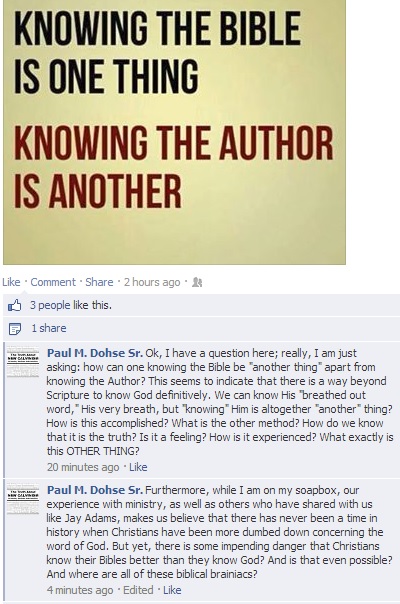

The Pauline approach to sanctification is an affront to contemporary Christianity. That’s the dilemma we face. Protestantism, which includes Baptists et al, is dumbed down by ecclesiastical design. On April 25, 1518, Martin Luther declared war on the priesthood of believers and sanctification via his declaration of Reformed theology in Heidelberg, Germany. The 95 Thesis was a moral treatise against Rome six months prior, but the Heidelberg Disputation was the very foundation of Reformed ideology. It called on theologians to interpret all of reality from a dual perspective: the glory story or the cross story.
True theology (the cross story) would look at man as worthless and empty with eyes of faith that can only see outward to the glory of God. This made all reality good as the sum equation of God’s goodness and man’s evil. So, tragedy only reflects man’s worthlessness and his deserved plight and the glorification of God following. The glory story was anything that recognized anything IN man at all. No goodness or grace is infused into man. True theology is a purely outward look, and only looks within to find reason for repentance that then glorifies God (“deep repentance”). Luther believed that man can experience the grace of God, but cannot participate in it. That would be works salvation. Man must empty himself to be saved and remain empty till the final judgment.
Hence, any notion that man could become good through salvation was deemed heretical, and a damning false gospel. In many ways, it was predicated on the Platonist idea that all matter is evil, and that would of course include man. The first sentence of the Calvin Institutes (CI 1.1.1) is based on Luther’s dual construct, and then the rest of the Institutes build a full metaphysical statement on the foundation of that first sentence. Pretty impressive. In that sentence, Calvin states that all wisdom is derived from a knowledge of us and knowledge of God. The two opposites define each other. Both Calvin and Luther were followers of Augustine who was the undisputed first and foremost integrationist in Western culture. Plato integrated Eastern mysticism with Western science, and Augustine integrated Platonism with the Bible. A cursory observation of world history makes this plain.
Therefore, the good Luther/Calvin cross theologian heartily agrees with, “study to show thyself approved, a workman that need not be ashamed.” But in the Protestant construct that redefines sanctification (and actually rejects it totally), what does “study” mean? What does “approved” mean? And what does “workman” mean? The Reformers did not believe anybody is approved. They believed work in sanctification (the Christian life) was equivalent to works salvation. Augustine, Luther, and Calvin believed baptism replaced circumcision, and sanctification replaced the Old Testament Sabbath Rest. Working on the Sabbath would bring death, and in the same way, working in sanctification also brings death (John King: The Complete Bible Commentary Collection of John Calvin; Genesis, Ch.2 sec.3, Ch.17 sec.13. Ibid: The Harmony of the Law, Due. 5:12-15, sec. 15). A good example how this demonstrates itself in the contemporary mindset follows. It was sent to me by a reader of the PPT blog:

Of course, as we have discussed many times, statements like this make no distinction between sanctification and justification.
So, “study” is really a focus on what ANY Bible text says about mankind’s wretched, sinful existence as opposed to God’s holiness. When the equation is seen, a steady flow of Christ’s obedience is imputed to our account and we remain justified. These manifestations may, or may not be experienced, but if they are, it is in the realm of the subjective where even the experience cannot be somehow attributed to us. This selfless, daily bearing of the cross and dying to self will lead to joy, but we do not know if this joy is directly linked to a Christ manifestation. The gospel is objective and remains outside of us, but is experienced subjectively. Any inward focus leads to inward subjectivity and as John Piper stated it, “imperils the soul.” It is merely an application of Eastern Mysticism to make sanctification by justification possible.
This is why Luther despised reason and called it a prostitute that should have “dung” rubbed in her face to “make her ugly.” Reason is the glory story. Our ability to reason has to do with an inner ability apart from God. Our “study” is limited to seeing the cross more by a greater and greater realization of our God unlikeness. Our “work” is this study and contentment in the ruin that God has sovereignly placed us in. But of course, “Contentment with godliness is great gain.” That is knowing our own place in the caste system which is sovereignly determined by birth. Supposedly, working hard at being content in our own wretched station of life is not work—it’s faith. Problem is, Luther et al considered that to be saving faith as long as it is practiced in sanctification. You do the math. There is a standard for what isn’t work in sanctification and what is work in sanctification for the purpose of remaining justified.
That is why we argue that justification must be a finished work separate from our Christian life. The conclusion of Paul’s treatise on justification in chapters 1-11 should lead to a free and aggressive sanctification. Though the Scripture has much to say about the colaboring of the Holy Spirit with us in sanctification and the reality that He makes it possible, I think the following quote by RC Sproul during a moment of sanity sums up the point well:
Sanctification is cooperative. There are two partners involved in the work. I must work and God will work. If ever the extra-biblical maxim, “God helps those who help themselves,” had any truth, it is at this point. We are not called to sit back and let God do all the work. We are called to work, and to work hard. To work something out with fear and trembling is to work with devout and conscientious rigor. It is to work with care, with a profound concern with the end result” (RC Sproul: Pleasing God p. 227).
If I am not mistaken, this is the only citation from Christian academia in this whole series on Romans, but again, I think it is worth getting in for the way it is stated. Though Paul was no less dependent on the power of the Spirit than anyone who has ever lived, he at times was brutally practical:
2Corinthians 9:1 – Now it is superfluous for me to write to you about the ministry for the saints, 2 for I know your readiness, of which I boast about you to the people of Macedonia, saying that Achaia has been ready since last year. And your zeal has stirred up most of them. 3 But I am sending the brothers so that our boasting about you may not prove empty in this matter, so that you may be ready, as I said you would be. 4 Otherwise, if some Macedonians come with me and find that you are not ready, we would be humiliated—to say nothing of you—for being so confident. 5 So I thought it necessary to urge the brothers to go on ahead to you and arrange in advance for the gift you have promised, so that it may be ready as a willing gift, not as an exaction.
Much can be learned from this passage about sanctification—not least of all in regard to the issue and application of accountability. Sanctification is a many-faceted, aggressive endeavor. It is full of practical and wise life application, and the Holy Spirit is ever willing to aid us accordingly.

 Paul's Passing Thoughts
6 comments