Religious Tyranny: A Case Study; Chapter Two, The Insurgency
Front Cover
As shared in Chapter one, Clearcreek Chapel was a church endowed with changing people because its ministry in general, including the pulpit ministry, was driven by Dr. Jay Adams’ biblical counseling construct. The framework focused on in-depth application of scriptural wisdom to life as opposed to merely living by “biblical generalities.” It rejected a medical model of sin and insisted on people “owning their sin” and taking responsibility for their failures. As we will see as this study progresses, the powerful living displayed at the Chapel during the 90’s was due to this model being partially correct in a biblical sense while maintaining too much fatal orthodoxy.
Said another way, until this time in church history, the church had a confused and tepid relationship with the concept of obedience, but the biblical counseling movement merely emphasized it more than it had ever been emphasized before. Of course, this is because Adams witnessed the cause and effect results demonstrated by Mowrer and applied it to biblical counseling while at the same time summarily dismissing Mowrer’s model as humanistic. As stated in the first chapter, we will be revisiting this major point with all zeal.
Protestantism has always had an uneasy and confused relationship with obedience because its most monstrous and evil nemesis, salvation by works, has its own application for obedience. As a result, obedience has always been seen as a possible Trojan horse whenever it presents itself in the church. The biblically intelligent obedience of Adams’ construct that was yielding change in the church was the elephant in the room. Everyone loved what was going on, but were privately uneasy when they heard, “The power is in the doing.” Adams, nor anyone else in the movement ever clarified why it was alright to believe that obedience is curative. How is obedience to the law for salvation not obedience to the law for salvation in Christian living? What’s the difference? How is obedience sanctified for Christian living? These questions were never answered because in reality most Protestants don’t even know enough to ask the question to begin with. One thing had not changed with the advent of the biblical counseling movement; the traditional Protestant confusion over the Holy Spirit’s role in the Christian’s life.
At this point in the study, we will unveil one of its major theses that begins to answer our stated interpretive questions: after the American Revolution, authentic Protestant orthodoxy became very confused. The fact is, the doctrine of the Protestant Reformation, at least according to the philosophy it was founded on, was extremely consistent and all ideological dots connected with a logical premise and conclusion. Yes, Reformation soteriology was a masterpiece of intellectual consistency. But moving forward post-Revolution, it became a mixture of original tenets and other ideas; hence, Protestantism became a morass of functionality that contradicted its intellectual proclamations. For example, many Protestants would become indignant in regard to the idea that people are saved by church membership, but the way “Christians” function in regard to that idea is altogether a different story.
In essence, freedom happened. In the same way that the Protestant Reformation made chaos of Catholic orthodoxy, the American Revolution made chaos of Protestant orthodoxy overseen by the Puritan theocracy that had ruled over the colonies. Post-Revolution and moving forward, Protestant orthodoxy became a paradoxical nightmare held together with specific talking points. These talking points sounded intelligent and pious, but if thought out to their logical conclusions—utterly mindless. The Adams biblical counseling revolution only fixed part of this problem with a stronger nod towards intelligent obedience. But as stated earlier, it was an uneasy coexistence. It was a revival with doubt running in the background.
Now we come to one of the more significant events in all of contemporary church history. In the exact same year that Jay Adams unleashed the biblical counseling movement, another movement was born and the significance of this other movement is historically profound. Though the history of how this movement came about will not be addressed in this study, its proposition and advent will be. The theological think tank that spawned this other movement was dubbed “The Australian Forum” and its primary thinkers were comprised of two Anglican theologians, a Seventh-day Adventist theologian, and a Reformed Baptist.
What was their proposition? Namely, that the true Protestant Reformation gospel had been lost. Furthermore, contemporary Calvinists were deemed guilty of swaying away from the true Reformed tradition, and evangelicalism wasn’t even in the gospel ballpark. This movement led to a worldwide insurgence known as the New Calvinist movement. It boasted, and still does, a return to the true Protestant gospel more than 500 years after the fact, and labeled all church as lost in a “sea of subjectivism” and falsehood.
And, in regard to what the Protestant Reformation was really about, they were, and are, exactly correct in that assertion.
This unequivocal fact stands as a monument for all time: the who’s who of contemporary church scholarship has all but admitted that it was wrong for more than 200 years, and the church was saved by a Seventh-day Adventist in 1970 although they like to leave out the Seventh-day Adventist part. This led to a massive covert insurgency movement within the church from 1970 to the present. In Sothern Baptist circles it has been decried as “aggressive Calvinism” and “high controlling churches.” But what is it really?
The Clearcreek Chapel story is a perfect microcosm of this worldwide church event because the insurgents of this movement who came to the Chapel were early foot soldiers of the movement. The Chapel study therefore gives us insight into the real Protestant gospel and its fallout when practiced in the milieu of life. It is the face of religious tyranny and cultism, and the Clearcreek Chapel story is the story of innumerable people and church events. It is the prototype of the New Calvinist meta-narrative. It is also instructive regarding the way home to true freedom in our beloved Christ.
But before we delve into the Chapel narrative further, what is the proof for this outrageous proposition? Contemporary church history is the proof; specifically, the Calvinist civil war.
Chapter Three: The Calvinist Civil War Named “Sonship”
Chapter Four: The Arrival of “Ravenous Wolves”
Religious Tyranny: A Case Study; Introduction and Chapter One
Cover: Religious Tyranny; A Case Study
Preamble
I need another project right now like I need a hole in the head; nevertheless, recent events have impressed upon me the immediate need for this work. As I accomplish each part I will be posting it here on PPT and making all readers part of an editing committee. So, comment here, email me here mail@ttanc.com, and pass judgment on content, grammar, style or whatever else editors do. The compilation will be available in a free ebook or hardcopy book form that can be purchased.
Thank you for your input.
paul
Introduction
“…I have sworn upon the altar of god eternal hostility against every form of tyranny over the mind of man.” – Thomas Jefferson to Dr. Benjamin Rush, September 23, 1801
This book flows not from the winepress of sour grapes, but rather from thankfulness. Whether secular or religious tyranny, these endeavors always yield freedom. Tyranny was a usurper into God’s creation and challenges man’s innate need to be free. Therefore, sin finds itself in a quandary; it is utterly driven by a lust to enslave, but this will eventually drive men to a fight or flight. Tyranny is affliction, but it will always awaken man to his freedom duty. For this, we can be thankful.
This book is an in-depth look into religious tyranny using Clearcreek Chapel in Springboro, Ohio as a case study. However, this case study is a story that reads like most church experiences in our day, and the personal testimonies read the same as well. The information written within will come from the author’s firsthand experience and the testimonies of others, but there is no need to focus on a few people when this is the like testimony of many. Hence, the study will focus on common experiences and not particular individuals.
Most people are saved according to the experience described by the apostle Paul in 1Thessalonians 1:5,
For our gospel came not to you in word only, but also in power, and in the Holy Ghost, and in much assurance; as you know what manner of men we were among you for your sake (KJV).
Yet, most professing Christians doubt their salvation, and furthermore, most professing Christians know there is something fundamentally missing in church; something isn’t right, but they can’t put their finger on it. The present mass exodus from the institutional church is well documented while most people leaving the church don’t know specifically why they are leaving. They are leaving because something is missing, but they are not sure what that something is. The salvation that came with much power and assurance has faded into doubt and indifference.
On the other hand, the church, whether Catholic or Protestant, seems to be supported by many others who are unwavering despite tyranny, illogical contradictions, hypocrisy, and evils not even spoken of in the secular world. How can this be? How can a church like Clearcreek Chapel now embrace beliefs that would have been rejected out of hand with extreme prejudice by the same Chapel parishioners twenty years prior? How can the present leadership behave in a way that would not have been tolerated for a moment twenty years prior by the same people who now embrace it wholeheartedly?
This study proposes to answer all of these questions in no uncertain way, but one final question needs to be answered to complete the study; once the indictment is clarified, what should our response be? What is the solution?
So then, how can we have full assurance of salvation? What is wrong with church? Why is tyranny acceptable? And what should we do about it?
Because only truth sanctifies (John 17:17),
Paul M. Dohse Sr.
Chapter One: The Chapel’s Unique Place in Church History
Clearcreek Chapel in Springboro, Ohio played an important and telling role in contemporary church history. Founded by a young Dr. John D. Street in the latter 1980’s, it sought to be relevant in contemporary culture. Dr. Street often described the church at that time as “ministering to the present culture while wearing bellbottom pants.” Street also patterned the Chapel ministry after his mentor, Pastor John MacArthur Jr.
Dr. Street also made an emerging movement at that time a hallmark of the Chapel ministry; the biblical counseling movement founded by Dr. Jay Adams. The advent of said movement began with Adams’ controversial book, “Competent to Counsel” (1970). The Chapel became a training center for the biblical counseling movement founded by Adams, and in large part a face of the biblical counseling movement.
Adams, a Presbyterian minister, was provoked by his own confession that he was unable to help people with serious problems, and indicted the church as a whole in the same way. What made this indictment painfully obvious was the integration of secular Psychology into religious thought during the 1980s. This integration was a movement that peaked in the 80’s. Help could not be found in the church so people looked for help outside of the church. The biblical counseling movement peaked in the 1990’s and this is when it experienced a true biblical revival, and Clearcreek Chapel was one of the epicenters of that spiritual awakening.
It is now very important to explain what that revival looked like because the implications are profound. This is the first point in beginning to answer the questions presented in the introduction: what’s wrong with church? Why do so many Christians doubt their salvation? Why do so many embrace churches that practice open tyranny? And lastly, what should we do about it?
If most Christians are honest, they see very little progressive change in the people they attend church with. If most Christians are honest, they admit people who are saved from the outside secular world into an enduring life testimony are very few and far in-between. Yet, this was not what was going on at the Chapel during the 90s. In one year (1995) as a result of the biblical counseling focus, twelve people were saved in 1Thessalonians 1:5 fashion and stayed the course. During this time other churches influenced by the Chapel shared the same testimony.
But let’s back up for a moment; Jay Adams’ testimony is startling. As one who came from the elitist hallowed halls of Protestant brain trust, he openly admitted himself that he was clueless in regard to helping people with real life problems. Furthermore, this was his indictment against the church at large as well. We must pause and ponder this fact soberly; after more than 500 years and oceans of Protestant scholarly ink, it was commonly accepted that most ministers were unable to take the word of God and help people with serious problems. There is a very simple answer in regard to why that was the reality and still is, and we will arrive there in due process. But before we move on, it is interesting to note that while the Protestant brain trust openly confessed its inability to help people with deep personal problems, it wailed and screamed in sackcloth and ashes that the void was filled with secular Psychology.
The brainchild of Adams’ biblical counseling construct is even more startling. In beginning his quest for helping people with real problems, he sought out none other than O. Hobart Mowrer, a notable secular Psychiatrist who fathered a kind of responsibility therapy movement championed by the likes of Dr. Phil McGraw and Dr. Laura Schlessinger. Adams wrote in the introduction of Competent To Counsel,
Reading Mowrer’s book The Crisis in Psychiatry and Religion, as I said, was an earth-shaking experience. In this book Mowrer, a noted research psychologist who had been honored with the Presidency of the American Psychological Association for his breakthrough in learning theory, challenged the entire field of psychiatry, declaring it a failure, and sought to refute its fundamental Freudian presuppositions. Boldly he threw down the gauntlet to conservative Christians as well. He asked: “Has Evangelical religion sold its birthright for a mess of psychological pottage?”
In Crisis, Mowrer particularly opposed the Medical Model from which the concept of mental illness was derived. He showed how this model removed responsibility from the counselee. Since one is not considered blameworthy for catching Asian Flu, his family treats him with sympathetic understanding, and others make allowances for him. This is because they know he can’t help his sickness. He was invaded from without. Moreover, he must helplessly rely on experts to help him get well. Mowrer rightly maintained that the Medical Model took away the sense of personal responsibility. As a result, psychotherapy became a search into the past to find others (parents, the church, society, grandmother) on whom to place the blame. Therapy consists of siding against the too-strict Super-ego (conscience) which these culprits have socialized into the poor sick victim.
In contrast, Mowrer antithetically proposed a Moral Model of responsibility. He said that the “patient’s” problems are moral, not medical. He suffers from real guilt, not guilt feelings (false guilt). The basic irregularity is not emotional, but behavioral. He is not a victim of his conscience, but a violator of it. He must stop blaming others and accept responsibility for his own poor behavior. Problems may be solved, not by ventilation of feelings, but rather by confession of sin.
From my protracted involvement with the inmates of the mental institutions at Kankakee and Galesburg, I was convinced that most of them were there, as I said, not because they were sick, but because they were sinful. In counseling sessions, we discovered with astonishing consistency that the main problems people were having were of their own making. Others (grandmother, et al.) were not their problem; they themselves were their own worst enemies. Some had written bad checks, some had become entangled in the consequences of immorality, others had cheated on income tax, and so on. Many had fled to the institution to escape the consequences of their wrongdoing. A number had sought to avoid the responsibility of difficult decisions. We also saw evidence of dramatic recovery when people straightened out these matters. Humanistic as his methods were, Mowrer clearly demonstrated that even his approach could achieve in a few weeks what in many cases psychotherapy had been unable to do in years.
I came home deeply indebted to Mowrer for indirectly driving me to a conclusion that I as a Christian minister should have known all along, namely, that many of the “mentally ill” are people who can be helped by the ministry of God’s Word. I have been trying to do so ever since.
This experience was the breakthrough that launched the biblical counseling movement and its subsequent success. Without Mowrer’s observations, the biblical counseling movement never happens. Nevertheless, Adams then states the following in the same introduction:
Let me append one final word about Mowrer. I want to say clearly, once and for all, that I am not a disciple of Mowrer or William Glasser (a writer in the Mowrer tradition who has become popular recently through the publication of Reality Therapy,a book that has confirmed Mowrer’s contentions in a different context). I stand far off from them. Their systems begin and end with man. Mowrer and Glasser fail to take into consideration man’s basic relationship to God through Christ, neglect God’s law, and know nothing of the power of the Holy Spirit in regeneration and sanctification. Their presuppositional stance must be rejected totally. Christians may thank God that in his providence he has used Mowrer and others to awaken us to the fact that the “mentally ill” can be helped. But Christians must turn to the Scriptures to discover how God (not Mowrer) says to do it.
All concepts, terms and methods used in counseling need to be re-examined biblically. Not one thing can be accepted from the past (or the present) without biblical warrant. Biblical counseling cannot be an imposition of Mowrer’s or Glasser’s views (or mine) upon Scripture. Mowrer and Glasser have shown us that many of the old views were wrong. They have exposed Freud’s opposition to responsibility and have challenged us (if we read their message with Christian eyes) to return to the Bible for our answers. But neither Mowrer nor Glasser has solved the problem of responsibility. The responsibility they advocate is a relative, changing human responsibility; it is a non-Christian responsibility which must be rejected as fully as the irresponsibility of Freud and Rogers. At best, Mowrer’s idea of responsibility is doing what is best for the most. But social mores change; and when pressed as to who is to say what is best, Mowrer falls into a subjectivism which in the end amounts to saying that each individual is his own standard. In other words, there is no standard apart from God’s divinely imposed objective Standard, the Bible. Tweedie is correct, therefore, when he rejects Mowrer’s “projected solution” to the problem of sin as an “acute” disappointment.
During the years that followed, I have been engrossed in the project of developing biblical counseling and have uncovered what I consider to be a number of important scriptural principles. It is amazing to discover how much the Bible has to say about counseling, and how fresh the biblical approach is. The complete trustworthiness of Scripture in dealing with people has been demonstrated. There have been dramatic results, results far more dramatic than those I saw in Illinois.
In light of the entire context stated here, Adams’ paradoxical twist on Mowrer is both stunning and perplexing, but don’t miss the much larger point; Adams’ perspective as documented here is profoundly indicative of what is fundamentally wrong with church. Yes, it is the something that is wrong that few are able to put their finger on. However, we are still in the history stage of our study. In regard to why Clearcreek Chapel is a paramount case study for religious tyranny, we are still laying the historical groundwork.
Chapter Two: The Insurgency
PPT Will Pen an In-Depth Exposé on Clearcreek Chapel
 In the near future, PPT will publish an in-depth exposé on Clearcreek Chapel in Springboro, Ohio. This will include its history and an in-depth profile of past and present elders. Also, its litany of unresolved conflict with many Christian families will be documented in painstaking detail.
This is in response to the constant flow of longstanding emotional suffering flowing out of this “ministry” that refuses to cease or even slow down. Particular attention will be paid to the rabid lust for controlling others practiced by the Clearcreek elders.
And lastly, evangelical organizations, churches, individuals, and pastors who enable their behavior will also be profiled.
This project will surpass any level of in-depth research performed by TANC Ministries since 2009, and will be accompanied by aggressive widespread publication.
The goal is to temper the suffering foisted upon unsuspecting people by Clearcreek Chapel that is constantly brought to our attention by those seeking counsel.
How should such organizations be responded to? That question will be explored as well.
Paul Dohse
TANC Ministries
The Protestant Twisting of 1John: A Clarification, Part 1
Originally published March 22, 2015
Listen to audio or download audio file.
Welcome to Blogtalk Radio False Reformation this is your host Paul M. Dohse Sr. Tonight, we are going to attack and unravel interpretive abuses of 1John, particularly 1John 1:9 and 2:1. There is only one other text twisted for ill use more than these two verses, and that would be Galatians 2:20 and 3:1-3. Later, In part 2, I will toss in an exegesis of those verses as a bonus.
There may be a lot of different religions and even more denominations, but for all practical purposes they all have one thing in common: this whole idea that salvation is a process with a beginning and an end. This makes salvation a process that includes our present life.
So, the argumentation between religions and denominations involves the correct way of getting from point A to point B. But there is no point A and point B. When you believe God unto salvation, you get the complete package and the salvation part of your life is finished. It is an instantaneous quickening of the Spirit that transports you from one kingdom to another, from one master to another, from being under law to being under grace, from the old person to the new person, and from darkness to light. You don’t become a servant of righteousness on the installment plan, and you don’t become a kingdom citizen on an installment plan.
How is 1 John used to argue for a progressive salvation, and what is John really saying in his epistle? Way back at the beginning of this ministry, I had this nailed down. If salvation is a process, and eternal life as opposed to eternal punishment is at stake, the Christian life is really a minefield. The focus isn’t being the best kingdom citizen; the focus is making sure you don’t mess up your salvation. The focus is salvation, not discipleship. The focus is fear of judgement, not love.
I realize many Christians hold to OSAS, “Once saved – always saved”, but the problem is how they are led by pastors trained in seminaries deeply grounded in Protestant tradition. That tradition looks to the institutional church as the primary way of getting God’s people from point A to point B in regard to their salvation. Whether OSAS or not, they are led to do the same things week in and week out. Be here at this time or that time; stand up; sing; sit down; listen to announcements; stand up; sing; sit down; listen to the special music presentation; put your tithe in the plate; listen to the sermon (always about the gospel just in case there are lost people present, wink, wink); stand up; sing “Just As I Am” until someone walks the isle so you can stop singing “Just As I Am”; pray; be dismissed; be cordial to people and tell them how much you love them; go home, and come back next week and do it again.
Why? Because all of that ritualism “imparts grace” and enables us to “grow in grace.” It enables us to “grow up in our salvation.” After all, discipleship is the “growing part of our salvation.” We have all said it, but salvation doesn’t grow. While believing in OSAS, most parishioners are led by pastors who believe in progressive salvation/justification which was clearly the foundational premise of Protestantism with the progression being overseen by the Protestant institutional church.
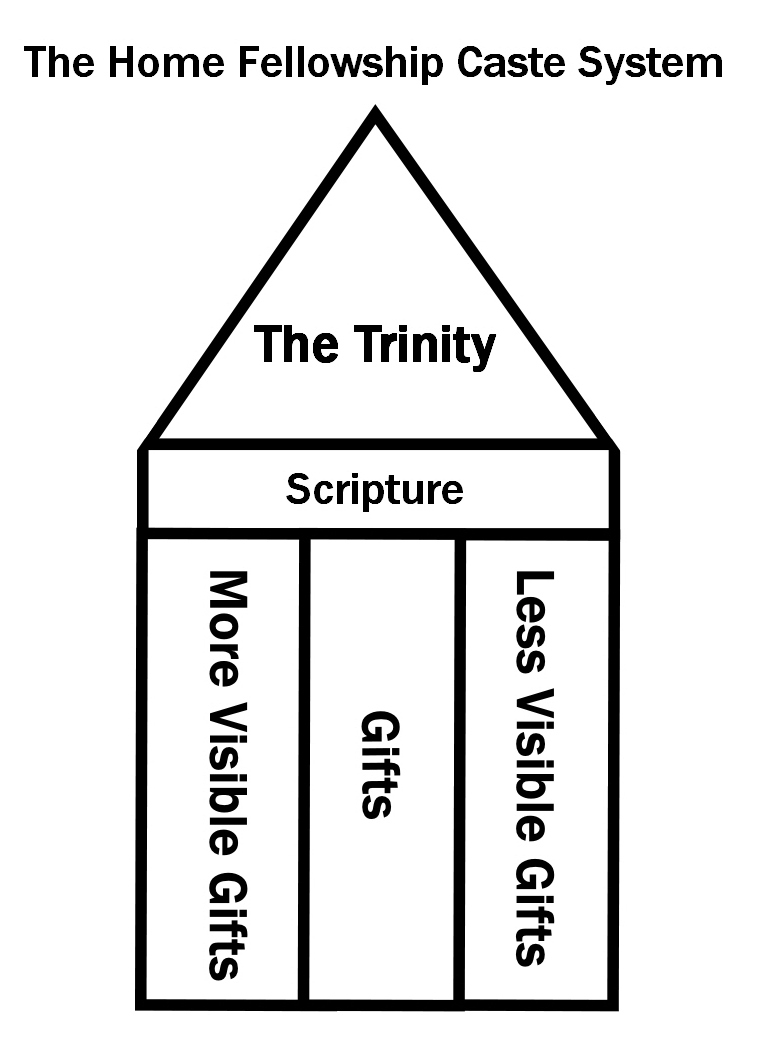
Moreover, let’s face it; while believing in OSAS, there is only one reason people put up with all of the nonsense and drama of the institutional church—OSAS means that if someone leaves the institutional church, they were never saved to begin with. Right? In other words, they function according to the idea that they are led by. It’s OSAS as long as you are “faithful” to the institution. Then each church has its own little “faithfulness” caste system. Those who show up for all of the services are the “core members” that run the church. Those “less faithful” that only come on Sunday mornings are a lower class of member in the caste system.
You have the pastors, staff and deacons, then the “faithful” that attend all of the services and tithe at least 10%, the “casual” attenders that tithe, and then the bottom of the caste strata, even lower than the serfs, the putrid “nonmembers.”
Whether Calvin or Luther, the two icons of Protestantism, these beliefs follow after the doctrine they established for the Protestant institutional church. Access to the institutional church was through water baptism, and the critical need according to the Reformers for formal church membership follows: as Christians, forgiveness for present and future sins can only be found in the institutional church, and those sins condemn us. Forgiveness for all sins does not occur at salvation, but only for past sins. Water baptism initiates us into church membership where forgiveness for present and future sins can be obtained through the sacraments; ie., “gospel preaching,” the Lord’s Table, and anything else deemed as acts of faithfulness to the institutional church not to exclude tithing by any means. Calvin states this explicitly in his institutes, 4.15.1.
All in all, you can say that in Protestantism, the status of sin does not change for the believer—it still condemns requiring perpetual resalvation for every sin committed.
Therefore, 1John 1:9 and 2:1 is interpreted in this light: “If we confess our sins, he is faithful and just to forgive us our sins and to cleanse us from all unrighteousness” (1:9). “My little children, I am writing these things to you so that you may not sin. But if anyone does sin, we have an advocate with the Father, Jesus Christ the righteous” (2:1).
These verses seem to bolster the authentic Protestant position on justification. Confession of sin in our Christian lives keeps us saved. And if we confess our sins, Jesus is up in heaven as our advocate with the Father continuing His work as a propitiation for our sins.
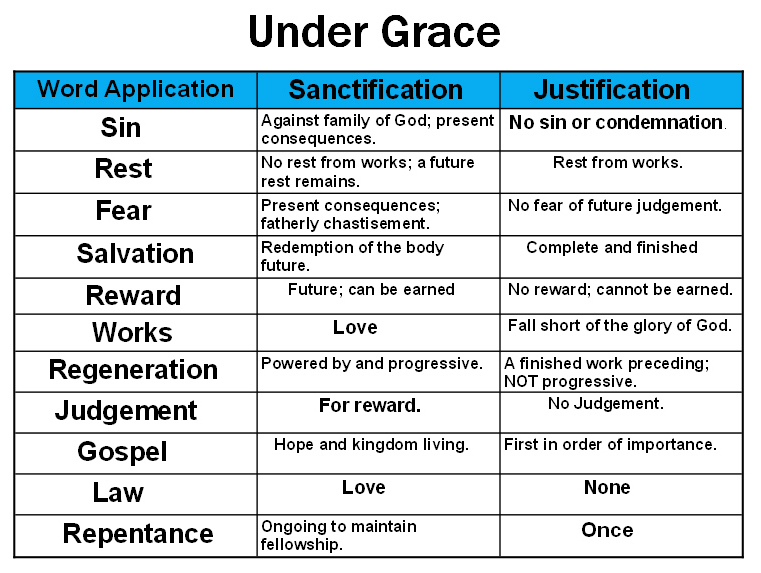
The problem is that this interpretation stands in stark contrast to what other Scriptures state about justification. Biblically, sin has a different classification after salvation—it can’t condemn; it can bring chastisement and present consequences, but it can’t condemn—its ability to condemn has been taken away. Hence, there is no need to have some institution that prevents future condemnation.
Nevertheless, it is easy to understand why the institutional church not only gets a pass on outrageous behavior, but the money keeps pouring in. What will people pay for their salvation and décor that glorifies the institution that saves them? Apparently, no price or compromise is too large. One can also appreciate the fear of so-called excommunication because the institutional church is the only place where one can receive continued forgiveness for present and future sins.
Before I move on, I will solidify my present point. Romans 8:1 states that there is presently NO condemnation for those who are in Christ. In Contrast, Calvin stated that “even saints cannot perform one work which, if judged on its own merits, is not deserving of condemnation” (CI 3.14.9, last sentence). Obviously, the focus is going to be avoiding condemnation, not our freedom to pursue aggressive love in discipleship.
So what are these verses in 1John really saying? Let’s begin to unpack that using the historical grammatical approach to interpretation as opposed to the traditional Protestant means of interpretation, the historical redemptive method. Since Protestantism sees salvation as a process, “redemptive” means that the Bible must be approached with a redemptive prism; ie., the Bible is about salvation. Clearly, this is eisegesis; going to the Bible with a presupposition.
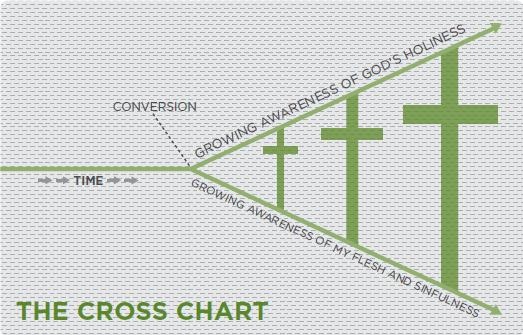
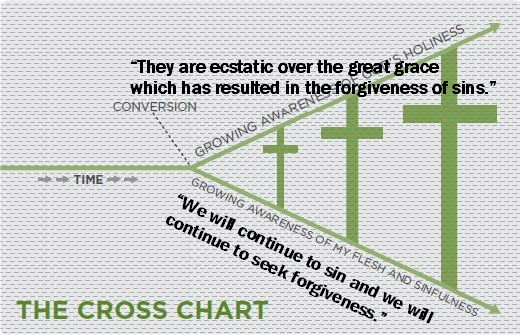
In regard to the history part, this is the belief that history is an unfolding drama about salvation. Hence, all of reality is interpreted through salvation. All of history and the Bible continually reveals the one two-fold redemptive truth/reality: the sinfulness of man and the holiness of God. Salvation begins when we see or understand this reality, and the experience of that reality increases until final salvation.
In contrast, the historical grammatical method uses historical facts to bring more meaning to the text, and all truth is determined by what can be concluded by the grammar—this is known as exegesis. All meaning and truth comes out of the text without anything being read into the text except conclusions from other texts.
In fact, Protestant tradition holds to the idea that a historical grammatical approach to the Scriptures invariably leads to works salvation. Protestant tradition insists that the Scriptures must be interpreted through the prism of total depravity. In this year’s TANC conference, this is what I am going to be hitting on. Christians, save a few, have no idea that Protestant pastors that are leading them view reality in a totally different way than most parishioners. And this is why church looks like it does. And there is no salvaging it—it’s a completely broken system.
So, if you interpret said verses in 1 John redemptively, it fits right into their narrative, right? You have to continue to repent for new sins in your Christian life in order to not be condemned and to keep your salvation. A good old fashioned Baptist lady who I am sure would hold OSAS stated this to my wife Susan in the grocery store a couple weeks ago. When Susan asked her why Christians need to go forward during alter calls, she answered, “they have sin that needs to be forgiven.” Well, why can’t they get that forgiveness by praying at home? You ought to see the reaction Susan and I get when we suggest her mother was saved even though not a member of a church.
Protestantism and all of its offshoots including the Baptists is nothing more or less than functioning Calvinism. Election isn’t the point, progressive salvation is the point. Protestants think salvation grows—salvation doesn’t grow—you are either forgiven once and for all time or you aren’t. Look, if you are going to stay in the institutional church, it makes absolutely no difference where you go. Please, stop driving 15 miles to the Baptist church when there is a Catholic Church right across the street—it’s a shameful waste of gas. It’s all progressive justification.
In contrast, we have to see 1 John in its exegetical historical context. It must be interpreted according to what was going on during the time that prompted this letter. And what was that?
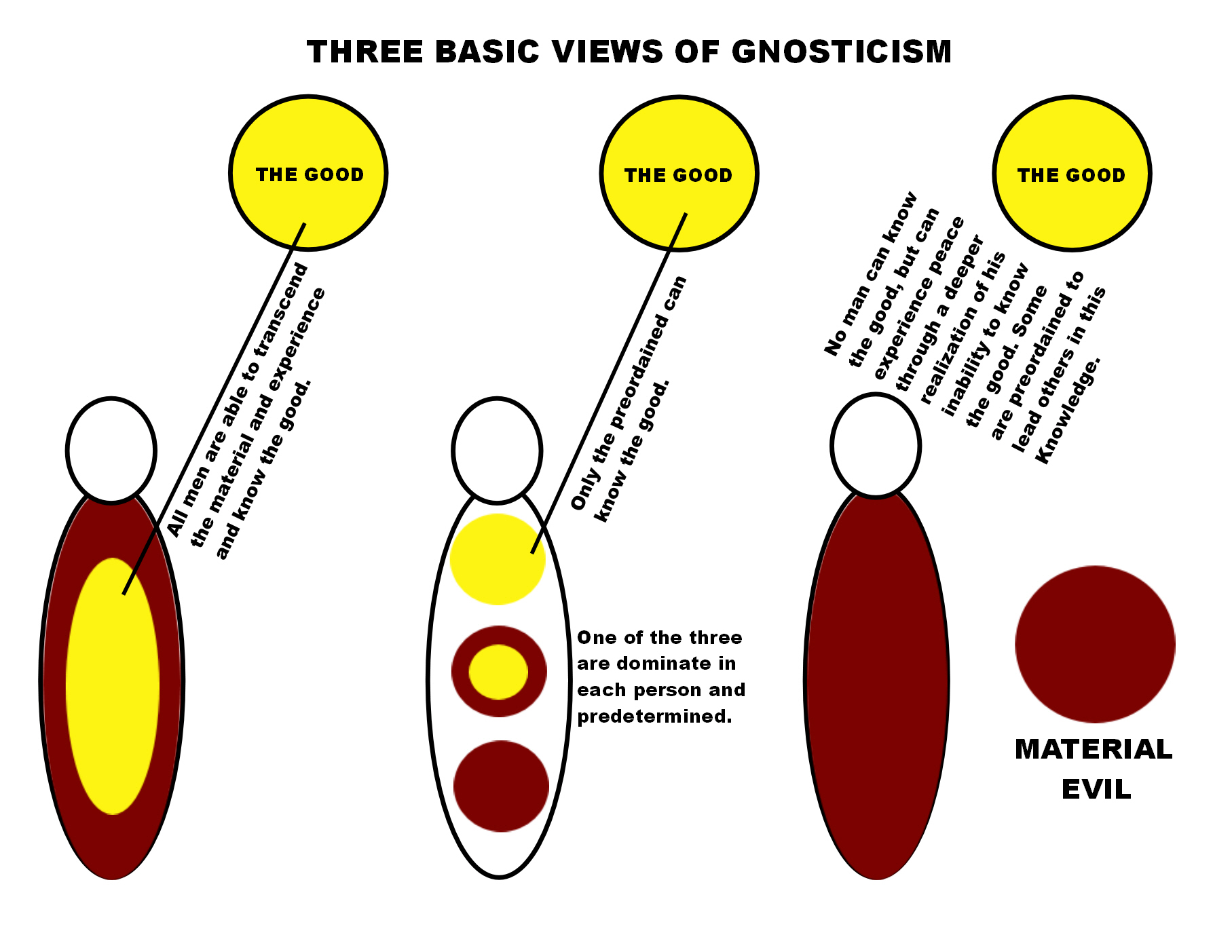
John was pushing back against the number-one nemesis of the assemblies during that time: Gnosticism. Now, there were many, many different veins of Gnosticism during that time, but like denominationalism, there are basics that are fundamentally the same. Denominationalism quibbles about how to get from point A to point B, but it is all progressive salvation.
When you understand the basics of Gnosticism, it is easy to see that John’s first epistle is a point by point rebuttal of Gnosticism, and NOT the proffering of progressive justification. Protestants can bicker with Catholics all they want to about how to get from point A to point B, but again, it’s all progressive justification. If it’s a religious institution, it’s selling final salvation, PERIOD.
If we follow John’s arguments in this epistle, it also apes the fundamental basics of Gnosticism, and that’s what we are going to do:
1 John 1:1 – That which was from the beginning, which we have heard, which we have seen with our eyes, which we have looked upon, and our hands have handled, of the Word of life; 2 (For the life was manifested, and we have seen it, and bear witness, and shew unto you that eternal life, which was with the Father, and was manifested unto us;) 3 That which we have seen and heard declare we unto you, that ye also may have fellowship with us: and truly our fellowship is with the Father, and with his Son Jesus Christ. 4 And these things write we unto you, that your joy may be full. [KJV].
The Gnostics taught that it really wasn’t the spiritual Christ that died on the cross. Gnosticism holds to the idea that material is evil and only the invisible spiritual world is good. Gnosticism rejected the idea that the spiritual realm, or godhood can be one with the material. You must understand: the biblical concept of God-man is a direct affront to the foundation of all false religions, or the knowledge of good and evil. It is the idea that true knowledge cannot be one with the material. Knowledge is good, material is evil and is only a shadow of true knowledge. Knowledge of the material is enslaved and dependent on the five senses.
Now, stop right there. Let me simplify this for you. All false religion flows from the religion of the knowledge of good and evil presented to Eve in the garden. This is also the first sentence of the Calvin Institutes and all of the Calvin Institutes flow from the foundation of 1.1.1., first sentence, viz, ALL wisdom is the knowledge of man and the knowledge of God; man is inherently evil and God is inherently good.
Also, the first sentence of the Calvin Institutes is the primary theses of Luther’s Heidelberg Disputation which is the Magnum Opus of the Reformation. All fundamentals found in contemporary evangelicalism can be found in the Heidelberg Disputation and flow from it. Calvin’s Institutes further articulated the former. In contemporary evangelicalism, we hear constantly that true biblical knowledge is “the knowledge of our own sinfulness as set against God’s holiness.” This is also the pronounced fundamental foundation of the contemporary biblical counseling movement as constantly stated publically in no uncertain terms.
Why am I interjecting this? Because even though much of our knowledge concerning first century Gnosticism comes from the writings of the early church fathers and while they railed against Gnosticism, they themselves were also Gnostics. However, in the process of railing against Gnosticism, they confirm unequivocally that John’s letter addressed the Gnosticism of their day; it just wasn’t the Gnosticism that they preferred.
And by the way, according to some church fathers, John was addressing a Gnostic named Cerinthus who was a contemporary of John and a personal nemesis.
Cerinthus was a gnostic and to some, an early Christian, who was prominent as a heresiarch in the view of the early Church Fathers. Contrary to proto-orthodox Christianity, Cerinthus’s school followed the Jewish law, used the Gospel according to the Hebrews, denied that the Supreme God had made the physical world, and denied the divinity of Jesus. In Cerinthus’ interpretation, the Christ came to Jesus at baptism, guided him in his ministry, but left him at the crucifixion.
He taught that Jesus would establish a thousand-year reign of sensuous pleasure after the Second Coming but before the General Resurrection, a view that was declared heretical by the Council of Nicaea. Cerinthus used a version of the gospel of Matthew as scripture.
Cerinthus taught at a time when Christianity’s relation to Judaism and to Greek philosophy had not yet been clearly defined. In his association with the Jewish law and his modest assessment of Jesus, he was similar to the Ebionites and to other Jewish Christians. In defining the world’s creator as the demiurge, he emulated Platonic philosophy and anticipated the Gnostics.
Early Christian tradition describes Cerinthus as a contemporary to and opponent of John the Evangelist, who may have written the First Epistle of John and the Second Epistle of John to warn the less mature in faith and doctrine about the changes he was making to the original gospel. All that is known about Cerinthus comes from the writing of his theological opponents (Wikipedia).
At any rate, the teachings of Cerinthus follow the basic fundamentals of 1st century Gnosticism of which there were two schools of thought unchanged from the cradle of society: intuitive knowledge within versus knowledge outside of man. While both schools held to the strict dichotomy of material being evil and the invisible good, and true knowledge being beyond the five senses, they disagreed on where that knowledge is found and whether or not it is intuitive among all men, or a select few preordained by nature or some supreme being.
Cerinthus followed the philosophical school of Idealism which holds to the belief that the one cosmic mind has an intuitive connection within every individual. Finding that knowledge is often a complex mind-numbing epistemology, but curiously, Luther and Calvin had their own angle that built on the Neo-Platonic teachings of St. Augustine.
This Gnostic bent actually allowed for Christ to be human, or at least some form of humanity. Apparently, God became exasperated with man’s penchant for trying to gain knowledge through the material world, and said in essence, “Ok, since you like to think you can know something and try to gain knowledge through the things that are seen, I am going to send my Son to die on the physical cross, and now all knowledge will only be gained through suffering—there mankind, take that!” This is the essence of the Heidelberg Disputation which is a philosophical treatise, not a theological one by any stretch of the imagination. Luther states plainly in the document that ALL knowledge is hidden in the suffering of the cross. Anyone who thinks they can understand Protestantism without a good grasp of world philosophy is sadly misguided. It is one of the historical necessities of historical grammatical hermeneutics.
Hence, in the Gnostic Protestant construct, Christ and His gospel is the only true objective knowledge and is outside of man. Man is not to seek any knowledge within himself, but all knowledge must be sought outside of him in contemplation of the gospel. All of reality is interpreted by the suffering of the cross. The cross is the epistemology from the material to the invisible, or from the evil to the good.
In contrast, other schools believe the epistemology is intuitive within all men because all men have a spiritual being separate from their material being, and the spiritual part of man is nonmaterial and therefore SINLESS. The material body of man is evil because it is material, but his invisible being is good and has a connection to the cosmic spiritual world that must be cultivated by transcending the material. This was key to the drug culture of the 60’s as LSD trips enabled the individual to transcend the five senses and see into the invisible spiritual world. Supposedly.
Other schools of thought believed that even though all men have a material and spiritual aspect, the spiritual anthropology has classifications in regard to who is able to see true knowledge and who isn’t as determined by the cosmos or cosmic mind; ie., determinism. And consequently, if utopia is to ever be achieved, those with the ability to see knowledge must rule over those who have the inability to transcend the material and are enslaved to it. How do you reason with people hopelessly enslaved to the material? They either understand that they can’t know reality and get with the program, or you kill them.
According to the Reformers, utopia is achieved by understanding that all reality is interpreted through the cross of redemption. This concept was established by Luther’s Heidelberg Disputation and is known as being a “theologian of the cross.” Theologians of the cross are able to know the “cross story,” or interpret reality through the cross, and all others are enslaved to the “glory story” or the story of man. This is the dichotomy of the knowledge of good and evil, or material versus spiritual.
Furthermore, the Reformers believed that the new birth entailed the gift of outward seeing only. All goodness remains outside of man. This is the pious distinction they claim over their fellow Gnostics. Unlike Cerinthus, who would be the modern equivalence of existentialism, no good can be in man, because that does not limit knowledge to suffering and the cross. Even though the early church fathers believed that material is evil and only the invisible is good like all ancient Gnostics, they labeled those heretics who believed that the invisible spirit within man was a connection to the good. That was heresy in their minds. And if you really understand what John Piper et al believe in our day, NOTHING HAS CHANGED.
The true Christians of that day had a different metaphysical take: the material realm is NOT evil, it’s weak. Something that is weak can still be good. The born again Christian struggles with sin because he/she is weak, not because the material realm is inherently evil. Christ really did come adorned in humanity in every since of the meaning because the material is not evil. This understanding of being fits together with the true gospel.
But what Cerinthus et al was teaching speaks directly to what John wrote in his first epistle, and we have addressed some of it in John’s introduction. John, in essence, said the following: Christ was 100% humanity and 100% God. We saw Him, we heard Him, we touched Him, we saw Him die on the cross, there isn’t two Christs, there is only one.
What Cerinthus et al taught explains everything John wrote in this epistle and why he wrote it. It not only explains why John wrote what he wrote in 1:9 and 2:1, it sheds light on why John wrote what he wrote in the rest of the book as well.
And that is what we will look at next. We will do a point by point fly over of 1 John while interpreting it according to this historical context of Gnosticism. John will address the definition of sin in contrast, the definition of knowledge and truth in contrast, the definition of the true gospel in context, the definition of love and hate in contrast, and the definition of the new birth in contrast.



The Reformation Counter-Reality
 The Reformers claimed, sola scriptura (truth based on Scripture alone). But in every case of any claim made by the Reformers of old or new, what they mean by any given word must be clarified. How did the Reformers define Scripture?
Here we begin to examine the Reformation’s redefinition of almost every word imaginable while allowing the masses to assume the normative definitions during indoctrination. If the people assume “nine,” but you want to bring them to “five,” you only talk about the “two” and the “three.” The nine is out of sight and out of mind. But also, during the process of bringing them to five, you allow them to assume two really means “two” and three really means “three.” In Reformed reality, the two and three really mean something different than the normally excepted grammatical definitions of two and three. Otherwise, both together would not equal nine which really means five in their reality. The goal is to get the masses to agree that nine really means five.
That’s a crass simplification, yet, the general idea. It may also be stated from the onset that this is a classic cult indoctrination technique. The technique deliberately excludes facts detrimental to the thesis and redefines words to collaborate a contrary truth. Nevertheless, this is a staple mode of communication among Reformed academia. Words mean what the Reformed academics deem them to mean, and you are the last to know until you see the world their way and it no longer matters. Those who define the words control how reality is perceived, and perception determines behavior. People act according to their logic.
How do people normally interpret information? And how do people normally process the reality that they are experiencing? Most people find their way in the world through natural assumptions. Few of us are taught anything different. As we grow up and mature, we assume that the world we live in is really as we perceive it, and we accumulate conclusions about life accordingly. When we went to grade school and learned words, we assumed that “cat” really means “cat” according to what we perceive a cat to be. We learned sentences such as, “The cat walked across the street,” “See Johnny run!” etc. When we read a newspaper or magazine and see sentences, we assume reported events really took place whether we were there or not. If the writer is telling the truth, a cat really walked across the street. Perception or understanding of the event is increased with more words; the color of the cat, the breed of cat, the name of the street crossed by the cat, etc. Relevant knowledge is what we use to negotiate the world we live in. This also assumes cause and effect, ability to comprehend reality, and some degree of control over our environment. Some call this, “free will.”
If you are being taught by someone who rejects these normative assumptions in a church venue, it is safe to assume that you have little or no mutual agreement in regard to the words being communicated. The words “two” and “three” are being used, but you assume those words do not add up to nine. The someone is allowing you to assume that they interpret reality in the same way you do. And, this description is the commonplace occurrence in most present-day Protestant churches.
Without getting into the realm of metaphysical theory, the Reformed principle will be stated simply, and then it will be confirmed as the standard mode of operation widely practiced in our day. It will also be established that this mode of operation flows from the historic roots and traditions of the Protestant Reformation.
The Imperative Command is Grounded in the Indicative Event
The Reformed principle is sometimes expressed as, “The imperative command is grounded in the indicative event.” The question now following is… “What in the world does that mean!” It begins by understanding that the Reformed use words that mean things to teach that words don’t always mean things. Let’s parse the statement with words that mean things. “Imperative command” simply refers to commands found in the Bible.1 The “indicative event” refers to Christ’s life and death as a historical event.2 Few realize the gravity of the cute play on words with the definition of the word, “history” as “His-story.” This is, in fact, a thumbnail phrase that expresses a vast metaphysical/philosophical body of thought and theory. It suggests that ALL reality is interpreted through the life of Christ. It suggests, as the only objective presupposition, that all of history and reality are interpreted through the one historical event. It is history as reality, and the Christ event is the lynchpin of the story. History is a story, and the story is reality. This is NOT difficult to understand; the danger is letting the simplicity of it escape you because of presuppositions that assume complexity. What the Reformed have done is used thousands of different sub-concepts to teach this one, simple, primary concept.
The key to understanding this view of reality is a focus on perception. In the Reformed worldview, humans are only able to truly perform one function: they are able to perceive things, or see things. Everything else is mere experience. Again, just follow the meaning of the words used here and put them together for a logical conclusion, this is very simple to understand. Again, the danger is being confused by the simplicity of it due to presuppositions.
According to the Reformed worldview, reality is divided into two categories; active and passive. In other words, there is active reality and passive reality. Humans belong to the passive reality, or realm. The passive reality, or realm, includes things like water; until water is acted upon, it is dormant. Items in the passive realm only operate according to the actions of the active realm. In essence, we are dealing with two realms, and NOTHING happens in the passive realm unless it is acted upon by the active realm. Please note: according to this principle, those things in the passive realm that perceive that an action is being initiated in the passive realm are only experiencing the action, but are not performing it. Though the action is very much experienced as something initiated by the will of the being dwelling in the passive realm, it is an illusion—the action is only being experienced and not performed. Free will, and cause and effect within the passive realm are illusions. Cause and effect is split between the two realms: cause is only possible in the active realm, and all actions in the passive realm come from the active realm.
So, what is the purpose of this seemingly futile worldview? Answer: well-being. Simply, happiness. Isn’t that what we all want? To the degree that we properly perceive the reality of the passive realm, we have well-being; no circumstance can disturb our soul, all events are the will of the active realm which is always good and true regardless of how mankind perceives it. And this brings us to the Reformed/Protestant definition of saving faith: it is a true perception of reality apart from any free will, and the belief that nothing of the active realm exists within. It is like an eye that only perceives outwardly. The perception itself in no way enables anything within to act upon the passive realm, but only perceives and experiences what the active realm accomplishes in the passive realm. Faith alone is perception alone apart from any work. If water freezes, it didn’t decide to freeze itself, and did nothing to contribute to the freezing, it was acted upon by a change in temperature. Hence, as many Reformed teachers are fond of saying: “Sanctification is not done by you, it is done to you.”
Where the confusion exists in attempting to understand this worldview is demonstrated by a question such as this: “But when I am doing something, am I not really doing it?” Answer: no, the doing is also an experience. Let’s say that you are standing in the rain. You can feel the rain and experience the rain and everything that comes with standing in the rain and getting wet, but you have no control over the rain. You did not make yourself wet, you are passive; you are only now wet because you were acted upon by the active realm. However, let’s say that you decide to run from the pouring rain and into some sort of shelter. The assumption is that this act occurred because your own will decided to activate your body for purposes of using shelter. Not so, you are a purely passive being who must be acted upon. The active realm acted upon your thoughts and will. Even though you cannot experience the rain’s active motion, you can experience your own, but in either case, it no more you acting upon yourself than the rain is acting upon itself—in both cases the active realm is commanding the effects seen in the passive realm. A tree does not move itself; the active realm uses the wind to move the tree.
We are now one more simple step closer to understanding the imperative command is grounded in the indicative event. Let’s review the critical elements that make up our understanding: passive realm; active realm; history; story; faith; Bible. The active realm acts upon the passive realm to effect a story as expressed in history. Faith is the ability to see the story for what it is, and to understand that you are a passive character in the story. Of course, the story is predetermined by God, and your role is also predetermined. The Bible is a prototype of the story, or a general pattern of the story. It is a tool for helping your faith see your own life reflected in the gospel narrative. Some of the Bible narrative tells the story of other humans who dwelt in the passive realm as a way to understand your own existence in the passive realm, while other parts of the Bible tell the end of the story, what is referred to theologically as eschatology, or end-time prophecy. So, some of the Bible is history specific, and other parts are patterns of understanding exhibit reality and an understanding of it. It may be stated this way: reality is a motion picture exhibited and executed by the active realm and observed by us in the passive realm.
Now, let’s describe what the story is. It is the redemptive story of Christ, and its purpose is to glorify God. Hence, God decided to write this…what we may call a metaphysical narrative, and for the express purpose of His own glory and “self-love.” Also, EVERYTHING in the narrative glorifies God. And consequently, to the degree that we see ourselves as nothing more than characters penciled into the metaphysical narrative plot by God as either vessels of wrath or vessels for glory, we find peace and happiness. After all, reality is just a gospel narrative written by God. Why get uptight about things that we have no control over, or things that ultimately glorify God whether good or evil? And even if your prewritten destiny is eternal destruction, the Bible can help you get so lost in the splendor of God that you would, in fact, rejoice in the opportunity to suffer eternally if it glorifies God. The primary purpose of the Bible is to lift God up, and bring mankind “down to hell.” To the degree that “believers” use the Bible to do this aided by the Holy Spirit, well-being is experienced.
This brings us to a conclusion in understanding the imperative command is grounded in the indicative event. There are obviously many commands in the Bible. According to this way of understanding the Bible, ie., according to a redemptive interpretation, God presents many commands to men in order to demonstrate the futility of man obeying any command without fault and to the pleasure of God. According to this narrative prewritten by God in the active realm and displayed in the passive realm, Christ performed a passive obedience and an active obedience in what is known as the “Christ event” (His death and life). Christ died on the cross to pay the penalty for sin, and lived a perfect life in obedience to the law for those preselected by God to receive the salvation supplied by Christ according to the narrative.
According to the narrative: the law, or the commands read in the Bible, are designed to show all people how evil they are. This shows them their need for Christ, but that need doesn’t cease with salvation. Remember, faith is merely a perception, and faith grows as the perception grows. The perception of what? Answer: the depths of, or an ever-increasing understanding of how much we need salvation. Therefore, the imperative commands are not meant for us to obey because we are not able to, but are rather designed to give us an ever-deepening understanding of how much we needed salvation. Said another way, “the law reveals our evil as set against God’s holiness.” Or…they are based on the indicative Christ event.
The imperative commands are NOT grounded in an expectation of man’s ability to obey them, or for some purpose of man’s co-laboring with God, or some means of people loving God and neighbor, but rather they are grounded in the Christ event for the express purpose of God’s glory. Using the Bible/law in this way supposedly increases understanding of our own evil leading to a gratitude for God’s infinite mercy, and subsequent happiness and well-being. This is what the Reformers really meant by sola scriptura. It is perhaps one of the most egregious misrepresentations ever perpetrated on mankind.
It is not surprising then that this use of Scripture is known as the historical-redemptive hermeneutic. Of course, presenting it as an interpretive method, or hermeneutic, when it is really a way of interpreting reality itself, is yet another flagrant deception. Consequently, what would normally be a contrasting hermeneutic, namely, the historical-grammatical hermeneutic, must now be recruited as a contending alternative to the historical-redemptive method of interpreting realty. What is this saying? It is saying that words mean what we normally understand them to mean. It means that the word “command” assumes that the person giving the command did not already obey the command for the person to whom the command is directed. It also assumes that the one giving the command assumes that the subject receiving the command has the ability to obey it. This is in contrast to the imperative command is grounded in the indicative event.
As we will see as we progress, these Reformed ideas are very ancient. They are actually grounded in ancient mythology. The imperative command is grounded in the indicative event is a more contemporary term that was borrowed from like views of secular metaphysics. For example:
It is often said that one cannot derive an “ought” from an “is”; that is to say, the imperative and the indicative deal with two radically different realms that do not intersect. The realms of fact and duty are like oil and water; they do not mix.3
This is also known as Hume’s law4 and slightly differs from the Reformed imperative/indicative in that the Reformed concur that good can be known in the passive realm, but is not able to be practiced in the material realm by passive beings. Really, it’s the same difference.
In this chapter, the principle elements of the indictment have been presented. In the next chapter, the proof will be presented that authentic Protestantism is guilty of this worldview and its fraudulent presentation. Protestant ideological cross-breeding and confusion can be measured by ignorance regarding the original worldview that the Protestant Reformation was founded on; usually expressed in various and sundry denominations. However, remnants of its ancient principles can be seen in things like let go and let God theology that are eerily similar to…
Be perfectly resigned, perfectly unconcerned; then alone can you do any true work. No eyes can see the real forces; we can only see the results. Put out self, forget it; just let God work, it is His business (Swami Vivekananda (12 January 1863 – 4 July 1902) was a teacher of Vedanta philosophy, and one of the most famous and influential spiritual leaders of Hinduism).
No significant understanding of our present-day church experience can be ascertained without understanding the ideology that produced Protestant orthodoxy. Any suggestion that Reformed tradition and thought was birthed by an exegetical interpretation of the Bible is absurd.
Moreover, it is an ideology that hates life, and will invariably lead to a culture of death, and apparently, happily so. True believers must grasp this, and as a result see what is really behind the lofty sounding theological doctrines it espouses.
3 The Void Within: An Inner Quest for Wholeness, By Arnold C. Harms, Ph.D.

 Paul's Passing Thoughts
2 comments