Are You a “Church” Member of a Little Geneva?
 “Diverting the saints away from a many-faceted application of truth to the narrow mystic prism of Redemptive Historical hermeneutics is the focused and intentional blitzkrieg of the Reformed oligarchy. The sole purpose of this hermeneutic is to stifle independent thought and free thinking.”
“One should note with much ado that ‘sin’ is anything that Reformed elders say it is. Parishioners often assume that Reformed elders define sin worthy of church discipline by a literal biblical definition. While such naivety is adorable, it is far from reality.”
“And ‘church autonomy’ was not intended to protect either church or state from each other. With Reformed history fresh in their minds, the framers of the constitution sought to prevent cooperation between the two for the expressed protection and well-being of the people.”
“The First Amendment has an ‘ embedded theology’? Really? I will say this as lovingly as I can: if you sign a membership covenant with any church, you need your head examined—the Reformed claim that church membership equals being saved notwithstanding.”
_____________________________________________________________________________
TANC, our organization that is in the process of being formed for the purpose of educating the church about Reformed theology, ultimately seeks to have Reformed theology, and Calvinism in particular, labeled as a cult. That is what we will be aggressively propagating with all diligence. And your support is appreciated.
Like all cults, Reformed theology seeks to control their subjects. But why? The reason stems from ancient spiritual caste systems in which an enlightened minority leads the masses. Proponents will include people who merely lust for power along with those with the best of intentions. Initially, governments and religious institutions were one and the same, ruling on earth in God’s behalf. Supposedly. Large numbers of people will buy into this because it offers them some sort of comfort /security, and it is also easy: “I belong to the fill in the blank ; therefore, heaven is guaranteed no matter what I believe or do.”
When these cults are old and survive a long time, they begin to be classified as “religions.” When individuals start religious movements (and ironically) with the exact same elements, they are often labeled, “cults.” Some cults that are poorly managed, and make bad decisions regarding their ancient presuppositions concerning mankind crash with a big bang. Jim Jones’ “People’s Temple” is a good example of this. Others like the Reformed tradition die a social death, but continue on with acceptable adjustments while retaining the same nomenclature. But from time to time the authentic article will resurface as new movements that have “rediscovered” the “true gospel.” This is the exclusiveness claim that is indicative of all cults.
This spiritual caste system always results in tyranny. How cult leaders manage the ebb and flow of comfort versus tyranny determines whether or not their particular brand will reach religious status, or even that of “denomination.” BUT, the same philosophical ideas that drive every cult are always present and operating. In the “success” thereof, the subjects believe that they are receiving something from the religious caste system (cultic religions/denominations) that they otherwise could not receive from God directly. That’s key—direct access to God =’s NO CONTROL.
The proof is in the pudding and John Calvin’s rule over Geneva is well documented and nothing less than Cult 101. The recent “Neo-Calvinism” surge in the church is merely an excellent contemporary study of the same exact elements that drove the tyranny in Geneva. It is a Geneva that the New Calvinists lust for. The only difference is the pesky separation of church and state that exists in many democracies such as the USA. So, they improvise.
Many New Calvinist “churches” pursue close relationships with local authorities with intentionality. A saved policeman that buys into the theology is considered to be a prized possession in Reformed churches. Such individuals can be used to intimidate unofficially, and in some cases, in a construct that is unlawful. For instance, if a Reformed church wants to ban an individual from church premises because of what they know while posing no objective threat to the safety of the parishioners, such a ban may have no lawful merit. And to obtain a restraining order is a due process that may expose the “church” to information that they do not want known. Here is where a phone call from a local police officer, or in my case, someone claiming to be a Springboro, Ohio police detective comes in handy. Churches, in most states, cannot ban members from the premises that do not pose a physical threat to parishioners or create a disturbance (for example, see the Wall Street Journal report here: http://goo.gl/zgf4R). In-house security details are also becoming popular in Reformed churches. They are used to intimidate and escort individuals from church premises making use of assumed authority by those who submit to their intimidation.
The following are the primary elements of a cult and ever present in Reformed churches as well:
I. Control mechanisms.
A. Small groups.
B. “Accountability”
C. “Mentors”
D. Unearned fast friendships.
a. Part of a reporting structure.
E. Time control.
a. Lots of events scheduled.
II. Love Bombing
A. Love is from the heart and transcends propositional truth.
III. Exclusiveness
A. The “unadjusted,” “underestimated,” “scandalous” gospel.
IV. Authoritative interpretation of truth.
A. The elders are the final authority on what the Bible teaches.
B. Parishioners have no authority to interpret the Bible for themselves.
C. Spiritual growth must include elder preaching.
D. Thinking for yourself is a dangerous stunt that shouldn’t be tried at home.
V. Authority to proclaim salvation status.
A. If the elders proclaim an individual unregenerate, whatever they bind on earth will be bound in heaven.
Reformed theologians control independent interpretation of the Bible through academic intimidation and the Redemptive Historical hermeneutic. To say that most parishioners of our day have been brainwashed into to thinking that they are not qualified to interpret the Bible on their own is a gargantuan understatement. But on top of this, the Redemptive Historical hermeneutic (uniquely of the Reformed tradition) demands a redemptive application for every verse in the Bible. Exegetical propositional truth has been replaced with gospel contemplation and an art (seeing the gospel in every verse of the Bible) reserved for the spiritually enlightened Reformed elders. The totally depraved herd should only be concerned with Jesus saving them more and more each day and not drawing any objective conclusions from the Bible that might disagree with Reformed ideas. Diverting the saints away from a many-faceted application of truth to the narrow mystic prism of Redemptive Historical hermeneutics is the focused and intentional blitzkrieg of the Reformed oligarchy. The sole purpose of this hermeneutic is to stifle independent thought and free thinking.
Yesterday, a reader sent me a review of a new book published from the monstrous New Calvinist propaganda machine which has all but completely polluted mainstream Christianity. A vast majority of Christians now depend on para-Bible information as the “subordinate” truth to live by. While recognizing its subordination to the Bible, they also recognize that they can’t understand the Bible. God’s anointed must interpret it for us.
The email heading was entitled, “Geneva Coming?” Probably not, but only because this is America. However, it is more than fair to say that Calvin’s Geneva was cultish to say the least, and New Calvinists will do everything they can to improvise within the present restrictions. It’s who they are—they can’t help it—they are driven by the same philosophy that drove Calvin. And that is what the new book is about: how to control people with church discipline without getting sued, or at least winning the court case if you do get sued as a church.
This is a necessary book for New Calvinists because what drives their church discipline is not based on a literal interpretation of the Bible—it’s based on controlling ideas and free thinking. Furthermore, non-New Calvinistic churches do not have the intestinal fortitude to stand up against the rampant bogus church discipline plaguing the church. Hence, out of frustration, many seek justice in the civil courts—especially because some of the issues are criminal in nature and not merely civil. In many cases, victims are held hostage at New Calvinist churches; elders disallow departure from membership because the reasons for leaving are “not biblical.” Departure would then result in excommunication. Calvinists believe they have the authority to declare someone unsaved, and whether right or wrong, God will honor it. Hence, to disobey the elders could cause you to lose your salvation. Furthermore, in Reformed circles, to be a member of a church is synonymous with salvation; as one Reformed elder has stated: “Since the church is the Body of Christ, a person cannot be “in Christ” unless he is in the church.” Therefore, to be excommunicated for any reason is synonymous with NOT being “in Christ.” In many states the threat of excommunication to control or stop a decision to leave a church is technically kidnapping. Ohio is a prime example:
Route: Ohio Revised Code » Title [29] XXIX CRIMES – PROCEDURE » Chapter 2905: KIDNAPPING AND EXTORTION
2905.12 Coercion.
(A) No person, with purpose to coerce another into taking or refraining from action concerning which the other person has a legal freedom of choice, shall do any of the following:
(1) Threaten to commit any offense;
(2) Utter or threaten any calumny against any person;
(3) Expose or threaten to expose any matter tending to subject any person to hatred, contempt, or ridicule, to damage any person’s personal or business repute, or to impair any person’s credit;
(4) Institute or threaten criminal proceedings against any person;
(5) Take, withhold, or threaten to take or withhold official action, or cause or threaten to cause official action to be taken or withheld.
(B) Divisions (A)(4) and (5) of this section shall not be construed to prohibit a prosecutor or court from doing any of the following in good faith and in the interests of justice:
(1) Offering or agreeing to grant, or granting immunity from prosecution pursuant to section 2945.44 of the Revised Code;
(2) In return for a plea of guilty to one or more offenses charged or to one or more other or lesser offenses, or in return for the testimony of the accused in a case to which the accused is not a party, offering or agreeing to dismiss, or dismissing one or more charges pending against an accused, or offering or agreeing to impose, or imposing a certain sentence or modification of sentence;
(3) Imposing a community control sanction on certain conditions, including without limitation requiring the offender to make restitution or redress to the victim of the offense.
(C) It is an affirmative defense to a charge under division (A)(3), (4), or (5) of this section that the actor’s conduct was a reasonable response to the circumstances that occasioned it, and that the actor’s purpose was limited to any of the following:
(1) Compelling another to refrain from misconduct or to desist from further misconduct;
(2) Preventing or redressing a wrong or injustice;
(3) Preventing another from taking action for which the actor reasonably believed the other person to be disqualified;
(4) Compelling another to take action that the actor reasonably believed the other person to be under a duty to take.
(D) Whoever violates this section is guilty of coercion, a misdemeanor of the second degree.
(E) As used in this section:
(1) “Threat” includes a direct threat and a threat by innuendo.
(2) “Community control sanction” has the same meaning as in section 2929.01 of the Revised Code.
Effective Date: 01-01-2004
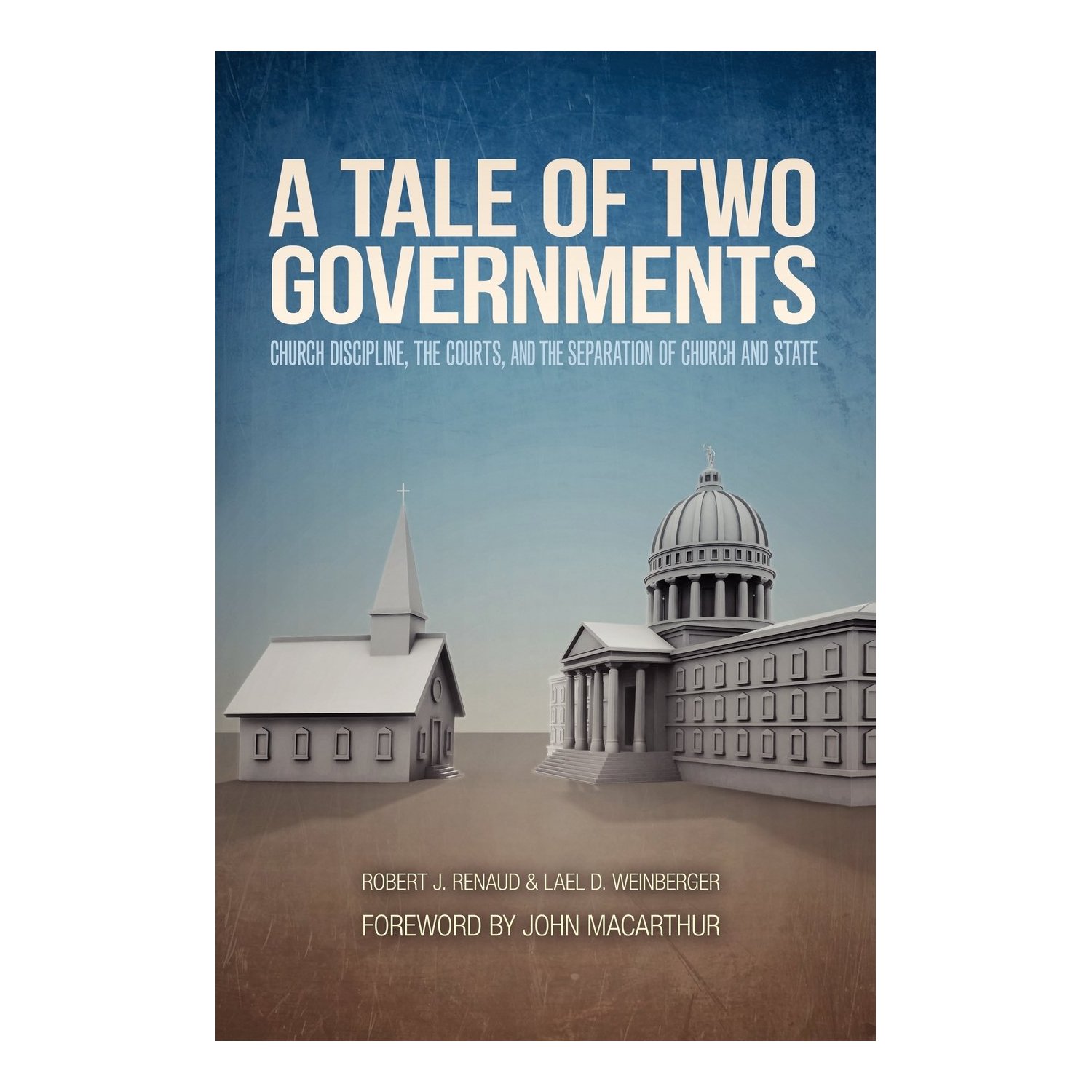
The name of the book that was the subject of the review is, “A Tale of Two Governments” by Robert J. Renaud and Lael D. Weinberger. The review was written by David V. Edling (http://goo.gl/gvPed). Edling is co-author of “Redeeming Church Conflicts”(Baker, 2012) and was the director of church relations at Peacemaker Ministries before his retirement. Peacemaker Ministries was formed to deal with the onslaught of lawsuits resulting from the recent resurgence of authentic Geneva style Calvinism and its tyranny.
The authors and the reviewer bemoan the fact that lawsuits may prevent churches from moving forward with church discipline, and the book apparently offers a clear path to overcoming those fears by implementing protocols that will prevent lawsuits or prevent a negative legal judgment against a church. According to Edling:
While fear of having to interact with the secular courts and fear of man may dampen the zeal to follow the biblical prescription when a church member hardens his or her heart and remains stuck in sin, these authors effectively refute the idea that such excuses hold any validity. The most significant contribution these authors make to life together in the church today is to provide church leaders and members with confidence—confidence that these common fears can be replaced with the knowledge that being biblical is protected by the laws that govern both church and state.
One should note with much ado that “sin” is anything that Reformed elders say it is. Parishioners often assume that Reformed elders define sin worthy of church discipline by a literal biblical definition. While such naivety is adorable, it is far from reality.
Edling continues with the following statement that is chilling to anyone one who knows the real truth about Reformed doctrine and history:
The foundation for their argument is Scripture. They effectively exegete the relevant passages, including an explanation of how Jesus proclaimed he would build his church by giving men “the keys of the kingdom of heaven” (Matt. 16:18-19), that is, the unique authority both to open the kingdom (through the preaching of the gospel) and to regulate its internal administration (through the practice of church discipline, binding and loosing sin). Using a threefold approach of (1) church history (specifically a “high point” review of 2,000 years of church-state relations); (2) a concise review of the common law and American jurisprudence (the development of the current legal doctrine called “church autonomy”); and (3) practical theology (how to keep your church out of court), Renaud and Weinberger deftly weave together their “tale” that leaves the reader with only one conclusion: if we are wise, we need not fear the courts or the reaction of our church members as we fulfill the call of Christ to love his people and build his church as he has directed using church discipline to restore, protect, and keep pure that for which he died.
Did Christ give Reformed elders a “unique” authority to “bind and loose sin” on earth? The apostles claimed no such “unique authority,” but rather constantly referred to the authority of Scripture and the ability of the saints to interpret it for themselves (Acts 17:11). The apostle Paul called on everyday saints to judge what the true gospel is for themselves (Galatians 1:8), and to only follow leaders AS they follow Christ. Furthermore, you can be certain that the authors only cover the “high point[s]” of Reformed history as it is saturated with the blood of those who disagreed with the Reformers. In the same way that people pick their noses in their cars and somehow think others cannot see them, Reformed elders think that the bloody oligarchy of Reformed history cannot be read. And “church autonomy” was not intended to protect either church or state from each other. With Reformed history fresh in their minds, the framers of the constitution sought to prevent cooperation between the two for the expressed protection and well-being of the people.
The reviewer continues with the following statement that can only be said to reveal how ignorant they believe the saints are:
What does it mean for the church to “be wise” from a secular legal perspective in light of the many court cases that have been decided over the years? As these authors summarize, church leaders must be aware of legal principles that will protect the church in its practice of discipline. Failure to stay within these boundaries may leave the church unprotected. The “church autonomy” doctrine is built on the First Amendment’s embedded theology that God established two separate but equal governments, but the First Amendment doesn’t necessarily bar all claims that may touch on religious conduct. To protect the legal distinction church leaders must understand that their jurisdiction to practice discipline depends on following the law. Central to understand is the “implied consent” that exists in a truly voluntary relationship between church and member (typically through formal membership), that an act of discipline must be grounded in a church’s doctrinal commitments that have been clearly articulated and are supported by recognized religious belief and practice, and that the church must have a clearly stated policy for the practice of biblical church discipline (usually set forth in its constitution or bylaws). Further, church leaders must help members understand the limits of confidentiality because church discipline, by definition, requires others knowing of the continuing sin in the life of one who fails to repent and change.
Here is the assertion that the church and the state are two separate “governments” with the church having its own “jurisdiction.” This mentality should send cold chills running up the back of any thinking person while running to reread the membership covenant they signed. The First Amendment has an “ embedded theology”? Really? I will say this as lovingly as I can: if you sign a membership covenant with any church, you need your head examined—the Reformed claim that church membership equals being saved notwithstanding.
In his conclusion, the reviewer states the following:
Consider whether your church may be failing to obey God’s appointed means of soul care through the faithful and consistent practice of redemptive church discipline.
“Redemptive church discipline”? What’s that? The Scriptures never use the term “church discipline” let alone the former. That term should alert you that something may not be exactly right. I address church discipline issues in detail via a free ebook available on this blog: https://paulspassingthoughts.com/wp-content/uploads/2012/04/ebook-church-discipline.pdf and for good measure: https://paulspassingthoughts.com/2012/02/09/new-calvinism-and-hotel-california/
Meanwhile, don’t join a little Geneva. And if you’re in one get out. You’re in a cult. A doctrine/philosophy of control equals cult regardless of the nomenclature.
paul
A Dead Dog in Dallas, Ghost Sex, Saving Baby Lions, and the Truth War
 The Bible teaches us how to be reconciled to God. It also teaches us how to show others the same salvation we received, but in doing so, it also teaches us how to interpret our entire world. This message is the crux of this ministry—what I believe God has called many to proclaim. The prism that dominates my mind concerning all questions regarding one; life, and two; godliness, is the apostle Paul’s rhetorical question, “What saith the Scriptures?”
It seems strange indeed: God wants to involve us in the knowledge process. We must, “study to show thyself approved.” We are to seek God’s wisdom for maneuvering through life which puts His wisdom on display and exposes the foolishness of men. This is set against the wide easy road of our day: the “gospel” is a narrative about Christ’s story. It is a metaphysical story, or a metanarrative that is a predetermined redemptive history by God that encompasses everything from what tie we decide to wear today to great historical events that affect the whole world.
Metaphysics is the interpretation of reality, and all reality therefore according to the “gospel” of our day must be interpreted through the redemptive metanarrative. The sole purpose of the Bible is to help us place ourselves in the narrative that is predestined rather than to use the Bible to determine propositional truth. Seeking truth in order to determine our way in life according to divine guardrails and guidelines arrogantly assumes that Christ’s redemptive story is not already predetermine in every detail.
All is predetermined to “show forth Christ and His gospel” in the historic metanarrative. Tragedies such as 911 and giant tsunamis that show forth Christ’s wrath towards sinful man are birth pangs that point towards the final birth of all wrath at the end of the ages. All good things that happen are for the sole purpose of showing forth the good (or glory of God), and all sins show forth the depravity of man as set against God’s holiness. Therefore, we should run to repentance because it is the other half of the epistemology that shows forth the all-encompassing gospel reality.
The gospel is a Genesis seed that grows organically into the full grown Revelation tree and encompasses every event in human history. Therefore, ALL wisdom (or epistemology: how we know what we know) is divided into two primary parts: the glory of God and the depravity of man. These two things enable us to see reality: the gospel metanarrative. All events therefore are predetermined to show forth gospel reality. If we do not “inter into the rest” by observing what God has predetermined and showing it forth, we are attempting to create our own reality. We are attempting to create our own gospel story where we please God with “our own efforts.” We are attempting to “be the gospel rather than showing forth the gospel” (Michael Horton).
This allows us to separate ourselves from true reality—a freedom from a material world that we often can’t control. Is there tragedy in your life? Don’t take it too hard, it’s merely part of the gospel narrative; ie, “God’s will,” and “for His glory.” Hence, coldblooded indifference is often interpreted as spiritual maturity that at times seems to even celebrate tragedy. Hence, the snooty indifference to politics because those on this spiritual plane flavored by Gnosticism are above the fray of such trivial worldliness. Hence, the indifference to injustice and spiritual abuse as well.
Much of the preaching in today’s church is driven by this philosophy. We do not often realize what is really behind seemingly harmless truisms like, “History is His story.” We assume things like the aforementioned mini-treatise are not behind those bumper stickers. Therefore, these ideas are slowly assimilated into our minds, and we begin to function according to philosophies that we are totally unaware of. This is why there are no answers for life’s difficult questions in the church. Answers are not the issue. Your pain isn’t the issue. A right way verses a wrong way isn’t the issue (men can’t do anything right anyway). The only issue is “how we respond to God’s gospel narrative.” I contest that the Bible refutes this epistemology, and it is a “wisdom” that will hinder the true gospel, and in fact has.
In our (The Potter’s House) study on the book of Romans, we see that book as equipping Christians to interpret reality from God’s viewpoint. The book is about how to be reconciled to God, and interpreting reality according to God’s worldview. It is how to do things God’s way. It is about changing our outlook to God’s outlook. And it involves us, and holds us personally responsible before God for doing so. It holds us responsible to learn our part, and to do our part, and to teach others to do the same.
We have finally come to a very exciting part of the book: God’s anthropological, psychological view of man. What makes mankind tick from the one who created man Himself. It will have much to say about something that I am going to touch on in this post: a life happening, and the question of how we should interpret it. Paul’s “what saith the Scriptures?”
It involves a dead dog in Dallas, ghost sex, and saving baby lions. Every day in this world our children get hit in the face with all kinds of information. And that information always has an agenda. Somebody wants to sell us something, either for money or a victory in the truth war that is constantly raging about us. We must always remember that the world is also trying to sell our children the same thing 24-7. TV shows are not mere entertainment—somebody’s trying to sell something. Interpretations and conclusions are the loss or winning of a battle that in part determines the winning of the war; specifically, the truth war. It is a war between the kingdom of God and the kingdom of Darkness. And even though the outcome is determined, those who win or lose eternally will be manifest according to the truth they buy or reject.
“It’s just entertainment.” That’s easy. “Truth isn’t absolute.” That’s easy. “It’s just a song.” That’s easy. “That’s what it means to me.” That’s easy. “It’s just part of the gospel narrative—praise God anyway!” That’s easy. “What saith the Scriptures?” That’s hard. And easy is the road, and wide is the gate that leads to destruction. Eternal destruction.
So let’s just pick something at random that hits our children in the face daily in this culture. The successful pop star Kesha, who stylizes her stage name by replacing the “S” with a dollar sign (Ke$ha), claims to have had sex with a ghost. This has been widely reported, and her attractive blonde persona does nothing to prevent further stimulation of young imaginations. The episode was reported as follows by the Huffington Post:
Ke$ha says she has had sex with a ghost. Yes, you read that right — sex with a ghost.
And what do you do when you have sex with a ghost? You write a song about the experience, of course.
At least that’s what the 25-year-old singer told Ryan Seacrest on his KIIS FM radio show, of her new song “Supernatural.”
“It’s about experiences with the supernatural… but in a sexy way,” she told Seacrest. “I had a couple of experiences with the supernatural. I don’t know his name! He was a ghost! I’m very open to it.”
The singer added that her new album “Warrior” is based around the theme of the spiritual quest she embarked on to improve her music.
“The theme of this record is magic. I went on a spirit journey by myself. No security guard. No managers. I just went around the world and lived on a boat,” she explained. “I was in Africa rehabilitating baby lions. I went diving with great white sharks, and just went on this crazy spirit quest. I got hypnotized, and I just really wanted this record to be really positive, really raw, really vulnerable and about the magic of life.”
If one googles this eventful claim by Kesha, opinions abound. And if our teenagers ask what we think of such a claim, will we push the easy button, or does the word of God speak to her report? Well, her reported experience is no new thing under the sun. Based on what the Bible describes, I assure you it didn’t happen. Not because the claim is sensational—truth can certainly be sensational, but because of objective information that can be found in God’s word. I would like to focus on a more difficult question that can arise from her statement: can lost people, even lost people who obviously have issues, do good works? And are the works, in and of themselves, good? I am speaking of her work in rehabilitating baby lions (apparently injured or otherwise). Kesha is an animal rights activist which is honorable. Does this earn her any merit at all with God? What about the whole issue of good works and lost people? Moreover, unbelievers have been known to execute extraordinary feats of good works. Does the Bible equip us to lead an Oscar Schindler to the Lord? Would we approach him with the gospel in the exact same way as we would others? Why do wicked people do good works?
I will never forget an experience I had as an unbeliever while living in Dallas, Texas. I was traveling down a street and saw the car in front of me hit a dog. They kept going and did not stop. I stopped and looked for the dog which was able to run some distance, though fatally injured. I found the dog at the same time the owner did who was a widow. The dog was her long time, and only companion in the world. It was truly a very sad affair to witness. The widow and I decided we would bury the dog and I would help her. It was winter; thus, not only cold, but the ground was hard and difficult to dig. Not only that, when I had a fairly deep whole dug, she remembered how much her dog enjoyed romping around a nearby pond and wondered if I would mind changing locations. I agreed. On the way home, I pointed out to God (assuming that He was listening) what a righteous deed it was that I had accomplished and suggested that He would have to agree that I was a pretty nice person.
I know now that unsaved people do righteous deeds because God has written the works of the law on their heart, and they also have a conscience that argues for the law and accuses them when they don’t obey it. We will observe this truth as we progress in the book of Romans. I believe that this greatly restrains evil in the world and is the only reason that the world is a fit place to live in at all. Nevertheless, sin still wreaks havoc, and all of creation groans under its curse and tragedy. Man would rather endure the awful weight of sin in order to avoid change. He is willing to pay a heavy price in order to remain the king of his own throne. God doesn’t want our good works, he wants our whole life. He wants more than common decency, He wants kingdom citizens. Men are willing to continue the bet that they will cheat death in order to proclaim their own glory.
People display common decency, but the whole world lays in the lap of the wicked one. They assume that the spring of true life puts forth both pure and bitter water. That’s Kesha’s “magic life.”
She’s right, if that were true, it would be magic. But life isn’t magic—it’s a gift from God, and all will give an account in regard to the offer of eternal life. Kesha, like many other prophets in both the religious and secular realm are selling something. It is competition for the persuasion of minds in the truth war. In such a war, slothful thinking and lack of discernment will certainly lead to death. Our major weapon is our epistemology, or how we interpret what truth is.
What is the proper use of the Bible? This is a life and death question. Eternally.
Paul
It’s All About the “O”: Mohler, DeYoung, Lucas; We Own You
 “You could be in a church that is subtly indoctrinating your family with the idea that they are owned by the government; in this case, church polity.”
Join a New Calvinist Church if you will, but let it be known: they now own you. Newsflash for the husbands: Calvinist elders believe they have the ultimate say and authority in your home. And another thing: the gospel they hold to rejects synergism in sanctification as works salvation. So, guess what? If your wife buys into that, you are now in what they call a mixed marriage. You are now dangerously close to divorce court as the divorce rate in these churches has skyrocketed.
In our recent TANC 2012 conference, author John Immel nailed it—it boils down to who owns man: in the Christian realm; does Christ own you or Reformed elders? In the secular realm, does man own man or does government own man? Recently, our President stated that government owns man. Recently, in a trilogy of articles by three Reformed pastors published by Ligonier Ministries, it was stated that the church owns Christians, and I will give you three wild guesses as to who represents the authority of the church. That would be the elders.
So it’s all about the “O.” It’s all about “ownership.”
True, elders have authority, but not beyond the Scriptures that call Christians to interpret them according to their own biblically trained consciences. As we shall see, these articles plainly state the Reformed tradition that came from Catholic tyranny. The Reformers never repented of the same underlying presuppositions concerning man’s need to be owned by enlightened philosopher kings. The Reformation was merely a fight for control over the mutton with the Reformers seeing themselves as the moral philosopher kings as opposed to the Romish ones. Their doctrine was just a different take on how the totally depraved are saved from themselves. But both doctrines reflect the inability of man to participate in sanctification.
The three articles posted were: Should I Stay or Should I Go? by Albert Mohler; Where and How Do We Draw the Line? by Kevin DeYoung; and, Who Draws the Line? by Sean Michael Lucas. All linked together for your indoctrination convenience.
Al Mohler states in his ownership treatise that Christians have “no right” to leave one church for another because of preferences. Emphasis by underline added:
Far too many church members have become church shoppers. The biblical concept of ecclesiology has given way to a form of consumerism in which individuals shop around for the church that seems most to their liking at that moment. The issue can concern worship and music, relationships, teaching, or any number of other things. The pattern is the same, however – people feel free to leave one congregation for another for virtually any reason, or no reason at all.
Church shopping violates the integrity of the church and the meaning of church membership. When members leave for insufficient reason, the fellowship of the church is broken, its witness is weakened, and the peace and unity of the congregation are sacrificed. Tragically, a superficial understanding of church membership undermines our witness to the gospel of Christ.
There is no excuse for this phenomenon. We have no right to leave a church over preferences about music, personal taste, or even programming that does not meet expectations. These controversies or concerns should prompt the faithful Christian to consider how he might be of assistance in finding and forging a better way, rather than working to find an excuse to leave.
Where to begin? First of all, while many New Calvinist churches will bring you up on church discipline for leaving because of “unbiblical” reasons, those reasons vary from church to church. So, not only do the reasons for leaving vary among parishioners, but what constitutes proper “biblical…. ecclesiology” in regard to departure varies as well. Mohler states in the same post that doctrine is a valid reason to leave a church, but yet, one of the more prominent leaders of the New Calvinist movement (CJ Mahaney), who is strongly endorsed by Mohler, states that doctrine is not a valid reason to leave a church. CJ Mahaney substantiated that New Calvinist position and clearly indicated what New Calvinists are willing to do to enforce that position when he blackmailed the cofounder of SGM, Larry Tomczak:
Transcript of Phone Conversation between C.J., Doris and Larry Tomczak on October 3, 1997 pp. 10-11:
C.J.: Doctrine is an unacceptable reason for leaving P.D.I.
Larry: C.J., I’m not in sync with any of the T.U.L.I.P., so whether you agree or not, doctrine is one of the major reasons I believe it is God’s will to leave P.D.I. and it does need to be included in any statement put forth.
C.J.: If you do that, then it will be necessary for us to give a more detailed explanation of your sins [ie, beyond the sin of leaving for doctrinal reasons].
Larry: Justin’s name has been floated out there when there’s statements like revealing more details about my sin. What are you getting at?
C.J.: Justin’s name isn’t just floated out there – I’m stating it!
Larry: C.J. how can you do that after you encouraged
Justin to confess everything; get it all out. Then when he did, you reassured him “You have my word, it will never leave this room. Even our wives won’t be told.”
I repeatedly reassured him, “C.J. is a man of his word. You needn’t worry.” Now you’re talking of publically sharing the sins of his youth?!
C.J.: My statement was made in the context of that evening. If I knew then what you were going to do, I would have re-evaluated what I communicated.
Doris: C.J., are you aware that you are blackmailing Larry? You’ll make no mention of Justin’s sins, which he confessed and was forgiven of months ago, if Larry agrees with your statement, but you feel you have to warn the folks and go national with Justin’s sins if Larry pushes the doctrinal button? C.J., you are blackmailing Larry to say what you want!―Shame on you, C.J.! As a man of God and a father, shame on you!
This will send shock waves throughout the teens in P.D.I. and make many pastors’ teens vow, “I‘ll never confess my secret sins to C.J. or any of the team, seeing that they‘ll go public with my sins if my dad doesn‘t toe the line.”―C.J., you will reap whatever judgment you make on Justin. You
have a young son coming up. Another reason for my personally wanting to leave P.D.I. and never come back is this ungodly tactic of resorting to blackmail and intimidation of people!
C.J.: I can‘t speak for the team, but I want them to witness this. We’ll arrange a conference call next week with the team.
Doris: I want Justin to be part of that call. It’s his life that’s at stake.
C.J.: Fine.
(SGM Wikileaks, part 3, p.139. Online source: http://www.scribd.com/sgmwikileaks)
Of course, this example and many others makes Mohler’s concern with the “integrity” of the church—laughable. But nevertheless, Mohler’s post and the other two are clear as to what common ground New Calvinists have on the “biblical concept of ecclesiology.”
Besides the fact that parishioners “have no right” to leave a church based on preference, what do New Calvinists fundamentally agree on in this regard? That brings us to the article by Sean Michael Lucas :
Because the church has authority to declare doctrine, it is the church that has authority to draw doctrinal lines and serve as the final judge on doctrinal issues. Scripture teaches us that the church serves as the “pillar and buttress of the truth.”
So, even in cases where New Calvinists believe that doctrine is an acceptable reason for leaving a church, guess who decides what true doctrine is? “But Paul, he is speaking of doctrine being determined by the church as a whole, not just the elders.” Really? Lucas continues:
In our age, this understanding—that the church has Jesus’ authority to serve as the final judge on doctrinal matters— rubs us wrong for three reasons. First, it rubs us wrong because we are pronounced individualists. This is especially the case for contemporary American Christians, who have a built-in “democratic” bias to believe that the Bible’s theology is accessible to all well-meaning, thoughtful Christians. Because theological truth is democratically available to all, such individuals can stand toe to toe with ministerial “experts” or ecclesiastical courts and reject their authority.
Creeped out yet? Well, if you are a blogger, it gets better:
Perhaps it is this individualistic, democratic perspective that has led to the rise of websites and blogs in which theology is done in public by a range of folks who may or may not be appropriately trained and ordained for a public teaching role. While the Internet has served as a “free press” that has provided important watchdog functions for various organizations, there are two downsides of the new media, which ironically move in opposite directions. On the one side, the new media (blogs, websites, podcasts, Facebook, Twitter) allow everyone to be his own theologian and judge of doctrinal matters. But because everyone is shouting and judging, the ironic other side is that those who are the most well known and have the biggest blogs gain the most market share and actually become the doctrinal arbiters of our electronic age. In this new media world, the idea that the church as a corporate body actually has authority to declare doctrine and judge on doctrinal issues is anathema.
Lucas continues to articulate the Reformed tradition that holds to the plenary authority of elders supposedly granted to them by Christ:
For some of us, again reflecting our individualism, such understanding of the church unnecessarily limits voices and perspectives that might be helpful in conversation. But restricting access to debates and judgments about theology to those who have been set apart as elders in Christ’s church and who have gathered for the purpose of study, prayer, and declaration actually ensures a more thoughtful process and a surer understanding of Christ’s Word than a pell-mell, democratic, individualistic free-for-all. Not only do we trust that a multiplicity of voices is represented by the eldership, but, above all, we trust that the single voice of the Spirit of Jesus will be heard in our midst.
So, bottom line: the priesthood of believers is a “pell-mell, democratic, individualistic free-for-all.” Still not creeped out? Then consider how they answer the question in regard to elder error:
Of course, such slow and deliberate processes do not guarantee a biblically appropriate result. After all, the Westminster Confession of Faith tells us that “all synods or councils, since the apostles’ times, whether general or particular, may err; and many have erred” (WCF 31.3). Sometimes, entire denominations err significantly as they prayerfully consider Scripture and judge doctrine. Such error, however, does not negate Jesus’ own delegation of authority to the church and set the stage for a free-for-all.
This brings us to another issue that DeYoung propogates in his post: since Reformed elders have all authority, their creeds and confessions are authoritative and not just commentaries. Hence, they declared in the aforementioned confession cited by Lucas that even though they error, they still have all authority. Whatever happened to the Apostle Paul’s appeal to only follow him as he followed Christ?
DeYoung:
Those who wrote the ancient creeds, such as the Apostles’ Creed, the Nicene Creed, and the Chalcedonian Definition, were not infallible, but these creeds have served as effective guardrails, keeping God’s people on the path of truth. It would take extraordinary new insight or extraordinary hubris to jettison these ancient formulas. They provide faithful summaries of the most important doctrines of the faith. That’s why the Heidelberg Catechism refers us to the Apostles’ Creed, “a creed beyond doubt, and confessed through the world,” when it asks, “What then must a Christian believe?” (Q&A 22–23).
FYI: If you see something in your own Bible reading that contradicts a Reformed creed or confession, you are partaking in visions of grandeur.
This is the crux of the matter; the question of authority. It is almost crazy that Christians don’t have this issue resolved in their mind before they join a church. You could be in a church that is subtly indoctrinating your family with the idea that they are owned by the government; in this case, church polity.
Let there be no doubt about it, New Calvinists are drooling over the idea of another Geneva theocracy with all the trimmings. And someone shared with me just the other day how this shows itself in real life. “Mike” is a local contractor in the Xenia, Ohio area. He is close friends with a farmer in the area who lives next door to a man and his family that attend a New Calvinist church.
One day, His new New Calvinist neighbor came over to inform him that he needed to stop working on Sunday because it is the Lord’s Day, and the noise of his machinery was disturbing their day of rest. Mike’s friend told him, in a manner of speaking, to hang it on his beak. Mike believes what transpired after that came from the neighbor’s belief that he was a superior person to his friend, and that his friend should have honored the neighbors request by virtue of who he is.
The neighbor has clout in the community, and to make a long story short—found many ways to make Mike’s friend miserable through legal wrangling about property line issues; according to my understanding, 8” worth. It was clear that Mike’s friend was going to be harassed until he submitted to this man’s perceived biblical authority.
New Calvinists have serious authority issues, and you don’t have to necessarily join in official membership to be considered under their authority. A contributor to Mark Dever’s 9 Marks blog stated that anyone who comes in the front door of a church proclaiming Christ as Lord is under the authority of that church.
It’s time for Christians to nail down the “O.” Who owns you? Are you aware of who owns you (or at least thinks so)? And are you ok with that?
paul
The Gospel According to John MacArthur’s Reformation Myth
“’Subjective’ verses ‘objective’ is key to understanding the Reformed denial of the new birth that predicates its false gospel.”
Note: Click on illustrations to make bigger.
Let me state something right out of the gate: the church has never been in a Dark Age. Christ said, “And I tell you that you are Peter, and on this rock I will build my church, and the gates of Hades will not overcome it” (Matthew 16:18). Imagine that. Peter wasn’t anybody—he was an everyday Joe—a blue-collar guy in that culture. Then one day God shows up personally and informs everybody that He would oikodomhsw “be building His church,” or some translators, “I shall be home building”….mou (of me)….the ekklhsian (out-called, not “church” which is not a biblical word) on Peter. You can trust me on this one: Jesus has been home building His out-called, and the construction project has never slowed down or stopped. The building project has always been on schedule and within budget—funded by the Blood. And Christ didn’t choose a John MacArthur Jr. of that day—He chose an ordinary Joe.
Right here, two pillars of the Reformation myth are found wanting. There has never been an out-called Dark Age, and Christ doesn’t primarily use renowned scholars like Martin Luther to get things done. Today’s “Reformed” “church” is built on the foundation of lofty creeds and confessions written by men of fleshly renown. The very name, “Reformed” is fundamentally false—our Lord’s building project has never needed a “reformation”—especially at the hands of murdering mystic despots.
But two days ago, Susan and I had the rare privilege of sitting down with four men who exemplify what Christ is using to build His out-called. We held siege at the restaurant for three hours. These men so encouraged me that it is a wonder that the local police were not called accompanied by men in white attire. They bore four marks of God’s true out-called:
1. Ordinary men.
2. Thinkers who constantly wrestle with understanding.
3. Wholly devoted to truth.
4. Sold-out to the sufficiency of the Scriptures as their only authority.
Somewhere in the world since the day Christ showed up and walked into the everyday lives of twelve men, He has been slowly building His out-called. He has been building with those who possess the same spirit of Noah and is in-fact a fifth mark: they will stand alone if they have to. In the present day neo-Reformed blitzkrieg, it is, and will be two or three families who come out from among them, weeping with sorry, often leaving the only church they have ever known while the door is held open for them by the young, petulant Reformers of our day that despise the sweat and blood that built the work that they have covertly sieged. As our brother Jude said of these brute beasts, they slip in “unawares” (v.4).
Basically, the problem is the same as when Christ showed up to found His out-called. The religion of the day was founded on the authority and institutions of self-important men. People where amazed that Christ didn’t check in with the academics before He launched His ministry, nor quoted the spiritual brainiacs of that day. Likewise, if Christ came today, John MacArthur, Al Mohler, and the insufferable likes of obnoxious men like Steve Lawson and Paul Washer would watch with incredulities as Christ would ignore them and make a b-line for the ghettos—choosing His workers and confidants from among them.
So how should I view an article sent to me by a reader that was written by John MacArthur regarding the Reformation motif of “Justification by faith.” First, as I am presently teaching my family, ALL ideas presented by men, and I believe that MacArthur fits into that category, will entail a litany of propositions that lead to a conclusion. Therefore, let us examine and wrestle with the propositions presented by MacArthur in this article (Justification by Faith: online source: http://goo.gl/xJyFO).
Proposition 1: “The Reformation doctrine of justification by faith is, and has always been, the number one target of the enemy’s attack.”
The “Reformation doctrine”? Excuse me Mr. MacArthur (hereafter, JM), but we get our doctrine from the Bible, not the Reformers, who, as I have noted, are an oxymoron to begin with. In the first sentence of this article, JM sets up an authority between the out-called priests (that’s us) and the word of God. Therefore, his article is predicated on a proposition by men who are not original authors chosen by God— buyers beware. Hence, if we are discerning, JM has raised the propositional ante to a considerable level. By citing the preapproved authors of the Bible, additional consideration could have been avoided.
JM goes on to state that this doctrine, “….provides the foundation of the bridge that reconciles God and man — without that key doctrine, Christianity falls.” This should now incite interpretive questions for the proposition:
1. Could the Reformers have been wrong?
2. Even if they were right, is there a danger in making Reformed epistemology a standard of truth?
3. Is the claim that the church stands or falls on this doctrine establishing Reformation doctrine as a significant authority? And if so, is this wise?
Proposition 2: “Social and political concerns have brought evangelicals and Catholics together in recent years to unite against the forces of secularism. Under the influence of ecumenism, it’s difficult for either group to remember what it was that divided them in the first place.
The pragmatists and ecumenicists are aided in their forgetfulness by new theological movements that redefine justification in more Catholic terms. Under the influence of liberalism and postmodernism, proponents of the New Perspective on Paul, the Emergent Church, and others have so confused and redefined the doctrine of justification that it has become shrouded in darkness once again
The Christian church today is in danger of returning to the Dark Ages. The seeker movement has Christianity turning in its Bibles; the ecumenical movement urges Christians to use worldly means to accomplish temporal ends; and current theological movements look through the lens of philosophy — Enlightenment rationalism and postmodern subjectivism — rather than Scripture. The departure from sola scriptura has led to the departure from sola fide — justification by faith alone.”
JM asserts that the Reformation was a marked contrast between Catholicism and the Reformers. Catholic influence is dragging the “church” back into a “Dark Age.” Regardless of the nomenclature of which he frames this proposition, he begins to articulate the Reformation motif in a way that is traditional, and packaged for fairly easy digestion—if you understand the premise of the motif, and we soon will.
The key here is this part of JM’s proposition: “….and current theological movements look through the lens of philosophy — Enlightenment rationalism and postmodern subjectivism — rather than Scripture.” First, throughout his post, JM uses the term “Reformation doctrine” and “Scripture” interchangeably. Hence, he is proposing that the two are synonymous—he is asking that you accept this proposition as fact. But what we want to focus on here as a gateway of understanding is the word “subjectivism” in his proposition. This is key to understanding my counter proposition:
1. There was no difference in Reformation doctrine and Catholic doctrine.
2. Subjective verses objective is key to understanding the Reformed denial of the new birth that predicates its false gospel.
MacArthur begins to propagate the traditional Reformed dogma of subjective verses objective; that is, as I have previously stated, the crux of their doctrine.
And is that biblical? Is Reformed doctrine biblical doctrine? Is the Reformed gospel the biblical gospel?
The History of the Reformation Motif / Myth
We will take an interlude on the way to our understanding to examine the very significant contemporary contribution to understanding Reformation doctrine by its own proponents and advocates. It is true that Reformation doctrine has experienced times of low recognition followed by “rediscovery,” “resurgence,” and “revival” since the Sixteenth century. The last resurgence began in 1970. It was a rediscovery of authentic Reformed theology that launched the SDA Awakening Movement. Until then, the doctrine had never been framed in a subjective verses objective model of understanding. “Subjectivism” was fingered as the root of all evil verses the, and here it is: objective gospel outside of us. More specifically, “The Centrality of the Objective Gospel Outside of Us.” Hereafter, COGOUS.
This apt method of framing Reformation doctrine was the brainchild of SDA theologian Robert Brinsmead, who was joined by Anglican theologians Geoffrey Paxton and Graeme Goldsworthy, and later by Reformed Baptist Jon Zens. They attributed all contra Reformation beliefs and movements such as the Enlightenment era to “subjectivism.” JM shows his kinship to this contemporary understanding of Reformation theology via his propositions in said article, of which the sender asked, “Does this muddy the waters?” Answer: no, in-fact, it clarifies MacArthur’s participation in the endeavor to save the church from a supposed “Evangelical Dark Age.”
The theological think tank formed by this “core four” was known as the Australian Forum and their theological journal was Present Truth Magazine which was the most publicized theological journal in English speaking countries during the Seventies. They compiled a vast amount of documentation that clearly shows that the Reformation gospel of Luther and Calvin was the Centrality of the Objective Gospel Outside of Us. It contends that if the power of God is infused into the believer, it will enable him/her to, as the truism states, “know enough to be dangerous.”
Because the Reformers saw justification and sanctification as the same thing, they argued that any enablement infused into the believer would automatically contribute to the justification process which they saw as progressive. Please note: this is exactly what JM et al accuse the Catholics of, but as we shall see, they are both guilty of this same thing: the fusion of justification and sanctification together.
Hence, in contemporary lingo, the outcry of the Reformers against Rome was the “infusion of grace into the believer—making sanctification the ground of his/her justification.” In other words, all enablement and spiritual life must remain outside of the believer. All of the power of grace must remain ‘objective” by staying outside of the believer. This Reformed paradigm was brilliantly illustrated by the Australian Four, hereafter A4, by the following pictorial illustration:

Also let me demonstrate by another A4 pictorial that they believed justification was progressive:
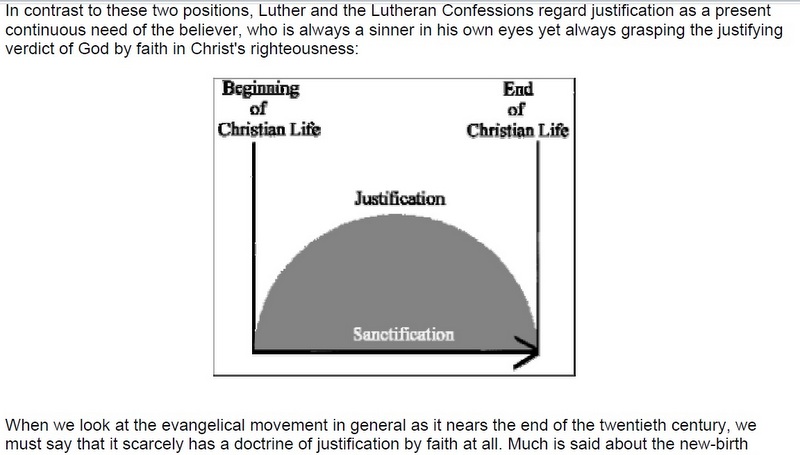
I will later explain the application of the two-man chart in this post. I can most certainly read your mind as you look at it: “How in the world does that work in real life?”
We will now further my contra proposition by substantiating some of my sub-propositions. Let’s first establish that one of the elder statesmen of the neo-Reformed movement, John Piper, and a close confidant of JM, agree with the AF’s contemporarily framed assessment of authentic Reformed doctrine, hereafter, ARD. Graeme Goldsworthy, one of the original A4, recently lectured at Southern Seminary on the Reformation. John Piper wrote an article on Goldsworthy’s lecture (Goldsworthy on Why the Reformation Was Necessary: Desiring God blog, June 25, 2009). Piper’s assessment of Goldsworthy’s lecture is a major smoking gun in regard to agreement on ARD:
In it [Goldsworthy’s lecture at Southern] it gave one of the clearest statements of why the Reformation was needed and what the problem was in the way the Roman Catholic church had conceived of the gospel….I would add that this ‘upside down’ gospel has not gone away—neither from Catholicism nor from Protestants….
This meant the reversal of the relationship of sanctification to justification. Infused grace, beginning with baptismal regeneration, internalized the Gospel and made sanctification the basis of justification. This is an upside down Gospel….
When the ground of justification moves from Christ outside of us to the work of Christ inside of us, the gospel (and the human soul) is imperiled. It is an upside down gospel [emphasis Piper’s—not this author].
Note, if you think about it, it is impossible to “reverse” justification and sanctification unless they are on the same plane. Nor can you turn a two-part object upside down unless both parts are attached—making either one the “ground” or otherwise. Hence, a careful observation of Piper’s use of words betrays his subtleness in regard to believing in the fusion of justification and sanctification together. Furthermore, Piper’s beef with Catholicism is not the fusion of justification and sanctification together per se, but rather the infusion of grace into the believer. The AF two-man illustration depicts Piper’s contention to a “T.” Note the exact same issue: Christ within, or Christ without. Just grasp that for now, and put the absurdity of it on the back burner—it will come together for you later.
Basically, if God’s grace/goodness is placed within the believer, he/she becomes enabled enough to become dangerous leading to all of the terrible things inside of the guy looking down. Everything must remain outside of the believer, leading to all of the good things listed on the right side of the chart which are listed outside of him. Don’t miss that. Today’s church owes Robert Brinsmead a tremendous debt of gratitude for publishing this chart.
A Major Key to Understanding: John H. Armstrong and SUBJECTIVISM
Now, let’s take yet another sub interlude to further my contra proposition. The following illustration shows how the AF made the objective/subjective / Christ within / Christ without the major crux of ARD:

A theologian named John H. Armstrong eludes to this exact survey in Present Truth to make a point in an article that he wrote (The Highway blog: Article of the Month; Sola Fide: Does It really Matter?). Armstrong was the general editor of a combined work called The Coming Evangelical Crisis (1996 by Moody Bible Institute) that included the who’s who of the neo-Reformed movement: R. Kent Houghs; John MacArthur; RC Sproul; and heretics Michael S. Horton and Albert Mohler Jr. Armstrong stated the following in the aforementioned article:
The sixteenth-century rediscovery of Paul’s objective message of justification by faith [and sanctification also because justification is supposedly progressive] came upon the religious scene of that time with a force and passion that totally altered the course of human history. It ignited the greatest reformation and revival known since Pentecost.
Now, if the Fathers of the early church, so nearly removed in time from Paul, lost touch with the Pauline message, how much more is this true in succeeding generations? The powerful truth of righteousness by faith needs to be restated plainly, and understood clearly, by every new generation.
In our time we are awash in a “Sea of Subjectivism,” as one magazine put it over twenty years ago. Let me explain. In 1972 a publication known as Present Truth published the results of a survey with a five-point questionnaire which dealt with the most basic issues between the medieval church and the Reformation. Polling showed 95 per cent of the “Jesus People” were decidedly medieval and anti-Reformation in their doctrinal thinking about the gospel. Among church-going Protestants they found ratings nearly as high….
I do not believe that the importance of the doctrine of justification by faith can be overstated. We are once again in desperate need of recovery. Darkness has descended upon the evangelical world in North America and beyond, much as it had upon the established sixteenth-century church.
As JM said in our observation of the article at hand:
….the doctrine of justification….has become shrouded in darkness once again. The Christian church today is in danger of returning to the Dark Ages.
And,
Enlightenment rationalism and postmodern subjectivism — rather than Scripture. The departure from sola scriptura has led to the departure from sola fide — justification by faith alone.
JM, John Piper, Armstrong, Graeme Goldsworthy, and what they call the “Justification by faith” doctrine—all the same camp, and the same belief: The Centrality of the Objective Gospel Outside of Us.
How in the World Does COGOUS Work in Real Life?
As far as how this doctrine functions, there are two camps. But in both camps, the believer remains unchanged and totally depraved. The crux of COGOUS is that sanctification is a total work of God because it finishes justification. The doctrine then frames man’s role in regard to Gnostic ideas. In fact, the very first sentence of the Calvin Institutes is a Gnostic idea. Calvin claims therein that all knowledge is contained in the knowledge of ourselves and knowledge of God. Since we already know that Calvin believed in the total depravity of man, this is the knowledge of good and evil.
Calvin, right out of the gate, states that this is the core of all true wisdom. So, what you begin to see when reading the works of various Reformers of old and new, is the idea that change begins with wisdom, and as we see our own depravity in deeper and deeper ways, and the holiness of God in deeper and deeper ways (which the former facilitates as well), a transformation takes place. Not in us, of course, we are totally depraved—we therefore cannot change—we rather manifest a realm. As it was explained to me by a fairly well known Calvinist, there is a Spirit realm, and a flesh realm (not an old nature within us), and both put pressure on us if we are saved, and we either “yield” to one or the other realms at any given time. But again, we don’t change, we merely manifest a realm. Out of this comes terms like, “Pastor of Spiritual Formation,” and “heart formation,” or “spiritual transformation.” Notice that the “spiritual” is being transformed, not us. I am presently doing research to get a more refined understanding in regard to “what this looks like.” Apparently, an exercise of our own will to obey is creating our own reality instead of “His preordained story.”
A rough sketch follows: all reality points to Christ’s glory, and all reality is wrapped up in the gospel and interpreted by it (the first tenet of New Covenant Theology). All history is “redemptive.” Therefore, all historical events, and events period, are preordained by God to show us wisdom; ie, the knowledge of the good (Christ), and the knowledge of the evil (our own depravity), and both point to God’s glory and “show forth the gospel.” So, all events in life are preordained by God to show us our own depravity, and His holiness. That’s the first way we gain wisdom of ourselves and God, and when we see it, our manifestation results in part of the grand gospel narrative preordained by God.
The second way that we manifest the gospel is through seeing historic events in the Bible that represent the same kind of events that happen in redemptive history. The Bible, in the same way that redemptive history does, gives us wisdom in regard to our own evil and God’s holiness, again resulting in redemptive historical manifestations. If we respond improperly to the redemptive historical event (whether good or bad), we reap “bad fruit” (ie., a bad manifestation) which lends further opportunity for deeper understanding of our own depravity and more glory for God. If we participate properly in the gospel story, we are assured peace and joy regardless of our circumstances (because we are in essence detached from reality in my view). Many Reformed thinkers such as David Powlison and Paul David Tripp call this,
The big picture model is the story of every believer. God invites us to enter into the plot! (Paul D. Tripp: How People Change, p.94).
As I said before, there are two camps: one rejects any kind of work at all by Christ in us, but Tripp is of the other camp that teaches that we remain totally depraved, but Christ does do a work in us, albeit His work in totality. Tripp states that as we gain deeper understanding of our own evil (deep repentance), our hearts are emptied of idols which then results in a filling of Christ resulting in spiritual formations or manifestations (Ibid, p. 28). Others believe that whatever we see in the Bible ( like a circumstance of Christ’s love) is imputed to us as we see it and understand it. Many of Reformed thought call this “such and such ( love or whatever) by proxy.” It is also known as the “active obedience of Christ” or progressive imputation. Following is an illustration of some of these ideas presented here (Ibid, p.100):
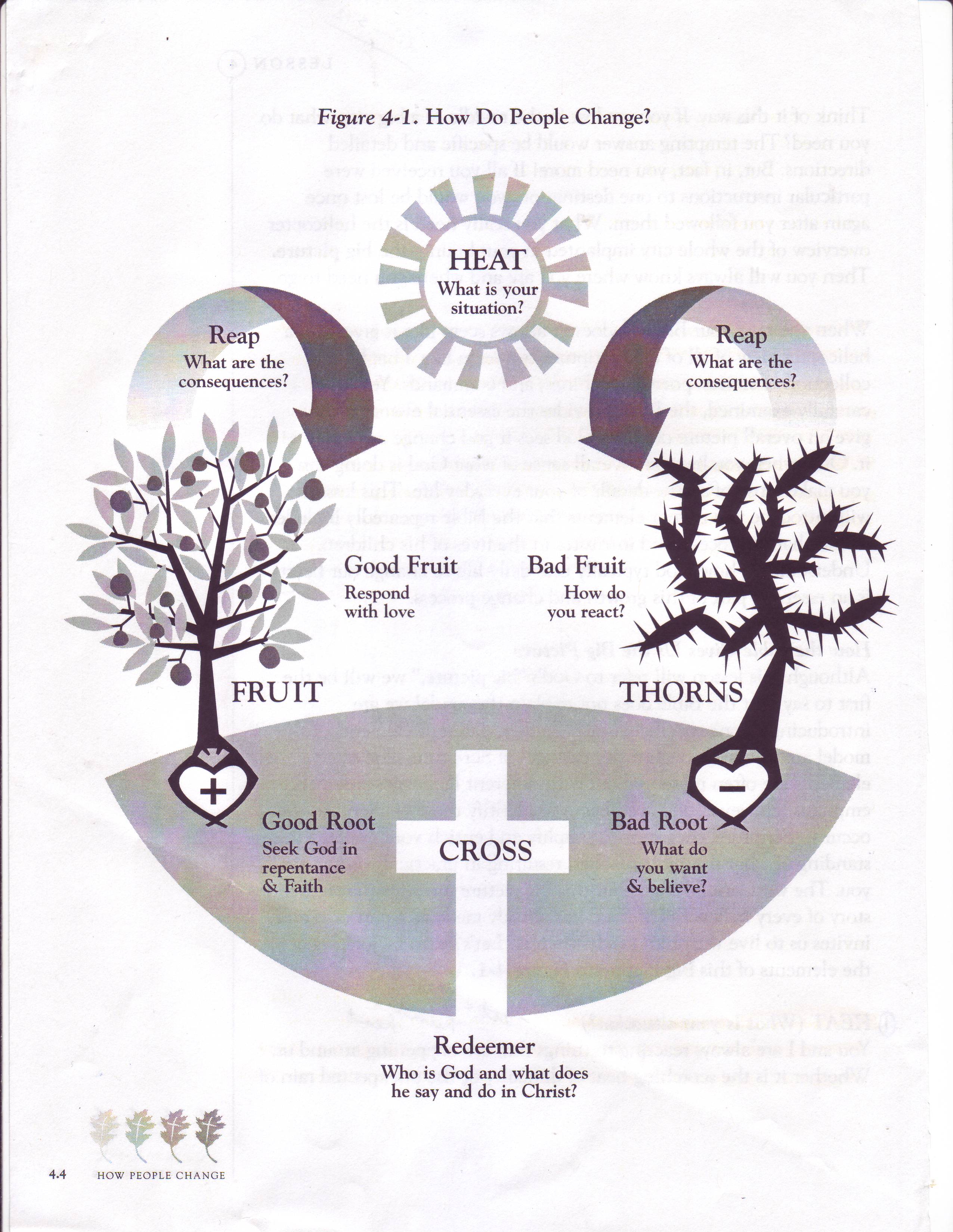
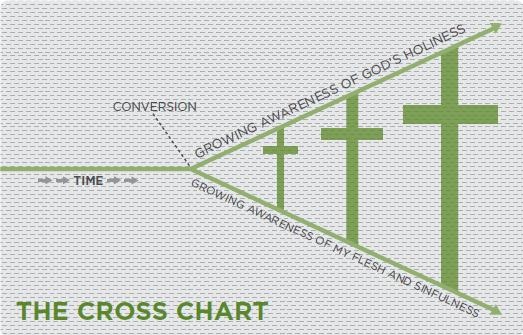
But you can also see some of these concepts if you refer back to the two-man chart. The gospel man meditates on “Grace, Justification, Perfection, Security, immortality, Law,” but these things remain outside of him as manifestations of the objective gospel. But the Christ within man has these things inside of him because that is where his focus is (subjective). Following is another Reformed illustration of what we are talking about. Notice that the cross gets bigger—not us. We don’t grow—the cross does. The cross represents grace outside of us; so, the cross is seen as bigger (ie, God is glorified) while we don’t change. These manifestations make God look bigger while not being connected to anything recognized as us being new and improved. Michael Horton refers to this as “preaching the gospel instead of being the gospel.”
MacArthur often conveys ideas that do nothing in regard to separating himself from this absurd mysticism. In writing the Forward to the Gnostic masterpiece, Uneclipsing the Son by former associate Rick Holland, JM states the following:
As believers gaze at the glory of their Lord—looking clearly, enduringly, and deeply into the majesty of His person and work—true sanctification takes place as the Holy Spirit takes that believer whose heart is fixed on Christ and elevates him from one level of glory to the next. This is the ever-increasing reality of progressive sanctification; it happens not because believers wish it or want it or work for it in their own energy, but because the glory of Christ captures their hearts and minds. We are transformed by that glory and we begin to reflect it more and more brightly the more clearly we see it. That’s why the true heart and soul of every pastor’s duty is pointing the flock to Christ, the Great Shepherd.
Let’s now return to the article at hand and address the more relevant parts. In the section entitled, “Back to the Beginning,” JM sates the following:
In the 1500s a fastidious monk, who by his own testimony “hated God,” was studying Paul’s epistle to the Romans. He couldn’t get past the first half of Romans 1:17: “[In the gospel] is the righteousness of God revealed from faith to faith” (KJV).
One simple, biblical truth changed that monk’s life — and ignited the Protestant Reformation. It was the realization that God’s righteousness could become the sinner’s righteousness — and that could happen through the means of faith alone. Martin Luther found the truth in the same verse he had stumbled over, Romans 1:17: “Therein is the righteousness of God revealed from faith to faith: as it is written, the just shall live by faith” (KJV, emphasis added).
JM then fails to mention that Luther believed that this justification passage also applies to sanctification. Then JM sates the following under the next heading, Declared Righteous: What Actually Changes?:
In its theological sense, justification is a forensic, or purely legal, term. It describes what God declares about the believer, not what He does to change the believer. In fact, justification effects no actual change whatsoever in the sinner’s nature or character. Justification is a divine judicial edict. It changes our status only, but it carries ramifications that guarantee other changes will follow. Forensic decrees like this are fairly common in everyday life….
Similarly, when a jury foreman reads the verdict, the defendant is no longer “the accused.” Legally and officially he instantly becomes either guilty or innocent — depending on the verdict. Nothing in his actual nature changes, but if he is found not guilty he will walk out of court a free person in the eyes of the law, fully justified.
In biblical terms, justification is a divine verdict of “not guilty — fully righteous.” It is the reversal of God’s attitude toward the sinner. Whereas He formerly condemned, He now vindicates. Although the sinner once lived under God’s wrath, as a believer he or she is now under God’s blessing.
This all looks to be very solid theologically, but I want you to notice that JM fails to mention that Justification is a finished work. That’s key. And it’s key because of what he states next:
Justification is more than simple pardon; pardon alone would still leave the sinner without merit before God. So when God justifies He imputes divine righteousness to the sinner (Romans 4:22-25). Christ’s own infinite merit thus becomes the ground on which the believer stands before God (Romans 5:19; 1 Corinthians 1:30; Philippians 3:9). So justification elevates the believer to a realm of full acceptance and divine privilege in Jesus Christ.
The problem here is the implication that a pardon is not enough, and that our “standing” must be maintained lest we find ourselves “without merit”…. “before God.” This is problematic because any kind of standard that would maintain merit before God for justification is voided (Romans 7;1-4). There is simply no merit or standard left for a Christian to be judged by in regard to justification.
But the smoking gun that convicts MacArthur in fusing justification and sanctification together in this same article follows under “How Justification and Sanctification Differ.” JM starts out well with this statement:
Justification is distinct from sanctification because in justification God does not make the sinner righteous; He declares that person righteous (Romans 3:28; Galatians 2:16). Notice how justification and sanctification are distinct from one another:
After stating this, JM, evokes the classic neo-Reformed double-speak sleight of hand for fusing justification and sanctification together without appearing to do so:
Those two must be distinguished but can never be separated. God does not justify whom He does not sanctify, and He does not sanctify whom He does not justify. Both are essential elements of salvation.
JM also clearly states that progressive sanctification is part of the same “salvation” process that justification is also a part of ; hence, they supposedly can’t be separated. But the Bible authors only speak of sanctification as salvation in a manner of speaking because there are three sanctifications: positional (1Cor. 6:11), progressive/practical (2 Cor. 7:11, 2 Peter ch. 1), and complete (1 Cor. 6:11[those who are sanctified positionally are glorified as well]), but only one justification that is a onetime legal declaration (Romans 8:30).
Furthermore, JM’s use of the distinct but never separate sleight of hand is the exact same mantra constantly used by many in the neo-Reformed crowd:
Though justification and sanctification cannot be separated they must be distinguished.
~ Ernest Reisinger
It would also stand to reason therefore that MacArthur, like all of the neo-Reformed, would not see any role for the believer in sanctification other than gospel contemplationism. This can be confirmed by reviewing the previous excerpt from Holland’s book.
Classic Reformed Kettles Calling the Pot Black
We now observe a trait by JM that was never true about him before he went over to the dark side—blatant contradictions that assume the utter stupidity of his followers. He follows the neo-Reformed protocol for drawing the line of distinction between the Reformers and Rome in this way:
Roman Catholicism blends its doctrines of sanctification and justification.
So, the two cannot be “separate,” but they can be blended? But what JM states next brings us full circle to what we observed in John Piper’s article on the Goldsworthy lecture at Southern:
Catholic theology views justification as an infusion of grace that makes the sinner righteous. In Catholic theology, then, the ground of justification is something made good within the sinner — not the imputed righteousness of Christ.
Please note JM’s either/or interpretive prism, (a neo-Reformed distinctive) that eliminates the possibility that the believer is empowered by the Spirit internally for something that is separate from justification; namely, kingdom living. Notice that the issue is specifically “something good” inside the believer verses the “imputed righteousness of Christ.” Obviously, JM rejects the idea that it can be both, and whatever it is, it must point back to justification if it is something “good” inside of the believer.
Rome’s motive for fusing the two together is beside the point, both the Reformers and Rome believe the two cannot be separated. Hence, for Rome it was easy: Christ forgives all of your past sins, but now you must do certain things to complete your justification because salvation is linear with both justification and sanctification on the same plane. Likewise, the Reformers believe in the same linear gospel, but pardon it by making everything that needs to be done to complete justification—totally of Christ alone. This requires us to remain totally depraved in the process and utilizes Gnosticism for whatever application can be surmised. Frankly, this is the first time that I have seen writings from JM that totally remove all doubt that he has bought into this doctrine , hook, line, and sinker.
JM continues:
If sanctification is included in justification, the justification is a process, not an event. That makes justification progressive, not complete. Our standing before God is then based on subjective experience, not secured by an objective declaration. Justification can therefore be experienced and then lost. Assurance of salvation in this life becomes practically impossible because security can’t be guaranteed. The ground of justification ultimately is the sinner’s own continuing present virtue, not Christ’s perfect righteousness and His atoning work.
The contradictions here are mindboggling. Again, “If sanctification is included in justification….” Is somehow different from, “… . but can never be separated.” Like all in this camp, JM complains about those who combine the two, while at the same time stating that they cannot be separated.
But perhaps the whole issue should be narrowed down to the most glaring contradiction in all of this. While MacArthur states that justification and sanctification cannot be separated, but are distinct, like all neo-Calvinists, he then complains that Rome “blends” the two. According to the standard New Calvinist MO, the cardinal sin in regard to this blending is “progressive justification.” Note once again the following excerpt in this post by JM:
If sanctification is included in justification, then justification is a process, not an event. That makes justification progressive, not complete.
But MacArthur is a Calvinist, and progressive justification is exactly what John Calvin propagated. Again, they accuse Rome of exactly what they are guilty of themselves. In fact, Calvin entitled chapter 14 of the the third book of the Calvin Institutes, “The Beginning of Justification. In What Sense Progressive.” Calvin then makes the same case throughout the rest of the chapter that all New Calvinists constantly make–that a believer must continually return to justification for their sanctification. Seeing these kinds of blatant neo-Reformed contradictions in his teaching is truly sad to watch.
What is it going to take to overcome this kind of error in the church? Christians who think, and love truth enough to wrestle with it long and hard. That’s going to be a small percentage of Christians as thinking is also not in vogue.
Nevertheless, they are out there—Christ said they would be in increasing numbers as He continues to build His out-called ones.
paul
Why Bloggers Must Stand Against Spiritual Despots
 It’s time to get a grip. Susan and I have been visiting many churches and reading a mass of recommended sermons on, “forgiveness,” “judging others,” “humbleness,” and “pursuing peace” that are saturating the internet. These sermons, like the ones we are hearing Sunday, after Sunday, are geared to control people via the following principles; albeit ever so subtle, and of course, by proof texting:
1. In comparison to Christ, everything on Earth, including life in general, is a pile of dung. So, all the bad things that happen are irrelevant. I mean, what do you expect? God allows these things to happen to draw us closer to Him and wean us from our desires for things on Earth. Oh that we would have no desires whatsoever other than “Christ and Him crucified!” That is our goal. No desires at all other than Christ is the ideal.
2. “Justice?” [add sarcastic smirk that begs the question: are you really that clueless?]. “You want justice? If we all got what we deserved, we would all be in hell!” “In regard to everything in life, remember the Puritan who looked upon a marcel of meat that was his only meal for that day and said, ‘What? Christ?? And this also???!’” Being interpreted: any dissatisfaction with life at all directly relates to your unthankfullness for being one of the chosen ones. Yes, I had a sinful thought the other day: I was thinking about how nice it would be to take Susan on a cruise. Just the two of us out on some boat in the middle of God’s vast ocean. How dare me! Those thoughts could have been better expended on the excellency of Christ!
3. The saints are incapable of righteous indignation because of our total depravity. Righteous indignation is arrogance. All anger is sin. We are always angry because we didn’t get our own way.
4. A sense of accomplishment is pride. Jesus does it all for us. We are totally depraved and every good work we do was preordained by God for His glory, and the rest of our life is left to us to muddle through to teach us not to depend on any of our fleshly “strengths” or “abilities.” It’s all good—both what God has predetermined and our own sins point us back to Christ and His works only, “not anything we would do.” “It’s not our doing—it’s Christ’s doing and dying.”
5. The preordained elders of the church must use the law to control the totally depraved zombie sheep. However, remember, every verse must be seen in the context of the historical Christ event, and this takes a special anointing given to those who have been preordained to lead the zombie sheep to heavenly safety despite themselves. “I’m sorry, you who question the elders, it just so happens that your marriage doesn’t ‘look like the gospel’ so we must tell your wife to divorce you. Yes, I know it seems like a contradiction to the plain sense of Scripture, but you don’t have the special anointing that enables you to see the ‘higher law of Christ’ that we can see.”
6. And remember, even though they are God’s chosen and specially anointed, they are still totally depraved like us. See, this is a huge problem—this whole problem with evangelicals wanting Reformed elders to “be the gospel, rather than preaching the gospel.” In other words, trying to manifest our own behavior, rather than manifesting the gospel; ie., Christ’s “active obedience” that is continually imputed to us in sanctification.
7. Conclusion: Keep your stinking mouth shut, buy the books that translate the Bible into “Chrsitocentric gospel truth,” tithe 10% or else, sit under elder preaching as the only way to manifest the historic Christ event, rejoice that all evil in the church makes the cross bigger, and report people who ask questions.
Certainly, the wholesale brainwashing of the saints in this country, and in our day, may be unprecedented. I see it daily in this ministry through correspondence from battered sheep: “Are my elders wrong in their wrongdoing?” How would we know? They supposedly can see things we can’t see. The rest of the congregation is told to “trust the elders who are close to the situation and know all the facts.” Saints stand perplexed and ask, “How can they do that when it is plainly against the Bible?” The answer is simple: they don’t read their Bibles the same way we do. The “gospel” is an objective truth (by the one word only) that is an unknowable eternal truth that the “knowers” can only know.
The Reformers bought into all this stuff, and it is nothing more than a Gnostic perspective that despises life. The statements that vouch for this are everywhere in the Calvin Institutes and Luther’s commentaries, as well as things spoken by contemporary Neo-Calvinists, but we simply don’t want to believe that they are saying what they are saying. Could they be wrong in their wrong? Could they be erroneous in their error? Is their hatred really hatred? Is their law-breaking really a violation of the law? Where do I even begin here? I had a Reformed elder call and tell me that another elder told him that God will bind in heaven whatever elders bind on earth—even if they are wrong. He then added that he didn’t really believe the guy said it. He was standing there, did he say it or not? And if he did, do they really believe that? Hhhheeeellllooo, yes they do!
This is just all a repeat of history. It all boils down to whether men own men by proxy, or whether God owns man. And if God owns man, to what point does He want us to be responsible for ourselves? To what point does our participation in life matter? How are we to think about the full philosophical spectrum of life? Bottom line: we are letting spiritual despots determine these questions and not our Creator. And yes, what God wants to be accomplished in His kingdom is being affected. The world is watching, and they are not impressed, and the answer is not “keeping it all in the family.” And, “What happens in the church, stays in the church because the world doesn’t understand the ‘historic Christ event.’”
“Deb,” or “Dee,” I forget which, over at, I forget, “The Whatburg blog”? or something like that, got it right: the internet is the modern-day Gutenberg press. Yes, there is a lot of pain out there, but there will be a lot more if what is done in darkness is not exposed to the light. This is exactly what God’s word instructs us to do when professing Christians refuse to repent of serious offences against each other: “TELL IT TO THE CHURCH.” Then what? Those who are aware of it are to “stay aloof” from them. It is a fellowship issue. And the willingness of MacArthur et al to fellowship with serial sheep abusers shows what their true love for biblical truth is: not much, if any.
Do you think I am being extreme? Then explain the following to me:
1. The rampant cover-ups by “respected” church leaders.
2. The utter indifference to abuse by the leaders of our day.
3. The blanket acceptance of ridiculous ideas by the who’s who of national religious leaders; such as, John Piper’s “Scream of the Damned.”
4. The wholesale fellowship of leaders with blatant mystics like Tim Keller.
5. Rape and pedophilia swept under the rug and ignored—an atrocity that was once identified primarily with the Catholic Church.
Whether Rome or Reformed, the behavior is the same because the underlying presupposition is the same: the totally depraved must be enslaved to “enlightened” leaders; supposedly, by God’s approved proxy. And there are a hundred different doctrines that seek to reach that goal—we argue over the correctness of each doctrinal nuance, but the goal of all of them is the same: CONTROL. As author John Immel aptly states, these men speak for God, but the problem is….God is not standing there to personally object. Immel states this as a manner of speaking—God is standing there to object, if the mental sluggards of our day would open the Bible and listen for themselves.
But nevertheless, this is way Reformed theologians want to make the Bible a mystical gospel narrative rather than a full philosophical statement on metaphysics, epistemology, ethics, and interpersonal application to be understood and interpreted by the individual born again believer with the help of elders—not the dictation thereof. The latter is for purposes of control—job one for most churches in this country.
The state’s worst fear is an uncontrolled populous, and religions have always come knocking on their doors offering a belief system that will produce a docile mass, and by the way, “if they won’t believe what we tell them to, you can kill them for us.” Do some historical googling on your own—Rome nor the Reformers have ever been any different on this wise. Oh, and you can add the Puritans to that list as well. They called their place of landing “New England.” New location—same England, complete with witch hunts and persecution of those who disagreed with them. Uh, do you think it is coincidence that their only Bible was the Geneva Bible? Now research the city council archives from Geneva during the time Calvin ruled there. Yes, it really happened. And yes, Rome would do what they have always done if the Enlightenment had not put them in their place. Historically, whether Reformed, or Romish, their tyranny has gone underground when they are contended against. A good illustration of this is the book. “House Of Death and Gate Of Hell” by Pastor L.J. King. Pushed back by the Enlightenment, the Catholic Church merely went underground with the Inquisition. Therefore, all of the whining about the evils of the Enlightenment among the Reformed is no accident. The freedom of ideas has always been the tyrants worst enemy.
“Oh now Paul, you can’t just paint the whole movement with one big brush.” Why not? That’s how Jesus painted the Pharisees. When did Jesus ever say, “Beware of the leaven of the Pharisees, but they aren’t all bad. I can’t just paint the whole movement with a big brush. Some of those guys are ok. We have to take from the shelf what is good and leave the rest where we found it.” See my point on how the Bible is a comprehensive statement on how to live and think for the individual? We can’t use it for that if it is a mystical gospel narrative. And that’s the point: control, by removing our ability to think for ourselves. When we read that Luther despised reason, we don’t think he really meant it just because he wrote it. Oh really?
So, in case you aren’t keeping track, that’s reason number three why discernment bloggers need to keep up the blogging: it’s a call to come out from among them. That’s the biblical model: ducks swim with the ducks and birds fly with the birds. Congregations that support abusive ministries need to be confronted about it, and most certainly, others need to be warned that they shouldn’t support those ministries either. Statistics show that 80% of all parishioners who visit a church will google it—exactly, why should the other side of the story not be told? Because abusive churches are masters of deceit, and centralist doctrine is slowly assimilated into the minds of people like the proverbial frog in boiling water, many people are simply in too deep before they realize what is going on. I deal with people who are simply too spiritually weak (through indoctrination designed to do just that) to do what they have to do to leave a given church. Let me state something in regard to what John Immel calls “private virtue.” If warning a sleeping family that their house is on fire is not a private virtue, which Immel rightly fingers as an oxymoron, neither is blogging about abusive churches. Far from it. There is no place for private virtue in our duty to stand against spiritually abusive leaders.
Another reason that the bogosphere must continue to take a hard stand is because the Bible specifically states that we are to do just that. Consider 2 Corinthians 10:4,5;
The weapons we fight with are not the weapons of the world. On the contrary, they have divine power to demolish strongholds. We demolish arguments and every pretension that sets itself up against the knowledge of God, and we take captive every thought to make it obedient to Christ.
Christians have a duty to contend against EVERY “thought” that is contrary to God’s truth, and they are to use truth to do that. I don’t think much needs to be added to this point.
Like our belief that the Popes of our day wouldn’t repeat the horrors of the inquisition, even though they clearly did up until the early 50’s after being forced underground by the Enlightenment, we imagine that the Neo-Calvinists of our day would never repeat the behavior of the Reformers and Puritans. We are sadly mistaken. The spiritual abuse tsunami that we are seeing in our day is Reformation light. The gallows and the stake stoked with green wood has been replaced by bogus church discipline with excommunication following, character assignation, commanding people to divorce their spouses, ruining people’s careers, and false incrimination. It is now protocol for many New Calvinist church leaders to make a concerted effort to get in tight with local law enforcement in case they would need a “favor.” In my contention with Clearcreek Chapel in Springboro, Ohio, I received a very inappropriate phone call from a police detective who ordered me to do certain things that were clearly outside of his authority. I immediately contacted an attorney and started compiling data because I didn’t know what was coming next. My life was also threatened via email. Whatever the present abuse might escalate to, I think it prudent to do all we can to end it where it is at.
The present-day Neo-Calvinists are absolutely correct: they have “rediscovered” the true Reformation gospel. Ministry themes like “Resurgence,” “Modern Reformation,” and “Resolved” are absolutely correct in their assertion that the true Reformation gospel has been recently rediscovered (circa 1970). But where did it go? “The Enlightenment and Existentialism suppressed It.” Hardly. The Enlightenment and Existentialist movements were a pushback against the tyranny that is part and parcel with the Reformation gospel. The Reformation gospel dies a social death every 100-150 years because of the following:
1. The idea of the plenary inability of man leads to a significant decrease in quality of life.
2. The saints eventually discover that said philosophy imposed an interpretation on the Bible regarding the gospel, instead of a gospel understood from exegesis. Another way of stating it: The Reformation gospel is false, fuses justification and sanctification together so that all works are of God only, denies the new birth, is Gnostic, and is accompanied by bad fruit accordingly.
3. The tranny that cannot help but be a part of this doctrine eventually peaks; ie., the saints finally get fed-up.
4. The Gnostic concept of continually recycling a narrow concept that is supposedly the gateway to higher knowledge eventually gets boring. In this case; gospel this, gospel that, gospel the other, gospel driven marriage, gospel driven music, gospel driven child rearing, gospel driven drivers education, gospel driven weight loss programs, and 52 different versions of the gospel a year parsed out on each Sunday. People also get tired of 7/11 music: seven verses about Jesus repeated 11 times.
5. A narrow sanctification dynamic begins to wreak havoc on the saints; ie., ruined lives become the norm.
6. An air of indifference becomes evident. Everybody starts acting like Dr. Spock.
7. Like its kissing cousin, Communism, it just eventually sucks the life out of people, and they start looking for something else. The doctrine simply does not deliver in the long run.
8. The light bulb finally turns on: when the doctor says: “there is nothing we can do,” that =’s no hope. The saints begin to wonder why the Christian life is any different.
And that’s what we are seeing right now. Big time. And regardless of the various stripes of those who are in the fight—we are united on the following: the tyranny and abuse must stop. And what will stop it is the same thing that has always stopped it: the truth proclaimed from the housetops. An incessant, relentless, tenacious proclaiming of the truth hastens the rightful death of tyranny.
It is true, “the keyboard is mightier than the sword.”
paul

 Paul's Passing Thoughts
48 comments