Horton’s Systematic Theology Adds To The Sonship/Gospel Sanctification Massive Subculture: Revised
[NOTE: This was written before I discovered that New Calvinism is in fact the same gospel that the Reformers taught. The resurgence movement began as COG in 1970, became Sonship circa 1986, Gospel Transformation in 2000, dubbed Gospel Sanctification by detractors in 2007, and finally New Calvinism in 2008. This was also written before I understood that orthodoxy is a part of spiritual caste in general].
“Gospel Sanctification, as Sonship is now called, will begin to totally rewrite orthodox Christianity” [Note also that I no longer equate “orthodoxy ” with truth per se].
[Further revision: much has been learned since this post, but the general idea is very accurate: the Neo-Calvinist movement is seeking to develop a subculture within American culture that will eventually, if all goes as planned, devour American culture as we know it. This is part and parcel with Calvinism’s dominion theology. This post submits a sketchy framework of useful categories under the general idea. For instance, one college that focuses strictly on the Neo-Calvinist vision is a far cry from the fact that this movement owns (in an intellectual capacity) most of the seminaries in America. Other categories could be added as well, e.g., Christian publishing ].
The Fix is now in. The false doctrine of the centrality of the objective gospel (COG) which found new life in Sonship Theology about thirty years ago—now has its own theology, hermeneutic, practical application, defined experience, ecumenical (inclusiveness) movement, history, college, counseling organization, missionary organization, Bible—and now, its own systematic theology. Gospel Sanctification (GS), as Sonship is now called, will begin to totally rewrite orthodox Christianity. It won’t be long; those who we minister to will have to be deprogrammed before we can help them, starting with convincing them that the Bible is to be taken as literal instruction from God as our authority for ministry and life. Not understanding GS beforehand will make any attempt to help people with the word of God—dead on arrival.
GS Theology
The movement started with a very powerful concept in the minds of its perpetrators. Supposedly, we grow spiritually by revisiting the gospel that saved us every day. Proponents were convinced (and still are) that this thesis stands alone as truth; therefore, all other propositions must bow to it.
The GS Hermeneutic
A literal interpretation of Scripture will continually contradict GS. So, the proponents have changed how we read/ interpret the Bible accordingly. The GS hermeneutic is an interpretive prism that will always yield results that make GS plausible. Unlike the rest of the elements (which are very contemporary), the hermeneutic (known as Biblical Theology or Redemptive-Historical hermeneutics) was borrowed from times past. It originated in Germany under the liberal teaching and writings of Johann Philipp Gabler (1753-1826), who emphasized the historical nature of the Bible over against a “dogmatic” interpretation thereof. Nearly a century later, Geerhardus Vos (1862-1949) was instrumental in taking the discipline of biblical theology in a, supposedly, more conservative direction. Graeme Goldsworthy tweaked the doctrine to facilitate COG, and today, Goldsworthy’s “Trilogy” is the pillar of interpretation within the movement.
Practical Application
The GS narrow approach to sanctification must be embellished and applicable to life in some way in order to be sold. This is Heart Theology, and was developed through David Powlison’s Dynamics of Biblical Change at Westminster Seminary. In 1996, two former students of Powlison articulated Heart Theology in a book entitled, “How People Change.”
Defined Experience
John Piper seeks to articulate how Sonship is experienced via Christian Hedonism. Because GS makes our works and the work of the Spirit an either/or issue, someone needed to develop a thesis that explained how the difference can be ascertained. John Piper answered the call with the development of Christian Hedonism.
Ecumenical Bent
GS now encompasses any group that agrees with its primary view of plenary monergism and the synthesis of justification and sanctification. All other disciplines are seen as secondary and irrelevant to fellowship and joint ventures. The Gospel Coalition (holding national conferences on odd years, 2011, etc.), and T4G (Together For The Gospel, holding national conferences on even years) work together to promote GS/S while promoting inclusiveness among denominations and religions.
History
GS proponents claim a historical precedent dating back to Creation, and also claim to be the second part of the first Reformation. Of course, this is laughable. Sonship, the Antioch school, TGC, T4G, NCT, CH, and HT have no historical precedent prior to 1970. Many of the notable proponents of GS are associated in some way with the father of Sonship Theology, Dr. John “Jack” Miller. Tim Keller and David Powlison were followers of Miller. Paul Tripp and Timothy Lane are followers of David Powlison. Jerry Bridges attributes his view of the gospel to Miller as well.
College
The Antioch School of leadership training has GS as its foundation and basis for training. It is located in Ames, Iowa.
Counseling Organization
The upstart Biblical Counseling Coalition, which seeks to network other counseling organizations as well, is intimately associated with T4G and The Gospel Coalition. The who’s who of Gospel Sanctification sit on its governing board including David Powlison and Paul David Tripp.
Missionary Organization
It’s primary missionary organization was founded by the father of Gospel Sanctification / Sonship—Dr. John “Jack” Miller. Banner of Truth states the following in The Movement Called Sonship: “Miller encouraged New Life Presbyterian Church into originating the ‘World Harvest Mission’, a non-denominational missionary organization. Sonship became its main teaching vehicle.”
Bible
The English Standard Version (ESV) was first published by Crossway in 2001. Its vice president of editorial is Justin Taylor who also authors The Gospel Coalition Blog, the multimedia propaganda machine for GS doctrine. One of the translators was Wayne Grudem, also well known as a major proponent of GS doctrine. The ESV’s GS connection has made it the most purchased English Bible in the past ten years. The latest promotion of the ESV by Crossway, “Trusted: Trusted Legacy [a whopping ten years]; trusted By Leaders; Trusted For Life,” features an endorsement by the who’s who of GS doctrine.
The Complete Fix
With Michael Horton’s recent publication of “The Christian Faith: A Systematic Theology for Pilgrims On the Way” (2011), the total fix is in place. The GS machine will now begin to move forward—rewriting and re-forming orthodox Christianity. I confidently predict that Horton’s book will be widely used in seminaries nationwide. Seminary students will be pumped into the local churches with a skewered view of truth—but using all of the same terminology that was formally orthodox.
What Can Be Done?
This doctrine thrives on the fact that Christians are theologically dumbed-down. If most Christians do not know the difference between justification and sanctification (and they don’t), they are helpless against this false doctrine. If most Christians don’t realize the importance of understanding hermeneutics (and they don’t), they are even more helpless. Local churches need to start in-doctrine–ating their people.
paul
Sally Lloyd-Jones: The Wicked Witch of New Calvinism
 “Basically, Jones is actively indoctrinating our children to see reality in a contra-normative construct, and teaching them salvation through perseverance in antinomianism. Christ is clear on this: for those who lead children astray, it would be better for them if they were never born. And that also goes for anyone who propagates her materials.”
It isn’t enough for the New Calvinists to lead adults into hell with a false gospel and let them have the blood of their own children on their hands. No, they have to take their false gospel directly to the children for fear that the parents cannot do the job themselves.
But targeting children with a false gospel is where I draw the line. Now that the New Calvinists have emasculated “Christian” fathers who now stand aside and give these tyrants unfettered access to their families, New Calvinist organizations are cashing in on repackaging the false gospel of progressive justification for children.
A reader sent me a post by Sally Lloyd-Jones in which she endorses her new children’s book that propagates the false gospel of progressive justification via Redemptive Historical hermeneutics; ie., the Bible as gospel metanarrative. Here, “meta” doesn’t mean “grand narrative,” but rather the interpretation of reality through narrative, or story. By seeing our wickedness as set against God’s holiness in the narrative, we experience the works of Christ that He imputed to our sanctification by His perfect fulfillment of the law while on earth. Hence, the Bible is not for instruction or rules. Its purpose is to show the works of Christ that we are unable to perform (though Christ plainly stated that we would do more than He did [JN 14:12]). It’s a formula for living by faith alone in sanctification. This is nothing new, it is primarily what James refuted in his epistle. That’s why Luther rejected the canonicity of said epistle—it contradicts the Reformed gospel that interprets ALL reality through Christocentricity. This also defies the metaphysical reality that all rules are not morally based. “Rules” make living life itself possible in many regards. The rules for baking a cake are morally neutral, but necessary if you want an edible cake.
According to this doctrine, the experience of our obedience, or better said, the experience of “obedient faith,” is subjective because we really don’t know what we are doing in our “own efforts” versus what the Spirit is manifesting in our realm. Anything done in our “own efforts” should be repented of as “self-righteous works.” I have heard elders offer up such prayers for the congregation firsthand. If we actually believe that we can learn God’s will and perform the work ourselves as born again believers, that is “mortal sin” of a false gospel that will condemn us to hell. If all of our good works are attended with fear that they could be perceived as our own works, that’s “venial sin” that doesn’t condemn us and can be forgiven by “repenting of good works” as propagated by the likes of Dr. Tim Keller. In fact, Keller, an in-your-face and in-broad-daylight Christian mystic is Jones’ pastor.
Jones, in the promo post for her children’s book entitled, “Teaching Children the Bible,” begins with this question:
Do you read the Bible like a rulebook? Do you look at the biblical characters as heroes to emulate? Or do you read Scripture as a Story with one great Hero?
This statement is indicative of the Redemptive Historical worldview; there isn’t more than one way to look at the Bible. But most importantly, the Bible is used as a tool for a worldview that is contra-normative to interpreting reality. In this construct, there are only two ways to look at reality: the cross story or the glory story. If it is about us (the glory story), rules and heroes are applicable. But if it’s about the cross story, only Christ and His works are to be seen, “not anything we do.” “It’s not about anything we do, but what Jesus has done.”
So, supposedly, there are two ways to look at reality, and in the correct way, the cross story, realty is only perceived in the difference between the following duality: our sinfulness as set against God’s holiness. Moreover, Jesus as hero is often presented by New Calvinists as Christ saving us from a wrathful God who still holds the law over our heads. That’s why rules are bad: we are still under the jurisdiction of the law and therefore unless we can keep the law perfectly, all bets are off—Jesus to the perpetual rescue. We are still under the law, so if we don’t keep it perfectly, we are guilty of violating all of it. To think we can keep the law in a way that pleases God is a mortal sin because when we break the law at any point, our basis for justification collapses. The basis of justification is a continued maintaining of the law. So obviously, a perpetual maintaining of the law is required to keep us saved; ie., the progressive imputation of Christ’s perfect works to our sanctification which is supposedly the road to “final justification.”
And this is clearly the problem with the Reformed gospel; the law is the standard for our justification and not the death of Christ alone. The one act of obedience is not the ground of our justification, but the perpetual and progressive imputation of Christ’s fulfillment of the law to our life by faith alone without works. This is a gospel that keeps Christians under law and redefines under grace as Christ keeping the law in our stead. But this is still, “under law.” Those under grace are justified “apart from the law.” Therefore, in the same way that we violated the law at every point when we were under it, we fulfill all of it when we love our neighbors because we are under grace and not under law.
The reader who sent me the link protested to a Facebook friend who endorsed the book on her page. Her response was that he was clueless because they were not advocating the unimportance of rules. Exactly, rules are extremely important to them because it is still the basis of our justification. The key is that Jesus keeps the law for us. But of course, this is a metaphysical sleight of hand that comes from Calvin himself and is an under law gospel. Basically, Jones is actively indoctrinating our children to see reality in a contra-normative construct, and teaching them salvation through perseverance in antinomianism. Christ is clear on this: for those who lead children astray, it would be better for them if they were never born. And that also goes for anyone who propagates her materials.
Unbelievably, Jones is given full access to our children by brain-dead shepherds. In the promotion, she brags about how she undermines what the parents in local churches teach their children:
When I go to churches and speak to children, I often start by asking them two questions:
First, How many people here sometimes think you have to be good for God to love you? They tentatively raise their hands. I raise my hand along with them.
And second, how many people here sometimes think that if you aren’t good, God will stop loving you? Almost without fail they raise their hands. These children think they have to keep the rules or God won’t love them. They think if they mess up God will stop loving them.
These children are in Sunday schools. They know all their Bible stories. And they have missed what the Bible is all about.
They are children like I once was.
On display here is the arrogant metaphysical sleight of hand that is indicative of mystic despots that believe they understand the high mysteries of God that the masses are unable to understand. If she is confronted about undermining the parents of the church, she will insist that she was referring to the children only when she said “people” and not the parents of the church. If she is confronted about law and love being mutually exclusive, she will assert that she was only talking about justification. Here we have the diabolical communication of the New Calvinist on full display. Law and love are mutually exclusive in justification, but NOT sanctification. However, that distinction is never made as these wicked false teachers talk about sanctification in a justification way because we are still under the law according to their gospel. They incessantly teach the fusion of justification and sanctification (which equals being yet under law), and only make the distinction when they are called on it. But even then, their “progressive sanctification” is really progressive justification as they play on the assumptions of those being deceived. This is deceptive communication that comes directly from the pit of hell.
Jones continues:
Even though I came to faith as a small child, I somehow grew up thinking the Bible was filled with rules you had to keep (or God wouldn’t love you) and with heroes setting examples you had to follow (or God wouldn’t love you).
I tried to be good. I really did. I was quite good at being good and keeping the rules. But however hard I tried, I couldn’t keep the rules all the time, so I knew God must not be pleased with me.
And as far as being a hero: I certainly couldn’t ever be as brave as Daniel. I remember being tormented by that Sunday school chorus “Dare to Be a Daniel.”
Notice how our love is completely excluded from the metaphysical construct of the argument. That’s because we cannot have any love, that’s the glory story. And if we have love, that enables a dichotomy between justification and sanctification. Hence, justification is the setting of God’s love on us without merit, and our love for God in sanctification is our fatherly love as His children that is not under law but under grace. Like all Calvinists, she makes the two the same. Any ability to love God points directly back to the standard of justification and is not separated from sanctification. And law is not the standard for justification to begin with; it’s the one act of Christ’s obedience to the cross.
In the second paragraph, the idea that perfection is a requirement to MAINTAIN our justification is clearly evident. I was really, really good at keeping the law, but God requires perfection in order to be pleased with us. Therefore, Christ must keep the law for us in sanctification in order to maintain our justification. This is clearly works salvation by persevering in antinomianism. Other Christians can’t inspire us to love God in sanctification by keeping His commands—that’s the glory story.
This doctrine also denies the new birth and the fundamental difference between being under law and under grace. When we are under law, we are enslaved to sin and free to do good (ROM 6:20). That means the overall direction of our life will be law-breaking and then we will be judged by that very law in the end. Under grace is enslavement to righteousness and the freedom to sin (ROM 6:18). In salvation and the new birth, slavery and freedom are switched resulting in an overall direction of life. But our justification will not be judged by our freedom to sin because we are no longer under it. The overall direction of our sanctified life will be righteousness because we are born of God and have His seed within us. Loving God by keeping His commandments is therefore the direction of our life and not the perfection. Per the Reformed false gospel of progressive justification, perfection is still the standard because we are still under law and not born again by the biblical definition:
At the end of the story there were no other teachers around, and I panicked and went into autopilot and heard myself—to my horror—asking, “And so what can we learn from Daniel about how God wants us to live?”
And as I said those words it was as if I had literally laid a huge load on that little girl. Like I broke some spell. She crumpled right in front of me, physically slumping and bowing her head. I will never forget it.
It is a picture of what happens to a child when we turn a story into a moral lesson.
When we drill a Bible story down into a moral lesson, we make it about us. But the Bible isn’t mainly about us, and what we are supposed to be doing—it’s about God, and what he has done.
Children don’t need to be told to try harder, believe more, or do it better. That just leaves them in despair. The moral code always leaves us in despair. We can never live up to it.
I knew it as a child—I could never be good enough or brave enough.
None of that is the point unless we are still under law. The point of sanctification is not moral law, but loving God and glorifying His name and wisdom through obedience. The Reformed gospel denies our ability to please God through obedience (ROM 8:7,8). The crux is perpetual re-salvation by faith alone apart from works in sanctification. Nothing could be clearer. The new birth is redefined by, “mortification and vivification” which is a perpetual reliving of our baptism to maintain our justification. Note Jones’ statement in the same promotion:
We don’t need a moral code. We need a rescuer. And that’s why I wrote The Jesus Storybook Bible and Thoughts to Make Your Heart Sing, So children could know what I didn’t: That the Bible isn’t mainly about me and what I should be doing. It’s about God and what he has done.
That the Bible is most of all a story—the story of how God loves his children and comes to rescue them.
Obviously, in context, one can only conclude logically that this is a perpetual “rescue” and not a onetime event. The New Calvinist Paul David Tripp calls this an “everyday rescue.” In a sermon at Southeastern Theological Seminary (Spring 2007), referring to Romans 7:24, he made it clear that Christians need to be rescued [saved] every day. That’s the crux.
It grieves my heart that these wicked satanic minions are given free access to our children. This is where Christians should be motivated to standup against these false teachers.
If we are not motivated by the eternal wellbeing of our children, we are a disgrace to the cause of Christ.
paul
The Bible is to Be Interpreted Grammatically, NOT Redemptively
 Labeling something with nomenclature that identifies something of high value as a way to lend credibility, and even circumvent scrutiny is the oldest trick in Evil’s tool bag. Hence, the “redemptive” historical method of interpreting the Bible. Supposedly, the Bible is a narrative about Christ’s works, and every verse must point back to that theme. Instead of the Bible being a full-orbed worldview, all reality is interpreted through Christ’s saving works, or “gospel.”
Let me just cut to the quick here: as a result of all of the study that Susan and I have done for this year’s conference, little more is obvious than the fact that the Reformers went to the Bible and interpreted it according to Plato’s worldview. They simply made Christ the “form of the good” or the perfect form, and made us the “lower forms” among “material objects.” Plato believed that only the pure forms of the good are “objective” and as you descend down to the “higher forms,” “lower forms,” “material objects,” and “images,” things are more and more “subjective.” Hence, the “centrality of the objective gospel outside of us” as opposed to “evangelical subjectivism.”
The Reformers even refer to the “golden chain of salvation” which is eerily reminiscing of the sophist familiarity of “the golden chain of Platonic succession.” Also known as the “golden chain of philosophers.”
Christ and the apostles interpreted the Bible grammatically and posed rebuttals with the minutest grammar rules. Christ argued for the resurrection against the Sadducees by citing the tense of “I am.” The apostle Paul argued for justification apart from the law by referring to the singular form of the word, “offspring.”
This argues for an empirical approach to the Scriptures concerning the literal meaning of words. This does not exclude the use of parables, metaphors, etc. as tools for understanding, but it does exclude the replacement of study and observation with meditation. The redemptive approach calls for meditation (or deeper understanding) of the only two things in our realm that do not change (supposedly): God’s holiness and our evil. This gives us access to the “unchanging truth” of the “object gospel.” In the selfsame tradition of the philosophers, Calvinist Paul Washer states that the gospel cannot be completely known.
Calvinists are really little more than a return to the elitist arrogance accompanying the propagation of the gnosis that plagued the apostolic church.
paul
Forget the Election Debate; Calvinism is a False Gospel
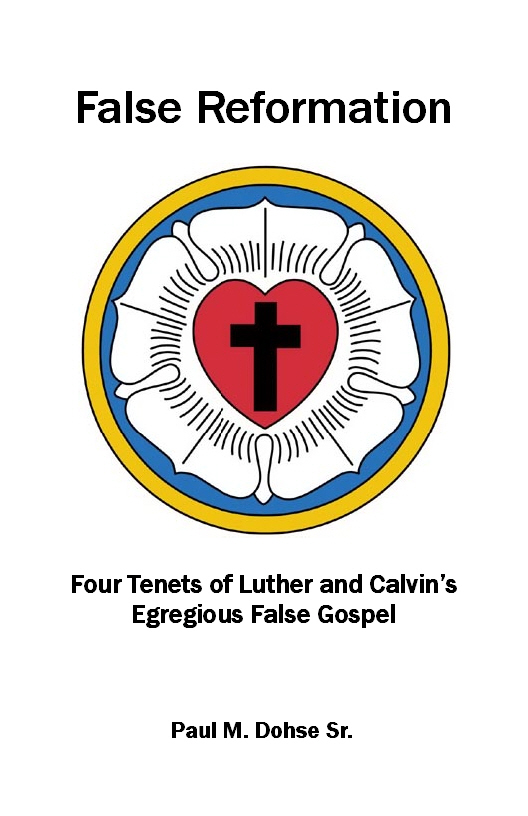 Perhaps the only book in existence that challenges the Protestant Reformation gospel in regard to doctrinal soundness. This book presents its case that the Reformation gospel is progressive justification, and that its major tenets such as total depravity extend to sanctification as well as justification. The total depravity of the saints? The book also explores the Reformation’s impact in regard to understanding the new birth.
Available on Amazon by these sellers: http://www.amazon.com/gp/product/1616588438

 Paul's Passing Thoughts
1 comment