New Calvinism Further Exposed With Help From Aaron O’Kelly: Part One
This is a shocking statement that unwittingly reveals O’Kelly’s ignorance in regard to the short history of the doctrine he embraces. Dr. John Miller is the father of Sonship theology and coined the mantra that is a hallmark of New Calvinism: “We must preach the gospel to ourselves everyday.” Luther didn’t coin that phrase—Miller did.
A New Calvinist blogger by the name of Aaron O’Kelly has responded to my open letter to Peter Lumpkin. Among many other accomplishments, Aaron obtained a doctorate degree from Southern seminary which is of particular interest to me as a Southern Baptist.
I will address the title of Aaron’s post first. It exemplifies the New Calvinist motif: us against them; evangelical Catholicism against the children of Luther; the scandalous doctrine of freedom; and partaking with Paul the apostle in being called an antinomian, etc. Though I could cite a gazillion examples, one from New Calvinist guru Tullian Tchividjian should suffice:
“As I’ve said before, I once assumed (along with the vast majority of professing Christians) that the gospel was simply what non-Christians must believe in order to be saved, while afterward we advance to deeper theological waters.”
That’s the mentality—they are set apart from the “vast majority” of professing Christians. Let that sink in. Towards the end of his post, Aaron eludes to their kinship with the great apostle in being called antinomian because they have discovered the long lost gospel:
“Dohse’s open letter is one more indication of how scandalous the gospel really is. When we receive the unfathomable good news that God receives us into his favor on account of Christ alone, and not because of anything in us, we instinctively recoil in an attempt to protect this glorious message from the charge of antinomianism. The pure gospel is too strong for us, and we think we need to mix it with a good bit of law to keep it from becoming too dangerous.”
And:
“But the gospel of the New Testament is the good news of freedom from the law through union with the crucified and risen Christ (Romans 7:1-7). It is a message that Paul was slandered for proclaiming, as though he encouraged sin (Romans 3:8). And those who have proclaimed it faithfully have been slandered ever since.”
O’Kelly also mentions that he considers himself a “Luthero-Calvinistic Baptist, but that hasn’t caught on yet.” Give it time Aaron, I’m sure it will eventually. After all, like Luther, New Calvinists are set apart from the “vast majority” of professing Christians.
I might also mention that the we are like the apostle Paul because he was accused of antinomianism also was tried on Jason Hood when New Calvinist Dane Ortlund responded to his calling out of Tchividjian. I comment on the exchange in another post:
“Moreover, a new one that I hadn’t heard before was mentioned by Hood regarding Ortlund’s original challenge—the whole idea that today’s New Calvinists are being ‘falsely’ accused of antinomianism like the apostle Paul was during his ministry (Rom 3:8). Therefore, if they are being accused of antinomianism, they must be preaching just like Paul was. Oh brother!”
Hood’s theological trouncing of Ortland’s position can be observed here: http://goo.gl/wYTrV .
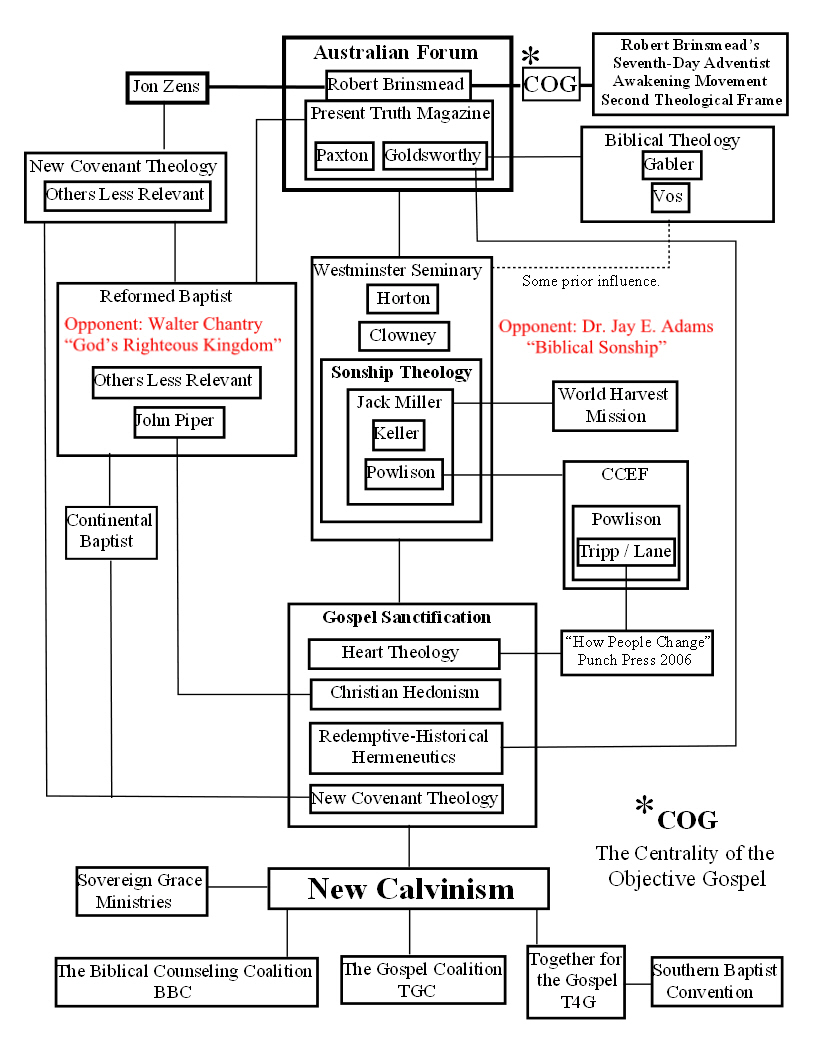
Much of Aaron O’Kelly’s (hereafter: “A-OK”) post addresses the genealogy chart. Perfect. After likening me to a government worker, he says the following:
“All kidding aside, charts like these have the effect of distorting the character of broad movements by implying that the adherents of the movement are members of a tightly knit group (cult?) who have conspired together to defend the novel teachings of their founder(s), to whom they are staunchly loyal.”
“Genealogy charts” and “family trees” (terms I use often to refer to the chart) in no way infer what A-OK is saying. Theological frameworks often leave behind a long history of people who never knew each other. Besides, the theological journal of the Australian Forum (hereafter: “AF”), Present Truth (hereafter “PT”), had a huge readership in Reformed Baptist circles and places like Westminster Seminary. In fact, Jon Zens was introduced to Brinsmead and the Forum through PT while he was a student at Westminster. To make my point, A-OK states the following concerning the top of the chart:
“I myself have never heard of the majority of names at the top of the list. I have heard of Graeme Goldsworthy, and I think he is an excellent Bible teacher. He is one influence among many (including some other names on the chart, but also including a large number of names that are not) who has played a role in my understanding of the Bible. Does that make me a card-carrying member of the group represented by this chart? If so, I must have missed the meeting where we learned the password and the secret handshake.”
So, A-OK seems to say that he has never heard of Zens or Brinsmead (he implies that Goldsworthy is the only one he knows of at the top of the chart), but it is well documented that Zens is the father of New Covenant Theology with considerable contributions by Brinsmead. Certainly, A-OK has heard of New Covenant Theology. He may even ascribe to it, but that doesn’t mean he’s a loyal follower of Jon Zens; or for that matter, even knew him or heard of him which seems to be the case.
Another indication that one does not need to know of the conceivers of a doctrine (or that my chart would imply a conspiracy) to embrace its elements passed on by various means, is the fact that A-OK parrots the AF’s position on the supposed subjective aspect of the gospel—even using their terminology. Here is what he writes:
“I am not sure why Dohse would consider it controversial to say ‘the gospel is something completely outside of us.’ To say otherwise would be to imply that salvation comes, at least in part, by gazing at our navels.”
Now consider what one of the AF3 wrote (Geoffrey Paxton, who I doubt he has heard of either) on the same wise:
“Such evangelical naval watching does nothing to commend Christianity….” (The False Gospel of the New Birth PT vol.37 article 4). The AF3 continually referred to “naval watching” when discussing the supposed subjective aspects of the gospel verses the objective gospel.
Another example would be Michael Horton who said this: “But to whom are we introducing people to, Christ or to ourselves? Is the ‘Good News’ no longer Christ’s doing and dying, but our own ‘Spirit-filled’ life?” Compared to G. Paxton who said this: “It robs Christ of His glory by putting the Spirit’s work in the believer above and therefore against what Christ has done for the believer in His doing and dying.”
Furthermore, A-OK prefaces the following statement in regard to the chart:
“By the way, I am speaking the language of Luther here; I am in no way indebted to the ‘Sonship theology’ that Dohse criticizes, nor have I ever heard of it prior to reading his letter.”
This is a shocking statement that unwittingly reveals O’Kelly’s ignorance in regard to the short history of the doctrine he embraces. Dr. John Miller is the father of Sonship theology and coined the mantra that is a hallmark of New Calvinism: “We must preach the gospel to ourselves everyday.” Luther didn’t coin that phrase—Miller did. Moreover, the present-day New Calvinist movement is replete with Miller’s spiritual children; namely, Tim Keller, David Powlison, Jerry Bridges, Darren Patrick, Mark Driscoll, and many others.
But now the most important points about the chart: First, it raises questions of integrity. Why does Keller and Powlison avoid the Sonship nomenclature among New Calvinist? You say, “They don’t” Then why do New Calvinist constantly espouse the phrase Miller invented, but yet they have never even heard of Sonship theology? O’Kelley said himself as one who is apparently qualified to write a response to the chart: “….nor have I ever heard of it prior to reading his letter.” I think this also adds to my aforementioned point as well—my chart hardly implies an accusation concerning a conspiracy.
Secondly, New Calvinists can no longer pretend that notable evangelicals have never had a problem with this doctrine. And to a more significant point, notable Calvinist themselves! And I don’t mean secondary disagreements, I mean, “This movement must be exposed and stopped.”
Thirdly, New Calvinist hacks can no longer go to conferences and pretend that all of the keynote speakers are parachuted in from Luther’s compound. Those days are over, and rightfully so.
Well, we have much more work to do on O’Kelly’s post. Lord willing, I will write part two tomorrow.
paul
But Peter, They’re Not Really Calvinist! An Open Letter To Peter Lumpkins
 Dear Peter,
I write to you as a fellow Southern Baptist.
I think real Calvinism has brought good things to Southern Baptists, but I just wanted to write you and mention that your present contention is not with real Calvinism.
They call themselves Calvinists, but that’s a lie. In fact, real Calvinists contend against them. Let me explain. The present movement you see in the SBC has a Calvinism label, but was really hatched by Jon Zens and a Seventh-day Adventist named Robert Brinsmead. Brinsmead created a project called the Australian Forum to promote the doctrine, and the two other primary contributors were Geoffrey Paxton and Graeme Goldsworthy. Their family tree, a work of mine with the help of others, can be seen in the following chart:

The basic frame of the doctrine they created is known as the centrality of the objective gospel (COG), and is what drives the present movement you see in the SBC. Apparently, the movement is now known as “New Calvinism,” and entails the T4G, The Gospel Coalition, and many, many other organizations that promote the movement.
Basically, it teaches that the gospel is something completely outside of us (objective), and that we are transformed by contemplating the depths of the gospel (or as John Piper states it: “Beholding as a way of becoming”). This outside, objective focus supposedly aids us in not being distracted by things that are subjective; for instance, even the belief that we are born again. In fact, the movement denies the significance of the new birth and teaches that Christians are still totally depraved. This can be illustrated by the video circulating on the Web called “John Piper is Bad” which doesn’t mean Piper is a cool guy, but rather that he is still a “T” in TULIP—totally depraved. Unlike real Calvinism, it projects TULIP onto sanctification as well. Piper acknowledged in an interview that he understood the video to mean exactly that and also agreed with it. Certainly, traditional Calvinism does not believe that Christians are still totally depraved.
In other words, the movement only recognizes justification (objective) and not the vital union or the new birth (subjective). We are supposedly transformed by focusing on the historical Christ event alone. This is why CJ Mahaney, one of the “core four” with Al Mohler in the T4G, always presents the gospel in the five-word epigram “Christ died for our sins.” In like manner, Piper presents a justification only gospel in “The gospel in 6 Minutes: “In a sentence….That’s the gospel.”
In 2008, one of the Australian 3, Graeme Goldsworthy, spoke at Southern Seminary (in the Australian Forum’s theological journal “Present Truth,” both Paxton and Goldsworthy declared the new birth a “false gospel”). John Piper reviewed Goldsworthy’s visit/lecture in an article posted on his Desiring God website (Piper is one of the keynote speakers at the 2012 T4G). In that article, Piper affirmed COG, and wrote the following:
“When the ground of justification moves from Christ outside of us to the work of Christ inside of us, the gospel (and the human soul) is imperiled. It is an upside down gospel [emphasis his, not mine].”
This is an interesting statement considering that Southern Baptists certainly change emphasis to our role as new creatures after we are saved. Piper is saying to do so is to put one’s soul in peril, and this is also exactly what the AF3 propagated. Furthermore, Piper seems to be saying that any emphasis on the work of Christ inside of us is a false gospel—also what the AF3 advocated. Peter, trust me, this problem is way bigger than Calvinism.
In addition, real Calvinist have fought this problem tooth and nail. As you can see from their family tree, the doctrine was repackaged by Dr. John Miller in the form of Sonship Theology while he was at Westminster Seminary. Pastors in the PCA (Calvin’s denomination) have been fighting the doctrine for years, especially Dr. Jay Adams who wrote a book against it in 1999. Tim Keller, a major figure in the New Calvinist movement, as well as David Powlison, were followers of John Miller. During a lecture at John Piper’s church, Powlison called Miller his mentor and chastised Adams for being critical of Dr. Miller for coining the phrase, “We must preach the gospel [justification] to ourselves everyday.” However, the fact that the criticism was in book form seemed to have slipped Powlison’s mind. Moreover, readers of my blog, one of which is taking the Sonship course presently, assure me that Sonship clearly teaches the total depravity of the saints, rejects the new birth, and holds to a New Covenant Theology view of the law. It is also common knowledge that Keller has taught Sonship Theology extensively.
It’s all the same doctrine. If the doctrine hadn’t found new life at Westminster, it wouldn’t have survived the brutal pushback by Reformed Baptist (more real Calvinist) such as Walter Chantry. Chantry and others adamantly called it out for what it is: “neo-antinomianism.” In the same way that COG plagued the Reformed Baptist by splitting churches and families, this doctrine continues to wreak havoc on God’s people.
Peter, worry about the real Calvinist later—these guys must go!
paul
John Piper Embraces the Australian Forum and Their Rejection of the New Birth
When the ground of justification moves from Christ outside of us to the work of Christ inside of us, the gospel (and the human soul) is imperiled. It is an upside down gospel.
~ John Piper
More and more, I see that the insight of one of my shy readers (or perhaps he is where he could be brought up on church discipline, the favorite weapon of New Calvinist) might just strike at the crux of this whole New Calvinist / Sonship Theology / Gospel Sanctification issue (hereafter NGSS). His take is that New Calvinism is a half gospel, claiming justification only, and denying the new birth—regardless of the fact that Christ said, “You must be born again.”
The nemesis of New Calvinism is the ability to obey the law because we have been created anew by God (unlike before we were saved, Romans 8:6-8). They don’t like that because they are antinomians—period. As you know, my thesis is that NGSS came from the Australian Forum’s (hereafter AF) centrality of the objective gospel (hereafter COG). The basics of the doctrine came from the Seventh-day Adventist Awakening movement led by Robert Brinsmead. He developed three primary doctrinal frameworks while he led that movement. The first concerned judgement, the second concerned the objective gospel, and the third was a total departure from Christianity all together after he left the AF (and their theological journal Present Truth) to begin writing Verdict. During his development of the second framework, he started the AF project and was joined by Geoffrey Paxton and Graeme Goldsworthy. I refer to them as the AF3. It was clearly their goal to developed Brinsmead’s second framework into a unified theological system.
What was his second framework? It is explained by an individual who was raised in the movement during that time:
“In 1971, Brinsmead scheduled a flurry of summer institutes to bring us his latest emphasis. There was more excitement than usual; the latest round of tapes had prepared us for something big. Bob had been studying the Reformation doctrine of justification by faith, comparing it to Roman Catholic doctrines. Reading Luther, he saw that justification is not just a means to the end of perfect sanctification. When we are justified by faith, not only does God impute Christ’s righteousness to us but we also possess Christ Himself—all His righteousness and all His perfection. Eternity flows from that fact. The apostle said,
‘And those whom he predestined he also called, and those whom he called he also justified, and those whom he justified he also glorified’ (Rom. 8:30).
The same ones he justified he also glorified. We began to realize we had inserted extra steps into Paul’s chain of salvation: sanctification and a final atonement brought about by blotting out sins” (Martin L. Carey, Judged by the Gospel: the Progression of Brinsmeaed’s Awakening).
In other words, because sanctification was left out of Romans 8:30, it was seen by Brinsmead as an “extra step” in the chain of salvation.
Carey continues in the cited article:
“[quoting Brinsmead:]’The righteousness by which we become just in God’s sight, remain just in His sight and will one day be sealed as forever just in His sight, is an outside righteousness. It is not on earth, but only in heaven…only in Jesus Christ.’”
According to Carey, Brinsmead thought the primary foe of the Reformers whom he was studying represented the antitheses of the true gospel:
“The Awakeners now saw how Adventist righteousness by faith resembled Catholic teachings. Present Truth, Brinsmead’s new magazine, summarized historic Catholic doctrine this way:
1. Justification is a process of inner renewal in us. 2. Justification is given to us by an infusion of God’s grace. God looks at what the Holy Spirit has done in us, and justifies us. 3. Justification is how man becomes just and pleasing to God in his person.
Both Rome and the reformers said that salvation was all of grace. However, for Rome, the work of grace was in man’s experience, a subjective work. Conversely, the reformers said the grace that saves us is outside man’s experience in the person of Christ, an objective work. Struggling sinners are not to look to their own experience for hope and acceptance with God. Everything Christ did as our representative is now counted as ours by faith. Luther said,
‘Mine are Christ’s living, doing, and speaking, his suffering and dying, mine as much as if I had lived, done, spoken, suffered, and died as he did.’
Many rejoiced at this clear proclamation of Christ’s finished work for us. So this is what a completed atonement looked like! But critics asked, ‘What about holiness?’ The reformers were unanimous; only because of Christ’s virtue is the Spirit given to the justified sinner to regenerate him for good works. True sanctification looks away from self and flows from the finished, objective work of Christ. In those who hear and believe, Christ’s Spirit reproduces His life…. For many Christians, the glory of the crucified Christ is not their focus; instead they seek internal experiences that eclipse the cross.”
What we have here by Carey is an eyewitness account of the very birth of COG. As also noted by Carey, Brinsmead started Present Truth (hereafter PT) during that time which was the theological journal of the AF and the primary contributing writers were Paxton and Goldsworthy. In volume 46, article 2, parts 4,5,6 of PT, they stress the need to develop a theological framework for COG that included covenants, a historical framework, and an eschatological framework. Without any doubt, their work forms the framework that New Calvinism has been built on for the past forty years.
Also involved in the AF was Jon Zens, the father of New Covenant Theology (according to Dennis Swanson, Introduction to New Covenant Theology [NCT] p.152). Brinsmead was intimately involved in helping Zens develop NCT ( http://wp.me/pmd7S-HB http://wp.me/pmd7S-HX http://wp.me/pmd7S-I1 ) and defended Zens against Walter Chantry’s brutal assault against NCT. Chantry called it “neo-antinomianism.” NCT has a view of the law that compliments NGSS. In fact, many NGSS churches consider NCT to be the primary doctrine that encompasses christian hedonism, heart theology, Gospel Sanctification, and historical redemptive hermeneutics. A good example of that would be “A Gospel-Centered Hermeneutic: Foundations for a New Covenant Theology” by Dr. Dale Evans. The first sentence of his manuscript reads: “Over the last several weeks, the pulpit ministry at Clearcreek Chapel has focused on presenting texts and issues related to the concept know[n] as New Covenant Theology.”
Before we move forward, review the NGSS family tree:
In March, 2008, none other than Graeme Goldsworthy delivered a lecture at Southern Baptist Theological Seminary titled Biblical Theology and its Pastoral Application. The presentation was pure AF COG. The following information concerning that presentation comes from an article entitled, Goldsworthy on Why the Reformation Was Necessary written by none other than John Piper on his Desiring God website. Piper wrote the piece on June 25, 2009. Piper states the following in the article:
“In it he [Goldsworthy] gave one of the clearest statements of why the Reformation was needed and what the problem was in the way the Roman Catholic church had conceived of the gospel.”
Got that? Piper concurs with Goldsworthy (and therefore the AF3) concerning what needed to be corrected in regard to Rome’s gospel. And what was that? Piper continues:
[1] “Both Catholicism and allegorical interpretation of Scripture involved the dehistoricizing of the Gospel. The Reformation rehistoricized both the Gospel and the Old Testament.”
In other words, Rome interpreted Scripture with concerns for things other than a strict historical view of the gospel (ie., the works of Christ only). This was a dominate theme of the AF. Regarding the aforementioned statement by Piper referring to Goldsworthy, “The Reformation rehistoricized both the Gospel and the Old Testament,” Goldsworthy wrote in Present Truth: “The gospel is no timeless ideal or myth-based ethical principle. The Old Testament unrelentingly binds us to the acts of God in history…. To neglect the Old Testament exposes us to the danger of turning the objective Christ event into the subjective Christ ideal” (Goldsworthy, PT: “Obituary for the Old Testament” vol.41 art.2).
So, “ideals” are subjective, but a strict history regarding the “Christ event” is objective.
Also according to Piper prefaced by his glowing endorsement:
[2] “The prime focus recovered in the Reformation was the justification of the sinner on the basis of the objective, historic work of Christ for us.”
Robert Brinsmead stated it this way: “This means that unless we are caught up in the Spirit of the gospel, we cannot understand or use the Bible correctly. Apart from the gospel the Bible is letter (gramma), not Spirit (pneuma). ‘The letter kills, but the Spirit gives life’” (“A Freedom from Biblicism” in The Christian Verdict, Essay 14, 1984. Fallbrook: Verdict Publications. Pgs. 9-14).
Only the gospel is objective—all other uses of the Bible are subjective and not illumined by the Spirit.
Piper continues with point four of Goldsworthy’s address:
[3] “Catholicism had reversed the vision so that the prime focus was on the work of Christ or his Spirit within us.”
These points are not in quotations by Piper. They are his summarizations. Notice that he emphasizes “within us.” Piper, agreeing with the AF, is plainly saying that the Reformation reversed a primary focus on the Spirits work in us rather than the historic works of Christ outside of us. But the Spirit’s work within us is known as sanctification; and indeed, evangelicals have always seen this as the most important matter at hand for the believer rather than the past forensic declaration by God that we have the righteousness of Christ positionally.
Piper reiterated his understanding on point four:
“This meant the reversal of the relationship of sanctification to justification. Infused grace, beginning with baptismal regeneration, internalized the Gospel and made sanctification the basis of justification. This is an upside down Gospel.”
This is a shocking statement by Piper. He basically says “Catholicism had reversed the vision so that the prime focus was on the work of Christ or his Spirit within us” calling that “infused grace.” Compare that statement with Carey’s above concerning the second framework of the Awakening movement’s view of the supposed antithetical gospel: “1. Justification is a process of inner renewal in us. 2. Justification is given to us by an infusion of God’s grace.”
Therefore, exactly like the AF, Piper dogmatically imposes an either / or gospel:
sanctification by justification = the true gospel.
justification by sanctification = works salvation
The relationship between the two are skewed and a false prism is declared. More kinship between the AF and John Piper can be seen on this same wise when one reads this Goldsworthy excerpt from Preaching the Whole Bible As Christian Scripture: The Application of Biblical Theology to Expository Preaching, p.237:
“One is unlikely to assert that we are justified by sanctification, but, whether done intentionally or not, that is what happens when we allow the teaching of Christian living, ethical imperatives, and exhortations to holiness to be separated from and to take the place of the clear statement of the gospel.”
Piper then completes his article with this statements:
“I would add that this ‘upside down’ gospel has not gone away—neither from Catholicism nor from Protestants…. When the ground of justification moves from Christ outside of us to the work of Christ inside of us, the gospel (and the human soul) is imperiled. It is an upside down gospel.”
Therefore, It should be no surprise that going hand in hand with COG is a denial of the new birth. In an issue of Plain Truth titled “The Upside Down Gospel” (as also mimicked by Piper twice in his short article), the AF points out supposed false teachings that result from interpreting the Bible from a “subjective” viewpoint; namely, “New-birth centered preaching,” “The believer’s crucifixion,” and “The believer’s resurrection life” (PT vol. 15, p. 8). Like Piper, the AF believed that the gospel and souls are “imperiled” when such things are taught because, as stated by Piper: “When the ground of justification moves from Christ outside of us to the work of Christ inside of us, the gospel (and the human soul) is imperiled.” Paxton, in no uncertain terms, denied the new birth in an article entitled “The False Gospel of the New Birth” (PT vol. 37 art. 4). Goldsworthy followed suit in “Obituary for the Old Testament” (PT vol.41 art.2) and referenced Paxton’s article for clarification.
My friend is absolutely right. This is clearly a justification only gospel. It excludes what he calls “the vital union.” I refer to it as the new birth. Look, plainly, NGSS teaches that Christians are totally depraved and are on the same plane with unbelievers. This approach to the gospel will profoundly effect how Christians walk and our presentation of the gospel. Like Jay Adams, I say “It must be stopped.” A line is in the sand. New Calvinist believe that the evangelical emphasis on our walk with Christ, and His work within us is subjective truth and a false gospel. Evangelicals do reject sanctification by justification when not considered a onetime act by God that enables us to participate in sanctification. They preach another gospel–not us; so with the apostle Paul, I say we let them be accursed.
paul
The Australian Forum 3 and Contemporary New Calvinists Sittin’ in a Tree, K-i-s-s-i-n-g
The false gospel of the new birth imagines that the new birth refers primarily to what happens in the believer and that this is the greatest news in the world. This is classical Roman Catholicism. It teaches that a good thing is the best thing, that the work of the Spirit is greater than that of the Son
~ Geoffrey Paxton
When the ground of justification moves from Christ outside of us to the work of Christ inside of us, the gospel (and the human soul) is imperiled…. Catholicism had reversed the vision so that the prime focus was on the work of Christ or his Spirit within us.
~ John Piper
And the new-birth oriented ‘Jesus-in-my-heart’ gospel of evangelicals has destroyed the Old Testament just as effectively as has nineteenth-century liberalism.
~ Graeme Goldsworthy
It robs Christ of His glory by putting the Spirit’s work in the believer above and therefore against what Christ has done for the believer in His doing and dying.
~ Geoffrey Paxton
But to whom are we introducing people to, Christ or to ourselves? Is the ‘Good News’ no longer Christ’s doing and dying, but our own ‘Spirit-filled’ life?
~ Michael Horton
This meant the reversal of the relationship of sanctification to justification. Infused grace, beginning with baptismal regeneration [which evangelicals reject], internalized the Gospel and made sanctification the basis of justification.
~ John Piper
[Evangelicals] unwittingly teach justification by sanctification.
~Graeme Goldsworthy
[Brinsmead on evangelicals and Catholics:] “Justification is a process of inner renewal in us. Justification is given to us by an infusion of God’s grace.”
~ Robert Brinsmead
It is an upside down gospel.
~ John Piper
It is an upside down gospel
~ The Australian Forum
paul
Uneclipsing the Father: Part 1
 Christians are beginning to wakeup to the fact that many of the most famous evangelical leaders of our day are saying that every verse in the Bible is about Christ. This obviously eclipses the Father, and the Holy Spirit as well. Even John MacArthur said in a forward to a recently published book that “no one” other than Christ “deserves” to be the primary focus of our message and private devotions. Really?
Please read this work by pastor Langley in regard to the Christocentric approach to the Bible. I did some research on Langley before I decided to post this, and he is orthodox.
Here is a pdf link to this excellent work by pastor Langley: WHEN CHRIST REPLACES GOD AT THE CENTER OF PREACHING.
paul

 Paul's Passing Thoughts
4 comments