The SBC is Shooting Innocent Wolves: is That a Good Thing?
 We Southern Baptists have our standards. I have been a Southern Baptist since 1983, and we are notorious for not confronting sin in our churches, unless the sin happens to be Calvinism. Leave? Why? It’s way too much fun admitting our hypocrisy at SBC gatherings and watching the veins swell-up in people’s necks.
So, apparently, there is a Calvinism controversy going on in the SBC. Southern Baptists are concerned about an “aggressive Calvinism” that is growing in the SBC. The latest episode where those rascally Calvinists got a learnin’ was the rejection of Pleasant Valley Community Church’s bid to become part of the Daviess-McLean Baptist Association. The Association voted 104-9 to deny membership because, “It affirms the doctrine of election and grace. While we know the doctrine is not heresy, we do recognize that it is vastly different than the majority of churches within the DMBA.”
This particular association also voted to separate from a church in the association due to some sort of compromise that was deemed to be a serious issue. Therefore, they have something right that is rare today; they understand that church discipline is a universal matter. There are situations where Matthew 18:15-20 needs to be carried out between churches and the fourth step is the breaking of Christian fellowship between those churches. Church A will no longer fellowship with church B—this sends a very powerful message. Point in case: member/spouse A files an unbiblical divorce on member/spouse B. Their church leaders will not deal with the problem, other than to “pray about it.” Spouse B goes to the leadership of another church in the association and pleads for help. The other church tells the couple’s church to deal with the problem or they will. This would be the first step of church discipline between churches, and though I get a lot of flak for this position, I stand by it and believe it is 100% biblical.
So kudos for DMBA—except for the fact that Pleasant Valley Community Church is innocent of being Calvinistic. I checked out their website; they are New Calvinists, NOT (old) Calvinists. Big difference. In fact, old Calvinists don’t even like New Calvinists. One well known Calvinist said of New Calvinism:
….a seriously distorted Calvinism falling far, far short of an authentic life of obedience to a sovereign God. If this kind of Calvinism prospers, then genuine biblical piety will be under attack as never before.
And….
The new Calvinism is not a resurgence but an entirely novel formula which strips the doctrine of its historic practice, and unites it with the world.
Yet another well known Calvinist said:
This movement runs contrary to the Reformation and the Scriptures. It is dangerous and must be exposed and halted.
So, if real Calvinists are saying, “Ya, they are like us in name only, but they are dangerous and don’t obey God,” wouldn’t it behoove SBC folk to learn what the difference is? If they won’t fellowship with the devil they do know, what about the devil they don’t know? Seems to me if you are going to break fellowship with people, you should know what they are really guilty of.
Per the usual, we Southern Baptists are the best at making idiots of ourselves even when we do the right thing. The DMBA said, “While we know the doctrine is not heresy, we do recognize that it is vastly different than the majority of churches within the DMBA.”
Ugh. First, Old Calvinism is NOT “VASTLY” different from Southern Baptist doctrine. I have NEVER heard a Southern Baptist pray for someone to save themselves. Southern Baptist are only Arminians when they are evangelizing. After they get someone saved; trust me, they believe God does it all! Southern Baptists have a lot to learn from Calvin on discipleship. Then the DMBA said, ”…. we know the doctrine is not heresy.” That’s true about Calvinism, BUT NOT Pleasant View! Pleasant View Community Church does in fact hold to a heretical doctrine—Old Calvinists even say so!
So, the SBC is shooting “wolves,” but not the ones that are eating the sheep. Is that ok? After all, a wolf is a wolf, right? No, I have a better idea. The SBC needs to unite with the real Calvinists that have been in the SBC forever (and have never caused a problem) to get rid of New Calvinism. In the process, we might learn something from them.
New Calvinism is the New Covenant Theology/Gospel Sanctification/Sonship Theology wolf in sheep’s clothing. They are not honest about who they are and deliberately hide behind the ignorance thereof. Um, DMBA, did you go to Pleasant View’s website? They say that they are a “Acts 29 church” (the church planting organization). Acts 29 came out of World Harvest which was founded by the father (Dr. John Miller) of Sonship Theology, a theology that has been banned in many Presbyterian churches (the church founded by Calvin). Also, ever heard of the Emergent Church, and their ties to Acts 29?
Please, please, my fellow Southern Baptists, get your head out of, um, er, uh, the sand.
paul
John Piper: You’re Either With Us, or You’re With Rome
“Piper is an antinomian false teacher who has the audacity to proclaim, in essence, “You are with us (the New Calvinists), or you are with the Roman Catholics.”
Let’s take some time here to chat about how John Piper thinks he’s the elder statesmen of a modern-day resurgence of the original Reformation. Truly, his ego cup runneth over.
First, as established in “The Truth About New Calvinism,” Piper and his arrogant horde got their doctrine from the Australian Forum. The Forum believed the following about what the true issue of the original Reformation was: Rome separated justification and sanctification, and thereby “infused grace” into the believer via the new birth. The new birth constituted a righteousness that was inside of us, or a righteousness that we actually possessed within us. Supposedly, the Reformation reclaimed “the objective righteousness of Christ completely outside of us.”
To believe that we have an actual righteousness imparted to us through the new birth is supposedly to believe that our participation in sanctification can maintain and finish justification. In other words, the Reformers supposedly believed that sanctification had to maintain justification and finish it. Of course, mortals cannot do that. Supposedly, the Reformers believed that Christ not only died so that we could be justified, but He lived a perfect life for us also, so that His obedience could be imputed to us for sanctification, which can now complete justification because it is Christ’s works and not ours that is being presented. The Forum believed that living by faith is to constantly present the works of Christ to the Father to maintain justification, and not our own imperfect righteousness.
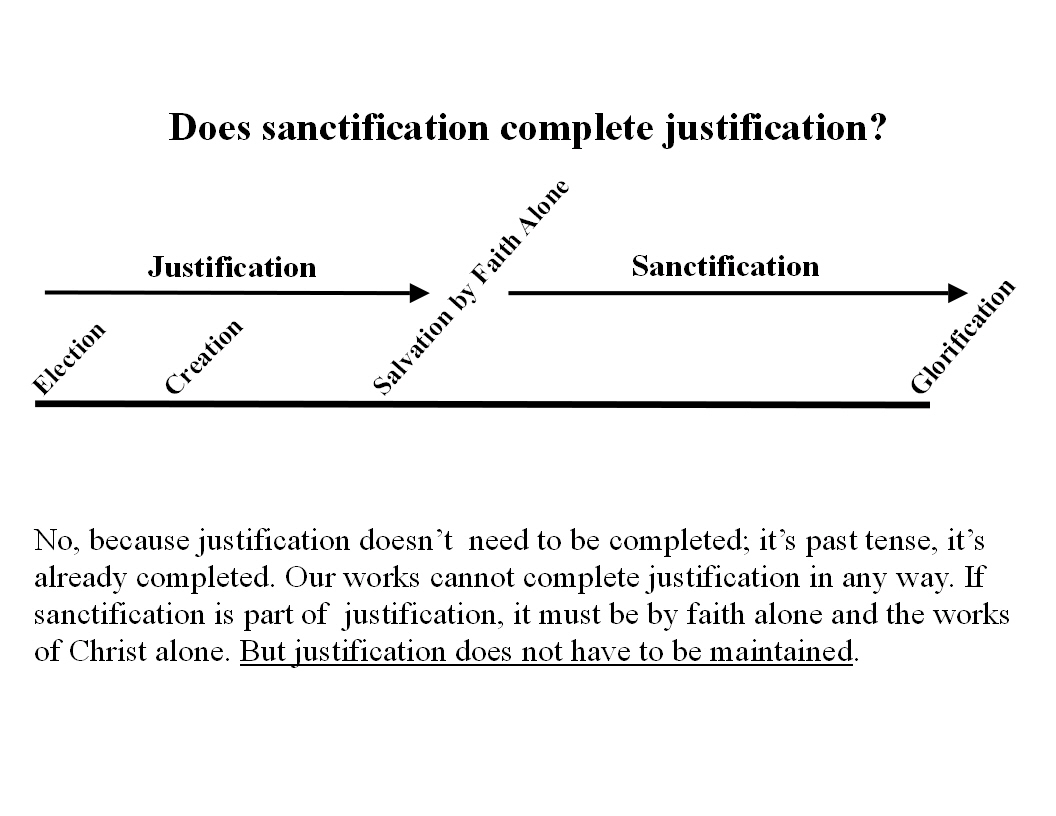
But the premise is false, and evangelicals believe that justification does not have to be maintained. We believe that justification is a onetime declaration that guarantees glorification (Romans 8:30). And the full righteousness of God has been credited to our account based on our faith ALONE in what Christ accomplished on the cross, and His resurrection. Evangelicals believe that sanctification can’t change that—it’s past tense—it’s a completely done deal. Evangelicals and old Calvinists alike utterly reject an infusion of sanctification and justification.
The truth of the matter is that the infusion of sanctification and justification is the bases for almost every false doctrine known to man because it leaves you with two alternatives only: First, faith alone justifies us and wipes out all of our past sin, but now our standing has to be maintained by what we do in sanctification, either by work or ritual. The other alternative is to say that Jesus ALONE does sanctification for us because everyone knows we are not even going to be faithful in the easier option of ritual to maintain justification; this second option is a Jesus obeys for us antinomianism.
Again, evangelicals don’t believe that justification has to be maintained or completed by sanctification. However, the Forum was formed to develop a systematic theology that made sanctification by Jesus alone for the purpose of completing justification plausible. They also taught ecciesia reformata semper reformanda which holds to the idea that the Reformation was not finished with Luther and Calvin.
The following charts might help to clarify the issue:

The following montage from the Forum’s theological journal confirms what they thought about the original Reformation and the new birth:
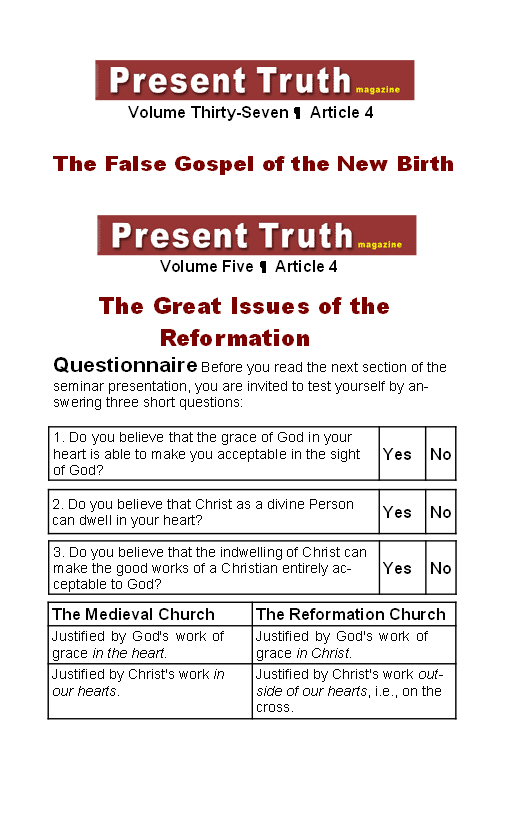

Then it happened. One of the original members of the Australian Forum did a series of lectures on the Reformation at Southern Theological Seminary. Piper, who usually stays aloof from his ties to the Forum—couldn’t help himself. He wrote an article about it:
Desiring God blog, June 25, 2009: Goldsworthy on Why the Reformation Was Necessary.
In the article, Piper shows his full agreement with the Forum on their ridiculous Reformation motif and false doctrine:
This meant the reversal of the relationship of sanctification to justification. Infused grace, beginning with baptismal regeneration, internalized the Gospel and made sanctification the basis of justification. This is an upside down Gospel.
In case one would think that Piper excludes evangelicals from this concern because of his mention of baptismal regeneration, consider what he said in the same article: “I would add that this ‘upside down’ gospel has not gone away— neither from Catholicism nor from Protestants….” Piper, like all New Calvinists, insists that justification and sanctification have a “relationship” (infusion), and of course, they reject the idea that we help in the completion of justification; that’s a “reversal” of the two and an “upside down” gospel. They therefore hold to option B: Jesus obeys for us antinomianism.
Piper also states in the same article:
When the ground of justification moves from Christ outside of us to the work of Christ inside of us, the gospel (and the human soul) is imperiled. It is an upside down gospel.
Like the Forum, Piper rejects the new birth as having anything to do with a righteousness that is possessed by the believer. This explains the continual pontification by New Calvinists that believers are no better off than the unregenerate. Paul David Tripp describes believers as dead and unable to do anything. Piper also got the “upside down gospel” phrase from the Forum. In fact, it was one of the major themes of an issue in their theological journal as can be observed below. BUT, also note that they even exclude a righteousness imparted to us by Christ within, and Him doing the work! In fact, to believe that Christ is doing the work within us “imperils(ed)” the soul!

Like the Forum, Piper lumps evangelicals together with Rome in the same article:
In it [Goldsworthy’s lecture at Southern] it gave one of the clearest statements of why the Reformation was needed and what the problem was in the way the Roman Catholic church had conceived of the gospel….I would add that this ‘upside down’ gospel has not gone away—neither from Catholicism nor from Protestants.
Piper is an antinomian false teacher who has the audacity to proclaim, in essence, “You are with us (the New Calvinists), or you are with the Roman Catholics. While Piper puts on the whole humbleness and wisdom of Yoda act, he is one the most arrogant and deceitful false teachers in recent church history.
paul
Robert Brinsmead’s Side of the Family Only Meets in the Desert
Why doesn’t Robert Brinsmead’s side of the family ever get invited to the big dances? You know, T4G and TGC. I know, I know, a little too close to the illegitimate Adventist children nobody knows about. But the Emergent Church side of the family gets invited to the big family reunions all the time! You know, Mark Driscol, Darren Patrick, etc. (Dr. John Miller’s chidren). And Geez, some of the Charismatic side of the family are keynote speakers! Yes, yes, I know, they are “Reformed Charismatics” (huh?), but hey, Robert Brinsmead was Reformed too! Not fair, just not fair.
Well, bless DA Carson’s little heart—he is willing to party with Brinsmead’s side of the family now and then. Ya, out in the desert, but it’s a start. He will do a little reunion with Fred Zaspel at “Clarus 12” held annually at Desert Springs Church and sponsored by TGC.
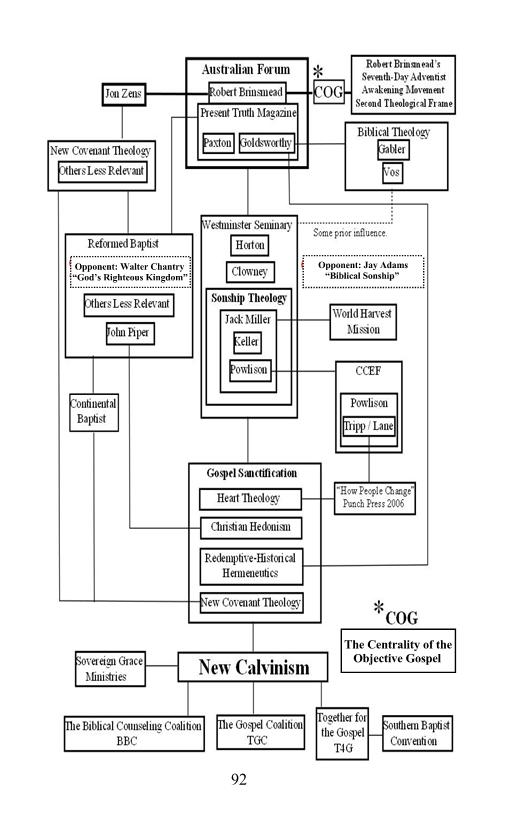
If you examine their family chart below, you only have Zaspel’s daddy, Jon Zens, between the New Covenant Theology clan (Zaspel would fall under “others less relevant” in the NCT box) and granddaddy Brinsmead’s Australian Forum. Jon Zens is known as the father of New Covenant Theology, and it is a well-documented fact that Brinsmead had a lot of input with Zens in the development of NCT. In 08, Carson did Clarus with Michael Horton and they discussed the Westminster offspring in a Q and A, but once again forgot to mention daddy Brinsmead. A shame.
NCT is the official position of New Calvinists but they won’t admit it due to the fact that Brinsmead and Zens concocted it. Brinsmead is now, as reported by many, an atheist, and Zens holds to Adventist-like beliefs. Though they put a good face on “all truth is God’s truth” they would rather not go there.
God’s people are not “ready” for that yet—the meeting and inclusion of all the family members.
paul
Interview With a New Calvinist: Part 5
Again, the purpose of this interview is education, not debate from the interviewer. But to accentuate the interview, I invite vigorous debate in the comment section. After his response here, I have decided to move on to the next topic.
Q: Me.
Responses in blue.
Italics are third-party references used in questions.
Continued from part 4. Q: I’m not so sure about that clarification. Let’s take a pure, unadulterated NC view of justification and see where you agree or disagree:
The Present, Continuous Nature of Justification; For all its strength, Reformed theology tends to relegate justification by faith to an initiatory action in the soteriological process. This is because it contends that the subjective (personal) justification of the believing sinner is a once-and-for-all, nonrepeatable act. Hence the relationship between justification and sanctification is seen as justification succeeded by sanctification. AGREED
And…Since the life of holiness is fueled and fired by justification by faith, sanctification must constantly return to justification. In other words, our sanctification is fueled/motivated by the grace of salvation. In a very technical sense, it is grace that precedes justification (i.e., the sovereign work of regeneration) that necessarily leads to justification, that brings us as Christians to the point of gratitude for grace. Regeneration is a monergistic act of the Holy Spirit where as justification is a synergistic act between God and man (i.e., God promises IF we believe, THEN we will be saved/justified). Traditionally, most classical “reformed” Christians have great difficulty labeling justification as synergistic, but that is because of the historical line of reasoning from Arminian and Pelagian forefathers.
Otherwise, the Christian cannot possibly escape arriving at a new self-righteousness. We cannot reach a point in sanctification where our fellowship with God does not rest completely on forgiveness of sins. Foundationally, yes. Exclusively, no. There are other motivating factors for a Christian, But they all coincide with a God/Christ centered motivation. The desire to be holy stems from a renewed heart’s love and passion to want to conform to the image of Christ, because of the gratitude for Christ, because of the joy found in glorifying Christ, his life, death and resurrection.
And…Christian existence is gospel existence. Sanctification is justification in action. Agreed.
[Q] Second part of this question: I’m not so sure evangelicals would say that, Any/all acts of obedience, we would say, are empowered alone by the Holy Spirit. “It is God who works in you, both to will and to act.” I am not an advocate of monergistic sanctification, so I hope I didn’t leave that impression. Classical Christianity understands sanctification as a synergistic act between God and man. God works in us, we work it out. The difference between “reformed” synergism and non-reformed synergism is that the former is understood as a sovereign-synergism and the latter, not.
That being said, when I/we say any/all acts of obedience are empowered alone by the Holy Spirit, we make reference to the monergistic act of the Holy Spirit whereby the bondage of our will has been liberated “alone” by the power of the Holy Spirit, and from then on out, the entirety of our obedience drives its ultimate “power” from the Holy Spirit. “What do you have that you have not been given, and if you have been given it, why do you boast as though you have not…For by him and through him and to him are all things. To God alone be the glory forever.”
[Q] Please distinguish this as opposed to sanctification by faith alone which evangelicals would reject out of hand. “Sanctification by faith alone…” does not mean we sit back and believe in some kind of fatalistic sanctification, that we just sit back and wait for God to, magically, “do everything.” SBFA is, as Martin Luther described it, an active/living faith. Utterly passive sanctification is agreeably just a fancy way of advocating antinomianism. SBFA simply means, we are sanctified, we are changed and made increasingly holy, as we trust God, at his word, trusting him by believing and obeying everything in his word, not just the verses that talk about believing in the life, death and resurrection of Christ. We trust him with all of our life by embracing and believing all of his word.
[Q] Third part of this question: How should we reconcile this with believers being described as “co-laborers with God” and the Holy Spirit being our “Helper.” To me, the reconciliation is very simple. We have paradoxical revelations in Scripture, both transcendent and imminent dealings with God and man. Both camps error when emphasizing one facet at the expense of the other (can you say Christological paradox? J). The difference between the two theological camps rests within the understanding that there is paradoxical revelations/teaching in Scripture that can lead one to believe that, transcendently, God does everything or imminently, God waits for man to accomplish anything.
[Q] Fourth: What’s you evaluation of the following statement:
Sanctification is cooperative. Agreed.
There are two partners involved in the work. I must work and God will work. Agreed.
If ever the extra-biblical maxim, “God helps those who help themselves,” had any truth, it is at this point. Again, this concept has validity so long as the balanced understanding of transcendence and imminence remains intact. Yes, God does draw near to those who draw near to him…If we abide in Christ, then he will abide in us…I believe in those contingent truths and promises like nobody’s business.
The point of departure from we what we would describe as evangelical orthodoxy stems from an autonomous understanding or practice of synergism, once the believer has been regenerate. The idea that once the HS has regenerated one’s life, somehow they are, for all practical purposes, autonomous, a sort of neo-deistic practice of the Christian life, that God has regenerated an individual and basically now, sits back for the rest of their spiritual life waiting to see what they will do with the regenerating life they have been given. This, we would say, is not how the Christian is to understand synergistic sanctification. That would be better defined as self-righteous self-betterment.
We are not called to sit back and let God do all the work. We are called to work, and to work hard. To work something out with fear and trembling is to work with devout and conscientious rigor. It is to work with care, with a profound concern with the end result. Agreed. We would simply qualify this as being motivated to chase after our sanctification via. the Christ centered-gospel motivation.
Sanctification is, undeniably, a synergistic process. God works concurrently with our human agency. However, theologically, there is a difference between “reformed” and “non-reformed” synergism and concurrence. For that reason, the previous entire statement can mean two different things to two different theological persuasions.

 Paul's Passing Thoughts
7 comments