Often Asked By Those Looking For a Church: How Do I Know If It Is New Calvinist Or Not?
 “Really, number one and number six are the most significant answers to the reader’s question.”
New Calvinism is not only dangerous to one’s soul, it is very subtle, and its proponents are deliberately covert. A post on what to look for is overdue, and my thanks to the reader who wrote and reminded me of this need. First, know this: in our day, New Calvinist churches will be the rule and not the exception. When you visit a church, assume that it is in the process of being taken over by New Calvinists, or has been in that camp completely for a period of time. Churches that have been solidly New Calvinist for a number of years will have cult-like characteristics.
Now, let me first begin my list by specifically answering the readers question and then I will expand from there: “….and would like to have a few questions to ask a Pastor to be able to know for sure if he is or is not in the NC camp by how the questions are answered. At the top of your head what questions would you recommend be asked that would be very telling?”
1) The biggie: “What hermeneutic do you use when you are preaching? Do you use the grammatical historical hermeneutic, or the redemptive historical hermeneutic?” Whether the pastor is NC or not, a deer in the headlight look will follow because most parishioners of our day do not know any theology. Think about it for a moment. These are two very different ways of approaching the Bible with the results being radically different; but yet, 99% of the parishioners out there have no idea which one their pastor uses.
GHH seeks to be exegetic; all ideas about everything are drawn from the text. RHH has an eisegetic approach; the sole purpose of the Bible is to gain a deeper understanding of Christ. It is sometimes called the “Chrstocentric” hermeneutic.
If the pastor admits that he is RHH, he is a NC. If he becomes aloof, for example; “Well, why don’t you come and see what we are about at one of our services, and then if you still want to talk about theology, we can do that” (by the way, that’s an actual quote from a pastor in response to my question concerning his hermeneutics), he is suspect. If he claims to be both, he is also suspect. If he is NC, he will know the very second you asked that question that he does not want you in his church.
2) Ask him who his favorite teachers are (you may want to word the question in a different way). If aloofness follows, he is suspect. If his favorite teachers are the likes of John Piper et al, he is either undiscerning or NC. In other words, he’s suspect.
3) You can ask him about his view on obedience, but you have to ask it this way in order not to be roper-doped: “Does all legitimate obedience and duty come out of a deeper understanding of our salvation? And when it does, is it a ‘mere natural flow?’”
4) “Do you believe that we are sanctified (set apart) by contemplating the gospel that saved us, or colaboring with the Holy Spirit in applying the word to our life.”
Bottom line: a skilled NC pastor can get around all of these questions except question number one. Even then, he can claim that he uses both hermeneutics.
Things to Look For
5) Is everything going on in the church about the gospel and Jesus? Is all of the music about redemption? Are all the messages about salvation, even though it’s a Christian setting? Is God the Father and the Holy Spirit rarely mentioned?
6) Another biggie: The missing transition communication technique in teaching and conversation. Like number one, this is huge. A message will begin with the subject of our Christian walk, but then will move into the subject of salvation without a transition in subject, as if the two are the same thing. Really, number one and number six are the most significant answers to the reader’s question.
7) The either/or communication technique, or the missing option C communication technique. The classic example is this prayer I heard spoken by a New Calvinist elder: “Lord, forgive us for obeying you in our own efforts.” The prayer insinuates that it’s either all of our effort, or all of something else that we don’t need forgiveness for. New Calvinists use this communication technique over a wide spectrum of teachings.
The Danger Zone
8.) Don’t forget, New Calvinist elders believe they have authority over you if you are a professing Christian and you are in their neck of the woods. Never, never, never, never meet with an elder or a group of elders ALONE. Never. And document everything. If you find yourself trying to ascertain where a church is doctrinally, and things are getting uncomfortable—that’s a New Calvinist church, or a cult, one or the other. Also, in this type of situation in a NC church, they consider these meetings to be steps of Matthew 18. They also consider any type of formal or informal counseling to be part of the discipline process. Regardless of whether you are a member or not, they will formally excommunicate you from the church universal in a Sunday morning service. And by the way, you have no legal grounds for a lawsuit in any state. Please, please, avoid these situations.
9) Watch for signs of exclusiveness; such as, “We preach the scandalous gospel,” ect. Or, “We teach this, as opposed to the ‘vast majority’ of other Christian churches.” “This is what makes us unique.” If you hear verbiage like this, gather your family and run for the nearest exit door. And don’t look back.
10) Watch out for love bombing. An overemphasis on love usually replaces things that are missing—like TRUTH! True loving relationships, even among Christians, are developed over time.
Also, in a NC church, if you are thought to be discerning, you may be approached by an elder with an unsolicited offer to “disciple” you on a weekly basis. This is more than likely for the purpose of neutralizing you as a threat. In many NC churches, this is considered counseling/discipline whether you are aware of it or not. It is known as “redemptive church discipline.” The goal is to bring you to a “redemptive” view of sanctification.
paul
The New Calvinist Takeover of Southwood Presbyterian Church: Part 18; Comment From Part 17 Reflects New Calvinist Doctrine
Still working on videos. Writing is easier.
The New Calvinist Takeover of Southwood Presbyterian Church: Part 17; New Calvinism’s Total Disregard for the Plain Sense of Scripture
This is a post in video form so I can make sure “An Introduction to New Calvinism” will work.
The New Calvinist Takeover of Southwood Presbyterian Church: Part 16; Three Reasons New Calvinism Is Here to Stay, and What We Should do About it
There is much discussion, even among New Calvinists themselves as to whether or not the New Calvinist movement has staying power. The best article I have read yet on that question is here: http://www.reclaimingthemind.org/blog/2011/11/confessions-of-a-theological-swinger/.
Yes, no doubt, the “swingers” mentality is very prevalent in the movement, but that is far from being what drives it. The movement is here to stay for the following reasons:
Because the Scriptures teach that the last age will be framed by type “A” doctrines (Antinomian).
And New Calvinism is type A. “Legalism” is not a biblical word, but “anomia” is. Consider:
Regarding Love in the Last Days:
“….and many false prophets will appear and deceive many people. Because of the increase of anomia, the love of most will grow cold” (Matthew 24:11,12).
“Their hearts are callous and unfeeling, but I delight in your law” (Psalm 119:70).
The Latter-Day Judgment :
“The Son of Man will send out his angels, and they will weed out of his kingdom everything that causes sin and all who do anomia” (Mathew 13:41).
“And then will I declare to them, ‘I never knew you; depart from me, you workers of anomia‘” (Matthew 7:23).
Fellowship:
“Do not be unequally yoked with unbelievers. For what partnership has righteousness with anomia?” (2Corinthians 6:14).
Already at work in the first century:
“For the mystery of anomia is already at work. Only he who now restrains it will do so until he is out of the way” (2 Thessalonians 2:7).
The Antichrist:
Called “the man of anomia” once and the “anomia one” twice in 2Thesalonians, chapter two.
The purpose of redemption:
“….who gave himself for us to redeem us from all anomia and to purify for himself a people for his own possession who are zealous for good works” (Titus 2:14).
Those who continually propagate New Calvinism state that “legalism” is the big problem in today’s church. And the high priestess of New Calvinism, Elyse Fitzpatrick, even claims there is no such thing as antinomianism and was praised for saying so by the who’s who of New Calvinism.
Flesh Appeal
The apostle Paul made it clear that the last age (marked by the first coming of Christ and ending with His return) would be marked by the masses heaping to themselves teachers that tell them what they want to hear. What is more appealing than Jesus does it for us and all that matters is where people stand on the gospel? Don’t worry, be happy. “You say they believe in snake handling? That doesn’t matter, where do they stand on the GOSPEL?” Can’t we just all get along? Yes, Absolutely!
Lack of Opposition
Believers are marked by a love for the truth (2Thess. 2:10). I am alarmed by the lack of zeal I see among today’s leaders (and parishioners following) in regard to truth. It seems the only exception is when teachers like Joel Osteen start squeezing the market share. Subtle antinomian doctrines like New Calvinism are far more dangerous than what Osteen teaches. He would scoff at the idea that Jesus obeys for us, and that the Bible is primarily a gospel narrative, and not for instruction.
A reader sent me an email and stated that he initially thought New Calvinism was a fad that would pass; and therefore, not worth fighting about. He wrote to say that he was wrong about that. In fact, folks have been saying that since the doctrine was New Covenant Theology (blatantly antinomian), then Sonship theology, then Gospel Sanctification, and now New Calvinism.
Nevertheless, we are commanded to demolish “every thought” that raises itself up against the knowledge of God. Christians are in the truth business, that’s what matters. Unity and peace are important, but that duo comes via truth; truth is what truly unifies. The apostle Paul commanded us to be unified in the truth, not compromise. Truth and peace come with a price—you can pay it now, or you can pay it later.
paul
Ps: still working on the Southwood video, “An Introduction to New Calvinism.” Never made one before, hoping it turns out ok.
The New Calvinist Takeover of Southwood Presbyterian Church: Part 15; The Fusion of Justification and Sanctification Can Only Lead to Two Things
“On the flip side, if sanctification is completely separate in operation, Christians can have an aggressive role in it because it has no bearing on the finished work of justification.”
A lot of New Calvinists have visited the Southwood series with the usual barrage of theological jargon that confuses. This is typical: observers trying to ascertain what the issues are walk away confused; so, time to clarify. This doctrine reminds me of the young old lady optical illusion picture. All of the lines, colors, and forms are exactly the same, but depending how you look at it, it’s radically different.

Hence, the discussion of this doctrine verses orthodoxy with justification and sanctification in the balance is not much different. But what is the big deal? This is, as quoted from The Truth About New Calvinism p. 77:
Third, because the believer’s role is reduced to a point that is not according to Scripture, he/she is deprived of the abundant life in a way God wants us to experience it for His glory and the arousing of curiosity from those who don’t have the hope of the gospel.
Fifth: while reductionist theologies seek to reduce the believer’s role to the least common denominator, supposedly to make much of God and little of man, the elements that attempt to make it seem plausible are often complex and mutating. Therefore, instead of majoring on the application of what is learned from Scripture, believers are constantly clamoring about for some new angle that will give them a “deeper understanding” of the gospel that saved them.
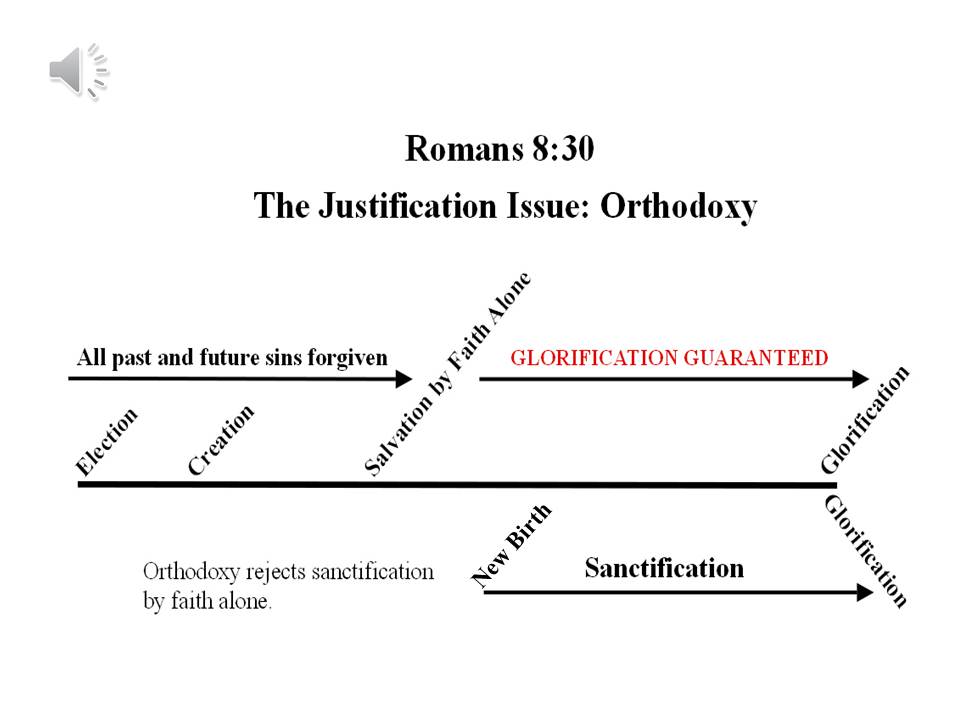
Sanctification IS NOT, as many New Calvinists say, “justification in action” because justification is a finished work. If sanctification is “justification in action,” then justification is not FINISHED, it’s still doing something, which means it’s a progressive work towards glorification, or at the very least a maintaining thereof. That’s works salvation if man does any of it (ie., grace/Christ plus works), and antinomianism if Christ does it all in sanctification. In other words, progressive justification (or what is deceptively called “progressive sanctification” by New Calvinists), or the belief that “sanctification is justification in action,” can only result in two things: works salvation or antinomianism. On the flip side, if sanctification is completely separate in operation, Christians can have an aggressive role in it because it has no bearing on the finished work of justification (click on image to enlarge).
That’s why New Calvinists, in essence, deny the new birth as being an objective recreation that is in us and of us. They believe the new birth is a “formation of Christ” that is displayed through us, but we are still spiritually dead. An actual recreation of our personhood makes it possible to colabor with Christ, and NC don’t like that idea. More on that later, so don’t let it confuse the central issue at this time.
This is the crux of the New Calvinist issue: Brinsmead merely converted Adventist doctrine from works salvation to antinomianism. When Justification is progressive and not a finished work, somebody has to keep the work going, so it’s works salvation. When we do even part of that by keeping the law, that’s Jesus plus works or law-keeping. When Jesus does all of the law-keeping for us (because someone has to keep the process moving forward), we are obviously not obligated to keep the law. In fact, to do so would be to participate in the fruits of justification, which we dare not do (click on image to enlarge).
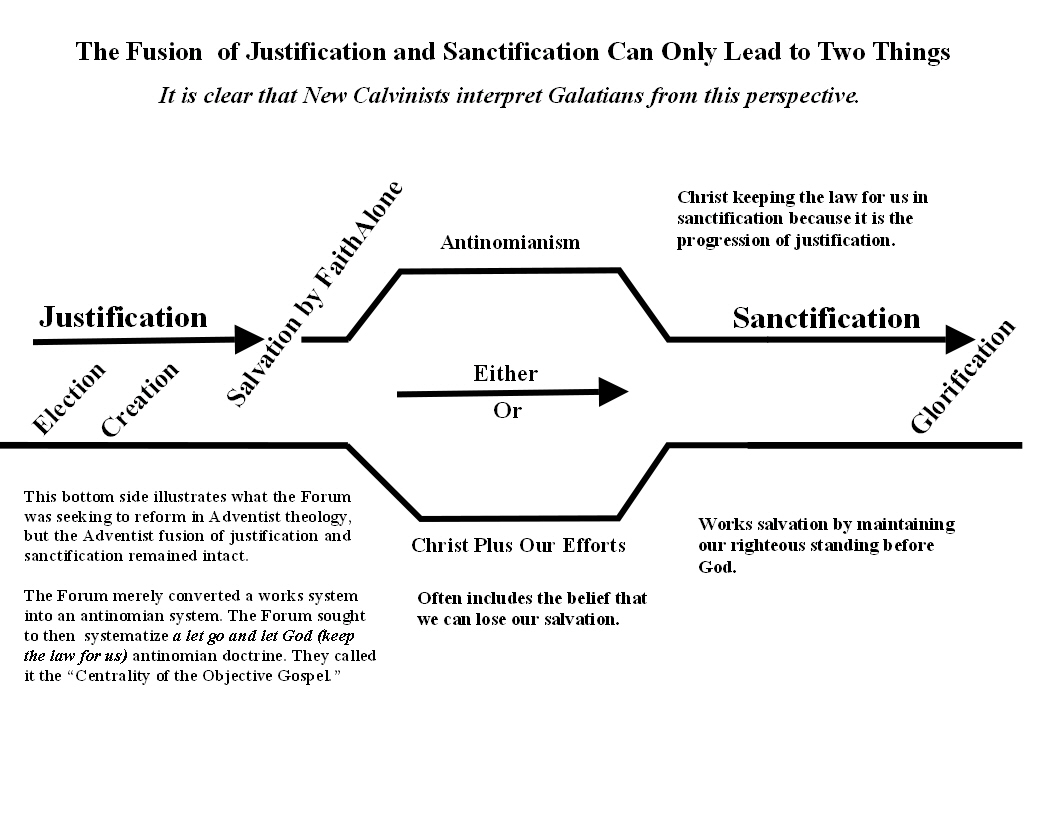
The Forum was seeking to reform Adventist theology, but the Adventist fusion of justification and sanctification remained intact.The Forum merely converted a works system into an antinomian system. The Forum sought to then systematize a let go and let God (keep the law for us) antinomian doctrine. They called it the “Centrality of the Objective Gospel,” and Reformed theologians fell for it, hook, line, and sinker.
In orthodoxy, Christians can aggressively pursue righteousness via the law because we know that it can’t contribute to our justification anyway—it’s IMPOSSIBLE, justification is a finished work. However, can our seeking after righteousness (Matthew 7:24-27) have an effect on how we experience the new birth? Absolutely. One of many aspects of that is seeing God glorified in the eyes of others because of our obedience to the Father. What could feel better? (Matthew 5:16).
paul

 Paul's Passing Thoughts
27 comments