What Exactly is New Calvinism? Its Five Major Tenets and Their Sources
The Core Four of the Australian Forum
 In1970, a think tank was initiated to systematize the “lost Reformation doctrine of justification.” The project was the brainchild of Robert Brinsmead, a Seventh-day Adventist theologian. Their theological journal was “Present Truth Magazine.” Brinsmead came from a family of respected Adventist theologians, and was active in the “justification debate” within Adventism.
He was joined by two Anglican theologians, Geoffrey Paxton and Graeme Goldsworthy. Clearly, Paxton was enamored by an Adventist motif that presented Adventism as the gatekeepers of Reformation doctrine. This is a major theme of his book, “The Shaking of Adventism.” Goldsworthy was a proponent of “Biblical Theology,” or “Redemptive Historical Hermeneutics” which has deep roots in neo-orthodoxy and modernist theology. Neo-orthodoxy and Modernism are the products of liberal, philosophical theology that was born among European philosophers and theologians (primarily in Germany). Biblical Theology was invented by the liberal theologian Johann Philipp Gabler (1753-1826), and was later remodeled by philosopher/theologian Geerhardus Vos (1862-1949). Many consider Graeme Goldsworthy as the one who has taken the torch forward from Vos.
The clear, stated goal of the Forum was to systematize Reformation doctrine to prevent it from being lost again (ref. p. 34 The Truth About New Calvinism). The Forum was later joined by Jon Zens who discovered the Forum through Present Truth which was widely distributed at Westminster Seminary where Zens was a student. Zens was deeply concerned with the relationship between law and gospel and how the two related to covenants.
The Unifying Central Crux
And all agreed on one thing: the Reformation doctrine of justification by faith alone had been lost because of subjectivism, ie., the Bible being interpreted through personal experience. They all agreed that Soren Kierkegaard’s existentialist theology was indicative, and at the very crux of what caused Reformation doctrine to be lost. Existentialism teaches that truth becomes truth for an individual when he accepts it as such according to his/her own experience (very subjective, iffy, fuzzy). The Forum believed that Rome/Protestantism set a tsunami of subjectivism into motion through emphasizing the new birth which supposedly encouraged existentialism-like doctrines. The Forum believed that ALL doctrine can be divided into two categories: Reformation or Romanism, and most of Protestantism ended up following Rome’s subjective gospel based on personal experience. Volume 25 of Present Truth Magazine dealt with the Forum’s view on this and included an article written by Zens on Existentialism.
The Cure: Tenet One; COGOUS
Brinsmead’s first theological frame that launched Progressive Adventism (the “Awakening” movement) taught that Christ stands in the judgment for us as opposed to the traditional Adventist view that Christians are enabled by God to obtain perfection in order to stand in the judgment. For lack of a better way of stating it; subconsciously, many Adventist weren’t buying it. The whole idea that Christ stands in our place and presents His righteousness for us in the judgment was exceedingly good news.
Brinsmead was afforded credibility across denominational lines because he supposedly came to this conclusion by studying Reformation doctrine, and the results seemed to speak for themselves. Everybody, especially Reformed folks, wanted to jump on the Brinsmead bandwagon. Present Truth was the most publicized theological journal of that time, and at least one edition printed one million copies.
Of course, the basic defect in comparison to orthodoxy is the view that there will be a future judgment for Christians in regard to maintaining our justification, which is already a settled matter. As an aside, one wonders if this defect is by design—if our justification is already a settled matter, what do we need pricy theologians for? A judgment to determine our rewards lowers the bar considerably.
But Brinsmead’s second theological frame (a tweaking of the first in regard to some eschatological issues, ie., when does the judgment occur in redemptive history?) settled the subjectivism issue as well as being found truly righteous at the judgment: the centrality of the objective gospel outside of us (COGOUS). This taught that we have NO righteousness in, and of ourselves for purposes of justification, and that all truth must be based on the gospel that is outside of us without regard to personal experience. But remember, just like the Romanism it despised (and the Adventism that it was enamored by), the Forum saw sanctification as a process that maintains and completes justification, or a road that links justification and glorification. So, COGOUS applied to both justification and sanctification. The doctrine was illustrated by the Forum using the following visual aid in volume 21 of Present Truth:
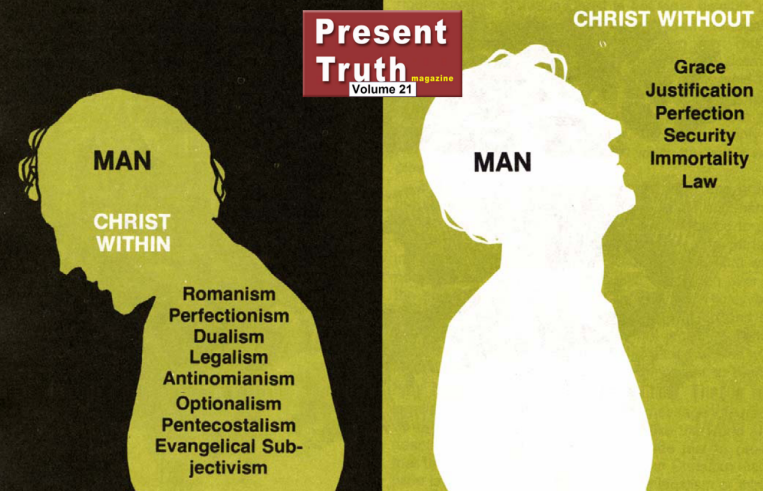
Therefore, the gospel was the measure of all truth, and all objective truth had to come from outside of us. All change had to come from outside of us as well. Christ does NOT do His work INSIDE of us. All New Calvinist thought begins with this premise. If Christ works within us, this makes us colaborers in justification so that we can be found righteous at the judgment. It is also seen as “emptying ourselves” and “dying to self.” It is anti-existentialism on steroids. But not really; as we will see, this objective puritanism leads to a hyper-subjectivism that characterizes New Calvinism.
Element One of COGOUS: Gospel Sanctification
The term “Gospel Sanctification,” was coined by this ministry in 2004 and picked up by others. COGOUS split into two notable theologies in the 80’s: New Covenant Theology and Sonship Theology. Both endured a violent push back among Baptists and Presbyterians to the point of going underground. “Sonship Theology” became “Gospel Transformation.” The movement functioned for ten years without a name; and in fact, experienced astronomical growth during that time. Based on the slogans, “The same gospel that saved you also sanctifies you,” and “We must preach the gospel to ourselves every day,” slogans that show its undisputable kinship to COGOUS, “Gospel Sanctification” became a useful tool for identifying the doctrine. Gospel Sanctification is the subject of “Another Gospel” which was never published. The movement was dubbed, “New Calvinism” in 2008.
Element Two of COGOUS: Gospel Contemplationism
Spiritual contemplationism is certainly nothing new. Spiritual growth via contemplating the works of Christ, and using the Bible to do so can be found among the earliest Adventist theologians, especially Ellen White (according to citations noted by Paxton in The Shaking of Adventism). White was always in the thick of trying to reconcile Adventist perfectionism with grace and law. Sanctification by Gospel Contemplationism has always been an apt companion for doctrines that want to reduce the role of the Christian to the lowest common denominator. Most of these ideas came from European philosophers posing as theologians. Gospel Contemplationism, like Gospel Sanctification, puts feet on the doctrine.
Tenet Two: Redemptive Historical Hermeneutics
Starting with Gabler, this hermeneutic (method of interpretation) makes the Bible a historical narrative about the gospel. Through deeper and deeper knowledge of the gospel, we are “wowed” and “motivated by gratitude.” This makes the Bible a perfect tool for contemplationism rather than instruction and propositional truth. Redemptive Historical hermeneutics, or “Biblical Theology” has its origin in Modernism and neo-orthodox theology. This may seem contradictory to New Calvinism’s supposed stance against existentialism, but this method actually leads to all kinds of subjectivism because a gospel interpretation is forced upon the whole Bible.
Tenet Three: New Covenant Theology
Jon Zens coined the phrase “New Covenant Theology” in 1981. Brinsmead and Zens worked together closely on how law and covenants relate to COGOUS. New Calvinists usually stay aloof from any association to NCT because of its direct link to Zens and the Forum. Though New Calvinists are not shy about playing the “all truth is God’s truth” card, they would rather not have to explain how their doctrine was contrived by a Seventh-day Adventist who is now purported to be an atheist. DA Carson is a good example of a New Calvinists that gives hefty support to NCT while pretending to be merely sympathetic to some of its tenets. Founders Ministries, a SBC organization founded in the early 80’s for the sole purpose of taking over the convention via COGOUS (and falsely associating the doctrine with a well-known Southern Baptist theologian), even claims to be anti-NCT. Founders Ministries has also been challenged to explain their claim that they published “In Defense of the Decalogue” which is a treatise against NCT.
Tenet Four: Heart Theology
This theology was developed through David Powlison’s Dynamics of Biblical Change which forms the basis of counseling curriculum at Westminster Seminary. The doctrine is based on Sonship Theology—Powlison specifically stated that as fact while giving a presentation at John Piper’s church. Powlison also stated that Gospel Sanctification (not the exact terminology he used) was the primary difference between his counseling philosophy and that of Jay Adams. In other words—a fundamental difference in how they interpret the gospel. See chapter 9 of “The Truth About New Calvinism.” How People Change, written by Paul David Tripp (an understudy of Powlison), is a treatise on Powlison’s Dynamics of Biblical Change, and practically a word for word recital of COGOUS.
In the tradition of New Calvinism’s takeover mentality, CCEF now controls almost all of the major counseling organizations, and the Biblical Counseling Coalition was recently organized to aid in that purpose.
Tenet Five: Christian Hedonism
This was concocted by John Piper in the 80’s as an important addition to COGOUS. Though Piper avoids any connections to the Forum like the Bubonic Plague, he showed his hand and specific allegiance to COGOUS when he wrote an article on a series of lectures that Graeme Goldsworthy did at Southern Seminary. See chapter 4 of The Truth About New Calvinism.
Before Piper attended Fuller Seminary, which advocated neo-orthodoxy during the time he attended there (they even hosted appearances by Karl Barth, the contemporary father of neo-orthodoxy), he majored in philosophical literature. Immediately upon graduating from Fuller in 1971, he went to Germany to study under modernist/neo-orthodox theologians. Piper’s theological upbringing is extremely suspect and warrants surprise in regard to his present popularity in Christian circles.
After jumping on the Brinsmead bandwagon, he saw a deficiency in COGOUS. It is best explained by somebody who witnessed the unfolding of the Awakening movement firsthand:
Our righteousness is in heaven, said Brinsmead:
The righteousness by which we become just in God’s sight, remain just in His sight and will one day be sealed as forever just in His sight, is an outside righteousness. It is not on earth, but only in heaven…only in Jesus Christ.”
True sanctification looks away from self and flows from the finished, objective work of Christ…. For many Christians, the glory of the crucified Christ is not their focus; instead they seek internal experiences that eclipse the cross. The Awakening rightly opposed the subjective, human-centered emphasis found among some groups within Christianity. Wrongly, they reacted with a cerebral, spiritless gospel. Brinsmead strongly opposed the Charismatic movement’s emphasis on experiences as a return to the theology of Rome.
However, going to another extreme, Present Truth magazine decried “the false gospel of the new birth,” and offered a new birth that was merely a corporate, objective blessing, not an individual experience.
John Piper to the Rescue
COGOUS was in danger of instigating the same kind of response that prompted existentialism: a pushback regarding indifference to the human experience. COGOUS supplied a theological frame that supposedly demolished the root of all false doctrine, but still didn’t deal with the human experience angle. This would explain why Piper is such a hero in this movement—he probably saved it. Christian Hedonism strongly emphasizes how COGOUS is experience (joy) while staying true to its strong emphasis on monergism. And, joy is a result of what we contemplate, not anything we do.
Conclusion
COGOUS is the doctrine/backbone of New Calvinism; Biblical Theology (RHH) is its hermeneutic; New Covenant Theology articulates COGOUS’s relationship to law and gospel; Heart Theology is its practical application (as far as that goes); and Christian Hedonism is how COGOUS is experienced. It’s the complete package. It is the first complete theological system for let go and let God theology ever devised in church history. It is powerful, and is a latter-day antinomian blitzkrieg of biblical proportions.
But the gigs up. Few Christians will buy into the idea that God used Robert Brinsmead to rediscover the lost Reformation doctrine. Trust me, it was never lost to begin with. I will conclude with a statement by John H. Armstrong that describes the New Calvinist motif, and a Piper video that contains subtle illusions to what they believe:
The sixteenth-century rediscovery of Paul’s objective message of justification by faith [and sanctification also because justification is supposedly progressive] came upon the religious scene of that time with a force and passion that totally altered the course of human history. It ignited the greatest reformation and revival known since Pentecost.
Now, if the Fathers of the early church, so nearly removed in time from Paul, lost touch with the Pauline message, how much more is this true in succeeding generations? The powerful truth of righteousness by faith needs to be restated plainly, and understood clearly, by every new generation.
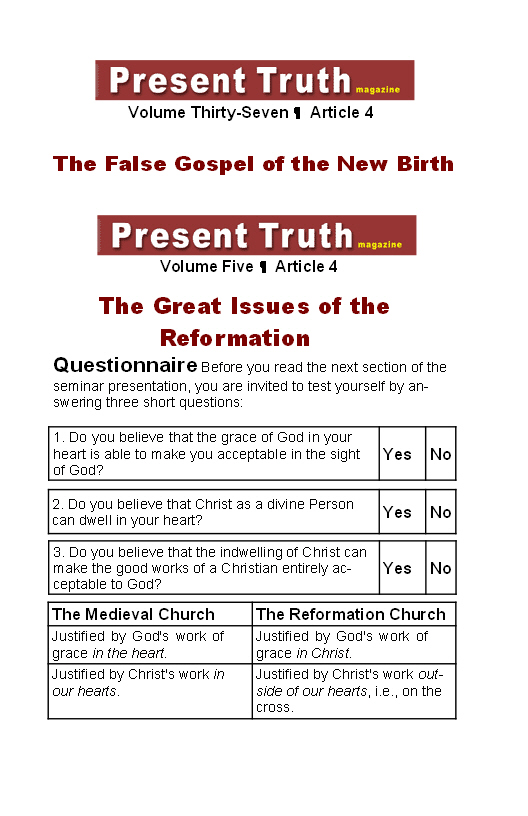
In our time we are awash in a “Sea of Subjectivism,” as one magazine put it over twenty years ago. Let me explain. In 1972 a publication known as Present Truth published the results of a survey with a five-point questionnaire which dealt with the most basic issues between the medieval church and the Reformation. Polling showed 95 per cent of the “Jesus People” were decidedly medieval and anti-Reformation in their doctrinal thinking about the gospel. Among church-going Protestants they found ratings nearly as high.
A visual illustration of the issue Armstrong is talking about follows:
And here is the Piper video:
NANC’s Salvation by Working at Doing Nothing
 Thanks to the reader who sent me a recent article by “counselor” Rick Thomas—a Fellow with the annexed National Association of Nouthetic Counseling. The article utilizes a wide body of New Calvinist theology and thought which originated with a Seventh-day Adventist who is now an atheist (the doctrine is presently known as “New Calvinism”). NANC, which is now an embodiment of false doctrine, and unfortunately under the auspices of counseling, continues to thrive on the neo-evangelicalism that godly pastors warned the church about in the latter sixties. Neo-evangelicalism is an attitude/philosophy promoted by neo-orthodoxy for purposes of promoting itself.
It goes something like this: “You can’t change something unless you remain a part of it.” “The way to bring about change is through infiltration.” “Be careful what you judge: all truth is God’s truth.” Neo-evangelicalism rejects the biblical concept of protecting the church by separation and cutting off provisions. CCEF used the neo-evangelicalism mentality to take over NANC, and today NANC thrives as a sinister network where pastors unwittingly send flock members to be slaughtered by ravenous wolves in sheep’s clothing.
Henceforth, this article by Thomas is an excellent insight into the black heart of NANC counseling, and a firsthand look at how NANC counseling points thousands of sheep down a road of slow spiritual death on a daily basis. But not only that , this post will explain how we got here.
Thomas begins his article (I’m not kidding: “The Danger of Trying to Please God”) with a description of “Sandra’s” problem:
Sandra has struggled all her life with people pleasing.
She said she could not remember a time when she was free from thinking about what others thought about her.
The way she dresses, the car she drives, the technology she carries, and the house she owns are all controlled to some degree by what others think of her.
A peek into her life
- She is fanatical about working out because of her keen awareness of what a “nice looking body” should look like.
- On a few occasions she has caught herself stretching the truth. She says she spins her stories because the real story doesn’t seem as interesting.
- She is fearful of bringing a bag lunch to the office because everyone else goes out to a local restaurant to eat. She’d rather go into debt than feeling like the odd man out.
- She has a low-grade anger toward her boyfriend because he pressured her to have sex with him. She believed he would leave her if she didn’t have sex. She needs to be loved by someone. Having a boyfriend is one of her ways of feeling significant.
Her biblical counselor quickly discerned that her problem was fear of man (Proverbs 29:25). The counselor told her she needed to be more concerned with pleasing God rather than others.
From there, the counselor laid out a plan of prayer, Bible study, and service oriented activities in order for her to practice a lifestyle of pleasing God.
The mistake the counselor made was not carefully unpacking what pleasing God meant to an idolater like Sandra. Sandra is an idolater who has been living a performance-driven, people pleasing lifestyle.
When she was told that she needed to be more willing to please God than man, it was not a difficult thing for her to do. People pleasing was what she knew best. Unfortunately, she was not told what pleases God so she did what she has always done–she ratcheted up her obedience.
First, Thomas sets the table with the whole first generation/second generation of biblical counseling motif. Supposedly, first generation NANC counselors solve every counseling situation by whipping out a legal pad and giving the counselee a list of do’s and don’ts. Well, I was counseled by the President of NANC, Dr. (unfortunately, the “Dr.” part came from CCEF’s version of Sonship Theology which is banned in many Presbyterian churches) John Street in the late 80’s and at the time he was definitely “first generation.” And trust me, that was NOT his approach. Presently, I do not know if John is a neo-evangelical, or a New Calvinist. Obviously, I would prefer the prior. But as President of the NANC monstrosity, he is at least that on steroids.
Thomas, aside from setting up a false scenario for interpretation, plays a card often exploited by New Calvinist counselors: First generation counseling solved a problem that was extremely prevalent in the church before Jay Adams came along. I call it, “stupid obedience.” Christians were trying to function on biblical generalities which led to the sheep not getting help for real problems. This led to the church turning to the world to get answers. The Adams reformation brought what I call “intelligent obedience” to the table, and the results speak for themselves. It also gave the counselee hope as opposed to, “There is nothing we can do for this patient but pray for a miracle.” We don’t like to hear that from a doctor, do we? Second generation counselors were not smart enough to figure that out, but nevertheless think they are the saviors of the contemporary church.
But specifically, what they do is to assign the problem that first generation counseling solved, to first generation counseling, and that’s a lie. Here, Thomas refers to it as “ratcheting up obedience.” What it really is—is more stupid obedience on top of stupid obedience. He exploits this misconception throughout his article, and in the end, Sandra thinks the poor counseling she got (if it was genuinely presented to begin with, which I doubt) is first generation, rather than what first generation solved. And of course, stupid obedience is still prevalent in the church today because CCEF interfered with the first generation reformation while aided by the mentality of neo-evangelicalism.
Let us now take a trip back into history to find out how we got here, and then we will deal with Mr. Thomas. The vast majority of today’s “biblical counseling” is based on a doctrine known as the centrality of the objective gospel outside of us. Thomas’ article is a mini treatise on that doctrine. As Susan and I continue to research how this all came about, we are continually amazed. In volume one of The Truth About New Calvinism, we focused on the basics of the doctrine and conceded to a second volume in favor of more research. Granted, the really big picture is drawn on the fact that antinomianism will be an ever-increasing reality as the Lord’s return grows closer. That was heavily emphasized in the first volume, but there is also a contemporary dynamic that is part of the picture.
For hundreds of years, theologians have sought to solidify a doctrine that is a middle ground between philosophy and fundamentalism. Or, if you will, “a happy medium between dogma and appreciation of human experience.” Or, between literal interpretation and interpretation that lends itself to other possibilities. You get the picture.
First, neo-orthodoxy sought to do that. Hence, it has always been a hybrid of orthodoxy and liberalism. That is why most of its tenets contain orthodox terminology with unorthodox ideas. This has always been the major accusation and complaint against neo-orthodoxy: it’s very subtle and resides in the mainstream. It’s an inside job.
At some point, neo-orthodoxy created a masterpiece called “Biblical Theology.” This is a hermeneutic (method of biblical interpretation) that is “truth as myth.” It promotes a truth as revealed in history, ie., the whole Bible is a historical narrative that contains the truth of salvation and reveals the works of redemption via that narrative. While that truth is literal dogma (appeals to fundamentalism), it doesn’t necessitate a literal interpretation for the purposes of dogmatic instruction (appeals to liberals). Whether or not the details of the story are to be taken literally or not, and whether or not the Bible is perfectly inerrant or not, is not the point—the truth that the passage conveys about the truth is the point.
Somewhat like Jesus’ parables. Is the purpose of those parables to convey truth? Absolutely. Are all of those stories necessarily actual events that really happened? No. That’s not the point, the truth conveyed by the parable is the point. And the crux of that truth is the gospel. Can the whole Bible really be a meta-narrative about redemption? Well, as the reasoning goes, would the Bible have been written if sin had not entered the world? No. Then for what other reason would it have been written? One must admit, it’s clever, and you can see how it caters to those who are concerned about literal truth as well as those who want to maintain the intellectual freedom of the individual. But in essence, you have them both agreeing on the gospel! Supposedly. And as a result, discussion on how to interpret gospel truth through that narrative is a huge playground where everyone can play nicely together; after all, we are all after the same gospel truth, right? Look, just go to any website dedicated to Redemptive Historical hermeneutics and these ideas are stated throughout. One example is Vossed World, a blog authored by an elder at one of the most well-known NANC training centers in the country.
But neo-orthodoxy, despite its masterpiece of unity, has always been fragmented and has experienced up and down success. In the US, it experienced a surge in the 40’s and 50’s, and then was nearly snuffed out in the early 60’s by doctrinal apologists. Therefore, there has always been an effort to discover the specific weakness that has plagued neo-orthodoxy from the beginning.
And the prize goes to Robert Brinsmead. He was the product of debate that came from a longstanding theological journey within the realm of Seventh-day Adventism. The crux of the debate within Adventism was justification, and first surfaced at their 1888 convention, then again in 1952. Brinsmead blew the whole debate wide open with his first theological frame that gave birth to the “Awakening” movement which turned Adventism on its head.
This led to a second theological frame invented by Brinsmead that answered contentions presented by E. Heppenstall and Desmond Ford. That theological frame was the centrality of the objective gospel outside of us which had a huge appeal for Reformed theologians enamored by various philosophies. Brinsmead, an Anglican named Geoffrey Paxton, and a Biblical Theology buff named Graeme Goldsworthy went to work in 1970 to develop Brinsmead’s doctrine into a consistent theological system that would stand the test of time. The project was called the Australian Forum, and it launched neo-orthodoxy into outer space. Neo-orthodoxy and its bosom buddy, Redemptive Historical hermeneutics, now had a skeleton to hold the flesh on: the centrality of the objective gospel outside of us. Hold on and don’t think ahead too far. Let me explain this a step at a time.
This doctrine is hard to get your mind around, but for the most part, it took the justification concept of the gospel’s alien righteousness completely separate from us and applied it to sanctification. Therefore, the doctrine denied the significance of the new birth (as do many New Calvinsts). But it had a basic flaw in its premise that forms the basis of understanding for the rest of what I am about to explain. I will get to how this doctrine works itself out as we progress.
The basic flaw is the fusion of justification and sanctification. Adventist debate always tried to work this problem out from that standpoint. Sanctification was seen as something that completes justification until we arrive at glorification. In other words, sanctification is not seen as something totally separate from justification that happens in a space of time between justification and glorification, but rather a connecting road between the two. That’s a huge problem. If sanctification is the “growing part of salvation,” (I have said this myself) then what is our part? But salvation (justification) does not grow! It is a finished act by God that takes place before creation! This was the Adventist dilemma: what can we do to maintain our just standing before God in order to be ready for the judgment? I triple-emphasize “just standing before God” for a reason. Don’t lose sight of that phrase.
Please note: 99% of all false doctrine is based on this misconception. The Adventists primary model stated that we are declared righteous at the point of our salvation, and all of our past sins are forgiven, but with the help of the Holy Spirit, and the fact that we are born again as new creatures, we could obtain perfectionism and therefore be ready to stand righteous before God in the judgment. Of course, with all doctrines that are founded on the fusion of justification and sanctification, it is believed that you can lose your salvation. If you can lose your salvation, what do you have to do to keep it? The necessity of the question itself reveals a salvation by works. However, this is why many false religions dumb-down the law and mix it with the traditions of men, or reduce it to mere ritual—it makes its keeping for salvation plausible. The fact that Adventists stood on the authority of Scripture didn’t make that Catholic-like option possible.
When you begin with the fusion of justification and sanctification which is completed with glorification, you can only have two results: forgiveness for all past sins and a role for us in maintaining a righteousness that will stand in the judgment (Christ plus works/ritual), or the maintaining of our just standing before God without our participation (antinomianism/let go and let God). Brinsmead opted for the second approach. But though these two options have been stated, really, as we shall see, BOTH are really works salvation. In real Christianity, our justification is a settled matter. We can do NOTHING in sanctification to add to our justification or take away from it. Sanctification is concerned with kingdom living and our walk with God. The concern that what we do in sanctification could unwittingly affect the “grounds of our justification” is an oxymoron using a red herring to mislead a straw man. That’s my way of trying to say that it is ridiculous times three.
So, Brinsmead’s doctrine stated that all righteousness for justification and sanctification was completely outside of us. He had to concede that we can have no role in the maintaining of justification. One of the primarily tenets of the doctrine also held that any work done by God inside of us was the infusion of grace within us, “making sanctification the grounds for our justification.” The Australian Forum also taught that if God did any kind of work inside of us—that was imputing His righteousness within us and involving us in the maintaining of justification. They believed that this was a fundamental error that was at the root of all false doctrine and was the very crux of the Reformation. They believed that this was the fundamental error of Romanism—that righteousness was imputed to us via the new birth and that Christ worked in us. Again, this supposedly infused grace within us and made us a part of the justification process. For salvation to be by grace alone, all righteousness and grace had to remain outside of us.
This is key because it enables justification and sanctification to be fused without the possibility of losing your salvation because you don’t have anything to lose. No righteousness was ever imparted to you to begin with, it’s salvation by faith alone in the strictest sense of the meaning—faith and absolutely nothing else. Hence, it is the imputed righteousness of Christ that maintains our justification in sanctification, not our own, and a righteousness that is also outside of us. Christ’s righteousness is not imputed to us personally, it is imputed to our sanctification.
So by now you are certainly incredulous, and want to ask the following: so what in the world do we do? Answer: live by faith. According to New Calvinism, sanctification is to be lived by faith alone. How in the world do we do that? Answer: by offering the perfect works of Christ by faith. Let me repeat that: by offering the perfect works of Christ by faith. That is the New Calvinist definition of faith.
How do we do that? Answer: gospel contemplationism. This is where neo-orthodoxy and it’s intimate lover, Biblical Theology come together with the centrality of the objective gospel outside of us. Though there are aberrations and slight variations, we partake in ‘beholding as a way of becoming.” Therefore, the Bible is a historical narrative that enables us to meditate on the works of Christ in redemptive history—a tool for gospel contemplationism—not to be taken literally for instruction purposes. All of the obedience that occurs as a result is the ”active obedience of Christ” and not our own. And this work is not taking place inside of us, it is “spiritual formation” or a “manifestation of Christ.” These manifestations are validated by effortless obedience accompanied by joy. Though variations of how this works with the central doctrine is allowable, all that is required is to stay faithful to the “Reformation” doctrine of the centrality of the objective gospel outside of us—anything else that fits with the primary frame is fair game and acceptable, and a virtual neo-orthodoxy love-fest.
With all that in mind, let’s now revisit Rick Thomas’ counsel to Sandra where we left it and see if we detect any parallels.
Who can please God?
And a voice came from heaven, You are my beloved Son; with you I am well pleased. – Mark 1:11 (ESV)
Christ pleases God. Anything the Son does pleases the Father. Jesus came to do the will of the Father and He completed that task perfectly. The Father received the finished work of the Son and now a way has been made for us to please the Father by accepting the Son’s work.
Without faith it is impossible to please him. – Hebrews 11:6 (ESV)
A Christian, who is living by faith in the works of the Son, is pleasing God. Pleasing God is not about what we do, but about believing in the only One who could authentically please the Father. Even on our best day, with our best works, we would not be acceptable to God.
We have all become like one who is unclean, and all our righteous deeds are like a polluted garment. – Isaiah 64:6 (ESV)
Sandra is a Christian. However, she is not seeking to please God by trusting (faith) in Him. She is still performing, but this time she is performing for the Father, hoping to get a good grade.
Rather than accepting what is pleasing to God–the works of the Son, she tries to please Him by her obedience.
Here, we see clearly the Australian Forum’s doctrine of offering the works of Christ in sanctification as a definition of living by faith alone. Also, “Who can please God?” is a rhetorical question. This is the Forum’s position that we have no righteousness within us that can affect actions that please God. It must be done with the works of Christ offered by faith.
What about obedience?
Obedience is obviously hugely important to any Christian. However, the key is to make sure that your obedience is not an effort to please God, but a response to your faith in God. This is the context when Paul told the Corinthians that:
We make it our aim to please him. – 2 Corinthians 5:9 (ESV)
Paul was trying to get the Corinthians to understand that pleasing God was a walk by faith rather than by sight (2 Corinthians 5:7). The context for the passage was Paul’s appeal to get them to trust Christ rather than the things that they could see. (See 2 Corinthians 4:16-18)
If the Corinthians were trusting Christ in the way that Paul was outlining, then they would be pleasing God too. Pleasing God is about faith. Obedience is another matter. Obedience is the biblical response from a person who is trusting Christ.
Don’t you think it pleases God when you trust (faith) Him? And because you trust Him, you obey Him. The logic would flow like this:
- I trust God.
- God is pleased that I trust Him.
- Because I trust Him, I obey Him.
Sandra needs to start over. She needs to understand what pleasing God means. It means to trust Him, which she is not doing. If she trusted Him she would not be trying to please Him. Contrariwise, she is trusting her works and if her works are satisfactory, according to her estimation, then God is pleased with her.
God has a good opinion of her if she is trusting His Son for salvation. This truth must be inculcated into her brain. Because she is a Christian she is in Christ and she cannot be any more in Christ.
Being more obedient does not make her more in Christ. When she was regenerated God was pleased with her and His pleasure in her does not ebb and flow.
She must guard her heart from the subtle deception that what she does through obedience can merit a better standing before God. For Sandra this is amazingly huge. She is an insecure, people pleasing, co-dependent, performance-driven person.
Warning: If you are not daily affected by Christ’s finished work on the cross you can subtly slip into an obedience lifestyle thinking that what you do pleases God as though there is some kind of merit you can achieve through your obedience.
Other than restating the previous point of what faith in sanctification is, this excerpt is pregnant with the Forum’s fusion of justification and sanctification, and the idea that any effort in sanctification by way of obedience is an attempt to participate in ones STANDING before God: “She must guard her heart from the subtle deception that what she does through obedience can merit a better standing before God.” And again: “Sandra was relieved and encouraged to know that she did not have to please God to gain His good opinion. She began to understand that her standing before God was as secure today as it was when He first acted upon her.
Also notice the emphasis that any effort in sanctification is an attempt to be MORE IN CHRSIT which is a justification/salvation concern:
God has a good opinion of her if she is trusting His Son for salvation. This truth must be inculcated into her brain. Because she is a Christian she is in Christ and she cannot be any more in Christ.
Being more obedient does not make her more in Christ. When she was regenerated God was pleased with her and His pleasure in her does not ebb and flow.
She must guard her heart from the subtle deception that what she does through obedience can merit a better standing before God.
Regarding what Thomas says about obedience—this is disingenuous; obviously, if we cannot please God as he plainly states prior to this, it is obviously not our obedience. Remember, he quotes Isaiah 64:6 to make that point, which by the way is a verse that concerns justification. But if not our obedience, whose obedience is it? He says right in the same post: “Rather than accepting what is pleasing to God–the works of the Son, she tries to please Him by her obedience.”
How Thomas thinks Sandra should read her Bible is also evident towards the end of the post and aligns with the whole idea of using the Bible as a tool for gospel contemplationism:
For the first time in Sandra’s life she was beginning to make Gospel-connections to her practical life. She was understanding that the Gospel was not just for salvation (Justification), but the Gospel was the power she needed to live for Christ (Sanctification).
Today, she reads her Bible with a new pair of glasses as she recently said. Sometimes she gets frustrated when she thinks of all the years of cross-less Bible reading and cross-less living, but she quickly recovers by reorienting her heart back to the finished work of Christ. Sandra is free in Christ!
My last comment is for Sandra. Sandra, don’t count your chickens before they are hatched. Thomas has led you to believe that justification and sanctification are the same thing. You must continually (as the Forum stated it) “offer the perfect works of Christ to the Father by faith” so that the works of Christ can maintain your just standing before God. But that’s still works salvation. It’s working at maintaining your justification by doing nothing. Did Thomas not state in this post:
Warning: If you are not daily affected by Christ’s finished work on the cross you can subtly slip into an obedience lifestyle thinking that what you do pleases God as though there is some kind of merit you can achieve through your obedience.
And because justification and sanctification are fused, that merit would have to be for justification purposes. Slipping back into an “obedience lifestyle” circumvents the “finished works of Christ” that powers your sanctification. Gee Sandra, how often can this happen before you lose your salvation? Once? Twice? Are you maintaining your justification by faith alone? How many times are you allowed to offer your own faithless works instead of the works of Christ by faith? Are you actually in a works salvation by faith alone? When you are in a situation that requires obedience as a duty, will that cost you your salvation?
Maybe you better give Rick a call and ask him. I would actually like to know the answer to that myself.
paul
John MacArthur Was Against Reckless Faith Before He Was For It
The Father of John Kerry theology continues to rack up the contradictions as his legacy wanes. To whom much is given, much is required, and MacArthur has already sold truth for a bowl of New Calvinist fame. At the upcoming 2012 Resolved Conference, he will take his place with the other gods of New Calvinism under the high-tech light show and above a sea of worshippers who can wave arms with the best of them.
He must be there, he can’t help himself, even though he will appear on stage with CJ Mahaney who represents what MacArthur used to call “Chaos” in the Christian life. But now MacArthur has seen the lights; things that used to cause chaos in the Christian life are now “secondary issues” because Mahaney majors on the doctrine contrived by a Seventh-day Adventist who is now an atheist: the centrality of the objective gospel outside of us. But what of MacArthur’s supposed conviction that elders should be above reproach in light of Mahaney’s serial abuse of power? Answer: as Dever and Mohler insinuate; collateral damage is to be expected when you are on the cutting edge of a new Reformation that is the rediscovery of the “scandalous gospel.” No, no, there is really no scandal at SGM, the only scandal is Mahaney’s martyrdom for the scandalous gospel.
MacArthur has always had discernment issues. In the 80’s, disciples of the heretical Larry Crabb were running his counseling program at Grace Community Church while he arrogantly dismissed concerns from those who lacked titles after their names. This despite Crabb’s horrendous dissing of Scripture in the book “Outside In” which on one page compared Bible reading to masturbation. MacArthur’s lack of discernment can also be seen in his understudies who continually praise and swoon over brazen antinomian John Piper on the Pyromaniacs blog. The primary author of the blog, Phil Johnson, once stated, “I love John Piper,” and noted that Piper was only preceded by MacArthur in regard to whom he read most. Another contributor to the blog, the insufferable Frank Turk, stated, “To know Piper is to understand Piper.” This is the disgusting New Calvinist mentality that you are obligated to read everything a New Calvinist has ever written in order to be qualified to judge their doctrine.
I have already noted the contradictions in New Calvinist teachings and the MacArthur book, Saved Without a Doubt here: http://wp.me/pmd7S-NH. The book was recently republished and it is the only book written by him that I would now recommend to anybody. My review of Slave is here http://wp.me/pmd7S-sD, and though this book is an excellent insight into the use of slave terminology in the Bible, the book lacked the usual practical application to kingdom living which has been a hallmark of his writings in the past while bolstering the credibility of various New Calvinists. Then there was The Truth War which bemoaned the Postmodern approach to Scripture (http://wp.me/pmd7S-1aY) while New Calvinism takes the exact same approach to the Bible.
This brings me to MacArthur’s book, Reckless Faith, which bemoans neo-orthodoxy. Here is MacArthur’s definition of neo-orthodoxy from pages 25-29):
Neo-orthodoxy is the term used to identify an existentialist variety of Christianity. Because it denies the essential objective basis of truth—the absolute truth and authority of Scripture—neo-orthodoxy must be understood as pseudo-Christianity. Its heyday came in the middle of the twentieth century with the writings of Karl Barth, Emil Brunner, Paul Tillich, and Reinhold Niebaur. Those men echoed the language and the thinking of [Soren] Kierkegaard, speaking of the primacy of “personal authenticity,” while downplaying or denying the significance of objective truth. Barth, the father of neo-orthodoxy, explicitly acknowledged his debt to Kierkegaard.
Neo-orthodoxy’s attitude toward Scripture is a microcosm of the entire existentialist philosophy: the Bible itself is not objectively the Word of God, but it becomes the Word of God when it speaks to me individually. In neo-orthodoxy, that same subjectivism is imposed on all the doctrines of historic Christianity. Familiar terms are used, but are redefined or employed in such a way that is purposely vague—not to convey objective meaning, but to communicate a subjective symbolism. After all, any “truth” theological terms convey is unique to the person who exercises faith. What the Bible means becomes unimportant, What it means to me is the relevant issue. All of this resoundingly echoes Kierkegaard’s concept of “truth that is true for me.”
Thus while neo-orthodox theologians often sound as if they affirming traditional beliefs, their actual system differs radically from the historic understanding of the Christian faith. By denying the objectivity of truth, they relegate all theology to the realm of subjective relativism. It is a theology perfectly suited for the age in which we live. And that is precisely why it is so deadly…
Only problem is, a method of interpreting the Bible that likewise has an orthodox sound to it, Biblical Theology (the theme of the 2011 The Gospel Coalition Conference), is awash in neo-orthodoxy. Biblical Theology is the staple hermeneutic of New Calvinism. As stated in The Truth About New Calvinism on page 23:
The Biblical-Theological movement originated in Germany under the liberal teaching and writing of Johann Philipp Gabler (1753–1826), who emphasized the historical nature of the Bible over against an overly dogmatic reading of it.
Nearly a century later, Princeton Theological Seminary inaugurated its first professor of Biblical Theology, Geerhardus Vos (1862–1949). Vos was instrumental in taking the discipline of biblical theology in a more conservative direction, using it to vindicate the Reformed faith and historic Christianity over against theological liberalism.
Many consider Graeme Goldsworthy, one of the primary figures behind the Australian Forum which contrived New Calvinism’s core doctrine (the centrality of the objective gospel outside of us) to be the contemporary torchbearer for Vos. His magnum opus, The Goldsworthy Trilogy, is a staple resource among New Calvinists. But Biblical Theology’s long history is fraught with instances of being integrated with neo-orthodoxy. Modernism /Neo-orthodoxy was a massive European movement that opened the floodgates of liberalism and Christian mysticism. The brunt of the movement found its moorings in Germany. Its most intensive affront to churches in the US came during the sixties and was aided by neo-evangelicalism which advocated tolerance and anti-separation). According to Charles Woodbridge, Fuller Seminary was a major proponent for tolerance in regard to Modernism and neo-orthodoxy in, or about 1968 (Charles Woodbridge: The New Evangelicalism, p.23). John Piper graduated from Fuller in 1971, and in that same year went to the University of Munich, Germany to study under Leonhard Goppelt (Wikipedia), a liberal theologian under the category of Modernism (HT Spence: Crucial Truths for Crucial Days, Volume Three, p. 143).
An article by Gary Dorrien published by Return to Religion Online in lieu of his book, The Word as Truth Myth: Interpreting Modern Theology outlines the connection between Modernism/neo-evangelism and the BTM: Biblical Theology Movement. According to Dorrien:
No theological perspective has a commanding place or an especially impressive following these days. Various theologies compete for attention in a highly pluralized field, and no theology has made much of a public impact. One significant and inescapable development, however, has been the emergence of “postliberal” theology, a major attempt to revive the neo-orthodox ideal of a “third way” in theology.
For nearly as long as modern theology has existed, efforts have been made to locate a third way between conservatism and liberalism. The idea of a third way was intrinsic to mid-19th-century German “mediating theology,” which blended confessional, pietistic and liberal elements. Two generations later, neo-orthodoxy issued a more aggressive appeal for a third way. While insisting that he was not tempted by biblical literalism, Karl Barth began his dogmatics by describing the liberal tradition of Friedrich Schleiermacher and Adolf von Harnack as “the plain destruction of Protestant theology and the Protestant church.” Emil Brunner’s “theology of crisis” similarly maintained that in different ways Protestant liberal-ism and Protestant orthodoxy both betrayed the Reformation principles of the sovereignty and freedom of the Word of God. Reinhold Niebuhr took a different tack toward a similar end, arguing that fundamentalism was hopelessly wrong because it took Christian myths literally, while liberal Christianity was hopelessly wrong because it failed to take Christian myths seriously [emphasis mine].
Neo-orthodoxy was an umbrella term for various profoundly different theologies. It was embraced in the U.S. by thousands of pastors and theologians, who generally got their theology from Brunner and Niebuhr rather than from Barth. American neo-orthodoxy in the 1940s and 1950s typically meant a compound of Brunner’s dogmatics, Niebuhr’s theological ethics, and the scripture scholarship of the biblical theology movement [emphasis mine]. This movement, a reaction to the perceived sterility of earlier, purely analytic studies, emphasized the unifying themes of scripture and stressed the revelatory acts of God in history as described in the Bible.
Bottom line: The myth is truth. The BTM satisfied liberals in that dogmatic propositional truth is not the point, and satisfied conservatives by saying that Bible narratives relate factual truth. In essence, the same way a parable may be a true story or it may not be—that’s not the point, the point is the truth that it conveys. BTM supplied a third way between Modernism and Fundamentalism. Another source that speaks of neo-orthodoxy as being synonymous with BTM is Out of Egypt by Craig G. Bartholomew and Elaine Botha, particularly on page 4. Both sources say that apologists James Barr and Langdon Gilkey dealt BTM and neo-evangelism a death blow in 1961 through their writings.
Though further study is needed, it would appear that Biblical Theology, ie., Redemptive Historical hermeneutics or Christocentric hermeneutics, made a comeback when mixed with the Forums centrality of the objective gospel outside of us in 1970.
For more than two centuries, Modernism and neo-orthodoxy has written Christian recipes for every kind of mysticism, spiritual contemplationism, and philosophy known to man. And Biblical Theology unites all of them because supposedly, the myth is literal truth. Did the historical events in the Bible actually happen? Are the events to be interpreted literally? That’s not relevant; what is relevant is the truth about the gospel that it conveys to the individual. Ironically, MacArthur continued to bemoan the following effects of neo-orthodoxy in the aforementioned book:
[Contemplative Spirituality aka] Mysticism is perfectly suited for religious existentialism; indeed, it is the inevitable consequence. The mystic disdains rational understanding and seeks truth instead through the feelings, the imagination, personal visions, inner voices, private illumination, of other purely subjective means. Objective truth becomes practically superfluous.
Mystical experiences are therefore self-authenticating; that is, they are not subject to any form of objective verification. They are unique to the person who experiences them. Since they do not arise from or depend upon any rational process, they are invulnerable to any refutation by rational means… Mysticism is therefore antithetical to discernment. It is an extreme form of reckless faith. Mysticism is the great melting pot into which neo-orthodoxy, the charismatic movement, anti-intellectual evangelicals, and even some segments of Roman Catholicism have been synthesized.
It has produced movements like the Third Wave (a neo-charismatic movement with excessive emphasis on signs, wonders and personal prophesies); Renovaré (an organization that blends teachings from monasticism, ancient [Roman] Catholic mysticism, Eastern Religion, and other mystical traditions); the spiritual warfare movement (which seeks to engage demonic powers in direct confrontation); and the modern prophesy movement (which encourages believers to seek private, extrabiblical revelation directly from God).
The influx of mysticism has also opened evangelicalism to New-Age concepts like subliminal thought-control, inner healing, communication with angels, channeling, dream analysis, positive confession, and a host of other therapies and practices coming directly from occult and Eastern religions. The face of evangelicalism has changed so dramatically in the past twenty years that what is called evangelicalism today is beginning to resemble what used to be called neo-orthodoxy. If anything, some segments of contemporary evangelicalism are even more subjective in their approach to truth than neo-orthodoxy ever was.
Somehow, MacArthur sees no correlation between spiritual contemplationism born of neo-orthodoxy and gospel contemplationism which is a hallmark of New Calvinism. The rest of what he describes in the above lengthy excerpt is woefully prevalent throughout the New Calvinism movement, especially the kind of mysticism propagated by one of the forefathers of New Calvinism, Tim Keller.
Though MacArthur shows no tolerance for those who deny a literal six days of creation in the book Think Biblically, writing that it undermines the gospel, he heaps praises on John Piper who stops short of confessing such, and admits that such a belief is not a requirement for eldership at his church ( http://wp.me/pmd7S-1b2 ). But this makes sense because in Piper’s mind, whether God created the earth in a literal six-day period is not the point; what that passage conveys about the gospel is the point. But in this approach of myth as literal truth, torturing such verses until they scream “gospel” is doomed to produce all kinds of subjective versions of the gospel. The prism may be objective: all verses are about the gospel, but how the creation event is interpreted as gospel will produce as many different results as those who interpret.
All of this is an astounding display of confused hypocrisy.
paul
New Calvinism is Totally Debunked by 2Peter 1:1-15
2 Peter 1:1-14 contradicts almost all of the major tenets of New Calvinism: Christocentric salvation; Christocentric interpretation; double imputation; Christocentric sanctification; the total depravity of the saints; sanctification by faith alone; the imperative command is grounded in the indicative event; assurance based on gospel contemplationism; sanctification is not “in our OWN efforts”; the apostolic gospel.
Christocentric Salvation
Simeon Peter, a servant and apostle of Jesus Christ, to those who have obtained a faith of equal standing with ours by the righteousness of our God and Savior Jesus Christ (v1).
Salvation is not Christocentric. Peter states that we obtained our faith by God the Father AND Jesus Christ.
Christocentric Interpretation
May grace and peace be multiplied to you in the knowledge of God and of Jesus our Lord (v2).
The benefits of salvation are multiplied by the knowledge of both the Father and the Son. Of course, this knowledge can only come from the Scriptures. Obviously, knowledge of both is required for the multiplication of grace and peace. One may also note that when Peter restates this truth in verse 3, he only mentions the one “who called us” which of course is God the Father.
Double Imputation
“The imputed righteousness of Christ” is an often heard slogan among New Calvinists. But it is the righteousness of God that was imputed to us by believing in Christ (see v1). God’s imputed righteousness is sufficient—Christ lived a perfect life as a man because of who He is, not for the purpose of imputing obedience to us as part of the atonement in sanctification.
Christocentric Sanctification
His divine power has granted to us all things that pertain to life and godliness, through the knowledge of him who called us to his own glory and excellence (v3).
Again, God the Father is the member of the Trinity who called us. Knowledge pertaining to the Father is efficacious in sanctification.
The Total Depravity of the Saints
His divine power has granted to us all things that pertain to life and godliness, through the knowledge of him who called us to his own glory and excellence, 4 by which he has granted to us his precious and very great promises, so that through them you may become partakers of the divine nature, having escaped from the corruption that is in the world because of sinful desire (v3,4).
“Partakers” is: koinōnos from koinos; a sharer, that is, associate: – companion, fellowship, partaker, partner. Koinos means: common, that is, (literally) shared by all or several and is derived from a primary preposition denoting union; with or together, that is, by association, companionship, process, resemblance, possession, instrumentality, addition, etc.: – beside, with. In compounds it has similar applications, including completeness.
Sanctification by Faith Alone
For this very reason, make every effort to add to your faith goodness; and to goodness, knowledge; 6 and to knowledge, self-control; and to self-control, perseverance; and to perseverance, godliness; 7 and to godliness, brotherly kindness; and to brotherly kindness, love (v 5,6,7).
Obviously, if sanctification is by faith alone, Peter wouldn’t tell us to ADD anything to it.
The Imperative Command is Grounded in the Indicative Event
For if you possess these qualities in increasing measure, they will keep you from being ineffective and unproductive in your knowledge of our Lord Jesus Christ. 9 But if anyone does not have them, he is nearsighted and blind, and has forgotten that he has been cleansed from his past sins. 10 Therefore, my brothers, be all the more eager to make your calling and election sure. For if you do these things, you will never fall, 11 and you will receive a rich welcome into the eternal kingdom of our Lord and Savior Jesus Christ (v8,9,10,11).
Glorification (and one could argue assurance as well) is an indicative act, but in these verses, it is contingent and preceded by imperatives. Peter uses the conjunction “if” three times to conjoin imperatives preceding the indicative.
Assurance Based on Gospel Contemplationism
One of the more hideous teachings of New Calvinism is that guilt is indicative of not understanding grace. Therefore, saints will not be told to take biblically prescribed action to relieve guilt, but will be told to further contemplate the gospel. There is barely anything more powerful in the Christian life than full assurance of salvation and Peter tells us in no uncertain terms how to obtain it: aggressively adding certain things to our faith.
Sanctification is not “in our OWN efforts.”
New Calvinism, by default, disavows our effort in sanctification by continually utilizing the either/or hermeneutic: it’s either all our effort, or all of Christ. Though we can do nothing without Christ, Peter makes it clear that peace and assurance will not take place if we do not “make every effort” (ESV).
The Apostolic Gospel
So I will always remind you of these things, even though you know them and are firmly established in the truth you now have. 13 I think it is right to refresh your memory as long as I live in the tent of this body, 14 because I know that I will soon put it aside, as our Lord Jesus Christ has made clear to me. 15 And I will make every effort to see that after my departure you will always be able to remember these things (v12,13,14,15).
Think about it. It had been revealed to Peter that his departure was near, so his ministry was focused on what he thought was the most important thing that they needed to be continually reminded of. Where is, “The same gospel that saves us sanctifies us”? Where is, “We must preach the gospel to ourselves every day”? Where is, “Beholding the face of Christ as a way of becoming”?
paul


 Paul's Passing Thoughts
leave a comment