When Church is Spiritual Gangrene: Sanctification by Justification
 We have recently received our weekly dose of Neo-Calvinist drama. This time, it was Matt Chandler’s turn to give discernment bloggers the gift that just keeps on giving. This recent incident involving Chandler’s Village Church has gone super-viral. Secular news networks are even reporting on the episode resulting in a public outcry.
These incidents are not isolated and will continue to be exposed in both Protestant and Catholic circles because they are the result of a false gospel. As Jesus said, a tree is known by its fruit.
Jordan Root
Apparently, the constant drama taking place in the evangelical church is not nature’s way of telling us something is wrong. However, the most recent drama concerning former missionary Jordan Root supplies a pretty decent insight into the core problem of progressive justification.
Christ’s called out assembly is a body that depends on individual members. The apostle Paul used a body analogy because it is the perfect analogy of Christ’s called out assembly. Strong individual members make a strong body. Consequently, every member’s role must be identified and nourished. To the degree that members (body parts, not the Salvation Club membership) do not function properly, the body is crippled and falls short of fulfilling Christ’s mandate.
Christ is the only head. The common goal is the one mind in Christ. The advent of Christ’s called out assembly was a monumental event. The monumental event was the baptism of the Holy Spirit. The Spirit is a major participant in the plan of salvation. Beware of any doctrine that emphasizes one of the three Trinity persons over the other in the plan of salvation. Salvation is Trinitarian.
 There was a new birth before the death, burial, and resurrection of Christ, but until that time, salvation was atonement by the law. In other words, according to Moses, obedience to the law could bring both life and death, but at that time the law was a covering for sin. All sin was imputed to the law and the law held that sin captive along with the believer. The believer was blessed by obedience to the law, and their sins that were a violation of the law were held in escrow until the coming of Christ. Of course, the terms of this particular escrow is an eradication instead of a payment.
On the other hand, the sins of unbelievers were not imputed to the law, but rather the law condemned them for every offence. In both cases, life and death according to the law was experienced, but with different ENDS. Whether believer or unbeliever, degrees of life and death occurred, but salvation determined a life end while being unsaved determined a death end with degree of violation determining the wages of eternal death.
When it was the Spirit’s time for His major event, He resurrected Christ from the grave and gave gifts to Christ’s assembly while baptizing Jews and Gentiles into one body. Christ died to end the law by paying the penalty for ALL sins imputed to it. With the ending of the law, all sins committed against it were ended as well except for those who were not covered by it. For unbelievers, the law was not ended and therefore they remain condemned by it.
Hence, the law is no longer an atonement for believers, but only serves as a means to love God and others. Before the baptism of the Holy Spirit, it served as atonement and a means of love, now it can only serve as a means of loving God and others. However, for unbelievers in this day, the law has a sort of grace to it; in that sin is still imputed to it. If and when they believe in Christ, every sin they committed against the law (all sin is a violation of the law) is ended with the law and now there is no law that can condemn them in the future. Therefore, the Old Testament atonement is still a “ministry of death” that is “passing away” (From an eschatology point of view, this is why believers were in the abode of the dead until Christ died on the cross. During the three days after His crucifixion, he preached to the “captives” and set others free leading them to heaven in a victory procession).
Nevertheless, through ignorance, the believer can experience as much present death, or even more death than unbelievers who will come to realize a death ending. There is a specific dynamic that figures in. The Bible splits this up into “under law” and “under grace.” Under law is the biblical definition of an unregenerate person and possesses a certain metaphysical dynamic, or state of being. Those under law are free to do good but enslaved to sin. This is primarily because they are under the law’s condemnation or judgement. In conjunction with SIN, the law empowers sin. When the law is ended, sin is stripped of its power because there is no condemnation. Sin finds its power in condemnation.
And death finds its sting in sin. The primary root of all fear is fear of judgment, and mankind, having the “works of the law” written on their hearts and administered by the conscience, knows intuitively that future death means future judgement. But “perfect love casts out fear.” What’s that? That’s “under grace” which is now no longer under the condemnation of the law; the law only serves to inform the believer in regard to loving God and others. There is NOW NO condemnation for those in Christ.
Yet, there is still a death/life dynamic going on that is experienced by the believer and unbeliever alike. The end is different, but not necessarily the life experience. Those under grace are enslaved to righteousness, but unfortunately free to sin. They are enslaved to righteousness because of the baptism of the Spirit. Don’t get too hung-up on the “slave” nomenclature. Under law enslaves the unbeliever to the laws condemnation. That is inescapable. They are crippled and enslaved to constant condemnation and the fear of death. This is where it is vital to realize that the baptism of the Spirit is a literal death of the person who is under law and enslaved to it. They are enslaved to its inevitable endgame of death measured by the degree of life choices regarding law—primarily the law of their conscience, but ultimately the full brunt of God’s specific law of which they are indifferent.
Once a person is saved, they are ”free” from the condemnation of the law also known as the “law of sin and death,” and “free to serve another.”
Romans 7:4 – Likewise, my brothers, you also have died to the law through the body of Christ, so that you may belong to another, to him who has been raised from the dead, in order that we may bear fruit for God. 5 For while we were living in the flesh, our sinful passions, aroused by the law, were at work in our members to bear fruit for death. 6 But now we are released from the law, having died to that which held us captive, so that we serve in the new way of the Spirit and not in the old way of the written code.
Note the slave terminology. Through the death of Christ, he purchased all of mankind by ending the law. His death purchased all people from the Sin slave master. Think about that in regard to those under law. Their freedom has been purchased already. If Christ died to end the law, and He did (Romans 10:4), and all unsaved people are under the law, and they are (Romans 8:2, 6:14), those who believe in Christ are now dead to the law and any possible condemnation in the future.
Christ didn’t die for anyone in particular, He died to end the law that all of mankind is under at one time or another. That necessarily demands a conclusion that Christ died for all people unless some are born into the world who are not under law, and that is obviously not the case.
To believe in Christ is to follow Him in the Spirit’s baptism. It is not merely a mental ascent to the facts of the gospel of first importance, it is a decision to follow Christ in that baptism. You recognize that Christ has purchased you from the Sin master, and know that you will not escape if you reject so great a salvation. The judgement is greater in this era because atonement spoke on earth through Moses and none who rejected it escaped, but now the call comes from heaven.
In Romans 7:4, we see both sides of the Spirit’s baptism:
A. Death;
you also have died to the law through the body of Christ, so that you may belong to another.
B. Resurrection;
But now we are released from the law, having died to that which held us captive, so that we serve in the new way of the Spirit.
This is summarized this way:
Romans 6:3 – Do you not know that all of us who have been baptized into Christ Jesus were baptized into his death? 4 We were buried therefore with him by baptism into death, in order that, just as Christ was raised from the dead by the glory of the Father, we too might walk in newness of life.
5 For if we have been united with him in a death like his, we shall certainly be united with him in a resurrection like his. 6 We know that our old self was crucified with him in order that the body of sin might be brought to nothing, so that we would no longer be enslaved to sin. 7 For one who has died has been set free from sin. 8 Now if we have died with Christ, we believe that we will also live with him. 9 We know that Christ, being raised from the dead, will never die again; death no longer has dominion over him. 10 For the death he died he died to sin, once for all, but the life he lives he lives to God. 11 So you also must consider yourselves dead to sin and alive to God in Christ Jesus.
12 Let not sin therefore reign in your mortal body, to make you obey its passions. 13 Do not present your members to sin as instruments for unrighteousness, but present yourselves to God as those who have been brought from death to life, and your members to God as instruments for righteousness. 14 For sin will have no dominion over you, since you are not under law but under grace.
We are released from the law (death) in order to be freed to “serve” another (resurrection). The guide for that service is the Spirit’s law. That’s a really good thing to call the Bible: the Spirit’s law; He uses it to convict the world of sin and the judgment to come in regard to those under law, and uses it to sanctify those under grace (John 17:17).
This is all by faith because if we do not live by this dynamic, if we do not take it literally, the metaphysical dynamic of life/death starts to bear unfortunate fruit – the death type. We will practice and apply what we believe to be true. How literally we take this dynamic does not modify the natural effect of the dynamic. If a tree really fell in the forest, that really happened whether we believe it or not. And the life/death dynamic happens whether we believe it or not.
Even though the endgame for every believer is life, they can live a life of death through ignorance. Through ignorance, they can actually be enslaved to the sin they were freed from. How does this happen? The Bible is very clear about how this happens.
It begins with ignorance about desire.
Though the old us/we literally died with Christ, and we are no longer under the law and free to serve Christ rather than serving the law of sin overseen by our old master, our mortal bodies that are not yet redeemed still possess the desires of the old man. The “mind” is redeemed, and we therefore share the same desires of the Spirit, but sin can still harass us through sinful desires. It is important to note that “the flesh” is NOT inherently evil, but rather “weak.” “Sins of the flesh” and “desires of the flesh” refer to when the flesh, or our bodies are succumbing to desires that come from sin via our choices regarding obedience. The body can also be used for holy purposes as well as sinful purposes.
At any rate, one who has died with Christ and has been resurrected to new creaturehood with Christ is able to say “no” to desires that come from sin that still resides in our mortal bodies. One reason among others that we are able to say “no” is due to the fact that sin’s power has been stripped away because it can no longer condemn us (1Corinthians 15:56). Our motives in love are by default pure in regard to justification because we are righteous and justified apart from the law. The law cannot condemn us, so the only venture left is to use the law for loving God and others. Any attempt by a believer to earn justification is completely illogical because that would be an attempt to finish an already finished work (Galatians 3:3 | note the YLT version).
Succumbing to sinful desires as a Christian is a matter of family sin, and not sin that relates to justification in any way. So in regard to justification we are blameless via the new birth that ended the law, but we may be chastised by God in regard to not loving our Father and others as we are called to. Note in the Lord’s Prayer that we ask forgiveness from our Father which is an altogether different matter than seeking salvation from sin that condemns us.
The Bible also teaches us that the intensity of sinful desires is increased if we give “provision” to those desires. In other words, by obeying sinful desires, we increase the intensity of sin’s appeal through the passions and emotions. Furthermore, since we become slaves of the master we obey, Christians can become enslaved “once again” to the demands and desires of the old master. Of course, this is due to extreme ignorance. Nevertheless, obeying sinful desires nourishes the desires, intensifies them, and over time a Christians can be habituated in regard to those desires.
This problem finds its roots in religions that promote progressive justification. Because salvation is supposedly a process that begins at point A and progresses to point B (rather than a onetime, and once-for-all-time transformation that guarantees salvation), the “Christian” life, also known as sanctification, is part of the salvation/justification “progression” from point A to point B. Consequently, the very definition of sanctification, ie., knowing how to “control our own bodies” (1Thessalonians 4:3,4) is egregiously circumvented.
And the idea of being sanctified by justification plays well for existing guilt. True believers feel bad that Christ had to die for our sin, and our lack of ability to grasp the full gravity of Christ’s sacrifice feeds that guilt as well. Far removed from the actual historical event, our lack of identification with Christ’s suffering makes us feel unthankful and indifferent. As a result, we are open to ways that enable us to better identify with Christ’s actual suffering as a way to obtain an acceptable appreciation of our salvation. This idea plays to our natural and logical inclinations.
But there are several problems with this approach. First, the Bible doesn’t call us to continually revisit the same gospel that saved us in order to obtain more and more gratitude for our salvation. This can easily become a way of earning our salvation via acceptable gratitude. Secondly, the guy who would be able to plunge the depths of why Christ had to die for him IS dead. Thirdly, the new creature cannot endeavor to better understand the condemnation that Christ died to end precisely because there is no condemnation. The subject is looking for something that cannot exist apart from the law, and therefore, if he/she finds any, it’s a figment of their misguided imagination.
Unless of course, they are deceived and are actually experiencing real condemnation because belief in a progressive justification gospel did not bring about the baptism of the Spirit. Remaining under law, they are finding ample condemnation that is “making the cross bigger and people smaller.”
In most cases, and due to overall ignorance regarding sanctification because all of the traditional rage is to make sanctification part of the justification process, the new Christian is immediately confused that they are experiencing sinful desires. After 2000 years since the advent of the Spirit’s baptism, EVERY new believer should be able to say:
According to the Bible, I just experienced a sinful desire. God has promised me that I am able to say “no” to that desire, and if I disobey that desire, I am sucking the life out of it more and more and learning to hate it more and more. I am a slave to whatever I obey, and sanctification is putting off the old habits of the old person and putting on the new habits of the new creature. Obedience results in habituation to either godliness or ungodliness.
This dynamic is not operative in those under law because they are not born again and are indifferent to God’s word. Psalm 119 is the heart of a born again individual. Those under law may live a moral life that is part and parcel with being created in the image of God, but every violation of the law is a wage for death. Not being subject to certain desires of the baser sort does not exclude them from being under law—they will just suffer a more tolerable end.
There is something VERY important to understand about the desires that come from sin: they are myriad, of various and sundry stripes, and at times horrifying. They can, and do include a desire to murder people, all kinds of covetousness, and a plethora of unnatural sexual desires.
Nothing is sadder than a Christian who experiences a baser type of sinful desire and doesn’t understand what’s going on. Immediately, in most cases, they will doubt that they were really saved. That will lead to fear of condemnation which is not love. Likewise, a person may profess Christ to escape such a desire, and rightfully so, only to find out that the desire is not gone. Not understanding that the desire is stripped of its power, the individual will be thrown into turmoil because the desire still presents itself. At this point, believing that the sinful desire is still a part of their redeemed being, which it is not, is very unhelpful to the cause of godliness to say the least.
How much better is it that a person follows Christ in death and resurrection, but understands that the desire may present itself after salvation? That should be the case. The individual should be prepared to understand the desire and what to do about it. Believing that sin no longer has “dominion” over the saint is part of believing the truth of the new birth and salvation itself. Others who seek Christ will have lesser struggles and different issues that caused them to seek Christ. Some may be moral persons who put many Christians to shame, but want the hope of eternal life. Even though they are upright persons as far as persons go, they are aware that they still fall short of God’s glory. Such persons will have a lesser struggle in sanctification.
But in all cases, various and sundry desires can be reduced to a whisper through depriving the desire of nutrients (provisions), and practicing selfless love. It’s hard to sin while you are loving God and others.
A sanctification dynamic that is not helpful is the idea of a Christian having “two natures.” No, a Christian only has ONE nature, the new one. The two natures construct gives under law and under grace equal billing, and places them in the ring to duke it out. No, Christian living is not a series of battles lost or won between two natures with equal dominion over the believer. Only one nature has dominion, and love is a choice. James explains the dynamic clearly:
James 1:13 – Let no one say when he is tempted, “I am being tempted by God,” for God cannot be tempted with evil, and he himself tempts no one. 14 But each person is tempted when he is lured and enticed by his own desire. 15 Then desire when it has conceived gives birth to sin, and sin when it is fully grown brings forth death.
All sin, even the family sin of saints that does not condemn brings forth some sort of death albeit very subtle in a lot of cases. For the believer, it is the present consequences of sin. ALL sin brings about some sort of death. Again, the death that is often brought about is very subtle. One consequence of sin that is apparent may actually be the culmination of several other sins. A person may look 15 years older than they should, and that can be the result of years of bad thinking, or the culmination of trillions of bad thoughts. This can even be more scientific; researchers have determined, on average, how much each cigarette smoked shortens one’s life. When a person smokes a cigarette, they don’t drop dead on the spot, but the one cigarette has brought forth death. Furthermore, this same analogy can be used to illustrate how obeying the desire to smoke one cigarette leads to being enslaved to the habit of smoking.
Back to Jordan Root
Let’s suppose that as a young man in seminary, Jordan was afflicted with the very unfortunate desire to have sexual relations with children. Horrible. Like most professing Christians in a progressive justification church culture, he would not have had the tools to deal with this affliction. Many in his shoes are afraid to approach individuals privately about the struggle because they are obviously very ashamed and confused that they have this desire. After all, it doesn’t seem to go well with a Christian profession to say the least. Many go to sermon after sermon after sermon in hopes that the issue will be addressed. In the Protestant church—that would be a pipe dream because sanctification is not the focus, returning to the same gospel that saved us in order to keep our justification moving forward is the focus.
That necessarily brings us to the preaching that Root eventually began to sit under: Neo-Calvinism. For Root to make direct efforts to rid himself of the desire through literal biblical instruction would have been “focusing on his own doing instead of what Jesus HAS done.” And you see, the whole problem with desires is that we “desire something more than Jesus.”
This doctrine would have been, and is presently a death sentence for Root. Typical is the creation of such problems by the nonexistent sanctification of Neo-Calvinism followed by their claim to be the cure for what they helped to create.
Gangrene
This is also exactly why the apostle Paul called false doctrine “gangrene” (2Timothy 2:17). My wife Susan contracted gangrene after a motorcycle accident. The doctor discovered it during a routine follow-up examination after the accident. The condition was completely painless and Susan was totally unaware that gangrene was silently and slowly eating away her leg. Fortunately, the condition was discovered before her leg needed to be amputated in order to prevent its spread to the rest of her body resulting in certain death.
There is not a more apt description of sin’s slow death and the false doctrines that promote it.
Progressive justification is driven by a return to the same gospel that saved us because apparently, as Christians, we still need salvation. And if we still need to be saved as Christians, as plainly stated by Dr. John Piper and many others including Matt Chandler, we abide in death still. In fact, the Neo-Calvinist doctrine of mortification and vivification calls for a meditation on our sin while only EXPERINCING resurrection—not walking in it. By a deeper and deeper realization of how sinful we are, we experience the joy of “future glory.” Sin is our function, while resurrection is not our function—only an EXPERIENCE. Even the experience is a progression towards the ultimate experience of “final justification.” Neo-Calvinist Paul Washer stated it this way:
At conversion, a person begins to see God and himself as never before. This greater revelation of God’s holiness and righteousness leads to a greater revelation of self, which, in return, results in a repentance or brokenness over sin. Nevertheless, the believer is not left in despair, for he is also afforded a greater revelation of the grace of God in the face of Christ, which leads to joy unspeakable. This cycle simply repeats itself throughout the Christian life. As the years pass, the Christian sees more of God and more of self, resulting in a greater and deeper brokenness. Yet, all the while, the Christian’s joy grows in equal measure because he is privy to greater and greater revelations of the love, grace, and mercy of God in the person and work of Christ. Not only this, but a greater interchange occurs in that the Christian learns to rest less and less in his own performance and more and more in the perfect work of Christ. Thus, his joy is not only increased, but it also becomes more consistent and stable. He has left off putting confidence in the flesh, which is idolatry, and is resting in the virtue and merits of Christ, which is true Christian piety” (Paul Washer: The Gospel Call and True Conversion; Part 1, Chapter 1, heading – The Essential Characteristics Of Genuine Repentance, subheading – Continuing and Deepening Work of Repentance).
Obviously, in this progressive justification process, “Christians” live for the sole purpose of experiencing joy only through primarily focusing on sin. Note that this joy is accompanied by a progressive “resting.” Clearly, this reduces Christianity to an experience only. Moreover, is this not, for all practical purposes, a rejoicing in evil that the apostle Paul warned about in 1Corintians 13? Is this, in essence, the antithesis of love? I believe it is. Justification is a rest; sanctification is a labor of love more and more as we see the day approaching. If we don’t actually do the work, we are not doing the love.
Progressive justification is a doctrine of death, and there are many Jordan Roots rotting away in the clutches of gangrene. Like Root, they at some point start losing limbs, but return to the source rather than new birth. Their end will be certain death.
paul

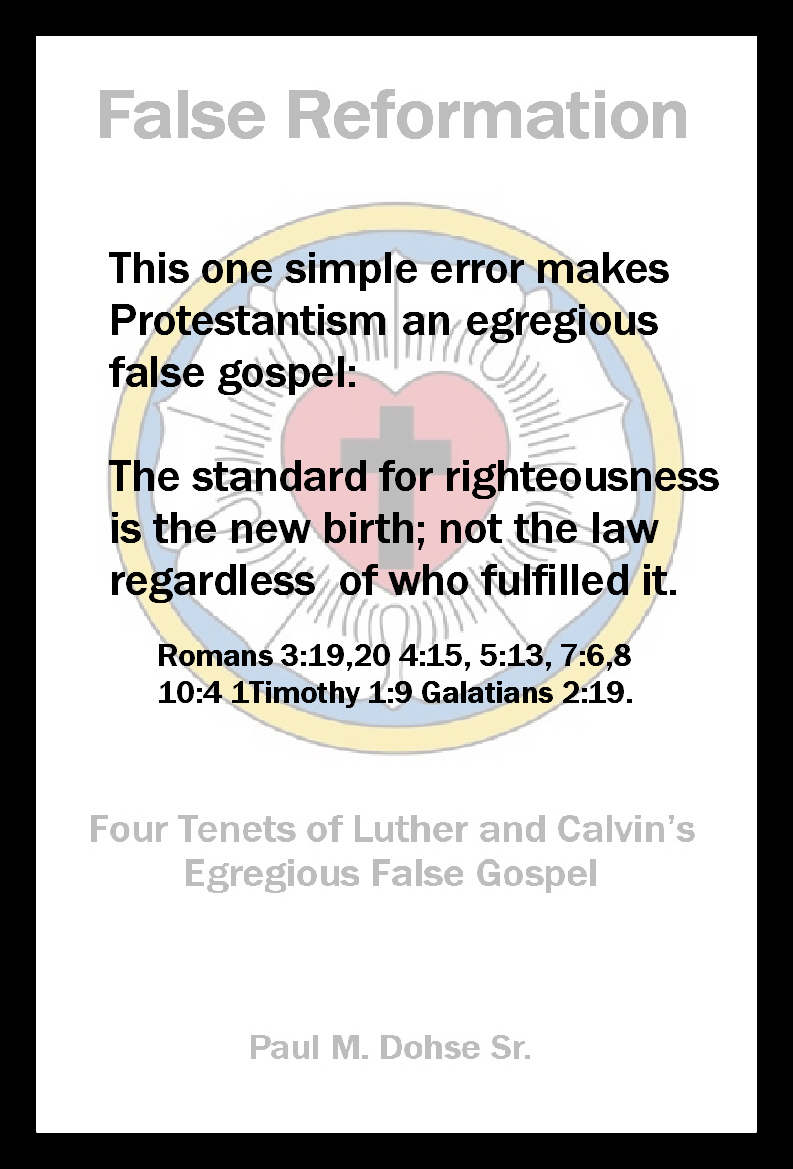
Why the Protestant Gospel Cannot Save: Todd Friel Defends Josh Duggar
 Todd Friel is a Reformed radio host and also MC for some very prestigious Reformed conferences. The name of Friel’s radio show is simply “Wretched.” The title is predicated on authentic Protestant soteriology: the new birth ONLY changes a person’s ability to see how wretched they are.
It’s not that the person doesn’t change per se; their ability to see the depths of their depravity improves. However, the saved person possesses no righteousness; ALL righteousness remains outside of the saved person. This is Martin Luther’s alien righteousness.
Because Protestantism is a super-cult that uses deceptive communication for the sole purpose of deceiving, Luther’s alien righteousness is often framed as “having no righteousness of our own.” Hence, the hearer is allowed to assume that “our own” denies that the means of righteousness originated with the believer. The biblical definition of the new birth is therefore deliberately skewed. The gift of new life is framed as an ownership issue rather than a supernatural embodiment of new being. To believe we are righteous is to make ourselves equal with God.
At any rate, and via many truisms, Protestants seek to keep the new birth in an ambiguous light. To say that we have “the righteousness of Christ” can be interpreted many different ways in regard to the new birth, and that is the idea. The goal is to keep people in a sliding mode of assumption until they are fully indoctrinated. This is Cult 101. For example, the assumption that Protestant pastors talk about the gospel every Sunday “because there might be some lost people present or members who are self-deceived.” Eventually, this assumption leads you to where they want to take you—you need the gospel every day to keep yourself saved and the gospel is only legit in the institutional church.
Another favorite deceptive truism is the idea that we focus on our depravity so that we will appreciate our salvation more, and then all obedience is sanctified and flows from “gratitude.” This seems perfectly logical, but wait a minute, what is the nature of the obedience if we are totally depraved to begin with? If a totally depraved person can obey, doesn’t that make them at least partially righteous?
Very good question, but most Protestants have been conditioned to not think that deeply, and are temporarily satisfied with such an answer until they are fully indoctrinated.
The citations from Friel’s defense of Duggar speak to what I am saying above. Yes, the disaster here, according to Friel, is not that the Gentiles have cause to blaspheme God because of the molestation of children, but rather…
There are two groups of people who should not be shocked to discover that a member of the Duggar family is a sinner: Christians and non-Christians. Surprisingly, both camps seemed to be surprised by this revelation.
That is what makes the Josh Duggar story a disaster.
Remember, this guy is not a Reformed lightweight by any stretch of the imagination, and often partakes in ministry projects with the likes of John MacArthur Jr. and RC Sproul.
He continues…
Based on his own admission, Josh sinned, repented and got saved. Why in the world would Christians be appalled to discover an unregenerate 14-year-old boy acted wickedly?
According to Josh himself, “I sought forgiveness from those I had wronged and asked Christ to forgive me and come into my life.” Sounds like a pretty typical conversion story to me.
Or do you not know that the unrighteous will not inherit the kingdom of God? Do not be deceived; neither fornicators, nor idolaters, nor adulterers, nor effeminate, nor homosexuals, nor thieves, nor the covetous, nor drunkards, nor revilers, nor swindlers, will inherit the kingdom of God.
Such were some of you; but you were washed, but you were sanctified, but you were justified in the name of the Lord Jesus Christ and in the Spirit of our God (I Cor.6:9-11).
Have we forgotten that the Apostle Paul was a murderer before God saved him?
It is a trustworthy statement, deserving full acceptance, that Christ Jesus came into the world to save sinners, among whom I am foremost of all. Yet for this reason I found mercy, so that in me as the foremost, Jesus Christ might demonstrate His perfect patience as an example for those who would believe in Him for eternal life (I Tim.1:15-16).
Stop right there. Notice how Friel proffers an angle that we would all agree with: what the guy did was horrible, but it led to his salvation. He even cites verses that speak of the behavior in the past tense. But then watch what he does in the very next sentence,
Josh is no worse than the Apostle Paul. Josh should not be shunned by Christians; he should be comforted by Christians who are just as wicked and just as forgiven as he is. Josh is nothing more, and nothing less, than a story of God’s amazing grace.
See how he slides from the past tense to the present tense without a transition? Something changes, but obviously NOT our nature. People are left to assume what the specifics of the changes are. Folks, this is classic cultic communication.
And…
This might be the bigger tragedy of the Josh Duggar story: unbelievers consider it a bombshell when it is discovered that a Christian has a shameful past. This ought not to be.
If we Christians were doing our job proclaiming that the Gospel is for sinners, of whom we are the foremost, the world would yawn when it discovered that Josh was a hound dog.
If Christians were as loud about the Gospel as we are about being the moral majority, I suspect there would be five results:
- Unbelievers would not see Josh Duggar as a hypocrite; they would see him as a typical born-again believer who is forgiven by an amazingly gracious God.
- Unbelievers would not see Christians as a mere special interest group that seeks to impose values on other people.
- The Gospel would be shining brightly.
- Somebody might get saved.
- Josh Duggar and his family would be going about their business today as a typical Christian family saved by grace alone.
Unfortunately, it doesn’t seem that any of those things are happening. I don’t blame the world; I blame us.
Is it possible we have become so obsessed with imposing our values on unbelievers that the world sees us as self-righteous Pharisees and not as blood-washed sinners?
Have we been so consumed by the culture wars that we have failed to engage in the spiritual battle for souls?
Notice again how Friel confuses the past condition of Christians with the present. A difference is delineated, yet it’s not defined; the change that takes place is ambiguous, and the logical conclusion cannot assume an actual ability to be righteous. Really, it boils down to a mere positional status rather than an actual change of being.
However, in his closing paragraph, Friel leaves no doubt as to the identity of believers in Reformed soteriology:
Josh tendered his resignation to the Family Research Council and they accepted it. While none of us know all of the details, if Josh were in my employ, I would not have accepted his resignation.
I would have shouted from the rooftops, “If you think Josh is wicked, you should meet the rest of us! That is why we are Christians! We need forgiveness for being wretched, vile, wicked rebels. If you are a rebel too, Jesus died for you! Run to Jesus! Join the wretched club.”
Let’s not squander this opportunity to share the great good news that Jesus died for perverts, liars, thieves, drunkards, abortionists, Wall Street fat cats, skid row bums, suburban housewives, blue collar workers and every sinner who will come to Him in repentance and faith.
Josh Duggar’s story is more than a Gospel tragedy; it is a Gospel opportunity. Don’t waste it.
This gospel cannot save, and will only attract those who do not want to undergo the radical change of new birth. It will only attract those who think they can sin all the more so grace will abound.
paul
Josh Duggar: The Protestant Gospel Strikes Again
 Yawn. Here we go again. The Catholics no longer have the market on sexual child abuse cornered…for some time now. Pray tell, how much longer are all of the clichés going to cover for this stuff until people finally realize that there is a serious fundamental problem underneath the hood of the Protestant magical yellow bus supposedly going to heaven.
May I suggest a false gospel?
How many children will be sacrificed for the sake of evangelicals saving face? I understand that Westerners don’t want to admit that we fell prey to the same en masse religious deceptions found in the East, but the price of children is way too high for the redemption of Western pride. Besides, Germany trashed the notion during the 40s anyway.
Dear discernment bloggers: in case you haven’t noticed, you cannot save the Protestant church. You are now merely gossip peddlers; nothing more or less. And enough with your whiney open forums: truth is found as promised by Christ in His word, not your pooling of ignorant uninformed opinions leading to more and more confusion.
It’s time to stop and question everything, and the answers are egregiously simplistic. It’s time for the solution.
The first century Christians met in homes for mutual edification because that is the intended model; always was, always will be. The “church” was NEVER meant to be any kind of institution. The Protestant gospel was designed for institutional purposes. The five word gospel, “Christ died for our sins,” was derived from spiritual caste presuppositions and an institutional mindset.
Catholics like Protestants because they both share the same metaphysical presuppositions concerning mankind and a call for oligarchy. Hence, the few will always be sacrificed for the collective good. Name one victim who has found justice in the church. Where is this victim? Where is Christ’s one in ninety-nine? You search in vain. That’s because in the Protestant five word gospel, “victim” is a misnomer.
What’s your first clue? Regardless of the fact that Josh Duggar confessed to child molestation in 2006, he was appointed as executive director of the Family Research Council. They knew. Everyone knew. James Dobson probably knew. Sigh. You really think it’s about families? Really? Are you that naive?
Again, the fundamental problem is egregiously simple: the Gospel of Jesus Christ is more than five words. Christ died so the old us could also die. The old us should be dead. But it isn’t, so we continually return to the death of Christ to seek forgiveness for our total depravity. By focusing on our total depravity, grace abounds, and those who know how sinful they are—are actually more qualified to be Christian leaders. And because of that, the Duggars are among the Grace Philosopher Kings, and the American Christian peasantry still doesn’t understand these things. Well, Josh must resign and once again Christianity has lost a great leader because of the Pharisees. In essence, this is the same worn-out Protestant response being proffered in the press by the Duggers.
Also missing from the Protestant five word gospel is our resurrection with Christ. Instead of emphasizing the holiness of new creaturehood, we rejoice in the evil that supposedly manifests Christ’s living, not a “righteous living of our own.” We have not died with Christ, nor have we been resurrected with Him. This is a gospel that is totally off the biblical reservation.
Gee whiz, it’s testimony to the fact that there is a lot more grace work to be done in the church—boy howdy—God’s people still do not understand grace. Poor Josh must resign because there are still way too many Pharisees in the church.
When are God’s people going to stop falling for all of this? When are the discernment bloggers going to beat their keyboards into tools for solutions instead of brushes for whitewashing the tombs of dead people? It’s not a few bad apples, it’s the whole Protestant basket.
And when are Christians going to see the five word gospel for what it is? When is the investment made in error going to look like dung in comparison to the children who have been made to stumble?
paul

 Paul's Passing Thoughts
leave a comment