The Protestant Twisting of 1John, Part 4 – A Clarification: Gospel and Obedience
 Originally published April 20, 2015
Listen to audio or download audio file.
Welcome to Blogtalk Radio False Reformation this is your host Paul M. Dohse Sr. Tonight, part 4 of “The Protestant Twisting of 1John: A Clarification.” If you would like to add to our lesson or ask a question, call (347) 855-8317. Remember to turn your PC volume down to prevent feedback. Per the usual, we will check in with Susan towards the end of the show and listen to her perspective.
If you would like to comment on our subject tonight, you can also email me at paul@ttanc.com. That’s Tom, Tony, Alice, Nancy, cat, paul@ttanc.com. I have my email monitor right here and can add your thoughts to the lesson without need for you to call in.
Initially, I wanted to just address 1John 1:9 in a thorough way to debunk this whole Protestant idea that we keep ourselves saved by returning to the same gospel that saved us. And, the way we reutilize the same gospel that saved us is a continued repentance for “present sin.” It’s this whole idea that Jesus died for our past sins, but we must ask forgiveness for known present sin in order to keep ourselves saved. When we do that, it’s a reapplication of Jesus’ death for present sin. Hence, 1John 1:9.
But it doesn’t stop there in Protestant soteriology. They then concern themselves with the question of true righteousness. If our sins are forgiven, that keeps us out of hell, but it doesn’t make us truly righteous. What to do? So here is what they came up with: Jesus came to die for our forgiveness, past and present IF we return to the same gospel that saved us by faith alone, but He also came to keep the law perfectly so that His perfect obedience could be imputed to “Christian” life. The Reformed call this “double imputation.”
And it turns the true biblical gospel completely upside down. First, it makes the law the standard for justification. There is no law in justification, we are justified APART from the law. Why would Christ obey the law for us when justification is apart from the law? Then what is the standard for righteousness? NOT the law, but rather God’s righteousness. What’s that? For one, and primarily, it’s the new birth. For us, the standard of righteousness is being a child of God. Being the offspring of God is what makes us righteous. Kinship, not law.
Secondly, we are not justified by the law, no matter who keeps it—who keeps it is not the point, the law itself is the point, because there is no law that can give life. Only the new birth gives life (Galatians 3:21).
Thirdly, double imputation is obviously a covering for sin with the righteousness of Christ and not an ENDING of sin. Our sins are not “taken away” they are only covered. “Christianity” is about living a life of faith only to maintain a covering for sin. Therefore, we are not the ones really obeying, and therefore, we are not the ones performing love either.
And boy does this notion land us right where we are at in 1John. I have invested so much in the untwisting of 1John 1:9 in this series, that I thought, “I might as well finish the book out and make it our 1John commentary.” And so it is.
This is our theses: the new birth creates us anew into people who love the truth, and therefore practice oblove. That’s a new word that I made up. What is the definition of oblove? It’s the combination of the words “love” and “obedience.” Biblically, you cannot separate these two words, they are synonymous. The law is the Bible, and it is a book of condemnation to the unsaved and a beloved love manual for those born again. This is also why our sins are not covered, they are taken away (1John 3:5). Christ came to take away sin, not cover it.
You know, many go to church and sing the hymns, and many listen to Christian radio and raise their hands in praise while stopped at red lights, but a lot of that good Protestant music is just really bad theology that imperils the soul and stops far short of inciting the curiosity of the unsaved. One example is a beautiful song by Steve Camp titled, “He Covers Me.” But again, the premise of the song is that our sins are covered and not ended.
You know, there is a quiet revolution going on in Christianity. Christian husbands are beginning to stand up and assume their rightful role as spiritual leaders. This necessarily means leaving the institutional church which deliberately seeks to emasculate the men among us. One thing that I hear back is that fathers are beginning to stand silent and not sing traditional songs that are deviations from the truth. Good for them. I even hear back that their children ask, “Daddy, why aren’t you singing?” And they tell them why. Undoubtedly, children and wives will get way more out of these types of examples rather than 365 different versions of the same gospel that saved us.
“Why is it that all we ever hear about in the church is the gospel?” Because we have to keep returning to the same gospel that saved us to keep ourselves saved, and by the way, the only place that this continued atonement is valid is in the institutional church. Sure, Protestants will deny salvation by church membership; they will rather become indignant and state that salvation is only found in the gospel. However, the fact remains that they also believe that authority to preach the gospel is vested in the institutional church.
If our sins are only covered, the focus of the Christian life is to keep ourselves covered, not obedience because now obedience is defined by law-keeping. We have been trained mentally to think of obedience as something demanded by the law. This makes the law a co-life-giver with God. At least in one regard, the idea of one God connects with this idea. There is only one life-giver (Galatians 3:10-21).
I strongly suspect that when the Bible talks about God being one, it in no way includes the context of the Trinity. It’s interesting to note that in context of Galatians 3:10-21, the point is that the law is not a coequal with God—there is only one God.
1John 3:1 – See what kind of love the Father has given to us, that we should be called children of God; and so we are. The reason why the world does not know us is that it did not know him. 2 Beloved, we are God’s children now, and what we will be has not yet appeared; but we know that when he appears we shall be like him, because we shall see him as he is. 3 And everyone who thus hopes in him purifies himself as he is pure.
4 Everyone who makes a practice of sinning also practices lawlessness; sin is lawlessness. 5 You know that he appeared in order to take away sins, and in him there is no sin. 6 No one who abides in him keeps on sinning; no one who keeps on sinning has either seen him or known him. 7 Little children, let no one deceive you. Whoever practices righteousness is righteous, as he is righteous. 8 Whoever makes a practice of sinning is of the devil, for the devil has been sinning from the beginning. The reason the Son of God appeared was to destroy the works of the devil. 9 No one born of God makes a practice of sinning, for God’s seed abides in him, and he cannot keep on sinning because he has been born of God. 10 By this it is evident who are the children of God, and who are the children of the devil: whoever does not practice righteousness is not of God, nor is the one who does not love his brother.
11 For this is the message that you have heard from the beginning, that we should love one another. 12 We should not be like Cain, who was of the evil one and murdered his brother. And why did he murder him? Because his own deeds were evil and his brother’s righteous. 13 Do not be surprised, brothers, that the world hates you. 14 We know that we have passed out of death into life, because we love the brothers. Whoever does not love abides in death. 15 Everyone who hates his brother is a murderer, and you know that no murderer has eternal life abiding in him.
16 By this we know love, that he laid down his life for us, and we ought to lay down our lives for the brothers. 17 But if anyone has the world’s goods and sees his brother in need, yet closes his heart against him, how does God’s love abide in him? 18 Little children, let us not love in word or talk but in deed and in truth.
19 By this we shall know that we are of the truth and reassure our heart before him; 20 for whenever our heart condemns us, God is greater than our heart, and he knows everything. 21 Beloved, if our heart does not condemn us, we have confidence before God; 22 and whatever we ask we receive from him, because we keep his commandments and do what pleases him. 23 And this is his commandment, that we believe in the name of his Son Jesus Christ and love one another, just as he has commanded us. 24 Whoever keeps his commandments abides in God, and God in him. And by this we know that he abides in us, by the Spirit whom he has given us.
The law is not the standard for justification; it is the standard for our love, obedience, and submission. If there is a standard for justification at all, it would simply be defined by the new birth. We are justified by virtue of being in God’s family. The first man was a created being. God did not decide to save man by restoring a covenant of works, or restoring man’s image created in the likeness of God, or to restore paradise lost. He decided to save man by making him His literal family. The gospel isn’t about restoring things; it’s about making all things new. This defines you as pure, albeit in mortality. Nevertheless, being born of God in mortality results in the inevitable morphing into more and more purity:
See what kind of love the Father has given to us, that we should be called children of God; and so we are. The reason why the world does not know us is that it did not know him. 2 Beloved, we are God’s children now, and what we will be has not yet appeared; but we know that when he appears we shall be like him, because we shall see him as he is. 3 And everyone who thus hopes in him purifies himself as he is pure.
Let’s ask an interpretive question here. What did Jesus mean when He told John the Baptist that His baptism by John would fulfill all righteousness? I think it fulfilled all righteousness by representing the literal new birth, or Spirit baptism. Though we still reside in mortal bodies, the decision to be saved is a decision to follow Christ in baptism, or a decision to be born again. That’s the gospel. That’s what the gospel is.
Romans 6:1 – What shall we say then? Are we to continue in sin that grace may abound? 2 By no means! How can we who died to sin still live in it? 3 Do you not know that all of us who have been baptized into Christ Jesus were baptized into his death? 4 We were buried therefore with him by baptism into death, in order that, just as Christ was raised from the dead by the glory of the Father, we too might walk in newness of life.
5 For if we have been united with him in a death like his, we shall certainly be united with him in a resurrection like his. 6 We know that our old self was crucified with him in order that the body of sin might be brought to nothing, so that we would no longer be enslaved to sin. 7 For one who has died has been set free from sin. 8 Now if we have died with Christ, we believe that we will also live with him. 9 We know that Christ, being raised from the dead, will never die again; death no longer has dominion over him. 10 For the death he died he died to sin, once for all, but the life he lives he lives to God. 11 So you also must consider yourselves dead to sin and alive to God in Christ Jesus.
12 Let not sin therefore reign in your mortal body, to make you obey its passions. 13 Do not present your members to sin as instruments for unrighteousness, but present yourselves to God as those who have been brought from death to life, and your members to God as instruments for righteousness. 14 For sin will have no dominion over you, since you are not under law but under grace.
The more you study the apostle John, the more you will see the apostle Paul. Romans 6 is key here. The perfection of the law is not the standard for righteousness, passing from life to death is the standard. Though we still sin, we are dead to sin. Being deemed righteous in our present state is defined by a reversal of slavery leading to a new direction in life. Romans 6 explains, as we shall see, 1John 3. The literal new birth, in essence reverses slavery (Romans 6:20). This also debunks the whole Reformed total depravity song and dance. Before the baptism of the Spirit that comes by believing on Christ, the unregenerate are free to do good, but enslaved to the law of sin and death (Romans 8:2).
Being under the curse of the law is both a forensic statement and a state of being. It is true, while under law, a perfect keeping of the law is demanded. But this is key: when it gets right down to it, unbelievers are indifferent to the Bible or the law of God. And remember, the law and the Bible are the same thing. Man is capable of doing good, and in fact does do good, but because he/she has no love for God’s truth, and in fact are indifferent to it, life decisions lead to many-faceted forms of death, and ultimately, eternal death. Unbelievers that live according to conscience will suffer a lesser punishment in this life and the life to come.
Believers can in fact make life and death decisions, but are inclined towards obeying the law because of the new birth. Clearly, the Bible states that there is a reversal of slavery. The believer is enslaved to righteousness, but unfortunately free to sin. But according to Paul, a believer can stupidly enslave themselves to certain sins by obeying the desire that the sin produces. The believer is no longer enslaved to sin, but can be ignorant of this fact. And keep in mind, Protestantism is predicated on the idea that we are still enslaved to sin as believers which goes part and parcel with still being under the law and law continuing to be the standard for justification.
Listen, here is why the home fellowship movement is going to eventually take off: the alternative is Protestantism which defines the believer according to how the Bible defines an unbeliever. Eventually, people are going to figure out that they have been proudly proclaiming themselves as unregenerate in the name of Christ.
Lastly, this is defined by the fact that believers have the freedom to present their bodies as living sacrifices, or in other words, present their members for holy purposes that please God. The body is not inherently evil because it is part of the material world. Whether saved or unsaved, the body can be used for good purposes. However, in the case of an unbeliever, good behavior doesn’t lead to life more abundantly, it just leads to lesser punishment and a more bearable eternal state. For the unbeliever, good behavior merely leads to less death. For the believer, obedient love leads to more life.
Now with all of this in mind, let’s read further in 1John Chapter 3:
4 Everyone who makes a practice of sinning also practices lawlessness; sin is lawlessness. 5 You know that he appeared in order to take away sins, and in him there is no sin. 6 No one who abides in him keeps on sinning; no one who keeps on sinning has either seen him or known him. 7 Little children, let no one deceive you. Whoever practices righteousness is righteous, as he is righteous. 8 Whoever makes a practice of sinning is of the devil, for the devil has been sinning from the beginning. The reason the Son of God appeared was to destroy the works of the devil. 9 No one born of God makes a practice of sinning, for God’s seed abides in him, and he cannot keep on sinning because he has been born of God. 10 By this it is evident who are the children of God, and who are the children of the devil: whoever does not practice righteousness is not of God, nor is the one who does not love his brother.
John wrote what he wrote in 1John 3 because of what Paul wrote in Romans 6—it’s saying the same thing. Obeying the law isn’t the issue, a “commitment” to obey the law isn’t the issue, the reality of the new birth is the issue.
1Corinthians 15:1- Now I would remind you, brothers, of the gospel I preached to you, which you received, in which you stand, 2 and by which you are being saved, if you hold fast to the word I preached to you—unless you believed in vain.
3For I delivered to you as of first importance what I also received: that Christ died for our sins in accordance with the Scriptures, 4 that he was buried, that he was raised on the third day in accordance with the Scriptures, 5 and that he appeared to Cephas, then to the twelve. 6 Then he appeared to more than five hundred brothers at one time, most of whom are still alive, though some have fallen asleep.
This is, as Paul called it, the gospel of “first importance” or literally “the gospel of first order of importance.” There is way more behind this than a mental ascent to the facts of the gospel. You have to believe that this first happened to Christ in order to believe that it really happened to you spiritually. Repentance is a change of mind in regard to many things concerning your life and the life of Christ.
By the way, there was an evangelical movement for a while that emphasized the new birth. It peaked in the 70’s and was considered to be the most egregious of all false gospels. The Australian Forum, the think tank that gave birth to the present-day return to authentic Reformed soteriology, actually published an article titled, “The False Gospel of the New Birth.”
John continues in chapter 3 to explain one of the characteristics of being born again, love. But let me insert this, and this is VERY important: the characteristics of the new birth are framed in what the Bible refers to as “abiding.” If God’s seed “abides in” us (1John 3:9), other things also abide in us: the fact that we abide in Him also; the truth abides in us; we know the truth; we love the truth; we love fellow Christians; we do not practice sin, but rather practice righteousness as a life direction and pattern; we love God’s law; we submit to need; we obey; we seek to please God; we have a hunger for learning more of God’s word, and many more can be listed.
Let’s read more of John 3 with this in mind:
11 For this is the message that you have heard from the beginning, that we should love one another. 12 We should not be like Cain, who was of the evil one and murdered his brother. And why did he murder him? Because his own deeds were evil and his brother’s righteous. 13 Do not be surprised, brothers, that the world hates you. 14 We know that we have passed out of death into life, because we love the brothers. Whoever does not love abides in death. 15 Everyone who hates his brother is a murderer, and you know that no murderer has eternal life abiding in him.
16 By this we know love, that he laid down his life for us, and we ought to lay down our lives for the brothers. 17 But if anyone has the world’s goods and sees his brother in need, yet closes his heart against him, how does God’s love abide in him? 18 Little children, let us not love in word or talk but in deed and in truth.
See, the order in which John discusses these things is in no wise disconnected. We need to start thinking about “obedience” in reference to love and the new birth. Really, the Christian life is about love. But listen, any love that flows from you starts with a love for truth. Also, please take note of a more biblical definition of love: love is a submission to need—that’s love. When the Scriptures tell women to submit to their husbands, that’s just another way of telling wives to love their husbands. When the Bible tells men to love their wives, it’s simply telling men to submit to their needs. Look at 1John 3:17 again. How does benevolence get parachuted into that body of text out of nowhere? John goes from discussing murder to meeting financial need; it seems like he is all over the map, but not really.
Lastly, working out the new birth with love leads to assurance.
19 By this we shall know that we are of the truth and reassure our heart before him; 20 for whenever our heart condemns us, God is greater than our heart, and he knows everything. 21 Beloved, if our heart does not condemn us, we have confidence before God; 22 and whatever we ask we receive from him, because we keep his commandments and do what pleases him. 23 And this is his commandment, that we believe in the name of his Son Jesus Christ and love one another, just as he has commanded us. 24 Whoever keeps his commandments abides in God, and God in him. And by this we know that he abides in us, by the Spirit whom he has given us.
Assurance of salvation comes through working out our new birth in fear and trembling. Assurance of salvation is grounded in the ending of the law because the old us died with Christ resulting in no condemnation, while our new relationship to the law leads us in love and life. Now listen, even a casual student of the Bible can begin to hang Bible verses all over this framework.
Next week, we will build on this as we go into chapter 4—let’s go to the phones.
Election and the Real Golden Chain of Salvation: Part 1
Let’s discuss yet another Reformed doctrine; the ordo solutis, or “order of salvation.” This is also known as the “golden chain of salvation” and the proof text is Romans 8:29,30.
For those whom he foreknew he also predestined to be conformed to the image of his Son, in order that he might be the firstborn among many brothers. 30 And those whom he predestined he also called, and those whom he called he also justified, and those whom he justified he also glorified.
It goes something like this: God fore-loved certain individuals and not others. He then predestined them to salvation. He then at some point in time calls them, and then justifies them resulting in glorification. Here is a Reformed illustration below:
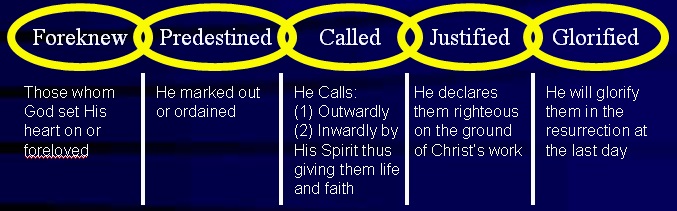
Catholic theologians often object to this take on Romans 8:29,30 because they reject once saved always saved, but they misunderstand, authentic Protestantism does NOT hold to OSAS. More to the point here, the golden chain of salvation is seen as individual, rather than a means of salvation. And that’s what election is: it chooses the means of salvation, and chooses individuals who have roles in the various purposes of salvation. God chose Christ to die on the cross, therefore Christ is elect; He chose the holy angels for certain roles in the salvation process, therefore they are elect; He chose the nation of Israel as part of the process, therefore the nation of Israel is elect, and He chose certain individuals throughout history to contribute to the process of salvation, therefore they are chosen as well to play a part in the means of salvation. That does not mean that they did not have a choice to follow God prior to that choosing for a role in God’s salvific plan. For instance, obviously, God chose the virgin Mary to bear and give birth to Christ as part of the salvation plan. It is also obvious that Mary was saved prior to that choosing. It is obvious that Christ chose the 12 disciples for a role in the slavific plan, but that doesn’t mean they had no choice in choosing God prior to that, hence,
You did not choose me, but I chose you and appointed you so that you might go and bear fruit—fruit that will last—and so that whatever you ask in my name the Father will give you. This is my command: Love each other.
In context, Christ is referring to their election as apostles, not some inability to choose God. As we shall see in the future parts, the REAL golden chain of salvation is a mode of salvation and those used by God to execute it, not a golden chain of salvation that pertains to individual salvation through determinism. Let me now make a beginning case for your consideration. Let me create some reasonable doubt in regard to the Reformed ordo solutis.
First, if you will note once again the Reformed illustration posted in this first part, it illustrates a past tense that preludes present continuous action. This, of course, is necessary for a deterministic conclusion. However, if you carefully examine Romans 8:29,30 it is strictly past tense. Paul is speaking of something that has already taken place. Any other conclusion is presumptuous at best. Paul is writing about something that has been established in the past, or a group of people who have already been glorified. This clearly casts reasonable doubt on the ordo solutis.
Secondly, the ordo solutis would indicate that all of those who are called are also justified, or saved. This is clearly not the case.
Matthew 22:1 – And again Jesus spoke to them in parables, saying, 2 “The kingdom of heaven may be compared to a king who gave a wedding feast for his son, 3 and sent his servants to call those who were invited to the wedding feast, but they would not come. 4 Again he sent other servants, saying, ‘Tell those who are invited, “See, I have prepared my dinner, my oxen and my fat calves have been slaughtered, and everything is ready. Come to the wedding feast.”’ 5 But they paid no attention and went off, one to his farm, another to his business, 6 while the rest seized his servants,treated them shamefully, and killed them. 7 The king was angry, and he sent his troops and destroyed those murderers and burned their city. 8 Then he said to his servants, ‘The wedding feast is ready, but those invited were not worthy. 9 Go therefore to the main roads and invite to the wedding feast as many as you find.’10 And those servants went out into the roads and gathered all whom they found, both bad and good. So the wedding hall was filled with guests.11 “But when the king came in to look at the guests, he saw there a man who had no wedding garment. 12 And he said to him, ‘Friend, how did you get in here without a wedding garment?’ And he was speechless. 13 Then the king said to the attendants, ‘Bind him hand and foot and cast him into the outer darkness. In that place there will be weeping and gnashing of teeth.’ 14 For many are called, but few are chosen.”
In this passage, the “called” are defined: the called are all peoples who are invited to believe in the gospel of the kingdom, and those who except the invitation are of the elect group. Not all of the called are elect. This throws a very large monkey wrench into the Reformed golden chain/order of salvation. Hence, John Calvin came up with three categories of individual preselection: the non-elect; the called; or those temperately chosen/illumined/born again, and those who persevere; or those who are both called and elected in the final analysis. Therefore, assurance of salvation is absolutely impossible in context of the ordo solutis. NO ONE can really know for certain that they are saved until they are “manifested” in the “final tribunal” where “final justification” is determined.
Yet, the apostle John wrote an epistle so that we may “know” presently that we are born again (1John 5:13). The Reformed order of salvation seems apparent based on its deterministic presuppositions, but further investigation is needed.
paul
Romans 9:11- God Does Not Choose, He Calls
 How should we interpret our Bibles? Clearly, Christ set the example. Throughout the gospels He reasoned with many via interpretation based on the technical meaning of words and how they are used in a sentence. We are to interpret the Bible grammatically. Also, the Bible is purposely written in a way that defines certain words according to the plain sense of context; so, while knowing Greek and Hebrew may be helpful, it’s far from being a prerequisite to understanding. The rules of grammar, for the most part, transcend culture. A noun is a noun, and a verb is a verb in any language. To even cite examples of this is to state the obvious, but I will mention Christ arguing for the resurrection based on the tense of “I am” in Matthew 22:31,32.
So, in regard to the question of determinism and the idea that God chooses some for salvation and others for damnation, we find something in the grammar of Romans 9:11 that should give us pause.
…though they were not yet born and had done nothing either good or bad—in order that God’s purpose of election might continue, not because of works but because of him who calls—(ESV)
If the point of Romans 9 is God’s pre-choosing of some for salvation and not others, why would Paul not have written, “because of him who chooses” rather than “him who calls”? Did Paul have a senior moment? Also peculiar to this passage is the stated purpose of election: the eradication of works from salvation. It seems that election accomplishes this for purposes of God calling all people to accept salvation as a pure gift rather than God’s choosing being the linchpin. Note the following:
For the gifts and the calling of God are irrevocable (Rom 11:29).
Again, why is it not the choosing of God that is irrevocable rather than the calling? This grammatical roadblock to determinism was not missed by John Calvin. If choosing and calling are something different, it could mean that the means of salvation was chosen for a particular purpose and then offered to all people as a gift that they could choose themselves or reject. Hence, Calvin separated determinism into 3 separate categories: the non-chosen, the temporarily chosen (the called), and the truly chosen (those who persevere). But of course, Calvin’s three-fold election construct is rarely discussed in Reformed circles for obvious reasons. You can add this fact to the list of other Reformed dirty little secrets relegated to the closets lest they would incite some sort of chemical reaction of thought within the cranium cases of Reformed Kool-Aid drinkers. And of course, no one is going to challenge me to come up with the specific citations from the Calvin Institutes because they know I can.
Here is my rudimentary hypothesis at this time: “election” is primarily a noun in the Scriptures that denotes a category of people and purpose while “calling” is the action taken by God, or the verb. God calls people, He doesn’t choose them. God chose the means of salvation, and calls all people to accept the means of salvation as a gift. The purpose of election is that salvation would be by PROMISE, and not works. Also, “election” is primarily defined in terms of miraculous new birth into the family of God and something made entirely possible by God alone. Any Bible passages that seem to make a direct connection between election and God’s choosing of individuals are rare, or completely absent at most, and ambiguous at least.
Let’s also remember that those who are not in need of salvation are also considered to be God’s “elect”; namely, the holy angels and Christ. The nation of Israel is elect for a particular purpose, and this is perhaps the best definition of election: it is a chosen means to obtain a particular purpose. God chooses the means of salvation, not individuals. Election makes salvation a pure gift and promise apart from the will of man or his abilities, but mankind is free to choose or reject the gift. True, because man fears the condemnation of God, his tendency is to not seek God, but the loving God seeks out mankind through the gospel. God seeks out man and corners him with the truth of the gospel, but man’s tendency to hide from God does not mean he has no ability to make a choice.
A good example of the ambiguity that surrounds the idea of God choosing individuals is 1Peter 5:13. Depending on the translation, it’s the “sister” that is chosen or the “church.” If the latter, that makes my point, but more interesting is the disagreement in translations concerning “elect” used as a noun or adjective as opposed to “chosen” or “elected” regarding those defined by an action, or verb. While the likes of the ESV translate “elect” as… “elected,” or “chosen,” many other mainstream translations like the ASV translate it “elect” without the ed suffix. In other words, a statement concerning the fact that we are all part of the family of God and His plan of salvation does not necessarily equal determinism, or the idea that “elect” equals those who were predetermined to be in the family of God coupled with total inability on man’s part to choose God.
And, if Christ wasn’t mincing words in His argument for the resurrection, neither is this consideration by any stretch of the imagination. And it’s funny; when I was doing word study on this and initially observed 1Peter 5:13 with the word “elected,” I assumed that if my hypothesis held any water that I would also find translations using the word “elect,” and as noted, that in fact ended up being the case.
If you follow the apostle Paul’s argument throughout Romans 9, 10, and 11, and Galatians 3 for good measure, the concern is that salvation is solely by the promise of miraculous new birth. Whether Sarah, Rebekah, Elizabeth, Mary, or the Spirit’s role described in Galatians 3, salvation is NOT by any will or work of man, but a onetime miraculous new birth. A denial of literal new birth paves the way for progressive justification via determinism which is the number one nemesis of the true gospel.
The new birth is a work of God alone, but that doesn’t mean man cannot choose it.
paul
The Protestant Twisting of 1John: A Clarification, Part 2
Originally published March 31, 2015
Listen to show or download audio here.
Listen or download full show uninterrupted.
Welcome to Blogtalk Radio False Reformation this is your host Paul M. Dohse Sr. Tonight, part 2 of “The Protestant Twisting of 1John: A Clarification.”
How is 1John used to argue for a progressive salvation, and what is John really saying in his epistle? That’s what we are discussing tonight. If you would like to add to our lesson or ask a question, call (347) 855-8317. Per the usual, we will check in with Susan towards the end of the show and listen to her perspective.
If you would like to comment on our subject tonight, you can also email me at paul@ttanc.com. That’s Tom, Tony, Alice, Nancy, cat, paul@ttanc.com. I have my email monitor right here and can add your thoughts to the lesson.
Ok, so this whole idea is very Protestant, that we must keep going back to the same gospel that saved us in order to keep ourselves saved. But, it’s all good because we are going back to the “gospel” and the “gospel” is by faith alone so going back to the gospel is a faith alone work which isn’t really a work. So, it’s ok to do something to keep ourselves saved as long as it’s a faith alone work.
As we discussed last week, here is where the home fellowship movement stands apart from the institutional church: salvation is a finished work; salvation is NOT a progression from point A to point B. The new birth is a onetime instantaneous quickening of the believer. The believer then in fact does move on to something completely different—kingdom living, or discipleship. Central to Protestantism is the idea that moving on from the gospel to doctrinal maturity is an abomination. The who’s who of Protestantism can be cited many times in stating this in no uncertain terms.
The home fellowship movement is not a mere preference over the institutional church—it is an anti-progressive justification movement. It is a return to the true gospel of Christ. All of the institutional church either embraces progressive justification or is willing to fellowship with it and is therefore altogether guilty.
Last week, we also introduced the fact that 1John must be interpreted according to its historical context. The number one nemesis of the 1st century assemblies was Gnosticism and 1John is a treatise against it. We covered John’s introduction which was a direct pushback against the Gnostic idea that the spiritual Christ did not die on the cross. We believe that John was specifically addressing the Gnostic teachings of Cerinthus. He taught that there was more than one Christ; one born naturally of human parents that will be resurrected with all other men in the last days, and the spiritual Christ who dwells in heaven. Elsewhere, John wrote:
1John 4:1 – “Beloved, do not believe every spirit, but test the spirits to see whether they are from God, for many false prophets have gone out into the world. 2 By this you know the Spirit of God: every spirit that confesses that Jesus Christ has come in the flesh is from God, 3 and every spirit that does not confess Jesus is not from God. This is the spirit of the antichrist, which you heard was coming and now is in the world already.”
The very definition of antichrist teachings is the denial that the true Christ (Messiah) was part of the material world, or actually came in the flesh. Gnostic systems of thought are very complex, but the cardinal principle is that material is evil and the spiritual or invisible is good.
The important distinction is that biblically, the material creation is not inherently evil, but weak. This is an important distinction because Christ coming as man makes it possible for men to be literally recreated and part of God’s literal family. The teaching that “denies Jesus is the Christ” (Messiah: 1Jn 2:22) circumvents the new birth. Throughout this epistle, John refers to the recipients as “little offsprings”(teknion; little children). I want to dig into this a little deeper; the new birth and its relationship to apostolic succession, but first, let me address the crux issue here.
John was also addressing an aspect of Gnosticism that believed the following: sin only resides in the material, and the spiritual part of man is sinless and has never sinned. In essence, it doesn’t matter what we do in the body because the spiritual part of man is sinless and has never sinned, and that is the only part of man that is eternal anyway. Many scholars concur that this was a common form of Gnosticism. Of course, this disavows any need for Christ to die on the cross and makes the knowledge of this supposed lie salvation itself. Salvation by being made into something new is out—coming to grips with the gnosis regarding man’s inner spark of divinity is in. This backdrop now explains exactly what John was getting at in 1John 1:7-10 and 2:1,2.
1John 1:7 – “But if we walk in the light, as he is in the light, we have fellowship with one another, and the blood of Jesus his Son cleanses us from all sin. 8 If we say we have no sin, we deceive ourselves, and the truth is not in us. 9 If we confess our sins, he is faithful and just to forgive us our sins and to cleanse us from all unrighteousness. 10 If we say we have not sinned, we make him a liar, and his word is not in us.”
1John 2:1 – “My little children, I am writing these things to you so that you may not sin. But if anyone does sin, we have an advocate with the Father, Jesus Christ the righteous. 2 He is the propitiation for our sins, and not for ours only but also for the sins of the whole world.”
“We” in these verses should be viewed as speaking to mankind in general while including both saved and unsaved individuals. Recognizing that Christ came to deal with man’s sin problem is efficacious to the gospel.
John is NOT stating the Protestant gospel of “deep repentance” which teaches that we keep ourselves saved (or washed) via a “lifestyle of repentance.” That would be a perpetual return to the same gospel that saved us for relief from “present sin.” That flies in the face of biblical justification. This makes “if” in these verses a conditional conjunction. That would mean that our sins continue to be forgiven, or washed, or cleansed “if” we “walk in the light” and continue to repent. That’s clearly works salvation, and clearly a reapplication of Christ’s sacrifice to present sin. As actually taught in Protestant circles, the sacrifice only happened once, but the remembrance of it continues to cleanse present and future sins.
This is the whole deal behind, “We must preach the gospel to ourselves every day” and the vital union doctrine. Living a “lifestyle of repentance” or deep repentance “keeps us in the love of Jesus.” This is salvation by Jesus + deep repentance to keep ourselves saved. The Reformed say, “No, it’s not works because repentance is a faith alone work,” but not even a so-called faith alone work can keep you born again—you can’t unborn yourself by not doing something. Look, here is the money point on all of this: the needed present and future forgiveness can only be found in the Protestant institutional church via baptism/formal membership. And we will be addressing that a little further along.
One of the many problems with this is, in regard to believers, follows: in order for present sin to exist, there has to be a law, and the blood of Christ ended the law—it’s a onetime cleansing. To have some need to reapply the blood of Christ to present sin implies that there is still sin, and there is not because where there is no law—there is no sin, and Christ died on the cross to end the law. This fact is found in Romans 3:19,20, 4:15, 5:13, 7:8, 10:4.
Some insist that John’s context here is fellowship, and since fellowship is the context, John is writing about repentance that is necessary to keep us in proper family relationship with God, and not a repentance that keeps us in the family of God; ie., John is talking about sanctification and not justification. Frankly, that’s the view that I used to hold to as well.
But John is talking about the onetime cleansing that justifies. Note that throughout these verses that it is a forgiveness that cleanses from “all sin” and “all unrighteousness.” That has to be justification. What John is saying is that no matter who you are in humanity, you have need to be forgiven of sin by believing that Jesus is the Christ and died for you. Note the subjects of these verses: “He is the propitiation for our sins, and not for ours only but also for the sins of the whole world.”
However, John is also saying that this fact doesn’t give us a license to sin any more than the Gnostics, “I am writing these things to you so that you may not sin.” But watch this: “But if anyone does sin, we [everyone] have an advocate with the Father.” Ok John, an advocate for what purpose? Answer: “He is the propitiation for our sins, and not for ours only but also for the sins of the whole world.” Who are the subjects? It’s obvious who the subjects are.
If this isn’t speaking to a onetime cleansing of sin, the world doesn’t need the new birth any more than Christians—they only need to ask forgiveness so the blood of Christ will be applied to the particular sin. Not only that, the new birth is also disavowed through the denial of a new creaturehood displayed by people who have passed from death to life. And John is speaking directly towards this issue as well. You see, who the “we” are and what the “if” is—is critical to interpreting these verses properly. The “we” are the “anyone.” The “if” is a cause and effect conjunction and not a conditional conjunction.
And let me tell you something, Protestant theologians rarely have any qualms about saying that God’s promises are conditional. I mean, what’s the paramount example? Replacement theology/supersessionism, right? This whole idea that Israel’s election was conditional on them holding up their end of the covenant. I just don’t know what can be more obvious, and this is their exact take on justification as well.
This is the crux. John is saying that if we walk in the light, it’s because we have been born again, not that we keep ourselves born again if we do our part by walking in the light. Walking in the light is not our part of the so-called vital union, we walk in the light because that’s what new creatures do; cows like hay and ducks like water—it’s a cause and effect conjunction not a conditional conjunction.
Now, here is where we really struggle with these verses: in verse 7, the English word in the plural strongly suggests a present continuous action. Verse 9 really isn’t that much of a problem as it’s merely saying that anyone that confesses their sin is cleansed of all unrighteousness. Note the following verse 10 that can be rendered this way: “If we say we have not [never] sinned.” The English “ed’ on the end of sin indicates past tense like, “I sinned.” That’s past tense. If John is speaking to the present continuance, why would he have not written, “if we say that we do not sin.” Right? Verse 9 simply fits into the Gnostic motif that John was arguing against.
Neither is 1John 2:1, 2 a problem. John is simply stating that anyone who recognizes their sin and wants to do something about it has an advocate in Christ who cleanses all sin. And by the way, the rest of John’s letter backs up my Pauline argument to the hilt. Just, all over the place in the rest of the letter, for example,
1John 3:3 – “And everyone who thus hopes in him purifies himself as he is pure. 4 Everyone who makes a practice of sinning also practices lawlessness; sin is lawlessness. 5 You know that he appeared in order to take away sins, and in him there is no sin.”
He came to “take away sin,” not to cover it with His own righteousness and to continue to forgive it. Christ came to end sin altogether. Are we “in Christ”? Well, in Him there is NO sin. So if we are in Him, why would we need forgiveness for present or future sin in regard to justification? In 1John 2:12-14, forgiveness of sin and overcoming the evil one is spoken of in the past tense.
The only matter at hand is the word “cleanses” in verse 7. Let me point something out to you. Most of the English translations that we have come out of the Protestant Reformation. Therefore, and there are myriads of examples of this, the translations are tainted with progressive justification presuppositions. And unfortunately, this includes the Greek word-study helps. Here is something I read in one:
Every encounter with a command to obey, is our opportunity to jettison self-reliance and to yield to the enabling power of the Holy Spirit. Supernatural commands from the supernatural God can only be carried out with reliance on His supernatural power! The Spirit is called the Helper, but don’t let His Name mislead you. To say that we need His help is to imply we have some ability of our own to obey and are in need of a little “push” so to speak.
See the problem? You can know the Greek backwards and forwards, but what good does it do if “help” doesn’t mean “help”? Look, what good have all of the Protestant Greek scholars done for us? I came to realize the problem of progressive justification by my own independent study in Romans. The basic concept easily understood regardless of the language, “where there is no law there is no sin.” That statement astounded me, but was the key to unraveling the whole mystery. Once you understand that fundamental, the rest of the Bible, when taken in context, fits together perfectly in every way. How much did any knowledge of Greek aid me in this understanding? Nada. Goose egg. Zilch. Loco zippo.
Greek can be confirming, and helpful, but the Bible is written in definitive structures that mean the same thing in all languages and that is no accident. You can translate the fact that Christ died on the cross to end the law, and where there is no law there is no sin, any way you want to—it’s going to mean the same thing in any language. Then you start seeing where the concept fits together with everything else in the Bible which enables you to nail down what the anomalies are. And a lot of the anomalies are bias towards a certain worldview.
Notice in the example I gave there is no room given for an authentic colaboring between us and the Holy Spirit. It is either all us or all of the Holy Spirit. My friends, that is the Protestant redemptive-historical worldview to a T and it is fundamentally Gnostic in its premise. Hence, when you use Greek word-study helps, you are often dealing with the same bias. This is why I eventually threw away my Kenneth Wuest expanded New Testament translation. I started seeing clear bias in how he processed the Greek verbs and I was totally done with him at that point.
I spent the better part of yesterday researching 1John 1:7 and the word “cleanses” therein. We know from biblical context that this verse cannot be saying that the one sacrifice of Christ continues to rewash us IF we continue to walk in the light; ie., Protestantism. And let me give you the thumbnail: if you remain faithful to the institutional church and its sacraments/ordinances, that keeps you saved. Even if the Greek usage indicates a present continual action there is no way to distinguish that from the simple reality of being washed once and remaining clean thereafter. In other words, there is no way to definitively distinguish between two intents: a required reapplication to reinstate a status or an unchanged status that continues in the same state without any further action.
Though “cleanses” appears to be some kind of continuing action in the ESV version of 1John 1:7 as well as many other versions, we know that this same cleansing of regeneration is clearly stated as a onetime final act in many, many other Bible passages. For example,
1 Corinthians 6:11- “And that is what some of you were. But you were washed, you were sanctified, you were justified in the name of the Lord Jesus Christ and by the Spirit of our God.”
Ok, you have “were” in there four times with sinful lifestyles being in the past tense, and sanctified, justified, and “washed” being in the present tense. It is one event that happens one time and transforms us into an immutable state. Period. This is irrefutable. And by the way, if you do a New Testament word search on the exact form of the Greek word “cleanses” (other translations “cleanseth”) in 1John 1:7, it is almost always used as a onetime ceremonial cleansing.
Matthew 8:2 – “And behold, a leper came to him and knelt before him, saying, ” Lord, if you will, you can make me clean.” 3 And Jesus stretched out his hand and touched him, saying, “I will; be clean.” And immediately his leprosy was cleansed.” [Here in Mathew 8:2, the same exact form of the Greek word is used for past, present, and future tense. “Ed” is added to the English word “cleansed” to indicate past tense].
Note how Young’s Literal Translation has 1John 1:7.
“and if in the light we may walk, as He is in the light — we have fellowship one with another, and the blood of Jesus Christ His Son doth cleanse us from every sin;”
Now, not only does this simply state the fact that the blood of Christ cleanses us from every sin with a much less conditional translation, it’s interesting that the YLT picks up on something that Andy related to me yesterday in regard to the word “may”:
What is interesting is that all of the examples that John uses where he says “if” are all 3rd class conditions. All the key verbs are in the subjunctive mood.
Here is an excerpt regarding 3rd class conditions…
“The third class condition often presents the condition as uncertain of fulfillment, but still likely. There are, however, many exceptions to this…The third class condition encompasses a broad range of potentialities in Koine Greek. It depicts what is likely to occur in the future, what could possibly occur, or even what is only hypothetical and will not occur” (Wallace, p. 696).
So John is really posing a series of future hypothetical situations. Any place where it says “if” you should read it as “if ever in the future…” or “if at any time in the future…”
It would appear that this seems to be an exercise in reason using hypothetical examples to refute the gnostics that were among them in those assemblies. Notice that the present tense verbs are present tense because they are in the conclusion (apodosis) to the proposed hypothetical conditional premise (protasis). But the verbs in the premise (protasis) are in the subjunctive mood.
Also, you cannot read verse 7 without verse 6. Verse 7 is an antithetical conclusion of verse 6. In other words, you can’t properly interpret vs 7 without vs 6. In fact, notice how 7 contrasts 6, AND vs 9 contrasts vs 8 also! They are parallel arguments, and then vs 10 kind of sums it up.
This bolsters my contention that John is addressing people in general regarding the ramifications of their beliefs about sin in contrast to Gnosticism. That’s the crux here: the backdrop is the Gnosticism John is addressing. If you say that you have no sin, for whatever reason, you are making God out to be a liar. But if you confess your sin, God will cleanse you from all unrightousness. And, that will have an effect on your life because you have been cleansed. John does not hone-in on the new birth right here, but does so in chapter 3 bigtime. Really, chapter 3 clarifies exactly what is being stated in the first two chapters.
In addition, John is saying that even though those who confess their sin are cleansed of all sin, that is not a different kind of license to sin without ramifications. Hence, “…I am writing these things to you so that you may not sin.” But if you do recognize that you have sin, we have an advocate with the Father that is a propitiation for all sin, those who confess that they have sin, and those who may in the future confess that they have sin—this is what is going on in this passage. And by the way, this is another refutation of limited atonement as well.
Let me give another example that might help clarify all of this. One Reformed fellow (a disciple of Paul David Tripp) arguing against me in regard to all of this stated the following:
In John 4, we are to drink once, but that one drink becomes a reserve that refreshes continually. The substance that refreshes is the same (Christ’s salvation, in an ongoing manner)…For Calvin, the cleaning is ongoing, because there WILL be new sins, and 1 John tells us there are new sins. WERE IT NOT FOR the ongoing cleaning and forgiveness, we would exit the family of God, but the faithful know of a certainty that this cleansing is ongoing and present.
See the problem with not interpreting this passage in its historical context? John isn’t talking about “new sins,” he is talking about SIN period. Where is there anything stated in this passage in regard to “new sins”? What relevance does “new sins” have with the unsaved world that is one of the subjects of this passage? The unsaved have “new sins”?
Also, Christians do not have “new sins” because Christ ended the law and where there is no law there is no sin. This is exactly why the Protestant gospel keeps people under law—the whole concept of “new sin.”
In addition, notice what he states about John 4 that is a common Reformed position:
“In John 4, we are to drink once, but that one drink becomes a reserve that refreshes continually.”
This statement is a common smoking gun that damns Protestantism. In that passage, Jesus said that those who drink of the water will never… (what?) again? Right, they will NEVER “thirst” again. Christians may need refreshment against the weakness of the flesh, but we never need our justification to be refreshed—that’s just a blatant false gospel.
Moreover, note, “WERE IT NOT FOR the ongoing cleaning and forgiveness, we would exit the family of God, but the faithful know of a certainty that this cleansing is ongoing and present.” This is where the “if(s)” of 1John totally shoot Protestantism in its gospel foot. If you take this approach, the if(s) of 1John 1:7-2:2 are conditional upon confessing “new sins.” This clearly makes the cleansing of sin that makes us part of God’s family conditional. It makes the new birth conditional. “If” we don’t confess, we can be unborn.
Doesn’t it make much more sense if John is saying that we (people in general) have to recognize that men have sin in order to receive a cleansing from it? Sure it does. John is pushing back against a philosophy that taught the following: man is spirit and therefore without sin; only the material world has sin. Therefore, it doesn’t matter what people do in the body, it’s all just part of the material world that is passing away. This also rejects the new birth and its righteous lifestyle that walks in the light as Christ is in the light and there is no darkness in Him. Those who walk in the light are born of the light and they are of the light because they recognized the need to confess their sin in order to be cleansed. Hence…
John 3:2 – “Beloved, we are God’s children now, and what we will be has not yet appeared; but we know that when he appears we shall be like him, because we shall see him as he is. 3 And everyone who thus hopes in him purifies himself as he is pure.”
Next week, we are going to look at how the rest of the book of 1John fits into this Pauline soteriological schema perfectly. Why does John follow our passage at hand with a discussion of love and then the new birth? How do we get from the gospel anomaly of “new sins” to “love,” and what does that have to do with the new birth? How does all of this make walking in the light synonymous with the new birth?
See you next, and now let’s go to the phones.
TANC 2015 – Andy Young, Session 1: Challenging Presuppositions of the Believer’s Identity
So I had originally chosen a few other topics on which to speak. And then several weeks ago Paul and I were chatting on Facebook, and I think it was following something he had just posted on the blog – I don’t remember the exact circumstances now – but I had been sitting there thinking about this, and the thought came to me, “Believers don’t really know who they are!” And I was overcome by the realization of this, how profound this was. Here we are, some 2000 years after, if you want to call it the “birth of Christianity”, some 500 years after the reformation.
What do we have?
- Grand churches with their grand buildings and their programs
- Christian schools
- Christian universities
- Seminaries turning out all these pastors
- all these resources
And with all of this, people are sitting in churches Sunday after Sunday, and they still don’t even know who or what they are. They are not aware of the reality of their existence. And that is what it really boils down to is this philosophy of existence. Who are we? What are we? And I don’t want to delve into a fundamental discussion about what is man. That’s a really esoteric subject, and not that it’s not worthy of discussion or that it’s not relevant, but I’ve only got so much time here, and I want to focus on something more specific.
Specifically, what is a Christian? You remember that it was in Antioch of the province of Syria that the term “Christian” was first coined, but not in a good way. It was a pejorative. It was meant as an insult. In the Greek, the word literally translates, “Christ ones”. We can make it sound even more derogatory by saying “christers”. You’re one of those “christers”. One who goes around talking about Christ. It was meant to be an insult. In fact, every time you see the word “Christian” used in the NT, which isn’t often, it is generally used in a negative context.
Of course, the fact that is was meant as an insult is what caused the term to be adopted as badge of honor in later decades and centuries, in a sort of ironic fashion. And to this day the word “Christian” is very common and normal and doesn’t carry the stigma with it. People in churches gladly call themselves Christians. Now granted, in recent years there has been a growing intolerance of what passes for Christianity, but for many years that wasn’t the case. It was almost popular to be a “Christian”.
But we’ve seen, I’d say in the last 10 years or more, a growing animosity towards Christians once again, and that isn’t necessarily for the reasons that we think of immediately. You know the first thing that comes to mind is this conflict between government and religion and the whole separation of church and state issue. But more and more I see that being a secondary issue. What we really have is a growing hatred for those who call themselves “Christians” because of what they represent. And that is, on an institutional level, on a theological level, on a philosophical level, it has to do with this seeming indifference to abuse and suffering both inside and outside the institution. Christians are viewed as uncaring and insensitive. You have Hollywood actors referring to God as a sadistic monster. And I can’t necessarily blame them for that kind of assessment. You look at the way “Christians” behave, especially toward each other.
And if you don’t believe me, watch what happens when you try to ask a question in Sunday school that questions the orthodox position. Or you leave a church over doctrinal matters and see how many of those people who you thought were friends continue to have contact with you. Or you watch how downright vicious they get with you when you try to present a rational argument in a Facebook discussion. One has to ask themselves, if they treat a fellow brother like that, how do they treat a lost person? How do they treat someone they are trying to evangelize?
And you don’t think the world sees this? You don’t think the world looks at the behavior of Christians, and then we wonder why they don’t want to have anything to do with us. What did Jesus say?
John 13:35 By this shall all men know that ye are my disciples, if ye have love one to another.
Does the world see us loving each other? How can they believe anything we have to say? Dear lost person, I want to share with you the gospel because I love you. Oh, like you love that other guy who calls himself a Christian? I see the way you treated him.
The blame for this rests squarely on Augustinian/Reformed/Protestant orthodoxy. Traditional orthodoxy has created a god in its own image that IS without a doubt a sadistic monster. And so as a result, you have followers of this god going around treating people the exact same way that they believe their god treats them. Why should we expect any different. And this is the reason then that the term “Christian” has become a pejorative once again. And it is for this reason why I no longer refer to myself as a “Christian”. I call myself a believer. Or follower of Christ. A disciple of Christ. I prefer believer.
So along those same lines then, this becomes the foundational premise for why those who call themselves “christians” don’t even know who they are. What is the primary defining term that traditional orthodoxy uses today and has used for centuries to determine our identity as believer? When you sit in that pew, or that stadium chair, or whatever kind of seats your church uses, and the pastor/elder/bishop/apostle or whatever he wants to call himself, stands in front of the plexiglass podium, and he’s standing up there, and he’s looking so hip with his goatee or soul patch, in his blue jeans and turtleneck and sports coat and brown suede shoes, and he starts to deliver his sermon, what is the one theme that is driven home to you over and over and over again? What does he want you to know about yourself? What are you?
SINNER!
This is the theme. This is what defines you. It’s in the songs we sing. Only a sinner saved by grace. Amazing grace…that saved a wretch like me. I need thee every hour! And I could go on. We see it in the pithy little memes on Facebook. Here’s one I saw recently….I’m not a christian because I am strong and have it all together…Of course the question we should immediately ask ourselves is, why do Christians need a savior? But we never ask those questions, do we? Here’s another one. I’m not that perfect Christian, I’m the one who knows I need Jesus. Of course there’s a subtle snarkiness to this one. It’s almost a kind of holier-than-thou attitude. It almost seems to contradict the very humility it’s supposed to be trying to convey. I’m so humble that I know I’m not perfect, but at the same time, I know something you don’t know. I know I need Jesus and you don’t. And of course at first glance, no one is going to argue with that. How can you say you don’t need Jesus? But what they don’t realize is that, wait a second, believers already have Jesus. We’re already saved. Why do I need a savior over and over? But you will see this theme over and over all over the place. Don’t forget, Christian, you’re a sinner!
Now of course what do they mean by that? Well they say, well I still sin. Right. They like to ask that question. Did you sin today? Then you’re a sinner. And of course they think they trick you when they ask you that question. They think they’re being clever if you come to them with some notion of righteousness. And of course their mistake there is equating righteousness with obeying the law.
But the fundamental flaw in this assumption about being a sinner is this. If you make this your assumption that because you sin you are therefore a sinner, what you are doing is allowing your identity to be defined by a practice or a behavior. (let me say that again.) You are allowing your identity to be defined by a practice or a behavior.
Now on a certain level this is not necessarily incorrect. This is something we do all the time in our everyday life. We tend to categorize ourselves and others by what we do. We do this in our jobs. I have my own business. I earn my living by cooking food. So since that is a behavior in which I engage, I can legitimately say, I am a cook. Or Paul writes for a blog, therefore Paul is a blogger. Or Cam Newton plays football for the Carolina Panthers, therefore Cam Newton is a football player. (I threw that one in there for Zach). Ok, all of these are examples of behaviors or activities that we use to categorize each other and to compare ourselves with others to help organize our world, and so all of these things are true. But do those things define us as individuals? In other words, aren’t we more than just cook, or blogger, or football player?
There is a tendency to divide people up in to groups and call them “communities”. And these so-called “communities” are defined by the behaviors and actions of those who would identify with them. And so what ultimately ends up happening is you have those who say they are part of this “community” as if everything they are, who they are, is defined solely by the behaviors that are common to those in this community. The LGBT crowd is a great example of this. How do they refer to themselves? They say the LGBT “community”. Well what does that mean? Their whole identity is wrapped up in a specific behavior. Now I’m not going to get into, is this a choice or are they born this way, that’s irrelevant to this point. Even if you assume you are born this way, it is still a behavior, and you are choosing a behavior to be the basis of your identity.
Why don’t we do this with other behaviors? Why don’t we have a pedophile community? Why don’t we talk about the serial killer community? Or the alchoholic community? And I’ll stop there because I don’t want to go too far and have the analogy fall apart, but I think you should begin to see the point I’m trying to make here. We don’t define ourselves by our behavior. And this has tremendous ramifications.
So how do we define ourselves? I think a great place to start is asking how does God define himself? Is God defined by His attributes? We say God is love, God is just, God is holy, God is immutable. But again, is this how God is defined, or are these all abstract concepts that man has assigned to God to help organize the world around him, and so we create these aspects of God so that we can try to understand Him? How did God define Himself? How does God identify Himself?
Moses asked this very question at the burning bush. You remember that he was to be the leader of Israel, and he was concerned that they would not follow him, and he asked God, who should I tell them sent me? How will they know You sent me? And so in Exodus 3:14 God answers Moses, and He says:
Exodus 3:14 “And God said unto Moses, I AM THAT I AM: and he said, Thus shalt thou say unto the children of Israel, I AM hath sent me unto you.”
God said, I exist! Do you realize what a profound declaration that is? God was not just being coy with Moses. In this simple three-word declaration in Hebrew, God was establishing the fundamental definition of self. I EXIST. Who am I? I am me. I am who I am. I exist! That is such a profound declaration. To declare your own existence is to acknowledge your right to self. But there is even more to this, as I was discussing this very point with Zach last week, as he pointed out, and I agree, that there is a corollary to this truth. That when God declared I EXIST, at the same time He declared, YOU EXIST. To recognize self also means to recognize the existence of other “selfs”. This is especially profound when we consider that God made man in His image. That God is “self” also means that man is self. So that man can also legitimately declare, I exist! I am! And because he can declare this, he must also recognize other “selfs”.
So if we truly understand this, we can see that man cannot be legitimately defined by actions or behaviors. He can only be defined as “self”. He is who he is. Who am I? I am me. You are you. That is who I am. That is the definition of my existence. You can categorize me anyway you want, but that is not who I am. And I’ll let you ponder all the ramifications of that.
But this is where we must start before we can even begin to discuss who we are as believers. What is means to be born again. Because first and foremost we are creatures made in God’s image whether we are born again or not. Everything I just said must be true of all mankind. We have to begin with the right assumption about man in general. Only then can we have a valid discussion and understanding about who we are as believers.
So that was a big long introduction. And now we’re finally ready to get into the meat of this whole topic. But that was some necessary ground work. So, as believers, who are we, really? If we are not defined as “sinners”, if we are not defined by behavior, who are we then?
Born again
I want to start off with this right here. This single statement by the apostle Paul is the single-most emphatic statement regarding the reality of the new birth.
“Therefore if any man be in Christ, he is a new creature: old things are passed away; behold, all things are become new.” ~ 2 Corinthians 5:17
In fact the structure of this verse in the Greek is rather interesting. I’m not going to get into a deep study of the grammatical structure of this verse, but there are a couple things I want to point out for starters. Most obvious in this verse is this contrast Paul uses between old and new. And I’m going to speak in depth on this contrast in the next session. But what I want you to see here are the words that Paul uses to express this contrast.
First of all, the “old things”. Now Paul uses a word here that is rarely used for “old”. In the NT there is another Greek word for “old”.
“Old” – παλαιος (pal-ay-OS) – antique, not recent, worn out. Paleontology.
This is the word used most frequently. In other words, when you are reading through the NT and you see the word “old”, most of the time it’s going to be this word “palaeos”. What is worth noting here about this word is that there is an age aspect involved. So this is old with respect to age. I might say, my grandfather is “old”. Or my car is “old”. I’m talking about it being old in years or months or whatever. And like I said I’ll talk more about this in the next session.
But Paul uses a different word here. And this is the word:
αρχαια (ar-KAY-ah) – original, that which was from the beginning, the former.
This is old not with respect to age but with respect to comparison. Someone might talk about his old school or his old job, or his old girlfriend. Now the old girlfriend might not like being referred to as “old”, but in this context we mean former or previous. This is the idea behind the word “archaiah”. So when Paul talks about the old things, he’s talking about the former things or the previous things. Now this is going to be important to understand later on when we talk about this again in the next session, because there is a time aspect involved in that we are referring to something that was in the past, but we are not specifically referencing the age of something. OK? So keep this in mind, we are differentiating between previous things and the age of something.
So Paul contrasts these old things, or these former things, or these previous things, with new things. He says all things are become new.
“New” – καινος (kay-NOS) – new with respect to freshness as opposed to age. Different. A replacement.
“He got a new job”. “My son just transferred to a new school.” “He has a new girlfriend”. You see the meaning here? We’re not talking about the age of something. When I say he got a new job I don’t mean a job that didn’t exist before. Although that could be the case, but fundamentally I’m referring to it being different. Different from the one he had before. This word presents the perfect inverse comparison with “archaiah”. It’s a comparison not of age but to indicate a difference or a distinction between the two. He left his old job; he started his new job. He left his old school; he’s going to a new school (Not one that was just built). He broke up with his old girlfriend; he’s dating a new girlfriend (not one that was just…what? can we say born? Let’s hope not. But you get the idea.)
It’s a profound distinctiveness. There is nothing that remains of the former. You don’t keep any of it around for sentimental reasons. It’s not like you took that which is former and restored it. Or rehabilitated it. No, you completely eliminated the former, the previous, in exchange for a different one. You have something now that is different from what you used to have. And this is a description of the new birth.
Jesus taught this very thing. In the middle of the night, a Pharisee named Nicodemus came to Jesus to ask him questions about His teaching. And he came at night because he didn’t want to be seen talking with Jesus. It would not have been good for him to be seen with Jesus. Because Nicodemus was genuinely interested in what Jesus had to say. And almost immediately Jesus responds to Nicodemus by teaching him about the new birth. He says In John 3:
John 3:3-7 “Jesus answered and said unto him, ‘Verily, verily, I say unto thee, Except a man be born again, he cannot see the kingdom of God.’ 4 Nicodemus saith unto him, ‘How can a man be born when he is old? Can he enter the second time into his mother’s womb, and be born?’ 5 Jesus answered, Verily, verily, I say unto thee, Except a man be born of water and of the Spirit, he cannot enter into the kingdom of God. 6 That which is born of the flesh is flesh; and that which is born of the Spirit is spirit. 7 Marvel not that I said unto thee, Ye must be born again.’ ”
This expression that Jesus uses is two words in the Greek.
γενναω ανοθεν (gen-AH-oh AN-oh-then) – to be born on high, from above
Now Peter takes this expression that Jesus uses, born from above, and he takes that idea with the proper understanding uses a different word altogether. He takes the word “genAHoh”, and combines that with the prefix “ana”, which if it’s used alone it means “up”. But when you combine it as the prefix of another word it adds a meaning of repetition or intensity. So in 1 Peter 1:23, Peter uses the word
αναγενναω (an-a-gen-AH-oh) – to be born again, to be reborn.
1 Peter 1:23 “Being born again, (αναγενναω) not of corruptible seed, but of incorruptible, by the word of God, which liveth and abideth for ever.”
These are the only two passages in the NT where you will see the expression “born again”. It is important for believers to realize they are born again. Why? How is this significant regarding a believer’s identity? Well here it is. Being born again is the basis for righteousness. Let’s run through this again. Why did Jesus die? Did Jesus die to shed his blood to be a covering for our sin? No, Jesus died to end the law. Specifically the law of sin and death. Jesus didn’t cover our sin, He took it away, as far as the east is from the west. What did John the Baptizer say when he saw Jesus coming? “Behold, the Lamb of God which taketh away the sins of the world!” This is the imagery of the scapegoat from Leviticus 16. You remember this? (See video below, mark 37:00, for summary of the scapegoat).
This is what Christ did for us. When he died he ended the law and took away all our sins. They aren’t covered, they are gone! Because what happens when we believe? When we believe on the Lord Jesus Christ, the old man dies. That old man that was under law is dead. The law can’t touch him any more. He was crucified with Christ. And a new man is resurrected in his place. A new man is reborn. The old law of sin and death can’t touch him. And where there is no law there is no sin. Where there is no sin there is no condemnation. Therefore, there is now no condemnation for those who are in Christ. There is no condemnation for the new man. There is no condemnation for the one who is born again because there is no sin because there is no law to condemn him. I know it sounds like I’m repeating myself, but I want this to be clear. I want you to get this.
Now if that wasn’t exciting enough, consider this. You tell this to any of your protestant/reformed friends, you tell them that you are righteous – not just positionally righteous, or forensically righteous, or declared righteous, but that you ARE righteous. That’s your identity. Righteous. Righteous because you are born again. What’s the first they will say to you? “Well did you sin today?” And they are so smug when they say that. They say it like they just gotcha. Ah ha! See! And if you say, no I didn’t sin, then they will immediately pull out 1 John 1:8
1 John 1:8 “If we say that we have no sin, we deceive ourselves, and the truth is not in us.”
Of course this is a proof text taken out of context, but they won’t hear you on that because it doesn’t fit in with their reality. Remember what is their reality? What is man? For that matter what are believers? SINNERS. To them, that is our identity. But let me show you something else John said in that same letter. And I tell you, I’ve read this passage in 1 John many times, and I’ve struggled with it, but then I was preparing this lesson, and I had one of those lightbulb moments, and my jaw hit the floor! And the reality of what I read just thrilled me! And I’m like, of course! That’s it! Let me show you this. Look at 1 John 3:8. Let’s start with that first.
1 John 3:8 “He that committeth sin is of the devil; for the devil sinneth from the beginning. For this purpose the Son of God was manifested, that he might destroy the works of the devil.”
Now the protestant/reformed crowd has a hard time with that verse because that would suggest that if believers still sin then we are still of the devil and not really saved. So they reinterpret it to better fit the orthodoxy. In fact the ESV translates that verse by saying “Everyone who makes a practice of sinning”. So the idea is that a believer sins, but he doesn’t make a practice of sinning. Which,if you think about it, is still an outright contradiction because according to them if it is our nature to sin then we can’t help it anyway, so calling it a practice means that somehow you can choose not to. So this is just one more example of the blatant hypocrisy in reformed doctrine. They play these word games with the text and try to get you to think they don’t really mean what they say.
But then we come to verse 9, and this is where the lightbulb went on. Remember we’re working with the conclusion where there is no law there is no sin. Did you sin today? You can state most emphatically, NO! Why?
1 John 3:9 “Whosoever is born of God doth not commit sin; for his seed remaineth in him: and he cannot sin, because he is born of God.”
Do you realize what this says? The reality of this is incredible! John says plainly, the born again believer does not sin. Not only that, he CANNOT sin! Is this talking about ability? One would think so, but think about what this has to do with the law? Where there is no law there is no sin. The believer CANNOT sin because there IS no sin! This is yet another contrast between the old and the new. Verse 8 and 9. Verse 8 is the old. Before you were born again you committed sin because you were under law. The law condemned you. Therefore you were of the devil. But that was then. The old passed away (the previous, the former). It was replaced with the new (something different). You were reborn and the law was ended and sin was taken away. Therefore you CAN no longer sin because there IS no sin. But it doesn’t end there. John goes on later in the letter and says the same thing again.
1 John 5:1 “Whosoever believeth that Jesus is the Christ is born of God: and every one that loveth him that begat loveth him also that is begotten of him.”
Again, talking about the new birth. Who is the one that begat? That would be God, the Father. We are born of God. Not only do we love the one who begat us, ok, not only do we love the Father, but we also love others, we love everyone else who is also born again. We’ll talk about this some more later on in another session as well. So we have the reality of the new birth once again. But then he continues. Look at verse 18 same chapter.
1 John 5:18 “We know that whosoever is born of God sinneth not; but he that is begotten of God keepeth himself, and that wicked one toucheth him not.”
Do you see how all of this so wonderfully fits together with the rest of what scripture teaches! How wonderfully consistent this is when we understand it in context. There is no conflict here. We don’t have to twist the words around to make it fit. It is logically consistent. This is the reason why believers are righteous. This is why we can say without a doubt, nope, I didn’t sin today. I am not condemned today. See and that’s really what they are talking about when it comes right down to it. Sin has to do with condemnation and judgment. Their reality says that when you sin, you need another covering to keep you from being condemned. But you see, this is what they don’t get about it.
So, what is our identity as believers? Are we sinners? No, we are born again. We are righteous. We cannot sin because there is no sin. The law was ended and our sins were taken away. We are truly righteous by virtue of our new birth. Do you see how important this is to understand? This reality alone is so liberating. Once believers come to the realization of who they are because of the new birth and what that actually means. This has got to be such an encouragement. To get out from underneath this burden of being constantly reminded that you’re a sinner, you’re a sinner, you’re a sinner, and to suddenly realize that no, I cannot sin. Not just I do not sin, but I cannot sin. How tremendously freeing that has to be for someone who’s been told otherwise all his life. So that is where I’m going to stop for this session. We’ll look at some more examples of the believer’s identity in the next session.

 Paul's Passing Thoughts
1 comment