John Piper Proclaims “Christians” Condemned and in Need of Continued Salvation
 One of the major truths that will be emphasized in the present TANC book project is that the Protestant Reformation was NOT based on the Bible. The Protestant kerfuffle with Rome concerned differences in world philosophy—not theology. Sola scriptura is a blatant falsehood. Martin Luther concocted a contending worldview in opposition to an increased influence of Thomism in the Catholic Church. Luther then dressed up his philosophy in Bible verses. Actually, to be more specific, he dressed up Neo-Platonism in biblical garb. This is hardly some deep, dark secret; a cursory observation of church history reveals this, unless you get your church history from a Protestant seminary.
Since the Protestant Reformation was really based on Plato’s Republic, the necessary theological fit was/is progressive justification for those who are preselected and the last to know if they are really selected or not. They get the news at the final judgment. Until then, EVERYBODY is presently under condemnation and in need of continued justification because we have “present sin.” In order to be perpetually rejustified, we must “preach the gospel to ourselves every day,” obey the pastors, and be a faithful church member.
Due to the fact that sola scriptura is a farce, the present-day expression of authentic Protestantism via New Calvinists routinely contradicts the plain sense of Scripture in insane fashion, and nobody blinks an eye. Moreover, cowardly pastors who know better even as confused Protestants allow the New Calvinists to be named and quoted among their sheep.
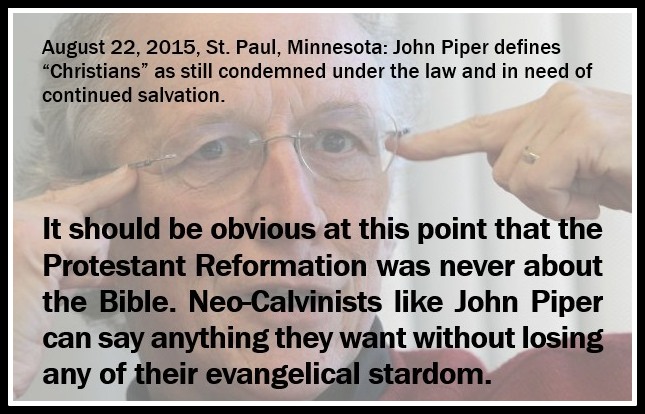
Let’s talk about one example, the one that prompted this post. On August 22, 2015, John Piper prayed at a Christian anti-abortion rally at a Planned Parenthood location in St. Paul, Minnesota. In that prayer, he stated:
And we acknowledge in the face of your holiness and power that we are sinners. Everyone standing here in this gathering is a sinner in desperate need of salvation that you offer in Jesus Christ. We know that our conscience condemns us, and if our own consciences do, how much more your holy law. So we have not lived up even to our own standards, let alone to your standards. And we confess our sins corporately before you as individuals.
In direct conflict to the Bible’s clear definition of a believer, Piper proclaimed everyone at the gathering as condemned under the law; this is the Bible’s succinct definition of a lost person. In addition, Piper clearly proclaimed in the prayer that Christians are still in need of salvation.
How does he get away with this and stand as one of the most beloved evangelicals of our day? Because he supposedly has authority, and we the believers have no real ability to perceive truth. Clearly, if it comes down to what we understand our Bibles to say versus what John Piper says, he will win the day every time.
So then, for all practical purposes, he speaks for God.
paul
The Protestant Twisting of 1John: A Clarification, Part 5 – Law, Gospel, and Love
 Originally posted April 27, 2015
Listen to show audio or download audio file.
Welcome to Blogtalk Radio False Reformation this is your host Paul M. Dohse Sr. Tonight, part 5 of “The Protestant Twisting of 1John: A Clarification.” If you would like to add to our lesson or ask a question, call (347) 855-8317. Remember to turn your PC volume down to prevent feedback. Per the usual, we will check in with Susan towards the end of the show and listen to her perspective.
If you would like to comment on our subject tonight, you can also email me at paul@ttanc.com. That’s Tom, Tony, Alice, Nancy, cat, paul@ttanc.com. I have my email monitor right here and can add your thoughts to the lesson without need for you to call in.
This is our final segment on 1John, and next week we will be doing a book review on “How People Change” by Paul David Tripp. I will be doing an overview of each of the 16 chapters in the book according to the theses of each chapter, and then will explain how the different points of each chapter fit together to form a particular doctrine. All in all, the book represents a pretty impressive application of Reformed mysticism.
Then, the following week, starting on May 8th, I think the time has come to do an in-depth evaluation of the Heidelberg Disputation. Martin Luther’s 95 Theses launched the Reformation, but all Reformed doctrines flow from the Heidelberg Disputation. Though very subtle, our present church culture is saturated with a collectivist doctrine of death, and I want to show exactly where this culture of death came from. We will be evaluating the Heidelberg Disputation theses by theses. How many Baptists know anything about the Heidelberg Disputation? Few, if any, yet the foundation of evangelicalism flows from this document.
Last week, I got away from our Gnostic theme and showed a correlation between John’s theology and that of the apostle Paul. The focus was the new birth, which Gnosticism denies. The historical backdrop is John’s pushback against Gnosticism which denies that people change. The Gnostics of that day believed that the material realm is evil and the spiritual realm is pure.
The goal is well-being that comes from getting beyond the five senses in order to gain knowledge. The particular vein of Gnosticism that John was contending against believed that sin only occurs in the body, and man’s spirit has never sinned per se. As a result, God’s people were being taught that what they did in the body was insignificant, and man didn’t need to deal with sin. Gaining spiritual knowledge for their own well-being was the key to having a happy life.
They denied that Christ really came as a man and was God’s Son. They taught that there were two Christ’s; one born of men and a Christ that was a spiritual avatar of sorts.
At any rate, the doctrine denied Christ’s deity, that He came to die for sin, and that mankind needed forgiveness for sin. Consequently, it also denied the new birth. In the same way Protestantism obviously denies that people change, redefine the new birth as an ability to perceive realm manifestation, and have their own unique distortion of the Trinity. When it gets right down to it, authentic Protestantism posits the Father and the Spirit as shadows of Christ.
Therefore, in chapter 3, John focuses on the new birth and why it changes us. But the dominate theme of the book, especially chapters 4 and 5, concentrates on love. Why is that? Because love in action should be the primary focus of Christians. Instead, what is the primary focus of Protestantism? Right; sin, sin, sin, sin, sin. Yes, our focus must be keeping our sins covered by the perfect righteousness of Jesus. Every song you sing, every sermon you hear is about how glorious Jesus is as set against our wretched vile selves. It boils down to praising our ability to see how rotten we are in the name of Jesus. (more…)
Why Al Mohler is a Heretic
 Originally published April 10, 2012
Listen friends, the gospel of progressive justification is a false gospel; it’s just that simple. I don’t care how educated Al is, how many followers he has, or anything else save the gospel he preaches. In the following video trailer from the 2011 Resolved Conference, Al Mohler states that the only purpose of the law in the life of a believer is to show us our ongoing need for salvation. Of course, he doesn’t word it that way. He states that believers have an ongoing need for Christ (which no Christian would refute), but note carefully: he is speaking in context of our initial salvation. So, instead of saying plainly that Christians need to be continually saved, or continually justified, he replaces that wording with “Christ.” However, again, the context is clearly salvation. He is saying that we need Christ in the same way that we needed Him for salvation.
Mohler is also saying that the law has the same relationship/purpose to unbelievers as it does believers: to show us our need for Christ. So, obviously, this is in contrast to any ability on the part of the believer to keep it. All the law can do is show NEED. Need for what? Well, what’s the context? Mohler also presents an either/or choice in regard to the law: it either shows us our need for Christ (again, what need specifically?), or we are using it to “rescue ourselves from sin.” Hmmm, what does it mean to “rescue ourselves from sin”? I believe Mohler deliberately uses the word “rescue” instead of “save” in order to add nuance to his point. “Rescue” is less direct, and could refer to a believer trying to overcome sin on his own. This is the same reason he replaces “salvation” with “Christ” in his prior point. It’s deliberate deception. Excluded is any mention that the law can be used by the believer to please God and glorify Him in all we do by “observing all that I have commanded.”
Mohler’s trailer starts at 1:35.
Election and the Real Golden Chain of Salvation: Part 2
 “Those who still need salvation have that need for a reason; they yet remain damned. Furthermore, they saturate themselves with a justification only perspective on the law which will magnify their damnation unless they repent.”
An item of particular interest in regard to the Reformed use of Romans 8:29,30 for the ordo salutis (order of salvation or the golden chain of individual salvation) is that sanctification is missing from the process. Sanctification is not in Romans 8:29,30. Let there be no doubt about it when the least common denominator is front and center: this issue concerns two different gospels. One gospel states that sanctification is not mentioned because it is the same thing as justification; the other gospel states that sanctification is missing because justification and sanctification are totally separate.
And obviously therefore, one states that salvation is a finished work while the other sees salvation as a process that the individual experiences and lives in while the process is ongoing. This is why Protestantism has ALWAYS been characterized by weak sanctification and lack of assurance. If justification and sanctification are the same thing, there is going to be an over emphasis on justification; if we are in the midst of the justification “process” and our salvation depends on whether or not God chose us to believe, and our individual election will not be verified until the “tribunal,” assurance will be lacking.
The Bible is clear. Assurance is based on two things: confidence in the FINISHED election process preordained by God, and the ability to work out the gifts given to us with our finished and final salvation being of no consideration in regard to our works of love. In other words, one of the purposes of election is to radically separate justification and sanctification leading to assurance and aggressive sanctification. The Reformed order of salvation uses election to fuse justification and sanctification together resulting in that train wreck we call “Protestantism.”
This is why I think Romans 8:29,30 is in the past tense; it concerns justification ONLY as a finished work. Yet, the Reformed use it to make a case for a salvation that is yet future; in other words, the Reformed throw out grammatical considerations regardless of whether it is in the English, Hebrew, or Greek. While they claim deep knowledge of the languages are efficacious to valid understanding of the Scriptures, they rape and ravage normative grammatical rules unfettered. While using knowledge of the languages to intimidate the great unwashed, they say, “good grammar makes bad theology” as if there are no rules of grammar in the Greek and Hebrew. But there are, and the rules are fairly consistent in all languages. Knowledge of Greek and Hebrew is oversold for purposes of control. More relevant than anything is a good working knowledge of grammar.
Romans 8:29,30 speaks of a group, or classification of people who were pre-loved, predestined, called, justified, and glorified. However, not all who are called within the group answer the call, but rather reject it. Those who accept the invitation of the calling are part of the elect group. In the same way, Israel was elected, but not all Israelites accept the invitation. Therefore, God also preordained the Gentiles for salvation in order to make the Jews jealous. In part one, I cite Matthew 22:1-14 to make this case in regard to the “called”, and would also like to add Romans 11. The “remnant” can also be considered an elect group as well, and any Jew can be saved by becoming a part of it IF they believe individually (Romans 11:23).
Throughout the Bible, people are called to believe and are warned that they will be judged if they don’t. The means of salvation being elected rather than individuals, and those individuals being called on to become part of the elect group excludes the need to relegate the gospel to paradox. God is not a God of confusion. If the “called” are not distinguished from the definition of “elect,” the Bible becomes utterly confusing. Nevertheless, Matthew 22:1-14 seems to end the argument altogether; many are called but few are elect. The elect are the ones who accept the invitation to the wedding feast.
Admittedly, this is a working hypothesis for consideration among the laity, but the following is certain: the Protestant gospel of a progressive order of salvation must be rejected with extreme prejudice for many, many definitive reasons. And Biblicism knows the following concretely in regard to its alternative gospel: justification is a finished work by God alone and the saint is free to love aggressively without fear of condemnation. We leave the cross and move on to maturity in love. Those who still need salvation have that need for a reason; they yet remain damned. Furthermore, they saturate themselves with a justification only perspective on the law which will magnify their damnation unless they repent.
At any rate, the idea that a group is elected for a certain purpose without all in the group being saved is far from being unbiblical, and Israel is the primary example (NASB):
Deuteronomy 7:6
“For you are a holy people to the LORD your God; the LORD your God has chosen you to be a people for His own possession out of all the peoples who are on the face of the earth.
Exodus 19:4-6
‘You yourselves have seen what I did to the Egyptians, and how I bore you on eagles’ wings, and brought you to Myself. ‘Now then, if you will indeed obey My voice and keep My covenant, then you shall be My own possession among all the peoples, for all the earth is Mine; and you shall be to Me a kingdom of priests and a holy nation.’ These are the words that you shall speak to the sons of Israel.”
Psalms 135:4
For the LORD has chosen Jacob for Himself, Israel for His own possession.
Isaiah 41:8-9
“But you, Israel, My servant, Jacob whom I have chosen, Descendant of Abraham My friend, You whom I have taken from the ends of the earth, And called from its remotest parts And said to you, ‘You are My servant, I have chosen you and not rejected you.
Isaiah 43:10
“You are My witnesses,” declares the LORD, “And My servant whom I have chosen, So that you may know and believe Me And understand that I am He Before Me there was no God formed, And there will be none after Me.
Isaiah 44:1-2
“But now listen, O Jacob, My servant, And Israel, whom I have chosen: Thus says the LORD who made you And formed you from the womb, who will help you, ‘Do not fear, O Jacob My servant; And you Jeshurun whom I have chosen.
Isaiah 45:4
“For the sake of Jacob My servant, And Israel My chosen one, I have also called you by your name; I have given you a title of honor Though you have not known Me.
Amos 3:2
“You only have I chosen among all the families of the earth; Therefore I will punish you for all your iniquities.”
In Romans 11:2, the apostle Paul even writes that God “foreknew” Israel. This is the election and foreknowledge of a group of which all are not saved. God calls all of those belonging to the group, but many within the group reject the call. Again, note Matthew 22:1-14. If they answer the call, they are elect because they are part of the group that was elected. It is plain that election is not defined by individual pre-selection alone, and in fact, specific verses that seem to indicate the election of individuals are not only rare, but ambiguous at best while the former are ample and concise.
Let me throw a couple of thoughts in here that would be prompted by reading almost anywhere throughout the New Testament. First, if individuals are pre-selected, the Scriptures pass on the opportunity to make that clear over and over again. For example:
Luke 16:27 – And he said, ‘Then I beg you, father, to send him to my father’s house— 28 for I have five brothers—so that he may warn them, lest they also come into this place of torment.’ 29 But Abraham said, ‘They have Moses and the Prophets; let them hear them.’ 30 And he said, ‘No,father Abraham, but if someone goes to them from the dead, they will repent.’ 31 He said to him, ‘If they do not hear Moses and the Prophets, neither will they be convinced if someone should rise from the dead.’”
If the issue is pre-selection, why wouldn’t Abraham merely say so? Why is the source of information that would persuade the rich man’s brothers the issue rather than God’s choosing? Individual pre-determinism makes the Bible an illogical convoluted mess, not to mention a god that is playing head games with mankind.
Secondly, if there is no future purpose for Israel, or the “church” has taken Israel’s place, which is an idea firmly embedded in Reformed tradition via amillennialism and supersessionism, does that not deny a true link in the election chain? Does it not make some aspects of election temporary? Why not? In part 1 we discussed John Calvin’s interpretation of the “called” as those who are temporarily chosen and therefore relegated to a greater damnation in the end.
So, what is the true golden chain of salvation? We begin to explore that in part 3.
paul
Also recommended: Live: Friday 9/17/2015 @ 7pm. Call in and join the conversation!

 Paul's Passing Thoughts
leave a comment