The Good News About God
 God is good news. This is perhaps the simplest distinction between Biblicism and Protestantism; Biblicists believe that the gospel, or the good news about God is good news to everyone. It believes that the offer of salvation is a valid offer. It believes that the gift is offered to everyone. This speaks to the pejorative claim that Biblicists are unreasonable wooden literalists; indeed, we believe that words mean things. We believe that “news” informs someone of something that they didn’t know previously, and that God is a good reporter tending towards full disclosure; it isn’t good news to some and bad news to others. How is predetermined eternal suffering for the glory of God good news? How can a promise be a promise to you if you have no way of knowing if the promise is actually for you or not? Biblicists assume different word choices from a God that is not a God of confusion. Biblicists believe words mean things; Protestants don’t, and even say so in no uncertain terms! (Note Rick Holland’s heading on page 39 of Uneclipsing The Son: “When Bad Grammar Makes Good Theology”).
In these sessions, the term “Protestant” refers to the authentic doctrine of the Protestant Reformation. The fact that many have strayed from the original article is noted, but what Protestant gives a waiver to a Buddhist that doesn’t believe everything Buddha believed? It’s still Buddhism.
Consider an apple tree. Apple trees do not produce peaches. However, nor are the branches or the fruit exactly the same. The branches differ, and the apples vary in size and color, but it is still an apple tree. Biblicism is an altogether different tree.
Before we examine the Biblicist gospel, let me take you to the book of Genesis to illustrate the aforementioned elements of Biblicism.
Genesis 1:1 – In the beginning, God created the heavens and the earth. 2 The earth was without form and void, and darkness was over the face of the deep. And the Spirit of God was hovering over the face of the waters.
3 And God said, “Let there be light,” and there was light. 4 And God saw that the light was good. And God separated the light from the darkness. 5 God called the light Day, and the darkness he called Night. And there was evening and there was morning, the first day.
All kinds of hay is made with these opening statements from God’s word; if this creation account is really about the gospel, or symbolic of it, then outrageous presuppositions can be assimilated into the thinking of people without plainly stating the thesis. If you believe that the creation account is about the gospel, you also concede that God preordained the fall of man, created evil (darkness), and goodness, (light). And in fact, as I think will be ascertained from Susan’s sessions, this very belief, that God created evil and preordained the fall of man for his own glory, is very much a part of Protestant tradition.
There is no doubt that many of the biblical authors used the creation account for metaphors, but that does not speak to the primary purpose or point of the passage. The idea that this creation account is about the gospel is an assumption, and Biblicism chooses conclusions that are plainly stated over assumption in all cases. This is an account of the “first day” of creation and how God brought that about. The rightness of this epistemology can also be seen in the same passage:
God called the light Day, and the darkness he called Night.
Hence, from the very beginning, we see that reality is defined by what it is called through using words. If the meaning and science of words are not concrete, reality cannot be known. If this is a metaphysical statement concerning the gospel and good and evil, why wouldn’t God simply state that accordingly?
As far as words interpreting reality, God involved Adam in the process:
Genesis 2:19 – Now out of the ground the Lord God had formed every beast of the field and every bird of the heavens and brought them to the man to see what he would call them. And whatever the man called every living creature, that was its name.
Don’t misunderstand, things don’t cease to exist because they are not named, but there is no way to define existence without words, at least not in our reality, and therefore, the unnamed thing has no meaning. Remember also that people can be manipulated into doing absolutely anything if they are convinced by others that certain words mean certain things.
The definitions of words define reality in the minds of people. Those who control the definitions control what and how people think, and thus control their actions as well. Some call this “propaganda.”
Symbolism is the most often-used communication technique to convince people that certain words mean things they don’t mean. This is very subtle and effective; if creation represents the gospel, then obviously God anticipated the fall of man because it was part of His intended will for mankind.
But mankind did fall, and the recorded account in Genesis gives us insight into the nature of God, the nature of man, the nature of Sin, the gospel, evangelism, and the Caste religion.
This shouldn’t surprise us, but the serpent approached Eve with a religion. Well, really, THE religion. If this approach worked, and it did, why would there be a deviation from the original article? Sure, applications will differ, but the basic principles remain the same; it’s a tree of kind. What is it?
Genesis 3:1 – Now the serpent was more crafty than any other beast of the field that the Lord God had made.
He said to the woman, “Did God actually say, ‘You shall not eat of any tree in the garden’?” 2 And the woman said to the serpent, “We may eat of the fruit of the trees in the garden, 3 but God said, ‘You shall not eat of the fruit of the tree that is in the midst of the garden, neither shall you touch it, lest you die.’” 4 But the serpent said to the woman, “You will not surely die. 5 For God knows that when you eat of it your eyes will be opened, and you will be like God, knowing good and evil.” 6 So when the woman saw that the tree was good for food, and that it was a delight to the eyes, and that the tree was to be desired to make one wise, she took of its fruit and ate, and she also gave some to her husband who was with her, and he ate. 7 Then the eyes of both were opened, and they knew that they were naked. And they sewed fig leaves together and made themselves loincloths.
Let’s focus on the obvious here. The Religion has four basic principles, and the second point is less obvious, but valid: for the most part, ALL religious and political ideologies flow from this religion. Mankind was absolutely hell-bent on functioning by this premise until the Enlightenment Era. Here are the four basic principles of the Caste religion:
1. There is spiritual knowledge that is separate from material knowledge; the knowledge of good and evil.
2. Mankind is unable to comprehend the spiritual; he is enslaved to the material world.
3. Mediators are needed between God and man to understand the spiritual knowledge and apply it to the material realm for the overall well-being of mankind.
4. These mediators are divinely gifted by God and preordained.
The first three points can clearly be seen in Genesis 3:1ff. “Hey Eve, there is a whole body of wisdom that God is keeping from you, and you need me to mediate that wisdom between you and God because I am superior to you and therefore qualified to do so.”
Notice the communication techniques used by the serpent to deceive Eve: he changed the definition of words; “No, no, Eve, you misunderstand what God said, he didn’t mean that you will literally die.” And she ate, and guess what? She didn’t drop dead. The serpent changed the definition of the word, “death” as God meant it in that context, and nothing has ever changed accordingly. When we allow mediators between ourselves and God, we are trusting them to define words for us because we supposedly can’t understand God. Take note: when men speak of “subordinate truth,” this is set against the superior truth that only they and God understand, and we call that “orthodoxy.” When Biblicists are criticized for thinking we do not need creeds and confessions, that ought to make cold chills run up our spine. Creeds, confessions, and counsels are nothing more than mediators penning bedtime stories for the great unwashed who are childlike in their ability to understand realty. Consider this illustration once again:

What is this? Right, the knowledge of good and evil. Right? Let me show you something else:
Our wisdom, insofar as it ought to be deemed true and solid wisdom, consists almost entirely of two parts: the knowledge of God and ourselves.
That’s the very first sentence of the Calvin Institutes. If only God is good, and mankind is totally depraved, how is this not the knowledge of good and evil as the premiere epistemology of all metaphysics? It’s the knowledge of good and evil mediated by those preordained by God for the well-being of society at large. This religion brought death in the garden, and created elitist caste systems that dictate life from the family unit to offices of governors and kings.
We saw it in high school, and we even see it in the Republican primary. The elitist party hacks are beside themselves that the great unwashed are being duped by Donald Trump, but instead of asking “why?” and looking in the mirror, it is chalked up to the total depravity of the masses. Therefore, the party elitists must neutralize Trump in order to save the great unwashed masses from themselves. Though Trump continues to lead the pack in the polls by double digits, he is summarily dismissed by political pundits. One cannot by any means separate this from an elitist mentality that dismisses the discernment of the voters.
SIN: THE BIBLICAL DEFINITION
Something else can be learned here about the nature of sin. What is the biblical definition of sin? It is defined as a master, or slave master. Sin is defined as a separate entity that seeks to enslave.
Genesis 4:5 – So Cain was very angry, and his face fell. 6 The Lord said to Cain, “Why are you angry, and why has your face fallen? 7 If you do well, will you not be accepted? And if you do not do well, sin is crouching at the door. Its desire is for you, but you must rule over it.”
In what can be considered the first detailed account of a gospel presentation and that by God Himself, sin is identified as something that has desire, and that desire is to rule over others. God tells Cain that he must instead rule over sin. We also find that sin makes its appeal through desire:
Genesis 3:6 – So when the woman saw that the tree was good for food, and that it was a delight to the eyes, and that the tree was to be desired to make one wise, she took of its fruit and ate, and she also gave some to her husband who was with her, and he ate.
James 1:13 – Let no one say when he is tempted, “I am being tempted by God,” for God cannot be tempted with evil, and he himself tempts no one. 14 But each person is tempted when he is lured and enticed by his own desire. 15 Then desire when it has conceived gives birth to sin, and sin when it is fully grown brings forth death.
This is a fundamental definition of sin that is an important building block for additional understanding: it is a slave master that desires to rule over others and makes its appeal through desires, or “sinful desires.” The results of sin are types of death experienced throughout life leading to ultimate death. Sin is also empowered by its ability to condemn:
1Corinthians 15:56 – The sting of death is sin, and the power of sin is the law. 57 But thanks be to God, who gives us the victory through our Lord Jesus Christ.
When we get into the subject of law/gospel in part 3 of this session, the correlation between law and condemnation will be explained, but for now, the main point is that sin is empowered by its ability to condemn. It’s a master who desires to rule over people and bring many faceted deaths into their lives, and makes its appeal through the desires of others. It is empowered by the condemnation that results. In one way, sin rules over people by paralyzing them with guilt and fear.
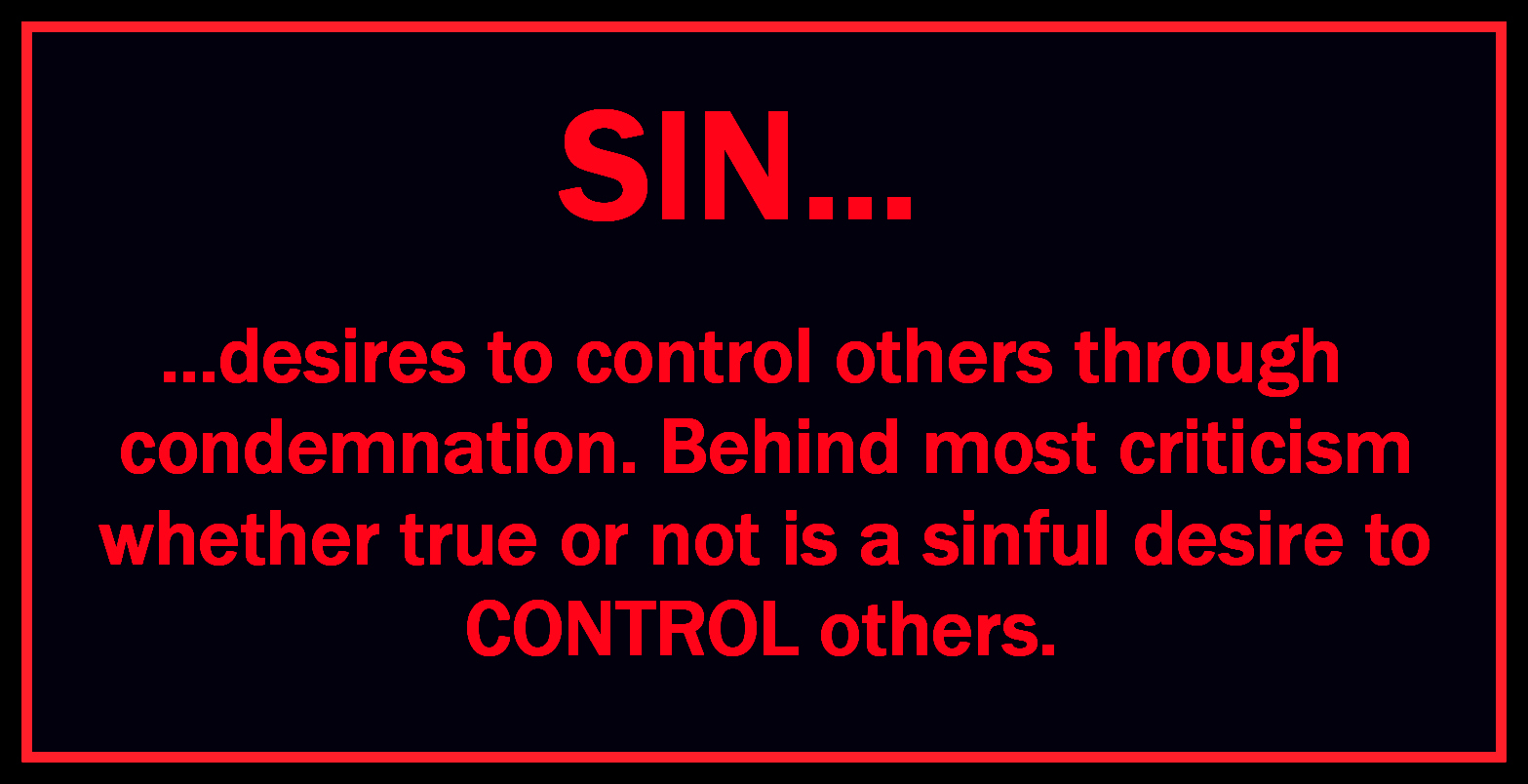
We see this in the garden. After Adam and Eve sin, they hide from God because they are afraid of God’s condemnation.
Genesis 3:9 – But the Lord God called to the man and said to him, “Where are you?” 10 And he said, “I heard the sound of you in the garden, and I was afraid, because I was naked, and I hid myself.” 11 He said, “Who told you that you were naked? Have you eaten of the tree of which I commanded you not to eat?”
Sin and fear of condemnation go together. This also speaks to evangelism and free will. Protestants love to make much of “No man seeks after God” (Rom 3:11). But this is not because man is totally depraved and has no inkling towards God whatever. Man does not seek God because he fears condemnation. Obviously, when Adam and Eve sinned, they did not immediately seek out God for a solution. Instead, they hid from God because they were afraid of His condemnation. This is why man does not seek God, he is afraid—not because he is totally depraved.
In addition, we see the essence of evangelism from the very beginning: God seeks out man with the remedy for sin. Just because God is the one who is proactive does not mean man has no ability to make a choice when confronted by God. Adam and Eve had no ability to come up with a plan that would fix the fall. Obviously, God is the only one who could remedy the problem. Man’s inability is in regard to proposing a plan of reconciliation with God, not an inability to accept the gift of salvation through a plan devised by God when offered.
Blog TalkRadio Podcast, Session 2: Challenging Doctrinal Presuppositions of Orthodoxy
Protestantism: The Loveless Religion
Faith works; why? Because it’s alive…
Even so faith, if it has no works, is dead, being by itself.
And the work of faith is love…
For in Christ Jesus neither circumcision nor uncircumcision counts for anything, but only faith working through love.
The dominate religion of our day, though it appears in many different forms and versions, is antinomianism. This is a religion that has an aversion to law which guides love…
If you love me, keep my commandments.
For the whole law is fulfilled in one word: “You shall love your neighbor as yourself.”
Love does no wrong to a neighbor; therefore love is the fulfilling of the law.
Because of the religion of antinomianism, love and the heart grows cold…
And because lawlessness [anomia] will be increased, the love of many will grow cold.
their heart is unfeeling like fat, but I delight in your law.
Protestantism is predicated on womb to the tomb substitution. Christ is not only a substitution for the penalty of sin, but must also be a substitution for our works. In other words, His loving works (plural) must be continually imputed to us.
Of course, this is illogical when set against the fact that our works will be evaluated…
His master said to him, ‘Well done, good and faithful servant. You have been faithful over a little; I will set you over much. Enter into the joy of your master.’
For all of us must appear before the judgment seat of the Messiah, so that each of us may receive what he deserves for what he has done in his body, whether good or worthless.
For God is not unjust. He will not forget how hard you have worked for him and how you have shown your love to him by caring for other believers, as you still do.
He said also to the man who had invited him, “When you give a dinner or a banquet, do not invite your friends or your brothers or your relatives or rich neighbors, lest they also invite you in return and you be repaid. But when you give a feast, invite the poor, the crippled, the lame, the blind, and you will be blessed, because they cannot repay you. For you will be repaid at the resurrection of the just.”
Every religion on earth can lay claim to some sort of good works, but when faith is separated from good works like a body is separated from the spirit, it is impossible for that religion to be earmarked by love. It is a dead body that looks good for a dead body—a body prepared for an open casket viewing.
It is a body of faithless, loveless, dead works. That’s Protestantism despite how well the dead body is adorned with spiritual sounding orthodoxy and dead works.
paul
Progressive Justification Orthodoxy Runs Long and Deep Among Those Who Call Themselves “Protestants”

It will only be a matter of time before I get “unfriended” again. (sigh)
Andy
What Your Sanctification Says About Your Justification: Is Your Gospel True or False?
 Originally posted February 27, 2015
“The law is the standard for love, not justification. In all of the aforementioned systems of sanctified justification by works, faith doesn’t work because it can’t lest salvation be lost. In the Christian life faith works because it can for the sake of love without condemnation.”
“Knowing that justification is a settled issue that has nothing to do with the law anyway, the true Christian only sees law-keeping as an opportunity to love. Christians not only have the anthropologic law of conscience written on the heart, the new birth writes the Bible there as well. In other words, we love the law.”
“Obviously, those who must focus on faith alone works in order to remain justified cannot focus on aggressive obedience to the law that defines love.”
What do you believe about salvation? Your Christian life will tell you. Therefore, the parable of the talents in Matthew 25:14-30 should not confuse us. The “wicked” servant was not cast into outer darkness because he didn’t put his talents to work, but rather what he thought it meant to be a servant. In other words, in order to be saved, you need to know what a Christian is. That should be fairly evident.
Do you live your Christian life by “faith alone”? That is a statement in regard to what you believe about salvation, or what happened to justify you, viz, justification.
This is not complicated. Don’t complain that I am making your touchy-feely “simple” gospel a theological treatise. I am sure you concur that some Bible words have to be understood in order to be saved. The Bible splits humanity into two categories: saved and unsaved, i.e., “under law” or “under grace” (Romans 6:14).
“Under law” is the biblical nomenclature for the unregenerate lost. Under law means that sin rules you. Not in a plenary sense, because man’s conscience and fear of punishment from civilian law restrains people. Yet, they are under the condemnation of God’s law and every violation is documented. Unless they are saved, they will be judged according to their works in the final judgment. Though some who followed their conscience more than others will receive a lesser condemnation, it is still eternal separation from God. They are under law, and enslaved to sin. The last judgment DOES NOT determine justification; it ONLY determines the degree of eternal condemnation. It doesn’t determine justification; it only determines the wages of sin.
Moreover, sin uses the condemnation of the law to provoke people to sin. Primarily, sin uses desires to tempt people, but sin’s incentive is the law because it condemns. Sin lives for the purpose of condemning people, and uses desire to get people to sin against God’s law. This leads to present and eternal death. Sin’s desire is to bring death. When the Bible speaks of “the desires of the flesh” it is referring to instances when the flesh is serving the desires of sin.
The flesh can also be used to serve the desires of the Spirit (Romans 12:1). The flesh has NO desires; it is used by the dweller for good or evil purposes. We will either use our bodies to serve the desires of sin or the desires of the Spirit. Of course, people have their own desires, but unfortunately, the unregenerate are guided by the desires of sin. They assume sinful desires are their own desire which is true. In contrast, sinful desires are not part and parcel with the regenerate soul.
Said another way: among the lost, the desires of sin are very much the same desires possessed by the individual who are indifferent to the law of God. A desire for God’s law is absent while their life is continually building a death and condemnation dividend. Some of that dividend is paid in this life until the full wages of death are paid at the final judgment.
Under grace is not void of law. The law (same as “Scripture” or same as “Bible”) has a different relationship to the saved, or those under grace. A literal baptism of the Holy Spirit takes place, as symbolized in water baptism, which puts to death the old person under law and resurrects the new person under grace. The saved person is now a new creature created by the Spirit of God. The person under grace is literally born of God—he/she is God’s literal offspring.
Therefore, the old person is no longer under the condemnation of the law in the same way a dead person cannot be brought under indictment for a crime. Consequently, the motivation for sin is gone. The power of sin is the law’s condemnation that leads to death (1Corintians 15:56, 57). In addition, the person under grace has been given a new heart that loves God’s law and its way of life. The book that could only bring death is now a book that brings life. Either way, it is the Spirit’s law; He uses it to condemn those that are under it, or uses it to sanctify those who are under grace (John 17:17).
THEREFORE, how you see the law determines what you believe about salvation. If you believe that you can somehow obey the law in a way that unwittingly seeks to be justified by law-keeping, you are still under law. If you believe justification is defined by perfect law-keeping, you are still under law. Those who believe this also believe they need a salvation system that filters all their works into a category of faith alone. The Christian life is categorized or departmentalized into works that attempt to be counted for justification and faith alone works that qualify as “living by faith alone.” Do not miss the point that this also includes abstaining from certain things that aren’t necessarily sin as defined by the Bible.
Yes, hypothetically, a person would need to keep the law perfectly to be justified by the law, but that doesn’t make perfect law-keeping the standard for righteousness. If that were the case, the law is a co-life-giver with the Holy Spirit, and a death would not be necessary. We are justified APART from the law—law has NO part in justification. The Bible defines justification, but it’s not a standard of justification (Rom 3:21, Gal 2:19, 4:21). Law-keeping by anyone does not justify.
If one is trusting in a system that fulfills the law for justification, particularly if it calls for not doing something in order that the law is fulfilled in our place, that is works salvation through some kind of intentionality whether passive or active. These kinds of systems are always indicative of being under law rather than under grace. One such system that has several variances calls for doing certain things or not doing certain things on the Sabbath which can be Saturday or Sunday depending on the stripe of system. If you follow the system on the Sabbath, all works done by you during the week are considered to be by faith alone.
In Reformed theology, particularly authentic Calvinism, contemplation on your sin leading to a return to the same gospel that saved you imputes the perfect law-keeping of Christ to your life. Notice that a fulfillment of the law is required to keep you saved, but we do faith alone works in order that Christ’s perfect law-keeping is imputed to our account. The problem here is that a fulfillment of the so-called “righteous demands of the law” is the standard for justification. Hence, clearly, this keeps so-called “Christians” UNDER LAW. In addition, a so-called faith alone work is still a work.
Not so with under grace. We are now free to follow our new desire to obey the law out of love without fear of condemnation. The law is the standard for love, not justification. In all of the aforementioned systems of sanctified justification by works, faith doesn’t work (or love) because it can’t lest salvation be lost. In the Christian life (sanctification) faith works because it can for the sake of love without condemnation (Galatians 5:6).
Knowing that justification is a settled issue that has nothing to do with the law anyway, the true Christian only sees law-keeping as an opportunity to love. Christians not only have the anthropologic law of conscience written on the heart, the new birth writes the Bible there as well. In other words, they love the law. Obviously, those who must focus on faith alone works in order to remain justified cannot focus on aggressive obedience to the law that defines love.
This is exactly what the books of James and 1John are about. Faith is not afraid to work because there is no condemnation. Faith without works is dead, “being alone” (James 2:17 KJV).
Are you in a religious system that propagates faith “alone” in the Christian life? Your faith is not only dead, it speaks to what you believe about justification. You believe justification has a progressive aspect and is not completely finished. Secondly, you believe the law has a stake in justification. Thirdly, your system categorizes works as faith alone works (an oxymoron of sorts) or works that are unfiltered in some way and therefore are efforts to “self-justify.”
If you believe the right gospel, you know that it is impossible to unwittingly partake in an endeavor to justify yourself. It’s a metaphysical impossibility—it’s not in the realm of reality. No false religion teaches that you earn your justification by perfect law-keeping—there is always a system that prescribes sanctified do’s and don’ts that in turn fulfill the law for you, otherwise known as “the traditions of men.”
It’s the fallacy of faith alone works for justification. But any work for justification is justification by works whether doing nothing (abstinence is still doing something), something passive (contemplationism or prayer is also a work) or anything active.
Law and justification are mutually exclusive, and true faith is “faith working through love” (Galatians 5:6). Faith works because there is no fear in love (1John 4:18). Don’t be like the servant who was afraid and hid his talents in the ground. Christ said it best:
“If you love me, keep my commandments.”
paul

 Paul's Passing Thoughts
leave a comment