

What a Protestant Would Say to the Mentality Disabled Guy
 A close friend of mine shared something with me witnessed in a residential care facility that happened recently. My gig in the world of home health care (HHA) is not in the realm of mental health, but I enjoy hearing how our trade applies there.
At any rate, a lot of God-happenings occur in both realms. As readers here at PPT know, one reason among many that I chose this career is to facilitate a greater knowledge of Christian living (sanctification) which is devalued in Protestantism by design. Protestant orthodoxy dismisses the idea that Christians have a separate life that is Christ-like-in-kind because we have the same Father, and propagates the idea that we have NO life apart from Christ’s life. In other words, Protestantism redefines biblical new birth and is therefore a false gospel.
As the children of God exit the church and begin fellowshipping in a home setting; i.e., family-of-God setting, viz, “household of God” setting, we will see people actually being saved not the reshuffling of sheep within the denominational/institutional church. It’s all about Christ’s mandate to make disciples.
This is where the event shared with me is apt in furthering this point. As the friend walked through a mental health facility, one resident said to another: “You aren’t going to come over here where I am because you know I will kick your ass.” It is not uncommon for some mentality disabled persons to be aggressive in nature. According to my friend who witnessed the event, the other resident responded, “No, no, I prayed to God this morning that He would help me be perfect today. So, I am not paying you any mind; I am not going to get sucked into your sin.”
This event is barely less than a perfect opportunity to illustrate the difference between the Protestant false gospel of progressive justification and the true biblical gospel. The Protestant would show this precious soul a “better way” as follows:
No, no, God is not going to HELP you be perfect because it is impossible for any person to be perfect—saved or unsaved. But, in fact, you must be perfect in order to be accepted by God. You must be perfect to be justified. This is why Christ came to die: to pay the penalty for our sin. ALSO, He lived a PERFECT life according to the law so that your imperfect life could be substituted for His.
Therefore, you must presently live life by faith alone in what “Jesus has done, not anything you do.” You must be faithful to church and its sacraments, and other faith-alone-works that fulfill the law through what Jesus has done, not anything you do…except faith alone works. Whatever works Christ wills to do through you will then be manifested according to His will…Not yours.
At this point, we may imagine for illustration purposes that a truly born again believer joins the conversation. It might go something like this:
Excuse me, but I must object to what the Protestant has just told you. First of all, he has redefined the word “perfect” as defined by the Bible. In the Bible, “perfection” is not defined by flawless law-keeping, but rather means, “maturity.” It also pertains to those who are already justified/righteous/saved. So, you were actually praying to be something that you already are; you are already perfect. This is why the Bible calls believers “holy” in many places…because we are.
Let me show you a better way to pray—pray that God would help you to love Him with all that is in you and love others the same way as well. We obtain reward in this life and the life to come for doing so. Unfortunately, we also reap consequences for failing to love because we are “weak,” but not “wicked.” We do not remain as “sinners” which is the biblical definition for the unregenerate. This is where the Protestant has also redefined “sin.” He interprets the word “sin” from a single perspective. Sin is the same for the saved or the unsaved: it condemns according to the law’s “righteous demands.” In contrast, the believer has a willing spirit to love, but the flesh is “WEAK” not inherently sinful. This is why the believer can use their bodies for holy purposes or what the Bible calls living sacrifices acceptable to God.
Because the believer has been literally born again, he/she has died with Christ and is no longer judged by the law. There is now no condemnation for the believer. A continual imputation of Christ’s payment for sin and good works are not needed for the believer because there is no law to judge him or her. Christ died to end the law and its condemnation for all those who believe.
The believer is also resurrected to new life with Christ, and this results in a different relationship to the law. Instead of being under its condemnation and therefore needing the continual imputation of Christ’s death and obedience to the law via “the means of grace” according to Protestant orthodoxy, the law is now something the believer is endeared to for purposes of wisdom in loving others. What was previously used by the Spirit to condemn is now used (in cooperation with the believer) to mature or perfect the believer in love.
Your goal is not perfection according to the law; your goal is maturing in love. You are under grace NOT under law and a perpetual imputation of Christ’s love in substitution for your obedient love is not only unneeded—it is a FALSE gospel that denies the new birth. Protestants remain as “sinners” yet under law and therefore need to continually return to the cross for “double imputation.”
One does well in asking God for perfection according to mature love, but not a love that is substituted for the fulfilment of a law that is ended.
We are under grace, not law. You don’t fear the law; you love the law. That doesn’t mean there is no law in grace it means that it is a law for love NOT condemnation.
paul
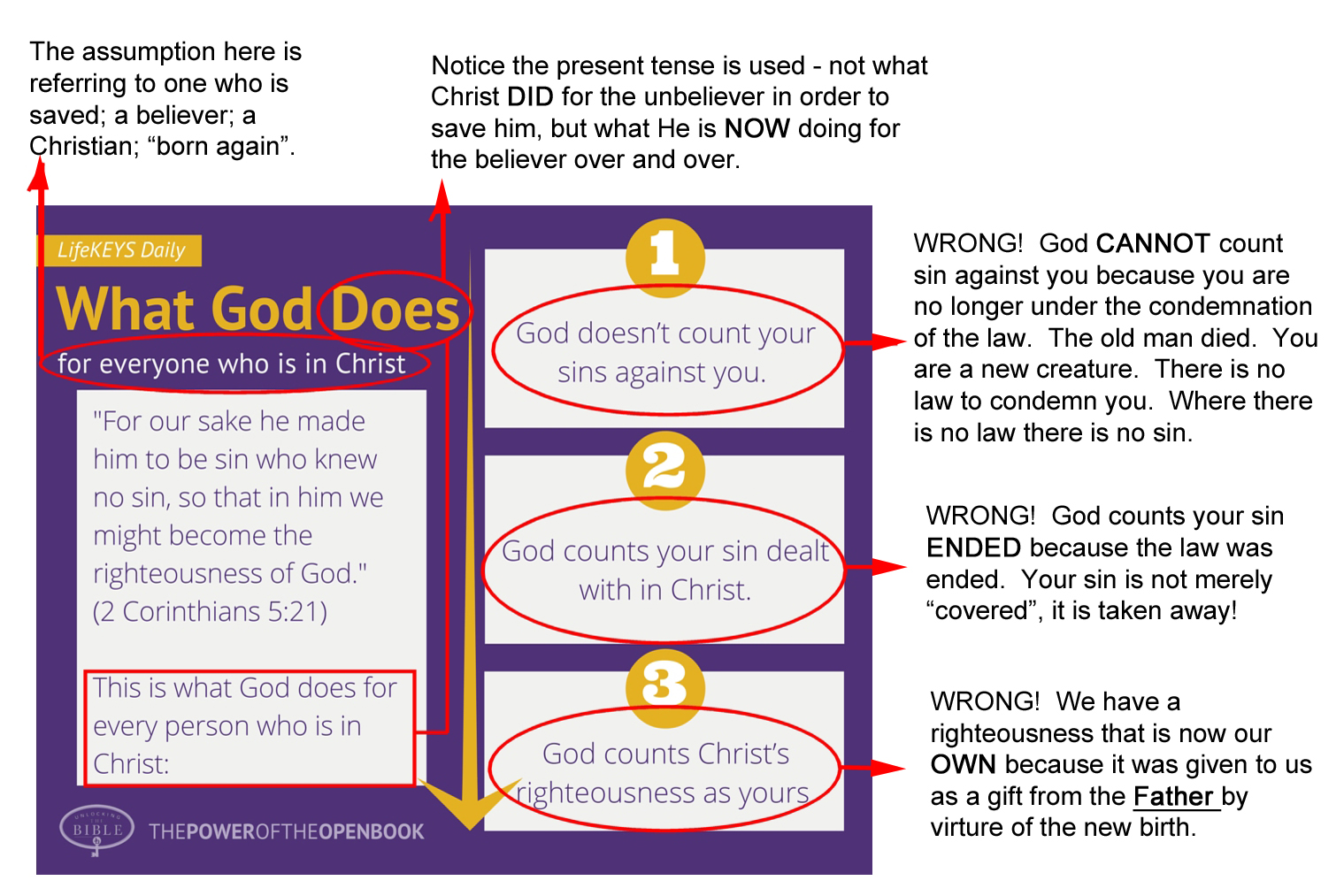
What God Does in Protestant Progressive Justification
Originally published May 31, 2015
There was a meme in my Facebook news feed that caught my eye this morning. I felt compelled to make some corrections to it. If you still don’t believe that Protestantism teaches progressive justification, think again.
Andy
Redemptive-Historical Hermeneutic – A Classic Example
Originally published March 4, 2015
 I came across an “interesting” blog article the other day. It appeared in my Facebook newsfeed because someone on my friend list commented on it when one of his friends shared it. Of course, since I am not friends with the one who originally shared it, I was unable to add my comment, thus the inspiration for this article today.
The title of the blog article in questions is, “If we sin, do we lose our salvation?” That mere fact that such a question is still posed in Christianity is indicative of just how biblically illiterate most Christians are. The fact that authors such as this one still address this question in the manner that he does is even more disturbing.
Before even addressing the issue of whether one can lose one’s salvation, the author begins his article by citing Jesus’ example of the two house builders found in Luke chapter 6. Let’s take a look at this passage ourselves before we move on.
47Whosoever cometh to me, and heareth my sayings, and doeth them, I will shew you to whom he is like: 48He is like a man which built an house, and digged deep, and laid the foundation on a rock: and when the flood arose, the stream beat vehemently upon that house, and could not shake it: for it was founded upon a rock. 49But he that heareth, and doeth not, is like a man that without a foundation built an house upon the earth; against which the stream did beat vehemently, and immediately it fell; and the ruin of that house was great.
Luke 6:47-49
Clearly, Jesus is using a metaphor, but to properly understand the metaphor we must ask ourselves, what is the context of this passage? It should be apparent that the context is a contrast between two kinds of individuals. One kind is an individual who hears AND does. The second kind is an individual who hears only. The parallel passage in Matthew 7 goes even further in marking this contrast.
24Therefore whosoever heareth these sayings of mine, and doeth them, I will liken him unto a wise man, which built his house upon a rock: 25And the rain descended, and the floods came, and the winds blew, and beat upon that house; and it fell not: for it was founded upon a rock. 26And every one that heareth these sayings of mine, and doeth them not, shall be likened unto a foolish man, which built his house upon the sand: 27And the rain descended, and the floods came, and the winds blew, and beat upon that house; and it fell: and great was the fall of it.
Matthew 7:24-27
The individual who hears AND does is considered wise. The one who hears only is considered foolish. Herein is the point of this whole passage: the emphasis on hearing AND doing, which is considered to be wise. But please notice what the blog author chooses as his focus:
“Building a house is very similar to one’s experience as either a Christian believer or an unsaved nonbeliever. That is why Jesus drew a comparison between the two (Luke 6:47-49). If you start out with a good foundation that is level and built on solid ground, you can confidently add on walls and flooring and a roof and every other component that makes up a house, and be certain that, because the foundation is sound, the house will be sound. But if you lay a poor foundation that is uneven and shaky, the rest of the house will follow and all the components that are built on that poor foundation will be compromised. To have a soundly constructed house, you must have a good foundation; to have a rock-solid Christian faith, you must build it on foundational truth.”
This is one of the most intellectually incompetent and dishonest uses of the two builders that I have ever seen! This example from scripture has nothing to do with “foundations”. It has everything to do with wisdom and sanctification. The author completely ignores the part about wisdom in both hearing and doing and instead engages in what I call “spiritualizing the analogy”, making it about justification instead. He has interpreted this passage in the so-called “proper gospel context”. This is what happens when you interpret scripture using a redemptive-historical hermeneutic. Spiritualizing the analogy makes a false application of a metaphor that was never intended. It is a logical fallacy. Let’s examine what I mean by this.
If I am given the logical premises that A=B and B=C, I can logically conclude that A=C. This is the logic of the example of the two house builders.
A = B Hearing and doing = a wise man
B = C A wise man = building on a rock (a good foundation)
therefore
A = C Hearing and doing = building on a rock (will make one strong; i.e. aggressive sanctification)
The same holds true for the foolish man.
A = B Hearing only = a foolish man
B = C A foolish man = building on sand (a poor foundation)
therefore
A = C Hearing only = building on sand (will make one weak; i.e. little or no sanctification)
A metaphor makes no sense in and of itself. It has no relevance outside of the initial truth that it represents. If Jesus had only said, “Make sure you build on a rock foundation and not a foundation of sand,” that would have made no sense whatsoever. But Jesus clearly stated that hearing and doing is wise, and He further emphasized that point by using the analogy of building on a rock. Notice also that a correct logical progression in thought results in the proper application of the conclusions. One can reasonably conclude that this not a salvation passage but rather a sanctification passage for believers.
That is the proper meaning and intention of this passage. Contrast that with what the author did in the article. He took the metaphor all by itself and made it say whatever he wanted it to say in order to make his case. And what is his case?
“If you believe that Jesus Christ died on the Cross to pay for your sins, and turn to God in repentance of your sins, then you will be saved… This does not mean that after this occurs, you will never sin again, or even that you will not commit the same sin repeatedly. It means that your heart has been changed toward sin so that you can now see it for what it is… Fortunately, for Paul and for you and for me, that question has a definitively glorious answer: ‘Thanks be to God, who delivers me through Jesus Christ our Lord!’”
Plain and simple, this is progressive justification. Notice it is an ongoing deliverance, not a onetime deliverance. So, then the question remains, what do we have to do to keep the deliverance going? Well, we repent, and that saves us, BUT we still sin. So what? Well, the “so what” is that we need perpetual saving by Jesus. This is what Paul David Tripp and Tim Keller and John Piper call a “daily rescue.” This is Luther’s theology of the cross, a perpetual mortification and vivification.
This is the very reason why the emphasis on the hearing AND doing is ignored. For us “to do” would be works, at least in this construct, if this were a passage on justification and not sanctification. We must live by “faith alone” and not build on the wrong “foundation.” We can only “experience” what it is to have the right foundation, because for us to try and work and build is building on the wrong foundation which is the reformed definition of the “unsaved”. But justification is a finished work. There is nothing we can do to add to it. Because it is finished, we can aggressively “do” the things we “hear” taught to us in the Word. Time and time again, the scriptures equate for us doing good with life and doing evil with death. Good = life = wise. Evil = death = foolish. When it comes right down to it, this really isn’t that hard to figure out.
Andy
Dear Reformed Brother, Was Jesus Righteous Before He Kept the Law?
Time and time again, this ministry has demonstrated that the reformed standard for justification is perfect law-keeping rather than the new birth. Here is a summary of the salient premises (what reformed theology must assume to be true to arrive at their conclusion). It goes something like this:
- Man is totally depraved.
- Because man is totally depraved, no one can keep the law perfectly.
- Because no one can keep the law perfectly, we need someone to keep the law on our behalf.
- Jesus is the only one who ever kept the law perfectly.
- Because Jesus kept the law perfectly, we must depend on Jesus to keep the law for us.
- God “declares” us righteous because Jesus’ obedience is imputed to us.
- When God looks at us He doesn’t “see” our sin, He only sees Christ (covering/atonement)
There might be a few more details one could add in there, but the conclusion is this:
The standard for righteousness is perfect law-keeping.
The list of problems with this line of reasoning is extensive, not the least of which is the fact that the Bible says righteousness is apart from the law. But when we keep thinking about the ramifications of the above assumptions, the conclusions are obvious. In this construct, a believer is only declared righteous as long as he keeps living by “faith alone”. So if at any time he ceases to live by “faith alone” he puts his justification at risk. This means he is never really “righteous” until he gets to the end of his life. And even then, his righteousness depends on the degree to which he lived by “faith alone”. In other words, no believer can ever really “know” if he is really righteous until all the facts come in. There would have to be sufficient “proof” that reveals that his justification is authentic.
But I want to camp on a notion that I doubt very few have ever stopped to consider. If the basis of righteousness is perfect law-keeping, then how is Jesus righteous? Would not He too be required to live a perfect life? Of course the protestant response to this is a resounding, yes. They openly declare that it was by His perfect law-keeping that Jesus was righteous. That is one of the assumptions listed above. But now consider this. How could a claim be made for Jesus’ righteousness until He had demonstrated perfect law-keeping His entire life? It is impossible to claim that Jesus was righteous before he ever demonstrated one good work. Ironically, the same standard that the reformed use for believers MUST also apply to the One who makes  justification possible according to their theology. And this just will not work because it makes Jesus’ own righteousness suspect (which the reformed conveniently do not allow for). You cannot reason something after-the-fact!
The Reformed gospel makes Jesus’ righteousness a function of works and not intrinsic to His nature. Jesus was not really righteous UNTIL He had demonstrated perfect law-keeping. Furthermore, such a conclusion of His righteousness could not have been realized UNTIL the end of His life.
Jesus is righteous by virtue of the fact that He is God’s Son. He has His own righteous nature because He was born of God, God’s offspring. He was not righteous because of His perfect law-keeping. It was intrinsic to who He is.
I can go to the NFL’s web store and order a jersey of my favorite football player, maybe Peyton Manning. When I receive that jersey in the mail I can now say I have Peyton Manning’s jersey, or I have the jersey of Peyton Manning. Does that mean that I have Peyton Manning’s ACTUAL jersey that he ACTUALLY wore when he played in games? Of course not. But it is still a jersey. It is similar (identical, like in kind) to Peyton Manning’s in every way with one exception; this one belongs to me.
Our righteousness is this way. Does this mean that we have the ACTUAL righteousness that Christ had? Only in the sense that it is IDENTICAL to it, the exception being is that the righteousness we have actually belongs to us! Why is that? Because it was given to us the moment we were born again. It is not a covering. It is intrinsic to the nature of our being as a child of God.
Whether reformed/protestants want to admit it or not, the fact remains that their construct of righteousness is works-based justification. It might not be “us” doing the works, but works are works no matter who does them. Not only is it works-based, it is progressive, meaning it must be performed throughout one’s life. This is why there is NO DIFFERENCE whatsoever between Catholicism and Protestantism. They both believe in a works-based progressive justification. Protestants have simply taken the “work” away from us and given it to Christ. And in the process, they have made Christ’s own righteousness predicated on works.
Andy

 Paul's Passing Thoughts
1 comment