Clarification From Galatians 3: The Trinity is Not a Paradox, Christians Don’t Live by Faith Alone, and the Covenant of Promise Defined
 “Again, it’s the same gospel with Jesus added as perfect law-keeper; it fuses law with gospel. That’s what the Judaizers did, and that’s what Protestant elders do…There is no law in perfection; there is only law in love.”
“All of true Israel will be saved. That’s the promise made to Abraham, and from that promise all the nations find their salvation as well. Any denial of a future redemption of national Israel according to its original identity is a plenary rejection of the gospel.”
“Do you believe a gospel that makes the New Covenant a fulfillment of the Old Covenant rather than an ending of it for those who believe? Have you substituted the fulfillment of the New Covenant via love for a substitutionary fulfillment of the covenant of death? This is what sets the covenant of promise apart from all other gospels. If you are a true Christian, you don’t live by faith alone, you live by love alone, and you are the one doing the loving because you are free from condemnation. Your love is not a substitution; Christ’s death is the only substitution that sets you free to love without fear of condemnation.”
Galatians chapter 3 corrects some significant misnomers that routinely plague those who have to listen to incessant Christian blathering coming from the same who are completely comfortable with contradictions. Faith has become a license for mindlessness, and paradox is now a legitimate hermeneutic.
Since the Bible says God is one person, and also three persons, and the Bible cannot contradict itself, gee whiz, that’s a paradox, and gee whiz, there must be other paradoxes in the Bible as well, and gee whiz, only our “leaders” (dictators) know what a paradox is or isn’t. So, another paradox is the idea that Christians do things by faith alone. We do stuff, but we are not really the ones doing it. “Christians” are very comfortable with this lingo: we didn’t do it, when clearly we did do it, but supposedly, Jesus really did it, lest we get credit for the deed even though Jesus does assign merit for good deeds, but to whom is unclear since we didn’t do it.
And of course, supposedly, people don’t buy into this nonsense because it’s nonsense, but are rather “totally depraved” and will accept the offer of salvation if it is really a promise made to them even though God tells us to tell them that the promise is to them though it may not be. And so it goes; we will pay someone 85,000 dollars a year with a hefty medical package to say things like, “You don’t keep the law by keeping the law.”1 Our job is to say “amen” in between sips of coffee served up from the large vat in the lobby. If the coffee has a little burn in the taste, we wonder, “Is this the day, or just another dry run?”
I am not going to get into the trinity debate, but rather, the point of this post is that the Bible isn’t making a statement about the trinity when it states that God is one. The biblical idea is a statement that makes it clear that there are no other mediators between God and man other than God Himself. Galatians chapter 3 makes this clear. Hence, Protestant popes love to keep the masses distracted with debates about paradoxes lest we figure out that God was drawing a contrast between Himself and them who will travel land, sea, and air to make someone three times the child of hell that they are. And of course, paid for by the Protestant peasantry enslaved to the material world and its knowledge. And of course, from that perspective, spiritual truth can be expected to appear as paradox. In fact, those who demand a logical exegesis of Scripture are deemed as lacking faith, and making Jesus a “precept rather than a person.” By the way, the idea of faith over logic/reason was a major clarion call of the Nazi party during its formative years and expressly Lutheran in origin.2
Galatians chapter 3 is a vivid clarification of the relationship between law and gospel—or better stated biblically, the relationship between law and promise which also excludes every kind of mediator other than God Himself. This is one of the major points of Galatians 3. Paul begins by stating the following in his epistle to the Galatians:
Galatians 3:1 – O foolish Galatians! Who has bewitched you? It was before your eyes that Jesus Christ was publicly portrayed as crucified. 2 Let me ask you only this: Did you receive the Spirit by works of the law or by hearing with faith? 3 Are you so foolish? Having begun by the Spirit, are you now being perfected by the flesh? 4 Did you suffer so many things in vain—if indeed it was in vain? 5 Does he who supplies the Spirit to you and works miracles among you do so by works of the law, or by hearing with faith—6 just as Abraham “believed God, and it was counted to him as righteousness”?
The dictators of the Protestant super-cult focus on the words, “Are you so foolish? Having begun by the Spirit, are you now being perfected by the flesh?” The case is therefore made that we must be perfected the same way we began. This is the Protestant false gospel of progressive justification in a nutshell. It begins with the idea that perfection, viz, justification, is a process. And next, we keep that process going by faith alone. And next, if we live by some sort of faith-alone formula, the same formula that originally saved us, the Holy Spirit will continue to keep us justified. In other words, we have to live by the same gospel that saved us in order to keep ourselves saved which is backdoor works salvation.
What is Paul really saying? His rhetorical question focuses on the erroneous idea that “perfection” (justification) is based on a process. The crux is any kind of process period, but in this case, the process involves the law of Moses. Protestantism uses this text to make the exact case that Paul is arguing against. Except, they add the law to the process in the same way that the Judaizers did albeit in a less direct way. Take note: the very false gospel that Paul is arguing against in Galatians 3 is the same gospel propagated by Protestantism in our day, and the exact same gospel that the Judaizers propagated with Jesus added. In this letter, Paul argues that law cannot be part of the gospel because that would make the law a co-mediator/life-giver with God, and only God can give life. The Judaizers taught that the law does give life, and that “believers” have to continue to draw life and justification from the law.3
But we must now stop and define what Paul meant by “law” in context of keeping it for justification. Judaizer-like false gospels never promote a truthful and perfect keeping of the law in order to remain justified because they know that’s impossible. So, the traditions of men are added as a Cliff Notes keeping of the law that fulfills the “righteous demands of the law.”4 Men are mediators between God and mankind that determine the sub-law that satisfies the holy law, and supposedly, they are appointed by God. Luther and Calvin merely added Jesus to this idea. If we obey the “Christ-centered,” “gospel-centered,” orthodoxy of Protestant elders, Jesus’ perfect obedience to the law of Moses will be imputed to our account, and we will remain “perfect” or justified. Again, it’s the same gospel with Jesus added as perfect law-keeper; it fuses law with gospel. That’s what the Judaizers did, and that’s what Protestant elders do.
Let’s nail this down a little more before we progress further. It entails an understanding of what Paul meant by the receiving of the Spirit. That’s the new birth. That’s the baptism of the Holy Spirit. That changes the believers relationship to the law. Paul’s protest regards the fusion of the law of Moses with perfection which takes place upon the receiving of the Spirit. Paul is protesting a progression or process of perfection by law-keeping. The Judaizers propagated a fulfilling of the law for righteousness via adherence to their traditions5 whereas Protestants demand an adherence to their traditions which supposedly results in Jesus’ perfect law keeping being imputed to the “believer.”
Paul said, in essence, “No, if you want to be justified (perfected) by the law of Moses (the law of sin and death), you have to keep it perfectly. No, circumcision and the observance of days is not a substitution for fulfillment of the law. The law has no part in justification, one is justified (perfected) by the new birth that is received by faith alone. The justified are not justified by the law—law-keeping is what they do, but it is not the law of sin and death for purposes of law-keeping, it is the law of the Spirit of life for purposes of love. There is no law in perfection; there is only law in love.” Hence…
Galatians 4:10 – You observe days and months and seasons and years! 11 I am afraid I may have labored over you in vain…21 Tell me, you who desire to be under the law, do you not listen to the law?…5:2 Look: I, Paul, say to you that if you accept circumcision, Christ will be of no advantage to you. 3 I testify again to every man who accepts circumcision that he is obligated to keep the whole law. 4 You are severed from Christ, you who would be justified by the law; you have fallen away from grace…6 For in Christ Jesus neither circumcision nor uncircumcision counts for anything, but only faith working through love.
In addition, the law being the standard for justification rather than the receiving of the Spirit always leads to a “relaxing of the law” (Matt 5:19). Why? Because some dumbing down of the law as a replacement for true law-keeping for love, or faith working through love, always leads to neglect of the law and true love accordingly. Hence…
Galatians 2:17 – But if, in our endeavor to be justified in Christ, we too were found to be sinners, is Christ then a servant of sin? Certainly not! 18 For if I rebuild what I tore down, I prove myself to be a transgressor. 19 For through the law I died to the law, so that I might live to God…5:7 You were running well. Who hindered you from obeying the truth? 8 This persuasion is not from him who calls you…13 For you were called to freedom, brothers. Only do not use your freedom as an opportunity for the flesh, but through love serve one another. 14 For the whole law is fulfilled in one word: “You shall love your neighbor as yourself.” 15 But if you bite and devour one another, watch out that you are not consumed by one another.
The fulfillment of Moses’ law, the law of sin and death (Romans 8:2), cannot be fulfilled for justification, but said false gospel (Gal 1:6ff.) attempts to do so through mediation in addition to God. This always leads to a dumbing down of the law for purposes of justification. The traditions of men end up being a cloak for unrighteousness under the auspices of being friends of the law. Tradition fulfills the law as a standard for righteousness when the real standard for righteousness is the new birth resulting in the loving of God’s law for purposes of loving God and others, not justification. Justification is a finished work totally apart from the law of sin and death; the only work left is “faith working through love.”
Sure, we don’t do that perfectly, but in regard to justification, so what? The motives of those born of God are love because part and parcel with the new birth is a love for the truth (2Thess 2:10). The law’s ability to condemn was ended by Christ (Rom 10:4) and where there is no law there is NO sin (Rom 4:15). If you now say: “So, the law is the Spirit’s law, and for those who are under law, He uses it to condemn them, but to those who have received Him, He uses it to lead them”; you rightly assess with an additional caveat…Moses’ law of sin and death, while being a ministry of death, still serves the same purpose for New Testament unbelievers as it did for Old Testament believers, that is, it holds sin captive until they believe in Christ, then their sins are ended along with the law that the old them was under, but one who is dead is no longer under the jurisdiction of law that can condemn6 (Romans 7:1-6). Those who receive the Spirit are now free to “serve another” (Rom 6:6). The “new life of the Spirit” enables us to fulfill the law in our acts of love (Rom 8:1-8). The apostle Paul develops these same ideas as we move along in Galatians 3.
Galatians 3:7 – Know then that it is those of faith who are the sons of Abraham. 8 And the Scripture, foreseeing that God would justify the Gentiles by faith, preached the gospel beforehand to Abraham, saying, “In you shall all the nations be blessed.” 9 So then, those who are of faith are blessed along with Abraham, the man of faith.
This is set against what the Judaizers were telling the Galatians. They were telling the Galatians that in order to be a true son of Abraham, you have to follow the recognition of days and circumcision; traditions that supposedly satisfied the law of Moses. Paul wrote this letter to set them straight. Paul wrote the letter to explain how one becomes a true son of Abraham, the man of faith. Note that the baptism of the Spirit is somewhat different from the new birth. As we will see in chapter 3 of this letter, the law of Moses had a particular purpose: to hold all sin captive. As the law increased, so did sin, but all sin is against the law (1Jn 3:4) and imputed to the law; the law of sin and death holds sin captive.
Old Testament believers were born again and ministered to by the Spirit, but their sins were still held captive by the law because the promise of the Spirit had not yet come. The promise of the Spirit would resurrect Christ from the grave who had already ended the law and its condemnation by dying on the cross, and baptize Jew and Gentile into one body.7 The promise of the Spirit was therefore to Abraham and Christ both (Gal 3:16). As King David had prophesied, God would not leave Christ in the grave to see corruption (Acts 2:27, 31, Ps 16:10).
Until then, Old Testament believers dwelt in a place called Hades which was divided into two parts with a gulf separating them (Luke 16:19-31). One side was occupied by those under law and its condemnation, and the other side was occupied by “the captives.” Why were they called “the captives”? Because Jesus had not yet ended the law’s condemnation, and the saints were yet held captive by the law. While Christ was in the grave, he went to Hades and proclaimed victory to the captives, and when the Spirit resurrected Him, according to the promise, He led the captives out of captivity because the law was ended (Eph 4:8, Ps 68:18, 1Pet 3:19). This is the gospel that God preached to Abraham face to face.
Galatians 3:10 – For all who rely on works of the law are under a curse; for it is written, “Cursed be everyone who does not abide by all things written in the Book of the Law, and do them.” 11 Now it is evident that no one is justified before God by the law, for “The righteous shall live by faith.” 12 But the law is not of faith, rather “The one who does them shall live by them.” 13 Christ redeemed us from the curse of the law by becoming a curse for us—for it is written, “Cursed is everyone who is hanged on a tree”— 14 so that in Christ Jesus the blessing of Abraham might come to the Gentiles, so that we might receive the promised Spirit through faith.
Paul is telling the Gentile Galatians, as a Jew of the Jews, that they were part of the gospel from the beginning, and are given access to the commonwealth of elect Israel (Eph 2:12) in the same way that Abraham was saved, by faith alone completely apart from the law. Paul will go on to argue that if the law is justification’s standard, the law is an additional seed, or offspring. In other words, the law is a co-life-giver with God. This is the crux of “one God.” However, don’t misunderstand and think that the law cannot give life to anyone for it can, but not those who are under its condemnation. It is impossible as Paul stated in Romans 8 for anyone under the curse of the law to find life in the law. That’s what Paul is stating here in Gal 3:10-14. Believers “live” (are justified) by faith alone in the free gift of the promise completely apart from the law. Those under grace love God’s law (Ps 119) and it can, in fact, give life to those who are born again (Jn 17:17, 1Pet 2:2).8
Those under the law can only find condemnation in the law. They can only receive the free gift by faith alone in the death and resurrection of Christ.9 When they believe, the Spirit falls on them,10 puts them to death with Christ, and thereby ending the law that all of their sins are against and imputed to, and resurrects them to new life in Christ where they walk according to the Spirit and find life in obedience to the Spirit’s law… “If you love me, keep my commandments.”11 The believer does not question motives in obedience—they know they cannot be justified by the law. They know they are justified by the new birth apart from the law. Paul furthers the point this way:
Galatians 3:15 – To give a human example, brothers: even with a man-made covenant, no one annuls it or adds to it once it has been ratified. 16 Now the promises were made to Abraham and to his offspring. It does not say, “And to offsprings,” referring to many, but referring to one, “And to your offspring,” who is Christ. 17 This is what I mean: the law, which came 430 years afterward, does not annul a covenant previously ratified by God, so as to make the promise void. 18 For if the inheritance comes by the law, it no longer comes by promise; but God gave it to Abraham by a promise.
It simply boils down to this: justification is completely void of law (Rom 3:19, 21, 28). Salvation and new birth come by believing the promise of miraculous new birth:
Romans 9:9 – For this is what the promise said: “About this time next year I will return, and Sarah shall have a son.” 10 And not only so, but also when Rebekah had conceived children by one man, our forefather Isaac,
And…“For what does the Scripture say? ‘Abraham believed God, and it was counted to him as righteousness.’” What did he believe exactly? He believed that God would bring about miraculous new birth demonstrated in Sarah, make his descendants like the sand of the sea, bless the Gentiles through him as well, and that his offspring would live forever in a city built by God (Heb 11:8-12). The miraculous conceptions of Sarah, Rebekah, Elizabeth, and Mary are not mere fodder for mystery, but speak of miraculous new birth and God’s elected means for the promised free gift. It’s by new birth, not law. There is no law in justification; the law is a protector that holds our sin captive until faith comes. Faith only believes in the promise like Abraham—the law did not come until 430 years after God made a covenant with him; the free gift—the promise. The law in NO WAY “ratified” the original covenant which had no law, but was based on the promise to Abraham and the ONE seed, Christ.
Why then the law?
Galatians 3:19 – Why then the law? It was added because of transgressions, until the offspring should come to whom the promise had been made, and it was put in place through angels by an intermediary. 20 Now an intermediary implies more than one, but God is one.
This brings us almost full circle. The law of Moses was put into place by angels on Mount Sinai in the apocalyptic event recorded in the Old Testament. Moses was the mediator, but he was the mediator for a ministry of death:
2Corinthians 3:7 – Now if the ministry of death, carved in letters on stone, came with such glory that the Israelites could not gaze at Moses’ face because of its glory, which was being brought to an end, 8 will not the ministry of the Spirit have even more glory? 9For if there was glory in the ministry of condemnation, the ministry of righteousness must far exceed it in glory. 10Indeed, in this case, what once had glory has come to have no glory at all, because of the glory that surpasses it. 11For if what was being brought to an end came with glory, much more will what is permanent have glory.
Note that Moses’ ministry of death has not completely ended, but is in the process of being abolished (Heb 8:13). Why? Because it still serves a purpose. It will be used to condemn those under it if they do not rid themselves of it. Meanwhile, all sin is imputed to it:
Hebrews 9:15 – Therefore he is the mediator of a new covenant, so that those who are called may receive the promised eternal inheritance, since a death has occurred that redeems them from the transgressions committed under the first covenant. 16 For where a will is involved, the death of the one who made it must be established. 17 For a will takes effect only at death, since it is not in force as long as the one who made it is alive. 18 Therefore not even the first covenant was inaugurated without blood. 19 For when every commandment of the law had been declared by Moses to all the people, he took the blood of calves and goats, with water and scarlet wool and hyssop, and sprinkled both the book itself and all the people, 20 saying, “This is the blood of the covenant that God commanded for you.” 21 And in the same way he sprinkled with the blood both the tent and all the vessels used in worship. 22 Indeed, under the law almost everything is purified with blood, and without the shedding of blood there is no forgiveness of sins.
Note that “a death has occurred that redeems them from the transgressions committed under the first covenant.” That’s because all sin is committed under the first covenant. If the first covenant is completely abolished, there is no sin for anyone. This is why unbelievers are “under law” (Rom 6:14). However, note that Christ has already ended the sin under that covenant for those who believe. The law, both that of the conscience written on every heart (Rom 2:14-16) and the Bible, is a “guardian” (protector) of which all sin is imputed and held captive, and also drives people towards a solution to its condemnation; that solution being the mediator of a better covenant. Again, this brings us full circle to the meaning of God being one, it refers to ONE MEDIATOR: “Now an intermediary implies more than one, but God is one.” Also, it refers to the idea that God is the only life-giver as well:
Galatians 3:21 – Is the law then contrary to the promises of God? Certainly not! For if a law had been given that could give life, then righteousness would indeed be by the law. 22 But the Scripture imprisoned everything under sin, so that the promise by faith in Jesus Christ might be given to those who believe.
23 Now before faith came, we were held captive under the law, imprisoned until the coming faith would be revealed. 24 So then, the law was our guardian until Christ came, in order that we might be justified by faith. 25 But now that faith has come, we are no longer under a guardian, 26 for in Christ Jesus you are all sons of God, through faith. 27 For as many of you as were baptized into Christ have put on Christ. 28 There is neither Jew nor Greek, there is neither slave nor free, there is no male and female, for you are all one in Christ Jesus. 29 And if you are Christ’s, then you are Abraham’s offspring, heirs according to promise.
Even though the law has no part of new birth or justification, viz, perfection, it is not contrary to the promise. Why? Because it takes all sin captive until faith comes, and its condemnation drives one to the mediator of the better covenant, the ONE mediator, Christ. Moses is not a mediator of a covenant that can give life, but yet he is not a mediator of a covenant that is contrary to the promise.
On the flip side, once a person receives the Spirit apart from the law (Gal 3:2), the law can in fact give life:
Ephesians 6:1 – Children, obey your parents in the Lord, for this is right. 2 “Honor your father and mother” (this is the first commandment with a promise), 3 “that it may go well with you and that you may live long in the land.” 4 Fathers, do not provoke your children to anger, but bring them up in the discipline and instruction of the Lord.
Of course, the new birth guarantees eternal life and cancels the law’s ability to condemn, but the believer can “love life and see good days” in the present via love, or obedience to the law (1Pet 3:10). In other words, one must use the law of God “lawfully” (1Tim 1:8). Not in any regard for justification, but for love. The law cannot under any circumstance give life for justification, but as the law of the Spirit of life (Romans 8:2), it enables us to serve God in the new way of the Spirit found in the Bible (Rom 7:6, 25).
Due to the weakness of the flesh, NOT the inherent evil of the flesh which is a Gnostic misnomer,12 the Christian can still be tempted to sin through “sinful desires.” The power of sin is broken because sin is empowered by its ability to condemn13 through the use of the law of sin and death:
1Corinthians 15:56 – The sting of death is sin, and the power of sin is the law. 57 But thanks be to God,who gives us the victory through our Lord Jesus Christ.
Before one is saved and under the condemnation of the law, the law that the unsaved have no love for provokes them to sin with strong desires lending assistance as well. The law, for them, actually makes sin come alive leading to death (Rom 7:7ff.). In the believer, sin is no longer empowered by the condemnation of the law, but sinful desires still exist. However, obeying sinful desires as opposed to the desires of the Spirit defined by Scripture can enslave a Christian to a particular sin (Rom 6:16). Providing provisions to sin can produce overwhelming desires that can control us (Rom 13:14). Wrong thinking or beliefs, in short, false doctrine, also contributes to God’s children leading confused and defeated lives.
What is the New Covenant?
The New Covenant is the second part of the covenant of promise. The Old Covenant was the first part, the New Covenant is the second part of the same covenant of promise.14 The promises (plural) are the other covenants that are the building blocks of the covenant of promise (Eph 2:12). The New Covenant was made to Israel and the father of that nation from which all other nations will be blessed. The Old Covenant proclaimed the New Covenant and held sin captive until Christ came to die. In this way, the Old Covenant was the family will executed upon Christ’s death. Old Testament believers were written into the will/inheritance:
Hebrews 9:15 – Therefore he is the mediator of a new covenant, so that those who are called may receive the promised eternal inheritance, since a death has occurred that redeems them from the transgressions committed under the first covenant.16 For where a will is involved, the death of the one who made it must be established. 17 For a will takes effect only at death, since it is not in force as long as the one who made it is alive. 18 Therefore not even the first covenant was inaugurated without blood. 19 For when every commandment of the law had been declared by Moses to all the people, he took the blood of calves and goats, with water and scarlet wool and hyssop, and sprinkled both the book itself and all the people, 20 saying, “This is the blood of the covenant that God commanded for you.” 21 And in the same way he sprinkled with the blood both the tent and all the vessels used in worship. 22 Indeed, under the law almost everything is purified with blood, and without the shedding of blood there is no forgiveness of sins.
Moses was the mediator of the Old Covenant, and Christ is the mediator of the New, but it is only the New Covenant that gives life. The Old is in no way contrary to the promise (Gal 3:21), but is a ministry of death that serves two purposes: it holds sin captive until faith comes, and will judge those who are under it. The angels are the enforcers of both covenants. They enforced the Old Covenant on Mount Sinai, and will enforce the New Covenant as detailed in the book of Revelation towards completion of the one covenant of promise. The angels are also ministers to the overall covenant of promise throughout time. Hence, their emphasis in regard to the tabernacle etc.
The New Covenant was made to Israel specifically (Jeremiah 31) because they are God’s elect people/nation from which all nations will be blessed. The New Covenant fulfilled the Old Covenant will, and baptized the Gentiles into the commonwealth of Israel. Part of the New Covenant plan was to use the baptism of the Gentiles into the family of God and its commonwealth to make the Jews jealous:
Deuteronomy 32:21 – They have made Me jealous with what is not God; They have provoked Me to anger with their idols. So I will make them jealous with those who are not a people; I will provoke them to anger with a foolish nation,
However, the New Covenant, which promises Israel eternal peace and safety in their own land, will finally be consummated after the fullness of the Gentiles come in:
Romans 11:25 – Lest you be wise in your own sight, I do not want you to be unaware of this mystery, brothers: a partial hardening has come upon Israel, until the fullness of the Gentiles has come in. 26 And in this way all Israel will be saved, as it is written, “The Deliverer will come from Zion, he will banish ungodliness from Jacob”; 27 “and this will be my covenant with them when I take away their sins.”
All of true Israel will be saved. That’s the promise made to Abraham, and from that promise all the nations find their salvation as well. Any denial of a future redemption of national Israel according to its original identity is a plenary rejection of the gospel.
The covenant of promise is a gospel that stands in contrast to all other gospels which make the law of sin and death the standard for righteousness and a co-life-giver with God. There is only one mediator of life. Christ did not come to fulfill the law of sin and death, the Old Covenant, which holds sin captive. He came to end that law for those who believe. Nor did Christ come to be a substitute for that law in the lives of believers for that law is for the unbelieving—not the saved.15 Instead, Christ came to set the captives free from that law in order to serve the righteousness of the law in loving service with no fear of condemnation. There is no fear in love because fear has to do with judgment (1Jn 4:16-19). However, there is a fear of present consequences for obeying sinful desires as we work out our other “salvation” so to speak: the saving of ourselves from potential death that still dwells in the mortal body, and from which we will be saved from in the future, also known as “redemption.”16 Justification and obedience in sanctification ending in redemption should not be confused.
Do you believe a gospel that makes the New Covenant a fulfillment of the Old Covenant rather than an ending of it for those who believe? Have you substituted the fulfillment of the New Covenant via love for a substitutionary fulfillment of the covenant of death? This is what sets the covenant of promise apart from all other gospels.
If you are a true Christian, you don’t live by faith alone, you live by love alone, and you are the one doing the loving because you are free from condemnation. Your love is not a substitution; Christ’s death is the only substitution that sets you free to love without fear of condemnation.
_______________________________________________________________________
1Pastor Jon Young: Dayton Avenue Baptist Church, Xenia, OH.
2https://paulspassingthoughts.com/2014/12/15/something-more-virtuous-than-reason-and-the-road-to-holocaust-2/
3https://paulspassingthoughts.com/2015/01/04/the-potters-house-biblical-covenants-an-overview-and-relevance-to-the-gospel-parts-1-2/ Note citation about perpetually offering the obedience of Christ to God for the satisfying of the law.
4In the Protestant case, rituals that satisfy the law by imputing Christ’s perfect obedience to the law. One of these is church membership which is considered to be one of the “means of grace” found in the institutional church.
5This was an often cited indictment by Jesus against the Pharisees who were rank antinomians for that very reason.
6This is also the real point behind Galatians 2:20 which is a justification verse, not a sanctification verse.
7The book of Acts is the historical account of what Paul is writing about in Galatians 3.
8For the unbeliever the law is death, for the believer it is life.
9Note that Paul emphasizes Christ’s death in the receiving of the Spirit, not Christ’s law-keeping (Gal 3:1ff.).
10As seen all through the book of Acts per the order of salvation: 1. The hearing of the word 2. Faith 3. The baptism of the Spirit.
11Love also fulfills the law. Christ’s ONE act of love makes it possible for us to fulfill the Spirit’s law apart from the law of sin and death. The law is for love—not justification.
12Romans 12:1 along with many other texts makes it clear that the body can be used for holy purposes. In fact, it’s a biblical imperative. It is a weak vessel, but not inherently evil.
13Therefore, be leery of condemnation motifs in any sanctification context.
14The Old and New covenants should not be viewed in a dispensational sense at all, but rather merely two parts of the same covenant. This is a progression of one covenant, not economies.
15Note in 1Tim 1:8-11 and Rom 2:12-16 that the law of Moses is also the gospel. This is because the OT law is a PART of the covenant of promise NOT a dispensation or different plan.
16Phil 2:13, Rom 7:24,25, Lk 21:28. Phil 2:13 is not about justification; it’s about choosing life over death in sanctification with God’s help which is available and leaves us without excuse.
Albert Mohler: “Christians” Retain Their Salvation by Sitting Under Pastoral Preaching
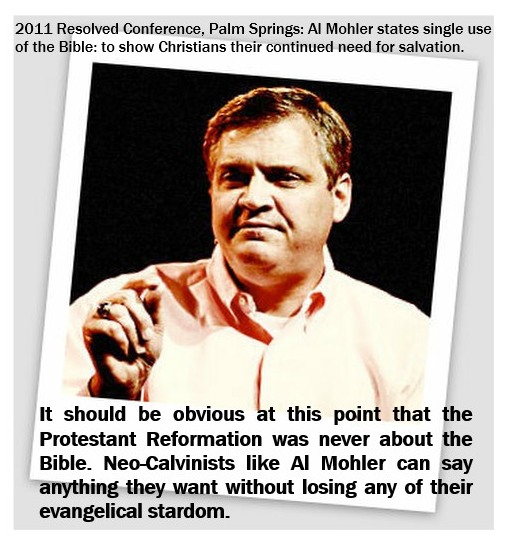 This ministry has documented extensively through the words of Protestant evangelical pundits what the true soteriology of authentic Protestantism is: it is the false gospel of progressive justification. One is saved through the institutional church and its hierarchical priesthood, and then must remain faithful to the institution and its “means of grace” in order to retain salvation. Though evangelicals vehemently deny salvation by church membership, the facts are irrefutable.
Let’s review the major tenets of this false gospel propagated by Protestants and their many offshoots such as Baptists etc. Though they claim salvation by new birth, the biblical definition is denied. In contrast to the biblical definition, justification is a mere “forensic declaration.” Instead of the saint being literally made righteous, they are only declared righteous. This attempts to reconcile their error concerning law and gospel.
In the soteriology of Protestantism, the law only has one purpose instead of two: it only serves to show one’s sin.1 Therefore, the law is justification’s standard. Hence, the simple biblical concept of justification being apart from the law is totally missed.2 Now more error must be added to cover for the fundamental error: their definition of justification as a legal declaration. Now, the law is unwittingly added as something that can give life.3 And since it is seated on a throne beside God and the Son, “its righteous demands must be continually fulfilled.” This necessarily requires even more error: the idea that Christ not only died for our sins, but that He also lived a perfect life in obedience to the law so that His obedience can be continually imputed to the law in the believer’s stead. This is known as “double imputation.”
Enter even more error. Since justification is only a legal declaration and didn’t put the old us to death through Spirit baptism, and we are therefore still under the law’s condemnation instead of Christ’s death ending that aspect of the law, our sins are only COVERED and not ENDED which means continued imputation of Christ’s death and righteousness is needed. However, we don’t need Christ’s obedience to the law imputed to us in order to keep us saved because we were made righteousness in being resurrected with Him4—also in Spirit baptism. This frees us from all condemnation under the law and frees us to serve according to the positive aspects of the law…love.5
And consequently due to this error, “saints” only remain covered by double imputation through faithfulness to the institutional church and its “means of grace” or what really boils down to means of continued salvation.6 These “means of grace” can only be found in the institutional church, and there are many, but one is the hearing of pastoral preaching. Faith comes by hearing the word of God, we know that, but in context of Protestantism, that’s an ongoing need that is only found in the institutional church. If we don’t continually hear the word from those “under the authority of the church” we lose our faith and subsequently our salvation.
In the following video link, Albert Mohler expresses these ideas starting at mark 1:14:00. Yes, he throws in some red herrings in regard to individual study of the word, but take note towards the end regarding his statement that salvation is for the lost as well as the saved. In other words, the “saved” need continued means of salvation that can only be found in the church. This ministry has documented many statements by evangelical leaders plainly stating that Christians continue to need salvation. Where the confusion often comes in is with the citation of verses referring to the saving of the mortal body, viz, redemption which is NOT salvation in the justification sense. Both only happen once.
paul
1Romans 8:2
2Romans 3:21
3Galatians 3
4Romans 5 and 6
5Romans 7 and Galatians 5:6
Video Edition of Bumper Stickers from Hell: A Review of 14 “Christian” Memes
Suggested Follow-up Resources:
Galatians 2:20 and the Gospel According to Phil Johnson, Parts 1 & 2
Listen to podcast or download audio file.
PAUL DOHSE: Welcome, truth lovers, to BlogTalkRadio.com/False Reformation. This is your host Paul Dohse. Tonight, part eight of the Magnum Opus of the Reformation, Martin Luther’s Heidelberg Disputation. Greetings from the Potter’s House and TANC ministries where we are always eager to serve all of your heterodox needs. Our teaching catalog can be found at tancpublishing.com. If you would like to add to our lesson or ask a question, call 855-8317. I failed to put the area code in there. That’s (347) 855-8317. Remember to turn your PC volume down to prevent feedback. If you choose to use Skype to listen to the show, my advice is to just dial direct from your Skype account without using any of the Blogtalk links. And again that number, just dial direct from your Skype account is (347) 855-8317. Per the usual, we will check in with Susan towards the end of the show and listen to her perspective. Remember, you may remain anonymous. When I say, “This is your host. You are on the air. What’s your comment or question,” just start talking. If you would like to comment on our subject tonight, you can also e-mail me at paul@ttanc.com. That’s paul@Tom-Tony-Alice-Nancy-Cat.com. I have my e-mail monitor right here and can add your thoughts to the lesson without need for you to call in. You can post a question as well.
Tonight, we’re going to have another interlude, and I know these interludes drive people crazy. But it is very important to establish and have a sentence by sentence evaluation of Martin Luther’s Heidelberg Disputation because that is the first and founding document of the Protestant Reformation. It was written about six months after Martin Luther’s Ninety-Five Theses which is thought to have launched the Protestant Reformation, and I guess that’s fair enough. But the Heidelberg Disputation is the first and foundational document of the Protestant Reformation. And it is, absolutely, amazing how to this day, literally everything that we see in contemporary, or at least the return to the contemporary authentic Protestantism, flows from that document. But in doing this series, to have a sentence by sentence evaluation of the Heidelberg Disputation, though very important, it is getting the cart a little bit before the horse. Because in our day, Christians, by and large, really don’t understand the gospel. They really don’t understand the gospel. And this is by design. This is the essence of Protestantism, a dumbed-downed congregant. And we’re learning why that is in our study of the Heidelberg Disputation. But foundational to the doctrinal illiteracy of present-day Christians is this whole idea that we’re sanctified by the gospel. So throughout Protestant history, the emphasis has always been the gospel, the gospel, the gospel, the gospel, or the gospel or first importance or going back, discontinually going back to the cross. And this gets a pass, by and large, because people are saying, “Oh, this is just a theory on how to be better sanctified or how to better grow in our faith by returning to the original gospel that saved us time and time again.” But as we are learning, and the contention of this ministry is that our contention is – our contention is that no, this just isn’t one of many techniques to better grow in the Lord according to the Bible supposedly. No. This is a gospel or a soteriology that calls for us to continually return back to the same gospel that saved us, so that we can live by faith alone as a way to keep ourselves saved. This is the dirty little secret of Protestantism.
So in essence, you have a work salvation by faith alone or in essence, a work salvation by doing nothing, kind of like Bachman-Turner Overdrive theology. I work hard at doing nothing all day as a way to keep myself saved. Or the way they put it, living by faith alone. And if you think about those words carefully, one might logically ask, “How do you live by faith alone?” Kind of like saying, “How do you live by thinking alone without doing anything?” So this is why we’re taking these interludes. It’s very important for us to establish what exactly the foundational document of Protestantism is all about. But, again, for contemporary or present practical purposes, we need to get it out there what the true gospel is, the true biblicist gospel in comparison to–I hate to say it, I hate to just put it out there–Protestantism.
Now as we’ve discussed before, the official coined term by this ministry, anyway, concerning the official doctrine of the authentic Protestant Reformation, not the watered down version and the truisms connected with it that most Protestants, Baptists, Methodists, Charismatics, et cetera, are used to, we’re talking about this return to the authentic Protestant Gospel in the body of the new Calvinist movement, which is all but completely taken over the institutional church.
In regard to gospel sanctification, the go-to verse is Galatians 2:20. This is the primary go-to verse. Now a lot of people claim that the Higher Life movement and all these other movements, the Keswick movement and all these movements, they are really big on Galatians 2:20 as well. And what’s in vogue is to think that the Higher Life movement and the Keswick movement, so on and so forth, are somehow different from authentic Reformed Protestantism and their gospel. And such is not the case. The applications are different, but the basic soteriology is the same. And what is that? Here it is. It’s a soteriology based on gospel contemplationism, and keeping yourself saved by going back to the cross. Or in essence, keeping yourself saved through contemplationism of some sort because to actually do something would be works salvation because this is key running the basic premise, running through all these doctrines is that justification is progressive.
And as we’re going to hear, and how we’re going to approach this topic in the show today, what we’re going to hear, Phil Johnson of John MacArthur’s Grace Community Church out in California, he is actually going to call salvation a process. And this is the fundamental basic premise of all of these doctrines, all of these passive doctrines, all of these doctrines that would say, synergistic sanctification is work salvation. Why? Because it’s, and we’ve all said this, “The growing part of salvation.” Well, folks, salvation doesn’t grow. Salvation doesn’t grow, okay? And, again, we’re going to really hunker down on Galatians 2:20 because I stumbled upon a video that’s a sermon by Phil Johnson of Grace Community Church in California where he really articulates Galatians 2:20 in the Reformed view to a T. And, again, in this incredible video, he is also speaking for the Higher Life movement and all these other movements, even though he speaks out against them in this. Again, the basic soteriology is the same, this whole idea that salvation is a process that starts at point A and gets to point B and that we have to keep the process going by doing nothing. So we’re going to look at this, and this ministry is just going to flat out make a lot of hay of this video, and we’re going to slice it, dice it, rework it, keep adding to it, taking away from it. And we begin that process in today’s program. And basically, we’re going to continue that process on Sunday morning as well. And as well, we’re going to post videos on Paul’s Passing Thoughts, the blog, for TANC ministries. And we’re going to, really, work this thing. We better get going because the sermon itself was 50 some minutes. I cut some parts out, and I’ll tell you why when we get into the video. (more…)
Identity
 TANC Ministries is presently working on a book project leading up to our 2016 conference in August. I guess my name will be on the book as the author, but the book is really a group project. Maybe the author should be “TANC Ministries.”
Why this project? I will cite some excerpts from the project objective:
“Those who are disillusioned with Christianity, but haven’t given up on God and are looking for answers, often ask, ‘Where do I start?’ Such people who come to PPT, and are overwhelmed by the mass of information often ask, ‘Where is the best place to start?’ Andy Young recently remarked about the multiple layers of misinformation and the question of where this ministry should start with people on our end of the question…The target audience are those looking for real and truthful answers amongst the confusion; they are those trying to make sense out of life in the confusion of Christianity as we know it in our day. The book will have a theological and philosophical bent. Protestants and Catholics alike are dumbed-down by design, think that the Reformation was a theological debate, are confused about basic elements of metaphysics and being, and need a place to start on their truth journey. Those who buy the book will have this in common: they assume reason is a necessary pathway to finding truth.”
At first, it looked like the project was off to a fast start, but what seemed like great ideas were shot down by the group, so it was suggested that I start submitting free-writing articles to the group based on the usual ministry themes, and this will result in an articulation of objectives that the group agrees with. This article is one such submission to the group.
I am not crazy about Facebook, but on the other hand, it is valuable to our ministry, and yesterday was no exception. I am not going to copy and paste the whole debate here between myself and a couple of Catholics, but I am very tempted to think that it will be the crux of our project. The excerpt that encapsulates the main point follows:
“You act as if the Pope speaking ex cathedra or the council of Bishops as an authority of truth is so absurd. I understand that you disagree with it, and you are entitled to the right to disagree. But the concept in and of itself is certainly not absurd. I have to say, if it comes down to which is less absurd, a church authority instituted by Christ is much more plausible than Jesus giving us a Bible and telling everyone they can discern truth completely (error free) by themselves. (Not saying we are completely void of discerning truth, but we will never be perfect at it). Look around you: if everyone could perfectly discern truth for themselves, then why do non-catholic churches continue to split up each and every day? I think there are like over 30,000 denominations now? We are not trying to attack you, Paul M. Dohse Sr. We are just trying to get to the truth. And I have felt misrepresented by your points, so I have to ask the tough questions.”
To me, this absolutely says it all; perhaps the project group will agree. It boils down to man’s (mankind) identity and his ability to interpret reality. Universally, the goal is man’s well-being. Is the key to well-being a proper identity? What does man’s identity have to do with evaluating truth? EVERYTHING. Suppose you identify man as a being that cannot know truth? I think that makes the point.
Now, this necessarily involves a discussion about philosophy and its four major tenets: metaphysics (state of being), epistemology (how we know), ethics (the moral application of how we perceive reality), and politics (how the ethics are communicated). But what about the Bible? From my own perspective, I see the Bible as God’s philosophical statement to mankind. If you are able to defend God’s truth, or the Gospel, you must know what the Bible states about these four tenets of philosophy. No? Really? Consider the following fact: this stream of conversation on Facebook was extremely long, and complete with Scripture stacking and citation wars, but to no avail. Why? Because truth is interpreted through the philosophical prism. A Chinese person might as well be attempting to convince an English person that Chinese is better (anything Chinese) while arguing in their perspective languages. The example that astounds me the most follows: people who seek counsel and assume the counselor shares their view of reality. No wonder so few people are helped by counseling accordingly. Another example makes its own point because few Christians will even know what I am talking about. Pastors in our day view reality from two different perspectives, redemptive or grammatical, and most parishioners are clueless in regard to where their pastors stand on that issue. They assume they know what the pastor is teaching from the pulpit, but really they are clueless.
What is the philosophy of the person that I was having the discussion with? Metaphysics: man cannot know truth PERFECTLY. Epistemology: “ex cathedra or the council of Bishops as an authority of truth.” Ethics: prevention of chaos. Politics: expected obedience to authority. Words mean things, so lets examine his words carefully. The issue with man, according to this person, is he cannot know truth “perfectly.” That’s key. So then, what is the ethic? Christ has appointed an authority on earth to prevent chaos because no man can know the truth perfectly.
But wait a minute, neither can the men whom Christ appointed as an authority; likewise, they cannot know the truth perfectly because they are also men, so what gives? This is what gives: authority for the sake of UNITY is the goal, not truth per se. In fact, UNITY defines truth itself. And where does that come from? Yep, P-l-a-t-o. Among most of the classic sophists, unity itself was truth. At least in Plato’s case, this was the definition of social justice as well. Does that ring any bells in regard to churchianity, or Western society in general? Let me further the point. What was this person’s primary argument for the authority of the Catholic Church? Right, to prevent the chaos of “30,000 denominations” the inevitable result of men being free to discern truth for themselves.
But it gets better when one considers biblical metaphysics. Again, via this person’s own words, the issue is INDIVIDUAL interpretation. But wait a minute, I thought a believer is a totally new creature indwelled by the Holy Spirit? What a minute, I thought the Bible said that the Spirit will lead us in ALL truth. So, why would members of one body with one mind in Christ, and striving for that one mind in Christ be lacking in unity? Why is such a notion “absurd.” Answer: because Catholics and Protestants both fundamentally deny the new birth, that’s why. And consequently, we also hear things from Protestant pastors such as Mark Driscoll saying, “Just keep your damn mouth shut and obey.” As Pastor Chad Bresson is fond of saying, Whether an elder is right or wrong is irrelevant to unity. For those who have the audacity to question an elder, Pastor James MacDonald suggests that they be tied to a catapult and “launched into the next county.” Why are they so passionate about being agreed with? Because obedience to authority is what unifies, not truth—authority is truth.
Moreover, with Believers, “perfection” is not the issue, but LOVE is the issue. Law as condemnation versus law as love is also the difference the new birth makes, but enough said for now. I will see if any of this gets some traction with the project group.
paul

 Paul's Passing Thoughts
leave a comment