Romans Series Interlude: Predestination, a Potter’s House Journey, Part 3; Election and Total Depravity were NOT New with the Reformers and Far from being Unique

“MacArthur’s common assertion that inability is contrary to all other world religions is a gross historical fallacy. The necessity of predeterminism due to inability has been a common doctrine in both religious and secular camps since the cradle of civilization. The idea of total depravity is not unique to Calvinism by any stretch of the imagination.”
“Predeterminism and election are in the Bible, but the biblical view is one view among many that have dominated the philosophical landscape of human history. The Reformation was NOT philosophically unique—it was the norm. I think it important to note in our journey, as a stepping stone of understanding, the following: The biblical view of election and predestination is unique, but Calvinism takes its place in the philosophical norm of human history. Our journey must be an honest one that does not allow the rewriting of history.”
Purveyors of Calvin’s election soteriology often boast that there is no doctrine more humbling to man who is naturally self-dependent. Election is presented as the most despised doctrine among men in all of human history, an anomaly that grates against his very being that clings to some claim of righteousness, no matter how minute.
The doctrine of human unwillingness and inability is perhaps the most attacked doctrine wittingly or unwittingly. The idea that sinners are completely helpless to redeem themselves or to make any contribution to that redemption from sin and divine judgment is the most attacked because in the big picture, it is the most despised doctrine.
Consequently, it is the most distinctively Christian doctrine, contrary to all non-Christian views of men. All religions in the world are some form of a works righteousness system. And at the foundation of all those religions other than the true faith in the true gospel is the idea that people can be good and good enough to contribute to their salvation, to somehow merit favor with deity and a happy after life. Because this is the universal foundational doctrine of all false systems of religion, it is therefore the most – because, I should say, the opposite of it is the foundation of all these religions, it is therefore the most attacked Christian doctrine. It is distinctively Christian because it affirms the absolute inability of man to do anything to contribute to his salvation.
It is a contrary doctrine as well. It doesn’t sit well with the sinner because one of the dominant features of universal human fallenness is deception about one’s true condition. Based on the dominating reality of human pride, the sinner is unwilling to see himself in his true condition and is convinced to one degree or another of his goodness (John MacArthur: 2008 T4G session 3).
This is not the case at all. MacArthur’s common assertion that inability is contrary to all other world religions is a gross historical fallacy. The necessity of predeterminism due to inability has been a common doctrine in both religious and secular camps since the cradle of civilization. The idea of total depravity is not unique to Calvinism by any stretch of the imagination.
Total depravity, or the incompetence of mankind, has always been a close companion to predeterminism. Obviously, any doctrine of predeterminism minimizes man’s ability to participate in his own fate. Predeterminism precedes total depravity, and elitism follows; this in fact has always been the predominate social model of humanity. At the root of humanity’s various caste systems is predeterminism. Sure, even though some men are arrogant and boastful, humanity has never been at loss for the humble who believe humanity has no worth.
One example of this is environmentalism. Proponents deem man worthless and harmful to planet Earth. The only purpose for man at all is to save the earth from man himself.
The Voluntary Human Extinction Movement (VHEMT) is an environmental movement that calls for all people to abstain from reproduction to cause the gradual voluntary extinction of humankind. VHEMT supports human extinction primarily because, in the group’s view, it would prevent environmental degradation. The group states that a decrease in the human population would prevent a significant amount of man-made human suffering. The extinctions of non-human species and the scarcity of resources required by humans are frequently cited by the group as evidence of the harm caused by human overpopulation.
VHEMT was founded in 1991 by Les U. Knight, an American activist who became involved in the environmental movement in the 1970s and thereafter concluded that human extinction was the best solution to the problems facing the Earth’s biosphere and humanity… Knight believes that Earth’s non-human organisms have a higher overall value than humans and their accomplishments, such as art: “The plays of Shakespeare and the work of Einstein can’t hold a candle to a tiger”. He argues that species higher in the food chain are less important than lower species. His ideology is drawn in part from deep ecology, and he sometimes refers to the Earth as Gaia. He notes that human extinction is unavoidable, and that it is better to become extinct soon to avoid causing the extinction of other animals. The potential for evolution of other organisms is also cited as a benefit. Online source | http://en.wikipedia.org/wiki/Voluntary_Human_Extinction_Movement
Obviously, John Calvin has nothing on Les U. Knight; in fact, in regard to human depravity Knight has raised the ante. Nor is VHEMT anywhere near to being a fringe nutball minority. The impact of this philosophy on our culture should be evident as the same people who put their lives in peril to save whales are strong proponents of abortion, and not to mention insane legislation that protects the snail darter and turtles at the expense of national security. Lazy-thinking Evangelicals chalk it all up to the insanity of sin, but that’s not the case at all. Insanity is not the issue; logic is the issue, and presuppositions concerning mankind. In regard to logic and presuppositions concerning mankind, there is absolutely NO difference between Knight and Calvin: both believe in the total depravity of man and a predestined outcome. This makes MacArthur’s well-traveled theses at T4G 2008 utter folly.
And this is paramount in our journey to understand predestination. If we buy into a prism of understanding, we might as well buy into the final analysis and call it a day. The tenet of Calvinism’s inability doctrine as a distinction that opposes all other schools of human thought stacks the metaphysical deck in Calvinism’s favor, but the premise is utterly false.
Predeterminism and election are in the Bible, but the biblical view is one view among many that have dominated the philosophical landscape of human history. The Reformation was NOT philosophically unique—it was the norm. I think it important to note in our journey, as a stepping stone of understanding, the following: The biblical view of election and predestination is unique, and Calvinism takes its place in the philosophical norm of human history. Our journey must be an honest one that does not allow the rewriting of history.
Inability begins in the garden. Satan approached Eve and suggested she had an inability to properly understand God. Satan then presented himself as an elitist efficacious to proper understanding. This is fairly evident. This isn’t a children’s story; this is the beginning of the very fiber of human existence: the totally depraved unenlightened masses being led by the elitist enlightened. Either by a natural selection, or a personal god, the enlightened are preordained to rule over the great unwashed masses. Everywhere you look in human history, you see social caste and economic strata along with the unpardonable sin of social mobility.
There is no sin against self; there is only sin against the collective good. This boils down to the question of purpose in the metaphysical schema of predeterminism. Whether the preordained are destined to lead man in the sole purpose of glorifying God and giving him pleasure with their own destruction, or leading man in his own destruction for the purpose of saving lower life forms so that true goodness will have a better chance—it’s the same metaphysical prism of understanding:
Predetermination →Total Depravity → Elitism → Social Caste → Collectivism → Final Solution.
Social caste is the fiber of culture in its historical duration and metaphysical spectrum. All blood ever spilled upon the earth finds its root cause in the question of free will, ability, individualism, and social mobility, and its effect on the collective. Fate is predetermined, and it is a war between those who hasten fate and those who are perceived as kicking against the inevitable. It is a war against those who prolong humanities mercy killing to the glory of a god, natural selection, or some other higher power of your choice. And the final solution is usually an escape from the material—a disdain for anything that can be perceived with the five senses. Calvinism is no different when all of these factors are considered. Calvinist Paul David Tripp has said that the essence of sin is sin against relationships. That’s code for the collective community. Albert Mohler, the president of Southern Seminary has said that Reformed pastors are preordained to save God’s people from ignorance. In the aforementioned session by John MacArthur, he stated that we should “Call the sinner to flee from all that is natural and all that powerfully enslaves him.” Let us now update our predeterminist prism:
Predetermination →Total Depravity → Elitism → Social Caste → Collectivism → Final Solution → Escape from all things natural/material.
We have no prayer of having a biblical understanding of predestination if we are led astray with red herrings—the Reformed construct is not unique, it is the same old song and dance. Everyone admits that Augustine is the father of Reformed doctrine, and a cursory observation of his writings reveals that he integrated the Bible with Platonism. Plato dignified ancient predeterminative doctrines. What was once mythology became dignified orthodoxy. Plato’s Academy set the mode of operation for Western education in both realms of secular and religious until this day. The ability for those of lower social strata to obtain a formal education that enables one to influence society did not come till very late in history (post WWII America). Slavery and prejudice find their roots in the cradle of civilization and its accompanied doctrines of predeterminism.
Christ spoke of predeterminism, and in our journey, we must document what we can know for certain as building blocks to a final conclusion. This part has a building block that we can write into the conclusion column: Christ’s predestination construct had different fruit. Christ came to push back against predestination as usual. When Christ came he crashed the predestination status quo. He was righteousness in a human body, that turned a lot of religion upside down in and of itself. The material can possess goodness. The material can possess pure knowledge.
He also completely bypassed Plato’s education model. Christ threw orthodoxy and its authority to the dogs. He deliberately chose twelve uneducated blue collar workers to lay the foundation of His assembly. He chose them against status quo predestination. His authority didn’t come from the certification of men; it came directly from heaven and was verified by miracles. No doubt, He chose the twelve, but it is interesting that we have here a predestination against a predestination—the two have different fruits.
Another fruit of Christ’s predestination is individualism versus collectivism. The fate of the individual is a higher priority than the collective good. The individual is not expendable for the “collective good.”
John 11:45 – Many of the Jews therefore, who had come with Mary and had seen what he did, believed in him, 46 but some of them went to the Pharisees and told them what Jesus had done. 47 So the chief priests and the Pharisees gathered the council and said, “What are we to do? For this man performs many signs. 48 If we let him go on like this, everyone will believe in him, and the Romans will come and take away both our place and our nation.” 49 But one of them, Caiaphas, who was high priest that year, said to them, “You know nothing at all. 50 Nor do you understand that it is better for you that one man should die for the people, not that the whole nation should perish.” 51 He did not say this of his own accord, but being high priest that year he prophesied that Jesus would die for the nation, 52 and not for the nation only, but also to gather into one the children of God who are scattered abroad. 53 So from that day on they made plans to put him to death.
54 Jesus therefore no longer walked openly among the Jews, but went from there to the region near the wilderness, to a town called Ephraim, and there he stayed with the disciples.
Even though Caiaphas unwittingly prophesied the will of God, this citation demonstrates the age-old collective good mentality. The few are expendable for the collective good. This can even escalate into the idea that an inferior race can threaten a superior race—that’s commonly known as genocide. The collective good mentality is set against what Christ taught:
Matthew 18:10 – “See that you do not despise one of these little ones. For I tell you that in heaven their angels always see the face of my Father who is in heaven. 12 What do you think? If a man has a hundred sheep, and one of them has gone astray, does he not leave the ninety-nine on the mountains and go in search of the one that went astray? 13 And if he finds it, truly, I say to you, he rejoices over it more than over the ninety-nine that never went astray. 14 So it is not the will of my Father who is in heaven that one of these little ones should perish.
Luke 15:8 – “Or what woman, having ten silver coins, if she loses one coin, does not light a lamp and sweep the house and seek diligently until she finds it? 9 And when she has found it, she calls together her friends and neighbors, saying, ‘Rejoice with me, for I have found the coin that I had lost.’ 10 Just so, I tell you, there is joy before the angels of God over one sinner who repents.”
In religious caste systems, the enlightened are deemed unexpendable because chaos will ensue if the inept sheep-like masses have no shepherd. Many among the unenlightened masses often buy into this philosophy as sold to them from generation to generation. This, and nothing else, explains why Protestants and Catholics alike cover for those who abuse parishioners, especially when the religious figure is iconic to the organization. The fall of the individual could harm the group as a whole. Therefore, the victim is expendable for the sake of the collective. This mentally was seen over and over again in the ABWE/Donn Ketcham scandal. It was continually suggested to the victims that they fall on their swords for the sake of ABWE and all of the good that it does for the collective.
This elitist construct is always predicated on a choosing by God, a predetermination. Hence, anyone who has received a dollar for every time they have heard a man say that he was “called” by God would certainly be a billionaire by now. Again, the idea of choosing and predetermination is in the Bible, but in our journey for understanding, we are noting that biblical election prescribes different fruit from the typical approach throughout the ages.
Another different fruit is leadership versus authority. This is under the category of individualism. If the individual is competent and culpable, he/she needs gifted leadership more than authority.
Matthew 20:25 – But Jesus called them to him and said, “You know that the rulers of the Gentiles lord it over them, and their great ones exercise authority over them. 26 It shall not be so among you. But whoever would be great among you must be your servant, 27 and whoever would be first among you must be your slave, 28 even as the Son of Man came not to be served but to serve, and to give his life as a ransom for many.”
1Peter 5:1 – To the elders among you, I appeal as a fellow elder and a witness of Christ’s sufferings who also will share in the glory to be revealed: 2 Be shepherds of God’s flock that is under your care, watching over them—not because you must, but because you are willing, as God wants you to be; not pursuing dishonest gain, but eager to serve; 3 not lording it over those entrusted to you, but being examples to the flock. 4 And when the Chief Shepherd appears, you will receive the crown of glory that will never fade away (NIV).
1Corinthians 14:29 – Let two or three prophets speak, and let the others weigh what is said.
1Corithians 11:1 – Be imitators of me, in so far as I in turn am an imitator of Christ (Weymouth New Testament).
Acts 17:10 – The brothers immediately sent Paul and Silas away by night to Berea, and when they arrived they went into the Jewish synagogue. 11 Now these Jews were more noble than those in Thessalonica; they received the word with all eagerness, examining the Scriptures daily to see if these things were so.
Caste systems always enforce the predestined pecking order by authority, and force if necessary. Christ never endorsed the use of force to compel acknowledgment and the following of truth. It is clear that what He endorsed was the freedom of choice. It is clear that the Reformation fathers endorsed force for purposes of compelling people to follow orthodoxy in the face of glaring scriptural contradiction.
In regard to social strata, the gods of religious caste have always collaborated with the power-brokers of the world. We find evidence in the New Testament that people equated wealth as proof of special favor from God. Well, God did choose a social strata (not to the complete exclusion of the other), but it wasn’t the typical upper crust:
1Corintians 1:26 – For consider your calling, brothers: not many of you were wise according to worldly standards, not many were powerful, not many were of noble birth. 27 But God chose what is foolish in the world to shame the wise; God chose what is weak in the world to shame the strong;
James 2:1 – My brothers, show no partiality as you hold the faith in our Lord Jesus Christ, the Lord of glory. 2 For if a man wearing a gold ring and fine clothing comes into your assembly, and a poor man in shabby clothing also comes in, 3 and if you pay attention to the one who wears the fine clothing and say, “You sit here in a good place,” while you say to the poor man, “You stand over there,” or, “Sit down at my feet,” 4 have you not then made distinctions among yourselves and become judges with evil thoughts? 5 Listen, my beloved brothers, has not God chosen those who are poor in the world to be rich in faith and heirs of the kingdom, which he has promised to those who love him? 6 But you have dishonored the poor man. Are not the rich the ones who oppress you, and the ones who drag you into court? 7 Are they not the ones who blaspheme the honorable name by which you were called?
Yet another distinction between the two predestinations is one mediator versus multiple mediators between God and man. Clearly, the Reformers believed that elders had the authority to forgive sins. Absolution was no less a Protestant concept than Catholic. This gives new meaning to you were chosen in Christ. There is only one mediator between God and man: Jesus Christ. Christ was also elected according to the Bible; this is in contrast to many being elected as our mediators. There was only one elected to be our mediator: Christ the Lord. In Reformed thought, even though one’s life is predetermined, the preordained elders seem to be able to trump fate with Calvin’s power of the keys to the kingdom; viz, whatever they bind on earth will be bound in heaven. Hence, making sure the elected elders like you is your free pass out of fatalism.
Another distinction is real time cause and effect as opposed to plenary predeterminism. In more contemporary Reformed circles, the Christian living paradigm is the willful entry into a redemptive meta-narrative completely preordained by God. This is why the Christian life as “story” is a dominate theme in today’s Christianity. Those of the Reformed camp often refer to the “divine drama” and use other similar phrases. Some refer to the gospel as an invitation by God to “enter into the plot.” Living outside of the redemptive narrative preordained by God is the very definition of madness and living in a contra-reality world.
The Bible is supposedly a prototype of the meta-narrative, and is organized into categories that “your own story” fits into. In the book How People Change by Paul David Tripp, the Bible narrative is categorized by heat, thorns, cross, and fruit. Your preordained story may be a different experience, but always fits into one of those four categories. The “Christian” classic Pilgrim’s Progress was based on this same principle. In contrast, Christ continually emphasized cause and effect in regard to our choices, and in the final analysis, man will be judged according to his choices. The Bible states that what happened to Old Testament believers is an example to us that we are to learn from for the purpose of making better decisions:
1Corinthians 10:11 – Now these things happened to them as an example, but they were written down for our instruction, on whom the end of the ages has come.
The word “instruction” is also translated “warning.” For certain, there is predestination in the Bible, but yet, the Bible is also saturated with the idea that we are individually capable of making godly decisions and personally responsible for them. Perhaps our journey can sort this out, but yet, that will not be possible if we do not begin by weeding out the traditions of men.
Let’s look at another distinction. All forms of predestination look for world domination by a single entity. This is always the wiping out of distinctions between peoples. Genocide and Aryan-like theories of predestination are always associated with purity of genetics that produce race. However, instead of a one world empire that enforces utopia, sometimes called, “destiny,” God elected little Israel to eventually be the head of the nations and not the tail while allowing distinctions between the peoples. That would be the millennial kingdom.
All other forms of predestination that make up the vast majority of religious and secular thought hold God’s election of Israel in contempt. The Reformers held that Israel’s election was based on a covenant between Israel and God and Israel broke that covenant. Therefore, Israel was replaced with the “church.” And of course, Israel’s rebellion was predetermined. It begs the question: “Does biblical election allow free will while predeterming an overall outcome desired by God?” This is one of our working theories in the journey, and would certainly answer a lot of questions about election. At any rate, the point here is the election of Israel versus all other (or at least most) predestination constructs that hold Israel in contempt.
Let’s sum up with the illustration below (click on to enlarge):

Christ came and turned a predominate worldview completely upside down. Predetermination was the dominate worldview until the Enlightenment era. Deism and Natural Theology does not arrive until the seventeenth century, yet, MacArthur et al make Deism the essence of man’s psyche and the root of all false religions. This is a metaphysical and historical fallacy—it is utter folly.
For certain, Deism was an overreaching pushback to the norm, but the amount of good heaped upon the earth as a result of its premise should be well noted and demands our consideration. A tree is known by its fruit. If we are to have a biblical understanding of predestination, we must weed out the traditions of men.
Lord willing, our journey will continue next week with part 4.
Romans Series Interlude: Predestination, a Potter’s House Journey; Part 2
I am very concerned with knowing the right wisdom that determines how we function as Christians. Another major concern of mine is evangelism. Evangelism has always been a struggle among Protestants, and it would seem that when it does happen the incentive is misguided.
I believe one of the major problems among Christians in our day is lazy thinking. When it gets right down to it, the human condition is predicated on good ideas versus bad ideas. Ideas are extremely important. Faith, by no means, is a license for simplicity. Angels, who need not faith, or trust, or hope, have not been given all of the answers on a silver platter. Yet, being holy, they “desire” to investigate the gospel (1Peter 1:12).
What we think, how we think, and what we believe forms our logic, and our logic will determine what we do. What we do is very important to me. What we do is very important to God. Here is a problem: when we hear someone talk about their “Christian worldview,” we assume this is a generic term that means the same to everyone and I find that assumption chilling. What we believe about predestination is very important. Be sure of this: the premise of every third world country and its misery following is a certain belief about predestination.
Predestination, or election, is in the Bible, I grant that. But I also think we should be sure of what we speak of when we use those terms. I know the prevailing views of our day, and I also know that accepting those views as our own without investigation is a big mistake. That is the journey we are on, and I have chosen 2Peter 3:1-18 as our foundation.
This is now the second letter that I am writing to you, beloved. In both of them I am stirring up your sincere mind by way of reminder, 2 that you should remember the predictions of the holy prophets and the commandment of the Lord and Savior through your apostles, 3 knowing this first of all, that scoffers will come in the last days with scoffing, following their own sinful desires.
I use the English Standard Bible (ESV). It is a Neo-Calvinist translation heavily slanted towards authentic Reformed doctrine. Throughout the Bible, we find that the redeemed part of the believer is their mind (http://wp.me/pmd7S-FH). The KJV states that our Christian minds are “pure.” The ESV tempers that with the weaker idea of “sincere.” The following is the actual word:
g1506. εἰλικρινής eilikrinēs; from εἵλη heilē (the sun’s ray) and 2919; judged by sunlight, i. e. tested as genuine (figuratively):— pure, sincere. AV (2)- sincere 1, pure 1; pure, sincere, unsullied found pure when unfolded and examined by the sun’s light.
What we have here is a sanctification principle stated by Peter. The apostles had taught so much to the believers of that day they forgot much of it, and this exposed them to the possibility of being led astray by false teachers. Note false teachers of that day often led believers astray by misrepresenting Bible prophecy:
4 They will say, “Where is the promise of his coming? For ever since the fathers fell asleep, all things are continuing as they were from the beginning of creation.” 5 For they deliberately overlook this fact, that the heavens existed long ago, and the earth was formed out of water and through water by the word of God, 6 and that by means of these the world that then existed was deluged with water and perished. 7 But by the same word the heavens and earth that now exist are stored up for fire, being kept until the day of judgment and destruction of the ungodly.
Let me also note what the standard of truth was for them in that day:
This is now the second letter that I am writing to you, beloved. In both of them I am stirring up your sincere mind by way of reminder, 2 that you should remember the predictions of the holy prophets and the commandment of the Lord and Savior through your apostles,
The Scriptures are the standard of truth taught by teachers and confirmed by the saints:
Acts 17:10 – The brothers immediately sent Paul and Silas away by night to Berea, and when they arrived they went into the Jewish synagogue. 11 Now these Jews were more noble than those in Thessalonica; they received the word with all eagerness, examining the Scriptures daily to see if these things were so. 12 Many of them therefore believed, with not a few Greek women of high standing as well as men.
The more I study the Bible, the more I am convinced that the primary strategy of the kingdom of darkness is to lead us away from transforming our mind and lives with the truth of God’s word (Eph 4:20-24). What better way than to teach every verse in the Bible is about justification, and that God has preordained everything? What better way than to teach Christians can only experience the works of Christ without direct participation in obedience? What better way than to teach that our choices have no cause and effect? What better way than to teach we will only be judged on how well we let Jesus do everything for us?
If we had no choices, God wouldn’t motivate us with incentives, and one of those incentives is the imminent return of Christ like a thief in the night. At a time when we think not, Christ will return and a sudden, horrific seven-year judgment will unfold on the earth. This is where we must be careful about biblical words like “salvation.” This word does not always mean eternal salvation for the Christian. Christ, speaking to the assembly at Philadelphia said the following:
Revelation 3:10 – Because you have kept my word about patient endurance, I will keep you from the hour of trial that is coming on the whole world, to try those who dwell on the earth. 11 I am coming soon. Hold fast what you have, so that no one may seize your crown.
Christians in this age have already been saved for eternity, will be saved from coming judgment, will be saved from this weak, sinful and mortal body (Rom 7:24,25), and Christians during the tribulation will be saved alive if they follow the Lord’s instructions (Matt 10:22,23). When we use biblical words, we must be careful to mean what the Bible means. Interpreting salvation as always meaning eternal salvation proffers the idea that salvation is a process that requires our perseverance in order to finish it. That’s a bad idea.
I want to use 2Peter 3:1-18 for our foundation because we learn from it that God prolongs His coming so that more people will be saved. It is not His intention to predetermine people to eternal judgment:
9 The Lord is not slow to fulfill his promise as some count slowness, but is patient toward you, not wishing that any should perish, but that all should reach repentance.
As I explained in a post last week (http://wp.me/pmd7S-32O), the ESV uses the pronoun “you” instead of “us-ward” (KJV [hemas]) which means “us” or “we.” The ESV actually uses a word that is second person singular, and only draws a possible plural meaning from the context. It’s obvious that the ESV translators wanted to confine the object of God’s patience to the elect only, or if you will, believers. The KJV rendering could go either way in regard to the idea of mankind in general or just Christians. But as we will see, “us-ward” refers to mankind in general.
Because of the way the sentence is constructed, the “any” or the “all” is determined by “us-ward” or “you.” The idea that God prolongs judgment because He does not intend (g1014. βούλομαι boulomai: stronger than g2309. θέλω thelō which denotes preference) that any perish does violence to the idea of predetermination. If you put this together with 1Timothy 2:1-4 which uses thelo, we can conclude that God prefers that all come to a knowledge of the truth while not condemning anybody with intentionality. He prolongs judgment so that as many people as possible will be saved. However, God will not strive with man forever (Gen 6:3). Indeed, now is the time to be reconciled to God for the time is short (2Cor 6:2).
Who are the “us-ward”?
The predetermination crowd say the text means that God is only patient for the sake of those he has elected beforehand; once the fullness of His elect believe, the judgment will then come because He is not willing that any of the elect parish. If they are to exclude mankind from God’s intent to predetermine condemnation, they must restrict “us-ward” to the elect only:
God is patient to ______→ determines the “any” and “all” that are the object of God’s patience and unwillingness to condemn.
CLICK TO ENLARGE

The only problem is, the preposition “to” is irrefutable in the text. It is the Greek preposition eis and is a primary preposition.
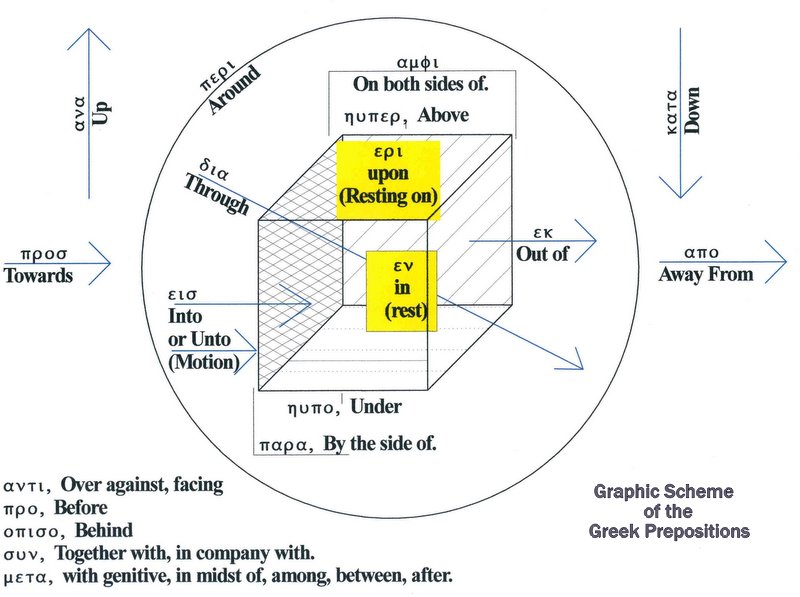
To say that God is patient to mankind for the sake of the elect or because of the elect would require a modification of the sentence structure in regard to adding another prepositional phrase.
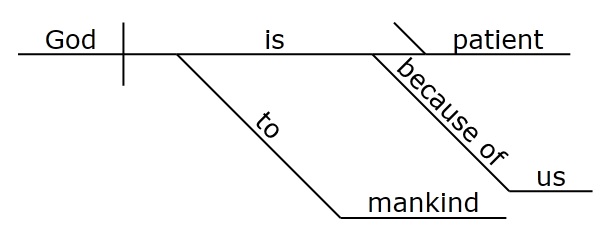
The actual sentence:

Also, Peter could have stated definitively that the elect alone are in view:
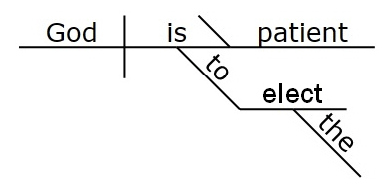
Therefore, supposedly, the elect are the sole object of God’s patience. However, this makes the elect subjects that need God’s patience in order to dissuade judgment. This makes the elect worthy of God’s judgment; therefore, he must be patient towards them in successive generations for the sake of the elect themselves. This is unavoidable unless you add another prepositional phrase to the text: God is patient towards the judgment-deserving elect for the sake of the elect.
This fits perfectly with Reformed soteriology, Calvinism if you will. The elect are still under the condemnation of the law, and mankind in general, or the non-elect, are not the beneficiaries of God’s patience in the least. God is only patient with the elect, because they are worthy of judgment, for the sake of the elect until they all believe.
So, you are going to interpret this Scripture according to your view of justification/salvation. Making “us-ward” the elect only fits with the idea that Christians are looking for a final salvation:
14 Therefore, beloved, since you are waiting for these, be diligent to be found by him without spot or blemish, and at peace. 15 And count the patience of our Lord as salvation,
Again, this fits because part and parcel with a predestined view of salvation and Calvinism is the idea that Christians, or the elect, still need God’s patience unto salvation. The “salvation” in verse 14 doesn’t pertain to the whosoever will of mankind, it pertains to the elect only. The elect still need God’s patience unto salvation. Why does God need to be patient? Because of sin, What kind of sin? The kind that deserves the judgment to come.
Certainly, God is patient with us, but it is a fatherly patience. If you don’t believe that Christians still need a patience that dissuades the final judgment until the other elect believe, “us-ward” must mean mankind in general. This presents the idea that Christians “hasten” the day of Christ’s coming (they anxiously await for it) while understanding that the Lord’s patience means salvation. Salvation for whom? Well, Christians already have salvation.
The former idea asserts that Christians need God’s patience because they deserve judgment, and God is patient with them because He is not willing that any of the other elect perish.
Unless you interpret this text with a proper view of salvation, “us-ward” is ambiguous. However, assessing the text with a proper view of salvation makes “us-ward” mankind because Christians are not the cause of the coming judgment—God doesn’t need to be patient with Christians in that way.
Once again, we see that eschatology is far from being a “secondary” issue. False teachers have always used eschatology to throw Christians off track (here and 2Thess 2:1-12). We live in an age when the return of Christ is imminent, and we are to be found faithful upon His arrival. This is a time of urgency seen in this text. While we hasten the day of the Lord, we understand that His patience means salvation for many. We are to work while it is still daylight:
Romans 13:11 – Besides this you know the time, that the hour has come for you to wake from sleep. For salvation is nearer to us now than when we first believed. 12 The night is far gone; the day is at hand. So then let us cast off the works of darkness and put on the armor of light.13 Let us walk properly as in the daytime, not in orgies and drunkenness, not in sexual immorality and sensuality, not in quarreling and jealousy.14 But put on the Lord Jesus Christ, and make no provision for the flesh, to gratify its desires.
Ephesians 5:15 – Look carefully then how you walk, not as unwise but as wise, 16 making the best use of the time, because the days are evil. 17 Therefore do not be foolish, but understand what the will of the Lord is. 18 And do not get drunk with wine, for that is debauchery, but be filled with the Spirit, 19 addressing one another in psalms and hymns and spiritual songs, singing and making melody to the Lord with your heart, 20 giving thanks always and for everything to God the Father in the name of our Lord Jesus Christ, 21 submitting to one another out of reverence for Christ.
Where is our urgency? It’s missing because we don’t have a dog in the fight, everything is predetermined—there is no cause and effect. Que, sera, sera, what will be will be. Who the “us-ward” are in this passage determines how we will function as Christians. I find the Reformed talking point that evangelism is exciting because it makes us a part of God’s predetermination wanting. You can add to that John MacArthur’s “because God said so” assertion, and God is glorified by people rejecting Him because of the “savor of death.”
Again, the Reformers didn’t even have salvation right, we must be Bereans and see for ourselves what is true about this issue. But in the final analysis, a view of God’s predestination must be tempered with the knowledge that God desires for all men to be saved and does not select people for damnation with intent. God takes no pleasure in the death of the wicked (Eze 18:32, 33:11). God does not seek glory in condemning people to eternal judgment:
http://www.jimmcguiggan.com/reflections3.asp?status=Calvinism%2C+worst+face+of&id=913
Predestination is Not True: 2Peter 3:1-13
 As PPT/TANC will invariably move toward a more solution oriented vision while moving away from blogosphere drama that seeks to save the institutional church, which is un-save-able, and founded on the false gospel of Protestantism, evangelism is a very important subject to us. And let’s face it; a Protestant view of predestination/election is a disincentive to evangelize. I have been a Protestant Baptist for many years, and know full well that most Protestants would rather kiss an alligator than witness. I believe this indifference to the Great Commission can be laid at the feet of Protestant orthodoxy.
Don’t get me wrong, my argument isn’t based on a desire to see more evangelism. If predestination is true, so be it. But the fact is—it’s not biblical. It has taken many years for me to come to this conclusion, and there are still a lot of pieces to put together, but in all my research on this issue of late, 2Peter 3:1-13 is the passage that has led me to this foundational conclusion:
God did not predetermine or choose some for salvation and others for hell. Man can be persuaded to believe.
I know that the typical lazy thinking Protestant Calvinists will call me an “Arminian,” but I have never read Jacobus Arminius, nor have I read anything about him. My conclusions come from reading the Calvin Institutes and the Bible. I also find it interesting that Neo-Calvinists find the same angle that I have settled on so intimidating that they changed words in the ESV to hide the meaning of “willing.” That doesn’t exactly dissuade me from thinking that I am on to something.
In 2Peter 3:1-13, Peter is reminding Christians of the following:
3 knowing this first of all, that scoffers will come in the last days with scoffing, following their own sinful desires. 4 They will say, “Where is the promise of his coming? For ever since the fathers fell asleep, all things are continuing as they were from the beginning of creation.” 5 For they deliberately overlook this fact, that the heavens existed long ago, and the earth was formed out of water and through water by the word of God, 6 and that by means of these the world that then existed was deluged with water and perished. 7 But by the same word the heavens and earth that now exist are stored up for fire, being kept until the day of judgment and destruction of the ungodly.
Notice that men “deliberately” overlook the truth because it is inconvenient to their own desires. That’s a choice. Men are not completely blinded, they are aware of the truth, but they deliberately suppress it (Rom 1:18,19). In this case, they deny the second coming by pointing to how long the earth has been functioning normally for thousands of years. Peter then defines their deliberate and false assertion:
8 But do not overlook this one fact, beloved, that with the Lord one day is as a thousand years, and a thousand years as one day. 9 The Lord is not slow to fulfill his promise as some count slowness, but is patient toward you, not wishing that any should perish, but that all should reach repentance.
The first discrepancy is the ESV’s (a Neo-Calvinist translation) use of “you”—but is patient towards you. This implies a second person plural which infers a continuing same salvation for believers as well as unbelievers. The correct translation (KJV) that fits with the context is “us-ward” (third person plural) which implies mankind in general and their need for salvation. The second person plural goes hand in hand with Calvinism’s progressive justification.
More interesting is how the ESV translates the word “willing” as “wishing” in this text—not wishing that any should perish. The actual word follows:
g1014. βούλομαι boulomai; middle voice of a primary verb; to “will,” i. e. (reflexively) be willing:— be disposed, minded, intend, list, (be, of own) will (- ing).
The idea is “intent,” or to “will.” This is what settled the issue for me. It is clearly NOT God’s “will” or “intent” that any parish. If God predestined certain men for destruction, that is clearly His intent and will. But that is not the case. But it gets better: on the one hand, God does not predetermine people for destruction because that is not His will or intent, and on the other hand, he desires all men to be saved:
1Timothy 2:1 – First of all, then, I urge that supplications, prayers, intercessions, and thanksgivings be made for all people, 2 for kings and all who are in high positions, that we may lead a peaceful and quiet life, godly and dignified in every way. 3 This is good, and it is pleasing in the sight of God our Savior, 4 who desires all people to be saved and to come to the knowledge of the truth.
The word for “desires”—who desires all people to be saved is,
g2309. θέλω thelō; to determine (as an active option from subjective impulse; whereas 1014 properly denotes rather a passive acquiescence in objective considerations), i. e. choose or prefer (literally or figuratively); by implication, to wish, i. e. be inclined to (sometimes adverbially, gladly);
Here, the ESV uses a proper word; God desires for all people to be saved, but of course, that’s not going to happen. But on the other hand, he doesn’t will or intend for people to be eternally condemned. That must mean it’s by their own choice, and contrary to God’s desires, will, or intent. Calvinists plainly do not like these renderings in holy writ and consider them a threat to their doctrine of predestination. They replace “will” and “intent” with the idea of thelo, or “wish.” Also, Note how the ESV translates Matthew 11:27.
All things have been handed over to me by my Father, and no one knows the Son except the Father, and no one knows the Father except the Son and anyone to whom the Son chooses to reveal him.
The ESV uses the word “chooses”—anyone to whom the Son chooses to reveal him. Shockingly, this is the exact same word used in 2Peter 3:9—βούλομαι boulomai. In 2Peter it is wishful thinking according to the ESV, but the same word in Matthew 11:27 is a CHOICE or a choosing, or predestination on the part of the Son. Here is how the KJV properly translates the verse:
All things have been delivered to Me by My Father, and no one knows the Son except the Father. Nor does anyone know the Father except the Son, and the one to whom the Son wills to reveal Him.
If the ESV was consistent with their questionable rendering of the word in Matthew 11:27, here is how 2Peter 3:9 would read:
The Lord is not slow to fulfill his promise as some count slowness, but is patient toward you, not choosing that any should perish, but that all should reach repentance.
Well then, the long list of Calvinist scholars that endorse the ESV agree with me:
God has not chosen anyone for condemnation.
paul
Addendum:
The word for “choose” follows: “g1586. ἐκλέγομαι eklegomai; middle voice from 1537 and 3004 (in its primary sense); to select:— make choice, choose (out), chosen. AV (21)- choose 19, choose out 1, make choice 1; to pick out, choose, to pick or choose out for one’s self.” Selecting the English word “choose” for boulomai (“willing”) in one place, and “wishing” in another seems to be a deliberate attempt to skew intended meaning.
Romans Series Interlude: Predestination, a Potter’s House Journey; Part 1

“Because the Reformation is the primary commentary on the subject of election, the subject must be thoroughly revisited with stringent biblical evaluation.”
Everyone must agree the doctrine of predestination came from the big three of the Reformation: Augustine, Luther, and Calvin. The doctrine is Augustinian*; Luther and Calvin systematized and articulated it for the Reformation. From my standpoint, after writing fifteen-hundred articles and four books on the Reformation, the Reformers were not biblically right about anything; particularly justification. So, were they right about predestination? That is, the idea that God selected, or predetermined some for salvation and not others; the idea that man has no will or ability to seek God or flee to Him for salvation—salvation is a total work of God; it’s “monergistic.”
This poses some logical problems, and also makes Christianity akin to Hinduism** and Islam which are also heavily predicated on the idea of predestination, but predestination should not be rejected for those reasons alone. Logically, one is perplexed by the idea that God judges people for not choosing Him when they have no ability to do so. Logically, one wonders why the prophets of God exhorted men with tears to repent when some have no ability to so.
The idea of predestination throws the Bible into confusion for many reasons, for one, God on the one hand states, “Come now, let us reason together, says the LORD: though your sins are like scarlet, they shall be as white as snow; though they are red like crimson, they shall become like wool.” Why would God inject reason into the process when men are unable to reason? One of the favorite Bible passages among the Reformed is the resurrection of Lazarus. “See, he was dead, he could do nothing, he couldn’t make a choice, he came to life by God’s calling alone.” Very well, if all men are like Lazarus, why would you try to reason with dead people? Furthermore, Lazarus was already a believer, so what’s the point? Making this resurrection a statement about justification is sloppy hermeneutics at best.
Let me be clear, I am speaking to the problem of confusion here and am not trying to refute predestination with pure logic, but clearly, the confusion of it all is very problematic for Christians. And let’s face it, especially in regard to evangelism, it is paralyzing. Who does not recognize the difficulty in getting people to evangelize in Christian circles? Clearly, the incentive is lacking. The God is going to do what he is going to do mindset is pervasive in both categories of Christian living and evangelism.
The short answer for all of this via the Reformed camp follows: “We evangelize because it illustrates that choice is all of God, and therefore, God is glorified when men repent, and God is equally glorified when men refuse to come to Him. If God saved everybody, the riches of His grace would not be known, it would be taken for granted, which would rob God of glory.” And in fact, there seems to be biblical precedent for this:
Roman 9:6 – But it is not as though the word of God has failed. For not all who are descended from Israel belong to Israel, 7 and not all are children of Abraham because they are his offspring, but “Through Isaac shall your offspring be named.” 8 This means that it is not the children of the flesh who are the children of God, but the children of the promise are counted as offspring. 9 For this is what the promise said: “About this time next year I will return, and Sarah shall have a son.” 10 And not only so, but also when Rebekah had conceived children by one man, our forefather Isaac, 11 though they were not yet born and had done nothing either good or bad—in order that God’s purpose of election might continue, not because of works but because of him who calls— 12 she was told, “The older will serve the younger.” 13 As it is written, “Jacob I loved, but Esau I hated.”
14 What shall we say then? Is there injustice on God’s part? By no means! 15 For he says to Moses, “I will have mercy on whom I have mercy, and I will have compassion on whom I have compassion.” 16 So then it depends not on human will or exertion, but on God, who has mercy. 17 For the Scripture says to Pharaoh, “For this very purpose I have raised you up, that I might show my power in you, and that my name might be proclaimed in all the earth.” 18 So then he has mercy on whomever he wills, and he hardens whomever he wills.
19 You will say to me then, “Why does he still find fault? For who can resist his will?” 20 But who are you, O man, to answer back to God? Will what is molded say to its molder, “Why have you made me like this?” 21 Has the potter no right over the clay, to make out of the same lump one vessel for honorable use and another for dishonorable use? 22 What if God, desiring to show his wrath and to make known his power, has endured with much patience vessels of wrath prepared for destruction, 23 in order to make known the riches of his glory for vessels of mercy, which he has prepared beforehand for glory—
Woe! Seems pretty clear, no? Now, instead of breaking down the context of this in order to refute the belief that this passage bolsters the idea that God has predetermined who will be saved and not saved, let me jettison to another aspect of election, the subject of what we just read. But before I do, I think something needs to be said about the apostle Paul. In fact, the apostle Peter said it:
2Peter 3:11 – Since all these things are thus to be dissolved, what sort of people ought you to be in lives of holiness and godliness, 12 waiting for and hastening the coming of the day of God, because of which the heavens will be set on fire and dissolved, and the heavenly bodies will melt as they burn! 13 But according to his promise we are waiting for new heavens and a new earth in which righteousness dwells.
14 Therefore, beloved, since you are waiting for these, be diligent to be found by him without spot or blemish, and at peace. 15 And count the patience of our Lord as salvation, just as our beloved brother Paul also wrote to you according to the wisdom given him, 16 as he does in all his letters when he speaks in them of these matters. There are some things in them that are hard to understand, which the ignorant and unstable twist to their own destruction, as they do the other Scriptures. 17 You therefore, beloved, knowing this beforehand, take care that you are not carried away with the error of lawless people and lose your own stability. 18 But grow in the grace and knowledge of our Lord and Savior Jesus Christ. To him be the glory both now and to the day of eternity. Amen.
By the way, it is very likely that these are the last words that Peter wrote to the assemblies of Christ, and he knew that they were his last words (see 1:12-13). This gives a very eerie tone to his “amen” at the end of this letter. Think about that. It’s a short book, and I would recommend it as a bedtime or lunchtime devotional for you as you read this letter with that reality in mind. These are the last thoughts that Peter deemed most important for the assemblies to remember.
But the point I want to make is what he said about Paul. I think Peter is being very gracious here as I will confess that Paul is by far the apostle I look up to the most, but yet very annoying. Paul wrote in a way that demands thinking. In regard to making things simple for the simple, he had no mercy. When pastors talk about “keeping the cookies on the bottom shelf,” you can be sure that they have never met Paul. I know many beloved brothers and fellow teachers of the word who are also often annoyed by Paul—I feel their pain.
But yet, the last three years of my Christian life are pretty much about Paul. Please take note of this: Calvinists want to debate me on all of the Bible verses that seem to indicate salvific predestination, but they don’t want to debate me on what Paul specifically wrote on justification. Paul is the Achilles’ heel for Calvinism. I have been turned down, in regard to public debate, by two respected Calvinists on this wise—they dare not get into a discussion of Pauline law and gospel—they are absolutely dead in the water on this issue.
But note what Peter said: many take the difficulty of what Paul wrote and use it to twist the Scriptures. And in regard to predestination, I believe this is the very case. Now, back to where I am going with this. It is easy to assert the idea that man has no choice and is “elected,” but what about the idea that Jesus Christ is also elected? What’s that all about?
Isaiah 42:1 – Behold my servant, whom I uphold, my chosen, in whom my soul delights; I have put my Spirit upon him; he will bring forth justice to the nations. 2 He will not cry aloud or lift up his voice, or make it heard in the street; 3 a bruised reed he will not break, and a faintly burning wick he will not quench; he will faithfully bring forth justice. 4 He will not grow faint or be discouraged till he has established justice in the earth; and the coastlands wait for his law.
1Peter 2:4 – As you come to him, a living stone rejected by men but in the sight of God chosen and precious, 5 you yourselves like living stones are being built up as a spiritual house, to be a holy priesthood, to offer spiritual sacrifices acceptable to God through Jesus Christ. 6 For it stands in Scripture:
Isaiah 28:16 – “Behold, I am laying in Zion a stone, a cornerstone chosen and precious, and whoever believes in him will not be put to shame.”†
The only way this makes sense is if Christ is the chosen means of salvation; in other words, the means of salvation are elected, but man still has an ability to choose the means. There is no salvation in any other name but Christ. Secondly, as a means of spreading the good news among the nations that God supplies a way to be reconciled to Him, he chose Israel as His nation to represent His name among the nations:
Exodus 19:3 – while Moses went up to God. The Lord called to him out of the mountain, saying, “Thus you shall say to the house of Jacob, and tell the people of Israel: 4 You yourselves have seen what I did to the Egyptians, and how I bore you on eagles’ wings and brought you to myself. 5 Now therefore, if you will indeed obey my voice and keep my covenant, you shall be my treasured possession among all peoples, for all the earth is mine; 6 and you shall be to me a kingdom of priests and a holy nation. These are the words that you shall speak to the people of Israel.”
Isaiah 8:8 – But you, Israel, my servant, Jacob, whom I have chosen, the offspring of Abraham, my friend; 9 you whom I took from the ends of the earth, and called from its farthest corners, saying to you, “You are my servant, I have chosen you and not cast you off”; 10 fear not, for I am with you; be not dismayed, for I am your God; I will strengthen you, I will help you, I will uphold you with my righteous right hand.††
Though all of Israel are Abraham’s offspring, not all within Israel will be saved. The linage, or offspring God chose was according to the miraculous promise not the conniving of Abraham to help God out (Gen 15-17, 21, Gal 4;21-31). God chose a certain linage within the national kinsmen of Abraham from which Christ would come. In the case of Isaac and Ishmael, Isaac represented God’s means. In the case of Jacob and Esau, Jacob was the chosen one to continue the lineage of promise. As we just read, God hated Esau and loved Jacob before either did anything bad or good.
Or did he? Actually, Rebekah was told “The older will serve the younger” before either of them did bad or well. God later hated the descendants of Esau (Edom) for their austere wickedness.‡ Did God appoint Edom to wickedness, or did he choose Jacob to continue the lineage of promise based on what he foreknew? That passage in Romans 9 is often described as God hating Esau and loving Jacob before they were born, but that is not the case at all. Paul was merely saying that the Edomites were not the nation from which the promise would come.
The point that Paul was making in Romans 9 is that the promise was still through Israel even though God had temporarily turned His back on Israel in favor of the Gentiles. Hence,
Romans 9 – But it is not as though the word of God has failed. For not all who are descended from Israel belong to Israel, 7 and not all are children of Abraham because they are his offspring, but
Gen 21:12 – “Through Isaac shall your offspring be named.”
This is not about individual predestination at all, this is about making it clear to the Roman Gentiles, and Gentiles in general, that Israel is still God’s chosen people. And indeed, this is not a message that Gentiles have understood well regardless of Paul turning himself into a pretzel to make the point in Romans 9-11. Read these chapters yourself, the election of Israel and its eventual salvation is the clear thesis. As Christ said, “Salvation is of the Jews.”
God’s plan of salvation involves the election of Christ and Israel. I am not going to take room here to expound further on this point, but let me also add that God elected apostleship (the ministry of the 12 apostles) and gifts as well. These are things mankind has NO control over. In John 3, of course the Spirit is like a blowing wind that man has no control over—of course man has no control over the Holy Spirit’s role in salvation, but can mankind choose to believe the truth about those works? I think he can.
Before I move on to why I think this is the case from a biblical perspective, let me mention a few of God’s purposes for election. First and foremost, God’s purpose of election is to completely eradicate works from justification:
though they were not yet born and had done nothing either good or bad—in order that God’s purpose of election might continue, not because of works but because of him who calls
Let’s pause here for a moment to think about something. Suppose God did elect certain individuals while condemning others. At least for the elect, they could be completely assured of their salvation because it was completely determined by God before the foundation of the world. How can you mess-up something that was determined by God umpteen years before you were even born? Many, many biblical texts could be cited to give this positive note to the presumed Reformed position on election. Problem is, Calvin believed that there are three forms of election: non-elect, temporary elect, and the truly elected. And therefore, assurance of salvation is not possible.‡‡ Of course, this defies the very purpose of writing 1John as stated by John himself (5:13). Because the Reformation is the primary commentary on the subject of election, the subject must be thoroughly revisited with stringent biblical evaluation.
Let’s look at another purpose of election in regard to Israel:
Deuteronomy 7:7 – It was not because you were more in number than any other people that the Lord set his love on you and chose you, for you were the fewest of all peoples, 8 but it is because the Lord loves you and is keeping the oath that he swore to your fathers, that the Lord has brought you out with a mighty hand and redeemed you from the house of slavery, from the hand of Pharaoh king of Egypt.
God chose Israel to demonstrate His power, promises, and protection through one of the smallest nations in the world. It makes no sense at all that a nation Israel’s size could survive in the midst of so many formidable enemies. This is the very manifestation in our day of God’s future promises for Israel.
God chose the lower classes of people in the world to demonstrate His wisdom through them:
1Corinthians 1:26 – For consider your calling, brothers: not many of you were wise according to worldly standards, not many were powerful, not many were of noble birth. 27 But God chose what is foolish in the world to shame the wise; God chose what is weak in the world to shame the strong; 28 God chose what is low and despised in the world, even things that are not, to bring to nothing things that are, 29 so that no human being might boast in the presence of God. 30 And because of him you are in Christ Jesus, who became to us wisdom from God, righteousness and sanctification and redemption, 31 so that, as it is written,
Jeremiah 9:24 – “Let the one who boasts, boast in the Lord.”
A problem that James confronted in the assemblies as well was the inclination of Christians in that day to capitulate to the rich and powerful. Paul reminds them that God chose their class to confound the pride of the rich and powerful, so a capitulation to the upper class circumvents the purposes of God in that aspect of election. This isn’t saying that the rich and powerful cannot be saved, but it is irrefutable that God chose the lowly in general by virtue of who He targeted in His ministry endeavors. A pattern of means and purposes in election is what we see developing in our study. This doesn’t exclude individual choice by any means.
Let’s begin to look at the individual. Mankind has an intuitive knowledge of God:
Romans 1:18 – For the wrath of God is revealed from heaven against all ungodliness and unrighteousness of men, who by their unrighteousness suppress the truth. 19 For what can be known about God is plain to them, because God has shown it to them. 20 For his invisible attributes, namely, his eternal power and divine nature, have been clearly perceived, ever since the creation of the world, in the things that have been made. So they are without excuse. 21 For although they knew God, they did not honor him as God or give thanks to him, but they became futile in their thinking, and their foolish hearts were darkened. 22 Claiming to be wise, they became fools, 23 and exchanged the glory of the immortal God for images resembling mortal man and birds and animals and creeping things.
24 Therefore God gave them up in the lusts of their hearts to impurity, to the dishonoring of their bodies among themselves, 25 because they exchanged the truth about God for a lie and worshiped and served the creature rather than the Creator, who is blessed forever! Amen.
Furthermore, mankind is created with the works of the law written on hearts along with a conscience that administers that law by either accusing us or excusing us:
Romans 2:12 – For all who have sinned without the law will also perish without the law, and all who have sinned under the law will be judged by the law. 13 For it is not the hearers of the law who are righteous before God, but the doers of the law who will be justified. 14 For when Gentiles, who do not have the law, by nature do what the law requires, they are a law to themselves, even though they do not have the law. 15 They show that the work of the law is written on their hearts, while their conscience also bears witness, and their conflicting thoughts accuse or even excuse them 16 on that day when, according to my gospel, God judges the secrets of men by Christ Jesus.
So…
Romans 1:32 – Though they know God’s righteous decree that those who practice such things deserve to die, they not only do them but give approval to those who practice them.
Man knows God, and knows right from wrong. He deliberately suppresses the truth in unrighteousness. Man is judged by God with a giving over to more enslavement to sin. This is a clear progression throughout the Bible. Even though God rose up Pharaoh to display His power and love for Israel, Pharaoh initially hardened his own heart, and that resulted in God further hardening the heart of Pharaoh. See, Exodus 7:3, 7:13, 7:22, 8:15, 8:19, 8:32, 9:7, 9:12, 9:34, 9:35, 10:1, 10:20, 10:27, 11:9 (the purpose), 14:4, 14:8, 14:17 (hearts of all the Egyptians hardened). I don’t believe God hardened Pharaoh’s heart against Pharaoh’s own will, I believe God made use of what He knew Pharaoh was going to do, and made Pharaoh more resolute in it via judgment. The Hebrews writer implored the people to not harden their hearts (Heb 3:8).
Clearly, man’s decision to not obey God and His gospel is a well-informed decision, but ultimately, will man always refuse to come to God unless God intervenes? Is his will in bondage unless God chooses to break that will?
As mentioned earlier, the traditional Protestant view of predestination must be rejected because it is fruit from the poisonous tree. The laity must seek out a biblical understanding of predestination because after all, “election” is in the Bible and is a biblical word. We are compelled to do this because it is our calling as the lowly of the world, and we are in darkness because we have capitulated to the academic elite.
We have looked at some of the big-picture aspects of election, and next week, we will bring this down to a more individual level. We will examine several verses in light of the big picture that do in fact seem to indicate that individual salvific fate is predetermined. We will also look at several verses that contradict that idea, and Lord willing, we will see the balance and truth in it.
But let me close with an important note on individual gospel appeal. One of the elements of Protestant predestination is the idea that Christ only died for those God preselected. This is known as “limited atonement.” My concern is that this doctrine greatly dampens the gospel plea of Hebrews 10. The idea there, is that the “Spirit of grace” will be “outraged” if such a “great salvation” is “neglected” (Heb 2:3). This indicates that Christ did die a horrible death in order to offer salvation to all. Hebrews 10 paints a terrifying picture of those who reject this salvation offer secured for them. Certainty, even if individuals are predetermined, we would be contradicting the apostolic office if we downplayed the terror of neglecting this salvation offered to all:
2Corintinthians 5:11 – Therefore, knowing the fear of the Lord, we persuade others.
Next week, we continue this journey and we invite you to come with us.
The Potter’s House Home Fellowship.
Endnotes
*This is a point widely conceded by the Reformed camp. One source among much conspicuous data is Dave Hunt’s classic work, What Love is This? pp. 56-60.
**Karma is the infant stage of Hinduism where saints believe they are responsible for their own actions, but as growth moves forward, the mature saint…
He becomes convinced that God has been doing everything by using his body, mind, energy and the senses. He feels that he is only an instrument in the hands of God, and whatever God has been doing to him is for his ultimate spiritual good. At this high level of spirituality the doctrine of predestination becomes the only valid doctrine to him. To him the doctrine of karma ceases to be a valid doctrine.
Therefore, these two doctrines, even though apparently contradictory to each other, are valid for people at different stages of spiritual growth.
~ Swami Bhaskarananda: Chapters IX to XI of the book “The Essentials of Hinduism,” Heading; “Predestination.”
†Also see Isaiah 48:14-15, 49:1-6, 61:1.
††Also see Isaiah 43:1, 44:1,2, 45:4, 48:12, 51:16.
‡Paul cites Malachi 1:2,3 which pertains to God’s hatred of Edom because of their wickedness and persecution of Israel. The Edomites were allied with Babylon and took part in the destruction of the first temple.
‡‡ Let us, therefore, embrace Christ, who is kindly offered to us, and comes forth to meet us: he will number us among his flock, and keep us within his fold. But anxiety arises as to our future state. For as Paul teaches, that those are called who were previously elected, so our Savior shows that many are called, but few chosen (Mt. 22:14). Nay, even Paul himself dissuades us from security, when he says, “Let him that thinketh he standeth take heed lest he fall,” (1 Cor. 10:12). And again, “Well, because of unbelief they were broken off, and thou standest by faith. Be not high-minded, but fear: for if God spared not the natural branches, take heed lest he also spare not thee,” (Rom. 11:20, 21). In fine, we are sufficiently taught by experience itself, that calling and faith are of little value without perseverance, which, however, is not the gift of all (CI 3.24.6).
Calvinism derived its 3 classes ultimately from the 3 classes in Valentinian Gnosticism (see Ireneaus’ five books Against Heresies):
1. Pneumatics (spirituals) – The elect of the elect.
2. Psuchics (soulys) – The average elect.
3. Hylics (carnals) – The non-elect.
Online source: http://wp.me/pmd7S-2LF
Fundamentals of American Christianity, Calvinism, Covenants, and Election: The Potter’s House: 4/7/2013
Chart illustration for discussion at 00:45:31
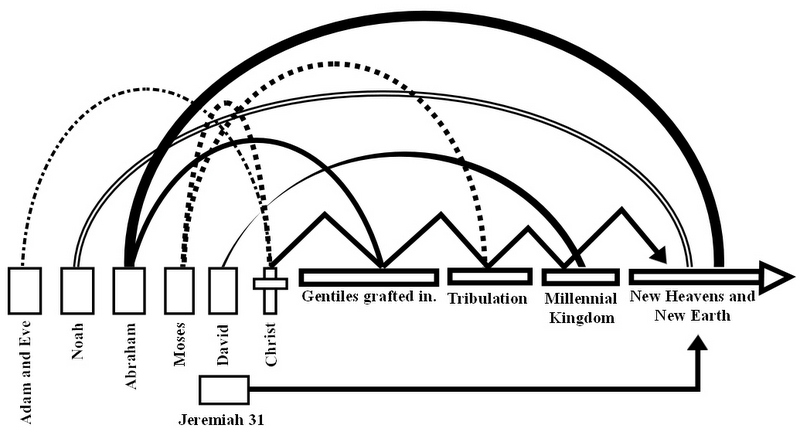
If you are much like me as an average American Christian, you are pretty foggy on God’s overall plan for mankind involving Old Testament and New Testament tenets. Perhaps due to laziness, we accept broad generalizations concerning the differences between the testaments. For example, “Old Testament saints were saved by keeping the law—we are saved by grace,” “God gave the law to show us we can’t keep it—to drive us to resting in Christ alone,” etc.
There is no doubt that it takes diligent study to understand redemptive covenants, election, and sanctification paradigms. The complexities of these issues have not been taught in the American church. Why? Our American Christian heritage comes from the Puritans who arrived on our Eastern shores from Europe. They were Calvinistic, and part and parcel with European Calvinism comes theocracy and orthodoxy. Like ducks searching for bodies of water, European Calvinism will eventually head in this direction. There are no exceptions, and it is only a matter of time. If Calvinism is ultimately deprived of theocracy and orthodoxy, particularity the Puritan breed, it will die. Lesser forms of pure Calvinism can survive well on orthodoxy alone, but the more pure forms like Puritanism will die without theocracy. Hence, Puritanism today is merely folklore propagandized with spiritual sound bites.
What is orthodoxy? It’s the antithesis of Acts 17:11. It assumes a spiritual caste system where some are preordained to understand things that the average saint cannot understand. The average Christian searching the Scriptures to determine if a pastor is teaching truth was, and still is an unacceptable construct in European Calvinism. It is thought to prideful, unsubmissive, and a rejection of God-appointed authority. Orthodoxy is what the spiritually enlightened prepare for the unenlightened in creeds, confessions, and counsels. One advertisement I saw for a seminary announced that it was “confessional.” What does that mean? It means that it teaches and holds to historic confessions of faith. These confessions have authority, and were written by the, for example, “Westminster Divines.” Problem is, this passes a traditional interpretation from generation to generation on an assumptive basis; i.e., to rethink orthodoxy would be arrogantly reinventing the spiritual wheel. This is our heritage, and why we don’t know much. Creeds, confessions, and counsels do not deliver in-depth analysis on the aforementioned issues; primarily, they tell us how to think.
Therefore, the Potter’s House is a journey, and there is no looking back. We have learned astounding things from the book of Romans that Susan and I have never been taught in our combined eighty years of being Christians. But most importantly, what we have learned are building blocks that are keys to understanding more of God’s counsel. I think it is time in our study to look at some of these fundamental building blocks. Some speak directly to the chapter we are in. But first, let’s review some former ones:
1. The “gospel” is the good news of God’s full counsel for life and godliness. The death, burial, and resurrection of Christ is the gospel of “first importance” or “first order of importance.” “Word,” Scripture,” Gospel,” “holy writ,” etc., are all used interchangeably throughout the Bible.
2. Paul categorizes all people into two categories: under law, and under grace. Those under the law are enslaved to sin, provoked to sin by the law, and will be judged by the law. Those under grace are enslaved to righteousness, provoked to do good by the law, and will not be judged by the law.
3. The importance of angels in administering God’s covenants.
4. Salvation is Trinitarian, not Christocentric.
5. A major key to understanding the book of Revelation is Exodus 19-24.
6. The Bible interprets itself and identifies its own methods of interpretation.
7. The law is completely separate from justification, but informs our sanctification.
8. The difference between justification, definitive sanctification, progressive sanctification, and final sanctification.
9. The difference between salvation and justification.
10. Why Christians are truly righteous in the here and now.
11. Why Christians still struggle with sin.
12. The difference between our redeemed hearts and our mortality.
13. Motivation to share the gospel and better ways to do it.
14. Divine Anthropology: what makes mankind tick?
Other things are becoming clearer in our study concerning election and covenants which brings us closer to the issues at hand in chapter nine. I will save election for last because once that is discussed it will be all anybody is thinking about. I would like to use Ephesians 2:11-16 for our first point:
11 Therefore remember that at one time you Gentiles in the flesh, called “the uncircumcision” by what is called the circumcision, which is made in the flesh by hands— 12 remember that you were at that time separated from Christ, alienated from the commonwealth of Israel and strangers to the covenants of promise, having no hope and without God in the world. 13 But now in Christ Jesus you who once were far off have been brought near by the blood of Christ. 14 For he himself is our peace, who has made us both one and has broken down in his flesh the dividing wall of hostility 15 by abolishing the law of commandments expressed in ordinances, that he might create in himself one new man in place of the two, so making peace, 16 and might reconcile us both to God in one body through the cross, thereby killing the hostility.
This passage makes separation from the covenants of promise synonymous with being alienated from God. There is also more than one covenant of promise.
“Covenants” is in the plural. So, we don’t want to think of Old Testament Covenants as being replaced by the New, but rather we want to think of all of these covenants as building on each other. Also, the covenants will have future elements, abolished elements, and elements that are being phased out with time. Paul states what part of the Mount Sinai Book of the Covenant was “abolished,” the ordinances regarding sin offerings since Christ fulfilled the propitiation for sin (vv. 14, 15).
To be separated from Christ is also likened to being separated from the “commonwealth” of Israel (v. 12). This speaks to Israel as a nation. As we discussed last week, this doesn’t mean that all of national Israel will be saved. They were an elect nation with elect people, but not all in the nation are elected individually. Allegorically, some are descendants of Hagar and others are from Sarah. This symbolizes slavery to sin versus heirs of the promise. Paul wanted to make sure the Gentiles at Rome understood that rebellion within Israel didn’t mean that God had revoked His promises to Israel as a nation.
As yet, none of the covenants have been abolished. Again, some elements are yet future, some are fading away, and some elements have been abolished. Even the New Covenant has such elements. Jeremiah 31 states that the law of God will be written on everyone’s heart and there will be no need to teach anybody about the Lord. Obviously, that is future. We read the following in 1Corintians 13:8-10;
8 Love never ends. As for prophecies, they will pass away; as for tongues, they will cease; as for knowledge, it will pass away. 9 For we know in part and we prophesy in part, 10 but when the perfect comes, the partial will pass away.
Prophesies, tongues, and knowledge are all under the New Covenant (past, present), and when the perfect comes knowledge will pass away. Nobody will have need to be taught as Jeremiah predicted. That’s future. The “perfect” is what Peter said we are ultimately looking for: the new heavens and new earth:
1Peter 3:13 – But according to his promise we are waiting for new heavens and a new earth in which righteousness dwells.
The “promise” is another name for the Abrahamic covenant which, as we looked at last week, included the Gentiles from the beginning.
Another truth about the Old Covenant is that it was a will. It was like the inheritance that your parents leave you in their will. The inheritance is eternal life, and Christ, the testator, had to die for the will to be executed:
Hebrews 9:15 – Therefore he is the mediator of a new covenant, so that those who are called may receive the promised eternal inheritance, since a death has occurred that redeems them from the transgressions committed under the first covenant. 16 For where a will is involved, the death of the one who made it must be established. 17 For a will takes effect only at death, since it is not in force as long as the one who made it is alive. 18 Therefore not even the first covenant was inaugurated without blood.
And like any will, the inheritance is promised. In this sense, sin was bound up or imputed to the covenant until Christ came:
Galatians 3:15 – To give a human example, brothers: even with a man-made covenant, no one annuls it or adds to it once it has been ratified.
Galatians 3:21 – Is the law then contrary to the promises of God? Certainly not! For if a law had been given that could give life, then righteousness would indeed be by the law. 22 But the Scripture imprisoned everything under sin, so that the promise by faith in Jesus Christ might be given to those who believe. 23 Now before faith came, we were held captive under the law, imprisoned until the coming faith would be revealed. 24 So then, the law was our guardian until Christ came, in order that we might be justified by faith. 25 But now that faith has come, we are no longer under a guardian, 26 for in Christ Jesus you are all sons of God, through faith.
These are building blocks; neither do I have a full understanding about how all of this works together, but apparently sins were imputed to the covenat/will until Christ died. To be saved in the Old Testament was to acknowledge that you were an heir of salvation through Christ. So, Old Testament saints would have definitely been looking for the coming of Christ. Soon after Christ died, the Gentiles received the good news that they were part of the inheritance as well.
Furthermore, outside of the covenant there is a principle of reaping and sowing as well as a principle of reaping and sowing in the covenant as well. This is abundantly clear as Paul cites the Old Covenant in regard to blessings in this life:
Ephesians 6:1 – Children, obey your parents in the Lord, for this is right. 2 “Honor your father and mother” (this is the first commandment with a promise), 3 “that it may go well with you and that you may live long in the land.” 4 Fathers, do not provoke your children to anger, but bring them up in the discipline and instruction of the Lord.
Hence, promises of spiritual wellbeing through obedience are an undeniable part of the Old Covenant and most definitely still in effect presently. There is a lot going on in these covenants and confusion in our day is not lacking. Nevertheless, the Scripture explains all of this in further detail, but it takes diligent study to show ourselves approved. The following chart may be helpful in encouraging you to study these things for yourself.
Lastly, the relationship between covenants and election. I get my share of grief over my present understanding of election. I take a paradoxical position. Election is 100% true and is crucial for keeping justification and sanctification separate as well as eternal security. Paul, as we saw last week, states the purpose of election is no uncertain terms: to exclude works from justification. On the other hand, I believe free will is also 100% true. I believe this because it is what I see in the Scriptures. It comes with special privilege as well: I get accused of being both a Calvinist and Arminian. But Calvinists don’t believe in election, that’s a myth. For example, though Israel was clearly elected by God (DEUT 7:6-8), most of them hold to Supersessionism. That’s the belief that God replaced Israel with the church because they violated their covenant with God. This is a denial of election. The promise is not contingent on anything we do. It’s not conditional. Blessings and cursing/reaping and sowing is conditional, but not election. This same Reformed take on Israel applies to the individual as well: we are elected to participate in the race, but must be faithful to the church in order to not be disqualified from the race of faith. Calvinists don’t believe in election. As if their doctrine wasn’t goofy enough already—you can add that: the supposed sultans of election don’t even hold to it.
Besides, this paradox can be seen in real life. We implore people with all passion to be reconciled to God, especially Arminians. Yet, Arminians always credit God with saving the person. Few Arminians will ever be heard crediting themselves or the redeemed person for his/her salvation. Nor have I ever heard an Arminian pray to God that anyone would save themselves.
In additon, to satisfy my John Locke Christian friends, its science. Susan and I have a friend who is in the process of writing a book on God’s sovereignty and man’s free will. I will share a small portion of his manuscript to make my point:
Of course, it must be admitted that finite mankind has a limited capacity for understanding the workings of our Infinite Creator. Consequently, one practical way to resolve this challenge to our faith is to face up to the reality of our finite ability to understand God’s workings. In this approach, it is necessary to accept by faith those things that seem beyond any rational understanding. For many, this may be a satisfactory solution to the dilemma. In fact, a similar approach is sometimes followed in the field of science. Consider, for example, the physics of light where two seemingly contradictory theories are used side-by-side to explain its different properties. The wave theory is used to understand the oscillation aspects of light (e.g., Polaroid sunglasses), while at the same time the particle theory is employed to explain other applications (e.g., photoelectric solar panels). Although these two theories are totally incompatible, each provides useful information in certain technical applications. To date, scientists simply use the appropriate theory as needed for a particular design problem. There is no worry about whether light actually exists as a wave, or as a particle, just because it is not yet fully understood. This same approach may be taken in the spiritual realm and is probably the best stance to take in dealing with the apparent contradiction between individual free will and God’s total sovereignty.
As an avid reader of the Bible since my conversion in 1983, I began to take this position in 1986 and have not abandoned it yet. The apostles and others evangelized like it depended on them, but yet made strong statements regarding the sovereignty of God in salvation.
paul
For a free DVD of this message mailed to you at no charge, click here.
The Potter’s House is a member of the Home Fellowship Network: homefellowship.net


 Paul's Passing Thoughts
2 comments