Predestination and Fatalism: “How Much?” is the Question that Only Leaves Two Choices

Originally published May 30, 2014
“This speaks to conditional and unconditional promises by God, cause and effect, and hope. What is at stake is our very understanding of reality itself.”
“What am I saying? A am saying that predeterminism is not a paradox in and of itself, I am suggesting that we consider the idea in our study that predeterminism is a slippery slope to making all of life a paradox. In other words, it makes objective truth unknowable.”
This is part 6 of our series on predestination. We are in the process of evaluating predestination from the viewpoint of love, promises, judgment, cause and effect, hope, commandments, obedience, fear, foreknowledge, freewill, choice, ability, total depravity, evangelism, the gospel, Bible doctrine, paradox, and salvation. In most cases, determinism creates a strained understanding of what some of these words mean to us in real life.
For instance, if God loves the world and man does not have the ability to choose, why does God choose some and not others? He is impartial, no? Why will God judge those who never had a chance to escape judgment? Would God really command us to do things that He knows we are not able to do? How is God’s love really defined? Paradox is a reality, but to what extent do we except paradox as a replacement for the common understanding of life concepts and the words that describe them? Are the simple concepts of commands, love, and choice really a paradox in spiritual matters but necessarily taken literally in the milieu of life? Does whosoever will really mean whosoever has been chosen? And if it does, why doesn’t God simply state that accordingly?
In part one, we established an important starting point: the doctrine of predestination has always been primarily framed and assimilated by Reformed theologians. That’s a problem because they had/have the gospel wrong. This is a matter of simple theological math; they were on the wrong side of the law and gospel. Therefore, the doctrine must be reexamined.
In part 2, we examined God’s will in regard to the lost and the relationship of evangelism and paradox. Evangelism is another word that becomes paradoxical in light of predestination. Obedience is a paradox, love is a paradox, judgment is a paradox, and evangelism as well because the legitimacy of the offer of salvation is called into question. Whosoever will becomes whosoever has been elected. If election is a paradox, all of the concepts connected to it are paradoxical as well.
In part 2, we established that God does not desire that any person perish. He does not take pleasure in the death of the wicked. Which brings up another paradox: does God plead and exhort man to be saved while knowing that he is unable to respond? When God states, “come, let us reason together,” is he saying that while knowing that man is unable to reason?
At any rate, we concluded in part 2 that God does not desire the death of the wicked—He desires that all would be saved.
In part 3, we established that predestination was not unique with the Reformers. In fact, determinism is an ancient concept that has dominated human history. We also examined the historical bad fruit produced by its ideology, and biblical contradictions as well.
In part 4, we looked at the means by which God seeks man. Man is created with intuitive knowledge of God, man begins life in the book of life and must be blotted out if he/she perishes, and Christ died for all men, not just the elect. Though not in the study, the fact that all sins are imputed to the Old Covenant, and belief in Christ eradicates the Old Covenant and all of the sin imputed to it, it implies a readiness and desire of God to vanquish one’s sin. The imputation of all sin to a covenant is sort of the opposite of starting life in the Book of Life; God wants to keep you in the one book and get rid of the other one.
Moreover, God sent the Holy Spirit to convict the world of sin and the judgment to come while the works of God’s law are already written on the heart of every person. On the one hand, God has set up a gargantuan infrastructural reality to facilitate the salvation of man, but in all of this, who enters in is ultimately predetermined by Him. Why all the drama? Why all of the paradox? Why all of the confusion? Yet, another paradox that could be added is the Holy Spirit’s warning in regard to judgment along with all of God’s prophets; why offer this incentive to escape judgment to those who are unable to respond? This speaks to conditional and unconditional promises by God, cause and effect, and hope. What is at stake is our very understanding of reality itself.
In part 5, we begin to answer the question, “How much?” Let’s say that man is unable to choose God initially, but what about post new birth? Is man then able to make choices? Curiously, the Reformers say, “no.” We looked at the Reformed redemptive-historical hermeneutic that interprets all reality as a gospel metaphysical narrative. We simply put ourselves in the narrative by believing everything in life points to a truth about Christ and is predetermined. We called this plenary determinism. Also, while discussing this, we introduced the possibility that certain things are predetermined by God, while other things are not. We used the following chart to illustrate this:

Granted, we want some things to be predetermined by God. We want a happy ending. We want justice. We want the good guys to win. We want everyone to live happily ever after. In times of danger, we want our fears tempered by knowing that God is control. In the book of Revelation, for certain, the opening of the six seals will make it seem like the earth is in complete chaos and spinning out of control, but the fact will be that God is in control of every bit of that. Will that temper the fear of those who know that at the time? Sure it will.
But is everything predetermined? Does man have any role in reality at all? The main source for predestination doctrine has always been the Reformers, at least in Western culture, and they disavow choice in both the saved and unsaved state. Consequently, from an eschatological view, there is only one judgment in which both believers and unbelievers stand in to determine one’s eternal fate. Opposing eschatological views posit a separate judgment for believers and unbelievers, one for reward (believers), and one that condemns (unbelievers).
Obviously, the idea of reward strongly suggests that the reward is for something earned by making a right choice. In Reformed circles, rewards spoken of in the Bible are attributed to salvation (the reward[s] is salvation), but now we have yet another paradox because it is not really a reward that we get for something that we did! What am I saying? I am saying that predeterminism is not a paradox in and of itself, I am suggesting that we consider the idea in our study that predeterminism is a slippery slope to making all of life a paradox. In other words, it makes objective truth unknowable.
However, the Reformers state that truth can be known, and that there is no paradox at all: Man and history were created to glorify God. Everything that happens is predetermined by God (cause), and everything that happens is for God’s glory, and in fact, does glorify Him (effect). Hence, man has no ability to choose in being the cause for anything that happens. Judgment reflects God’s glory alone in simply revealing what God has preordained via good or evil. If this is not true, then how much choice does man have? That must be determined. If true, then how much choice does man not have? This must be determined as well.
At the T4G 2008 conference, John MacArthur stated the following:
The sum is that man is evil and selfish, unwilling and unable because he is dead. He loves his sin. He loves the darkness. He thrives on selfish lust. He’s happy to make a god of his own, manufacturing and convinced himself that he is good enough to satisfy that god. He may see his sin in his sin, but he does not see his sin in his goodness, and he does not see his sin in his religion, and it is his sin in his goodness that is most despicable for there is the deception and it is his sin in his religion that is most blasphemous because there it is that he worships a false god…
The contemporary idea today is that there’s some residual good left in the sinner. As this progression came from Pelagianism to Semipelagianism and then came down to sort of contemporary Arminianism and maybe got defined a little more carefully by Wesley who was a sort of a messed up Calvinist because Wesley wanted to give all the glory to God, as you well know, but he wanted to find in men some place where men could initiate salvation on his own will. That system has literally taken over and been the dominant system in evangelical Christianity. It is behind most revivalism. It is behind most evangelism. That there’s something in the sinner that can respond.
Notice how MacArthur combines ability with goodness. Ability is made to be a moral issue. Why does an ability to choose something, or make a wise choice, or desire to have something that is rooted in anthropology, have to be an issue of inherent goodness? If unregenerate man can make wise choices, or at least correct choices, and certainly he can, why couldn’t one of those wise choices be that of salvation? Yes, certainly the Bible teaches that man’s inclination is away from God, but once God seeks him out and confronts him, does he have the ability to be persuaded? Why is man able to choose to stop at a red light (cause) to prevent an accident (effect), but unable to choose God?
Throughout the same message, MacArthur asserts the following like points:
Wesley wanted to give all the glory to God, as you well know, but he wanted to find in men some place where men could initiate salvation on his own will.
Here, MacArthur makes an ability to choose equal with initiating the means of salvation and initially seeking God. Our previous lessons assert that man doesn’t initially seek God, but once God seeks him by various means, man has the ability to choose. Man has many abilities that are morally neutral, even in his weakness, why can’t the ability to choose be one of them when he/she is aided by God and convicted by the Holy Spirit? In Scripture, we have instances of men being nearly persuaded (Mark 12;34, Acts 26:25-32); what are we to surmise from this, that man has the ability to be partially persuaded, but not the ability to be fully persuaded? James suggested that some men can believe in God, but fall short of believing in a saving way (2:19). This means man has an ability to believe in God intellectually, but is unable to understand saving truth about God and make his own choice? Why would man then have the ability to believe in God at all?
According to MacArthur,
A new wave followed as people struggled to hang on to human freedom which said that Adam’s sin had “in some measure” affected and disabled all men, but sinners were left with just enough freedom of the will to make the first move of faith toward God. And then God’s grace kicked in. But sinners made the first move, and that’s what became known as semi-Pelagianism. Some would call it prevenient grace. There’s a component of grace in all human beings that gives them in the freedom of their own will the ability to initiate salvation. The idea is that depravity is real, but it is not total. Saving grace from God then becomes a divine response rather than the efficient cause of our salvation. This view is denounced, as you know, by several councils starting around 529.
How does an ability to choose equal the initiation of salvation? How does an ability to choose, or the freedom of the will to choose equal us making the first move? We by no means made the first move! Clearly, God made the first move by supplying the means of salvation, and the second move by calling all men unto salvation. After this, how does our abilty to choose constitute the “first move”? It’s not the first move, it’s a response to God’s love. And in regard to the point of our first lesson, throughout his message, MacArthur validates his points by citing St. Augustine; that is very problematic in and of itself. MacArthur then moves on in the same message to make the new birth synonymous with our ability to choose. If we have an ability to be persuaded, that is supposedly like giving birth to ourselves:
When the Bible speaks about the condition of the sinner, with what words does it speak? Well, when the Bible speaks of the sinner’s condition, it is usually in the language of death, sometimes darkness, sometimes blindness, hardness, slavery, incurable sickness, alienation, and the Bible is clear that this is a condition that affects the body, the mind, the emotion, the desire, the motive, the will, the behavior. And it is a condition that is so powerful no sinner unaided by God can ever overcome it… John 3, you are very familiar with it, Nicodemus, and no one is going to be able to see the kingdom of God unless he’s born again, Jesus said in verse 3, very interesting. Nicodemus said to him, “How can a man be born when he is old? He cannot enter a second time into his mother’s womb and be born, can he?” He is not stupid. He’s a teacher in Israel. He’s speaking metaphorically. He’s picking up on Jesus’ born again metaphor and asking the question, how does that happen? How does it happen? You can’t do it on your own. You can’t birth yourself. That’s his point. He gets it. He understands that man has no capability to bring birth to himself. Jesus follows up by saying, “Truly, truly, I say to you, unless one is born of water and the spirit,”
First, MacArthur’s concession, perhaps unwittingly, that “it is a condition that is so powerful no sinner unaided by God can ever overcome it” is exactly what we are saying, and not by any means that man can choose God solo. God supplies the means of salvation and seeks after man with the conviction of the Holy Spirit and the word of God. But in the end, man is able to neglect this great salvation, and to his own eternal detriment. Also, the new birth is part of the means of salvation totally out of man’s control; the new birth is a promise to those who believe, and obviously not man giving birth to himself.
When you start thinking about these things apart from Reformed orthodoxy, some observations become interesting. MacArthur used the following proof texts to make one of his points:
But let me just work you through John for a minute, John 1:12-13. “But as many as received him, to them he gave the right to become the children of God even to those who believed in his name who were born, not of blood nor of the will of the flesh nor of the will of men, but of God.” That is unmistakable. Unmistakable. Salvation being the work of God.
First, notice that man’s role is simply to receive, and then man is “given” the “right” to become the children of God. Then MacArthur bemoans the following:
It is behind most revivalism. It is behind most evangelism. That there’s something in the sinner that can respond. And this is sort of like the right in a free country. You have to have this right. This wouldn’t be fair if God didn’t give the sinner the right to make his own decision so that the sinner unaided by the Holy Spirit must make the first move. That’s essentially Arminian theology. The sinner unaided must make the first move. And God then will respond when the sinner makes the first move.
This is exactly what the proof text that MacArthur stated says, that those who receive Christ do in fact have the “right” to become part of God’s kingdom. Also, in stating his Reformed logic in another way, he suggested that hearing the gospel message and receiving it was the same thing as preaching ourselves:
What can remedy that? We do not preach ourselves, verse 5, we preach Christ Jesus as Lord and ourselves as your slaves for Jesus’ sake. We preach the gospel of Christ as lord and ourselves as slaves. And what happens? Verse 6, God who said light shall shine out of darkness, that’s taking you back to creation, God who created, who spoke light into existence is the one who has shown in our hearts to give the light of the knowledge of the glory of God in the face of Christ.
Aside from the fact that having the ability to be persuaded is not preaching ourselves rather than Christ, note that MacArthur equates creation with the gospel which insinuates that the fall was built into creation itself. This is part and parcel with the supralapsarianism that we discussed in previous lessons.
But the thrust of this lesson centers on the “how much” when it comes to any role at all for man in salvation and the logical end of it, and in the final analysis how God’s love is defined. This is a sobering consideration. In both the 2013 Shepherds’ Conference and T4G 2008, MacArthur presents the idea that John 3, regarding the new birth, is something that is done to the individual without any participation on the part of the believer. The clear message in both cases was that any decision or belief on the part of the believer was excluded also. It was very much like the following rendition of the same text:
When we consider the great teachings of Scripture, they are not there just to give us information and they are not to teach us what we can do in our own strength. In Musings 34 (http://www.godloveshimself.org/?p=2018) we looked at how believing that the doctrine of justification is true is not the same thing as being justified. The new birth was also mentioned at the end. In the passage above (John 3:3-5) Jesus speaks pointedly and with power in a way that reflects on the issue being mused on here. Jesus did not tell Nicodemus that he must know the truth about the new birth in order to enter the kingdom. Jesus also did not tell Nicodemus that he must believe the truth about the new birth in order to enter the kingdom. Instead of that, Jesus told Nicodemus that he must actually be born again in order to enter the kingdom. There is a huge difference between believing what is true and what is true actually happening to you.
If we take this as a picture or even as an example of the teachings of Scripture, we can view what it means to believe something with different eyes or with a different perspective. Neither Jesus or Paul declared that a person must believe the facts about justification in order to be justified, but simply that a person must be justified (God Loves Himself .wordpress .com: Musing 35; February 10, 2014).
So, if reality is a prewritten metaphysical narrative for the sole purpose of glorifying God in all that happens in the narrative, it only stands to reason that God is motivated by self-glorification and self-love as the highest purpose for all that he does:
Perhaps this concept that Edwards gives just above cannot be stated too strongly or emphasized too much since all true Christianity depends on the truth of it. If God is not centered upon Himself and He does not do all for His own glory, then God Himself is not holy and acts against the perfection of His own nature, wisdom, holiness, and perfect rectitude. If God Himself does not love Himself and do all He does out of love for Himself (as triune), then He does not keep the same standard that He commands all others to do. If God does not love Himself and do all He does out of love for Himself, then the both the great Commandments and the Ten Commandments are not a transcript of the character of God. If God Himself does not love Himself and do all He does out of love for Himself (as triune), then He does not do what He requires of others in the first three petitions in the Lord’s Prayer. If God Himself does not love Himself and do all He does out of love for Himself (as triune), then He does not do all in His own name as He requires others to do so. If God Himself does not love Himself and do all He does out of love for Himself (as triune), then He does not do all for His own glory which He requires others to do (God Loves Himself .wordpress .com: Edwards on the God Centeredness of God; 11 December 7, 2013).
Add yet another paradox in regard to love. God didn’t send His Son to the cross because he loves mankind, he sent His Son to the cross because He loves Himself. The list of commonly understood words in a grammatical reality that have been redefined by the doctrine of determinism is now very lengthy. Why indeed did God even bother to write the Bible in a grammatical format? No wonder that Rick Holland, a former associate of John MacArthur has stated that good grammar makes bad theology. No kidding? Add yet another paradox: the idea that God is not a God of confusion. Of course, the Reformed would say that there is no confusion at all—ALL things are predetermined for God’s glory and completely out of our control—end of story.
Let’s pad this point a little more with some quotes from John Piper:
I would like to try to persuade you that the chief end of God is to glorify God and enjoy himself forever. Or to put it another way: the chief end of God is to enjoy glorifying himself.
The reason this may sound strange is that we tend to be more familiar with our duties than with God’s designs. We know why we exist – to glorify God and enjoy him forever. But why does God exist? What should he love with all his heart and soul and mind and strength? Whom should he worship? Or will we deny him that highest of pleasures? It matters a lot what God’s ultimate allegiance is to! (Desiring God .org: Is God for Us or for Himself?; October 23, 1984).
Actually, the Bible states that the chief end of man is to obey God, and that God takes more pleasure in obedience than sacrifice (Ecc 12:13,14 1Sam 15:22). I am not sure that the Bible ever states any “chief end” of God. Really? God’s life has a primary purpose that we can understand? And its narcissism?
Though there seems to be many Scriptures that bolster determinism, it requires the redefining of many commonly understood word meanings, and inevitably leads to an unavoidable illogical outcome. If the doctrine of predetermination in and of itself was the only paradox, that would be different, but the problem we see here is that it makes all of reality a paradox unless you accept the mythological Reformed metaphysical narrative.

Election

This will be our ninth and final lesson on election. We will now continue on in our verse by verse study of Romans. We will resume in Romans 14:1. Just three chapters left in our study of Romans. We are not quite ready to relent from our focus on justification in this gospel-illiterate age, so our next verse by verse focus will be Paul’s letter to the Galatians.
I wanted to divert into a temporary journey of discovery regarding election because it is an important part of Paul’s letter to the Romans. As I have stated before, I was comfortable skimming over the subject because of the overall ignorance in regard to justification. I somewhat rethought that position and decided to look at election closer. The first eight parts of our interlude have set forth a mostly logical argument against the idea of salvific preselection of individuals, but I believe our study here nails down a definitive doctrinal argument based on grammatical interpretation.
I have come to believe that individuals are not preselected, but it is the plan of salvation that is elected, and the end of it predetermined. Hence, the certain outcome of God’s plan for the ages is what is predetermined, and that is part of the good news: a hopeful outcome is predetermined, not specific people. Certainly, God knows who is going to be saved, but He does not preselect individuals for eternal life and eternal damnation. I have seen this vaguely in Scripture from time to time, but the first three chapters of Ephesians have convinced me of it.
This is why we are going to move on in the book of Romans; we could spend a lifetime learning about election, but I think basic understanding is enough for now as we will see more of the pieces come together in future readings.
Whenever election appears in the text of Scripture, the subject is almost always Jew and Gentile, and that is what we see in the first three chapters of Ephesians. Election is not about individuals, it is about God’s purpose for groups in His overall plan of salvation. Individuals are not excluded from the plan of salvation. The plan is offered as a gift to man, and there is no other way to be saved. That’s the theme of election—it is the offering of a gift; viz, God’s plan of salvation for all men.
Ephesians 1:3 – Blessed be the God and Father of our Lord Jesus Christ, who has blessed us in Christ with every spiritual blessing in the heavenly places, 4 even as he chose us in him before the foundation of the world, that we should be holy and blameless before him. In love 5 he predestined us for adoption as sons through Jesus Christ, according to the purpose of his will, 6 to the praise of his glorious grace, with which he has blessed us in the Beloved.
“Us” refers to both Jew and Gentile. Jew and Gentile were chosen before the foundation of the earth, not individuals. Paul will also cite the specific purposes of God’s plan accordingly. Two groups of people are in view here, not individuals. As we move along, this becomes clearer and clearer. These groups were chosen “in Christ.” His death made the inclusion possible. These groups will also be adopted sons, or part of God’s literal family.
Ephesians 1:7 – In him we have redemption through his blood, the forgiveness of our trespasses, according to the riches of his grace, 8 which he lavished upon us, in all wisdom and insight 9 making known to us the mystery of his will, according to his purpose, which he set forth in Christ 10 as a plan for the fullness of time, to unite all things in him, things in heaven and things on earth.
What is elected is Christ and God’s plan for the ages. The “mystery” of His will is according to His purposes set forth in Christ. The purposes are, “to unite all things in him,” which includes heaven and earth, and to make it all “known to us,” that is, Jew and Gentile.
Ephesians 1:11 – In him we have obtained an inheritance, having been predestined according to the purpose of him who works all things according to the counsel of his will, 12 so that we who were the first to hope in Christ might be to the praise of his glory. 13 In him you also, when you heard the word of truth, the gospel of your salvation, and believed in him, were sealed with the promised Holy Spirit, 14 who is the guarantee of our inheritance until we acquire possession of it, to the praise of his glory.
“We” is Jew and Gentile. But, “we” in verse 12 are the Jews only who were first to hope in Christ. God’s will is that they be the “praise of his glory.” Note “In him you also” (verse 13) is obviously talking about Gentiles. Individuals are not the subject here. What is in view is God’s plan, purposes, and the groups that He has chosen to bring about those purposes according to the counsel of His will.
Individuals enter into the privileges and purposes of God’s plan when they hear the word of truth and believe. It is when we hear the gospel and believe that we are “sealed.” Hence, it is God’s plan for people groups that is predetermined, individuals are saved in time when they hear the gospel and believe. It is “when” we heard and believed that we were “sealed,” we were not sealed before the foundation of the earth; we were sealed in time when we believed. There is a clear distinction in the text between these two ideas. We enter into God’s family and His plan for the ages “through” faith.
Ephesians 2:1 – And you were dead in the trespasses and sins 2 in which you once walked, following the course of this world, following the prince of the power of the air, the spirit that is now at work in the sons of disobedience— 3 among whom we all once lived in the passions of our flesh, carrying out the desires of the body and the mind, and were by nature children of wrath, like the rest of mankind. 4 But God, being rich in mercy, because of the great love with which he loved us, 5 even when we were dead in our trespasses, made us alive together with Christ—by grace you have been saved— 6 and raised us up with him and seated us with him in the heavenly places in Christ Jesus, 7 so that in the coming ages he might show the immeasurable riches of his grace in kindness toward us in Christ Jesus. 8 For by grace you have been saved through faith. And this is not your own doing; it is the gift of God, 9 not a result of works, so that no one may boast. 10 For we are his workmanship, created in Christ Jesus for good works, which God prepared beforehand, that we should walk in them.
“Made ‘us’ alive together with Christ” continues to show the dominant theme of Jew and Gentile and God’s purposes in making both groups joint heirs of God’s salvation and entry into His family. Now, many take note of “For by grace you have been saved through faith. And this is not your own doing; it is the gift of God”…
See! See! Your very faith is a gift. Not only is the plan predestined, your faith is predestined.
So, the question becomes, is it God’s grace (salvation) that is the gift, or faith? Let’s answer the question with Scripture:
Romans 3:22…For there is no distinction: 23 for all have sinned and fall short of the glory of God, 24 and are justified by his grace as a gift, through the redemption that is in Christ Jesus, 25 whom God put forward as a propitiation by his blood, to be received by faith. This was to show God’s righteousness, because in his divine forbearance he had passed over former sins. 26 It was to show his righteousness at the present time, so that he might be just and the justifier of the one who has faith in Jesus. 27 Then what becomes of our boasting? It is excluded.
Clearly, it is grace that is the gift, made possible by Christ’s death, and “received” by faith. In both texts, the fact that grace is the gift excludes boasting, not the idea that our faith is predetermined. Also, “Of this gospel I was made a minister according to the gift of God’s grace, which was given me by the working of his power” (Eph 3:7). Grace is the gift, not faith. Faith comes by hearing the word and being persuaded that it is the way of salvation.
Ephesians 3:11 – Therefore remember that at one time you Gentiles in the flesh, called “the uncircumcision” by what is called the circumcision, which is made in the flesh by hands— 12 remember that you were at that time separated from Christ, alienated from the commonwealth of Israel and strangers to the covenants of promise, having no hope and without God in the world. 13 But now in Christ Jesus you who once were far off have been brought near by the blood of Christ. 14 For he himself is our peace, who has made us both one and has broken down in his flesh the dividing wall of hostility 15 by abolishing the law of commandments expressed in ordinances, that he might create in himself one new man in place of the two, so making peace, 16 and might reconcile us both to God in one body through the cross, thereby killing the hostility. 17 And he came and preached peace to you who were far off and peace to those who were near. 18 For through him we both have access in one Spirit to the Father. 19 So then you are no longer strangers and aliens, but you are fellow citizens with the saints and members of the household of God, 20 built on the foundation of the apostles and prophets, Christ Jesus himself being the cornerstone, 21 in whom the whole structure, being joined together, grows into a holy temple in the Lord. 22 In him you also are being built together into a dwelling place for God by the Spirit.
This is the “mystery” that is now revealed:
Ephesians 3:1 – For this reason I, Paul, a prisoner for Christ Jesus on behalf of you Gentiles— 2 assuming that you have heard of the stewardship of God’s grace that was given to me for you, 3 how the mystery was made known to me by revelation, as I have written briefly. 4 When you read this, you can perceive my insight into the mystery of Christ, 5 which was not made known to the sons of men in other generations as it has now been revealed to his holy apostles and prophets by the Spirit. 6 This mystery is that the Gentiles are fellow heirs, members of the same body, and partakers of the promise in Christ Jesus through the gospel.
And another purpose is stated:
Ephesians 3:8 – To me, though I am the very least of all the saints, this grace was given, to preach to the Gentiles the unsearchable riches of Christ, 9 and to bring to light for everyone what is the plan of the mystery hidden for ages in God who created all things, 10 so that through the church the manifold wisdom of God might now be made known to the rulers and authorities in the heavenly places.
The revealing of the mystery and its purposes in Christ is what is elected, not individuals. This is the very theme that is initially stated:
Ephesians 1:3 – Blessed be the God and Father of our Lord Jesus Christ, who has blessed us in Christ with every spiritual blessing in the heavenly places, 4 even as he chose us in him before the foundation of the world, that we should be holy and blameless before him. In love 5 he predestined us for adoption as sons through Jesus Christ, according to the purpose of his will, 6 to the praise of his glorious grace, with which he has blessed us in the Beloved.
Again, “us” is both Jew and Gentile—that the two would be one is what is predetermined—not individuals. It is an “eternal” purpose (Eph 3:11). We gain “access” to this purpose and become part of its covenants and promises “through our faith in him” (Eph 3:11). Faith is distinct from the eternal purpose which is elected. God elected the means which are accessed through faith. If faith is the mark of those who have been preselected as opposed to those who haven’t been preselected, why wouldn’t the Bible state that fact in plain terms? This is why some peradventure to make faith a gift in the same wise as grace using Eph 2:8. Romans 3:22ff and many other texts refute that idea—grace is the gift. In one sense, faith is an indirect gift because without grace there is nothing to believe in, but in the biggest sense salvation is a legitimate offer and mankind’s choice to either accept the gift or reject it.
In this discussion, let’s consider Matthew 22:
And again Jesus spoke to them in parables, saying, 2 “The kingdom of heaven may be compared to a king who gave a wedding feast for his son, 3 and sent his servants to call those who were invited to the wedding feast, but they would not come. 4 Again he sent other servants, saying, ‘Tell those who are invited, “See, I have prepared my dinner, my oxen and my fat calves have been slaughtered, and everything is ready. Come to the wedding feast.”’ 5 But they paid no attention and went off, one to his farm, another to his business, 6 while the rest seized his servants, treated them shamefully, and killed them. 7 The king was angry, and he sent his troops and destroyed those murderers and burned their city. 8 Then he said to his servants, ‘The wedding feast is ready, but those invited were not worthy. 9 Go therefore to the main roads and invite to the wedding feast as many as you find.’ 10 And those servants went out into the roads and gathered all whom they found, both bad and good. So the wedding hall was filled with guests.
11 “But when the king came in to look at the guests, he saw there a man who had no wedding garment. 12 And he said to him, ‘Friend, how did you get in here without a wedding garment?’ And he was speechless. 13 Then the king said to the attendants, ‘Bind him hand and foot and cast him into the outer darkness. In that place there will be weeping and gnashing of teeth.’ 14 For many are called, but few are chosen.”
Again, the context of election is two groups: Jew and Gentile. Jesus directs this parable towards the Jewish leaders who were rejecting Him and leading the Jewish people to do the same. The original invitation to the wedding feast was to the Jews. When they, for the most part rejected the invitation, and even murdered those who invited them, the King orders His servants to call anyone they can find to the feast (the Gentiles). The one found at the feast without the traditional wedding coat represents a Jew who comes to the feast on his own terms.
What I would like to address is verse 14, “For many are called, but few are chosen.” Just about everywhere else in Scripture, the same word translated “chosen” here, is eklektos which appears 21 times in the New Testament and translated “elect.” So, a better translation here would be, “many are called, but few are elect.” Jesus was addressing the mindset of the Jewish leaders that they would be a part of the great feast because they were God’s chosen people. In reality, they were being called to God’s elect purposes which included Christ, the elect angels, and the election of Jews and Gentiles both. Their rejection of this elect purpose would condemn them to eternal punishment. The point saturates the context surrounding this passage.
This brings us to the infamous Acts 13:48:
And when the Gentiles heard this, they began rejoicing and glorifying the word of the Lord, and as many as were appointed to eternal life believed (ESV).
Regardless of the controversy surrounding the various translations of this verse, the context is God’s predetermination that the Gentiles would become heirs of the promises made to Israel. There would not be two classes of people in the kingdom—Jew and Gentile would become one body in the commonwealth of Israel. That is the mystery of the gospel revealed in this age. Acts is the historical account of this plan being unfolded. The point in Acts 13:48 is the inclusion of a group, not the preselection of individuals. I do believe that many translations slant this verse towards that conclusion (individual selection), but clearly, it doesn’t fit the context and is off-topic.
It is amazing how we have been conditioned by Protestantism to interpret everything through the prism of individual selection. Every instance of intervention on God’s part is used to assume plenary predeterminism and thereby plunging the Scriptures into total confusion. God “opened” Lydia’s heart, so that means nobody understands anything unless God shows it to them. Hence, all ignorance is predetermined by God. “Study to show thyself approved,” but you aren’t going to understand anything unless God “opens” your eyes like He did to the disciples on the road to Emmaus.
This extreme view of Scripture starts with plenary monergism, and can only lead to one place: a caste system that inserts philosopher kings as mediators between mankind and God. This is also why Reformed theology posits Christ as the primary member of the Trinity with God the Father and the Holy Spirit playing secondary roles: Christ is promoted to the role of Father so that men can assume His role as mediator between God and mankind. This is where a Platonist worldview is essential to the mediation of elitist philosophers construct. God predetermines certain men to rule over the great unwashed masses. This, in turn, leads to absolution and salvation being found in an institution run by elitists.
Yet another consideration:
Romans 9:6 – But it is not as though the word of God has failed. For not all who are descended from Israel belong to Israel, 7 and not all are children of Abraham because they are his offspring, but “Through Isaac shall your offspring be named.” 8 This means that it is not the children of the flesh who are the children of God, but the children of the promise are counted as offspring. 9 For this is what the promise said: “About this time next year I will return, and Sarah shall have a son.” 10 And not only so, but also when Rebekah had conceived children by one man, our forefather Isaac, 11 though they were not yet born and had done nothing either good or bad—in order that God’s purpose of election might continue, not because of works but because of him who calls— 12 she was told, “The older will serve the younger.” 13 As it is written, “Jacob I loved, but Esau I hated.”
14 What shall we say then? Is there injustice on God’s part? By no means! 15 For he says to Moses, “I will have mercy on whom I have mercy, and I will have compassion on whom I have compassion.” 16 So then it depends not on human will or exertion, but on God, who has mercy. 17 For the Scripture says to Pharaoh, “For this very purpose I have raised you up, that I might show my power in you, and that my name might be proclaimed in all the earth.” 18 So then he has mercy on whomever he wills, and he hardens whomever he wills.
19 You will say to me then, “Why does he still find fault? For who can resist his will?” 20 But who are you, O man, to answer back to God? Will what is molded say to its molder, “Why have you made me like this?” 21 Has the potter no right over the clay, to make out of the same lump one vessel for honorable use and another for dishonorable use? 22 What if God, desiring to show his wrath and to make known his power, has endured with much patience vessels of wrath prepared for destruction, 23 in order to make known the riches of his glory for vessels of mercy, which he has prepared beforehand for glory— 24 even us whom he has called, not from the Jews only but also from the Gentiles?
Once again, what is the context? In fact, what is the context of what follows in Romans chapters 10 and 11? Answer, the whole Jew/Gentile issue… “even us whom he has called, not from the Jews only but also from the Gentiles?” Because of God’s elected purpose, neither Jew nor Gentile has reason to boast. And again, it is grace that is elected, not individual choice. Does the Bible ever say directly that individual choice is predetermined? I don’t think so. Rather, freedom to choose seems to be assumed. For certain, what man can choose is predetermined, but the choice itself is not predetermined. Many things such as God’s intervention and helping us in our weakness is interpreted as plenary monergism—I think this is wrong—weakness does NOT equal total inability.
Furthermore, indeed, God hated Esau and loved Jacob before they were even born…or did he? Read the text carefully. Before they were born, he predetermined that the older would serve the younger based on what God knew about these two men and their lives beforehand. Esau would not be selected to further the linage of the coming Messiah because of what God knew about his character beforehand. If you read the Old Testament text that Paul uses to make his point (Malachi 1:2,3), you will find that God hated Esau because of his betrayal of Israel in time, not because God predetermined his behavior.
God elected the plan of salvation and His purposes for the ages. All men are “invited” (klētos: Rom 8:28; Matt 22:14) to be a part of this plan THROUGH faith. Many are invited, but only those who love God are part of His elect group called out for His specific purposes. The plan, and the way he works all things together for the elect is His “workmanship,” not individuals per se. In other words, God doesn’t predetermine our choices as God’s elect. He may intervene at certain points to bring about our good, but we are responsible for our own choices. Unsaved people are free to accept the invitation or reject it.
This is why many of the Reformed make it a point to call the gospel an “announcement,” “herald,” or “proclamation.” The idea that the gospel is an “invitation” creates huge problems for them.
The so-called “church,” ekklēsia, is the “out-called,” ek (out) – klesia (called). It is not an institution; it is a calling to Gods purposes for the ages and an invitation to be a part of it. You are being called away from all other plans to God’s plans that have a certain end—you can also call that “repentance.” You are “persuaded” by the invitation and believe it.
You are then part of God’s elect.
Romans Series Interlude: Predestination, a Potter’s House Journey; Part 8, “What’s in the Word, ‘Perseverance’”? Part 1 on “Perseverance”

The doctrine of perseverance is a confused mess. In the book, The Race Set before Us: A Biblical Theology of Perseverance & Assurance by Thomas R. Schreiner and Ardel B. Caneday, they try to clear up the confusion about the doctrine. However, the book merely toes the traditional Reformed line of already but not yet. What is that?
It’s the belief that those who have already been chosen (already) and predetermined for salvation can have assurance by working out their salvation through obedience. This doesn’t necessarily determine with certainty whether or not you have been chosen, but it can give you the best peace and assurance possible until the one final judgment where God separates the sheep from the goats (not yet). Shreiner and Caneday assert that God uses “warnings and admonitions” as a means to complete the PROCESS (Ordo Salutis) of salvation.
Let’s be clear, the Reformed Ordo Salutis (Latin for “order of salvation”) includes justification (salvation), regeneration, sanctification, and glorification. It’s not semantics about what happens first, second, and maybe third at the point of salvation. Yet, the Reformed crowd insists on being indignant about the accusation of “progressive justification.” Clearly, they teach salvation as a process and not a finished work.
So, as a believer, you merely take part in the means and outcome of what God has already predetermined. If you don’t persevere, that means you were not given the “gift” of perseverance. It’s not works salvation per se, the outcome has already been determined, your work in sanctification is merely the MEANS God uses to complete what He has already predetermined. However, you don’t have any chance at all unless you enter The Race Set Before Us. This same explanation is used for evangelism; viz, you are participating in what God has already predetermined.
This fits perfectly with Calvin’s three classes of persons in regard to election: the non-elect, the general elect, and those who persevere. The non-elect do not enter the race of salvation at all; those of the general call are temporarily illumined, but only those who persevere are the true elect—those who have been given the “gift” of perseverance…
Let us, therefore, embrace Christ, who is kindly offered to us, and comes forth to meet us: he will number us among his flock, and keep us within his fold. But anxiety arises as to our future state. For as Paul teaches, that those are called who were previously elected, so our Savior shows that many are called, but few chosen (Mt. 22:14). Nay, even Paul himself dissuades us from security, when he says, “Let him that thinketh he standeth take heed lest he fall,” (1 Cor. 10:12). And again, “Well, because of unbelief they were broken off, and thou standest by faith. Be not high-minded, but fear: for if God spared not the natural branches, take heed lest he also spare not thee,” (Rom. 11:20, 21). In fine, we are sufficiently taught by experience itself, that calling and faith are of little value without perseverance, which, however, is not the gift of all (CI 3.24.6).
The expression of our Savior, “Many are called, but few are chosen,” (Mt. 22:14), is also very improperly interpreted (see Book 3, chap. 2, sec. 11, 12). There will be no ambiguity in it, if we attend to what our former remarks ought to have made clear—viz. that there are two species of calling: for there is an universal call, by which God, through the external preaching of the word, invites all men alike, even those for whom he designs the call to be a savor of death, and the ground of a severer condemnation. Besides this there is a special call which, for the most part, God bestows on believers only, when by the internal illumination of the Spirit he causes the word preached to take deep root in their hearts. Sometimes, however, he communicates it also to those whom he enlightens only for a time, and whom afterwards, in just punishment for their ingratitude, he abandons and smites with greater blindness (CI 3.24.8).
The Reformed gospel is little more than an invitation to enter the salvation lottery. Some Reformed pastors do teach that you can know that you are saved, but the prescription is entering a rest wherein you stay at the foot of the cross rather than picking it up and walking according to the Spirit. Supposedly, doubt is always the result of “legalism” and the cure is a return to faith alone in our Christian walk. It’s about “what Jesus has done, not anything you do.” Nevertheless, proponents of this view say that sanctification is “hard work” because admitting our sin and “deep repentance” is hard for us to do. The essence of all sin is the “pride of life” and “thinking that we have some semblance of good.”
A myriad of Scripture texts are used to support this motif.
Philippians 2:12 – Therefore, my beloved, as you have always obeyed, so now, not only as in my presence but much more in my absence, work out your own salvation with fear and trembling, 13 for it is God who works in you, both to will and to work for his good pleasure.
We are to work out the already salvation, with fear and trembling, because it is God within us that is using the Christian life as a means to complete the work he began in us:
Philippians 1:6 – And I am sure of this, that he who began a good work in you will bring it to completion at the day of Jesus Christ.
“Fear and trembling” denotes uncertainty, and this is exactly what John Calvin advocated in the Christian life:
Certain learned men, who lived long before the present days and were desirous to speak simply and sincerely according to the rule of Scripture, held that repentance consists of two parts, mortification and quickening. By mortification they mean, grief of soul and terror, produced by a conviction of sin and a sense of the divine judgment. For when a man is brought to a true knowledge of sin, he begins truly to hate and abominate sin… By quickening they mean, the comfort which is produced by faith, as when a man prostrated by a consciousness of sin, and smitten with the fear of God, afterwards beholding his goodness, and the mercy, grace, and salvation obtained through Christ, looks up, begins to breathe, takes courage, and passes, as it were, from death unto life. I admit that these terms, when rightly interpreted, aptly enough express the power of repentance; only I cannot assent to their using the term quickening, for the joy which the soul feels after being calmed from perturbation and fear. It more properly means, that desire of pious and holy living which springs from the new birth; as if it were said, that the man dies to himself that he may begin to live unto God (CI 3.33).
The four words that must be considered here are judgment, salvation, fear, and perseverance. There are two judgments, two fears, two salvations, but only ONE perseverance. Perseverance is not related to justification or salvation. There are two judgments; one pertaining to justification, and another pertaining to the Christian life. There are two fears; one pertaining to the unregenerate, and one pertaining to the saved. And there are two salvations; one is the eternal saving of the soul, and the other is being saved from our present mortality. We must also make a distinction between works of the law and love.
The problem with Reformed doctrine is it makes justification (salvation), sanctification (the Christian life), and glorification (redemption) all one process. That means one judgment; one salvation; one fear that must apply to fear of eternal judgment in the Christian life, and one perseverance that must take place between salvation and resurrection. It must define perseverance as a necessary process to complete salvation, and that’s where many problems come into play.
Calvin states clearly that sin in the Christian life should create fear in regard to the final judgment (CI 3.25.9), but in contrast, the Bible states clearly that Christians will not stand in a judgment that determines our justification. There are two judgments: one for rewards and one for the condemned who will be judged by the law:
2 Corinthians 5:6 – So we are always of good courage. We know that while we are at home in the body we are away from the Lord, 7 for we walk by faith, not by sight. 8 Yes, we are of good courage, and we would rather be away from the body and at home with the Lord. 9 So whether we are at home or away, we make it our aim to please him. 10 For we must all appear before the judgment seat of Christ, so that each one may receive what is due for what he has done in the body, whether good or evil.
1Corithians 3:10 – According to the grace of God given to me, like a skilled master builder I laid a foundation, and someone else is building upon it. Let each one take care how he builds upon it. 11 For no one can lay a foundation other than that which is laid, which is Jesus Christ. 12 Now if anyone builds on the foundation with gold, silver, precious stones, wood, hay, straw— 13 each one’s work will become manifest, for the Day will disclose it, because it will be revealed by fire, and the fire will test what sort of work each one has done. 14 If the work that anyone has built on the foundation survives, he will receive a reward. 15 If anyone’s work is burned up, he will suffer loss, though he himself will be saved, but only as through fire.
Luke 14:12 – He said also to the man who had invited him, “When you give a dinner or a banquet, do not invite your friends or your brothers or your relatives or rich neighbors, lest they also invite you in return and you be repaid. 13 But when you give a feast, invite the poor, the crippled, the lame, the blind, 14 and you will be blessed, because they cannot repay you. For you will be repaid at the resurrection of the just.”
“Resurrection of the just” seems to be a specific judgment for believers in which they will receive rewards for things done in the body. In contrast, the judgment of those under law is a separate judgment that does not include believers:
Revelation 20:1 – Then I saw an angel coming down from heaven, holding in his hand the key to the bottomless pit and a great chain. 2 And he seized the dragon, that ancient serpent, who is the devil and Satan, and bound him for a thousand years, 3 and threw him into the pit, and shut it and sealed it over him, so that he might not deceive the nations any longer, until the thousand years were ended. After that he must be released for a little while.
4 Then I saw thrones, and seated on them were those to whom the authority to judge was committed. Also I saw the souls of those who had been beheaded for the testimony of Jesus and for the word of God, and those who had not worshiped the beast or its image and had not received its mark on their foreheads or their hands. They came to life and reigned with Christ for a thousand years. 5 The rest of the dead did not come to life until the thousand years were ended. This is the first resurrection. 6 Blessed and holy is the one who shares in the first resurrection! Over such the second death has no power, but they will be priests of God and of Christ, and they will reign with him for a thousand years.7 And when the thousand years are ended, Satan will be released from his prison 8 and will come out to deceive the nations that are at the four corners of the earth, Gog and Magog, to gather them for battle; their number is like the sand of the sea. 9 And they marched up over the broad plain of the earth and surrounded the camp of the saints and the beloved city, but fire came down from heaven and consumed them, 10 and the devil who had deceived them was thrown into the lake of fire and sulfur where the beast and the false prophet were, and they will be tormented day and night forever and ever.
11 Then I saw a great white throne and him who was seated on it. From his presence earth and sky fled away, and no place was found for them. 12 And I saw the dead, great and small, standing before the throne, and books were opened. Then another book was opened, which is the book of life. And the dead were judged by what was written in the books, according to what they had done. 13 And the sea gave up the dead who were in it, Death and Hades gave up the dead who were in them, and they were judged, each one of them, according to what they had done. 14 Then Death and Hades were thrown into the lake of fire. This is the second death, the lake of fire. 15 And if anyone’s name was not found written in the book of life, he was thrown into the lake of fire.
This is clearly a separate judgment that pertains to being judged by the law that the unregenerate are under. The redeemed are not under the law, and will not even stand in that judgment. In fact, there are two other judgments; one pertaining to the Gentiles which I believe to be the bema seat, and another pertaining to Israel:
Revelation 20:4 – Then I saw thrones, and seated on them were those to whom the authority to judge was committed. Also I saw the souls of those who had been beheaded for the testimony of Jesus and for the word of God, and those who had not worshiped the beast or its image and had not received its mark on their foreheads or their hands. They came to life and reigned with Christ for a thousand years. 5 The rest of the dead did not come to life until the thousand years were ended. This is the first resurrection. 6 Blessed and holy is the one who shares in the first resurrection! Over such the second death has no power, but they will be priests of God and of Christ, and they will reign with him for a thousand years.
Matthew 19:28 – Jesus said to them, “Truly, I say to you, in the new world, when the Son of Man will sit on his glorious throne, you who have followed me will also sit on twelve thrones, judging the twelve tribes of Israel.
Luke 20:28 – “You are those who have stayed with me in my trials, 29 and I assign to you, as my Father assigned to me, a kingdom, 30 that you may eat and drink at my table in my kingdom and sit on thrones judging the twelve tribes of Israel.
Obviously, this judgment involves multiple judges, i.e., the Apostles, and more than likely at the end of the tribulation period. There is also a judgment of the nations that involves both saved and unsaved who are left living, probably at the end of the tribulation period as well. The final white throne judgment only pertains to the second death:
Matthew 25:31 – “When the Son of Man comes in his glory, and all the angels with him, then he will sit on his glorious throne. 32 Before him will be gathered all the nations, and he will separate people one from another as a shepherd separates the sheep from the goats. 33 And he will place the sheep on his right, but the goats on the left. 34 Then the King will say to those on his right, ‘Come, you who are blessed by my Father, inherit the kingdom prepared for you from the foundation of the world. 35 For I was hungry and you gave me food, I was thirsty and you gave me drink, I was a stranger and you welcomed me, 36 I was naked and you clothed me, I was sick and you visited me, I was in prison and you came to me.’ 37 Then the righteous will answer him, saying, ‘Lord, when did we see you hungry and feed you, or thirsty and give you drink? 38 And when did we see you a stranger and welcome you, or naked and clothe you? 39 And when did we see you sick or in prison and visit you?’ 40 And the King will answer them, ‘Truly, I say to you, as you did it to one of the least of these my brothers, you did it to me.’
41 “Then he will say to those on his left, ‘Depart from me, you cursed, into the eternal fire prepared for the devil and his angels. 42 For I was hungry and you gave me no food, I was thirsty and you gave me no drink, 43 I was a stranger and you did not welcome me, naked and you did not clothe me, sick and in prison and you did not visit me.’ 44 Then they also will answer, saying, ‘Lord, when did we see you hungry or thirsty or a stranger or naked or sick or in prison, and did not minister to you?’ 45 Then he will answer them, saying, ‘Truly, I say to you, as you did not do it to one of the least of these, you did not do it to me.’ 46 And these will go away into eternal punishment, but the righteous into eternal life.”
At the end of the Millennial kingdom, just prior to the white throne judgment, the angels do not gather the nations together for judgment, God merely rains fire down from heaven and consumes those who have surrounded Jerusalem. Also, Christ will rule the world from David’s throne and Israel is the head of the nations and not the tail; so, whether or not people helped His people is hardly an issue. These are different judgments, for different purposes, at different times. At this time, I am not sure when the bema seat takes place and who those receiving rewards are, but the judgment of the nations and the judgment of the 12 tribes of Israel probably take place at the end of the tribulation period. It is likely that the bema seat takes place after the rapture and involves the so-called “church” age believers.
So, in our endeavor to examine perseverance, we have laid an important foundation by examining judgment. Let me suggest that justification is not determined by any of these judgments, but rather FRUIT. That would be fruits of reward, and fruits of death:
Romans 7:4 – Likewise, my brothers, you also have died to the law through the body of Christ, so that you may belong to another, to him who has been raised from the dead, in order that we may bear fruit for God. 5 For while we were living in the flesh, our sinful passions, aroused by the law, were at work in our members to bear fruit for death. 6 But now we are released from the law, having died to that which held us captive, so that we serve in the new way of the Spirit and not in the old way of the written code.
The judgments determine fruit: degree of reward or degree of death. Justification is not determined by any judgment. Certainly, Christians are called to persevere, but for what purpose? We reject with prejudice any idea that perseverance is part of the justification process. Let’s just look at one example where care in interpretation is called for:
Matthew 24:13 – But the one who endures to the end will be saved.
In the next parts, we will be looking at the various salvations of the Bible. Salvation doesn’t always mean the salvation of the soul, and this is one such case. Note the following text that speaks also of the tribulation period:
Matthew 10:21 – Brother will deliver brother over to death, and the father his child, and children will rise against parents and have them put to death, 22 and you will be hated by all for my name’s sake. But the one who endures to the end will be saved. 23 When they persecute you in one town, flee to the next, for truly, I say to you, you will not have gone through all the towns of Israel before the Son of Man comes.
Here, Christ is giving instruction for Jews living during the tribulation period on persevering to the salvation of the body. This becomes even more evident if you read Matthew 24 in its full context. Also, notice the colaboring in this endeavor: you flee from town to town, and Christ will put an end to the tribulation period before they can get you. One may also note the significance Christ puts on the saving of life—even that of mortals.
In addition, note the following:
Matthew 10:40 – “Whoever receives you receives me, and whoever receives me receives him who sent me. 41 The one who receives a prophet because he is a prophet will receive a prophet’s reward, and the one who receives a righteous person because he is a righteous person will receive a righteous person’s reward. 42 And whoever gives one of these little ones even a cup of cold water because he is a disciple, truly, I say to you, he will by no means lose his reward.”
Right here, we have three rewards spoken of. The reward is not the salvation of the soul (justification), but rewards for acts of love in the Christian life. In James, we read the following:
James 1:12 – Blessed is the man who remains steadfast under trial, for when he has stood the test he will receive the crown of life, which God has promised to those who love him.
The word for “crown” follows:
4735 stéphanos – properly, a wreath (garland), awarded to a victor in the ancient athletic games (like the Greek Olympics); the crown of victory (versus 1238 /diádēma, “a royal crown”).
Now, I know Reformed types mock the concept of “the victorious Christian life,” but is that not in fact exactly what we have here, the “crown of life,” or a crown/reward that denotes victory over trials in the Christian life? Is the reward salvation of the soul, or a reward for persevering in the Christian life?
We have noted that the vast majority of teachings on predestination comes from the Reformed camp, and it is irrefutable that they have the gospel dead wrong. No doubt, predestination is a difficult subject, but our theory is that if we focus on what we know definitively about justification and sanctification, we will be led to a proper understanding of predestination. So we will continue to look at the other aforementioned words next week and how they lend proper understanding to perseverance.
The Gospel of Sovereignty? Romans Series Interlude: Predestination, a Potter’s House Journey; Part 7
sov·er·eign·ty [sov-rin-tee, suhv-] noun, plural sov·er·eign·ties.
1. the quality or state of being sovereign.
2. the status, dominion, power, or authority of a sovereign; royalty.
3. supreme and independent power or authority in government as possessed or claimed by a state or community.
4. rightful status, independence, or prerogative.
5. a sovereign state, community, or political unit.
“The sovereignty of God” is a phrase that we hear often in Christian circles; in fact, it is a subject that dominates Christian discussion in our day. Moreover, it is an attribute of God that Christians make intrinsic to the gospel itself. In my contention against progressive justification in our day, the argument I hear most is, “You don’t understand the sovereignty of God.”
And no wonder, one of the premier evangelicals of our day, John MacArthur Jr., had this to say in a message titled, “An Explanation of the Sovereign Gospel.”
So we know it has been laid upon us to be faithful in our evangelistic responsibility. At the same time, sometimes we struggle with this reality of divine sovereignty and what it is that we can do when everything is predetermined by God and worked by the Holy Spirit.
Well, the simple answer to the question is God has not only ordained whom He will save, but He has ordained that we in our faithful evangelism would be the means by which He would save His own. To be useful to Him is the purpose in the fulfillment of His sovereign plan, to be an instrument that He can use, to be a vessel unto honor, fit for the Master’s use. To be obedient because that brings, of course, blessing, reward in this life and eternal reward as well (Grace Community Church | Romans 9-11 | September 03, 2011).
Of course, if God has predetermined who will be saved, and uses our evangelism to carry that out, our obedience to evangelism must be preordained as well. As discussed in a previous lesson in this series, this necessarily requires the redefining of the words “obedience” and “reward” as well as many other words and the normative understanding of them. But the main point I want to make here is MacArthur making salvation synonymous with sovereignty which is defined as CONTROL.
Herein is the problem: the word “sovereign” does NOT mean “control,” it means that one has the right to have authority in a given jurisdiction. Even some among the Reformed admit this:
What does it mean to say that God is sovereign? The refrain has become so common, almost clichéd, in Reformed writing and preaching that it sometimes slips away from the reader or listener without lodging meaning in the mind. Worse, we typically hear the phrase to mean something it doesn’t. When Christians affirm that “God is sovereign,” they often mean “God is in control.” Paul Tripp, for example, wrote in his excellent book Lost in the Middle that “God truly is sovereign . . . there is no situation, relationship, or circumstance that is not controlled by our heavenly Father.”
The problem is that the English word sovereignty does not mean control. The U. S. government is sovereign within American territory, but that doesn’t mean the government controls everything within American borders or causes all that happens. If you look up sovereignty in the dictionary you’ll not find control in the definition—nor even as a synonym in a thesaurus.
Sovereignty means “rightful authority.” A dictionary gives “supreme rank” as one definition, and a thesaurus lists jurisdiction and dominion as synonyms. The doctrine of God’s sovereignty tells us God is the rightful ruler of the universe. He has legitimate claim to lordship. His government is just. In fact, justice is defined as his rule. God’s sovereignty doesn’t tell us whether God does in fact rule—just that he ought to, and that we should acknowledge his rule and obey it. (Is “Sovereign” the Best Descriptor for God? Paul D. Miller).
Miller goes on to say…
Once again, it is true God is sovereign. It’s also true he’s in control of everything that happens and he causes all that happens. But that is the doctrine of God’s providence, not his sovereignty.
Does God CAUSE everything to happen? Perhaps, but that’s not what providence means either.
prov·i·dence [prov-i-duhns] noun
1. the foreseeing care and guidance of God or nature over the creatures of the earth.
2. God, especially when conceived as omnisciently directing the universe and the affairs of humankind with wise benevolence.
3. a manifestation of divine care or direction.
4. provident or prudent management of resources; prudence.
5. foresight; provident care.
First, the word “sovereign” appears nowhere in the Bible which should give people pause in regard to the frivolousness of its use in Christian circles. Secondly, it does NOT mean, control, preordination, or predetermination. Certainly, if God wanted to control everything, He could, but does He? Did God know sin was going to come into the world? Yes, so why didn’t he prevent it beforehand? The best answer points to the importance of freewill. God did not cause sin by not preventing it. God tempts no one with sin and is not the creator of evil (James 1:13-18).
When the attributes of God are considered (most theologians name 21 different attributes), absolute deterministic control is not one of them. Even with said attributes, God at times chooses to forfeit the attribute for a period of time. Therefore, if God is predeterminist, He wouldn’t always necessarily choose to predetermine. Some attributes of God are temporarily mutable, and others are NOT ever mutable. An immutable attribute of God is His love towards mankind for all the living. Clearly, an example of an attribute that God has temporarily suspended at times is omniscience:
Genesis 18:20 – Then the Lord said, “Because the outcry against Sodom and Gomorrah is great and their sin is very grave, 21 I will go down to see whether they have done altogether according to the outcry that has come to me. And if not, I will know.”
Mark 13:32 – But concerning that day or that hour, no one knows, not even the angels in heaven, nor the Son, but only the Father.
Also, yes, in regard to some things God is immutable, but in contrast, he can be persuaded by prayer:
Isaiah 38:1 – In those days Hezekiah became sick and was at the point of death. And Isaiah the prophet the son of Amoz came to him, and said to him, “Thus says the Lord: Set your house in order, for you shall die, you shall not recover.” 2 Then Hezekiah turned his face to the wall and prayed to the Lord, 3 and said, “Please, O Lord, remember how I have walked before you in faithfulness and with a whole heart, and have done what is good in your sight.” And Hezekiah wept bitterly.
4 Then the word of the Lord came to Isaiah: 5 “Go and say to Hezekiah, Thus says the Lord, the God of David your father: I have heard your prayer; I have seen your tears. Behold, I will add fifteen years to your life. 6 I will deliver you and this city out of the hand of the king of Assyria, and will defend this city.
2Chronicles 16;12 – In the thirty-ninth year of his reign Asa was afflicted with a disease in his feet. Though his disease was severe, even in his illness he did not seek help from the LORD, but only from the physicians (NIV).
We have established that sovereign would be the wrong word to describe God as causing all that happens, and those things being according to His desired will. It has also been mentioned that the word “sovereign” is not in the Bible. Even if sovereign did mean that all things are predetermined according to God’s pleasure, would it be correct to make that part and parcel with the gospel as most do in our day? Below is yet another version of the infamous Cross Chart that can be applied to this question:
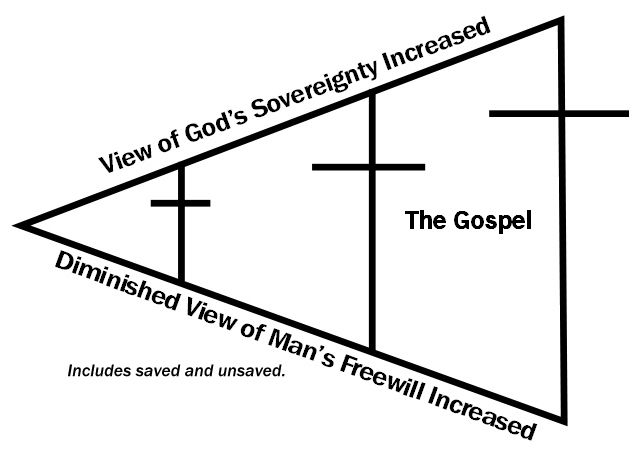
The Problem is defining the gospel according to God’s sovereignty as opposed to God’s love and the good news thereof. Why would the idea that God preordained people to hell be good news? This also speaks to man’s worth. Did Christ die for humanity because it has some kind of worth to God? We can again utilize the cross chart for this question:
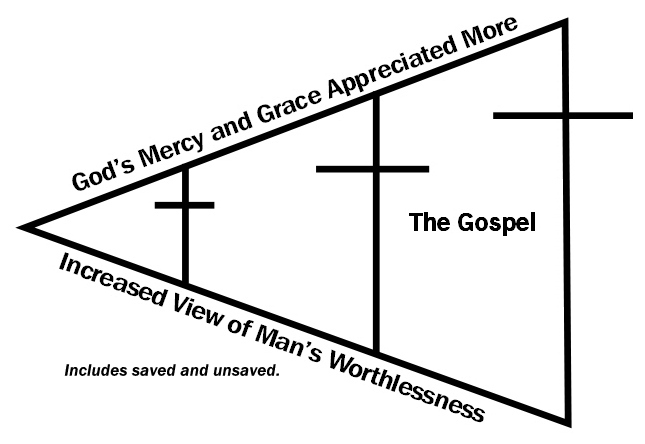
To the extent that man has worth, the gospel gets smaller and God’s grace, and the degree of His sacrifice are diminished. A gospel based on the sovereignty of God must completely eliminate man altogether, and John Immel’s point made in this year’s TANC conference is well taken: it eventually boils down to Man having no right to exist.
All of this greatly hinders the proper answering of questions people have about the Bible. Take note of John Piper’s answer to the question, “Why was it right for God to slaughter women and children in the Old Testament? How can that ever be right?”
It’s right for God to slaughter women and children anytime he pleases. God gives life and he takes life. Everybody who dies, dies because God wills that they die.
God is taking life every day. He will take 50,000 lives today. Life is in God’s hand. God decides when your last heartbeat will be, and whether it ends through cancer or a bullet wound. God governs.
So God is God! He rules and governs everything. And everything he does is just and right and good. God owes us nothing.
If I were to drop dead right now, or a suicide bomber downstairs were to blow this building up and I were blown into smithereens, God would have done me no wrong. He does no wrong to anybody when he takes their life, whether at 2 weeks or at age 92.
God is not beholden to us at all. He doesn’t owe us anything.
Now add to that the fact we’re all sinners and deserve to die and go to hell yesterday, and the reality that we’re even breathing today is sheer common grace from God.
I could make the question harder. As it was stated, it doesn’t feel hard to me, because God was stated as the actor.
My basic answer is that the Old and New Testaments present God as the one who has total rights over my life and over my death.
“The Lord gave, and the Lord has taken away; blessed be the name of the Lord” (Job 1:21). How he takes away is his call. He never wrongs anybody.
~ Ask Pastor John | Desiring God .org | February 27, 2010
In essence, you see the mentality in this answer that man does not have the right to exist, and has no worth. Yet…
Malachi 3:17 – They shall be mine, says the LORD of hosts, in the day when I make up my treasured possession, and I will spare them as a man spares his son who serves him.
John Piper has been called out many times publicly for making these kinds of statements in regard to tragedies, but no one seems to understand the ideology behind such statements. Some also notice tacit acceptance of terrorism as well, and the lack of justice in the institutional church for those who have been abused speaks for itself. If the president of the flagship seminary in service to the largest denomination in the world thinks that “One man’s terrorist is another man’s patriot,” what are we to expect?
When one thinks of life past the fatalistic prism of the “sovereign” gospel that saturates today’s church and reads the Bible in the same thinking way, much better answers evolve. Unfortunately, life teaches us that terrorists cannot be reasoned with. I heard a retired high-ranking military official state this week that the only way to deal with terrorists is to eliminate them. Keep in mind, this is because they do not value mankind or life because of the same presuppositions that we are discussing.
When Israel was getting ready to enter the Promised Land, it could very well be that God knew certain cultures in the area would continually harass Israel and were completely unreasonable while having no regard for life. Israel’s lack of obedience in following God’s command to completely wipe out certain cultures came back to bite them for hundreds of years—even until this very day. These were cultures very much like ISIS, the Islamic State of Iraq and Syria who are presently wreaking havoc in the Middle East and mercilessly slaughtering thousands. These people, unfortunately, cannot be negotiated with.
Lastly, another problem with a gospel that is based on deterministic fatalism follows. There is only one person spoken of less in our day than the Holy Spirit: Satan. The Bible warns us throughout to be aware of the devil’s schemes, and that he “deceives” the world. Why would this be relevant and how do you “deceive” someone who is already preordained for eternal punishment? The Bible continually places blame on Satan for leading people into condemnation.
In the final analysis, a “sovereign” gospel devalues prayer, God’s promises, evangelism, sin, justice, hope, life value, future reward, and the belief that what we do in this life is relevant. I have come to believe that people will perish because we have been neutralized by ignorance:
Ezekiel 3:16 – And at the end of seven days, the word of the Lord came to me: 17 “Son of man, I have made you a watchman for the house of Israel. Whenever you hear a word from my mouth, you shall give them warning from me. 18 If I say to the wicked, ‘You shall surely die,’ and you give him no warning, nor speak to warn the wicked from his wicked way, in order to save his life, that wicked person shall die for his iniquity, but his blood I will require at your hand. 19 But if you warn the wicked, and he does not turn from his wickedness, or from his wicked way, he shall die for his iniquity, but you will have delivered your soul. 20 Again, if a righteous person turns from his righteousness and commits injustice, and I lay a stumbling block before him, he shall die. Because you have not warned him, he shall die for his sin, and his righteous deeds that he has done shall not be remembered, but his blood I will require at your hand. 21 But if you warn the righteous person not to sin, and he does not sin, he shall surely live, because he took warning, and you will have delivered your soul.”
John MacArthur claims that Christians should take part in God’s “sovereign” plan, and therefore find blessings in being obedient to evangelism. I have heard this same take from people who equate freewill with an unsovereign gospel/false gospel. Again, God’s “sovereignty” is the attribute that primary drives the gospel and not love. But the following is irrefutable, such obedience must also be preordained and not really of our own volition. Furthermore, the reward is invalid as well.
I have also come to believe that there are no paradoxes in God’s election. I believe the confusion can be eliminated, and people motivated to labor in God’s ministry field with zeal. But I believe the study will be very hard work.
Nevertheless, let us begin it posthaste.
The God Who Seeks Us
“Supralapsarianism and infralapsarianism are not good news. It will make evangelism anemic, and will defile what little evangelism takes place.”
We have all heard it many times: no one seeks after God. Salvation isn’t like God throwing us a life preserver; we are floating in the water dead—we can’t even grab the life preserver. We have no choice in the matter in regard to an ability to choose God for salvation. If left to ourselves, we will always choose death. So yes, man can choose, but unless God intervenes he will always choose eternal death. He only has an ability to not choose God, God must choose him first. The verse most often cited is:
Romans 3:10 – As it is written, There is none righteous no not one. 11 There is none that understandeth: there is none that seeketh God. 12 They have all gone out of the way: they have been made altogether unprofitable: there is none that doeth good, no not one. 13 Their throat is an open sepulcher: they have used their tongues to deceit: the poison of asps is under their lips. 14 Whose mouth is full of cursing and bitterness. 15 Their feet are swift to shed blood. 16 Destruction and calamity are in their ways: 17 And the way of peace they have not known. 18 The fear of God is not before their eyes (Geneva Bible 1599). Psalms 13:1-3, 5:10, 139:4, 9:28, 35:2, Isaiah 59:7,8 (LXX Brenton). Psalms 14:1-3, 53:1-3, 5:9, 140:3, 10:7, 36:1, Proverbs 1:16, Isaiah 59:7,8 (Masoretic AV).
As the apostles did many times in their writings, Old Testament quotations in the New were a combination of many different verses to make one point. But should this text be interpreted as a specific rule, or does it characterize the enemies of God? Does the subject of these references, the “fool” understand absolutely nothing about God? Is he completely devoid of any good work? Does the fool NEVER fear God etc., or is this a characterization rather than a hard fast rule? Since other Scriptures contradict the rule, for example, there are many instances of unbelievers fearing God in the Bible; we must conclude that this description characterizes the unbeliever, but is not a definitive description. It is like saying, “You never _______.” We aren’t saying that they never do this, that, or the other, it is a manner of speaking that regards a life pattern.
Granted, man does not initiate a relationship with God. We see this in the fall of man. Adam and Eve hid from God after they sinned, and it was God who searched for them in the garden. After Cain slew Able, it was God who confronted Cain to elicit repentance.
Did God create man as a despised thing in order to bring Himself glory? Did God predetermine the fall of man in order to contrast evil with His good? Does His wrath demonstrate His righteousness? Does His wrath accentuate His grace? Protestantism can be divided into two camps in this regard: supralapsarianism and infralapsarianism. The following chart (other source) demonstrates the difference between the two views.

As you can see, supralapsarianism holds to the position that God preordained the fall of man. Infralapsarianism holds to the idea that it was God’s intent to create man, but not His intent that man fall. In other words, God didn’t create man for the express purpose of his fall. Both hold to the idea that God preselected some for eternal life and others for eternal destruction. Calvin was a superlapsarian.
The human mind, when it hears this doctrine, cannot restrain its petulance, but boils and rages as if aroused by the sound of a trumpet. Many professing a desire to defend the Deity from an invidious charge admit the doctrine of election, but deny that any one is reprobated (Bernard. in Die Ascensionis, Serm. 2). This they do ignorantly and childishly since there could be no election without its opposite reprobation. God is said to set apart those whom he adopts for salvation. It were most absurd to say, that he admits others fortuitously, or that they by their industry acquire what election alone confers on a few. Those, therefore, whom God passes by he reprobates, and that for no other cause but because he is pleased to exclude them from the inheritance which he predestines to his children. Nor is it possible to tolerate the petulance of men, in refusing to be restrained by the word of God, in regard to his incomprehensible counsel, which even angels adore. We have already been told that hardening is not less under the immediate hand of God than mercy. Paul does not, after the example of those whom I have mentioned, labour anxiously to defend God, by calling in the aid of falsehood; he only reminds us that it is unlawful for the creature to quarrel with its Creator (Institutes 3.23.1).
Hence, evangelism is a “savor of death, and a savor of life,” and God is glorified by both. Evangelism isn’t for the purpose of “saving” the lost; it is for the purpose of putting a response to the gospel on display for the glory of God.
There is a universal call, by which God through the external preaching of the word invites all men alike, even those for whom he designs the call to be a savour of death, and the ground of a severer condemnation (Institutes 3.24.8).
He arranges all things by his sovereign counsel, in such a way that individuals are born, who are doomed from the womb to certain death, and are to glorify him by their destruction (3.23.6).
Calvin also held to the idea that Adam and Eve were fallen before the fall:
Even If man had remained in his integrity, still his condition was too base for him to attain to God. How much less could he have raised himself so far, after having been plunged by his ruin into death and hell, after staining himself with so many defilements nay, even stinking in his corruption and all overwhelmed with misery? (Institutes 2.12.1).
This is in stark contradiction to Genesis 1:28-31;
28 And God blessed them. And God said to them, “Be fruitful and multiply and fill the earth and subdue it, and have dominion over the fish of the sea and over the birds of the heavens and over every living thing that moves on the earth.” 29 And God said, “Behold, I have given you every plant yielding seed that is on the face of all the earth, and every tree with seed in its fruit. You shall have them for food. 30 And to every beast of the earth and to every bird of the heavens and to everything that creeps on the earth, everything that has the breath of life, I have given every green plant for food.” And it was so. 31 And God saw everything that he had made, and behold, it was very good. And there was evening and there was morning, the sixth day.
If Eve was “very good,” we must assume free will at that point.* Eve had a choice to trust and obey God who had glorious plans for mankind without the fall (Genesis 1:28). Evil entered into the world through the angelic rebellion led by Satan (Eze 28:11-19, Isa 14:12-14, Rev 12:3,4), and apparently, though speculative, this is a backdrop that effected the way God decided to interact with Adam and Eve. He installed two trees in the garden amidst many other trees, and the one tree that they were forbidden to eat of was the tree of the knowledge of good and evil. They were allowed to eat of the tree of life, but not the other tree of the knowledge of good and evil. God didn’t keep it from them that evil existed, He just didn’t want them to experience it (Gen 2:2-8, 15,16).
It is interesting to note that God intervened to prevent Adam and Eve from eating of the tree of life which would have resulted in them living forever, so He banned them from the garden (Gen 3:22-24). Therefore, we must conclude that to some extent the world and man operates separately from the will of God and God therefore intervenes in the affairs of men, in time, to bring about His desired outcome. We see the same in Genesis 11:1-9—God confused the languages to prevent an undesired outcome. As an aside, let me mention that Gen 11:6 does not bode well for the idea of total inability:
And the Lord said, “Behold, they are one people, and they have all one language, and this is only the beginning of what they will do. And nothing that they propose to do will now be impossible for them.
This study focuses on the fact that God intervenes in the affairs of men by seeking them and calling them to repentance. Does He do this according to a predetermined outcome, or does He know what’s going to happen, and how men will react to specific circumstances? Is God’s intervention merely for the sport of self-glorification in life and death, or does God exhaust every effort to call man to Himself, and when it gets right down to it (in the final analysis), does every person have an ability to choose, the fact that God knows the future notwithstanding?
The latter is for forthcoming study, but we will now look at how God seeks to be reconciled to man.
John 1:12 – But to all who did receive him, who believed in his name, he gave the right to become children of God, 13 who were born, not of blood nor of the will of the flesh nor of the will of man, but of God.
In the garden, Adam and Eve hid from God, they did not seek Him, He sought them out. Neither was it their will to come up with a means of reconciliation according to God’s righteousness. God announced that on the spot after He confronted them:
Genesis 3:15 – and I will put enmity between thee and the woman, and between thy seed and her seed: he shall bruise thy head, and thou shalt bruise his heel (ASV).
Man doesn’t seek God, and he certainly did not come up with the plan of salvation, but does that mean he has no choice when he is cornered by God with the solution for his sin? It seems to me that many verses concerning God’s seeking and His means of reconciliation are interpreted as inability to choose.
We have discussed before how man is created with an intuitive knowledge of God and His righteousness and deliberately suppresses that truth in unrighteousness. Mankind descended from Adam and Eve who talked with God face to face. Creation also testifies about God. Man has been endowed with an ability to know God. Supralapsarianism posits the belief that God predetermined to endow mankind with an inability to choose God before the fall, infralapsarianism posits the belief that inability came after the fall. Their concern is the idea that God is the creator of evil. But in their assessment that God chooses some and not others for salvation, are those not chosen being tempted to greater evil by God in accordance with James 1:13? In other words, is God temping some to greater condemnation with the “good news”? Well, if God is glorified by the savor of death, it would seem so.
There are many ways that God seeks us, but let us name one as evangelism with the “good news” which would seem to be good news to some, but very bad news to others who are endowed with more condemnation every time they hear the gospel. I have even heard some pastors use this savor unto life/death as an incentive for evangelizing. What is the PURPOSE of the good news, to save only, or further condemn as well? (Perhaps John 3:17 answers that question).
Consider that the offer of reconciliation to all men is a legitimate offer. Christ secured salvation for all men—Christ died for all men—this is irrefutable:
2Peter 2:1 – But false prophets also arose among the people, just as there will be false teachers among you, who will secretly bring in destructive heresies, even denying the Master who bought them, bringing upon themselves swift destruction.
Being “bought with a price” is salvific language in the New Testament (1Cor 6:20). Also, we are warned to not “neglect” salvation in Hebrews 2:3. How can we neglect something that is not truly ours for the taking?
God seeks us out with a legitimate offer of salvation. We are also told that we can understand the offer, and even experience the goodness of the offer, and yet reject it (Heb 6:4-6). Final judgment is horrific and eternal because they have rejected the Christ who died for them.
Secondly, God seeks us by sending the Holy Spirit after Christ’s ascension to convict the world of sin:
John 16:6 – But because I have said these things to you, sorrow has filled your heart. 7 Nevertheless, I tell you the truth: it is to your advantage that I go away, for if I do not go away, the Helper will not come to you. But if I go, I will send him to you. 8 And when he comes, he will convict the world concerning sin and righteousness and judgment: 9 concerning sin, because they do not believe in me; 10 concerning righteousness, because I go to the Father, and you will see me no longer; 11 concerning judgment, because the ruler of this world is judged.
Thirdly, as we have discussed in previous parts, it is not God’s desire that any person perish. This is further demonstrated by the fact that God did not create hell for man, but the devil and his angels (Matthew 25:41). In contrast, the prepared place for mankind is God’s mansion (John 14:2,3). I think this is telling; the Bible NEVER states that God created hell for mankind. In light of supralapsarianism and infralapsarianism, this doesn’t add up.**
As we move forward in promoting home fellowships, it is important to me that our incentive for evangelism is valid. Our incentive should be that God died for the sins of every person. Our incentive should be that it is His desire that all men be saved. It should be a call to not neglect such a great salvation. It should be a call not to go to a hell that was not prepared for them.
Supralapsarianism and infralapsarianism are not good news. It will make evangelism anemic, and will defile what little evangelism takes place.
Notes
*Keep in mind the “holy” angels as well. Those who followed Satan in the rebellion must have done so by choice. Inherent in their created being was an ability and freedom to choose.
**A good study is the “book of life.” It would appear that all people born into the world are originally written in the book of life which includes the righteous. It would also appear that they are only “blotted out” when they ultimately reject God’s way of reconciliation.
Other views (other source):
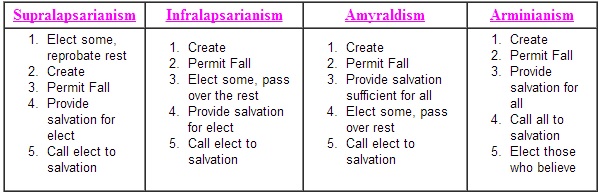

 Paul's Passing Thoughts
leave a comment