Church “Covenants” and How You Should Behave in a Protestant Church
 One endeavor on the long list of objectives here at TANC ministries is to get solid legal insight into what has become protocol in evangelical churches. That process began yesterday during a consultation with a local attorney. As documented here at PPT, the Association of Certified Biblical Counselors (ACBC) and its network of churches has become a virtual divorce mill. The pattern that this ministry continues to be made privy to is documented in an open letter to the executive director of ACBC, Heath Lambert.
Simply stated, New Calvinism, which is a return to the original church polity of the Reformation, does not have the force of state to compel church members to follow its orthodoxy. So, it improvises. Instead of simply burning heretics at the stake, or burning a hole through the tongues of those who ask questions in a challenging way, they ruin names and finances.
We must remember, the orthodoxy of the Protestant Reformation was tailored for a church state. America was originally founded by the Pilgrims who didn’t like how the Church of England did church-state, so they came to America and founded “New England.” The name is not happenstance. The American Revolution put an end to the Pilgrims’ theocracy that dominated the colonies. Actually, “Pilgrims” is a soft term for “Puritans.” And please, spare me the emails about the differences between the Pilgrims and the Puritans—the differences are insignificant in the whole scheme of things.
That brings us to the discussion of soft terms. First, the original Protestant Reformation was a simple church state, but in reality, the definition of “cult” comes into play when church states had to improvise in order to control people because of the American Revolution. A cult is defined as follows: it is any religious organization that controls people by means other than a church state. The etymology of the word “cult” does not become significant until post American Revolution.
In other words, without the force of the state to compel people to obey its orthodoxy, it must resort to manipulation and brainwashing to control people. Yes, church states also emphasize brainwashing because murdering people is costly in its implementation, and fewer people amounts to less resources, but brainwashing becomes even more important and refined when the final solution has been outlawed in an open society.
So, let’s state a definitive definition of cult: it is any religious organization that controls people by means other than a church state, and combines faith with authority. Like its church state predecessor, it assumes that the nature of man cannot obtain unity for a given cause without being ruled by those with superior knowledge of realty.
After the American Revolution, churches became a hybrid of orthodoxy and enlightenment thinking. It became an alphabet soup with a broad range of attitude concerning the ability of man to rule self. But, this never resulted in the full-blown focus on individual responsibility mirrored by the 1st century assembly of Christ. The concept of “church” spawned in the 4th century has always permeated the American church psyche, i.e., orthodoxy being a storybook form of truth written by church “Divines” that the saints can understand, and enforced for their own wellbeing.
With that said, soft terms become vital to the American church as we know it today. Church polity is a soft term for church government; church discipline is a soft term for Unam sanctam, or John Calvin’s power of the keys that gives church authority to decide someone’s salvation on behalf of God. It goes without saying that you obey someone that can take away your salvation.
And, “church covenant” is a soft term for “church contract.” Basically, when you sign a church covenant church contract, you are signing away your right to be heard. In most of these contracts, you agree to obey the leadership and to be “teachable.” Hence, from now on, when our ministry hears, “Gee whiz, all I did was ask questions and now my life is being destroyed,” the subject will mostly likely hear, “No, what you did is breach of contract so take your medicine.”
Note: in many churches that deem themselves congregational, the parishioners unwittingly circumvent that reality by agreeing to a revised church covenant prepared and presented by the elders. See how that works?
Moreover, these third party contracts often negate rights found under civil and criminal law. This ministry, more specifically I, stands corrected in my assertion that coercion is being used to control parishioners. In fact, it is not coercion, but according to what the parishioner has agreed to and signed, especially regarding permission to leave church membership. It’s a contract—you signed it, so shut up, nod your head, say amen, and put your money in the plate. It’s all good; if the elders like you—you will more than likely “be able to stand in the judgement.”
What are the redeeming facts here, if any? Education: NEVER sign a church contract. It’s NOT a “covenant” bolstered by your signature—it’s a CONTRACT. This is why TANC does what it does; education, then solution/alternative.
Is there a way to get justice after signing our rights away? Perhaps, because apparently, marriage is also a contract. Rather than burning you at the stake and burying you in the church yard under a stone edict condemning you to hell, which of course is against the law presently, they will begin by ruining your name, and then destroy you financially via divorce.
The process goes something like this: you break your contract and stop being “teachable.” This tells the leadership that you no longer see yourself as a sinner, and you have become “insubordinate.” A dozen or so respected leaders and their wives start telling your wife that you are no longer “humble” and whether she realizes it or not, she is married to an “angry man.” And hark, behavior that your wife formerly assumed not to be abusive, in fact is abusive. Yes, she is married to a man who “doesn’t love her like Christ loved the church.” It’s all downhill from there.
Apparently, legally, this is interference with a marriage contract. Damages would be determined by a jury if the situation ends in divorce. Also, the idea that ACBC could eventually be subject to a class action lawsuit is not all that farfetched.
However, this is just more evidence that the premise and foundations of the institutional church is egregiously flawed and was designed for a church state to begin with. The solution is the cooperation of spiritual gifts, not authority, and fellowship—not membership.
Meanwhile, if you do not like the solution, behave yourself in the Protestant church. Stop going to discernment blogs and whining—you signed the contract, shut up and live by it.
paul
Smoking Gun: ACBC is a Nationwide Divorce Mill
 Christ made it clear that what God has brought together NO man is to separate. Does this mean God predetermines every marriage in regard to particular spouses? I doubt it. This probably refers to God’s covenant of marriage and the theology of vows. At any rate, death, unrepentant adultery, and an unbeliever who abandons their believing spouse are the only exceptions.
How does one live happily with a spouse who has become difficult? For Protestants, that is a hard question because the focus has been on justification for 500 years with little emphasis on the biblical art of godly living (sanctification). When you are supposedly sanctified by a perpetual “return to the gospel afresh”… knowledge on how to repair a marriage is going to be what it is today, practically nonexistent. And of course, living by the same gospel that saves us (not saved us) is a very complex matter needing the ongoing “research and development” of gospel-centered experts.
Add to that: Protestants don’t even have justification right. Little wonder then that the institutional church is a train wreck after 500 years of scholarship and trillions of hard-earned laity dollars. What is the answer? The answer is a laity movement that will reclaim the priesthood of believers seized by Gnostic hacks dressed in biblical garb.
The answers will come through one Lord, and one word interpreted by individuals indwelt by the Spirit who gives all knowledge needed for life and godliness liberally. In case we forget the obvious, “I was only obeying the elders” will not cut it when you stand before Christ and His blazing eyes of fire. The Nazis were very good at being “subordinate,” and many were hanged accordingly. I realize Reformed elders claim God gave them His authority to rule on earth, but you may want to rethink that claim.
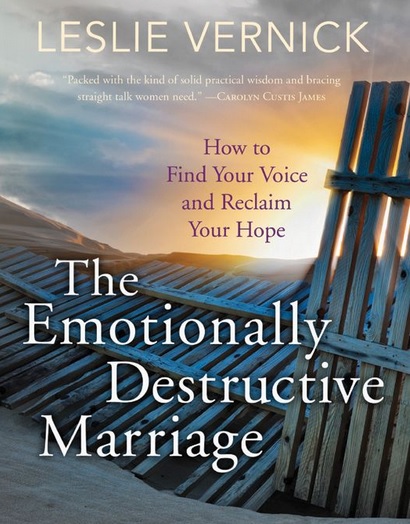
As predicted, the biblical counseling movement overseen primarily by the Association of Certified Biblical Counselors (ACBC) has become a divorce mill via its efforts to build marriages that “look like the gospel.” And the smoking gun is a book written by Leslie Vernick titled The Emotionally Destructive Marriage: How to Find Your Voice and Reclaim Your Hope that is widely used among ACBC counselors.
The obvious problems here are first seen in the title of the book. As Christians, is it really our goal to, “find our voice”? I thought it was our goal to please God in every circumstance. Secondly, the idea of emotional destruction is subjective at best and a ticket to do anything you want at worst. To make the point here, Google “American Civil Law.” In a culture judging anything that causes bad feelings to be abuse, such an approach to “biblical counseling” should give one pause.
Thirdly, why do Christians need a 240 page book written by a serial regurgitator of other people’s thoughts to FIND hope? You would think that by now Christians would be fairly certain about where hope is found.
Chilling is the examination of the 61-question survey found in the book that supposedly determines if one is in an abusive relationship or not. In the hands of a person that is unhappy in their marriage, the outcome will be a foregone conclusion. It’s like asking a chicken if Colonel Sanders is an emotional abuser.
The lynchpin becomes the ACBC’s loose interpretation of 1Corinthians 7:12-16. If the spouse is already an unbeliever, emotional abuse is tantamount to departing from the marriage even if they have not left physically or filed for divorce. Church discipline takes care of the pesky obstacle of the “abusive” spouse being a believer—they can be declared an unbeliever…actually MADE an unbeliever by elder authority supposedly vested to them by God. This paves the way for sanctified divorce.
It boils down to this: whoever is handed the book by the counselor is coronated as the abused spouse. Be sure of this: if both counselees in a bad marriage were handed the book, both would be guilty of the same thing. This is the smoking gun: it depends on who the ACBC “biblical counselor” wants to label abusive for whatever the motives might be.
I think a present situation that I am involved in says it all. I know enough about the situation to know that if the person I am talking with took the book’s survey, the other spouse would be judged as emotionally abusive hands down. The other spouse was handed the book because of who the ACBC counselor wanted to label “abusive.”
This is the niche service that Leslie Vernick now supplies to ACBC counselors.
paul
Why Every Self‐Respecting Premillennialist Isn’t a Calvinist
 Originally published April 9, 2014
“One’s eschatology will be consistent with their view of justification—unless you’re John MacArthur.”
At the 2007 Shepherds’ Conference, Pastor John MacArthur gave the opening message titled, “Why Every Self‐Respecting Calvinist Is a Premillennialist.” The message caused a hyper hissy fit among the authentic Geneva style Calvinists that used to associate with MacArthur. Most of the hysterical reviews were whining rants about how the message was an “ambush.” They came to the conference to hear solid fatalistic Reformed doctrine while enjoying sweet fellowship among philosopher kings, and instead were personally dressed down at the very beginning of the conference that they attended with hard earned parishioner money. It just ain’t right.
No doubt, the message left amillennialism naked and freezing outside in the cold. Well, sort of, depending on your understanding of Calvin’s election construct. This is why the various responses danced around the real issue and were in bondage to MacArthur’s fundamental misunderstanding about what Calvinism is while calling himself one. Paul warned the Corinthians that elitist academia is not the venue that God works from, and this fiasco is just one good example among many as to why that is so. The Geneva popes could not expose the fact that MacArthur’s fundamental premise is wrong—that would expose what Calvin really believed about election—a truth that the totally depraved artisans can’t handle.
MacArthur said this during the message:
“But bottom line here, of all people on the planet to be pre-millennialist it should be Calvinists; those who love sovereign election. Let’s leave amillennialism for the Arminians. It’s perfect! [laughter] It’s ideal. It’s a no-brainer. God elects nobody and preserves nobody. Perfect! Arminians make great amillennialists. It’s consistent. But not for those who live and breathe the rarified air of sovereign electing grace. That makes no sense. We can leave amillennialism to the process theologians . . . The irony is that those who most celebrate the sovereign grace of election regarding the church, and its inviolable place in God’s purpose from predestination to glorification, and those who most aggressively and militantly defend the truth of promise and fulfillment, those who are the advocates of election being divine, unilateral, unconditional, and irrevocable by nature for the church, unashamedly deny the same for elect Israel. That is a strange division.”
Ok, so MacArthur highlighted one of the assumed positive notes that can be taken from the idea of Calvin’s election: Once saved always saved. And, absolute assurance of salvation because it is God’s work alone—we can’t mess it up. And, how can you proffer election for the individual and ignore the fact that Israel was elected? This put the Geneva popes in a tough spot because they know that this apparent contradiction fits perfectly with Calvin’s doctrine of election.
Calvin believed in three categories of election: the non-elect, the called elect, and the chosen elect. This necessarily denies assurance because the called elect don’t know for certain whom among them have been chosen. Calvin stated this in no uncertain terms:
Let us, therefore, embrace Christ, who is kindly offered to us, and comes forth to meet us: he will number us among his flock, and keep us within his fold. But anxiety arises as to our future state. For as Paul teaches, that those are called who were previously elected, so our Savior shows that many are called, but few chosen (Mt. 22:14). Nay, even Paul himself dissuades us from security, when he says, “Let him that thinketh he standeth take heed lest he fall,” (1 Cor. 10:12). And again, “Well, because of unbelief they were broken off, and thou standest by faith. Be not high-minded, but fear: for if God spared not the natural branches, take heed lest he also spare not thee,” (Rom. 11:20, 21). In fine, we are sufficiently taught by experience itself, that calling and faith are of little value without perseverance, which, however, is not the gift of all (CI 3.24.6).
You can be called, and you can have faith, but that doesn’t seal the deal, said Calvin:
The expression of our Savior, “Many are called, but few are chosen,” (Mt. 22:14), is also very improperly interpreted (see Book 3, chap. 2, sec. 11, 12). There will be no ambiguity in it, if we attend to what our former remarks ought to have made clear—viz. that there are two species of calling: for there is an universal call, by which God, through the external preaching of the word, invites all men alike, even those for whom he designs the call to be a savor of death, and the ground of a severer condemnation. Besides this there is a special call which, for the most part, God bestows on believers only, when by the internal illumination of the Spirit he causes the word preached to take deep root in their hearts. Sometimes, however, he communicates it also to those whom he enlightens only for a time, and whom afterwards, in just punishment for their ingratitude, he abandons and smites with greater blindness (CI 3.24.8).
So, this fits perfectly with Calvin’s eschatology; Israel was temporarily elected just like many individuals are temporarily elected. The logical conclusion of Calvin is that God’s word did in fact fail (Romans 9:6). Moreover, and in direct contradiction to 1John 5:13, authentic Reformed doctrine has always denied assurance. This is reflected in many contemporary authentic Calvinists:
There is danger on the way to salvation in heaven. We need ongoing protection after our conversion. Our security does not mean we are home free. There is a battle to be fought (John Piper: Bethlehem Baptist Church Minneapolis, Minnesota; The Elect Are Kept by the Power of God October 17, 1993).
Words mean things. Piper is clearly saying that our battle in sanctification is a battle for justification. If you really understand the Reformed view of justification, you know: that battle is against our supposed propensity to gain favor with God through works in sanctification (“please/love God” changed to: merit for salvation). There is no separation of justification and sanctification, so works in sanctification must be sanctified with a faith alone formula. It’s salvation by Christ plus not doing any works in sanctification (Christ + antinomianism to maintain our salvation). We must be sanctified the same way we were justified so that we can properly finish justification. Therefore, Calvin believed that sins committed in the Christian life separate us from grace, and a continual repentance, the same repentance that saved us, is needed to maintain our salvation. Unless we live by faith alone in sanctification, Christ’s blood will not be applied to the new sins we commit. This is the battle Piper is talking about. Said Calvin:
…by new sins we continually separate ourselves, as far as we can, from the grace of God… Thus it is, that all the saints have need of the daily forgiveness of sins; for this alone keeps us in the family of God (John Calvin: Commentaries on the Catholic Epistles; The Calvin Translation Society 1855. Editor: John Owen, p. 165 ¶4).
And, guess what? It just so happens that your local Reformed elder, via the Reformed power of the keys, has the authority to forgive those pesky sins that take away your salvation. Whoever would have thunk it?
To impart this blessing to us, the keys have been given to the Church (Mt. 16:19; 18:18). For when Christ gave the command to the apostles, and conferred the power of forgiving sins, he not merely intended that they should loose the sins of those who should be converted from impiety to the faith of Christ; but, moreover, that they should perpetually perform this office among believers (The Calvin Institutes: 4.1.22).
Secondly, This benefit is so peculiar to the Church, that we cannot enjoy it unless we continue in the communion of the Church. Thirdly, It is dispensed to us by the ministers and pastors of the Church, either in the preaching of the Gospel or the administration of the Sacraments, and herein is especially manifested the power of the keys, which the Lord has bestowed on the company of the faithful. Accordingly, let each of us consider it to be his duty to seek forgiveness of sins only where the Lord has placed it. Of the public reconciliation which relates to discipline, we shall speak at the proper place (Ibid).
Calvinism is an egregious false gospel being flaunted in broad daylight by academic elitists who are in reality clueless, which brings me to my second point. This is where the vast majority of American Christians are functioning Calvinists…among many other ways while vehemently denying Calvin. Specifically, the whole idea that eschatology is a “secondary issue.” No, no, no, no, no, no, no! Eschatology is gospel; you cannot separate the cross from eschatology. One’s eschatology will be consistent with their view of justification—unless you’re John MacArthur.
The number of resurrections and judgments, and who stands in those judgments, are indicative of a particular view of justification, and election in particular. MacArthur’s dispensationalism coupled with naming the name of Calvinistic soteriology, which really isn’t Calvin’s soteriology to begin with, is a dumbfounding contraction that leaves one without words to fully explain. Calvin’s eschatology calls for one resurrection and one judgment at the end of time where everyone sweats it out while waiting to find out if they were antinomian enough. Some of the books at the Great White Throne Judgment are the books of the law that will be used by God to judge the works of those standing in that judgment. As one aspect of Christian security, we will not stand in that judgment because we are not under the law. Furthermore, we don’t wait to see if our antinomianism sufficiently utilized the “doing and dying” of Christ to cover our sins—our sins have been completely eradicated.
The number of resurrections and judgments speak to our view of what part of Christ’s works on the cross are finished and not finished, the separation of justification and sanctification, the new birth, election, and future Israel. Eschatology is gospel.
That’s why every self‐respecting premillennialist isn’t a Calvinist, and why MacArthur isn’t a Calvinist, but he thinks he is a Calvinist. As stated by Richard Muller,
There is every likelihood that John MacArthur’s “Calvinism” would probably not be recognized by Calvin himself.
It’s all simply pathetic.
paul
The Biblical Emphasis on Pastors and Their Authority: Where is It? Romans 15:14
 Listen to the show audio or download the video file here.
Welcome to Blogtalk Radio False Reformation this is your host Paul M. Dohse Sr. Tonight, “The Biblical Emphasis on Pastors and Their Authority: Where is It?” If you would like to add to our lesson or ask a question, call (347) 855-8317. Remember to turn your PC volume down to prevent feedback. Per the usual, we will check in with Susan towards the end of the show and listen to her perspective.
If you would like to comment on our subject tonight, you can also email me at paul@ttanc.com. That’s Tom, Tony, Alice, Nancy, cat, paul@ttanc.com. I have my email monitor right here and can add your thoughts to the lesson without need for you to call in.
We are going to begin tonight by surveying the present landscape. The church invests billions in the education and accreditation of pastors. Of course, this is all made possible by the working class laity. Pastorate authority is expressed in church polity, and they are seen as the gatekeepers of orthodoxy. Never before in history have so many willingly paid so much for the privilege of being subservient.
Let me just pull the rabbit out of the hat right now. Let me go ahead and reveal where I am going with all of this tonight, and then I will make my case. We know that America was the first idea in human history that rejected the marriage of faith and force, and the results speak for themselves. We also know why some people deny what America has done for the world because of their ancient presuppositions concerning mankind; i.e., if mankind is allowed to self-govern, chaos will ensue.
There is that crowd, then there is the crowd that thinks mankind is just outright evil, and the American idea emphasizes life and liberty, so America is the antitheses of this whole idea that mankind is evil. And remember, this is not just a religious idea. No, no, no. This is also very prevalent among secular ideas. Some environmentalists would be included among them.
In the minds of the framers of the American Constitution, the marriage of faith and force always leads to tyranny, and history would agree. It all starts with those who are specially gifted to know truth that the masses are not able to understand, and for their own good, the masses that is, or the “great unwashed” if you will, the great seers call on the state to enforce their wisdom for the good of mankind and its overall survival. It is a striving for social justice leading to utopia.
We know that this basic presupposition about man’s ability to self-govern always leads to tyranny, and it now begs the question: culturally, in the church, if truth is married with pastoral authority, is the same tyranny inevitable? We think the answer is “yes.” The marriage of faith and authority in the church will yield the same results as the marriage of faith and force among governments. The problem is the injunction of truth on the majority by the few.
Without getting into another body of study altogether, let me answer some anticipated objections. A couple of weeks ago while Charlie Rose was interviewing the president of Syria, here is a paraphrase of what he said: “Society in general doesn’t accept the use of chemical weapons.” Interesting. What was he in essence saying albeit probably unwittingly? Answer: Romans chapters one and two. The law of God is written on the hearts of every man and his God-given conscience passes judgement on his actions. Why do we need government? For people who are deficient in regard to their faculties of conscience—that’s why.
Let’s note something important moving forward. The behavior evidenced in the church in our present day is consistent across all religions and denominations. Why? Because they all have one thing in common: they marry faith and authority. This is just another institutional church elephant in the room; the question of pastoral authority. And how churches get around this is soooo smooth:
“As pastors, our only authority is in the word of God.”
Well, that’s just wonderful because the Bible covers every nuance of life. While that answer usually assumes the Bible is boss and pastors only point people to its authority, what is really being said is the Bible determines the parameters of their authority which is without bounds if determined by the Bible.
What does this across-the-board authority look like regardless of the particular breed of church? What does it mean when we say that pastors “have authority”? It all starts with a same presupposition concerning mankind. Basically, mankind in general is not able to properly understand reality in a way that brings about social justice resulting in utopia. Man needs to be ruled over for his own good, and those who believe man can self-govern must be neutralized for the good of the many.
This is why the line between churches and liberal leftwing politics is often blurred. Why did some church, I think in New York, recently sue Walmart to ban their gun sales? Because in their mind, you just can’t have people in general running around with guns. In their minds, that’s a disaster waiting to happen.
So, it starts with that philosophy. Now, how does it seek to implement this philosophy? What system dictates the application for the greater good? Again, in ALL religions and denominations it’s the same: mediation, authority, orthodoxy, progressive justification, polity, political collectivism, resulting in the EXACT same results and behavior. This is the technical definition of “the church.” Take note of how often you hear “the church” in the everyday white noise of churchianity.
Mediation. The Bible makes it clear that there is one mediator between God and man: Christ, period. All institutional churches have a concept of what Protestants call the “power of the keys.” This is the idea that the institution represents the body of Christ on earth. Hence, institutional membership is synonymous with salvation. The institution represents Christ’s mediation on earth by proxy. Whatever the church binds on earth will be bound in heaven, and whatever the church looses on earth will be loosed in heaven.
Authority. Vested in the elders/pastors of the church regardless of the fact that Christ clearly stated that ALL authority in heaven and earth has been given to Him. Pastors are men who have been preordained and specially gifted to know things that the common Christian does not know. Therefore, God has supposedly given them authority on earth for the collective good of mankind. Every institutional church has its own breed of popery.
“But Paul, I am a Southern Baptist and our churches are” …and this is so adorable… “independently autonomous.”
OK, now try to be a pastor of a Southern Baptist church without a degree from a Southern Baptist seminary. Good luck with that. If you are not credentialed, if you do not speak according to authority given you by the church, if your words do not carry authority by the aping of those credentialed, you are nothing but a little yapping mutt that will be ignored. If you tithe enough, people will put up with you and that’s about it.
For the time being, file this away: this is the exact same system Christ was up against when he came. How did He deal with it? Confirming miracles. Remember the paraplegic He healed so that people would know that the Son of Man has authority to forgive sins on earth?
Orthodoxy. This is the extra-biblical authoritative body of teaching that is developed by those in authority. Since the great unwashed cannot understand truth, orthodoxy takes the higher knowledge of truth and puts it in story form for the spiritually adolescent masses. It’s exactly like story books written for children that explain reality via narratives that they can understand. In church culture, orthodoxy is synonymous with truth itself. This is why in seminary you are told straight up that the knowledge you are learning there is not anything you will be teaching at local churches—they can’t understand it. However, you will learn a lot about being a good spiritual cowboy who keeps the herd from being spooked resulting in a stampede. You will also be taught how to deal with those who think they can know truth, also known as Mad Cow disease.
Progressive justification. All religions and denominations have some form of progressive justification. This soteriology is the necessary gospel that must go hand in hand with mediation, authority, and orthodoxy. It is the teaching that salvation progresses from point A to point B, and the institutional church is the overseer of that progression. This is a hard-fast rule. The church cannot function or survive by propagating the true gospel—it’s impossible and we will look at why this is the case tonight. Why are there so many different religions and denominations? It’s all disagreement on how you get from point A to point B.
Polity. Or “church polity.” This is a soft term for “church government.” All churches have church government. It’s different levels of authority and an epistemological pecking order. In contrast, biblical contra church assemblies are based on fellowship with the Father and His Son—not authority. Historically, churches enforce polity by getting into bed with the government, but post America, the emphasis is control over your salvation.
In pre-American history, if you didn’t believe the church had the authority to take away your salvation, they would simply hang you, drown you, cut you in half, or burn you, not necessarily in that order. So, in our day, the heavy emphasis is authority and control over your eternal destiny. Why do people obey the outrageous notions that flow from the traditions of men? Because their eternal salvation depends on it, and “faith believes all things,” right? One of the favorite truisms vomited out by the clergy is this whole Lutheresque idea that “knowledge puffeth up” and makes people proud.
The real problem is that informed people are very difficult to control. Let me pull another rabbit out of the hat right now. I will make the case tonight that cultism goes hand in hand with elder authority. It is absolutely impossible to separate horizontal authority among God’s people and cultism. Religion plus horizontal authority ALWAYS equals cult. This is an unavoidable and hard-fast rule.
Political collectivism. Here is the dirty little secret: ultimate control is really in the hands of the populous. Why? It’s simple; they outnumber government. In China, if the people decide to rise up, the Chinese government is totally screwed. There are particular things common to people that the framers of the American constitution recognized such as those things that are “self-evident.” All in all, the church has merely stuck its nose in the debate over who owns truth: mankind in general or the state?
This necessarily demands a conversation about the church’s dominion theology. Is God’s kingdom presently on earth, or is it presently in heaven? If it is presently down here, then obviously the church has a dog in the fight. Therefore, since populous rule is the real power in the world, power is determined by how many people you have effectively brainwashed. The church cannot avoid being a political animal seeking to gain control by numbers and infrastructure because it believes it is a nation builder on earth.
This includes all of the trappings of doing good works to endear numbers, and formal education for the purposes of indoctrinating people. Most church hierarchies openly admit that their agenda is to take over every aspect of culture; i.e., education, the arts, etc, etc. The specific quotations abound and are not the least bit ambiguous.
Also, watch out for the “Oh my, missionaries are being persecuted for the gospel in this country, that country, or the other country.” No, many countries are more privy to the dominion aspirations of the church than their own missionaries. In many cases, it is feared that missionaries will incite an insurrection. A cursory observation of history confirms this as a valid concern. Traditionally, church missionaries not only want to get people saved, they want to quote, “transform the culture.” They say it all the time!
Let me stick this idea in here. Do you know how home fellowships could do world evangelism? We could find people gifted to be elders in other countries and bring them stateside to live for a while in the home fellowship network. They would live with a sponsoring family and learn/experience the New Testament model. As they learn and experience, they could be feeding the information back to their country of origin. This would be dirt cheap and very effective.
Do you know how expensive and ineffective world missions are in the institutional church? It’s horrific, and mostly predicated on Western arrogance. I have heard missionaries say it: “Without our academic wherewithal, effective ministry is impossible.” Behold the arrogance: after hundreds of years of trial and error and oceans of ink used in the pontification of orthodoxy, 1600 people a day leave the church and become Nones or Dones. 1500 pastors per month leave the ministry for good. But yet, the church continues to export this failed model overseas on the financial backs of the laity. It’s beyond insane.
Behavior. The results are all the same. Spiritual abuse in the church is just a symptom of the specific problem, church. Stuff happening in the church is not the problem—church is the problem. Thanks to the internet, we now know that the church produces the exact same behavior over and over and over again. We now know that the institutional church is nothing more or less than a super-cult.
Let’s begin to look at the evidence.
Yes, once again, Calvary Temple of Sterling, Va. is back in the news. Let’s listen to the recent news report by MRC TV titled “Sexual Abuse, Broken Families, and Race Cars: The Story Of An Alleged D.C.-Area Cult” dated 4/2/2015/. As you listen to this clip, make a list of the elements such as “authority,” “broken family relationships,” “control,” “divorce,” etc.
Listen, whether the HBO documentary I mentioned last week on Scientology, or my wife’s testimony in regard to her experience in the Baptist church, or what my son shared with me the other night about a Jehovah Witness that he works with and what that guy is going through with his church, or my own testimony, or myriads of testimonies that you can read via the internet discernment blogs, it is all the same basic elements in regard to behavioral outcomes.
Sure, John MacArthur Jr. isn’t going to marry a twenty-year-old and buy a dragster and a race car, he just oversees an in-house police station at Grace Community Church that will escort you out to your car if you ask too many questions in Sunday school. I know from firsthand testimony that MacArthur rules that church with an iron fist. I rubbed shoulders with some of his elders for years. In addition, accusations from relatively sound people that Grace Community Church is a cult abound. One such site is The Watchman Wakes .com / John MacArthur’s cult. Google that and the exact link should come up. Look, all one needs to know for purposes of confirming these allegations is MacArthur’s own words from last week’s sound bites; the inevitable result of the belief that elders have authority on earth is cultism.
Let’s also look at the obvious manifestation of well-behaved tyranny. Even though some church pastors would not engage in some of the more outrageous behavior, by and large, the well-behaved tyrants of the church turn a blind eye to the behavior and even cover for it. MacArthur is absolutely notorious for turning a blind eye to the atrocities committed by the institutional church. Why? The obvious answer is the church’s authority to forgive sins on earth. Without the institutional church, there is no means of salvation for anyone so the church must be saved at all cost. I am not sure what is more obvious.
Look, for example, Jack Hyles could have been shut down years ago. All it would have taken is twenty-five IFB pastors walking down the isle of First Baptist Church of Hammond, Ind. and rebuking the guy publically on a Sunday morning. Game over. Why doesn’t that ever happen even though it is the exact biblical prescription? Because the institution has to be preserved as God’s authority on earth by proxy—that’s why.
I am not going to rehearse the outrageous details of the ABWE scandal, but in reaction to ABWE refusing to deal with the situation, not one GARB church withdrew from the association in protest, and as far as I know, not one church withdrew support from ABWE. One GARB pastor that I know who was mortified by the scandal nevertheless allowed Michael Loftis, at that time the president of ABWE to speak at their church.
Why?!!!! because there is only one name under heaven by which man is saved—the institutional church and its authority on earth by proxy. This isn’t complicated. Support the church if you will, but also know that you are supporting the divine right of kings to rape, pillage and steel at will.
“But my pastor isn’t like that!” Yes he is—he turns a blind eye to it!
It’s all the same, and they all operate by the same principles; for example, let’s just take one, orthodoxy. For Baptists, what is it? The First and Second London Baptist Confessions. For Presbyterians, what is it? The Westminster Confession. For Jehovah Witnesses, what is it? The Watchtower. For Mormons, what is it? The Book of Mormon. For Islam, what is it? The Quran. It’s all the same stuff resulting in the same behavior. Read history for yourself—none of these religions acted any differently until America came along.
At any rate, the church invests billions in the education and accreditation of pastors. Their authority is expressed in church polity, and they are seen as the gatekeepers of orthodoxy. When one surveys the emphasis on pastors in the church, certainly we should expect to easily find abundant information about them in the Scriptures. A cursory observation of Scripture should reveal their purpose, scope of authority, and a description of their duties.
But in reality, the lack of biblical emphasis on pastors and elders is stunning when compared to the emphasis experienced in the institutional church. If a pastor has authority, where does that authority begin and end? While the idea of elder authority is common, any discussion of the parameters is extremely uncommon and such ambiguity can lead anywhere, and it does. Furthermore, their assumed authority is nowhere to be found in holy writ.
In regard to their importance in general, the specific gift of elder/pastor is mentioned a meager four times in Scripture.
In the most vital portions of Scripture where elders would be prevalent according to their assumed authority, they are not mentioned. In the corrective letters to Corinth where Christianity was completely off the reservation, elders are not mentioned once. In the book of Romans, the magnum opus of soteriology, again, elders are not written about.
In Paul and Peter’s mini-treatises regarding submission starting in the home, to the workplace, and society in general, again, no mention of elders (Eph 5:22-33, 1Pet 2:13-3:7).
In the protocol for solving conflict among believers in Matthew 18, the same. If a person finally refuses to repent of what he has done to a fellow brother, the passage doesn’t say to go tell the elders, it says to go tell the assembly. The process in Matthew 18 is commonly thought to be a process under the control and auspices of the elders, but if that’s the case, where are they?
Sure, when the Greek widows were treated unfairly as documented in Acts 6:1ff, the people appealed to the apostles, but who was given the responsibility to choose what I think were the first Deacons? Right, the saints in general. Not only that, notice that the solution offered by the apostles met the approval of the people. They did not go to the apostles for an edict—they sought their counsel and leadership in the situation, but it obviously needed the approval of the people.
In Philippians 4:2,3, Paul entreats the whole congregation to reconcile the two women who were in some kind of rift, and this is the same pattern found in Matthew 18 as well. Listen, we could go on and on and on and add Acts 17:11 as well, but is this sinking in? Where are the big bad elders? Where are they and their supposed authority? I do believe the apostles had authority, but clearly what they emphasized is the model that would follow after their departure; appeal to the one mind of Christ and not the dictation of authority.
Moreover, not only are elders conspicuously missing, the saints in general are told throughout the New Testament that they are qualified to do ministry that is normally attributed to elders exclusively. A good example is Romans 15:14.
I myself am satisfied about you, my brothers, that you yourselves are full of goodness, filled with all knowledge and able to instruct one another.
Another one is 1John 2:27.
But the anointing that you received from him abides in you, and you have no need that anyone should teach you. But as his anointing teaches you about everything, and is true, and is no lie—just as it has taught you, abide in him.
Clearly, when it gets right down to it, God’s people can do without elders. Eldership is a gift that is no more or less important to the body of Christ than any other gift. Yes, if God’s people are serious about furthering the testimony and deepening fellowship, they should seek out good elders. But eldership is not a horizontal authority granted by God. Eldership does not represent God’s authority on earth.
Indeed, the apostles did have some of God’s authority, and that’s why they will sit on twelve thrones judging Israel in the final days, but that authority was NOT passed on to the elders. This is why the apostles predominately appealed to the one mind of Christ and not authority.
So, what is in fact the biblical model? Let’s compare the biblical model point by point with the institutional model. Here we go.
Presuppositions concerning mankind. Simple, Romans chapters one and two. Man can know reality and is personally and individually accountable to God. Throughout history for the most part, society in general determines law and what is acceptable. But please do not underestimate the real debate underlying the more visible debates manifested in this question: does man understand the reality that he lives in. He most certainly does. Mankind does not need seers to rule over them who have special insight into a reality that the masses do not understand.
History is a vicious cycle of the masses buying into that philosophy resulting in revolts when the tyranny of it becomes more than they can bear. Life gets to the point where it is not worth living and there is an uprising. The framers of the American Constitution observed this vicious historical cycle of serfism, tyranny, war, freedom, serfism, tyranny, war, freedom, serfism, tyranny, war, freedom, and the lightbulb turned on. America is the greatest country ever because it is the first ever government by the people and for the people.
The Bible is clear, people stand before God at the judgement individually. Be sure of this: the church’s emphasis on pastors comes from the world’s debate on man’s ability to self-govern. According to the Bible, and more specifically 1John, God’s people are able to self-govern because all of them have the same anointing of the Holy Spirit. When it gets right down to it, we have no need for anyone to teach us.
Mediation. There is only one mediator between God and man—Christ. Clearly, the church posits elders as sub mediators. This does not pass biblical muster.
Orthodoxy. There isn’t any. God’s people do not need a dumbed down version of truth written by sub-mediators creating…watch it… here it is, “subordinate truth.” Really? This is absolutely nothing new and the very reason that the Bible is constantly drilling down on oneness: one truth, one mind, one mediator, one Spirit, one baptism, one anointing, one Lord, etc., etc., ect. There isn’t two minds, there is only one and one truth accordingly. And really? There is such a thing as a lesser truth? No, it is either true or it isn’t true.
Progressive justification. No institution or religious hierarchy is needed to get us from salvation point A to salvation point B. This is why we constantly hear, “We don’t believe the gospel and then move on to something else, we never leave the gospel.” “The gospel isn’t the ABCs of salvation, it’s the A-Z,” etc., etc., etc. If your salvation is finished, and you do move on to something else, guess who you no longer need?
The elements of the institutional church follow a logical progression: presuppositions concerning mankind; sub-mediation; orthodoxy or sub-truth; the gospel of progressive justification; church government (polity) because authority trumps fellowship; political activism because God’s kingdom is supposedly on earth (if it wasn’t authority would be absent), and the subsequent bad behavior ordinarily exhibited by the divine right of kings, mind control cults, and institutional ownership of truth.
Church polity (government). Christ’s assembly does not have a government structure. There is no church polity. There is a body made up of gifts that seeks to mature by “mutual edification” through fellowship under one head. There is no government, but rather organization. Here is the organization: gifted elders equip the saints for ministry, and deacons/deaconesses oversee need. There aren’t any bosses; it’s a cooperative striving for a common goal. It’s an organized body where every part is equally valued. It’s just this simple, and this is the exact same analogy seen throughout the New Testament: to the degree that your body is sound, you can accomplish work. Ephesians 4:1-16 spells it out point by point, and so does 1Corinthians chapter 12. That’s not a government—it’s an organized body.
Political collectivism. It is not the concern of Christ’s assembly to take over every aspect of culture. Our concern is to build up the body in love and let the world watch. And watch they will. Our kingdom is NOT on earth—it’s still up in heaven. That’s why we are called “ambassadors” in the Bible. What’s an “ambassador”? An ambassador doesn’t live in a country to…here it is, we hear this constantly…”take over the culture for Christ.” No, we are here to represent another kingdom that is not presently here.
Behavior. The goal is to think like our big brother Jesus Christ and do what He would do. And trust me, the world will take note.
Here are some references that you should read on your own: Matt 23:8, Psalm 133:1, Acts 4:32, Rom 12:16, Rom 14:19… Rom 15:5, 1Cor 1:10, 2Cor 13:11, Eph 4:3, Phil 1:27, Phil 2:2, Phil 3:16, 1Peter 3:8.
Elder authority, where is it? Where is the emphasis on body striving for unity in one mind? EVERYWHERE! Let’s now go to the phones.

 Paul's Passing Thoughts
2 comments