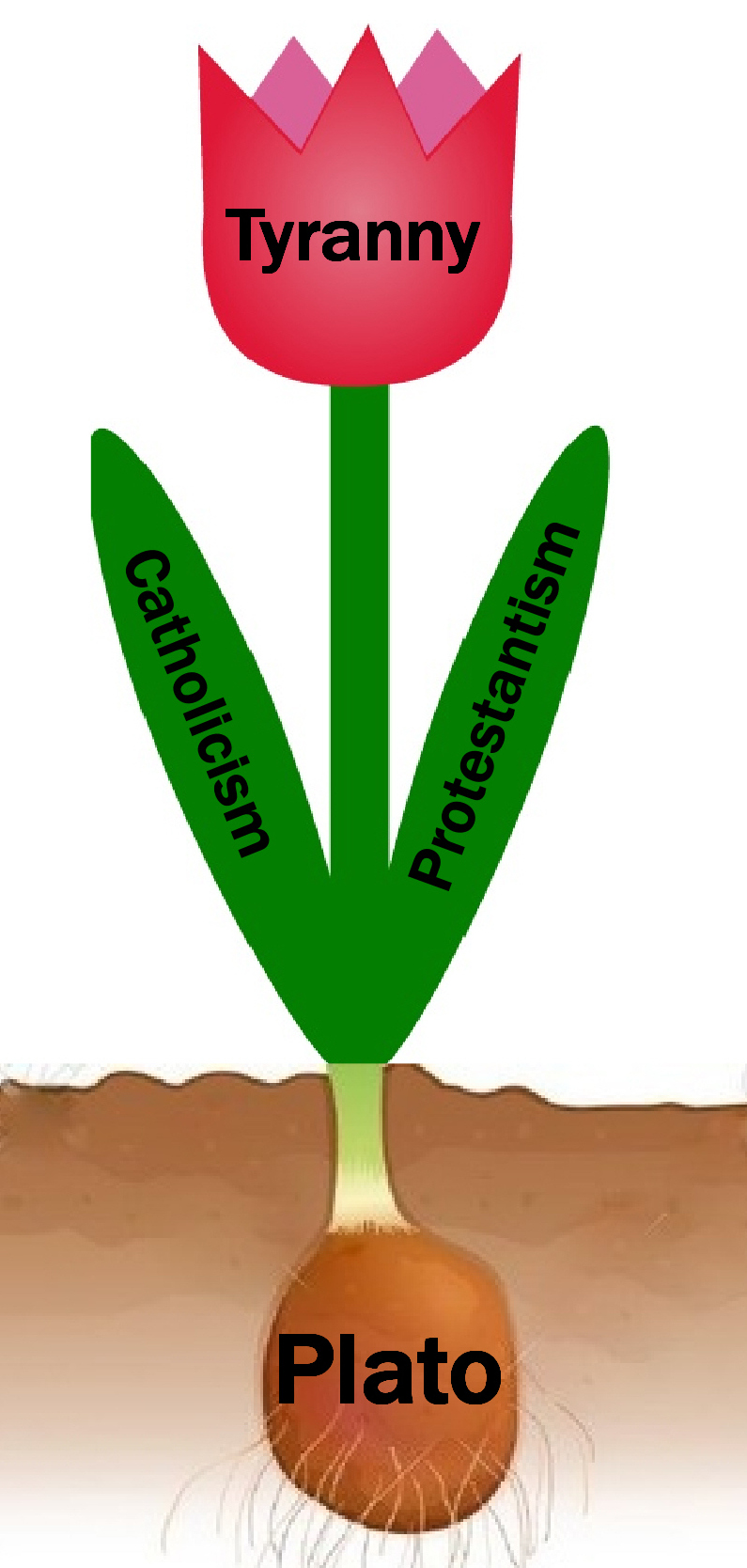
Susan Dohse on Plato, Augustine, Calvin, and the Reformation
 TANC 2013 Conference on Gospel Discernment and Spiritual Tyranny
Transcript: Susan D. Dohse MEd.
Plato
I’m Susan Dohse. I’m married to Paul Dohse for two years, and it has been an adventure. My role in this year’s conference has changed. This year I became Paul’s research assistant. The pay stinks, but the fringe benefits are really nice. Unlike last year when I spoke from personal experience, which though difficult and emotional at times, was easier than this year’s assignment. This year I was asked to step outside my preschool box and share what I’ve learned through not personal experience but personal study and research. And I am thankful for the World Wide Web, computers, and the Internet even though I fuss and say unkind things to the computer, I am thankful that the Lord created those on the eighth day. If I had to find answers to the questions that I had in the old-fashioned way, by using the card catalog and the Dewey Decimal system, I wouldn’t be here this morning. I would still be at the library roaming the stacks. My role in this year’s conference is to share my research. My goal though is to provoke you to think. What I want to share is only an introduction. It’s not even a scratch on the surface of what there is to know about these historical figures. It’s up to you though to continue the research project. So you do have an assignment. I want you to think of me as just a grain of sand, an irritant in the oyster that over time though yields a pearl.
Matthew 7:24-27, Jesus is speaking here. “Therefore, whosoever hears these sayings of mine and does them, I will liken him unto a wise man who built his house upon a rock. And when the rains descended and the floods came and the winds blew and beat upon that house, it fell not, for it was founded upon a rock. And everyone that hears these sayings of mine and does them not shall be likened then to a foolish man who built his house upon the sand, and the rains descended and the floods came and the winds blew and beat upon that house, and great was the fall of it.”
The foundation of thought that I want to illustrate is built upon a historical figure that I just knew initially in a Jeopardy quiz show fashion, you know. Student of Socrates, Greek philosopher, The Republic. Who is Plato? Well, if I were to ask you to tell me something that you know or you’ve been taught about this man, I’m certain I would get classic textbook answers. Greek philosopher, student of Socrates, established the first university called The Academy, wrote The Republic, I would give you credit for being correct. For over 2,500 years, Plato has been studied, admired, modified, personalized, and deified. He has been described as a great thinker, lover of wisdom, a crusader against error, and an enemy of falsehood. Well, after reading hundreds of pages about him, I cannot help but agree that he was a man of great intelligence. He was a mathematical genius, an advocate of education. In your list of trivia facts, would you also include pagan, polytheist, crusader against individuality, founder of communistic, socialistic, and Darwinian evolutionary thought, enemy of God, hero of the reformers?
Born in 427 BC, the son of noble and wealthy Athenian parents with the blood of ancient kings of Attica flowing through his veins. It was this status in life that gave him the way and the means to pursue his quests. Unlike others of his day, he didn’t have to earn a living and go to school at night or hold two jobs to pay for his education. He was of the ruling class of Athens, a privileged elite.
At the age of 20, Plato came to Socrates and asked to be his pupil. And Socrates saw before him a handsome youth, broad shoulders of an athlete, a noble brow of a philosopher, the limpid eyes of a poet. Those aren’t my descriptive terms. This is how Socrates described him. Socrates accepted him as a student, and this became the beginning of a tender and an intimate relationship that lasted until Socrates’ death. The respect and admiration of the student for his teacher was profound and lasting.
Well, after Socrates was executed, Plato and the other disciples of Socrates took to the world, and they traveled the ancient world. Now whether of fear that they would be arrested and also executed because of their association with Socrates or because they wanted to be foreign exchange students is not really well documented. Plato went to Cyrene where Theodorus instructed him in mathematics. He went to southern Italy where he studied the science of numbers under three of the most learned doctors of the Pythagorean mathematical system of his day, went to Egypt to receive instruction from those learned doctors and priests of that ancient land. Some records say he visited Persia, Babylonia, and even India. So he returns to Athens and establishes his Academy, the first university in Europe where he taught until the age of 81.
So up until his return to Athens, we can say letter P for professional student, P for pagan polytheist. Plato regarded the sun, moon, stars, and planets as the visible gods. These heavenly bodies do not come into beings and then pass away. Plato attributed divine souls to the sun, moon, stars, and planets because they followed that intelligible course through the sky. He also held [SOUNDS LIKE] the invisible gods, the gods of the civilized life where the king was Zeus. These gods care about humans. They’re aware of whether we are good or evil. Though invisible, they can reveal them themselves when they want to. They are not standards of justice, beauty, truth, and goodness, but they were living beings who have the perfect knowledge of those standards. Plato wrote, “I do believe that there are gods, and that in a far higher sense than that which any of my accusers believe in them.”
P for platonic wisdom which unites with methodology. P for philosopher ruler. Plato referred to himself as a philosopher ruler. He stressed the importance of living the life of a philosopher by worshipping ideas. The search of ideas, the appreciation of ideas, the participation of the ideas—that’s the life of a philosopher, and that’s what he taught, and that’s what he believed. So the life of Plato was a tireless quest for those ideas. His life is a sustained effort to live by those ideas and to teach others to do so.
P, political scientist, his political philosophy was explained in his writing The Republic. The ideal state, he says, should be divided into three classes of citizens, and each class has its own particular duty to be performed and a special virtue to be developed. The lower class, the laborers and the artisans, their immediate task, acquire skill. The second class, that’s the warriors, and they’re given the opportunity to develop courage and fortitude at their stage of evolution. And the ruling class, those are those men who have learned how to govern themselves and are therefore fit to govern others. I quote from Plato, “Unless philosophers become rulers or rulers become true and thorough students of philosophy, there will be no end to the troubles of the state and humanity.” When each state concentrates upon its own duty and virtue, there will be a well-balanced and harmonious state in which all of the citizens will work, but not for the interest of self but for the common good of the whole. The state will be in charge of production and that sphere of physical goods and life. (more…)
The Heavenly B-52s Can Save American Christianity from Its Present Dark Age
 Originally published February 11, 2013
We must remember that the Dark Ages were a European thing. And we must remember that Greco-Roman philosophy was the source and then it was turbocharged with the integration of European style religiosity. European religion has always been grounded in Plato’s disdain for humanity. Hence, one philosopher stated well that faith and force together are the destroyers of the modern world. One of the most notable historians of our time, K.R. Popper, fingered Plato specifically in regard to the logic that has wreaked havoc on Western culture through Communism, Islam, Catholicism, and Reformed theology. Augustine, one of the fathers of the Reformation, called Plato a pre-Christian Christian, and the juggernaut of faith and force was thus born.
And primarily, American religion was imported from Europe via the Puritans who were a European style religious political sect. They wanted to create a theocracy of their own in the new world. That’s the “religious freedom” they sought in America—a political one. Ironically, this importation of a European pandemic is romanticized by the Thanksgiving holiday. Somehow, deep in our evangelical American psyche, we think the Puritans could have led us to the religious utopia that we all lust for. And in fact, deep in our evangelical psyches, we think the war still rages between our Puritan foundations and the evils of Enlightenment philosophy. And if Enlightenment philosophy would surrender, all would be well and the heavenly Jerusalem would finally come down to Earth.
Nothing could be further from the truth. Enlightenment thought, even with its many abhorrent shortcomings, launched America to unprecedented greatness as a nation because of three basic principles that God agrees with: man is free; man is capable; and man is responsible for the sum and substance of his own life before God. Men “small and great” will all stand before God. Plato’s philosopher kings do not stand before God in our stead regardless of the priestly garb that the Reformers have adorned them with.
In the movie Moneyball, based on a true story, the General Manager of the Oakland A’s baseball team set all time league records with a meager budget and has-been players by breaking tradition with the ways big league teams have always been built. The player’s manager of the team was against the plan, and was a constant hindrance to its implementation. But when the Oakland A’s became the talk of the sports world because of the plan, the player’s manager got all of the credit. In the same way, the manager of American Christianity, the one of 95 Theses fame, Martin Luther, is given credit for America’s greatness. God has blessed America because of the Puritan missionary children that he spawned. Their roots are the lifeblood of America. We were “founded on their Christian principles.” This is a significant departure from reality.
Luther despised reason. He believed that reasoning was a dangerous stunt that the unenlightened masses shouldn’t try at home. And because they are not capable, they have to be protected from themselves; hence, neither are they free. To the degree that we are free the world is in a spree. Man must be saved from himself; by force if necessary, and for the good of the world. Martin Luther to the rescue. Stalin to the rescue. Muhammad to the rescue. The Moral Majority to the rescue. And on every Thanksgiving Day, deep, deep in our American psyche, a small still voice cries out: “Oh but for the Puritans! What could we be?” It’s all the same logic. You can dress it up in different doctrines, but it’s all the same. Logic comes in many doctrinal forms—both secular and religious.
The founding fathers of this country were children of the Enlightenment era. Until America popped up on the history radar screen, force and faith was the big league tradition. Our founding fathers proposed something different: government as the protector of man’s right to be free, capable, and responsible. And a government that served at the pleasure of the people to do so. It is a testimony to the power that is displayed when merely three ideas from God are implemented in our realty. Three ideas from God made America the envy of all world history. In the end, the motif that any child can perceive in the book of Revelation will fill the world with blood up to the horse’s bridles: force and faith. To what is said here, the proffers of force and faith, the Reformed of our day, answer in all of their Puritan glory, “I beg your pardon! Jesus Christ should be the envy of the world!” But which Jesus Christ? The Puritan Jesus Christ? And enlightened minds want to know: “Are we free to decide that for ourselves?” And: “Are we capable of even knowing that?” We fear that the answer to both of these questions is, “No.” And that is why giving you power in our lives at any level is a really bad idea.
Hence, To the degree that the Reformed Dark Age feigns, darkness in the American church does rein. And we are in that Dark Age. It came in essence as logic stowed away in the Mayflower’s diseased European rats bringing the same plague with it. I could drag out all of the apocalyptic data and its many faceted manifestations, but a recent televised top of the hour newscast introduction will suffice:
Here we go again, another sex scandal in the Evangelical church.
You notice they said, “Evangelical” and not “Catholic.” Anybody who knows the facts knows that sexual abuse and the subsequent cover-ups are just as prevalent in the Protestant Evangelical Church as it is in the Catholic Church. The scandals are the same, and the silence among clergy is the same, along with the same disregard for victims. Different doctrines—same logic—same results. Logic always has an endgame; there are many different doctrines that can get you there.
But the American Dark Age takes on a different appearance than the open fires of European religious wars and unspeakable terrors for it is tempered with freedom, capability, and responsibility. In the same way that God’s spies found refuge with a harlot, the American church has been saved from itself by Enlightenment thought. The result has been Reformed Light, and the carnage has been greatly limited. The European Reformers believed that children should be seen and not heard; American Reformed Light allows their children to play in a sandbox. Children are happier when they have a sandbox to play in, and they can form all kinds of ideas in what they make in the sand. But when it is time for dinner, it’s also time to put our little buckets and shovels away, run to the dinner bell, and obey mommy and daddy. They protect us from truth that can cause division because we are unable to handle truth, and they make truth a storybook that we can understand. They read it to us at night, and we are much comforted. We can pretend in the backyard, and we feel safe because mommy is watching from the kitchen window.
But the children of Reformed Light do not grow up. For certain, the American church is every bit like grown adults playing in a sandbox. The real Reformers now come forward and scoff at the pathetic sight, and say they are the answer. Yes, not playing with ideas at all must be the answer. Adults in a sandbox is not the problem, the sandbox is the problem. Sandboxes tempt people to play with truth. The Reformers to the rescue—those half breed Semi-Pelagian parents be damned.
Children in adult bodies will always rape, hate, pillage and steal. It is what it is: spiritually, they were born slaves, born incapable, and born irresponsible. Reformed theology is a bus of misfits, but all believe that it is the only bus going to heaven—the bus of faith alone in Puritan sanctification. All kinds are on the bus, but the tie that binds is womb to the tomb total depravity.
Some do not persevere in accepting their total depravity and the total depravity of others. Some do not trust God’s anointed to get the bus of misfits to heaven, so an Inquisition is needed. The European Reformers used the gallows and the burning stake (if the victim was lucky), brainwashing, and orthodoxy. The American Reformers can use brainwashing and orthodoxy, but because of the founding fathers, the American Reformers must replace the gallows and burning stake with character assassination, authority to condemn eternally, and false criminality. And all of the aforementioned paints the portrait of the present-day American Dark Age in the church. There is a little metal plate on the bottom of the spectacular painting hanging in the gallery of human history, and it reads:
Here we go again.
The Bible is written for mass consumption. All Bible books, save a few, were written to assemblies and not leadership. God has also written his word on the hearts of every person ever born into the world (Romans 2:14). We are all responsible before God, free to obey Him or not Obey Him, and obviously, must exercise our minds for understanding. We also live in the information age; so, if man was without excuse in the days of the apostolic church (Romans 2:1) we are certainly without excuse today.
Nations, particularly the USA, have used heavy bombers to drop propaganda leaflets on cities before an invasion or in an attempt to turn the population at large against the enemy leadership. Each bomb usually weighs about 250 lbs. and rains about 60,000 leaflets on a given area. During the Iraq/US war, leaflet bombings resulted in the mass surrender of Iraqi soldiers. In the same way, regardless of what’s going on in the world, God has a message of truth for every person. Invariably, it is man’s responsibility to do what God wants him to do in any given situation.
God has given the truth to all men, and only the truth will set us free. We need to pick up and read the leaflet and surrender to the Chief Shepherd. The Reformation is responsible for this present Dark Age in the American church. It is a doctrine that must be rejected with prejudice, and we must disdain anything that has touched its filthy garments.
A little leaven leavens the whole lump.
paul
John Calvin: Mankind Fallen BEFORE the Fall
Originally published December 22, 2013
For some time I have heard teachings coming from Calvinists that seem to insinuate that man was fallen before the fall. A popular teaching in the Patriarchy movement is the idea that Adam sinned before Eve bought into the idea that she needed a mediator between her and God. In fact, the need for mediation between man and God before the fall is very prevalent in Calvin’s writings. Francos Wendal, in his work, Calvin: Origins and Development of His Religious Thoughts (Presses Universitaires Defrance 1950) states the following on page 216:
“Indeed, for any contact to be established between the most holy God and sinful man, it was necessary for God to come right down to man, since man would never, of his own strength, have been able to raise himself up to God. ‘The majesty of God is too high,’ said Calvin, ‘For us to say that mortal men could attain to it, seeing that they can do no more than crawl over the earth like little worms,’*
“That, of course. Is the state of man since the Fall. But Calvin had no very high opinion of humanity even before the original sin. It is not so surprising therefore, that he could write:
‘Even If man had remained in his integrity, still his condition was too base for him to attain to God. How much less could he have raised himself so far, after having been plunged by his ruin into death and hell, after staining himself with so many defilements nay, even stinking in his corruption and all overwhelmed with misery?’** [The Calvin Institutes 2.12.1: Henry Beveridge translation varies slightly]”
The more Calvin is studied, the more it is realized that he sought to upend every element of truth in the Bible. The root of this is Calvin’s Platonist underpinnings that of course would have to see a problem with man before the fall because of his material essence.
Again, in regard to the pastorate of our day, who knew what and when? And in regard to those who didn’t know, why not?
paul
Endnotes
* Inst., 2.6.4. Among numerous similar passages, the Course upon Hosea, Opp. 42, 264: “Deum a nobis quaeri non posse, nisi in mediatore Ghristo. . . . Nisi Christus se medium nobis offerat qua via possemus ad Deum accedere?” Or again, the sermon on I Ephesians 1.1-3: “Without this Mediator, it is certain that we are all foreclosed [by God] and the majesty of God ought to make the hairs of our head stand on end.” Opp.9 51, 256.
Ground Zero for Understanding the Biblical Counseling Movement
Originally published September 18, 2013
“I believe this will go down in church history as one of the most grotesque betrayals ever perpetrated on a man in the name of friendship and the gospel.”
A Chapter Theses for Clouds Without Water: The Biblical Counseling Movement; It’s True History and Doctrine
In the Beginning, Plato, and then Augustine.
During the first century, the upstart assemblies of the risen Christ suffered a viral affront from Gnostic sects. The first century church was made up of people from all socioeconomic strata, and the Gnostics infiltrated Christianity for that purpose. Those in the first century church well-endowed with money were a valuable resource, and this is who the Gnostic sects primarily targeted with their false doctrine.
Gnosticism has always been about elitism, power, and money. If you want to see an immaculate mural of the American church, read Philip J. Lee’s “Against the Protestant Gnostics.”
Gnosticism finds its roots in the philosophy of Plato. Every American born into the world should be thoroughly apprised of Plato the man and his philosophy. To understand Plato is to understand Western culture politically and spiritually. All the philosophers agree on this point. From there, the math is easy: Augustine was the father of Reformation doctrine, and a rabid follower of Plato. Augustine had little use for the Bible without Platonist insight, and considered Plato a Pre-Christianity Christian.
Of course, the favorite red herring is that Plato is not agreed with on every point, but the fact remains that his primary construct founded Reformed theology: the incompetence of man, and the need for a select few (the enlightened) to rule over the masses. Those with gnosis know how society best functions, and they know how the masses can find individual peace from the desires that rule over them.
The Age of Enlightenment (circa 1630) produced men who were the first to confront Plato’s construct successfully. The most formidable product of that movement was the American experiment which obviously turned out quite well. It was founded on the competence of the individual. The competition was the Platonist Puritans who unfortunately survived the voyage from Europe and wreaked havoc on the East coast. But fortunately, their worldview kept them from settling further inland. “Go west young man!” is hardly the motivational words of competence found among the purer forms of Reformed thought.
Let there be no doubt about it, the idea of merging church and state is grounded in the religion of man’s incompetence. The masses need the state to take care of them. Plato’s philosopher kings contrive orthodoxy, and the soldiers enforce it. This concept did not find its way into the Westminster Confession by accident. Even those who think the state should be separate from the church think a utopia would arise if the church ran the state. “Separation of church and state” doesn’t mean no theocracy; theocracy would be a good thing, supposedly. The state has always had an interest in ruling over religion because ideas are dangerous, and the church has always been a willing participant if the state agrees to enforce their orthodoxy. The battle between the two for the upper hand of control is the political intrigue that is European history in a nutshell. And that is how the world as we know it will end: the zenith of church statecraft as described in the book of Revelation.
This is Western history, and the children of the enlightenment would have no part of it on American soil. Ten years after the Declaration of Independence, James Madison successfully stopped a European style push for a church state in A Memorial in Remonstance Against Religious Assessments. For all practical purposes, it was an indictment against the fruits of European Reformed doctrine.
The Reformation’s Historical Cycle of Social Death and Resurgence
The Reformers, being children of Plato, didn’t interpret reality with a normative epistemology. Plato’s Achilles’ heel has always been the application of Eastern mysticism. Instead of reality being interpreted empirically, and a course of action being determined by discovery, conclusions are drawn by using interpretive gateways to the “pure” form of reality that is hopefully good. Plato thought it was good, but his interpretive gateway to reality rejected the five senses out of hand. Gnosis was the key.
The Reformers merely replaced gnosis with the personhood of Christ as a sort of stargate to reality. That reality was predicated on the difference between the unchangeable pure form of Christ, and the inherent evil of man dwelling in a world that constantly changes. Plato equated the pure forms with immutable objectivity, and evil matter with mutable subjectivity. Hence, today’s Platonist Reformers speak of the “objective gospel experienced subjectively.” This is clearly Plato’s metaphysical construct based on the incompetence of man in regard to interpreting reality. Like Plato, the Reformers of old and new alike bemoan man’s attempt to understand reality “in the shadows” of all matters that “eclipse Christ.” While donning the persona of Biblicism, pastors like Steve Lawson call for pastors to “come out from the shadows.”
This is the theme of books like “Uneclipsing the Son” by John MacArthur confidant Rick Holland. In his book, he hints at why purest Reformed theology gets lost in the minds of Christians from time to time and therefore needs periodic resurgences and rediscoveries. He notes in his book that good grammar makes bad theology. The mystic heretic Paul David Tripp makes the same assertion in “How People Change,” noting that a literal interpretation of Scripture circumvents the personhood of Christ and His saving work. What’s in an interpretation method? According to Tripp—your salvation.
This is the paramount point at hand: the Reformers did not interpret the Bible grammatically, objectively, exegetically, or literally at any point; they interpreted the Bible through the dual prism of “reality” seen in God’s holiness and our evil. The only objective truth is the person of Christ leading to a mere subjective experience of His power and grace manifestations. Hence, many Reformed purists in our day embodied in the New Calvinist movement speak of, “spiritual growth in seeing our own evil as set against the holiness of God.” Therefore, commands in the Bible become part of the narrative that helps us see what we are unable to do rather than commands to be obeyed. We merely seek to see, and wait for the subjective experience of “vivification.” The seeing is the “mortification.” Reformed theologians like Michael Horton explain this as a continual re-experience of our original baptism as we perpetually revisit the same gospel that saved us “afresh.”
This reduces the Christian life to experiences of perpetual rebirth found in Eastern concepts Plato borrowed for “practical life application.” This is the foundation of Historical Redemptive hermeneutics born of Reformed purism. This is also the interpretive method that is all of the rage in our day through programs like BibleMesh.
This is not the natural bent towards interpreting truth. We are wired to interpret truth objectively, and grammatically—tools like allegory and parables notwithstanding. This is why Reformed purism dies a social death from time to time throughout history. Thus, this metaphysical anomaly experiences “rediscovery” and “resurgence” movements. Be certain of the following: this is the New Calvinist movement in our day, and in essence, a return to the exact same viral Gnosticism that plagued the New Testament church with this caveat added: we by no means possess the doctrinal intestinal fortitude of the first century church.
Ground Zero: The 1970 Resurgence
1970 is ground zero for the present landscape of American Christianity. In that year, two movements emerged. Since colonial times, the third resurgence of Reformed purism was born through a project called the Australian Forum. In that same year, Dr. Jay E. Adams, a hybrid of Calvinism and Historical Grammatical interpretation, launched the biblical counseling movement. His movement was predicated on the competence of enabled congregants to counsel each other through the deepest of human problems. Adams also recognized the simple concept of anthropology and its relationship to helping people. Because all humans are created by God, what works well for the unsaved should work even better for the saved. If unsaved people who don’t violate their consciences are happier, this should also aid Christians in their walk with God. Bad ideas are simply bad for everyone, the ultimate need for eternal salvation notwithstanding. But that doesn’t mean you throw out the unsaved baby with the bath water of practicality. And in addition, does practicality show forth the wisdom of God and thereby point people to God? Should God not know what makes people tick? Moreover, what is the authority for interpreting human existence? Philosophy, or the Bible?
Adams’ biblical construct produced astounding conclusions, especially in areas where a medical model covered for escape mechanisms that create another reality for realties one may not like. If Bob is in big trouble, he merely becomes Ted, or maybe even Jane. This is a bad idea for Christians. Adams created a dichotomy between salvation and the Christian life. He believed in the utter incompetence of man to save himself, but abundant competence in colaboring with God for a victorious life over sin. With Adams, it is about CHANGE for the glory of God and the happiness of His people.
Thus, with the resurgence of Reformed purism at the same time, the battle lines were drawn, and a confusion of conflict emerged in the biblical counseling movement. The one predicated on the utter incompetence of man whether saved or unsaved, and the other predicated on the competence of the Spirit-filled Christian. The one predicated on Christians only being righteous positionally, and the other predicated on the idea that Christians are also practically righteous. The one predicated on contemplationism, the other predicated on obedience. This is the civil war that has raged in the biblical counseling movement from its conception until this day. It is for the most part a civil war of servility, lest two different gospels be separate, and careerism maimed.
The Forum doctrine quickly found footing at Westminster Seminary in Pennsylvania where Adams was a professor. The initial vestige of relevant infection was found in Dr. John “Jack” Miller, also a professor at Westminster Seminary. True, Westminster was founded by Reformed purists that believed the many acts of Christ’s righteousness were part of the atonement, not just His one act of death on the cross, but for the most part, the Reformation’s metaphysical anomalies had reduced Westminster to moderate Reformed ideology. If you will, a hybrid Calvinism that interpreted reality grammatically.
Miller changed that. While the doctrine was in the process of suffering a brutal death in Reformed Baptist circles by moderate Calvinists, being labeled as antinomianism, it found resurgent life at Westminster in Miller’s Sonship Theology incubator. The forerunner of this doctrine in Reformed Baptist circles, Jon Zens, discovered the doctrine in the early years of the Forum while he was a student at Westminster. He actually became heavily involved with the Forum in the 70’s, convincing them that everyday Covenant Theology would be a hindrance to infecting Christianity with the newly rediscovered disease. From that conversation came the birth of New Covenant Theology circa 1981. It was a significant addition to the present repertoire of elements that confuse the real crux of the issue. Till this day, few moderate Calvinists make this historical connection between New Covenant Theology and New Calvinism.
But it was a particular mentoree of Miller’s that saw Adam’s construct as a threat to the successful spread of the Forum’s rediscovery: Dr. David Powlison. Powlison, working closely with Miller, developed the Dynamics of Biblical Change which is a counseling construct based on Reformation purism. This became the counseling model for Westminster’s biblical counseling wing known as The Christian Counseling & Education Foundation (CCEF). Later, there was a proposal for an organization that would certify counselors for CCEF. Adams was opposed to it as it smacked of the kind of elitism that he was trying to avoid. Remember, Adams was all about the competence of the average congregant to counsel. But Purist Reformed ideology is all about elitism because Gnosticism is all about elitism; the two go hand in glove.
Show Me the Money
Gnosticism rejects the average man’s ability to understand reality. So, assimilation for purposes of functionality is the main concern; ie., that the masses are controlled by indoctrination that is not necessarily understood, but invokes behavioral goals. But another primary goal is the spiritual caste system that provides millions of dollars for elitist educators. In essence, these are the professional Sophists produced by Platonism. This is why Gnosticism always dwells in the upper socioeconomic strata, as Phillip J. Lee notes in the aforementioned book, Gnosticism is a rich man’s game. CCEF certified counselors are extremely rare in zip codes of average incomes less than $80,000 per year, and nowhere to be found in zip codes of $50,000 or less. This of course, is very telling. Their conferences require registration fees of $300.00 per person or more.
Meanwhile, NANC Happens
Powlison followed a classic mode of Gnostic deception by seeking to be identified with the persona of Adams’ successful counseling construct while despising the doctrine as a supposed false gospel. To be more specific, he wanted to gain ground by being identified with Adams’ success, and with a deliberate long-term goal of destroying the historical grammatical approach to biblical counseling.
Unfortunately, and to the chagrin of Adams, the National Association of Nouthetic Counselors was born (NANC). “Nouthetic” counseling was a Greek term introduced by Adams and often associated with him. Therefore, Powlison et al were able to be identified with the tsunami like personal transformations of the Adams reformation as a jump start for their own construct, and with a long-term goal of destroying the competition. They did this so effectively that Adams was often thought of as the founder of NANC, which was never true.
Consequently, Adams experienced an increased persecution from within the contemporary biblical counseling movement that he founded. His counseling was dubbed “first generation” biblical counseling and referred to as nothing more than “producing better Pharisees.” I believe this will go down in church history as one of the most grotesque betrayals ever perpetrated on a man in the name of friendship and the gospel.
The fallout in our day is indicative of the spiritual carnage that has always been left in the path of Gnosticism. While the spiritual peasantry cries out in hopes that the elite will police their own, the Nicolaitans of our day laugh all the way to the bank. After all, subjective reality is messy business and peasants just don’t understand. The biblical counseling community has founded organizations who seek to keep them out of court and prevent the obscuring of cash flow. The New Calvinism movement is intrinsically connected by a complicated and massive network of associations—in many cases disagreeing with each other on “secondary issues.” A prime example is the G.R.A.C.E mediatory organization headed by Boz Tchividjian. While playing the part of advocates for the spiritually abused, they are professionally networked with serial abusers of the worst sort.
Conclusion
The biblical counseling movement embodied in New Calvinism is nothing more or less than a return to the exact same Gnosticism that plagued the first century church. The fact that Eastern mysticism is often the application can be seen by what happened at a Passion Conference where the who’s who of New Calvinism led the audience in a form of Transcendental Meditation. Tim Keller, a co-mentoree of Miller along with David Powlison in the early days, is a staunch advocate of Eastern mysticism as a practical application for Christian living.
CCEF, and NANC are the epitome of false advertising. They advertise the gospel and change, but believe in neither. Like the father of their faith, St. Augustine, it is Plato they trust. The banner over them is not love, but a sense of elitist entitlement to be paid and supported by the unenlightened masses for their own good. Sheep that don’t get it are more than expendable; the one in 99 is expendable for the 99 who know their place and pay the Shamans their tax deductible dues.
They invent and sell orthodoxy, the layman’s manual for experiencing perpetual rebirth. On the one hand, there is a Christianity that posits the living water that is received once, the onetime washing, and the moving on to maturity from the beginning principles of baptisms, and then there is the gospel of our day that posits the perpetual rebirth of Eastern mysticism.
But this is not a mere disagreement about how to live the Christian life. How we see the Christian life reveals the gospel that we really believe. When our salvation is not a finished work, something must be done by us to finish it—even if that means doing nothing with intentionality. NOT living by a list of do’s and don’ts is the work that keeps us saved. It is playing it safe by hiding our talents in the ground and giving the Lord back what He originally gave.
Christians would do well to choose which gospel they will live by in our day. At this point, that conversation has not arrived yet. And to be sure, many do not want the conversation to be clarified to that point. The gospel itself has become the elephant in the room.
paul

 Paul's Passing Thoughts
1 comment