John Calvin Heresy 101: Sabbath Salvation
 Originally published December 9, 2013
I often hear complaints that Reformed theology is too complicated, and therefore difficult to judge according to its truthfulness. “So, everything seems ok at the Calvinist church I attend, and they talk about the Bible.” Well, this isn’t difficult to understand: Calvin believed you keep yourself saved by living your Christian life according to the Old Testament Sabbath. In what way? Answer: by not doing any works. The Christian life must be lived out as the Sabbath Day, and in the same way that working on the Sabbath was a capital offense in the Old Testament, working in the Christian life will bring spiritual death:
Ezekiel is still more full, but the sum of what he says amounts to this: that the Sabbath is a sign by which Israel might know God is their sanctifier. If our sanctification consists in the mortification of our own will, the analogy between the external sign and the thing signified is most appropriate. We must rest entirely, in order that God may work in us; we must resign our own will, yield up our heart, and abandon all the lusts of the flesh. In short, we must desist from all the acts of our mind, that God working in us, we may rest in him, as the Apostle also teaches (Heb. 3:13; 4:3, 9). [The Calvin Institutes 2.8.29]
And how long, and to what degree should we live out the Sabbath?
Should any expect some secret meaning in the number seven, this being in Scripture the number for perfection, it may have been selected, not without cause, to denote perpetuity. In accordance with this, Moses concludes his description of the succession of day and night on the same day on which he relates that the Lord rested from his works. Another probable reason for the number may be, that the Lord intended that the Sabbath never should be completed before the arrival of the last day. We here begin our blessed rest in him, and daily make new progress in it; but because we must still wage an incessant warfare with the flesh, it should not be consummated until the fulfillment of the prophecy of Isaiah: “From one new moon to another, and from one Sabbath to another, shall all flesh come to worship before me, saith the Lord,” (Isaiah 66:23); in other words, when God shall be “all in all,” (1Cor. 15:28). It may seem, therefore, that the seventh day the Lord delineated to his people the future perfection of his sabbath on the last day, that by continual meditation on the sabbath, they might throughout their whole lives aspire to this perfection. [The Calvin Institutes 2.8.30]
In other words, we “aspire” to perfection (when we are ultimately perfected at the resurrection) “by continual meditation on the sabbath.” When I was sharing these Calvin nuggets with my wife Susan, she asked, “How do you not work in the Christian life?” My answer: “By meditating on your own sin and God’s grace and holiness, and thereby allowing God to work through you.” Her next question: “But how do you know when it is God’s work or your work?” My answer: “Everything that you do that is a good work is done by God and only EXPERIENCED by you. All sin is your doing, and is an aid to understanding how sinful you are. All the good works experienced by you are imputed or manifested by God. And, Christians are not to live by faith alone, or in other words, live by the Sabbath for the sake of the manifestations. That would be doing something other than living by faith alone”:
He, however, who has emptied himself (cf. Phil. 2:7) through suffering no longer does works but knows that God works and does all things in him. For this reason, whether God does works or not, it is all the same to him. He neither boasts if he does good works, nor is he disturbed if God does not do good works through him. He knows that it is sufficient if he suffers and is brought low by the cross in order to be annihilated all the more…He is not righteous who does much, but he who, without work, believes much in Christ. [Martin Luther: The Heidelberg Disputation ; thesis 24,25]
Christians, according to the Reformers, are completely unable to do any good work pleasing to God:
We must strongly insist on these two things: that no believer ever performed one work which, if tested by the strict judgment of God, could escape condemnation; and, moreover, that were this granted to be possible (though it is not), yet the act being vitiated and polluted by the sins of which it is certain that the author of it is guilty, it is deprived of its merit. [The Calvin Institutes 3.14.11]
So what’s the point? What’s the payoff? Answer: JOY! The more we live by faith alone (Sabbath rest) in the Christian life by focusing on our sin and God’s Holiness, the more we experience the joy of our original salvation. Said Luther:
Now you ask: What then shall we do? Shall we go our way with indifference because we can do nothing but sin? I would reply: By no means. But, having heard this, fall down and pray for grace and place your hope in Christ in whom is our salvation, life, and resurrection. For this reason we are so instructed-for this reason the law makes us aware of sin so that, having recognized our sin, we may seek and receive grace. Thus God »gives grace to the humble« (1 Pet. 5:5), and »whoever humbles himself will be exalted« (Matt. 23:12). The law humbles, grace exalts. The law effects fear and wrath, grace effects hope and mercy. Through the law comes knowledge of sin (Rom. 3:20), through knowledge of sin, however, comes humility, and through humility grace is acquired… Nor does speaking in this manner give cause for despair, but for arousing the desire to humble oneself and seek the grace of Christ.
This is clear from what has been said, for, according to the gospel, the kingdom of heaven is given to children and the humble (Mark 10:14,16), and Christ loves them. They cannot be humble who do not recognize that they are damnable whose sin smells to high heaven. Sin is recognized only through the law. It is apparent that not despair, but rather hope, is preached when we are told that we are sinners. Such preaching concerning sin is a preparation for grace, or it is rather the recognition of sin and faith in such preaching. Yearning for grace wells up when recognition of sin has arisen. A sick person seeks the physician when he recognizes the seriousness of his illness. Therefore one does not give cause for despair or death by telling a sick person about the danger of his illness, but, in effect, one urges him to seek a medical cure. To say that we are nothing and constantly sin when we do the best we can does not mean that we cause people to despair (unless we are fools); rather, we make them concerned about the grace of our Lord Jesus Christ. [Heidelberg Disputation: thesis 16, 17]
So, the Christian life is a cycle of seeking mercy by using the Bible (the law) to reveal our wretchedness which results in being “exalted.” It is a perpetual cycle of humbling ourselves resulting in grace (exaltation). Seek mercy—get grace—seek mercy—get grace—seek mercy—get grace. The Reformers called this “mortification and vivification.” This occurs in the Sabbath rest:
Spiritual rest is the mortification of the flesh; so that the sons of God should no longer live to themselves, or indulge their own inclination. So far as the Sabbath was a figure of this rest, I say, it was but for a season; but insomuch as it was commanded to men from the beginning that they might employ themselves in the worship of God, it is right that it should continue to the end of the world. [The Complete Commentaries on the First Book of Moses Called Genesis: Jean Calvin; translated by John King, 1844-1856. Genesis 2:1-15, section 3.]
According to the Reformers, this perpetual cycle of seeking mercy and receiving the joy of grace is in fact their definition of the new birth, and this experience is a congruent deeper and deeper realization of our sinfulness coupled with more and more consistent joy. It is a perpetual reliving of our baptism and the joy thereof (Michael Horton: The Christian Faith; mortification and vivification, pp. 661-663 [Calvin Inst. 3.3.2-9], Paul Washer: The Gospel Call and True Conversion; Part 1, Chapter 1, heading – The Essential Characteristics Of Genuine Repentance, subheading – Continuing and Deepening Work of Repentance, The Heidelberg Disputation These 24, The Complete Biblical Commentary Collection of John Calvin 1844-1856: Commentaries on the Catholic Epistles, Translated by John Owen | 1Peter 4:1-5, section 2). John Piper added some contemporary philosophical pizazz to this doctrine with his Christian Hedonism doctrine. So, the pay-off is easy believism with the JOY bonus. However, many Calvinists contend that it is really the hard and narrow way because the essence of all sin is: to avoid repentance whether unregenerate or Christian. It is the hard way of Dr. Larry Crabb’s “inside look.” It is “peeling off the layers of sin ” prescribed by CJ Mahaney. Nevertheless, the affront to the Bible command to not rejoice in evil cannot be missed here (1Cor 13:6). Also, we must not miss the point that this is a prescription for keeping ourselves saved by living in the Reformed Sabbath:
And this emptying out of self must proceed so far that the Sabbath is violated even by good works, so long as we regard them as our own; for rightly does Augustine remark in the last chapter of the 22nd book, De Civitate Dei, ‘For even our good works themselves, since they are understood to be rather His than ours, are thus imputed to us for the attaining of that Sabbath, when we are still and see that He is God; for, if we attribute them to ourselves, they will be servile, whereas we are told as to the Sabbath, “Thou shalt not do any servile work in it.” [The Complete Commentaries on the First Book of Moses Called Genesis: Jean Calvin; translated by Charles William Bingham ,1844-1856. The Harmony of the Law: Commentaries on the Four Last Books of Moses | Its Repetition—Deuteronomy 5:12-15. ¶2]
In essence, this is salvation by Christ + the Reformed Sabbath Rest. It is living in a cycle of seeking knowledge of our sin in order to better appreciate the cross. Our salvation is not finished, we must “keep ourselves in the love of Christ” (CJ Mahaney). We must keep ourselves in the Reformed Sabbath for the “attaining of that Sabbath.”
paul
An Open Letter to the Board of Trustees of Southern Seminary

Paul M. Dohse
TTANC L.L.C.
PO Box 583
Xenia, Ohio 45385
To Dr. Walter Price and the Board of Trustees of Southern Seminary:
Gentlemen,
It is no surprise that truth is of low value in our day; the apostle Paul informed Timothy that in the latter days people would not tolerate sound doctrine, and we are in those days. Hence, there are no expectations in regard to this letter, but nevertheless, it is a duty to proclaim the truth.
Southern Seminary now offers academic credits for attending seminars at conferences sponsored by various organizations connected with the present-day resurgence of authentic Calvinism. Though the traditions of men and antinomianism was of primary concern as stated by Christ during His earthly ministry, the evangelical academia of our day follows the crowds in wholesale acceptance of any doctrinal name brand that sells.
This blitzkrieg of resurgent conferences targets youth specifically. The resurgence seeks to turn a whole generation of youth to this doctrine. This represents the future of the American church. Evangelicals, and its academia in particular, seem indifferent to the gravity of future accountability attached to this reality.
Our organization researches the Calvin Institutes, and the trustees of Southern Seminary would do well in following our example rather than the opinions of men like Albert Mohler. Calvin’s gospel, as stated in the Institutes, is a call to keep ourselves saved through the practice of antinomianism, and has a distinctive Gnostic application. It is works salvation by Christ plus antinomianism, and reduces obedience to only experiencing the imputation of Christ’s perfect obedience to the Christian life. An example of this would be on page 215 in How People Change (2006), a book written by Paul David Tripp, a speaker at the recent Cross Conference endorsed by Southern Seminary. He states the following:
When we think, desire, speak, or act in a right way, it isn’t time to pat ourselves on the back or cross it off our To Do List. Each time we do what is right, we are experiencing what Christ has supplied for us. In Chapter 11, we introduced some of the fruit Christ produces. We will expand the discussion here.
Calvin, as well as Luther, believed that all reality is interpreted through the works of Christ in the gospel, or the “objective” gospel and the imputation of those works are experienced “subjectively” in order to remove our works from sanctification. Hence, “the subjective power of an objective gospel” and other such mantras often heard among evangelicals today. This necessitates, in a manner of speaking, interpreting every verse in the Bible as a justification verse; i.e., “Biblical Theology,” a buzz word at Southern. This way of interpreting the Bible was introduced by Christian mystic Geerhardus Vos circa 1938.
Calvin also redefined the new birth as an experience of perpetual rebirth in order to keep ourselves saved by the same gospel that originally saved us. So, the new birth is not a one-time event, it is a perpetual cycle of the same repentance and new birth experience that originally saved us—that’s why we must, “preach the gospel to ourselves every day.” This is the doctrine of mortification and vivification. It is part of Calvin’s systematic theology. This is factually indisputable. The Christian life focuses on our total depravity and repentance only, leading to the experience of vivification, or a joyful experience.
Therein, the human “heart” is redefined as something that is transformed only by its increased ability to experience vivification. This is why John Piper states that joy is essential to the Christian life; if vivification is not being experienced; perpetual rebirth is not taking place:
The pursuit of joy in God is not optional. It is not an ‘extra’ that a person might grow into after he comes to faith. Until your heart has hit upon this pursuit, your ‘faith’ cannot please God. It is not saving faith (Desiring God: p. 69).
Likewise, Southern Baptist Paul Washer states the following:
This cycle simply repeats itself throughout the Christian life. As the years pass, the Christian sees more of God and more of self, resulting in a greater and deeper brokenness. Yet, all the while, the Christian’s joy grows in equal measure because he is privy to greater and greater revelations of the love, grace, and mercy of God in the person and work of Christ. Not only this, but a greater interchange occurs in that the Christian learns to rest less and less in his own performance and more and more in the perfect work of Christ. Thus, his joy is not only increased, but it also becomes more consistent and stable (Paul Washer: The Gospel Call and True Conversion; Part 1, Chapter 1, heading – The Essential Characteristics Of Genuine Repentance, subheading – Continuing and Deepening Work of Repentance).
The new birth is redefined as a “cycle” rather than a one-time event like our physical birth. It is redefined as a perpetual rebirth experience as we focus on our saintly total depravity. We are only righteous positionally; regeneration is a mere experience of Christ’s perfect obedience to the law. This not only keeps Christians under law, but inadvertently calls for a rejoicing in our own supposed total depravity.
This is why authentic Calvinism dies a social death within Christianity every 100 years or so. God’s people eventually catch on to the fact that it is a false gospel. Lighter forms of it survive the rejection while maintaining the label. We are presently within the fifth resurgence since Calvin’s Geneva, and the trustees of Southern are mindless participants accordingly.
We had the wonderful privilege of meeting many, many young people at the recent Cross Conference where you promoted this false gospel. We realize that there will only be a remnant that loves the truth enough to reject this latest academic novelty. But this is a generation of young people capable of great things, and smart enough to know that they only need God Himself to accomplish His mission. We believe that American Christianity has become a mission field in and of itself; namely, YOUR resurgence movement, a movement that bears your name, and we are seeking to reach that remnant of God that loves His truth. This is our duty and calling. A gospel promoting a justification that is not finished cannot save.
Meanwhile, as stated by the apostle Paul, let those who teach another gospel be accursed whether they be angels or men of renown.
Because only truth saves and sanctifies,
Paul M. Dohse
John 17:17
Matthew 4:4
Seven Questions That Would be Answered “Yes” by John Calvin
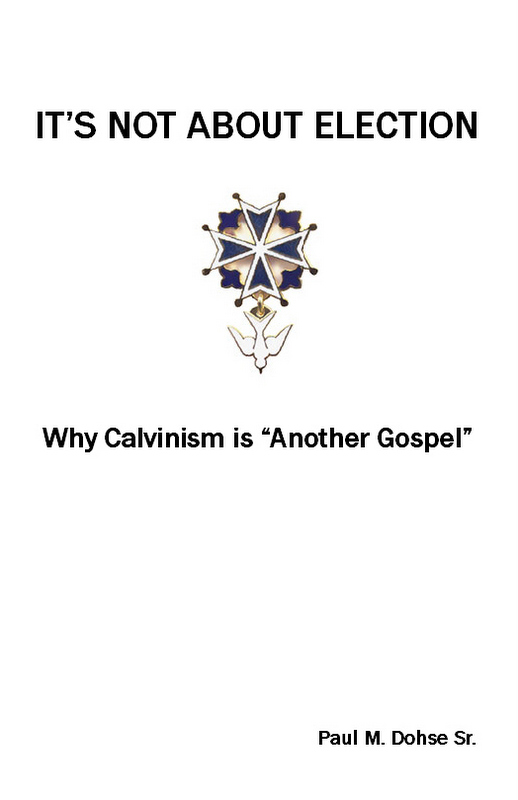
Now Available on Amazon
1. Do we keep ourselves saved by preaching the gospel to ourselves every day?
2. Do sins committed in the Christian life separate us from our salvation?
3. Do we need to be reconciled to God daily in a saving way?
4. Are Christians totally depraved?
5. Are Christians still under the law for Justification?
6. Do pastors have the authority to forgive your sins?
7. Do you believe that the New Testament Christian life is the Old Testament Sabbath; i.e., if we do works in our Christian life we will die spiritually?

 Paul's Passing Thoughts
2 comments