



Kevin DeYoung Bagged by the New Calvinist Slither Police, Part 2: Is Special K the Forerunner of the Great Slither?
 Kevin DeYoung, hereafter affectionately referred to as “Special K” (SK), offered a response to officer Tullian Tchividjian’s (hereafter, OTT) “pushback” regarding an article he wrote that sounded too orthodox. You can’t blame him; after all, OTT is one bad dude. Anybody who is privy to OTT’s merciless hostile takeover of Coral Ridge would certainly hesitate to ruffle his feathers. Even James D. Kennedy’s daughter barely got out of there with her hairdo still intact.
In SK’s response to OTT’s response, he mentioned that he is on sabbatical to write a book on sanctification. Funny, just last week, a reader wrote an email to me—asking what I thought of sabbaticals. I told him they are a joke, with the exception of a pastor doing so to search the Scriptures for himself regarding serious theological issues of our day. Bingo, what’s more important in our day than the whole question of sanctification? Compare SK’s sabbatical with Piper’s last sabbatical where the purpose was to expunge several “species of idols” in his heart. The sabbatical was predetermined to be eight months, so we can only assume that his consultants, Tim Keller and Paul Tripp, identified the idols as those that can always be rectified by deep repentance in an eight-month period—just in time to return on January 1; because after all, like everything else, the new year was all about him. I almost went myself, video cam in-hand, to document the fawning (complete with glazed-over eyes, perspiration, and weak knees) of his Koolaid drinking followers waiting with bated breath as he walked up to the podium to pontificate his first Sunday morning message after his “sabbatical.”
But, back to SK. I found the interpretive questions he is asking himself during his sabbatical to be very interesting, and leads one to think that his church may be populated with a rare breed of Christians known as homo thinking sapiens:
1. Can the justified believer please God with his obedience? [Yes, du, Paul said, “it is our goal to please Him”]
2. Is the justified believer displeasing to God in some way when he sins? [Yes, du, the opposite of “please” is “displease.”]
3. Is unbelief the root of every sin? [No—read about king David and Jonah] Or is it pride? Or idolatry? Should we even both trying to find a root sin? [No]
4. How are justification and sanctification related? [Read JC Ryle’s “Holiness”]
5. Can we obey God? [ SK, see John 14:15,16. Why is the Holy Spirit called our “helper”?]
6. Can we feel confident about our obedience, not in a justifying way but that we have done as we were commanded? [Yes, see 2Peter Chapter 1]
7. How does Scripture motivate us to obedience? [Start with Romans 5:13, then read verse 4 in the same chapter, and many other Scriptures like those. It’s NOT either the Holy Spirit or Scripture—it’s both.]
8. Are most Christians too hard on themselves (thinking they are filthy scum when they actually walk with the Lord in a way that pleases him)? [Not if they have a biblically trained conscience]
9. Or are most Christians too easy on themselves (thinking nothing of holiness and content with little progress in godliness)? [Ya think?]
10. What is the role of union with Christ in sanctification? And how do union with Christ and sanctification relate to justification? [SK: see the Australian Forum archives for a review of what you presently believe on that. It’s called the “centrality of the objective gospel.”]
But stop the presses! DeYoung wrote another article after he capitulated to the fearsome OTT entitled, “Is Sanctification By Faith Alone?” I will just say it plainly: dead on! With the exception of one whopper in the beginning of the piece, the rest of the post is a masterful articulation of true biblical sanctification. Is this the first time I have complimented a New Calvinist in the two-year history of this blog? Yes! In regard to the whopper: “Though it sounds very Protestant, it is not correct to say ‘sanctification is by faith alone.’” Uh, Special K, it has never been Protestant to say that, but hey, you’re going in the right direction.
This is major. DeYoung’s post is clearly in the face of New Calvinist doctrine, and the ten questions asked in the prior post are intimately connected to the conclusions stated in the latter. I can only pray that his healthy infatuation with JC Ryle will result in a positive outcome regarding the book he is writing on sanctification (and such a book is long overdue). In fact, Ryle’s “Holiness,” a book DeYoung often quotes, was written to refute false doctrines running amuck in Ryle’s day that were evil twins to present-day New Calvinism.
So, will SK take a hard stand and separate himself from the New Calvinism cartel? Or will he stay and be a lynchpin for the Great Slither? (See part 1): “Uh, ya, I agree with SK, absolutely! Yep, that’s been my position all along. In all of those other quotes of mine, I was talking about justification—not sanctification. But I will admit, I should have put a grammatical transition between the two—my bad dude.”
Or, if SK stays the course, will the New Calvinist throw him under the bus? Will the dreaded tweet come from the High Priest of New Calvinism?: “Bye, bye, Kevin DeYoung.”
paul
Gospel Sanctification and Sonship’s Gospel-Driven Genealogy, Part 4: Spiritually Dead Christians
As I sort through the history of Seventh-Day Adventism, Robert Brinsmead’s biography, and the teachings of the Australian Forum (AF), my mind is overwhelmed with the theological elements and characteristics that liken to present-day New Calvinism / Gospel Sanctification / Sonship Theology (NCGSS). However, there are two places in our endeavor where we can drive stakes thus far, and with certainty: the centrality and premise of everything gospel (ie., justification), and everything seen, understood, and interpreted through the gospel (justification) prism. In other words, two elements that make up the foundation of these two movements are exactly the same: a dogmatic refusal to let any truth eclipse justification, and a gospel-centered hermeneutic.
In the first, we also see the kinship between the two movements in the either / or interpretive schema. It’s what I call GB theology—you’re either with us—or you’re with the terrorist. In BOTH movements, you are either for justification only in sanctification (of course, that’s not how they would frame it)—or you are totally against justification by faith alone for salvation as well.
In the latter, the echo between the AF and the likes of Paul David Tripp regarding “all things must be seen in its gospel context” is utterly uncanny. I contend that the aforementioned facts show a historical uniqueness between the two groups that hardly persuade me that one didn’t come from the other.
This post is about NCGSS’s total depravity of the saints—and AF’s denial of the new birth. Obviously, spiritually dead saints (as Paul Tripp teaches), and born again Christianity is a contradiction. In Present Truth Magazine (the official journal of AF doctrine), archives volume 37, article 4, Paxton (one of the AF three) penned the article entitled “The False Gospel of the New Birth.” Present Truth (PT) had a large readership among Reformed Baptist in the seventies, and many voiced their displeasure at the article. More research is needed, but I have a working hypothesis that the AF, and movements within Reformed Baptist circles that facilitated New Covenant Theology (NCT) played a part in John Piper’s injection into NCGSS.
Take note: Goldsworthy, one of the AF three and the golden boy of NCGSS hermeneutics, affirmed his agreement with Paxton by footnoting the article in “Obituary for the Old Testament.”:
“Bultmann’s existential gospel led him inevitably to a negative view of the Old Testament. And the new-birth oriented “Jesus-in-my-heart” gospel of evangelicals has destroyed the Old Testament just as effectively as has nineteenth-century liberalism.1”
The footnote as in the same article is the following:
1 See Geoffrey J. Paxton, “The False Gospel of the New Birth,” Present Truth Magazine 7, no.3 (June 1978): 17-22.
Let me save a bunch of ink here. The premise of Paxton’s article is that since the new birth isn’t as important as focusing on Christ’s works in the gospel—the new birth is therefore not relevant. Again, it’s either / or, which characterizes and saturates NCGSS teachings. While Paxton writes, “We [“we” being the AF three] are not saying that the typical evangelical approach to the new birth is an outright denial of the truth,” he then continues to write, “Rather, it is the corruption of the ultimate truth. It confuses a good effect with the best cause. It puts a good fruit in place of the best root. Many who do this are good people whose Christian status and integrity we do not question. But that is the alarming thing about the newbirth craze.”
Stop right there. Let me now introduce another example (characteristic) of how the student looks like the teacher. Like NCGSS, AF writings are saturated with a bias against Evangelicals. Here, Paxton refers to the “typical evangelical approach.” As can be seen in this article, you can even accidentally get two examples of this if you refer back to the aforementioned Goldsworthy quote: “And the new-birth oriented ‘Jesus-in-my-heart’ gospel of evangelicals has destroyed the Old Testament just as effectively as has nineteenth-century liberalism.”
And stop right there again. I am going to introduce another related characteristic that the two groups share: the whole inside verses outside focus thing. What is that? Well, it dominates NCGSS teaching, especially that of Michael Horton. It is the idea that to focus on something like the new birth is to focus on us, or what is inside of us, rather than what is outside of us, namely, the gospel. This is a major theme of late in Horton’s writings. Paxton writes in the article that is the subject of this post:
“This approach to the new birth is incredibly introspective and self-preoccupied. Such evangelical ‘navel watching’ does nothing to commend robust Christianity to non-evangelicals or to those outside the church. It assaults the tender consciences of believers. It robs Christ of His glory by putting the Spirit’s work in the believer above and therefore against what Christ has done for the believer in His doing and dying. It is, in fact, anti-Christ.”
Sigh. Ok, I am really busy today and I can’t remember where I filed some Horton quotes that ape the AF example exactly, so let me take a minute and google “Michael Horton outside of us.” Be right back. Ok—it’s been about 30 seconds, and here is what I have, though not the best examples:
“Each of these themes serves to remind the believer that his or her righteousness is found not within, but outside.”
“It is essential, therefore, to point unbelievers and believers alike to Christ outside of their own subjective experiences and actions.”
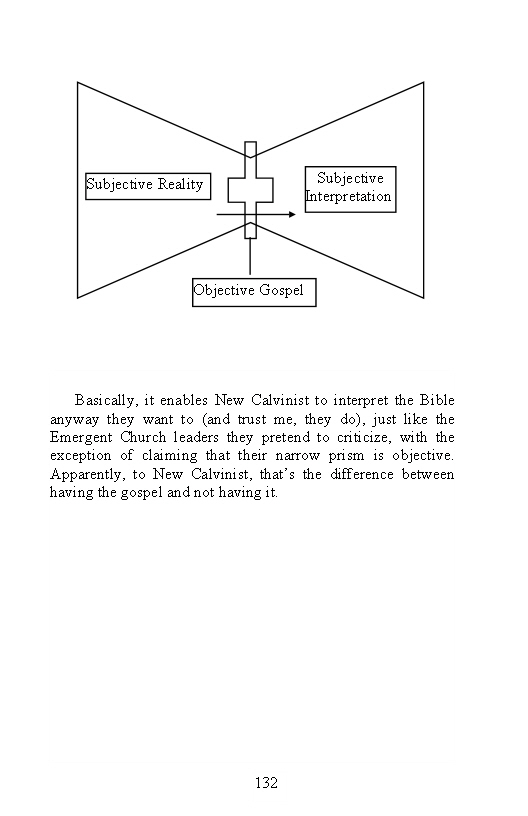
I could now get into yet another apeian characteristic of how the two camps interpret anything to do with us as being “subjective,” while the gospel outside of us is “objective.” Of course, as I have written before: using the objective gospel prism to interpret everything in the Bible leads to gargantuan subjectivity, but I digress. The more one peers into the data, the more it’s like grabbing two handfuls of Jell-O out of the same bowl and comparing them. In fact, I asked my readers to pray about a project I have been working on, but the way the prayers were answered was totally unexpected. The recent discovery of the AF firebombed the project. The project was a workbook that analyzed the writings of John Fonville because the way he writes makes an articulation of NCGSS easy to understand. Not only that—Fonville is a very contemporary up and comer in the movement, which should make my comparison to AF writings very interesting. Fonville wrote in one article:
“Throughout much of my Christian life I was a professing Evangelical but in practice a functioning Roman Catholic…. What do I mean by that? I would habitually turn inward to conduct personal ‘fruit inspection’ and then wallow and mope around for long periods of time in despair, guilt and a troubled conscience. I would beat myself up with self-focused thoughts.”
Interestingly, Paxton says this in the article that we are considering: “The false gospel of the new birth imagines that the new birth refers primarily to what happens in the believer and that this is the greatest news in the world. This is classical Roman Catholicism.”
Even more characteristics could be discussed; such as, both camps relying heavily on the writings of Walter Marshal. More to my point, before I even knew of the AF, I wrote this in the now defunct Fonville project: : “In addition to ill definitions and antithetical exaggerations, Fonville, like other GS teachers, employs an either/or paradigm in interpreting Scripture. There will be many examples of this in his writings, and we observe the first here as he insinuates that the law can only have a plenary role in spiritual growth, or none at all. Fonwell will also deny a colaboring in spiritual growth (1Corinthians 3:9 and 1Thessalonians 3:2) by default—insinuating that both saint and Spirit cannot work in the process—it’s either/or.”
Besides the undeniable, twofold, primary foundation of both camps, everything justification dogma, and the gospel prism of interpretation, the list of identical characteristics and elements continues to get longer with each hour of study: either/or, us against Evangelicals, and outside focus verses inside focus, etc.
paul

 Paul's Passing Thoughts
2 comments