The Potter’s House 2/10/2013: The Gospel According to Moses; Part 1

 Yesterday, I was invited to teach at Church of the Messiah which is a Christian movement that seeks to rediscover our Judeo-Christian roots. Since we are deeply invested in the subject of law and gospel right now via the book of Romans I thought it would be a good supplement.
The more we study through the Scriptures we realize that there is little difference between the Old Testament and New Testament. Believers of Old looked toward the cross; we look back to the cross. The ministry of the Holy Spirit is fundamentally the same. I think the primary variance is marked by the inclusion of the Gentiles into the commonwealth of Israel. But at any rate, believers of Old understood all of the salvific implications of Messiah’s arrival:
Luke 2:22 – And when the time came for their purification according to the Law of Moses, they brought him up to Jerusalem to present him to the Lord 23 (as it is written in the Law of the Lord, “Every male who first opens the womb shall be called holy to the Lord”) 24 and to offer a sacrifice according to what is said in the Law of the Lord, “a pair of turtledoves, or two young pigeons.” 25 Now there was a man in Jerusalem, whose name was Simeon, and this man was righteous and devout, waiting for the consolation of Israel, and the Holy Spirit was upon him. 26 And it had been revealed to him by the Holy Spirit that he would not see death before he had seen the Lord’s Christ. 27 And he came in the Spirit into the temple, and when the parents brought in the child Jesus, to do for him according to the custom of the Law, 28 he took him up in his arms and blessed God and said,
29 “Lord, now you are letting your servant depart in peace, according to your word; 30 for my eyes have seen your salvation 31 that you have prepared in the presence of all peoples, 32 a light for revelation to the Gentiles, and for glory to your people Israel.” 33 And his father and his mother marveled at what was said about him. 34 And Simeon blessed them and said to Mary his mother, “Behold, this child is appointed for the fall and rising of many in Israel, and for a sign that is opposed 35 (and a sword will pierce through your own soul also), so that thoughts from many hearts may be revealed.”
36 And there was a prophetess, Anna, the daughter of Phanuel, of the tribe of Asher. She was advanced in years, having lived with her husband seven years from when she was a virgin, 37 and then as a widow until she was eighty-four. She did not depart from the temple, worshiping with fasting and prayer night and day. 38 And coming up at that very hour she began to give thanks to God and to speak of him to all who were waiting for the redemption of Jerusalem.
Christ chastised Nicodemus for not comprehending the new birth which is normally thought of as a New Testament element of salvation:
John 3:1 – Now there was a man of the Pharisees named Nicodemus, a ruler of the Jews. 2 This man came to Jesus by night and said to him, “Rabbi, we know that you are a teacher come from God, for no one can do these signs that you do unless God is with him.” 3 Jesus answered him, “Truly, truly, I say to you, unless one is born again he cannot see the kingdom of God.” 4 Nicodemus said to him, “How can a man be born when he is old? Can he enter a second time into his mother’s womb and be born?” 5 Jesus answered, “Truly, truly, I say to you, unless one is born of water and the Spirit, he cannot enter the kingdom of God. 6 That which is born of the flesh is flesh, and that which is born of the Spirit is spirit. 7 Do not marvel that I said to you, ‘You must be born again.’ 8 The wind blows where it wishes, and you hear its sound, but you do not know where it comes from or where it goes. So it is with everyone who is born of the Spirit.”
9 Nicodemus said to him, “How can these things be?” 10 Jesus answered him, “Are you the teacher of Israel and yet you do not understand these things? 11 Truly, truly, I say to you, we speak of what we know, and bear witness to what we have seen, but you do not receive our testimony. 12 If I have told you earthly things and you do not believe, how can you believe if I tell you heavenly things? 13 No one has ascended into heaven except he who descended from heaven, the Son of Man. 14 And as Moses lifted up the serpent in the wilderness, so must the Son of Man be lifted up, 15 that whoever believes in him may have eternal life.
Also, when we look at Old Testament covenants, we must be careful to give diligent study because it seems that many of them are relevant now and will continue to be:
Ephesians 2:11 – Therefore remember that at one time you Gentiles in the flesh, called “the uncircumcision” by what is called the circumcision, which is made in the flesh by hands— 12 remember that you were at that time separated from Christ, alienated from the commonwealth of Israel and strangers to the covenants of promise, having no hope and without God in the world. 13 But now in Christ Jesus you who once were far off have been brought near by the blood of Christ.
Notice that “covenants” is in the plural and the Gentiles were alien to these covenants. Also note that they are called “covenants of promise.” The covenants are still in place until the promise attached to any given covenant is fulfilled.
Exodus 19-24 was used by the apostle Peter to write his first letter. How different is the Sinai event from the fundamental principles of the New Testament gospel? Not much. As we shall see, the relationship of obedience, law, death, and resurrection is no different.
I ask you to now take note of our first illustration that we will be utilizing:

Israel arrives at Mt. Sinai three lunar moons after leaving Egypt (three months). Between Egypt and Sinai, it was the Lord’s flight school:
Exodus 19:4 – You yourselves have seen what I did to the Egyptians, and how I bore you on eagles’ wings and brought you to myself.
This is a reference to how eagles teach their young to fly. They drop them from a great height and then fly under them before they hit the ground, and the events leading up to Sinai look very much like that.
When Israel arrives, God calls Moses up to the mountain; there, He proposes a covenant:
Exodus 19:5 – Now therefore, if you will indeed obey my voice and keep my covenant, you shall be my treasured possession among all peoples, for all the earth is mine; 6 and you shall be to me a kingdom of priests and a holy nation. These are the words that you shall speak to the people of Israel.”
The covenant is based on three things: obedience, kingdom of priests, and holy nation. At some point this happens—God gets what He wants. We know this because that’s what we are right now according to Peter:
1Peter 2:9 – But you are a chosen race, a royal priesthood, a holy nation, a people for his own possession, that you may proclaim the excellencies of him who called you out of darkness into his marvelous light. 10 Once you were not a people, but now you are God’s people; once you had not received mercy, but now you have received mercy.
This is very likely a direct reference to Exodus 19:5 by Peter. More than likely, this is consummated at Sinai and has always been reality. Therefore, we begin to see inappropriate dichotomies between the Old and New Testaments.
Moses then returns and informs the people that God wants to make a covenant with them. Interestingly, they agree to commit to whatever covenant God draws up. The key word here is commitment. The Israelites didn’t do anything to earn the right to enter into a covenant with God; rather, they committed to trust him: “we will do” is future tense. Even the writers of the Jewish midrash recognize that it is a matter of trust (The Jewish Study Bible: Jewish Publication Society; Oxford University Press 2004, p.162). This reminds of how Christ often called people to salvation: “Follow me.” Following doesn’t save you; the commitment to follow saves you. Trust is also belief.
When the people agree to the covenant, God calls for three days of consecration and sends Moses back down to lead the people in preparation for His arrival and the covenant ceremony. God’s form of theophany terrifies the people, and God recites the Book of the Covenant to Moses which includes the Decalogue (the Ten Commandments). The Decalogue is probably a sort of table of contents for the Book of the Covenant. The Book of the Covenant, though not precisely, seems to follow the Decalogue’s line of thought.
Once Moses receives the covenant, he rehearses it to the people. This brings us to our next illustration:
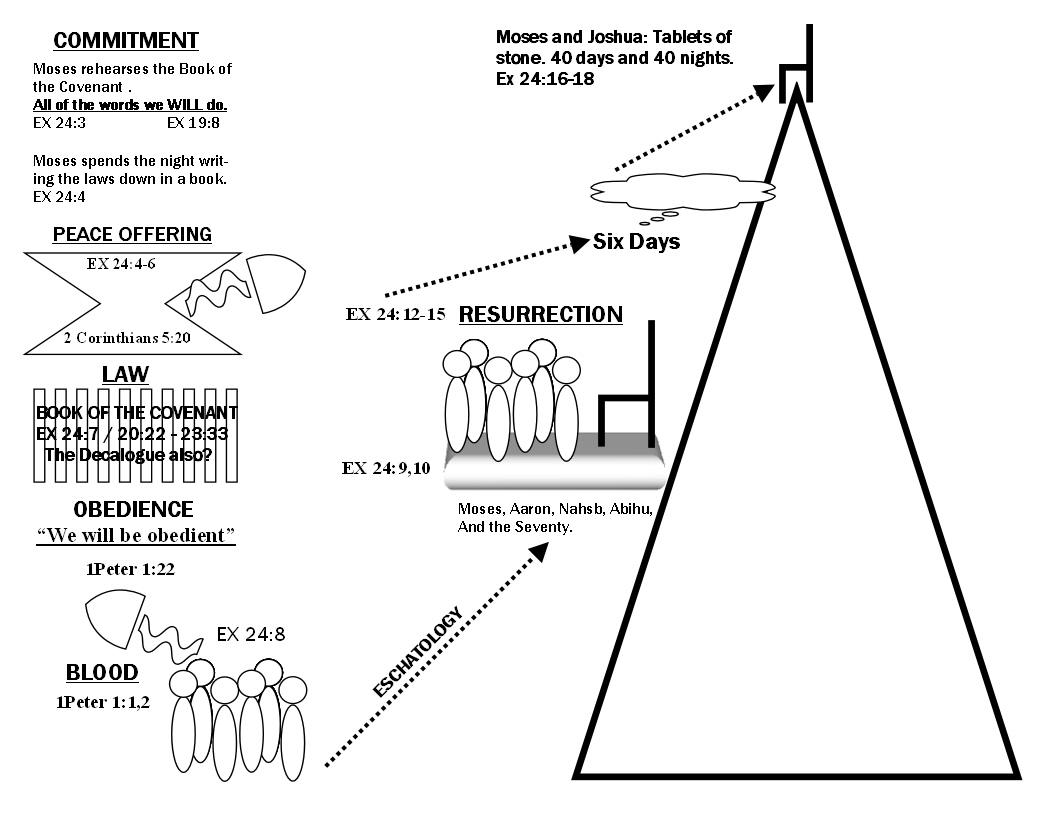
Interesting: Moses doesn’t take time to write it all down in a book until the people agree to the details. He then begins early the next morning in preparation for the ceremony. He has young men slaughter the appropriate sacrifices and throws some blood on the alter while procuring the rest in basins. But the ceremony begins with a peace offering—this is key. The fact that we were enemies makes the call to be reconciled with God paramount and is the theme of many gospel presentations in the New Testament. Our ministry is one of reconciliation:
2 Corinthians 5:18 – All this is from God, who through Christ reconciled us to himself and gave us the ministry of reconciliation; 19 that is, in Christ God was reconciling the world to himself, not counting their trespasses against them, and entrusting to us the message of reconciliation. 20 Therefore, we are ambassadors for Christ, God making his appeal through us. We implore you on behalf of Christ, be reconciled to God. 21 For our sake he made him to be sin who knew no sin, so that in him we might become the righteousness of God.
Ephesians 2:15 – by abolishing the law of commandments expressed in ordinances, that he might create in himself one new man in place of the two, so making peace, 16 and might reconcile us both to God in one body through the cross, thereby killing the hostility. 17 And he came and preached peace to you who were far off and peace to those who were near.
So far, we have two critical elements to include in our gospel presentations: trust (commitment: “follow me”), and reconciliation (peace with God).
Moses then read the Book of the Covenant which would be Exodus 20:22-23:33. When the people once again agreed to obey, he threw the remainder of the blood on them. Again, at this point, no law from the Book of the Covenant has yet been obeyed, but the commitment to do so resulted in the sprinkling of blood. Peter makes a direct reference to this as well:
1Peter 1:22 – Having purified your souls by your obedience to the truth for a sincere brotherly love, love one another earnestly from a pure heart,
The Israelites were purified by obedience—that’s what brought the covering of blood. And this is a critical third element to any gospel: obedience—the willingness to obey “truth.” The Book of the Covenant, like the rest of God’s canon is “truth.” And only truth sanctifies:
John 17:17 – Sanctify them in the truth; your word is truth.
A commitment to the truth saves (2Thessalonians 2:10), the law then informs our sanctification. But “I will obey” brings the blood. Trust, reconciliation, obedience. Not necessarily in that order. In the application of the blood of Christ, the old self dies with Christ and is no longer enslaved to sin, but is now enslaved to the law by nature (Romans 7:25). We are enslaved to the law by nature because of the new birth made possible by Christ’s resurrection. We are endowed with the same power that raised Him from the dead (Ephesians 1:19, 20). Once again, 1Peter 1:1, 2 is a direct reference to this Old Testament passage:
To those who are elect exiles of the Dispersion in Pontus, Galatia, Cappadocia, Asia, and Bithynia, 2 according to the foreknowledge of God the Father, in the sanctification of the Spirit, for obedience to Jesus Christ and for sprinkling with his blood: May grace and peace be multiplied to you.
Moses and the other pre-designated individuals go up the mountain to meet God after the ceremony. The scene is inescapably eschatological. Eating a meal with God during this encounter points to the marriage supper of the Lamb in my book. In regard to the cup that symbolizes the new covenant in His blood, Christ said He would not drink of it again until that supper in His kingdom. The remembrance was instituted at what is commonly known as the last supper (Mark 14:22-25).
Not only does Matthew 4:4 and 2Timothy 3:16 state that ALL Scripture is efficacious, some estimate that 25% of the Bible is eschatological. And as we have seen in our Romans series, eschatology is gospel. The paramount questions on this wise are, how many resurrections, and how many judgments? The answers to these questions should match our gospel and thus reveal it. Being mindful of what we have learned in Romans, you can relate this to the third illustration:

Peter’s gospel emphasis is seen in the Sinai event. And our gospel should always include trust, commitment, reconciliation, obedience, and the death, burial, and resurrection demonstrated in Christ’s blood. Christ’s obedience to the cross should also be explained in relationship to our death and freedom from the law as well as our enslavement by nature to law through the new birth that endowed us with the Spirit’s resurrection power.
paul

The Potter’s House: Sunday, January 22, 2013; Romans 6
Romans 6
Not that any part of Romans is more important than the rest, but I can’t help but say that we now enter into a most significant chapter in our day. Why do Christians sin? How can we be declared righteous and holy when our sin haunts us daily? If we are born again, if we are new creatures, why do we still sin? We start finding the answers in Romans chapter six.
Paul has been emphasizing the point over and over again that we are justified apart from the law. We are under grace, not under law. There is no law in justification though the law informs our Christian living. So now, Paul begins a rebuttal of what would seem to be the logical conclusion of what he has taught thus far:
Romans 6:1 – What shall we say then? Are we to continue in sin that grace may abound?
The rhetorical question should serve to illustrate how hard Paul has emphasized that Christians are not under the law for justification. He then answers the question as follows:
2 By no means! How can we who died to sin still live in it?
How have we died to sin? Answer:
3 Do you not know that all of us who have been baptized into Christ Jesus were baptized into his death? 4 We were buried therefore with him by baptism into death, in order that, just as Christ was raised from the dead by the glory of the Father, we too might walk in newness of life.
Here we have it in a nutshell. We died with Christ when we were saved, and are raised like Christ to “newness” of life. If we are new in life, the old died. A new life obviously replaced the old one. It happened “in order that” “we too” might walk in newness of life. “We” (first person plural) is us, as in, Christians. “Too” means that we might walk in newness of life like Jesus walked. “Too” implies that we are the ones walking—Jesus doesn’t walk for us. We are new creatures and able to walk in newness of life—the fact that we are empowered by the Holy Spirit is true, but does not negate the fact that we also walk. Let me remind you that even the unregenerate walk by the power of Christ who sustains all things (Colossians 1:9). That doesn’t mean that the unregenerate aren’t really the ones walking just because they are sustained by Christ. The same must be said for us regardless of the fact that we are empowered and recreated. Water baptism pictures this spiritual reality.
Romans 6:5 – For if we have been united with him in a death like his, we shall certainly be united with him in a resurrection like his. 6 We know that our old self was crucified with him in order that the body of sin might be brought to nothing, so that we would no longer be enslaved to sin. 7 For one who has died has been set free from sin. 8 Now if we have died with Christ, we believe that we will also live with him. 9 We know that Christ, being raised from the dead, will never die again; death no longer has dominion over him. 10 For the death he died he died to sin, once for all, but the life he lives he lives to God. 11 So you also must consider yourselves dead to sin and alive to God in Christ Jesus.
Dead to sin, and alive to God. Note verse 6 specifically: the “old self” was crucified with Christ which resulted in us not being any longer “enslaved to sin.” The reason that we can be considered righteous in our present life is because slavery is the issue. The old man is dead, so the life that enslaved him is powerless, but there is a remnant that is left behind or we would not still be walking around in mortal bodies. Nevertheless, his power to enslave to sin has been broken and we are free from the bondage of sin.
This is the case when we died with Christ, and what is also true is that we are now alive WITH Christ. We do not remain dead and the only life in us is Christ, we are also alive. Our resurrection life would be impossible without Christ, but that doesn’t mean we are still dead because we got our life from Him. Like any gift, once it is given, we have possession of it. This would seem evident. The apostle John made it clear that we have the seed of God in us (1John 3:9), so that making us righteous in our present day should not be an issue. The ability to do works that please God should not be an issue either.
According to what we have learned thus far in Romans, this old man that is now dead is also part of a position that we are no longer are a part of; namely, “under the law.” The eternal state is decided by whether one is under law or under grace. Those who are under the law will be judged by the law (Romans 2:12) and the standard is perfection. It will not go well for them. Not only are we considered righteous in our present state, but there is simply no law to judge the sin that presently takes place in the Christian life under the confines of justification. In regard to our justification, the law has no jurisdiction. Even if we were to appear in a court to determine our just state the judge would have no law to judge us by:
Romans 5:13 – for sin indeed was in the world before the law was given, but sin is not counted where there is no law.
The relationship of the law to Christians differs from that of the unbeliever: in regard to our justification the law has no jurisdiction. The jurisdiction of the law now applies to our sanctification. The law no longer informs our justification—we are no longer “under it.” But it does inform our sanctification:
Galatians 4:21 – Tell me, you who desire to be under the law, do you not listen to the law?
There is no need for Christ to keep the law for us in our sanctification as many teach in our day—we are not under it to begin with. The law itself informs us that we are no longer under it for our justification. Moreover, it is the full counsel of God for our sanctified life—it defines the reality thereof. This position is antithetical to being under the law; i.e., “under grace.”
So, we must consider the old man to be dead, and the new man alive. Even though the old man is dead and is no longer able to enslave us to sin, he is able to make an appeal to sin through the emotions:
Romans 5:12 – Let not sin therefore reign in your mortal body, to make you obey its passions. 13 Do not present your members to sin as instruments for unrighteousness, but present yourselves to God as those who have been brought from death to life, and your members to God as instruments for righteousness. 14 For sin will have no dominion over you, since you are not under law but under grace.
We are not primarily informed of this transformation from death to life experientially. Again, the law informs us that this is the case and we are to act accordingly. Apparently, our mortal bodies, which still includes the mind, can make one whale of a plea to sin through the passions. We don’t have to sin, but it is inevitable because though transformed, we are still imprisoned in our present mortality. Christ stated it this way:
Watch and pray that you may not enter into temptation. The spirit indeed is willing, but the flesh is weak (Matthew 26:41).
The law now informs us on how to present “your members to God as instruments for righteousness.” Elsewhere, Paul states it this way:
1Thessalonians 4:1 – Finally, then, brothers, we ask and urge you in the Lord Jesus, that as you received from us how you ought to walk and to please God, just as you are doing, that you do so more and more. 2 For you know what instructions we gave you through the Lord Jesus. 3 For this is the will of God, your sanctification: that you abstain from sexual immorality; 4 that each one of you know how to control his own body in holiness and honor, 5 not in the passion of lust like the Gentiles who do not know God;
For the believer, a lot of the law is about, “how you ought to walk.” And we are to do it, “more and more.” And we can do it because we are no longer under the dominion of sin which is synonymous with being “under the law.”
So, as far as obedience in sanctification, why all the fuss? The law can’t touch our eternal destiny, and where there is sin, grace abounds that much more (Romans 5:20). So, why not be relaxed in regard to the law? Paul explains:
Romans 6:15 – What then? Are we to sin because we are not under law but under grace? By no means! 16 Do you not know that if you present yourselves to anyone as obedient slaves, you are slaves of the one whom you obey, either of sin, which leads to death, or of obedience, which leads to righteousness? 17 But thanks be to God, that you who were once slaves of sin have become obedient from the heart to the standard of teaching to which you were committed, 18 and, having been set free from sin, have become slaves of righteousness. 19 I am speaking in human terms, because of your natural limitations. For just as you once presented your members as slaves to impurity and to lawlessness leading to more lawlessness, so now present your members as slaves to righteousness leading to sanctification.
20 For when you were slaves of sin, you were free in regard to righteousness. 21 But what fruit were you getting at that time from the things of which you are now ashamed? For the end of those things is death. 22 But now that you have been set free from sin and have become slaves of God, the fruit you get leads to sanctification and its end, eternal life. 23 For the wages of sin is death, but the free gift of God is eternal life in Christ Jesus our Lord.
Paul’s first point is that we show ourselves saved or unsaved by what we are enslaved to:
16 Do you not know that if you present yourselves to anyone as obedient slaves, you are slaves of the one whom you obey, either of sin, which leads to death, or of obedience, which leads to righteousness?
This is linked intrinsically to our assurance of salvation. We show ourselves a slave to righteousness or unrighteousness. Everybody born into the world is a slave. Yes, there is a choice; what type of slave do we want to be? A slave to righteousness or unrighteousness? Once again, we learn another powerful concept that can be integrated into our gospel presentations as we go in the way. I am convinced that more would be led to Christ in our day if we were better educated in the law. This is indeed a concept that can even be shared with children at a very young age.
Secondly, Paul makes the point that we become better and better slaves to whatever we are enslaved to—righteousness or unrighteousness. Slaves to unrighteousness sow and reap more and more death upon their lives, and slaves to righteousness sow and reap more and more righteousness upon their lives. Can you see that the difference between saved and unsaved is being defined here? Oh my! What a horrible travesty in our day that such a distinction is blurred! Again, the applications here on this one point are endless. One who doubts their salvation should give attention to their slavery. One who is a slave to sin with indifference should not be given any comfort that they are not under the law.
Third, Paul adds yet another point to why the law should not be lax in sanctification. Even though we are no longer under it for our justification, we were COMMITED to it for our sanctification:
17 But thanks be to God, that you who were once slaves of sin have become obedient from the heart to the standard of teaching to which you were committed, 18 and, having been set free from sin, have become slaves of righteousness.
A commitment (obedience) to the “standard of teaching” (the law) is part and parcel with the transformed heart. We are not saved by the law, but we are sanctified by it (John 17:17). When we profess Christ by faith alone, we are not only signing up for salvation, but for discipleship (Matthew 28:19, 20). Enslavement to sin, becoming a better and better slave to sin, and being under the law which in itself provokes the slave to sin more and more, and moreover will judge him/her in the end, is indicative of the unregenerate. Slavery to righteousness leading to more and more righteousness, and a love for truth (2 Thessalonians 2:10,11) is indicative of the righteous. Hence,
19 I am speaking in human terms, because of your natural limitations. For just as you once presented your members as slaves to impurity and to lawlessness leading to more lawlessness, so now present your members as slaves to righteousness leading to sanctification.
It might be added here that a commitment to no longer be a slave to sin is not in concert with so-called Lordship salvation. Anybody who is presented with the gift of the gospel should certainly be informed that they are not only seeking to escape hell by faith alone, but are also seeking to escape slavery to sin. They should also understand that they are escaping judgment from the law by the same token. Certainly, to understand that they are now a slave to Christ and not unrighteousness is efficacious to a proper understanding of the gospel. Lordship does not have one thing to do with our justification because there is no standard (law) in justification. The “standard” is now in sanctification (the “standard of teaching”) and is merely indicative of who we are. As Christians, we merely experience the reality that the law informs us of—by appropriating it through obedience, or working out what has been worked in. This is essential to our assurance. In order to prevent confusion, you can’t just say, “Lordship salvation.” It must be framed as Lordship justification or Lordship sanctification. Lordship justification is still under the law and enslaved to sin, Lordship sanctification is under grace.
Romans 6:20 – For when you were slaves of sin, you were free in regard to righteousness. 21 But what fruit were you getting at that time from the things of which you are now ashamed? For the end of those things is death. 22 But now that you have been set free from sin and have become slaves of God, the fruit you get leads to sanctification and its end, eternal life. 23 For the wages of sin is death, but the free gift of God is eternal life in Christ Jesus our Lord.
Paul frames this concept with slavery and freedom. The cute little Reformed comeback to the argument for freewill, “Mankind has a freewill alright; free to sin,” is actually backwards. Man is born in slavery to sin, and freedom in regard to righteousness. There is in fact, freewill. Slavery to a direction towards either righteousness or unrighteousness is the crux of the matter, with freedom to do good or evil with either. Note the illustration below:

Ultimately, though the unbeliever is enslaved toward evil, he/she has the freedom to do good, and I contend that at times do so accordingly. Even with honorable motives. The good works of the unrighteous have merit—not for justification, but in other matters. One, for what it is worth, is degree of eternal punishment. We also see some measure of freedom in regard to righteousness when Jesus said the following:
Matthew 11:20 – Then he began to denounce the cities where most of his mighty works had been done, because they did not repent. 21 “Woe to you, Chorazin! Woe to you, Bethsaida! For if the mighty works done in you had been done in Tyre and Sidon, they would have repented long ago in sackcloth and ashes. 22 But I tell you, it will be more bearable on the day of judgment for Tyre and Sidon than for you. 23 And you, Capernaum, will you be exalted to heaven? You will be brought down to Hades. For if the mighty works done in you had been done in Sodom, it would have remained until this day. 24 But I tell you that it will be more tolerable on the day of judgment for the land of Sodom than for you.”
Let’s now look at the circle on the right: are believers free to do evil? They most certainly are. But this is what Paul states in that regard:
21 But what fruit were you getting at that time from the things of which you are now ashamed? For the end of those things is death. 22 But now that you have been set free from sin and have become slaves of God, the fruit you get leads to sanctification and its end, eternal life.
Many English translations tend to give the idea that we persevere in doing good and this perseverance ends with eternal life, but that’s not what Paul is saying. If our perseverance ends with eternal life, then we are trying to obtain an end by works. This is Paul’s same point in Galatians 3:1-3;
O foolish Galatians! Who has bewitched you? It was before your eyes that Jesus Christ was publicly portrayed as crucified. 2 Let me ask you only this: Did you receive the Spirit by works of the law or by hearing with faith? 3 Are you so foolish? Having begun by the Spirit, are you now being perfected by the flesh?
Now note how Young’s Literal Translation renders this:
O thoughtless Galatians, who did bewitch you, not to obey the truth — before whose eyes Jesus Christ was described before among you crucified?
2 this only do I wish to learn from you — by works of law the Spirit did ye receive, or by the hearing of faith? 3 so thoughtless are ye! having begun in the Spirit, now in the flesh do ye end?
Paul, in essence is asking, “How do you work towards an end that has already been ended? This of course is in regard to justification. We have already come to an end of our justification before the Earth was even created. Also note that when we believed, we received the Spirit who seals us until the day of redemption (Ephesians 4:30). Paul is making two points here: it’s foolish to work towards an end that has already been finished. It’s foolish to work to keep something that is already sealed by the Holy Spirit’s power.
Rather, Paul is speaking of two directions: one that experiences progressive life and ending in eternal life, and one that experiences progressive death with eternal death as its end. As the arrows in the picture illustrate, we are either moving from less righteousness to more unrighteousness, or from less unrighteousness to more righteousness. It is no wonder that the gospel is often framed in context of repentance—repentance is a change of direction. I believe that the Scripture states that we can be so sure of this paradigm that we can know our present spiritual condition by examining our lives. I believe this is the whole point of 1John. See 1John 2:5 and 5:13 specifically. Peter also wrote of adding to the foundation of our faith in order to obtain a “rich” entry into heaven (2Peter 1:5-11). Can a saved person have poor entry into heaven shrouded with doubt? Yes, I think so.
Christians can experience death in this life through sin, and those experiences don’t lend themselves to a hopeful end. James spoke of singular sinful events that lead to death (James 1:14,15). John spoke of sin that leads to death among Christians (1John 5:16,17) and Paul wrote elsewhere that God puts some to death so that they will not be judged with the world (1Corintians 5:4,5; 11:30,31).
A life of death gives assurance that eternal death will be the end. A life of life gives assurance of eternal life. Being unregenerate is like job wages, the wages of sin is death, but our already finished end is a gift—let us be sure of it by how we walk,
23 For the wages of sin is death, but the free gift of God is eternal life in Christ Jesus our Lord.
The Potter’s House: Sunday, 1/6/2013; Romans 5:1-5


“In sanctification, our work and the Holy Spirit’s work are seamless”
There are a number of extremely important truths presented here in the fifth chapter of Romans. These are truths that are also particularly important in our day because of the kind of teachings that are in vogue. I would like to first point out that Paul does something here in the first verse that he does throughout his writings: both God the Father and Jesus Christ are strongly emphasized. The stated purpose of salvation in verse one is to reconcile humanity with God. Mankind is God’s enemy. Christ went to the cross to pay the penalty for our sin and was resurrected by God’s power (Ephesians 1:20). He went there for the purpose of reconciling us to God. Salvation is Trinitarian, and an overemphasis on a member of the Trinity is often present with the root of most heresies. And let there be no doubt: an overemphasis on Christ in our day is in the same vein of cults that overemphasize the Father to the exclusion of Christ, and other movements that overemphasize the Spirit to the exclusion of the Father and Christ. Chapter five also reiterates the importance of recognizing that justification is a finished work, and the strong dichotomy between justification and our Christian life (sanctification).
What we are given freely by faith alone is experienced in greater measure in our sanctification—if we have proper understanding of gospel basics. The work of justification is finished. The Father, the Son, and the Holy Spirit all had a role until Christ was resurrected. Christ was raised for our justification (Romans 4:25). He then sat down at the right hand of the Father (Hebrews 1:3). That work is finished, but the Trinity still works in our sanctification. We have all three of the Trinity members behind us in our Christian walk. BUT, reconciliation is a ministry that has given us “access” to the kingdom and now is one of our ministries to the world (2Corinthians 5:18-21). We must understand the actions of the Trinity in Justification and in sanctification as being different actions for different purposes. The confusion of these two works has been detrimental to innumerable Christians.
One of the great gifts of salvation is hope. Life without salvation has no hope. The unsaved are God’s enemies; they are under the constant threat of the revelation of God’s wrath; have little wisdom for making life work in a fulfilling way; and only have eternal judgment to look forward to in the end. Their life will not have a good ending, and they know it. A story with an assured bad ending is hopelessness. The unsaved live in an uncertain (from the mortal perspective) time frame that seeks to keep them as comfortable as possible until the tragic end. Without a doubt, most so-called mental illness is the result of hopelessness. This also hearkens back to the question of what we really want to draw from human wisdom in regard to life and godliness from people who have no hope.
In verse two, we have the hope of justification. It was obtained by faith alone, and rejoices in the grace of God and His glory. Our life story will have a glorious end. We are no longer “under the law”….for justification. But now, the law informs us in regard to something about our hope:
3 Not only that, but we rejoice in our sufferings, knowing that suffering produces endurance, 4 and endurance produces character, and character produces hope, 5 and hope does not put us to shame, because God’s love has been poured into our hearts through the Holy Spirit who has been given to us.
What does trouble in the life of an unbeliever avail? It is a disturbance in their effort to remain as comfortable as possible until they enter eternal judgment. Their only hope is a temporary hope that man can help them salvage as much of their uncertain comfort that may remain. Believers receive hope in the gospel of first importance, but now as the law informs our sanctification, we find that trouble in life aids us in a greater realization of the hope that lies ahead. We are saved in great power and hope (1Thessalonians 1:4, 5), but if we do not begin to rightly apply the law to our sanctification (which cannot effect our justification because there is no law in justification) our assurance will begin to wane, along with hope, and leading to shame.
Paul told Timothy that rightly dividing the law would result in a workman not being ashamed (2Timothy 1:15,16). In verses three and four, Paul documents the process of applying God’s wisdom to trouble in life in order to increase hope—leading to the absence of shame (guilt). Paul might have used the word “rejoice” to get their attention in regard to the Christian approach to trouble as opposed to that of the world. But at any rate, trouble in life lends opportunity for Christians to be more assured of their salvation. You cannot separate hope and assurance. When assurance lacks, the lack of hope follows. A saint that is 100% assured of heaven is immovable as well. What can this world possibly do to him or her?
Paul even explains the details of the process stated in verses 3-5. Endurance produces character. How so? Well, in the law, we find that “trouble,” “temptation,” and “trials” are all words that are used interchangeably. Why? Answer: we are often tempted to sin in a trial.
James 1:2—Count it all joy, my brothers, when you meet trials of various kinds, 3 for you know that the testing of your faith produces steadfastness. 4 And let steadfastness have its full effect, that you may be perfect and complete, lacking in nothing….12 Blessed is the man who remains steadfast under trial, for when he has stood the test he will receive the crown of life, which God has promised to those who love him. 13 Let no one say when he is tempted, “I am being tempted by God,” for God cannot be tempted with evil, and he himself tempts no one. 14 But each person is tempted when he is lured and enticed by his own desire. 15 Then desire when it has conceived gives birth to sin, and sin when it is fully grown brings forth death.
Perhaps we are in the trial because of sin to begin with. “Endurance” is equal to thinking the right way, praying the right way, and doing the right things in a trial. It is the proper application of biblical wisdom to life; so, not surprisingly, it builds what? Right, character.
Now, when we see the character, although we study the issue to find God’s wisdom (that’s what a disciple is, a “learner”) and successfully apply it to our lives, we know that we are actually seeing the “fruit of the Spirit.” In sanctification, our work and the Holy Spirit’s work are seamless. Sure, if we don’t work in sanctification, the Holy Spirit will still work, but more than likely it will be works that seek to confront our spiritual laziness. And, if we grieve Him (Ephesians 4:30), we will live an anemic life full of fear.
One of the fruits of the Holy Spirit is “self-control.” If there is no temptation present, self-control is not needed. And who is doing the controlling? Self– control. We are doing the controlling. But whose fruit is it? Answer: the Holy Spirit’s. We must work. The Holy Spirit will work. But where the two works divide in the finished results is not ascertainable. However, the law is full of promises in this regard: if we do A, the Holy Spirit will do B. There are many different motivations in sanctification to obey Scripture. We are even warned that there is judgment in this life for doing wrong as a Christian (1Thessalonians 4:6, 7, 1Corinthians 11:30-32, 1John 5:16-18, 1Corinthians 5:4,5). But it is a judgment separate from justification. It is a judgment that renders unfortunate consequences in this life.
Paul is describing a sanctification process. Endurance leading to character and hope, resulting in a clear conscience, and manifesting the love of the Holy Spirit in our hearts. I believe this is a testimony of God’s love for us when this process is functioning the way God wants it to. But now one cries out:
See! See!, you are teaching that God’s love for us is increased via certain behaviors; i.e., KEEPING THE LAW! You are saying that we earn God’s love through works!
No I am not, and this idea can be sold to many Christians in our day because of doctrinal illiteracy. Churches must begin to strive for doctrinal education to be returned to the local churches. I have come to believe that seminaries do more harm to Christianity than good.
When we are saved, we are given all of God’s love and righteousness. We cannot earn any of it. It is by faith alone. That granting is initially experienced with much exhilaration, but in sanctification, the question becomes to what degree that we will EXPERIENCE the gift! As we have previously noted in this study series, salvation is separate from justification. Justification is a onetime legal declaration. Salvation is also finished in that its fullness has been credited to our account, in full, and once for all time. Note Ephesians 1:15-23:
15 For this reason, because I have heard of your faith in the Lord Jesus and your love toward all the saints, 16 I do not cease to give thanks for you, remembering you in my prayers, 17 that the God of our Lord Jesus Christ, the Father of glory, may give you the Spirit of wisdom and of revelation in the knowledge of him, 18 having the eyes of your hearts enlightened, that you may know what is the hope to which he has called you, what are the riches of his glorious inheritance in the saints, 19 and what is the immeasurable greatness of his power toward us who believe, according to the working of his great might 20 that he worked in Christ when he raised him from the dead and seated him at his right hand in the heavenly places, 21 far above all rule and authority and power and dominion, and above every name that is named, not only in this age but also in the one to come. 22 And he put all things under his feet and gave him as head over all things to the church, 23 which is his body, the fullness of him who fills all in all.
Salvation doesn’t grow. But our experience of it in sanctification certainly does. As far as the “victorious” Christina life—there has already been a victory—are we going to live the victory and show it to the world in order to glorify God? Will we live a life that causes people to come to us privately and ask about…. what? Our “hope,” right? That’s the word Peter used, right? (1Peter 3:15). Paul notes in our Romans text at hand that hope grows in our Christian life if we deal with life God’s way. BUT it requires our colaboring with the Spirit in sanctification.
This is the dreadful evil of our day: the Christian witness is sapped because of passive sanctification. Why is this? Clearly, it is because sanctification is seen as the “growing part” of our salvation that COMPLETES justification. Therefore, what we do in sanctification is seen as affecting our “just standing.” This is the paramount reason for crippled sanctification in our day. It is the reason for lack of assurance; lack of hope; lack of evangelism, and lack of a powerful Christian witness in the world. As this ministry constantly harps, it is the difference between the linear gospel and the parallel gospel. Some illustrative charts that we use are following:


In the remainder of the chapter, Paul writes about before and after: before salvation; and after salvation. Justification and sanctification are two different realities. Treating them as the same will devastate Christian living. Everywhere Susan and I go, Christians tiptoe around the issue of obedience in sanctification as if it is the Bubonic Plague. Again, this is due to fear that what we do in sanctification might in some way effect our “just standing.” Not the Apostle Paul:
1Thessalonians 4:1— Finally, then, brothers, we ask and urge you in the Lord Jesus, that as you received from us how you ought to walk and to please God, just as you are doing, that you do so more and more. 2 For you know what instructions we gave you through the Lord Jesus. 3 For this is the will of God, your sanctification: that you abstain from sexual immorality; 4 that each one of you know how to control his own body in holiness and honor, 5 not in the passion of lust like the Gentiles who do not know God; 6 that no one transgress and wrong his brother in this matter, because the Lord is an avenger in all these things, as we told you beforehand and solemnly warned you. 7 For God has not called us for impurity, but in holiness. 8 Therefore whoever disregards this, disregards not man but God, who gives his Holy Spirit to you.
And not Peter:
2Peter 1:3—His divine power has granted to us all things that pertain to life and godliness, through the knowledge of him who called us to his own glory and excellence, 4 by which he has granted to us his precious and very great promises, so that through them you may become partakers of the divine nature, having escaped from the corruption that is in the world because of sinful desire. 5 For this very reason, make every effort to supplement your faith with virtue, and virtue with knowledge, 6 and knowledge with self-control, and self-control with steadfastness, and steadfastness with godliness, 7 and godliness with brotherly affection, and brotherly affection with love. 8 For if these qualities[f] are yours and are increasing, they keep you from being ineffective or unfruitful in the knowledge of our Lord Jesus Christ. 9 For whoever lacks these qualities is so nearsighted that he is blind, having forgotten that he was cleansed from his former sins. 10 Therefore, brothers, be all the more diligent to confirm your calling and election, for if you practice these qualities you will never fall. 11 For in this way there will be richly provided for you an entrance into the eternal kingdom of our Lord and Savior Jesus Christ.
12 Therefore I intend always to remind you of these qualities, though you know them and are established in the truth that you have. 13 I think it right, as long as I am in this body, to stir you up by way of reminder, 14 since I know that the putting off of my body will be soon, as our Lord Jesus Christ made clear to me. 15 And I will make every effort so that after my departure you may be able at any time to recall these things.
All of God’s divine power for life and godliness has been granted to us in full. We are now called to be partakers of the divine nature. We have it all, but we must become, what? Answer: “partakers.” We must ADD certain things to our faith as we learn them, and by doing that we “make our calling and election sure.” And we also prepare for ourselves a “rich entry” rather than a deathbed laden with regret, doubt, and a shred of hope.
This is such a critical truth: the difference between who we were and who we are now; and how that applies to our present sanctification. It is the focus of Romans five, and we will continue to delve into this deeper next week with the Apostle Paul’s help.
The Potter’s House 12/30/2012: Law and Grace; Romans Chapter 4

We now come to chapter four in our study of Romans. Thus far, Paul has emphasized that all men, whether Jew or Gentile, are saved by faith alone. This salvation is a revelation of God’s righteousness, and is imputed to us when we believe in Jesus Christ. We have learned that the gospel is the full counsel of God which of course includes the death burial, and resurrection of Christ. We have learned that Paul was very concerned with a spiritual caste system that would render the Gentiles as second-class citizens in the church. Though the church is uniquely Jewish, God shows no partiality in regard to race and gives the various gifts of salvation to all men freely.
What we have in the book of Romans is a radical dichotomy between justification and sanctification; or said another way, salvation and its imputed righteousness set against the Christian life as kingdom citizens living on earth as aliens and ambassadors. However, there is NO dichotomy between law and gospel. Why? Because both are the full counsel of God. In the Bible, “law,” “truth,” “gospel,” “Scriptures,” “holy writ,” “the law and the prophets,” and other terms are used interchangeably to speak of the closed canon of God’s full counsel for life and godliness. Christ as well as Paul made it absolutely clear: man lives by every word that proceeds from God and ALL Scripture is profitable to make the servant of God complete in every good work.
Now listen: though the life application of some Scripture changes with time and circumstances, it still remains that all Scripture informs us in regard to our walk with God in the way we pray, think, and act. We do not stone rebellious children in our day. Nay, when we have a rebellious teen in the church, we do not gather the congregation together and stone him/her to death. With that said, does the fact that God at one time instructed the Jews to do so inform us in regard to many applications for teen rebellion in our day? Absolutely. Oh my, the contemporary applications in our day are almost endless. Not only that, Old Testament ritual and symbolism offers a built-in protective hermeneutic for the Scriptures as a whole. What do I mean by that? Well, you can mess with words, but symbolism is very difficult to mess with. If it’s a lampstand, it’s hard to change that to a Honda Civic. Right?
Paul delves into a paramount truth for Christians in the book of Romans: The relationship of the law to the unsaved verses the saved. And here it is: the lost are UNDER the law, and the saved are UNDER grace, but informed by the law. Let me repeat that: the lost are UNDER the law, and the saved are UNDER grace, but informed by the law. And we can see this right in the same neighborhood of the text that we are in.
Romans 3:21—But now the righteousness of God has been manifested apart from the law, although the Law and the Prophets bear witness to it—
That verse pretty much says it all. We are justified apart from the law, and as we will see, Paul means totally apart from the law. But we are informed by it. Paul states in Romans 3:28:
For we hold that one is justified by faith apart from works of the law.
Now note what he states after a few verses following in Romans 4:3,
For what does the Scripture say?
Paul strives to make the point in this letter that law is not even on the radar screen in regard to justification. And this is extremely important to know in our day for many teach that law is on the justification radar screen and therefore Christ must keep the law for us in order to maintain our justification. Not so, there is no law to keep in regard to justification—a righteousness APART from the law, the very righteousness of God has been imputed to our account in full. Paul even writes (and this is very radical) that Christians are sinless in regard to justification because there is no law in justification to judge us:
Romans 7:1—Or do you not know, brothers—for I am speaking to those who know the law—that the law is binding on a person only as long as he lives?
Romans 7:6—But now we are released from the law, having died to that which held us captive….(v.8) Apart from the law, sin lies dead.
Now, the law can judge our sin in our Christian life, but that can’t touch the fact that we are “washed.” Therefore, in sanctification, we only need to wash our feet to maintain a healthy family relationship with our Father God and Brother, the Lord Jesus Christ. Turn with me and let’s look at this in John 13:1-11:
Now before the Feast of the Passover, when Jesus knew that his hour had come to depart out of this world to the Father, having loved his own who were in the world, he loved them to the end. 2 During supper, when the devil had already put it into the heart of Judas Iscariot, Simon’s son, to betray him, 3 Jesus, knowing that the Father had given all things into his hands, and that he had come from God and was going back to God, 4 rose from supper. He laid aside his outer garments, and taking a towel, tied it around his waist. 5 Then he poured water into a basin and began to wash the disciples’ feet and to wipe them with the towel that was wrapped around him. 6 He came to Simon Peter, who said to him, “Lord, do you wash my feet?” 7 Jesus answered him, “What I am doing you do not understand now, but afterward you will understand.” 8 Peter said to him, “You shall never wash my feet.” Jesus answered him, “If I do not wash you, you have no share with me.” 9 Simon Peter said to him, “Lord, not my feet only but also my hands and my head!” 10 Jesus said to him, “The one who has bathed does not need to wash, except for his feet, but is completely clean. And you are clean, but not every one of you.” 11 For he knew who was to betray him; that was why he said, “Not all of you are clean.”
Clearly, “washing” refers to salvation, and differs from needing the lesser washing of the feet. The example is set against the unregenerate betrayer among them. Note that Jesus said that even though we needed to wash our feet, we are still “completely clean.” My, my, what a strong contrast to much of the teachings in our day; i.e., the idea of “deep repentance” that is the same repentance that saved us and keeps us saved—as long as we are in a Reformed church where such forgiveness is available.
Secondly, this passage shows that the gratuitous pardon of sins is given us not only once, but that it is a benefit perpetually residing in the Church, and daily offered to the faithful. For the Apostle here addresses the faithful; as doubtless no man has ever been, nor ever will be, who can otherwise please God, since all are guilty before him; for however strong a desire there may be in us of acting rightly, we always go haltingly to God. Yet what is half done obtains no approval with God. In the meantime, by new sins we continually separate ourselves, as far as we can, from the grace of God. Thus it is, that all the saints have need of the daily forgiveness of sins; for this alone keeps us in the family of God (Calvin’s Commentaries, Vol. 45: Catholic Epistles).
So, Paul in chapter four, in his endeavor to get this into the heads of Christians, approaches it from another angle: the life of Abraham, the father of faith. This is so powerful. Again, you can fiddle with words in translation, but rearranging the order of Abraham’s biography would be a difficult endeavor and the order of his life from the Old Testament account solidifies what Paul is teaching here about justification:
Romans 4:1-8—What then shall we say was gained by Abraham, our forefather according to the flesh? 2 For if Abraham was justified by works, he has something to boast about, but not before God. 3 For what does the Scripture say? “Abraham believed God, and it was counted to him as righteousness.” 4 Now to the one who works, his wages are not counted as a gift but as his due. 5 And to the one who does not work but believes in him who justifies the ungodly, his faith is counted as righteousness, 6 just as David also speaks of the blessing of the one to whom God counts righteousness apart from works: 7 “Blessed are those whose lawless deeds are forgiven, and whose sins are covered; 8 blessed is the man against whom the Lord will not count his sin.
We had a fellowship last night and a brother pointed out a common problem among Christians; they often don’t know when something should be simply applied and not figured out. And this is one—faith declares us completely righteous and no sin will be counted against us. Justification is a gift. Righteousness is a gift. If the gift is righteousness and God says so, that is the end of the discussion. Unlike a gift, any kind of work in justification equals a wage that is due. Paul then deals with the issue of justification through circumcision (something we do):
9 Is this blessing then only for the circumcised, or also for the uncircumcised? For we say that faith was counted to Abraham as righteousness. 10 How then was it counted to him? Was it before or after he had been circumcised? It was not after, but before he was circumcised. 11 He received the sign of circumcision as a seal of the righteousness that he had by faith while he was still uncircumcised. The purpose was to make him the father of all who believe without being circumcised, so that righteousness would be counted to them as well, 12 and to make him the father of the circumcised who are not merely circumcised but who also walk in the footsteps of the faith that our father Abraham had before he was circumcised.
What Paul is saying is that God deliberately waited to have Abraham circumcised so that he would be the father of the uncircumcised as well as the circumcised. Also, to make the point that no ritual saves us whether circumcision or baptism, and followed by an attitude that we are justified accordingly by the ritual alone, and can hence live anyway we want to. As we have discussed previously in this study, an attitude of obedience is part and parcel with saving faith. Obedience and saving faith are two sides of the same coin. This is NOT so-called “lordship salvation,” but a statement regarding the fact that saving faith is not accompanied by a libertine attitude towards God’s full counsel, but rather a love for the truth. No obedience saves anybody, but saving faith is also endowed with a love for the truth with natural results following. However, as we will see later in this same book, the flesh is weak and faith alone does not carry the day in sanctification like it does in justification; so, many other factors come to bear in sanctification. This is where the sanctification by justification rave of our day is most unfortunate.
This is not the only place in Scripture where Paul uses the chronology of Abraham’s life to argue for righteousness completely separate from the law:
Galatians 3:15—To give a human example, brothers: even with a man-made covenant, no one annuls it or adds to it once it has been ratified. 16 Now the promises were made to Abraham and to his offspring. It does not say, “And to offsprings,” referring to many, but referring to one, “And to your offspring,” who is Christ. 17 This is what I mean: the law, which came 430 years afterward, does not annul a covenant previously ratified by God, so as to make the promise void. 18 For if the inheritance comes by the law, it no longer comes by promise; but God gave it to Abraham by a promise.
This is the foolishness of any idea that the law is still a standard for our justification and the law must be maintained by Christ in our sanctification, or that Christ’s life was for the purpose of imputing his obedience to our sanctification. The promise of justification by faith alone was ratified before the law ever came through Moses—430 years before. Why would Christ have to maintain a perfect keeping of a law that had nothing to do with the promise whatsoever? Hence, look at the perfect fit we have in Romans 4:13-15:
13 For the promise to Abraham and his offspring that he would be heir of the world did not come through the law but through the righteousness of faith. 14 For if it is the adherents of the law who are to be the heirs, faith is null and the promise is void. 15 For the law brings wrath, but where there is no law there is no transgression.
Again, no law, no transgression. Transgression is not absent in justification because Christ maintains the law for us in sanctification—there is no transgression to be counted against our justification because there is no law in justification period. It’s based on promise—not law. Christ came to die in order to fulfill the promise that was given 430 years before the law. And this brings us to a previous point. As some know, because of the focus of the particular ministry I am in, I use the ESV translation of the Bible. The ESV is a contemporary translation by New Calvinists and is their Bible of choice. Now note how Romans 4:16 is translated in the ESV:
That is why it depends on faith, in order that the promise may rest on grace and be guaranteed to all his offspring—….
“Depends” is a very interesting choice of words here. Actually, there is no merit at all for the use of that word in Romans 4:16. The word, or even that idea doesn’t appear in any interlinear, expanded translation, or manuscript such as the Received text, Majority text, or Critical text. But it does have merit in regard to the Reformed view of justification; i.e., maintaining our just standing requires a continuance of faith alone in sanctification. Our justification “depends” on that. “Depends” also hints of an ongoing or continual dependence.
Paul then concludes with a definition of this saving faith:
16 That is why it depends on faith, in order that the promise may rest on grace and be guaranteed to all his offspring—not only to the adherent of the law but also to the one who shares the faith of Abraham, who is the father of us all, 17 as it is written, “I have made you the father of many nations”—in the presence of the God in whom he believed, who gives life to the dead and calls into existence the things that do not exist. 18 In hope he believed against hope, that he should become the father of many nations, as he had been told, “So shall your offspring be.” 19 He did not weaken in faith when he considered his own body, which was as good as dead (since he was about a hundred years old), or when he considered the barrenness of Sarah’s womb. 20 No unbelief made him waver concerning the promise of God, but he grew strong in his faith as he gave glory to God, 21 fully convinced that God was able to do what he had promised. 22 That is why his faith was “counted to him as righteousness.” 23 But the words “it was counted to him” were not written for his sake alone, 24 but for ours also. It will be counted to us who believe in him who raised from the dead Jesus our Lord, 25 who was delivered up for our trespasses and raised for our justification.
Herein we have a definition of saving faith: it has a stubborn trust in the promises of God regardless of life circumstances. It hopes in God regardless of the hopeless motif continually posited by the world. And, Abraham grew in faith as he gave glory to God. What’s that mean? We have a clue from Matthew 5:14-16;
14 “You are the light of the world. A city set on a hill cannot be hidden. 15 Nor do people light a lamp and put it under a basket, but on a stand, and it gives light to all in the house. 16 In the same way, let your light shine before others, so that they may see your good works and give glory to your Father who is in heaven.
We are all saved and justified with an initial faith that varies according to the grace of God (Romans 12:3), but certainly, our faith in sanctification grows as we exercise it through obedience while giving glory to God. Obedience demonstrates trust. Applying God’s truth to our life demonstrates that we believe that He knows best and blessings will result. Peter said that we should be diligent to “add to our faith” (2Peter 1:5-11). Faith is a gift that justifies us once, and for all time with the very righteousness of God. But we participate in the growth of our faith through application of the full counsel of God. This is what the book of James is about (see James 1:25), and only one example among many in holy writ.
Of course, the life of Christ was very awesome for many reasons, but His life was not for the purpose of obeying the law perfectly so that His obedience to the law could be imputed to us in sanctification for the purpose of maintaining our just standing. The law is not the standard for maintaining justification; it is finished. Christ was the only Man ever born into the world under the law who could be the perfect sacrifice required by God. All others born under law are under its curse and provoked to sin by it. But note the last verse here in chapter four:
23 But the words “it was counted to him” were not written for his sake alone, 24 but for ours also. It will be counted to us who believe in him who raised from the dead Jesus our Lord, 25 who was delivered up for our trespasses and raised for our justification.
Paul states that our justification came through Christ’s resurrection, not His life. The Reformed construct of Christ living for our sanctification and dying for our justification is simply nowhere to be found in Scripture, and if it is, as with a myriad of other textual examples, Paul fails to mention such a crucial fact in these last verses.

The Potter’s House 12/23/2012: What’s in the Word, “Righteousness”? Romans Chapter 3
In Romans 1:16, Paul begins his gospel treatise to the Romans. From there to 3:1 where we begin today’s lesson, Paul begins to unfold the gospel—the full counsel of God. He had hoped to do this much sooner and in person, but since God had hindered him, he delivered this treatise by letter. The church at Rome was in dire need of God’s wisdom in the midst. These Christians came from a culture that was the cradle of Western philosophy. The fact that these people embraced a faith that was inherently and predominantly Jewish is astounding. Therefore, Paul’s gospel treatise seeks to set the metaphysical story straight. In this treatise, he is adjusting deep rooted Greco-Roman philosophical presuppositions and attitudes dating back to the 6th century BC. These were deep-rooted presumptions brought with them into an antithetical Jewish culture that also needed significant adjustment. Rome was a highly hierarchical and class-conscious society; but yet, they willingly embraced a faith that clearly attributed privileged status to the Jews as God’s chosen people.
Therefore, Paul makes it clear that there are no second class citizens in the kingdom of God, and all men must inter the kingdom and live in the kingdom by the same standard whether Jew or Greek. Paul approaches this from many different angles in the first two chapters to the point where clarification is needed in 3:1. Paul realizes that he has so strongly emphasized this that the Romans would now conclude that there was nothing unique at all in regard to being a Jew. Hence,
Romans 3:1—Then what advantage has the Jew? Or what is the value of circumcision? 2 Much in every way. To begin with, the Jews were entrusted with the oracles of God.
Among the nations, God chose the Jews to oversee God’s “logion” or utterances/oracles. Yes, they were written in a canon, but they were no less the breath of God—documentation of His very words to man. This was a special privilege among many others (Due. 4:8), but didn’t mean that Jews could live before God by their own standards and on their own terms. But even though some rebelled this did not nullify the promises of God for them:
Romans 3:3—What if some were unfaithful? Does their faithlessness nullify the faithfulness of God? 4 By no means! Let God be true though every one were a liar, as it is written, “That you may be justified in your words, and prevail when you are judged”
Once again, as we endeavor in our personal study, we are not enslaved by what leaders decide to teach us. All Christians should partake in their own hefty study of the word of God. I was stalled in this lesson for some time due to a reoccurring theme that was a little puzzling to me. When we think of God’s “righteousness” we think of His judgment and His actions as a righteous judge. But actually, God’s righteousness is revealed by everything he does; particularly, His saving actions which we usually think of as His mercy and love. There is no doubt that His salvation is an act of mercy and love, but the Bible often speaks of His salvation as being for the purpose of revealing His righteousness:
Romans 3:21—But now the righteousness of God has been manifested apart from the law, although the Law and the Prophets bear witness to it—
Hence, the law is not the standard for justification, what God does is the standard. Therefore, the whole idea that Christ had to fulfill the law while He was here on earth so that our justification would be validated becomes problematic to say the least because the law is not the standard for God’s righteousness which was imputed to us. The fact that God saved us REVEALS His righteousness apart from the law. I suppose you could say that nothing outside of God stands in judgment over His actions. He Himself is righteousness. AND, the idea that God will not fulfill His promises to Israel because of things they have done plainly denies God’s righteousness which is ill advised.
Let’s look at some examples of this:
Deuteronomy 9:5
Not because of your righteousness or the uprightness of your heart are you going in to possess their land, but because of the wickedness of these nations the LORD your God is driving them out from before you, and that he may confirm the word that the LORD swore to your fathers, to Abraham, to Isaac, and to Jacob.
Deuteronomy 9:6
“Know, therefore, that the LORD your God is not giving you this good land to possess because of your righteousness, for you are a stubborn people.
Let’s look further into this idea that every act of God declares His righteousness:
Judges 5:11
To the sound of musicians at the watering places, there they repeat the righteous triumphs of the LORD, the righteous triumphs of his villagers in Israel. “Then down to the gates marched the people of the LORD.
1 Samuel 12:7
Now therefore stand still that I may plead with you before the LORD concerning all the righteous deeds of the LORD that he performed for you and for your fathers.
2 Chronicles 12:6
Then the princes of Israel and the king humbled themselves and said, “The LORD is righteous.”
Nehemiah 9:8
You found his heart faithful before you, and made with him the covenant to give to his offspring the land of the Canaanite, the Hittite, the Amorite, the Perizzite, the Jebusite, and the Girgashite. And you have kept your promise, for you are righteous.
Nehemiah 9:33
Yet you have been righteous in all that has come upon us, for you have dealt faithfully and we have acted wickedly.
Job 36:3
I will get my knowledge from afar and ascribe righteousness to my Maker.
Psalm 7:17
I will give to the LORD the thanks due to his righteousness, and I will sing praise to the name of the LORD, the Most High.
Psalm 22:31
they shall come and proclaim his righteousness to a people yet unborn, that he has done it.
There is not enough time to cite all of the biblical references that name the various ways and things God does to display His righteousness. In this context, Paul speaks to the fact that God reveals His righteousness by keeping His promises to the Nation of Israel regardless of anything they do. Their sin reveals God’s righteousness because He kept His promises to them regardless. Paul then, as a teaching technique posits hypothetical rebuttals to this truth:
Romans 3:5— But if our unrighteousness serves to show the righteousness of God, what shall we say? That God is unrighteous to inflict wrath on us? (I speak in a human way.)
Said another way: “Well, if our sin reveals the mercy aspect of God’s righteousness, then He is unrighteousness in His display of wrath, right? Wrong. Paul states:
6 By no means! For then how could God judge the world?
God’s righteousness is revealed in judgment as well as mercy. Hence,
Exodus 33:19
And he said, “I will make all my goodness pass before you and will proclaim before you my name ‘The LORD.’ And I will be gracious to whom I will be gracious, and will show mercy on whom I will show mercy.
The truth that God’s promises are kept by Him regardless of man’s shortcomings and the revealing of His righteousness thereof resulted in people teaching the following (and apparently citing Paul as a source):
7 But if through my lie God’s truth abounds to his glory, why am I still being condemned as a sinner? 8 And why not do evil that good may come?—as some people slanderously charge us with saying. Their condemnation is just.
The reason is simply because God’s righteousness is revealed in both mercy and judgment. The very acts of God reveal His righteousness. Nothing, or no one passes judgment on God. I once participated in a radio program episode of which some atheists were being interviewed. They cited several Old Testament references and used them to accuse God of unrighteousness. That’s not a good idea. Now their opinion on the righteousness that God has revealed about Himself is being used to judge God by men. No doubt that the judgment day will do business with this particularly egregious sin. Let us remember that the word of God (“law”/ “gospel”/ “full counsel of God”) informs us concerning God’s righteousness, but He is not judged by it. Bottom line:
Psalm 145:17—The Lord is righteous in all his ways and kind in all his works.
Furthermore, we would be amiss to not use this truth to refute a present-day novelty; specifically, that every verse in the Bible is about Christ’s saving work in history, and that history is interpreted by His redemptive work. Not so, a vast portion of Scripture speaks to the purpose of revealing the righteousness of God. And not just through His saving acts, but through a myriad of other ways. Moreover, the Bible states that we can participate in revealing God’s righteousness by mimicking His worldview and doing what He does with tremendous blessings to follow. The Old testament is saturated with this idea—an idea denied by many in our day:
2 Samuel 22:21
“The LORD dealt with me according to my righteousness; according to the cleanness of my hands he rewarded me.
1 Kings 3:6
And Solomon said, “You have shown great and steadfast love to your servant David my father, because he walked before you in faithfulness, in righteousness, and in uprightness of heart toward you. And you have kept for him this great and steadfast love and have given him a son to sit on his throne this day.
1 Kings 8:32
then hear in heaven and act and judge your servants, condemning the guilty by bringing his conduct on his own head, and vindicating the righteous by rewarding him according to his righteousness.
1 Kings 10:9
Blessed be the LORD your God, who has delighted in you and set you on the throne of Israel! Because the LORD loved Israel forever, he has made you king, that you may execute justice and righteousness.”
Here we have another biblical concept on righteousness that could occupy the rest of our days. Though the Bible calls it our righteousness, we learn it from God:
Psalm 19:9
the fear of the LORD is clean, enduring forever; the rules of the LORD are true, and righteous altogether.
We learn for the express purpose of glorifying His name via His righteousness:
Psalm 1:1
Blessed is the man who walks not in the counsel of the wicked, nor stands in the way of sinners, nor sits in the seat of scoffers;
Job 36:3
I will get my knowledge from afar and ascribe righteousness to my Maker.
It is most gracious of God to call it our righteousness, but we must not forget that herein lays a powerful truth that frees us from all boasting in our righteous acts: though it is us doing it, they are God’s righteous acts. We would not even know of them but for our Lord. We love Him by proclaiming His righteousness to the world by what we do. Simply proclaiming His gospel truth is not enough, we must live it. We must put it on. When we do, we commit righteous acts worthy of reward. But again, all boasting is gone because it is God’s righteousness, not ours. However, God attributes our acts to righteousness because we perform them for His glory. Many doctrines of our day seek to deprive us of this liberating truth and unspeakable blessing. In addition, making every verse in the Bible about God’s grace demands a passive observing by us as opposed to other topics that also speak of God’s righteousness. Narrow prisms deprive us of our ability to display God’s righteousness to the world. It makes us observers only and not participants in His righteousness. This also speaks to the folly of implementing ideas foreign to Scripture into life. These sources to not have the revealing of God’s righteousness as their goal, so why use them?
Paul continues by citing more Old Testament proof for his gospel treatise as he does no less than 41times in the book of Romans, and in many instances it includes large bodies of Old Testament texts. In doing so, he is revealing God’s righteousness. Our particular focus this morning in chapter three seems to be a Pauline commentary on Psalms 51through 53. He makes the next point as follows:
Romans 3:9—What then? Are we Jews any better off? No, not at all. For we have already charged that all, both Jews and Greeks, are under sin, 10 as it is written: “None is righteous, no, not one; 11 no one understands; no one seeks for God 12 All have turned aside; together they have become worthless; no one does good, not even one.”13 “Their throat is an open grave; they use their tongues to deceive.” “The venom of asps is under their lips.” 14 “Their mouth is full of hhcurses and bitterness.”15 “Their feet are swift to shed blood; 16 in their paths are ruin and misery, 17 and the way of peace they have not known.” 18 “There is no fear of God before their eyes.”
Paul’s statement here is drawn from several different Old Testament Scriptures depending on what manuscripts are used to determine translation (Masoretic, LXX, etc.), but generally, the ideas seem to be drawn from Psalms 5:9,10; 9:28-10:7; 13:1-3; 14:1-3; 35:2; 53:1-3; 139:4; 140:3; Isaiah 59:7,8; Proverbs 1;16.
Paul again reiterates that God chose to use the Jews to reveal His righteousness to the nations through His oracles, but the playing field is leveled in regard to Jew or Gentile entering into the kingdom of God. Both Jew and Gentile are “under the law” which he makes synonymous with being “under sin” in verse 9 for where there is no law—there is no sin; and those under the law will be judged by the law:
Romans 2:12—For all who have sinned without the law will also perish without the law, and all who have sinned under the law will be judged by the law.
Romans 6:14—For sin will have no dominion over you, since you are not under law but under grace.
Romans 7:6—But now we are released from the law, having died to that which held us captive, so that we serve in the new way of the Spirit and not in the old way of the written code.
Romans 7:9—I was once alive apart from the law, but when the commandment came, sin came alive and I died.
Being under the bondage of sin and law with the inevitable judgment by the law is part and parcel with being unsaved. Law is a marriage covenant of death for the unsaved:
Romans 7:1—Or do you not know, brothers—for I am speaking to those who know the law—that the law is binding on a person only as long as he lives? 2 For a married woman is bound by law to her husband while he lives, but if her husband dies she is released from the law of marriage. 3 Accordingly, she will be called an adulteress if she lives with another man while her husband is alive. But if her husband dies, she is free from that law, and if she marries another man she is not an adulteress.
4 Likewise, my brothers, you also have died to the law through the body of Christ, so that you may belong to another, to him who has been raised from the dead, in order that we may bear fruit for God. 5 For while we were living in the flesh, our sinful passions, aroused by the law, were at work in our members to bear fruit for death. 6 But now we are released from the law, having died to that which held us captive, so that we serve in the new way of the Spirit and not in the old way of the written code.
Now observe: Paul’s description of the unsaved person in Romans 3:10-18 speaks to those who are under the law and also under sin, not saved people as many heretics in our day pontificate via their vile spewing. What could be more certain than what Paul states immediately following:
Romans 3:19—Now we know that whatever the law says it speaks to those who are under the law, so that every mouth may be stopped, and the whole world may be held accountable to God. 20 For by works of the law no human being will be justified in his sight, since through the law comes knowledge of sin.
The law has absolutely nothing to do with our righteousness, and we will not stand in any judgment that has anything to do with the law at all. And, we cannot sin against our imputed righteousness because there is no law to say they we have done so. God’s own eternal righteousness has been imputed to our account in full and like God’s righteousness—nothing can judge it. Hence, Paul continues:
Romans 3:21—But now the righteousness of God has been manifested apart from the law, although the Law and the Prophets bear witness to it— 22 the righteousness of God through faith in Jesus Christ for all who believe. For there is no distinction: 23 for all have sinned and fall short of the glory of God, 24 and are justified by his grace as a gift, through the redemption that is in Christ Jesus, 25 whom God put forward as a propitiation by his blood, to be received by faith. This was to show God’s righteousness, because in his divine forbearance he had passed over former sins. 26 It was to show his righteousness at the present time, so that he might be just and the justifier of the one who has faith in Jesus.
All of the above reveals God’s righteousness. The whole Bible is not about Christ, His awesome Lordship notwithstanding; He went to the cross to reveal God’s righteousness. Therefore,
Romans 3:27—Then what becomes of our boasting? It is excluded. By what kind of law? By a law of works? No, but by the law of faith. 28 For we hold that one is justified by faith apart from works of the law. 29 Or is God the God of Jews only? Is he not the God of Gentiles also? Yes, of Gentiles also, 30 since God is one—who will justify the circumcised by faith and the uncircumcised through faith. 31 Do we then overthrow the law by this faith? By no means! On the contrary, we uphold the law.
When Paul writes, “our” boasting, he is speaking from the viewpoint of him writing to these Gentiles as a Jew himself. The law, though entrusted to the Jews, does not give them any advantage or exclude them from salvation by faith alone. In addition, neither does circumcision. God made the way of salvation the same for both; therefore, He is the Savior of both. But does this mean that faith alone overthrows the law? Paul is emphatic: BY NO MEANS! On the contrary, we “uphold the law.” Why?
Because it upholds the righteousness of God (as revealed to us) before the world. Christ obeyed the cross to reveal the righteousness of God. And we obey to reveal the righteousness of God. We have no righteousness of our own to reveal. To say that we are “self-righteous” in our attempt to reveal God’s righteousness is ludicrous. Traditions and ideas that do not agree with God’s truth are indeed self-righteous endeavors. Therefore, to say that we are self-righteous in our endeavors to obey God’s righteousness posits the very legalism that it proposes to refute.

 Paul's Passing Thoughts
1 comment