Excerpt from this Sunday’s Potter’s House Message
 “Beware of any man who applies justification verses to sanctification issues. Mark that man and flee from him.”
The Potter’s House: Elect Israel and Justification
“The future of Israel is far from being a ‘non-essential secondary issue.’ If you don’t understand Israel’s election, you don’t understand your own election.”
“Works do not flow from justification—they flow from the new birth. They flow from the surviving spouse that is no longer under the marriage covenant of the law. Two different things entirely are pursued in each: justification is pursued by faith alone; in sanctification, fruit is pursued for the purpose of pleasing God.”
The first eleven chapters of Romans are about justification and its contrast to sanctification. We have learned that the express purpose of election is to remove all works from justification:
Romans 9:11- though they were not yet born and had done nothing either good or bad—in order that God’s purpose of election might continue, not because of works but because of him who calls— 12 she was told, “The older will serve the younger.” 13 As it is written, “Jacob I loved, but Esau I hated.”
Election is not something that we should take and mold into a doctrine of fatalistic determinism. Many times, such doctrines translate into “Eat and drink, for tomorrow we die.” Or, “Who is God to find fault for who can resist His will?” I find agreement in statements that I have heard from other pastors: “God’s offer to the lost is a legitimate offer,” and “I don’t understand how God weaves His sovereignty together with our will.”
Election, as clearly stated in Romans 9:11, is for the purpose of completely removing any element of our works in justification. The purpose of election is not endless debate; the sole purpose is clearly stated. Nothing that we do in sanctification can affect what God chose to do before the world was created. We are free to pursue righteousness in sanctification freely and without fearful introspection. We have one motive; to please God. Paul said that we MAKE that our motive:
2 Corinthians 5:9 – So whether we are at home or away, we make it our aim to please him.
I also find it interesting that in context Paul is talking about this life and our afterlife, and in our afterlife, it will still be our goal to please the Lord. In eternity, we will still have goals. So, how important are GOALS in this life?
But all in all, I believe election creates a radical dichotomy between justification and sanctification. In fact, in one respect, those who teach that we can’t lose our salvation even if we deny the Lord are technically correct. But as we have learned in the book of Romans, there is a hitch called the new birth. Once born again, we are enslaved to righteousness:
Romans 6:18 – and, having been set free from sin, have become slaves of righteousness.
We have also learned that to be set free from sin is synonymous with being set free from the law. Paul called this the law of sin (ROM 7:23). How can this be? How can we be free from the law and enslaved to its righteous requirements at the same time? That’s where the radical dichotomy between justification and sanctification must be true. For the believer there is no righteous requirement of the law in justification; we are justified by a righteousness that is apart from the law. In sanctification we are enslaved to the righteous requirement of the law. We don’t keep the law perfectly, but that doesn’t have any effect on our justification. If we don’t act like we are enslaved to the law by a willing spirit it brings our salvation into doubt. We may still be under law and not under grace. We cannot review the following too often in our day:
Lost = under law = will be judged by the law + provoked to sin by the law + and enslaved to sin.
Saved = under grace = will not be judged by the law + declared righteous apart from the law + provoked to righteousness by the law + enslaved to righteousness + able to please God by law-keeping.
We are now going to talk about the election of Israel as a nation and how that relates to this very subject of justification and sanctification, and the difference between the pursuits thereof. First of all, be sure of this: Israel was elected as a nation and all of God’s desires that Israel will be a holy nation before Him will be realized because God has determined it. Paul closes out his subject of justification, or the gospel if you will, with Israel as the context in Chapters 9-11. Chapter 12 begins instruction regarding life application in sanctification. Sanctification will not be successful without a proper understanding of justification. What’s wrong with the American church? Few Christians understand the difference between the two. They even understand less about how Israel fits into that understanding.
Just because national Israel was rebellious doesn’t mean that they weren’t elected, nor does it mean that election offers an opportunity to be saved, but then you have to do something to keep yourself in God’s family. Or, NOT do something to keep you in God’s family. If you have to not work in sanctification to keep your salvation, that’s working at not doing anything. In so-called “do’s and don’ts” the “don’ts” are works as much as the “do’s. “Living by a list” of such requires both. What we do in sanctification is a natural result of the new birth and totally separate from justification.
Listen, your attitude towards Israel reveals what you believe about justification. The future of Israel is far from being a “non-essential secondary issue.” If you don’t understand Israel’s election, you don’t understand your own election. Israel is the head and not the tail. They will always be prominent in God’s plan to reconcile himself to man. As Christ said to the woman at the well, “Salvation is of the Jews.” This is why Paul tells the Romans the following:
Romans 9:6 – But it is not as though the word of God has failed.
Paul also stated the irrevocable position of Israel in redemption and what “belongs” to them (present tense):
Romans 9:1 – I am speaking the truth in Christ—I am not lying; my conscience bears me witness in the Holy Spirit— 2 that I have great sorrow and unceasing anguish in my heart. 3 For I could wish that I myself were accursed and cut off from Christ for the sake of my brothers, my kinsmen according to the flesh. 4 They are Israelites, and to them belong the adoption, the glory, the covenants, the giving of the law, the worship, and the promises. 5 To them belong the patriarchs, and from their race, according to the flesh, is the Christ, who is God over all, blessed forever. Amen.
Ephesians 2:11 – Therefore remember that at one time you Gentiles in the flesh, called “the uncircumcision” by what is called the circumcision, which is made in the flesh by hands— 12 remember that you were at that time separated from Christ, alienated from the commonwealth of Israel and strangers to the covenants of promise, having no hope and without God in the world.
Anyone who is saved belongs to the commonwealth of Israel. Israel’s identity before God has not been diminished by the engrafting of the Gentiles:
Romans 11:28 – As regards the gospel, they are enemies for your sake. But as regards election, they are beloved for the sake of their forefathers. 29 For the gifts and the calling of God are irrevocable.
So, national Israel is elected, and then there is a remnant within Israel that is elected, but the non-elect within Israel doesn’t mean Israel is not elected. This is because the general offspring of Abraham, (national Israel) are divided into children of the flesh and children of the promise:
Romans 9:6 – But it is not as though the word of God has failed. For not all who are descended from Israel belong to Israel, 7 and not all are children of Abraham because they are his offspring, but “Through Isaac shall your offspring be named.” 8 This means that it is not the children of the flesh who are the children of God, but the children of the promise are counted as offspring. 9 For this is what the promise said: “About this time next year I will return, and Sarah shall have a son.” 10 And not only so, but also when Rebekah had conceived children by one man, our forefather Isaac, 11 though they were not yet born and had done nothing either good or bad—in order that God’s purpose of election might continue, not because of works but because of him who calls— 12 she was told, “The older will serve the younger.” 13 As it is written, “Jacob I loved, but Esau I hated.”
In the first case, if the promise came through Ishmael rather than Isaac, that’s a problem because Abraham and Sarah tried to help God in producing the offspring. Remember, Hagar gave birth to a nation via Ishmael (GEN 16:10). The offspring would come through the promised miracle, Isaac. Then when Isaac’s wife Rebekah became pregnant, the Lord told her that there were “two nations” in her womb (GEN 25:23). Look, there is only salvation through one nation, Israel, and not multiple nations. Muhammad didn’t come out of Israel. Buddha didn’t come out of Israel. Sun Myung Moon didn’t come out of Israel. I find it curious that you never hear of a false Christ being rejected on that fact alone.
And in Israel, there is a single “seed” not “seeds.” This is the offspring from which Christ was born and was sustained by God’s work alone and many miracles. This offspring (singular) is also associated with “the promises” and “promise” as opposed to law. Hence, Paul states the following in Galatians:
Galatians 3:16 – Now the promises were made to Abraham and to his offspring. It does not say, “And to offsprings,” referring to many, but referring to one, “And to your offspring,” who is Christ. 17 This is what I mean: the law, which came 430 years afterward, does not annul a covenant previously ratified by God, so as to make the promise void. 18 For if the inheritance comes by the law, it no longer comes by promise; but God gave it to Abraham by a promise.
Those who don’t pursue righteousness by the promise alone are under the law which is synonymous with being enslaved to the flesh….
Galatians 4:21 – Tell me, you who desire to be under the law, do you not listen to the law? 22 For it is written that Abraham had two sons, one by a slave woman and one by a free woman. 23 But the son of the slave was born according to the flesh, while the son of the free woman was born through promise. 24 Now this may be interpreted allegorically: these women are two covenants. One is from Mount Sinai, bearing children for slavery; she is Hagar. 25 Now Hagar is Mount Sinai in Arabia; she corresponds to the present Jerusalem, for she is in slavery with her children. 26 But the Jerusalem above is free, and she is our mother.
Paul also refers to the fact that those under the law, and in slavery to the flesh, will also be judged by the law:
Galatians 3:10 – For all who rely on works of the law are under a curse; for it is written, “Cursed be everyone who does not abide by all things written in the Book of the Law, and do them.” 11 Now it is evident that no one is justified before God by the law, for “The righteous shall live by faith.” 12 But the law is not of faith, rather “The one who does them shall live by them.” 13 Christ redeemed us from the curse of the law by becoming a curse for us—for it is written, “Cursed is everyone who is hanged on a tree”— 14 so that in Christ Jesus the blessing of Abraham might come to the Gentiles, so that we might receive the promised Spirit through faith.
In Romans, Paul refers to being under the law as a marriage covenant in which the old us that was under the law has died, as is represented as a spouse under that covenant:
Romans 7:1- Or do you not know, brothers—for I am speaking to those who know the law—that the law is binding on a person only as long as he lives? 2 For a married woman is bound by law to her husband while he lives, but if her husband dies she is released from the law of marriage. 3 Accordingly, she will be called an adulteress if she lives with another man while her husband is alive. But if her husband dies, she is free from that law, and if she marries another man she is not an adulteress.
4 Likewise, my brothers, you also have died to the law through the body of Christ, so that you may belong to another, to him who has been raised from the dead, in order that we may bear fruit for God. 5 For while we were living in the flesh, our sinful passions, aroused by the law, were at work in our members to bear fruit for death. 6 But now we are released from the law, having died to that which held us captive, so that we serve in the new way of the Spirit and not in the old way of the written code.
You can also tie this back into Galatians 3:10 ff. in that the old spouse (the former us) died with Christ when He became a curse for us and bore our sins on the cross. We, and our sins, died with Christ:
Romans 6:1 – What shall we say then? Are we to continue in sin that grace may abound? 2 By no means! How can we who died to sin still live in it? 3 Do you not know that all of us who have been baptized into Christ Jesus were baptized into his death? 4 We were buried therefore with him by baptism into death, in order that, just as Christ was raised from the dead by the glory of the Father, we too might walk in newness of life.
5 For if we have been united with him in a death like his, we shall certainly be united with him in a resurrection like his. 6 We know that our old self was crucified with him in order that the body of sin might be brought to nothing, so that we would no longer be enslaved to sin. 7 For one who has died has been set free from sin. 8 Now if we have died with Christ, we believe that we will also live with him. 9 We know that Christ, being raised from the dead, will never die again; death no longer has dominion over him. 10 For the death he died he died to sin, once for all, but the life he lives he lives to God. 11 So you also must consider yourselves dead to sin and alive to God in Christ Jesus.
12 Let not sin therefore reign in your mortal body, to make you obey its passions. 13 Do not present your members to sin as instruments for unrighteousness, but present yourselves to God as those who have been brought from death to life, and your members to God as instruments for righteousness. 14 For sin will have no dominion over you, since you are not under law but under grace.
Below is a chart that organizes the preceding thoughts visually:

Let me move on to the primary point I want to make with the following verses in Romans 9:
22 What if God, desiring to show his wrath and to make known his power, has endured with much patience vessels of wrath prepared for destruction, 23 in order to make known the riches of his glory for vessels of mercy, which he has prepared beforehand for glory— 24 even us whom he has called, not from the Jews only but also from the Gentiles? 25 As indeed he says in Hosea, “Those who were not my people I will call ‘my people,’ and her who was not beloved I will call ‘beloved.’” 26 “And in the very place where it was said to them, ‘You are not my people,’ there they will be called ‘sons of the living God.’”
27 And Isaiah cries out concerning Israel: “Though the number of the sons of Israel be as the sand of the sea, only a remnant of them will be saved, 28 for the Lord will carry out his sentence upon the earth fully and without delay.” 29 And as Isaiah predicted, “If the Lord of hosts had not left us offspring, we would have been like Sodom and become like Gomorrah.”
Paul’s obvious point is that without God’s election, calling, and promise of the seed, neither Jew nor Gentile would be saved, but salvation is still of the Jews. There are many Israelites that will not be saved because they pursued righteousness by “a” law, and not by faith. Here is an important point: when Paul states that many pursue righteousness by the law, he is not speaking of a sincere effort to truly keep “the” law, it is always “a” law of their own picking and choosing; primarily, the traditions of men. In Galatians, I believe a doctrine was being taught that propagated the idea of salvation by circumcision along with a loose commitment to the rest of Scripture (GAL 4:2-6).
This brings us to the last point:
Romans 9:30 – What shall we say, then? That Gentiles who did not pursue righteousness have attained it, that is, a righteousness that is by faith; 31 but that Israel who pursued a law that would lead to righteousness did not succeed in reaching that law. 32 Why? Because they did not pursue it by faith, but as if it were based on works. They have stumbled over the stumbling stone, 33 as it is written, “Behold, I am laying in Zion a stone of stumbling, and a rock of offense; and whoever believes in him will not be put to shame.”
Justification is pursued by faith alone, but once it is obtained, we are free to pursue fruit in sanctification. In fact, we are commanded many times to do just that in sanctification. This is a primary difference between justification and sanctification. Salvation can only be pursued by faith, but once saved we are to pursue fruit:
Romans 14:19 – So then let us pursue what makes for peace and for mutual upbuilding.
1 Corinthians 14:1- Pursue love, and earnestly desire the spiritual gifts, especially that you may prophesy.
1 Timothy 6:11- But as for you, O man of God, flee these things. Pursue righteousness, godliness, faith, love, steadfastness, gentleness.
2 Timothy 2:22 – So flee youthful passions and pursue righteousness, faith, love, and peace, along with those who call on the Lord from a pure heart.
1 Peter 3:11- let him turn away from evil and do good; let him seek peace and pursue it.
Now, in our day we must consider that most churches teach us that we must pursue justification, and that fruits will flow from justification as we continually pursue a deeper and deeper knowledge of justification. See the below illustration:

CLICK ON TO ENLARGE
So, a pursuit of fruits directly makes “the fruit the root.” Others call it “fruit stapling” because it doesn’t flow from the roots of justification. But election makes justification a finished work. Works do not flow from justification—they flow from the new birth. They flow from the surviving spouse that is no longer under the marriage covenant of the law. Two different things entirely are pursued in each: justification is pursued by faith alone; in sanctification, fruit is pursued for the purpose of pleasing God.
The Holy Spirit is not an inept communicator; if He wanted us to primarily pursue justification in order to properly produce fruit, why wouldn’t He simply state that rather than stating in no uncertain terms that we are to pursue the fruits directly instead?

Protected: The Potter’s House: TANC Theology Test and Discussion
Enter your password to view comments.
Fundamentals of Biblical Eschatology as Related to Covenants: The Potter’s House: 4/14/2013

Member: Home Fellowship Network
Click here for free message workbook.
Last week we looked at basic principles, building blocks of understanding to help us better understand the relationship of our justification to the covenants. Do you remember those basics?
1. No particular covenant has been abrogated or has passed away (HEB 8:13).
2. The covenants build on each other and have varied applications to future ages.
3. The unregenerate are spoken of as being alienated from more than one covenant (EPH 2:11,12).
4. Some elements of the covenants have ceased because they were only useful for a given time. This pertains to some of the old covenant laws. Ok, look, the American church is not a visible nation with a central hierarchy commissioned by God to overthrow evil nations and subdue land. So, parts of the old covenant are not going to be relevant for today. But yet, they still teach us many other things about God’s way of thinking.
5. No covenant has been fully consummated. The conclusion of the new covenant is yet future (JER 31:31ff., HEB 13:8).
6. The old covenant concept of reaping and sowing, or blessings and coursings is part of the new covenant. We are no longer under the law, but are motivated to obey by this conditional part of the old covenant (EPH 6:1-3 [3]).
7. Some parts of the covenants are conditional while others are unconditional. Election is unconditional and based on promise; reaping and sowing and blessings/coursings are conditional. There is THE PROMISE and THE SEED (unconditional and irrevocable) and “precious promises (2PET 1:1-4)” which are conditional.
8. The old covenant was a will that was executed when the testator died. Until then, sin was imprisoned under that covenant until faith came. Much more understanding on this point is needed (HEB 9:15-18).
Last week’s message can be reviewed online and is also available on DVD. Once again, we emphasize that the means of justification are unconditional, but much of sanctification is conditional and depends on our obedience. Clearly, the blessings of sanctification are in the doing (James 1:25). Boldness in sanctification comes from the knowledge that sanctification cannot affect God’s finished work of justification. James and Peter (JS 2:22,23, 2PET 1:5-11) both insist that we add works to our faith without fear that it jeopardizes the finished work of justification. I am convinced that weak sanctification is the result of not understanding the full counsel of God.
What is the gospel? What is the difference between justification and sanctification? What is the relationship between law and gospel? What are the covenants about and how do they fit into God’s plan? We have paused in chapter nine to look at some of these basics that you will undoubtedly see fall together as you study the Bible. We looked at law and gospel deeply, but only touched on some basics regarding covenants, and tonight before we move further in chapter nine of Romans I want to add more building blocks of understanding through biblical eschatology. This is the study of last things, prophesy if you will, and makes up about 25% of the Bible. And let me demonstrate the importance of this information in regard to our focus on justification in Romans. Turn with me to Luke 21:
25 “And there will be signs in sun and moon and stars, and on the earth distress of nations in perplexity because of the roaring of the sea and the waves, 26 people fainting with fear and with foreboding of what is coming on the world. For the powers of the heavens will be shaken. 27 And then they will see the Son of Man coming in a cloud with power and great glory. 28 Now when these things begin to take place, straighten up and raise your heads, because your redemption is drawing near.”
Notice Christ doesn’t say that our justification is drawing near. Redemption speaks of something already paid for that is being claimed, amen? Look, part and parcel with gospels that fuse justification and sanctification together resulting in weak sanctification is the idea that there is one judgment to determine who is justified and who isn’t in the end. That is one reason sanctification can be really weak—due to the introspection and fear that results from the two being fused—the idea that what we do in sanctification can affect our justification. The one resurrection idea brings with it the whole idea that our justification will be confirmed on the last day. That’s unsettling to say the least. This approach has always been common in Reformed theology; eg., the father of Reformed theology, Augustine[1]. John said that he wrote the book of 1John so that we can know for certain that we are saved (1JN 5:13). Why would we then stand in a judgment to confirm what we already know?
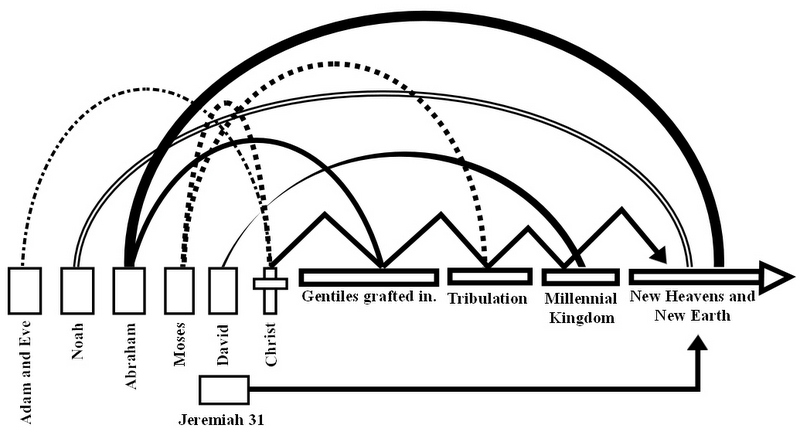
Covenants, the issue of justification, and eschatology all fit together perfectly and confirm an unshakable light for our path ahead and that is why we are taking this approach. Note the illustration below:

Seeing all of these elements fit together and therefore confirming what we believe is both powerful and important. If our defined difference between saved and unsaved are the following, “those under the law are enslaved to sin, cannot obey the law, are provoked to sin by the law, and will be judged by the law while those under grace are justified apart from the law, able to obey the law, and enslaved by the law,” shouldn’t there be different judgments accordingly? And if judgment is always associated with resurrection, shouldn’t there be more than one resurrection?
Reformed theology is predicated on a single resurrection which goes hand in hand with the idea that our justification is confirmed in the end. This also fits with their view that the law is still the standard for justification and we must therefore live by the same faith alone that saved us. So, the one final judgment confirms that we lived our sanctified life by faith alone. Their sanctification by justification determines their covenant theology as well as their eschatology. Listen, it’s all gospel. Don’t fall for this essential/non-essential stuff—every verse in the Bible is a piece of the truth puzzle. That’s why we have Matthew 4:4 and 2Timothy 3:16,17. What we believe about any given truth must fit together overall. That’s when we can have great confidence that we stand in the truth.
Now, let’s have a look at our thesis for tonight:

Here we have Mount Sinai, or the old covenant, Christ’s death and resurrection, the last days, the tribulation period, the millennial kingdom (1000 year reign of Christ on David’s throne in Jerusalem), and the new heavens and new earth. As we have mentioned before, as Christians, we ultimately look for the new heavens and new earth where righteousness dwells (1PET 3:3). We are in the last days or what some people call the church age. The Bible never calls these days the church age, but rather the last days. The last days are marked by the first coming of Christ and will end with Christ’s imminent return (HEB 1:1,2, 1COR 18:11). This will begin the seven year tribulation period, and that period will end with the beginning of the millennial rein of Christ, and that will end with the new heavens and new earth. Now, let’s look at where the resurrections fit in:
The first resurrection is a resurrection of the righteous sometimes referred to as the rapture. It is imminent. At the end of the tribulation period, you have the separation of the sheep and the goats. The goats are judged and the sheep will populate the millennial kingdom. At that time, you have another resurrection of the righteous. No judgment is mentioned. At the end of the millennial kingdom the nations lay siege to Israel and are destroyed by God. At that time, all of the unregenerate from all ages are resurrected and judged by the law, and it doesn’t go well for them because perfect adherence is required to be just apart from Christ’s sacrifice. By the way, that’s a good gospel message: coming to Christ to avoid this coming judgment.
Furthermore, the old covenant is consummated by the tribulation period, and the new covenant is completed by the new heavens and new earth (HEB 8:8). God gets his way in regard to what He wanted at Mt. Sinai and the covenant is enforced by angels during the tribulation period accordingly. The present age is the grafting in of the Gentiles and that is a consummation of about half of the Abrahamic covenant which also is consummated or completed by the new heavens and new earth.
The saints do not stand in the last judgment where law is the standard. Only the non-elect are judged there. The saints cannot be judged by the law to determine their justification because they were justified apart from the law and their transgressions against the law are already pardoned. Besides, they died with Christ and are no longer under the covenant of the law to begin with. It’s inverted triple jeopardy:
1. We have the righteousness of God imputed to us, so no one can bring a charge against us (ROM 8:33,34).
2. All of our sins are imputed to Christ, so we can’t be charged (Ibid).
3. There is no law to judge us with (ROM 7:1-3 [4]).
But because justification is unconditional, and sanctification is conditional, there will be a judgment of rewards for the Christian. This is how covenants and eschatology fit together with the truth of justification versus sanctification.
Now, time to prove the theses Scripturally. Let’s start with the Abrahamic covenant. God promises to make Abraham a great nation, promises blessings for those who bless him, and curses for those who curse him. Abraham is promised specific geography, and told the nations of the earth will be blessed by him. We see here two different types of promises that are conditional and unconditional. If you will, justification and sanctification. The promise to make Abraham a great nation is unconditional. This covenant will be completed by God no matter what the Israelites do. Blessings and cursing are conditional depending on what we do. Those who bless Abraham will be blessed, those who curse him will be cursed. God also predicts the captivity in Egypt and when He will lead them out to possess the land (GEN 12:1-3, 15:13-16, 18-21, 17:5).
Now we come to Mt. Sinai and the fulfillment of the prophecy of Israel being led out of captivity as a great nation. God informs Moses that he wants to make Israel a holy nation and a kingdom of priests. This is partially fulfilled in the new covenant according to Peter. This is a continuation of the promise which is unconditional. Under the conditional promises God warns Israel not to break the weekly Sabbath or the Sabbath of resting the land every seven years. To do so was to not help the poor or give rest to the servants and workers in Israel. God also warns Israel not to make a covenant with other nations but to rather trust Him for protection and needs. God warns Israel that a violation of resting the land every seven years will be punished times seven (7×7). References: EX 19:4-6, 23:10, 32, 1PET 2:9, LEV 25:4,5, 26:14-35, JER 25:11,12, 29:10,11, 2CHRON 36:21. Now, let’s go to the book of Daniel and chapter nine:
In the first year of Darius the son of Ahasuerus, by descent a Mede, who was made king over the realm of the Chaldeans— 2 in the first year of his reign, I, Daniel, perceived in the books the number of years that, according to the word of the Lord to Jeremiah the prophet, must pass before the end of the desolations of Jerusalem, namely, seventy years.
20 While I was speaking and praying, confessing my sin and the sin of my people Israel, and presenting my plea before the Lord my God for the holy hill of my God, 21 while I was speaking in prayer, the man Gabriel, whom I had seen in the vision at the first, came to me in swift flight at the time of the evening sacrifice. 22 He made me understand, speaking with me and saying, “O Daniel, I have now come out to give you insight and understanding. 23 At the beginning of your pleas for mercy a word went out, and I have come to tell it to you, for you are greatly loved. Therefore consider the word and understand the vision.
24 “Seventy weeks are decreed about your people and your holy city, to finish the transgression, to put an end to sin, and to atone for iniquity, to bring in everlasting righteousness, to seal both vision and prophet, and to anoint a most holy place. 25 Know therefore and understand that from the going out of the word to restore and build Jerusalem to the coming of an anointed one, a prince, there shall be seven weeks. Then for sixty-two weeks it shall be built again with squares and moat, but in a troubled time. 26 And after the sixty-two weeks, an anointed one shall be cut off and shall have nothing. And the people of the prince who is to come shall destroy the city and the sanctuary. Its end shall come with a flood, and to the end there shall be war. Desolations are decreed. 27 And he shall make a strong covenant with many for one week, and for half of the week he shall put an end to sacrifice and offering. And on the wing of abominations shall come one who makes desolate, until the decreed end is poured out on the desolator.”
Let me sum this up thus far. Israel violated the national sign of their covenant with God: the Sabbath years, or weeks of years (EX 31:12-14). That was letting the land rest every seven years in order that the poor could glean from the fields (EX 23:10,11). Gabriel informs Daniel that there was seventy weeks to complete the transgression, or 490 years. Gabriel states that there are two time periods totaling 69 weeks that end with the destruction of Jerusalem, or 483 years. Then he states the last seven years are marked by Israel making a covenant with the antichrist. In the middle of that week, the antichrist stops the sacrifices in the temple in Jerusalem and declares himself God. Therefore, the last days (HEB 1:1,2 1COR 10:11) are an undisclosed number of years that end with Christ’s return. The 490 years is known as the “times of the Gentiles and ends with the completion of the tribulation period:
Luke 21:20 – “But when you see Jerusalem surrounded by armies, then know that its desolation has come near. 21 Then let those who are in Judea flee to the mountains, and let those who are inside the city depart, and let not those who are out in the country enter it, 22 for these are days of vengeance, to fulfill all that is written. 23 Alas for women who are pregnant and for those who are nursing infants in those days! For there will be great distress upon the earth and wrath against this people. 24 They will fall by the edge of the sword and be led captive among all nations, and Jerusalem will be trampled underfoot by the Gentiles, until the times of the Gentiles are fulfilled.
Christ was speaking of the destruction of Jerusalem in 70AD until the times of the Gentiles are fulfilled which is at the end of the tribulation period. This time period spans four world empires as described via several visions recorded in the book of Daniel. During the times of the Gentiles, believing Gentiles are grafted into the nation of Israel as a partial fulfillment of the Abrahamic covenant. Christ said that no man knows when He will come for the church which would exclude the tribulation period because His return in that time period has a specific beginning, middle point, and ending which begin with Israel’s covenant with the antichrist. Isaiah calls this a covenant with hell:
28:15 – Because you have said, “We have made a covenant with death, and with Sheol we have an agreement, when the overwhelming whip passes through it will not come to us, for we have made lies our refuge, and in falsehood we have taken shelter”; 16 therefore thus says the Lord God, “Behold, I am the one who has laid as a foundation in Zion, a stone, a tested stone, a precious cornerstone, of a sure foundation: ‘Whoever believes will not be in haste.’ 17 And I will make justice the line, and righteousness the plumb line; and hail will sweep away the refuge of lies, and waters will overwhelm the shelter.” 18 Then your covenant with death will be annulled,
The imminent return of Christ is a resurrection of the just including those who are still alive:
1Corinthians 15:50 – I tell you this, brothers: flesh and blood cannot inherit the kingdom of God, nor does the perishable inherit the imperishable. 51 Behold! I tell you a mystery. We shall not all sleep, but we shall all be changed, 52 in a moment, in the twinkling of an eye, at the last trumpet. For the trumpet will sound, and the dead will be raised imperishable, and we shall be changed. 53 For this perishable body must put on the imperishable, and this mortal body must put on immortality.
1 Thessalonians 4:13 – But we do not want you to be uninformed, brothers, about those who are asleep, that you may not grieve as others do who have no hope. 14 For since we believe that Jesus died and rose again, even so, through Jesus, God will bring with him those who have fallen asleep. 15 For this we declare to you by a word from the Lord, that we who are alive, who are left until the coming of the Lord, will not precede those who have fallen asleep. 16 For the Lord himself will descend from heaven with a cry of command, with the voice of an archangel, and with the sound of the trumpet of God. And the dead in Christ will rise first. 17 Then we who are alive, who are left, will be caught up together with them in the clouds to meet the Lord in the air, and so we will always be with the Lord. 18 Therefore encourage one another with these words.
Another obvious resurrection of the just is at the end of the tribulation period:
Revelation 20:1 – Then I saw an angel coming down from heaven, holding in his hand the key to the bottomless pit and a great chain. 2 And he seized the dragon, that ancient serpent, who is the devil and Satan, and bound him for a thousand years, 3 and threw him into the pit, and shut it and sealed it over him, so that he might not deceive the nations any longer, until the thousand years were ended. After that he must be released for a little while.
4 Then I saw thrones, and seated on them were those to whom the authority to judge was committed. Also I saw the souls of those who had been beheaded for the testimony of Jesus and for the word of God, and those who had not worshiped the beast or its image and had not received its mark on their foreheads or their hands. They came to life and reigned with Christ for a thousand years. 5 The rest of the dead did not come to life until the thousand years were ended. This is the first resurrection. 6 Blessed and holy is the one who shares in the first resurrection! Over such the second death has no power, but they will be priests of God and of Christ, and they will reign with him for a thousand years.
Then we have the judgment after the end of the millennial kingdom:
Revelation 20:11 – Then I saw a great white throne and him who was seated on it. From his presence earth and sky fled away, and no place was found for them. 12 And I saw the dead, great and small, standing before the throne, and books were opened. Then another book was opened, which is the book of life. And the dead were judged by what was written in the books, according to what they had done. 13 And the sea gave up the dead who were in it, Death and Hades gave up the dead who were in them, and they were judged, each one of them, according to what they had done. 14 Then Death and Hades were thrown into the lake of fire. This is the second death, the lake of fire. 15 And if anyone’s name was not found written in the book of life, he was thrown into the lake of fire.
Please note: because of the Reformed view of justification, one resurrection and one judgment is VERY helpful to their thesis. More than one resurrection can lead to the belief that Christians will not stand in a judgment to determine their just standing, but rather a judgment for rewards because their just standing is already determined. See those books in the second resurrection? We can’t be judged by them because the righteousness imputed to us was apart from those books. I have discussed this personally with many Reformed folks—they definitely hold to a single resurrection and judgment. Why? Because it fits their view of justification; that’s why. Justification is not confirmed positively till the final judgment. To the contrary, we don’t stand in the last judgment, but rather a judgment for rewards (1COR 3:10-15, 2COR 5:10, LK 14:12-14). I might add that if our justification is not sealed, we need them to guide us safely to a right standing in the judgment. Listen, church historian and dear friend John Immel has it right: it’s all abuot CONTROL. As I recently wrote, there are only two kinds of religions in the world: cult or word; caste or truth. You are in one kind of church or another: one where the leaders want to lead you, or one where they want to control you.
Now, in regard to the Davidic covenant in 2Samuel 7, I only want to mention the principle of THE PROMISE and PROMISES. Please note:
14 I will be to him a father, and he shall be to me a son. When he commits iniquity, I will discipline him with the rod of men, with the stripes of the sons of men, 15 but my steadfast love will not depart from him, as I took it from Saul, whom I put away from before you. 16 And your house and your kingdom shall be made sure forever before me. Your throne shall be established forever.’” 17 In accordance with all these words, and in accordance with all this vision, Nathan spoke to David.
We see that in the covenants, there is the principle of God disciplining us as His children versus judgment and condemnation. Also note: 1COR 11:31, 32, HEB 12:3-17 (PROV 3:11,12) 1COR 5:4,5.
Let’s wrap up with a look at the new covenant in Jeremiah 31:
31 “Behold, the days are coming, declares the Lord, when I will make a new covenant with the house of Israel and the house of Judah, 32 not like the covenant that I made with their fathers on the day when I took them by the hand to bring them out of the land of Egypt, my covenant that they broke, though I was their husband, declares the Lord. 33 For this is the covenant that I will make with the house of Israel after those days, declares the Lord: I will put my law within them, and I will write it on their hearts. And I will be their God, and they shall be my people. 34 And no longer shall each one teach his neighbor and each his brother, saying, ‘Know the Lord,’ for they shall all know me, from the least of them to the greatest, declares the Lord. For I will forgive their iniquity, and I will remember their sin no more.” 35 Thus says the Lord, who gives the sun for light by day and the fixed order of the moon and the stars for light by night, who stirs up the sea so that its waves roar—the Lord of hosts is his name: 36 “If this fixed order departs from before me, declares the Lord, then shall the offspring of Israel cease from being a nation before me forever.” 37 Thus says the Lord: “If the heavens above can be measured, and the foundations of the earth below can be explored, then I will cast off all the offspring of Israel for all that they have done, declares the Lord.” 38 “Behold, the days are coming, declares the Lord, when the city shall be rebuilt for the Lord from the Tower of Hananel to the Corner Gate. 39 And the measuring line shall go out farther, straight to the hill Gareb, and shall then turn to Goah. 40 The whole valley of the dead bodies and the ashes, and all the fields as far as the brook Kidron, to the corner of the Horse Gate toward the east, shall be sacred to the Lord. It shall not be plucked up or overthrown anymore forever.”
Obviously, this covenant is not completed yet. All of these covenants work together towards the final goal that we look for: the new heavens and new earth where righteousness dwells. And all other biblical elements fit into this goal and work in concert with it including eschatology, covenants, soteriology, and eschatology must all agree.
ENDNOTES:
1. “In this book, then, I shall speak, as God permits, not of those first judgments, nor of these intervening judgments of God, but of the last judgment, when Christ is to come from heaven to judge the quick and the dead. For that day is properly called the Day of Judgment, because in it there shall be no room left for the ignorant questioning why this wicked person is happy and that righteous man unhappy. In that day true and full happiness shall be the lot of none but the good, while deserved and supreme misery shall be the portion of the wicked, and of them only….I shall now cite from the Gospel according to Matthew the passage which speaks of the separation of the good from the wicked by the most efficacious and final judgment of Christ” (Augustine: City of God).
“Augustine taught that the eternal fate of the soul is determined at death” (http://en.wikipedia.org/wiki/Augustine_of_Hippo).
Dogma of particular judgment
The Catholic doctrine of the particular judgment is this: that immediately after death the eternal destiny of each separated soul is decided by the just judgment of God. Although there has been no formal definition on this point, the dogma is clearly implied in the Union Decree of Eugene IV (1439), which declares that souls leaving their bodies in a state of grace, but in need of purification are cleansed in Purgatory, whereas souls that are perfectly pure are at once admitted to the beatific vision of the Godhead (ipsum Deum unum et trinum) and those who depart in actual mortal sin, or merely with original sin, are at once consigned to eternal punishment, the quality of which corresponds to their sin (paenis tamen disparibus). The doctrine is also in the profession of faith of Michael Palaeologus in 1274, in the Bull “Benedictus Deus” of Benedict XII, in 1336, and in the professions of faith of Gregory XIII and Benedict XIV (Catholic Encyclopedia).
2. If you note Exodus 32:32-35 it is interesting that Moses indicates that people are originally written in a book and at some point blotted out.
3. There are 275 direct citations from the Old Testament used to make points by the New Testament writers. That strongly indicates a process of all the covenants continuing to have a role until the very end.
4. Some say we will stand in a final judgment, but God will only see Christ’s perfect obedience because we lived by faith alone in sanctification. What law? We died to the law with Christ. Who keeps it is irrelevant, there is no law to keep.
5. Matthew McGee: http://www.matthewmcgee.org/millen.html
After the rapture of the church, after the seven year tribulation, and after the second coming, Jesus Christ will reign in His kingdom. What will the kingdom be like? Here we will examine some of the basic characteristics of the kingdom.
The Duration of the Kingdom
One of the most concise and informative passages on the kingdom occurs in Revelation. After the description of the Lord’s second coming in chapter 19, but before the great white throne judgment in Revelation 20:11-15 and the eternal kingdom in chapters 21 and 22, we have this description of the kingdom.
Revelation 20:1-10 says, “And I saw an angel come down from heaven, having the key of the bottomless pit and a great chain in his hand. And he laid hold on the dragon, that old serpent, which is the Devil, and Satan, and bound him a thousand years, And cast him into the bottomless pit, and shut him up, and set a seal upon him, that he should deceive the nations no more, till the thousand years should be fulfilled: and after that he must be loosed a little season. And I saw thrones, and they sat upon them, and judgment was given unto them: and I saw the souls of them that were beheaded for the witness of Jesus, and for the word of God, and which had not worshipped the beast, neither his image, neither had received his mark upon their foreheads, or in their hands; and they lived and reigned with Christ a thousand years. But the rest of the dead lived not again until the thousand years were finished. This is the first resurrection. Blessed and holy is he that hath part in the first resurrection: on such the second death hath no power, but they shall be priests of God and of Christ, and shall reign with him a thousand years. And when the thousand years are expired, Satan shall be loosed out of his prison, And shall go out to deceive the nations which are in the four quarters of the earth, Gog and Magog, to gather them together to battle: the number of whom is as the sand of the sea. And they went up on the breadth of the earth, and compassed the camp of the saints about, and the beloved city: and fire came down from God out of heaven, and devoured them. And the devil that deceived them was cast into the lake of fire and brimstone, where the beast and the false prophet are, and shall be tormented day and night for ever and ever.”
This passage makes several things very clear. Satan will be bound and unable to influence mankind. The first resurrection, the resurrection of the Old Testament saints (Daniel 12:2-3 and 12:13) and tribulation saints, will occur at the beginning of the kingdom. This resurrection is not to be confused with the resurrection of the Christians at the rapture, which will occur seven years earlier, prior to the tribulation. The rapture was a mystery first revealed to Apostle Paul and is not the subject of either Old Testament prophecy or prophecies given in Christ’s earthly ministry.
The duration of this kingdom will be one millennium. This passage makes this very clear by telling us not just once but six times that it will last one thousand years. Satan will be released for a brief period after the one thousand years. This passage may bring questions to the minds of many readers, but hopefully, the remainder of this paper will adequately address most of them. For a description of the eternal kingdom which will follow this one thousand year kingdom, one may read Revelation chapters 21 and 22.
Animals Become Peaceful
Now regarding the character of the kingdom, the book of Isaiah is rich with kingdom prophecies. In Isaiah 11:6-9 it is revealed that “The wolf also shall dwell with the lamb, and the leopard shall lie down with the kid; and the calf and the young lion and the fatling together; and a little child shall lead them. And the cow and the bear shall feed; their young ones shall lie down together: and the lion shall eat straw like the ox. And the sucking child shall play on the hole of the asp, and the weaned child shall put his hand on the cockatrice’ den. They shall not hurt nor destroy in all my holy mountain: for the earth shall be full of the knowledge of the LORD, as the waters cover the sea.”
First of all, we see that animals that are presently carnivorous, will begin to eat vegetation only, so that the animals will not fear one another or harm people. Many have taken this passage and tried to spiritualize (allegorically interpret) the truth away from it, saying it is not literal. However, not only will all animals literally be herbivores in the future, but all animals once were herbivores, since neither man nor beast ate animal flesh prior to the great flood.
Genesis 1:29-30 “And God said, Behold, I have given you every herb bearing seed, which is upon the face of all the earth, and every tree, in the which is the fruit of a tree yielding seed; to you it shall be for meat. And to every beast of the earth, and to every fowl of the air, and to every thing that creepeth upon the earth, wherein there is life, I have given every green herb for meat: and it was so.”
The Hebrew word “oklah” translated “meat” by the King James Version of the Bible (KJV) simply means food or that which is devoured. Notice that the beasts are neither given for Adam’s food, nor for one another’s food. Both Adam and the beasts are given the herbs and fruits to eat. So man and beast were all vegetarian. However, God changed things after the great flood
In Genesis 9:2-3 God says to Noah, “And the fear of you and the dread of you shall be upon every beast of the earth, and upon every fowl of the air, upon all that moveth upon the earth, and upon all the fishes of the sea; into your hand are they delivered. Every moving thing that liveth shall be meat for you; even as the green herb have I given you all things.”
So the animals began to fear man, because man was given permission to eat the animals. This is also when many animals became carnivorous. Further scriptural evidence of animals becoming peaceful in the kingdom will be provided in the next section.
The world we live in today is filled with people who deny the deity of Jesus Christ, including many who even deny the existence of God. But that will not be the case in the kingdom. Isaiah 11:9, quoted above, states that, “… the earth shall be full of the knowledge of the LORD, as the waters cover the sea.”
Life Spans Increased
Here is another passage which is loaded with information. Isaiah 65:20-25 says, “There shall be no more thence an infant of days, nor an old man that hath not filled his days: for the child shall die an hundred years old; but the sinner being an hundred years old shall be accursed. And they shall build houses, and inhabit them; and they shall plant vineyards, and eat the fruit of them. They shall not build, and another inhabit; they shall not plant, and another eat: for as the days of a tree are the days of my people, and mine elect shall long enjoy the work of their hands. They shall not labour in vain, nor bring forth for trouble; for they are the seed of the blessed of the LORD, and their offspring with them. And it shall come to pass, that before they call, I will answer; and while they are yet speaking, I will hear. The wolf and the lamb shall feed together, and the lion shall eat straw like the bullock: and dust shall be the serpent’s meat. They shall not hurt nor destroy in all my holy mountain, saith the LORD.”
There are many key statements in this passage. We see a great increase in life spans. Like the previously mentioned Isaiah 11 passage which says that “… the leopard shall lie down with the kid …”, many have taken what this passage says about the long life spans and tried to spiritualize (allegorically interpret) the truth away from it, saying it is not literal. However, not only will life spans literally be longer, but this too was this way before the great flood.
In the genealogy from Adam to Noah given in Genesis 5 and 9:29, there are extremely long life spans. When we exclude Enoch who was taken by God (Genesis 5:24) at the age of 365 years and Lamech who died at the age of 777 years, we find that all of the other eight lived between 895 and 969 years. After the great flood, there was a rapid drop in life span to a little over 400 years. Around the time of the tower of Babel, life spans dropped to a little over 200 years. Then they began to slowly decrease to more modern life spans over a period of hundreds of years.
Of course many will say that the idea of humans having lived for more than 900 years is ridiculous. However, the following factors produced great changes in man’s environment and/or lifestyle. Without speculating on the positive or negative effects these factors may have had on life span, some of them are: (1) Prior to the flood it did not rain on the earth, rather the earth was watered by mist that came up from the ground (Genesis 2:5-6). (2) As previously mentioned, it was after the great flood that man began to eat meat for the first time (Genesis 9:3). (3) The removal of the vast layer of waters above the firmament (Genesis 1:7 and 7:11) may have effected the sun’s rays, the earth’s magnetic field, or the air pressure. (4) After the flood, the human race was replenished through only eight people (Genesis 6:18) which required the marriage of some near relatives. These factors and others not contemplated here may have had a tremendous effect on human life. We are not capable of determining what all of the effects might be, except to say that the ramifications would be great. So we should take God at his Word (something we should do anyway) when He tells us about the life spans of those who lived before the flood and those who will live in the coming kingdom.
In the Isaiah 65:20-25 passage we also see normal, everyday life taking place. Often people may incorrectly equate the kingdom with some popular idea of heaven. However, this prophecy does not describe people sitting on clouds strumming harps. Instead we see normal activities like building houses, living in them, planting vineyards, eating fruit, bearing children, and sometimes even death.
This passage also provides further evidence of carnivorous animals becoming herbivores, which we have already discussed.
One common misunderstanding is to think that only those who are resurrected or changed into immortal bodies will enter the kingdom. This would leave no one in the kingdom who could possibly sin or die. But Matthew 25:31-46 describes Jesus Christ dividing the sheep from the goats at the end of the great tribulation. This is the judgment of the Gentile nations (v. 32). All of the people gathered on the Lord’s right hand are survivors of the great tribulation and will pass into the kingdom in their mortal bodies. They will bear children who are mortal as well. The same is true for the many Israelites who will survive the great tribulation, and will bear children in the kingdom. Ezekiel 37:25-26 says, “And they shall dwell in the land that I have given unto Jacob my servant, wherein your fathers have dwelt; and they shall dwell therein, even they, and their children, and their children’s children for ever: and my servant David shall be their prince for ever. Moreover I will make a covenant of peace with them; it shall be an everlasting covenant with them: and I will place them, and multiply them, and will set my sanctuary in the midst of them for evermore.” All of these people and their descendants will be capable of both sin and death in the millennial kingdom, even though Satan will be in chains and unable to influence them.
An End to Wars
There will be no war during this one thousand years, until Satan is released (Revelation 20:7-9) for a short period at the end. In reference to Jesus Christ, Micah 4:3 says, “And he shall judge among many people, and rebuke strong nations afar off; and they shall beat their swords into plowshares, and their spears into pruninghooks: nation shall not lift up a sword against nation, neither shall they learn war any more.” Isaiah 2:4 is very similar passage. Not only will there no longer be any war, but the weapons will be dismantled and battle strategies will no longer be taught.
Israel will be at peace and dwell safely in the kingdom. “Behold, the days come, saith the LORD, that I will raise unto David a righteous Branch, and a King shall reign and prosper, and shall execute judgment and justice in the earth. In his days Judah shall be saved, and Israel shall dwell safely: and this is his name whereby he shall be called, THE LORD OUR RIGHTEOUSNESS” (Jeremiah 23:5-6). This is certainly in contrast to the present with Israel surrounded by her enemies on all sides.
Jesus Christ’s Judgment and the Restored Judges
The Micah and Jeremiah verses above also refer to Jesus Christ judging the nations of the earth. He will do so in all wisdom and perfect justice, with a rod of iron. “And out of his mouth goeth a sharp sword, that with it he should smite the nations: and he shall rule them with a rod of iron: and he treadeth the winepress of the fierceness and wrath of Almighty God” (Revelation 19:15). He will reign as a literal king on a throne, dwelling in Jerusalem. He will also restore the judges to Israel. “And I will restore thy judges as at the first, and thy counsellors as at the beginning: afterward thou shalt be called, The city of righteousness, the faithful city” (Isaiah 1:26). Who will the judges of the twelve tribes of Israel be? Jesus Christ told His disciples, “… Verily I say unto you, That ye which have followed me, in the regeneration when the Son of man shall sit in the throne of his glory, ye also shall sit upon twelve thrones, judging the twelve tribes of Israel” (Matthew 19:28).
Israel will be a Kingdom of Priests
“Thus saith the LORD of hosts; It shall yet come to pass, that there shall come people, and the inhabitants of many cities: And the inhabitants of one city shall go to another, saying, Let us go speedily to pray before the LORD, and to seek the LORD of hosts: I will go also. Yea, many people and strong nations shall come to seek the LORD of hosts in Jerusalem, and to pray before the LORD. Thus saith the LORD of hosts; In those days it shall come to pass, that ten men shall take hold out of all languages of the nations, even shall take hold of the skirt of him that is a Jew, saying, We will go with you: for we have heard that God is with you” (Zechariah 8:20-23).
“Now therefore, if ye will obey my voice indeed, and keep my covenant, then ye shall be a peculiar treasure unto me above all people: for all the earth is mine: And ye shall be unto me a kingdom of priests, and an holy nation. These are the words which thou shalt speak unto the children of Israel” (Exodus 19:5-6).
The Feast of Tabernacles
One very interesting prophecy occurring in Zechariah 14:16-19 concerns the Gentile nations keeping the feast of tabernacles in the millennial kingdom. “And it shall come to pass, that every one that is left of all the nations which came against Jerusalem shall even go up from year to year to worship the King, the LORD of hosts, and to keep the feast of tabernacles. And it shall be, that whoso will not come up of all the families of the earth unto Jerusalem to worship the King, the LORD of hosts, even upon them shall be no rain. And if the family of Egypt go not up, and come not, that have no rain; there shall be the plague, wherewith the LORD will smite the heathen that come not up to keep the feast of tabernacles. This shall be the punishment of Egypt, and the punishment of all nations that come not up to keep the feast of tabernacles.”
Here we see that in the kingdom the Gentiles must keep the feast of tabernacles which was formerly a feast just for Israel. To do so, they must travel to Jerusalem once each year in the autumn to “worship the King”, Jesus Christ. Jesus Christ will reign on His throne in Jerusalem like Ezekiel 43:7 says, “And he said unto me, Son of man, the place of my throne, and the place of the soles of my feet, where I will dwell in the midst of the children of Israel for ever, and my holy name, shall the house of Israel no more defile …”.
Some may be unfamiliar with this feast, so we will review the feast of tabernacles in Leviticus 23:33-44, which is also known as the feast of booths. “And the LORD spake unto Moses, saying, Speak unto the children of Israel, saying, The fifteenth day of this seventh month shall be the feast of tabernacles for seven days unto the LORD. On the first day shall be an holy convocation: ye shall do no servile work therein. Seven days ye shall offer an offering made by fire unto the LORD: on the eighth day shall be an holy convocation unto you; and ye shall offer an offering made by fire unto the LORD: it is a solemn assembly; and ye shall do no servile work therein. These are the feasts of the LORD, which ye shall proclaim to be holy convocations, to offer an offering made by fire unto the LORD, a burnt offering, and a meat offering, a sacrifice, and drink offerings, every thing upon his day: Beside the sabbaths of the LORD, and beside your gifts, and beside all your vows, and beside all your freewill offerings, which ye give unto the LORD. Also in the fifteenth day of the seventh month, when ye have gathered in the fruit of the land, ye shall keep a feast unto the LORD seven days: on the first day shall be a sabbath, and on the eighth day shall be a sabbath. And ye shall take you on the first day the boughs of goodly trees, branches of palm trees, and the boughs of thick trees, and willows of the brook; and ye shall rejoice before the LORD your God seven days. And ye shall keep it a feast unto the LORD seven days in the year. It shall be a statute for ever in your generations: ye shall celebrate it in the seventh month. Ye shall dwell in booths seven days; all that are Israelites born shall dwell in booths: That your generations may know that I made the children of Israel to dwell in booths, when I brought them out of the land of Egypt: I am the LORD your God.” It should be noted that Israel’s calendar begins in the spring, so the seventh month is not July, but occurs later, in the autumn.
In addition to the annual feast, Deuteronomy 31:10-13 explains that the law was to be read to all of Israel once every seven years, at the feast of tabernacles. “And Moses commanded them, saying, At the end of every seven years, in the solemnity of the year of release, in the feast of tabernacles, When all Israel is come to appear before the LORD thy God in the place which he shall choose, thou shalt read this law before all Israel in their hearing. Gather the people together, men, and women, and children, and thy stranger that is within thy gates, that they may hear, and that they may learn, and fear the LORD your God, and observe to do all the words of this law: And that their children, which have not known any thing, may hear, and learn to fear the LORD your God, as long as ye live in the land whither ye go over Jordan to possess it.”
It may be that the feast of tabernacles takes on a slightly different meaning in the kingdom since Israel will no longer celebrate their rescue from Egypt, but rather, from all the nations to which they have been scattered. Jeremiah 16:14-15 says, “Therefore, behold, the days come, saith the LORD, that it shall no more be said, The LORD liveth, that brought up the children of Israel out of the land of Egypt; But, The LORD liveth, that brought up the children of Israel from the land of the north, and from all the lands whither he had driven them: and I will bring them again into their land that I gave unto their fathers.”
The Temple and the Law
The temple of the millennial kingdom is described in detail in Ezekiel chapters 40-44. Although we will not go into the details here, we will mention a few key points. The glory of the Lord will fill the temple (Ezekiel 43:5). The law given by God through Moses will still be kept including the sacrifices (Ezekiel 43:19-27). The Levites will still minister in the temple (Ezekiel 44:9-11). The laws and statutes delivered by Moses will be obeyed (Ezekiel 44:24). Ezekiel 44:25 and 31 show further evidence that some death of people and animals can and will occur in the kingdom. The sabbaths and feasts of the Israel will still be kept including the passover, the feast of unleavened bread (Ezekiel 45:21), and the feast of tabernacles (Ezekiel 45:25). It will be well known by all that Jesus Christ gave his life as the perfect sacrifice for all mankind. None-the-less, the prophecy reveals that the sacrifices will still be kept and the law of Moses strictly followed.
Geographical Changes in Israel
There will also be tremendous geographical changes in Israel. When Jesus Christ returns to the mount of Olives, just east of Jerusalem, an earthquake will split the mountain in two. “And his feet shall stand in that day upon the mount of Olives, which is before Jerusalem on the east, and the mount of Olives shall cleave in the midst thereof toward the east and toward the west, and there shall be a very great valley; and half of the mountain shall remove toward the north, and half of it toward the south. And ye shall flee to the valley of the mountains; for the valley of the mountains shall reach unto Azal: yea, ye shall flee, like as ye fled from before the earthquake in the days of Uzziah king of Judah: and the LORD my God shall come, and all the saints with thee” (Zechariah 14:4-5).
In addition, the fountain of living water described in Zechariah and Ezekiel will have a geographical impact. “In that day there shall be a fountain opened to the house of David and to the inhabitants of Jerusalem for sin and for uncleanness” (Zechariah 13:1). Then Zechariah 14:8 shows us where the waters will flow, “And it shall be in that day, that living waters shall go out from Jerusalem; half of them toward the former (eastern) sea, and half of them toward the hinder (western) sea: in summer and in winter shall it be.” The living waters will flow out of Jerusalem in two directions, to the west to the great sea (western or Mediterranean Sea) and to the east to the Dead Sea (eastern or Salt Sea). Also see Ezekiel 47:1-7.
What effect will this have on the Dead Sea? The Dead Sea is about 10 miles wide and 50 miles long running north and south on along the eastern side of Judea. Its northern end is about as far north as Jerusalem. It has no outlet and is seven times more salty than the oceans. No fish live in the Dead Sea, and ocean fish placed in its waters soon die. Only certain types of microbes live in it. Yet In Ezekiel 47:8-11 we are told the waters of the Dead Sea will be healed. “Then said he unto me, These waters issue out toward the east country, and go down into the desert, and go into the sea: which being brought forth into the sea, the waters shall be healed. And it shall come to pass, that every thing that liveth, which moveth, whithersoever the rivers shall come, shall live: and there shall be a very great multitude of fish, because these waters shall come thither: for they shall be healed; and every thing shall live whither the river cometh. And it shall come to pass, that the fishers shall stand upon it from Engedi even unto Eneglaim; they shall be a place to spread forth nets; their fish shall be according to their kinds, as the fish of the great sea, exceeding many. But the miry places thereof and the marishes thereof (swamps and marshes) shall not be healed; they shall be given to salt.” Engedi, mentioned above, is on the western coast of the Dead Sea about 25 miles southeast of Jerusalem. A peninsula juts out into the sea from the east. South of this peninsula the Dead Sea is shallow, less than 20 feet deep in most places. But the majority of the sea is north of the peninsula, where the central and northern part of the sea is more than one thousand feet deep. Perhaps verse 11 refers to the shallow southern end, furthest from Jerusalem, that will remain too salty for aquatic life.
This passage is not in conflict with the passage that refers to there being no sea. That verse (Revelation 21:1) refers to the new heaven and new earth and occurs after the one thousand year kingdom that is being described here.
As the many following Isaiah verses show, the land of Israel will become much more fertile. The deserts will become fertile fields and the fields will become as forests.
“Until the spirit be poured upon us from on high, and the wilderness be a fruitful field, and the fruitful field be counted for a forest” (Isaiah 32:15).
“Is it not yet a very little while, and Lebanon shall be turned into a fruitful field, and the fruitful field shall be esteemed as a forest?” (Isaiah 29:17).
“For the LORD shall comfort Zion: he will comfort all her waste places; and he will make her wilderness like Eden, and her desert like the garden of the LORD; joy and gladness shall be found therein, thanksgiving, and the voice of melody” (Isaiah 51:3).
“… the dessert shall rejoice, and blossom as the rose” (Isaiah 35:1).
The nation of Israel will also be given far more land than they presently possess. A general description is found Genesis. “In the same day the LORD made a covenant with Abram, saying, Unto thy seed have I given this land, from the river of Egypt unto the great river, the river Euphrates …” (Genesis 15:18). God confirmed this promise to Abraham’s son, Isaac, in Genesis 26:3 and later to Isaac’s son, Jacob, in Genesis 35:12. A detailed description of how this land will be divided by the tribes of Israel is found in Ezekiel chapter 48.
These are just some of the changes to Israel’s geography and ownership that God’s Word says will take place when the kingdom comes. Further study is encouraged of passages such as Zechariah 14:10 which reveal other geographical changes.
Warning Against Allegorical Interpretation
These are only a few of the many prophecies about the kingdom in which Jesus Christ will reign on the earth from Jerusalem. The prophecies that God has provided are quite vast and detailed. There are those who would claim that the kingdom prophecies are only to be interpreted allegorically. That is, they attempt to say that all of these events are figurative and try to sweep their literal fulfillment under the rug. Typically, these are those which teach the false doctrine that the church has forever taken Israel’s place. Therefore, they despise the prophecies about the future prominence of the nation of Israel. While claiming to be more spiritual, they label as carnal, those who believe the literal meaning of the kingdom prophecies. But what could be more spiritual than faith, taking God at His Word? What could be more carnal than assuming that God did not mean what He said, and then trying to nullify His Word with the doctrine of men? As shown above, they truly have a mountain of truth to try to conceal. The evidence presented here is but a small sample of the teaching God’s Word has to offer on the kingdom.
Fundamentals of American Christianity, Calvinism, Covenants, and Election: The Potter’s House: 4/7/2013
Chart illustration for discussion at 00:45:31
If you are much like me as an average American Christian, you are pretty foggy on God’s overall plan for mankind involving Old Testament and New Testament tenets. Perhaps due to laziness, we accept broad generalizations concerning the differences between the testaments. For example, “Old Testament saints were saved by keeping the law—we are saved by grace,” “God gave the law to show us we can’t keep it—to drive us to resting in Christ alone,” etc.
There is no doubt that it takes diligent study to understand redemptive covenants, election, and sanctification paradigms. The complexities of these issues have not been taught in the American church. Why? Our American Christian heritage comes from the Puritans who arrived on our Eastern shores from Europe. They were Calvinistic, and part and parcel with European Calvinism comes theocracy and orthodoxy. Like ducks searching for bodies of water, European Calvinism will eventually head in this direction. There are no exceptions, and it is only a matter of time. If Calvinism is ultimately deprived of theocracy and orthodoxy, particularity the Puritan breed, it will die. Lesser forms of pure Calvinism can survive well on orthodoxy alone, but the more pure forms like Puritanism will die without theocracy. Hence, Puritanism today is merely folklore propagandized with spiritual sound bites.
What is orthodoxy? It’s the antithesis of Acts 17:11. It assumes a spiritual caste system where some are preordained to understand things that the average saint cannot understand. The average Christian searching the Scriptures to determine if a pastor is teaching truth was, and still is an unacceptable construct in European Calvinism. It is thought to prideful, unsubmissive, and a rejection of God-appointed authority. Orthodoxy is what the spiritually enlightened prepare for the unenlightened in creeds, confessions, and counsels. One advertisement I saw for a seminary announced that it was “confessional.” What does that mean? It means that it teaches and holds to historic confessions of faith. These confessions have authority, and were written by the, for example, “Westminster Divines.” Problem is, this passes a traditional interpretation from generation to generation on an assumptive basis; i.e., to rethink orthodoxy would be arrogantly reinventing the spiritual wheel. This is our heritage, and why we don’t know much. Creeds, confessions, and counsels do not deliver in-depth analysis on the aforementioned issues; primarily, they tell us how to think.
Therefore, the Potter’s House is a journey, and there is no looking back. We have learned astounding things from the book of Romans that Susan and I have never been taught in our combined eighty years of being Christians. But most importantly, what we have learned are building blocks that are keys to understanding more of God’s counsel. I think it is time in our study to look at some of these fundamental building blocks. Some speak directly to the chapter we are in. But first, let’s review some former ones:
1. The “gospel” is the good news of God’s full counsel for life and godliness. The death, burial, and resurrection of Christ is the gospel of “first importance” or “first order of importance.” “Word,” Scripture,” Gospel,” “holy writ,” etc., are all used interchangeably throughout the Bible.
2. Paul categorizes all people into two categories: under law, and under grace. Those under the law are enslaved to sin, provoked to sin by the law, and will be judged by the law. Those under grace are enslaved to righteousness, provoked to do good by the law, and will not be judged by the law.
3. The importance of angels in administering God’s covenants.
4. Salvation is Trinitarian, not Christocentric.
5. A major key to understanding the book of Revelation is Exodus 19-24.
6. The Bible interprets itself and identifies its own methods of interpretation.
7. The law is completely separate from justification, but informs our sanctification.
8. The difference between justification, definitive sanctification, progressive sanctification, and final sanctification.
9. The difference between salvation and justification.
10. Why Christians are truly righteous in the here and now.
11. Why Christians still struggle with sin.
12. The difference between our redeemed hearts and our mortality.
13. Motivation to share the gospel and better ways to do it.
14. Divine Anthropology: what makes mankind tick?
Other things are becoming clearer in our study concerning election and covenants which brings us closer to the issues at hand in chapter nine. I will save election for last because once that is discussed it will be all anybody is thinking about. I would like to use Ephesians 2:11-16 for our first point:
11 Therefore remember that at one time you Gentiles in the flesh, called “the uncircumcision” by what is called the circumcision, which is made in the flesh by hands— 12 remember that you were at that time separated from Christ, alienated from the commonwealth of Israel and strangers to the covenants of promise, having no hope and without God in the world. 13 But now in Christ Jesus you who once were far off have been brought near by the blood of Christ. 14 For he himself is our peace, who has made us both one and has broken down in his flesh the dividing wall of hostility 15 by abolishing the law of commandments expressed in ordinances, that he might create in himself one new man in place of the two, so making peace, 16 and might reconcile us both to God in one body through the cross, thereby killing the hostility.
This passage makes separation from the covenants of promise synonymous with being alienated from God. There is also more than one covenant of promise.
“Covenants” is in the plural. So, we don’t want to think of Old Testament Covenants as being replaced by the New, but rather we want to think of all of these covenants as building on each other. Also, the covenants will have future elements, abolished elements, and elements that are being phased out with time. Paul states what part of the Mount Sinai Book of the Covenant was “abolished,” the ordinances regarding sin offerings since Christ fulfilled the propitiation for sin (vv. 14, 15).
To be separated from Christ is also likened to being separated from the “commonwealth” of Israel (v. 12). This speaks to Israel as a nation. As we discussed last week, this doesn’t mean that all of national Israel will be saved. They were an elect nation with elect people, but not all in the nation are elected individually. Allegorically, some are descendants of Hagar and others are from Sarah. This symbolizes slavery to sin versus heirs of the promise. Paul wanted to make sure the Gentiles at Rome understood that rebellion within Israel didn’t mean that God had revoked His promises to Israel as a nation.
As yet, none of the covenants have been abolished. Again, some elements are yet future, some are fading away, and some elements have been abolished. Even the New Covenant has such elements. Jeremiah 31 states that the law of God will be written on everyone’s heart and there will be no need to teach anybody about the Lord. Obviously, that is future. We read the following in 1Corintians 13:8-10;
8 Love never ends. As for prophecies, they will pass away; as for tongues, they will cease; as for knowledge, it will pass away. 9 For we know in part and we prophesy in part, 10 but when the perfect comes, the partial will pass away.
Prophesies, tongues, and knowledge are all under the New Covenant (past, present), and when the perfect comes knowledge will pass away. Nobody will have need to be taught as Jeremiah predicted. That’s future. The “perfect” is what Peter said we are ultimately looking for: the new heavens and new earth:
1Peter 3:13 – But according to his promise we are waiting for new heavens and a new earth in which righteousness dwells.
The “promise” is another name for the Abrahamic covenant which, as we looked at last week, included the Gentiles from the beginning.
Another truth about the Old Covenant is that it was a will. It was like the inheritance that your parents leave you in their will. The inheritance is eternal life, and Christ, the testator, had to die for the will to be executed:
Hebrews 9:15 – Therefore he is the mediator of a new covenant, so that those who are called may receive the promised eternal inheritance, since a death has occurred that redeems them from the transgressions committed under the first covenant. 16 For where a will is involved, the death of the one who made it must be established. 17 For a will takes effect only at death, since it is not in force as long as the one who made it is alive. 18 Therefore not even the first covenant was inaugurated without blood.
And like any will, the inheritance is promised. In this sense, sin was bound up or imputed to the covenant until Christ came:
Galatians 3:15 – To give a human example, brothers: even with a man-made covenant, no one annuls it or adds to it once it has been ratified.
Galatians 3:21 – Is the law then contrary to the promises of God? Certainly not! For if a law had been given that could give life, then righteousness would indeed be by the law. 22 But the Scripture imprisoned everything under sin, so that the promise by faith in Jesus Christ might be given to those who believe. 23 Now before faith came, we were held captive under the law, imprisoned until the coming faith would be revealed. 24 So then, the law was our guardian until Christ came, in order that we might be justified by faith. 25 But now that faith has come, we are no longer under a guardian, 26 for in Christ Jesus you are all sons of God, through faith.
These are building blocks; neither do I have a full understanding about how all of this works together, but apparently sins were imputed to the covenat/will until Christ died. To be saved in the Old Testament was to acknowledge that you were an heir of salvation through Christ. So, Old Testament saints would have definitely been looking for the coming of Christ. Soon after Christ died, the Gentiles received the good news that they were part of the inheritance as well.
Furthermore, outside of the covenant there is a principle of reaping and sowing as well as a principle of reaping and sowing in the covenant as well. This is abundantly clear as Paul cites the Old Covenant in regard to blessings in this life:
Ephesians 6:1 – Children, obey your parents in the Lord, for this is right. 2 “Honor your father and mother” (this is the first commandment with a promise), 3 “that it may go well with you and that you may live long in the land.” 4 Fathers, do not provoke your children to anger, but bring them up in the discipline and instruction of the Lord.
Hence, promises of spiritual wellbeing through obedience are an undeniable part of the Old Covenant and most definitely still in effect presently. There is a lot going on in these covenants and confusion in our day is not lacking. Nevertheless, the Scripture explains all of this in further detail, but it takes diligent study to show ourselves approved. The following chart may be helpful in encouraging you to study these things for yourself.
Lastly, the relationship between covenants and election. I get my share of grief over my present understanding of election. I take a paradoxical position. Election is 100% true and is crucial for keeping justification and sanctification separate as well as eternal security. Paul, as we saw last week, states the purpose of election is no uncertain terms: to exclude works from justification. On the other hand, I believe free will is also 100% true. I believe this because it is what I see in the Scriptures. It comes with special privilege as well: I get accused of being both a Calvinist and Arminian. But Calvinists don’t believe in election, that’s a myth. For example, though Israel was clearly elected by God (DEUT 7:6-8), most of them hold to Supersessionism. That’s the belief that God replaced Israel with the church because they violated their covenant with God. This is a denial of election. The promise is not contingent on anything we do. It’s not conditional. Blessings and cursing/reaping and sowing is conditional, but not election. This same Reformed take on Israel applies to the individual as well: we are elected to participate in the race, but must be faithful to the church in order to not be disqualified from the race of faith. Calvinists don’t believe in election. As if their doctrine wasn’t goofy enough already—you can add that: the supposed sultans of election don’t even hold to it.
Besides, this paradox can be seen in real life. We implore people with all passion to be reconciled to God, especially Arminians. Yet, Arminians always credit God with saving the person. Few Arminians will ever be heard crediting themselves or the redeemed person for his/her salvation. Nor have I ever heard an Arminian pray to God that anyone would save themselves.
In additon, to satisfy my John Locke Christian friends, its science. Susan and I have a friend who is in the process of writing a book on God’s sovereignty and man’s free will. I will share a small portion of his manuscript to make my point:
Of course, it must be admitted that finite mankind has a limited capacity for understanding the workings of our Infinite Creator. Consequently, one practical way to resolve this challenge to our faith is to face up to the reality of our finite ability to understand God’s workings. In this approach, it is necessary to accept by faith those things that seem beyond any rational understanding. For many, this may be a satisfactory solution to the dilemma. In fact, a similar approach is sometimes followed in the field of science. Consider, for example, the physics of light where two seemingly contradictory theories are used side-by-side to explain its different properties. The wave theory is used to understand the oscillation aspects of light (e.g., Polaroid sunglasses), while at the same time the particle theory is employed to explain other applications (e.g., photoelectric solar panels). Although these two theories are totally incompatible, each provides useful information in certain technical applications. To date, scientists simply use the appropriate theory as needed for a particular design problem. There is no worry about whether light actually exists as a wave, or as a particle, just because it is not yet fully understood. This same approach may be taken in the spiritual realm and is probably the best stance to take in dealing with the apparent contradiction between individual free will and God’s total sovereignty.
As an avid reader of the Bible since my conversion in 1983, I began to take this position in 1986 and have not abandoned it yet. The apostles and others evangelized like it depended on them, but yet made strong statements regarding the sovereignty of God in salvation.
paul
For a free DVD of this message mailed to you at no charge, click here.
The Potter’s House is a member of the Home Fellowship Network: homefellowship.net

 Paul's Passing Thoughts
1 comment