Our Justification Crisis, Perseverance, and Assurance: Part 2
Live Streamed every Sunday @ 7pm from freebereans.blogspot.com
CLICK ON TO ENLARGE

CLICK ON TO ENLARGE

CLICK ON TO ENLARGE

CLICK ON TO ENLARGE
Last week we looked at the nature of the present-day justification crises. Tonight we will look at the relationship between justification, perseverance, and assurance of salvation. This is another topical subject related to the book of Romans that we are adding to our verse by verse study. I have interjected this study because of the rampant confusion related to perseverance and the Christian. Granted, there are verses in the Bible that seem to indicate that Christians have to persevere in their faith to obtain a “final justification.”
If there is anything about election that would endear detractors at all, it is the idea that our justification was determined before the creation of the world, and therefore, there is nothing we or anyone else can do in sanctification to mess that up. Once saved, always saved. Traditionally, Calvinists have been primarily associated with this election idea. The idea makes people uneasy, but at least you get assurance of salvation in the deal. Or do you?
In our endeavor to understand the paramount subject of justification, Calvinism and Reformed doctrine in general must be dealt with. Why? Because as the lazy-thinking church slumbered, Calvinists have established a doctrinal foundation. They own the history. They own the seminaries. They own the publishing companies. They own the debate. They are accepted out of hand as the ones who know. This is what they do—they attempt to create a reality that yields the results that they want. And in our day, they have nearly succeeded. If not for the internet, this would be a done deal.
Many assumptions prevail: total depravity only pertains to the unregenerate. Faith alone (sola fide) only pertains to justification. Christ alone (solus Christus) doesn’t literally mean “Christ alone” to the exclusion of the other Trinity members. Scripture alone (Sola scriptura): instruction for life and godliness, or a meta-narrative for gospel contemplationism? And now we find that election doesn’t really mean “election” per se. Now we find that election justifies you, if you are chosen, but you have to persevere in order to obtain “final justification.”
And this idea is split up into two authentic Calvinism camps. In one camp, the Christian must persevere in sanctification by faith alone with his/her primary nemesis being the temptation to “obey in our own efforts.” “Effort” is the essence of works salvation. Augustine and Calvin both taught that the Sabbath rest was sanctification specifically. Because salvation is a “golden chain” where justification starts, and progresses in the middle towards final justification, we must maintain our justification in the same way that it began at the beginning of the chain. By faith alone. This is the double imputation crowd. Christ’s passive obedience to the cross secured our justification, His active obedience to the law while He lived on earth is imputed to our sanctification as long as we live by faith alone in sanctification. To the contrary, biblical double imputation is the imputation of God the Father’s righteousness to us apart from the law by faith in Christ alone, and the imputation of our sin to Christ. The imputation of Christ’s perfect obedience to the law being imputed to our sanctification to finish justification is NOT righteousness apart from the law.
Now the other camp. They reject Reformed double imputation, but their view of election is also an initial justification that must be maintained by our perseverance. In this case, a general faithfulness to the New Covenant. Note the following comments I received on my blog from a knowledgeable Reformed teacher from this camp:
I think it is clear from Scripture that salvation (election, calling, justification, glorification) cannot be lost. But justification can be initially entered into via faith alone, but we must then remain faithful. This was the error of the Jews, they thought that because they had entered a right standing (justification) with God, they were good to go…. All who have been elected unto mercy will persevere unto salvation, but Scripture makes it clear that there will be some who enter into or begin a relationship with God (justification, a right standing), but who fall away, commit apostasy, are severed from Christ, do not bear fruit, soil their garments, are excommunicated, etc. Another way to say this is that they lose their justification.
Justification is necessary for salvation, but the initial possession of justification does not mean that one will be saved in the end. He must endure….Sure there is – the New Covenant. And our faithfulness to this law will certainly be judged. This is why Paul teaches a gospel of righteousness, self-control and judgment in Acts 25 (or 24?)…. Back to your first statement – there is a standard: it is called the New Covenant. We now have cleansing (forgiveness, justification) through faith in Christ, but just like the Jews, we must also maintain that righteousness by virtue of faithfulness to the moral law – which, by the way, has been the same since Adam and Eve. Furthermore, under the new covenant, it is the Church (the Body of Christ) that is the focus of this covenant. We are enslaved to God, we are bound to the law of the Spirit, the law of Christ, etc. We have all kinds of instruction in Scripture about how to keep the law of God and what to do when we break it.
The key is the covenant community, however. There is no justification outside of the visible, local church…. All who have been elected unto mercy will persevere unto salvation, but Scripture makes it clear that there will be some who enter into or begin a relationship with God (justification, a right standing), but who fall away, commit apostasy, are severed from Christ, do not bear fruit, soil their garments, are excommunicated, etc. Another way to say this is that they lose their justification.
Justification is necessary for salvation, but the initial possession of justification does not mean that one will be saved in the end. He must endure.
Here was one of my responses that I think is the crux of my contention:
The problem is a standard for faithfulness maintaining justification. Those who are justified are no longer under any standard/law that judges whether or not they are justified. The justified live BY the law as a pattern of life, but not FOR justification. We are justified “apart from the law” and it is impossible for us to sin in the eyes of justification because apart from the law, “sin lies dead.”
That’s the problem. There is no standard or way to judge faithfulness in regard to justification because we are no longer “under the law.”
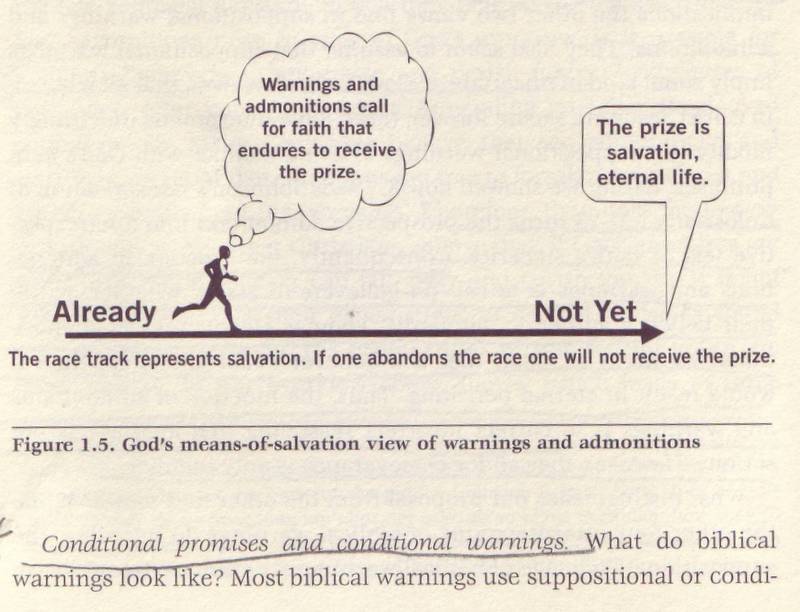
This view by camp B is specifically called, mutable justification. So, these are the two authentic Calvinist camps: Reformed double imputation and mutable justification. Both of these ideas are referred to the reformed motto, already-but not yet. Here is yet another assumption, that this is a Reformed paradox. Not so, “already” is initial justification; “not yet” is perseverance. This is why Calvinism is predicated on lack of assurance. The following is an illustration from the Reformed book, The Race Set Before Us p. 40:
CLICK ON TO ENLARGE
Now, let me begin by saying that election must be completely reevaluated because most of the thinking in regard to it has come from Reformed orthodoxy. That makes election according to the Reformers extremely suspect, especially since it is not really election to begin with. And trust me, for six years, I have been dealing with the justification issue and its relationship to the law and have not had time to reevaluate the metaphysics of election, and I know, much to the consternation of many of PPT’s (blog) readers. But I want to begin our evaluation of justification’s relationship to perseverance and assurance by beginning with what we do know about election. We have addressed the reality of the present-day foundation that dominates the church; now let’s look at this biblically.
What do we know today, here at the Potter’s House, about election? First, we know its purpose. Its purpose is to completely remove works from justification:
Romans 9:11 – though they were not yet born and had done nothing either good or bad—in order that God’s purpose of election might continue, not because of works but because of him who calls— 12 she was told, “The older will serve the younger.” 13 As it is written, “Jacob I loved, but Esau I hated.”
This couldn’t be clearer: God’s purpose in election is to remove all of our works from justification and make it dependent on the “call.” By the way, though I haven’t revisited the metaphysical questions of election yet, I do reject, on the basis of Scripture, that the call equals fatalistic determinism. Now, I don’t know how that fact is going to play out when I revisit this, but to date, I know that much. This brings us to the second thing that we know about election. In the following text, election is referred to as the call:
Romans 8:30 – And those whom he predestined he also called, and those whom he called he also justified, and those whom he justified he also glorified.
Stop right there. Here is where we drive a stake. If we can’t take this at face value, neither can we take John 3:16 at face value. The two things we know about election is that it has two purposes: one, to eliminate all works in justification; therefore, perseverance must be excluded from justification because perseverance has to be judged by a standard. To meet that standard is a work. Perseverance must be severed from justification completely. Secondly, election is for assurance of salvation. Election is the bedrock of our assurance. Paul makes this clear in the next verses immediately following:
31 What then shall we say to these things? If God is for us, who can be against us? 32 He who did not spare his own Son but gave him up for us all, how will he not also with him graciously give us all things? 33 Who shall bring any charge against God’s elect? It is God who justifies. 34 Who is to condemn? Christ Jesus is the one who died—more than that, who was raised—who is at the right hand of God, who indeed is interceding for us. 35 Who shall separate us from the love of Christ? Shall tribulation, or distress, or persecution, or famine, or nakedness, or danger, or sword? 36 As it is written,
“For your sake we are being killed all the day long; we are regarded as sheep to be slaughtered.”
37 No, in all these things we are more than conquerors through him who loved us. 38 For I am sure that neither death nor life, nor angels nor rulers, nor things present nor things to come, nor powers, 39 nor height nor depth, nor anything else in all creation, will be able to separate us from the love of God in Christ Jesus our Lord.
Now, how can glorification be spoken of in the past tense? Because it is a finished issue. It is guaranteed. In addition, the philosophers among us can probably be a help here, but I assume there is no beginning and end in eternity. This calling took place before creation. So does this mean there was never a time when we weren’t elected? That would be an interesting discussion for the philosophers among us. But sanctification is not in Romans 8:30 because sanctification has no connection to justification. Justification results in glorification. The two are inseparable because the calling guarantees glorification.
Romans 11: 29 – For the gifts and the calling of God are irrevocable.
John 6:35 – Jesus said to them, “I am the bread of life; whoever comes to me shall not hunger, and whoever believes in me shall never thirst. 36 But I said to you that you have seen me and yet do not believe. 37 All that the Father gives me will come to me, and whoever comes to me I will never cast out. 38 For I have come down from heaven, not to do my own will but the will of him who sent me. 39 And this is the will of him who sent me, that I should lose nothing of all that he has given me, but raise it up on the last day. 40 For this is the will of my Father, that everyone who looks on the Son and believes in him should have eternal life, and I will raise him up on the last day.”
Verses that seem to indicate a necessary perseverance by the believer to the obvious hindrance of assurance must be interpreted in light of Romans 8:30 and 9:11-13. These verses are definitive. Furthermore, 1John 5:13 states unequivocally that we can presently know that we have eternal life. If final justification awaits a confirmation in the future as a result of our perseverance, this is ambiguous at best. Though we are born again, our ultimate confidence, our sure confidence, is in God. Moreover, the New Covenant is a one-way covenant that does not depend on anything we do. We enjoy the benefits of the covenant as heirs, but all the riches of the inheritance are because of the testator, not our contribution to that covenant. The Old Covenant was the will; the New Covenant is the inheritance upon the death of the testator, Jesus Christ. The fullness of the inheritance will be realized at the new heavens and new earth.
There are many, many, conditional promises in the Bible, for example, EPH 6:1-3, but The Promise, the Abrahamic Covenant that is built by all the other covenants, is UNCONDITIONAL. God put Abraham in a deep sleep and consummated the covenant himself. The thief on the cross contributed nothing to his election. He only believed, and was assured by God Himself that he would be in heaven that day. Not because of anything he did, there was no perseverance to be had by him—he could only hang there with the hope he had been given by God’s promise.
So what is going on with all of the verses in the Bible that seem to indicate a requirement on our part to persevere in order to obtain a supposed “final justification”? You can consider Romans 8:30 and 9:11-13 point one, and the following point 2: perseverance is stated throughout Scripture as a characteristic of salvation, but not a condition. We are engaged in warfare, and the friends of God and the enemies of God are evident. During the tribulation period as now, the side you are on is manifest. We are not justified by anything we do, but we can be called justified by what we do. Our actions justify our justification. We have a good example of this in the book of James:
James 2:14 – What good is it, my brothers, if someone says he has faith but does not have works? Can that faith save him? 15 If a brother or sister is poorly clothed and lacking in daily food, 16 and one of you says to them, “Go in peace, be warmed and filled,” without giving them the things needed for the body, what good is that? 17 So also faith by itself, if it does not have works, is dead.
18 But someone will say, “You have faith and I have works.” Show me your faith apart from your works, and I will show you my faith by my works. 19 You believe that God is one; you do well. Even the demons believe—and shudder! 20 Do you want to be shown, you foolish person, that faith apart from works is useless? 21 Was not Abraham our father justified by works when he offered up his son Isaac on the altar? 22 You see that faith was active along with his works, and faith was completed by his works; 23 and the Scripture was fulfilled that says, “Abraham believed God, and it was counted to him as righteousness”—and he was called a friend of God. 24 You see that a person is justified by works and not by faith alone. 25 And in the same way was not also Rahab the prostitute justified by works when she received the messengers and sent them out by another way? 26 For as the body apart from the spirit is dead, so also faith apart from works is dead.
This isn’t that complicated. Saving faith justifies us, and is alive: therefore, works result that per se, justify us, or show that we are justified. Rahab wasn’t justified by what she did, her actions revealed the fact that she was justified. This is also the Bible’s way of making a strong statement about Christians acting like Christians. Stating that we are justified by what we do is using an obvious contradiction to get our attention: behavior is so intrinsically connected to the new birth that for all practical purposes you can say one is justified by what they do. This is the point James is making. And I think that point is made throughout Scripture:
Romans 2:13 – For the hearers of the law be not just with God, but the doers of the law shall be made just (Wycliffe Bible).
You can’t read the book of Romans and think for a second that Paul is talking about being justified by the law. The point is made here: obedience justifies the claim that we are justified. Likewise, those who are justified persevere as a characteristic of the justified; the perseverance does not make them justified. It’s our character resulting in practice, not our position. All such verses can be read in that way.
This is the third point concerning assurance: practice gives assurance. No text gives this more clarity than 2Peter 1:5-11:
3 According as his divine power hath given unto us all things that pertain unto life and godliness, through the knowledge of him that hath called us to glory and virtue: 4 Whereby are given unto us exceeding great and precious promises: that by these ye might be partakers of the divine nature, having escaped the corruption that is in the world through lust. 5 And beside this, giving all diligence, add to your faith virtue; and to virtue knowledge; 6 And to knowledge temperance; and to temperance patience; and to patience godliness; 7 And to godliness brotherly kindness; and to brotherly kindness charity. 8 For if these things be in you, and abound, they make you that ye shall neither be barren nor unfruitful in the knowledge of our Lord Jesus Christ. 9 But he that lacketh these things is blind, and cannot see afar off, and hath forgotten that he was purged from his old sins.
10 Wherefore the rather, brethren, give diligence to make your calling and election sure: for if ye do these things, ye shall never fall: 11 For so an entrance shall be ministered unto you abundantly into the everlasting kingdom of our Lord and Saviour Jesus Christ (KJV).
Obviously, Peter isn’t talking about solidifying our election through works; he is talking about making our election sure to ourselves through obedience. This is also the major theme of 1John. Verse ten strikes a contrast between it and verses eight and nine. We can forget that we have been purged from our sins and heaven can become a distant reality. Also note that there is a quality of entry into heaven (v.11). Some translations refer to a “rich” entry into heaven. Verse ten refers to falling into deep sin. This is a picture of someone who is unsure of their standing with God. We can’t work for our justification, but we can certainly work for our assurance. Peter calls for “diligence” in this regard. One of the elements he mentions that needs to be added to our faith is “patience.” This has the idea of “endurance” and “perseverance.” The three words are used interchangeably throughout Scripture. The reward for our perseverance is assurance—not salvation.
I would like to close with some charts. The following two are from last week and illustrate what we have discussed in general.
CLICK ON TO ENLARGE
CLICK ON TO ENLARGE
The next one is from page 24 of False Reformation:

Justification is a one-time declaration. Salvation is a little different. At salvation we receive all of the blessings and power of heaven. As we appropriate that power through obedience in sanctification the reality and power of our salvation is experienced. This gives assurance, and shows others that we are justified. In that regard we are justified by our works.
Addendum:
We have discussed many reasons why we believe that Christians will not stand in a final judgment to determine final justification. We reject the idea that justification has a beginning, process, and end (aka, justification, “progressive sanctification” and final justification confirmed at a final judgment). We find that at the final judgment, books are opened and the “dead” are judged from the books according to what they have done (REV 20:11-14). Being “under the law,” we assume that they are judged according to the law. Everyone at this judgment has died. This is NOT so with the OTHER judgment that seems to be primarily a judgment for rewards.
We believe that Christians will not be judged by the law in a final judgment. It is very possible that our sins were once recorded in those books, but were blotted out when we gave our lives to Christ:
Isaiah 43:25 – I, I am he who blots out your transgressions for my own sake, and I will not remember your sins.
Many texts document the fact that God will not remember the sins of the redeemed (a few: HEB 8:12, 10:17, JER 31:34, Micah 7: 19 ISA 44:22, Acts 3:19, PS 103:12) . As the apostle Paul said, “love does not keep a record of wrong.” At one judgment, Christ states, “depart from me….I never knew you.” “Knew” probably refers to the fact that He never loved them as a kingdom heir. At the final judgment, there is obviously a record of sin. But of particular interest is the blotting out statements. Again, this probably refers to the idea that our sins were once recorded in those books, but were blotted out when we were saved. Similar language is used to refer to those who are blotted out from the book of life:
Psalm 69:28 – Let them be blotted out of the book of the living; let them not be enrolled among the righteous.
A Scriptural study of the books is critical to understanding justification and the grace of God. How many of us have been taught this subject in-depth? Let me give you some framework as a result of some residual study I have done. There appears to be books where all of the sins of mankind are recorded, and the book of life in which all who are born into the world are recorded. A cursory observation seems to point to the idea that the saved are blotted out of the books that record sin, and not blotted out of the book of life. It is also possible that some are never recorded in the book of life even though they walk the earth at some point. The Lamb’s book of life may also be a separate book. Christ promised the saved would never be blotted out of the book of life (one among many: REV 3:5).
The Potter’s House: Our Justification Crisis, Perseverance, and Assurance: Part 1
Tonight we will be looking at the present justification crisis, perseverance, and assurance. The relationship between these three is causing much confusion in our day. This is another topical subject related to our Romans study as we have been fluctuating between specific verses in Romans and topics related to Romans. We will look at the crisis tonight, introduce perseverance, and address the remainder of perseverance and assurance next week. Then the following week is our annual conference.
First, the crisis.
Those who love God simply want to know the truth; they want wisdom; they want to know the way; they want to be at peace with God; they want to please God, and they want to be able to share God with others according to the truth. They want hope; they want to know for certain that they will live with God for eternity. I recently watched a disturbing video that was a Q and A excerpt from the 2010 “Shepherds” Conference hosted by Dr. John MacArthur’s church. In light of the supposed Calvinistic view of election, an attendee asked what should be said to people when we evangelize. MacArthur’s answer was somewhat snarky; in essence, “Tell them what the Bible says, duh!” MacArthur then went on to explain that the Bible was full of paradoxes and tensions that couldn’t be understood. Therefore, just obey Scripture and leave all of the logic to God. In essence, understanding is none of our business. Dr. Michael Horton seems to parrot the same idea by stating that the law “gives us something to do.” It would seem that the totally depraved Christian masses need something to keep them focused while God does whatever He is going to do despite ourselves.
Let me just pause here a moment and clarify “supposed” in regard to Calvinists believing in election. Election should give Christians complete confidence that they are going to heaven which is the headquarters for His Tabernacle Project. Chew on that awhile; heaven is not our eternal dwelling place, that’s a Protestant fairytale, to name just one among many others. More would be done for God in the here and now if we understood that it is preparation for much bigger tasks that we will be doing for God in the future. The apostle Paul said that whether here in our present bodies, or present with the lord, we make it our “goal” to please Him. What! In heaven we will have a “goal” to please God? Woe! Perhaps we are not getting the whole story about our future with God. Perhaps our future with God is a lot more definitive than we have been taught. And does this affect our present service for God. Absolutely. Lack of information never facilitates action. Never.
Granted, election is a mystery. But what is important is that election and justification go hand in hand. Romans 8:29,30 makes that clear. Our justification was sealed before the foundation of the world. Our justification was before time, as in, space of time. That’s why in those verses we were also considered glorified. Now look, there are a lot of theories on election, and I don’t care which one who hold to just so you agree with me that our salvation was settled before time, and if we were justified before we were born, we can’t do anything to mess that up.
Unless you’re a Calvinist. If you’re a Calvinist, you can mess that up by unwittingly doing something in sanctification that is a “work” and thereby making sanctification the “ground of your justification.” Reformed elders are the experts in regard to what is a work in sanctification and what isn’t a work in sanctification. Be sure of this: the crux of Calvinism is the following: “We can’t know anything for certain so your best shot at heaven is listening to God’s anointed who save us from ignorance as much as that can be done. Though they don’t claim to know anything for certain either, they have been given the keys to the kingdom and have the authority to declare us unbelieving. They can’t give us assurance of our salvation, because living by faith alone in sanctification is very tricky business, but they can declare the contrary. Be a good Calvinist, keep your mouth shut, obey the elders, and hope for the best. That’s Calvinism, and I will debate anyone who tries to say otherwise. Words mean things, and I have the black and white of their words in abundance.
Unfortunately, Calvinism must be harped on in our day because this ideology has been ruling the American church since 1995. Its contemporary form was launched in 1970 and grew at a very fast pace, but circa 1995 marked a beginning of dominance culminating in the fact that this movement crosses all denominational lines and is the only option available in many US cities. And its view of justification has profound implications for the Christian—utterly profound. If revival is possible in America, Calvinism must be used as an example to highlight the way to real sanctified life; it must be stripped of its deceptive costume because the case has been well presented—evil and brilliance are not mutually exclusive. The leaven that blinds must be rooted out as learning progresses.
I find my discussions with Susan regarding her material for this year’s conference disturbing. On the one hand, Calvinists, including John MacArthur, proudly claim St. Augustine as the father of Reformation doctrine. On the other hand, Augustine flaunted his Platonism in broad daylight and stated in no uncertain terms that the Bible has no credibility without Plato. Pardon me if I am extremely uncomfortable with a justification formed by a committee of which Plato was a contributor. Moreover, the results speak for themselves.
Although the New Calvinists have dominated the American church for eighteen years now, things are not better, they are worse. John Piper, while announcing his future post-retirement plans from Geneva, stated that wherever the Reformation doctrine has sprung forth, that same geography is saturated with the blessed light of God. Well then, where’s the beef? Socially, there were over 333,000 abortions in America last year. Divorce in the church has surpassed secular statistics and is approaching an astounding 60%. Spiritual abuse blogs, mostly focused on New Calvinist leaders, have exploded in number over the past two years. In the past ten years, at least two organizations have been formed to keep New Calvinist churches out of civil and criminal court. This is all unprecedented. Where’s the beef? And where are the NEW converts associated with real revival? Polls have clearly indicated that new sheep are not coming in; they are merely being relocated and rearranged at the cost of split churches.
Yet, New Calvinists constantly talk as if they have arrived on the scene recently and their “revival” is just now getting into second gear. This is nonsense! They have been in solid control of the American church for at least eighteen years. And please, please, do not miss this: they continue to blame the mess they have created on “evangelical subjectivism.” This is the religious equivalent to the political, “Blame it on Bush.” Don’t miss this either: the problems with evangelicalism to begin with are due to the fact that the Reformers gave birth to them resulting in an overemphasis on salvation to the detriment of sanctification.
I say all of that to say this: when the Australian Forum launched Neo-Calvinism in 1970, they highlighted the idea that the church was in a “justification crisis.” That isn’t true, the church was actually in a sanctification crisis, not a justification crisis. But the reason for its crisis was the root that it came from: the belief that justification and sanctification are the same thing. Hence, getting people saved continued to be the obsession along with a woeful devaluing of discipleship. Basically, New Calvinism offered the full dose of the cancer as a cure.
But this is a very good thing. It is especially good because the theological dream team of the Australian Forum systematized this doctrine in a way that gives it staying power. These guys were right in a wrong way (they absolutely did rediscovery the authentic Reformation gospel), but nevertheless, they had brilliant theological minds coupled with personalities capable of strong persuasion. What this will do, finally, is force the church into revisiting the subject of justification in an in-depth way. It will force the American church to come to grips with their long held mentality regarding justification. And here is the crisis of confusion in our present day: what is the relationship between the two?
Here at the Potter’s House we have looked at that deeply. For instance, how could Christ have come stating that he didn’t come to abolish the law while the apostle Paul stated the exact opposite? We conclude that Christ was speaking of sanctification and Paul was referring to justification. Here is a statement for you: “The law is for those under it and those being sanctified, but not the justified.” Or how about this statement: “The law has a relationship to unregeneration and progressive sanctification, but has no relationship to definitive sanctification and justification.” The first one may incite the following conversation:
But I thought anyone who is justified is sanctified. “That’s absolutely true.” So how can you say the law has no relationship to your justification? “Because I didn’t need the law for my justification, but I need it for my sanctification. In fact, I couldn’t be justified with the law.” Then why do you need it for your sanctification? “Because being justified without the law resulted in being enslaved to the law.” So then, what was your relationship to the law before justification? “It was my enemy.” How so? “Because the desires of the flesh are contrary to the law, and the law provoked sinful desires within me. That doesn’t mean the law is bad, the law is holy, and unfortunately while provoking sinful desires within me, a judgment awaited me by that same law in the future. But now the law is my friend, and instead of provoking me to sin, it provokes me to righteousness. I am not sanctified apart from the law (John 17:17), but I am justified apart from the law (Romans 3:21).” But that verse states that the righteousness of God was MANEFESTED apart from the law. That righteousness is Jesus, not you in regard to justification. “Well, if that righteousness manifested was Jesus, that would teach that His righteousness was manifested apart from the law as well, so what’s your point? My point is that justification is apart from the law. If you look at verse 19 prior, and verse 22 after, the point is a righteousness manifested by faith in Christ alone. That’s my point.”
This brings us to Perseverance. Granted, there are verses in the Bible that seem to say that our salvation is contingent on persevering till the end. I have done a lot of reading on this from the Reformed perspective, and clearly, the belief is that the promise of salvation is “conditional.” Sanctification is a race from which we can be disqualified, but if we aren’t, the prize spoken of in Scripture is salvation. Salvation is the prize for finishing the race. The Reformed refer to this as “already-but-not-yet.” This would eliminate any rewards for obedience and service in sanctification. The reward is salvation itself. So, election (already) qualifies us for the race, but we have to finish in a way that doesn’t disqualify us (not yet). The obvious problem here is, if the focus is staying saved by faith alone, or persevering in our salvation, this keeps us focused on staying saved and not serving! No wonder sanctification is so weak in Protestantism, if salvation is not a done deal, that’s where our focus is going to be if we are smart. In fact, we are warned not to “obey in our own efforts” or “live by do’s and don’ts.” This is all very confusing to say the least.
I want to address one particular passage they cite regarding this:
Matthew 10:21 – Brother will deliver brother over to death, and the father his child, and children will rise against parents and have them put to death, 22 and you will be hated by all for my name’s sake. But the one who endures to the end will be saved. 23 When they persecute you in one town, flee to the next, for truly, I say to you, you will not have gone through all the towns of Israel before the Son of Man comes.
Here is what I want to point out: in this passage, “saved” doesn’t mean “salvation.” This is where I keep saying that eschatology is not “secondary.” Eschatology is gospel. Remembering what we have learned in the past makes it obvious that Christ is giving directions for staying alive during the tribulation period. Verse 23 is the point; if you flee from town to town, you options are not going to run out before my return. The obvious implication is that they will remain alive. This is so very important. If you do not understand eschatology, this passage means our salvation is not a finished work; it means we have to persevere to finish our salvation. This passage also adds much weight to the argument for the millennial kingdom following the tribulation period which begins with the judgment of the nations.
Let’s look at what this all boils down to in the following visual illustrations:
As we have discussed before, sanctification is missing from Romans 8:29,30, but what follows is Paul’s point to what he stated in verses 29 and 30:
31 What then shall we say to these things? If God is for us, who can be against us? 32 He who did not spare his own Son but gave him up for us all, how will he not also with him graciously give us all things? 33 Who shall bring any charge against God’s elect? It is God who justifies. 34 Who is to condemn? Christ Jesus is the one who died—more than that, who was raised—who is at the right hand of God, who indeed is interceding for us. 35 Who shall separate us from the love of Christ? Shall tribulation, or distress, or persecution, or famine, or nakedness, or danger, or sword? 36 As it is written,
“For your sake we are being killed all the day long; we are regarded as sheep to be slaughtered.”
37 No, in all these things we are more than conquerors through him who loved us. 38 For I am sure that neither death nor life, nor angels nor rulers, nor things present nor things to come, nor powers, 39 nor height nor depth, nor anything else in all creation, will be able to separate us from the love of God in Christ Jesus our Lord.
This cannot be deviated from. Paul is stating here that trials cannot separate us from the love of God. Something else is being communicated in passages that seem to say that we are required to persevere in life for some kind of “final justification.” Lord willing, we will take a much closer look at this next week
The Potter’s House: Calvinism’s View of the Law Driven by Platonist Metaphysics

We Are Declared Righteous, and We Are Righteous
I had planned to continue in Romans 10 and 11 tonight as we are looking at those two chapters as one unit beginning in 10:1 and ending at 11:26 with a doxology following. But a combination of events has prompted me to share something very important tonight. Lord willing, we will finish our study on justification from the book of Romans within the next two weeks and begin studying more in the area of sanctification, or Christian living.
Last week, I wrote an article announcing that the Potter’s House is now an organized church. I have also been very busy because of the upcoming conference—so busy that I almost didn’t recognize the craziness that was going on. Paul’s Passing Thoughts blog is not a blog that usually evokes a lot of comments, but out of nowhere, it seemed that Calvinist crackpots where converging on the blog from every direction. I finally stopped to take a look at what was going on. That post in particular drew more than 60 comments (with an additional 30 related comments posted on other articles) in a couple of days with no end in sight—I finally closed the comments down.
But with the research Susan has been doing for the conference in the back of my mind, a particular comment on the blog hit me right between the eyes—truly a light bulb moment. It just made it all come together for me and supplied a clear vision moving forward for the Potter’s House. First, let me display the Reformed illustration that will be the thesis of all three of my sessions at the conference:
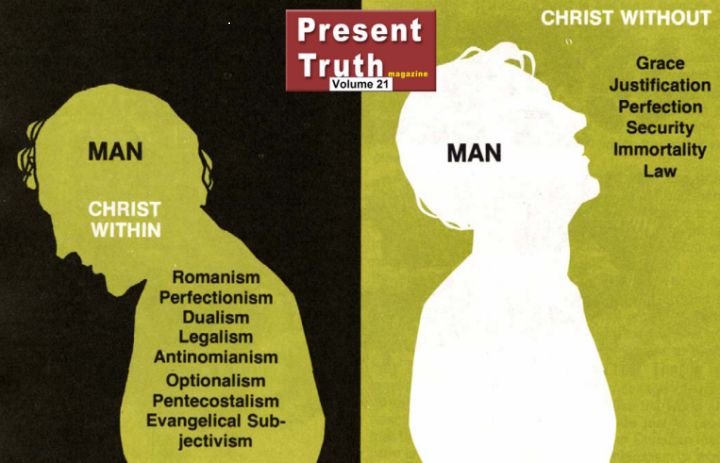
This is a Reformed illustration of the official Reformation gospel, the centrality of the objective gospel outside of us. Here is what Susan’s research has made clear to me: this is nothing more or less than a Platonist construct; period. This is predicated on the idea that matter is inherently evil and only spirit is the true, good, and the beautiful which is Plato’s trinity. That’s what this is. Man, being part of the material world, cannot have grace or goodness within him. And I quote:
When the ground of justification moves from Christ outside of us to the work of Christ inside of us, the gospel (and the human soul) is imperiled. It is an upside down gospel.
~ John Piper
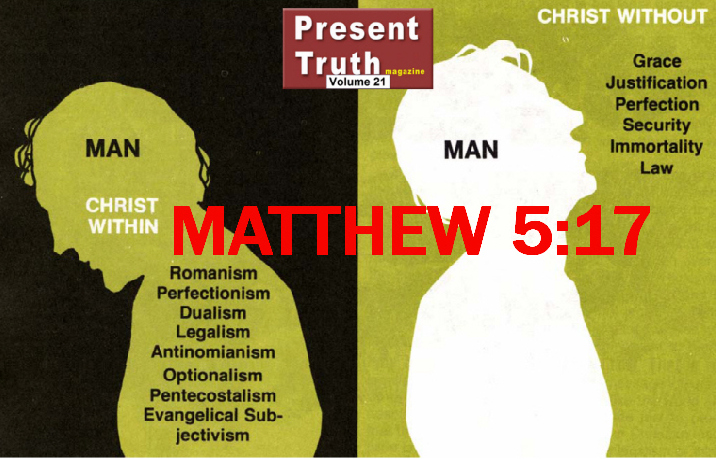
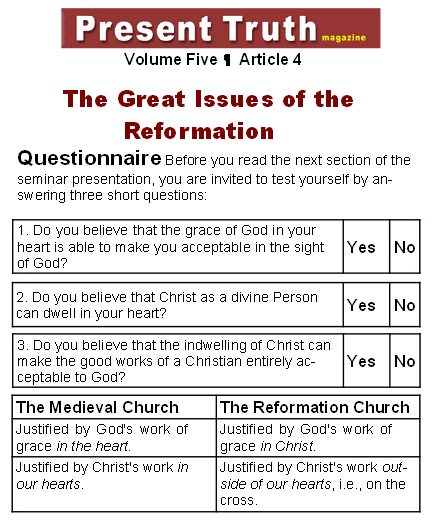
In our time we are awash in a “Sea of Subjectivism,” as one magazine put it over twenty years ago [see left man in illustration]. Let me explain. In 1972 a publication known as Present Truth published the results of a survey with a five-point questionnaire which dealt with the most basic issues between the medieval church and the Reformation. Polling showed 95 per cent of the “Jesus People” were decidedly medieval and anti-Reformation in their doctrinal thinking about the gospel. Among church-going Protestants they found ratings nearly as high.
~ John H. Armstrong
And here is an excerpt from the exact article Armstrong spoke of:
Whether the Medieval church believed the new birth aided us in finishing our justification is not the point. The point is that sanctification does not finish justification and the two or totally separate, but more on that later. I now want to address the aforementioned comment on Paul’s Passing Thoughts blog:
Perhaps you could give me an example of a Calvinist teaching that matter is evil in and of itself. What you say about law is true regarding Calvinists and Paul’s teaching except that Calvinists do believe that Jesus satisfied the Law’s righteous requirements so that the believer stands justified before the Law.
And this was my answer to the comment:
You just stated it yourself. Calvinists believe Jesus had to fulfill the law for us and not in us because we are of matter and not Spirit. Paul taught that the new birth enabled the righteous requirements of the law to be fulfilled in us in sanctification–and the law is abolished in regard to justification.
Of course, this is a direct reference to Matthew 5:17;
“Do not think that I have come to abolish the Law or the Prophets; I have not come to abolish them but to fulfill them.
THIS IS IT RIGHT HERE. The Calvinist interpretation of this passage equals the same as the two-man illustration. This has to be interpreted as Christ fulfilling the law for us while not abolishing it for justification. Abolishment pertains to justification; i.e., Christ didn’t come to abolish the law in regard to justification, and fulfillment is completely of Christ for that purpose. Because of the fundamental idea that the true, the good, and the beautiful cannot be united with evil and create good, this MUST be their view of law. It is of necessity within that construct.
But this is where interpreting the Bible in context of justification and sanctification is absolutely critical. Is Matthew 5:17 regarding justification or sanctification? Unless this distinction is made, the Bible contradicts itself. How so? Because in fact, the apostle Paul stated that Christ came to “end” the law:
Romans 10:4 – For Christ is the end of the law for righteousness to everyone who believes.
When one believes, they are no longer “under the law” ….for justification. In regard to justification, the law is abolished—it is no longer a standard for our justification:
Romans 3:19 – Now we know that whatever the law says it speaks to those who are under the law, so that every mouth may be stopped, and the whole world may be held accountable to God. 20 For by works of the law no human being will be justified in his sight, since through the law comes knowledge of sin. 21 But now the righteousness of God has been manifested apart from the law, although the Law and the Prophets bear witness to it— 22 the righteousness of God through faith in Jesus Christ for all who believe.
Romans 5:13 – for sin indeed was in the world before the law was given, but sin is not counted where there is no law.
So what was Christ saying when He said He didn’t come to abolish the law, but rather to fulfill it? He was talking about sanctification which by the way is the subject of the Sermon on the Mount. Justification by faith alone is nowhere to found in that sermon. The sermon is about how the Christian builds their life on a rock. So, in what way did Christ say He was going to fulfill the law? Let’s see:
Romans 8:3 – For God has done what the law, weakened by the flesh, could not do. By sending his own Son in the likeness of sinful flesh and for sin, he condemned sin in the flesh, 4 in order that the righteous requirement of the law might be fulfilled in us, who walk not according to the flesh but according to the Spirit. 5 For those who live according to the flesh set their minds on the things of the flesh, but those who live according to the Spirit set their minds on the things of the Spirit. 6 For to set the mind on the flesh is death, but to set the mind on the Spirit is life and peace. 7 For the mind that is set on the flesh is hostile to God, for it does not submit to God’s law; indeed, it cannot. 8 Those who are in the flesh cannot please God.
Christ came and died on the cross to release us from the law so that the law could be fulfilled in us….for sanctification. Another way of looking at this is that he came and died on the cross to destroy the works of the devil in us:
1John 3:8 – Whoever makes a practice of sinning is of the devil, for the devil has been sinning from the beginning. The reason the Son of God appeared was to destroy the works of the devil. 9 No one born of God makes a practice of sinning, for God’s seed abides in him, and he cannot keep on sinning because he has been born of God. 10 By this it is evident who are the children of God, and who are the children of the devil: whoever does not practice righteousness is not of God, nor is the one who does not love his brother.
Living a life of sin denies the very reason Christ went the cross. Ephesians gives us a good example of how this is applied:
Ephesians 4:19 – They have become callous and have given themselves up to sensuality, greedy to practice every kind of impurity. 20 But that is not the way you learned Christ!— 21 assuming that you have heard about him and were taught in him, as the truth is in Jesus, 22 to put off your old self, which belongs to your former manner of life and is corrupt through deceitful desires, 23 and to be renewed in the spirit of your minds, 24 and to put on the new self, created after the likeness of God in true righteousness and holiness.
By practicing righteousness (put on) we please God, love Christ, and fulfill the righteousness of the law in His service. By putting off the old us we serve Christ by destroying the works of the devil. But if obeying the law perfectly to maintain our just standing is the case, we are obviously out of the loop. Moreover, it combines the good with mortality which is anathema in the Platonist construct. Hence, in Calvinism, the law must remain as a standard to maintain a just standing. That makes righteousness within mortality impossible. This is the crux of the issue. True righteousness operating in imperfection is a metaphysical impossibility to the Platonist. But God has accomplished it by putting to death the mortal body we dwell in, abolishing the law for our justification, imputing our sin to Christ, and imputing His righteousness to us apart from the law. The old us died with Christ and cannot be judged, and the righteous seed of God dwells within us.
Let’s examine some of the answers to this that I received by Calvinists on the blog:
No, I was asking for an example of a Calvinist teaching that matter is evil in and of itself. Where does any Calvinist teach that Jesus had to fulfill the law for us because we are matter and not spirit? Now I even have questions about your statement that Paul taught that law is abolished in regard to justification. Where does he ever say the law is abolished in regard to justification?
In regard to the latter, we have answered that question. Paul stated plainly that we are justified APART from the law in many places. In regard to the former, it is like a wife-beater demanding to be shown in the Bible where it states specifically that he cannot beat his wife. It’s ludicrous. The principle can be seen in Calvinism’s “T” in T.U.L.I.P: total depravity. Look, I could once again cite the Calvin Institutes to make this point, but I think the following tweet from Tullian Tchividjian should suffice:
This mentality mimics Calvin precisely. Hence, my answer:
Calvin rejected the idea that any saint has ever done one righteous deed that pleased God (CI 3.14.9-11). Was he speaking of flesh or spirit? And if both are depraved, why would it make a difference?
I got this in reply:
Even those who believe in total depravity (whether in a regenerate or unregenerate state—most Calvinists would not subscribe to the idea that believers continue to be totally depraved in the same sense as are the unregenerate) do not believe the body is evil in and of itself.
And my reply:
In regard to you: we are all totally depraved, but not in the same way, and it doesn’t mean our bodies are inherently evil. Right. Typical Calvinist double speaking nonsense–you will not be wasting any more of my time. Post if you will, and get your jollies doing it–but they will not see the light of day here.
No matter what verbiage Calvinists use and what they seem to say, they must be brought back to the two-man illustration to give an account. In our day, the New Calvinist problem is a return of the exact same Gnosticism (which came from Platonism) that wreaked havoc on the first century church. This can be seen throughout the New Testament. New Calvinists like Paul David Tripp and CJ Mahaney call Christians, “enemies of God,” “God ignoring,” “we hate God,” etc., while the apostles stated the exact opposite:
Romans 15:14 – I myself am satisfied about you, my brothers, that you yourselves are full of goodness, filled with all knowledge and able to instruct one another.
The book of 1John is peppered with rebuttals that reflect a contention against the exact same things that the New Calvinists teach in our day. That is because John was contending against Gnosticism and that’s what the New Calvinists are. This will be clearly demonstrated at this year’s conference historically, doctrinally, and practically.
Therefore, the clear vision for the Potter’s House moving forward is a strong assertion that we are not only declared righteous, we are righteous. Our primary goals are aggressive sanctification in all areas of life, emphasis on doctrinal and theological training, and making disciples by teaching them all that the Lord commanded.
Because only truth sanctifies.
The Potter’s House 5/19/2013: The Gospel Truth About Israel (Part 2); “All Israel Will be Saved”


The Potter’s House 5/19/2013: The Gospel Truth About Israel (Part 1); “All Israel Will be Saved”
“The idea that all of national Israel will be saved is absolutely huge in understanding prophecy and its connection to the gospel.”
We are now very near to the end of our study on justification. Please pray for me as we will continue in the book of Romans and take a sharp right turn into the arena of Christian living. The apostle Paul is going to teach us how to obtain a powerful life to the glory of our Father. That starts in Romans 12.
The first eleven chapters in Romans are about justification. The gospel of first importance. How we are reconciled to God. How we tell others to be reconciled to God. And how those that we are trying to reconcile think. What man’s greatest need is, and what makes him tick. But there is another gospel as well: the good news of kingdom living. The perfect law of liberty that sets us free.
Paul finishes his treatise on justification with a major element thereof: the issue of national Israel. As we have seen, national Israel was elected by God, and there is a remnant within Israel that is also elected. We have seen clearly that God had a specific purpose in election—to completely eradicate man from any participation in his eternal security. If we were not born again with a heart enslaved to the desires of the Holy Spirit we would have absolutely no incentive whatsoever to live according to the law in our Christian life….for justification. And look, all of the Bible must be interpreting with this prism: [Bible verse]….for justification; or,[Bible verse]….for sanctification. The Bible is divided into those two subjects. Beware of any man who applies justification verses to sanctification issues. Mark that man and flee from him. The law has NOTHING to say to us….for justification. It has plenty to say to us….for sanctification.
And know this, know this shocking revelation (ROM 11:25): If Paul’s prayer in Romans 10:1 is not answered in the affirmative, no one, but no one is saved:
Brothers, my heart’s desire and prayer to God for them is that they may be saved.
Listen, Romans 10-11 is a sermon manuscript in and of itself. It’s self-explanatory. Paul opens with that prayer in verse one, and closes with the following statement preceding his doxology in Romans 11:
26 And in this way all Israel will be saved, as it is written, “The Deliverer will come from Zion, he will banish ungodliness from Jacob”; 27 “and this will be my covenant with them when I take away their sins” (ISA 59: 20, 21).
In what way? In what way will Israel be saved? As we will see, there is yet another purpose in God’s election. Paul shortly revisits justification fundamentals in regard to national Israel’s rebellion which is, as we will see, used by God in His second great purpose of election. Paul’s sermon here is really about the two great purposes of God’s election.
And note: “ALL” Israel will be saved. Stop right there. Please do not believe the lie that eschatology cannot be understood definitively. Please do not believe that it is “secondary,” “nonessential” truth. We have bought into that because of the confusion surrounding the subject of Israel. If there is a time that ALL of national Israel will be saved, and obviously that is the case, this is a key interpretive element in understanding eschatology. AND justification. AND the gospel. 25% of the Bible being about eschatology is not an aside—it’s not a preface—it’s gospel.
The idea that all of national Israel will be save is absolutely huge in understanding prophecy and its connection to the gospel. First, let’s go back in time and establish that this was God’s original purpose for Israel:
Exodus 19:3 – while Moses went up to God. The Lord called to him out of the mountain, saying, “Thus you shall say to the house of Jacob, and tell the people of Israel: 4 You yourselves have seen what I did to the Egyptians, and how I bore you on eagles’ wings and brought you to myself. 5 Now therefore, if you will indeed obey my voice and keep my covenant, you shall be my treasured possession among all peoples, for all the earth is mine; 6 and you shall be to me a kingdom of priests and a holy nation. These are the words that you shall speak to the people of Israel.”
God’s original covenant with Israel was contingent on His promise alone, or “the promise.” When God made this covenant with the father of our faith, God put Abram into a deep sleep and consummated the promise himself:
Genesis 15:1 – After these things the word of the Lord came to Abram in a vision: “Fear not, Abram, I am your shield; your reward shall be very great.” 2 But Abram said, “O Lord God, what will you give me, for I continue childless, and the heir of my house is Eliezer of Damascus?” 3 And Abram said, “Behold, you have given me no offspring, and a member of my household will be my heir.” 4 And behold, the word of the Lord came to him: “This man shall not be your heir; your very own son shall be your heir.” 5 And he brought him outside and said, “Look toward heaven, and number the stars, if you are able to number them.” Then he said to him, “So shall your offspring be.” 6 And he believed the Lord, and he counted it to him as righteousness.
7 And he said to him, “I am the Lord who brought you out from Ur of the Chaldeans to give you this land to possess.” 8 But he said, “O Lord God, how am I to know that I shall possess it?” 9 He said to him, “Bring me a heifer three years old, a female goat three years old, a ram three years old, a turtledove, and a young pigeon.” 10 And he brought him all these, cut them in half, and laid each half over against the other. But he did not cut the birds in half. 11 And when birds of prey came down on the carcasses, Abram drove them away.
12 As the sun was going down, a deep sleep fell on Abram. And behold, dreadful and great darkness fell upon him. 13 Then the Lord said to Abram, “Know for certain that your offspring will be sojourners in a land that is not theirs and will be servants there, and they will be afflicted for four hundred years. 14 But I will bring judgment on the nation that they serve, and afterward they shall come out with great possessions. 15 As for you, you shall go to your fathers in peace; you shall be buried in a good old age. 16 And they shall come back here in the fourth generation, for the iniquity of the Amorites is not yet complete.”
17 When the sun had gone down and it was dark, behold, a smoking fire pot and a flaming torch passed between these pieces. 18 On that day the Lord made a covenant with Abram, saying, “To your offspring I give this land, from the river of Egypt to the great river, the river Euphrates, 19 the land of the Kenites, the Kenizzites, the Kadmonites, 20 the Hittites, the Perizzites, the Rephaim, 21 the Amorites, the Canaanites, the Girgashites and the Jebusites.”
And the plan always included the Gentiles being grafted in (blessed) “through” God’s covenant with Israel:
Genesis 12:1 – Now the Lord said to Abram, “Go from your country and your kindred and your father’s house to the land that I will show you. 2 And I will make of you a great nation, and I will bless you and make your name great, so that you will be a blessing. 3 I will bless those who bless you, and him who dishonors you I will curse, and in you all the families of the earth shall be blessed.”
Genesis 17:1 – When Abram was ninety-nine years old the Lord appeared to Abram and said to him, “I am God Almighty; walk before me, and be blameless, 2 that I may make my covenant between me and you, and may multiply you greatly.” 3 Then Abram fell on his face. And God said to him, 4 “Behold, my covenant is with you, and you shall be the father of a multitude of nations. 5 No longer shall your name be called Abram, but your name shall be Abraham, for I have made you the father of a multitude of nations. 6 I will make you exceedingly fruitful, and I will make you into nations, and kings shall come from you. 7 And I will establish my covenant between me and you and your offspring after you throughout their generations for an everlasting covenant, to be God to you and to your offspring after you. 8 And I will give to you and to your offspring after you the land of your sojournings, all the land of Canaan, for an everlasting possession, and I will be their God.”
Genesis 22:15 – And the angel of the Lord called to Abraham a second time from heaven 16 and said, “By myself I have sworn, declares the Lord, because you have done this and have not withheld your son, your only son, 17 I will surely bless you, and I will surely multiply your offspring as the stars of heaven and as the sand that is on the seashore. And your offspring shall possess the gate of his enemies, 18 and in your offspring shall all the nations of the earth be blessed, because you have obeyed my voice.”
In regard to the Mt. Sinai covenant, national Israel did break it for the most part except for the remnant chosen by God. But God used that rebellion, prophesied in the original covenant, to bless the Gentiles while adding another covenant to the original covenant:
Jeremiah 31:31 – “Behold, the days are coming, declares the Lord, when I will make a new covenant with the house of Israel and the house of Judah, 32 not like the covenant that I made with their fathers on the day when I took them by the hand to bring them out of the land of Egypt, my covenant that they broke, though I was their husband, declares the Lord. 33 For this is the covenant that I will make with the house of Israel after those days, declares the Lord: I will put my law within them, and I will write it on their hearts. And I will be their God, and they shall be my people. 34 And no longer shall each one teach his neighbor and each his brother, saying, ‘Know the Lord,’ for they shall all know me, from the least of them to the greatest, declares the Lord. For I will forgive their iniquity, and I will remember their sin no more.”
35 Thus says the Lord, who gives the sun for light by day and the fixed order of the moon and the stars for light by night, who stirs up the sea so that its waves roar—the Lord of hosts is his name: 36 “If this fixed order departs from before me, declares the Lord, then shall the offspring of Israel cease from being a nation before me forever.” 37 Thus says the Lord: “If the heavens above can be measured, and the foundations of the earth below can be explored, then I will cast off all the offspring of Israel for all that they have done, declares the Lord.”
38 “Behold, the days are coming, declares the Lord, when the city shall be rebuilt for the Lord from the Tower of Hananel to the Corner Gate. 39 And the measuring line shall go out farther, straight to the hill Gareb, and shall then turn to Goah. 40 The whole valley of the dead bodies and the ashes, and all the fields as far as the brook Kidron, to the corner of the Horse Gate toward the east, shall be sacred to the Lord. It shall not be plucked up or overthrown anymore forever.”
The New Covenant was never made between God and the Gentiles—it was made with Israel. Nor is the covenant fully consummated. We presently enjoy the blessings of the New Covenant by Jewish proxy. What God said He was going to accomplish in the New Covenant is clearly not fulfilled. Many need to simply get over it: the saving of national Israel is yet future. But when? And what relationship does that have to justification?
Obviously, those who want to make weak distinctions between justification and sanctification (resulting in passive sanctification) do not want to separate the two in prophetic interpretations. Popular in our day and indicative of Protestant tradition is the idea of one resurrection and one judgment. More than one resurrection and judgment opens up the door to distinctions between justification and sanctification as well as Jewish uniqueness. The latter is has always been the scourge of worldly sentiment dressed in religious garb. Moreover, the idea of one final judgment to determine who is truly justified and who isn’t is somewhat disconcerting to anyone who understands justification. The idea that our justification is a settled issue is far more desirable, and I contend, biblical. Notice the excerpt below from a video interview conducted with John Piper:

Notice “last day” is singular and we are only then going to be counted righteousness. Such an assertion gives us pause in light of Romans 8:
28 And we know that for those who love God all things work together for good, for those who are called according to his purpose. 29 For those whom he foreknew he also predestined to be conformed to the image of his Son, in order that he might be the firstborn among many brothers. 30 And those whom he predestined he also called, and those whom he called he also justified, and those whom he justified he also glorified.
31 What then shall we say to these things? If God is for us, who can be against us? 32 He who did not spare his own Son but gave him up for us all, how will he not also with him graciously give us all things? 33 Who shall bring any charge against God’s elect? It is God who justifies. 34 Who is to condemn? Christ Jesus is the one who died—more than that, who was raised—who is at the right hand of God, who indeed is interceding for us. 35 Who shall separate us from the love of Christ? Shall tribulation, or distress, or persecution, or famine, or nakedness, or danger, or sword? 36 As it is written,
“For your sake we are being killed all the day long; we are regarded as sheep to be slaughtered” (PS 44:22).
37 No, in all these things we are more than conquerors through him who loved us. 38 For I am sure that neither death nor life, nor angels nor rulers, nor things present nor things to come, nor powers, 39 nor height nor depth, nor anything else in all creation, will be able to separate us from the love of God in Christ Jesus our Lord.
Election calls for us to be counted righteous before the earth was even created. It is a settled issue presently. During the 2009 Resolved Conference, Pastor Steve Lawson preached on the Great White Throne Judgment. Throughout the message, it was unclear where he stands on whether or not believers will stand in the same judgment with unbelievers to determine final justification. But throughout the message he seemed to insinuate that believers would not be present. I thought this odd knowing that he is an avowed Calvinist. That is, until he connected Matthew 25:31-46 with the final judgment. That is a judgment where the sheep are separated from the goats among all the nations gathered before Him. Is that the scene at the Great White Throne Judgment? And obviously, if it is, this is where our final justification would be confirmed.
Furthermore, in this particular judgment, not all of Israel is saved. This is the judgment that follows the return of Christ visibly with myriads of angels. The scene is extremely apocalyptic:
Luke 21:25 – “And there will be signs in sun and moon and stars, and on the earth distress of nations in perplexity because of the roaring of the sea and the waves, 26 people fainting with fear and with foreboding of what is coming on the world. For the powers of the heavens will be shaken. 27 And then they will see the Son of Man coming in a cloud with power and great glory. 28 Now when these things begin to take place, straighten up and raise your heads, because your redemption is drawing near.”
Matthew 24:27 – For as the lightning comes from the east and shines as far as the west, so will be the coming of the Son of Man. 28 Wherever the corpse is, there the vultures will gather.
29 “Immediately after the tribulation of those days the sun will be darkened, and the moon will not give its light, and the stars will fall from heaven, and the powers of the heavens will be shaken. 30 Then will appear in heaven the sign of the Son of Man, and then all the tribes of the earth will mourn, and they will see the Son of Man coming on the clouds of heaven with power and great glory. 31 And he will send out his angels with a loud trumpet call, and they will gather his elect from the four winds, from one end of heaven to the other.
However, at the end of the Millennial Kingdom, and preceding the Great White Throne Judgment, there is no visible return of Christ. When the armies of all the other nations surround Israel, God merely rains fire down from heaven and consumes them:
Revelation 20:1 – Then I saw an angel coming down from heaven, holding in his hand the key to the bottomless pit and a great chain. 2 And he seized the dragon, that ancient serpent, who is the devil and Satan, and bound him for a thousand years, 3 and threw him into the pit, and shut it and sealed it over him, so that he might not deceive the nations any longer, until the thousand years were ended. After that he must be released for a little while.
4 Then I saw thrones, and seated on them were those to whom the authority to judge was committed. Also I saw the souls of those who had been beheaded for the testimony of Jesus and for the word of God, and those who had not worshiped the beast or its image and had not received its mark on their foreheads or their hands. They came to life and reigned with Christ for a thousand years. 5 The rest of the dead did not come to life until the thousand years were ended. This is the first resurrection. 6 Blessed and holy is the one who shares in the first resurrection! Over such the second death has no power, but they will be priests of God and of Christ, and they will reign with him for a thousand years.
7 And when the thousand years are ended, Satan will be released from his prison 8 and will come out to deceive the nations that are at the four corners of the earth, Gog and Magog, to gather them for battle; their number is like the sand of the sea. 9 And they marched up over the broad plain of the earth and surrounded the camp of the saints and the beloved city, but fire came down from heaven and consumed them, 10 and the devil who had deceived them was thrown into the lake of fire and sulfur where the beast and the false prophet were, and they will be tormented day and night forever and ever.
11 Then I saw a great white throne and him who was seated on it. From his presence earth and sky fled away, and no place was found for them. 12 And I saw the dead, great and small, standing before the throne, and books were opened. Then another book was opened, which is the book of life. And the dead were judged by what was written in the books, according to what they had done. 13 And the sea gave up the dead who were in it, Death and Hades gave up the dead who were in them, and they were judged, each one of them, according to what they had done. 14 Then Death and Hades were thrown into the lake of fire. This is the second death, the lake of fire. 15 And if anyone’s name was not found written in the book of life, he was thrown into the lake of fire.
Furthermore, prior to the Great White Throne Judgment, Satan is bound for 1000 years. This is certainly not the case prior to the Millennial Kingdom. During the tribulation period, Satan is free to wreak havoc on the earth. More than likely, the judgment Steve Lawson referred to is known as the judgment of the nations at the end of the tribulation period. Those who will be commended by Christ at that judgment are commended for helping people with needs that will not be present during the Millennial Kingdom:
Matthew 25:31 – “When the Son of Man comes in his glory, and all the angels with him, then he will sit on his glorious throne. 32 Before him will be gathered all the nations, and he will separate people one from another as a shepherd separates the sheep from the goats. 33 And he will place the sheep on his right, but the goats on the left. 34 Then the King will say to those on his right, ‘Come, you who are blessed by my Father, inherit the kingdom prepared for you from the foundation of the world. 35 For I was hungry and you gave me food, I was thirsty and you gave me drink, I was a stranger and you welcomed me, 36 I was naked and you clothed me, I was sick and you visited me, I was in prison and you came to me.’ 37 Then the righteous will answer him, saying, ‘Lord, when did we see you hungry and feed you, or thirsty and give you drink? 38 And when did we see you a stranger and welcome you, or naked and clothe you? 39 And when did we see you sick or in prison and visit you?’ 40 And the King will answer them, ‘Truly, I say to you, as you did it to one of the least of these my brothers, you did it to me.’
41 “Then he will say to those on his left, ‘Depart from me, you cursed, into the eternal fire prepared for the devil and his angels. 42 For I was hungry and you gave me no food, I was thirsty and you gave me no drink, 43 I was a stranger and you did not welcome me, naked and you did not clothe me, sick and in prison and you did not visit me.’ 44 Then they also will answer, saying, ‘Lord, when did we see you hungry or thirsty or a stranger or naked or sick or in prison, and did not minister to you?’ 45 Then he will answer them, saying, ‘Truly, I say to you, as you did not do it to one of the least of these, you did not do it to me.’ 46 And these will go away into eternal punishment, but the righteous into eternal life.”
Until the day Satan is released, a mass of Scriptures describe the Millennial Kingdom as paradise on earth. Also note REV 20:4—there is also a judgment in which those slain for their faith during the tribulation period stand. These are multiple judgment thrones, and probably the same ones Christ referred to in a discussion with His disciples:
Matthew 19:27 – Then Peter said in reply, “See, we have left everything and followed you. What then will we have?” 28 Jesus said to them, “Truly, I say to you, in the new world, when the Son of Man will sit on his glorious throne, you who have followed me will also sit on twelve thrones, judging the twelve tribes of Israel. 29 And everyone who has left houses or brothers or sisters or father or mother or children or lands, for my name’s sake, will receive a hundredfold and will inherit eternal life. 30 But many who are first will be last, and the last first.
Christ’s “glorious throne” is the same one He refers to regarding the judgment of the nations. Apparently, at the end of the tribulation period, Christ will judge the nations and the apostles will judge the elect of Israel in regard to rewards and how they will rein with Christ for the next 1000 years. I think the Judgment Christ speaks of in Matthew 7:21-23 refers to the judgment of the nations during that time. In both cases, “lawlessness (anomia)” and false wonders/miracles are a major theme. In both cases, entering into the kingdom of heaven is a theme, but there is no such theme at the White Throne Judgment because it is a judgment connected in totality to the “second death.” Besides, what follows would be an entering into the new heavens and new earth—not the kingdom of heaven on earth. This is a given because all who are not at this judgment have received their invitation to the wedding supper of the lamb (REV 19:9) which takes place when the Bride arrives from heaven (REV 21:9-14).
Moreover, during the Millennial Kingdom, all of the inhabitants of national Israel will be saved:
Revelation 20:7 – And when the thousand years are ended, Satan will be released from his prison 8 and will come out to deceive the nations that are at the four corners of the earth, Gog and Magog, to gather them for battle; their number is like the sand of the sea. 9 And they marched up over the broad plain of the earth and surrounded the camp of the saints and the beloved city, but fire came down from heaven and consumed them, 10 and the devil who had deceived them was thrown into the lake of fire and sulfur where the beast and the false prophet were, and they will be tormented day and night forever and ever.
I believe Paul’s reference to ALL of national Israel being saved is encompassed in the 20th chapter of Revelation. That begins when God sends His angels to enforce the Mt. Sinai covenant during the tribulation period. The angels put the covenant in place at Mt. Sinai (GAL 3:19). That’s why there are direct references to that covenant in Revelation. For example:
Revelation 6:9 – When he opened the fifth seal, I saw under the altar the souls of those who had been slain for the word of God and for the witness they had borne. 10 They cried out with a loud voice, “O Sovereign Lord, holy and true, how long before you will judge and avenge our blood on those who dwell on the earth?” [Alter of incense].
Revelation 8:3 – And another angel came and stood at the altar with a golden censer, and he was given much incense to offer with the prayers of all the saints on the golden altar before the throne, 4 and the smoke of the incense, with the prayers of the saints, rose before God from the hand of the angel. 5 Then the angel took the censer and filled it with fire from the altar and threw it on the earth, and there were peals of thunder, rumblings,[a] flashes of lightning, and an earthquake.
Revelation 11: 19 – Then God’s temple in heaven was opened, and the ark of his covenant was seen within his temple. There were flashes of lightning, rumblings, peals of thunder, an earthquake, and heavy hail.
The final judgment to consider is the bema judgment (1COR 3:10-15, 2COR 5:10). This is a judgment for rewards and probably occurs shortly after the rapture since the twenty- four elders in REV 4:10 already have their crowns. This is also distinct from the White Throne Judgment because everyone at that judgment has died. That’s not the case with the rapture (1THES 4:13-5:4, 2THES 2:1-12, 1COR 15: 51-53, LK 14:12-14). The main distinction between the judgment of the nations and the rapture is that one is imminent while tribulation events are marked by time periods. So, from the signing of the treaty between Israel and the Antichrist (God strictly forbade the signing of covenants with other nations for protection at Mt. Sinai) to the visible apocalyptic return of Christ will be exactly seven years. It is not an imminent return, and unlike the rapture is not a meeting with Christ in the air.
At any rate, the idea that eschatology is too deep and mysterious to be definitively understood is just more Protestant boloney. It doesn’t make sense that a subject comprising 25% of the Bible has no objective outcome as if it’s God’s goal to keep us confounded. The following chart illustrates what we have discussed thus far:

I contend that the issue here is the relationship of eschatology to the gospel. One resurrection and one judgment argues for progressive justification. “Final justification,” while giving a node to once saved always saved actually calls for an ambiguous final judgment where the elect’s justification is “manifested” and confirmed. If God knows we are justified, and we know we are justified (1JN 5:13) why is such a confirmation hearing necessary? Many in Reformed circles, if not most, posit the idea that the prize we seek in the Christian race is salvation itself. We must keep ourselves “qualified” by faith alone in sanctification in order to not be “disqualified” from the race. Some even suggest “mutable justification” as opposed to immutable justification. A wink and a node is given to once saved always saved with “already not yet.”
How we are saved effects how things end. All of Israel will be saved because the New Covenant is dependent on what God does, and not anything Israel has done or will do. Likewise, the security of our own salvation does not depend on anything we do in sanctification. Seeing the biblically defined power of God in our lives certainly bolsters our assurance, but the work of justification is finished. We are all like that thief on the cross; all he could do was believe and ask for mercy, and with that Christ declared that he would be in paradise that same day. Likewise, in Romans 8:30, we are declared glorified already; it is finished, it is as good as done.


 Paul's Passing Thoughts
7 comments