Part 1: Enabled? Paul’s Take
 “What they don’t understand is the Spirit’s work and our work together is seamless. We appropriate the Spirit’s power and that leaves us without excuse because we can do all things through Him who strengthens us (Philippians 4:13). Working hard while knowing by faith that the Spirit is working with us in accordance to God’s word, and not outside of it, is not ‘fruit hanging.’ I beg your pardon, but that’s a lie. It’s not either all us, or all of the Spirit, and I beg your pardon again, but that won’t always be experienced as a ‘natural flow.'”
I am on a sabbatical to get a major project done and I suppose it was bound to happen—I have allowed distraction. I saw a Facebook note the other day that read,
“Spiritual fruit is born from the inside—not applied to the outside.”
As anybody who knows me can attest, these churchy truisms drive me nuts. I tried to stay the course by having Susan do this piece for me, but per the usual, she doesn’t think EXACTLY like I do—an attribute of hers that has been known to annoy me more than once. However, I have entitled this post “Paul’s Take” in hopes that she will post on it as a second part for added perspective. Besides, I love the email I get telling me how much this blog needs her “sensitive” touch.
So, I can’t let it go. My initial response to the jingle was the following:
What does that mean exactly? How is fruit birthed from the inside out? Since Christ told us to put into practice “these words of mine,” how do we put them into practice WITHOUT “applying it to the outside.” ? So, in order to do what Christ wants us to, what’s the right approach according to your truism?
Depending on the answer I got, I could be continuing my work, but the answer I got contained the “E” word:
Gents, this is a quote I liked from an article I was reading. A small excerpt of it is in one of my facebook notes titled the same as above. Once you read it, it will be clear the author’s intent is that beautiful true and lasting fruit (natural outward words and deeds) flow from a heart stayed on God. This is opposed to false fruit such as outward appearance and acts that do not reflect the inner heart condition. These “fruits” are not intrinsic to the person, but mere ornamentation (such as tassels and phylacteries) meant to deceive men. These fruits only have earthly reward (worthless impressions of men) and do not last (perhaps even on earth and certainly not eternally). We can bear no true fruit without the enablement of the spirit. Once redeemed, we then have the power available to walk in righteousness, but we also can choose to disobey. Indeed, a Christian is making a conscious choice to sin each time they do. God’s sovereign will is worked out even in sin (of redeemed or unredeemed people). We are active agents in all we do, yet God remains in control.
The excerpt he is referring to is the following:
Imagine that the fruit you desired was the edible variety, so you went out into your yard and planted an apple tree. Just suppose that one day, while you were waiting for the apples to begin growing on your tree, you caught a glimpse of a neighbor’s apple tree. You noticed in admiration that its branches were laden with big, luscious apples. What would you do? Would you run to the produce market to buy some apples, then go home, and in the dead of night, tie them onto your tree? If you did, the sight of your tree might really impress your neighbors. But that is not what you would do. You would likely go to the neighbor and ask how he cared for and fertilized his tree to produce such fruit. It is the same with our children – luscious fruit will be born from what we put into them – not from what we tie onto them. As a matter of fact, in no time, the fruit that we put onto our children will rot and fall off
The excerpt was taken from an article by Reb Bradley who produces gospel-centered (the antinomian concept of “the same gospel that saved you also sanctifies you, ie., sanctification by justification) teaching materials for the homeschool subculture. The article was reposted by New Calvinist/gospel centered guru Joshua Harris on his blog resulting in 107 comments (http://goo.gl/zuNzE0).
Is the author’s excerpt “clear”? Hardly. Why is it important? Because the New Testament teaches that the age marked by the ascension of Christ in its beginning, till His return marking its end, is a unique age identified predominantly with d-e-c-e-p-t-i-o-n. Look at the New Testament. Apart from the historical books, all but maybe two books were written for the sole purpose of addressing error—in the church. That’s in the first century; the kingdom of darkness has had 2000 years since then to hone its craft. More than ever it’s important to teach truth with biblical words.
So, does the Holy Spirit lead believers to obey in a way that isn’t what we will call fruit stapling through “enablement”? No, and the whole fruit stapling/”fruit hanging” thesis is a false premise. We will address that prism/illustration first and then address “enablement.”
Though the facebooker’s answer is not totally objectionable, the excerpt is based on antinomian reductionist theology propagated by Reb Bradley, Paul David Tripp in “Age of Opportunity” and the Priestess of Contemporary Antinomianism, Elyse Fitzpatrick, in her new book, “Give Them Grace.” Elyse wrote an article recently denying that there is any such thing as antinomianism, even stating that in her many years of counseling she has never met one. Well, I have news for Elyse, Sigmund Freud never met one either. Learning through specific biblical words in our day is vital, and Fitzpatrick’s claim that there is no such thing as an antinomian is a great example.
The word “anomia” which is the Greek word for what English speaking folks refer to as “antinomianism” occurs in the New Testament twenty-five times. It’s almost surreal that those who are revered as the premier teachers of our day can commit these first-degree theological felonies in broad daylight and get away with it. This is important because Jesus Christ framed the judgment in the last days in context of antinomianism:
Not everyone who says to me, ‘Lord, Lord,’ will enter the kingdom of heaven, but only the one who does the will of my Father who is in heaven. Many will say to me on that day, ‘Lord, Lord, did we not prophesy in your name and in your name drive out demons and in your name perform many miracles?’ Then I will tell them plainly, ‘I never knew you. Away from me, you evildoers! (Matthew 7:21-23 NIV).
The word for “evildoers” is “anomia.” The passage rightfully reads: “Away from me, you antinomians!” The word anomia means “lawless” or “without the law” and speaks to any devaluing of obedience to God’s word as final authority (Matthew 5:17-20). Hence, in Matthew 7:21-23, the ESV rightfully translates “evildoers” as “lawlessness” which is much closer to the real meaning.
One stands aghast when they realize that “Give Them Grace” is a parenting book and the article she wrote, “Dear Mr. Antinomian” was applauded by the who’s who of New Calvinism (http://goo.gl/61oYZ). Likewise, Harris did not repost Bradley’s piece for pastime. Also note Harris’ disingenuous comment in introducing the piece that he was “challenged” by it when his ministry has been saturated with such teachings for years, and the full article is nothing more than a regurgitation of gospel-centered Sonship Theology as propogated by Tripp’s Age of Opportunity and Fitzpatrick’s Give Them Grace.
That’s the introduction; now let’s look at the illustration first.
It is the same with our children – luscious fruit will be born from what we put into them – not from what we tie onto them. As a matter of fact, in no time, the fruit that we put onto our children will rot and fall off.
This is an erroneous illustration that leads astray because it creates an unbiblical dichotomy between “natural” obedience and obedience in our own efforts. This is how my fellow Facebooker understood the article saying,
Once you read it, it will be clear the author’s intent is that beautiful true and lasting fruit (natural outward words and deeds) flow from a heart stayed on God. This is opposed to false fruit such as outward appearance and acts that do not reflect the inner heart condition. These “fruits” are not intrinsic to the person, but mere ornamentation (such as tassels and phylacteries) meant to deceive men.
Notice that his understanding of the article is correct: “true” obedience is a “natural….flow” from a “heart condition….intrinsic to the person.” Just prior to the fruit tree illustration in the article, Bradley stated the following:
Preoccupation with results often leads to emphasis on outward form. When we are preoccupied with achieving results it is natural to admire the results others seem to have achieved with their children. We like the way the pastor’s kids sit reverently in the front pew and take notes of their father’s sermon, so we go home and begin to teach our children to sit reverently and to take notes. What we don’t know is that the pastor’s kids conduct themselves with reverence and attentiveness not because he “cleaned the outside of the cup” and simply drilled them to do so—he lived a genuine love for Jesus that was contagious, and watched as the fruit was born (Matt 23:26). Parents are destined for disappointment when they admire fruit in others and seek to emulate merely that expression of fruit in their own children. Fruit is born from the inside—not applied to the outside.
Note the author redefines biblical obedience as outward only. He is saying, like Tripp and Fitzpatrick, that the only way to our children’s heart is to speak grace into it by modeling a genuine love for Jesus that is “contagious.” However, Christ modeled Himself in front of the disciples for three years, and at the end of the day, it wasn’t pretty. But the point here is that Bradley propagates the same, worn out antinomian teaching that obedience only concerns the outward, and he does this by only teaching half of Christ’s cup and tomb illustration.
Christ’s indictment of the Pharisees was not only a concern for outward lawlessness, but inside lawlessness. The Pharisees were guilty of inside disobedience as well as outside disobedience. True, Christ said inside obedience comes first—inside thinking dictates outside behavior, but that is not the way Bradley frames it in his article. The biblical model of outside obedience following inside obedience is clearly replaced with wowing our children with the love of Christ and letting the outside behavior flow naturally from the inside because we are motivated by love and not fear:
….he lived a genuine love for Jesus that was contagious, and watched as the fruit was born (Matt 23:26).
It’s about having a real faith in God, and expressing it in a real relationship with a real person—not about methods and self-working principles. God intends that the side-effect of loving Jesus and enjoying the grace of the gospel will be that all people—including our children—will be touched by the Savior in us [observe the statement carefully. Really, it boils down to this illustration: http://wp.me/pmd7S-U4 ].
What about Christ’s true indictment of the Pharisees? This is the model Christ presented when the other half of the cup and tomb illustration that Bradley left out is considered:
Woe to you, scribes and Pharisees, hypocrites! For you clean the outside of the cup and the plate, but inside they are full of greed and self-indulgence. You blind Pharisee! First clean the inside of the cup and the plate, that the outside also may be clean. Woe to you, scribes and Pharisees, hypocrites! For you are like whitewashed tombs, which outwardly appear beautiful, but within are full of dead people’s bones and all uncleanness. So you also outwardly appear righteous to others, but within you are full of hypocrisy and lawlessness (Matthew 23:25-28 ESV).
Inside lawlessness was the issue, not a mere modeling of “grace” and Christ’s love that supposedly leads to a “natural flow” that we are to sit back and observe like a motion picture so that we can give God all the glory. Notice Christ said that they were full of “lawlessness” on the inside. We are to instruct our children how to think inwardly according to Scripture. We are to instruct our children how to pray, and we are to instruct our children how to behave. And yes, we are to set the right example, but then we are to instruct them to follow that example! Christ did not call a mismatched outward and inward obedience “fruit hanging,” He called it “hypocrisy.” This model of obedient thinking, obedient praying, and obedient doing can be clearly seen in Philippians 4:2-9. Also, the very reason God judged the world was because mankind’s “every intention of the thoughts of his heart was only evil continually” (Genesis 6:5). The apostle Paul made it clear that our spiritual warfare entails taking every thought captive and bringing it into obedience to Jesus Christ (2Corinthians 10:5,6).
We are to teach our children that if they will judge themselves according to God’s word—they will not endure God’s discipline because those who are his children he will discipline if necessary (1Corinthians 11:31,32). If anything is “clear”, Bradley’s article excludes the complete teaching of Christ’s cup and tomb illustration and replaces it with musings about going to the store to buy fruit and hanging it on a tree—this makes a mockery of God’s word. Furthermore, Christ’s primary contention was not the Pharisees’ method, but contrary to Bradley, Tripp, and Fitzpatrick, His primary contention was they were making the law void by mixing it with their tradition (Matthew 15:6). To make the law void is to be antinomian. Obviously.
Bradley’s article is a mere rewriting of Fitzpatrick’s Give Them Grace, and one mother had apt comments accordingly on Fitzpatrick’s book:
*Sigh* I get that burying your kids under a pile of rules can set up the expectation that holiness is completely predicated on one’s behavior rather than grace and one’s heart attitude. But what’s wrong with having compliant children? Can’t we teach them manners and good behavior, AND teach them that manners and good behavior don’t save them?
Because I can just hear it across churches and the blogosphere now: My kids are terrors, but I’m a “grace-based parent” and therefore better than you because you make your kids obey the rules like a good little Pharisee.
Please tell me the book addresses potential misinterpretations of its point, like I’m bringing out here.
But, the Pharisees didn’t obey God’s word, they were antinomians par excellence and “lawless” on the outside as well as the inside. That is why Jesus told the people that their righteousness needed to surpass that of the Pharisees—they were lawless inside and out. In addition, also regarding the above comment—these “teachers” aren’t talking about salvation, they’re talking about sanctification. What they don’t understand is the Spirit’s work and our work together is seamless. We appropriate the Spirit’s power and that leaves us without excuse because we can do all things through Him who strengthens us (Philippians 4:13). Working hard while knowing by faith that the Spirit is working with us in accordance to God’s word, and not outside of it, is not “fruit hanging.” I beg your pardon, but that’s a lie. It’s not either all us, or all of the Spirit, and I beg your pardon again, but that won’t always be experienced as a “natural flow.”
In fact, that will undoubtedly be the fruit of this doctrine in due time. Especially since this doctrine considers obedient thinking to be an outside work regardless of the fact that Christ called it an inside consideration that was efficacious to outside behavior. For example, Paul David Tripp refers to our efforts in aligning our thinking/attitudes with the Bible as omitting the “person and work of Christ as Savior” (How People Change p.27). Got that? It’s either all of Christ and His grace, or us omitting Him completely—even as Savior!
This brings us to “enablement.” Does the Bible teach that the Holy Spirit enables us? Again, we must be careful to use biblical words. The person who posted the article originally commented in reply:
We can bear no true fruit without the enablement of the Spirit. Once redeemed, we then have the power available to walk in righteousness, but we also can choose to disobey. Indeed, a Christian is making a conscious choice to sin each time they do.
Again, the fellow Facebooker’s comment is not totally objectionable, but much qualification is needed when we say that we are “enabled” by the Spirit—especially when set against the article he is endorsing. Their version of enablement would have to be, in essence, the Holy Spirit obeying for us, or the Holy Spirit enabling with each act of obedience. The disconnect is huge and just plain ambiguous. The enablement issue will be covered in part 2.
paul
A Response to Aaron O’Kelly, Part Two: Dr. O’Kelly is Only Totally Depraved When He Talks About It
Once again, pardon me for concluding from statements like this that Horton sees no difference between the spiritual condition of the saved /unsaved, and their equal need for the gospel of justification only.
As we continue our work concerning Aaron O’Kelly’s response to my open letter to Peter Lumpkin, it is difficult to know where to go next; the response is rich with post material. However, in this second part, we will focus on the following excerpt as we continue to evaluate New Calvinism with Dr. O’Kelly’s help:
“Dohse does make the claim that the NC denies the significance of the new birth. Such a claim is simply false. Some figures on the chart, such as Goldsworthy, have argued that the message of the gospel cannot be equated with the message of the new birth (and to what degree the new birth should be categorized as a component of the gospel or as an implication of the gospel is a point on which you would find disagreement within the NC), but such a denial does not entail that the new birth is insignificant.
Furthermore, the claim that the official teaching of the NC is that believers remain totally depraved after regeneration is likewise suspect. I myself am not aware of any uniformity among the theologians on the chart with regard to this question, nor have I ever heard any of them discuss it at length. I would imagine that different theologians on the chart would speak of it in different ways. It is certainly no pillar of NC orthodoxy, as Dohse implies. In my own practice, I often speak of myself as totally depraved, but what I mean by that is, considered apart from the grace of Christ, I am totally depraved in and of myself. It is a conceptual category that enables me to speak of myself from a certain perspective, not a theological statement about the inefficacy of regeneration to give me spiritual life. Again, this way of speaking likewise goes at least back to Luther.”
First, A-OK (Dr. Aaron O’Kelly) rightly words my claim: “Dohse does make the claim that the NC denies the significance of the new birth.” Then A-Ok follows with this: “Such a claim is simply false.” Really? I apologize that I got that idea from quotes such as this from New Calvinist Michael Horton:
“But to whom are we introducing people to, Christ or to ourselves? Is the ‘Good News’ no longer Christ’s doing and dying, but our own ‘Spirit-filled’ life?”
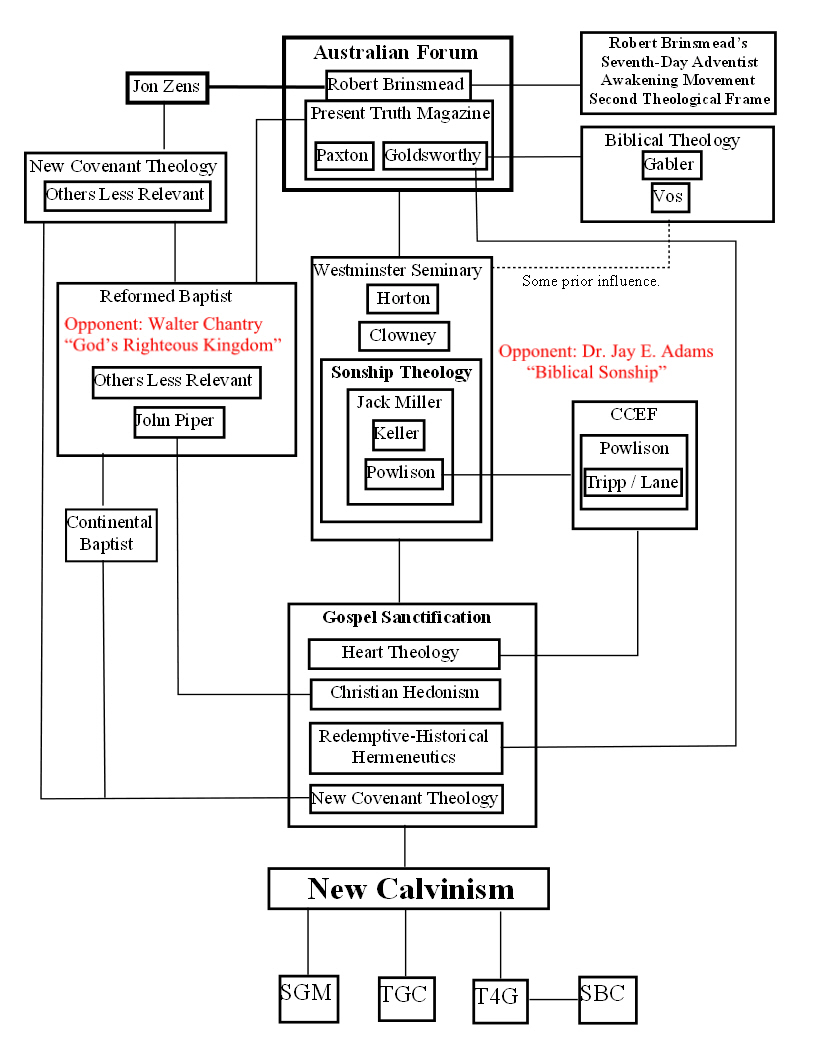
I further apologize that I got that idea because of the following: according to at least one author, much of Horton’s theological thinking and ministry philosophy was formed by the Australian Forum. In a particular article written by the Forum, Goeffrey Paxton states, “It [the new birth] robs Christ of His glory by putting the Spirit’s work in the believer above and therefore against what Christ has done for the believer in His doing and dying.” I found this comparison when one of my readers flippantly commented that he wondered if Horton got one of his favorite jingles, “Christ’s doing and dying” from the Forum. For giggles, I looked into it and was shocked to find the latter quote from the Forum. The quote comes from an article written by the Forum entitled “The False Gospel of the New Birth.” I suppose drawing any conclusions from such a title is presumptuous. Furthermore, Goldsworthy prefaced Paxton’s article with a footnote to make his point clear concerning this statement in Obituary for the Old Testament (G. Goldsworthy, PT vol.41 article2): “And the new-birth oriented ‘Jesus-in-my-heart’ gospel of evangelicals has destroyed the Old Testament just as effectively as has nineteenth-century liberalism.”
Notice, I repeat, notice how all three quotes frame any emphasis on the new birth as another gospel: “Is the ‘Good News’ no longer….but [rather] our….” “….by putting the Spirit’s work in the believer above and therefore against….” “And the new-birth oriented ‘Jesus-in-my-heart’ gospel [emphasis mine]….”
Moreover, Horton said this in Christless Christianity, page 62:
“Where we land on these issues is perhaps the most significant factor in how we approach our own faith and practice and communicate it to the world. If not only the unregenerate but the regenerate are always dependent at every moment on the free grace of God disclosed in the gospel, then nothing can raise those who are spiritually dead or continually give life to Christ’s flock but the Spirit working through the gospel. When this happens (not just once, but every time we encounter the gospel afresh), the Spirit progressively transforms us into Christ’s image. Start with Christ (that is, the gospel) and you get sanctification in the bargain; begin with Christ and move on to something else, and you lose both.”
Once again, pardon me for concluding from statements like this that Horton sees no difference between the spiritual condition of the saved /unsaved, and their equal need for the gospel of justification only. And even though the consequences of “move[ing] on to something else” is the loss of justification (ie., your lost), he doesn’t qualify what “something else” is. In my first part, if you observe my citation of Tullian Tchividjian, his “something else” is “deeper theological waters.” Am I the only one who has a problem with this? Also, spare me the Horton quotes where he appears to emphasize obedience. Horton believes, like many New Calvinist, that biblical imperatives are meant to “drive us to despair of self righteousness” so that we will gain a deeper understanding of our need for justification—in contrast to new creatures who find joy in obedience (though joy does not walk with obedience at every moment) as they are aided by the “Helper” (ESV John 14:15-17).
Throughout his post A-OK employs the New Calvinist protocol to deflect accountability for any particular belief; “One final observation to make before I close is that Dohse appears to be completely unaware of the fact that a very substantive discussion, including a good bit of back-and-forth disagreement, has been going on right in the center of the NC for some time now over the very question of sanctification and how the gospel and our own personal efforts are related to it. Justin Taylor provided a roundup of that discussion here. A quick perusal of that conversation will reveal quite clearly that there is no official New Calvinist position on the question, as Dohse implies. It is an ongoing conversation with significant areas of disagreement within the movement.”
In case, after case, after case, after case, those who confront elders about what is being taught in their churches, and trying to get to the bottom of it, hear this: “Well, all of the elders do not agree on that point.” This is a classic method implemented by cults to avoid coming clean about what they believe until the sheep are “ready to receive it.” And in fact, I will be discussing in one of the next parts how New Calvinism nurtures a cult-like atmosphere in churches since A-OK brought the “cult” angle into the discussion.
However, A-OK does clarify his own position; I think, anyway. After implementing the aforementioned deflection technique cited in another part of his post, He states:
“In my own practice, I often speak of myself as totally depraved, but what I mean by that is, considered apart from the grace of Christ, I am totally depraved in and of myself. It is a conceptual category that enables me to speak of myself from a certain perspective, not a theological statement about the inefficacy of regeneration to give me spiritual life. Again, this way of speaking likewise goes at least back to Luther.”
Here, we can see exactly what New Calvinist really believe about the new birth. First, why would it ever be necessary to speak of a Christian as totally depraved in any context? It goes without saying that if Christ does not indwell us we are not spiritually alive. So why frame anything that way unless you’re talking about BC/AC? And if that is what he is talking about in the above statement, he certainly doesn’t say so. I mean really: “Hey guys, did you know that if Christ didn’t indwell us we would be totally depraved?” Well, duh.
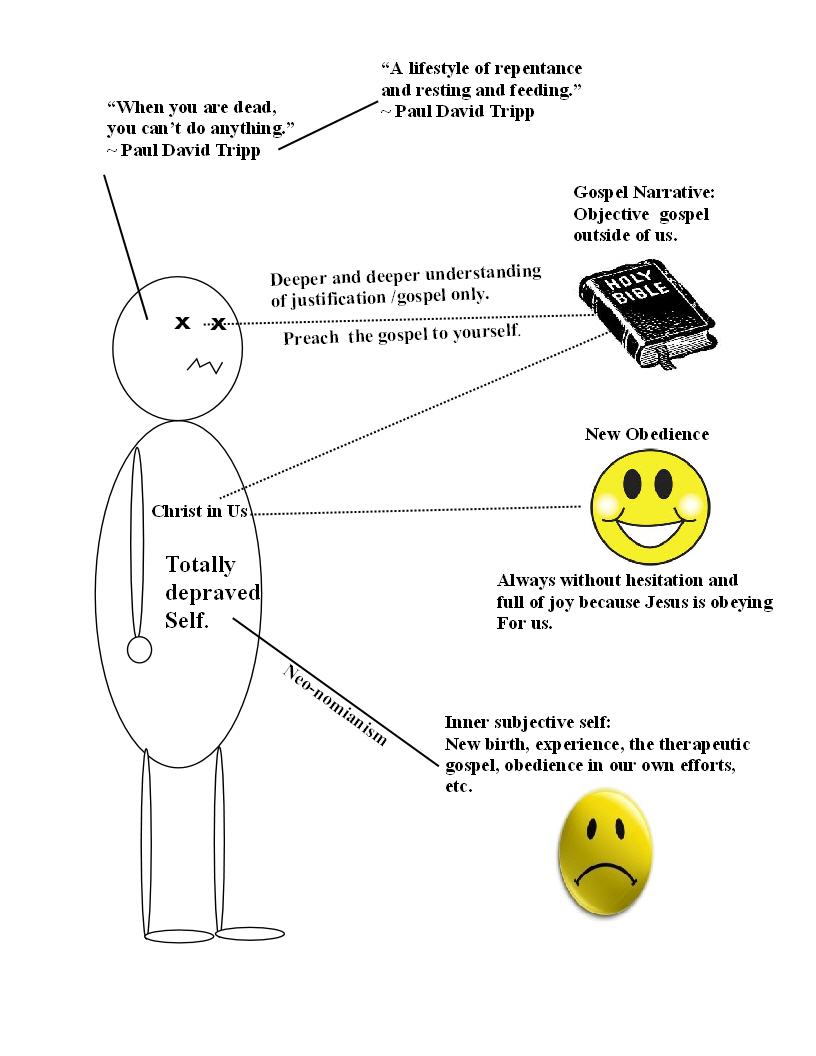
The key to understanding what A-OK is saying is the notation of these two phrases: “I am totally depraved in and of myself (present tense is assumed; ‘I am’)” and “….not a theological statement about the inefficacy of regeneration to give me spiritual life.” This concept was articulated by New Calvinist Paul David Tripp in How People Change. Throughout the book, Tripp refers to the “living Christ” over, and over again as if we didn’t know that Christ is alive. Then on pages 64, and 65 (2006 edition) he plainly states that Christians are spiritually dead, writing, “When you are dead you can’t do anything.” Simply stated, we are still spiritually dead and the living Christ within us obeys for us. This is also strongly implied by how many New Calvinists treat Galatians 2:20. We are not actually new creatures per se, but the only thing within us that is alive is Christ through the Holy Spirit. Before you reject this notion out of hand (though you must admit that it can be seen in Aaron’s careful wording), read Donn Arms’ book review on How People Change here: http://www.nouthetic.org/blog/?p=4793 Or here: http://wp.me/pmd7S-EC .
As Christians, if we are, as Dr. O’Kelly writes, “….totally depraved in and of myself,” how can the Holy Spirit be our “Helper.” What’s a helper? There is no helping the dead, the Holy Spirit would have to do all the work. And trust me, that’s what they really believe. Yet, not only did Christ say, “You must be born again,” the apostle Paul said, “Behold, all things are new.” New for whom? The Holy Spirit certainly doesn’t need anything new. The apostle also said to put off the old man (some translations, “former”) and put on the new creation. Does the Holy Spirit need to put anything new on Himself? I think not.
The implications here are profound. And frankly, I do not give a rat’s behind about disagreements between New Calvinist hacks. At the very least, their position is unclear—that’s on them. Moreover, again, where did Luther ever write: “We must preach the gospel to ourselves everyday”? And if he did, so what? The Bereans didn’t give the apostle Paul a pass on truth; and trust me, Luther was no apostle Paul.
paul

Brinsmead’s Second “Awakening” Framework is the Foundation of New Calvinism
 I recently read an article written by Martin L. Carey entitled, “Judged by the Gospel: The Progression of Brinsmead’s Awakening.” Carey was the son of Iris Carey, a staunch follower of Brinsmead during the Awakening movement of which he was the central figure.
According to Carey, this was no small movement within Adventist circles:
“For three decades, the ‘Brinsmead Agitation’ challenged Adventist leadership on several continents. During the years I was growing up, the conflict over his teachings became so intense that showing any agreement with Brinsmead’s heresy could get one expelled—and this I saw firsthand. Many pastors lost their jobs or left the ministry voluntarily because they espoused Brinsmead’s theology. For his followers, even mentioning the name of Brinsmead could put one’s membership at risk. Moreover, much Adventist literature published in the 1970’s was aimed at correcting Brinsmead’s influence.”
Carey does a good job of explaining Adventist doctrine and how Brinsmead interacted with it, but let me give you the short version: In justification, all of a saint’s past sins are forgiven, but then Christians have to work for moral perfection to be completely justified at the judgment. The first theological framework that laid the foundation for Brinsmead’s Awakening movement was borrowed from protestant beliefs; specifically, that we stand in the judgment clothed in Christ’s righteousness, not our own. This is what makes us fit for the judgment. Carey further explains:
“This was the original ‘Awakening Message.’ For many Adventists who had lived in dread of God’s judgment, this was good news. As Brinsmead later described,
‘…it was the most sweet and joyful news that many had ever heard. Neither time nor circumstances…can efface the memory of souls weeping for joy at the simple revelation that Christ is our righteousness in judgment’(Review of Awakening, Pt. 1).
Brinsmead decided to leave Avondale in 1958 to speak independently and to publish. His following soon became a significant movement in Australia. By 1960, they called themselves the ‘Sanctuary Awakening Fellowship.’ Even though the Australian Adventist leadership strenuously opposed the Awakening, the movement spread. Inevitably, on December 19, 1960, the Awakening message came to America, and the General Conference had no idea what was about to hit them.”
This is when Carey’s mother began to follow Brinsmead:
“In 1961, a young mother of three named Iris Carey was among those who heard and ‘wept for joy.’ She lived a few blocks from the Review and Herald building in Tacoma Park, and she began excitedly and widely circulating Brinsmead sermon tapes. Some caught that excitement, others strongly resisted. (Indifference was not a typical Adventist reaction to Brinsmead.) Meanwhile, for the three of us who were kids of Iris Carey, tension with our church and the world was a constant reality. In spite of its polarizing message and charismatic leader, the Awakening movement never tried to be a separate denomination. Indeed, Brinsmead’s purpose was not to destroy Adventism but to restore it to its original judgment day urgency [due to the fact that many knew in their heart that they could not obtain perfection on their own and preferred not to discuss it while playing along with a token recognition of the doctrine]. In the 1960’s, most Awakeners, as we called ourselves, remained members of Adventist churches—that is, as long as they would have us…. Iris was expelled from several churches for giving out Brinsmead literature and for holding unauthorized Bible studies. For her, this persecution confirmed the prophetic status of the Awakening message, and throughout the movement it unified Awakeners into a distinct Adventist subculture.”
Then Carey explains the following:
“The resulting abundance of literature and tapes galvanized our movement’s mission and kept it moving. Additionally, Bob Brinsmead was constantly adjusting his message. Whenever Awakeners would meet they would ask one another, ‘Have you heard the latest?’ We always looked for the next church-shaking new emphasis. Brinsmead had a genius for building elaborate theological structures, getting everyone excited, then tearing them down for a ‘new framework.’ He often said, ‘Like Abraham, Isaac, and Jacob, I keep moving my tent in faith.’ There was no resting for the devoted Awakener following Brinsmead’s mercurial leading.”
The second theological framework Brinsmead developed before he abandoned the Awakening movement lives on today in the form of New Calvinism. The doctrine was developed when Brinsmead began researching the Reformers:
“In 1971, Brinsmead scheduled a flurry of summer institutes to bring us his latest emphasis. There was more excitement than usual; the latest round of tapes had prepared us for something big. Bob had been studying the Reformation doctrine of justification by faith, comparing it to Roman Catholic doctrines. Reading Luther, he saw [supposedly] that justification is not just a means to the end of perfect sanctification. When we are justified by faith, not only does God impute Christ’s righteousness to us but we also possess Christ Himself—all His righteousness and all His perfection. Eternity flows from that fact. The apostle said,
‘And those whom he predestined he also called, and those whom he called he also justified, and those whom he justified he also glorified’ (Rom. 8:30).
The same ones he justified he also glorified. We began to realize we had inserted extra steps into Paul’s chain of salvation: sanctification and a final atonement brought about by blotting out sins. Those added steps, in fact, were the heart of the Awakening message—but we had ignored the heart of the real gospel: being justified by faith, we ‘rejoice in hope of the glory of God.’ Our righteousness is in heaven, said Brinsmead:
‘The righteousness by which we become just in God’s sight, remain just in His sight and will one day be sealed as forever just in His sight, is an outside righteousness. It is not on earth, but only in heaven…only in Jesus Christ.”
Brinsmead’s theological frame eliminated the extra “step” of sanctification from the gospel. Not only that, the gospel was completely objective and an “outside righteousness. It is not on earth, but only in heaven…only in Jesus Christ.” So, the believer does not (supposedly) experience a righteousness that he possesses through the new birth, in Brinsmead’s second frame, that’s “subjective”:
“True sanctification looks away from self and flows from the finished, objective work of Christ…. For many Christians, the glory of the crucified Christ is not their focus; instead they seek internal experiences that eclipse the cross. The Awakening rightly opposed the subjective, human-centered emphasis found among some groups within Christianity. Wrongly, they reacted with a cerebral, spiritless gospel. Brinsmead strongly opposed the charismatic movement’s emphasis on experiences as a return to the theology of Rome. However, going to another extreme, Present Truth magazine decried ‘the false gospel of the new birth,’ and offered a new birth that was merely a corporate, objective blessing, not an individual experience.”
Though mainline Adventist were at the other extreme, propagating a justification that you had to keep on your own, they rightly complained that Brinsmead’s new frame was a “justification-centered gospel” that “encouraged spiritual laziness.” During that time, the project that was solidifying this doctrine into a “consistent” theological framework was the Australian Forum. Their doctrinal publication was Plain Truth magazine mentioned by Carey. The primary Australian three were Brinsmead, Geoffrey Paxton, and Graeme Goldsworthy. The writings of Graeme Goldsworthy are a mainstay of contemporary New Calvinism, especially the “Goldsworthy Trilogy.” This “justification-centered gospel” can be seen among many New Calvinists like CJ Mahaney who continually claim that the gospel can be defined by five words: “Christ died for our sins.” Like the Australian Forum, New Calvinists believe that all of life flows from objective justification and deny the new birth as a subjective truth that is not relevant to the more important matter of the gospel. This regardless of the fact that Christ said, “You must be born again.” Hence, Sonship Theology, which is based on the centrality of the objective gospel and helped give birth to New Calvinism, propagates a total depravity of the saints. Well known New Calvinists David Powlison and Tim Keller were forefathers of that movement.
That’s pretty much the smoking gun: the hallmark of Brinsmead’s centrality of the objective gospel necessitates the denial of the new birth, and central figures of the New Calvinist movement clearly deny the new birth accordingly; for example, Graeme Goldsworthy and Michael Horton. Goldsworthy said this in an article he wrote in Plain Truth Magazine: “And the new-birth oriented ‘Jesus-in-my-heart’ gospel of evangelicals has destroyed the Old Testament just as effectively as nineteenth-century liberalism” (Obituary for the Old Testament Vol. 41-Article 2). Goldsworthy footnoted this statement by referencing an article by Paxton entitled “The False Gospel of the New Birth” (Present Truth Vol. 7 Article 3 June 1978 ps. 17-22). In that article, Paxton made the following statement: “It robs Christ of His glory by putting the Spirit’s work in the believer above and therefore against what Christ has done for the believer in His doing and dying.”
Compare that with what Michael Horton wrote in Receiving Christ (from his out of print book In the Face of God): “Is the ‘Good News’ no longer Christ’s doing and dying, but our own ‘Spirit-filled” life?’”
New Calvinists who do not plainly deny the new birth do so practically by advocating the total depravity of the saints and the idea that Christians are spiritually dead. Paul David Tripp states plainly that Christians are still spiritually dead on pages 64 and 65 of the 2006 printing of “How People Change.” Concerning a video that is a satire on total depravity entitled “John Piper is Bad,” Piper concurred in an interview that the point of the video was theologically true, Christians are still “bad” in regard to our behavior.
paul

 Paul's Passing Thoughts


4 comments