The New Calvinist Mega-Lie: Obedience and Truth are Separate
 “Therefore, Christians don’t obey for the purpose of maintaining our just standard; it is a finished work by Christ that needs no further maintenance. We obey for other reasons….”
Have you ever noticed? The Scriptures NEVER call “obedience” works salvation. We are never told that people are trying to earn their way into heaven through “obedience.” Obedience, in the Scriptures, is ALWAYS associated with the truthful application of God’s word to our lives in how we think and what we do. It is the truthful application of our role in sanctification which is putting off the old self and putting on the new creature (Ephesians 4:20-24). In the Scriptures, truth is always assumed in obedience.
This is New Calvinism’s greatest deception, the idea that one can sincerely seek to apply God’s word to their lives in a truthful way, and at the same time do so to maintain a just standing before God without realizing they are doing so. This invokes a dependance on them, a don’t try sanctification at home mentality. Though they claim that obedience is motivated by fear within the evangelical community, their sanctification formula propagates an unfounded fear that obedience is nothing more than works salvation, in and of itself. The fact of the matter is that works salvation is always based on falsehood.
Unlike the Bible, New Calvinists don’t associate obedience with truth, a love for the truth, and faith. They separate the two, specifically by separating “law” and “gospel.” Law is obedience, whether practiced in truth or not, and gospel is truth. There are many examples of this, but here is the best one I have seen of late:
This is fundamentally no different than Islam! The Gospel offers us freedom from our sin-stained hearts and our obedience-stained garments and bids us rest in the finished work of Christ which is better than us being better!!!” (Jean F. Larroux, III, Green Grass of Grace Southwood blog).
Notice: obedience is obedience whether it is Christian or Islam. Truth isn’t the issue. But the apostle Paul clearly unites the two:
They have become callous and have given themselves up to sensuality, greedy to practice every kind of impurity. But that is not the way you learned Christ!—assuming that you have heard about him and were taught in him, as the truth is in Jesus, to put off your old self, which belongs to your former manner of life and is corrupt through deceitful desires, and to be renewed in the spirit of your minds, and to put on the new self, created after the likeness of God in true righteousness and holiness (Ephesians 4:19-24).
Obviously, Paul is calling on Christians to learn truth, and put off what we learn to put off, and put on what we learn that is to be put on. The Bible calls this “obedience” when it is done as biblically prescribed. If I tell my son to take the trash out to the curb, but instead he leaves it halfway down the driveway, that’s not obedience. Unless you’re a New Calvinist. With them, truthful obedience is neither here nor there because it is impossible for Christians to accomplish anyway:
The bad news is far worse than making mistakes or failing to live up to the legalistic standards of fundamentalism. It is that the best efforts of the best Christians, on the best days, in the best frame of heart and mind, with the best motives fall short of the true righteousness and holiness that God requires [notice that there is no distinction between this sentence and the one prior (legalistic standards verses true righteousness)]. Our best efforts cannot satisfy God’s justice. Yet the good news is that God has satisfied his own justice and reconciled us to himself through the life, death, and resurrection of his Son. God’s holy law can no longer condemn us because we are in Christ (Michael Horton, Christless Christianity p. 91).
It is also extremely important here to notice the crux of New Calvinist error in this statement; specifically, the supposed need to maintain justification: “….the best motives fall short of the true righteousness and holiness that God requires…. Our best efforts cannot satisfy God’s justice.” But in sanctification, God no longer requires a just standard to maintain salvation, that has already been accomplished as a finished work. God no longer “requires” perfection that maintains our just standing. Therefore, Christians don’t obey for the purpose of maintaining our just standard/standing; it is a finished work by Christ that needs no further maintenance. We obey for other reasons—to glorify God, to experience the reality of our new birth, to show others the abundant life, and to destroy evil works, to name just a few. And also, our God-given love for the truth compels us to apply it to our lives.
Therefore, New Calvinism fuses what shouldn’t be fused and separates what shouldn’t be separated, turning orthodoxy completely upside down. They fuse justification and sanctification, and separate obedience from truth, while fictitiously calling obedience “law” (whether Christian or Islamic), and encapsulating truth in the “gospel” which is supposedly distinct from “law.” But what would we know about the gospel apart from Scripture? Christ said man lives by every word that comes from the mouth of God. Wouldn’t that include the law? Paul told Timothy that we are fully equipped for every good work by ALL Scripture. Wouldn’t that also include the law?
This fusing of what shouldn’t be fused and separating what shouldn’t be separated is the basis of their Gospel Contemplationism. Law (any effort to obey, whether according to the truth or not) is separate from gospel and impossible for us to obey perfectly in order to maintain a salvation that doesn’t need to be maintained to begin with. The formula? Contemplation on the truth that results in a “Christ formation” within totally depraved, dead jars of clay. Doubt that? reread Larroux’s quote; our hearts are sin stained as well as any obedience we may perform.
The truth: we are declared righteous and are righteous, though hindered by the flesh. Though our striving falls short of perfection, we know that can’t affect our righteous standing that has already been declared based on the finished work of Christ. And that cannot be revoked. As we strive, we also long for the day when we can obey our Lord perfectly without hindrance. So like Paul, we cry out, “who will deliver me from this body of death?”
Our striving creates that thirst, experiencing both the blessings of that truth and the failures that prevent the full experience. Peter states clearly that we are to strive for a “rich entry,“ not the beggarly entry that comes from let go and let God theology.
paul
The New Calvinist Takeover of Southwood Presbyterian Church: Part 19; Bachman – Turner Overdrive
Cruising down the highway as a young man, I was feeling pretty good listening to my rock music on the awesome new technology that replaced 8-track tapes, cassettes. One of my preferred bands was Bachman-Turner Overdrive, and one of my favorite songs was “Taking Care Of Business.” Sure, I knew a particular statement in the lyrics made no sense at all; “We love to work at nothing all day,” but I really dug the song man, and at that time of my life, trust me, the tune was way more important than the truth.
Since I have been studying New Calvinism for nearly five years now, that song has constantly been triggered in my mind. As I was perusing Southwood’s blog this morning, stopping to read “Green Grass of Grace,” by Jean (pronounced “ Jon”) F. Larroux (don’t forget: “The Third” hereafter; “JL3”), I observed the opening sentence: “Grace is difficult. It is harder than trying harder.” Then it happened in my head:
“People see you having fun
Just a-lying in the sun
Tell them that you like it this way
It’s the work that we avoid
And we’re all self-employed
We love to work at nothing all day
And we be…
Taking care of business every day
Taking care of business every way
I’ve been taking care of business, it’s all mine
Taking care of business and working overtime.”
In another post, JL3 said, “I’m not arguing for NO EFFORT or WORK I am arguing for GREATER EFFORT and MORE DIFFICULT WORK, the work of humbling ourselves, being broken, repentant, prostrate before God, looking past our ‘symptomatic sins’ to their root causes and being faced with such horror over my depravity that I am left with no other options than Jesus” (not sure, but I think the comment was pulled down).
Tullian Tchividjian, JL3’s obvious mentor stated it this way in “The Tyranny of Accountability Groups”:
The bottom line is this, Christian: because of Christ’s work on your behalf, God does not dwell on your sin the way you do. So relax and rejoice…and you’ll actually start to get better. The irony, of course, is that it’s only when we stop obsessing over our own need to be holy and focus instead on the beauty of Christ’s holiness that we actually become more holy! Not to mention, we start to become a lot easier to live with!
Oh really? I would think that people who focus on Matthew 7:24 with the result of their life being built on a rock would be the ones easier to get along with. And of course, I am constantly told by New Calvinist hacks that for me to say that these kinds of statements insinuate that Jesus obeys for is “reading into their statements.” Whatever. We see four things in Tchividjian’s statement: 1; Christ has done the work of sanctification on our behalf (ie., sanctification’s work was part of the atonement). 2; Doing less results in being “better,” productivity for the sake of the kingdom is conspicuously absent—per the usual. 3; Holiness comes by focusing on Christ’s holiness and not our own, resulting in more holiness. And I am often accused of “reading things into their statements” regarding the “Gospel Contemplationism” charge. Again, whatever. 4; The either/or communication technique, It’s either Christ’s holiness or our holiness, it can’t be both.
JL3 continues:
We are allergic to resting in the finished work of Christ and the hardest ‘trophy’ to lay down is that trophy of obedience I have been working for my whole life. To make the shift from an life driven by fear to a life motivated by love is very, very painful.
Notice that the finished work of Christ pertains to both justification and sanctification. Accuse me of reading into to this if you will, but what else can be surmised? Also, we gain see the either/or hermeneutic: we are either motivated by love or fear, it can’t be something else—it’s either/or. But the contradictions in JL3’s posts are too massive to document; for example, the Scriptures are clear that at times, God does motivate us by fear. Like all New Calvinists, JL3 validates love as something that is always (as stated by, of all people, John MacArthur) “always sweet, never bitter-sweet.” This removes the self-sacrifice aspect of love through obedience. And it brings us back to Bachman-Turner Overdrive theology as well: they only worked hard at what they loved, which was doing nothing.
Most of us have obeyed because of fear of reprisal from God. To know that we are loved apart from our obedience or disobedience is a truth that is elusive. This is why it must be pounded into our souls week after week.
This is a bunch of boloney, and notice JL3’s New Calvinist us against them mentality. “Most” obey from fear? Anybody who does counseling knows that isn’t true—fear of God is never been more lacking in recent church history.
We have purposed to drive deep into those fields ripe with the green grass of the grace of God, not into the rocky crags of fundamentalism, legalism and pietism hoping that some nourishing shoot of grace will emerge every now and again. The sheep cannot be sustained on a sparse diet of occasional grace.
Either/or: it’s either grace, or rocky crags. Nuff said, like all New Calvinists, his whole realm of speech is fraught with deceptive communication techniques.
Everything in Christendom tells them to weave for themselves garments of obedience and performance to wear before the Great White Throne of Judgment as ‘jewels in their crown.’
This hearkens back to JL3’s ancestors of the Australian Forum (the cradle of New Calvinism) who mixed Reformed teachings with SDA investigative judgment theology. Christians fear no future judgment concerning our righteousness—the righteousness of God has already been accredited to our account in full.
This is fundamentally no different than Islam! The Gospel offers us freedom from our sin-stained hearts and our obedience-stained garments and bids us rest in the finished work of Christ which is better than us being better!!!’
So, obedience in Islam is no different than obedience in Christianity? Sure it is. Christian obedience is based on T-R-U-T-H. The fundamental difference between Christianity and all other religions is our God given love for truth (2Thess. 2:10), which translates into applying it to our life. Hence, “If you love me, keep my commandments.” You can’t separate love for the truth from wanting to learn more about it, and then making it part of you. We are promised blessings if we do that (James 1:25).
JL3’s New Calvinistic teachings also has another tone shared by Bachman-Turner theology: the song demeaned people who supposedly wasted their life by doing things they didn’t like to do. New Calvinists often refer to our striving to obey as “rats on a treadmill” etc. Like MacArthur, we are told by JL3 that we should strive for a life that is “sweet, never bittersweet.” The fact is rather this: in pursuing truth, it will often collide with life, and other times it will bring joy. But when the experience is “bittersweet,” that’s not works salvation, it’s called “self-sacrifice.”
The apostle John reminded us that the Lord’s commands are not “burdensome.” We need to be reminded of this, because his commands are truth, and we love the truth. Sometimes the truth is hard, and it calls for us to reject the tune in exchange for the truth. Whatever the tune may be, whether, “resting is better than being better,” or a “love to work at nothing all day.”
paul
The New Calvinist Takeover of Southwood Presbyterian Church: Part 18; Comment From Part 17 Reflects New Calvinist Doctrine
Still working on videos. Writing is easier.
The New Calvinist Takeover of Southwood Presbyterian Church: Part 2; Southwood’s Future Family Tree?
Here We Go Again: The New Calvinist Takeover of Southwood Presbyterian Church; Part 1
“This issue couldn’t be clearer; there are two gospels among us, and New Calvinist David Powlison plainly said so accordingly. He even admitted that the notable Jay Adams doesn’t agree with his gospel. This should incite serious questions among God’s people….Southwood must choose their gospel and stand for it. What else is there?”
It plays out daily in the American church from coast to coast:
Therefore, the pattern is the same: new pastors assume leadership in a church that doesn’t know what New Calvinism is, and the church takes it for granted that their theology is orthodox. Then once in, they replace present leadership with those of like mind, and begin to make vast and rapid changes because they see that church as a bastion of falsehood that has sent many to hell. Then, dissenters are mercilessly mowed down and muzzled, usually via church discipline. In most cases, the dissenters don’t have a full understanding of what they are dealing with, they just know something isn’t right (The Truth About New Calvinism [TTANC] p. 134).
I don’t know any inside details concerning the present controversy at Southwood Presbyterian Church in Huntsville, Alabama. Some or all of the elements cited above from TTANC might be evident, but one thing is clear: a New Calvinist “pastor” recently assumed leadership, and the congregation has realized that he isn’t what he seemed to be. Less than a year after assuming leadership, we read the following on their website:
November 17, 2011
To the members & friends of Southwood Presbyterian Church,
Last evening the Session of Southwood Presbyterian Church met again to consider the matters before the church. After much prayer from both the members of the Session and members of the congregation the Lord provided a decision with no dissension or abstention. The UNANIMOUS motion reads as follows:
“With repentance and conviction over our own personal and corporate sin, particularly for having stirred dissension with a premature motion delivered after Monday night’s meeting, the Session has met and deliberated further on the issues before our church. Having considered the breadth of the situation and our unified desire for the peace and purity of the church, the Session does hereby revise the purpose of the called congregational meeting to begin addressing the myriad of issues brought before us, including Jean F. Larroux, III, but we are not recommending the dissolution of the pastoral relationship with him at this meeting. Furthermore, we are in need of, thankful for and desirous to have further prayer from the congregation in all our deliberations. Submitted by Bob Greenman, Clerk.”
The Session will meet again on Monday evening, November 21st and greatly desires your prayers and support for a continued spirit of unity and peace as we begin to make plans for addressing the myriad of issues before us. The called congregational meeting will be held on Sunday, December 4, 2011, in the sanctuary of Southwood Presbyterian Church commencing at 12:30pm.
God is at work. His Spirit is moving to bring forgiveness and healing. I personally urge you to work toward, pray for and labor after unity, charity and peace. Let your love be known among all men.
Yours and His,
Jean F. Larroux, III
Larroux is the pastor in question. A perusal of their website confirms that he is the epitome of New Calvinism. When the congregation brought him in to assume leadership, did they know what a New Calvinist is? No. Did Larroux know what a New Calvinist is? Yes. Did he know the congregation didn’t know what a New Calvinist is? Yes. Could I be wrong about these assumptions? I doubt it.
What Does Jean F. Larroux, III Represent?
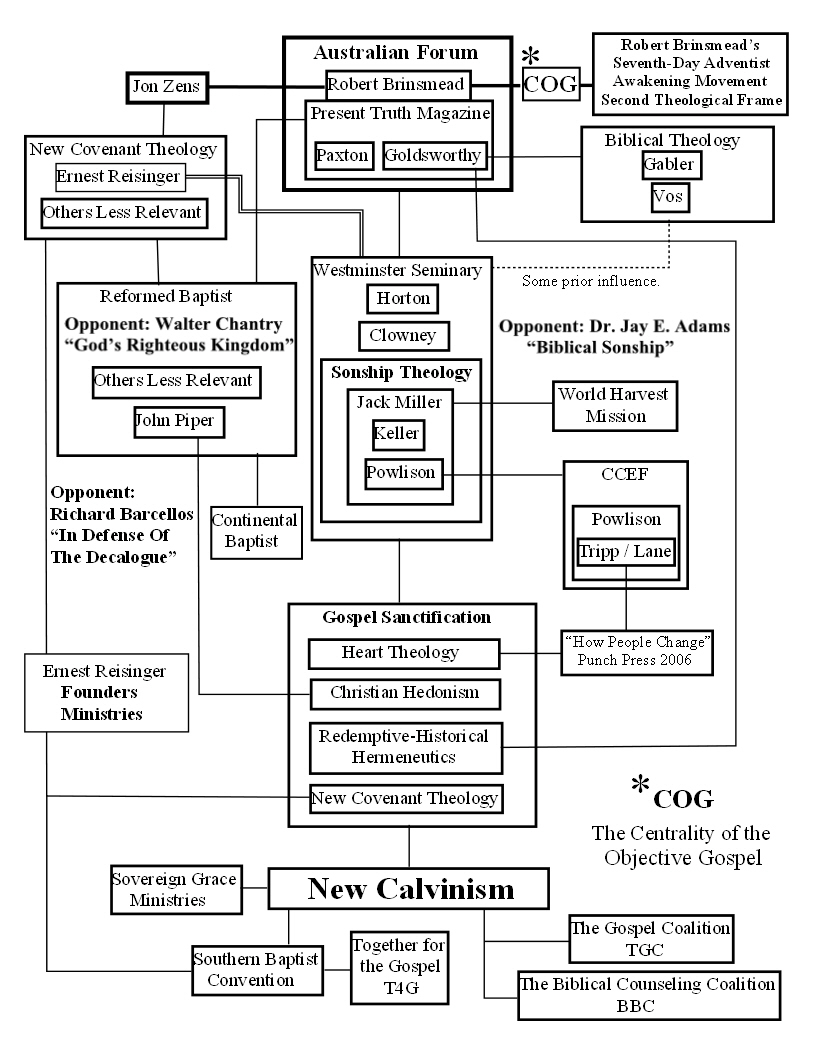
So what’s a New Calvinist? As we shall see, they are legends in their own minds. The movement originated in 1970 when a Seventh-day Adventist named Robert Brinsmead met an Anglican theologian named Geoffrey Paxton in Australia. Brinsmead was attempting to reform Adventism through his studies in Reformed doctrine. Together, they formed a theological think tank named the Australian Forum project. They were later joined by Graeme Goldsworthy who wrote the Goldsworthy Trilogy which is presently the New Calvinist standard for Bible interpretation (TTANC chapters 3 and 4).
The Forum’s magazine became the most widely publicized theological journal among English speaking people (one edition had over one million copies printed), and caught the attention of a Westminster graduate by the name of Jon Zens in the early 70’s. He joined the Forum’s efforts to formulate their central doctrine into a consistent systematic theology. Their primary doctrine that was the hub of everything they taught was called the centrality of the objective gospel (COG). The doctrine fused justification and sanctification together into a progressive justification that replaced sanctification. Zens helped to form a systematic theology that would attempt to make the issues of law and covenants fit with COG doctrine. Today, that doctrine is known as New Covenant Theology (TTANC chapter 5).
The Forum had vast influence at Westminster Seminary during the 70’s and early 80’s. A professor there by the name of Dr. John Miller adapted COG into a doctrine that emphasized more of a counseling model. He dubbed it “Sonship Theology.” His understudies were Tim Keller and David Powlison. Powlison used Sonship/COG to mold his Dynamics of Biblical Change which is the counseling model for Westminster’s CCEF. Two of Powlison’s understudies, Paul David Tripp and Timothy Lane, articulated the doctrine in How People Change, published by Punch Press in 2006. The book fits the Forum’s COG doctrine to a “T.” Donn Arms (M.Div.) of INS recently wrote an unfavorable review of the book and pointed out its disturbing elements.
However, the doctrine experienced a heavy pushback among Presbyterians in 1996-1999, so the Sonship name was dropped and replaced with “Gospel Transformation.” Jay Adams, who wrote a book in contention against the doctrine when it was known as Sonship, thought the doctrine had faded away. Under its stealth era between 2000 and 2008, the movement’s growth exploded. In 2004, a small group of protestants which included Jay Adams dubbed the movement “Gospel Sanctification.” Jay Adams has a GS archives on his blog and has written against it extensively. In 2008, the movement stumbled; it accepted the label “New Calvinism” which was coined by journalist Collin Hansen. New Calvinism is: COG, NCT, GS, and Sonship. It’s all the same doctrine
Visions of Grandeur
As stated in TTANC:
And New Calvinists are no exception, starting with their primary deception that must necessarily lead to arrogance. They believe they are a new Reformation and have the true gospel, and evangelicalism at large has been propagating a false gospel for the past 100 years. This line of thought and the specific differences in the two gospels can be seen in the following statement by New Calvinist Tullian Tchividjian:
“As I’ve said before, I once assumed (along with the vast majority of professing Christians) that the gospel was simply what non-Christians must believe in order to be saved, while afterward we advance to deeper theological waters. But I’ve come to realize that ‘the gospel isn’t the first step in a stairway of truths, but more like the hub in a wheel of truth.’ As Tim Keller explains it, the gospel isn’t simply the ABCs of Christianity, but the A-through-Z. The gospel doesn’t just ignite the Christian life; it’s the fuel that keeps Christians going every day. Once God rescues sinners, his plan isn’t to steer them beyond the gospel, but to move them more deeply into it. After all, the only antidote to sin is the gospel—and since Christians remain sinners even after they’re converted, the gospel must be the medicine a Christian takes every day. Since we never leave off sinning, we can never leave the gospel.”
Notice that Tchividjian refers to the other camp as the “vast majority” of other Christians who don’t believe in New Calvinism’s sanctification by justification gospel. The Major themes of a New Calvinist biannual convention, Together for the Gospel (T4G) have been “the unadjusted gospel” and “the underestimated gospel.” A popular phrase among them in the blogsphere has been the “scandalous gospel.” Regarding the thesis of this book, their gospel makes much of God and little of Man by reducing our role in God’s work to the least common denominator, but they have done that so well, that much is being made of the men who have done such a good job of making much of God. The four men who founded T4G, a Presbyterian, two Southern Baptists, and a Charismatic, have been dubbed the “core four” and have a cult following that approaches creepiness.
This whole Reformation motif was started by the Forum which taught that all doctrines either fall into the objective gospel or subjective experience. Subjective spirituality was supposedly spawned by Rome and resulted in a reversal of justification and sanctification. Therefore, the Reformers rediscovered the objective gospel which ignited the Reformation, and also taught that the job wasn’t done (semper reformanda), and you can imagine who contemporary New Calvinists think that duty has fallen to. This is all covered in chapter four along with documentation concerning the fact that John Piper, one of the “elder statesmen” of the New Calvinist movement agrees with that scenario. This us against them mentality was passed down from the Forum and blossoms in the movement to this very day. They are the children of the Reformers—we are Rome.
And this arrogance translates into a predominant characteristic of New Calvinism: heavy-handed leadership style. As far as New Calvinists are concerned, evangelicals have been leading people into hell for the past 100 years (their estimation of when semper reformanda was lost) and any interference with the “unadjusted gospel” will be dealt with—no holds barred. The weapon of choice is church discipline (pages 130, 131).
The Two Gospels of Our Day
There are two gospels afoot in our day, and those doctrines can be defined by the contention between two notable men:
The crux of the matter can be further ascertained from Powlison’s message at Piper’s church as mentioned before:
“ This might be quite a controversy, but I think it’s worth putting in. Adams had a tendency to make the cross be for conversion. And the Holy Spirit was for sanctification. And actually even came out and attacked my mentor, Jack Miller, my pastor that I’ve been speaking of through the day, for saying that Christians should preach the gospel to themselves. I think Jay was wrong on that.”
At the core of a longstanding contention between Jay Adams and the CCEF clan, and later NANC also because of CCEF influence, was disagreement on the gospel. The distinction cannot be clearer—Adams believes that the gospel is for salvation, and then we move on in making disciples by teaching them to observe the whole counsel of God. Powlison, according to Westminster’s version of the Forum’s centrality of the objective gospel which is Sonship Theology, believes the same gospel that saved us also sanctifies us. Powlison also mentioned the phrase that Miller coined that is the motto of contemporary New Calvinism: We must preach the gospel to ourselves every day (TTANC pages 81, 82).
What’s at Stake?
The truth and many other issues are at stake here, but one of the major concerns is the fact that New Calvinism has a tendency to create cult-like churches:
All this leads to many New Calvinist churches taking on cult-like tendencies. Exclusiveness (new Reformation), an attitude that some higher knowledge is a part of the movement that many are not “ready” for (the scandalous gospel), and a subjective view of Scripture (a gospel narrative, not instruction) is a mixture that will have bad results, and is the perfect formula for a cult-like church (TTANC p. 134).
And endnote 104:
Many New Calvinist churches fit all eight descriptive points published by cultwatch.com: 1. Deception 2. Exclusiveness 3. Intimidation 4. Love Bombing 5. Relationship Control 6. Information Control 7. Reporting Structure 8. Time Control (p. 145).
And Larroux is no exception. The Southwood website and blog is saturated with examples of how New Calvinists control parishioners with their doctrines of deep repentance and the total depravity of the saints. Donn Arms addresses these doctrines in some detail in his book review of How People Change. Frankly, Larroux’s writings on this site are so saturated with this doctrine—I don’t even know where to start. That’s why this post will be a series until their December meeting.
Unlike Coral Ridge, perhaps Southwood parishioners can at least know the details of why they are being ravaged rather than being led to the slaughter like oxen. I can at least do that for them. One can toss a dart onto the Southwood website and nail verbiage by Larroux that is designed to control and manipulate—it’s everywhere, whether putting God’s stamp of approval on everything he does or this: “Would you trust him to determine whether or not you were in sin EVEN IF you didn’t think you were?” Notice that the authority here is what an elder or someone else sees in your life and not Scripture. Sonshippers call this “speaking life into you,” a phrase that I saw being used on the site at least once by Larroux. I also noticed that those who questioned Larroux’s fitness to lead Southwood are the ones who are now repenting. This is typical. I warn the Southwood parishioners, I know of New Calvinist congregations that will barley even buy new cloths without consulting with the elders first.
Southwood Must Choose a Gospel and Contend for It
It is evident, based on what I have read on their blog, that Larroux is controlling the agenda in this situation:
God is at work. His Spirit is moving to bring forgiveness and healing. I personally urge you to work toward, pray for and labor after unity, charity and peace. Let your love be known among all men.
Oh really? Per the usual, New Calvinist “pastors” have a direct line to God’s throne. Southwood better wise-up, this isn’t a time for peace and unity at Southwood, this is a time to earnestly contend for the faith once delivered to the saints. This is like one of the seven letters; if anything, Christ has something against Southwood because they are tolerating false doctrine.
This issue couldn’t be clearer; there are two gospels among us, and New Calvinist David Powlison plainly said so accordingly. He even admitted that the notable Jay Adams doesn’t agree with his gospel. This should incite serious questions among God’s people. Between Jean F. Larroux, III and Jay Adams, I can tell you where I would put my money; that’s a no-brainer. Southwood must choose their gospel and stand for it. What else is there?
paul

 Paul's Passing Thoughts
55 comments