TANC Online Newsletter: March 2012

The Doctrine of New Calvinism is Gospel Sanctification
 Sanctification is a critical issue. We will run the race well or we won’t and it matters to God (Acts 20:24, 1Cor 9:24, Gal 2:2, Gal 5:7, 2Tim 4:7, Heb 12:1). He saved us for the purpose of running the race of sanctification to please Him: “So we make it our goal to please him, whether we are at home in the body or away from it” (2 Cor 5:9). “He who does what is sinful is of the devil, because the devil has been sinning from the beginning. The reason the Son of God appeared was to destroy the devil’s work” (1 Jn 3:8). Gospel sanctification claims to be the only right way to run the race of sanctification, but is that really the case?
What is Gospel Sanctification?
First, let’s look at a traditional view of sanctification. The Scriptures make it clear that there is nothing we can do to save ourselves; it is a work of God alone. But once we are born again we are new creatures set apart and enabled by God to dependently work with him in the sanctification process. Sanctification is the spiritual growth process that takes place until God brings us home. Most evangelicals would agree with that definition. However, proponents of gospel sanctification would say: “No, no, no, God alone saved us but now you say we can work for our sanctification? The gospel saved us and it also must sanctify us, both are a work of God alone. We are saved by the gospel and sanctified by the gospel.” Hence the term gospel sanctification. As Jerry Bridges often says: “We must preach the gospel to ourselves every day.” Therefore, we are saved by the gospel and must live by the gospel every day (there is some element of truth to this; for instance, everyday repentance likens somewhat to our original repentance at salvation, but in fact, is not exactly the same [Jn 13:10]). The next logical question is: how does that apply to our everyday walk with God? As a friend of mine often says, “Put feet on that.” Well, think salvation. The main key to gospel sanctification is that you couldn’t do anything to be saved and you therefore cannot do anything to be sanctified. Dana L. Stoddard, in his treatise on gospel sanctification in the Journal Of Biblical Counseling entitled, “The Daily Christian Life,” put it this way:
It is by virtue of Christ’s perfect life, death on the cross and resurrection-plus nothing-that we are justified (made and declared right with God) and sanctified (set apart, kept, and viewed as right in the Lord’s eyes by virtue of his obedience). Christ is our holiness. Christ is our sanctification.
Therefore, according to Stoddard in this article which is an excellent representation of the gospel-driven life, both justification and sanctification are brought about by the life and death of Christ “plus nothing.” Stoddard further drives this point home by quoting John Murray who calls this view definitive sanctification (sanctification by virtue of the indicative alone): “Being made and declared holy is a definitive act of God alone in Christ” (emphasis mine). Therefore, gospel sanctification by virtue of its definition alone is necessarily a passive approach to sanctification. It seeks to synthesize justification and sanctification as much as possible making everything a total work of God alone. Is it biblical? And if it isn’t, what are the ramifications?
But first, let me say that proponents of gospel sanctification would be very quick to answer a charge of let go and let God. Gospel sanctification does have a practical application. But again, it is necessarily limited by its passive definition and attempts to make sanctification as monergistic as justification (or otherwise as passive as possible). In other words, our contribution to the sanctification process is limited and narrow. Paul David Tripp, a propagator of gospel sanctification, even refers to biblical thinking as a, “technique that is not sufficient for real change.” For all practical purposes, he says in one of his books that 2 Corinthians 10:4-6 is unbiblical:
But this approach again omits the person and work of Christ as Savior, Instead, it reduces our relationship to Christ to think his thoughts and act the way Jesus would act (How People Change pg. 27).
When you warn readers that even our own efforts to change our thinking to the mind of Christ is a work that eclipses the person and work of Christ, that is excessively passive. Also, note that the crux of the matter in Tripp’s mind is “omitting the person and work of Christ as Savior” (emphasis mine). This is a very defining statement in regard to gospel sanctification; we can exclude Christ as Savior from the sanctification process. Any effort on our part, even an attempt to align our thinking with the mind of Christ is to exclude the person of Christ from the sanctification process. Proponents of gospel sanctification make no distinction between justification and sanctification; both are monergistic and obtained by the gospel. Of course, this approach would be a really hard sell to Christians at large if there was no real-life application. So then, what are the primary working dynamics of gospel sanctification, if any? In other words, is there a practical application? As one person asked me, “So what are we supposed to do?” (GS proponents often say that very question is indicative of a grave spiritual problem).
Deep Repentance
Remember, think gospel. What did you have to do to get saved? Believe and repent. The sanctification process is then no different. Daily repentance is the primary thrust of gospel sanctification because it is the lowest common denominator of passivity that proponents can come up with. Remember, we are dealing with a narrow concept, so whatever elements they have must be greatly embellished. So, we have deep repentance as opposed to regular everyday biblical repentance. This is a process in which the heart is emptied of any desire that exceeds our desire for Christ. This can be done through our recognition of daily sin but not stopping there, we must determine what desire led to the sin (good luck).
Theology of the Heart
This is the process that is used to determine the sinful desires of the heart (see “How People Change,” chapter 6). It involves a knowledge of how the heart supposedly works in the milieu of life and often explained through visual charts. Besides outward sin and response to circumstances, desires can be evaluated by asking ourselves x-ray questions. Paul Tripp supplies a list of thirty-four with two or three phrases in each that ask additional questions in each separate question on page 163 of “HPC” for a total of about 100. The most popular one that you will hear often is: “What did you want?” Imagining possible future circumstances of life and thinking about how we might respond while asking ourselves the right x-ray questions is yet another way to determine desires of the heart that cause sin. We empty our heart of idols that distort our desires by confessing them daily, and then Christ fills our hearts with himself resulting in an effortless flow of obedience. Supposedly.
Belief and Identity
Once we have emptied our heart of idols, we then “rest and feed” on the living Christ who then fills our heart with Himself, replacing the idols of the heart (idols that create desires that exceed a desire for Christ, “HPC” pg. 28). We also focus and learn about who we are, and what we have in Christ to fill the void left by the eradication of sinful desires / idols effected by deep repentance.
New Obedience
The result of this process is new obedience. Or as Tripp explains it in “HPC”: “New and Surprising Fruit” (chap. 14). Or as others explain it, obedience is always a “mere natural flow” (The Imperative Command is Grounded in the Indicative Event, “Vossed World” blog). In other words, we are walking along and holy fruit just starts popping up everywhere without any effort and to our surprise. However, Philippians 2:8 says Christ was obedient to the cross. Now go to Matthew 26:36-46 and read about the struggle Christ experienced as he faced the cross. Hebrews 12:3,4 says: “Consider him who endured such opposition from sinful men, so that you will not grow weary and lose heart. In your struggle against sin, you have not yet resisted to the point of shedding your blood.”
Nevertheless, according to proponents of gospel sanctification, Christ died to pay the penalty for our sins and justify us before God, but also lived an obedient life in order to obey for us as well (remember what Stoddard said about us being justified and sanctified by the “life” and “death” of Christ with His active obedience being imputed to us, not just righteousness). To accept anything less is to exclude the person of Christ from the gospel, so they say. Some call this belief monergistic substitutionary sanctification. Christ was not only a substitute for the penalty of sin; but was also, and presently is, a substitution for all our works in sanctification as well.
Joy
So how do we know when we are obeying God in our own efforts or when it is the work of Christ through us? Easy, our obedience is accompanied by joy and all willingness, that’s how we know according to proponents of the gospel-driven life. Joyless obedience is always in our own efforts and not pleasing to God. Please do not misunderstand me, I realize there is much obedience in the life of a believer accompanied by joy and complete willingness, but sometimes that joy comes as a result of the obedience at a later time. Knowing this often helps us to endure accordingly: “Let us fix our eyes on Jesus, the author and perfecter of our faith, who for the joy set before him endured the cross, scorning its shame, and sat down at the right hand of the throne of God” (Heb 12:2). Here I must pause and interject a very important note: Paul Tripp is the guru who has articulated the supposed practical application of the gospel-driven life via “How People Change.” John Piper is the guru who has articulated the experience of gospel sanctification via Christian hedonism and other such writings. Much of the theory in regard to how the gospel-driven life is experienced is through the writings of John Piper.
What does that look like?
This is a gospel sanctification (GS) buzz question / mantra that replaces “how do we do that?” How, is now the wrong question to ask because it indicates there is actually something we can do to participate in the sanctification process, a crime worthy of death. If you doubt the wide spread influence GS has today, take note of how often you hear that phrase. Even the terminology must be changed to discourage some kind of effort on our part in the sanctification process that might imply some verb to follow.
The GS Hermeneutic
But what about all of those pesky Bible verses that seem to contradict gospel sanctification’s passive approach? Like say for instance, 1 Corinthians 9:27; ”No, I beat my body and make it my slave so that after I have preached to others, I myself will not be disqualified for the prize.” No problem. GS has its own process for interpreting the Bible through the lens of a gospel perspective so everything comes out redemptive. It’s called the redemptive-historical hermeneutic, or the Christocentric hermeneutic, or the cross-centered hermeneutic; so you have the theology of GS doing the interpretation.
GS Characteristics
Gospel sanctification is well suited for American culture. It’s new, It’s easy, and claims to have a low failure rate. It also has a strong intimidation factor. To speak against GS is to be against Christ and his gospel. To be against GS is to propagate the “legalism” of self-discipline and hard work in the sanctification process. Worse yet, if you believe that obedience is an exercise of the will to please God, you are supposedly engaging in works salvation. First of all, any Christian knows that we cannot please God apart from His life giving Spirit, but neither are we merely potted plants in the process:
We sent Timothy, who is our brother and God’s fellow worker in spreading the gospel of Christ, to strengthen and encourage you in your faith (1 Thess 3:2, emphasis mine. Some translations: “coworker”). Do your best to present yourself to God as one approved, a workman who does not need to be ashamed and who correctly handles the word of truth (2 Tim 2:15, emphasis mine).
GS is destructive error for the following reasons:
It takes away from the word of God in regard to elements of biblical sanctification.
Our resources and guiding truth concerning sanctification in the Bible are many faceted and numerous. GS is a narrow approach that excludes or ignores key truths of sanctification such as satanic strategy and our battle with the flesh. According to GS proponents, these kinds of considerations, and many others distract us from “owning our own sin.” They say that the flesh is not our problem, the heart is the problem, the flesh is a realm. As only one example among many, most GS teachers do not see Satan as being in the loop of spiritual warfare, regardless of clear warnings from the Scriptures. This is no trite matter.
The following quote concerns John Piper’s Christian Hedonism which is the articulation of how gospel sanctification is experienced. But, the same concerns expressed by Dr. Masters below can also be applied to gospel sanctification as a whole. Gospel sanctification applies, and confines sanctification to the same elements of justification which are much fewer; namely, by faith alone.
But Dr. Piper’s formula for its use undoubtedly alters the understanding of sanctification long held by believers in the Reformation tradition, because it elevates one Christian duty above all others.
Delighting in God, we repeat, is made the organizing principle for every other spiritual experience and duty. It becomes the key formula for all spiritual vigor and development. Every other Christian duty is thought to depend on how well we obey this central duty of delighting in the Lord. The entire Christian life is simplified to rest upon a single quest, which is bound to distort one’s perception of the Christian life and how it must be lived. Whatever the strengths of Dr. Piper’s ministry, and there are many, his attempt to oversimplify biblical sanctification is doomed to failure.
Because the biblical method for sanctification and spiritual advance consists of a number of strands or pathways of action, and all must receive individual attention. As soon as you substitute a single ‘big idea’ or organizing principle, and bundle all the strands into one, you alter God’s design and method. Vital aspects of Truth and conduct will go by the board to receive little or no attention.
It denies specific biblical instruction.
GS denies that the Bible includes specific instruction. The hit list of GS includes: living by lists; do’s and don’ts; put off and put on; biblical thinking; discipline; and a traditional view of obedience among many others. Yet 2 Timothy 3:16 says: “All Scripture is God-breathed and is useful for teaching, rebuking, correcting and training in righteousness.”
It redefines obedience and the gospel.
It makes obedience in the sanctification process synonymous with works salvation. Therefore, it redefines Christ as a Lord that does not require obedience, and in fact, rejects it. Is it therefore a half gospel that presents Christ as Savior only? Yes.
It redefines spiritual warfare.
Gospel sanctification’s battleground location would suggest a totally different form of warfare as opposed to warfare with sin that abides in the flesh. For one thing, warfare with the flesh is much more defined as opposed to the subjective nature of what the Bible calls the heart. As a matter of fact, Jeremiah suggested that we cannot know the heart to begin with. These are two separate paths of sanctification. Saints would do well to choose their path carefully.
The church for the most part defines spiritual warfare as Scripture describes it, a warfare between our regenerate heart and the flesh. Disciplines that feed our spirit God’s pure milk and deprive the flesh of provisions is not merely an outside warfare verses an inside warfare, it is the biblical prescription.
It robs Christians of assurance of salvation.
Throughout Scripture, striving in obedience to the word of God is said to result in assurance of salvation. Most notably, 2 Peter 1:5-11. This is a far cry from the prescription for assurance by New Calvinist Jerry Bridges who counsels us to have assurance via “preaching the gospel to ourselves every day.”
paul
David Powlison’s Gnostic Counseling Paradigm
David Powlison is the major figure representing the counseling wing of Westminster Theological Seminary: the Christian Counseling and Educational Foundation (CCEF). Powlison was mentored by Dr. John Miller who was a professor at Westminster. Miller was the father of Sonship Theology which was his own twist on the rediscovery of the doctrine of perpetual justification (Gospel Sanctification) via the Australian Forum think tank formed in 1970.
Powlison took the concept of progressive justification and used it to develop his Dynamics of Biblical Change project which is the foundation of counseling education at Westminster. Two former students of his, Paul David Tripp, and Timothy Lane, wrote a book entitled “How People Change”(HPC) which is a treatise on the “practical application” of Gospel Sanctification (the doctrine of the present-day New Calvinist movement). The title of the book is a lie; as we shall see, New Calvinists do not really believe that people change.
This is most evident when one reads pages 64 and 65 of HPC. Tripp and Lane describe Christians as “powerless,” “enslaved,” and “dead.” They further elaborate by writing, “When you are dead, you can’t do anything” (p. 64, HPC). How do dead Christians change? Obviously, they don’t. Hence, this is why the vast majority of present-day biblical counseling controlled by the CCEF machine is a farce: the counseling is not about change.
So what’s going on? Basically, it starts with Plato and what was later known as Gnosticism. Some refer to Gnosticism as “Platonism for Dummies,” but the basics are easier to explain through fundamental Platonism. Plato believed man was unable to know reality. The following excerpt is a good explanation of Platonism 101:
Plato, the most creative and influential of Socrates’ disciples, wrote dialogues, in which he frequently used the figure of Socrates to espouse his own (Plato’s) full-fledged philosophy. In “The Republic,” Plato sums up his views in an image of ignorant humanity, trapped in the depths and not even aware of its own limited perspective. The rare individual escapes the limitations of that cave and, through a long, tortuous intellectual journey, discovers a higher realm, a true reality, with a final, almost mystical awareness of Goodness as the origin of everything that exists. Such a person is then the best equipped to govern in society, having a knowledge of what is ultimately most worthwhile in life and not just a knowledge of techniques; but that person will frequently be misunderstood by those ordinary folks back in the cave who haven’t shared in the intellectual insight….the Allegory also attacks people who rely upon or are slaves to their senses (Analysis of The Allegory of the Cave by Plato Online source:123helpme.com/view.asp?id=135077).
Because the common man is enslaved to his own senses and can only comprehend what he can sense from the material world which is merely shadows of reality, Plato devised what we now call a cybernetic loop. This is a process that evaluates the outcomes of experience/circumstances/data for the purposes of making adjustments or reaching goals. Since the common man is not enlightened, the next best thing is to devise a system that gives him guidance from the criteria that he can experience with his senses. The enlightened ones, who should lead and govern the common man, develop these cybernetic loops to help guide mankind in their world of dark shadows. Plato believed in a world ruled by philosopher kings. Below are some illustrations of cybernetic loops:
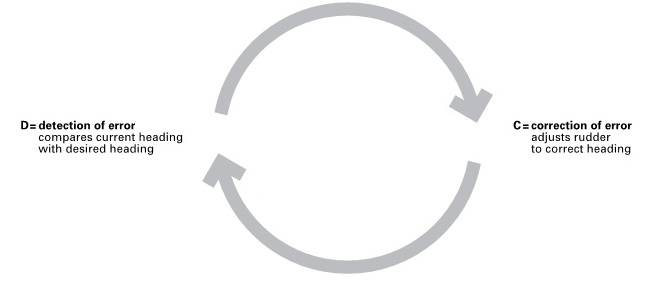
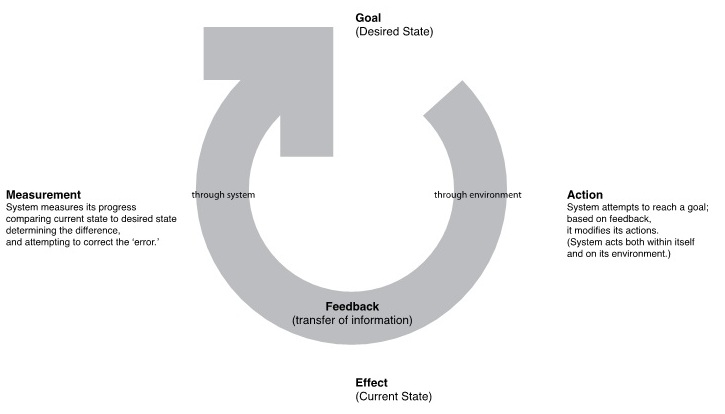
These loops can be complicated and may involve loops that evaluate other loops. Below is another illustration in regard to Plato’s philosophy:
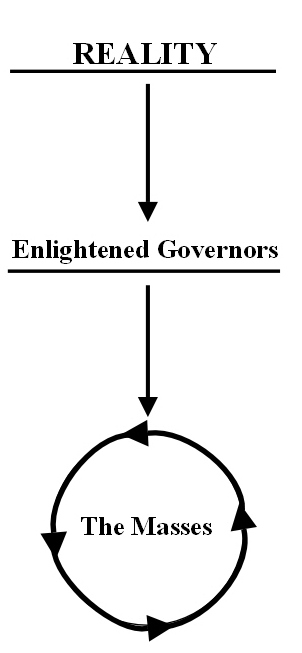
Plato had a vast influence on Augustine who is primarily responsible for the total depravity of the saints tenet found in Reformed theology. This prism had a profound influence in the forming of the gospel of perpetual atonement, or the idea that the effects of Christ’s death on the cross wasn’t a finished work, but was progressive for the purpose of maintaining a righteous standing for the saints. See illustration below:

This is opposed to the gospel that rejects the total depravity of the saints and propagates an enablement through the new birth:

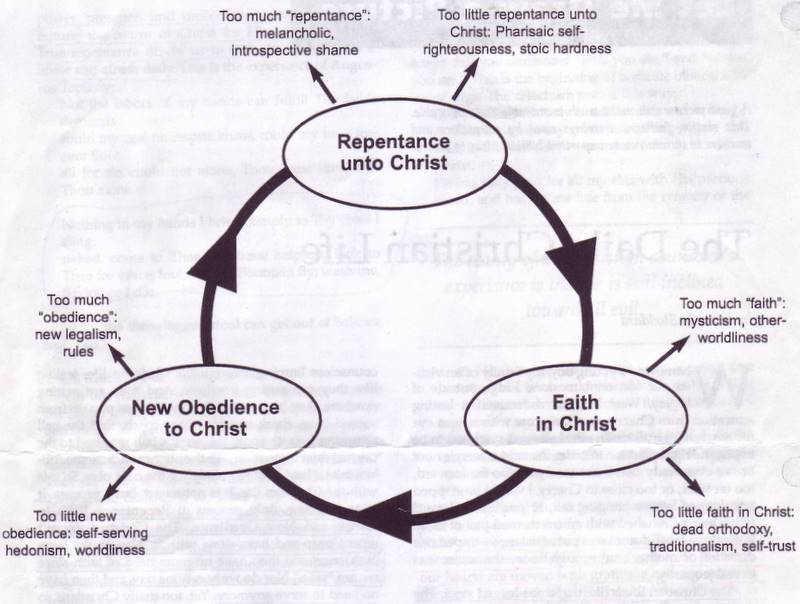
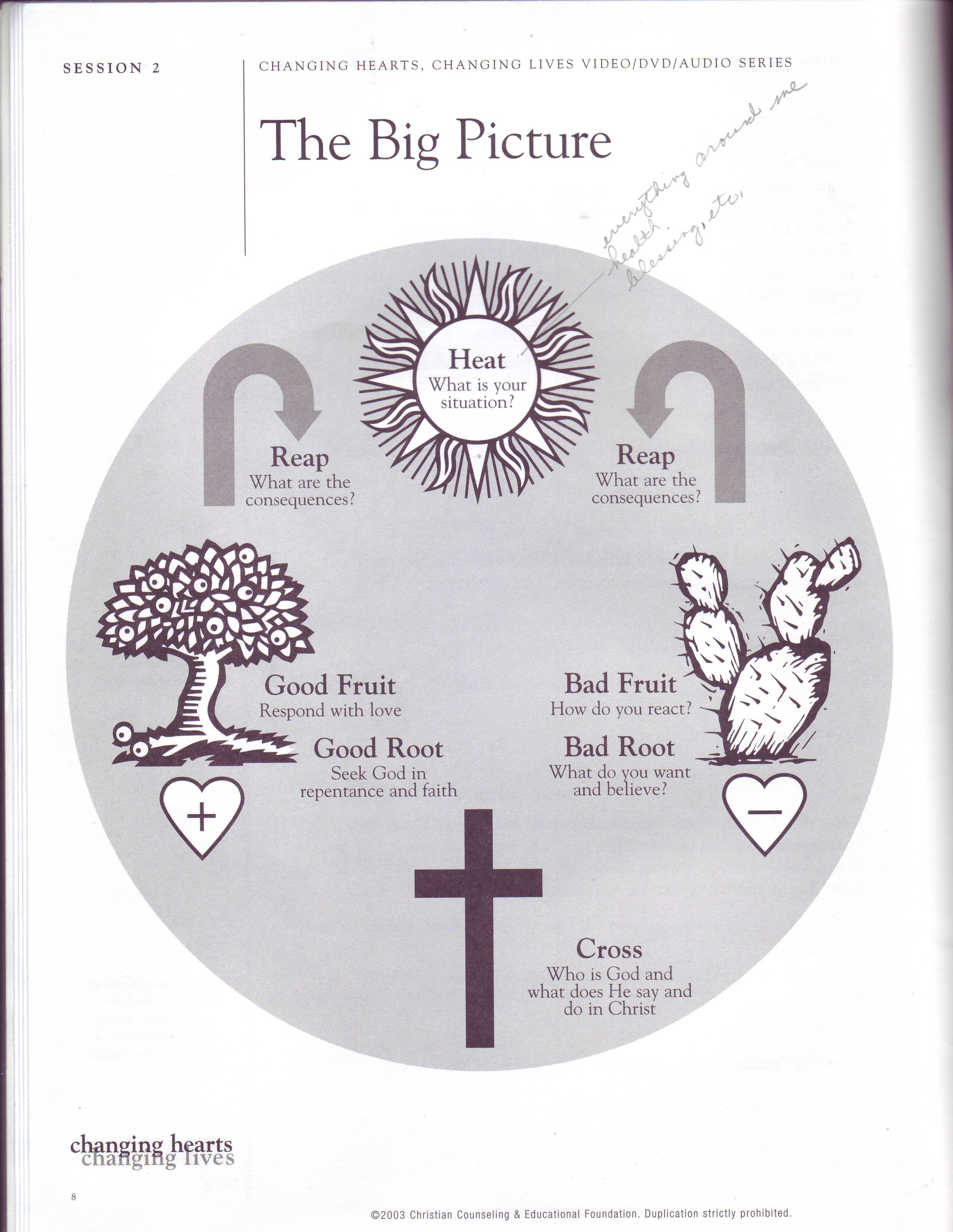
In the second model, the believer has the responsibility to learn and apply the word of God to their lives. But the first model, because it relies mostly on Platonist philosophy, also borrows the cybernetic loop for its “practical application.” Therefore, New Calvinists merge progressive justification into various cybernetic loops for “practical application.” Since the saints are supposedly unable to keep the law because they are still totally depraved, there has to be a way for the saints to continually partake in the same gospel that saved us. In order to come up with a way to do this, the New Calvinists went back to the basics: Plato. The first illustration of this is from CCEF’s The Journal of Biblical Counseling vol. 18, number 1, Fall 1999:
The following are illustrations from HPC and Powlison’s Dynamics of Biblical Change:

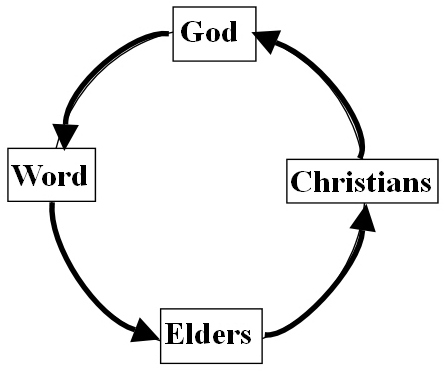
In the following excerpt from Dr. Devin Berry’s “How to Listen to a Sermon,” Berry uses a C-loop concept to explain the New Calvinist theory on how the saints receive the word of God. The illustration following the excerpt is mine:
Note this cycle: Paul, from the Word, delivers words. The Bereans, from Paul’s words, go to the Word. The Word cycles from God, through the preacher, to the people, back to the Word, and this, verse 12 tells us, produced belief in the God of the Word. An important thing to note is that this happened daily – suggesting a regular interaction between preaching, personal study, and the Word.
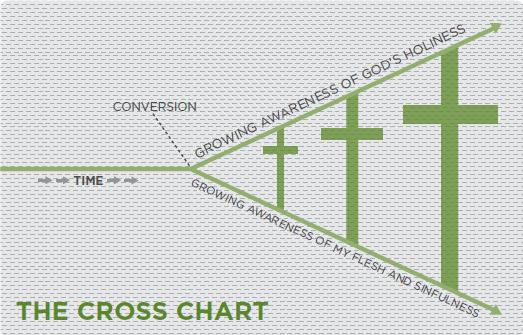
The goal of all of this is not change in the believer which is impossible anyway according to their theology because Christians are still totally depraved. The goal is to make the cross (or, the works of Christ) bigger by a deeper and deeper knowledge of how totally depraved we supposedly are. This is illustrated by the following chart produced by a New Calvinist organization:
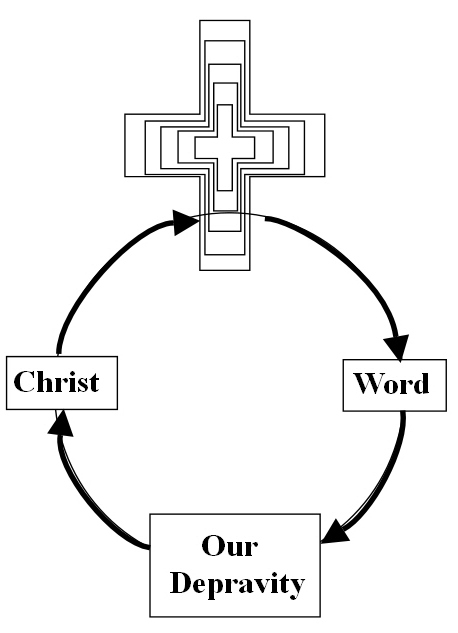
 Below is a C-loop that can illustrate the above chart:
Tragedy At Southeastern? What’s The Big Deal? I Thought We Are All Totally Depraved!
Stuff like this always causes me to have to stop everything I am doing and post. I didn’t know anything of William Birch or his blog before the breaking story this week that he fell into significant sin and has confessed. Apparently, even though I have never heard of him, he was fairly well known in the blogosphere and was a student at Southeastern Theological Seminary. In fact, the sinful act took place on campus, and we are not talking about getting caught smoking in the boy’s restroom.
Of course, Southeastern is stunned and is busily partaking in damage control. Am I here right now? Southeastern is all but totally in the tank for the doctrine of Gospel Sanctification which is the hallmark of, well, “aggressive Calvinism” or New Calvinism, depending from what perspective you are looking at it. Basically, the doctrine teaches that we are (this includes Christians) totally depraved, really don’t change, and either manifest a sin realm or spirit realm depending on how often we use the Scriptures to contemplate the gospel; ie, Gospel Contemplationism. Supposedly, when we contemplate the works of Christ in the Scriptures, his righteousness is imputed to us in the same way it was when we were saved. In salvation, it is a general imputation; as Christians, specific things are imputed to us in the same way when we see them in the Scriptures. Hence, sanctification is still an imputation of righteousness in the same way justification was.
Therefore, the doctrine denies an orthodox view of the new birth, claims that Christians are totally depraved, and also claims that we do not really change, we only manifest one realm/sphere or the other at any given time. A post that is an example of how they see progressive imputation through use of the Scriptures can be observed here: http://wp.me/pmd7S-1lh . An example of how they view the fact that we do not really change as Christians can be read here: http://goo.gl/T1pMg , but the money quote by New Calvinist Terry Rayburn follows:
There are several problems with that essentially Legalistic view of Sanctification, as reflected in the following observations:
1) Our flesh cannot get better. In Romans 7:18 Paul wrote, “For I know that NOTHING good dwells in me, that is, in my flesh…” Your flesh cannot be improved. Flesh is flesh, and spirit is spirit.
2) Our new nature, on the other hand cannot get better, because it has already been made new and perfect through regeneration. We have been given a “new heart” (new nature, or new spirit), and not a defective one, which would be absurd. This new spirit has been made “one spirit with Him” (1 Corinthians 6:17), such that when we “walk according to the Spirit” (i.e., the Holy Spirit), we also walk according to our own new spirit.
3) Those who deal with Sanctification by zeroing in on so-called “Progressive” Sanctification as the main point of Sanctification, are at best in Kindergarten.
So, Southeastern will come forth in dismay and act completely incredulous that this has happened. Meanwhile, Southeastern’s conference schedule is saturated with propagators of this doctrine, including Tullian Tchividjian. On the one hand, it’s a tragedy. On the other hand, they invite leaders to speak to the students who teach that we are totally depraved and can’t change! Can teaching seminary students such things lead to said behavior? Well, forgive me for thinking so! How ironic that Tchividjian has already spoken there this year, and is scheduled to return in the fall. Consider this commentary on a post he wrote on the total depravity of the saints http://goo.gl/Jiu4I , and the following tweets by Tchividjian:
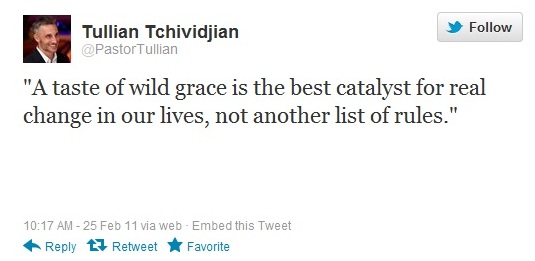

I guess I am the only one scratching my head on all of this, but I also wonder if Southeastern is going to get a “I told you so” from New Calvinist Michael Horton who often warns Christians about trying to “be the gospel” rather than “preaching the gospel.” Like all New Calvinists, Horton teaches that the gospel is “news to be proclaimed” not a list of “do’s and don’ts.” They plainly teach that “law and gospel” are separate. This concept can be found in Horton’s book, “Christless Christianity” on pages 117-119, and also on pages 53-54 of “Family Shepherds” written by Southeastern graduate Voddie Baucham. If the same gospel that saved us also sanctifies us, and the law and gospel are separate; well, you do the math (the law is separated from sanctification). Supposedly, a deeper understanding of the gospel that saved us must always precede obedience which then is a “mere natural flow” without effort because we are really manifesting a spiritual realm that was imputed to us at salvation.
And the present-day New Calvinist movement got this doctrine from Seventh-Day Adventist Robert Brinsmead, who combined Reformed theology with Platonism to come up with the centrality of the objective gospel outside of us. Instead of reality or truth being completely outside of man (Plato), in New Calvinism, the gospel must remain completely outside of us, and nothing of grace may be infused within us. Hence, consider the following quotations by the who’s who of New Calvinism in our day:
When the ground of justification moves from Christ outside of us to the work of Christ inside of us, the gospel (and the human soul) is imperiled. It is an upside down gospel. ~John Piper
Thus, it will inevitably lead not to self-examination that leads us to despair of ourselves and seek Christ alone outside of us, but to a labyrinth of self-absorption. ~ Michael Horton
So what does this objective Gospel look like? Most importantly, it is outside of us.~ Tullian Tchividjian
The blessings of the gospel come to us from outside of us and down to us.~ John Fonville
It robs Christ of His glory by putting the Spirit’s work in the believer above and therefore against what Christ has done for the believer in His doing and dying.~ Geoffrey Paxton (Australian Forum)
But to whom are we introducing people to, Christ or to ourselves? Is the “Good News” no longer Christ’s doing and dying, but our own “Spirit-filled” life?~ Michael Horton
And the new-birth-oriented “Jesus-in-my-heart” gospel of evangelicals has destroyed the Old Testament just as effectively as has nineteenth-century liberalism. (footnoted to Paxton’s article with above quote). ~ Graeme Goldsworthy (Australian Forum)
Of course, the only practical application of Platonism is Gnosticism, and incredibly, some of the most popular New Calvinists of our day have Gnostic themes for their ministries as illustrated by the following two screen shots that clearly illustrate Gnostic dualism.


Then if one googles “Plato Two Worlds,” you get:

And the similarities between the New Calvinist concept of separating law and gospel is eerily similar to those of the 2nd century Gnostic heretic Marcion. In regard to the gospel being completely outside of us like knowledge of reality (Plato), many New Calvinists now teach that the gospel cannot be fully known: http://5ptsalt.com/2012/02/23/grasping-the-gospel/
Lastly, I heard on the news that this brother that fell is going to enter counseling at Southeastern! Right, that’s all this brother now needs—to be taught that he is totally depraved, that he can’t change, and that the primary cure for his problem is a deeper understanding of the death, burial, and resurrection. After all, as Southeastern hero Paul David Tripp often states: applying biblical instruction to this problem would not be seeing the problem in its “gospel context,” and instruction also denies Christ’s saving work on the cross by replacing Christ’s personhood with “a cognitive concept applied to a new formula for life.”
The brother has it bad right now. Counseling at Southeastern will finish the job. I am reading a lot on the blogosphere about all the friends this guy has. Ha! We will see.
paul
The Cat is Out of the Bag: Biblical Counseling Isn’t About Change
As The Coalition Against New Calvinism is forming, one of my goals as a member is to publish a pdf report to be distributed among churches en mass. The first is almost complete and will be an introduction, but the second will address what is now apparent. David Powlison and the Christian Counseling & Educational Foundation have perpetrated a huge fraud upon the church. In the early 70’s many evangelical leaders adopted the doctrine and motif of the Australian Forum, a project that systematized Progressive Adventism. The base doctrine was the centrality of the objective gospel outside of us, and its primary focus was a call to semper reformanda. This was the idea (and still is) that the Reformation didn’t end with Luther, and the Forum had rediscovered the lost gospel of the Reformation (documentation on this and what follows is now ample and convincing).
Church leaders bought into the frenzy wholesale, especially many at Westminster Seminary where the Forum’s theological journal was widely distributed. One of those leaders at Westminster was the mentor of David Powlison and Tim Keller (Dr. John Miller). The movement spawned a massive takeover mentality among its proponents which sought to “reform” the American church with this new rediscovered Reformation gospel. Powlison is on record saying that the fundamental difference between CCEF and NANC (National Association of Nouthetic Counselors) was a traditional view of sanctification verses John Miller’s theology (which he got from the Forum). Therefore, it is no surprise that CCEF sought to assimilate the semper reformanda into NANC, which they have been very successful in doing.
One of the major themes promoted by Jay Adams when he was involved with NANC was the idea that counseling was about biblical change. Though unclear at this time whether the following came directly from the Forum or was added later, a significant portion of the NANC/CCEF counseling culture believes no such thing. Rather, they believe that people do not change (but remain totally depraved whether believers or not), and that the primary goal of counseling is to teach Christians how to manifest one of two realms or spheres. We don’t change, but we can experience and manifest the realm of the Holy Spirit or the flesh/worldly/law realm. This prism enables them, as you can imagine, to use orthodox sounding verbiage to promote this doctrine. In fact, they do just that. Spiritual growth is now, “spiritual formation.” Repentance is now, “deep repentance,” etc.
CCEF has been a lost cause from the beginning, but it is unfortunate that the leadership of NANC shows no intestinal fortitude in dealing with this problem. In fact, they refer hundreds of people daily to these counselors with complete indifference. Daily, hundreds of troubled people seek to be helped by these counselors while totally unaware of what they believe.
It is the coalition’s duty to change that. The second newsletter will be aggressively circulated to churches worldwide. It is our goal to be servants of those who struggle with full disclosure.
paul

 Paul's Passing Thoughts

leave a comment