Calvinism Show and Tell With 3 Pictures
Click Picture to enlarge:
Reformed “Total Depravity” and Yin-Yang
 Most Christians are familiar with the Reformed view of total depravity from the T.U.L.I.P acrostic fame. Mankind, being totally depraved, cannot and will not seek God. This is also often prefaced with “also known as Total Inability and Original Sin.” This leads to the logical progression of Unconditional Election, or the “U.” God didn’t choose us because of anything worthy in us. Well, of course not. This leads to Limited Atonement, often prefaced with “also known as Particular Atonement.” This and the “I,” Irresistible Grace, is where most of the arguments come in according to the free will/sovereign grace debate. There is almost no disagreement with the “P,” or Perseverance of the Saints, often prefaced with, “also known as Once Saved Always Saved.” Few argue about that as discussion swirls about regarding “I’m a fill in the blank: 1-5 point Calvinist.”
So goes the arguments around, and round, and round for 500 years now, and with no resolution. Why? Because the arguments are based on a faulty understanding of the doctrine. This is evident from the idea that you can be a partial-point advocate of Calvinism. The points depend on each other. It’s like saying you’re a partial advocate of the equation, 1+1+1+1+1=5. Moreover, once there is an understanding of what makes Calvinism tick, the free will/sovereign grace issue is exposed as just an inferior byproduct of the big picture.
We begin with the dirty little secret concerning the “T.” The total depravity of man (original sin) is also the total depravity of the saints. It has come to the point where neo-Calvinists have had to come clean on this of late. And if you are paying attention, they are constantly saying that we (Christians) are “wicked sinners saved by grace,” “enemies of God,” “no different than unbelievers,” etc, etc, etc. This ministry has a storehouse of data confirming this. Calvin himself stated that Christians are utterly unable please God in any way (Calvin Institutes: Book 3; ch. 14, sections 9-11). The fact that this idea flies in the face of the apostle’s stated goal of pleasing God, whether here or in glory, is irrelevant because of how Calvin approached the Scriptures. Reformed theology is not based on exegesis by any stretch of the imagination.
We remain totally depraved. We remain completely evil. We don’t change. This is foundational to Reformed theology. It also brings us to the next dirty little secret: “P” or, once saved always saved, is not “true” in the way most Christians think it is from a Reformed viewpoint. The perseverance of the saints is really Christ persevering for us. Hence, Christians “manifest” Christ’s perseverance. This is simple math. How can the totally depraved persevere? Once Calvinists have to come clean on the total depravity of the saints, the house of cards will fall. The “P” as worded indicates that the saints have a part in the persevering—this is a deliberate, deceptive lie. Something else is going on. But what?
We get a clue from beginnings. Specifically, Genesis and the first sentence of the Calvin Institutes. In the very first sentence of the Calvin Institutes, Calvin states that ALL wisdom comes from a deeper and deeper understanding of God, and ourselves. That’s his metaphysics and epistemology, and is appropriately stated in the very first sentence of his magnum opus. But wait. If we are evil and remain evil, and God is good, is this not the same thing as the “knowledge of good and evil”? Where have we heard that before? This is the knowledge that the Serpent tempted Eve with. He told her God was withholding true wisdom from her which could be found by eating the fruit from the tree of “the knowledge of good and evil.”
Basically, we have Calvin agreeing with Satan in regard to what true knowledge is. But is ALL knowledge ALWAYS the best wisdom? Is all metaphysics good metaphysics? Obviously, sin was a knowledge that Adam and Eve knew nothing about. They had to sin to get the sin knowledge. Let me repeat that in another way because it’s an important element: they had to disobey God to get the knowledge and actually experience it.
The Bible states the details of Satan’s fall and the entering of evil into reality or, what is (metaphysics). The passages are Isaiah 14:12-14 and Ezekiel 28:11-19. At that point, no doubt, evil was born into the knowledge of reality. But was that a good thing? And hold on to this question for now: did God need evil to better define Himself?
Since the garden, men and women have founded many philosophies on the idea of good and evil being the full knowledge of reality. The whole metaphysical story if you will. They often made that knowledge equal with wisdom, and wisdom being good, in and of itself. Added was the idea that good and evilas moral verses immoral is not reality, but was contrived by men because of their misunderstanding of true reality. This is known as Dualism and is the foundation of most false religions of all kinds with thousands of variances. Basically however, it’s the idea that the invisible reality is a higher knowledge than the material, and cannot be obtained through what the five senses can ascertain. The goal (in some cases) is to join the spiritual with the physical by accessing the spiritual (invisible). By gaining a deeper and deeper knowledge of both invisible and material, the invisible can be experienced in the material realm resulting in wellbeing.
We see this concept in the most ancient of civilizations; eg, oriental culture. The goal of the Yin-Yang (literally, “shadow and light”) is to gain understanding of both which leads to an understanding of reality because opposites give definition to each other. Darkness can’t be understood without light etc. Likewise, “the good” or God, can’t be understood without evil. Hence, reality is made up of opposites (male, female, etc), and understanding the opposites and how they define each other is the key (epistemology) to understanding reality. That’s the gest.
And let there be no doubt—this basic idea is the foundation of Reformed theology. Again, the math is simple. If we don’t change—if we remain evil—there is only one place left to go: Mystic Dualism. But how do they make this work? It’s not that difficult, and can be seen throughout Reformed teachings. First, all of the magnificent teachings in Reformed theology are mostly about how great God is. We focus on that (who wouldn’t!), we are mesmerized by that (who wouldn’t be!), and miss what is missing: learn and apply. Learn and apply isn’t the point; more and more knowledge of the good (God) and the evil (us) is supposedly the point. Stopping to apply God things to our life cuts off the God experience achieved through the knowledge of both.
The Reformed camp states it all the time: “Seeing God’s holiness as set against my own sinfulness is the key to transformation.” Al Mohler says it all the time. Elyse Fitzpatrick says it all the time. John Piper says it all the time. CJ Mahaney says it all the time. It’s a first-degree theological felony performed in broad daylight under the cover of how awesome God is—a very powerful cover! It reminds me of my frog-gigging days with my grandfather: the rays from the flashlight paralyze the bullfrog, and then you spear his stupidity.
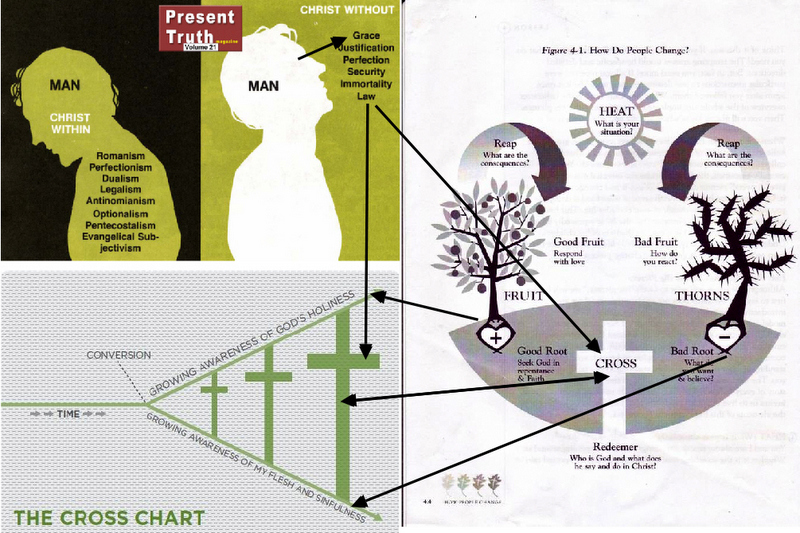
I have often posted the New Calvinist cross chart on this blog, and sigh, I will do it again at the end of this post. This is their chart, not mine, and what is more obvious? We don’t change. By seeing God’s holiness more and more, and our sinfulness more and more, the cross gets bigger. This lends to powerful “rhetorical” questions that argue the case such as, “Do you want to be bigger? Or do you want the cross to be bigger?” “Do you want what you do to be bigger? Or what Christ did on the cross to be bigger?” This is very powerful; primarily, because it was hatched from the minds of demons. But if you stop and think for a while, you might stop and ask: “The cross getting bigger; what does that look like? How is that experienced?”
Good question, and the key is the word EXPERIENCE. What we experience is not necessarily who we are. We can experience the cross getting bigger—that doesn’t necessarily mean we are bigger. We can experience the cross in our lives as we use the Scriptures to see the glory of God and our own sinfulness (Chrsitocentric, or gospel-centered hermeneutics). And, that experience leads to more UNDERSTANDING which leads to more experience, or a “transformation from glory to glory.” But the experience is separate from who we are, more like a manifestation in the realm in which we exist. Therefore, we may experience an obedient act in our lives, but it is not really us obeying, it is the “active obedience” of Christ imputed to us. This is why New Calvinists often say that our obedience, when it is real obedience, isn’t experienced in what feels like “self-effort,” or “obedience in our own effort.” As Francis Chan states:
When we work for Christ out of obligation, it feels like work. But when we truly love Christ, our work is a manifestation [emphasis Added] of that love and it feels like love (Crazy Love: p.110).
That’s because we are experiencing the obedience of Christ imputed to us, and not an obedience that we exercise. Hence, as New Calvinist Chad Bresson often states, it’s a “mere natural flow.” Other Reformed teachers call obedience “kinesthetic” or “experienced, not performed.” It is also interesting what the first tenet of New Covenant Theology states:
New Covenant Theology insists on the priority of Jesus Christ over all things, including history, revelation, and redemption. New Covenant Theology presumes a Christocentricity to the understanding and meaning of all reality.
This simply means that “all reality” is interpreted through the gospel; ie, the aforementioned cross chart. So, gospel contemplationism leads to experiencing “grace,” and that experience leads to an even deeper understanding of grace, leading to more deeper and deeper experiences of grace. Or, “spiritual formation.” Or, “heart transformation.”
What about sin? Well, remember, the cross, or the cross experience, gets bigger as we gain a deeper and deeper knowledge of our own sin as well as God’s holiness. Therefore, our sin serves to give us a deeper understanding of both the Yin and the Yang. In this case, God’s holiness “as set against our sinfulness.” The experience of both, one fruit (Christ’s imputation), and thorns (our sin) contribute to knowledge of the good which leads to deeper experiences of grace. The latter is the theme of Paul David Tripp’s How People Change published by Punch Press in 2006. I included a visual illustration from that book at the end of this post along with the cross chart for your viewing pleasure. Anyone familiar with Gnostic dualism will immediately recognize the cybernetic loop of experience that leads to deeper knowledge through reinforcement, and hence deeper experiences of the spiritual, or the gospel.
There are two fundamental problems with this approach. Serious problems. First, it sees the necessity of understanding evil to better understand God. Evil is factual, but it isn’t God’s truth—He doesn’t need it to define His Holiness. The idea is the epitome of vileness. Secondly, this philosophy encourages an endeavor that Scripture forbids—dwelling on that which is not honorable (Philippians 4:8 among a myriad of other texts). We are to learn what sin is in order to put it off in our lives, not to inflate our supposed identity as among the totally depraved in order to glorify God. This is all a complete distortion of sanctification reality.
In the final equation, total depravity being total inability in both justification and sanctification is the dirty little secret that completely unravels Reformed theology. When we remain unchanged, there is only one formula left: mysticism, and interpreting obedience as something performed by Christ and only experienced by us. In the same way that Adam and Eve could only know evil by experiencing it, we can only know good through experience, but are not able to practice it ourselves. In other words, in the fall, ability to perform and experience our own performance of good was supposedly reversed with evil. Now, we can only perform evil and experience the good imputed to us by Christ’s obedient life as part of the atonement, and added to His, apparently, not all sufficient death. You can add that as a third reason to believe Reformed theology is nothing short of repugnant.
This is elementary. The simple knowledge of what total depravity really means leaves the whole Reformed house in ruins. The only thing that now adds up is the misery, blood, and oceans of foolish ink left in its wake.
paul


Are Calvinists Saved?
 The begging of the question has a sound Scriptural argument.
This ministry has made much of the critical importance of separating justification (salvation) and sanctification (growth in holiness, or kingdom living). The Reformed (Calvin/Luther Reformation doctrine/gospel) “never separate, but distinct” doublespeak doesn’t cut it in the arena of truth, and we will see why. “Never separate” =’s false gospel. If you get a little lost in the first part of my argument which gives the lay of the land, don’t worry, when I get into the specific Scriptural argument, it will clear things up and make it all come together for you.
It must delight the ghosts of the Reformation that the argument has always been in the arena of freewill verses predestination. It’s the primary thrust of this ministry to change that argument. This isn’t a quibbling about semantics in the mainstream—this is about the truth of the gospel. As New Calvinist Russ Kennedy once thundered from the pulpit in his mousy voice: “Any separation of justification and sanctification is an abomination!”
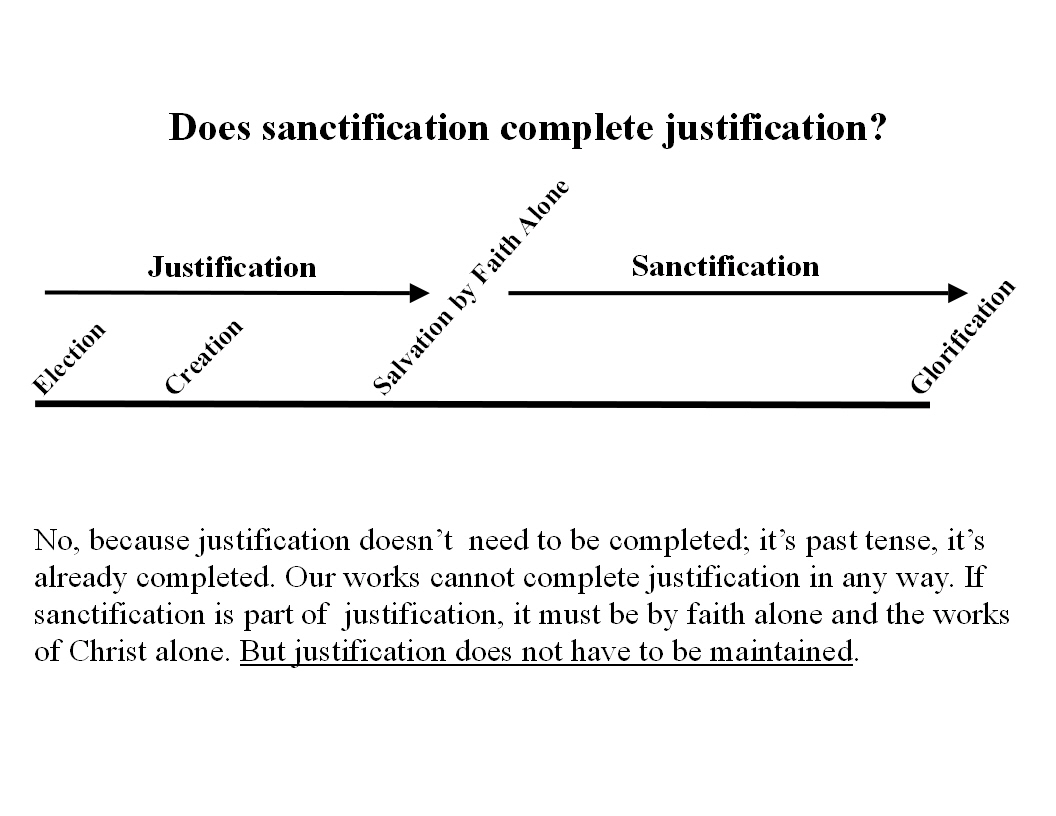
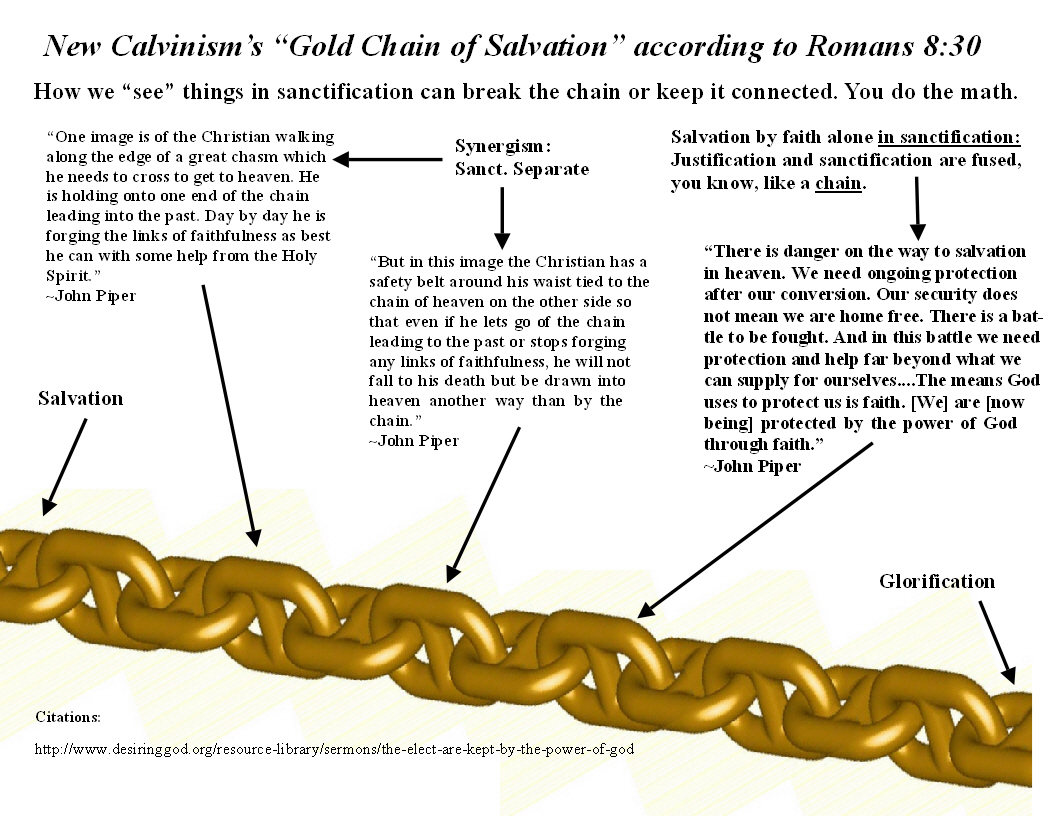
I have often argued from the standpoint of this issue. If sanctification is the middle of the Reformed “golden chain of salvation” then sanctification is part of finishing justification. This means that what happens in sanctification determines whether or not justification is properly finished. What’s a chain? John Piper even preached a message about the eternal importance of our contribution to the “links” in just the right way. In essence, sanctification becomes a spiritual minefield.
This is exactly the same thing that the Reformed crowd has always accused Rome of: the fusing together of justification and sanctification. However, as we shall see, they are both guilty of the exact same heresy/false gospel. As we shall see, both teach that sanctification finishes justification.
This is a linear gospel (one unified chain from salvation to resurrection (glorification) versus a parallel gospel with salvation on one plane as a finished work before the foundation of the world, and kingdom living that runs parallel with the finished work and reflects the reality of our salvation until glorification. Typical in the linear gospel is the idea that Christ died for all of our past sins, but we must now finish the work (with the Holy Spirit’s help [sanctified works salvation]) until glorification when we are completely transformed into complete holiness. This is the often-heard bemoaning of “Christ PLUS something.”
An excellent example is some strains of Freewill Baptists who teach that Christ died for all of our past sins, but with the help of the Holy Spirit, we must confess and repent of every sin we commit until the resurrection; e.g., Christ plus salvation by repentant prayer for sins committed after we are “saved.” My grandparents were saved out of this tradition. When my grandfather asked my grandmother if she thought that God could ever forgive him of all the sins he committed, she answered: “Yes, but you are going to have to pray awful hard!” Praise God that through the ministry of several individuals my grandparents eventually abandoned that gospel for the true one of salvation by faith alone as a finished work.
Likewise, Rome teaches that you must let the Catholic Church finish your justification through ritual; e.g., Christ plus Catholic ritual. The Reformation gospel is also Christ plus something else, but the something else is ever-so-subtle. In both cases, sin must be dealt with in sanctification in order for the saint to remain justified until the final judgment. In other words, the righteous standard of justification must be maintained on our behalf. Like all other proponents of a linear gospel, the Reformed crowd contends that anything less than the perfection demanded of the law (“all sin is transgression of the law”) is “legal fiction.” So both Rome and the Reformers agree: justification must be maintained by sanctification, and in the case of the Reformers specifically, they believe that the perfect standard of the law must be maintained until glorification; otherwise, our justification is “legal fiction.”
Here is where Reformed subtlety is uncanny: Christ keeps the law for us in sanctification. He maintains the perfect standard. All the fruit of sanctification (obedience/good works) flows from the life He lived on Earth and His death on the cross. Christ plus the works of Christ to finish salvation. “But Paul, what in the world is wrong with that!” Here is what is wrong with it: works are still required to maintain justification. That is a huge problem, even if it is Christ doing the work. What did the Hebrew writer say about Christ’s work for justification not being complete?
And even more subtle is the following Reformed idea: believing that the law is no longer a standard for maintaining justification is antinomianism. Antinomianism =’s legal fiction. Their definition of antinomianism is the removal of the law from justification as the standard for maintaining it. Traditionally, among Biblicist, antinomianism is the removal of the law from sanctification, and herein lays even further steroidal subtlety: the Reformed theologians would refute a removal of the law from sanctification as well, not only because they think justification and sanctification are the same thing, but because its perfect keeping is required to maintain a true declaration of the just that is not “legal fiction.”

However, the Biblicist believes that the law is a standard for kingdom living and is no longer a standard for justification. Therefore, if we attempt to obey it with the Holy Spirit’s help, and to please/serve the Lord, it can have no bearing on our just state. While the Biblicists think they are therefore joint contenders with the Reformers against antinomianism, such is far from the truth. The Reformed mind believes the Biblicist is either a legalist or an antinomian, or both. The Biblicist is supposedly an antinomian because he/she has removed the law from justification as a just standard, or is a legalist because they think they should strive to keep the law in sanctification. Since sanctification finishes justification’s perfect standard of law keeping, our “own” attempts to keep the law in sanctification is an attempt to finish justification. Hence, what the Biblicist fails to understand is the Reformers belief that Christ must maintain the law for us in sanctification because justification and sanctification are not separate. Anything more or less is supposedly works salvation.
On the other hand, because it is vital that Christ obeys the law for us in sanctification, the likes of John Piper and Tullian Tchividjian contend that those who are really preaching the Reformed gospel will indeed be accused of antinomianism. All in all, their position is easy to see if you pay attention. John Piper and many other Calvinists often state that, “Good works are the fruit of justification.” And, “Justification is the root, and sanctification is the fruit.”
Well, the average Biblicist then thinks, “Yes, but of course, our salvation makes good works in sanctification possible.” But that’s not what they are saying. If you pay closer attention, they are saying that justification is a tree that produces its own fruit. Justification is the root, and whatever happens in true sanctification is the fruit of the root of the justification tree. Problem is, justification doesn’t grow. Justification is a finished work. What Calvinists refer to as “progressive sanctification” is really the fruit of the root: progressive justification. Another name for this that they throw around is “definitive sanctification.” The word “definitive” refers back to the definite completion of justification.

Revision: this ministry now rejects the idea that orthodoxy is truth; orthodoxy is the traditions of men. Never in Scripture do we find premise for a body of teaching that explains the teaching. The above illustration is valuable for demonstrating that the fruit of justification is glorification, NOT sanctification.
This brings us to the Scriptural argument which begins with a question I asked myself just this morning: “Paul, you are always harping about the crucial importance of the separation of justification and sanctification—a parallel gospel versus a linear one. But where does the Bible say specifically that this is critical?”
First, the very definition of a lost person in the Bible is one who is “under the law”:
Romans 3:19
Now we know that whatever the law says it speaks to those who are under the law, so that every mouth may be stopped, and the whole world may be held accountable to God.
Romans 6:14
For sin will have no dominion over you, since you are not under law but under grace.
Romans 6:15
What then? Are we to sin because we are not under law but under grace? By no means!
1 Corinthians 9:20
To the Jews I became as a Jew, in order to win Jews. To those under the law I became as one under the law (though not being myself under the law) that I might win those under the law.
Romans 7:1
Or do you not know, brothers —for I am speaking to those who know the law—that the law is binding on a person only as long as he lives?
Romans 7:2
For a married woman is bound by law to her husband while he lives, but if her husband dies she is released from the law of marriage.
Romans 7:3
Accordingly, she will be called an adulteress if she lives with another man while her husband is alive. But if her husband dies, she is free from that law, and if she marries another man she is not an adulteress.
The unsaved are “under the law” and will be judged by it in the end. This is the very definition of the unsaved. Calvinists define Christians the same way—we are supposedly still under the law and will be judged by it in the end. That’s why Christ must keep the law for us—because we are still under it.
If not this position, why do many in the Reformed tradition hold to the idea that Christ’s perfect obedience is imputed to our sanctification? His death justifies us, and His perfect life sanctifies us. Hence, His death pays the penalty for past sins, and then His perfect life imputed to our sanctification keeps us justified. Why would an imputation to our sanctification be necessary if we are no longer under the law? This is known as the Reformed view of “double imputation” and has been called out as heresy by many respected theologians for this very reason: it implies that Christians are still under the law.
In regard to sustaining the law in our stead, why? It has been totally abolished in regard to our just standing:
Romans 3:20
For by works of the law no human being will be justified in his sight, since through the law comes knowledge of sin.
Romans 3:21
But now the righteousness of God has been manifested apart from the law, although the Law and the Prophets bear witness to it—
Romans 4:15
For the law brings wrath, but where there is no law there is no transgression.
The keeping of the law by anybody DOES NOT do anything to justify mankind:
Romans 3:28
For we hold that one is justified by faith apart from works of the law.
Here is where the separation of justification and sanctification is vital on this first point: we ARE NOT under the law for justification, but rather UPHOLD THE LAW in sanctification. The two must be separate because of the differing relationships to the law:
Romans 3:31
Do we then overthrow the law by this faith? By no means! On the contrary, we uphold the law.
Romans 6:15
What then? Are we to sin because we are not under law but under grace? By no means!
Furthermore, if we are still under the law (whether or not Christ obeys it for us to keep us in a just standing), this means we are still under the power of sin. Being under the law and also under its spell to provoke sin in the unregenerate is spoken of as being synonymous in the Bible. Those who are “under the law” are also under the power of sin and enslaved to it:
Romans 7:4
Likewise, my brothers, you also have died to the law through the body of Christ, so that you may belong to another, to him who has been raised from the dead, in order that we may bear fruit for God.
Romans 7:5
For while we were living in the flesh, our sinful passions, aroused by the law, were at work in our members to bear fruit for death.
Romans 7:6
But now we are released from the law, having died to that which held us captive, so that we serve in the new way of the Spirit and not in the old way of the written code.
Romans 7:8
But sin, seizing an opportunity through the commandment, produced in me all kinds of covetousness. For apart from the law, sin lies dead.
If we are still under the law, and will be judged by it, whether or not Christ stands in the judgment for us with His own works, we are still enslaved to sin by virtue of being under the law…. for justification. And Calvinists know this to be true, that’s why they say we are still…. what? Right, even as Christians, “totally depraved.” And, “enemies of God.” Of course, throughout the Bible, Christians are spoken of as being friends of God and no longer His enemies. Our status as enemies of God is stated in the past tense. But the Reformed crew continually state that Christians are vile enemies of God and are enslaved to sin. They realize that this goes hand in hand with being under the law.
To the contrary, dying to the law in the death of Christ….for justification—sets us free to be enslaved to the righteousness that is defined by the law. We are dead to the law for justification and alive to obey truth….for sanctification:
Romans 8:2
For the law of the Spirit of life has set you free in Christ Jesus from the law of sin and death.
Romans 8:3,4 [emphasis by author]
For God has done what the law, weakened by the flesh, could not do. By sending his own Son in the likeness of sinful flesh and for sin, he condemned sin in the flesh,….in order that the righteous requirement of the law might be fulfilled in us, who walk not according to the flesh but according to the Spirit.
Romans 8:7
For the mind that is set on the flesh is hostile to God, for it does not submit to God’s law; indeed, it cannot.
Romans 9:31
but that Israel who pursued a law that would lead to righteousness did not succeed in reaching that law.
John 17:17
Sanctify them in the truth; your word is truth.
James 1:25
But the one who looks into the perfect law, the law of liberty, and perseveres, being no hearer who forgets but a doer who acts, he will be blessed in his doing.
So, that is the separation that must be for the true Christian: Justification has no law for which we are judged, and we live by the law of blessings in sanctification.
This brings us to another important separation in the two: the judgments. Those under the law and sin will stand in a final judgment which will be according to the law. Again, because Calvinists believe that we are still under the law, albeit that Christ obeyed/obeys it for us, Christians will supposedly stand in the same judgment as the damned who are under the law and enslaved to it. At that time, the children of God, according to Calvinists, will be “made manifest.”
But because Christians are not under the law and cannot be judged by it, they will stand in a judgment for rewards and not a judgment that determines a perfect keeping of the law by Christ in our stead. Hence, there will be two different resurrections: one for those under the law and another for those under grace, and two different judgments for the same two groups. One for rewards, and one to determine if those under the law kept it perfectly. That judgment doesn’t go well for any standing in it.
Luke 14:12-14
He said also to the man who had invited him, “When you give a dinner or a banquet, do not invite your friends or your brothers or your relatives or rich neighbors, lest they also invite you in return and you be repaid. 13 But when you give a feast, invite the poor, the crippled, the lame, the blind, 14 and you will be blessed, because they cannot repay you. For you will be repaid at the resurrection of the just.” [Notice that this is a resurrection for the “just.” They are already determined to be just before they are resurrected].
2Corinthians 5:9,10
So whether we are at home or away, we make it our aim to please him. 10 For we must all appear before the judgment seat of Christ, so that each one may receive what is due for what he has done in the body, whether good or evil.
1Corintians 3:11-15
For no one can lay a foundation other than that which is laid, which is Jesus Christ. 12 Now if anyone builds on the foundation with gold, silver, precious stones, wood, hay, straw— 13 each one’s work will become manifest, for the Day will disclose it, because it will be revealed by fire, and the fire will test what sort of work each one has done. 14 If the work that anyone has built on the foundation survives, he will receive a reward. 15 If anyone’s work is burned up, he will suffer loss, though he himself will be saved, but only as through fire.
Hebrews 6:10
For God is not unjust so as to overlook your work and the love that you have shown for his name in serving the saints, as you still do.
Revelation 20:6
Blessed and holy is the one who shares in the first resurrection! Over such the second death has no power, but they will be priests of God and of Christ, and they will reign with him for a thousand years.
Revelation 20:11-15
Then I saw a great white throne and him who was seated on it. From his presence earth and sky fled away, and no place was found for them. 12 And I saw the dead, great and small, standing before the throne, and books were opened. Then another book was opened, which is the book of life. And the dead were judged by what was written in the books, according to what they had done. 13 And the sea gave up the dead who were in it, Death and Hades gave up the dead who were in them, and they were judged, each one of them, according to what they had done. 14 Then Death and Hades were thrown into the lake of fire. This is the second death, the lake of fire. 15 And if anyone’s name was not found written in the book of life, he was thrown into the lake of fire.
Don’t let anyone tell you that eschatology is a “secondary” or “nonessential” consideration. Your eschatology is your gospel. It will state your position regarding whether or not you fuse justification and sanctification together; ie, likening Christians to those under the law.
Yet another vital difference in sanctification and justification is repentance. Repentance for salvation (when you are justified) is different from our repentance in sanctification. Among many in the Reformed tradition where the “same gospel that saved you also sanctifies you,” the repentance is the same. Repentance unto salvation is not a onetime “washing,” but rather a means to continue “in the gospel” through what they call, “deep repentance.” Biblicism holds to repentance in sanctification that restores his/her fellowship and communion with God as His children. They would see repentance unto salvation as differing, and only necessary for salvation—a onetime decision to take one’s life in a new direction by following Christ, and believing in his death, burial, and resurrection.
Reformed repentance, according to the likes of Paul David Tripp and others is a “daily rescue.” Our original repentance was for rescue, and we need rescue today as much as we needed rescue when we were saved. Again, this indicates their belief that we are still under the curse of the law and need to be continually rescued from it while remaining under the bondage of sin.
However, Christ made it clear to Peter (John 13:6-11) that those who have been washed (1Corinthians 6:11, Romans 8:30) do not need another washing. Those who drink of the living water do not thirst again (John 4:13,14).
Lastly, though many other separations could be discussed, why saints can be considered just while they still sin at times is of paramount importance. There is no sin in our justification because there is no law, and where there is no law, there is no sin. Though unfortunate, there can be sin in our sanctification because it is totally separate from justification and can’t affect our just standing with God.
Basically, all of the aforementioned makes it of necessity to deny the new birth. If we have God’s seed in us, and we do (1John 3:9), that dispels total depravity, and without total depravity, justification and sanctification cannot be fused together. The new birth is a huge problem for Reformed theology. If the old man that was under the law is dead (Romans 7:1ff), and the seed of God is in the saved person, and the sin due our weakness in the flesh cannot be laid to our account for justification, then our justification is not “legal fiction” because we do not exhibit perfect obedience to the law. This is another grave consideration because Christ said, “You must be born again.” Obviously, despite their denials that they deny the new birth—you can’t be both totally depraved and born again.
Reformation doctrine is clearly a false gospel. Its version of justification does not void the law, and denies the new birth while distorting everything in-between. Freewill verses predestination is hardly the issue, the very gospel itself is the issue.
paul
Acts 10: Reformed Theology and the Problem With Cornelius
I was asked recently what I thought the primary key to discernment is. I answered this way: one of the major keys is daily Bible reading. If nothing else, read through the Scriptures and get a general idea of what is going on.
When you do that, you discover that things you hear from the pulpit may need a little bit more consideration and thinking.
We know the Reformed drill. Man is totally depraved. He can’t do anything to merit salvation. You’re either chosen, or not chosen. We can’t do anything to please God—all of our works are as filthy rags before God, and so forth.
So, as you are taking my advice, drinking some morning coffee and reading through Acts 10, you’re stopped dead in your tracks and immediately realize why Luther hated reason so much.
We read the following there:
1 At Caesarea there was a man named Cornelius, a centurion in what was known as the Italian Regiment. 2 He and all his family were devout and God-fearing; he gave generously to those in need and prayed to God regularly. 3 One day at about three in the afternoon he had a vision. He distinctly saw an angel of God, who came to him and said, “Cornelius!”
4 Cornelius stared at him in fear. “What is it, Lord?” he asked.
The angel answered, “Your prayers and gifts to the poor have come up as a memorial offering before God. 5 Now send men to Joppa to bring back a man named Simon who is called Peter. 6 He is staying with Simon the tanner, whose house is by the sea.”
Um, is it just me, or does this kinda throw a monkey wrench in the whole, “all of our works are filthy rags before God” routine? Now, heretics like Paul David Tripp would quickly step forward and say, “That text needs to be seen in its gospel context.” Oooookay. So, somehow, in the “gospel context,” “memorial” really means, “filthy rags.” Right.
Furthering the complexity leading to a need for more consideration is the question of whether or not Cornelius was officially saved when the angel made this statement.
Watch out for neatly arranged theological systems. Especially Reformed ones.
And read your Bible daily.
paul
Heresy in Heels: The Queens of Progressive Justification
 “As one respected Reformed pastor noted: it is the same Catholic salvation that those of Reformed thought claim to refute.”
He is supposedly the Master who does all the work for us lest He be robbed of any glory. Somehow, if we actually do any of the work as born again slaves, that doesn’t honor the Master, but yet, he insists on being known as a master. It seems like God would want to be known by something else other than, “Lord.”
Using language that referred to the slave culture of that day, the apostle Paul said we were “bought with a price.” We were purchased as slaves with the blood of Christ, but the gospel that is all the rage of our day denies this very purchase and the lordship of Christ; it’s replaced with a supposed purchase of parasites.
As the heretic Paul David Tripp states it: we “rest and feed” on Christ. Got that? We are the slaves, He is the Lord, but we “rest and feed.” Really? And how valid is any profession of faith that doesn’t understand this relationship? How valid is a profession that accepts Christ as Savior only and denies the purchase?
Contemporary Reformed leaders of our day are now cashing in on this false gospel two-fold. The judgement they are heaping upon themselves for present-day cash is not enough—they are getting their wives in on the action. The organization True Woman .com is only one of many massive organizations saturating Christian culture with New Calvinism’s fusion of justification and sanctification.
The organization is led by several wives of the who’s who of neo-Calvinism—following their husbands in heresy. And I am not the only one saying so. Even those of the “Reformed tradition” label the neo-Calvinist active obedience of Christ (Christ obeys for us) as, “heresy,” “works salvation” by not working in sanctification, “easy believism,” and antinomianism.
When justification and sanctification are fused together, justification is not a finished work. The doctrine makes two justifications: one finished and one progressive. They deceptively refer to this as “progressive sanctification.” Hence, “progressive sanctification” is really finishing justification. That’s a huge problem because we are in the sanctification process and what we do can therefore effect our “just standing with God.” It requires a maintaining of antinomianism to keep our just standing before God; ie., sanctification by faith alone. But living by faith alone in sanctification becomes a way to maintain our just standing before God—for all practical purposes, works salvation by antinomianism.
It’s not an oxymoron; when justification and sanctification are fused together, everything we do in sanctification points back to, or effects our justification because at least one aspect of it is not finished. As one respected Reformed pastor noted: it is the same Catholic salvation that those of Reformed thought claim to refute.
Furthermore, the primary catalyst for the doctrine’s present success was its Sonship theology package hatched at Westminster Seminary by Dr. John “Jack” Miller. A self-proclaimed understudy of Miller’s, David Powlison, then made the doctrine the foundation of Westminster’s biblical counseling curriculum via CCEF. In a book written by Dr. Jay E. Adams, he clearly states that the doctrine promotes a view that sanctification is powered by justification. Clearly, even in the Reformed community, there is a dispute in regard to the very reason we are supposed to be here: the gospel.
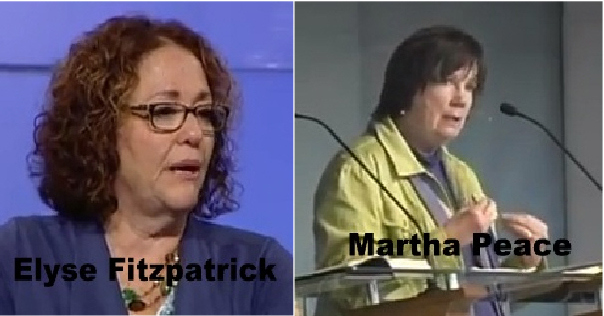
But does the Reformed tradition trump gospel truth? The answer is a resounding, “yes,” especially in the biblical counseling community. The two primary queens of that movement are Elyse Fitzpatrick and Martha Peace. Fitzpatrick has openly denied that there is any such thing as an antinomian because man is helplessly legalistic. Like all good neo-Calvinists, the poo-pooing of specific biblical truth is done without a blinking of the eye. In this case, the biblical word “anomia” is completely dismissed. And apparently, Satan came to Eve in the garden as a legalist.
Peace is a hardcore New Calvinist proponent of the active obedience of Christ and sanctification by faith alone. But yet, these two women are the toast of the biblical counseling community—even by those who refute the neo-Calvinist take on double imputation (the active and passive obedience of Christ imputed to our sanctification).
Why? Because it’s really not about the gospel. That’s why. And as far as counseling, people can’t be helped with a false gospel. No way.
paul

 Paul's Passing Thoughts
1 comment