Something to Ponder: The Night Real Death Visited a Celebration of Death
 “Can we, or should we, separate death and evil as an entertainment theme from the true reality of death and evil?”
It’s safe to assume that if most Christians really don’t understand justification, and they don’t, they understand sanctification even less. Sanctification deals with Christian living after salvation, and the wisdom thereof. More specifically, it’s knowledge in loving God and others.
The manual for such wisdom is the Bible, or in other words, the law (see Gal 3:21-23). Elsewhere in Scripture, the antithesis of love is a direct rejection of Scripture, or what we call antinomianism (Greek: anomia). This is the word translated “lawlessness” in Matthew 24:12, or without law (anomia).The process in Matthew 24:11,12 is worthy of notation: cold hearts are the result of people being led astray from the law by false teachers. In the latter days, the days we are in, this will involve “many.” This is why the flippant discernment among Christians in our day, and an overall inability to think drives me nuts, and in my estimation, the very reason that love is lacking in the church. In fact, the one’s labeled “unloving” among Christians are those who call for holding leaders accountable. Think about this: are we obligated to obey “God’s anointed” if they are leading us into lovelessness? How many of the guys in Matthew 24:11 insist that we “put ourselves under the authority of Godly men”? No, you never trade love for obedience to men and their definition of love whatever that might be.
In Romans 2:12-16, we find that the works of the law are written on the hearts of every individual born into the world along with a conscience that speaks words to the mind. These words that come from the conscience either accuse or excuse. Therefore, the law, or law-like principles inform the judge, ie., the conscience. Based on this, I buy into what I heard a police detective say: “Psychopaths aren’t born, they’re made.” Information intake makes the judge, and a person is the product of the judge speaking to their minds. This is what you are doing when you read to your children at bedtime: you are informing and training their judge.
Of course, this is critical in regard to the spiritual development of our children, and I am not sure where this interconnects with the actual salvation of our children, but the apostle Paul seemed to have a radical view of right thinking for all professing Christians. He demanded that EVERY thought, that is “every” thought, be taken captive, interrogated, and brought into alignment with the law of love (2Cor 10:5). Furthermore, it was Paul’s objective to “destroy” EVERY…mere opinion? This is very interesting in light of an accusation leveled against me on a continual basis: “Why do have to over-think everything?” And in addition, “Why do you have to argue about everything? Oh, here we go again, Paul thinks that error—go figure!”
So this post is some more “over-thinking.” I’m not much for do’s and don’ts and the condemnation thereof, but I wonder in light of the law of love: should Christians celebrate death? Should Christians continually seek out contradictory thinking in their lives? Based on the fact that we are commanded to take every thought captive, the answer to the latter is probably, “yes.”
This is where the recent terror attack in Paris has me pondering, specifically in regard to the attack on the Bataclan Concert Hall where the band, “Eagles of Death Metal” were playing. Can we, or should we, separate death and evil as an entertainment theme from the true reality of death and evil? You make your own observations, but I find myself pondering the visitation of real death and evil on a celebration of, well, death and evil. Whether the answer is yes or no, what are the implications for our lives and even the functioning of our conscience? Are the two categories of entertainment theme verses reality something that can really be completely separate? If nothing else, this is a question pertinent to our youth, no?
Aside from the fact that it goes without saying the act was horrific, consider the opening song that was playing when the terrorists entered: “Kiss the Devil.” Some of the lyrics follow:
Who’ll love the devil?…
Who’ll song his song?…
Who will love the devil and his song?…
I’ll love the devil!…
I’ll sing his song!…
I will love the devil and his song!…
Who’ll love the devil?…
Who’ll kiss his tongue?…
Who will kiss the devil on his tongue?…
I’ll love the devil!…
I’ll kiss his tongue!…
Wow, just wow. This whole scenario is just stunning to think about. Is there a lesson here somewhere? What does the Bible, the law of love say about the devil? It says “He was a murderer from the beginning, and abode not in the truth, because there is no truth in him.” And, “Ye are of your father the devil, and the lusts of your father ye will do. He was a murderer from the beginning” (Jn 8:33 KJV). So, as this song was being played to the jubilant crowd, those who share this lust for murder walked in and begin mowing people down with assault rifles who just moments before were celebrating the father of murder. This is indeed a bizarre scene.
But let’s consider other hits by this band that more than likely would have been played that night. Here are the lyrics of “Midnight Creeper,”
Well I come in through your window
I see your family there
Yes I’m the midnight creeper
When I go creepin y’all better beware
Well Your child is gently sleeping
Pleasant dreams are in his head
That wife of yours is a sweet young thing
When I leave your wife’ll be dead
Well my steel is sharp and silent
The devil guides my hand
Well I just love to slit them throats
And creep all around this land
Somebody help me out here. What is the logical disconnect that would have kept the concert-goers from actually embracing the terrorists? In fact, one survivor initially thought the attack was part of the show. Are celebrant thoughts of murdering children simply cool, and not their own deaths? For Christians, does death as an entertainment theme fall into the category of love, or at least liberty?
Phil 4:8,9 says to dwell on “lovely” things and peace will follow. Perhaps that’s something to think about in all of this.
paul
Pray for Paris? How Specifically?
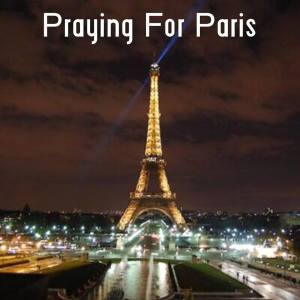 Per the usual in these situations, we see a call to pray, but not for anything in particular. I do pray for Paris; specifically, that they will repent of their insane politically correct policies that lead their people to the slaughter. So, this refugee thing; news is already coming out that these guys came from Syria. Listen, guilt over privilege is no reason to sacrifice our children; ie., we have to let these people in because they aren’t privileged and we are. Really? The conditions of these countries are a cause and effect issue. You worked to be “privileged” in a government philosophy/system that many have given their lives for. Elections have consequences, and political philosophies are not mere opinions, they are matters of life and death. Unfortunately, as one expert noted last night albeit crassly, many more people will have to yet die before people get a grip. However, many, even in our culture, think that we deserve terrorism because of our “privilege.” This is just lovers of death trying to con the lovers of life to embrace their worldview. Pray for that; pray that Paris will begin to choose life.
And this has a personal application as well. Christians call for prayer in difficult situations without any concern for truth and consequences. This is primarily rooted in a worldview that sees God as tolerant of evil, and prayer beckons for Him to do something good that we don’t deserve. It’s a fatalistic mindset. There is no truth or consequences—there is no choosing death over life.
But, in fact, we must continually choose life over death, and do our part on every level of life experience.

 Paul's Passing Thoughts
4 comments