“Grace” is NOT Salvation, and Why Justification is the Antithesis of Sanctification
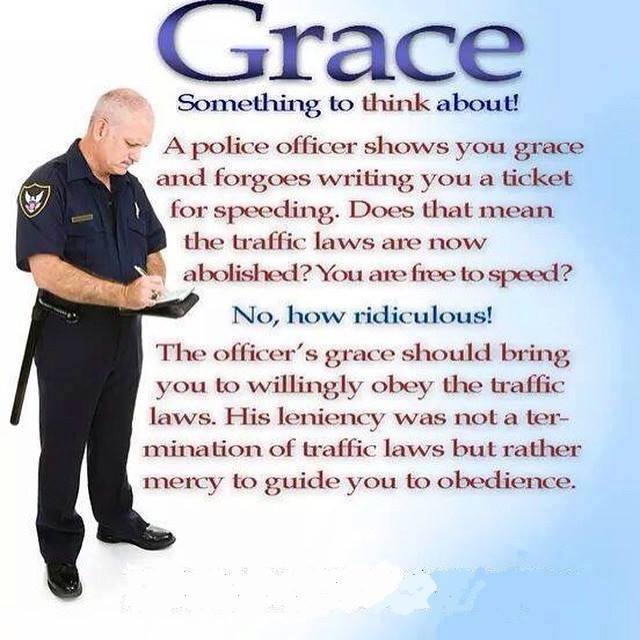 If every verse in the Bible is not about justification, but Protestants believe that, and they do, this will redefine the Bible from cover to cover, and it does. The result is a completely upside down gospel.
For example, the internet placard that inspired this post. How does it define “grace”? Obviously, it defines grace as Christians not getting the punishment they deserve from the “righteous demands of the law.” This “mercy” “guides” you to obedience. But what “obedience”? Well, let me quote the pastor of the person who posted the placard: “You don’t keep the law by keeping the law.”
“You don’t keep the law by keeping the law.” What does that mean in conjunction with “mercy” leading us to this “obedience.” And, do Christians still need “mercy”? According to Protestantism, “yes.” I understand that some Protestants understand this to mean that we are motivated by God’s mercy when we don’t get the punishment that we deserve, but that is a watered down version of the authentic Protestant gospel. And anyway, true Christians no longer need mercy because we are no longer under condemnation; there is “no condemnation” for Christians. But more on the significance of that later.
The crux of the placard and the idea that Christians still need grace is well defined by some comments that were posted in regard to the placard. It starts with the idea that “grace” is synonymous with biblical justification or salvation. And since we still need “mercy” from the law as Christians, we must know how to obtain this mercy leading to keeping the law by not keeping the law. The endeavor is twofold, and exemplified in the following aforementioned comments:
MERCY is when judgement is constrained, and hence is what is being illustrated in this story by the officer letting you off the hook. But GRACE is not that judgement was constrained, but that it was conferred! It’s the picture of the officer, though acknowledging that you were guilty of trespassing the speed limit, determines that he’ll let you go on the premise that he PAID the ticket for you!
And…
What if the police officer decided to jump in the car with you. So every time you drove he’s sitting next to you and just keeps saying don’t worry about speeding I have fulfilled that law. [Viz, I kept the law for you] I’ll whisper to your heart and let you know if you are heading towards the speed limit. I just want to sit and chat with you and get to know you so well that you never ever want to speed again. Because you are forgiven and I love you.
If you think these are armchair theologians, think again. What they are saying is a mirror image of how two heavyweight Protestant theologians stated it in the following video:
What’s the idea here? Since Christians still need mercy from the righteous demands of the law, they must continually receive it by returning to the same gospel that saved them. “Grace” is defined as justification/salvation, so obviously, we must continually return to the same gospel that saved us. To most professing Christians in our day, the idea that Christians still need grace and mercy is a no-brainer and is pontificated with the often-heard, “We must preach the gospel to ourselves every day.”
What is that gospel? It is twofold as exhibited by the two comments. Christ died for our sins which takes care of the penalty of sin (first comment), and then He kept the law perfectly so that His righteousness (perfect obedience) can be imputed to our Christian life. Therefore, as Christians, we continually go back to the salvation well for forgiveness and a righteousness that is not our own. That’s how we keep the law by not keeping the law: Jesus keeps it/kept it for us. The same gospel that saved you also sanctifies you.
Why is this an egregious false gospel? First, we are not under the law for justification. There is no law for Jesus to keep for us. Jesus didn’t come to keep the law for us, He came to end the law… for Justification (Romans 10:4). The fulfilling of the law by Christ does not refer to Him keeping the law perfectly so that His obedience can be imputed to our sanctification.
And “grace” is NOT justification or salvation. “Grace” defines why God saved man; it’s an act of love that expects nothing in return, and of course, we need this same kind of love in our Christian lives, but that doesn’t make our sanctification a progression or specific expression of justification. The love of God is not applied to justification in the exact same way it is applied to our Christian lives (sanctification). Grace, as the reason God justified us (His unmerited love) expects nothing in return because man is utterly unable to justify himself.
However, God also displays His love (“grace” also means “help”) in regard to the purpose for which he saved us: good works…that we actually do in order to please Him. God doesn’t love Himself through us—we are not mere conduits from which God loves Himself; we in fact love God or we do not belong to Him. God’s love towards man in justification has a different application in sanctification. In the former man is completely helpless, in the latter man needs help. Both expressions of love are “grace.”
This is demonstrated by Ephesians 2:8-10…
8 For by grace you have been saved through faith. And this is not your own doing; it is the gift of God, 9 not a result of works, so that no one may boast. 10 For we are his workmanship, created in Christ Jesus for good works, which God prepared beforehand, that we should walk in them.
Grace, or charis, is a Greek word that means “a joyful benevolence.” Actually, the word has a wide variance of applications including, “favor,” “love,” “help,” “dignity,” etc. To define “grace” as synonymous with salvation is inaccurate; grace is the reason God saves, but it is also the reason God does many other things as well. Grace is also the reason that God is our advocate, comforter, co-laborer, and helper in our Christian life. In regard to our Christian life (sanctification), these words are used interchangeably (Heb 13:6, Jn 14:16 Rom 8:26).
Note verse 8: grace is the reason God saved us (John 3:16), but salvation is “the gift.” It is not the result of “works” (v.9), but the result of grace. This is where we have a radical dichotomy between justification (gift) and sanctification (reward). The two are mutually exclusive, and “grace” does not bridge the two. Gift and reward are mutually exclusive. In fact, Hebrews 6:10 says that God would be “unjust” to forget our works in sanctification. Why? Because our works in sanctification is an earned reward that deserves to be recognized. There is no other conclusion that can be drawn from that passage.
The word for “works” in verse 9 is ergon which according to Greek scholar Spiros Zodhiates “stands in direct antithesis” to charis (grace) and the two words are “mutually exclusive” (The Complete Word Study Dictionary, AMG Int. 1992, p.1469). Yet, verse 10 indicates that good “ergon” or works is the purpose of salvation. Salvation is caused by grace, but works is the purpose of salvation. This is why justification and sanctification are mutually exclusive and not bridged by grace. One result of grace is the gift of salvation while the result of the other is reward. Gift and reward cannot be intermingled.
The type and kind of works were predetermined, but we are responsible to “walk” in them with God’s help. In justification, God is a savior; in sanctification, God is a “helper.”
Notice how the professing Christians of our day are obsessed with SIN. Because we are still supposedly under law and need the same “grace” that saved us, our Christianity is obsessed with failure and our dire need for more and more mercy. Life is lived under the cloud of the law, and the focus is how often the holy policemen in the sky does not write a ticket of condemnation.
A pity, because we are not under law and are rather under grace which means we seek to obey God’s law in love. The focus isn’t failure so that we can supposedly glorify God by returning to the foot of the cross, the focus is love which “covers a multitude of sin” (1Pet 4:8). We would sin a lot less if our focus was love, not the expectation of failure under the heavy burden of the law. We are not under the law of sin and death, we are under the law of the Spirit of life (Rom 8:2). We strive to obey that law in love as the primary focus of our life; we dwell on love, not sin.
Moreover, if we glory in more and more mercy that saves us from the law that we are supposedly still under, that will result in a relaxing (lyō) of the law in sanctification that Christ warned us about (Matt 5:19) because after all, we can’t keep it perfectly anyway.
As Christians, our sin is family sin against our Father and can bring chastisement, but it is not sin under the condemnation of the law that requires a return to the same “grace” that saved us. That’s a false gospel. That’s under law, NOT under grace.
So, you do in fact keep the law by keeping the law, because that’s love.
paul
Redemptive-Historical Hermeneutic – A Classic Example
 I came across an “interesting” blog article the other day. It appeared in my Facebook newsfeed because someone on my friend list commented on it when one of his friends shared it. Of course, since I am not friends with the one who originally shared it, I was unable to add my comment, thus the inspiration for this article today.
The title of the blog article in questions is, “If we sin, do we lose our salvation?” That mere fact that such a question is still posed in Christianity is indicative of just how biblically illiterate most Christians are. The fact that authors such as this one still address this question in the manner that he does is even more disturbing.
Before even addressing the issue of whether one can lose one’s salvation, the author begins his article by citing Jesus’ example of the two house builders found in Luke chapter 6. Let’s take a look at this passage ourselves before we move on.
47Whosoever cometh to me, and heareth my sayings, and doeth them, I will shew you to whom he is like: 48He is like a man which built an house, and digged deep, and laid the foundation on a rock: and when the flood arose, the stream beat vehemently upon that house, and could not shake it: for it was founded upon a rock. 49But he that heareth, and doeth not, is like a man that without a foundation built an house upon the earth; against which the stream did beat vehemently, and immediately it fell; and the ruin of that house was great.
Luke 6:47-49
Clearly, Jesus is using a metaphor, but to properly understand the metaphor we must ask ourselves, what is the context of this passage? It should be apparent that the context is a contrast between two kinds of individuals. One kind is an individual who hears AND does. The second kind is an individual who hears only. The parallel passage in Matthew 7 goes even further in marking this contrast.
24Therefore whosoever heareth these sayings of mine, and doeth them, I will liken him unto a wise man, which built his house upon a rock: 25And the rain descended, and the floods came, and the winds blew, and beat upon that house; and it fell not: for it was founded upon a rock. 26And every one that heareth these sayings of mine, and doeth them not, shall be likened unto a foolish man, which built his house upon the sand: 27And the rain descended, and the floods came, and the winds blew, and beat upon that house; and it fell: and great was the fall of it.
Matthew 7:24-27
The individual who hears AND does is considered wise. The one who hears only is considered foolish. Herein is the point of this whole passage: the emphasis on hearing AND doing, which is considered to be wise. But please notice what the blog author chooses as his focus:
“Building a house is very similar to one’s experience as either a Christian believer or an unsaved nonbeliever. That is why Jesus drew a comparison between the two (Luke 6:47-49). If you start out with a good foundation that is level and built on solid ground, you can confidently add on walls and flooring and a roof and every other component that makes up a house, and be certain that, because the foundation is sound, the house will be sound. But if you lay a poor foundation that is uneven and shaky, the rest of the house will follow and all the components that are built on that poor foundation will be compromised. To have a soundly constructed house, you must have a good foundation; to have a rock-solid Christian faith, you must build it on foundational truth.”
This is one of the most intellectually incompetent and dishonest uses of the two builders that I have ever seen! This example from scripture has nothing to do with “foundations”. It has everything to do with wisdom and sanctification. The author completely ignores the part about wisdom in both hearing and doing and instead engages in what I call “spiritualizing the analogy”, making it about justification instead. He has interpreted this passage in the so-called “proper gospel context”. This is what happens when you interpret scripture using a redemptive-historical hermeneutic. Spiritualizing the analogy makes a false application of a metaphor that was never intended. It is a logical fallacy. Let’s examine what I mean by this.
If I am given the logical premises that A=B and B=C, I can logically conclude that A=C. This is the logic of the example of the two house builders.
A = B Hearing and doing = a wise man
B = C A wise man = building on a rock (a good foundation)
therefore
A = C Hearing and doing = building on a rock (will make one strong; i.e. aggressive sanctification)
The same holds true for the foolish man.
A = B Hearing only = a foolish man
B = C A foolish man = building on sand (a poor foundation)
therefore
A = C Hearing only = building on sand (will make one weak; i.e. little or no sanctification)
A metaphor makes no sense in and of itself. It has no relevance outside of the initial truth that it represents. If Jesus had only said, “Make sure you build on a rock foundation and not a foundation of sand,” that would have made no sense whatsoever. But Jesus clearly stated that hearing and doing is wise, and He further emphasized that point by using the analogy of building on a rock. Notice also that a correct logical progression in thought results in the proper application of the conclusions. One can reasonably conclude that this not a salvation passage but rather a sanctification passage for believers.
That is the proper meaning and intention of this passage. Contrast that with what the author did in the article. He took the metaphor all by itself and made it say whatever he wanted it to say in order to make his case. And what is his case?
“If you believe that Jesus Christ died on the Cross to pay for your sins, and turn to God in repentance of your sins, then you will be saved… This does not mean that after this occurs, you will never sin again, or even that you will not commit the same sin repeatedly. It means that your heart has been changed toward sin so that you can now see it for what it is… Fortunately, for Paul and for you and for me, that question has a definitively glorious answer: ‘Thanks be to God, who delivers me through Jesus Christ our Lord!’”
Plain and simple, this is progressive justification. Notice it is an ongoing deliverance, not a onetime deliverance. So, then the question remains, what do we have to do to keep the deliverance going? Well, we repent, and that saves us, BUT we still sin. So what? Well, the “so what” is that we need perpetual saving by Jesus. This is what Paul David Tripp and Tim Keller and John Piper call a “daily rescue.” This is Luther’s theology of the cross, a perpetual mortification and vivification.
This is the very reason why the emphasis on the hearing AND doing is ignored. For us “to do” would be works, at least in this construct, if this were a passage on justification and not sanctification. We must live by “faith alone” and not build on the wrong “foundation.” We can only “experience” what it is to have the right foundation, because for us to try and work and build is building on the wrong foundation which is the reformed definition of the “unsaved”. But justification is a finished work. There is nothing we can do to add to it. Because it is finished, we can aggressively “do” the things we “hear” taught to us in the Word. Time and time again, the scriptures equate for us doing good with life and doing evil with death. Good = life = wise. Evil = death = foolish. When it comes right down to it, this really isn’t that hard to figure out.
Andy
I Always Do Dr. J’s Homework
 Originally published August 8, 2010
In another recent post by Dr. Jay Adams, he seems to once again allude to the doctrine of the evil twins (Dr. Jay’s Hopeful Post and the Evil Twins). The post I am referring to can be viewed here.
Let me begin with this quote from his post:
“Others are confused because of the recent revival of an old error: confounding Justification by faith with Sanctification by the work of the Spirit. The Spirit works His fruit in us by enabling us to understand the Word, by giving us the desire to obey it, and by enabling us to do so.”
Dr. J further explains:
“In the revival of this teaching, passages that speak of justification by faith are related to sanctification.”
Yes, there are many examples of this. He then relates how this can affect counseling:
“As a result, instead of encouraging Christians to obey God’s admonitions in the Bible, they are told that they can’t do so, and that—in one way or another (not everyone agrees how)—God must do it to them, for them, instead of them.”
Then he continues with a suggestion for those counselors who are fortunate enough by the grace of God to get a second crack at those who have been counseled that way, unlike many that I know who have had their faith shipwrecked by this teaching:
“When meeting up with those who have been taught this sort of thing in your counseling, and who are confused because it ‘didn’t work,’ you should ask them to do something like the following:
- List all of the commands in 1 Corinthians (for instance).
- Write down how many times Christ, the Holy Spirit or the Father is the One Who is thus commanded.
- The write down how many times you (or the Corinthians, if you will) are commanded to do them.
Well, when I was in counseling some time ago, I was given a lot of Jay’s homework assignments from his various books by a guy who I hope is not being deceived by the doctrine of the evil twins. But since I did all of the homework assignments, when Jay posted this one, I just couldn’t resist. So, in the following list, I document all commands from 1 Corinthians and answer questions 2 and 3. This should make it much easier for any counselor or counselee who actually wants to follow through with Jay’s suggestion, and share the results with him ( feedback@nouthetic.org ) However, remember, this would not even include instruction or commands that are implied through Paul’s informative teaching.
Also, the list creates huuuuuuge problems for the four pillars of Gospel Sanctification (not necessarily what Jay is speaking of here, but very similar; could just be a doctrinal evil twin); namely, New Covenant Theology, heart theology, Christian hedonism (wouldn’t JC Ryle love that one?), and redemptive historical hermeneutics. I will be posting in the near future on why these verses do extreme violence to the GS doctrine. But, if someone wants to help me out with some examples, I would appreciate it. Post them in the comment boxes.
So, here’s the list, hope it helps: (more…)
So Far, This is What I Know by Andy Young
So far this is what I know:
- Belief in Jesus = belief in God (Matthew 10:32-33; Mark 8:38; Luke 9:26; John 5:23, 24, 38-47; 6:29; 8:19, 42, 49, 52; 10:25, 38; 14:7 [actually, just about all of John 14!]; 15:23; 16:3, 27)
- Belief in God = righteousness = justification (Romans 3:21-26; Romans 4:3, 5, 11, 20-22; 9:30; 10:4, 10; Galatians 3:6; Philippians 3:9; Hebrews 11:4, 7; James 2:23)
- Righteousness = justification = new birth (John 5:24; 1 John 2:29, 2 Corinthians 5:17; Galatians 6:15; Colossians 3:10, 1 Peter 1:23, 1 John 3:9)
- New Birth = ending of the law (John 5:24; Romans 6:14; 10:4)
- Ending of the law = no condemnation (John 3:18; 5:24; Romans 4:15; 5:13; 8:1)
- No condemnation = freedom to show love by obedience to the law in sanctification. (John 13:34; 15:12; 15:17; Romans 8:2; 12:10; 13:8, 10; 14:13; Galatians 5:1, 13, 22-26; 6:2; Ephesians 4:1-2, 28-32; Colossians 3:10-17; Titus 3:7-8; Hebrews 10:22-24; James 1:22-25; 1 Peter 1:22; 2:13-16; 1 John 3:11, 14, 22; 4:7; 2 John 5)
There may be a few more steps in there (and these references are by no means exhaustive), but that’s pretty much the gist of it.
Andy
Basic Principles of Sanctification
1. Sin and weakness are not the emphasis, love is. 1Peter 3:8
2. No fear in regard to justification or condemnation; fear of consequences in sanctification. James 5:9, Philippians 2:12,13, 1John 4:16-19
3. We are truly righteous and good. 1John 3:9, Romans 15:14
4. Rewards for obedience in this present life. Philippians 4:9
5. Justification is a gift, we earn rewards in sanctification. Hebrews 6:10
6. Obedience is love. John 14:15
7. The Holy Spirit is our HELPER, not one who obeys for us. John 14:16
8. Sanctification is NOT a rest. Galatians 5:7, Hebrews 4:9-11
9. Our soul is saved, we await the redemption of the body. Romans 7:24 (“wretched” means: one who is persevering in affliction, NOT personal wickedness). Also Romans 8:23
10. Prayers can be hindered by disobedience. 1Peter 3:7
11. Strive for a clear conscience. Acts 24:16
12. You become enslaved to what you obey. Romans 6:16
13. Sanctification is wisdom for controlling your body. 1Thessalonians 4:3
14. We are resurrected to a reward, not a judgment. Luke 14:14
15. We use the body for Holy purposes: Romans 12:1
16. We desire what we invest in. Matthew 6:21
17. Scripture application to life leads to a life built upon a rock. Matthew 7:24-27
18. Those who do good love life. 1Peter 3:10-12, Psalms 34:12-16
19. The power is in the doing. James 1:25
20. Learning to hate evil and love good. Romans 12:9
21. Practice of truth leads to more understanding. John 17:17, Hebrews 5:14
22. Adding biblical truth to our lives bolsters a feeling of assurance. 2Peter 1:10
23. Our goal is a rich entry. 2Peter 1:11
24. Sin uses desire to tempt us. We must define sinful desires versus godly desires. James 1: 14
25. Teachers are a help, but not efficacious to individual learning. 1John 2:27
26. There is only one judge that we are individually accountable to. Romans 14:12
27. Put off the old habits of the dead you, learn the ways of the new man, and apply them to life. Ephesians 4: 20-24
28. Our practice is “true” righteousness—it is really us doing it. We are “truly” righteous beings. Ephesians 4:24
29. Faith works through love in sanctification. Our faith doesn’t work for salvation of the soul, it works for love. Galatians 5:6
30. Our ultimate goal is the new heavens and new earth. This is the full consummation of The Promise. 2Peter 3:13
31. All three Trinity members help us in our sanctification. Philippians 2:12,13, John 14:16
32. Our sanctification is powered by the same power of the Holy Spirit that raised Christ from the grave. Ephesians 1:18-20
33. Some things are a mystery, but we are individually responsible to learn and obey the majority of Scripture. Deuteronomy 29:29.

 Paul's Passing Thoughts
leave a comment