Horton’s Systematic Theology Adds To The Sonship/Gospel Sanctification Massive Subculture: Revised
[NOTE: This was written before I discovered that New Calvinism is in fact the same gospel that the Reformers taught. The resurgence movement began as COG in 1970, became Sonship circa 1986, Gospel Transformation in 2000, dubbed Gospel Sanctification by detractors in 2007, and finally New Calvinism in 2008. This was also written before I understood that orthodoxy is a part of spiritual caste in general].
“Gospel Sanctification, as Sonship is now called, will begin to totally rewrite orthodox Christianity” [Note also that I no longer equate “orthodoxy ” with truth per se].
[Further revision: much has been learned since this post, but the general idea is very accurate: the Neo-Calvinist movement is seeking to develop a subculture within American culture that will eventually, if all goes as planned, devour American culture as we know it. This is part and parcel with Calvinism’s dominion theology. This post submits a sketchy framework of useful categories under the general idea. For instance, one college that focuses strictly on the Neo-Calvinist vision is a far cry from the fact that this movement owns (in an intellectual capacity) most of the seminaries in America. Other categories could be added as well, e.g., Christian publishing ].
The Fix is now in. The false doctrine of the centrality of the objective gospel (COG) which found new life in Sonship Theology about thirty years ago—now has its own theology, hermeneutic, practical application, defined experience, ecumenical (inclusiveness) movement, history, college, counseling organization, missionary organization, Bible—and now, its own systematic theology. Gospel Sanctification (GS), as Sonship is now called, will begin to totally rewrite orthodox Christianity. It won’t be long; those who we minister to will have to be deprogrammed before we can help them, starting with convincing them that the Bible is to be taken as literal instruction from God as our authority for ministry and life. Not understanding GS beforehand will make any attempt to help people with the word of God—dead on arrival.
GS Theology
The movement started with a very powerful concept in the minds of its perpetrators. Supposedly, we grow spiritually by revisiting the gospel that saved us every day. Proponents were convinced (and still are) that this thesis stands alone as truth; therefore, all other propositions must bow to it.
The GS Hermeneutic
A literal interpretation of Scripture will continually contradict GS. So, the proponents have changed how we read/ interpret the Bible accordingly. The GS hermeneutic is an interpretive prism that will always yield results that make GS plausible. Unlike the rest of the elements (which are very contemporary), the hermeneutic (known as Biblical Theology or Redemptive-Historical hermeneutics) was borrowed from times past. It originated in Germany under the liberal teaching and writings of Johann Philipp Gabler (1753-1826), who emphasized the historical nature of the Bible over against a “dogmatic” interpretation thereof. Nearly a century later, Geerhardus Vos (1862-1949) was instrumental in taking the discipline of biblical theology in a, supposedly, more conservative direction. Graeme Goldsworthy tweaked the doctrine to facilitate COG, and today, Goldsworthy’s “Trilogy” is the pillar of interpretation within the movement.
Practical Application
The GS narrow approach to sanctification must be embellished and applicable to life in some way in order to be sold. This is Heart Theology, and was developed through David Powlison’s Dynamics of Biblical Change at Westminster Seminary. In 1996, two former students of Powlison articulated Heart Theology in a book entitled, “How People Change.”
Defined Experience
John Piper seeks to articulate how Sonship is experienced via Christian Hedonism. Because GS makes our works and the work of the Spirit an either/or issue, someone needed to develop a thesis that explained how the difference can be ascertained. John Piper answered the call with the development of Christian Hedonism.
Ecumenical Bent
GS now encompasses any group that agrees with its primary view of plenary monergism and the synthesis of justification and sanctification. All other disciplines are seen as secondary and irrelevant to fellowship and joint ventures. The Gospel Coalition (holding national conferences on odd years, 2011, etc.), and T4G (Together For The Gospel, holding national conferences on even years) work together to promote GS/S while promoting inclusiveness among denominations and religions.
History
GS proponents claim a historical precedent dating back to Creation, and also claim to be the second part of the first Reformation. Of course, this is laughable. Sonship, the Antioch school, TGC, T4G, NCT, CH, and HT have no historical precedent prior to 1970. Many of the notable proponents of GS are associated in some way with the father of Sonship Theology, Dr. John “Jack” Miller. Tim Keller and David Powlison were followers of Miller. Paul Tripp and Timothy Lane are followers of David Powlison. Jerry Bridges attributes his view of the gospel to Miller as well.
College
The Antioch School of leadership training has GS as its foundation and basis for training. It is located in Ames, Iowa.
Counseling Organization
The upstart Biblical Counseling Coalition, which seeks to network other counseling organizations as well, is intimately associated with T4G and The Gospel Coalition. The who’s who of Gospel Sanctification sit on its governing board including David Powlison and Paul David Tripp.
Missionary Organization
It’s primary missionary organization was founded by the father of Gospel Sanctification / Sonship—Dr. John “Jack” Miller. Banner of Truth states the following in The Movement Called Sonship: “Miller encouraged New Life Presbyterian Church into originating the ‘World Harvest Mission’, a non-denominational missionary organization. Sonship became its main teaching vehicle.”
Bible
The English Standard Version (ESV) was first published by Crossway in 2001. Its vice president of editorial is Justin Taylor who also authors The Gospel Coalition Blog, the multimedia propaganda machine for GS doctrine. One of the translators was Wayne Grudem, also well known as a major proponent of GS doctrine. The ESV’s GS connection has made it the most purchased English Bible in the past ten years. The latest promotion of the ESV by Crossway, “Trusted: Trusted Legacy [a whopping ten years]; trusted By Leaders; Trusted For Life,” features an endorsement by the who’s who of GS doctrine.
The Complete Fix
With Michael Horton’s recent publication of “The Christian Faith: A Systematic Theology for Pilgrims On the Way” (2011), the total fix is in place. The GS machine will now begin to move forward—rewriting and re-forming orthodox Christianity. I confidently predict that Horton’s book will be widely used in seminaries nationwide. Seminary students will be pumped into the local churches with a skewered view of truth—but using all of the same terminology that was formally orthodox.
What Can Be Done?
This doctrine thrives on the fact that Christians are theologically dumbed-down. If most Christians do not know the difference between justification and sanctification (and they don’t), they are helpless against this false doctrine. If most Christians don’t realize the importance of understanding hermeneutics (and they don’t), they are even more helpless. Local churches need to start in-doctrine–ating their people.
paul
Forget the Election Debate; Calvinism is a False Gospel
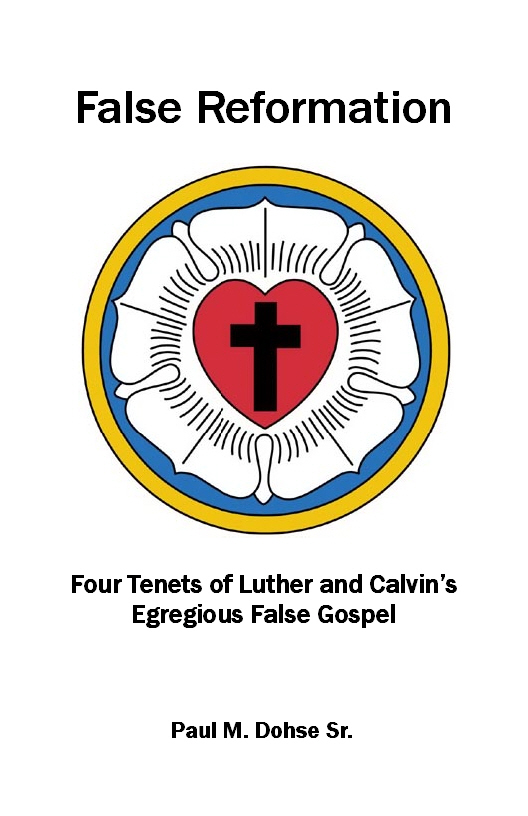 Perhaps the only book in existence that challenges the Protestant Reformation gospel in regard to doctrinal soundness. This book presents its case that the Reformation gospel is progressive justification, and that its major tenets such as total depravity extend to sanctification as well as justification. The total depravity of the saints? The book also explores the Reformation’s impact in regard to understanding the new birth.
Available on Amazon by these sellers: http://www.amazon.com/gp/product/1616588438
Calvinism’s Platonist Rejection of the Trinity
 How do Calvinists reject the Trinity? Basically, they make God the Father and the Holy Spirit lesser forms of Jesus Christ. Their rejection of the Trinity is based on Plato’s theory of forms. This shouldn’t be any big surprise as one of the forefathers of the Reformation, St. Augustine, was a Plato groupie. My wife Susan will address the Plato/Augustine love affair in significant detail at this year’s TANC conference.
Plato’s basic idea of forms led to the Reformed Emphasis Hermeneutic, also known as the Redemptive Historical Hermeneutic. Plato’s trinity was the good, the true, and the beautiful, and all other forms, or solid matter if you will, are lesser forms of the true form. In one sense, Calvin believed that Jesus Christ brought the two together, but that is a philosophical angle we will not pursue here because other manifestations of this heresy are more plainly and easily seen. Calvinists merely make Jesus Christ the full expression of the good, true, and beautiful while representing the other members of the Trinity as lesser forms.
Hence, Jesus Christ, and His works become the stargate to all understanding of reality. The “gospel” is a term that encompasses the personhood of Christ and His works—this is the gateway to understanding ALL reality. The saving act (singular) of Jesus Christ is not something done in history as part of the Trinity’s plan to reconcile them to mankind, but is the key to understanding all reality. Therefore, many Calvinists refer to the “saving acts” (plural) of Christ and His personhood as keys to understanding. The Bible is therefore 100% about the gospel i.e., the personhood and works of Christ. More on this further along.
This is abundantly evident via the everything Jesus mentality of today’s churchianity. The books, the sermons, and the music are everything Jesus. This is why; it is a Protestant family tradition set on fire by the Neo-Calvinist movement. And it all begins in a galaxy far, far away known as Western philosophy. Calvin notes the following in his Institutes of the Christian Religion:
For this reason Augustine [who he quotes on average every 2.5 pages in the Institutes], treating of the object of faith (De civitate Dei lib. 11 c. 2), elegantly says, “The thing to be known is, whither we are to go, and by what way”; and immediately after infers, that “the surest way to avoid all errors is to know him who is both God and man, It is God we tend, and it is by man we go, and both of these are found only in Christ.
Therefore, supposedly, the “only” sure way to avoid error is to focus on Jesus Christ only, the idea that spiritual reality and physical reality are only seen in Christ notwithstanding. A clearer way to see how this all fleshes out is in the first tenet of New Covenant Theology which is a spinoff of Neo-Calvinism:
New Covenant Theology insists on the priority of Jesus Christ over all things, including history, revelation, and redemption. New Covenant Theology presumes a Christocentricity to the understanding and meaning of all reality.
Considered to be the foremost authority on Reformed hermeneutics in our day, Graeme Goldsworthy stated the following on page 48 of Gospel-Centered Hermeneutics (InterVarsity Press 2006):
If the story is true, Jesus Christ is the interpretative key to every fact in the universe and, of course, the Bible is one such fact. He is thus the hermeneutic principle that applies first to the Bible as the ground for understanding, and also to the whole of reality.
Calvinism concurs. ALL reality is Chrsitocentricity. The gospel is a stargate to the pure form of the good. Geoffrey Paxton, an Anglican theologian and authority on the Reformation, stated the following on page 41 of The Shaking of Adventism (Baker Book House 1978):
Christ alone means literally Christ alone, and not the believer. And for that matter, it does not even mean any other member of the Trinity!
This statement is both shocking and representative of Reformed trinitarian thinking. Paxton is absolutely right, Solus Christus means just that. Another way of understanding this is via the solar eclipse. This is the most popular example of how Christ must be the gateway to pure understanding. Christ is the Sun, the life-giving rays of light. To let anything obscure that light, no matter what it is—is to deprive ourselves of wisdom and life to that degree. When we let objects, even objects that are factual and true obscure Christ, we are “living in the shadows.” This is the theses of longtime John MacArthur confidant Rick Holland’s book, Uneclipsing The Son. The book is a Platonist/Gnostic treatise that is not even ambiguous. On page 11, Holland writes that the book of James presents Christ as the “rule and standard of all spiritual instruction.” On the same page, Holland asserts that Christ is the “one true God” and then cites five Scripture references that say no such thing.
John MacArthur wrote the Forward to Holland’s book being presently considered, and made these statements:
Rick Holland understands that truth. This book is an insightful, convicting reminder that no one and nothing other than Christ deserves to be the central theme of the tidings we as Christians proclaim—not only to one another and to the world, but also in the private meditations of our own hearts.
The pastor who makes anything or anyone other than Christ the focus of his message is actually hindering the sanctification of the flock.
No greater subject exists than Jesus Christ–no greater gift can be given than uplifting His glory for another soul to see it and be changed by it. This book will be a wonderful help to anyone who senses the need to orient one’s life and message properly with a Christ centered focus. It is full of fresh, practical, and memorable spiritual insight that will show you how to remove whatever obstacle is blocking your vision of the Son and allow His light to blind you with joy.
Christ, while praying to the Father, referred to the Bible as “your word” and “your word is truth” (John 17:17). We pray to God the Father, not Christ, and we baptize in the name of all three Trinity members. The Bible is not Chrsitocentric. The Bible has many major themes. The father of our faith looked for “a city built by God.” This contradicts the plain sense of Scripture, which brings me to my next point.
The Redemptive Historical Hermeneutic calls for a contemplation on Christ and His works only, or the gospel, and a logical conclusion drawn from the formation of verbs, nouns, adjectives, prepositions, etc., must be disregarded for a Chrsitocentric conclusion or a “truth” that “shows forth the gospel.” In the aforementioned book, on page 39, Holland has the audacity to make the following statement under the heading “When Bad Grammar Makes Good Theology”: “The rules of grammar are intended to be guardrails for communication. But sometimes they prevent it.” Insinuated is the idea that Christ’s greatness transcends mere grammatical rules, and therefore, one must break those rules to communicate how consumed our life must be with Christ.
A good example of this is a statement by Paul David Tripp on page 27 of How People Change (Punch Press 2006). Tripp acknowledges that the Bible in-fact does state that we should apply biblical commands to our life, but to take that literally, and not in its “Christ-centered gospel context” (p. 26) is to “omit” Christ in our life as “Savior.” Therefore, a literal approach to the Bible harkens to works salvation. The results of this can be seen in this approach to preparing Bible lessons:
At this time, resist the temptation to utilize subsequent passages to validate the meaning or to move out from the immediate context. Remembering that all exegesis must finally be a Christocentric exegesis.
Look for Christ even if He isn’t there directly. It is better to see Christ in a text even if He isn’t, than to miss Him where He is (Biblical Theological Study Center: A Christo-Presuppositional Approach to the Entire Scriptures; Max Strange. Online source: http://goo.gl/5sGjP).
Another authority on the Reformation, Robert Brinsmead, states this perspective concisely:
That which makes the Bible the Bible is the gospel. That which makes the Bible the Word of God is its witness to Christ. When the Spirit bears witness to our hearts of the truth of the Bible, this is an internal witness concerning the truth of the gospel. We need to be apprehended by the Spirit, who lives in the gospel, and then judge all things by that Spirit even the letter of Scripture (Brinsmead, Robert D. ”A Freedom from Biblicism” in The Christian Verdict, Essay 14, 1984. Fallbrook: Verdict Publications. Pgs. 9-14).
In other words, the meaning of Scripture according to the letter [i.e., logical interpretations from the grammatical construction] must be judged by “that Spirit” which “lives in the gospel.” All bets are off concerning any interpretation that seems to be the plain sense of the text.
Moreover, New Calvinists take this concept dangerously close to disparaging God the Father. In the book here cited by Holland, he suggests that Christ saved the world from God. In fact, the heading on page 23 reads, “Saved—From God.” So, apparently, hell is a God the Father sort of thing. On page 43 and following, Holland presents God as “our most pressing problem.” And, “man’s greatest problem is God, God Himself.” And of course, it’s Christ to the rescue, right?
Though few would reject the idea that Christ saved us from God’s wrath, it’s hardly the whole story and promotes the subtle New Calvinist goal of making Christ more significant than God the Father. Holland gives no Scripture references for this concept of Christ saving us from God because there isn’t any. God was just as involved in the salvation solution as Christ was, and Christ is also a God of wrath just as much as the Father is (Rev. 6:16,17 and 19:11-16). This whole concept is a subtle, but dangerous distortion. At the very least, making a strict dichotomy that associates wrath with God and salvation with Christ is ill advised and smacks of Marcionism.
Holland is hardly alone in this approach among New Calvinists. Paul Washer suggested to an audience of European college students that the goodness of God is man’s biggest problem (Online source: http://wp.me/pmd7S-1A3). At any rate, a standalone dichotomy of wrath versus love associated with Christ and the Father that is unqualified, is a concept that should make Christians very uncomfortable.
Calvinism promotes a Platonist-like distortion of the Trinity. It shouldn’t surprise us as the Plato/Reformed love affair is well documented. New Calvinists in our day even sport ministry subtitles with Platonist themes: “Between Two Worlds,” “Between Two Spheres,” and in regard to Plato believing that pure truth is static, “Truth Unchanging.”
Like all cultic false religions throughout history, they distort and therefore reject the Trinity.
paul
ADDENDUM
Calvin presented the priority of Christ over the other two Trinity members in the following way as explained by Mark Driscoll associate Justin Holcomb:
According to Calvin, the object of faith’s knowledge is Jesus Christ. He defines faith by proceeding to the center of a series of concentric circles: God’s existence, God’s power, God’s truthfulness, God’s will “toward us” as revealed in Scripture, and finally Christ. All these circles are implied in faith, but only the last is properly understood as the object of faith. Calvin goes so far as to say that those who say that God is the proper object of faith “rather mislead miserable souls by vain speculation, than direct them to the proper mark” (Institutes III.2.i). Christ as mediator is necessary if humans are to know God. Christ is not set over against God. Rather, Calvin asserts, Christ is the means—the only means—by which we can believe in God (Online source: http://theresurgence.com/2009/07/10/calvin-on-faith-christ-and-his-gospel).
ADDENDUM
One might consider the ruckus that was created over my suggestion that salvation involves all members of the Trinity and not Christ alone. I think this is telling. The following is a reprint of the controversy on Pastor Joel Taylor’s blog that resulted from some comments I had made on that subject:
5 pt salt .com
JUSTIFICATION IS NOT OF CHRIST ALONE
POSTED BY JOEL TAYLOR ON DECEMBER 15, 2011 IN GENERAL | 24 COMMENTS
I’m not even sure I like the title of this post. Not because it’s not true, but because it’s confusing.
Let me explain.
A few days ago I posted this piece promoting the book by Paul Dohse entitled The Truth About New Calvinism: It’s History, Doctrine, and Character. It’s worth reading. In fact, I think his book is an important one, and yes, I highly recommend you get it.
But, of course, not everyone feels that way.
Yesterday, after reading that post of mine, one 5ptsalt reader left this comment to me regarding Dohse and his book:
I’m pretty shocked you are promoting this book. Taking a peak inside reveals some pretty far out stuff. Just one example:
“First, justification is not by Christ ALONE. If God didn’t elect Christ, elect the elect, and draw them to Christ, along with sacrificing His only Son, what Christ did would have been for naught. So, justification is not by Christ alone.”
Buyer beware. This is dangerous stuff.
Well brethren, don’t be shocked that I promote this book. Be glad. And for you buyers, no need to beware.
Dohse is Right
Fact is, Paul Dohse is spot on, and even though he doesn’t need me to defend his statements, this reader’s comment gives us the opportunity to look at Scripture and, hopefully, instruct all of us. As Martha Stuart is apt to say, “That’s a good thing.”
See, it’s always important to look at statements in their proper context, a practice often overlooked and disregarded in the heat of defending what one is doctrinally comfortable with. But we need more importantly to examine all things in light of Scripture, it being – yes, I’m saying it again – the final authority in all things.
This comment by Dohse can be found from this post [link] of his which itself is a response to a series of questions by one of his readers. Here’s the question of the reader, followed by Dohse’s response:
Q: You have raised many issues in the last post that would take a book to answer. If I may, I would like to ask a few questions that might help us to clarify the issues on which we disagree. First, I want to state a couple of points on which I think we agree. Incidentally, I am convinced Piper and others would also agree.
…….
2. Justification is based on the work of Christ alone and our works do not contribute to it at all.
…..
Dohse responds to the second point:
2. First, justification is not by Christ ALONE. If God didn’t elect Christ, elect the elect, and draw them to Christ, along with sacrificing His only Son, what Christ did would have been for naught. So, justification is not by Christ alone.
Now, as I said earlier, Dohse is right. In fact, spot on. Here’s why: In a nutshell, it took all three persons of the Trinity to accomplish our justification. Father, Son and the Holy Spirit. If one dogmatically asserts that the Son alone is responsible for our salvation, including our justification, such a statement is clearly, from the Biblical testimony, an error.
Yes, the basis of our justification is the finished work of Christ alone, apart from our own works. That is true. Yet Dohse is merely pointing out the fact that unless the Father had predestined some to salvation, there would be none. The Father sent the Son to redeem us. The Holy Spirit works in us to make us holy. So Dohse is pointing out the involvement of the Trinity in our complete salvation. Although the basis for justification is Christ alone, there would be no justification without the involvement of all three persons of the Trinity in our redemption.
First, let’s give a simple definition of what justification is. Be sure and learn this, I implore you. When this is learned, hopefully, much confusion will be dismissed altogether.
Justification Defined
Justification is a declaration from the throne of God the Father concerning our legal status before His law. It is a single act, occurs one time, is never again repeated and is definitely not a process.
God the Father is the Author and Origin of Our Justification:
since indeed God who will justify the circumcised by faith and the uncircumcised through faith is one. – Romans 3:30
But to the one who does not work, but believes in Him who justifies the ungodly, his faith is credited as righteousness, – Romans 4:5
and these whom He predestined, He also called; and these whom He called, He also justified; and these whom He justified, He also glorified. – Romans 8:30
By the way, who predestination the elect unto salvation? Jesus Christ the Son? No! God the Father predestination us, according to Scripture. You see, it is God the Father who makes the declaration of justification, so to think justification is of Christ alone, well, that is simply not a biblical position.
Blessed be the God and Father of our Lord Jesus Christ, who has blessed us with every spiritual blessing in the heavenly places in Christ, just as He chose us in Him before the foundation of the world, that we would be holy and blameless before Him – Ephesians 1:3-4
Who will bring a charge against God’s elect? God is the one who justifies; – Romans 8:33
When anyone objects to statements like “Justification is not by Christ alone”, I would suggest one needs to pull back, calm down, and search the Scriptures and strive towards of a biblical understanding of precisely what justification is, a declaration from God the Father.
Brethren, I hear far, far, far too much praying for the Holy Spirit to “come down” and manifest Himself. I strongly object to such, and I would encourage pastors, and elders who are allowing such to continue to rethink what they are encouraging.
Listen. The Holy Spirit, third person of the Trinity, points us to Christ, not to Himself, and does not anywhere in Scripture ask us to ask more of Him! (John 16:13, 14).
Listen again, please. Christ Jesus points us to the Father! He is the way to the Father, not just to Himself! John 14:6.
Look at Ephesians 2:18, 19 brethren, and for all you New Calvinists, contemplate this:
for through Him we both have our access in one Spirit to the Father. So then you are no longer strangers and aliens, but you are fellow citizens with the saints, and are of God’s household
Now, why do so many focus only on the Son? For you to be redeemed, it took the entire Trinity, the triune Godhead, in perfect agreement together regarding a predestined, glorious plan of redemption of those given by the Father to the Son by the work of the Holy Spirit.
Sonship theology, indeed. Paul Dohse is right, because Paul Dohse is listening to God’s written Word, not the latest guru of truth.
Brethren, in love, I ask you not to ignore two members of the Trinity. Christianity is not wearing a Calvinistic t-shirt, boasting of your reformed views, and getting people to contemplate on the Gospel more.
That is utterly absurd. It is ignoring the whole counsel of God. This business of “Gospel sanctification” and Sonship theology is a dangerous – and exceedingly popular movement. And it is a movement that endangers souls.
So get that book, read it, be alert, and learn and be aware of anything and anyone who, in your heart, trumps the Word of God. May we all strive to better acknowledge the final authority of God’s Word, and rest our beliefs on its veracity alone.
24 COMMENTS
JOSHUA
DECEMBER 15, 2011
Did you believe this before Dohse made his statements or did he lead you to this understanding?
REPLY
ELLEN
DECEMBER 15, 2011
What then are we to think about the following scripture, relating to the reasoning in this post? In the beginning was the Word and the Word was with God and the Word
was God. John 1:1
REPLY
JOEL TAYLOR, PASTOR-TEACHER POST AUTHOR
DECEMBER 15, 2011
You should think that Jesus was in the beginning, eternal, and was with God, with God the Father, God the Holy Spirit, and was/is God Himself, and created all things, and all things are upheld by Him, for Him and through Him.
REPLY
JOE
DECEMBER 15, 2011
I like John 3:16
REPLY
JOHNDUNNINGUK
DECEMBER 15, 2011
I believe that if we are to truly accept the doctrines of grace as being true, we cannot do so sincerely, and yet fail to understand the crucial role that all three Persons of the Godhead play in our salvation.
In covenant theology, there is a sense whereby that which we know as the covenant of grace, flows directly out of an agreement within the Godhead made before creation, known as the counsel of peace, and sometimes as the covenant of redemption.
It was in this coming together of the Godhead to form a plan of creation, redemption and salvation, that each Person of the Godhead took upon their role. (I realise this is a pretty poor description on my part, so please excuse me). Each Person of the Godhead being indispensible to the other, and the faithful work of each Person, utterly vital for the plan of salvation to succeed.
Although I can sort of understand peoples reaction to this post generally, I have to agree that I think it more emotional than intellectual. It is undoubtedly true to say that there is absolutely no sacrifice for sin that is acceptable to God, other than Christ. However it would also be true that without the sovereign election of the Father, giving a people to His Son to redeem through His own blood, His sacrifice would be for nought. And were it not for the Holy Spirit, sealing those who have been chosen and redeemed, acting as the deposit that guaranteed their inheritance in Christ, then none would be brought to glory anyway.
REPLY
MAY
DECEMBER 15, 2011
However it would also be true that without the sovereign election of the Father, giving a people to His Son to redeem through His own blood, His sacrifice would be for nought.
Why would His sacrifice be for nought? The Father knows that some will and some will not believe.
REPLY
JOHNDUNNINGUK
DECEMBER 16, 2011
Why would His sacrifice be for nought? The Father knows that some will and some will not believe.
If you read through John 6:37-44 you will see what I meant more clearly. Christ did not come to the earth to do His own will, but the will of the One who sent Him. Namely the Father.
It is the Father who elects those who are to be saved and gives them to His Son to raise up on the Last Day, and we are told that ALL those who are given by the Father shall come to the Son.
The willingness of Christ to lay down His life to save us as the redeeming price, can only redeem those the Father has given Him to redeem. Therefore without being given a people by His Father, His sacrifice would purchase nothing.
REPLY
TIM SCOTT
DECEMBER 15, 2011
I’m a little confused. I want to ask a clarifying question, just to make sure I have read your article correctly. Aren’t you denying a central tenet of the Reformation? I mean, yes, salvation involves all persons of the Godhead but how was that salvation accomplished? Through Christ right?
REPLY
JOEL TAYLOR, PASTOR-TEACHER POST AUTHOR
DECEMBER 15, 2011
What ‘central tenet’ of the reformation would I be denying? The Father is the one who justifies, according to Scripture.
REPLY
Pingback: God Making His Appeal Through Us. « Kevin Nunez
TIM SCOTT
DECEMBER 15, 2011
Solus Christus
REPLY
JOEL TAYLOR, PASTOR-TEACHER POST AUTHOR
DECEMBER 15, 2011
Tim, the Father elected those who would be saved, and gave them to the Son to be redeemed, which He did at the cross. That is the testimony of Holy Scripture. We must be careful not to make being ‘reformed’ more important than being biblical. Solus Christus is not about the doctrine of justification brother.
REPLY
TIM SCOTT
DECEMBER 15, 2011
Thanks. That is why I was making sure I understood what you were saying. Appreciate your answer bro.
JOHNDUNNINGUK
DECEMBER 16, 2011
It seems to me that this is the result of a sloppy question/statement followed by a precise answer. I’m not saying that to lay blame on anyone, but merely to say that where matters of doctrine are concerned, precision in our language is essential. All the JW’s do is add one little letter “a” to John 1:1 and it turns the whole Gospel on its head!
The statement made was: “2. Justification is based on the work of Christ alone and our works do not contribute to it at all.” To which the response made was bang on. The intent of the statement maybe obvious enough to some, but it is far from being accurate, and may well lead to wrong doctrine developing if left unchallenged.
REPLY
VINCEPLANETTA@GMAIL.COM
DECEMBER 16, 2011
It doesn’t seem to me the statement should be shocking at all (Jam 2:24). I think reformers have placed too much emphasis on “alone” and is so often misleading. Not that it is incorrect but can potentially detract from man’s response and action.
REPLY
GRACEWRITERRANDY
DECEMBER 16, 2011
The real issue is not whether all three persons of the Trinity are involved in the work of salvation, That should go without saying for anyone who has read the Scriptures. The question that I originally asked to Paul Douche concerned the basis of the sinner’s justification before God. Is it the work of Christ alone or is it the work of Christ’s work or Christ’s work plus our obedience. Whether you like it or not, the Father’s work in electing believers was not the basis of our justification; the Spirit’s work in regeneration was not the basis of our justification. Were those works necessary in order to justify us? Of course they were! Were they the basis of our justification? No way! The basis of our justification was the obedience of Christ alone.
REPLY
JOEL TAYLOR, PASTOR-TEACHER POST AUTHOR
DECEMBER 19, 2011
The basis of our justification is the finished work of Christ, absolutely. However, this post never mentions you, nor is it about you. it concerns a comment left on 5ptsalt in regards to PD.
REPLY
GRACEWRITERRANDY
DECEMBER 16, 2011
“Solus Christus is not about the doctrine of justification brother.”
If it is not about justification. what is it about?
REPLY
JOEL TAYLOR, PASTOR-TEACHER POST AUTHOR
DECEMBER 17, 2011
Salvation.
Acts 4:12 – and there is salvation in no other One, for neither is there any other name under Heaven having been given among men by which we must be saved.
1Ti 2:5 For there is one God, and there is one mediator between God and men, the man Christ Jesus,
1Ti 2:6 who gave himself as a ransom for all, which is the testimony given at the proper time.
REPLY
GRACEWRITERRANDY
DECEMBER 17, 2011
johndunninguk,
You stated that there is something inaccurate about the statement I made. I would be interested in knowing what part of that statement you find sloppy. Do you think it is inaccurate to say that God’s declaration is based on [not by] Christ’s finished work alone or do you think it is inaccurate to state that our works do not contribute to justification at all? If it is not based on Christ’s finished work, on what basis do you think an absolutely holy God could declare sinners righteous and remain righteous himself?
REPLY
JOHNDUNNINGUK
DECEMBER 17, 2011
Hello Andy,
Firstly I do fully believe that our justification is based upon the finished work of Christ on our behalf. I also believe that the very reason that God is willing to justify sinners, can only be because by faith we have accepted and put our trust in the only acceptable sacrifice that can be made for our sins, and that is the One who God sent as that sacrifice. Our own works have nothing to do with it, apart from maybe fighting against the process.
The thing I disagree with is your initial statement “Justification is based on the work of Christ alone”, which is not fully true. Our justification can only come through repentance and faith, both of which I would consider the works of Father and Holy Spirit, as opposed to Christ Himself.
I only object because unless we are elected by the Father, given the gift of faith and drawn by Him, and regenerated and convicted of our sin by the Holy Spirit; then the completed works of Christ alone do not justify us at all. To believe otherwise leaves pitfalls such as universalism wide open for us to fall into.
God bless you, and please excuse me if I have come across harsh in any way. John.
REPLY
GRACEWRITERRANDY
DECEMBER 17, 2011
John,
Thanks for your reply. I don’t think we disagree re: the statement I made. It seems our only areas of disagreement have to do with the difference between the basis of justification and how justification is received. Justification is clearly THROUGH faith which includes repentance, but we are never told that justification is BASED ON, that is on account of or because of the sinner’s faith.
It is important that we distinguish between redemption planned, redemption accomplished and redemption applied. Although the Father and the Spirit were both involved in the offering up of Christ’s obedience unto death, it was his obedience that formed the basis upon which the Father declares us righteous in his sight. It is his righteousness that is put to our account and forms the basis for the Father’s declaration that we are righteous before him. The Father’s primary work in the process of redemption occurred in the area of redemption purposed or planned. He is also involved in the application phase, i.e., effectual calling. The Spirit’s primary work occurs in the application phase. As essential as these works of the Father and the Spirit are, none of those activities on their part form the judicial basis upon which God justifies sinners.
Randy
GRACEWRITERRANDY
DECEMBER 17, 2011
John,
One additional thought. Part of Christ’s redemptive work is reconciliation that not only effects the putting away of the Father’s holy wrath toward the elect, but also guarantees the putting away of our unholy hostility toward God. It is this redemptive accomplishment that the Spirit applies to the elect in regeneration. If we are believers, we have now received the reconciliation (Rom. 5:11) that Jesus accomplished objectively on the cross. That is, Jesus’ accomplishment has now been applied.
Randy
Are You a “Church” Member of a Little Geneva?
 “Diverting the saints away from a many-faceted application of truth to the narrow mystic prism of Redemptive Historical hermeneutics is the focused and intentional blitzkrieg of the Reformed oligarchy. The sole purpose of this hermeneutic is to stifle independent thought and free thinking.”
“One should note with much ado that ‘sin’ is anything that Reformed elders say it is. Parishioners often assume that Reformed elders define sin worthy of church discipline by a literal biblical definition. While such naivety is adorable, it is far from reality.”
“And ‘church autonomy’ was not intended to protect either church or state from each other. With Reformed history fresh in their minds, the framers of the constitution sought to prevent cooperation between the two for the expressed protection and well-being of the people.”
“The First Amendment has an ‘ embedded theology’? Really? I will say this as lovingly as I can: if you sign a membership covenant with any church, you need your head examined—the Reformed claim that church membership equals being saved notwithstanding.”
_____________________________________________________________________________
TANC, our organization that is in the process of being formed for the purpose of educating the church about Reformed theology, ultimately seeks to have Reformed theology, and Calvinism in particular, labeled as a cult. That is what we will be aggressively propagating with all diligence. And your support is appreciated.
Like all cults, Reformed theology seeks to control their subjects. But why? The reason stems from ancient spiritual caste systems in which an enlightened minority leads the masses. Proponents will include people who merely lust for power along with those with the best of intentions. Initially, governments and religious institutions were one and the same, ruling on earth in God’s behalf. Supposedly. Large numbers of people will buy into this because it offers them some sort of comfort /security, and it is also easy: “I belong to the fill in the blank ; therefore, heaven is guaranteed no matter what I believe or do.”
When these cults are old and survive a long time, they begin to be classified as “religions.” When individuals start religious movements (and ironically) with the exact same elements, they are often labeled, “cults.” Some cults that are poorly managed, and make bad decisions regarding their ancient presuppositions concerning mankind crash with a big bang. Jim Jones’ “People’s Temple” is a good example of this. Others like the Reformed tradition die a social death, but continue on with acceptable adjustments while retaining the same nomenclature. But from time to time the authentic article will resurface as new movements that have “rediscovered” the “true gospel.” This is the exclusiveness claim that is indicative of all cults.
This spiritual caste system always results in tyranny. How cult leaders manage the ebb and flow of comfort versus tyranny determines whether or not their particular brand will reach religious status, or even that of “denomination.” BUT, the same philosophical ideas that drive every cult are always present and operating. In the “success” thereof, the subjects believe that they are receiving something from the religious caste system (cultic religions/denominations) that they otherwise could not receive from God directly. That’s key—direct access to God =’s NO CONTROL.
The proof is in the pudding and John Calvin’s rule over Geneva is well documented and nothing less than Cult 101. The recent “Neo-Calvinism” surge in the church is merely an excellent contemporary study of the same exact elements that drove the tyranny in Geneva. It is a Geneva that the New Calvinists lust for. The only difference is the pesky separation of church and state that exists in many democracies such as the USA. So, they improvise.
Many New Calvinist “churches” pursue close relationships with local authorities with intentionality. A saved policeman that buys into the theology is considered to be a prized possession in Reformed churches. Such individuals can be used to intimidate unofficially, and in some cases, in a construct that is unlawful. For instance, if a Reformed church wants to ban an individual from church premises because of what they know while posing no objective threat to the safety of the parishioners, such a ban may have no lawful merit. And to obtain a restraining order is a due process that may expose the “church” to information that they do not want known. Here is where a phone call from a local police officer, or in my case, someone claiming to be a Springboro, Ohio police detective comes in handy. Churches, in most states, cannot ban members from the premises that do not pose a physical threat to parishioners or create a disturbance (for example, see the Wall Street Journal report here: http://goo.gl/zgf4R). In-house security details are also becoming popular in Reformed churches. They are used to intimidate and escort individuals from church premises making use of assumed authority by those who submit to their intimidation.
The following are the primary elements of a cult and ever present in Reformed churches as well:
I. Control mechanisms.
A. Small groups.
B. “Accountability”
C. “Mentors”
D. Unearned fast friendships.
a. Part of a reporting structure.
E. Time control.
a. Lots of events scheduled.
II. Love Bombing
A. Love is from the heart and transcends propositional truth.
III. Exclusiveness
A. The “unadjusted,” “underestimated,” “scandalous” gospel.
IV. Authoritative interpretation of truth.
A. The elders are the final authority on what the Bible teaches.
B. Parishioners have no authority to interpret the Bible for themselves.
C. Spiritual growth must include elder preaching.
D. Thinking for yourself is a dangerous stunt that shouldn’t be tried at home.
V. Authority to proclaim salvation status.
A. If the elders proclaim an individual unregenerate, whatever they bind on earth will be bound in heaven.
Reformed theologians control independent interpretation of the Bible through academic intimidation and the Redemptive Historical hermeneutic. To say that most parishioners of our day have been brainwashed into to thinking that they are not qualified to interpret the Bible on their own is a gargantuan understatement. But on top of this, the Redemptive Historical hermeneutic (uniquely of the Reformed tradition) demands a redemptive application for every verse in the Bible. Exegetical propositional truth has been replaced with gospel contemplation and an art (seeing the gospel in every verse of the Bible) reserved for the spiritually enlightened Reformed elders. The totally depraved herd should only be concerned with Jesus saving them more and more each day and not drawing any objective conclusions from the Bible that might disagree with Reformed ideas. Diverting the saints away from a many-faceted application of truth to the narrow mystic prism of Redemptive Historical hermeneutics is the focused and intentional blitzkrieg of the Reformed oligarchy. The sole purpose of this hermeneutic is to stifle independent thought and free thinking.
Yesterday, a reader sent me a review of a new book published from the monstrous New Calvinist propaganda machine which has all but completely polluted mainstream Christianity. A vast majority of Christians now depend on para-Bible information as the “subordinate” truth to live by. While recognizing its subordination to the Bible, they also recognize that they can’t understand the Bible. God’s anointed must interpret it for us.
The email heading was entitled, “Geneva Coming?” Probably not, but only because this is America. However, it is more than fair to say that Calvin’s Geneva was cultish to say the least, and New Calvinists will do everything they can to improvise within the present restrictions. It’s who they are—they can’t help it—they are driven by the same philosophy that drove Calvin. And that is what the new book is about: how to control people with church discipline without getting sued, or at least winning the court case if you do get sued as a church.
This is a necessary book for New Calvinists because what drives their church discipline is not based on a literal interpretation of the Bible—it’s based on controlling ideas and free thinking. Furthermore, non-New Calvinistic churches do not have the intestinal fortitude to stand up against the rampant bogus church discipline plaguing the church. Hence, out of frustration, many seek justice in the civil courts—especially because some of the issues are criminal in nature and not merely civil. In many cases, victims are held hostage at New Calvinist churches; elders disallow departure from membership because the reasons for leaving are “not biblical.” Departure would then result in excommunication. Calvinists believe they have the authority to declare someone unsaved, and whether right or wrong, God will honor it. Hence, to disobey the elders could cause you to lose your salvation. Furthermore, in Reformed circles, to be a member of a church is synonymous with salvation; as one Reformed elder has stated: “Since the church is the Body of Christ, a person cannot be “in Christ” unless he is in the church.” Therefore, to be excommunicated for any reason is synonymous with NOT being “in Christ.” In many states the threat of excommunication to control or stop a decision to leave a church is technically kidnapping. Ohio is a prime example:
Route: Ohio Revised Code » Title [29] XXIX CRIMES – PROCEDURE » Chapter 2905: KIDNAPPING AND EXTORTION
2905.12 Coercion.
(A) No person, with purpose to coerce another into taking or refraining from action concerning which the other person has a legal freedom of choice, shall do any of the following:
(1) Threaten to commit any offense;
(2) Utter or threaten any calumny against any person;
(3) Expose or threaten to expose any matter tending to subject any person to hatred, contempt, or ridicule, to damage any person’s personal or business repute, or to impair any person’s credit;
(4) Institute or threaten criminal proceedings against any person;
(5) Take, withhold, or threaten to take or withhold official action, or cause or threaten to cause official action to be taken or withheld.
(B) Divisions (A)(4) and (5) of this section shall not be construed to prohibit a prosecutor or court from doing any of the following in good faith and in the interests of justice:
(1) Offering or agreeing to grant, or granting immunity from prosecution pursuant to section 2945.44 of the Revised Code;
(2) In return for a plea of guilty to one or more offenses charged or to one or more other or lesser offenses, or in return for the testimony of the accused in a case to which the accused is not a party, offering or agreeing to dismiss, or dismissing one or more charges pending against an accused, or offering or agreeing to impose, or imposing a certain sentence or modification of sentence;
(3) Imposing a community control sanction on certain conditions, including without limitation requiring the offender to make restitution or redress to the victim of the offense.
(C) It is an affirmative defense to a charge under division (A)(3), (4), or (5) of this section that the actor’s conduct was a reasonable response to the circumstances that occasioned it, and that the actor’s purpose was limited to any of the following:
(1) Compelling another to refrain from misconduct or to desist from further misconduct;
(2) Preventing or redressing a wrong or injustice;
(3) Preventing another from taking action for which the actor reasonably believed the other person to be disqualified;
(4) Compelling another to take action that the actor reasonably believed the other person to be under a duty to take.
(D) Whoever violates this section is guilty of coercion, a misdemeanor of the second degree.
(E) As used in this section:
(1) “Threat” includes a direct threat and a threat by innuendo.
(2) “Community control sanction” has the same meaning as in section 2929.01 of the Revised Code.
Effective Date: 01-01-2004
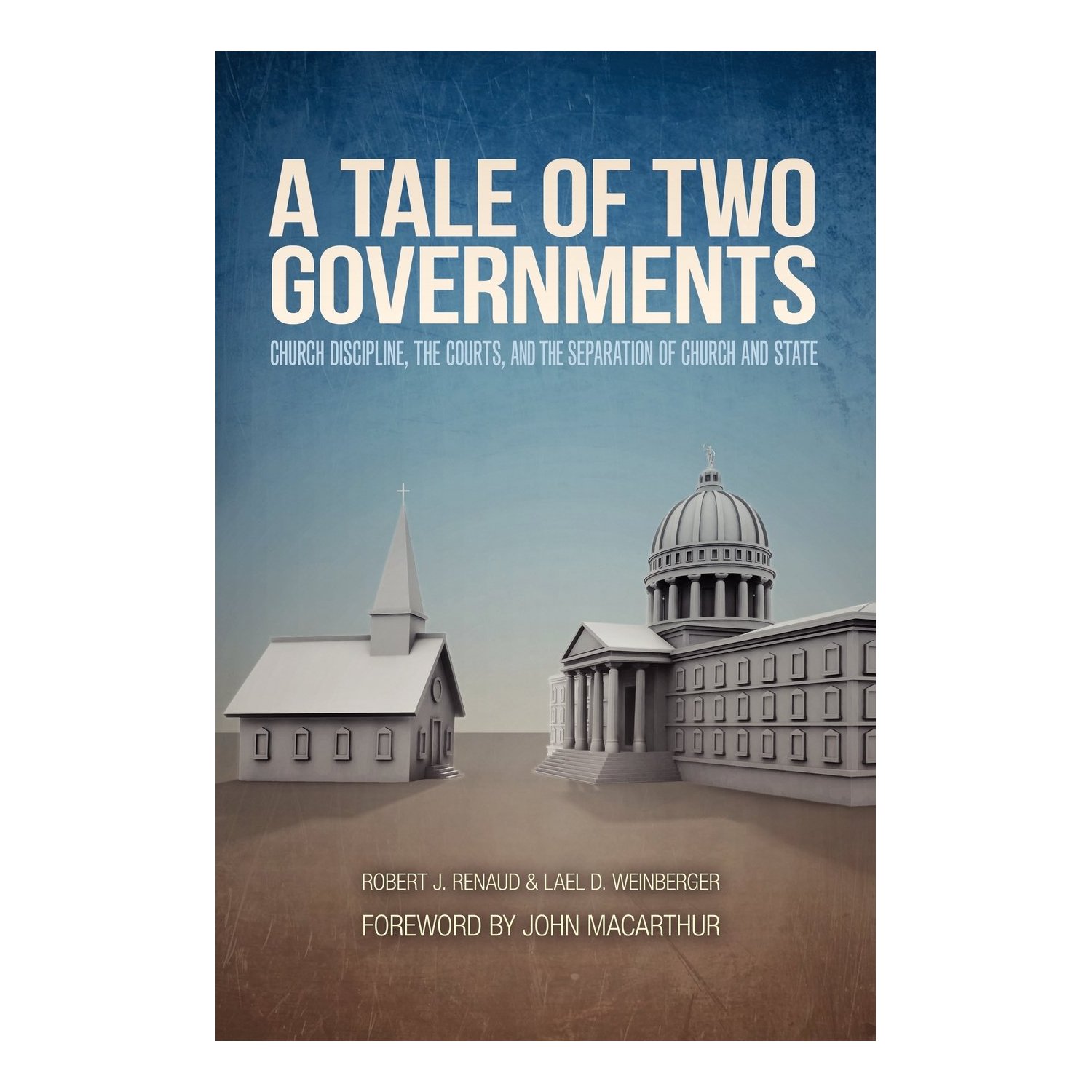
The name of the book that was the subject of the review is, “A Tale of Two Governments” by Robert J. Renaud and Lael D. Weinberger. The review was written by David V. Edling (http://goo.gl/gvPed). Edling is co-author of “Redeeming Church Conflicts”(Baker, 2012) and was the director of church relations at Peacemaker Ministries before his retirement. Peacemaker Ministries was formed to deal with the onslaught of lawsuits resulting from the recent resurgence of authentic Geneva style Calvinism and its tyranny.
The authors and the reviewer bemoan the fact that lawsuits may prevent churches from moving forward with church discipline, and the book apparently offers a clear path to overcoming those fears by implementing protocols that will prevent lawsuits or prevent a negative legal judgment against a church. According to Edling:
While fear of having to interact with the secular courts and fear of man may dampen the zeal to follow the biblical prescription when a church member hardens his or her heart and remains stuck in sin, these authors effectively refute the idea that such excuses hold any validity. The most significant contribution these authors make to life together in the church today is to provide church leaders and members with confidence—confidence that these common fears can be replaced with the knowledge that being biblical is protected by the laws that govern both church and state.
One should note with much ado that “sin” is anything that Reformed elders say it is. Parishioners often assume that Reformed elders define sin worthy of church discipline by a literal biblical definition. While such naivety is adorable, it is far from reality.
Edling continues with the following statement that is chilling to anyone one who knows the real truth about Reformed doctrine and history:
The foundation for their argument is Scripture. They effectively exegete the relevant passages, including an explanation of how Jesus proclaimed he would build his church by giving men “the keys of the kingdom of heaven” (Matt. 16:18-19), that is, the unique authority both to open the kingdom (through the preaching of the gospel) and to regulate its internal administration (through the practice of church discipline, binding and loosing sin). Using a threefold approach of (1) church history (specifically a “high point” review of 2,000 years of church-state relations); (2) a concise review of the common law and American jurisprudence (the development of the current legal doctrine called “church autonomy”); and (3) practical theology (how to keep your church out of court), Renaud and Weinberger deftly weave together their “tale” that leaves the reader with only one conclusion: if we are wise, we need not fear the courts or the reaction of our church members as we fulfill the call of Christ to love his people and build his church as he has directed using church discipline to restore, protect, and keep pure that for which he died.
Did Christ give Reformed elders a “unique” authority to “bind and loose sin” on earth? The apostles claimed no such “unique authority,” but rather constantly referred to the authority of Scripture and the ability of the saints to interpret it for themselves (Acts 17:11). The apostle Paul called on everyday saints to judge what the true gospel is for themselves (Galatians 1:8), and to only follow leaders AS they follow Christ. Furthermore, you can be certain that the authors only cover the “high point[s]” of Reformed history as it is saturated with the blood of those who disagreed with the Reformers. In the same way that people pick their noses in their cars and somehow think others cannot see them, Reformed elders think that the bloody oligarchy of Reformed history cannot be read. And “church autonomy” was not intended to protect either church or state from each other. With Reformed history fresh in their minds, the framers of the constitution sought to prevent cooperation between the two for the expressed protection and well-being of the people.
The reviewer continues with the following statement that can only be said to reveal how ignorant they believe the saints are:
What does it mean for the church to “be wise” from a secular legal perspective in light of the many court cases that have been decided over the years? As these authors summarize, church leaders must be aware of legal principles that will protect the church in its practice of discipline. Failure to stay within these boundaries may leave the church unprotected. The “church autonomy” doctrine is built on the First Amendment’s embedded theology that God established two separate but equal governments, but the First Amendment doesn’t necessarily bar all claims that may touch on religious conduct. To protect the legal distinction church leaders must understand that their jurisdiction to practice discipline depends on following the law. Central to understand is the “implied consent” that exists in a truly voluntary relationship between church and member (typically through formal membership), that an act of discipline must be grounded in a church’s doctrinal commitments that have been clearly articulated and are supported by recognized religious belief and practice, and that the church must have a clearly stated policy for the practice of biblical church discipline (usually set forth in its constitution or bylaws). Further, church leaders must help members understand the limits of confidentiality because church discipline, by definition, requires others knowing of the continuing sin in the life of one who fails to repent and change.
Here is the assertion that the church and the state are two separate “governments” with the church having its own “jurisdiction.” This mentality should send cold chills running up the back of any thinking person while running to reread the membership covenant they signed. The First Amendment has an “ embedded theology”? Really? I will say this as lovingly as I can: if you sign a membership covenant with any church, you need your head examined—the Reformed claim that church membership equals being saved notwithstanding.
In his conclusion, the reviewer states the following:
Consider whether your church may be failing to obey God’s appointed means of soul care through the faithful and consistent practice of redemptive church discipline.
“Redemptive church discipline”? What’s that? The Scriptures never use the term “church discipline” let alone the former. That term should alert you that something may not be exactly right. I address church discipline issues in detail via a free ebook available on this blog: https://paulspassingthoughts.com/wp-content/uploads/2012/04/ebook-church-discipline.pdf and for good measure: https://paulspassingthoughts.com/2012/02/09/new-calvinism-and-hotel-california/
Meanwhile, don’t join a little Geneva. And if you’re in one get out. You’re in a cult. A doctrine/philosophy of control equals cult regardless of the nomenclature.
paul

 Paul's Passing Thoughts
1 comment