Submitted to the Committee on Resolutions for the 2011 Southern Baptist Convention
Resolution On Distinctions Between Justification And Sanctification
June 2011
WHEREAS, A major contribution to the spiritual weakness of many Protestant denominations has been erroneous teachings in regard to sanctification; and
WHEREAS, Some teach that Christians are sanctified by the exact same means of justification only; and
WHEREAS, Some teach that Christians should preach the Gospel of justification to themselves everyday for sanctification purposes; and
WHEREAS, Some teach that contemplation on the Gospel of justification alone is the primary duty for the Christian, and from that one duty, all other duties find life; and
WHEREAS, Some teach that a worshipful doxology resulting from a contemplation on justification always precedes obedience acceptable to God; and
WHEREAS, Some teach that Christians need to be justified continually until glorification, and enablement to participate in sanctification has not been granted by God in any portion more than those who need to be justified; and
WHEREAS, Some teach that personal exertion by Christians in response to all that Christ has commanded in Scripture is works salvation.
BE IT THEREFORE RESOLVED, That the Southern Baptist Convention affirm Scriptural distinctions between justification and sanctification; and
BE IT FURTHER RESOLVED, That we affirm these distinctions according to Scripture and those that are clearly evident in Article IV of the 2000 Baptist Faith and Message Statement. Concerning enablement in sanctification, Article IV (C) contains this statement as follows: “Sanctification is the experience, beginning in regeneration, by which the believer is set apart to God’s purposes, and is enabled to progress toward moral and spiritual maturity through the presence and power of the Holy Spirit dwelling in him.”
Concerning justification as a one-time legal declaration by God, Article IV (B) contains the following statement: “Justification is God’s gracious and full acquittal upon principles of His righteousness of all sinners who repent and believe in Christ”; and
BE IT FURTHER RESOLVED, That we believe that the Scriptures are not for the sole purpose of contemplating justification only, but rather according to Article I of the 2000 Baptist Faith and Message Statement which contains the following in regard to the Scriptures: “It is a perfect treasure of divine instruction. It has God for its author, salvation for its end, and truth, without any mixture of error, for its matter. It reveals the principles by which God judges us; and therefore is, and will remain to the end of the world, the true center of Christian union, and the supreme standard by which all human conduct, creeds, and religious opinions should be tried”; and
BE IT FURTHER RESOLVED, That we affirm our belief in the biblical truth that Christians are new creatures in Jesus Christ, and therefore, we also agree with Article XV of the 1925 confession which contains this statement: “There is a radical and essential difference between the righteous and wicked”; and
BE IT FURTHER RESOLVED, That we affirm as true and biblical, any endeavor or teaching concerning sanctification that likens to these words written by JC Ryle: “In justification the word to address to man is believe–only believe; in sanctification the word must be ‘watch, pray, and fight.’ What God has divided let us not mingle and confuse”; and
BE IT THEREFORE FINALLY RESOLVED, That because of the aforementioned convictions commonly believed by Southern Baptists as described in these resolutions, that those who persist in confounding two things that differ–that is, justification and sanctification, be deemed unfit as ministers or teachers of the Gospel.
The Heart / Flesh Debate
Heart Versus Flesh
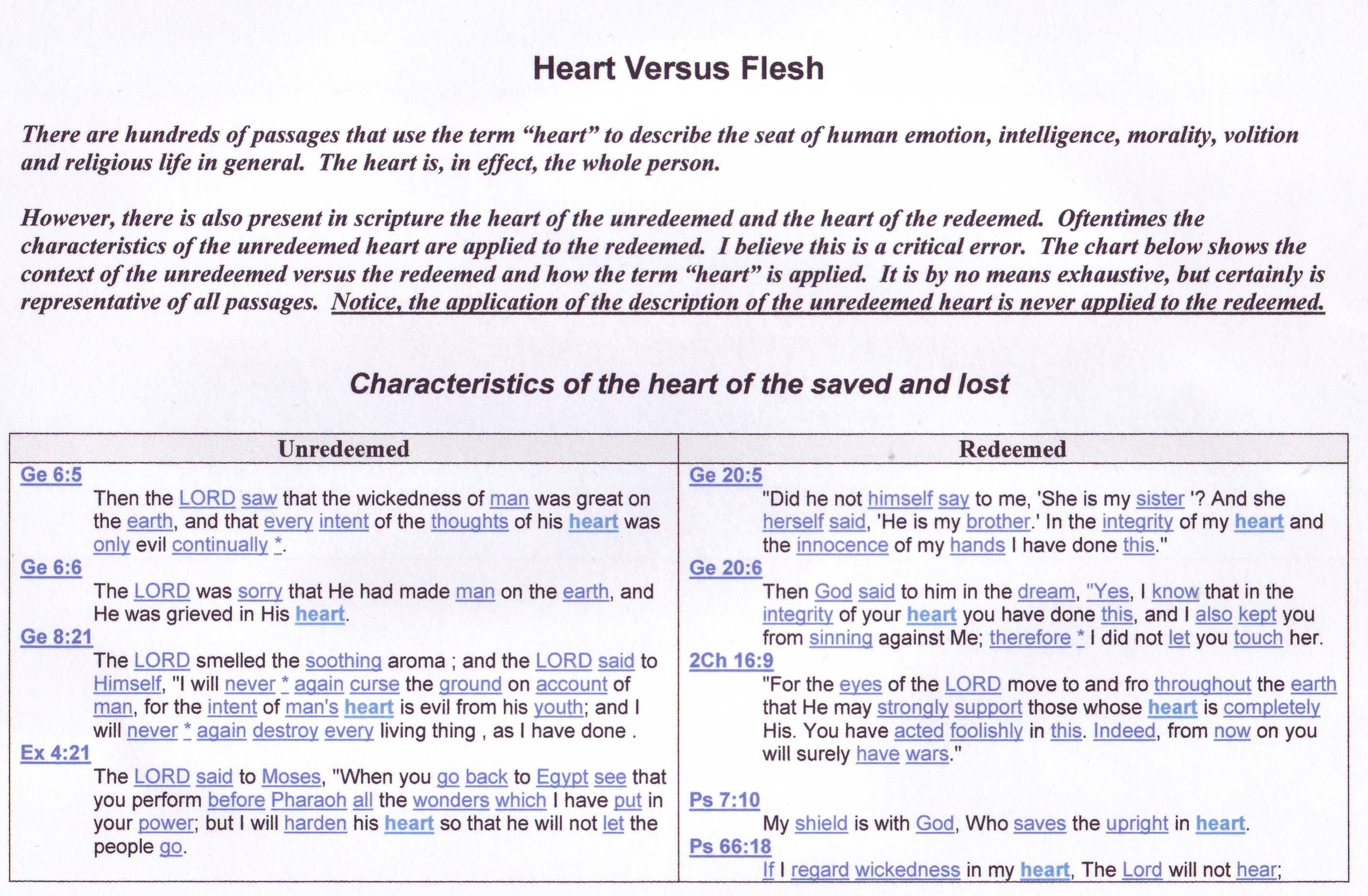
There are hundreds of passages that use the term “heart” to describe the seat of human emotion, intelligence, morality, volition and religious life in general. However, most often, “heart” is used in Scripture as an idiom for the mind.
There is also present in scripture the heart of the unredeemed and the heart of the redeemed. Oftentimes the characteristics of the unredeemed heart are applied to the redeemed. I believe this is a critical error. The chart below shows the context of the unredeemed versus the redeemed and how the term “heart” is applied. It is by no means exhaustive, but certainly is representative of all passages. Notice, the application of the description of the unredeemed heart is never applied to the redeemed.
Characteristics of the heart of the saved and lost
|
Unredeemed |
Redeemed |
| Ge 6:5Then the LORD saw that the wickedness of man was great on the earth, and that every intent of the thoughts of his heart was only evil continually *.
Ge 6:6The LORD was sorry that He had made man on the earth, and He was grieved in His heart.Ge 8:21 The LORD smelled the soothing aroma ; and the LORD said to Himself, “I will never * again curse the ground on account of man, for the intent of man’s heart is evil from his youth; and I will never * again destroy every living thing , as I have done . Ex 4:21 The LORD said to Moses, “When you go back to Egypt see that you perform before Pharaoh all the wonders which I have put in your power; but I will harden his heart so that he will not let the people go. De 5:29 ‘Oh * that they had such a heart in them, that they would fear Me and keep all My commandments always *, that it may be well with them and with their sons forever ! De 8:14 then your heart will become proud and you will forget the LORD your God who brought you out from the land of Egypt, out of the house of slavery. 1Sa 7:3 Then Samuel spoke to all the house of Israel, saying, “If you return to the LORD with all your heart, remove the foreign gods and the Ashtaroth from among you and direct your hearts to the LORD and serve Him alone; and He will deliver you from the hand of the Philistines.” 2Ch 12:14 He did evil because he did not set his heart to seek the LORD. 2Ch 25:2 He did right in the sight of the LORD, yet not with a whole heart. 2Ch 26:16 But when he became strong, his heart was so proud that he acted corruptly, and he was unfaithful to the LORD his God, for he entered the temple of the LORD to burn incense on the altar of incense. Ps 73:1 Surely God is good to Israel, To those who are pure in heart ! Ps 78:8 And not be like their fathers, A stubborn and rebellious generation, A generation that did not prepare its heart And whose spirit was not faithful to God. Jer 5:23 ‘But this people has a stubborn and rebellious heart; They have turned aside and departed. Jer 17:9 “The heart is more deceitful than all else And is desperately sick; Who can understand it? Eze 14:4 “Therefore speak to them and tell them, ‘Thus says the Lord GOD, “Any man of the house of Israel who sets up his idols in his heart, puts right before his face the stumbling block of his iniquity, and then comes to the prophet, I the LORD will be brought to give him an answer in the matter in view of the multitude of his idols, Eze 20:16 because they rejected My ordinances, and as for My statutes, they did not walk in them; they even profaned My sabbaths, for their heart continually went after their idols. Mr 7:21 “For from within, out of the heart of men, proceed the evil thoughts, fornications, thefts, murders, adulteries, Lu 6:45 “The good man out of the good treasure of his heart brings forth what is good; and the evil man out of the evil treasure brings forth what is evil; for his mouth speaks from that which fills his heart. Ac 8:21 “You have no part or portion in this matter, for your heart is not right before God. Ro 1:21 For even though they knew God, they did not honor Him as God or give thanks, but they became futile in their speculations, and their foolish heart was darkened. Ro 2:5 But because of your stubbornness and unrepentant heart you are storing up wrath for yourself in the day of wrath and revelation of the righteous judgment of God, Eph 4:18 being darkened in their understanding, excluded from the life of God because of the ignorance that is in them, because of the hardness of their heart;
|
Ge 20:5“Did he not himself say to me, ‘She is my sister ‘? And she herself said, ‘He is my brother.’ In the integrity of my heart and the innocence of my hands I have done this.”Ge 20:6Then God said to him in the dream, “Yes, I know that in the integrity of your heart you have done this, and I also kept you from sinning against Me; therefore * I did not let you touch her.
2Ch 16:9 “For the eyes of the LORD move to and fro throughout the earth that He may strongly support those whose heart is completely His. You have acted foolishly in this. Indeed, from now on you will surely have wars.” Ps 7:10 My shield is with God, Who saves the upright in heart. Ps 66:18 If I regard wickedness in my heart, The Lord will not hear; Ps 73:1 Surely God is good to Israel, To those who are pure in heart ! Ps 86:12 I will give thanks to You, O Lord my God, with all my heart, And will glorify Your name forever. Jer 24:7 ‘I will give them a heart to know Me, for I am the LORD; and they will be My people , and I will be their God, for they will return to Me with their whole heart. Jer 31:33 “But this is the covenant which I will make with the house of Israel after those days,” declares the LORD, “I will put My law within them and on their heart I will write it; and I will be their God, and they shall be My people . Jer 32:39 and I will give them one heart and one way, that they may fear Me always *, for their own good and for the good of their children after them. Eze 11:19 “And I will give them one heart, and put a new spirit within them. And I will take the heart of stone out of their flesh and give them a heart of flesh, Eze 36:26 “Moreover, I will give you a new heart and put a new spirit within you; and I will remove the heart of stone from your flesh and give you a heart of flesh. Mt 5:8 “Blessed are the pure in heart, for they shall see God. Mt 12:34 “You brood of vipers, how can you, being evil, speak what is good ? For the mouth speaks out of that which fills the heart. Mt 15:18 “But the things that proceed out of the mouth come from the heart, and those defile the man. Lu 6:45 “The good man out of the good treasure of his heart brings forth what is good; and the evil man out of the evil treasure brings forth what is evil; for his mouth speaks from that which fills his heart. Ro 2:29 But he is a Jew who is one inwardly; and circumcision is that which is of the heart, by the Spirit, not by the letter; and his praise is not from men, but from God. Ro 6:17 But thanks be to God that though you were slaves of sin, you became obedient from the heart to that form of teaching to which you were committed, Heb 10:22 let us draw near with a sincere heart in full assurance of faith, having our hearts sprinkled clean from an evil conscience and our bodies washed with pure water. 1Pe 1:22 Since you have in obedience to the truth purified your souls for a sincere love of the brethren, fervently love one another from the heart, 1Jo 3:21 Beloved, if our heart does not condemn us, we have confidence before God; Addendum: Romans 6:17 – But thanks be to God, that you who were once slaves of sin have become obedient from the heart to the standard of teaching to which you were committed, Romans 7:25 – Thanks be to God through Jesus Christ our Lord! So then, I myself serve the law of God with my mind, but with my flesh I serve the law of sin. Hebrews 10:22 – let us draw near to God with a sincere heart and with the full assurance that faith brings, having our hearts sprinkled to cleanse us from a guilty conscience and having our bodies washed with pure water. |
As you look at the references above, you’ll easily see that the Bible never applies the ugly characteristics of an unregenerate heart to a redeemed person. Why then, should we? God has renewed the heart of a believer and it is unbiblical to accuse the Body of Christ of having hearts that are unregenerated.
Where then, is the battle? The Bible teaches that the battle against sin is in the flesh, NOT the heart. Notice, please:
Mt 26:41
“Keep watching and praying that you may not enter into temptation; the spirit is willing, but the flesh is weak.”
Jesus is speaking to a redeemed person. He shows them that the danger is in the flesh, not the heart (perhaps synonymous with spirit in this passage).
Ro 7:5
For while we were in the flesh, the sinful passions, which were aroused by the Law, were at work in the members of our body to bear fruit for death.
Paul teaches here that our sinful passions are from the flesh.
Ro 7:18
For I know that nothing good dwells in me, that is, in my flesh; for the willing is present in me, but the doing of the good is not.
A critical passage! We know the Bible teaches that our flesh was not redeemed at salvation and, in fact, awaits the glorification described so clearly in 1 Corinthians 15. Therefore, we have a “redeemed heart” incarcerated in “unredeemed flesh.” This is exactly why we struggle. Notice:
Ro 7:14
For we know that the Law is spiritual, but I am of flesh, sold into bondage to sin.
Ro 7:25
Thanks be to God through Jesus Christ our Lord ! So then, on the one hand I myself with my mind am serving the law of God, but on the other, with my flesh the law of sin.
Ro 8:3
For what the Law could not do, weak as it was through the flesh, God did: sending His own Son in the likeness of sinful flesh and as an offering for sin, He condemned sin in the flesh,
Ro 8:4
so that the requirement of the Law might be fulfilled in us, who do not walk according to the flesh but according to the Spirit.
Ro 8:5
For those who are according to the flesh set their minds on the things of the flesh, but those who are according to the Spirit, the things of the Spirit.
Ro 8:6
For the mind set on the flesh is death, but the mind set on the Spirit is life and peace,
Ro 8:7
because the mind set on the flesh is hostile toward God; for it does not subject itself to the law of God, for it is not even able to do so,
Ro 8:8
and those who are in the flesh cannot * please God.
Ro 8:9
However, you are not in the flesh but in the Spirit, if indeed the Spirit of God dwells in you. But if anyone does not have the Spirit of Christ, he does not belong to Him.
Ro 8:12
So then, brethren, we are under obligation, not to the flesh, to live according to the flesh —
Ro 8:13
for if you are living according to the flesh, you must die; but if by the Spirit you are putting to death the deeds of the body, you will live.
The heart is not mentioned anywhere in this key teaching. Romans 6 through 8 contain the key teaching on our struggle against sin. And, it is clear; the struggle is centered on the flesh, not the heart.
Further evidence of this:
Ro 13:14
But put on the Lord Jesus Christ, and make no provision for the flesh in regard to its lusts.
1Co 3:1
And I, brethren, could not speak to you as to spiritual men, but as to men of flesh, as to infants in Christ.
How do we cleanse ourselves and appear holy before the Lord?
2Co 7:1
Therefore, having these promises, beloved, let us cleanse ourselves from all defilement of flesh and spirit, perfecting holiness in the fear of God.
Ga 5:13
For you were called to freedom, brethren; only do not turn your freedom into an opportunity for the flesh, but through love serve one another.
Ga 5:16
But I say, walk by the Spirit, and you will not carry out the desire of the flesh.
Ga 5:17
For the flesh sets its desire against the Spirit, and the Spirit against the flesh; for these are in opposition to one another, so that you may not do the things that you please.
Ga 5:19
Now the deeds of the flesh are evident, which are: immorality, impurity, sensuality,
Ga 5:24
Now those who belong to Christ Jesus have crucified the flesh with its passions and desires.
Ga 6:8
For the one who sows to his own flesh will from the flesh reap corruption, but the one who sows to the Spirit will from the Spirit reap eternal life.
~ Penned and researched by Brian Jonson, West Chester, Ohio
Should Christian Doctrinal Debate Be Public?

I have taken a lot of heat lately over my public criticism of New Calvinism. Some arguments, for example, go something like this:
“I respect you working hard at something you so fiercely believe in but in the grand scheme of the Great Commission, do these arguments help or hurt the cause of Christ? Sparring between brothers in a good debate is one thing, but making a spectacle of Christianity is not a testament of the grace of God. It is dangerous to publicly call out other brothers.”
Though this comment was made in the same thread as those defending New Calvinist, that wasn’t the intent of this Christian—the intent was to simply pose the question for consideration. However, there was an element of New Calvinism that I wanted to post on that can be based on this question; so, let the New Calvinist themselves answer this question. Also, you can frame this post in regard to comments like the following as well: “Who are you to publicly criticize these great men of God?” Or: “How dare you slam God’s chosen men?” Or: “DA Carson is the greatest theological mind in recent history—who are you?”
Let me set the table. At the 2006 Together for the Gospel conference (T4G), New Calvinist presented an official statement on “the gospel.” T4G is a gargantuan organization (along with The Gospel Coalition) that promotes New Calvinism. The document was divided into three primary categories: “In the essentials unity…in the nonessentials, liberty…and in all things, charity.”
In the essentials unity? Many of the core leaders of T4G are Charismatics. In fact, a huge portion of the New Calvinist movement includes Sovereign Grace Ministries which is an organization founded on—get this: “Reformed Charismatics.” One of the T4G’s “Core four” is CJ Mahaney who is president of SGM. So, obviously, teaching that Christians don’t get all of the Holy Spirit when they are saved is not essential to the gospel. Hmmmm.
In the nonessentials, liberty? That would be anything and everything other than the four core elements of New Calvinism: sanctification by faith alone (sanctification by justification only), the total depravity of the saints, daily salvation, and Scripture as narrative only—not instruction. Please, please, don’t complain that these four tenets are not substantiated in this post; this blog is pregnant with direct quotations from New Calvinist that confirm these tenets. Also, indicative of the movement’s confusion, part of Article XVI states, “We further affirm that the teaching office of the church is assigned only to those men who are called of God in fulfillment of the biblical teachings.” Though I agree, what does that have to do with the essentials of the gospel? That’s more of an essential than Pneumatology? Not only that, Charismatics ordain women all the time! I might also add that Steve Camp had the following complaint in regard to the document: “In these eighteen articles there is no Scripture listed.”
In all things, Charity? Here, I finally get to the point: all things charity unless you’re an orthodox evangelical. Because of the shear mass of this movement and its immense media power; and in a twist of absurd irony, there has never been a time in redemptive history when orthodox Christianity has been more fustigated publicly by professing Christians. The best known proponents of the movement constantly accuse evangelicals at large of promoting a false gospel, and nothing has ever been more public. Furthermore, it boils down to nothing more than a call for mass division in the church. As a matter of fact, I was attending a church in Fort Wayne, Indiana that was loosing members to a New Calvinist church in the area, and the elders couldn’t figure out why. Not only that, the departing members seemed to be offended, and no wonder.
Though, again, several examples can be found on this blog, I will cite some examples:
Tullian Tchividjian: “As I’ve said before, I once assumed (along with the vast majority of professing Christians) that the gospel was simply what non-Christians must believe in order to be saved, while afterward we advance to deeper theological waters…..Fundamentalist smother the gospel in moralism.”
Paul Washer: [I don’t believe that] “even 15% of my Baptist brethren are saved….we find a truth that must be rediscovered by all of us [emphasis mine]. The Gospel is not merely an introductory message to Christianity. It is ‘the’ message of Christianity, and it is not only the means of salvation, but also the means of continued sanctification in the life of the most mature believer.”
Michael Horton: “Where we land on these issues is perhaps the most significant factor in how we approach our own faith and practice and communicate it to the world. If not only the unregenerate but the regenerate are always dependent at every moment on the free grace of God disclosed in the gospel, then nothing can raise those who are spiritually dead or continually give life to Christ’s flock but the Spirit working through the gospel. When this happens (not just once, but every time we encounter the gospel afresh), the Spirit progressively transforms us into Christ’s image. Start with Christ (that is, the gospel) and you get sanctification in the bargain; begin with Christ and move on to something else, and you lose both” [in other words: if you don’t believe in sanctification by faith alone—your lost, and that would definitely be the vast majority of evangelicals].
Chad Bresson: “I believe the greater danger lies with those who would so exalt the Bible [by using it for instruction and wisdom], that the Centrality of Christ in all of life and all of history is eclipsed. And that is the legacy of the conservativism of our own day.”
John Piper: “ You never outgrow the need to preach to yourself the gospel….I know that there are people reading this who are not trusting Jesus Christ, and therefore can only expect condemnation” [if you don’t preach the gospel to yourself everyday].
Comment on an article by Justin Taylor, The Gospel Coalition Blog: “It’s not that complicated: the ground of all Christian obedience is the faithfulness of Jesus Christ. Justification [salvation] occurs EACH [emphasis NOT mine] time a believer confesses and receives forgiveness for his sins [among the many other comments posted on this article including those by Justin Taylor and Chad Bresson—none disputed this comment / statement. In fact, Bresson supported it by indicating that Christ presently obeys for us].
Paul David Tripp: “I am deeply concerned that the gospel has been redefined in the contemporary church in a terribly significant way.”
Concerning the aforementioned question, I will answer it from the standpoint of this blog; when a massive movement calls on evangelicals to acknowledge that they have been sold a bill of goods concerning the gospel for the past several hundred years, and in a very public way, does one have any choice but to counter that publicly? I don’t think so. Can the ignoring of such a movement hinder the gospel? Absolutely.
paul
New Calvinist Leaders Now Worshipping Each Other—Dead or Alive
I know I start a lot of articles this way, but I can’t say it enough: foul doctrine yields bad results. Before I get to the information that prompted this post (sent by a reader), what do I mean by “New Calvinism”? NC is a massive movement (supposedly a new reformation) sweeping across the world like a giant tsunami. It encompasses Sonship Theology, Gospel Sanctification, New Covenant Theology, Christian Hedonism, Redemptive Historical Hermeneutics, and Heart Theology. The movement has totally rewritten orthodox Christianity, and soon (if not already the case), considering seminary graduates for ministry in the local church will be a prohibitive risk. Dumbed-down congregants by the masses are ever-waiting with bated breath for the next profound unction to proceed from the mouths of New Calvinist gods. John Piper, who often writes and says outrageously unorthodox things—has over 300,000 followers on Twitter. One wonders if Christianity has ever been inflicted with such a large percentage of koolaholics, as others stand aghast and bewildered regarding the growth of this movement.
The leaders of this movement realize more and more that they can get away with saying and doing anything, and at times seem to be amused themselves at what they get a pass on. Hence, they now worship each other openly—dead or alive. Recently, a group of New Calvinist leaders wrote a book of essays for the purpose of praising John Piper. One of the authors that contributed to the book was none other than John MacArthur Jr. He also wrote a glowing forward in a book written by Piper that was full of outlandish statements. The essay book was presented to Piper at a conference (as a surprise) by his fawning protégé, Justin Taylor. Yes, they wanted to sing his praises—apparently for his great service to Christianity in developing a theology called “Christian Hedonism.” No, it isn’t a dream.
So then, no surprise that Chad Bresson, radio personality and elder at Clearcreek Chapel (a well known and respected church in the NC network), held a tribute to Geerhardus Vos at his grave. Geerhardus Vos is the supposed father of Redemptive-Historical Hermeneutics, a tenet of New Calvinism. But not really, the hermeneutic was developed by a liberal theologian in the eighteenth century—Vos supposedly redeveloped the hermeneutic and took it in a more conservative direction. He developed the hermeneutic into the very orthodox sounding name of “Biblical Theology” which is anything but. “Biblical Theology” was the theme of this year’s Gospel Coalition convention. Per the usual deception of the movement, the term “Redemptive-Historical” was rarely used, if at all because “Biblical Theology” sounds, well, “biblical.”
Bresson brazenly posted photographs of the tribute on his FaceBook page, but why not? After all—who’s going to call him on it? The photograph below shows Bresson reading writings by Vos graveside. One of the comments on his FB page in reference to the pictures said the following: “Standing in the midst of the obvious decay that is the hallmark of the already, speaks of the inbreaking ‘not yet’ through lumped throat and wet eyes.” Creepy, no?

Though I would be amiss not to mention the contrast between this behavior from New Calvinist gods and their supposedly everything Jesus theology, the fact of the matter is, they get a pass on all their hypocrisy, contradictions, and doublespeak as well. As Bresson has written or said on many occasions, he has a major problem with the belief that there is a future for national Israel because that’s eclipsing Christ with a sliver of geography. Apparently, it’s alright to do that if one of the gods of New Calvinism is under the sliver.
paul
I’m Not Kidding—That’s What He Said
A reader sent me a manuscript from the 2011 John Bunyan Conference in Lewisburg, Pennsylvania. Basically, the yearly event is a New Covenant Theology love-fest. This year’s conference had many of the who’s who of NCT including John Reisinger and Fred Zaspel. NCT is a tenet of Gospel Sanctification which was mothered by Sonship Theology. NCT, like GS’s other tenets, was developed to bolster Sonship. The two, GS and NCT, go hand in hand. Determined to hold fast to the concept of being sanctified by the same gospel that saves us, advocates have been hard at work since 1980 (approx.) to make the rest of the Bible fit with the aforementioned concept. The result is the following: NCT, Heart Theology, Christian Hedonism, and a gospel-centered hermeneutic borrowed from Redemptive-Historical hermeneutics—invented by liberal theologian Johann Philipp Gabler (1753-1826).
The manuscript was the text of one of the speakers, Chad Bresson—radio personality and elder at Clearcreek Chapel in Springboro, Ohio. Clearcreek Chapel considers themselves a NCT church (according to another elder there, Dale Evans), and their doctrine is the epitome of Gospel Sanctification. The reader who sent the manuscript referred to Bresson as the “Golden Boy of Gospel Sanctification” in central Ohio. Gagingly, I would have to agree. The opening line of the manuscript, a twenty-nine page linguistic drone, finally surpasses the outrageous absurdity of Bresson’s “Another Brick in the Wall,” in which he creepily / cultishly suggested that the original sin in the garden was not disobedience, but the sin of not submitting to the authority of teachers/ elders. But truly, his thesis and opening line on this one takes the cake:
“Stephen was killed for preaching New Covenant Theology.” I’m not kidding—that’s what he said. I can just see him opening his message (after a silent pause) with this, supposedly, profound capture. First of all, nobody denies that NCT is a recent creation. Richard Barcellos, in his excellent critique of NCT, “In Defense Of The Decalogue,” voiced concern in the book’s preface that the movement was still in its developmental stages, and therefore, difficult to evaluate. That was in 2001. Bresson’s thesis is therefore indicative of NCT’s extreme arrogance—they are supposedly the gatekeepers of this newfound truth some two-thousand years later, and I will give you three wild guesses as to who they think would stone them today. This is why an us against them mentality saturates many GS / Sonship / NCT churches.
After suffering through about twelve pages of the obituary-like document, a few statements begged attention that somehow fail to alarm Christians of our day. First, that the New Covenant abrogated the law, and that all former covenants were cancelled by the NC as well. Of course, as Barcellos points out in his book, the first point blatantly contradicts Jeremiah 31:33, Matthew 5:17, and Romans 3:31. As far as the second point that caught my attention like a penguin singing “I Just Gotta Be Me” in the midst of the flock, it blatantly contradicts Ephesians 2: 11,12 where Paul likens the unregenerate to those “alienated from the commonwealth of Israel and strangers to the covenants [PLURAL NOT SINGULAR] of promise.” Furthermore, Paul then cites an excerpt from the Decalogue to make a point in Ephesians 6:1-3 making it clear that the “promise” thereof still applies to us today. All of the gallons of ink spilled by Bresson will not stand against these few verses of Scripture—truth does not bow to a myriad of words.
paul

 Paul's Passing Thoughts
7 comments