Sure, I Can Do That, But….
 ….I wasn’t born yesterday. The top part of your essay is the imperative. The bottom part is the indicative: “What we sinners fail to understand is that there is no true freedom apart from wearing the yoke of God’s anointed one. Jesus said, ‘Come unto Me, all you who labor and are heavy laden, and I will give you rest. Take My yoke upon you and learn from Me, for I am gentle and lowly in heart, and you will find rest for your souls. For My yoke is easy and My burden is light’ (Matthew 11:28-30).”
Ie., the imperative commands are grounded in the indicative event. The “true freedom” you are talking about is freedom from the law when we take upon ourselves the yoke of Jesus and enter into “His rest” from the law. The imperatives you describe in the first part are an effortless “mere natural flow (NCT guru Chad Bresson)”—flowing from the indicative event (Christ’s atonement).
Nice try, and here is what you sent me:
“I was just wondering if you thought the following might have been written by one of those pernicious NCT Antinomians. Perhaps you would like to publish it as an example of how they try to turn people away from true righteousness.
Randy Seiver
LET US BREAK THEIR BONDS ASUNDER
Let us break their bonds asunder, and let us cast away their yokes from us (Psalm 2:3).
The scene portrayed in these verses is one of high treason against the LORD of heaven and earth. Those engaged against Him are recalcitrant rebels who refuse to be controlled any longer. They have set themselves in battle array against Jehovah and against His Anointed one. They refuse to wear the restraint of His law any longer. They desire to throw off the yoke of obedience to Him. The metaphor is taken from balky animals that break the cords that restrain them and throw off the yoke.
Israel is often guilty of refusing Jehovah’s yoke in this manner. In Hosea’s prophecy, Jehovah charges that His people are like a heifer that backs away from the yoke (Hosea 4:16). Such is the nature of sinful rebels. We imagine we will be happy if only we can free ourselves from God’s oppressive demands. Yet, we find when we are most free from His yoke that we are most shackled in the bonds of iniquity.
What we sinners fail to understand is that there is no true freedom apart from wearing the yoke of God’s anointed one. Jesus said, “Come unto Me, all you who labor and are heavy laden, and I will give you rest. Take My yoke upon you and learn from Me, for I am gentle and lowly in heart, and you will find rest for your souls. For My yoke is easy and My burden is light” (Matthew 11:28-30).
Nevertheless, the struggle to be free continues from generation to generation. We continue to balk and bawl at the sight of the Christ’s yoke until God in sovereign grace makes us willing to be subdued”
Thank you for this example of classic New Calvinist deception,
paul
The Significance of Kevin DeYoung’s Top Ten
“However, it is my hope that [DeYoung] will realize that as we grow spiritually using everything in our ‘sanctification tool belt,’ that we become increasingly aware of what we have been saved from, and hence, a deeper appreciation of our original salvation.”
“One can only pray that DeYoung will free himself completely from the insanity that creates such questions.”
“Whenever New Calvinist followers feel guilty, they don’t check their Holy Spirit tool belt; they are rather taught to contemplate the gospel that saved them.”
Kevin DeYoung, hereafter, “Special K” (SK), recently wrote a third post
( http://shar.es/HeU1Q ) clarifying his position on sanctification. SK wrote a prior post
( http://shar.es/HeU3w ) which was a capitulation to Tullian Tchividjian who responded to his first post on the same subject. In the second post, SK listed ten interpretive questions that he is considering while on a sabbatical for the purpose of writing a book on sanctification. The significance of these ten questions should not be missed. Those ten questions strike at the heart of New Calvinism, and it would seem that in light of his latest post, he has answered those questions in a way that is not favorable to New Calvinism. In fact, it almost seems like the latest post is in your face when compared to his response to Tchividjian’s “pushback” regarding his first post which only hinted of orthodoxy to begin with. The significance of these ten questions is the following:
1. Can the justified believer please God with his obedience?
SK didn’t pull these questions out of the clouds. This question has to be asked because New Calvinist (NC) teach that God cannot be anymore pleased with us than He already is in Jesus Christ (that’s true in regard to justification). The “justified” believer, as opposed to simply, “believer” is not worded that way for no reason. Supposedly, to admit that there is something we can do to please God as believers is to take away from the sufficiency of Christ’s atonement. Also, remember that the core beliefs of New Calvinism came from the Australian Forum, and their doctrine is primarily driven by the centrality of the objective gospel. In other words, the gospel is something outside of us, not inside (subjective). Inside considerations (like anything we would do [subjective]) cannot “eclipse” anything Christ has done (note: Rick Holland’s “Uneclipsing The Son” will soon be available for purchase).
2. Is the justified believer displeasing to God in some way when he sins?
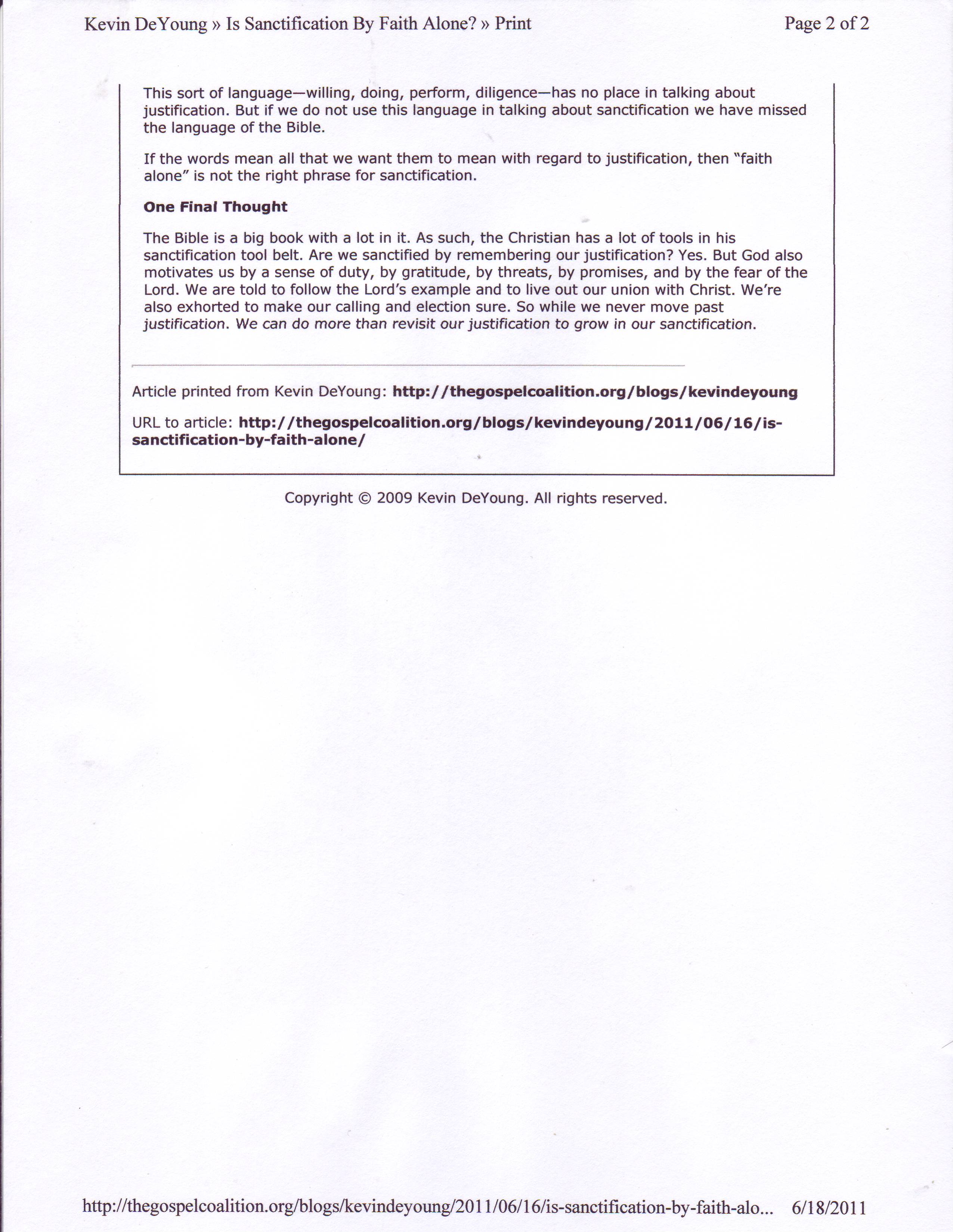
This question is simply the other side of number one. New Calvinist teach that God cannot be displeased with us anymore than he can be displeased with Christ, and for the same reasons that we cannot do anything to gain more favor with God than we already have in Christ. Again, it’s not about us (subjective) and how the supposed displeasure of God would make us feel (subjective). SK seems to have answered this question for himself in the third post: “But God also motivates us by a sense of duty, by gratitude, by threats, by promises, and by the fear of the Lord.” And by the way, to NC, this statement is barely less than blaspheme.
3. Is unbelief the root of every sin? Or is it pride? Or idolatry? Should we even both
trying to find a root sin?
Obviously, SK is questioning one of the four major tenets of NC: Theology of the Heart. This theology was added to NC via Sonship Theology and David Powlison’s Dynamics of Biblical Change which was articulated in Paul Tripp’s “How People Change”
What Jonah knew and believed about God is what caused him to rebel. He knew God was a merciful God and would probably save the Ninevites, whom Jonah hated. That’s why he didn’t want to go there. In Jonah’s case, it was attitude, bad thinking, and a refusal to obey, not unbelief. It is evident in the book that Jonah had tremendous faith in God. But NC must make all issues in sanctification the same as justification which is primarily by faith only; so, it stands to reason that they have to make all sin issues in sanctification a belief issue. The NC position on this question is no better defended than in Tripp’s book. SK needs to read “How People Change” followed by the Donn Arms book review of HPC ( http://wp.me/pmd7S-EC ).
4. How are justification and sanctification related?
I think this question is now rightly, for the most part, answered by SK’s third post. I only take exception to a few statements thereof, but here is one: “Are we sanctified by remembering our justification? Yes.” SK is saying that contemplating our justification is still a viable way to grow spiritually, but he is presenting it as another tool “in our tool belt” rather than the only discipline from which all other duties flow (Dr. Peter Masters’ contention regarding Piper). However, it is my hope that SK will realize that as we grow spiritually using everything in our sanctification tool belt, that we become increasingly aware of what we have been saved from, and hence, a deeper appreciation of our original salvation.
5. Can we obey God?
This speaks to the NC doctrine of the total depravity of the saints. Again, most definitely, this originated with the Australian Forum who denied the new birth, or being born again. Michael Horton also denies the significance of the new birth and takes his cue from the Forum on that issue.
6. Can we feel confident about our obedience, not in a justifying way but that we
have done as we were commanded?
This clearly speaks to the NC belief that obedience in sanctification is synonymous with an attempt to be justified. Hence, asked another way: “Is the totally depraved believer really able to obey and know that it is legitimate obedience that pleases God?” One can only pray that DeYoung will free himself completely from the insanity that creates such questions.
7. How does Scripture motivate us to obedience?
By describing the tools in our tool belt, not the NC belief that the Bible is only a tool for contemplating the gospel.
8. Are most Christians too hard on themselves (thinking they are filthy scum when
they actually walk with the Lord in a way that pleases him)?
No Kevin. Many Christians are walking in violation of their conscience because of what New Calvinism teaches. Whenever New Calvinist followers feel guilty, they don’t check their Holy Spirit tool belt, they are rather taught to contemplate the gospel that saved them. My brother—please flee—perhaps there is not too much blood on your hands.
9. Or are most Christians too easy on themselves (thinking nothing of holiness
and content with little progress in godliness)?
Of course they are! They are taught that they cannot be a part of the progress!
10. What is the role of union with Christ in sanctification? And how do union with
Christ and sanctification relate to justification?
It’s the antithesis of the Forum’s view that formed New Calvinism: “The centrality of the objective gospel.”
paul





Kevin DeYoung Bagged by the New Calvinist Slither Police, Part 2: Is Special K the Forerunner of the Great Slither?
Kevin DeYoung, hereafter affectionately referred to as “Special K” (SK), offered a response to officer Tullian Tchividjian’s (hereafter, OTT) “pushback” regarding an article he wrote that sounded too orthodox. You can’t blame him; after all, OTT is one bad dude. Anybody who is privy to OTT’s merciless hostile takeover of Coral Ridge would certainly hesitate to ruffle his feathers. Even James D. Kennedy’s daughter barely got out of there with her hairdo still intact.
In SK’s response to OTT’s response, he mentioned that he is on sabbatical to write a book on sanctification. Funny, just last week, a reader wrote an email to me—asking what I thought of sabbaticals. I told him they are a joke, with the exception of a pastor doing so to search the Scriptures for himself regarding serious theological issues of our day. Bingo, what’s more important in our day than the whole question of sanctification? Compare SK’s sabbatical with Piper’s last sabbatical where the purpose was to expunge several “species of idols” in his heart. The sabbatical was predetermined to be eight months, so we can only assume that his consultants, Tim Keller and Paul Tripp, identified the idols as those that can always be rectified by deep repentance in an eight-month period—just in time to return on January 1; because after all, like everything else, the new year was all about him. I almost went myself, video cam in-hand, to document the fawning (complete with glazed-over eyes, perspiration, and weak knees) of his Koolaid drinking followers waiting with bated breath as he walked up to the podium to pontificate his first Sunday morning message after his “sabbatical.”
But, back to SK. I found the interpretive questions he is asking himself during his sabbatical to be very interesting, and leads one to think that his church may be populated with a rare breed of Christians known as homo thinking sapiens:
1. Can the justified believer please God with his obedience? [Yes, du, Paul said, “it is our goal to please Him”]
2. Is the justified believer displeasing to God in some way when he sins? [Yes, du, the opposite of “please” is “displease.”]
3. Is unbelief the root of every sin? [No—read about king David and Jonah] Or is it pride? Or idolatry? Should we even both trying to find a root sin? [No]
4. How are justification and sanctification related? [Read JC Ryle’s “Holiness”]
5. Can we obey God? [ SK, see John 14:15,16. Why is the Holy Spirit called our “helper”?]
6. Can we feel confident about our obedience, not in a justifying way but that we have done as we were commanded? [Yes, see 2Peter Chapter 1]
7. How does Scripture motivate us to obedience? [Start with Romans 5:13, then read verse 4 in the same chapter, and many other Scriptures like those. It’s NOT either the Holy Spirit or Scripture—it’s both.]
8. Are most Christians too hard on themselves (thinking they are filthy scum when they actually walk with the Lord in a way that pleases him)? [Not if they have a biblically trained conscience]
9. Or are most Christians too easy on themselves (thinking nothing of holiness and content with little progress in godliness)? [Ya think?]
10. What is the role of union with Christ in sanctification? And how do union with Christ and sanctification relate to justification? [SK: see the Australian Forum archives for a review of what you presently believe on that. It’s called the “centrality of the objective gospel.”]
But stop the presses! DeYoung wrote another article after he capitulated to the fearsome OTT entitled, “Is Sanctification By Faith Alone?” I will just say it plainly: dead on! With the exception of one whopper in the beginning of the piece, the rest of the post is a masterful articulation of true biblical sanctification. Is this the first time I have complimented a New Calvinist in the two-year history of this blog? Yes! In regard to the whopper: “Though it sounds very Protestant, it is not correct to say ‘sanctification is by faith alone.’” Uh, Special K, it has never been Protestant to say that, but hey, you’re going in the right direction.
This is major. DeYoung’s post is clearly in the face of New Calvinist doctrine, and the ten questions asked in the prior post are intimately connected to the conclusions stated in the latter. I can only pray that his healthy infatuation with JC Ryle will result in a positive outcome regarding the book he is writing on sanctification (and such a book is long overdue). In fact, Ryle’s “Holiness,” a book DeYoung often quotes, was written to refute false doctrines running amuck in Ryle’s day that were evil twins to present-day New Calvinism.
So, will SK take a hard stand and separate himself from the New Calvinism cartel? Or will he stay and be a lynchpin for the Great Slither? (See part 1): “Uh, ya, I agree with SK, absolutely! Yep, that’s been my position all along. In all of those other quotes of mine, I was talking about justification—not sanctification. But I will admit, I should have put a grammatical transition between the two—my bad dude.”
Or, if SK stays the course, will the New Calvinist throw him under the bus? Will the dreaded tweet come from the High Priest of New Calvinism?: “Bye, bye, Kevin DeYoung.”
paul

 Paul's Passing Thoughts
27 comments