Words Mean Things
Paul,
You have raised many issues in the last post that would take a book to answer. If I may, I would like to ask a few questions that might help us to clarify the issues on which we disagree. First, I want to state a couple of points on which I think we agree. Incidentally, I am convinced Piper and others would also agree.
1. Justification and sanctification are separate works of God.
2. Justification is based on the work of Christ alone and our works do not contribute to it at all.
3. Sanctification involves our obedience to the commands of Christ.
4, Our obedience to Christ contributes to our assurance since obedience demonstrates the reality of our faith.
Questions:
1. Is it possible for a professing Christian to be deceived?
2. Can a person who has professed faith in Christ but whose faith is not genuine, continue to rest in his good deeds to justify him before God?
3. Can the works he believes he is performing in the process of sanctification become a snare for him so that he continues to trust in his own works rather than trusting in the finished work of Christ?
4, Do such persons need exhortation to avoid “falling from the grace of God” as Paul did in Galatians?
5. If a person should return to a system of legal obedience and thus forsake the way of grace, would we not agree that such a person was never truly justified?
6. Do you believe faith is something we profess once and sort of get that part of it over with and then everything else is accomplished apart from faith, or does the believer go on believing in Christ for life? If his faith doesn’t continue, how can he be pleasing to God, since without faith it is impossible to please him?
7. Have you never known anyone who gave the clear impression that their obedience in sanctification had become their basis of hope for justification? Do you not think such people need to be exhorted to trust in Christ alone and not in anything of their own obedience, i.e., not to trust their own efforts but Christ alone?
8. Do you see not difference between telling a person not to trust his own performance in sanctification and telling him he doesn’t need to obey in the process of sanctification?.
|
Submitted on 2011/12/08 at 11:49 am | In reply to gracewriterrandy.
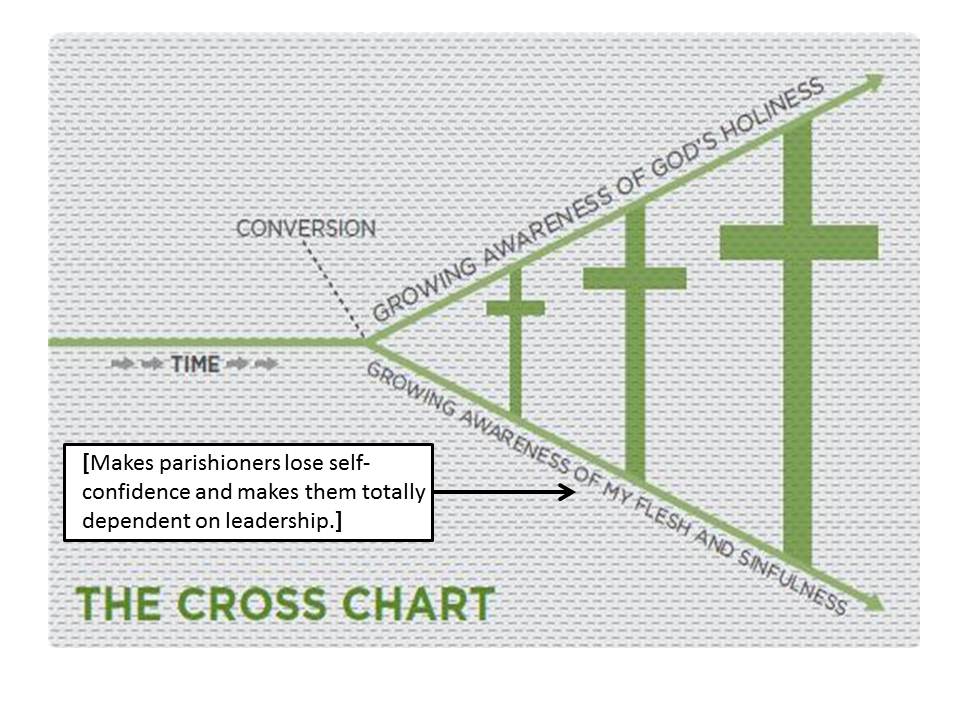
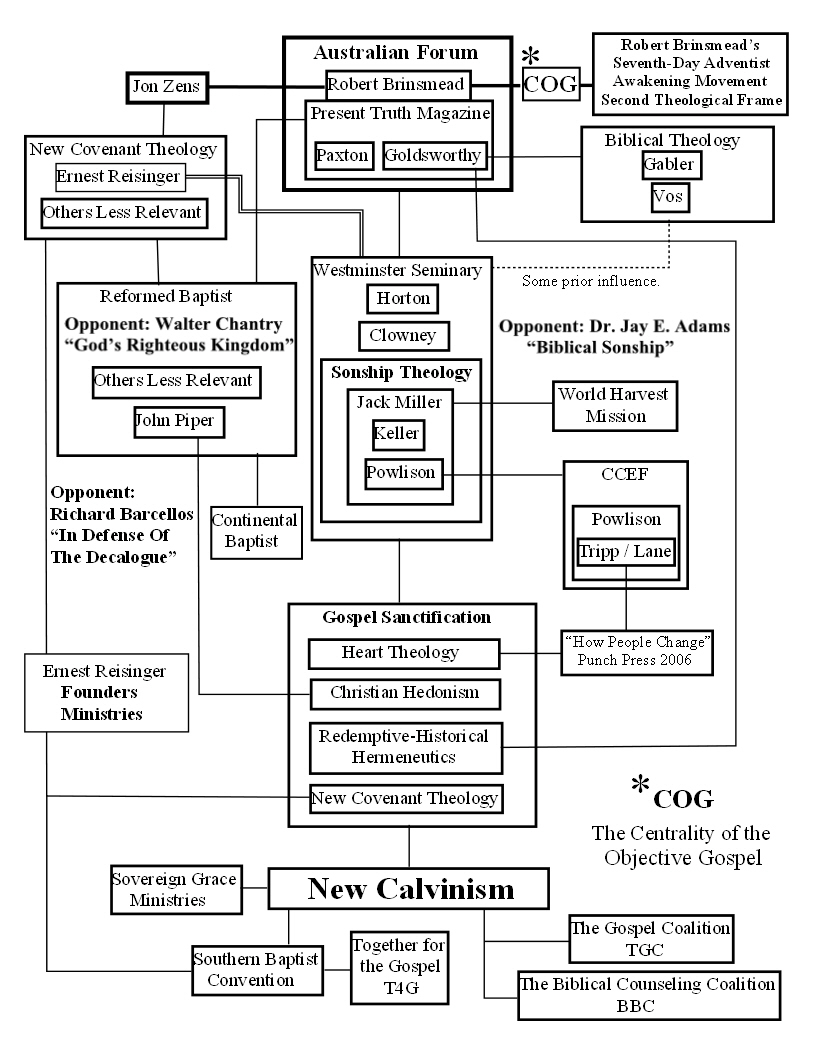
Randy, 1. Separate works, but the same thing. Sanctification, or what they call “progressive sanctification” because they lie all the time, is “justification in action.” Both are justification, but one is a legal declaration, and the other is “the power of the gospel.” That’s what all neo-antinomians believe. 2. First, justification is not by Christ ALONE. If God didn’t elect Christ, elect the elect, and draw them to Christ, along with with sacrificing His only Son, what Christ did would have been for naught. So, justification is not by Christ alone. 3. That’s NOT what New Calvinists believe. They believe that Christ obeys for us. This is well documented in the book, chapter 13. 4. Right. 100% true. 1. Professing? Or genuine? You don’t clarify. 2. Such a person has a wrong view of salvation. How they experience their false profession is not relevant and has no bearing on a theological discussion. 3. No, because it’s not really sanctification. Like New Calvinists, he believes the two are one and he must contribute to maintaining his just standing before God. New Calvinists also believe the two are one, but rightly conclude that there is no way we can maintain our just standing before God. That’s why their daddy, Robert Brinsmead, came up with a theological system where Jesus obeys for us. Graeme Goldsworthy supplied the necessary hermeneutic for the system, Jon Zens helped with how the Law related to the system, and Geoffrey Paxton was the promoter and wrote most of the articles in their theological journal. 4. Yes, in regard to justification, but NOT sanctification. The notion that the first four chapters of Galatians is about sanctification is an antinomian lie. 5. Legal obedience? This is the view that people can sincerely, truthfully, and correctly apply the word of God to their lives, but for the purpose of maintaining their just standing before God. This model is a biblical anomaly. Works salvation, as described in the Bible, ALWAYS involves rituals and standards that are the “traditions and precepts of men.” I reject the premise of your question because it is biblically unfounded. When people are really saved, they have been given a love for the truth, and that’s why they seek to apply it to their life correctly. Therefore, true obedience for the sake of maintaining the legal declaration is an oxymoron. But of course, New Calvinists continually present this type of model in their teachings because they lie all the time about almost everything. 6. Here, you are employing the either/or communication technique. Faith is EITHER all about the Christ/gospel that saved us, OR all about other things that don’t require faith. It’s either/or, faith can only refer to the gospel that saved us. No, faith applies to other realms within sanctification that please God. 7. Again, you present the oxymoronic biblical aonomaly of people presenting true obedience to God in kingdom living for the purpose of maintaining their just standing before God. Unsaved people can have no such desire for the truth. That’s why works salvation always presents an unbiblical standard or ritual. 8. I have a problem with the use of the word “trust” in your question. Again, you employ the EITHER/OR communication technique. The only “trust” there can be in sanctification is EITHER trust in our performance, OR trust in the gospel/works of Christ. In sanctification, it’s trust in the word of God which results in our performance. Also, as Christians in sanctification, we don’t “obey a PROCESS.” We “observe all that I have commanded you.” If Christ meant to say, “teaching them to observe all of the gospel and my personhood,” that’s what He would have said. |
Often Asked By Those Looking For a Church: How Do I Know If It Is New Calvinist Or Not?
 “Really, number one and number six are the most significant answers to the reader’s question.”
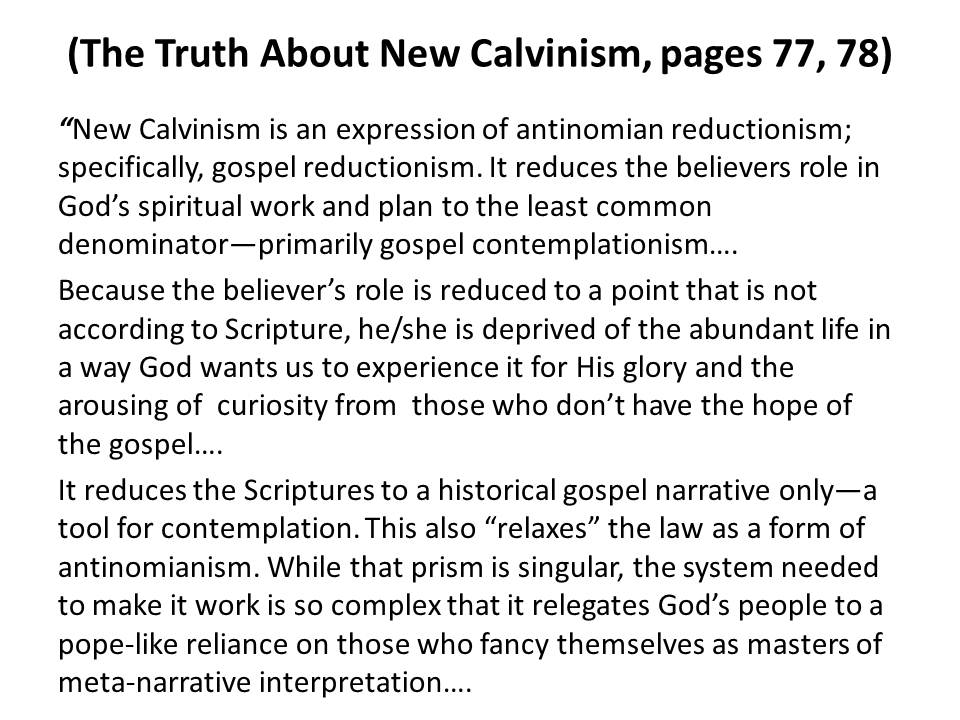
New Calvinism is not only dangerous to one’s soul, it is very subtle, and its proponents are deliberately covert. A post on what to look for is overdue, and my thanks to the reader who wrote and reminded me of this need. First, know this: in our day, New Calvinist churches will be the rule and not the exception. When you visit a church, assume that it is in the process of being taken over by New Calvinists, or has been in that camp completely for a period of time. Churches that have been solidly New Calvinist for a number of years will have cult-like characteristics.
Now, let me first begin my list by specifically answering the readers question and then I will expand from there: “….and would like to have a few questions to ask a Pastor to be able to know for sure if he is or is not in the NC camp by how the questions are answered. At the top of your head what questions would you recommend be asked that would be very telling?”
1) The biggie: “What hermeneutic do you use when you are preaching? Do you use the grammatical historical hermeneutic, or the redemptive historical hermeneutic?” Whether the pastor is NC or not, a deer in the headlight look will follow because most parishioners of our day do not know any theology. Think about it for a moment. These are two very different ways of approaching the Bible with the results being radically different; but yet, 99% of the parishioners out there have no idea which one their pastor uses.
GHH seeks to be exegetic; all ideas about everything are drawn from the text. RHH has an eisegetic approach; the sole purpose of the Bible is to gain a deeper understanding of Christ. It is sometimes called the “Chrstocentric” hermeneutic.
If the pastor admits that he is RHH, he is a NC. If he becomes aloof, for example; “Well, why don’t you come and see what we are about at one of our services, and then if you still want to talk about theology, we can do that” (by the way, that’s an actual quote from a pastor in response to my question concerning his hermeneutics), he is suspect. If he claims to be both, he is also suspect. If he is NC, he will know the very second you asked that question that he does not want you in his church.
2) Ask him who his favorite teachers are (you may want to word the question in a different way). If aloofness follows, he is suspect. If his favorite teachers are the likes of John Piper et al, he is either undiscerning or NC. In other words, he’s suspect.
3) You can ask him about his view on obedience, but you have to ask it this way in order not to be roper-doped: “Does all legitimate obedience and duty come out of a deeper understanding of our salvation? And when it does, is it a ‘mere natural flow?’”
4) “Do you believe that we are sanctified (set apart) by contemplating the gospel that saved us, or colaboring with the Holy Spirit in applying the word to our life.”
Bottom line: a skilled NC pastor can get around all of these questions except question number one. Even then, he can claim that he uses both hermeneutics.
Things to Look For
5) Is everything going on in the church about the gospel and Jesus? Is all of the music about redemption? Are all the messages about salvation, even though it’s a Christian setting? Is God the Father and the Holy Spirit rarely mentioned?
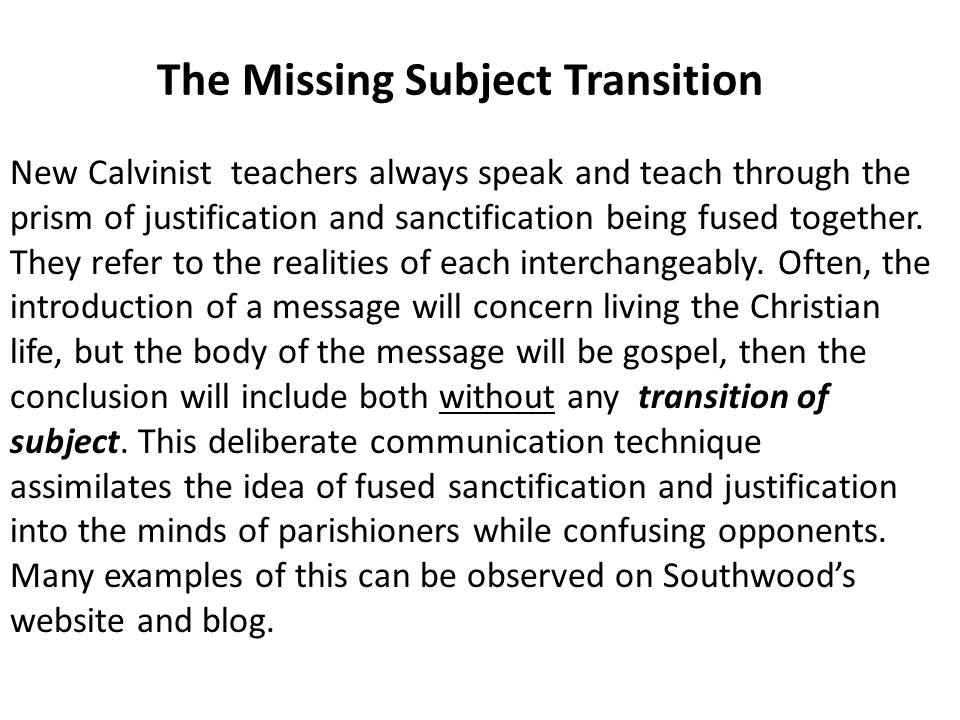
6) Another biggie: The missing transition communication technique in teaching and conversation. Like number one, this is huge. A message will begin with the subject of our Christian walk, but then will move into the subject of salvation without a transition in subject, as if the two are the same thing. Really, number one and number six are the most significant answers to the reader’s question.
7) The either/or communication technique, or the missing option C communication technique. The classic example is this prayer I heard spoken by a New Calvinist elder: “Lord, forgive us for obeying you in our own efforts.” The prayer insinuates that it’s either all of our effort, or all of something else that we don’t need forgiveness for. New Calvinists use this communication technique over a wide spectrum of teachings.
The Danger Zone
8.) Don’t forget, New Calvinist elders believe they have authority over you if you are a professing Christian and you are in their neck of the woods. Never, never, never, never meet with an elder or a group of elders ALONE. Never. And document everything. If you find yourself trying to ascertain where a church is doctrinally, and things are getting uncomfortable—that’s a New Calvinist church, or a cult, one or the other. Also, in this type of situation in a NC church, they consider these meetings to be steps of Matthew 18. They also consider any type of formal or informal counseling to be part of the discipline process. Regardless of whether you are a member or not, they will formally excommunicate you from the church universal in a Sunday morning service. And by the way, you have no legal grounds for a lawsuit in any state. Please, please, avoid these situations.
9) Watch for signs of exclusiveness; such as, “We preach the scandalous gospel,” ect. Or, “We teach this, as opposed to the ‘vast majority’ of other Christian churches.” “This is what makes us unique.” If you hear verbiage like this, gather your family and run for the nearest exit door. And don’t look back.
10) Watch out for love bombing. An overemphasis on love usually replaces things that are missing—like TRUTH! True loving relationships, even among Christians, are developed over time.
Also, in a NC church, if you are thought to be discerning, you may be approached by an elder with an unsolicited offer to “disciple” you on a weekly basis. This is more than likely for the purpose of neutralizing you as a threat. In many NC churches, this is considered counseling/discipline whether you are aware of it or not. It is known as “redemptive church discipline.” The goal is to bring you to a “redemptive” view of sanctification.
paul
The New Calvinist Takeover of Southwood Presbyterian Church: Part 4; Jean F. Larroux, III is Pure New Calvinism
As I peruse the Southwood website blog, it is saturated with New Calvinist doctrine; there may not be a finer specimen than Jean Larroux, III, hereafter, “LM3.” This is good for me because I was getting ready to write a series of articles on Ligon Duncan who is much more nuanced than LM3. Ligon Duncan is one of the “Core Four” of the T4G conferences that is doing damage control and spin concerning the former president of SGM ministries, CJ Mahaney, who is also one of the Core Four. CJ Mahaney is a serial propagator of parishioner abuse, and there are several SGM expose blogs that document his abuses—that’s why he had to step down. Apparently, Duncan, as a “pastor,” is completely indifferent to this reality.
As I look through the site, I think I will address this particular post first: Idolatry, Self-righteousness and other confessions of a Homeschooling father…(Monday, September 26, 2011). This is LM3’s repost of an article by New Calvinist Reb Bradley. My post on the Bradley article is here: http://wp.me/pmd7S-Us .
Also, I noticed that LM3 has done a series on Galatians. He probably toed the NC line that the apostle Paul was teaching that synergistic sanctification is a false gospel. I address that here: http://wp.me/pmd7S-KC . You can click on the pages to make them bigger if needed.
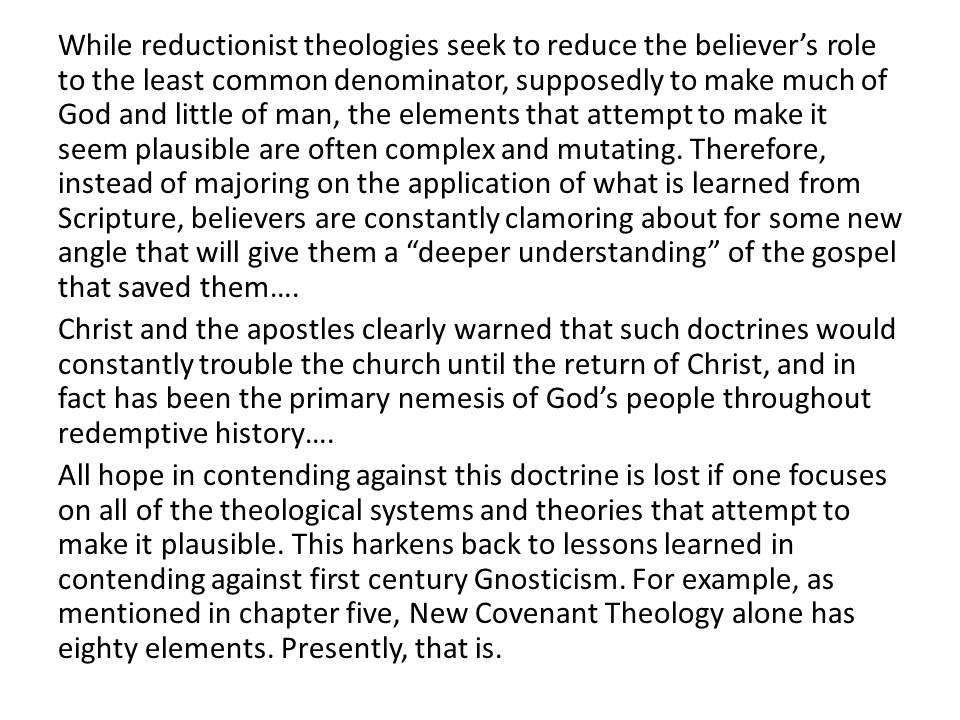
Also, no surprise, it looks like LM3 uses the New Calvinist view of the Pharisees as well. Here is an excerpt from The Truth About New Calvinism that deals with that: Chapter 2
paul








 Paul's Passing Thoughts
24 comments