Shaking of Adventism Update
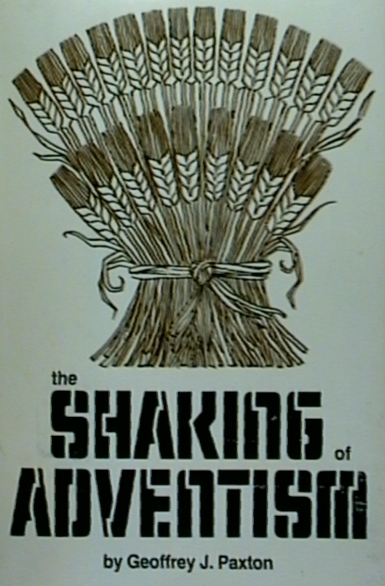 The Shaking of Adventism written by one of the Australian 3 promises to be a valuable addition to the second volume of The Truth About New Calvinism. Dr. Geoffrey Paxton wrote the book during the pinnacle of the Australian Forum’s influence.
On page 63 of The Truth About New Calvinism, I cite a writer who said the Forum “shaped the thoughts and ideas of Michael Horton.” That might be the understatement of the century—Paxton’s book has an uncanny semblance to Christless Christianity, a book written by Horton.
Another unexpected treat: I thought Gospel Sanctification, Christocentric Hermeneutics, and Gospel Contemplationism where probably Johnny-come-lately theologies that the Forum integrated with Brinsmead’s brainchild, the centrality of the objective gospel outside of us. Not so. Brinsmead drew these things from within SDA’s historical theologies. Paxton shows clearly how the 1888 Convention attempted to move Adventism away from Pelagianism toward a more orthodox view of justification. In the mix is a clear testimony showing that Ellen White was advocating a Gospel Contemplationism via Christocentric preaching and teaching. Was it original with her? Or did she get it from someone else? Hard telling, but keep in mind, we are talking about 1888 here.
At the 1952 Convention, Dr. Edward Heppenstall built on the 1888 Conference and advocated what we now call “Gospel Sanctification”: “ The other method of bringing harmony between man and the law is to change the sinful nature of man, so that it becomes again in accord with the divine law. There is only one method by which this can be done. That is the method of free grace or righteousness by faith.”
However, the debate then began over whether or not that a righteousness by faith that was within us was merely semi-Pelagianism verses crass Pelagianism. Adventists Dr. Desmond Ford and H.K. LaRondelle (who studied under G.C. Berkouwer) would have profound influence on Brinsmead in regard to these issues. However, remember that the whole debate was still founded on a false premise: the fusion of justification and sanctification.
paul
The False Gospel Duo and a Confused Hypocrite Following
 Missed in the entire fray about New Calvinism is the simple fact that its premise is a false gospel. Clearly, the core of New Calvinism is the Australian Forum’s centrality of the objective gospel outside of us (COGOUS). Not many will fuss over a view that true righteousness comes to us from the outside for justification, but the Forum then extended that same reality to sanctification as well. We are supposedly sanctified by a righteousness that is still completely outside of us and not part of us. Certainly, this should be evident via the constant bellowing by New Calvinists that believers are still totally depraved. Hence, like the Forum, New Calvinists like Michael Horton deny the significance of the new birth.
The fundamental flaw of New Calvinism, like 99% of all false gospels, starts with the idea that justification has to be maintained. In order for us to be proclaimed righteous, we have to actually be perfectly righteous in practical behavior and able to stand righteous before God at any time. But Christians will not stand at a judgment that determines righteousness, for we have already been declared such, and the full righteousness of God has been credited to our account. Sanctification is totally separate from justification and cannot take away from justification or add to it. Romans 8:30 makes this certain.
But the Forum, being primarily grounded in SDA theology, followed the idea that is indicative of all Jesus plus something else doctrines: sanctification is the link between justification and glorification; the two (just. and sanct.) cannot be separated. Starting with that premise, there can only be two outcomes: justification only deals with the past and we have to work our way to heaven via keeping the law (always mixed with traditions or the “commandments of men”) and ritual. Or, the understanding that if that’s the case, Jesus or the Holy Spirit must keep the law for us so perfection can always be offered to God “by faith.” Hence, we are able to stand righteous at the judgment because Christ or the Holy Spirit keeps the law for us. Ie., antinomianism. New Calvinism bought into the latter Forum package hook, line, and sinker.
How this pans out among New Calvinists in “practical application” varies, but a good example is David Powlison’s Dynamics of Biblical Change as articulated by Paul David Tripp in “How People Change”: we are sanctified the same way we are justified; as we partake in “deep repentance by faith” our hearts are emptied of idols that replace Christ and we experience a filling of Christ leading to manifestations of the Holy Spirit. In New Calvinism, sanctification is sort of a purgatory where we work out justification by faith alone. As long as our motive is to be sanctified the way we were justified, by faith alone, we are ok. Like Steve Green’s song, “That’s Where The Joy Comes From,” we are, “empty vessels waiting to be filled.” Like John Piper’s thesis in When I Don’t Desire God, obedience that comes from heaven is validated by joy, and we cannot do anything to obtain joy—it is a gift. We work out our salvation in the weeds and the tares and wait for joy to come (p.43). When we are confronted with a choice to obey and do not possess joy resulting from gospel contemplationism, go ahead and obey, but ask for forgiveness in doing so (ebook, Treating Delight as Duty is Controversial).
Again, according to many New Calvinists, sanctification is a sort of justification purgatory where we work out our salvation through subjective experience while focusing on the works of Christ only, and this is why justification should never be subordinated to sanctification. Yes, the “new birth” is true, but it is not objective like the gospel (justification) and should always be explained in a justification context.
New Calvinism is stayed on the concept that all righteousness remains outside of the believer. This was a Forum distinctive. Therefore, it would stand to reason that repentance on our part would not be included in the gospel message. A call for repentance AND faith insinuates a righteousness within the believer that would see the need for change. Regeneration is not the goal of the New Calvinist gospel—that encourages a focus on self and “navel watching” to the exclusion of recognizing the work of Christ and His glory. Sanctification is different because the goal there is to joyfully endeavor in discovering the depths of our wickedness. As we see and repent, more wickedness is revealed, more Holy Spirit manifestations occur, and the cross is made bigger by seeing more of Christ’s holiness and more of our wickedness. The only difference between a believer and unbeliever is believers see more of who they really are. See chart below published by a New Calvinist organization:

Therefore, two good examples of “the gospel” from two New Calvinists would be John Piper’s gospel “in a sentence” and CJ Mahaney’s gospel in five words. Mahaney often says that the gospel can be summed up in five words: Christ died for our sins. He also states: “Such news is specific: there is a defined ‘thatness’ to the gospel which sets forth the content of both our saving faith and our proclamation. It is objective, and not to be confused with our response.”
And regarding sanctification, Mahaney states:
The Bible tells us that, while there are many different callings and many possible areas of service in the kingdom of God, one transcendent truth should define our lives. One simple truth should motivate our work and affect every part of who we are.
Christ died for our sins.
It’s all about what Christ did, not anything we might do, like repentance as a result of new creaturehood. Likewise, here is what Piper states regarding the gospel:
What’s the gospel? I’ll put it in a sentence. The Gospel is the news that Jesus Christ, the Righteous One, died for our sins and rose again, eternally triumphant over all his enemies, so that there is now no condemnation for those who believe, but only everlasting joy. That’s the gospel.
In the following post http://wp.me/pmd7S-RP , I display four gospel video presentations by Piper in which the new birth and repentance are conspicuously missing. But yet, Piper worshipper John MacArthur continually fustigates others that don’t preach a gospel that includes repentance. The following video is one example:
AND A ONE-SENTENCE GOSPEL, AND A FIVE-WORD GOSPEL IS?
And, once again, like 2005, 2006, 2007, 2008, 2009, 2010, 2011, MacArthur will appear on stage with Mahaney at the 2012 Resolved Conference sponsored by his church, Grace Community. And this after Mahaney was forced to step down from a ministry he founded for serial sheep abuse.

In light of this, I will think of MacArthur in the best possible light: a former stalwart of the faith is now a confused hypocrite. I guess that’s better than saying that he now advocates a false gospel. Even though he does, our former heroes die hard. But because of our love for the truth, die they will as those whom we follow. Even the apostle Paul instructed Christians to follow him “as I follow Christ.” And trust me, MacArthur is no apostle Paul. If Paul were invited to speak at a Resolved Conference, he would shrink back in horror at the rock concert like setting that seems to say that we need more than the excitement of the very words that come forth from God’s own mouth. And the location is also telling: Palm Springs. For sure that would have been Paul’s favorite place for ministry.
paul
Dear Tullian, Is My Pastor Preaching Correctly?
The litmus test that I use for myself is that if people walk away from my sermons thinking more about what they need to do than what Jesus has already done, I’ve failed to preach the Gospel….And a lot of preaching these days is “do more, try harder”…. (Tullian Tchividjian: Does Your Preaching Pass the Grace Test?).
“Finally, then, brothers, we ask and urge you in the Lord Jesus, that as you received from us how you ought to walk and to please God, just as you are doing, that you do so more and more” (Apostle Paul, 1Thess. 4:1).
It’s behavior modification (Tullian Tchividjian: Does Your Preaching Pass the Grace Test?).
“….having a good conscience, so that, when you are slandered, those who revile your good behavior in Christ may be put to shame” (Apostle Peter, 1Peter 3:16).
“Older women likewise are to be reverent in behavior, not slanderers or slaves to much wine. They are to teach what is good,” (Apostle Paul, Titus 2:3).
We come to church expecting God to give us a to-do list or the preacher to give us a to-do list (Tullian Tchividjian: Does Your Preaching Pass the Grace Test?).
“For this very reason, make every effort to add to your faith goodness; and to goodness, knowledge; 6 and to knowledge, self-control; and to self-control, perseverance; and to perseverance, godliness; 7 and to godliness, brotherly kindness; and to brotherly kindness, love. 8 For if you possess these qualities in increasing measure, they will keep you from being ineffective and unproductive in your knowledge of our Lord Jesus Christ” (Apostle Peter, 2Peter 1:5-8).
As long as we are given a to-do list, we maintain some measure of control over our lives (Ibid).
“Every athlete exercises self-control in all things. They do it to receive a perishable wreath, but we an imperishable….But I discipline my body and keep it under control, lest after preaching to others I myself should be disqualified….that each one of you know how to control his own body in holiness and honor….(Apostle Paul, 1Cor. 9:25, 27, 1Thess. 4:4).
So we come to church saying, “Pastor, my marriage is in trouble…my children are going off the deep end…my business is failing…I’m coming to you as the expert to tell me what to do to fix my own life…” And as a result, our lives get worse, not better, because we’re taking matters into our own hands (Ibid).
“I do not write these things to make you ashamed, but to admonish (noutheteo , or to counsel) you as my beloved children….We ask you, brothers, to respect those who labor among you and are over you in the Lord and admonish (Ibid) you….I myself am satisfied about you, my brothers, that you yourselves are full of goodness, filled with all knowledge and able to instruct (Ibid) one another….Let the word of Christ dwell in you richly, teaching and admonishing (Ibid) one another in all wisdom, singing psalms and hymns and spiritual songs, with thankfulness in your hearts to God….Now these things happened to them as an example, but they were written down for our instruction (Ibid), on whom the end of the ages has come” (Apostle Paul, 1Cor. 4:14, 1Thess. 5:12, Romans 15:14, Colossians 3:16, 1Cor. 10:11).
So my job at the end of every sermon—and this is the grid by which I preach—I preach God’s law, and then I preach God’s Gospel. Both are good. The law diagnoses my need and shows me that my best is never good enough. So I’m always trying to help our people realize that they’re a lot worse than they realize, and they’re a lot more incapable than they think they are (Ibid).
“I myself am satisfied about you, my brothers, that you yourselves are full of goodness, filled with all knowledge and able to instruct one another” (Apostle Paul).
So my job at the end of every sermon is to, in some way, shape, or form, encourage our people by saying, “Cheer up. You’re a lot worse off than you think you are, but God’s grace is infinitely larger than you could have ever hoped or imagined. It is finished”(Ibid).
“Or do you not know that the unrighteous will not inherit the kingdom of God? Do not be deceived: neither the sexually immoral, nor idolaters, nor adulterers, nor men who practice homosexuality, nor thieves, nor the greedy, nor drunkards, nor revilers, nor swindlers will inherit the kingdom of God” (Apostle Paul, 1Cor. ch6).
It’s the people who constantly demand to-do lists and then preachers who capitulate to that demand and give them to-do lists; those are the people who get worse. I’ve realized, and I’m only 39 years old, but I’ve realized the more I try to get better, the worse I get. I’m just realizing I am a narcissist. I think way too much about how I’m doing, if I’m doing it right, have I confessed every sin. In other words, I’m thinking much more about me and what I need to do than Jesus and what He’s already done. And as a result, I’m not getting better. I’m getting worse (Ibid)..
“For this is the will of God, your sanctification: that you abstain from sexual immorality” (1Thess. 4:3).
I think the whole notion of what it means to progress in the Christian life has been radically misunderstood. Progress in the Christian life is not “I’m getter better and better and better…” Progress in the Christian life is, “I’m growing in my realization of just how bad I am and growing in my appreciation of just how much Jesus has done for me (Ibid).
“For we must all appear before the judgment seat of Christ, so that each one may receive what is due for what he has done in the body, whether good or evil” (Apostle Paul, 2Cor. 5:10).
Proverbs 4:18
But the path of the righteous is like the light of dawn, which shines brighter and brighter until full day.
“His master said to him, ‘Well done, good and faithful servant. You have been faithful over a little; I will set you over much. Enter into the joy of your master’” (Jesus Christ, Matthew 25:23).
paul
Not Knowing Tullian Tchividjian Saved My Life
A reader sent me the latest post by Tullian Tchividjian. Go figure, he wasn’t able to pass on criticizing a concept that involves the possible use of verbs: New Year Resolutions. Susan and I had just finished working on a resolution of our own to begin the new year. We were not excited to partake in the endeavor. We knew it would reveal the necessity to make hard choices together. It was difficult not to focus on that rather than the glory that could be brought to God through the process. Afterward, while somewhat moody about the task, I checked my email, clicked on the link, and read it. So, hide the children.
Tullian Tchividjian is an icon among the Young, Reckless, and Rebellious that are presently tormenting the church. His followers are those who the apostle Paul said would come in the last days with itching ears—wanting to hear that the Christian life is a “mere natural flow.” According to Tchividjian, the acid test for determining if you are preaching the true gospel is to be accused of antinomianism. And while many of this bunch applauded the Queen of Anomia, Elyse Fitzpatrick, for stating that there is no such thing as antinomianism, others like New Calvinist/Super Yuppie Dane Ortlund claim that the apostle Paul was accused of being one; so hence, it is their goal as well. Even more detestable is the way that library theologians like John MacArthur lend credibility to these enemies of righteousness. In his ignorant ramblings about how the Young, Restless, and Reformed need to “grow up and keep reforming,” he is stupidly incredulous that antinomians are acting like antinomians.
And their arrogance is without boundary, having reverence for nothing but their own visions of grandeur. For example: yes, I realize that Dietrich Bonhoeffer had some issues in regard to orthodoxy, but I won’t even go there. Why? Because he left a cushy ministry in the States to take a stand against Nazism in Germany. He observed that like the pastors of this day, they wouldn’t take a stand in Germany, but rather emphasized the positive of what Hitler had to offer. Bonhoeffer was eventually hanged while naked with piano wire. But as ones who talk like those who have taken off their armor before putting it on and standing before the razor thin noose, they constantly rag on him for saying things like, “ One act of obedience is better than one hundred sermons.” Another example that is almost equally disgusting is the book written by the pretentious and puerile Heath Lambert, passing judgment on the likes of Jay Adams. If the book is ever produced in audio, it would be an excellent complement to ventriloquist David Powlison.
And of course, Tchividjian wasted no time speaking for Susan and me regarding our New Year Resolution for the Lord. His message? Like all things that we try to do for the lord, it will fail. And gee whiz, isn’t it great that our acceptance before the Lord doesn’t depend on our performance?
I have some theological news for this vile antinomian and his fiend friend that sent him the quote that he thought was so special. That would be the friend who delights (like all New Calvinists) in bringing elderly saints up on bogus church discipline (I told you to hide the children. I am fed-up with this bunch and the cowards that cover for them). Here is the news flash: Susan and I don’t claim to be the brightest bulbs in the house, but we know at least this much; we cannot do anything to gain favor with God for purposes of justification. That’s impossible because He chose us to be completely justified before the Earth was created. Therefore, He also chose us, and the guaranteed result is glorification at a time of His choosing and good pleasure. Susan and I believe this with all of our hearts and it is the basis of this belief that gives us assurance of our salvation. But unlike these brute beasts, Susan and I have a King that we want to please for many reasons—reasons that He states, not mere men. We long to stand before Him and hear, “Well done, faithful servant.” And guess what? We actually believe He is talking about what we actually do. Excuuuuuse us for taking that literally and not embracing Tchividjian’s Gnostic-like approach to the Scriptures (also known as Redemptive Historical hermeneutics).
But what really torques me off about these men is their HOPELESS message. When I went to a biblical counselor some twenty-four years ago in the midst of a serious trial, I was a New Calvinist before New Calvinism was cool. I read Scripture and prayed for hours “seeking the Lord’s face.” In 1994, MacArthur explained what that means; in essence he said, “We don’t really mean like, you know, looking for a face in the Scriptures like something mystical. We mean like, you know, looking for Jesus in the Scriptures.” Ya, got it, except for the part about what Jesus SAYS, not what he looks like. MacArthur seems to have bought into the New Calvinist hermeneutic that is primarily concerned with who Jesus is as a “person.” It’s almost as if none of them can wait to meet Jesus face to face so they can ask him what His sign is and His favorite color. “Is fish really your favorite food? Or was it because that was the staple food of the day?” Oh to know who Jesus really is! The perfect complement is Francis Chan’s Jesus is my boyfriend theology. Meanwhile, Steve Camp and others have no clue where all of the Jesus is my boyfriend music comes from that they constantly lament. Antinomians acting like antinomians and those seeking to fall in love with Jesus singing Jesus is my boyfriend music, and no one is apparently able to connect the dots. What in the world is going on?
Thank goodness my counselor wasn’t Tchividjian . And thank goodness my counselor had not yet become the president of an evil empire. He told me that I could actually do something about my problem; specifically, what the Lord instructs. “Oh, you mean nothing’s happening because Jesus also wants me to do things? “ Profound.
This ministry is a witness to how New Calvinists counsel: “We are helpless creatures who have this treasure of Jesus in clay vessels. Embrace the pounding of the trial as it breaks apart these vessels of clay and allows the glory of Jesus to shine out!” Meanwhile, New Calvinists play on the results of an existing epidemic of our day: Christians functioning on biblical generalities and trying to do the right thing the wrong way. THAT IS WHY THEIR CHRISTIAN RESOLUTIONS FAIL, not for lack of a Tchividjian false gospel. Thank goodness I didn’t know him. It would have been one New Calvinist leading another into a ditch.
paul
Paxton’s “Shaking” Adds More Confirmation to TTANC: Introduction to Series
I just finished reading “The Shaking of Adventism” by Geoffrey Paxton. The book was published in 1978 and is an inside look into historical events surrounding the Australian Forum during its apex. Paxton was one of the AF3, and wrote most of the Australian Forum’s articles published in Present Truth magazine which was the Forum’s theology journal.
The book clearly articulates present-day New Calvinism while crediting Robert Brinsmead with rediscovering the Reformation gospel. Paxton only notes two primary sources that helped Brinsmead develop the centrality of the objective gospel outside of us (COGOUS) doctrine that is the heart and soul of New Calvinism: the Reformers, and Seventh-day Adventist leaders. The only exception is the mentioning that a well-known SDA teacher studied under G.C. Berkouwer, a gospel contemplationist quoted often by New Calvinists such as Michael Horton. The Forum also quoted Berkouwer extensively.
Paxton’s thesis is the following: Adventists have always claimed to be the guardians of Reformation doctrine, so the idea that the Reformation was rediscovered through them should be no surprise. COGOUS is clearly defined as the original Reformation doctrine. Paxton documents the historical events that paved the way for Brinsmead’s “discovery.”
Without any exception, the book strongly supports the position of “The Truth About New Calvinism.” More to come after I get back from celebrating my first year with Susan. Our anniversary is tomorrow.
May your new year be blessed by our Lord,
paul

 Paul's Passing Thoughts
leave a comment