How Most Pastors Today Use The Bible
“….if the higher law of love abrogates the law of Scripture, it sure as hell abrogated your by-laws. I find the incredulous demeanor of people who come to me with these reports both adorable and naive. It’s time for Christians to wake up and start drinking more coffee.”
I’m wondering; can we begin calling our present day, “The Age of the Australian Forum”? If you really want to understand what’s going on in the church theologically, read the Forum’s journal: Present Truth Magazine. It can be obtained online for free through a Progressive Adventist church that archived most of the issues.
The Forum’s hermeneutic was based on their thesis, the centrality of the objective gospel completely outside of us (COGOUS) which is supposedly the lost doctrine of the Reformation. It’s monergism on steroids. We are so wicked and totally depraved, that objective truth can only be outside of us. When truth starts being processed inside of us, the only result can be subjectivism.
What to do then? Answer: focus on central truth that is the “power of the gospel.” Basically, gospel, gospel, and more gospel transforms us into Christ likeness. We need to saturate ourselves with information about the works of Christ, not anything we would do. Hence, pithy truisms like, “Not, ‘What would Jesus do?’ But, ‘What has Jesus done.’”
Supposedly, saturating ourselves with what Jesus has done, not anything that we would do fills our hearts with gratitude and makes us willing and joyful participants in obedience. However, the key is to focus on gospel and then allow works to flow from that. Obedience when we don’t feel like it, or out of duty, is not “done in love” And, the point isn’t how well we do that—because we are not “under law, but under grace.” The point is not to “obey in our own efforts.” Results are not the goal, we can’t affect any results anyway; the goal is to avoid “making our sanctification the basis of our justification.” In other words, all works must flow from justification truth and the “power of the gospel.” Just focus on gospel, and let the “active obedience of Christ” take care of the rest.
This is because Christ was not only obedient to the cross (known as His “passive” obedience), but also lived a perfect life so that His obedience for sanctification could be imputed to us as well (Christ’s “active” obedience). Hence, and don’t miss this, if we try to obey in sanctification, we are trying to accomplish works that have already been finished by Christ as part of the atonement, and thus making our sanctification the grounds of our justification because the two are fused together and part of the atonement with Christ living a perfect life here on Earth for one, and dying for the other. Got that? This makes sanctification very tricky business. At any time, we could be unwittingly “making our sanctification the grounds of our justification.”
Come now, admit it, we hear this lingo all the time reverberating throughout churchianity.
Where does the use of the Bible fit into all of this? Answer: it is a tool for the gospel contemplationism needed to transform us into the likeness of Christ. All of the commands in the Bible are to remind us of the fact that Christ obeyed all of them for us (this is the basis of the New Calvinist motto, “Christ for us”). Biblical imperatives are supposed to remind us of the futility of trying to keep them ourselves while invoking thankfulness for what Jesus has done “for us,” not anything we do. However, polity framework is considered to be a separate issue. They concede that the Bible contains guidelines for structuring the church, but that is for practical function and is separate from “spiritual formation.” Moreover, this view contends that the Holy Spirit only illumines when the Bible is used to see the gospel in a deeper and deeper way. And also, aside from practical use for structuring, seeing the Bible through the prism of gospel (ie., Christ the person and His works) interprets the Bible itself for all uses in “spiritual formation.”
Now, since Christ already fulfilled the law and imputed it to us, our goal isn’t to follow specific imperatives in the Bible, but rather to fulfill the “higher law of love” that Christ has instituted to replace the “fulfilled” law which is now abrogated by the “higher law of Christ.” What does that look like?! Answer: it looks like whatever the gospel produces! Because, when it’s the result of the gospel, it can’t be wrong! If the elders of your church are “saturated with the gospel”—they can’t be wrong, and it may, or may not look like “the dead letter of the law,” ie., biblical imperatives not seen in their “gospel context.” As Francis Chan states it: “When you are loving, you can’t sin.”
Look folks, this ministry sees this approach to the Bible fleshing itself out in real-life church situations daily: “But, but, how can they do this?! It is clearly against Scripture!” No, in their minds, it is against a law that has been abrogated by the higher law of Christ. “But, but, what’s that?” Answer: whatever results in the elders being saturated with the gospel, that’s what. And then there is the whole issue of New Calvinist elders poo—pooing church constitutions and by-laws. Trust me, if the higher law of love abrogates the law of Scripture, it sure as hell abrogated your by-laws. I find the incredulous demeanor of people who come to me with these reports both adorable and naive. It’s time for Christians to wake up and start drinking more coffee.
Let me tell you what the perfect cover is and why so many pastors get away with using the Bible this way. In fact, I will begin to explain with a question: how many great sermons can be preached about the awesomeness of Christ and all that He has done for us? Answer: how many books has John Piper written? And people rave about all of them! But what is missing? Answer: aside from a truckload, Matthew 7:24-27. One of the best friendships I have was brought about when she objected to an article I wrote along these lines, and mentioned a book by John Piper that was supposedly “full of biblical instruction.” I then responded and encouraged her to reread the book and list every biblical life application she could find. She did just that and contacted me by email: “Your right. This is a real eye opener.”
What prompted this post? I read this article here: article link. Read it for yourself and let me know if it rings any bells.
paul
The New Calvinist Agenda: Take Over All of the Church With COGOUS
A New Calvinist takeover is coming to a church near you—probably yours. Is that a good thing? Well, think with me: they think the original doctrine of the Reformation was lost shortly after it made its impact. And, it was recently rediscovered by men like John Piper. In fact, Piper doesn’t think most of us are really “ready” for the recently rediscovered Reformation that is “ongoing.” Do you doubt that? Well then, let’s pause to watch the following video:
You see, that’s why New Calvinists like Al Mohler aren’t honest about what they really believe—us poor ignorant souls are not “ready” for the whole truth yet. Bless his heart, in a letter to me last year, he lied to me and said he didn’t know anyone who believes what I described. Al was just looking out for me until am “ready.”
Who rediscovered the lost doctrine of the Reformation? Answer: a Seventh-day Adventist who is now purported to be an atheist. Of course, they don’t tell the truth about that either. Most of us Bible thumping evangelicals don’t have sense enough to know that God would use such a person to rediscover the “lost Reformation doctrine” of the centrality of the gospel completely outside of us. We just aren’t “ready” for that yet. Do you doubt that? Keeping in mind that the project headed by this man was called the Australian Forum, and their theological journal was named Present Truth, consider this statement by well-known Presbyterian John H. Armstrong:
The sixteenth-century rediscovery of Paul’s objective message of justification by faith [and sanctification also because justification is supposedly progressive] came upon the religious scene of that time with a force and passion that totally altered the course of human history. It ignited the greatest reformation and revival known since Pentecost.
Now, if the Fathers of the early church, so nearly removed in time from Paul, lost touch with the Pauline message, how much more is this true in succeeding generations? The powerful truth of righteousness by faith needs to be restated plainly, and understood clearly, by every new generation.
In our time we are awash in a “Sea of Subjectivism,” as one magazine put it over twenty years ago. Let me explain. In 1972 a publication known as Present Truth published the results of a survey with a five-point questionnaire which dealt with the most basic issues between the medieval church and the Reformation. Polling showed 95 per cent of the “Jesus People” were decidedly medieval and anti-Reformation in their doctrinal thinking about the gospel. Among church-going Protestants they found ratings nearly as high…. I do not believe that the importance of the doctrine of justification by faith can be overstated. We are once again in desperate need of recovery. Darkness has descended upon the evangelical world in North America and beyond, much as it had upon the established sixteenth-century church (The Highway blog: Article of the Month, Sola Fide: Does It Really Matter?; Dr. John H. Armstrong).
Truly, Armstrong is one of the New Calvinists that talks too much. It must drive those other guys crazy. But the survey he talked about in Present Truth can be seen in the following illustration and denotes the basics of the Forum’s thesis: COGOUS. Basically, it teaches that the new birth is not part of the gospel and that all of the gospel’s power is completely outside of us. Before we get to the illustration, do you doubt that? Well then, consider these quotes by New Calvinists and members of the Australian Forum:
But to whom are we introducing people to, Christ or to ourselves? Is the “Good News” no longer Christ’s doing and dying, but our own “Spirit-filled” life?
~ Michael Horton
It robs Christ of His glory by putting the Spirit’s work in the believer above and therefore against what Christ has done for the believer in His doing and dying.
~ Geoffrey Paxton (Australian Forum)
And the new-birth-oriented “Jesus-in-my-heart” gospel of evangelicals has destroyed the Old Testament just as effectively as has nineteenth-century liberalism. (footnoted to Paxton’s article with above quote).
~ Graeme Goldsworthy (Australian Forum)
And let’s tie this in with the video that we watched as well:
In it [Goldsworthy’s lecture at Southern] it gave one of the clearest statements of why the Reformation was needed and what the problem was in the way the Roman Catholic church had conceived of the gospel….I would add that this “upside down” gospel has not gone away—neither from Catholicism nor from Protestants.
~ John Piper
Now consider these illustrations from the Forum’s theological journal:
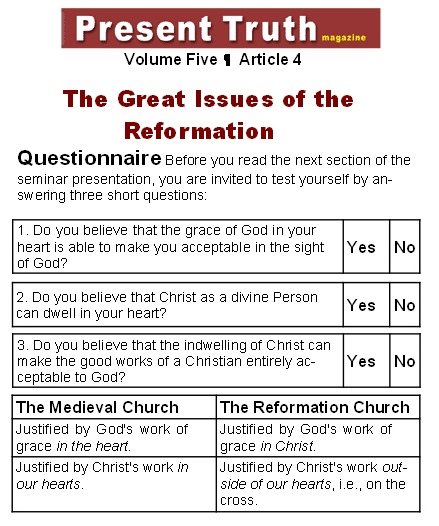
These men are out to save the church, and you had better not get in their way. The takeover mentality was ignited by this amazing “rediscovery” and fueled by visions of grandeur and the egos of men. “Founders Ministries” was an organization founded in 1982 for the sole purpose of taking over the Southern Baptist Convention with this doctrine. CCEF successfully took over NANC and formed the “Biblical Counseling Coalition” to finish the job of taking over what’s left of biblical counseling organizations.
This year’s “Together for the Gospel” (T4G) convention is not geared for individual spiritual growth, but for individuals who are dissatisfied with their church! They will be indoctrinated at the conference and sent back to their local congregations with the supposed answer to the dilemma: the lost Reformation! Observe the following T4G promo:
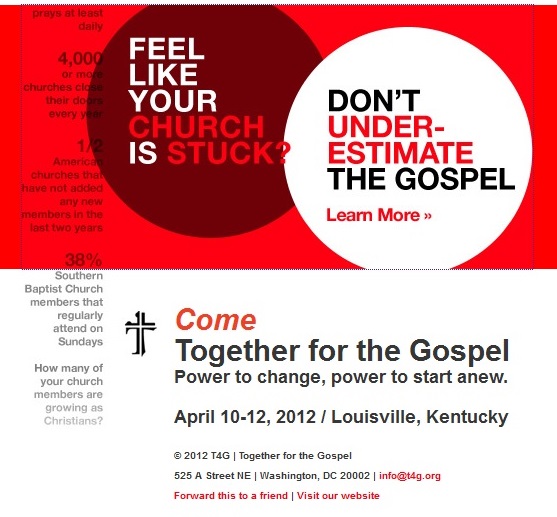 Of course, this is playing on the real problem in today’s churches and why they are dead—living by biblical generalities and an unwillingness to align with biblical truth at all cost. Another aspect is “stupid obedience” verses “intelligent obedience.” Learn about intelligent obedience here: http://www.nouthetic.org/
Got a sick church? Trust me, Dr. Kevorkian isn’t the answer.
paul
Why New Calvinism is Works Salvation and a False Gospel
“So, as long as we don’t, ‘move on to something else’ we don’t ‘lose both.’ What does ‘lose‘ mean?”
I’m going to keep saying it: any doctrine that fuses justification and sanctification together is necessarily a false gospel. Sanctification does not complete justification, and sanctification does not link justification to glorification. That is why Romans 8:30 is stated the way it is. Salvation is a finished work by God alone before the foundation of the Earth and it guarantees glorification. Nothing that you do in sanctification can change that.
New Calvinism fuses justification and sanctification together. This is not even arguable; for, “The same gospel that saves you also sanctifies you.” Here is where New Calvinism goes the way of many other works salvation systems: they erroneously make a false dichotomy between mental activity and physical effort. They think this makes the fusion of justification and sanctification possible because mental activity is supposedly not a work.
Hence, we can keep our salvation by NOT “trying to please God in our own efforts or in our own strength.” So how do we do that? Oh, sorry, rather, “What does that look like” (as if looking isn’t a human activity either). Answer: by contemplating more on the gospel instead of making an effort to do something because contemplation supposedly doesn’t qualify as a human activity. Instead of NOT “trying harder and doing more” we need to “contemplate more and contemplate harder.” Searching the Scriptures in search of “pictures of Jesus” is supposedly not human activity or works either.
But ANYTHING we participate in to MAINTAIN our justification IS works salvation. Indicative of this fusion is the belief that we can lose our salvation. The fusion of justification and sanctification is always coupled with the idea that we can lose our salvation; the two are mutually inclusive. If we can lose our salvation, what do we have to do to keep it? For New Calvinism, the answer is: nothing in our own effort. Salvation by Christ plus doing nothing except for contemplation. For you folks old enough to remember, it’s salvation by Bachman—Turner Overdrive theology: “we work hard at doing nothing all day.” But that is still something that we participate in to maintain our salvation.
Of course, New Calvinists would vehemently deny this, but their teachings often imply, well, “implicit” is really a better word—that we need to perform tasks to maintain our salvation daily. Am I kidding? Well, if words really mean things, no! In Paul David Tripp’s chapel message at Southeastern Theological Seminary in the Spring of 2008 entitled “Playing With The Box,” he plainly stated that Romans 7:24 referred to a “daily rescue.” You do the math.
In “Christless Christianity” by Michael Horton on page 62, he states the following:
Where we land on these issues is perhaps the most significant factor in how we approach our own faith and practice and communicate it to the world. If not only the unregenerate but the regenerate are always dependent at every moment on the free grace of God disclosed in the gospel, then nothing can raise those who are spiritually dead or continually give life to Christ’s flock but the Spirit working through the gospel. When this happens (not just once, but every time we encounter the gospel afresh), the Spirit progressively transforms us into Christ’s image. Start with Christ (that is, the gospel) and you get sanctification in the bargain; begin with Christ and move on to something else, and you lose both.
We Christians are dependent on what at every moment? Answer: the same thing that the unregenerate are dependent on. For what? Answer: spiritual life. How often? Answer: “not just once, but every time we encounter the gospel afresh.” What happens if we “move on to something else”? Answer: “we lose both.” Both what? Answer: obviously, both justification and sanctification. So, as long as we don’t, “move on to something else” we don’t “lose both.” What does “lose” mean?
Yet another example is a comment on The Gospel Coalition blog in regard to an article written by Tullian Tchividjian:
It’s not that complicated: the ground of all Christian obedience is the faithfulness of Jesus Christ. Justification occurs EACH time a believer confesses and receives forgiveness for his sins. The pattern of justification is illustrated by Paul in Romans 4. Abraham believes in the God who justifies the ungodly (in this case gentile Abraham), David is forgiven for his adultery and murder. God’s condemnation for sin has reached into history at the cross, glorification has reached into history at conversion where believers experience a foretaste of glory. Neither Old or New Covenant obedience require moral perfection, they both require obedience of faith….so, having been justified from faithfulness we have peace with God!
I have quoted this example in many articles, resulting in TGC pulling the comment down. However, for some reason they thought the following comment by NCT guru Chad Bresson on the same post is more subtle:
I usually take it a half-step back further in the indicative, including Christ’s life, death, and resurrection. The indicative isn’t simply our position in Christ, but is (more importantly) Christ for us. IOW, not only should we be encouraging our people to become who they already are in Christ Jesus, we must be reminding them of what He has already been and done for them. We *do* the imperatives, not simply because of who we are in our union with Him, but because Christ has already done the imperatives on our behalf because we couldn’t. When I can’t do any given imperative perfectly (failing miserably), I rest in the One who has. Christ’s imputed active obedience is never far from the indicative-imperative rhythm of the Pauline ethic.
Obviously, if obedience in sanctification was imputed to us as part of the atonement, then any attempt by us to obey in sanctification is a denial of the gospel. If at any time in our Christian life we believe that we must put forth effort—that’s works salvation. Instead, we must continue to believe in a supposed salvation by doing nothing which is really Christ plus doing nothing, but is something because it is doing nothing for the purpose of maintaining our salvation because justification and sanctification are fused.
And this of course leads to total confusion among Christians, and I believe a built-in intent of don’t you dare try sanctification at home because it could (as John Piper states it): “imperil your soul.” We supposedly need these spiritual brainiacs to guide us through the very tricky business of deciphering what is works salvation and what isn’t. Good luck with that.
This is the problem you get into when you try to toy with God’s law and its relationship to the gospel. It’s not only antinomianism, but it also tampers with salvation and the true gospel.
paul
What Exactly is New Calvinism? Its Five Major Tenets and Their Sources
The Core Four of the Australian Forum
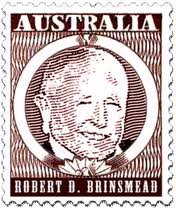 In1970, a think tank was initiated to systematize the “lost Reformation doctrine of justification.” The project was the brainchild of Robert Brinsmead, a Seventh-day Adventist theologian. Their theological journal was “Present Truth Magazine.” Brinsmead came from a family of respected Adventist theologians, and was active in the “justification debate” within Adventism.
He was joined by two Anglican theologians, Geoffrey Paxton and Graeme Goldsworthy. Clearly, Paxton was enamored by an Adventist motif that presented Adventism as the gatekeepers of Reformation doctrine. This is a major theme of his book, “The Shaking of Adventism.” Goldsworthy was a proponent of “Biblical Theology,” or “Redemptive Historical Hermeneutics” which has deep roots in neo-orthodoxy and modernist theology. Neo-orthodoxy and Modernism are the products of liberal, philosophical theology that was born among European philosophers and theologians (primarily in Germany). Biblical Theology was invented by the liberal theologian Johann Philipp Gabler (1753-1826), and was later remodeled by philosopher/theologian Geerhardus Vos (1862-1949). Many consider Graeme Goldsworthy as the one who has taken the torch forward from Vos.
The clear, stated goal of the Forum was to systematize Reformation doctrine to prevent it from being lost again (ref. p. 34 The Truth About New Calvinism). The Forum was later joined by Jon Zens who discovered the Forum through Present Truth which was widely distributed at Westminster Seminary where Zens was a student. Zens was deeply concerned with the relationship between law and gospel and how the two related to covenants.
The Unifying Central Crux
And all agreed on one thing: the Reformation doctrine of justification by faith alone had been lost because of subjectivism, ie., the Bible being interpreted through personal experience. They all agreed that Soren Kierkegaard’s existentialist theology was indicative, and at the very crux of what caused Reformation doctrine to be lost. Existentialism teaches that truth becomes truth for an individual when he accepts it as such according to his/her own experience (very subjective, iffy, fuzzy). The Forum believed that Rome/Protestantism set a tsunami of subjectivism into motion through emphasizing the new birth which supposedly encouraged existentialism-like doctrines. The Forum believed that ALL doctrine can be divided into two categories: Reformation or Romanism, and most of Protestantism ended up following Rome’s subjective gospel based on personal experience. Volume 25 of Present Truth Magazine dealt with the Forum’s view on this and included an article written by Zens on Existentialism.
The Cure: Tenet One; COGOUS
Brinsmead’s first theological frame that launched Progressive Adventism (the “Awakening” movement) taught that Christ stands in the judgment for us as opposed to the traditional Adventist view that Christians are enabled by God to obtain perfection in order to stand in the judgment. For lack of a better way of stating it; subconsciously, many Adventist weren’t buying it. The whole idea that Christ stands in our place and presents His righteousness for us in the judgment was exceedingly good news.
Brinsmead was afforded credibility across denominational lines because he supposedly came to this conclusion by studying Reformation doctrine, and the results seemed to speak for themselves. Everybody, especially Reformed folks, wanted to jump on the Brinsmead bandwagon. Present Truth was the most publicized theological journal of that time, and at least one edition printed one million copies.
Of course, the basic defect in comparison to orthodoxy is the view that there will be a future judgment for Christians in regard to maintaining our justification, which is already a settled matter. As an aside, one wonders if this defect is by design—if our justification is already a settled matter, what do we need pricy theologians for? A judgment to determine our rewards lowers the bar considerably.
But Brinsmead’s second theological frame (a tweaking of the first in regard to some eschatological issues, ie., when does the judgment occur in redemptive history?) settled the subjectivism issue as well as being found truly righteous at the judgment: the centrality of the objective gospel outside of us (COGOUS). This taught that we have NO righteousness in, and of ourselves for purposes of justification, and that all truth must be based on the gospel that is outside of us without regard to personal experience. But remember, just like the Romanism it despised (and the Adventism that it was enamored by), the Forum saw sanctification as a process that maintains and completes justification, or a road that links justification and glorification. So, COGOUS applied to both justification and sanctification. The doctrine was illustrated by the Forum using the following visual aid in volume 21 of Present Truth:
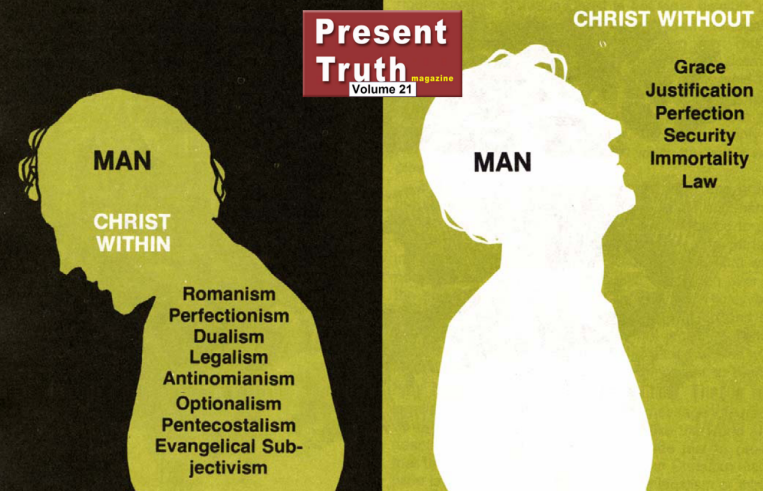
Therefore, the gospel was the measure of all truth, and all objective truth had to come from outside of us. All change had to come from outside of us as well. Christ does NOT do His work INSIDE of us. All New Calvinist thought begins with this premise. If Christ works within us, this makes us colaborers in justification so that we can be found righteous at the judgment. It is also seen as “emptying ourselves” and “dying to self.” It is anti-existentialism on steroids. But not really; as we will see, this objective puritanism leads to a hyper-subjectivism that characterizes New Calvinism.
Element One of COGOUS: Gospel Sanctification
The term “Gospel Sanctification,” was coined by this ministry in 2004 and picked up by others. COGOUS split into two notable theologies in the 80’s: New Covenant Theology and Sonship Theology. Both endured a violent push back among Baptists and Presbyterians to the point of going underground. “Sonship Theology” became “Gospel Transformation.” The movement functioned for ten years without a name; and in fact, experienced astronomical growth during that time. Based on the slogans, “The same gospel that saved you also sanctifies you,” and “We must preach the gospel to ourselves every day,” slogans that show its undisputable kinship to COGOUS, “Gospel Sanctification” became a useful tool for identifying the doctrine. Gospel Sanctification is the subject of “Another Gospel” which was never published. The movement was dubbed, “New Calvinism” in 2008.
Element Two of COGOUS: Gospel Contemplationism
Spiritual contemplationism is certainly nothing new. Spiritual growth via contemplating the works of Christ, and using the Bible to do so can be found among the earliest Adventist theologians, especially Ellen White (according to citations noted by Paxton in The Shaking of Adventism). White was always in the thick of trying to reconcile Adventist perfectionism with grace and law. Sanctification by Gospel Contemplationism has always been an apt companion for doctrines that want to reduce the role of the Christian to the lowest common denominator. Most of these ideas came from European philosophers posing as theologians. Gospel Contemplationism, like Gospel Sanctification, puts feet on the doctrine.
Tenet Two: Redemptive Historical Hermeneutics
Starting with Gabler, this hermeneutic (method of interpretation) makes the Bible a historical narrative about the gospel. Through deeper and deeper knowledge of the gospel, we are “wowed” and “motivated by gratitude.” This makes the Bible a perfect tool for contemplationism rather than instruction and propositional truth. Redemptive Historical hermeneutics, or “Biblical Theology” has its origin in Modernism and neo-orthodox theology. This may seem contradictory to New Calvinism’s supposed stance against existentialism, but this method actually leads to all kinds of subjectivism because a gospel interpretation is forced upon the whole Bible.
Tenet Three: New Covenant Theology
Jon Zens coined the phrase “New Covenant Theology” in 1981. Brinsmead and Zens worked together closely on how law and covenants relate to COGOUS. New Calvinists usually stay aloof from any association to NCT because of its direct link to Zens and the Forum. Though New Calvinists are not shy about playing the “all truth is God’s truth” card, they would rather not have to explain how their doctrine was contrived by a Seventh-day Adventist who is now purported to be an atheist. DA Carson is a good example of a New Calvinists that gives hefty support to NCT while pretending to be merely sympathetic to some of its tenets. Founders Ministries, a SBC organization founded in the early 80’s for the sole purpose of taking over the convention via COGOUS (and falsely associating the doctrine with a well-known Southern Baptist theologian), even claims to be anti-NCT. Founders Ministries has also been challenged to explain their claim that they published “In Defense of the Decalogue” which is a treatise against NCT.
Tenet Four: Heart Theology
This theology was developed through David Powlison’s Dynamics of Biblical Change which forms the basis of counseling curriculum at Westminster Seminary. The doctrine is based on Sonship Theology—Powlison specifically stated that as fact while giving a presentation at John Piper’s church. Powlison also stated that Gospel Sanctification (not the exact terminology he used) was the primary difference between his counseling philosophy and that of Jay Adams. In other words—a fundamental difference in how they interpret the gospel. See chapter 9 of “The Truth About New Calvinism.” How People Change, written by Paul David Tripp (an understudy of Powlison), is a treatise on Powlison’s Dynamics of Biblical Change, and practically a word for word recital of COGOUS.
In the tradition of New Calvinism’s takeover mentality, CCEF now controls almost all of the major counseling organizations, and the Biblical Counseling Coalition was recently organized to aid in that purpose.
Tenet Five: Christian Hedonism
This was concocted by John Piper in the 80’s as an important addition to COGOUS. Though Piper avoids any connections to the Forum like the Bubonic Plague, he showed his hand and specific allegiance to COGOUS when he wrote an article on a series of lectures that Graeme Goldsworthy did at Southern Seminary. See chapter 4 of The Truth About New Calvinism.
Before Piper attended Fuller Seminary, which advocated neo-orthodoxy during the time he attended there (they even hosted appearances by Karl Barth, the contemporary father of neo-orthodoxy), he majored in philosophical literature. Immediately upon graduating from Fuller in 1971, he went to Germany to study under modernist/neo-orthodox theologians. Piper’s theological upbringing is extremely suspect and warrants surprise in regard to his present popularity in Christian circles.
After jumping on the Brinsmead bandwagon, he saw a deficiency in COGOUS. It is best explained by somebody who witnessed the unfolding of the Awakening movement firsthand:
Our righteousness is in heaven, said Brinsmead:
The righteousness by which we become just in God’s sight, remain just in His sight and will one day be sealed as forever just in His sight, is an outside righteousness. It is not on earth, but only in heaven…only in Jesus Christ.”
True sanctification looks away from self and flows from the finished, objective work of Christ…. For many Christians, the glory of the crucified Christ is not their focus; instead they seek internal experiences that eclipse the cross. The Awakening rightly opposed the subjective, human-centered emphasis found among some groups within Christianity. Wrongly, they reacted with a cerebral, spiritless gospel. Brinsmead strongly opposed the Charismatic movement’s emphasis on experiences as a return to the theology of Rome.
However, going to another extreme, Present Truth magazine decried “the false gospel of the new birth,” and offered a new birth that was merely a corporate, objective blessing, not an individual experience.
John Piper to the Rescue
COGOUS was in danger of instigating the same kind of response that prompted existentialism: a pushback regarding indifference to the human experience. COGOUS supplied a theological frame that supposedly demolished the root of all false doctrine, but still didn’t deal with the human experience angle. This would explain why Piper is such a hero in this movement—he probably saved it. Christian Hedonism strongly emphasizes how COGOUS is experience (joy) while staying true to its strong emphasis on monergism. And, joy is a result of what we contemplate, not anything we do.
Conclusion
COGOUS is the doctrine/backbone of New Calvinism; Biblical Theology (RHH) is its hermeneutic; New Covenant Theology articulates COGOUS’s relationship to law and gospel; Heart Theology is its practical application (as far as that goes); and Christian Hedonism is how COGOUS is experienced. It’s the complete package. It is the first complete theological system for let go and let God theology ever devised in church history. It is powerful, and is a latter-day antinomian blitzkrieg of biblical proportions.
But the gigs up. Few Christians will buy into the idea that God used Robert Brinsmead to rediscover the lost Reformation doctrine. Trust me, it was never lost to begin with. I will conclude with a statement by John H. Armstrong that describes the New Calvinist motif, and a Piper video that contains subtle illusions to what they believe:
The sixteenth-century rediscovery of Paul’s objective message of justification by faith [and sanctification also because justification is supposedly progressive] came upon the religious scene of that time with a force and passion that totally altered the course of human history. It ignited the greatest reformation and revival known since Pentecost.
Now, if the Fathers of the early church, so nearly removed in time from Paul, lost touch with the Pauline message, how much more is this true in succeeding generations? The powerful truth of righteousness by faith needs to be restated plainly, and understood clearly, by every new generation.
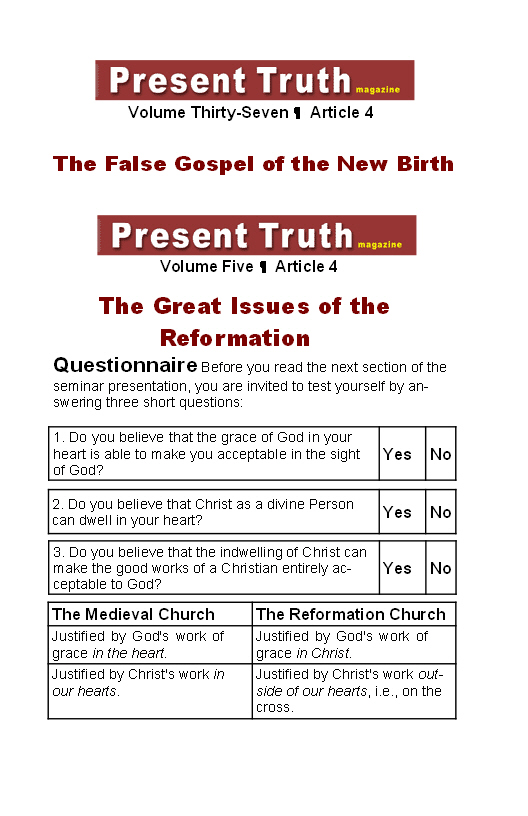
In our time we are awash in a “Sea of Subjectivism,” as one magazine put it over twenty years ago. Let me explain. In 1972 a publication known as Present Truth published the results of a survey with a five-point questionnaire which dealt with the most basic issues between the medieval church and the Reformation. Polling showed 95 per cent of the “Jesus People” were decidedly medieval and anti-Reformation in their doctrinal thinking about the gospel. Among church-going Protestants they found ratings nearly as high.
A visual illustration of the issue Armstrong is talking about follows:
And here is the Piper video:
New Calvinism is Totally Debunked by 2Peter 1:1-15
2 Peter 1:1-14 contradicts almost all of the major tenets of New Calvinism: Christocentric salvation; Christocentric interpretation; double imputation; Christocentric sanctification; the total depravity of the saints; sanctification by faith alone; the imperative command is grounded in the indicative event; assurance based on gospel contemplationism; sanctification is not “in our OWN efforts”; the apostolic gospel.
Christocentric Salvation
Simeon Peter, a servant and apostle of Jesus Christ, to those who have obtained a faith of equal standing with ours by the righteousness of our God and Savior Jesus Christ (v1).
Salvation is not Christocentric. Peter states that we obtained our faith by God the Father AND Jesus Christ.
Christocentric Interpretation
May grace and peace be multiplied to you in the knowledge of God and of Jesus our Lord (v2).
The benefits of salvation are multiplied by the knowledge of both the Father and the Son. Of course, this knowledge can only come from the Scriptures. Obviously, knowledge of both is required for the multiplication of grace and peace. One may also note that when Peter restates this truth in verse 3, he only mentions the one “who called us” which of course is God the Father.
Double Imputation
“The imputed righteousness of Christ” is an often heard slogan among New Calvinists. But it is the righteousness of God that was imputed to us by believing in Christ (see v1). God’s imputed righteousness is sufficient—Christ lived a perfect life as a man because of who He is, not for the purpose of imputing obedience to us as part of the atonement in sanctification.
Christocentric Sanctification
His divine power has granted to us all things that pertain to life and godliness, through the knowledge of him who called us to his own glory and excellence (v3).
Again, God the Father is the member of the Trinity who called us. Knowledge pertaining to the Father is efficacious in sanctification.
The Total Depravity of the Saints
His divine power has granted to us all things that pertain to life and godliness, through the knowledge of him who called us to his own glory and excellence, 4 by which he has granted to us his precious and very great promises, so that through them you may become partakers of the divine nature, having escaped from the corruption that is in the world because of sinful desire (v3,4).
“Partakers” is: koinōnos from koinos; a sharer, that is, associate: – companion, fellowship, partaker, partner. Koinos means: common, that is, (literally) shared by all or several and is derived from a primary preposition denoting union; with or together, that is, by association, companionship, process, resemblance, possession, instrumentality, addition, etc.: – beside, with. In compounds it has similar applications, including completeness.
Sanctification by Faith Alone
For this very reason, make every effort to add to your faith goodness; and to goodness, knowledge; 6 and to knowledge, self-control; and to self-control, perseverance; and to perseverance, godliness; 7 and to godliness, brotherly kindness; and to brotherly kindness, love (v 5,6,7).
Obviously, if sanctification is by faith alone, Peter wouldn’t tell us to ADD anything to it.
The Imperative Command is Grounded in the Indicative Event
For if you possess these qualities in increasing measure, they will keep you from being ineffective and unproductive in your knowledge of our Lord Jesus Christ. 9 But if anyone does not have them, he is nearsighted and blind, and has forgotten that he has been cleansed from his past sins. 10 Therefore, my brothers, be all the more eager to make your calling and election sure. For if you do these things, you will never fall, 11 and you will receive a rich welcome into the eternal kingdom of our Lord and Savior Jesus Christ (v8,9,10,11).
Glorification (and one could argue assurance as well) is an indicative act, but in these verses, it is contingent and preceded by imperatives. Peter uses the conjunction “if” three times to conjoin imperatives preceding the indicative.
Assurance Based on Gospel Contemplationism
One of the more hideous teachings of New Calvinism is that guilt is indicative of not understanding grace. Therefore, saints will not be told to take biblically prescribed action to relieve guilt, but will be told to further contemplate the gospel. There is barely anything more powerful in the Christian life than full assurance of salvation and Peter tells us in no uncertain terms how to obtain it: aggressively adding certain things to our faith.
Sanctification is not “in our OWN efforts.”
New Calvinism, by default, disavows our effort in sanctification by continually utilizing the either/or hermeneutic: it’s either all our effort, or all of Christ. Though we can do nothing without Christ, Peter makes it clear that peace and assurance will not take place if we do not “make every effort” (ESV).
The Apostolic Gospel
So I will always remind you of these things, even though you know them and are firmly established in the truth you now have. 13 I think it is right to refresh your memory as long as I live in the tent of this body, 14 because I know that I will soon put it aside, as our Lord Jesus Christ has made clear to me. 15 And I will make every effort to see that after my departure you will always be able to remember these things (v12,13,14,15).
Think about it. It had been revealed to Peter that his departure was near, so his ministry was focused on what he thought was the most important thing that they needed to be continually reminded of. Where is, “The same gospel that saves us sanctifies us”? Where is, “We must preach the gospel to ourselves every day”? Where is, “Beholding the face of Christ as a way of becoming”?
paul

 Paul's Passing Thoughts
12 comments